


DOSING IN CHILDRENS
Dr. Ramesh Bhandari
Asst. Professor
Department of Pharmacy Practice
KLE College of Pharmacy, Belagavi
Dr.RameshBhandari
Asst.Profesor
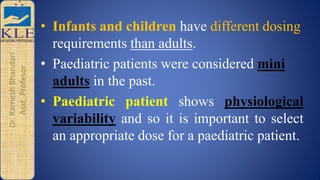
• Infants and children have different dosing
requirements than adults.
• Paediatric patients were considered mini
adults in the past.
• Paediatric patient shows physiological
variability and so it is important to select
an appropriate dose for a paediatric patient.
Dr.RameshBhandari
Asst.Profesor
• The development of organs continue until
the age of 12 years.
• The variation in body composition and
the maturity of liver, kidney, and other
organ functions are potential sources of
differences in pharmacokinetics with
respect to age.
Dr.RameshBhandari
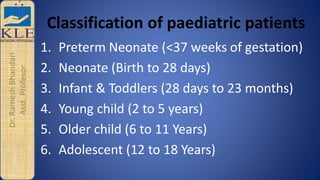
Asst.Profesor Classification of paediatric patients
1. Preterm Neonate (<37 weeks of gestation)
2. Neonate (Birth to 28 days)
3. Infant & Toddlers (28 days to 23 months)
4. Young child (2 to 5 years)
5. Older child (6 to 11 Years)
6. Adolescent (12 to 18 Years)
Dr.RameshBhandari
Asst.Profesor
• When dosage guidelines are not available
for a drug, empirical dose adjustment
methods are often used.
• These empirical dose adjustment methods
are based on body surface area or body
weight.
• However, pharmacokinetic parameters may
vary as a function of age.
Dr.RameshBhandari
Asst.Profesor • Dosage based on body surface area has the
advantage of avoiding some bias due to
obesity or unusual body weight, because the
height and the weight of the patient are both
considered.
• The body surface area method gives only a
rough estimation of the proper dose, because
the pharmacokinetic differences between
patients of the same body surface area are not
considered.
Dr.RameshBhandari
Asst.Profesor
• Dosage regimens for the newborn, infant,
and child must consider the changing
physiologic development of the patient
and the pharmacokinetics of the specific
drug for that age group.
Dr.RameshBhandari
Asst.Profesor ABSORPTION
 Gastric pH is 6-8 at birth, but drops to pH 1–3
within 24 hours of birth
 Gastric acid secretion then declines (Achlorhydria)
during 8–30 days, and does not approach adult
values until approximately 3 years of age
 This lower level of gastric acid secretion contributes
to the increased bioavailability of acid-labile drugs
in neonates compared to older children and adults
(E.g.: Penicillin G, Ampicillin)
Dr.RameshBhandari
Asst.Profesor
 Gastric emptying is delayed (upto 6 – 8 hours) and
irregular in the neonate and infant, but approaches adult
values by 6–8 months of age.
 Intestinal motility (peristalsis) is also irregular,
unpredictable and only partially dependent on feeding
patterns in newborn until 1 year.
 In newborns, decreased GI motility can delay drug
absorption and result in lower peak plasma drug
concentrations, but does not alter the fraction of drug
absorbed for most drugs.
 In older infants and children, GI transit time may be
increased.
Dr.RameshBhandari
Asst.Profesor
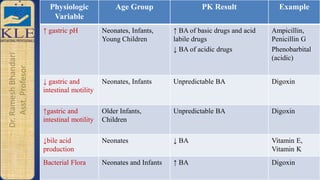
Physiologic
Variable
Age Group PK Result Example
↑ gastric pH Neonates, Infants,
Young Children
↑ BA of basic drugs and acid
labile drugs
↓ BA of acidic drugs
Ampicillin,
Penicillin G
Phenobarbital
(acidic)
↓ gastric and
intestinal motility
Neonates, Infants Unpredictable BA Digoxin
↑gastric and
intestinal motility
Older Infants,
Children
Unpredictable BA Digoxin
↓bile acid
production
Neonates ↓ BA Vitamin E,
Vitamin K
Bacterial Flora Neonates and Infants ↑ BA Digoxin
Dr.RameshBhandari
Asst.Profesor Drug Absorption in Paediatric patients
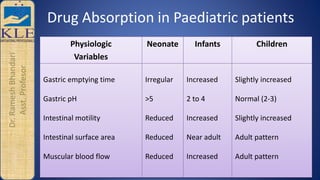
Physiologic
Variables
Neonate Infants Children
Gastric emptying time
Gastric pH
Intestinal motility
Intestinal surface area
Muscular blood flow
Irregular
>5
Reduced
Reduced
Reduced
Increased
2 to 4
Increased
Near adult
Increased
Slightly increased
Normal (2-3)
Slightly increased
Adult pattern
Adult pattern
Dr.RameshBhandari
Asst.Profesor
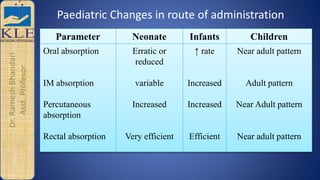
Paediatric Changes in route of administration
Parameter Neonate Infants Children
Oral absorption
IM absorption
Percutaneous
absorption
Rectal absorption
Erratic or
reduced
variable
Increased
Very efficient
↑ rate
Increased
Increased
Efficient
Near adult pattern
Adult pattern
Near Adult pattern
Near adult pattern
Dr.RameshBhandari
Asst.Profesor Examples
Gastrointestinal Drug Absorption
Increased in
Newborns
Infants = adults Decreased in
newborns
Penicillin Theophylline Phenytoin
Ampicillin Sulfonamides Acetaminophen
Erythromycin Phenobarbitol
Digoxin
Zidovudine
Dr.RameshBhandari
Asst.Profesor DISTRIBUTION
• Some of the factors that determine drug
distribution within the body are subject to
change with age.
• These includes vascular perfusion, body
composition, tissue binding characteristics
and the extent of plasma protein binding.
Dr.RameshBhandari
Asst.Profesor
Extracellular fluid volume and total body water as a percentage of
body weight at different life stages
Age Total body water (%) Extracellular fluid (%)
Preterm Neonates 85 50
Term Neonate 75 45
3 Months 75 30
1 year 60 25
Adult 60 20
Dr.RameshBhandari
Asst.Profesor
Plasma protein binding and drug distribution
Parameters Neonate Infants Children
Plasma Albumin and
total Globulin
Decreased Approx. Normal Approx adult
Total protein Decreased Decreased Approx adult
Adipose Tissue Less Decreased Reduced
Total Body water Increased Increased Approx adult
Extracellular water Increased Increased Approx adult
Hydrophilic drugs Vd Increased Increased Slightly increased
Hydrophobic drugs Vd Decreased Decreased Slightly decreased
Dr.RameshBhandari
Asst.Profesor
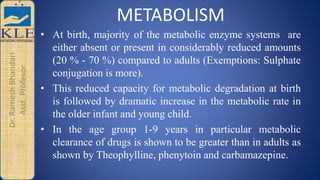
METABOLISM
• At birth, majority of the metabolic enzyme systems are
either absent or present in considerably reduced amounts
(20 % - 70 %) compared to adults (Exemptions: Sulphate
conjugation is more).
• This reduced capacity for metabolic degradation at birth
is followed by dramatic increase in the metabolic rate in
the older infant and young child.
• In the age group 1-9 years in particular metabolic
clearance of drugs is shown to be greater than in adults as
shown by Theophylline, phenytoin and carbamazepine.
Dr.RameshBhandari
Asst.Profesor
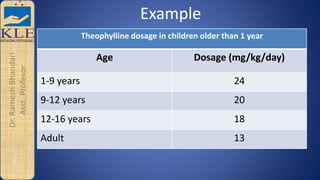
Example
Theophylline dosage in children older than 1 year
Age Dosage (mg/kg/day)
1-9 years 24
9-12 years 20
12-16 years 18
Adult 13
Dr.RameshBhandari
Asst.Profesor • Glucuronidation is very less. Therefore
chloramphenicol is not bound extensively
and so poor elimination results in
accumulation of chloramphenicol that
leads to Gray baby syndrome.
• Drugs that are extensively metabolized by
liver should be administered cautiously
like caffeine, lidocaine, chloramphenicol.
Dr.RameshBhandari
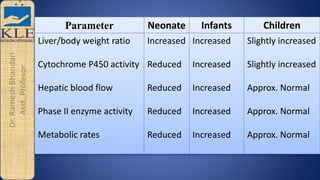
Asst.Profesor Parameter Neonate Infants Children
Liver/body weight ratio
Cytochrome P450 activity
Hepatic blood flow
Phase II enzyme activity
Metabolic rates
Increased
Reduced
Reduced
Reduced
Reduced
Increased
Increased
Increased
Increased
Increased
Slightly increased
Slightly increased
Approx. Normal
Approx. Normal
Approx. Normal
Dr.RameshBhandari
Asst.Profesor EXCRETION
• The anatomical and functional immaturity of
the kidneys at birth limits the renal excretory
capacity.
• Younger than 3-6 months, the GFR rate is
lower than that of adults.
• Generally the complete maturation of
glomerular and tubular function is reached
after only towards 12-18 months of age.
Dr.RameshBhandari
Asst.Profesor Renal Clearance of Gentamicin
Plasma Half life
(in hours)
Small premature infants weighing less than 1.5
kg
11.5
Small premature infants weighing 1.5-2 kg 8
Term infants and large premature infants less
than1 week of age
5.5
Infants 1 week to months 3-3.5
Infants more than months to adulthood 2-3
Dr.RameshBhandari
Asst.Profesor Therapeutic Problem in childrens
Sampling blood is difficult.
Alternative source to be considered like
urine or saliva.
While selecting dosage form oral dosage
forms are more preferred than intravenous.
Dr.RameshBhandari
Asst.Profesor
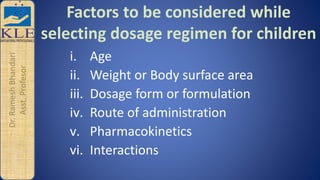
Factors to be considered while
selecting dosage regimen for children
i. Age
ii. Weight or Body surface area
iii. Dosage form or formulation
iv. Route of administration
v. Pharmacokinetics
vi. Interactions
Dr.RameshBhandari
Asst.Profesor
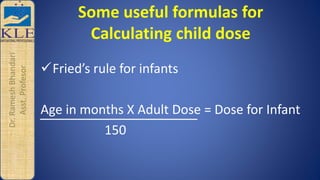
Some useful formulas for
Calculating child dose
Fried’s rule for infants
Age in months X Adult Dose = Dose for Infant
150
Dr.RameshBhandari
Asst.Profesor
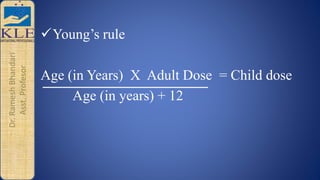
Young’s rule
Age (in Years) X Adult Dose = Child dose
Age (in years) + 12
Dr.RameshBhandari
Asst.Profesor
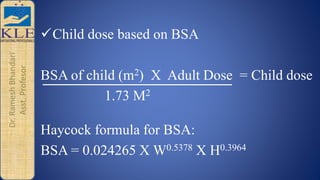
Child dose based on BSA
BSA of child (m2) X Adult Dose = Child dose
1.73 M2
Haycock formula for BSA:
BSA = 0.024265 X W0.5378 X H0.3964
Dr.RameshBhandari
Asst.Profesor
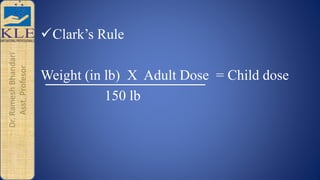
Clark’s Rule
Weight (in lb) X Adult Dose = Child dose
150 lb
Dr.RameshBhandari
Asst.Profesor Practice Problem
The elimination half-life of penicillin G is
0.5 hour in adults and 3.2 hours in
neonates (0–7 days old). Assuming that the
normal adult dose of penicillin G is
4 mg/kg every 4 hours, calculate the dose
of penicillin G for an 11-lb infant.
Dr.RameshBhandari
Asst.Profesor

Dosing in childrens

  • 1.
    DOSING IN CHILDRENS Dr.Ramesh Bhandari Asst. Professor Department of Pharmacy Practice KLE College of Pharmacy, Belagavi
  • 2.
    Dr.RameshBhandari Asst.Profesor • Infants andchildren have different dosing requirements than adults. • Paediatric patients were considered mini adults in the past. • Paediatric patient shows physiological variability and so it is important to select an appropriate dose for a paediatric patient.
  • 3.
    Dr.RameshBhandari Asst.Profesor • The developmentof organs continue until the age of 12 years. • The variation in body composition and the maturity of liver, kidney, and other organ functions are potential sources of differences in pharmacokinetics with respect to age.
  • 4.
    Dr.RameshBhandari Asst.Profesor Classification ofpaediatric patients 1. Preterm Neonate (<37 weeks of gestation) 2. Neonate (Birth to 28 days) 3. Infant & Toddlers (28 days to 23 months) 4. Young child (2 to 5 years) 5. Older child (6 to 11 Years) 6. Adolescent (12 to 18 Years)
  • 5.
    Dr.RameshBhandari Asst.Profesor • When dosageguidelines are not available for a drug, empirical dose adjustment methods are often used. • These empirical dose adjustment methods are based on body surface area or body weight. • However, pharmacokinetic parameters may vary as a function of age.
  • 6.
    Dr.RameshBhandari Asst.Profesor • Dosagebased on body surface area has the advantage of avoiding some bias due to obesity or unusual body weight, because the height and the weight of the patient are both considered. • The body surface area method gives only a rough estimation of the proper dose, because the pharmacokinetic differences between patients of the same body surface area are not considered.
  • 7.
    Dr.RameshBhandari Asst.Profesor • Dosage regimensfor the newborn, infant, and child must consider the changing physiologic development of the patient and the pharmacokinetics of the specific drug for that age group.
  • 8.
    Dr.RameshBhandari Asst.Profesor ABSORPTION  GastricpH is 6-8 at birth, but drops to pH 1–3 within 24 hours of birth  Gastric acid secretion then declines (Achlorhydria) during 8–30 days, and does not approach adult values until approximately 3 years of age  This lower level of gastric acid secretion contributes to the increased bioavailability of acid-labile drugs in neonates compared to older children and adults (E.g.: Penicillin G, Ampicillin)
  • 9.
    Dr.RameshBhandari Asst.Profesor  Gastric emptyingis delayed (upto 6 – 8 hours) and irregular in the neonate and infant, but approaches adult values by 6–8 months of age.  Intestinal motility (peristalsis) is also irregular, unpredictable and only partially dependent on feeding patterns in newborn until 1 year.  In newborns, decreased GI motility can delay drug absorption and result in lower peak plasma drug concentrations, but does not alter the fraction of drug absorbed for most drugs.  In older infants and children, GI transit time may be increased.
  • 10.
    Dr.RameshBhandari Asst.Profesor Physiologic Variable Age Group PKResult Example ↑ gastric pH Neonates, Infants, Young Children ↑ BA of basic drugs and acid labile drugs ↓ BA of acidic drugs Ampicillin, Penicillin G Phenobarbital (acidic) ↓ gastric and intestinal motility Neonates, Infants Unpredictable BA Digoxin ↑gastric and intestinal motility Older Infants, Children Unpredictable BA Digoxin ↓bile acid production Neonates ↓ BA Vitamin E, Vitamin K Bacterial Flora Neonates and Infants ↑ BA Digoxin
  • 11.
    Dr.RameshBhandari Asst.Profesor Drug Absorptionin Paediatric patients Physiologic Variables Neonate Infants Children Gastric emptying time Gastric pH Intestinal motility Intestinal surface area Muscular blood flow Irregular >5 Reduced Reduced Reduced Increased 2 to 4 Increased Near adult Increased Slightly increased Normal (2-3) Slightly increased Adult pattern Adult pattern
  • 12.
    Dr.RameshBhandari Asst.Profesor Paediatric Changes inroute of administration Parameter Neonate Infants Children Oral absorption IM absorption Percutaneous absorption Rectal absorption Erratic or reduced variable Increased Very efficient ↑ rate Increased Increased Efficient Near adult pattern Adult pattern Near Adult pattern Near adult pattern
  • 13.
    Dr.RameshBhandari Asst.Profesor Examples Gastrointestinal DrugAbsorption Increased in Newborns Infants = adults Decreased in newborns Penicillin Theophylline Phenytoin Ampicillin Sulfonamides Acetaminophen Erythromycin Phenobarbitol Digoxin Zidovudine
  • 14.
    Dr.RameshBhandari Asst.Profesor DISTRIBUTION • Someof the factors that determine drug distribution within the body are subject to change with age. • These includes vascular perfusion, body composition, tissue binding characteristics and the extent of plasma protein binding.
  • 15.
    Dr.RameshBhandari Asst.Profesor Extracellular fluid volumeand total body water as a percentage of body weight at different life stages Age Total body water (%) Extracellular fluid (%) Preterm Neonates 85 50 Term Neonate 75 45 3 Months 75 30 1 year 60 25 Adult 60 20
  • 16.
    Dr.RameshBhandari Asst.Profesor Plasma protein bindingand drug distribution Parameters Neonate Infants Children Plasma Albumin and total Globulin Decreased Approx. Normal Approx adult Total protein Decreased Decreased Approx adult Adipose Tissue Less Decreased Reduced Total Body water Increased Increased Approx adult Extracellular water Increased Increased Approx adult Hydrophilic drugs Vd Increased Increased Slightly increased Hydrophobic drugs Vd Decreased Decreased Slightly decreased
  • 17.
    Dr.RameshBhandari Asst.Profesor METABOLISM • At birth,majority of the metabolic enzyme systems are either absent or present in considerably reduced amounts (20 % - 70 %) compared to adults (Exemptions: Sulphate conjugation is more). • This reduced capacity for metabolic degradation at birth is followed by dramatic increase in the metabolic rate in the older infant and young child. • In the age group 1-9 years in particular metabolic clearance of drugs is shown to be greater than in adults as shown by Theophylline, phenytoin and carbamazepine.
  • 18.
    Dr.RameshBhandari Asst.Profesor Example Theophylline dosage inchildren older than 1 year Age Dosage (mg/kg/day) 1-9 years 24 9-12 years 20 12-16 years 18 Adult 13
  • 19.
    Dr.RameshBhandari Asst.Profesor • Glucuronidationis very less. Therefore chloramphenicol is not bound extensively and so poor elimination results in accumulation of chloramphenicol that leads to Gray baby syndrome. • Drugs that are extensively metabolized by liver should be administered cautiously like caffeine, lidocaine, chloramphenicol.
  • 20.
    Dr.RameshBhandari Asst.Profesor Parameter NeonateInfants Children Liver/body weight ratio Cytochrome P450 activity Hepatic blood flow Phase II enzyme activity Metabolic rates Increased Reduced Reduced Reduced Reduced Increased Increased Increased Increased Increased Slightly increased Slightly increased Approx. Normal Approx. Normal Approx. Normal
  • 21.
    Dr.RameshBhandari Asst.Profesor EXCRETION • Theanatomical and functional immaturity of the kidneys at birth limits the renal excretory capacity. • Younger than 3-6 months, the GFR rate is lower than that of adults. • Generally the complete maturation of glomerular and tubular function is reached after only towards 12-18 months of age.
  • 22.
    Dr.RameshBhandari Asst.Profesor Renal Clearanceof Gentamicin Plasma Half life (in hours) Small premature infants weighing less than 1.5 kg 11.5 Small premature infants weighing 1.5-2 kg 8 Term infants and large premature infants less than1 week of age 5.5 Infants 1 week to months 3-3.5 Infants more than months to adulthood 2-3
  • 23.
    Dr.RameshBhandari Asst.Profesor Therapeutic Problemin childrens Sampling blood is difficult. Alternative source to be considered like urine or saliva. While selecting dosage form oral dosage forms are more preferred than intravenous.
  • 24.
    Dr.RameshBhandari Asst.Profesor Factors to beconsidered while selecting dosage regimen for children i. Age ii. Weight or Body surface area iii. Dosage form or formulation iv. Route of administration v. Pharmacokinetics vi. Interactions
  • 25.
    Dr.RameshBhandari Asst.Profesor Some useful formulasfor Calculating child dose Fried’s rule for infants Age in months X Adult Dose = Dose for Infant 150
  • 26.
    Dr.RameshBhandari Asst.Profesor Young’s rule Age (inYears) X Adult Dose = Child dose Age (in years) + 12
  • 27.
    Dr.RameshBhandari Asst.Profesor Child dose basedon BSA BSA of child (m2) X Adult Dose = Child dose 1.73 M2 Haycock formula for BSA: BSA = 0.024265 X W0.5378 X H0.3964
  • 28.
  • 29.
    Dr.RameshBhandari Asst.Profesor Practice Problem Theelimination half-life of penicillin G is 0.5 hour in adults and 3.2 hours in neonates (0–7 days old). Assuming that the normal adult dose of penicillin G is 4 mg/kg every 4 hours, calculate the dose of penicillin G for an 11-lb infant.
  • 30.