Pediatrics
Pharmaco-Kinetics
Ahmad K. Al-Jalehawi
MSc Clinical pharmacy
Al-Kafeel university
The lack of paediatric clinical trials and dosing information has
been highlighted by the US Food and Drug Administration (FDA)
and the European Medicines Agency (EMA) as areas of clinical
need, and there is now a requirement for more paediatric data in
the evaluation of new drugs.
In the absence of data, the use of many drugs in children,
especially neonates, is often off label.
The off-label use of drugs is associated with an increased risk of
adverse effects, particularly in patients under the age of two years.
children are
not small adults
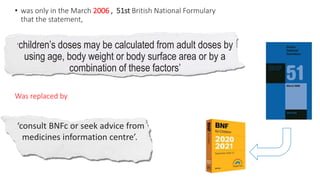
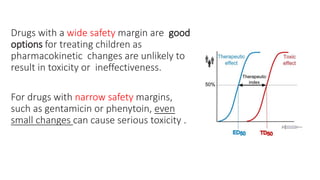
• was only in the March 2006 , 51st British National Formulary
that the statement,
‘children’s doses may be calculated from adult doses by
using age, body weight or body surface area or by a
combination of these factors’
Was replaced by
‘consult BNFc or seek advice from
medicines information centre’.
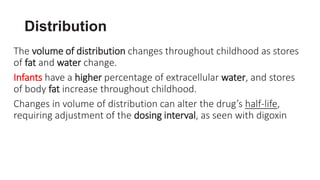
Drugs with a wide safety margin are good
options for treating children as
pharmacokinetic changes are unlikely to
result in toxicity or ineffectiveness.
For drugs with narrow safety margins,
such as gentamicin or phenytoin, even
small changes can cause serious toxicity .
Dosing
• Dosing information is difficult to determine in children as traditional
pharmacokinetic studies are hard to conduct in children and are subject
to a greater range of ethical considerations.
• These studies require large amounts of blood to be taken over periods of
time and this is not considered ethical in children
• Weight-based and surface-area-based dosing regimens are simple and
are used in most clinical situations. However, with the lack of specific
paediatric data, these dosing equations are often based on adult data
and then scaled based on size and age as an approximation for drug
activity in children.
•Paediatric growth and development is not a linear process.
•When prescribing for children it is appropriate to
use a paediatric reference source. Use a reputable
dosing reference
•The recommended dose may not be the optimum
dose for some children. It may then be necessary to
adjust the dose according to the clinical response.
•NOTE : Doses can be rounded to ensure they are
able to be measured by parents and healthcare
providers accurately
Absorption
• The composition of intestinal fluids and the permeability of the gut
vary during childhood.
• Absorption of orally administered drugs is affected by changes in
gastric pH which decreases during infancy to reach adult values by
two years of age.
• Infants are at higher risk of toxicity via skin absorption due to a
larger surface area to volume ratio and they also absorb more of a
drug across skin due to their thinner stratum corneum.
• This explains why infants have an increased risk of
methaemoglobinaemia with topical anaesthetics
Variation of Iron absorption in relation to Age
Distribution
The volume of distribution changes throughout childhood as stores
of fat and water change.
Infants have a higher percentage of extracellular water, and stores
of body fat increase throughout childhood.
Changes in volume of distribution can alter the drug’s half-life,
requiring adjustment of the dosing interval, as seen with digoxin
• Hydrophilic drugs also have larger volumes of distribution in
preschool children as extracellular water decreases
during development, from 70% total body weight in newborns to
61.2% in 1-year-old infants .
• As a consequence of higher volumes of distribution of water
soluble drugs in infants, for example gentamicin . higher doses per
kilogram bodyweight must be given to infants compared with
adults to achieve comparable plasma and tissue concentration
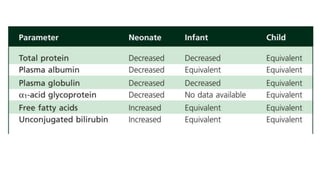
• In newborns, total plasma protein concentrations are 86% of adult values.
• Examples of drugs where lower protein binding has been documented in newborn
babies include phenytoin, salicylates, ampicillin, nafcillin, sulfisoxazole and
sulfamethoxyphrazine .
• Consequently, greater free fractions of these drugs are circulating and thus are able to
penetrate various tissue compartments, yielding higher distribution volumes.
• In general terms, one can assume that the influence of protein binding on free plasma
drug concentrations is limited to drugs which have a high degree of protein
binding ( >95% ).
• As protein levels reach adult values in infancy this effect is likely to be most pronounced
in newborn babies and infants.
Protein Binding
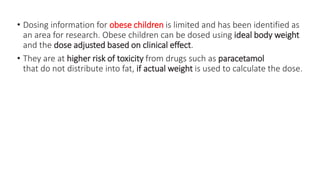
• Dosing information for obese children is limited and has been identified as
an area for research. Obese children can be dosed using ideal body weight
and the dose adjusted based on clinical effect.
• They are at higher risk of toxicity from drugs such as paracetamol
that do not distribute into fat, if actual weight is used to calculate the dose.
Metabolism
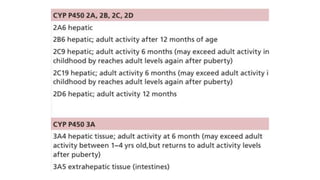
• Cytochrome P450 (CYP) enzymes are active in the fetus.
• Enzyme activity begins to increase during the later stages of pregnancy with different rates
of individual enzyme development seen in infants who are born preterm.
• most enzymes increase in activity over the first few months of life, some such as CYP3A7
are replaced by other enzymes, in this case CYP3A4.
• The development of metabolic processes, such as glucuronidation, is less clear, but
is thought to take at least three years to achieve full activity.
• Liver blood flow may be relatively high in infants. This could affect first-pass metabolism
particularly for drugs with a high extraction ratio, like propranolol
Elimination
• Excretion is an important step in the final removal of the drug and
any metabolites from the body. It relies on effective renal and hepatic
function that develop over time.
• Preterm neonates develop renal excretion pathways more slowly than
term neonates.
• Glomerular filtration rates (GFR) reach adult levels by about
two years of age.
• Urinary pH value can influence the reabsorption of weak acids or bases
which, in turn, will influence the elimination.
• Infant urinary pH is lower than adult values which may increase the
reabsorption of weakly acidic drugs
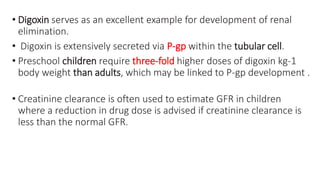
• Digoxin serves as an excellent example for development of renal
elimination.
• Digoxin is extensively secreted via P-gp within the tubular cell.
• Preschool children require three-fold higher doses of digoxin kg-1
body weight than adults, which may be linked to P-gp development .
• Creatinine clearance is often used to estimate GFR in children
where a reduction in drug dose is advised if creatinine clearance is
less than the normal GFR.
References :
Check google for : 
• Ryan S. Funk et al . Pediatric Pharmacokinetics : Human Development and Drug Disposition
• Paediatric pharmacokinetics: key considerations
• Pharmacokinetic considerations when prescribing in children

Paediatric pharmaco-kinetics

  • 1.
    Pediatrics Pharmaco-Kinetics Ahmad K. Al-Jalehawi MScClinical pharmacy Al-Kafeel university
  • 2.
    The lack ofpaediatric clinical trials and dosing information has been highlighted by the US Food and Drug Administration (FDA) and the European Medicines Agency (EMA) as areas of clinical need, and there is now a requirement for more paediatric data in the evaluation of new drugs. In the absence of data, the use of many drugs in children, especially neonates, is often off label. The off-label use of drugs is associated with an increased risk of adverse effects, particularly in patients under the age of two years. children are not small adults
  • 3.
    • was onlyin the March 2006 , 51st British National Formulary that the statement, ‘children’s doses may be calculated from adult doses by using age, body weight or body surface area or by a combination of these factors’ Was replaced by ‘consult BNFc or seek advice from medicines information centre’.
  • 5.
    Drugs with awide safety margin are good options for treating children as pharmacokinetic changes are unlikely to result in toxicity or ineffectiveness. For drugs with narrow safety margins, such as gentamicin or phenytoin, even small changes can cause serious toxicity .
  • 6.
    Dosing • Dosing informationis difficult to determine in children as traditional pharmacokinetic studies are hard to conduct in children and are subject to a greater range of ethical considerations. • These studies require large amounts of blood to be taken over periods of time and this is not considered ethical in children • Weight-based and surface-area-based dosing regimens are simple and are used in most clinical situations. However, with the lack of specific paediatric data, these dosing equations are often based on adult data and then scaled based on size and age as an approximation for drug activity in children.
  • 7.
    •Paediatric growth anddevelopment is not a linear process. •When prescribing for children it is appropriate to use a paediatric reference source. Use a reputable dosing reference •The recommended dose may not be the optimum dose for some children. It may then be necessary to adjust the dose according to the clinical response. •NOTE : Doses can be rounded to ensure they are able to be measured by parents and healthcare providers accurately
  • 9.
    Absorption • The compositionof intestinal fluids and the permeability of the gut vary during childhood. • Absorption of orally administered drugs is affected by changes in gastric pH which decreases during infancy to reach adult values by two years of age. • Infants are at higher risk of toxicity via skin absorption due to a larger surface area to volume ratio and they also absorb more of a drug across skin due to their thinner stratum corneum. • This explains why infants have an increased risk of methaemoglobinaemia with topical anaesthetics
  • 10.
    Variation of Ironabsorption in relation to Age
  • 11.
    Distribution The volume ofdistribution changes throughout childhood as stores of fat and water change. Infants have a higher percentage of extracellular water, and stores of body fat increase throughout childhood. Changes in volume of distribution can alter the drug’s half-life, requiring adjustment of the dosing interval, as seen with digoxin
  • 14.
    • Hydrophilic drugsalso have larger volumes of distribution in preschool children as extracellular water decreases during development, from 70% total body weight in newborns to 61.2% in 1-year-old infants . • As a consequence of higher volumes of distribution of water soluble drugs in infants, for example gentamicin . higher doses per kilogram bodyweight must be given to infants compared with adults to achieve comparable plasma and tissue concentration
  • 16.
    • In newborns,total plasma protein concentrations are 86% of adult values. • Examples of drugs where lower protein binding has been documented in newborn babies include phenytoin, salicylates, ampicillin, nafcillin, sulfisoxazole and sulfamethoxyphrazine . • Consequently, greater free fractions of these drugs are circulating and thus are able to penetrate various tissue compartments, yielding higher distribution volumes. • In general terms, one can assume that the influence of protein binding on free plasma drug concentrations is limited to drugs which have a high degree of protein binding ( >95% ). • As protein levels reach adult values in infancy this effect is likely to be most pronounced in newborn babies and infants. Protein Binding
  • 18.
    • Dosing informationfor obese children is limited and has been identified as an area for research. Obese children can be dosed using ideal body weight and the dose adjusted based on clinical effect. • They are at higher risk of toxicity from drugs such as paracetamol that do not distribute into fat, if actual weight is used to calculate the dose.
  • 19.
    Metabolism • Cytochrome P450(CYP) enzymes are active in the fetus. • Enzyme activity begins to increase during the later stages of pregnancy with different rates of individual enzyme development seen in infants who are born preterm. • most enzymes increase in activity over the first few months of life, some such as CYP3A7 are replaced by other enzymes, in this case CYP3A4. • The development of metabolic processes, such as glucuronidation, is less clear, but is thought to take at least three years to achieve full activity. • Liver blood flow may be relatively high in infants. This could affect first-pass metabolism particularly for drugs with a high extraction ratio, like propranolol
  • 22.
    Elimination • Excretion isan important step in the final removal of the drug and any metabolites from the body. It relies on effective renal and hepatic function that develop over time. • Preterm neonates develop renal excretion pathways more slowly than term neonates. • Glomerular filtration rates (GFR) reach adult levels by about two years of age. • Urinary pH value can influence the reabsorption of weak acids or bases which, in turn, will influence the elimination. • Infant urinary pH is lower than adult values which may increase the reabsorption of weakly acidic drugs
  • 24.
    • Digoxin servesas an excellent example for development of renal elimination. • Digoxin is extensively secreted via P-gp within the tubular cell. • Preschool children require three-fold higher doses of digoxin kg-1 body weight than adults, which may be linked to P-gp development . • Creatinine clearance is often used to estimate GFR in children where a reduction in drug dose is advised if creatinine clearance is less than the normal GFR.
  • 26.
    References : Check googlefor :  • Ryan S. Funk et al . Pediatric Pharmacokinetics : Human Development and Drug Disposition • Paediatric pharmacokinetics: key considerations • Pharmacokinetic considerations when prescribing in children