Psychopharmacology
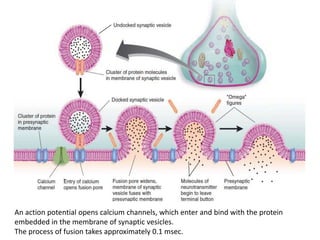
An action potential opens calcium channels, which enter and bind with the protein
embedded in the membrane of synaptic vesicles.
The process of fusion takes approximately 0.1 msec.
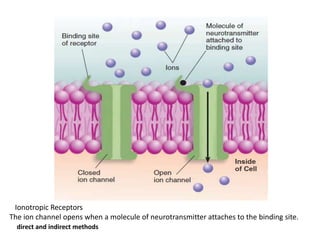
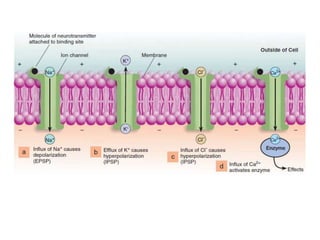
Ionotropic Receptors
The ion channel opens when a molecule of neurotransmitter attaches to the binding site.
direct and indirect methods
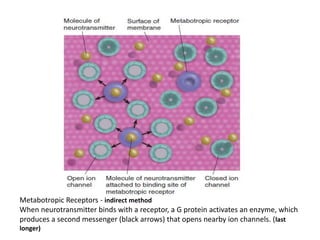
Metabotropic Receptors - indirect method
When neurotransmitter binds with a receptor, a G protein activates an enzyme, which
produces a second messenger (black arrows) that opens nearby ion channels. (last
longer)
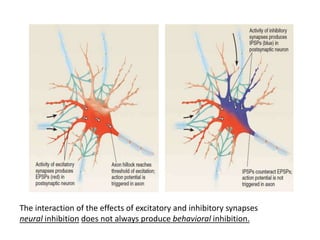
The interaction of the effects of excitatory and inhibitory synapses
neural inhibition does not always produce behavioral inhibition.
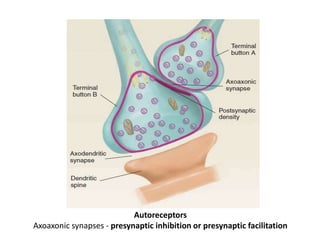
Autoreceptors
Axoaxonic synapses - presynaptic inhibition or presynaptic facilitation
Drug Effectiveness
• Most psychopharmacological drugs exert their
effects by binding at sites of action in the CNS—such
as presynaptic or postsynaptic receptors, transporter
molecules, or by interacting with enzymes involved in
the production or deactivation of neurotransmitters.
• different drugs may have different sites of action
• Drugs vary in their affinity for the molecules to
which they attach
Effects of Repeated Administration
• effects of drug diminish—a phenomenon known as tolerance - is seen in
many commonly abused drugs
• drug becomes more and more effective—a phenomenon known as
sensitization.
• Tolerance is the result of the body’s attempt to compensate for the
effects of the drug.
• When the effects of a drug alter the systems for a prolonged time,
compensatory mechanisms begin to produce the opposite reaction.
• Either the receptors become less sensitive to the drug (that is, their
affinity for the drug decreases), or the receptors decrease in number.
• if individual suddenly stops taking the drug he will suffer from
withdrawal symptoms
• Withdrawal symptoms are primarily the opposite of the effects of the
drug itself. are caused by the same mechanisms that are responsible for
tolerance. when the person stops taking the drug, the compensatory
mechanisms make themselves felt, unopposed by the action of the drug.
Sites of Drug Action
• Effects on Production of Neurotransmitters
• Effects on Storage and Release of Neurotransmitters
• Effects on Receptors
• Effects on Reuptake or Destruction of
Neurotransmitters
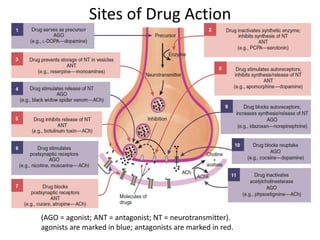
Sites of Drug Action
(AGO = agonist; ANT = antagonist; NT = neurotransmitter).
agonists are marked in blue; antagonists are marked in red.
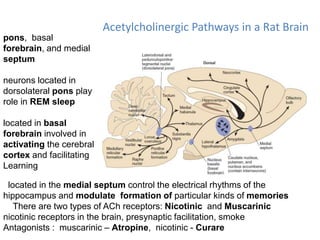
Acetylcholinergic Pathways in a Rat Brain
located in the medial septum control the electrical rhythms of the
hippocampus and modulate formation of particular kinds of memories
There are two types of ACh receptors: Nicotinic and Muscarinic
nicotinic receptors in the brain, presynaptic facilitation, smoke
Antagonists : muscarinic – Atropine, nicotinic - Curare
pons, basal
forebrain, and medial
septum
neurons located in
dorsolateral pons play
role in REM sleep
located in basal
forebrain involved in
activating the cerebral
cortex and facilitating
Learning
The Monoamines
• Dopamine, norepinephrine, epinephrine, serotonin, and
histamine belong to a family of monoamines.
• Because the molecular structures of these substances are
similar, some drugs affect the activity of all of them
• monoamines are produced mostly in brainstem. Axon
terminal buttons distributed throughout many regions of the
brain
• first three— dopamine, norepinephrine, and epinephrine —
belong to a subclass of monoamines called catecholamines
• Catecholamines are derived from the amino acid tyrosine,
which is derived from dietary sources
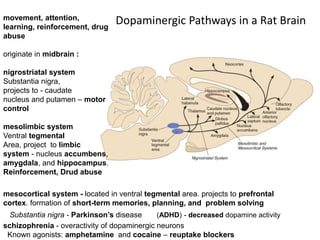
Dopaminergic Pathways in a Rat Brain
mesocortical system - located in ventral tegmental area. projects to prefrontal
cortex. formation of short-term memories, planning, and problem solving
Substantia nigra - Parkinson’s disease (ADHD) - decreased dopamine activity
schizophrenia - overactivity of dopaminergic neurons
Known agonists: amphetamine and cocaine – reuptake blockers
movement, attention,
learning, reinforcement, drug
abuse
originate in midbrain :
nigrostriatal system
Substantia nigra,
projects to - caudate
nucleus and putamen – motor
control
mesolimbic system
Ventral tegmental
Area, project to limbic
system - nucleus accumbens,
amygdala, and hippocampus.
Reinforcement, Drud abuse
• Studies Link Dopamine receptors to such a
behavioral traits as – Risk taking behavior,
impulsiveness and novelty seeking
• Stimulation of D 2 receptor agonism alone is
sufficient for the development of the addictive
syndrome.
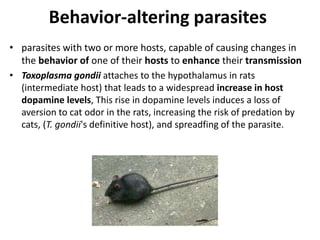
Behavior-altering parasites
• parasites with two or more hosts, capable of causing changes in
the behavior of one of their hosts to enhance their transmission
• Toxoplasma gondii attaches to the hypothalamus in rats
(intermediate host) that leads to a widespread increase in host
dopamine levels, This rise in dopamine levels induces a loss of
aversion to cat odor in the rats, increasing the risk of predation by
cats, (T. gondii's definitive host), and spreadfing of the parasite.
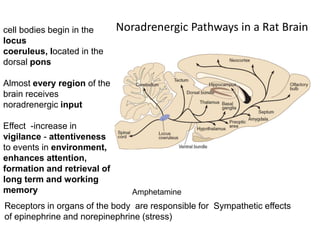
Noradrenergic Pathways in a Rat Brain
Receptors in organs of the body are responsible for Sympathetic effects
of epinephrine and norepinephrine (stress)
cell bodies begin in the
locus
coeruleus, located in the
dorsal pons
Almost every region of the
brain receives
noradrenergic input
Effect -increase in
vigilance - attentiveness
to events in environment,
enhances attention,
formation and retrieval of
long term and working
memory Amphetamine
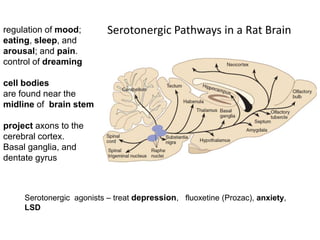
Serotonergic Pathways in a Rat Brain
regulation of mood;
eating, sleep, and
arousal; and pain.
control of dreaming
cell bodies
are found near the
midline of brain stem
project axons to the
cerebral cortex.
Basal ganglia, and
dentate gyrus
Serotonergic agonists – treat depression, fluoxetine (Prozac), anxiety,
LSD
Amino Acids
• three of them are especially important because they are the
most common neurotransmitters in the CNS:
• Glutamate - principal excitatory neurotransmitter in the brain
and spinal cord
• Gamma-aminobutyric acid (GABA) – principal Inhibitory
neurotransmitter in the brain and spinal cord
• Glycine - Inhibitory neurotransmitter in the spinal cord
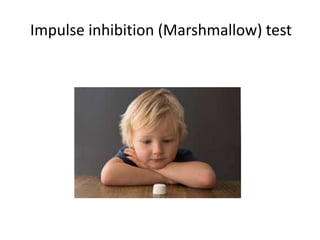
Impulse inhibition (Marshmallow) test
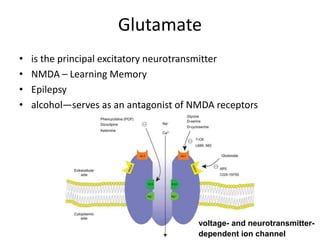
Glutamate
• is the principal excitatory neurotransmitter
• NMDA – Learning Memory
• Epilepsy
• alcohol—serves as an antagonist of NMDA receptors
voltage- and neurotransmitter-
dependent ion channel
GABA
• Inhibitory neurotransmitter
• Epilepsy
• Agonists - reduce anxiety, promote sleep, and
muscle relaxation, reduce seizure activity
• alcohol binds with an as-yet unknown site on
the GABA receptor
Peptides
• Endogenous opioids - enkephalins, dynorphins and endorphin
• motivation, emotion, the response to stress and pain
• the more important of the opiate-like substances are β-
endorphin, met-enkephalin, leu-enkephalin, and dynorphin
• two enkephalins and Dynorphin are found in the brain stem
and spinal cord, in the portions of analgesia system
• β-endorphin is present in hypothalamus and pituitary gland
• brain contain specialized receptors that respond to opiates
(opium, morphine, and heroin)
• analgesia, inhibition of defensive Responses, reinforcement
• Antagonist - naloxone, is used clinically to reverse opiate
intoxication
Lipids
• Endocannabinoids – THC tetrahydrocannabinol, (active
ingredient of marijuana) stimulates cannabinoid receptors in the
frontal cortex, anterior cingulate cortex, basal ganglia,
cerebellum, hypothalamus, and hippocampus
• outside the brain - in cells of the immune system.
• Produces analgesia and sedation, stimulates appetite, reduces
nausea caused by drugs used to treat cancer, relieves asthma
attacks, and reduces the symptoms of certain motor disorders.
• THC interferes with concentration and memory, alters visual and
auditory perception, and distorts perceptions of the passage of
time.
Nucleosides
• One of the Nucleosides, adenosine serves as a neuromodulator in
the brain.
• Adenosine is released by astrocytes when neurons are short of
fuel or oxygen.
• adenosine activates receptors on nearby blood vessels and causes
them to dilate, increasing the flow of blood and bringing of more
of the needed substances
• Adenosine also acts as a
neuromodulator, through action
on adenosine receptors. have
generally inhibitory effects on
behavior
• play an important role in the
control of sleep
Soluble Gases
• nitric oxide (NO) is used as a messenger in many parts of the
body
• is involved in the control of the muscles of the intestines,
dilates blood vessels in metabolically active regions of the
brain
• play a role in the establishment of neural changes produced
by learning.
• NO does not activate membrane-bound receptors but enters
neighboring cells, where it activates the production of a
second messenger - cyclic GMP

PSYCHOPARMACOLOGY presentation by profes

  • 1.
  • 3.
    An action potentialopens calcium channels, which enter and bind with the protein embedded in the membrane of synaptic vesicles. The process of fusion takes approximately 0.1 msec.
  • 4.
    Ionotropic Receptors The ionchannel opens when a molecule of neurotransmitter attaches to the binding site. direct and indirect methods
  • 5.
    Metabotropic Receptors -indirect method When neurotransmitter binds with a receptor, a G protein activates an enzyme, which produces a second messenger (black arrows) that opens nearby ion channels. (last longer)
  • 7.
    The interaction ofthe effects of excitatory and inhibitory synapses neural inhibition does not always produce behavioral inhibition.
  • 8.
    Autoreceptors Axoaxonic synapses -presynaptic inhibition or presynaptic facilitation
  • 9.
    Drug Effectiveness • Mostpsychopharmacological drugs exert their effects by binding at sites of action in the CNS—such as presynaptic or postsynaptic receptors, transporter molecules, or by interacting with enzymes involved in the production or deactivation of neurotransmitters. • different drugs may have different sites of action • Drugs vary in their affinity for the molecules to which they attach
  • 10.
    Effects of RepeatedAdministration • effects of drug diminish—a phenomenon known as tolerance - is seen in many commonly abused drugs • drug becomes more and more effective—a phenomenon known as sensitization. • Tolerance is the result of the body’s attempt to compensate for the effects of the drug. • When the effects of a drug alter the systems for a prolonged time, compensatory mechanisms begin to produce the opposite reaction. • Either the receptors become less sensitive to the drug (that is, their affinity for the drug decreases), or the receptors decrease in number. • if individual suddenly stops taking the drug he will suffer from withdrawal symptoms • Withdrawal symptoms are primarily the opposite of the effects of the drug itself. are caused by the same mechanisms that are responsible for tolerance. when the person stops taking the drug, the compensatory mechanisms make themselves felt, unopposed by the action of the drug.
  • 11.
    Sites of DrugAction • Effects on Production of Neurotransmitters • Effects on Storage and Release of Neurotransmitters • Effects on Receptors • Effects on Reuptake or Destruction of Neurotransmitters
  • 12.
    Sites of DrugAction (AGO = agonist; ANT = antagonist; NT = neurotransmitter). agonists are marked in blue; antagonists are marked in red.
  • 13.
    Acetylcholinergic Pathways ina Rat Brain located in the medial septum control the electrical rhythms of the hippocampus and modulate formation of particular kinds of memories There are two types of ACh receptors: Nicotinic and Muscarinic nicotinic receptors in the brain, presynaptic facilitation, smoke Antagonists : muscarinic – Atropine, nicotinic - Curare pons, basal forebrain, and medial septum neurons located in dorsolateral pons play role in REM sleep located in basal forebrain involved in activating the cerebral cortex and facilitating Learning
  • 14.
    The Monoamines • Dopamine,norepinephrine, epinephrine, serotonin, and histamine belong to a family of monoamines. • Because the molecular structures of these substances are similar, some drugs affect the activity of all of them • monoamines are produced mostly in brainstem. Axon terminal buttons distributed throughout many regions of the brain • first three— dopamine, norepinephrine, and epinephrine — belong to a subclass of monoamines called catecholamines • Catecholamines are derived from the amino acid tyrosine, which is derived from dietary sources
  • 15.
    Dopaminergic Pathways ina Rat Brain mesocortical system - located in ventral tegmental area. projects to prefrontal cortex. formation of short-term memories, planning, and problem solving Substantia nigra - Parkinson’s disease (ADHD) - decreased dopamine activity schizophrenia - overactivity of dopaminergic neurons Known agonists: amphetamine and cocaine – reuptake blockers movement, attention, learning, reinforcement, drug abuse originate in midbrain : nigrostriatal system Substantia nigra, projects to - caudate nucleus and putamen – motor control mesolimbic system Ventral tegmental Area, project to limbic system - nucleus accumbens, amygdala, and hippocampus. Reinforcement, Drud abuse
  • 16.
    • Studies LinkDopamine receptors to such a behavioral traits as – Risk taking behavior, impulsiveness and novelty seeking • Stimulation of D 2 receptor agonism alone is sufficient for the development of the addictive syndrome.
  • 17.
    Behavior-altering parasites • parasiteswith two or more hosts, capable of causing changes in the behavior of one of their hosts to enhance their transmission • Toxoplasma gondii attaches to the hypothalamus in rats (intermediate host) that leads to a widespread increase in host dopamine levels, This rise in dopamine levels induces a loss of aversion to cat odor in the rats, increasing the risk of predation by cats, (T. gondii's definitive host), and spreadfing of the parasite.
  • 18.
    Noradrenergic Pathways ina Rat Brain Receptors in organs of the body are responsible for Sympathetic effects of epinephrine and norepinephrine (stress) cell bodies begin in the locus coeruleus, located in the dorsal pons Almost every region of the brain receives noradrenergic input Effect -increase in vigilance - attentiveness to events in environment, enhances attention, formation and retrieval of long term and working memory Amphetamine
  • 19.
    Serotonergic Pathways ina Rat Brain regulation of mood; eating, sleep, and arousal; and pain. control of dreaming cell bodies are found near the midline of brain stem project axons to the cerebral cortex. Basal ganglia, and dentate gyrus Serotonergic agonists – treat depression, fluoxetine (Prozac), anxiety, LSD
  • 20.
    Amino Acids • threeof them are especially important because they are the most common neurotransmitters in the CNS: • Glutamate - principal excitatory neurotransmitter in the brain and spinal cord • Gamma-aminobutyric acid (GABA) – principal Inhibitory neurotransmitter in the brain and spinal cord • Glycine - Inhibitory neurotransmitter in the spinal cord
  • 21.
  • 22.
    Glutamate • is theprincipal excitatory neurotransmitter • NMDA – Learning Memory • Epilepsy • alcohol—serves as an antagonist of NMDA receptors voltage- and neurotransmitter- dependent ion channel
  • 23.
    GABA • Inhibitory neurotransmitter •Epilepsy • Agonists - reduce anxiety, promote sleep, and muscle relaxation, reduce seizure activity • alcohol binds with an as-yet unknown site on the GABA receptor
  • 24.
    Peptides • Endogenous opioids- enkephalins, dynorphins and endorphin • motivation, emotion, the response to stress and pain • the more important of the opiate-like substances are β- endorphin, met-enkephalin, leu-enkephalin, and dynorphin • two enkephalins and Dynorphin are found in the brain stem and spinal cord, in the portions of analgesia system • β-endorphin is present in hypothalamus and pituitary gland • brain contain specialized receptors that respond to opiates (opium, morphine, and heroin) • analgesia, inhibition of defensive Responses, reinforcement • Antagonist - naloxone, is used clinically to reverse opiate intoxication
  • 25.
    Lipids • Endocannabinoids –THC tetrahydrocannabinol, (active ingredient of marijuana) stimulates cannabinoid receptors in the frontal cortex, anterior cingulate cortex, basal ganglia, cerebellum, hypothalamus, and hippocampus • outside the brain - in cells of the immune system. • Produces analgesia and sedation, stimulates appetite, reduces nausea caused by drugs used to treat cancer, relieves asthma attacks, and reduces the symptoms of certain motor disorders. • THC interferes with concentration and memory, alters visual and auditory perception, and distorts perceptions of the passage of time.
  • 26.
    Nucleosides • One ofthe Nucleosides, adenosine serves as a neuromodulator in the brain. • Adenosine is released by astrocytes when neurons are short of fuel or oxygen. • adenosine activates receptors on nearby blood vessels and causes them to dilate, increasing the flow of blood and bringing of more of the needed substances • Adenosine also acts as a neuromodulator, through action on adenosine receptors. have generally inhibitory effects on behavior • play an important role in the control of sleep
  • 27.
    Soluble Gases • nitricoxide (NO) is used as a messenger in many parts of the body • is involved in the control of the muscles of the intestines, dilates blood vessels in metabolically active regions of the brain • play a role in the establishment of neural changes produced by learning. • NO does not activate membrane-bound receptors but enters neighboring cells, where it activates the production of a second messenger - cyclic GMP