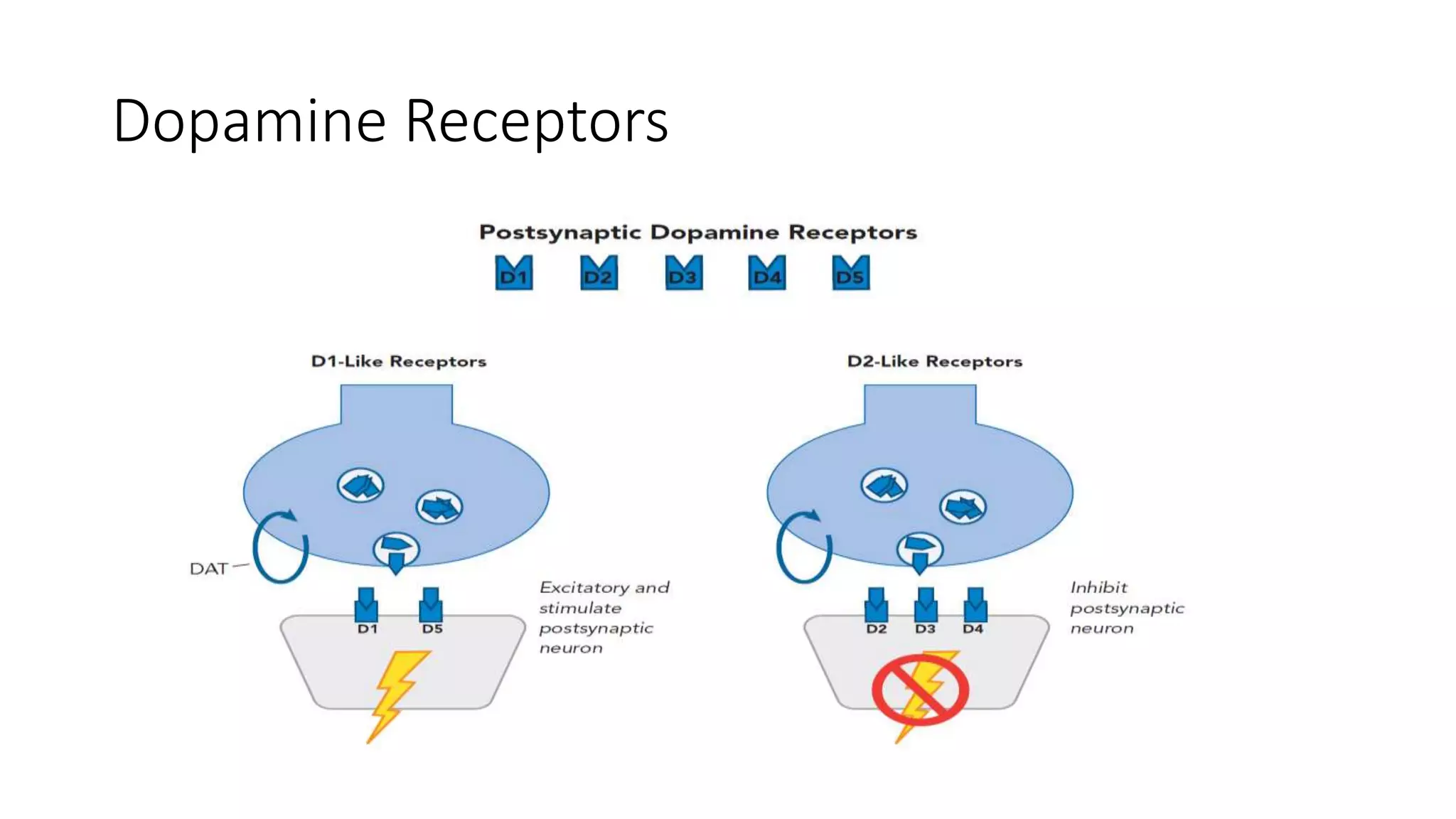
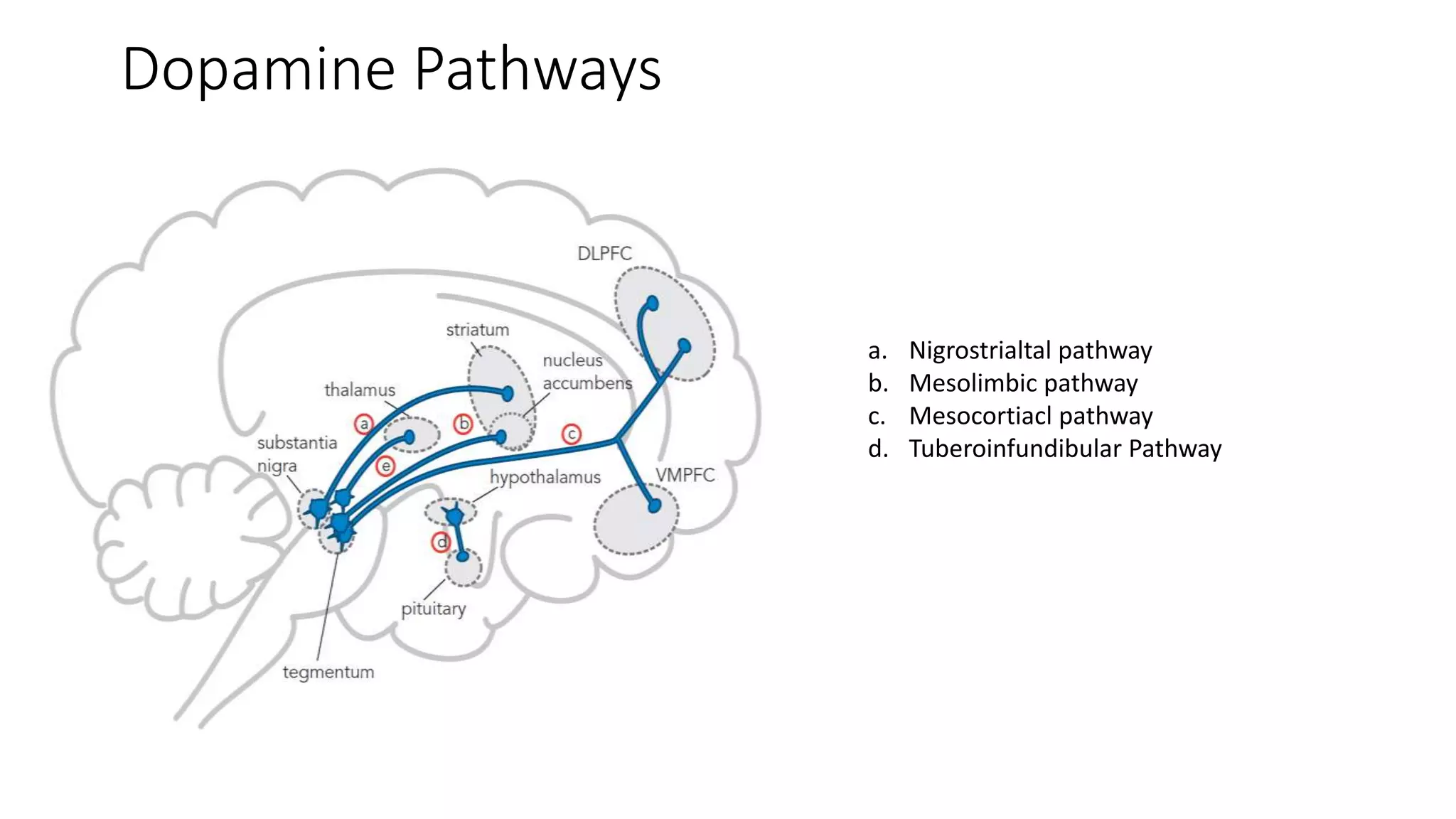
The document discusses several dopamine pathways in the brain. The nigrostriatal dopamine pathway controls motor function and movement. The mesolimbic dopamine pathway is involved in behaviors like pleasure, drug reward, and psychosis symptoms. The mesocortical dopamine pathway mediates cognitive and affective symptoms of schizophrenia by projecting to different parts of the prefrontal cortex. The tuberoinfundibular dopamine pathway controls prolactin secretion, while the function of the thalamic dopamine pathway is still being investigated. Recent evidence suggests overactivity in the intermediate associative striatum may better explain psychosis symptoms than the classic view of ventral striatum overactivity.
Dopamine Synthesis
• Dopamineis synthesized by
dopaminergic nerve terminals from the
amino acid tyrosine.
TYR- Tyrosine
TOH- Tyrosine hydroxylase
DDC- DOPA decarboxylase
VMAT2 - Vesicular monoamine transporter
3.
Termination of Dopamine’saction
DA - Dopamine
DAT - Dopamine transporter
COMT- Catechol-O-methyltransferase
MAO A or B - Monoamine oxidase A or B
In cortical dopamine terminal
DAT is relatively sparse
The Mesolimbic DopaminePathway
• The mesolimbic Dopamine pathway projects from DA cell bodies in the VTA
of the brainstem (i.e., mesencephalon) to the nucleus accumbens in the
ventral striatum.
• Dopamine release from this pathway is thought to have an important role
in several normal emotional behaviors, including
Motivation
Pleasure
Reward
• Too much Dopamine in this pathway classically is thought to cause the
positive symptoms of psychosis(delusions and hallucinations) as well as the
artificial reward (drug-induced “high”) of substance abuse
• Hyperactivity of mesolimbic DA neurons may also play a role in causing
impulsive, agitated, aggressive, and hostile symptoms in any of the illnesses
associated with positive symptoms of psychosis
9.
• Hypoactivity ofthe Mesoliombic Pathway is
associated with symptoms of anhedonia,
apathy, and lack of energy as well as with the
negative symptoms of schizophrenia
10.
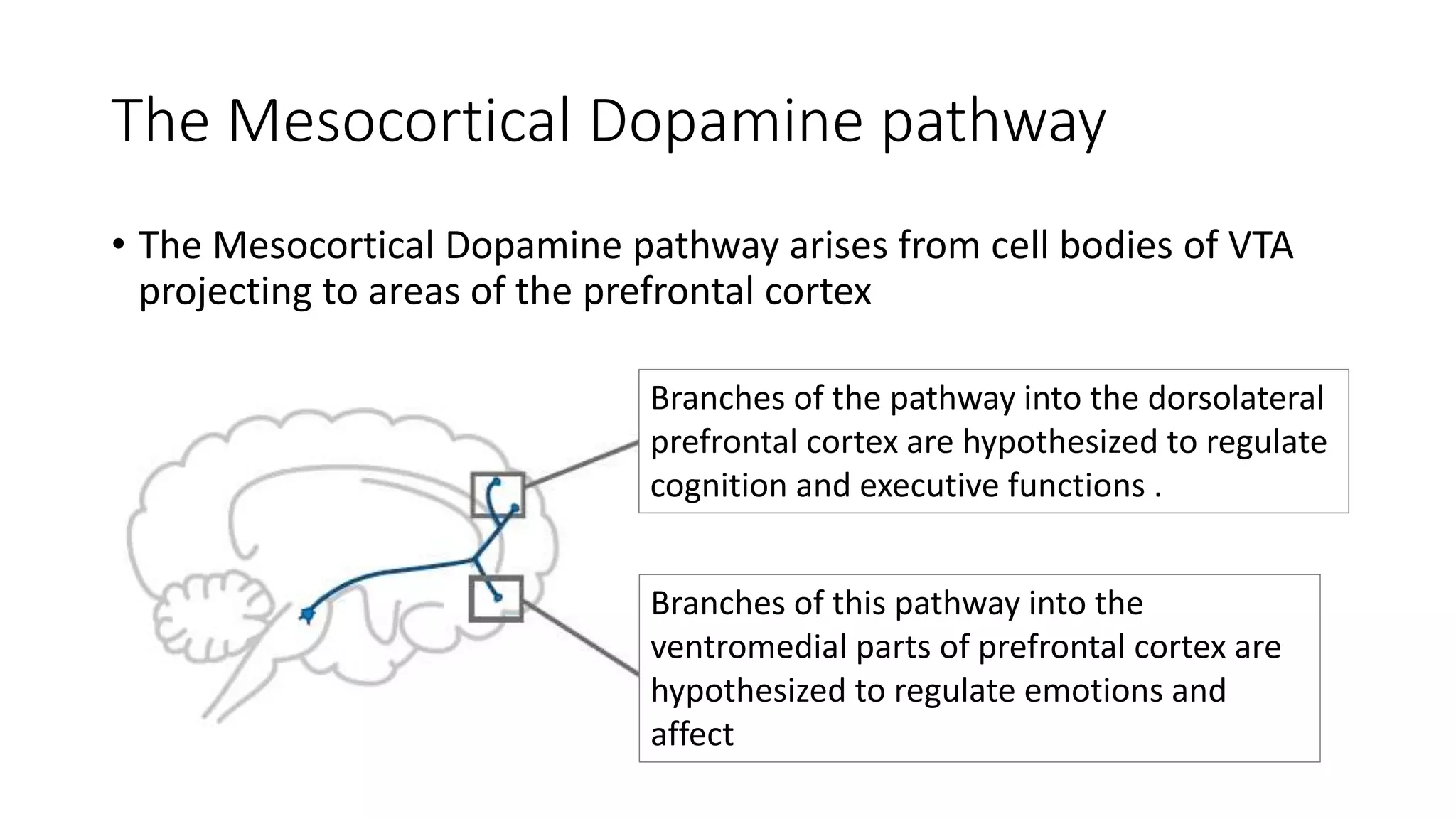
The Mesocortical Dopaminepathway
• The Mesocortical Dopamine pathway arises from cell bodies of VTA
projecting to areas of the prefrontal cortex
Branches of the pathway into the dorsolateral
prefrontal cortex are hypothesized to regulate
cognition and executive functions .
Branches of this pathway into the
ventromedial parts of prefrontal cortex are
hypothesized to regulate emotions and
affect
11.
The Mesocortical Dopaminepathway
Hypoactivity of dopamine
neurons in the mesocortical
dopamine pathway
theoretically mediates the
cognitive, negative, and
affective symptoms of
schizophrenia
12.
Tuberoinfundibular Pathway
• TheDopamine neurons that project
from hypothalamus to anterior
pituitary
• Normally, these neurons are tonically
active and inhibit prolactin release.
• In the postpartum state, however, the
activity of these Dopamine neurons is
decreased. Prolactin levels can
therefore rise during breast feeding so
that lactation will occur.
13.
Tuberoinfundibular Pathway
• Ifthe functioning of tuberoinfundibular DA neurons is disrupted by
lesions or drugs, prolactin levels can also rise.
• Elevated prolactin levels are associated with galactorrhea
(breastsecretions), gynecomastia (enlarged breasts especiallyin men),
amenorrhea (loss of ovulation and menstrual periods), and possibly
other problems such as sexual dysfunction.
14.
The Thalamic Pathway
•This Dopamine pathway that innervates the thalamus arises from
multiple sites including the periaqueductal gray matter, the ventral
mesencephalon, from various hypothalamic nuclei, and from the lateral
parabrachial nucleus .
• Its function is still under investigation, but may be involved in sleep and
arousal mechanisms by gating information passing through the
thalamus to the cortexand other brain areas.
15.
The Nigrostriatal DopaminePathway
• The Nigrostriatal Dopamine pathway
projects from Dopamine cell bodies in
the brainstem substantia nigra via
axons terminating in the striatum.
• It is a part of the extrapyramidal
nervous system,
• It is involved in the control motor
movements via its connections with
the thalamus and cortex in cortico-
striato-thalamo-cortical (CSTC) circuits
or loops.
18.
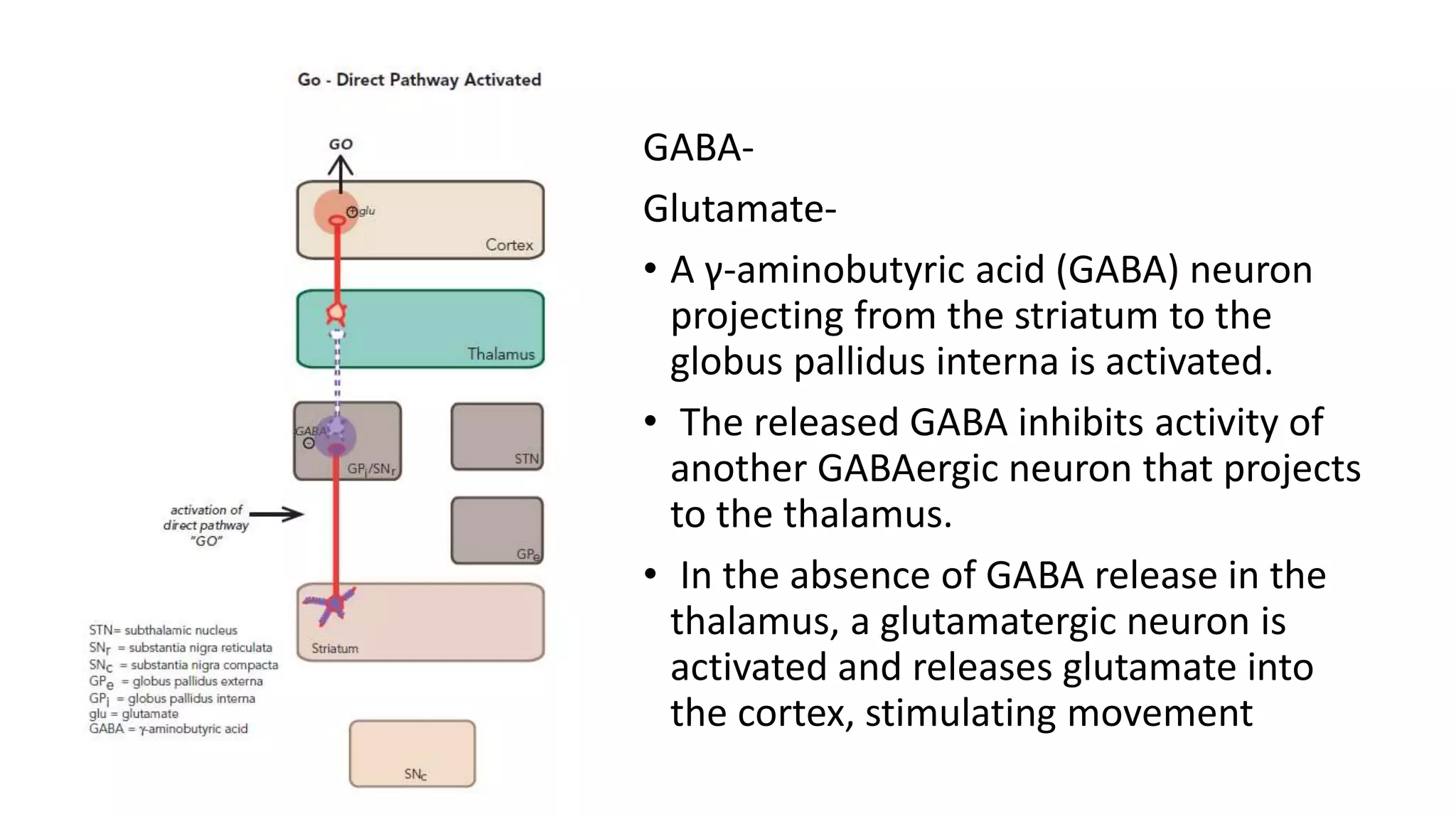
GABA-
Glutamate-
• A γ-aminobutyricacid (GABA) neuron
projecting from the striatum to the
globus pallidus interna is activated.
• The released GABA inhibits activity of
another GABAergic neuron that projects
to the thalamus.
• In the absence of GABA release in the
thalamus, a glutamatergic neuron is
activated and releases glutamate into
the cortex, stimulating movement
19.
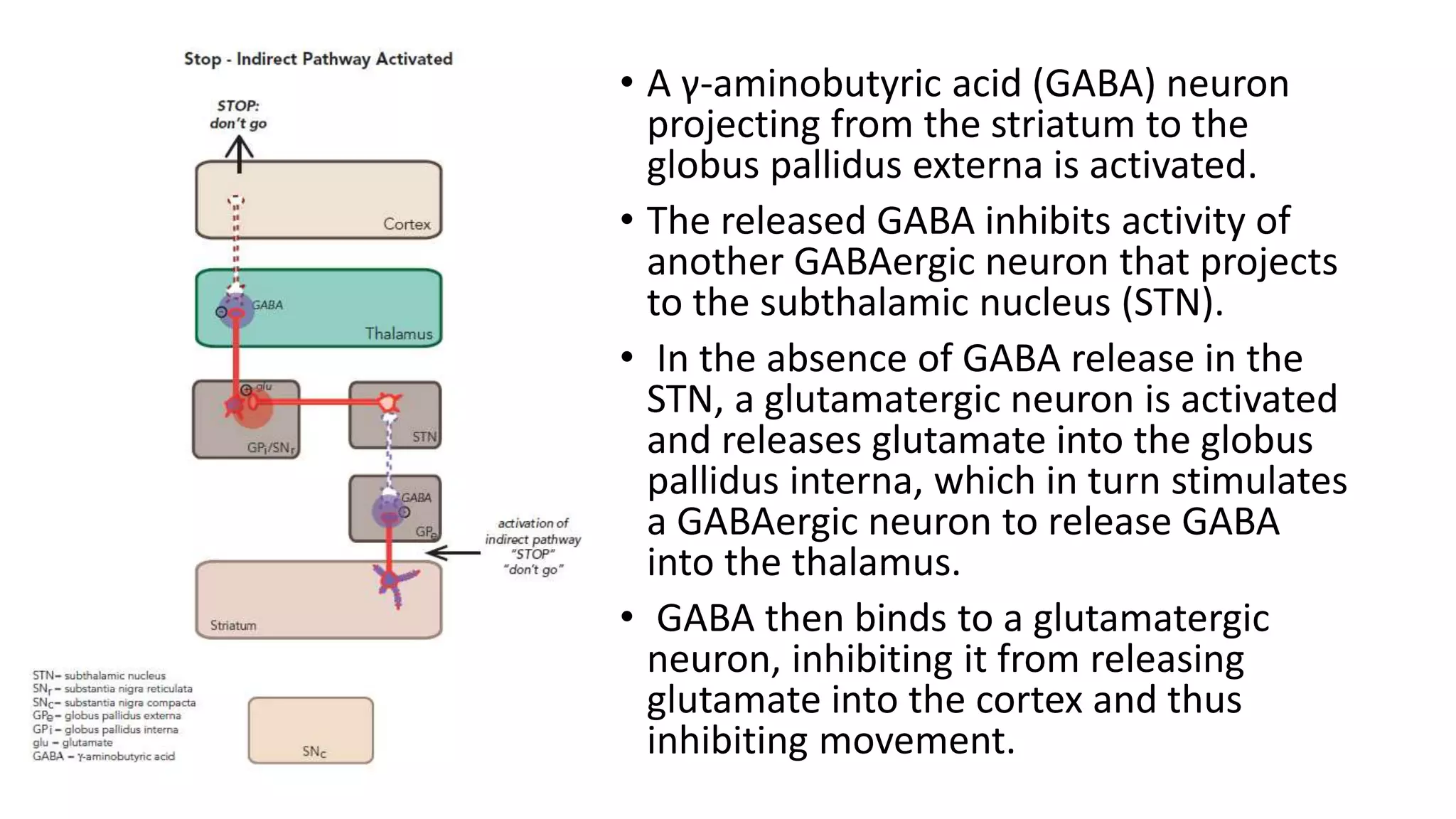
• A γ-aminobutyricacid (GABA) neuron
projecting from the striatum to the
globus pallidus externa is activated.
• The released GABA inhibits activity of
another GABAergic neuron that projects
to the subthalamic nucleus (STN).
• In the absence of GABA release in the
STN, a glutamatergic neuron is activated
and releases glutamate into the globus
pallidus interna, which in turn stimulates
a GABAergic neuron to release GABA
into the thalamus.
• GABA then binds to a glutamatergic
neuron, inhibiting it from releasing
glutamate into the cortex and thus
inhibiting movement.
20.
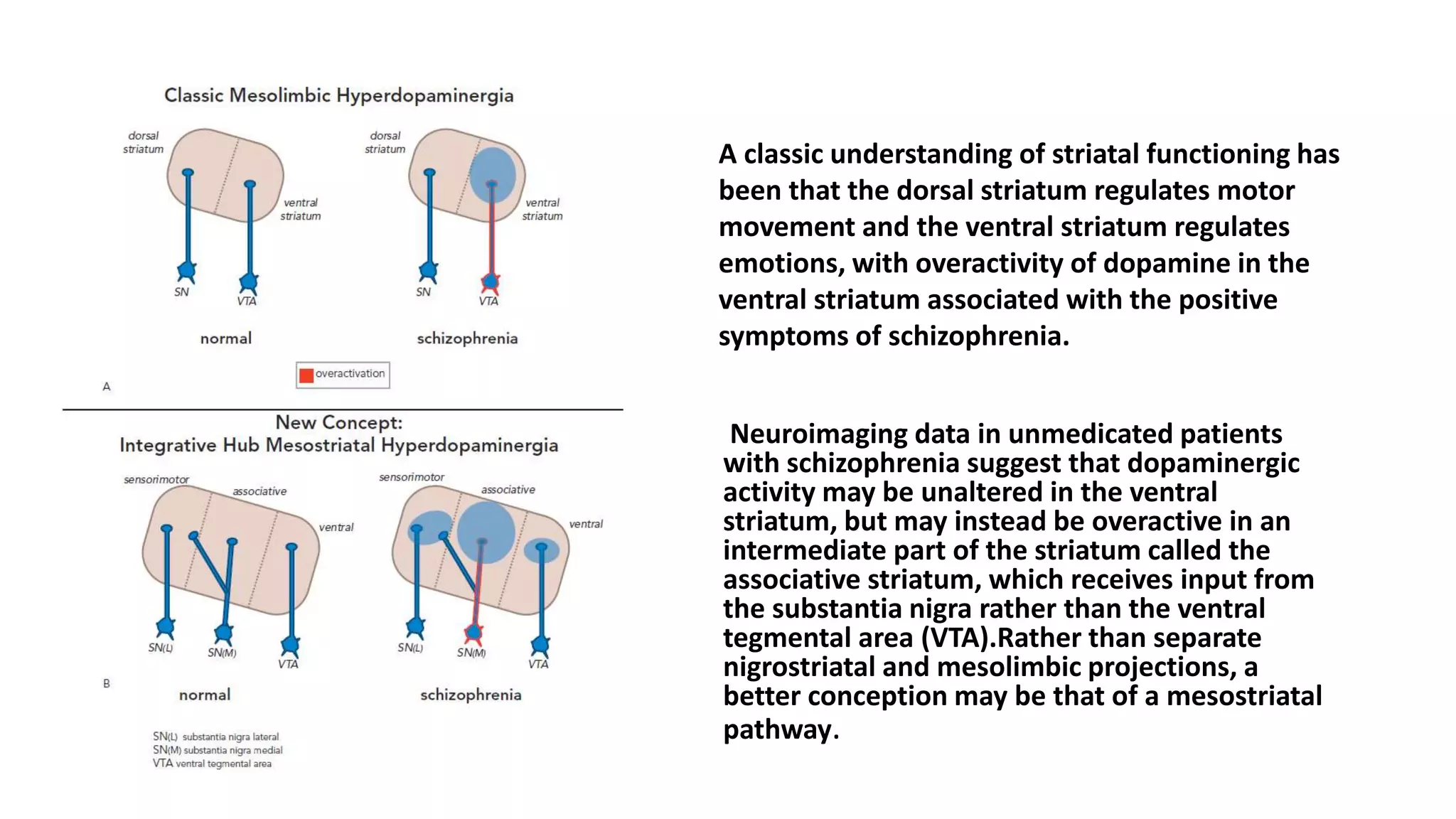
New Developments inthe Dopamine Hypothesis of
Positive Symptoms of Psychosis in Schizophrenia
21.
A classic understandingof striatal functioning has
been that the dorsal striatum regulates motor
movement and the ventral striatum regulates
emotions, with overactivity of dopamine in the
ventral striatum associated with the positive
symptoms of schizophrenia.
Neuroimaging data in unmedicated patients
with schizophrenia suggest that dopaminergic
activity may be unaltered in the ventral
striatum, but may instead be overactive in an
intermediate part of the striatum called the
associative striatum, which receives input from
the substantia nigra rather than the ventral
tegmental area (VTA).Rather than separate
nigrostriatal and mesolimbic projections, a
better conception may be that of a mesostriatal
pathway.
23.
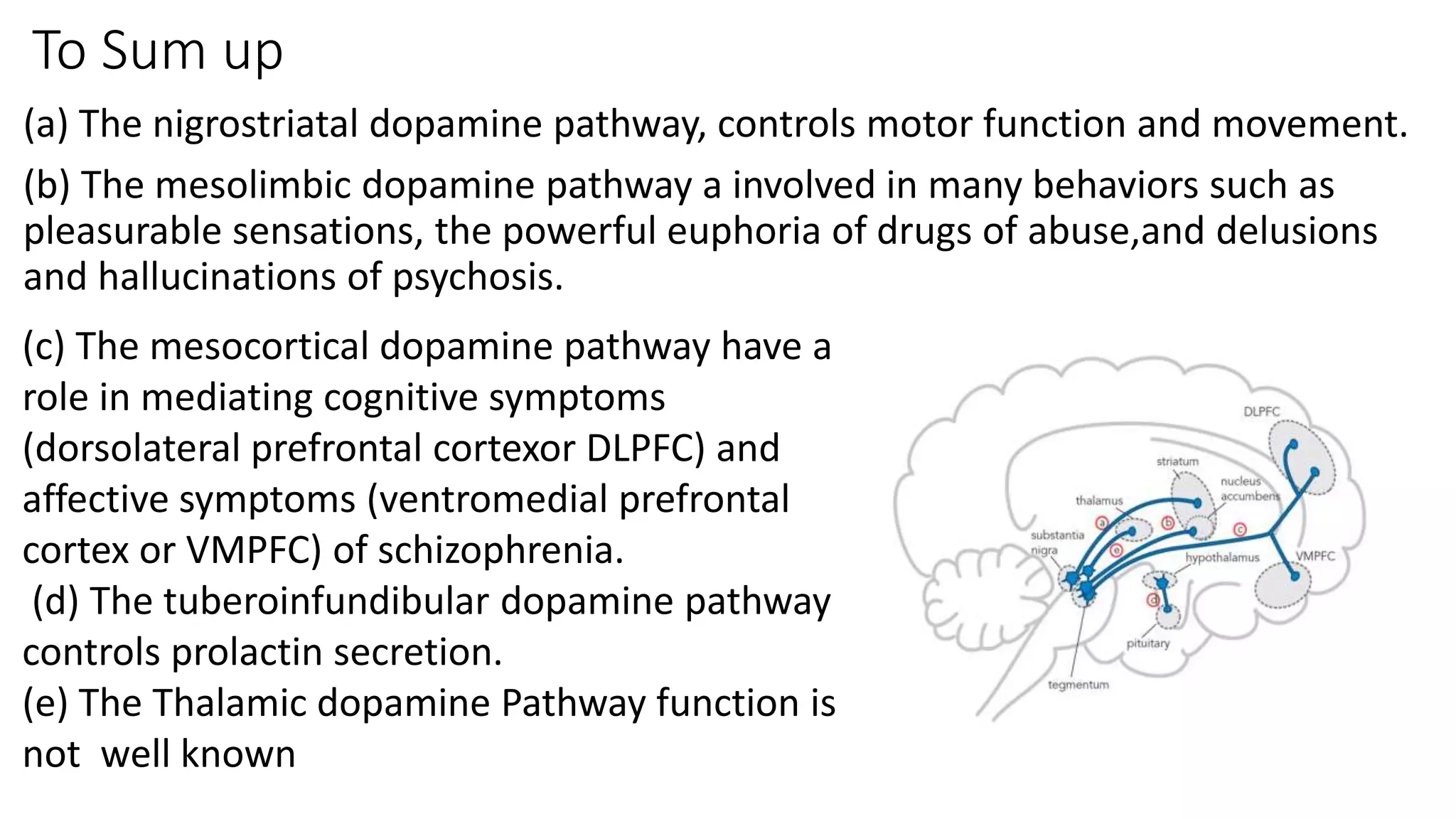
To Sum up
(a)The nigrostriatal dopamine pathway, controls motor function and movement.
(b) The mesolimbic dopamine pathway a involved in many behaviors such as
pleasurable sensations, the powerful euphoria of drugs of abuse,and delusions
and hallucinations of psychosis.
(c) The mesocortical dopamine pathway have a
role in mediating cognitive symptoms
(dorsolateral prefrontal cortexor DLPFC) and
affective symptoms (ventromedial prefrontal
cortex or VMPFC) of schizophrenia.
(d) The tuberoinfundibular dopamine pathway
controls prolactin secretion.
(e) The Thalamic dopamine Pathway function is
not well known











![Neuro-humoral-Transmission-of-Dopamine[1].pptx](https://cdn.slidesharecdn.com/ss_thumbnails/neuro-humoral-transmission-of-dopamine1-241027041656-822de07d-thumbnail.jpg?width=640&height=640&fit=bounds)


