DOMINO’S INDIA
LOGISTICS
MANAGEMENT
PRESENTED BY
NIKHIL S. TATKE
MILIND A. SHEVDE
M.V.SAIMAHESH
AGENDA
• FACTS
• INTRODUCTION
• BACKGROUND NOTE
• LOGISTICS MODEL
• INVENTORY MANAGEMENT
• CONCLUSION
Facts
• Domino’s outlet in India opened in 1996.
• It is second largest in revenue over the world.
• Jubilant Food Works Limited, a Jubilant Bhatia Group company
holds the Master Franchise rights for India, Nepal, Sri Lanka and
Bangladesh.
• By 6th august 2014 there are 772 Domino’s pizza restaurants in
India.
• Revenue
– 70 % from home deliveries
– 30 % from OTC (over the counter) sales
INTRODUCTION
• Pawan Bhatia took over as the CEO of Domino’s in
November 1999
• Bhatia was planning to open 150 new outlets by the end of
2002 covering 23 cities including Bhubaneswar and
Jamshedpur.
• Indocean Chase, the private equity fund bought a 25%
stake in Domino’s operations in India in 1999.
• Indocean Chase advised Domino’s to go beyond its 16
outlets in Delhi to exploit the potential in pizza delivery
business.
• As part of its expansion plans Domino’s revamped its
entire supply chain operations, from sourcing raw
materials to shipping them for processing at a central
location to delivering it to the customers.
• Initially, Domino’s had a simple model. It had three self-
contained commissaries in New Delhi, Mumbai and Bangalore
which bought their own wheat, tomatoes and other
ingredients, processed them, then delivered them in
refrigerated trucks to each outlet.
• Bhatia said, “It’s crucial for us to build a low-cost supply chain
operation which takes costs out of the system and in turns
gives us greater pricing flexibility in the marketplace”.
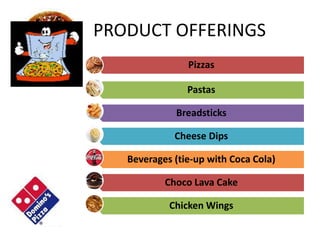
Pastas
Breadsticks
Cheese Dips
Beverages (tie-up with Coca Cola)
Choco Lava Cake
Chicken Wings
PRODUCT OFFERINGS
Pizzas
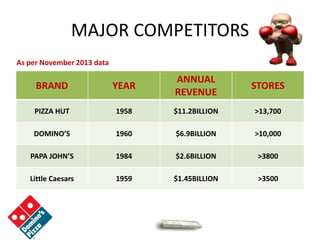
MAJOR COMPETITORS
BRAND YEAR
ANNUAL
REVENUE
STORES
PIZZA HUT 1958 $11.2BILLION >13,700
DOMINO’S 1960 $6.9BILLION >10,000
PAPA JOHN’S 1984 $2.6BILLION >3800
Little Caesars 1959 $1.45BILLION >3500
As per November 2013 data
OTHER COMPETITORS ARE
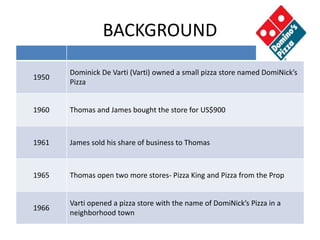
BACKGROUND
1950
Dominick De Varti (Varti) owned a small pizza store named DomiNick’s
Pizza
1960 Thomas and James bought the store for US$900
1961 James sold his share of business to Thomas
1965 Thomas open two more stores- Pizza King and Pizza from the Prop
1966
Varti opened a pizza store with the name of DomiNick’s Pizza in a
neighborhood town
• Thomas decided to change the store name, One of
his employees suggested the name Domino’s Pizza.
• Domino’s Philosophy rested on two principles
1) Limited menu
2) Delivering hot and fresh pizzas within 30minutes.
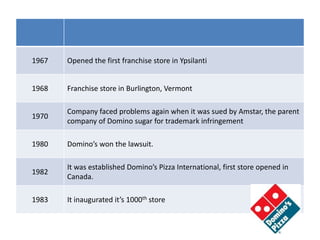
1967 Opened the first franchise store in Ypsilanti
1968 Franchise store in Burlington, Vermont
1970
Company faced problems again when it was sued by Amstar, the parent
company of Domino sugar for trademark infringement
1980 Domino’s won the lawsuit.
1982
It was established Domino’s Pizza International, first store opened in
Canada.
1983 It inaugurated it’s 1000th store
• In 1984 Domino’s faced tough competition from Pizza Hut
in the home delivery segment.
• Little Caeser was eating into Domino’s market share with its
innovative marketing strategies.
• In 1993, Thomas took measures to expand Domino’s
product line.
• Thomas gave about 90% of the franchisee agreements in
the US to people who had worked as drivers with Domino’s.
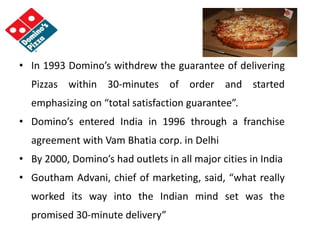
• In 1993 Domino’s withdrew the guarantee of delivering
Pizzas within 30-minutes of order and started
emphasizing on “total satisfaction guarantee”.
• Domino’s entered India in 1996 through a franchise
agreement with Vam Bhatia corp. in Delhi
• By 2000, Domino’s had outlets in all major cities in India
• Goutham Advani, chief of marketing, said, “what really
worked its way into the Indian mind set was the
promised 30-minute delivery”
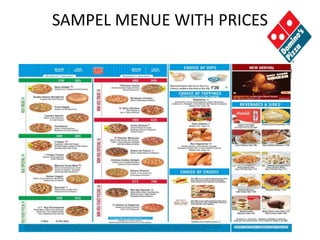
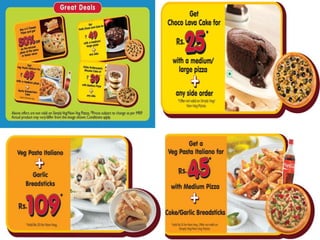
SAMPEL MENUE WITH PRICES
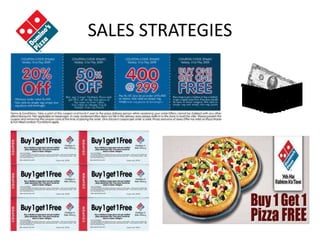
SALES STRATEGIES
DOMINO’S LOGISTICS MODEL
• Analysts felt that Domino’s took a cue from McDonald’s supply
chain model.
• In early 2000, Domino’s came out with its own Logistics model.
• Wheat was cheapest in Jalandhar’s wholesale markets.
• The pizza dough and other items prepared in commissaries were
then sent to the retail outlets again in the refrigerated trucks.
• The retail outlets had to use up the processed dough
within 3days of delivery.
• To get to Jalandhar, the trucks had to pass chandigarh,
Through it is a cosmopolitan population it opend an
outlet to reduce their costs.
• It opened outlet in shimla.
• On the way back to Delhi, the trucks could pick up
cheese from Karnal.
• With the revamped supply chain, Domino’s was able to
leverage its fleet much better.
• The logistics model adopted by Domino’s offered some
obvious benefits including lower transportation costs,
cheaper procurement and economies of scale.
• Bhatia said, “ Our roll-out began only after we mapped
out our procurement strategy
• Domino’s also identified specialty crops in each region.
• Bhatia planned to use Domino’s 25 refrigerated trucks to
transport products for other companies on the same
route.
• Profit center had the potential to bring in Rs 10bn by
2006.
• Domino’s hoped to lower its prices by saving from the
logistics model and third-party transportation.
• In 2000 it announced a cut in pizza prices to Rs49.
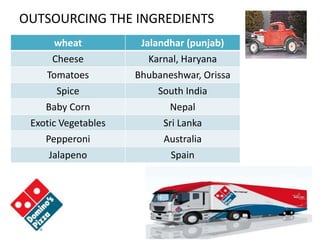
OUTSOURCING THE INGREDIENTS
wheat Jalandhar (punjab)
Cheese Karnal, Haryana
Tomatoes Bhubaneshwar, Orissa
Spice South India
Baby Corn Nepal
Exotic Vegetables Sri Lanka
Pepperoni Australia
Jalapeno Spain
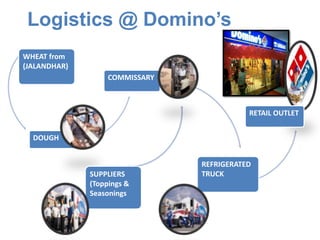
Logistics @ Domino’s
WHEAT from
(JALANDHAR)
DOUGH
COMMISSARY
SUPPLIERS
(Toppings &
Seasonings
REFRIGERATED
TRUCK
RETAIL OUTLET
Inventory Management @
DOMINO’S
ITEM SHELF LIFE
Dough ball 5 days
Mexican Wrap Base 3-4 days
Cheese Dip 4-5 days
Seasoning and Toppings 4-5 days
Onion, Tomato, Capsicum 5 days
Cheese Blend 4-5 days
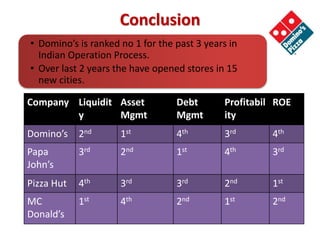
• Domino’s is ranked no 1 for the past 3 years in
Indian Operation Process.
• Over last 2 years the have opened stores in 15
new cities.
Conclusion
Company Liquidit
y
Asset
Mgmt
Debt
Mgmt
Profitabil
ity
ROE
Domino’s 2nd 1st 4th 3rd 4th
Papa
John’s
3rd 2nd 1st 4th 3rd
Pizza Hut 4th 3rd 3rd 2nd 1st
MC
Donald’s
1st 4th 2nd 1st 2nd
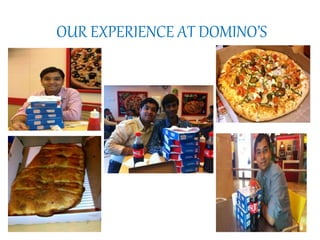
OUR EXPERIENCE AT DOMINO’S
DIAL : 68886888
THANK YOU

Domino's scm presentation

  • 1.
    DOMINO’S INDIA LOGISTICS MANAGEMENT PRESENTED BY NIKHILS. TATKE MILIND A. SHEVDE M.V.SAIMAHESH
  • 2.
    AGENDA • FACTS • INTRODUCTION •BACKGROUND NOTE • LOGISTICS MODEL • INVENTORY MANAGEMENT • CONCLUSION
  • 3.
    Facts • Domino’s outletin India opened in 1996. • It is second largest in revenue over the world. • Jubilant Food Works Limited, a Jubilant Bhatia Group company holds the Master Franchise rights for India, Nepal, Sri Lanka and Bangladesh. • By 6th august 2014 there are 772 Domino’s pizza restaurants in India. • Revenue – 70 % from home deliveries – 30 % from OTC (over the counter) sales
  • 4.
    INTRODUCTION • Pawan Bhatiatook over as the CEO of Domino’s in November 1999 • Bhatia was planning to open 150 new outlets by the end of 2002 covering 23 cities including Bhubaneswar and Jamshedpur. • Indocean Chase, the private equity fund bought a 25% stake in Domino’s operations in India in 1999.
  • 5.
    • Indocean Chaseadvised Domino’s to go beyond its 16 outlets in Delhi to exploit the potential in pizza delivery business. • As part of its expansion plans Domino’s revamped its entire supply chain operations, from sourcing raw materials to shipping them for processing at a central location to delivering it to the customers.
  • 6.
    • Initially, Domino’shad a simple model. It had three self- contained commissaries in New Delhi, Mumbai and Bangalore which bought their own wheat, tomatoes and other ingredients, processed them, then delivered them in refrigerated trucks to each outlet. • Bhatia said, “It’s crucial for us to build a low-cost supply chain operation which takes costs out of the system and in turns gives us greater pricing flexibility in the marketplace”.
  • 7.
    Pastas Breadsticks Cheese Dips Beverages (tie-upwith Coca Cola) Choco Lava Cake Chicken Wings PRODUCT OFFERINGS Pizzas
  • 8.
    MAJOR COMPETITORS BRAND YEAR ANNUAL REVENUE STORES PIZZAHUT 1958 $11.2BILLION >13,700 DOMINO’S 1960 $6.9BILLION >10,000 PAPA JOHN’S 1984 $2.6BILLION >3800 Little Caesars 1959 $1.45BILLION >3500 As per November 2013 data
  • 9.
  • 10.
    BACKGROUND 1950 Dominick De Varti(Varti) owned a small pizza store named DomiNick’s Pizza 1960 Thomas and James bought the store for US$900 1961 James sold his share of business to Thomas 1965 Thomas open two more stores- Pizza King and Pizza from the Prop 1966 Varti opened a pizza store with the name of DomiNick’s Pizza in a neighborhood town
  • 11.
    • Thomas decidedto change the store name, One of his employees suggested the name Domino’s Pizza. • Domino’s Philosophy rested on two principles 1) Limited menu 2) Delivering hot and fresh pizzas within 30minutes.
  • 12.
    1967 Opened thefirst franchise store in Ypsilanti 1968 Franchise store in Burlington, Vermont 1970 Company faced problems again when it was sued by Amstar, the parent company of Domino sugar for trademark infringement 1980 Domino’s won the lawsuit. 1982 It was established Domino’s Pizza International, first store opened in Canada. 1983 It inaugurated it’s 1000th store
  • 13.
    • In 1984Domino’s faced tough competition from Pizza Hut in the home delivery segment. • Little Caeser was eating into Domino’s market share with its innovative marketing strategies. • In 1993, Thomas took measures to expand Domino’s product line. • Thomas gave about 90% of the franchisee agreements in the US to people who had worked as drivers with Domino’s.
  • 14.
    • In 1993Domino’s withdrew the guarantee of delivering Pizzas within 30-minutes of order and started emphasizing on “total satisfaction guarantee”. • Domino’s entered India in 1996 through a franchise agreement with Vam Bhatia corp. in Delhi • By 2000, Domino’s had outlets in all major cities in India • Goutham Advani, chief of marketing, said, “what really worked its way into the Indian mind set was the promised 30-minute delivery”
  • 15.
  • 16.
  • 18.
    DOMINO’S LOGISTICS MODEL •Analysts felt that Domino’s took a cue from McDonald’s supply chain model. • In early 2000, Domino’s came out with its own Logistics model. • Wheat was cheapest in Jalandhar’s wholesale markets. • The pizza dough and other items prepared in commissaries were then sent to the retail outlets again in the refrigerated trucks.
  • 19.
    • The retailoutlets had to use up the processed dough within 3days of delivery. • To get to Jalandhar, the trucks had to pass chandigarh, Through it is a cosmopolitan population it opend an outlet to reduce their costs. • It opened outlet in shimla. • On the way back to Delhi, the trucks could pick up cheese from Karnal.
  • 20.
    • With therevamped supply chain, Domino’s was able to leverage its fleet much better. • The logistics model adopted by Domino’s offered some obvious benefits including lower transportation costs, cheaper procurement and economies of scale. • Bhatia said, “ Our roll-out began only after we mapped out our procurement strategy • Domino’s also identified specialty crops in each region.
  • 21.
    • Bhatia plannedto use Domino’s 25 refrigerated trucks to transport products for other companies on the same route. • Profit center had the potential to bring in Rs 10bn by 2006. • Domino’s hoped to lower its prices by saving from the logistics model and third-party transportation. • In 2000 it announced a cut in pizza prices to Rs49.
  • 22.
    OUTSOURCING THE INGREDIENTS wheatJalandhar (punjab) Cheese Karnal, Haryana Tomatoes Bhubaneshwar, Orissa Spice South India Baby Corn Nepal Exotic Vegetables Sri Lanka Pepperoni Australia Jalapeno Spain
  • 23.
    Logistics @ Domino’s WHEATfrom (JALANDHAR) DOUGH COMMISSARY SUPPLIERS (Toppings & Seasonings REFRIGERATED TRUCK RETAIL OUTLET
  • 24.
    Inventory Management @ DOMINO’S ITEMSHELF LIFE Dough ball 5 days Mexican Wrap Base 3-4 days Cheese Dip 4-5 days Seasoning and Toppings 4-5 days Onion, Tomato, Capsicum 5 days Cheese Blend 4-5 days
  • 25.
    • Domino’s isranked no 1 for the past 3 years in Indian Operation Process. • Over last 2 years the have opened stores in 15 new cities. Conclusion Company Liquidit y Asset Mgmt Debt Mgmt Profitabil ity ROE Domino’s 2nd 1st 4th 3rd 4th Papa John’s 3rd 2nd 1st 4th 3rd Pizza Hut 4th 3rd 3rd 2nd 1st MC Donald’s 1st 4th 2nd 1st 2nd
  • 26.
  • 27.