Literature Survey,  Literature Comprehension, &  Literature Review
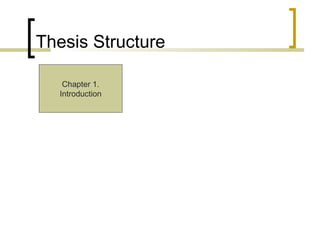
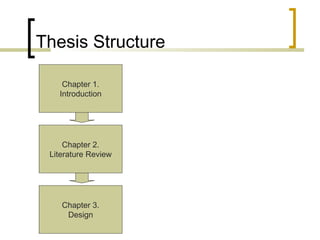
Thesis Structure Chapter 1. Introduction
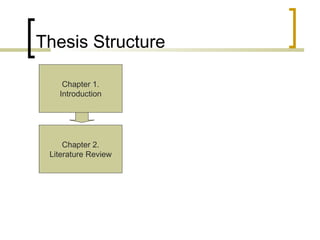
Thesis Structure Chapter 1. Introduction Chapter 2. Literature Review
Thesis Structure Chapter 1. Introduction Chapter 2. Literature Review Chapter 3. Design
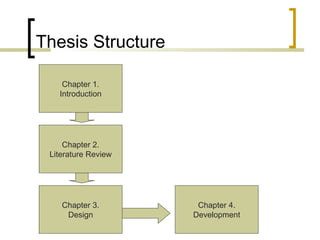
Thesis Structure Chapter 1. Introduction Chapter 2. Literature Review Chapter 3. Design Chapter 4. Development
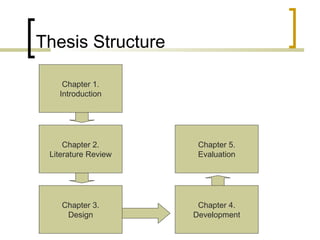
Thesis Structure Chapter 1. Introduction Chapter 2. Literature Review Chapter 3. Design Chapter 4. Development Chapter 5. Evaluation
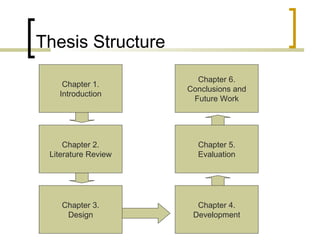
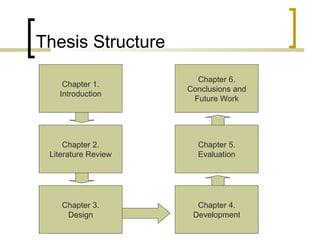
Thesis Structure Chapter 1. Introduction Chapter 2. Literature Review Chapter 3. Design Chapter 4. Development Chapter 5. Evaluation Chapter 6. Conclusions and Future Work
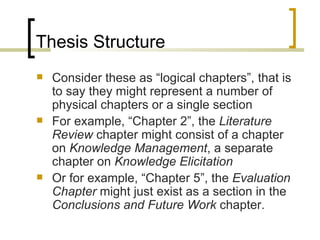
Thesis Structure Consider these as “logical chapters”, that is to say they might represent a number of physical chapters or a single section For example, “Chapter 2”, the  Literature Review  chapter might consist of a chapter on  Knowledge Management , a separate chapter on  Knowledge Elicitation Or for example, “Chapter 5”, the  Evaluation Chapter  might just exist as a section in the  Conclusions and Future Work  chapter.
Thesis Structure Chapter 1. Introduction Chapter 2. Literature Review Chapter 3. Design Chapter 4. Development Chapter 5. Evaluation Chapter 6. Conclusions and Future Work
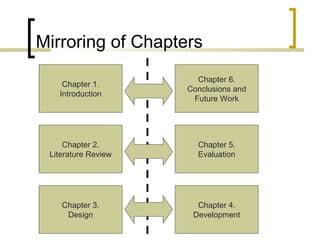
Mirroring of Chapters Chapter 1. Introduction Chapter 2. Literature Review Chapter 3. Design Chapter 4. Development Chapter 5. Evaluation Chapter 6. Conclusions and Future Work
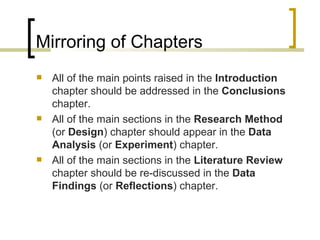
Mirroring of Chapters All of the main points raised in the  Introduction  chapter should be addressed in the  Conclusions  chapter. All of the main sections in the  Research Method  (or  Design ) chapter should appear in the  Data Analysis  (or  Experiment ) chapter. All of the main sections in the  Literature Review  chapter should be re-discussed in the  Data Findings  (or  Reflections ) chapter.
Introduction to Literature
Introduction   Finding out what is happening in your area of research is a vital step along your journey to discovery,  to find and understand how leading researchers in your field have tackled similar problems and the results they obtained, shortcomings they observed and methodologies they employed  are the goals of the literature review process.
Introduction   Additionally the literature reviews serves other purposes; It shares the reader with other studies closely related to your work It relates your work to the larger, ongoing dialogue in the literature It shows how your study is filling in gaps and extending prior studies. It provides a framework for establishing the importance of your study It provides a benchmark for comparing the results of your study with other findings
Introduction   ...in other words...
Introduction   ...the literature review...
Introduction   ...is really, really important.
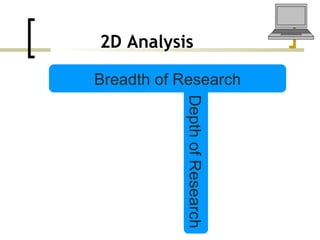
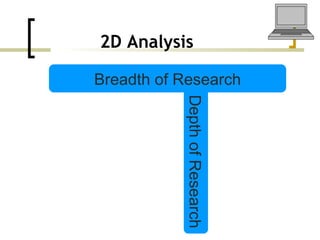
2D Analysis   The objective of this process is to systematically analyse the existing research and classify it in one of two dimensions.  The  breadth  of the review is concerned with ‘ setting the scene ’, in terms of describing the foundational research in this particular domain, there will be research mentioned from each of the areas you have included in your spider diagram. The  depth  of the research concerns itself with  the particular topic work  that your research will be built upon. There should be approximately the same number of research papers covered in the depth and breath of the research review.
Examples Let’s look at two examples Knowledge Management Information Technology
2D Analysis   Breadth of Research Depth of Research
2D Analysis   Breadth of Research
Knowledge Management Example Knowledge Management
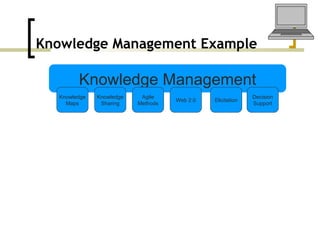
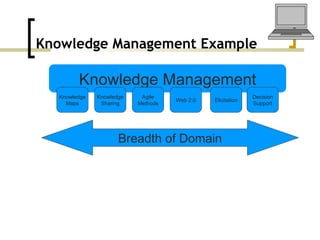
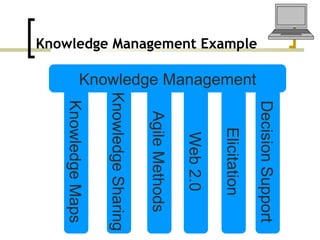
Knowledge Management Example Knowledge Management Web 2.0 Knowledge Sharing Agile Methods Elicitation Knowledge Maps Decision Support
Knowledge Management Example Knowledge Management Web 2.0 Knowledge Sharing Agile Methods Elicitation Knowledge Maps Decision Support Breadth of Domain
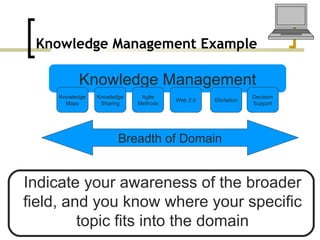
Knowledge Management Example Knowledge Management Web 2.0 Knowledge Sharing Agile Methods Elicitation Knowledge Maps Decision Support Breadth of Domain Indicate your awareness of the broader field, and you know where your specific topic fits into the domain
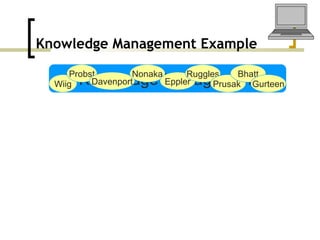
Knowledge Management Example Knowledge Management Wiig Probst Davenport Nonaka Eppler Ruggles Prusak  Bhatt Gurteen
2D Analysis   Breadth of Research Depth of Research
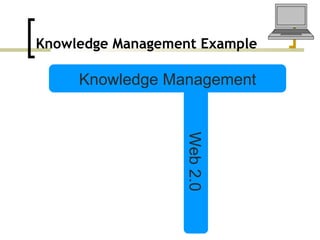
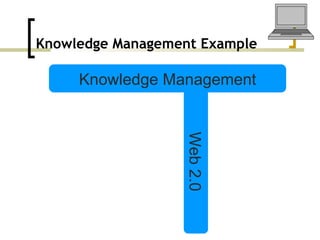
Knowledge Management Example Knowledge Management Web 2.0
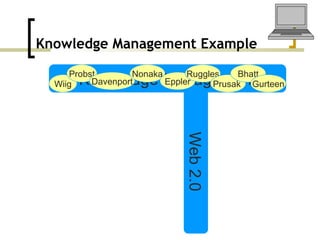
Knowledge Management Example Knowledge Management Web 2.0 Wiig Probst Davenport Nonaka Eppler Ruggles Prusak  Bhatt Gurteen
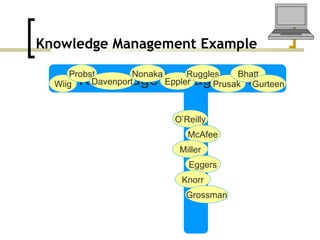
Knowledge Management Example Knowledge Management Web 2.0 Wiig Probst Davenport Nonaka Eppler Ruggles Prusak  Bhatt Gurteen O’Reilly McAfee Miller Eggers Knorr Grossman
Knowledge Management Example Knowledge Management Web 2.0
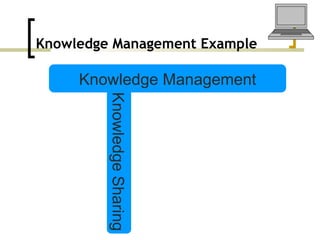
Knowledge Management Example Knowledge Management Knowledge Sharing
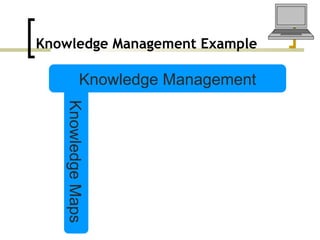
Knowledge Management Example Knowledge Management Knowledge Maps
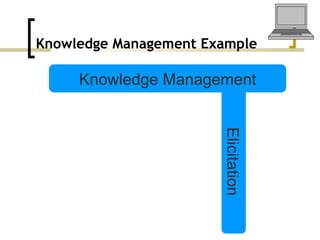
Knowledge Management Example Knowledge Management Elicitation
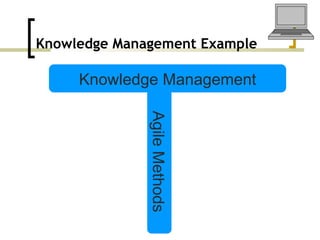
Knowledge Management Example Knowledge Management Agile Methods
Knowledge Management Example Knowledge Management Decision Support
Knowledge Management Example Knowledge Management Web 2.0 Knowledge Sharing Agile Methods Elicitation Knowledge Maps Decision Support
2D Analysis   Breadth of Research
Information Technology Example Information Technology
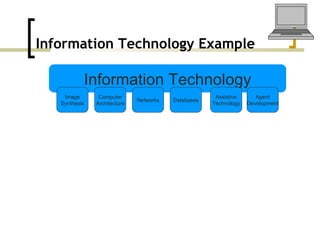
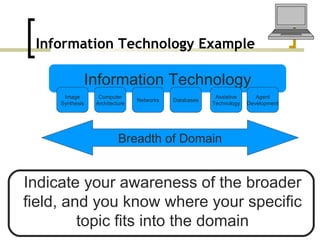
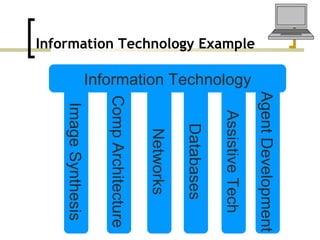
Information Technology Example Information Technology Databases Computer Architecture Networks Assistive Technology Image Synthesis Agent Development
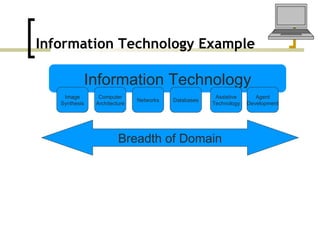
Information Technology Example Information Technology Databases Computer Architecture Networks Assistive Technology Image Synthesis Agent Development Breadth of Domain
Information Technology Example Information Technology Databases Computer Architecture Networks Assistive Technology Image Synthesis Agent Development Breadth of Domain Indicate your awareness of the broader field, and you know where your specific topic fits into the domain
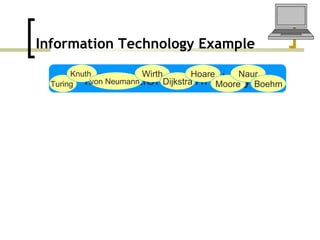
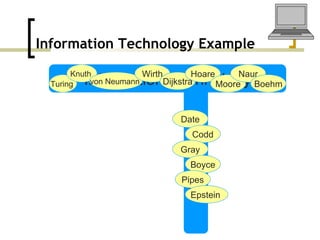
Information Technology Example Information Technology Turing  Knuth  von Neumann  Wirth Dijkstra Hoare Moore Naur Boehm
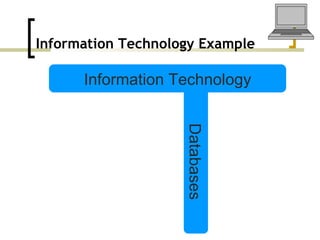
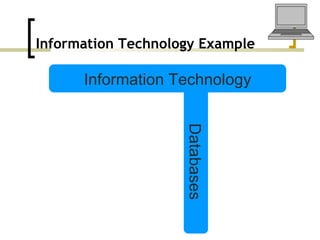
Information Technology Example Information Technology Databases
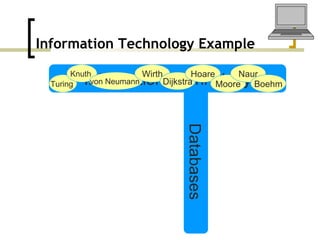
Information Technology Example Information Technology Databases Turing  Knuth  von Neumann  Wirth Dijkstra Hoare Moore Naur Boehm
Information Technology Example Databases Date Codd Gray Boyce Pipes Epstein  Information Technology Turing  Knuth  von Neumann  Wirth Dijkstra Hoare Moore Naur Boehm
Information Technology Example Information Technology Databases
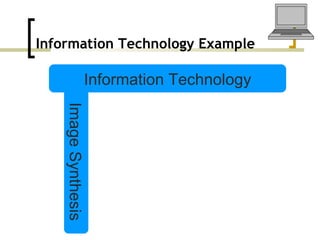
Information Technology Example Information Technology Image Synthesis
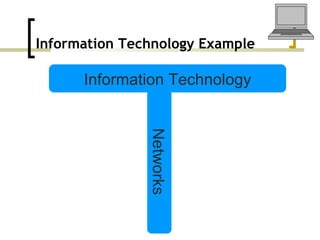
Information Technology Example Information Technology Networks
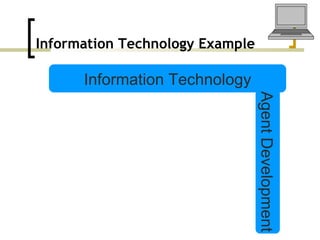
Information Technology Example Information Technology Agent Development
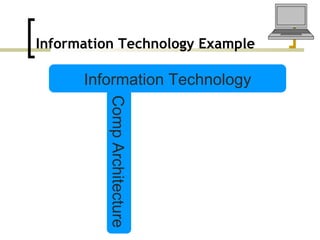
Information Technology Example Information Technology Comp Architecture
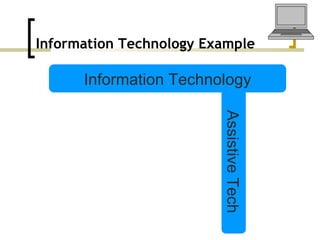
Information Technology Example Information Technology Assistive Tech
Information Technology Example Information Technology Databases Comp Architecture Networks Assistive Tech Image Synthesis Agent Development
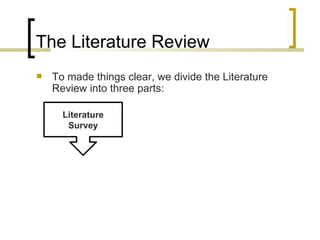
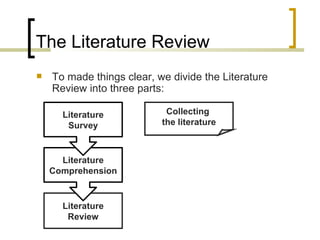
The Literature Review To made things clear, we divide the Literature Review into three parts:
The Literature Review To made things clear, we divide the Literature Review into three parts: Literature Survey
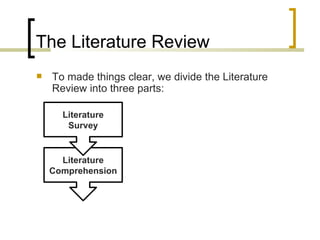
The Literature Review To made things clear, we divide the Literature Review into three parts: Literature Comprehension Literature Survey
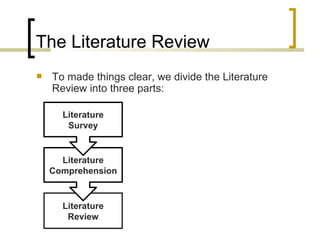
The Literature Review To made things clear, we divide the Literature Review into three parts: Literature Review Literature Comprehension Literature Survey
The Literature Review To made things clear, we divide the Literature Review into three parts: Literature Review Literature Comprehension Literature Survey Collecting  the literature
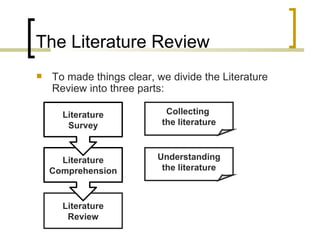
The Literature Review To made things clear, we divide the Literature Review into three parts: Literature Review Literature Comprehension Literature Survey Collecting  the literature Understanding the literature
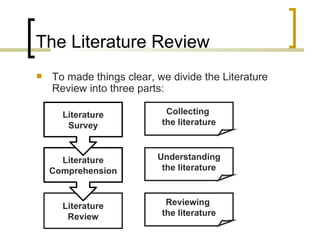
The Literature Review To made things clear, we divide the Literature Review into three parts: Literature Review Literature Comprehension Literature Survey Collecting  the literature Understanding the literature Reviewing  the literature

Doing a Literature Review - Part 1

  • 1.
    Literature Survey, Literature Comprehension, & Literature Review
  • 2.
    Thesis Structure Chapter1. Introduction
  • 3.
    Thesis Structure Chapter1. Introduction Chapter 2. Literature Review
  • 4.
    Thesis Structure Chapter1. Introduction Chapter 2. Literature Review Chapter 3. Design
  • 5.
    Thesis Structure Chapter1. Introduction Chapter 2. Literature Review Chapter 3. Design Chapter 4. Development
  • 6.
    Thesis Structure Chapter1. Introduction Chapter 2. Literature Review Chapter 3. Design Chapter 4. Development Chapter 5. Evaluation
  • 7.
    Thesis Structure Chapter1. Introduction Chapter 2. Literature Review Chapter 3. Design Chapter 4. Development Chapter 5. Evaluation Chapter 6. Conclusions and Future Work
  • 8.
    Thesis Structure Considerthese as “logical chapters”, that is to say they might represent a number of physical chapters or a single section For example, “Chapter 2”, the Literature Review chapter might consist of a chapter on Knowledge Management , a separate chapter on Knowledge Elicitation Or for example, “Chapter 5”, the Evaluation Chapter might just exist as a section in the Conclusions and Future Work chapter.
  • 9.
    Thesis Structure Chapter1. Introduction Chapter 2. Literature Review Chapter 3. Design Chapter 4. Development Chapter 5. Evaluation Chapter 6. Conclusions and Future Work
  • 10.
    Mirroring of ChaptersChapter 1. Introduction Chapter 2. Literature Review Chapter 3. Design Chapter 4. Development Chapter 5. Evaluation Chapter 6. Conclusions and Future Work
  • 11.
    Mirroring of ChaptersAll of the main points raised in the Introduction chapter should be addressed in the Conclusions chapter. All of the main sections in the Research Method (or Design ) chapter should appear in the Data Analysis (or Experiment ) chapter. All of the main sections in the Literature Review chapter should be re-discussed in the Data Findings (or Reflections ) chapter.
  • 12.
  • 13.
    Introduction Finding out what is happening in your area of research is a vital step along your journey to discovery, to find and understand how leading researchers in your field have tackled similar problems and the results they obtained, shortcomings they observed and methodologies they employed are the goals of the literature review process.
  • 14.
    Introduction Additionally the literature reviews serves other purposes; It shares the reader with other studies closely related to your work It relates your work to the larger, ongoing dialogue in the literature It shows how your study is filling in gaps and extending prior studies. It provides a framework for establishing the importance of your study It provides a benchmark for comparing the results of your study with other findings
  • 15.
    Introduction ...in other words...
  • 16.
    Introduction ...the literature review...
  • 17.
    Introduction ...is really, really important.
  • 18.
    2D Analysis The objective of this process is to systematically analyse the existing research and classify it in one of two dimensions. The breadth of the review is concerned with ‘ setting the scene ’, in terms of describing the foundational research in this particular domain, there will be research mentioned from each of the areas you have included in your spider diagram. The depth of the research concerns itself with the particular topic work that your research will be built upon. There should be approximately the same number of research papers covered in the depth and breath of the research review.
  • 19.
    Examples Let’s lookat two examples Knowledge Management Information Technology
  • 20.
    2D Analysis Breadth of Research Depth of Research
  • 21.
    2D Analysis Breadth of Research
  • 22.
    Knowledge Management ExampleKnowledge Management
  • 23.
    Knowledge Management ExampleKnowledge Management Web 2.0 Knowledge Sharing Agile Methods Elicitation Knowledge Maps Decision Support
  • 24.
    Knowledge Management ExampleKnowledge Management Web 2.0 Knowledge Sharing Agile Methods Elicitation Knowledge Maps Decision Support Breadth of Domain
  • 25.
    Knowledge Management ExampleKnowledge Management Web 2.0 Knowledge Sharing Agile Methods Elicitation Knowledge Maps Decision Support Breadth of Domain Indicate your awareness of the broader field, and you know where your specific topic fits into the domain
  • 26.
    Knowledge Management ExampleKnowledge Management Wiig Probst Davenport Nonaka Eppler Ruggles Prusak Bhatt Gurteen
  • 27.
    2D Analysis Breadth of Research Depth of Research
  • 28.
    Knowledge Management ExampleKnowledge Management Web 2.0
  • 29.
    Knowledge Management ExampleKnowledge Management Web 2.0 Wiig Probst Davenport Nonaka Eppler Ruggles Prusak Bhatt Gurteen
  • 30.
    Knowledge Management ExampleKnowledge Management Web 2.0 Wiig Probst Davenport Nonaka Eppler Ruggles Prusak Bhatt Gurteen O’Reilly McAfee Miller Eggers Knorr Grossman
  • 31.
    Knowledge Management ExampleKnowledge Management Web 2.0
  • 32.
    Knowledge Management ExampleKnowledge Management Knowledge Sharing
  • 33.
    Knowledge Management ExampleKnowledge Management Knowledge Maps
  • 34.
    Knowledge Management ExampleKnowledge Management Elicitation
  • 35.
    Knowledge Management ExampleKnowledge Management Agile Methods
  • 36.
    Knowledge Management ExampleKnowledge Management Decision Support
  • 37.
    Knowledge Management ExampleKnowledge Management Web 2.0 Knowledge Sharing Agile Methods Elicitation Knowledge Maps Decision Support
  • 38.
    2D Analysis Breadth of Research
  • 39.
    Information Technology ExampleInformation Technology
  • 40.
    Information Technology ExampleInformation Technology Databases Computer Architecture Networks Assistive Technology Image Synthesis Agent Development
  • 41.
    Information Technology ExampleInformation Technology Databases Computer Architecture Networks Assistive Technology Image Synthesis Agent Development Breadth of Domain
  • 42.
    Information Technology ExampleInformation Technology Databases Computer Architecture Networks Assistive Technology Image Synthesis Agent Development Breadth of Domain Indicate your awareness of the broader field, and you know where your specific topic fits into the domain
  • 43.
    Information Technology ExampleInformation Technology Turing Knuth von Neumann Wirth Dijkstra Hoare Moore Naur Boehm
  • 44.
    Information Technology ExampleInformation Technology Databases
  • 45.
    Information Technology ExampleInformation Technology Databases Turing Knuth von Neumann Wirth Dijkstra Hoare Moore Naur Boehm
  • 46.
    Information Technology ExampleDatabases Date Codd Gray Boyce Pipes Epstein Information Technology Turing Knuth von Neumann Wirth Dijkstra Hoare Moore Naur Boehm
  • 47.
    Information Technology ExampleInformation Technology Databases
  • 48.
    Information Technology ExampleInformation Technology Image Synthesis
  • 49.
    Information Technology ExampleInformation Technology Networks
  • 50.
    Information Technology ExampleInformation Technology Agent Development
  • 51.
    Information Technology ExampleInformation Technology Comp Architecture
  • 52.
    Information Technology ExampleInformation Technology Assistive Tech
  • 53.
    Information Technology ExampleInformation Technology Databases Comp Architecture Networks Assistive Tech Image Synthesis Agent Development
  • 54.
    The Literature ReviewTo made things clear, we divide the Literature Review into three parts:
  • 55.
    The Literature ReviewTo made things clear, we divide the Literature Review into three parts: Literature Survey
  • 56.
    The Literature ReviewTo made things clear, we divide the Literature Review into three parts: Literature Comprehension Literature Survey
  • 57.
    The Literature ReviewTo made things clear, we divide the Literature Review into three parts: Literature Review Literature Comprehension Literature Survey
  • 58.
    The Literature ReviewTo made things clear, we divide the Literature Review into three parts: Literature Review Literature Comprehension Literature Survey Collecting the literature
  • 59.
    The Literature ReviewTo made things clear, we divide the Literature Review into three parts: Literature Review Literature Comprehension Literature Survey Collecting the literature Understanding the literature
  • 60.
    The Literature ReviewTo made things clear, we divide the Literature Review into three parts: Literature Review Literature Comprehension Literature Survey Collecting the literature Understanding the literature Reviewing the literature