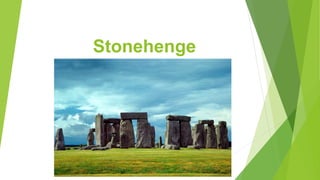
Stonehenge
Introduction
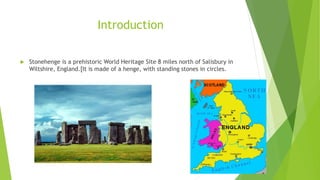
 Stonehenge is a prehistoric World Heritage Site 8 miles north of Salisbury in
Wiltshire, England.[It is made of a henge, with standing stones in circles.
Building details
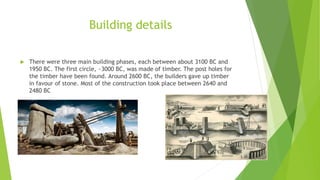
 There were three main building phases, each between about 3100 BC and
1950 BC. The first circle, ~3000 BC, was made of timber. The post holes for
the timber have been found. Around 2600 BC, the builders gave up timber
in favour of stone. Most of the construction took place between 2640 and
2480 BC
History
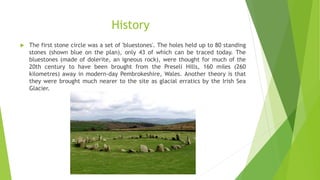
 The first stone circle was a set of 'bluestones'. The holes held up to 80 standing
stones (shown blue on the plan), only 43 of which can be traced today. The
bluestones (made of dolerite, an igneous rock), were thought for much of the
20th century to have been brought from the Preseli Hills, 160 miles (260
kilometres) away in modern-day Pembrokeshire, Wales. Another theory is that
they were brought much nearer to the site as glacial erratics by the Irish Sea
Glacier.
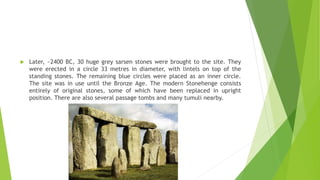
 Later, ~2400 BC, 30 huge grey sarsen stones were brought to the site. They
were erected in a circle 33 metres in diameter, with lintels on top of the
standing stones. The remaining blue circles were placed as an inner circle.
The site was in use until the Bronze Age. The modern Stonehenge consists
entirely of original stones, some of which have been replaced in upright
position. There are also several passage tombs and many tumuli nearby.
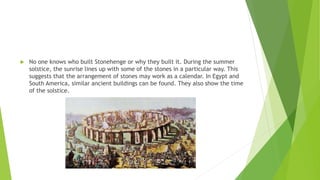
 No one knows who built Stonehenge or why they built it. During the summer
solstice, the sunrise lines up with some of the stones in a particular way. This
suggests that the arrangement of stones may work as a calendar. In Egypt and
South America, similar ancient buildings can be found. They also show the time
of the solstice.
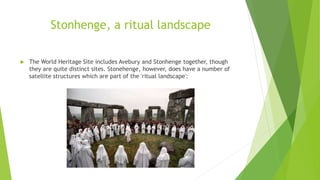
Stonhenge, a ritual landscape
 The World Heritage Site includes Avebury and Stonhenge together, though
they are quite distinct sites. Stonehenge, however, does have a number of
satellite structures which are part of the 'ritual landscape':
Stonehenge presentation

Stonehenge presentation

  • 1.
  • 2.
    Introduction  Stonehenge isa prehistoric World Heritage Site 8 miles north of Salisbury in Wiltshire, England.[It is made of a henge, with standing stones in circles.
  • 3.
    Building details  Therewere three main building phases, each between about 3100 BC and 1950 BC. The first circle, ~3000 BC, was made of timber. The post holes for the timber have been found. Around 2600 BC, the builders gave up timber in favour of stone. Most of the construction took place between 2640 and 2480 BC
  • 4.
    History  The firststone circle was a set of 'bluestones'. The holes held up to 80 standing stones (shown blue on the plan), only 43 of which can be traced today. The bluestones (made of dolerite, an igneous rock), were thought for much of the 20th century to have been brought from the Preseli Hills, 160 miles (260 kilometres) away in modern-day Pembrokeshire, Wales. Another theory is that they were brought much nearer to the site as glacial erratics by the Irish Sea Glacier.
  • 5.
     Later, ~2400BC, 30 huge grey sarsen stones were brought to the site. They were erected in a circle 33 metres in diameter, with lintels on top of the standing stones. The remaining blue circles were placed as an inner circle. The site was in use until the Bronze Age. The modern Stonehenge consists entirely of original stones, some of which have been replaced in upright position. There are also several passage tombs and many tumuli nearby.
  • 6.
     No oneknows who built Stonehenge or why they built it. During the summer solstice, the sunrise lines up with some of the stones in a particular way. This suggests that the arrangement of stones may work as a calendar. In Egypt and South America, similar ancient buildings can be found. They also show the time of the solstice.
  • 7.
    Stonhenge, a rituallandscape  The World Heritage Site includes Avebury and Stonhenge together, though they are quite distinct sites. Stonehenge, however, does have a number of satellite structures which are part of the 'ritual landscape':