Innovation Technology
in Education
Mobile learning in Education
By Joyce Udoh
Diffusion and Innovation of Technology in Education
Dr. Timothy Green
EDUC 8841
November, 2014
Introduction to Mobile
Learning
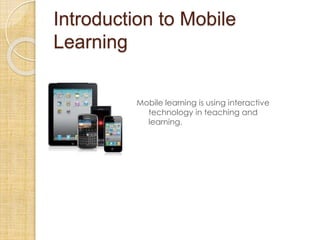
Mobile learning is using interactive
technology in teaching and
learning.
MOBILE LEARNING
TECHNOLOGIES
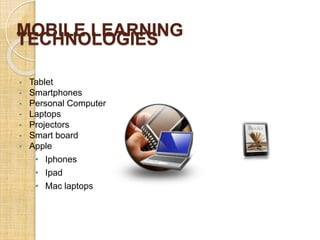
• Tablet
• Smartphones
• Personal Computer
• Laptops
• Projectors
• Smart board
• Apple
• Iphones
• Ipad
• Mac laptops
Web Site Applications
 Location-Based uses GPS capabilities
of mobile devices
 Use a check-in app like Foursquare
can be game-based, like ARIS:
arisgames.org
 Using raz-kids.com for k-5+ is an
interactive reading tool for students to
practice.
Need
 Improve teaching and learning
experience for effective performance
in the students academic work.
 To support classroom activities
 To motive and engage the students
with school-based curriculum even at
the convince of their home.
 The need for the teacher to monitor
the students homework activities.
RESEARCH
• Terras and Ramsay conducted a study on
the “Central psychological challenges
facing effective mobile learning” (Terras &
Ramsay, 2012).
• Doyle et al, (2013) conducted a study on
the effective use of mobile technology in
nursing institution.
• Göksu, I & Atici . B, (2013). Need for
mobile learning: Technologies and
Opportunities, Procedia - Social and
Behavioral Sciences, 103(26) 685-694,
ISSN 1877-0428,
http://dx.doi.org/10.1016/j.sbspro.2013.10.3
88.
• Keegan, D. (2005). The incorporation of
mobile learning into mainstream education
and training in mlearn2005
Development
What problems were encountered in the development process for your innovation? Who was
the intended audience for your innovation?
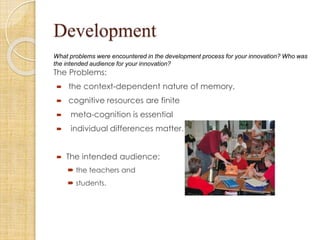
The Problems:
 the context-dependent nature of memory,
 cognitive resources are finite
 meta-cognition is essential
 individual differences matter.
 The intended audience:
 the teachers and
 students.
Commercialization
Describe the production, manufacturing, packaging, marketing, and
distribution of your innovation.
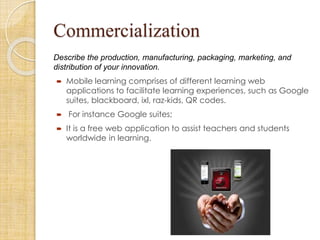
 Mobile learning comprises of different learning web
applications to facilitate learning experiences, such as Google
suites, blackboard, ixl, raz-kids, QR codes.
 For instance Google suites;
 It is a free web application to assist teachers and students
worldwide in learning.
TIMELINE OF
COMMUNICATION
Innovation Decision Process
Rogers (2003), presented 5 stages of the
innovation-decision process.
 stage1: Knowledge
Stage 2: Persuasion
Stage 3: Decision
Stage 4: Implementation
Stage 5: Confirmation
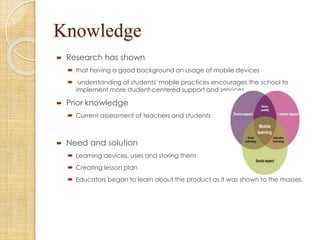
Knowledge
 Research has shown
 that having a good background on usage of mobile devices
 understanding of students' mobile practices encourages the school to
implement more student-centered support and services.
 Prior knowledge
 Current assessment of teachers and students
 Need and solution
 Learning devices, uses and storing them
 Creating lesson plan
 Educators began to learn about the product as it was shown to the masses.
Persuasion
 Personal
◦ Mobile technologies are playing an
increasingly important role in college
students' academic lives (Chen and
Danyelle, 2013).
◦ Teachers and students, now bring their
bring their own digital devices to college.
 Communication
◦ Mobile technologies will improve
interaction between instructors, teachers
and students.
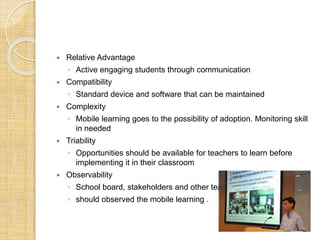
 Relative Advantage
◦ Active engaging students through communication
 Compatibility
◦ Standard device and software that can be maintained
 Complexity
◦ Mobile learning goes to the possibility of adoption. Monitoring skill
in needed
 Triability
◦ Opportunities should be available for teachers to learn before
implementing it in their classroom
 Observability
◦ School board, stakeholders and other teachers
◦ should observed the mobile learning .
Implementation
 Adoption
◦ Selection of teachers to give
opportunity to use mobile learning
◦ Mobile technologies focuses on the
interactions among technologies,
contents, and pedagogies.
◦ These teachers will use projectors,
computer and camera in the classroom
◦ Successful, these teachers will help
others to adopt.
 Rejection
◦ If the teachers are not comfortable with
the implementation of mobile learning
technologies, opportunity to opt out
will be provide.

◦ They will continue the training session
until they are comfortable to these
technology tools.
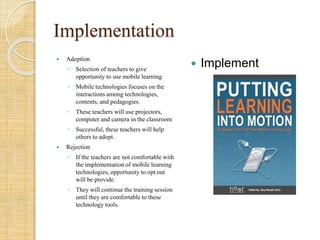
 Implement
Confirmation
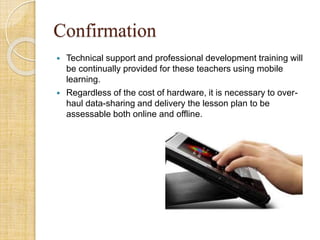
 Technical support and professional development training will
be continually provided for these teachers using mobile
learning.
 Regardless of the cost of hardware, it is necessary to over-
haul data-sharing and delivery the lesson plan to be
assessable both online and offline.
Communication Channels
 Mass Media
◦ Radio
◦ Television
◦ Newspaper
◦ Text messages
 Interpersonal communication
◦ Face-2-face activity:
 Chatting
 Discussion
 Meetings
 Interactive communication
◦ Using of internet:
 Email
 Viber
 Skype
 email
ADOPTERS CATEGORIES
AND THE S-CURVE
WHAT IS A S-CURVE
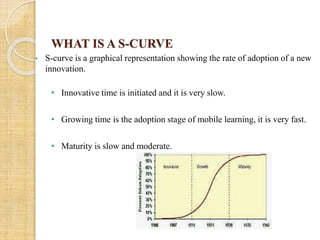
• S-curve is a graphical representation showing the rate of adoption of a new
innovation.
• Innovative time is initiated and it is very slow.
• Growing time is the adoption stage of mobile learning, it is very fast.
• Maturity is slow and moderate.
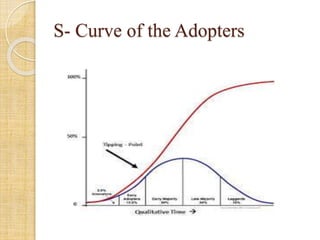
S- Curve of the Adopters
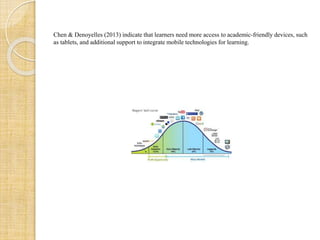
Chen & Denoyelles (2013) indicate that learners need more access to academic-friendly devices, such
as tablets, and additional support to integrate mobile technologies for learning.
PERCEIVED ATTRIBUTES OF
INNOVATION
Mobile learning
Change Agents
 Instructional Design Technologist
 Teachers
 School Administrators
 Students
 Parents
 Stakeholders
Key Change Agents
 Innovators include students and
technology instructors.
 Early adopters include students and
teachers who are familiar with some of
the technology and are interested to
adopt this new technology.
strategies
 Well planned professional development
training on mobile learning technology
 Interactive triability session for early adopters
 Designed posttest and pretest task for the
early adopters to complete. This will provide
feedback of the sessions.
 It is important to recognize the teachers and
students for their accomplishment to the
school.
Key Laggards
 Teachers without technological
knowledge
 School Administrators, without
technological knowledge will not
understand the benefits
 Students from low- economic back
that is not expose to technology.
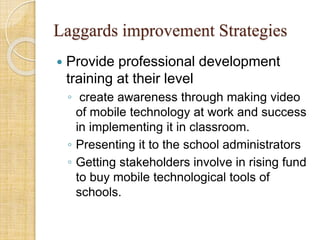
Laggards improvement Strategies
 Provide professional development
training at their level
◦ create awareness through making video
of mobile technology at work and success
in implementing it in classroom.
◦ Presenting it to the school administrators
◦ Getting stakeholders involve in rising fund
to buy mobile technological tools of
schools.
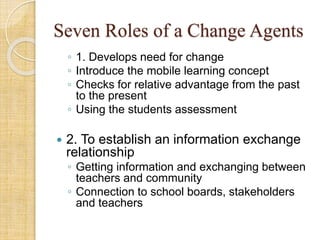
Seven Roles of a Change Agents
◦ 1. Develops need for change
◦ Introduce the mobile learning concept
◦ Checks for relative advantage from the past
to the present
◦ Using the students assessment
 2. To establish an information exchange
relationship
◦ Getting information and exchanging between
teachers and community
◦ Connection to school boards, stakeholders
and teachers
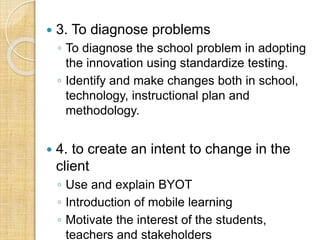
 3. To diagnose problems
◦ To diagnose the school problem in adopting
the innovation using standardize testing.
◦ Identify and make changes both in school,
technology, instructional plan and
methodology.
 4. to create an intent to change in the
client
◦ Use and explain BYOT
◦ Introduction of mobile learning
◦ Motivate the interest of the students,
teachers and stakeholders
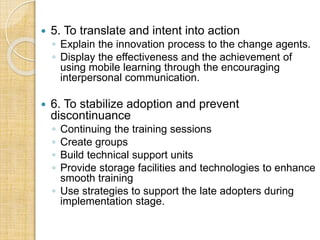
 5. To translate and intent into action
◦ Explain the innovation process to the change agents.
◦ Display the effectiveness and the achievement of
using mobile learning through the encouraging
interpersonal communication.
 6. To stabilize adoption and prevent
discontinuance
◦ Continuing the training sessions
◦ Create groups
◦ Build technical support units
◦ Provide storage facilities and technologies to enhance
smooth training
◦ Use strategies to support the late adopters during
implementation stage.
 7. Achieving a lasting Relationship
Develop a self-renewing behavior
(Rogers, 2003,p. 370).
◦ Assuring the school boards, stakeholders.
Teachers and students that mobile learning
can be maintained and continued in the
schools.
◦ To increase the students achievement and
engagement in the classroom activities.
CRITICAL MASS AND
CHANGE AGENTS
Decentralizing Approach
 The strategies employ will be
◦ Low cost effective
◦ Using a BYOT policy (Bring Your Own
Technology)
◦ Involving people and resources that is
available
Critical Mass
 Critical mass shows when the
innovators adopt an innovation “such
that the innovation’s further rate of
adoption becomes self-sustaining”
(Rogers, 2003, p. 343).
 When the key change agents are
using this mobile learning and sharing
it with their others, the growth of the
adopting it is self sustaining.
Organizational Concept
Champion
 These will be:
◦ instructors
◦ Technological coordinators
 The need for the innovation
◦ Improve learning experiences
◦ Students ability to learn better
◦ Teaching effectiveness
Champion
 Determine and note the right
classrooms, timelines to begin
implementing the mobile learning
 Taking note the following:
◦ Language difference
◦ Learning ability and style
◦ Knowledge base
◦ Using the right mobile tools
Support Needed
 Mobile Learning
 Focus on the students strength and weakness
 To show that learning is meaningful
 To show that learning is accessible to all
 Learning can occur outside the classroom
It is time for
eLearning!

Innovation technology in education 5

  • 1.
  • 2.
    Mobile learning inEducation By Joyce Udoh Diffusion and Innovation of Technology in Education Dr. Timothy Green EDUC 8841 November, 2014
  • 3.
    Introduction to Mobile Learning Mobilelearning is using interactive technology in teaching and learning.
  • 4.
    MOBILE LEARNING TECHNOLOGIES • Tablet •Smartphones • Personal Computer • Laptops • Projectors • Smart board • Apple • Iphones • Ipad • Mac laptops
  • 5.
    Web Site Applications Location-Based uses GPS capabilities of mobile devices  Use a check-in app like Foursquare can be game-based, like ARIS: arisgames.org  Using raz-kids.com for k-5+ is an interactive reading tool for students to practice.
  • 6.
    Need  Improve teachingand learning experience for effective performance in the students academic work.  To support classroom activities  To motive and engage the students with school-based curriculum even at the convince of their home.  The need for the teacher to monitor the students homework activities.
  • 7.
    RESEARCH • Terras andRamsay conducted a study on the “Central psychological challenges facing effective mobile learning” (Terras & Ramsay, 2012). • Doyle et al, (2013) conducted a study on the effective use of mobile technology in nursing institution. • Göksu, I & Atici . B, (2013). Need for mobile learning: Technologies and Opportunities, Procedia - Social and Behavioral Sciences, 103(26) 685-694, ISSN 1877-0428, http://dx.doi.org/10.1016/j.sbspro.2013.10.3 88. • Keegan, D. (2005). The incorporation of mobile learning into mainstream education and training in mlearn2005
  • 8.
    Development What problems wereencountered in the development process for your innovation? Who was the intended audience for your innovation? The Problems:  the context-dependent nature of memory,  cognitive resources are finite  meta-cognition is essential  individual differences matter.  The intended audience:  the teachers and  students.
  • 9.
    Commercialization Describe the production,manufacturing, packaging, marketing, and distribution of your innovation.  Mobile learning comprises of different learning web applications to facilitate learning experiences, such as Google suites, blackboard, ixl, raz-kids, QR codes.  For instance Google suites;  It is a free web application to assist teachers and students worldwide in learning.
  • 10.
  • 11.
    Innovation Decision Process Rogers(2003), presented 5 stages of the innovation-decision process.  stage1: Knowledge Stage 2: Persuasion Stage 3: Decision Stage 4: Implementation Stage 5: Confirmation
  • 12.
    Knowledge  Research hasshown  that having a good background on usage of mobile devices  understanding of students' mobile practices encourages the school to implement more student-centered support and services.  Prior knowledge  Current assessment of teachers and students  Need and solution  Learning devices, uses and storing them  Creating lesson plan  Educators began to learn about the product as it was shown to the masses.
  • 13.
    Persuasion  Personal ◦ Mobiletechnologies are playing an increasingly important role in college students' academic lives (Chen and Danyelle, 2013). ◦ Teachers and students, now bring their bring their own digital devices to college.  Communication ◦ Mobile technologies will improve interaction between instructors, teachers and students.
  • 14.
     Relative Advantage ◦Active engaging students through communication  Compatibility ◦ Standard device and software that can be maintained  Complexity ◦ Mobile learning goes to the possibility of adoption. Monitoring skill in needed  Triability ◦ Opportunities should be available for teachers to learn before implementing it in their classroom  Observability ◦ School board, stakeholders and other teachers ◦ should observed the mobile learning .
  • 15.
    Implementation  Adoption ◦ Selectionof teachers to give opportunity to use mobile learning ◦ Mobile technologies focuses on the interactions among technologies, contents, and pedagogies. ◦ These teachers will use projectors, computer and camera in the classroom ◦ Successful, these teachers will help others to adopt.  Rejection ◦ If the teachers are not comfortable with the implementation of mobile learning technologies, opportunity to opt out will be provide. ◦ They will continue the training session until they are comfortable to these technology tools.  Implement
  • 16.
    Confirmation  Technical supportand professional development training will be continually provided for these teachers using mobile learning.  Regardless of the cost of hardware, it is necessary to over- haul data-sharing and delivery the lesson plan to be assessable both online and offline.
  • 17.
    Communication Channels  MassMedia ◦ Radio ◦ Television ◦ Newspaper ◦ Text messages  Interpersonal communication ◦ Face-2-face activity:  Chatting  Discussion  Meetings  Interactive communication ◦ Using of internet:  Email  Viber  Skype  email
  • 18.
  • 19.
    WHAT IS AS-CURVE • S-curve is a graphical representation showing the rate of adoption of a new innovation. • Innovative time is initiated and it is very slow. • Growing time is the adoption stage of mobile learning, it is very fast. • Maturity is slow and moderate.
  • 20.
    S- Curve ofthe Adopters
  • 21.
    Chen & Denoyelles(2013) indicate that learners need more access to academic-friendly devices, such as tablets, and additional support to integrate mobile technologies for learning.
  • 22.
  • 23.
    Change Agents  InstructionalDesign Technologist  Teachers  School Administrators  Students  Parents  Stakeholders
  • 24.
    Key Change Agents Innovators include students and technology instructors.  Early adopters include students and teachers who are familiar with some of the technology and are interested to adopt this new technology.
  • 25.
    strategies  Well plannedprofessional development training on mobile learning technology  Interactive triability session for early adopters  Designed posttest and pretest task for the early adopters to complete. This will provide feedback of the sessions.  It is important to recognize the teachers and students for their accomplishment to the school.
  • 26.
    Key Laggards  Teacherswithout technological knowledge  School Administrators, without technological knowledge will not understand the benefits  Students from low- economic back that is not expose to technology.
  • 27.
    Laggards improvement Strategies Provide professional development training at their level ◦ create awareness through making video of mobile technology at work and success in implementing it in classroom. ◦ Presenting it to the school administrators ◦ Getting stakeholders involve in rising fund to buy mobile technological tools of schools.
  • 28.
    Seven Roles ofa Change Agents ◦ 1. Develops need for change ◦ Introduce the mobile learning concept ◦ Checks for relative advantage from the past to the present ◦ Using the students assessment  2. To establish an information exchange relationship ◦ Getting information and exchanging between teachers and community ◦ Connection to school boards, stakeholders and teachers
  • 29.
     3. Todiagnose problems ◦ To diagnose the school problem in adopting the innovation using standardize testing. ◦ Identify and make changes both in school, technology, instructional plan and methodology.  4. to create an intent to change in the client ◦ Use and explain BYOT ◦ Introduction of mobile learning ◦ Motivate the interest of the students, teachers and stakeholders
  • 30.
     5. Totranslate and intent into action ◦ Explain the innovation process to the change agents. ◦ Display the effectiveness and the achievement of using mobile learning through the encouraging interpersonal communication.  6. To stabilize adoption and prevent discontinuance ◦ Continuing the training sessions ◦ Create groups ◦ Build technical support units ◦ Provide storage facilities and technologies to enhance smooth training ◦ Use strategies to support the late adopters during implementation stage.
  • 31.
     7. Achievinga lasting Relationship Develop a self-renewing behavior (Rogers, 2003,p. 370). ◦ Assuring the school boards, stakeholders. Teachers and students that mobile learning can be maintained and continued in the schools. ◦ To increase the students achievement and engagement in the classroom activities.
  • 32.
  • 33.
    Decentralizing Approach  Thestrategies employ will be ◦ Low cost effective ◦ Using a BYOT policy (Bring Your Own Technology) ◦ Involving people and resources that is available
  • 34.
    Critical Mass  Criticalmass shows when the innovators adopt an innovation “such that the innovation’s further rate of adoption becomes self-sustaining” (Rogers, 2003, p. 343).  When the key change agents are using this mobile learning and sharing it with their others, the growth of the adopting it is self sustaining.
  • 35.
  • 36.
    Champion  These willbe: ◦ instructors ◦ Technological coordinators  The need for the innovation ◦ Improve learning experiences ◦ Students ability to learn better ◦ Teaching effectiveness
  • 37.
    Champion  Determine andnote the right classrooms, timelines to begin implementing the mobile learning  Taking note the following: ◦ Language difference ◦ Learning ability and style ◦ Knowledge base ◦ Using the right mobile tools
  • 38.
    Support Needed  MobileLearning  Focus on the students strength and weakness  To show that learning is meaningful  To show that learning is accessible to all  Learning can occur outside the classroom
  • 39.
    It is timefor eLearning!