Bibi-Ka-Maqbara
1. About topic
2. About conservation
3. About heritage
4. Need of the topic
5. Aim
6. Objective
7. Goals
8. Justification
9. Evolutional development
of Aurangabad
10. Ecological data
11.Planning
12. Garden significance
13. Comparison of Taj Mahal
& Bibi-ka-maqbara
14.Materials
15.Issues
16.Treatments
17.Classification
18.Bibliography
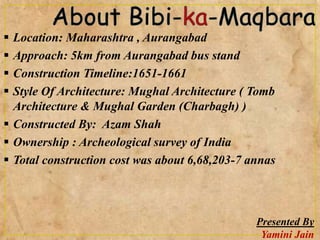
 Location: Maharashtra , Aurangabad
 Approach: 5km from Aurangabad bus stand
 Construction Timeline:1651-1661
 Style Of Architecture: Mughal Architecture ( Tomb
Architecture & Mughal Garden (Charbagh) )
 Constructed By: Azam Shah
 Ownership : Archeological survey of India
 Total construction cost was about 6,68,203-7 annas
Presented By
Yamini Jain
 The Process Through Which The Material, Historical &
Design Integrity Of Humanity's Built Heritage Are
Prolonged Through Carefully Planned Interventions are
known as architectural conservation.
 Conservation process:1.Assesment
2.Treatment
 Assessment is sensitive study of history and merits
 Treatment deals with cleaning and repair of both exteriors
and interiors
 The property or the structure that is or may be
inherited is known as Heritage
 Heritage may refer to-natural Heritage , Cultural
Heritage , Industrial Heritage , Virtual Heritage Etc.
 Cultural Heritage : The legacy of physical artifacts
& intangible attributes of a group or society that are
preserved and conserved for future generations
 Cultural Heritage include tangible cultures ,
intangible cultures & natural culture.
 Indian cultures replicate cultural diversities among
which the one is Mughal culture
 Mughal architecture includes a amalgam of
Islamic , Persian & Indian architecture
 Bibi-ka-Maqbara is one of the Mughal monument
 As Bibi-ka-Maqbara replicate cultural heritage of
Mughal architecture .It is our duty to conserve it and
document it for future generation
 Almost every Mughal emperor has left behind landmarks
in the history of architecture.
 The Bibi-ka-Maqbara is one of the shining example of the
same tradition which is unique in the history of world
architecture.
 It is an important and most impressive monument in
understanding the architectural developments under the
late Mughals showing unique continuity, one of its kinds
in the world.
 Hence it is necessary to conserve this monument for future
generation
• The objective of conservation is to maintain the
significance of the structure or site.
• Significance is constituted in both tangible &
intangible form.
• Conservation of structure & site must retain
meaning for the society in which it exist
 Retain visual identity
 Adaptive reuse
 Restoration
 Replication
 Local material & traditional technology
 Integrated conservation
 sustainability
 The purpose to choose this topic is to study both
tomb architecture & mughal gardens
 To study & compare the differences between Taj
Mahal & Bibi-ka-maqbara
 One of the place attracted by the tourist
 It is necessary to keep a record & document it for
students and future generation as it replicates
ancient cultures & it is one among the national
importance monument
Evolution:
 Ambar Malik-Named As Kharki
 Fateh Khan -Named As Fatehnagar
 Aurangzeb -Named As Aurangabad
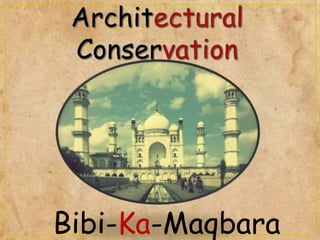
 It is beautiful mausoleum of Dilraz Bano begum
wife of Aurangzeb.
 Constructed by his son between 1651 & 16611ad.
 Main entrance & door was designed & erected by
Ar.Ata Ullah & Hanspat Rai.
 The mausoleum drawn an inspiration from the
world famous Taj Mahal of Agra hence it is known
as Taj Of Deccan.
 Topography: Architectural Plain Land
 Geology : Deccan plateau
 Soil: black cotton soil , Deccan basalt stone
 Vegetation: shady tree
 Hydrology: well drainage
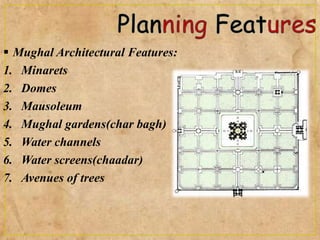
 Mughal Architectural Features:
1. Minarets
2. Domes
3. Mausoleum
4. Mughal gardens(char bagh)
5. Water channels
6. Water screens(chaadar)
7. Avenues of trees
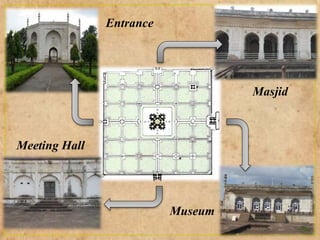
Entrance
Meeting Hall
Museum
Masjid
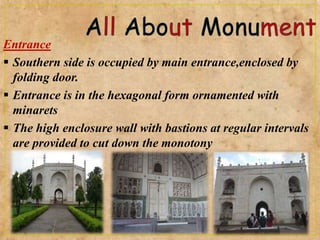
Entrance
 Southern side is occupied by main entrance,enclosed by
folding door.
 Entrance is in the hexagonal form ornamented with
minarets
 The high enclosure wall with bastions at regular intervals
are provided to cut down the monotony
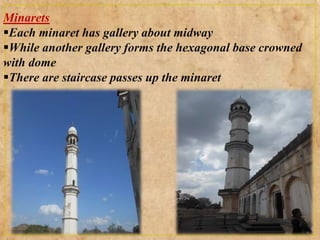
Minarets
Each minaret has gallery about midway
While another gallery forms the hexagonal base crowned
with dome
There are staircase passes up the minaret
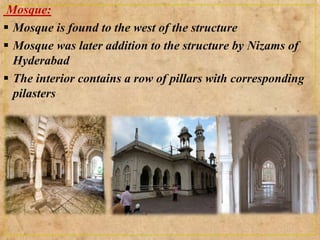
Mosque:
 Mosque is found to the west of the structure
 Mosque was later addition to the structure by Nizams of
Hyderabad
 The interior contains a row of pillars with corresponding
pilasters
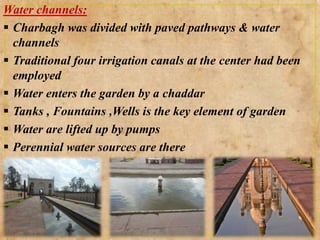
Water channels:
 Charbagh was divided with paved pathways & water
channels
 Traditional four irrigation canals at the center had been
employed
 Water enters the garden by a chaddar
 Tanks , Fountains ,Wells is the key element of garden
 Water are lifted up by pumps
 Perennial water sources are there
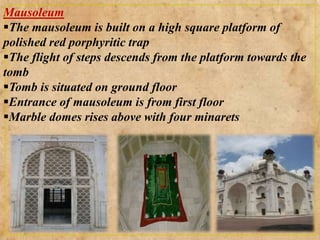
Mausoleum
The mausoleum is built on a high square platform of
polished red porphyritic trap
The flight of steps descends from the platform towards the
tomb
Tomb is situated on ground floor
Entrance of mausoleum is from first floor
Marble domes rises above with four minarets
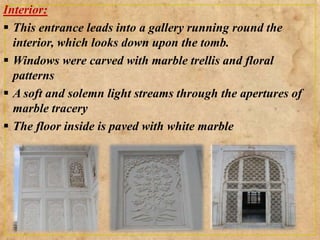
Interior:
 This entrance leads into a gallery running round the
interior, which looks down upon the tomb.
 Windows were carved with marble trellis and floral
patterns
 A soft and solemn light streams through the apertures of
marble tracery
 The floor inside is paved with white marble
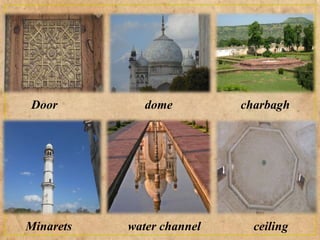
Door dome charbagh
Minarets water channel ceiling
Aesthetic significance –The design of tomb and garden were
treated as one; the setting enhanced the beauty of the
monument.
Economic significance – Tomb garden contains charbagh
pattern, was the Mughal's major unique garden architecture
in this region. Because of this garden majorly contributing
the main role in economic activity of this place.
Educational significance –This garden having its own
planning principal to an understand of both natural &
cultural history of this place, it having potential of many
unique garden information.
Technological significance – The water management-
hydraulic system- providing to the richness charbagh,
represent the highly technology on its period.
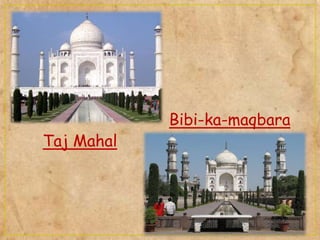
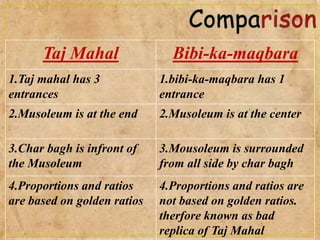
Taj Mahal Bibi-ka-maqbara
1.Taj mahal has 3
entrances
1.bibi-ka-maqbara has 1
entrance
2.Musoleum is at the end 2.Musoleum is at the center
3.Char bagh is infront of
the Musoleum
3.Mousoleum is surrounded
from all side by char bagh
4.Proportions and ratios
are based on golden ratios
4.Proportions and ratios are
not based on golden ratios.
therfore known as bad
replica of Taj Mahal
Taj Mahal
Bibi-ka-maqbara
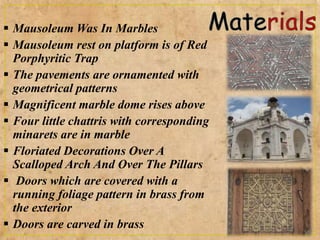
 Mausoleum Was In Marbles
 Mausoleum rest on platform is of Red
Porphyritic Trap
 The pavements are ornamented with
geometrical patterns
 Magnificent marble dome rises above
 Four little chattris with corresponding
minarets are in marble
 Floriated Decorations Over A
Scalloped Arch And Over The Pillars
 Doors which are covered with a
running foliage pattern in brass from
the exterior
 Doors are carved in brass
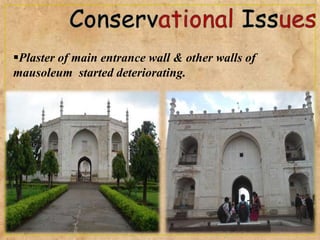
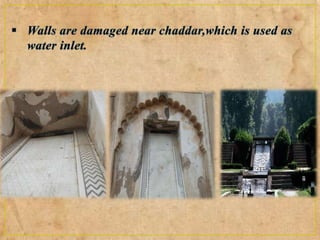
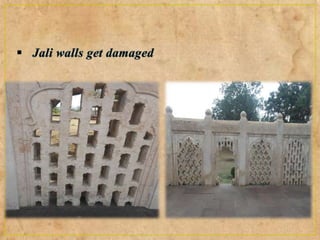
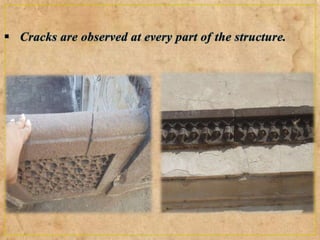
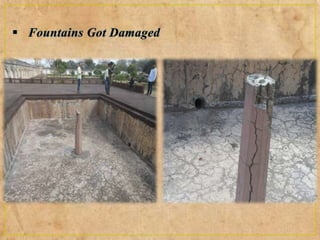
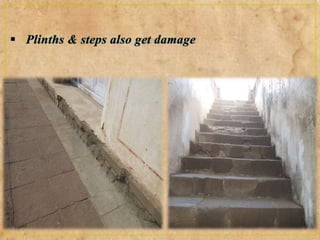
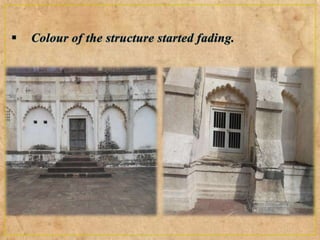
Plaster of main entrance wall & other walls of
mausoleum started deteriorating.
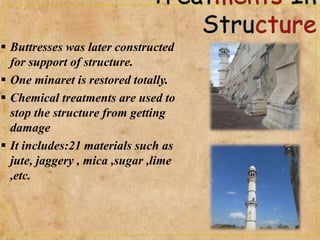
 Buttresses was later constructed
for support of structure.
 One minaret is restored totally.
 Chemical treatments are used to
stop the structure from getting
damage
 It includes:21 materials such as
jute, jaggery , mica ,sugar ,lime
,etc.
 Declared as national importance monument dated on 28th
november 1951
 Classified as A,B,C
Category A:
 World Heritage Sites and those monuments which have
been included in the Tentative list of World Heritage sites
Category B
 Ticketed Monument
Category C
 Monument located in densely populated urban areas and
most sensitive from construction activity point of view
 Google
 On site photographs
 Information given by Archeologist P.G.Deshmukh
 Notes guided by mentor

Documentation on bibi ka-maqbara

  • 1.
  • 2.
    1. About topic 2.About conservation 3. About heritage 4. Need of the topic 5. Aim 6. Objective 7. Goals 8. Justification 9. Evolutional development of Aurangabad 10. Ecological data 11.Planning 12. Garden significance 13. Comparison of Taj Mahal & Bibi-ka-maqbara 14.Materials 15.Issues 16.Treatments 17.Classification 18.Bibliography
  • 3.
     Location: Maharashtra, Aurangabad  Approach: 5km from Aurangabad bus stand  Construction Timeline:1651-1661  Style Of Architecture: Mughal Architecture ( Tomb Architecture & Mughal Garden (Charbagh) )  Constructed By: Azam Shah  Ownership : Archeological survey of India  Total construction cost was about 6,68,203-7 annas Presented By Yamini Jain
  • 4.
     The ProcessThrough Which The Material, Historical & Design Integrity Of Humanity's Built Heritage Are Prolonged Through Carefully Planned Interventions are known as architectural conservation.  Conservation process:1.Assesment 2.Treatment  Assessment is sensitive study of history and merits  Treatment deals with cleaning and repair of both exteriors and interiors
  • 5.
     The propertyor the structure that is or may be inherited is known as Heritage  Heritage may refer to-natural Heritage , Cultural Heritage , Industrial Heritage , Virtual Heritage Etc.  Cultural Heritage : The legacy of physical artifacts & intangible attributes of a group or society that are preserved and conserved for future generations  Cultural Heritage include tangible cultures , intangible cultures & natural culture.
  • 6.
     Indian culturesreplicate cultural diversities among which the one is Mughal culture  Mughal architecture includes a amalgam of Islamic , Persian & Indian architecture  Bibi-ka-Maqbara is one of the Mughal monument  As Bibi-ka-Maqbara replicate cultural heritage of Mughal architecture .It is our duty to conserve it and document it for future generation
  • 7.
     Almost everyMughal emperor has left behind landmarks in the history of architecture.  The Bibi-ka-Maqbara is one of the shining example of the same tradition which is unique in the history of world architecture.  It is an important and most impressive monument in understanding the architectural developments under the late Mughals showing unique continuity, one of its kinds in the world.  Hence it is necessary to conserve this monument for future generation
  • 8.
    • The objectiveof conservation is to maintain the significance of the structure or site. • Significance is constituted in both tangible & intangible form. • Conservation of structure & site must retain meaning for the society in which it exist
  • 9.
     Retain visualidentity  Adaptive reuse  Restoration  Replication  Local material & traditional technology  Integrated conservation  sustainability
  • 10.
     The purposeto choose this topic is to study both tomb architecture & mughal gardens  To study & compare the differences between Taj Mahal & Bibi-ka-maqbara  One of the place attracted by the tourist  It is necessary to keep a record & document it for students and future generation as it replicates ancient cultures & it is one among the national importance monument
  • 11.
    Evolution:  Ambar Malik-NamedAs Kharki  Fateh Khan -Named As Fatehnagar  Aurangzeb -Named As Aurangabad
  • 12.
     It isbeautiful mausoleum of Dilraz Bano begum wife of Aurangzeb.  Constructed by his son between 1651 & 16611ad.  Main entrance & door was designed & erected by Ar.Ata Ullah & Hanspat Rai.  The mausoleum drawn an inspiration from the world famous Taj Mahal of Agra hence it is known as Taj Of Deccan.
  • 13.
     Topography: ArchitecturalPlain Land  Geology : Deccan plateau  Soil: black cotton soil , Deccan basalt stone  Vegetation: shady tree  Hydrology: well drainage
  • 14.
     Mughal ArchitecturalFeatures: 1. Minarets 2. Domes 3. Mausoleum 4. Mughal gardens(char bagh) 5. Water channels 6. Water screens(chaadar) 7. Avenues of trees
  • 15.
  • 16.
    Entrance  Southern sideis occupied by main entrance,enclosed by folding door.  Entrance is in the hexagonal form ornamented with minarets  The high enclosure wall with bastions at regular intervals are provided to cut down the monotony
  • 17.
    Minarets Each minaret hasgallery about midway While another gallery forms the hexagonal base crowned with dome There are staircase passes up the minaret
  • 18.
    Mosque:  Mosque isfound to the west of the structure  Mosque was later addition to the structure by Nizams of Hyderabad  The interior contains a row of pillars with corresponding pilasters
  • 19.
    Water channels:  Charbaghwas divided with paved pathways & water channels  Traditional four irrigation canals at the center had been employed  Water enters the garden by a chaddar  Tanks , Fountains ,Wells is the key element of garden  Water are lifted up by pumps  Perennial water sources are there
  • 20.
    Mausoleum The mausoleum isbuilt on a high square platform of polished red porphyritic trap The flight of steps descends from the platform towards the tomb Tomb is situated on ground floor Entrance of mausoleum is from first floor Marble domes rises above with four minarets
  • 21.
    Interior:  This entranceleads into a gallery running round the interior, which looks down upon the tomb.  Windows were carved with marble trellis and floral patterns  A soft and solemn light streams through the apertures of marble tracery  The floor inside is paved with white marble
  • 22.
    Door dome charbagh Minaretswater channel ceiling
  • 23.
    Aesthetic significance –Thedesign of tomb and garden were treated as one; the setting enhanced the beauty of the monument. Economic significance – Tomb garden contains charbagh pattern, was the Mughal's major unique garden architecture in this region. Because of this garden majorly contributing the main role in economic activity of this place. Educational significance –This garden having its own planning principal to an understand of both natural & cultural history of this place, it having potential of many unique garden information. Technological significance – The water management- hydraulic system- providing to the richness charbagh, represent the highly technology on its period.
  • 24.
    Taj Mahal Bibi-ka-maqbara 1.Tajmahal has 3 entrances 1.bibi-ka-maqbara has 1 entrance 2.Musoleum is at the end 2.Musoleum is at the center 3.Char bagh is infront of the Musoleum 3.Mousoleum is surrounded from all side by char bagh 4.Proportions and ratios are based on golden ratios 4.Proportions and ratios are not based on golden ratios. therfore known as bad replica of Taj Mahal
  • 25.
  • 26.
     Mausoleum WasIn Marbles  Mausoleum rest on platform is of Red Porphyritic Trap  The pavements are ornamented with geometrical patterns  Magnificent marble dome rises above  Four little chattris with corresponding minarets are in marble  Floriated Decorations Over A Scalloped Arch And Over The Pillars  Doors which are covered with a running foliage pattern in brass from the exterior  Doors are carved in brass
  • 27.
    Plaster of mainentrance wall & other walls of mausoleum started deteriorating.
  • 35.
     Buttresses waslater constructed for support of structure.  One minaret is restored totally.  Chemical treatments are used to stop the structure from getting damage  It includes:21 materials such as jute, jaggery , mica ,sugar ,lime ,etc.
  • 36.
     Declared asnational importance monument dated on 28th november 1951  Classified as A,B,C Category A:  World Heritage Sites and those monuments which have been included in the Tentative list of World Heritage sites Category B  Ticketed Monument Category C  Monument located in densely populated urban areas and most sensitive from construction activity point of view
  • 37.
     Google  Onsite photographs  Information given by Archeologist P.G.Deshmukh  Notes guided by mentor