
Dissertation-Report
“RESTORATION IN MODERN CONTEXT”
Dissertation submitted in partial fulfillment for the B.Arch. Degree
CHAPTER 1: INTRODUCTION
-AIM
-OBJECTIVE
CHAPTER 2 : LITERATURE REVIEW
-Conservation of Historic Buildings
-THE ROYAL PALACES OF INDIA
-HISTORIC PRESERVATION: AN INTRODUCTION TO ITS HISTORY, PRINCIPLE
AND PRACTICES
-PALACES OF INDIA: A TRAVELLOR’S COMPANION FEATURING THE PALACE
HOTELS
CHAPTER 3: PALACES IN INDIA
-ANARCHY IN INDIA AND ITS DECLINE
-TYPICAL SPACES IN A PALACE
-BUILDING SPACES
-AESTHETIC
-ELEMENTS OF RAJASTHANI ARCHITECTURE
-THE ELEMENTS
-HAVELI
-GUIDELINES FOR CLASSIFICATION OF HERITAGE HOTELS
CHAPTER 4:CONSERVATION AND ITS APPROACH
-INTRODUCTION
-HISTORY OF THE ARCHITECTURAL CONSERVATION MOVEMENT
-VALUES IN CONSERVATION
-ETHICS OF CONSERVATION
-DEGREE OF INTERVENTION
-NEED FOR RESTORATION, REHABILITATION AND PRESERVATION
HERITAGE BUILDINGS
-STANDARDS FOR RESTORATION
-THE ARCHAEOLOGICAL SURVEY OF INDIA
-LEGISLATIONS
CHAPTER 5: CASE STUDIES
-NEEMRANA FORT-PALACES,JAIPUR-DELHI HIGHWAY
-JAG NIWAS MANDIR,UDAIPUR
CHAPTER 6: CONCLUSIONS
-AN OBVIOUS SOLUTION
- COMMERCIAL DEVELOPMENTOF HERITAGE HOTELS
-ADAPTABILITY AND RE-USE
-NEGATIVE EFFECTS
1. Conservation of Heritage buildings of the past for the benefit of the future.
2. They are the representatives of our culture our civilization our history our
tradition,etc.
3. Heritage buildings reveal the development of a consistent architectural style:
palace/haveli architectural style shows an amalgamation of various indigenous
and imported style.
4. In my study I have tried to show the reuse of abandoned Heritage buildings in
such a developing country like ours, conserving and restoring these structures
are a huge task because of extensive allocation of funds.
5. Because of such issues by the government public private and international
Institutions such as Aga Khan trust have taken bold initiatives to lend definite
erections in the Restoration process.
6. Art and architecture to vital and authentic links that relate us of our ancestors.
CHAPTER 1: INTRODUCTION
AIMS:
To emphasis on ways to restore Forts and Palaces into hotels considering the structural, cultural and
economic aspects.
OBJECTIVE:
•To study the character and cultural identity of the heritage building and its effects on the restoration process.
•To analyze these places and determine how the essence of these spaces is manifested architecturally.
•To study the elements of these built forms in order to propose methods to preserve or reproduce it.
•To study adaptation and reuse of the building and changes in these built form brought about by the
transformation.
•To study the role of tourism in conservation.
•To study the parameters of reuse and restoration of a historical building into hotel.
SCOPE:
For the ease of study, only palaces from the north-western region of India have been discussed.
METHODOLOGY:
Literature Survey
Case Studies
Analysis and conclusion
Documentation
CHAPTER 2 : LITERATURE REVIEW
“CONSERVATION OF HISTORIC BUILDINGS.”
By Bernard M. Feilden Third edition 2003
•Heritage conservation doesn't mean freezing a building in time, creating a museum or tying the hands of property
owners so they can't do anything with their properties.
•Instead, it seeks to maintain and thereby increase the value of buildings by keeping their original built form and
architectural elements, favouring their restoration rather than replacement and, when restoration is impossible,
recreating scale, period and character.
•Heritage Conservation provides concrete benefits to property owners, to businesses and to the community as a
whole:
Heritage preservation and designation increases property values.
•Heritage preservation can be a draw to tourism and helps businesses attract customers.
•Restoration keeps money within the community.
•With the right programs in place, businesses and building owners can take advantage of government programs and
incentives to maintain and restore heritage buildings.
•Restoration reduces construction and demolition waste and uses less than half the energy of new construction.
•Heritage preservation is an investment in our community that rewards us today and leaves an invaluable resource for
future generations.
“THE ROYAL PALACES OF INDIA”
George Michell Antonio Martinell
•In-depth survey of Indian palaces.
•George Michell, a recognized authority on Indian architecture and art, evokes life within these complexes and
describes their many elements: defences; spacious courtyards; temples and mosques; private apartments and
service quarters.
•The oldest surviving are those erected by the Muslim conquerors.
•In the north, the Mughals built vast imperial palace-cities at Fatehpur Sikri, Agra and Delhi.
•The Hindu and Rajputs in Central and Western India.
•Gwalior, Udaipur and Amber.
•Chandragiri and the breezy timber halls of Padmanabhapuram.
•By the British domination, such as Mysore, Baroda and Morvi.
7
8
“HISTORIC PRESERVATION: AN INTRODUCTION TO ITS HISTORY, PRINCIPLES, AND PRACTICES"
By Norman Tyler
•Overview of the theory, technique, and procedure for preserving our architectural heritage.
•covers preservation philosophy, the history of the movement.
•The designation and documentation of historic structures, establishing a historic district, architectural styles,
sensitive architectural design and planning, preservation technology, and the economics of building
rehabilitation.
PALACES OF INDIA: A TRAVELLER'S COMPANION FEATURING THE PALACE HOTELS
By MichaelSugich
•an elegant and idiosyncratic charm. Tourist attractions in their own right..
9
CHAPTER 3: PALACES IN INDIA
3.1. ANARCHY IN INDIA AND ITS DECLINE
•The abode of nobility- where hospitality was a way of life.
•Visitors, guests,even strangers were welcomed in a tradition that was a part of the life styles.
•Post-independence democratic India witnessed immediate loss of revenue, power, prestige and purpose, maintenance
became a major problem.
•The abandonment of these princely palaces and forts became a major issue.
•Till a few enterprising pioneers realized that, the only way to maintain these historic homes was their appropriate
reuse, in the form of Heritage Hotels.
•There are two main phases in the palace building in India : The Mughal and the British.
10
3.2. TYPICAL SPACES IN A PALACE
• MARDAN
• ZENANA
• STABLES
• WATER RESERVOIRS
• MINISTERS RESIDENCES
3.3. BUILDING BLOCKS
•MATERIALS: Stone, Sandstone and Marble found in the Aravalli Ranges.
•The walls are rubble faced with plaster and paints.
•Ornamented with elaborate bracket and corbels.
•Chhatris,Jharokhas, domes and arches ,Cusped arch and Bangaldar roof as predominant features of this area.
3.4. AESTHETICS
•System of order and symmetry.
•Fusion of loose pattern and free forces.
•Walls are contiguous.
•The walls,ceilings and floors are painted.
3.5. ELEMENTS OF RAJASTHANI ARCHITECTURE:
1.JHAROKHA -Overhanging enclosed balcony
2.CHHATRIS -Elevated, dome-shaped pavilions
3.HAVELI -Enclosed place
4. JALI OR JAALI- Perforated stone or latticed screen
5. JOHAD-A rainwater storage tank
6. STEPWELL -Bawdi or baoli is a step down pond or
8. ARCH -Curved structure that spans a space
9. DIWAN-I-KHAS-Hall of private audiences
10.DIWAN-I-AM-Hall of audience
11. HAMMAM -large hall and the stone benches
12. BRACKET -Architectural element a structural or decorative member
12. CHOWK -A central space of gathering that has four corner
13. CHAUBARAS -Four openings
14. KOTHA -Corner rooms or other small rooms in the haveli
15. ZENANA -Pertaining to women
16.PARINDA –A small enclosure near staircase
17. TALGHAR - Aecret place to store the valuables like cash and gold coins
18. POL - Entrance lobby space
19. OHRA OR OVARO – Storage areas.
3.6. THE ELEMENTS:
ELEMENTS OF HORIZONTAL DEMARCATION:
ELEMENTS OF VERTICAL DEMARCATION
DECORATIVE ELEMENTS
12
3.7. HAVELI
MEANING OF HAVELI
•The origin of the word is traced to ‘haowala’ meaning partition in old arabic. The meaning of Haveli
translated from Persian it means “enclosed place” or other translations come out with “palace” or “private
mansion”.
•Haveli, a multi-storeyed building with rooms facing an inner courtyard or a system of courtyards.
•They are generally built of red sandstone or brick with lime mortar.
•The haveli principle was developed to contend with the extreme climate and to satisfy perse socio cultural
requirements.
•Divides havelis into two broad categories
•Brahmins & Rajput Marwari
•The former is asymmetric, non-axial, less ornate and more
sprawled out. Thesecond category is with a regular square,
rectangular plots, symmetric and with axial planning and greater
ornamentation.
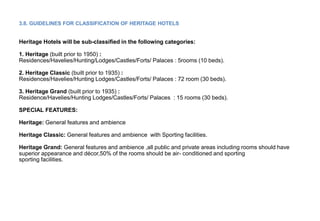
3.8. GUIDELINES FOR CLASSIFICATION OF HERITAGE HOTELS
Heritage Hotels will be sub-classified in the following categories:
1. Heritage (built prior to 1950) :
Residences/Havelies/Hunting/Lodges/Castles/Forts/ Palaces : 5rooms (10 beds).
2. Heritage Classic (built prior to 1935) :
Residences/Havelies/Hunting Lodges/Castles/Forts/ Palaces : 72 room (30 beds).
3. Heritage Grand (built prior to 1935) :
Residence/Havelies/Hunting Lodges/Castles/Forts/ Palaces : 15 rooms (30 beds).
SPECIAL FEATURES:
Heritage: General features and ambience
Heritage Classic: General features and ambience with Sporting facilities.
Heritage Grand: General features and ambience ,all public and private areas including rooms should have
superior appearance and décor,50% of the rooms should be air- conditioned and sporting
sporting facilities.
SPORTING FACILITIES:
Swimming Pool, Health Club, Lawn Tennis, squash, Riding, Golf Course
Golf, Boating, Sailing, Fishing or other adventure sports such as Ballooning, Parasailing, Wind-surfing, Safari
excursions, Trekking etc. and indoor games.
CUSINE:
Heritage: Traditional cuisine
Heritage Classic: Traditional cuisine but should have 4 to 5 items
continental cuisine.
Heritage Grand: Traditional and continental cuisine.
MANAGEMENT:
Managed and run by the owning family and/or professionals.
GENERAL FEATURES:
-Adequate parking space for cars.
-Room should be well maintained and well equipped with quality carpets/area rugs/good quality duries,
furniture, fittings etc.
-Clean, airy, pest free without dampness and musty odour, and of reasonably large size with attached
bathrooms with modern facilities
-Well appointed lobby and/or lounge equipped with furniture of high standard with separate ladies and gents
cloak rooms with good fittings.
CHAPTER 4: CONSERVATION AND ITS APPROACH
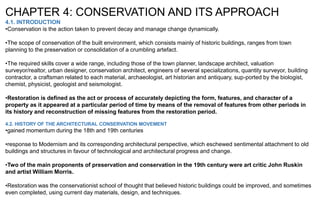
4.1. INTRODUCTION
•Conservation is the action taken to prevent decay and manage change dynamically.
•The scope of conservation of the built environment, which consists mainly of historic buildings, ranges from town
planning to the preservation or consolidation of a crumbling artefact.
•The required skills cover a wide range, including those of the town planner, landscape architect, valuation
surveyor/realtor, urban designer, conservation architect, engineers of several specializations, quantity surveyor, building
contractor, a craftsman related to each material, archaeologist, art historian and antiquary, sup-ported by the biologist,
chemist, physicist, geologist and seismologist.
•Restoration is defined as the act or process of accurately depicting the form, features, and character of a
property as it appeared at a particular period of time by means of the removal of features from other periods in
its history and reconstruction of missing features from the restoration period.
4.2. HISTORY OF THE ARCHITECTURAL CONSERVATION MOVEMENT
•gained momentum during the 18th and 19th centuries
•response to Modernism and its corresponding architectural perspective, which eschewed sentimental attachment to old
buildings and structures in favour of technological and architectural progress and change.
•Two of the main proponents of preservation and conservation in the 19th century were art critic John Ruskin
and artist William Morris.
•Restoration was the conservationist school of thought that believed historic buildings could be improved, and sometimes
even completed, using current day materials, design, and techniques.
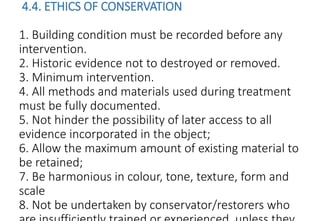
4.4. ETHICS OF CONSERVATION
1. Building condition must be recorded before any
intervention.
2. Historic evidence not to destroyed or removed.
3. Minimum intervention.
4. All methods and materials used during treatment
must be fully documented.
5. Not hinder the possibility of later access to all
evidence incorporated in the object;
6. Allow the maximum amount of existing material to
be retained;
7. Be harmonious in colour, tone, texture, form and
scale
8. Not be undertaken by conservator/restorers who
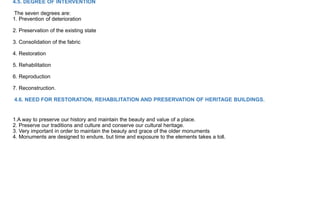
4.5. DEGREE OF INTERVENTION
The seven degrees are:
1. Prevention of deterioration
2. Preservation of the existing state
3. Consolidation of the fabric
4. Restoration
5. Rehabilitation
6. Reproduction
7. Reconstruction.
4.6. NEED FOR RESTORATION, REHABILITATION AND PRESERVATION OF HERITAGE BUILDINGS.
1.A way to preserve our history and maintain the beauty and value of a place.
2. Preserve our traditions and culture and conserve our cultural heritage.
3. Very important in order to maintain the beauty and grace of the older monuments
4. Monuments are designed to endure, but time and exposure to the elements takes a toll.
4.7. STANDARDS FOR RESTORATION
1. Each property will be recognized as a physical record of its time, place, and use.
2. Designs that were never executed historically will not be constructed.
3. Distinctive materials, features, finishes, and construction techniques or examples of craftsmanship that characterize
the restoration period will be preserved.
4. Materials and features from the restoration period will be retained and preserved.
period will be repaired rather than replaced.
5. Replacement of missing features will be substantiated by documentary and physical evidence.
6. Chemical or physical treatments will be undertaken using the gentlest means possible.
7. Archeological resources affected by a project will be protected and preserved in place.
8. Materials, features, spaces, and finishes that characterize other historical periods will be documented prior to their
alteration or removal.
4.8. THE ARCHAEOLOGICAL SURVEY OF INDIA
1. The Archaeological Survey of India (ASl), is the premier organization for the archaeological researches and
protection of the cultural heritage of the nation. Maintenance of ancient monuments and archaeological sites and
remains of national importance is the prime concern of the ASI.
2. The organization has a large work force of trained archaeologists, conservators, epigraphist, architects and scientists
for conducting archaeological research projects.
CHAPTER 5: CASE STUDIES
5.1. NEEMRANA FORT PALACE:
5.1. 1. INTRODUCTION
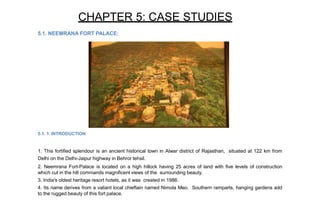
1. This fortified splendour is an ancient historical town in Alwar district of Rajasthan, situated at 122 km from
Delhi on the Delhi-Jaipur highway in Behror tehsil.
2. Neemrana Fort-Palace is located on a high hillock having 25 acres of land with five levels of construction
which cut in the hill commands magnificent views of the surrounding beauty.
3. India's oldest heritage resort hotels, as it was created in 1986.
4. Its name derives from a valiant local chieftain named Nimola Meo. Southern ramparts, hanging gardens add
to the rugged beauty of this fort palace.
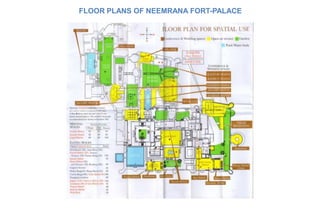
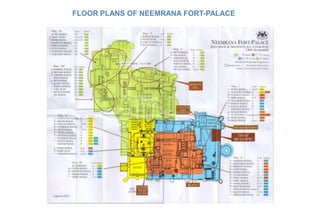
FLOOR PLANS OF NEEMRANA FORT-PALACE
5.1. 2. HISTORICAL CONTEXT
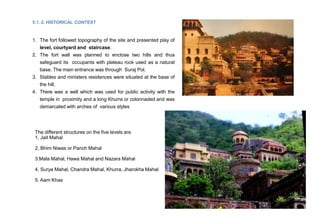
1. The fort followed topography of the site and presented play of
level, courtyard and staircase.
2. The fort wall was planned to enclose two hills and thus
safeguard its occupants with plateau rock used as a natural
base. The main entrance was through Suraj Pol.
3. Stables and ministers residences were situated at the base of
the hill.
4. There was a well which was used for public activity with the
temple in proximity and a long Khurra or colonnaded and was
demarcated with arches of various styles
The different structures on the five levels are
1. Jait Mahal
2. Bhim Niwas or Panch Mahal
3.Mala Mahal, Hawa Mahal and Nazara Mahal
4. Surya Mahal, Chandra Mahal, Khurra, Jharokha Mahal
5. Aam Khas
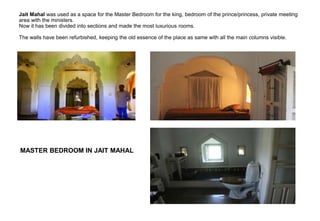
Jait Mahal was used as a space for the Master Bedroom for the king, bedroom of the prince/princess, private meeting
area with the ministers.
Now it has been divided into sections and made the most luxurious rooms.
The walls have been refurbished, keeping the old essence of the place as same with all the main columns visible.
MASTER BEDROOM IN JAIT MAHAL
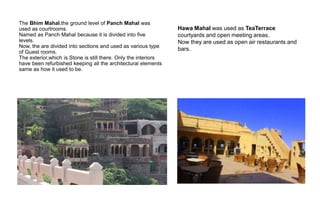
The Bhim Mahal,the ground level of Panch Mahal was
used as courtrooms.
Named as Panch Mahal because it is divided into five
levels.
Now, the are divided into sections and used as various type
of Guest rooms.
The exterior,which is Stone is still there. Only the interiors
have been refurbished keeping all the architectural elements
same as how it used to be.
Hawa Mahal was used as TeaTerrace
courtyards and open meeting areas.
Now they are used as open air restaurants and
bars.
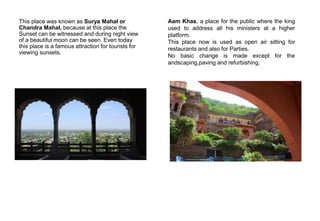
This place was known as Surya Mahal or
Chandra Mahal, because at this place the
Sunset can be witnessed and during night view
of a beautiful moon can be seen. Even today
this place is a famous attraction for tourists for
viewing sunsets.
Aam Khas, a place for the public where the king
used to address all his ministers at a higher
platform.
This place now is used as open air sitting for
restaurants and also for Parties.
No basic change is made except for the
andscaping,paving and refurbishing.
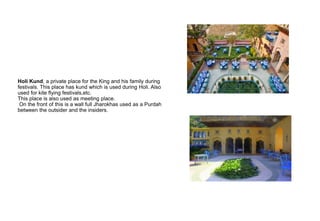
Holi Kund, a private place for the King and his family during
festivals. This place has kund which is used during Holi. Also
used for kite flying festivals,etc.
This place is also used as meeting place.
On the front of this is a wall full Jharokhas used as a Purdah
between the outsider and the insiders.
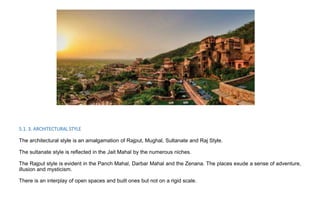
5.1. 3. ARCHITECTURAL STYLE
The architectural style is an amalgamation of Rajput, Mughal, Sultanate and Raj Style.
The sultanate style is reflected in the Jait Mahal by the numerous niches.
The Rajput style is evident in the Panch Mahal, Darbar Mahal and the Zenana. The places exude a sense of adventure,
illusion and mysticism.
There is an interplay of open spaces and built ones but not on a rigid scale.
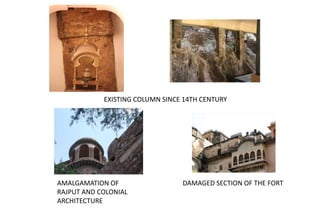
EXISTING COLUMN SINCE 14TH CENTURY
AMALGAMATION OF
RAJPUT AND COLONIAL
ARCHITECTURE
DAMAGED SECTION OF THE FORT
5.1.4. PRESENT SCENARIO
The restoration process was done in stages:
-The first phase started in 1990 where Suraj Pol, Tea Terrace and the Tulsi Chowk were restored.
-The second phase started in 1991 with work done on Holi Kund, Aam Khas and Panch Mahal.
- Today, there exist 72 rooms, 4 dining halls, a French restaurant, a Japanese Restaurant, a conference room and
terraces.
- The upper level rooms of Jai Mahal adorning the corners as the masonry suggested relate to the scale of the
courtyard.
- The removal of rubble- stone, mud and building elements cleared drainage.
5.1.5. RESTORATION AND REBUILDING
1. The Kalash were replicated from stone and grouted on the top.
2. Kangaroos were made of cement mortar and small pieces of bricks and wooden template.
3. Jalis of Sheesh Mahal were built using Berla stone from Alwar district.
4. Reproduction of elements was done to replace broken arches, columns and brackets.
5. Cleaning and lime was ensured preservation.
6. Stone construction was used on fluted columns, low parapets, curvaceous brackets, bungree and a rather bulky
dome in masonry.
7. Half the brackets of Tulsi Chowk were missing ,Existing brackets of 17 pieces each were replicated to complete the
overhanging balcony.
5.2. JAG NIWAS PALACE
5.2.1. INTRODUCTION
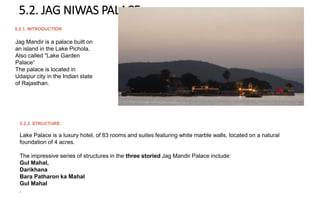
Jag Mandir is a palace built on
an island in the Lake Pichola.
Also called "Lake Garden
Palace“
The palace is located in
Udaipur city in the Indian state
of Rajasthan.
5.2.2. STRUCTURE:
Lake Palace is a luxury hotel, of 83 rooms and suites featuring white marble walls, located on a natural
foundation of 4 acres.
The impressive series of structures in the three storied Jag Mandir Palace include:
Gul Mahal,
Darikhana
Bara Patharon ka Mahal
Gul Mahal
.
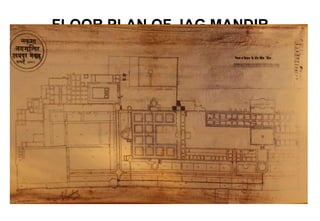
FLOOR PLAN OF JAG MANDIR
PALACE
Gul Mahal
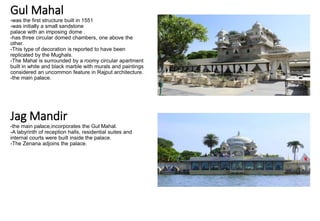
-was the first structure built in 1551
-was initially a small sandstone
palace with an imposing dome .
-has three circular domed chambers, one above the
other.
-This type of decoration is reported to have been
replicated by the Mughals.
-The Mahal is surrounded by a roomy circular apartment
built in white and black marble with murals and paintings
considered an uncommon feature in Rajput architecture.
-the main palace.
Jag Mandir
-the main palace,incorporates the Gul Mahal.
-A labyrinth of reception halls, residential suites and
internal courts were built inside the palace.
-The Zenana adjoins the palace.
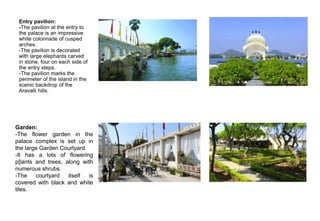
Entry pavilion:
-The pavilion at the entry to
the palace is an impressive
white colonnade of cusped
arches.
-The pavilion is decorated
with large elephants carved
in stone, four on each side of
the entry steps.
-The pavilion marks the
perimeter of the island in the
scenic backdrop of the
Aravalli hills.
Garden:
-The flower garden in the
palace complex is set up in
the large Garden Courtyard.
-It has a lots of flowering
p[lants and trees, along with
numerous shrubs.
-The courtyard itself is
covered with black and white
tiles.
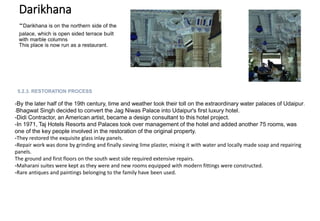
Darikhana
-Darikhana is on the northern side of the
palace, which is open sided terrace built
with marble columns
This place is now run as a restaurant.
5.2.3. RESTORATION PROCESS
-By the later half of the 19th century, time and weather took their toll on the extraordinary water palaces of Udaipur.
-Bhagwat Singh decided to convert the Jag Niwas Palace into Udaipur's first luxury hotel.
-Didi Contractor, an American artist, became a design consultant to this hotel project.
-In 1971, Taj Hotels Resorts and Palaces took over management of the hotel and added another 75 rooms, was
one of the key people involved in the restoration of the original property.
-They restored the exquisite glass inlay panels.
-Repair work was done by grinding and finally sieving lime plaster, mixing it with water and locally made soap and repairing
panels.
The ground and first floors on the south west side required extensive repairs.
-Maharani suites were kept as they were and new rooms equipped with modern fittings were constructed.
-Rare antiques and paintings belonging to the family have been used.
CHAPTER 6: CONCLUSIONS
6.1. AN OBVIOUS SOLUTION
-After independence in 1947 , the property belonging to theses royal palaces were reduces considerably and all that
remained of their landholdings were forts and palaces.
-Their large castles and mansions lay almost abandoned or unattended till a few enterprising pioneers realised that perhaps
the only way to maintain these historic homes was their appropriate reuse.
-Old buildings often outlive their original purpose. Adaptive reuse retains their historic features.
-These palaces continue to sustain without electricity or drainage. By handing over these structures to hotel giants we give
them opportunities to flourish with all amenities.
-Reuse of such palaces and hotels generates the best financial returns. It becomes economically viable and also stays
consistent with the historic forms and character of the building.
6.2. COMMERCIAL DEVELOPMENT OF HERITAGE HOTELS
6.3. ADAPTABILITY AND RE-USE
6.4. NEGATIVE EFFECTS

“RESTORATION IN MODERN CONTEXT”

  • 1.
    Dissertation-Report “RESTORATION IN MODERNCONTEXT” Dissertation submitted in partial fulfillment for the B.Arch. Degree
  • 2.
    CHAPTER 1: INTRODUCTION -AIM -OBJECTIVE CHAPTER2 : LITERATURE REVIEW -Conservation of Historic Buildings -THE ROYAL PALACES OF INDIA -HISTORIC PRESERVATION: AN INTRODUCTION TO ITS HISTORY, PRINCIPLE AND PRACTICES -PALACES OF INDIA: A TRAVELLOR’S COMPANION FEATURING THE PALACE HOTELS CHAPTER 3: PALACES IN INDIA -ANARCHY IN INDIA AND ITS DECLINE -TYPICAL SPACES IN A PALACE -BUILDING SPACES -AESTHETIC -ELEMENTS OF RAJASTHANI ARCHITECTURE -THE ELEMENTS -HAVELI -GUIDELINES FOR CLASSIFICATION OF HERITAGE HOTELS
  • 3.
    CHAPTER 4:CONSERVATION ANDITS APPROACH -INTRODUCTION -HISTORY OF THE ARCHITECTURAL CONSERVATION MOVEMENT -VALUES IN CONSERVATION -ETHICS OF CONSERVATION -DEGREE OF INTERVENTION -NEED FOR RESTORATION, REHABILITATION AND PRESERVATION HERITAGE BUILDINGS -STANDARDS FOR RESTORATION -THE ARCHAEOLOGICAL SURVEY OF INDIA -LEGISLATIONS CHAPTER 5: CASE STUDIES -NEEMRANA FORT-PALACES,JAIPUR-DELHI HIGHWAY -JAG NIWAS MANDIR,UDAIPUR CHAPTER 6: CONCLUSIONS -AN OBVIOUS SOLUTION - COMMERCIAL DEVELOPMENTOF HERITAGE HOTELS -ADAPTABILITY AND RE-USE -NEGATIVE EFFECTS
  • 4.
    1. Conservation ofHeritage buildings of the past for the benefit of the future. 2. They are the representatives of our culture our civilization our history our tradition,etc. 3. Heritage buildings reveal the development of a consistent architectural style: palace/haveli architectural style shows an amalgamation of various indigenous and imported style. 4. In my study I have tried to show the reuse of abandoned Heritage buildings in such a developing country like ours, conserving and restoring these structures are a huge task because of extensive allocation of funds. 5. Because of such issues by the government public private and international Institutions such as Aga Khan trust have taken bold initiatives to lend definite erections in the Restoration process. 6. Art and architecture to vital and authentic links that relate us of our ancestors. CHAPTER 1: INTRODUCTION
  • 5.
    AIMS: To emphasis onways to restore Forts and Palaces into hotels considering the structural, cultural and economic aspects. OBJECTIVE: •To study the character and cultural identity of the heritage building and its effects on the restoration process. •To analyze these places and determine how the essence of these spaces is manifested architecturally. •To study the elements of these built forms in order to propose methods to preserve or reproduce it. •To study adaptation and reuse of the building and changes in these built form brought about by the transformation. •To study the role of tourism in conservation. •To study the parameters of reuse and restoration of a historical building into hotel. SCOPE: For the ease of study, only palaces from the north-western region of India have been discussed. METHODOLOGY: Literature Survey Case Studies Analysis and conclusion Documentation
  • 6.
    CHAPTER 2 :LITERATURE REVIEW “CONSERVATION OF HISTORIC BUILDINGS.” By Bernard M. Feilden Third edition 2003 •Heritage conservation doesn't mean freezing a building in time, creating a museum or tying the hands of property owners so they can't do anything with their properties. •Instead, it seeks to maintain and thereby increase the value of buildings by keeping their original built form and architectural elements, favouring their restoration rather than replacement and, when restoration is impossible, recreating scale, period and character. •Heritage Conservation provides concrete benefits to property owners, to businesses and to the community as a whole: Heritage preservation and designation increases property values. •Heritage preservation can be a draw to tourism and helps businesses attract customers. •Restoration keeps money within the community. •With the right programs in place, businesses and building owners can take advantage of government programs and incentives to maintain and restore heritage buildings. •Restoration reduces construction and demolition waste and uses less than half the energy of new construction. •Heritage preservation is an investment in our community that rewards us today and leaves an invaluable resource for future generations.
  • 7.
    “THE ROYAL PALACESOF INDIA” George Michell Antonio Martinell •In-depth survey of Indian palaces. •George Michell, a recognized authority on Indian architecture and art, evokes life within these complexes and describes their many elements: defences; spacious courtyards; temples and mosques; private apartments and service quarters. •The oldest surviving are those erected by the Muslim conquerors. •In the north, the Mughals built vast imperial palace-cities at Fatehpur Sikri, Agra and Delhi. •The Hindu and Rajputs in Central and Western India. •Gwalior, Udaipur and Amber. •Chandragiri and the breezy timber halls of Padmanabhapuram. •By the British domination, such as Mysore, Baroda and Morvi. 7
  • 8.
    8 “HISTORIC PRESERVATION: ANINTRODUCTION TO ITS HISTORY, PRINCIPLES, AND PRACTICES" By Norman Tyler •Overview of the theory, technique, and procedure for preserving our architectural heritage. •covers preservation philosophy, the history of the movement. •The designation and documentation of historic structures, establishing a historic district, architectural styles, sensitive architectural design and planning, preservation technology, and the economics of building rehabilitation. PALACES OF INDIA: A TRAVELLER'S COMPANION FEATURING THE PALACE HOTELS By MichaelSugich •an elegant and idiosyncratic charm. Tourist attractions in their own right..
  • 9.
    9 CHAPTER 3: PALACESIN INDIA 3.1. ANARCHY IN INDIA AND ITS DECLINE •The abode of nobility- where hospitality was a way of life. •Visitors, guests,even strangers were welcomed in a tradition that was a part of the life styles. •Post-independence democratic India witnessed immediate loss of revenue, power, prestige and purpose, maintenance became a major problem. •The abandonment of these princely palaces and forts became a major issue. •Till a few enterprising pioneers realized that, the only way to maintain these historic homes was their appropriate reuse, in the form of Heritage Hotels. •There are two main phases in the palace building in India : The Mughal and the British.
  • 10.
    10 3.2. TYPICAL SPACESIN A PALACE • MARDAN • ZENANA • STABLES • WATER RESERVOIRS • MINISTERS RESIDENCES 3.3. BUILDING BLOCKS •MATERIALS: Stone, Sandstone and Marble found in the Aravalli Ranges. •The walls are rubble faced with plaster and paints. •Ornamented with elaborate bracket and corbels. •Chhatris,Jharokhas, domes and arches ,Cusped arch and Bangaldar roof as predominant features of this area. 3.4. AESTHETICS •System of order and symmetry. •Fusion of loose pattern and free forces. •Walls are contiguous. •The walls,ceilings and floors are painted.
  • 11.
    3.5. ELEMENTS OFRAJASTHANI ARCHITECTURE: 1.JHAROKHA -Overhanging enclosed balcony 2.CHHATRIS -Elevated, dome-shaped pavilions 3.HAVELI -Enclosed place 4. JALI OR JAALI- Perforated stone or latticed screen 5. JOHAD-A rainwater storage tank 6. STEPWELL -Bawdi or baoli is a step down pond or 8. ARCH -Curved structure that spans a space 9. DIWAN-I-KHAS-Hall of private audiences 10.DIWAN-I-AM-Hall of audience 11. HAMMAM -large hall and the stone benches 12. BRACKET -Architectural element a structural or decorative member 12. CHOWK -A central space of gathering that has four corner 13. CHAUBARAS -Four openings 14. KOTHA -Corner rooms or other small rooms in the haveli 15. ZENANA -Pertaining to women 16.PARINDA –A small enclosure near staircase 17. TALGHAR - Aecret place to store the valuables like cash and gold coins 18. POL - Entrance lobby space 19. OHRA OR OVARO – Storage areas. 3.6. THE ELEMENTS: ELEMENTS OF HORIZONTAL DEMARCATION: ELEMENTS OF VERTICAL DEMARCATION DECORATIVE ELEMENTS
  • 12.
    12 3.7. HAVELI MEANING OFHAVELI •The origin of the word is traced to ‘haowala’ meaning partition in old arabic. The meaning of Haveli translated from Persian it means “enclosed place” or other translations come out with “palace” or “private mansion”. •Haveli, a multi-storeyed building with rooms facing an inner courtyard or a system of courtyards. •They are generally built of red sandstone or brick with lime mortar. •The haveli principle was developed to contend with the extreme climate and to satisfy perse socio cultural requirements. •Divides havelis into two broad categories •Brahmins & Rajput Marwari •The former is asymmetric, non-axial, less ornate and more sprawled out. Thesecond category is with a regular square, rectangular plots, symmetric and with axial planning and greater ornamentation.
  • 13.
    3.8. GUIDELINES FORCLASSIFICATION OF HERITAGE HOTELS Heritage Hotels will be sub-classified in the following categories: 1. Heritage (built prior to 1950) : Residences/Havelies/Hunting/Lodges/Castles/Forts/ Palaces : 5rooms (10 beds). 2. Heritage Classic (built prior to 1935) : Residences/Havelies/Hunting Lodges/Castles/Forts/ Palaces : 72 room (30 beds). 3. Heritage Grand (built prior to 1935) : Residence/Havelies/Hunting Lodges/Castles/Forts/ Palaces : 15 rooms (30 beds). SPECIAL FEATURES: Heritage: General features and ambience Heritage Classic: General features and ambience with Sporting facilities. Heritage Grand: General features and ambience ,all public and private areas including rooms should have superior appearance and décor,50% of the rooms should be air- conditioned and sporting sporting facilities.
  • 14.
    SPORTING FACILITIES: Swimming Pool,Health Club, Lawn Tennis, squash, Riding, Golf Course Golf, Boating, Sailing, Fishing or other adventure sports such as Ballooning, Parasailing, Wind-surfing, Safari excursions, Trekking etc. and indoor games. CUSINE: Heritage: Traditional cuisine Heritage Classic: Traditional cuisine but should have 4 to 5 items continental cuisine. Heritage Grand: Traditional and continental cuisine. MANAGEMENT: Managed and run by the owning family and/or professionals. GENERAL FEATURES: -Adequate parking space for cars. -Room should be well maintained and well equipped with quality carpets/area rugs/good quality duries, furniture, fittings etc. -Clean, airy, pest free without dampness and musty odour, and of reasonably large size with attached bathrooms with modern facilities -Well appointed lobby and/or lounge equipped with furniture of high standard with separate ladies and gents cloak rooms with good fittings.
  • 15.
    CHAPTER 4: CONSERVATIONAND ITS APPROACH 4.1. INTRODUCTION •Conservation is the action taken to prevent decay and manage change dynamically. •The scope of conservation of the built environment, which consists mainly of historic buildings, ranges from town planning to the preservation or consolidation of a crumbling artefact. •The required skills cover a wide range, including those of the town planner, landscape architect, valuation surveyor/realtor, urban designer, conservation architect, engineers of several specializations, quantity surveyor, building contractor, a craftsman related to each material, archaeologist, art historian and antiquary, sup-ported by the biologist, chemist, physicist, geologist and seismologist. •Restoration is defined as the act or process of accurately depicting the form, features, and character of a property as it appeared at a particular period of time by means of the removal of features from other periods in its history and reconstruction of missing features from the restoration period. 4.2. HISTORY OF THE ARCHITECTURAL CONSERVATION MOVEMENT •gained momentum during the 18th and 19th centuries •response to Modernism and its corresponding architectural perspective, which eschewed sentimental attachment to old buildings and structures in favour of technological and architectural progress and change. •Two of the main proponents of preservation and conservation in the 19th century were art critic John Ruskin and artist William Morris. •Restoration was the conservationist school of thought that believed historic buildings could be improved, and sometimes even completed, using current day materials, design, and techniques.
  • 16.
    4.4. ETHICS OFCONSERVATION 1. Building condition must be recorded before any intervention. 2. Historic evidence not to destroyed or removed. 3. Minimum intervention. 4. All methods and materials used during treatment must be fully documented. 5. Not hinder the possibility of later access to all evidence incorporated in the object; 6. Allow the maximum amount of existing material to be retained; 7. Be harmonious in colour, tone, texture, form and scale 8. Not be undertaken by conservator/restorers who
  • 17.
    4.5. DEGREE OFINTERVENTION The seven degrees are: 1. Prevention of deterioration 2. Preservation of the existing state 3. Consolidation of the fabric 4. Restoration 5. Rehabilitation 6. Reproduction 7. Reconstruction. 4.6. NEED FOR RESTORATION, REHABILITATION AND PRESERVATION OF HERITAGE BUILDINGS. 1.A way to preserve our history and maintain the beauty and value of a place. 2. Preserve our traditions and culture and conserve our cultural heritage. 3. Very important in order to maintain the beauty and grace of the older monuments 4. Monuments are designed to endure, but time and exposure to the elements takes a toll.
  • 18.
    4.7. STANDARDS FORRESTORATION 1. Each property will be recognized as a physical record of its time, place, and use. 2. Designs that were never executed historically will not be constructed. 3. Distinctive materials, features, finishes, and construction techniques or examples of craftsmanship that characterize the restoration period will be preserved. 4. Materials and features from the restoration period will be retained and preserved. period will be repaired rather than replaced. 5. Replacement of missing features will be substantiated by documentary and physical evidence. 6. Chemical or physical treatments will be undertaken using the gentlest means possible. 7. Archeological resources affected by a project will be protected and preserved in place. 8. Materials, features, spaces, and finishes that characterize other historical periods will be documented prior to their alteration or removal. 4.8. THE ARCHAEOLOGICAL SURVEY OF INDIA 1. The Archaeological Survey of India (ASl), is the premier organization for the archaeological researches and protection of the cultural heritage of the nation. Maintenance of ancient monuments and archaeological sites and remains of national importance is the prime concern of the ASI. 2. The organization has a large work force of trained archaeologists, conservators, epigraphist, architects and scientists for conducting archaeological research projects.
  • 19.
    CHAPTER 5: CASESTUDIES 5.1. NEEMRANA FORT PALACE: 5.1. 1. INTRODUCTION 1. This fortified splendour is an ancient historical town in Alwar district of Rajasthan, situated at 122 km from Delhi on the Delhi-Jaipur highway in Behror tehsil. 2. Neemrana Fort-Palace is located on a high hillock having 25 acres of land with five levels of construction which cut in the hill commands magnificent views of the surrounding beauty. 3. India's oldest heritage resort hotels, as it was created in 1986. 4. Its name derives from a valiant local chieftain named Nimola Meo. Southern ramparts, hanging gardens add to the rugged beauty of this fort palace.
  • 20.
    FLOOR PLANS OFNEEMRANA FORT-PALACE
  • 21.
    FLOOR PLANS OFNEEMRANA FORT-PALACE
  • 22.
    5.1. 2. HISTORICALCONTEXT 1. The fort followed topography of the site and presented play of level, courtyard and staircase. 2. The fort wall was planned to enclose two hills and thus safeguard its occupants with plateau rock used as a natural base. The main entrance was through Suraj Pol. 3. Stables and ministers residences were situated at the base of the hill. 4. There was a well which was used for public activity with the temple in proximity and a long Khurra or colonnaded and was demarcated with arches of various styles The different structures on the five levels are 1. Jait Mahal 2. Bhim Niwas or Panch Mahal 3.Mala Mahal, Hawa Mahal and Nazara Mahal 4. Surya Mahal, Chandra Mahal, Khurra, Jharokha Mahal 5. Aam Khas
  • 23.
    Jait Mahal wasused as a space for the Master Bedroom for the king, bedroom of the prince/princess, private meeting area with the ministers. Now it has been divided into sections and made the most luxurious rooms. The walls have been refurbished, keeping the old essence of the place as same with all the main columns visible. MASTER BEDROOM IN JAIT MAHAL
  • 24.
    The Bhim Mahal,theground level of Panch Mahal was used as courtrooms. Named as Panch Mahal because it is divided into five levels. Now, the are divided into sections and used as various type of Guest rooms. The exterior,which is Stone is still there. Only the interiors have been refurbished keeping all the architectural elements same as how it used to be. Hawa Mahal was used as TeaTerrace courtyards and open meeting areas. Now they are used as open air restaurants and bars.
  • 25.
    This place wasknown as Surya Mahal or Chandra Mahal, because at this place the Sunset can be witnessed and during night view of a beautiful moon can be seen. Even today this place is a famous attraction for tourists for viewing sunsets. Aam Khas, a place for the public where the king used to address all his ministers at a higher platform. This place now is used as open air sitting for restaurants and also for Parties. No basic change is made except for the andscaping,paving and refurbishing.
  • 26.
    Holi Kund, aprivate place for the King and his family during festivals. This place has kund which is used during Holi. Also used for kite flying festivals,etc. This place is also used as meeting place. On the front of this is a wall full Jharokhas used as a Purdah between the outsider and the insiders.
  • 27.
    5.1. 3. ARCHITECTURALSTYLE The architectural style is an amalgamation of Rajput, Mughal, Sultanate and Raj Style. The sultanate style is reflected in the Jait Mahal by the numerous niches. The Rajput style is evident in the Panch Mahal, Darbar Mahal and the Zenana. The places exude a sense of adventure, illusion and mysticism. There is an interplay of open spaces and built ones but not on a rigid scale.
  • 28.
    EXISTING COLUMN SINCE14TH CENTURY AMALGAMATION OF RAJPUT AND COLONIAL ARCHITECTURE DAMAGED SECTION OF THE FORT
  • 29.
    5.1.4. PRESENT SCENARIO Therestoration process was done in stages: -The first phase started in 1990 where Suraj Pol, Tea Terrace and the Tulsi Chowk were restored. -The second phase started in 1991 with work done on Holi Kund, Aam Khas and Panch Mahal. - Today, there exist 72 rooms, 4 dining halls, a French restaurant, a Japanese Restaurant, a conference room and terraces. - The upper level rooms of Jai Mahal adorning the corners as the masonry suggested relate to the scale of the courtyard. - The removal of rubble- stone, mud and building elements cleared drainage.
  • 30.
    5.1.5. RESTORATION ANDREBUILDING 1. The Kalash were replicated from stone and grouted on the top. 2. Kangaroos were made of cement mortar and small pieces of bricks and wooden template. 3. Jalis of Sheesh Mahal were built using Berla stone from Alwar district. 4. Reproduction of elements was done to replace broken arches, columns and brackets. 5. Cleaning and lime was ensured preservation. 6. Stone construction was used on fluted columns, low parapets, curvaceous brackets, bungree and a rather bulky dome in masonry. 7. Half the brackets of Tulsi Chowk were missing ,Existing brackets of 17 pieces each were replicated to complete the overhanging balcony.
  • 31.
    5.2. JAG NIWASPALACE 5.2.1. INTRODUCTION Jag Mandir is a palace built on an island in the Lake Pichola. Also called "Lake Garden Palace“ The palace is located in Udaipur city in the Indian state of Rajasthan. 5.2.2. STRUCTURE: Lake Palace is a luxury hotel, of 83 rooms and suites featuring white marble walls, located on a natural foundation of 4 acres. The impressive series of structures in the three storied Jag Mandir Palace include: Gul Mahal, Darikhana Bara Patharon ka Mahal Gul Mahal .
  • 32.
    FLOOR PLAN OFJAG MANDIR PALACE
  • 33.
    Gul Mahal -was thefirst structure built in 1551 -was initially a small sandstone palace with an imposing dome . -has three circular domed chambers, one above the other. -This type of decoration is reported to have been replicated by the Mughals. -The Mahal is surrounded by a roomy circular apartment built in white and black marble with murals and paintings considered an uncommon feature in Rajput architecture. -the main palace. Jag Mandir -the main palace,incorporates the Gul Mahal. -A labyrinth of reception halls, residential suites and internal courts were built inside the palace. -The Zenana adjoins the palace.
  • 34.
    Entry pavilion: -The pavilionat the entry to the palace is an impressive white colonnade of cusped arches. -The pavilion is decorated with large elephants carved in stone, four on each side of the entry steps. -The pavilion marks the perimeter of the island in the scenic backdrop of the Aravalli hills. Garden: -The flower garden in the palace complex is set up in the large Garden Courtyard. -It has a lots of flowering p[lants and trees, along with numerous shrubs. -The courtyard itself is covered with black and white tiles.
  • 35.
    Darikhana -Darikhana is onthe northern side of the palace, which is open sided terrace built with marble columns This place is now run as a restaurant. 5.2.3. RESTORATION PROCESS -By the later half of the 19th century, time and weather took their toll on the extraordinary water palaces of Udaipur. -Bhagwat Singh decided to convert the Jag Niwas Palace into Udaipur's first luxury hotel. -Didi Contractor, an American artist, became a design consultant to this hotel project. -In 1971, Taj Hotels Resorts and Palaces took over management of the hotel and added another 75 rooms, was one of the key people involved in the restoration of the original property. -They restored the exquisite glass inlay panels. -Repair work was done by grinding and finally sieving lime plaster, mixing it with water and locally made soap and repairing panels. The ground and first floors on the south west side required extensive repairs. -Maharani suites were kept as they were and new rooms equipped with modern fittings were constructed. -Rare antiques and paintings belonging to the family have been used.
  • 36.
    CHAPTER 6: CONCLUSIONS 6.1.AN OBVIOUS SOLUTION -After independence in 1947 , the property belonging to theses royal palaces were reduces considerably and all that remained of their landholdings were forts and palaces. -Their large castles and mansions lay almost abandoned or unattended till a few enterprising pioneers realised that perhaps the only way to maintain these historic homes was their appropriate reuse. -Old buildings often outlive their original purpose. Adaptive reuse retains their historic features. -These palaces continue to sustain without electricity or drainage. By handing over these structures to hotel giants we give them opportunities to flourish with all amenities. -Reuse of such palaces and hotels generates the best financial returns. It becomes economically viable and also stays consistent with the historic forms and character of the building. 6.2. COMMERCIAL DEVELOPMENT OF HERITAGE HOTELS 6.3. ADAPTABILITY AND RE-USE 6.4. NEGATIVE EFFECTS