Documentaries
The purpose of a documentary is to document i.e report with evidence something that has
actually happened
It can show this by using actuality footage or reconstructions. Documentaries typically use
a narrators voiceover to anchor the meaning or rely on the participants themselves with
the occasional interjection by the narrator.
The term documentary was coined by filmmaker John Grierson in 1926 to describe a film
made about life on a south sea island.
He defined documentary as the creative treatment of actuality. (on reality)
Documentaries are not just about facts. Instead facts are used to create socially critical
arguments, thereby inviting the audience to draw conclusions.
Types of Documentaries
Fully Narrated; Voiceover is used top make sense of the visuals and dominates their
meaning e.g natural history documentaries
Fly On The Wall; The cameras films the subjects without interference e.g 24 Hours in
A&E
The Mixed Documentary; Uses a combination of interview, observation and narration
Self Reflective; The subjects of the documentary acknowledges the presence of the
camera and often speak directly to the filmmaker. They draw attention to the film-
makers role on construction a view of reality.
DocuDrama; Reconstructions’ a rein-actment of events as they are supposed to have
actually happened
DocuSoaps; These programmes follow the daily lives of particular individuals wthin an
organisation e.g Airline/ The Cruise
Features of a Documentary
John Corner stated that their are 5 different elements to a documentary:
1. Observation- The programme makers pretend that the camera is unseen or
ignored by the people taking part in the events. It places the audience as an ‘eye
witness’ to the events.
2. The Interview- TV documentaries rely on interviews. The interviewee addresses
the unseen interviewer rather than the audience, Interviews are intercut with
images of observation to what they are talking about.
3. Dramatisation- All documentaries use a sense of drama throughout the
observation element.
4. Mise-en-scene- Documentary makers carefully compose shots so that they
contain images they want the audience to see.
5. Exposition- the line of argument. The way the argument ‘unfolds’.
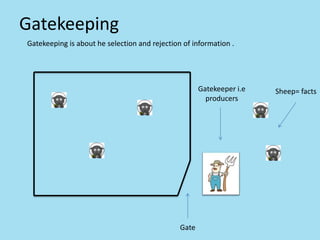
Gatekeeping
Gatekeeping is about he selection and rejection of information .
Gate
Gatekeeper i.e
producers
Sheep= facts
Types of
Narrative Structure
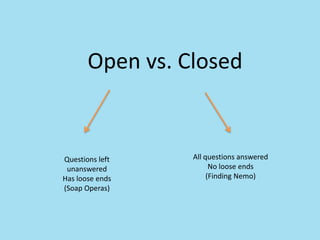
Open vs. Closed
Questions left
unanswered
Has loose ends
(Soap Operas)
All questions answered
No loose ends
(Finding Nemo)
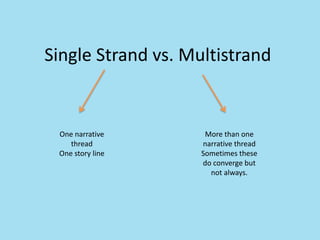
Single Strand vs. Multistrand
One narrative
thread
One story line
More than one
narrative thread
Sometimes these
do converge but
not always.
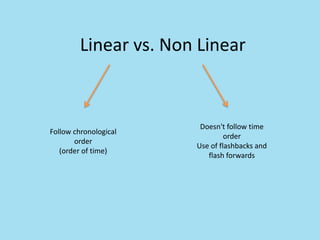
Linear vs. Non Linear
Follow chronological
order
(order of time)
Doesn't follow time
order
Use of flashbacks and
flash forwards
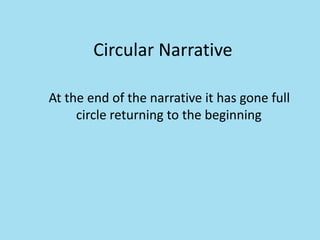
Circular Narrative
At the end of the narrative it has gone full
circle returning to the beginning

Documentaries first powerpoint

  • 1.
  • 2.
    The purpose ofa documentary is to document i.e report with evidence something that has actually happened It can show this by using actuality footage or reconstructions. Documentaries typically use a narrators voiceover to anchor the meaning or rely on the participants themselves with the occasional interjection by the narrator. The term documentary was coined by filmmaker John Grierson in 1926 to describe a film made about life on a south sea island. He defined documentary as the creative treatment of actuality. (on reality) Documentaries are not just about facts. Instead facts are used to create socially critical arguments, thereby inviting the audience to draw conclusions.
  • 3.
    Types of Documentaries FullyNarrated; Voiceover is used top make sense of the visuals and dominates their meaning e.g natural history documentaries Fly On The Wall; The cameras films the subjects without interference e.g 24 Hours in A&E The Mixed Documentary; Uses a combination of interview, observation and narration Self Reflective; The subjects of the documentary acknowledges the presence of the camera and often speak directly to the filmmaker. They draw attention to the film- makers role on construction a view of reality. DocuDrama; Reconstructions’ a rein-actment of events as they are supposed to have actually happened DocuSoaps; These programmes follow the daily lives of particular individuals wthin an organisation e.g Airline/ The Cruise
  • 4.
    Features of aDocumentary John Corner stated that their are 5 different elements to a documentary: 1. Observation- The programme makers pretend that the camera is unseen or ignored by the people taking part in the events. It places the audience as an ‘eye witness’ to the events. 2. The Interview- TV documentaries rely on interviews. The interviewee addresses the unseen interviewer rather than the audience, Interviews are intercut with images of observation to what they are talking about. 3. Dramatisation- All documentaries use a sense of drama throughout the observation element. 4. Mise-en-scene- Documentary makers carefully compose shots so that they contain images they want the audience to see. 5. Exposition- the line of argument. The way the argument ‘unfolds’.
  • 5.
    Gatekeeping Gatekeeping is abouthe selection and rejection of information . Gate Gatekeeper i.e producers Sheep= facts
  • 6.
  • 7.
    Open vs. Closed Questionsleft unanswered Has loose ends (Soap Operas) All questions answered No loose ends (Finding Nemo)
  • 8.
    Single Strand vs.Multistrand One narrative thread One story line More than one narrative thread Sometimes these do converge but not always.
  • 9.
    Linear vs. NonLinear Follow chronological order (order of time) Doesn't follow time order Use of flashbacks and flash forwards
  • 10.
    Circular Narrative At theend of the narrative it has gone full circle returning to the beginning