DOCUMENTARY INTRODUCTION
Purpose
The purpose of a documentary is to document something, this could be a person, a
group of people, an object really anything can be documented into a documentary. The
three main purposes of a documentary are to entertain, educate and inform the person
viewing it.
History
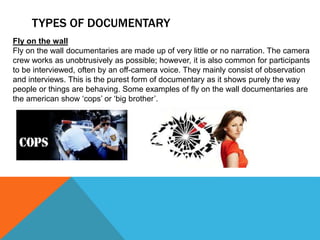
John Grierson was a pioneering Scottish documentary
maker, often considered the father of British and
Canadian documentary film. He defined documentary as
"creative treatment of actuality” this definition has gained
wide acceptance too.
TYPES OF DOCUMENTARY
Fly on the wall
Fly on the wall documentaries are made up of very little or no narration. The camera
crew works as unobtrusively as possible; however, it is also common for participants
to be interviewed, often by an off-camera voice. They mainly consist of observation
and interviews. This is the purest form of documentary as it shows purely the way
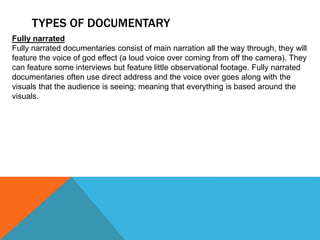
people or things are behaving. Some examples of fly on the wall documentaries are
the american show ‘cops’ or ‘big brother’.
TYPES OF DOCUMENTARY
Fully narrated
Fully narrated documentaries consist of main narration all the way through, they will
feature the voice of god effect (a loud voice over coming from off the camera). They
can feature some interviews but feature little observational footage. Fully narrated
documentaries often use direct address and the voice over goes along with the
visuals that the audience is seeing; meaning that everything is based around the
visuals.
TYPES OF DOCUMENTARY
Mixed
Mixed documentaries are what they say they are. They are a mix of different
aspects of documentaries. It features observational footage such as cctv or
filmed action, archive footage, interviews and it features some narration.
TYPES OF DOCUMENTARY
Docudrama
Is a dramatized television film based on real events. This can feature little
narration, lots of observational footage and some interviews. Docudramas
tend to demonstrate some or most of the following characteristics;
Representation of actual historical events. Focus on the facts of the event, as
they are known, Use of literary and narrative techniques to flesh out the bare
facts of an event in history to tell a story and Some degree of license is often
taken with minor historical facts for the sake of enhancing the drama.
TYPES OF DOCUMENTARY
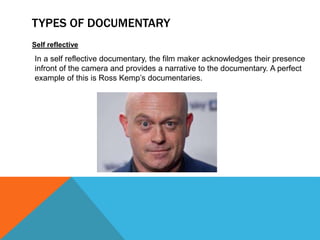
Self reflective
In a self reflective documentary, the film maker acknowledges their presence
infront of the camera and provides a narrative to the documentary. A perfect
example of this is Ross Kemp’s documentaries.
TYPES OF DOCUMENTARY
Docusoap
A combination of two different types of television, documentary and
soap programmes. It is therefore a mix of fact and fiction. They can
involve many characters and storylines. A lot of docusoaps are
constructed reality meaning the are based around the truth but that
truth is set up. A good example of this is many programmes on MTV
like ‘geordie shore’ and ‘laguna beach’.

Genre analysis

  • 2.
    DOCUMENTARY INTRODUCTION Purpose The purposeof a documentary is to document something, this could be a person, a group of people, an object really anything can be documented into a documentary. The three main purposes of a documentary are to entertain, educate and inform the person viewing it. History John Grierson was a pioneering Scottish documentary maker, often considered the father of British and Canadian documentary film. He defined documentary as "creative treatment of actuality” this definition has gained wide acceptance too.
  • 3.
    TYPES OF DOCUMENTARY Flyon the wall Fly on the wall documentaries are made up of very little or no narration. The camera crew works as unobtrusively as possible; however, it is also common for participants to be interviewed, often by an off-camera voice. They mainly consist of observation and interviews. This is the purest form of documentary as it shows purely the way people or things are behaving. Some examples of fly on the wall documentaries are the american show ‘cops’ or ‘big brother’.
  • 4.
    TYPES OF DOCUMENTARY Fullynarrated Fully narrated documentaries consist of main narration all the way through, they will feature the voice of god effect (a loud voice over coming from off the camera). They can feature some interviews but feature little observational footage. Fully narrated documentaries often use direct address and the voice over goes along with the visuals that the audience is seeing; meaning that everything is based around the visuals.
  • 5.
    TYPES OF DOCUMENTARY Mixed Mixeddocumentaries are what they say they are. They are a mix of different aspects of documentaries. It features observational footage such as cctv or filmed action, archive footage, interviews and it features some narration.
  • 6.
    TYPES OF DOCUMENTARY Docudrama Isa dramatized television film based on real events. This can feature little narration, lots of observational footage and some interviews. Docudramas tend to demonstrate some or most of the following characteristics; Representation of actual historical events. Focus on the facts of the event, as they are known, Use of literary and narrative techniques to flesh out the bare facts of an event in history to tell a story and Some degree of license is often taken with minor historical facts for the sake of enhancing the drama.
  • 7.
    TYPES OF DOCUMENTARY Selfreflective In a self reflective documentary, the film maker acknowledges their presence infront of the camera and provides a narrative to the documentary. A perfect example of this is Ross Kemp’s documentaries.
  • 8.
    TYPES OF DOCUMENTARY Docusoap Acombination of two different types of television, documentary and soap programmes. It is therefore a mix of fact and fiction. They can involve many characters and storylines. A lot of docusoaps are constructed reality meaning the are based around the truth but that truth is set up. A good example of this is many programmes on MTV like ‘geordie shore’ and ‘laguna beach’.