GENRE ANALYSIS
Raychelle Shaw
INTRODUCTION OF DOCUMENTARIES
The purpose of a documentary
is to document an aspect of
reality. They also:
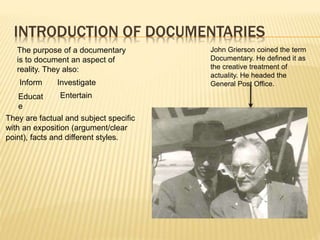
John Grierson coined the term
Documentary. He defined it as
the creative treatment of
actuality. He headed the
General Post Office.Inform
Educat
e
Entertain
Investigate
They are factual and subject specific
with an exposition (argument/clear
point), facts and different styles.
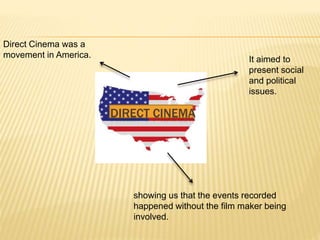
Direct Cinema was a
movement in America.
It aimed to
present social
and political
issues.
showing us that the events recorded
happened without the film maker being
involved.
DIRECT CINEMA
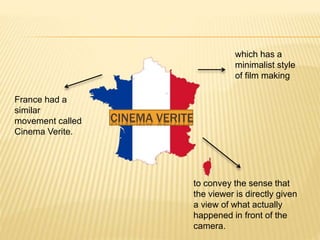
France had a
similar
movement called
Cinema Verite.
which has a
minimalist style
of film making
to convey the sense that
the viewer is directly given
a view of what actually
happened in front of the
camera.
CINEMA VERITE
THE FEATURES OF A DOCUMENTARY
Observations and
Interviews.
Observations are when you closely monitor something or someone. This
can include the use of cameras.
Interview: A conversation between two or more people, questions are asked
by the interviewer, this extracts facts and statements from the interviewee.
Dramatisation: A reconstruction of an event, novel or story in a suitable form
for dramatic purposes.
Mise en scene: An expression used to describe the design aspects of a
theatre or film production, which essentially means visual theme or telling a
story.
Exposition: The exposition is the portion of a story that introduces important
background information to the audience for example, information about the
setting, events occurring before the main plot, characters backstories, etc.
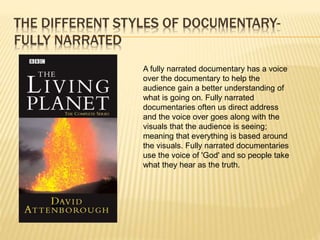
THE DIFFERENT STYLES OF DOCUMENTARY-
FULLY NARRATED
A fully narrated documentary has a voice
over the documentary to help the
audience gain a better understanding of
what is going on. Fully narrated
documentaries often us direct address
and the voice over goes along with the
visuals that the audience is seeing;
meaning that everything is based around
the visuals. Fully narrated documentaries
use the voice of 'God' and so people take
what they hear as the truth.
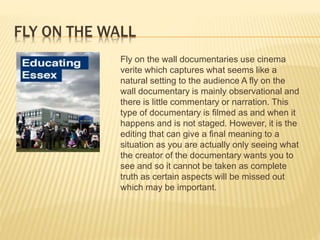
FLY ON THE WALL
Fly on the wall documentaries use cinema
verite which captures what seems like a
natural setting to the audience A fly on the
wall documentary is mainly observational and
there is little commentary or narration. This
type of documentary is filmed as and when it
happens and is not staged. However, it is the
editing that can give a final meaning to a
situation as you are actually only seeing what
the creator of the documentary wants you to
see and so it cannot be taken as complete
truth as certain aspects will be missed out
which may be important.
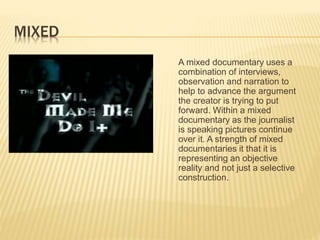
MIXED
A mixed documentary uses a
combination of interviews,
observation and narration to
help to advance the argument
the creator is trying to put
forward. Within a mixed
documentary as the journalist
is speaking pictures continue
over it. A strength of mixed
documentaries it that it is
representing an objective
reality and not just a selective
construction.
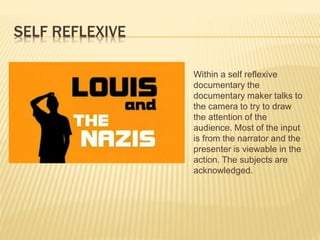
SELF REFLEXIVE
Within a self reflexive
documentary the
documentary maker talks to
the camera to try to draw
the attention of the
audience. Most of the input
is from the narrator and the
presenter is viewable in the
action. The subjects are
acknowledged.
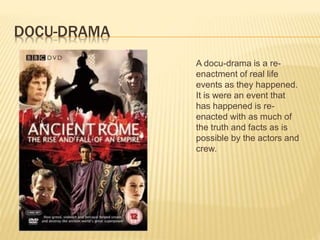
DOCU-DRAMA
A docu-drama is a re-
enactment of real life
events as they happened.
It is were an event that
has happened is re-
enacted with as much of
the truth and facts as is
possible by the actors and
crew.
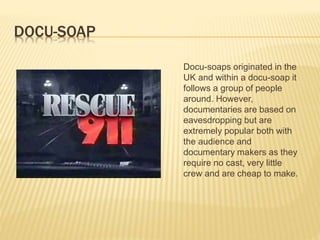
DOCU-SOAP
Docu-soaps originated in the
UK and within a docu-soap it
follows a group of people
around. However,
documentaries are based on
eavesdropping but are
extremely popular both with
the audience and
documentary makers as they
require no cast, very little
crew and are cheap to make.

Genre analysis powerpoint

  • 1.
  • 2.
    INTRODUCTION OF DOCUMENTARIES Thepurpose of a documentary is to document an aspect of reality. They also: John Grierson coined the term Documentary. He defined it as the creative treatment of actuality. He headed the General Post Office.Inform Educat e Entertain Investigate They are factual and subject specific with an exposition (argument/clear point), facts and different styles.
  • 3.
    Direct Cinema wasa movement in America. It aimed to present social and political issues. showing us that the events recorded happened without the film maker being involved. DIRECT CINEMA
  • 4.
    France had a similar movementcalled Cinema Verite. which has a minimalist style of film making to convey the sense that the viewer is directly given a view of what actually happened in front of the camera. CINEMA VERITE
  • 5.
    THE FEATURES OFA DOCUMENTARY Observations and Interviews. Observations are when you closely monitor something or someone. This can include the use of cameras. Interview: A conversation between two or more people, questions are asked by the interviewer, this extracts facts and statements from the interviewee. Dramatisation: A reconstruction of an event, novel or story in a suitable form for dramatic purposes. Mise en scene: An expression used to describe the design aspects of a theatre or film production, which essentially means visual theme or telling a story. Exposition: The exposition is the portion of a story that introduces important background information to the audience for example, information about the setting, events occurring before the main plot, characters backstories, etc.
  • 6.
    THE DIFFERENT STYLESOF DOCUMENTARY- FULLY NARRATED A fully narrated documentary has a voice over the documentary to help the audience gain a better understanding of what is going on. Fully narrated documentaries often us direct address and the voice over goes along with the visuals that the audience is seeing; meaning that everything is based around the visuals. Fully narrated documentaries use the voice of 'God' and so people take what they hear as the truth.
  • 7.
    FLY ON THEWALL Fly on the wall documentaries use cinema verite which captures what seems like a natural setting to the audience A fly on the wall documentary is mainly observational and there is little commentary or narration. This type of documentary is filmed as and when it happens and is not staged. However, it is the editing that can give a final meaning to a situation as you are actually only seeing what the creator of the documentary wants you to see and so it cannot be taken as complete truth as certain aspects will be missed out which may be important.
  • 8.
    MIXED A mixed documentaryuses a combination of interviews, observation and narration to help to advance the argument the creator is trying to put forward. Within a mixed documentary as the journalist is speaking pictures continue over it. A strength of mixed documentaries it that it is representing an objective reality and not just a selective construction.
  • 9.
    SELF REFLEXIVE Within aself reflexive documentary the documentary maker talks to the camera to try to draw the attention of the audience. Most of the input is from the narrator and the presenter is viewable in the action. The subjects are acknowledged.
  • 10.
    DOCU-DRAMA A docu-drama isa re- enactment of real life events as they happened. It is were an event that has happened is re- enacted with as much of the truth and facts as is possible by the actors and crew.
  • 11.
    DOCU-SOAP Docu-soaps originated inthe UK and within a docu-soap it follows a group of people around. However, documentaries are based on eavesdropping but are extremely popular both with the audience and documentary makers as they require no cast, very little crew and are cheap to make.