Documentary Features and Types
By Joe Hadfield
 The purpose of a documentary is to document.
 It is to report, with evidence, something that has actually happened. It can show
this by using actuality footage or reconstructions.
 Primary purpose is to inform and educate, but should also entertain.
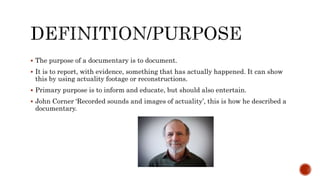
 John Corner ‘Recorded sounds and images of actuality’, this is how he described a
documentary.
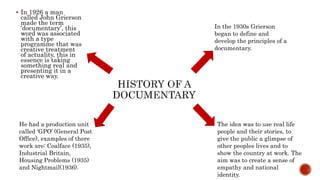
 In 1926 a man
called John Grierson
made the term
‘documentary’, this
word was associated
with a type
programme that was
creative treatment
of actuality, this in
essence is taking
something real and
presenting it in a
creative way.
In the 1930s Grierson
began to define and
develop the principles of a
documentary.
He had a production unit
called ‘GPO’ (General Post
Office), examples of there
work are: Coalface (1935),
Industrial Britain,
Housing Problems (1935)
and Nightmail(1936).
The idea was to use real life
people and their stories, to
give the public a glimpse of
other peoples lives and to
show the country at work. The
aim was to create a sense of
empathy and national
identity.
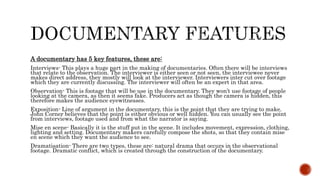
A documentary has 5 key features, these are:
Interviews- This plays a huge part in the making of documentaries. Often there will be interviews
that relate to the observation. The interviewer is either seen or not seen, the interviewee never
makes direct address, they mostly will look at the interviewer. Interviewers inter cut over footage
which they are currently discussing. The interviewer will often be an expert in that area.
Observation- This is footage that will be use in the documentary. They won’t use footage of people
looking at the camera, as then it seems fake. Producers act as though the camera is hidden, this
therefore makes the audience eyewitnesses.
Exposition- Line of argument in the documentary, this is the point that they are trying to make.
John Corner believes that the point is either obvious or well hidden. You can usually see the point
from interviews, footage used and from what the narrator is saying.
Mise en scene- Basically it is the stuff put in the scene. It includes movement, expression, clothing,
lighting and setting. Documentary makers carefully compose the shots, so that they contain mise
en scene which they want the audience to see.
Dramatisation- There are two types, these are: natural drama that occurs in the observational
footage. Dramatic conflict, which is created through the construction of the documentary.
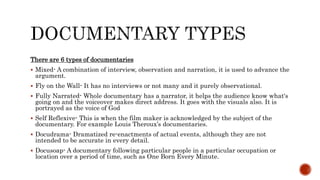
There are 6 types of documentaries
 Mixed- A combination of interview, observation and narration, it is used to advance the
argument.
 Fly on the Wall- It has no interviews or not many and it purely observational.
 Fully Narrated- Whole documentary has a narrator, it helps the audience know what's
going on and the voiceover makes direct address. It goes with the visuals also. It is
portrayed as the voice of God
 Self Reflexive- This is when the film maker is acknowledged by the subject of the
documentary. For example Louis Theroux’s documentaries.
 Docudrama- Dramatized re-enactments of actual events, although they are not
intended to be accurate in every detail.
 Docusoap- A documentary following particular people in a particular occupation or
location over a period of time, such as One Born Every Minute.

Documentary Types

  • 1.
    Documentary Features andTypes By Joe Hadfield
  • 2.
     The purposeof a documentary is to document.  It is to report, with evidence, something that has actually happened. It can show this by using actuality footage or reconstructions.  Primary purpose is to inform and educate, but should also entertain.  John Corner ‘Recorded sounds and images of actuality’, this is how he described a documentary.
  • 3.
     In 1926a man called John Grierson made the term ‘documentary’, this word was associated with a type programme that was creative treatment of actuality, this in essence is taking something real and presenting it in a creative way. In the 1930s Grierson began to define and develop the principles of a documentary. He had a production unit called ‘GPO’ (General Post Office), examples of there work are: Coalface (1935), Industrial Britain, Housing Problems (1935) and Nightmail(1936). The idea was to use real life people and their stories, to give the public a glimpse of other peoples lives and to show the country at work. The aim was to create a sense of empathy and national identity.
  • 4.
    A documentary has5 key features, these are: Interviews- This plays a huge part in the making of documentaries. Often there will be interviews that relate to the observation. The interviewer is either seen or not seen, the interviewee never makes direct address, they mostly will look at the interviewer. Interviewers inter cut over footage which they are currently discussing. The interviewer will often be an expert in that area. Observation- This is footage that will be use in the documentary. They won’t use footage of people looking at the camera, as then it seems fake. Producers act as though the camera is hidden, this therefore makes the audience eyewitnesses. Exposition- Line of argument in the documentary, this is the point that they are trying to make. John Corner believes that the point is either obvious or well hidden. You can usually see the point from interviews, footage used and from what the narrator is saying. Mise en scene- Basically it is the stuff put in the scene. It includes movement, expression, clothing, lighting and setting. Documentary makers carefully compose the shots, so that they contain mise en scene which they want the audience to see. Dramatisation- There are two types, these are: natural drama that occurs in the observational footage. Dramatic conflict, which is created through the construction of the documentary.
  • 5.
    There are 6types of documentaries  Mixed- A combination of interview, observation and narration, it is used to advance the argument.  Fly on the Wall- It has no interviews or not many and it purely observational.  Fully Narrated- Whole documentary has a narrator, it helps the audience know what's going on and the voiceover makes direct address. It goes with the visuals also. It is portrayed as the voice of God  Self Reflexive- This is when the film maker is acknowledged by the subject of the documentary. For example Louis Theroux’s documentaries.  Docudrama- Dramatized re-enactments of actual events, although they are not intended to be accurate in every detail.  Docusoap- A documentary following particular people in a particular occupation or location over a period of time, such as One Born Every Minute.