The Documentary
Genre
STEPH PARRY
What is a Documentary?
 The purpose of a documentary is to document i.e. to report with evidence,
something that has actually happened.
 It can show this by using actuality footage or a reconstruction. Even when
filming consists of actuality footage, people are directed and sets
organised so there is still a high level of construction taking place.
 A good documentary should be about the topic and not the style of
presentation. However, the content alone without any intervention from
the producers would seldom be enough to make the documentary
coherent, yet alone interesting.
 To give the product a sense of pace and structure they draw on many of
the characteristics of fiction in their use of camera angles, framing, lighting
and editing.
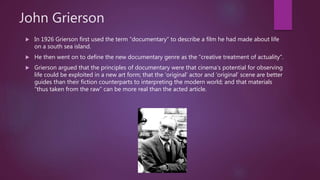
John Grierson
 In 1926 Grierson first used the term “documentary” to describe a film he had made about life
on a south sea island.
 He then went on to define the new documentary genre as the “creative treatment of actuality”.
 Grierson argued that the principles of documentary were that cinema’s potential for observing
life could be exploited in a new art form; that the ‘original’ actor and ‘original’ scene are better
guides than their fiction counterparts to interpreting the modern world; and that materials
“thus taken from the raw” can be more real than the acted article.
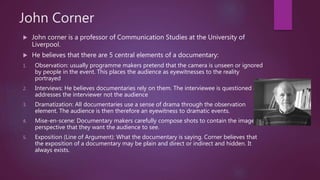
John Corner
 John corner is a professor of Communication Studies at the University of
Liverpool.
 He believes that there are 5 central elements of a documentary:
1. Observation: usually programme makers pretend that the camera is unseen or ignored
by people in the event. This places the audience as eyewitnesses to the reality
portrayed
2. Interviews: He believes documentaries rely on them. The interviewee is questioned and
addresses the interviewer not the audience
3. Dramatization: All documentaries use a sense of drama through the observation
element. The audience is then therefore an eyewitness to dramatic events.
4. Mise-en-scene: Documentary makers carefully compose shots to contain the image or
perspective that they want the audience to see.
5. Exposition (Line of Argument): What the documentary is saying. Corner believes that
the exposition of a documentary may be plain and direct or indirect and hidden. It
always exists.
Types of Documentaries
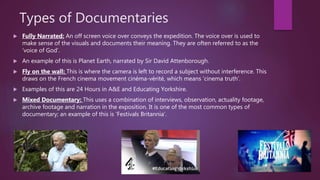
 Fully Narrated: An off screen voice over conveys the expedition. The voice over is used to
make sense of the visuals and documents their meaning. They are often referred to as the
‘voice of God’.
 An example of this is Planet Earth, narrated by Sir David Attenborough.
 Fly on the wall: This is where the camera is left to record a subject without interference. This
draws on the French cinema movement cinéma-vérité, which means ‘cinema truth’.
 Examples of this are 24 Hours in A&E and Educating Yorkshire.
 Mixed Documentary: This uses a combination of interviews, observation, actuality footage,
archive footage and narration in the exposition. It is one of the most common types of
documentary; an example of this is ‘Festivals Britannia’.
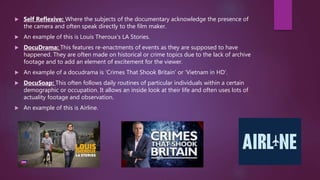
 Self Reflexive: Where the subjects of the documentary acknowledge the presence of
the camera and often speak directly to the film maker.
 An example of this is Louis Theroux’s LA Stories.
 DocuDrama: This features re-enactments of events as they are supposed to have
happened. They are often made on historical or crime topics due to the lack of archive
footage and to add an element of excitement for the viewer.
 An example of a docudrama is ‘Crimes That Shook Britain’ or ‘Vietnam in HD’.
 DocuSoap: This often follows daily routines of particular individuals within a certain
demographic or occupation. It allows an inside look at their life and often uses lots of
actuality footage and observation.
 An example of this is Airline.

Documentary genre

  • 1.
  • 2.
    What is aDocumentary?  The purpose of a documentary is to document i.e. to report with evidence, something that has actually happened.  It can show this by using actuality footage or a reconstruction. Even when filming consists of actuality footage, people are directed and sets organised so there is still a high level of construction taking place.  A good documentary should be about the topic and not the style of presentation. However, the content alone without any intervention from the producers would seldom be enough to make the documentary coherent, yet alone interesting.  To give the product a sense of pace and structure they draw on many of the characteristics of fiction in their use of camera angles, framing, lighting and editing.
  • 3.
    John Grierson  In1926 Grierson first used the term “documentary” to describe a film he had made about life on a south sea island.  He then went on to define the new documentary genre as the “creative treatment of actuality”.  Grierson argued that the principles of documentary were that cinema’s potential for observing life could be exploited in a new art form; that the ‘original’ actor and ‘original’ scene are better guides than their fiction counterparts to interpreting the modern world; and that materials “thus taken from the raw” can be more real than the acted article.
  • 4.
    John Corner  Johncorner is a professor of Communication Studies at the University of Liverpool.  He believes that there are 5 central elements of a documentary: 1. Observation: usually programme makers pretend that the camera is unseen or ignored by people in the event. This places the audience as eyewitnesses to the reality portrayed 2. Interviews: He believes documentaries rely on them. The interviewee is questioned and addresses the interviewer not the audience 3. Dramatization: All documentaries use a sense of drama through the observation element. The audience is then therefore an eyewitness to dramatic events. 4. Mise-en-scene: Documentary makers carefully compose shots to contain the image or perspective that they want the audience to see. 5. Exposition (Line of Argument): What the documentary is saying. Corner believes that the exposition of a documentary may be plain and direct or indirect and hidden. It always exists.
  • 5.
    Types of Documentaries Fully Narrated: An off screen voice over conveys the expedition. The voice over is used to make sense of the visuals and documents their meaning. They are often referred to as the ‘voice of God’.  An example of this is Planet Earth, narrated by Sir David Attenborough.  Fly on the wall: This is where the camera is left to record a subject without interference. This draws on the French cinema movement cinéma-vérité, which means ‘cinema truth’.  Examples of this are 24 Hours in A&E and Educating Yorkshire.  Mixed Documentary: This uses a combination of interviews, observation, actuality footage, archive footage and narration in the exposition. It is one of the most common types of documentary; an example of this is ‘Festivals Britannia’.
  • 6.
     Self Reflexive:Where the subjects of the documentary acknowledge the presence of the camera and often speak directly to the film maker.  An example of this is Louis Theroux’s LA Stories.  DocuDrama: This features re-enactments of events as they are supposed to have happened. They are often made on historical or crime topics due to the lack of archive footage and to add an element of excitement for the viewer.  An example of a docudrama is ‘Crimes That Shook Britain’ or ‘Vietnam in HD’.  DocuSoap: This often follows daily routines of particular individuals within a certain demographic or occupation. It allows an inside look at their life and often uses lots of actuality footage and observation.  An example of this is Airline.