Documentaries
Introduction:
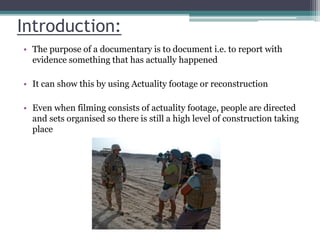
• The purpose of a documentary is to document i.e. to report with
evidence something that has actually happened
• It can show this by using Actuality footage or reconstruction
• Even when filming consists of actuality footage, people are directed
and sets organised so there is still a high level of construction taking
place
• A good documentary should be about the topic and not the style of
presentation. However, the content alone without any intervention
from the producers would seldom be enough to make a
documentary coherent let alone interesting
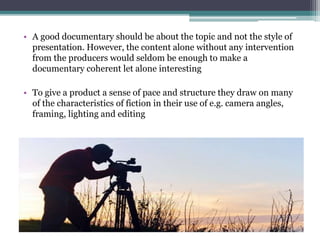
• To give a product a sense of pace and structure they draw on many
of the characteristics of fiction in their use of e.g. camera angles,
framing, lighting and editing
Theorists
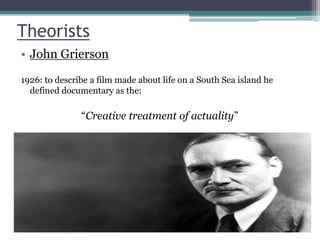
• John Grierson
1926: to describe a film made about life on a South Sea island he
defined documentary as the:
“Creative treatment of actuality”
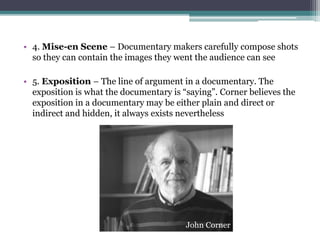
John Corner -University of Liverpool
• 5 Central Elements of the Documentary:
• 1. Observation- usually the programme makers pretend the
camera is unseen or ignored by people taking part in the event. This
“unseen observation” places the audience in the role of thee
eyewitnesses to events.
• 2. Interview- TV Documentaries rely on interviews. The
interviewee is questioned and addresses the interviewer not the
audience
• 3. Dramatisation- All documentaries use a sense of Drama
through the observation element. The audience is an eyewitness to
dramatic events
• 4. Mise-en Scene – Documentary makers carefully compose shots
so they can contain the images they went the audience can see
• 5. Exposition – The line of argument in a documentary. The
exposition is what the documentary is “saying”. Corner believes the
exposition in a documentary may be either plain and direct or
indirect and hidden, it always exists nevertheless
John Corner
Types of Documentary
Fully Narrated
An off-screen voiceover conveys the exposition. The voiceover is used to
make sense of the visuals and dominates their meaning. Often referred to
as the “Voice of God”
Fly on the Wall
The cameras are left to record the subject without interference. Draws
on Cinema Verite.
Mixed
Uses a combination of interview, observation, actuality, archive and
narration in the exposition
Self-Reflexive
When the subjects of a documentary acknowledge the presence of the
camera and often speak directly to the filmmaker
Docu-Dramas
A re-enactment of events as they are supposed to have actually
happened
Docu-Soap
A series in which the lives of the people filmed are presented as entertainment or drama

Documentaries

  • 1.
  • 2.
    Introduction: • The purposeof a documentary is to document i.e. to report with evidence something that has actually happened • It can show this by using Actuality footage or reconstruction • Even when filming consists of actuality footage, people are directed and sets organised so there is still a high level of construction taking place
  • 3.
    • A gooddocumentary should be about the topic and not the style of presentation. However, the content alone without any intervention from the producers would seldom be enough to make a documentary coherent let alone interesting • To give a product a sense of pace and structure they draw on many of the characteristics of fiction in their use of e.g. camera angles, framing, lighting and editing
  • 4.
    Theorists • John Grierson 1926:to describe a film made about life on a South Sea island he defined documentary as the: “Creative treatment of actuality”
  • 5.
    John Corner -Universityof Liverpool • 5 Central Elements of the Documentary: • 1. Observation- usually the programme makers pretend the camera is unseen or ignored by people taking part in the event. This “unseen observation” places the audience in the role of thee eyewitnesses to events. • 2. Interview- TV Documentaries rely on interviews. The interviewee is questioned and addresses the interviewer not the audience • 3. Dramatisation- All documentaries use a sense of Drama through the observation element. The audience is an eyewitness to dramatic events
  • 6.
    • 4. Mise-enScene – Documentary makers carefully compose shots so they can contain the images they went the audience can see • 5. Exposition – The line of argument in a documentary. The exposition is what the documentary is “saying”. Corner believes the exposition in a documentary may be either plain and direct or indirect and hidden, it always exists nevertheless John Corner
  • 7.
    Types of Documentary FullyNarrated An off-screen voiceover conveys the exposition. The voiceover is used to make sense of the visuals and dominates their meaning. Often referred to as the “Voice of God” Fly on the Wall The cameras are left to record the subject without interference. Draws on Cinema Verite. Mixed Uses a combination of interview, observation, actuality, archive and narration in the exposition Self-Reflexive When the subjects of a documentary acknowledge the presence of the camera and often speak directly to the filmmaker Docu-Dramas A re-enactment of events as they are supposed to have actually happened Docu-Soap A series in which the lives of the people filmed are presented as entertainment or drama