Documentaries
Documentaries
Documentaries
Purpose of a Documentary
★ The purpose of a Documentary
is to document aspects of reality
and maintaining a historical
record. Documentaries are
based on true facts as they are
based on real life situations.
Documentaries also have to
Inform, Educate, and Entertain
but the most important ones is
Inform and Educate.
Documentaries
History of Documentaries
1895
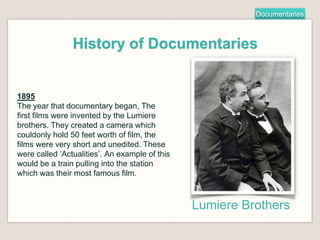
The year that documentary began, The
first films were invented by the Lumiere
brothers. They created a camera which
couldonly hold 50 feet worth of film, the
films were very short and unedited. These
were called ‘Actualities’. An example of this
would be a train pulling into the station
which was their most famous film.
Lumiere Brothers
Documentaries
1922
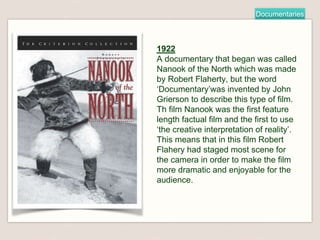
A documentary that began was called
Nanook of the North which was made
by Robert Flaherty, but the word
‘Documentary’was invented by John
Grierson to describe this type of film.
Th film Nanook was the first feature
length factual film and the first to use
‘the creative interpretation of reality’.
This means that in this film Robert
Flahery had staged most scene for
the camera in order to make the film
more dramatic and enjoyable for the
audience.
Documentaries
1930s
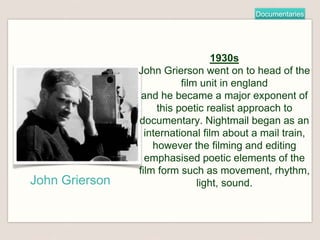
John Grierson went on to head of the
film unit in england
and he became a major exponent of
this poetic realist approach to
documentary. Nightmail began as an
international film about a mail train,
however the filming and editing
emphasised poetic elements of the
film form such as movement, rhythm,
light, sound.John Grierson
Documentaries
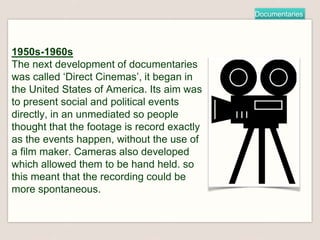
1950s-1960s
The next development of documentaries
was called ‘Direct Cinemas’, it began in
the United States of America. Its aim was
to present social and political events
directly, in an unmediated so people
thought that the footage is record exactly
as the events happen, without the use of
a film maker. Cameras also developed
which allowed them to be hand held. so
this meant that the recording could be
more spontaneous.
Documentaries
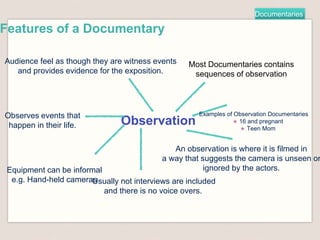
Features of a Documentary
Observation
Most Documentaries contains
sequences of observation
An observation is where it is filmed in
a way that suggests the camera is unseen or
ignored by the actors.
Audience feel as though they are witness events
and provides evidence for the exposition.
Observes events that
happen in their life.
Equipment can be informal
e.g. Hand-held camerasUsually not interviews are included
and there is no voice overs.
Examples of Observation Documentaries
★ 16 and pregnant
★ Teen Mom
Documentaries
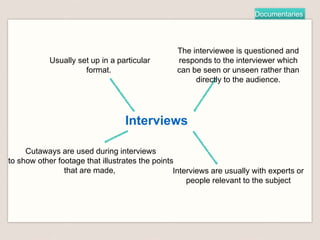
Interviews
Usually set up in a particular
format.
The interviewee is questioned and
responds to the interviewer which
can be seen or unseen rather than
directly to the audience.
Cutaways are used during interviews
to show other footage that illustrates the points
that are made, Interviews are usually with experts or
people relevant to the subject
Documentaries
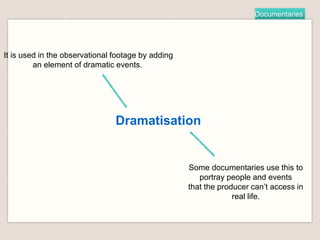
Dramatisation
It is used in the observational footage by adding
an element of dramatic events.
Some documentaries use this to
portray people and events
that the producer can’t access in
real life.
Documentaries
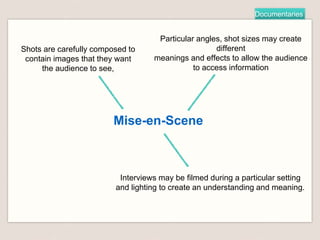
Mise-en-Scene
Shots are carefully composed to
contain images that they want
the audience to see,
Particular angles, shot sizes may create
different
meanings and effects to allow the audience
to access information
Interviews may be filmed during a particular setting
and lighting to create an understanding and meaning.
Documentaries
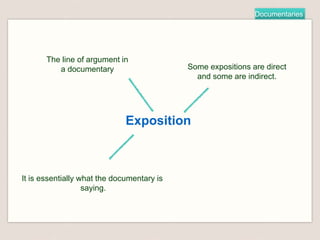
Exposition
The line of argument in
a documentary
It is essentially what the documentary is
saying.
Some expositions are direct
and some are indirect.
Documentaries
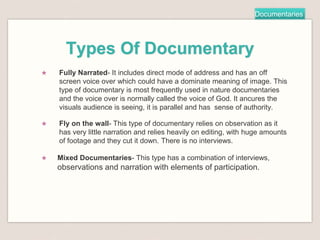
Types Of Documentary
★ Fully Narrated- It includes direct mode of address and has an off
screen voice over which could have a dominate meaning of image. This
type of documentary is most frequently used in nature documentaries
and the voice over is normally called the voice of God. It ancures the
visuals audience is seeing, it is parallel and has sense of authority.
★ Fly on the wall- This type of documentary relies on observation as it
has very little narration and relies heavily on editing, with huge amounts
of footage and they cut it down. There is no interviews.
★ Mixed Documentaries- This type has a combination of interviews,
observations and narration with elements of participation.
Documentaries
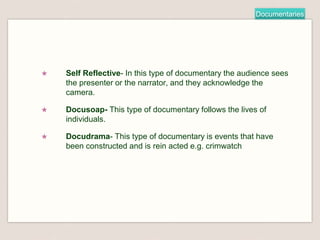
★ Self Reflective- In this type of documentary the audience sees
the presenter or the narrator, and they acknowledge the
camera.
★ Docusoap- This type of documentary follows the lives of
individuals.
★ Docudrama- This type of documentary is events that have
been constructed and is rein acted e.g. crimwatch

Documentaries

  • 1.
  • 2.
    Documentaries Purpose of aDocumentary ★ The purpose of a Documentary is to document aspects of reality and maintaining a historical record. Documentaries are based on true facts as they are based on real life situations. Documentaries also have to Inform, Educate, and Entertain but the most important ones is Inform and Educate.
  • 3.
    Documentaries History of Documentaries 1895 Theyear that documentary began, The first films were invented by the Lumiere brothers. They created a camera which couldonly hold 50 feet worth of film, the films were very short and unedited. These were called ‘Actualities’. An example of this would be a train pulling into the station which was their most famous film. Lumiere Brothers
  • 4.
    Documentaries 1922 A documentary thatbegan was called Nanook of the North which was made by Robert Flaherty, but the word ‘Documentary’was invented by John Grierson to describe this type of film. Th film Nanook was the first feature length factual film and the first to use ‘the creative interpretation of reality’. This means that in this film Robert Flahery had staged most scene for the camera in order to make the film more dramatic and enjoyable for the audience.
  • 5.
    Documentaries 1930s John Grierson wenton to head of the film unit in england and he became a major exponent of this poetic realist approach to documentary. Nightmail began as an international film about a mail train, however the filming and editing emphasised poetic elements of the film form such as movement, rhythm, light, sound.John Grierson
  • 6.
    Documentaries 1950s-1960s The next developmentof documentaries was called ‘Direct Cinemas’, it began in the United States of America. Its aim was to present social and political events directly, in an unmediated so people thought that the footage is record exactly as the events happen, without the use of a film maker. Cameras also developed which allowed them to be hand held. so this meant that the recording could be more spontaneous.
  • 7.
    Documentaries Features of aDocumentary Observation Most Documentaries contains sequences of observation An observation is where it is filmed in a way that suggests the camera is unseen or ignored by the actors. Audience feel as though they are witness events and provides evidence for the exposition. Observes events that happen in their life. Equipment can be informal e.g. Hand-held camerasUsually not interviews are included and there is no voice overs. Examples of Observation Documentaries ★ 16 and pregnant ★ Teen Mom
  • 8.
    Documentaries Interviews Usually set upin a particular format. The interviewee is questioned and responds to the interviewer which can be seen or unseen rather than directly to the audience. Cutaways are used during interviews to show other footage that illustrates the points that are made, Interviews are usually with experts or people relevant to the subject
  • 9.
    Documentaries Dramatisation It is usedin the observational footage by adding an element of dramatic events. Some documentaries use this to portray people and events that the producer can’t access in real life.
  • 10.
    Documentaries Mise-en-Scene Shots are carefullycomposed to contain images that they want the audience to see, Particular angles, shot sizes may create different meanings and effects to allow the audience to access information Interviews may be filmed during a particular setting and lighting to create an understanding and meaning.
  • 11.
    Documentaries Exposition The line ofargument in a documentary It is essentially what the documentary is saying. Some expositions are direct and some are indirect.
  • 12.
    Documentaries Types Of Documentary ★Fully Narrated- It includes direct mode of address and has an off screen voice over which could have a dominate meaning of image. This type of documentary is most frequently used in nature documentaries and the voice over is normally called the voice of God. It ancures the visuals audience is seeing, it is parallel and has sense of authority. ★ Fly on the wall- This type of documentary relies on observation as it has very little narration and relies heavily on editing, with huge amounts of footage and they cut it down. There is no interviews. ★ Mixed Documentaries- This type has a combination of interviews, observations and narration with elements of participation.
  • 13.
    Documentaries ★ Self Reflective-In this type of documentary the audience sees the presenter or the narrator, and they acknowledge the camera. ★ Docusoap- This type of documentary follows the lives of individuals. ★ Docudrama- This type of documentary is events that have been constructed and is rein acted e.g. crimwatch