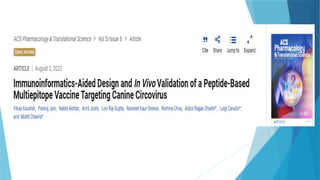
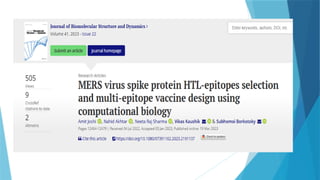
Research applications of Molecular docking
&
Future directions and emerging trends in
computational biochemistry
Presented by –
Dr. Amit Joshi
Department of Biochemistry
Kalinga University
Molecular Docking
Two approaches are particularly popular within the molecular
docking community.
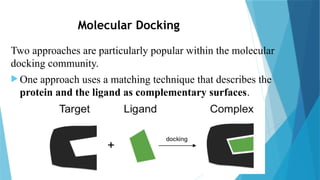
 One approach uses a matching technique that describes the
protein and the ligand as complementary surfaces.
 The second approach simulates the actual docking process in which
the ligand-protein pairwise interaction energies are calculated.
Here, the protein and the ligand are separated by some physical
distance, and the ligand finds its position into the protein's active
site after a certain number of “moves” in its conformational space.
 The moves incorporate rigid body transformations such as
translations and rotations, as well as internal changes to the
ligand's structure including torsion angle rotations. Each of these
moves in the conformation space of the ligand induces a total
energetic cost of the system. Hence, the system's total energy is
calculated after every move.
Scoring function
 Docking programs generate a large number of potential ligand poses, of
which some can be immediately rejected due to clashes with the protein.
The remainder are evaluated using some scoring function, which takes a
pose as input and returns a number indicating the likelihood that the pose
represents a favorable binding interaction and ranks one ligand
relative to another.
 Most scoring functions are physics-based molecular mechanics
force fields that estimate the energy of the pose within the binding site.
The various contributions to binding can be written as an additive equation:
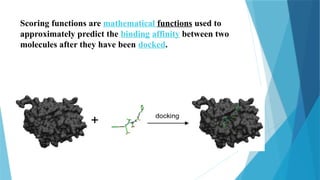
Scoring functions are mathematical functions used to
approximately predict the binding affinity between two
molecules after they have been docked.
4-types of Scoring Functions in Molecular
Docking
• Force field-based – Estimates affinities by summing van der Waals and
electrostatic interactions, often including solvation effects. ( for eg: a)
Kollman charges are added: used to develop force field, Quantum
mechanical electrostatic potential: to represent H-H Bonding, Dipole
forces, Ionic Interactions, b) Torsion tree: detection of roots helps in
exposing rotational bonds on the ligands)
• Empirical – Counts specific interaction types (e.g., hydrogen bonds,
hydrophobic contacts) and applies regression-derived coefficients.
• Knowledge-based – Uses statistical potentials derived from observed
interactions in large structural databases.
• Machine-learning-based – Learns binding affinity directly from data
without predefined functional forms, often outperforming classical
methods.
Applications of Molecular Docking
 Drug Discovery & Design – Identifies potential drug candidates by predicting ligand binding to target
proteins.
 Protein-Ligand Interaction Analysis – Investigates molecular interactions to understand biological
mechanisms.
 Enzyme Inhibitor Design – Develops inhibitors to block enzyme activity for therapeutic purposes.
 Toxicology & Safety Assessment – Evaluates potential off-target effects and toxicity of compounds.
 Agricultural & Pesticide Research – Designs pesticides and herbicides targeting specific enzymes in
pests.
 Nanomedicine & Drug Delivery – Assists in designing nanoparticles for targeted drug delivery.
 Synthetic Biology & Metabolic Engineering – Aids in designing novel enzymes and metabolic
pathways for biotechnology applications.
Among the notable trends in biochemistry, we can highlight:
 Genomics and Proteomics: The application of genomic sequencing
technologies has transformed our ability to analyze genetic material quickly
and affordably. This, coupled with proteomic techniques, enables the
comprehensive study of protein interactions and functions in various
biological contexts.
 Metabolic Engineering: This emerging discipline focuses on modifying
metabolic pathways to improve the production of useful compounds.
*Synthetic biology* principles are often employed to design organisms
capable of synthesizing drugs, biofuels, and other valuable chemicals.
Artificial Intelligence: The incorporation of AI tools in biochemical
research has enhanced data analysis, pattern recognition, and
predictive modeling. As one expert noted,“AI is revolutionizing the way
we approach complex biochemical data, allowing for faster insights and
innovative solutions.”
Environmental Biochemistry: Increasing concerns over
environmental sustainability have spurred research into bioremediation
and the biochemical roles of microorganisms in ecosystems. This field
investigates how biochemical processes can mitigate pollution and
enhance ecosystem health.
 Personalized Medicine: Biochemical insights are foundational
to developing tailored therapies that consider individual genetic
differences. This approach enhances the efficacy of treatments
while minimizing adverse effects.
Each of these trends is contributing to a broader understanding of
living organisms and their biochemical functions. For instance, the
investigation of microbiomes has revealed their significant roles in
human health, influencing metabolism, immune function, and even
behavior.
Thank You

Research Application of MOLECULAR DOCKING

  • 1.
    Research applications ofMolecular docking & Future directions and emerging trends in computational biochemistry Presented by – Dr. Amit Joshi Department of Biochemistry Kalinga University
  • 2.
    Molecular Docking Two approachesare particularly popular within the molecular docking community.  One approach uses a matching technique that describes the protein and the ligand as complementary surfaces.
  • 3.
     The secondapproach simulates the actual docking process in which the ligand-protein pairwise interaction energies are calculated. Here, the protein and the ligand are separated by some physical distance, and the ligand finds its position into the protein's active site after a certain number of “moves” in its conformational space.  The moves incorporate rigid body transformations such as translations and rotations, as well as internal changes to the ligand's structure including torsion angle rotations. Each of these moves in the conformation space of the ligand induces a total energetic cost of the system. Hence, the system's total energy is calculated after every move.
  • 4.
    Scoring function  Dockingprograms generate a large number of potential ligand poses, of which some can be immediately rejected due to clashes with the protein. The remainder are evaluated using some scoring function, which takes a pose as input and returns a number indicating the likelihood that the pose represents a favorable binding interaction and ranks one ligand relative to another.  Most scoring functions are physics-based molecular mechanics force fields that estimate the energy of the pose within the binding site. The various contributions to binding can be written as an additive equation:
  • 5.
    Scoring functions aremathematical functions used to approximately predict the binding affinity between two molecules after they have been docked.
  • 6.
    4-types of ScoringFunctions in Molecular Docking • Force field-based – Estimates affinities by summing van der Waals and electrostatic interactions, often including solvation effects. ( for eg: a) Kollman charges are added: used to develop force field, Quantum mechanical electrostatic potential: to represent H-H Bonding, Dipole forces, Ionic Interactions, b) Torsion tree: detection of roots helps in exposing rotational bonds on the ligands) • Empirical – Counts specific interaction types (e.g., hydrogen bonds, hydrophobic contacts) and applies regression-derived coefficients. • Knowledge-based – Uses statistical potentials derived from observed interactions in large structural databases. • Machine-learning-based – Learns binding affinity directly from data without predefined functional forms, often outperforming classical methods.
  • 7.
    Applications of MolecularDocking  Drug Discovery & Design – Identifies potential drug candidates by predicting ligand binding to target proteins.  Protein-Ligand Interaction Analysis – Investigates molecular interactions to understand biological mechanisms.  Enzyme Inhibitor Design – Develops inhibitors to block enzyme activity for therapeutic purposes.  Toxicology & Safety Assessment – Evaluates potential off-target effects and toxicity of compounds.  Agricultural & Pesticide Research – Designs pesticides and herbicides targeting specific enzymes in pests.  Nanomedicine & Drug Delivery – Assists in designing nanoparticles for targeted drug delivery.  Synthetic Biology & Metabolic Engineering – Aids in designing novel enzymes and metabolic pathways for biotechnology applications.
  • 8.
    Among the notabletrends in biochemistry, we can highlight:  Genomics and Proteomics: The application of genomic sequencing technologies has transformed our ability to analyze genetic material quickly and affordably. This, coupled with proteomic techniques, enables the comprehensive study of protein interactions and functions in various biological contexts.  Metabolic Engineering: This emerging discipline focuses on modifying metabolic pathways to improve the production of useful compounds. *Synthetic biology* principles are often employed to design organisms capable of synthesizing drugs, biofuels, and other valuable chemicals.
  • 9.
    Artificial Intelligence: Theincorporation of AI tools in biochemical research has enhanced data analysis, pattern recognition, and predictive modeling. As one expert noted,“AI is revolutionizing the way we approach complex biochemical data, allowing for faster insights and innovative solutions.” Environmental Biochemistry: Increasing concerns over environmental sustainability have spurred research into bioremediation and the biochemical roles of microorganisms in ecosystems. This field investigates how biochemical processes can mitigate pollution and enhance ecosystem health.
  • 10.
     Personalized Medicine:Biochemical insights are foundational to developing tailored therapies that consider individual genetic differences. This approach enhances the efficacy of treatments while minimizing adverse effects. Each of these trends is contributing to a broader understanding of living organisms and their biochemical functions. For instance, the investigation of microbiomes has revealed their significant roles in human health, influencing metabolism, immune function, and even behavior.
  • 22.