2016© Bhupathi Consulting Inc
Docker and Containers
Disrupting the Virtual Machine
Rama Krishna Bhupathi
ramakris@gmail.com
2016© Bhupathi Consulting Inc
Some Terminologies
● Virtualization: In computing, virtualization refers to the act
of creating a virtual version of a computer resource
including CPU, operating systems, storage , and computer
network resources.
● Virtual Machine:A virtual machine (VM) is an emulation of a
particular computer system, its resources such as CPU,
RAM, Disk space. Each VM has its own kernel,OS, and
supporting libraries. Behaves like a machine(PC) but not
real machine(everything is virtualized)
2
2016© Bhupathi Consulting Inc
Some Terminologies
● Hypervisor: A hypervisor or virtual machine monitor (VMM)
is a piece of computer software, firmware or hardware that
creates and runs virtual machines.
Zen (Used by Amazon Web Services)
KVM (Used by OpenStack)
Microsoft Hyper V
VMWare VSphere ESXi
RedHat Enterprise Virtualization
3
2016© Bhupathi Consulting Inc
Why Virtualization is so popular?
● More Agile , more dynamic provisioning
● Reduce the data center footprint
● Reduce vendor lock-in
● Faster Server Provisioning
● Reduced costs
● More flexibility in demand / supply of resources.
● High Server Utilization
● Low Total Cost of Ownership(TCO)
4
2016© Bhupathi Consulting Inc
Virtualization Timeline
1960 and 1970s: First Virtual machines used by IBM
1990s: x86 becomes prominent server platform
1999: VMWare first commercial product to virtualize x86
2006: AMD(AMD-V) and Intel(Intel-VT) build Virtualization
into their CPUs
5
2016© Bhupathi Consulting Inc
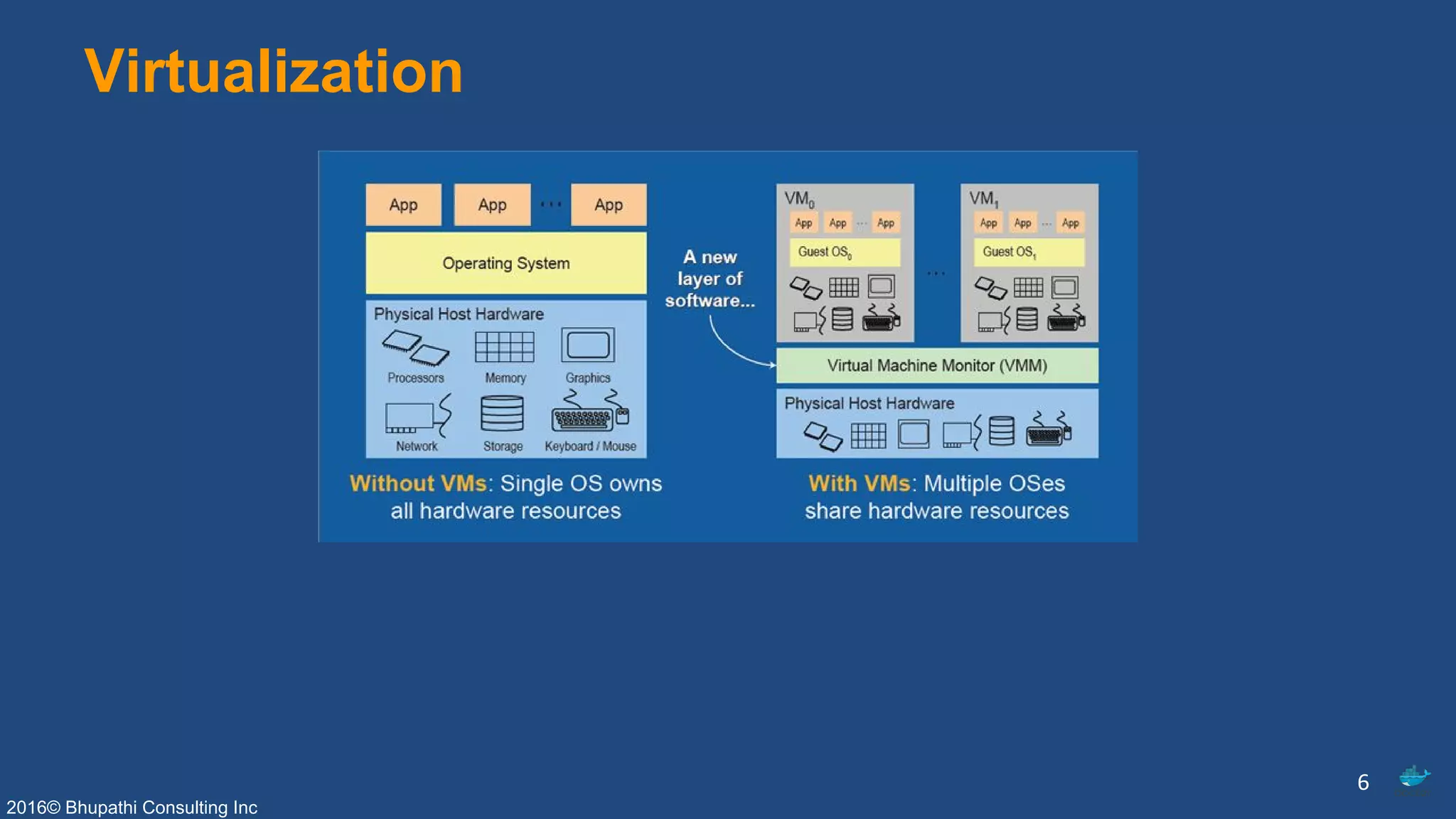
Virtualization
6
2016© Bhupathi Consulting Inc
Virtualization...any improvements?
● Virtual Machines are fat (requires its own OS)
● Overhead in terms of the hypervisor that emulates the
hardware.
● Even if you want to run an application you need a full
scale OS stack.
● Maintenance: Need to patch the individual OSes on the
VM as needed
● Increased complexity when there are huge number of
OSes in VMs that needs patching
● Explicitly turn ON virtualization at BIOS.
7
2016© Bhupathi Consulting Inc
Linux Containers
Containers are lightweight isolated operating system
environments(processes) running on a host. Unlike virtual
machines, containers ...
● don’t need additional hardware capabilities such as
Intel-VT and so on.
● don’t need emulated BIOS or completely virtualized
hardware
8
2016© Bhupathi Consulting Inc
Linux Containers
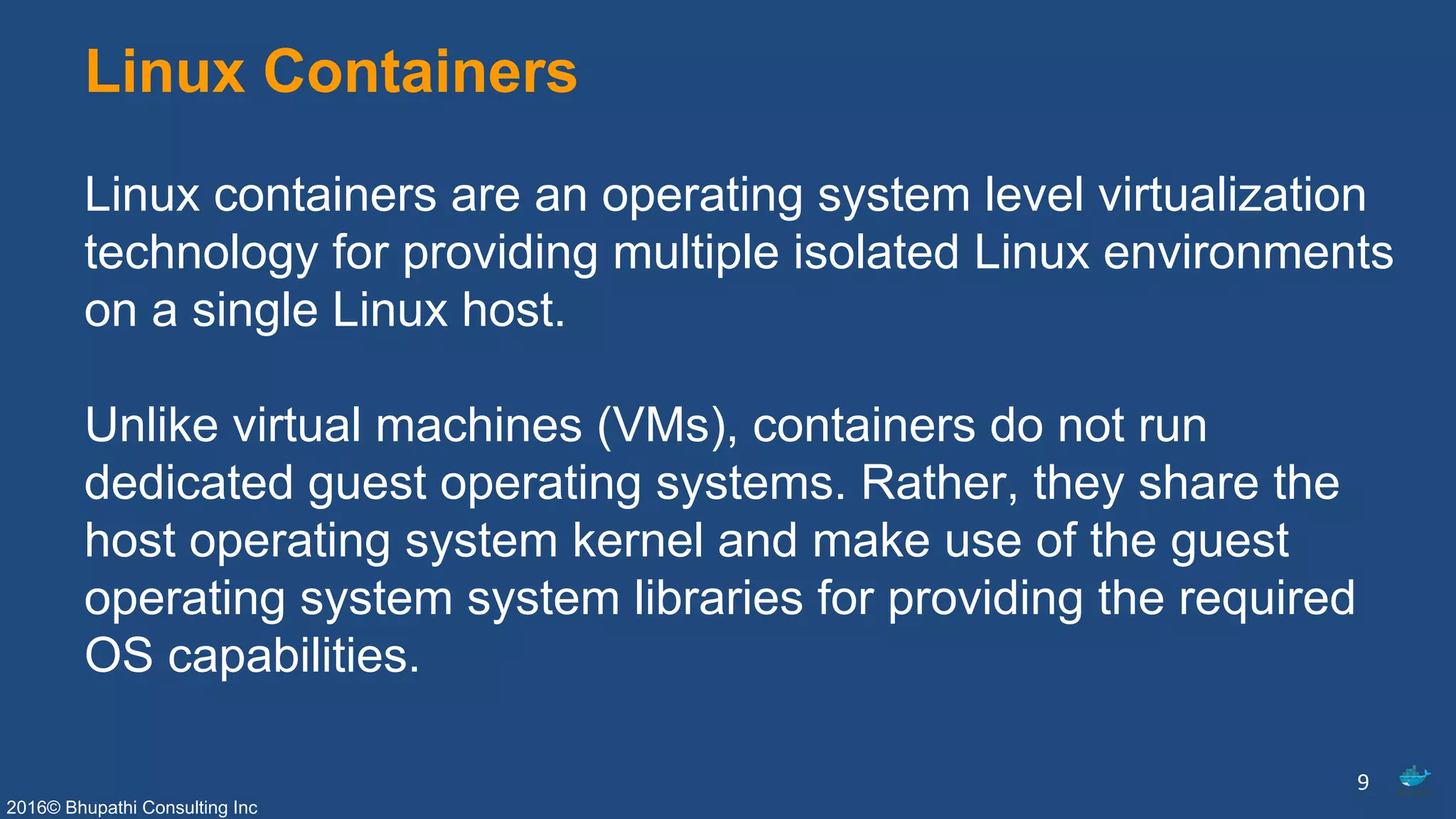
Linux containers are an operating system level virtualization
technology for providing multiple isolated Linux environments
on a single Linux host.
Unlike virtual machines (VMs), containers do not run
dedicated guest operating systems. Rather, they share the
host operating system kernel and make use of the guest
operating system system libraries for providing the required
OS capabilities.
9
2016© Bhupathi Consulting Inc
Linux Containers
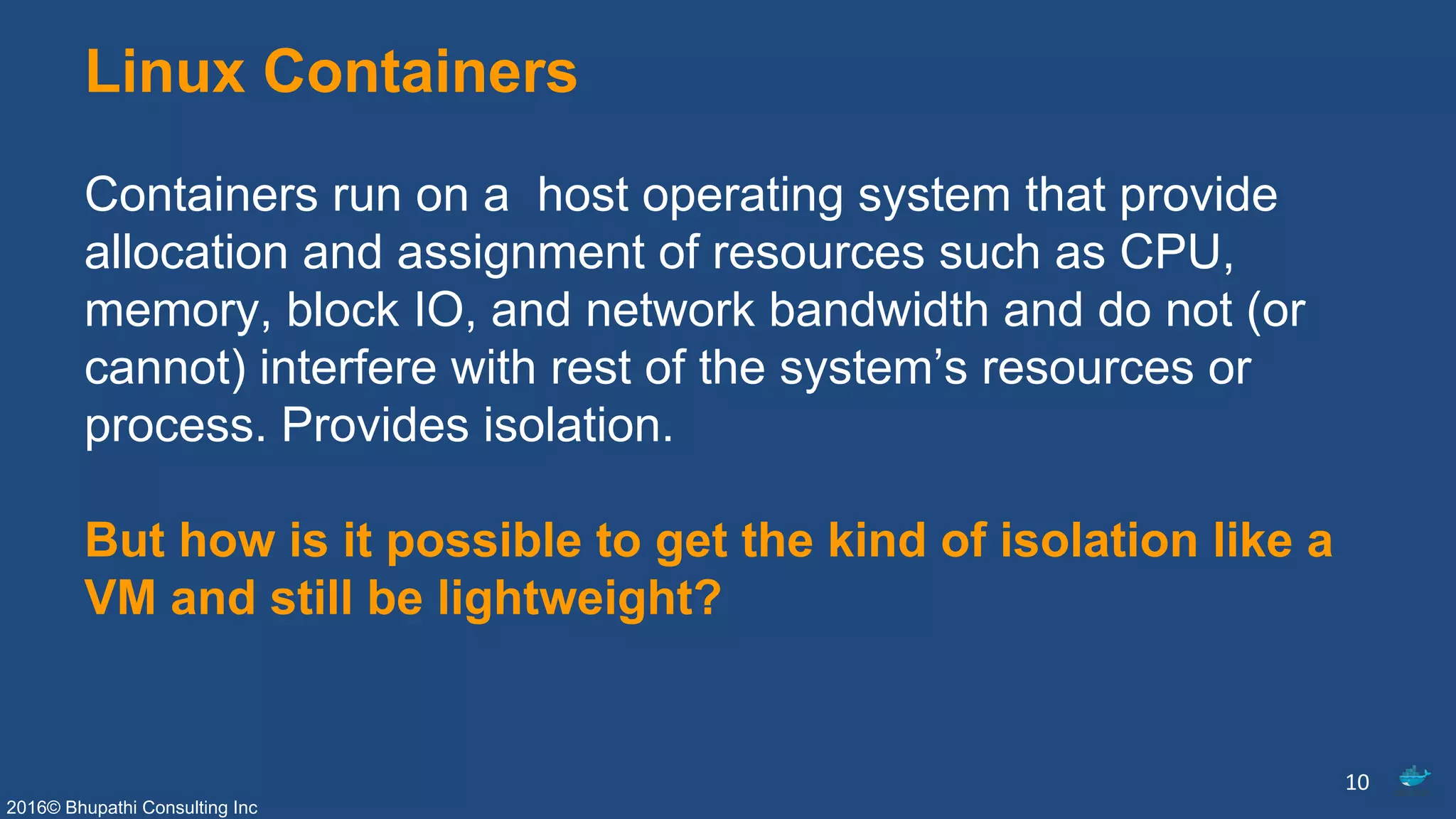
Containers run on a host operating system that provide
allocation and assignment of resources such as CPU,
memory, block IO, and network bandwidth and do not (or
cannot) interfere with rest of the system’s resources or
process. Provides isolation.
But how is it possible to get the kind of isolation like a
VM and still be lightweight?
10
2016© Bhupathi Consulting Inc
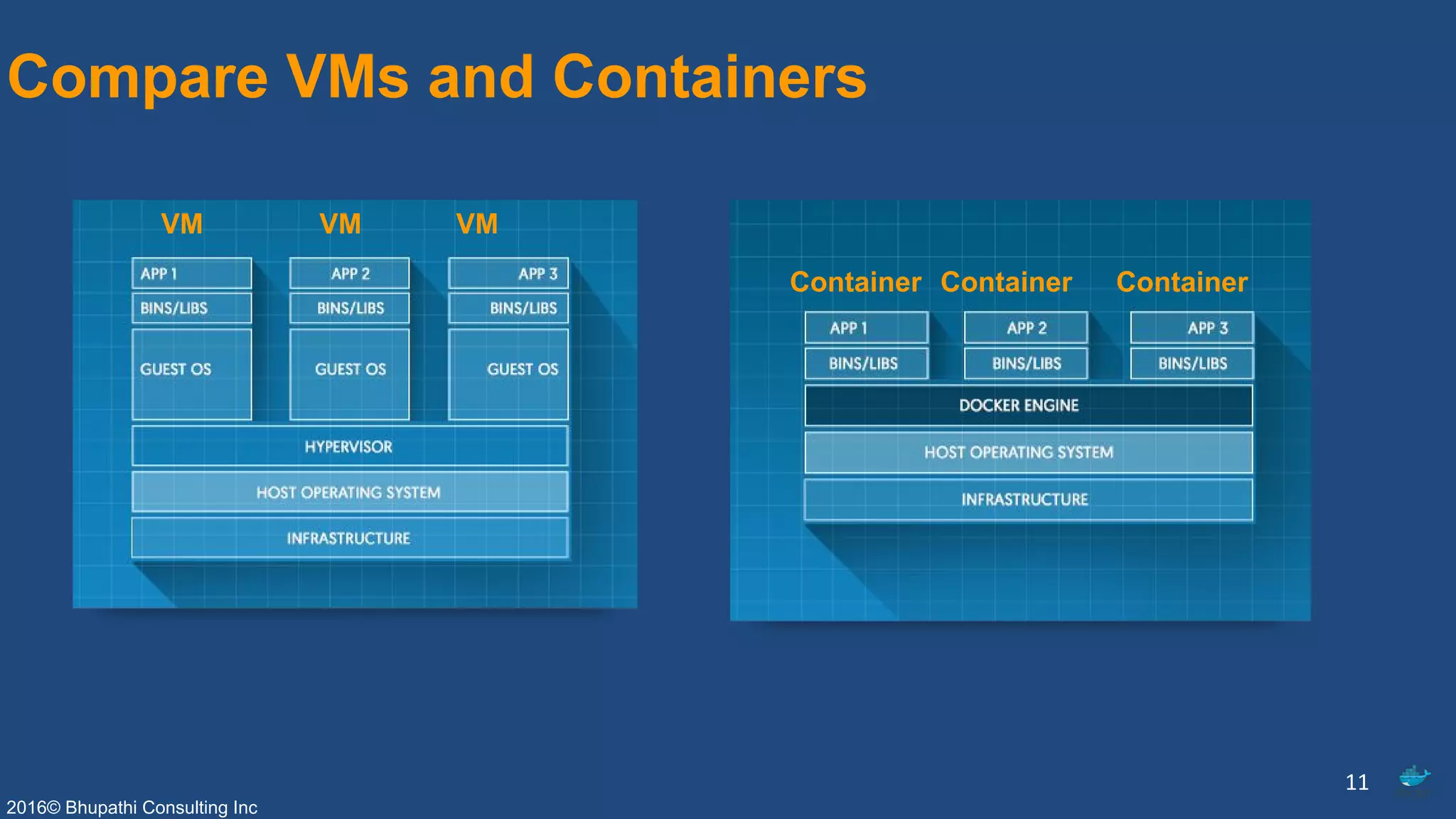
Compare VMs and Containers
VM VM VM
Container Container Container
11
2016© Bhupathi Consulting Inc
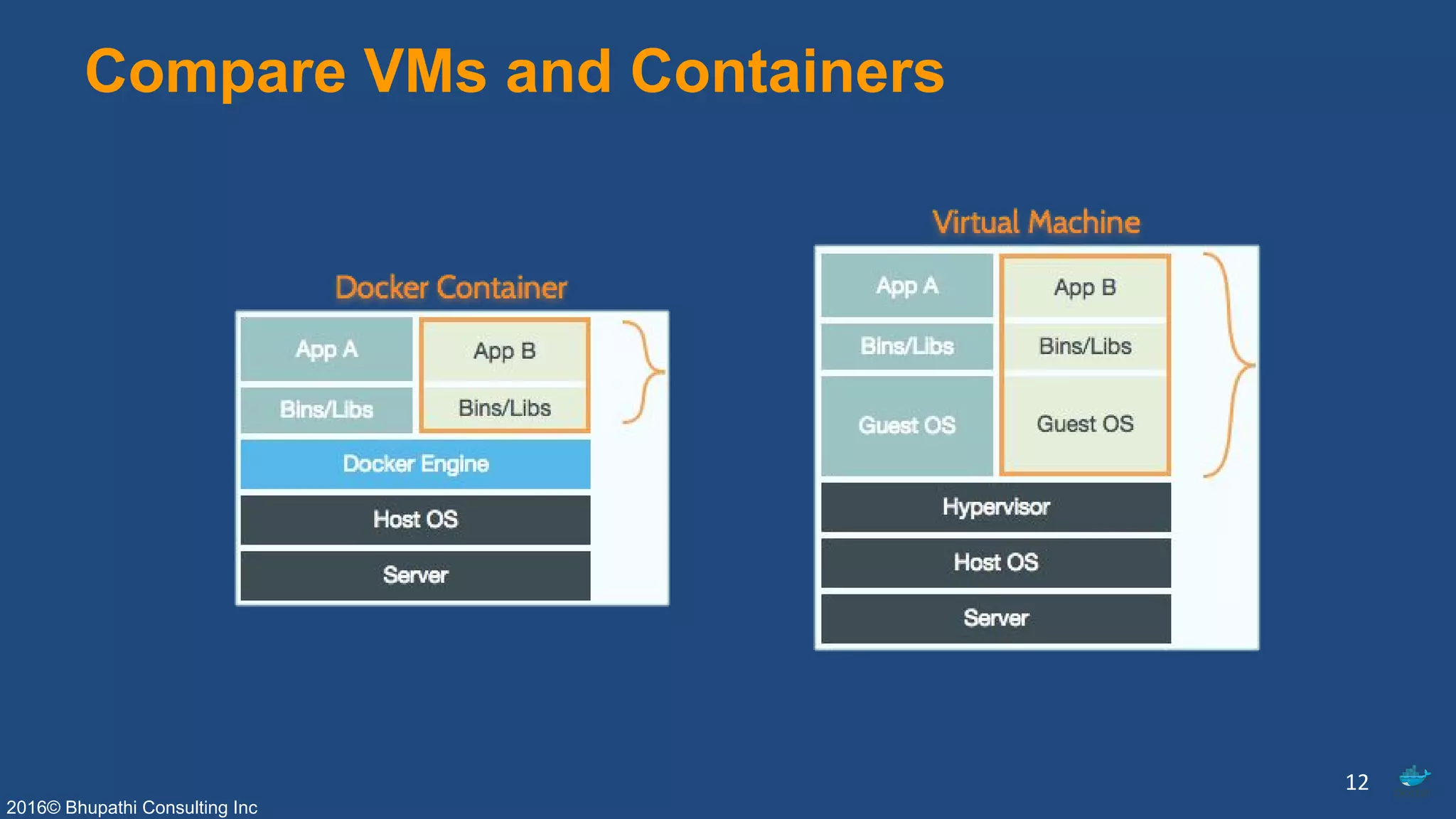
Compare VMs and Containers
12
2016© Bhupathi Consulting Inc
Compare VMs and Containers
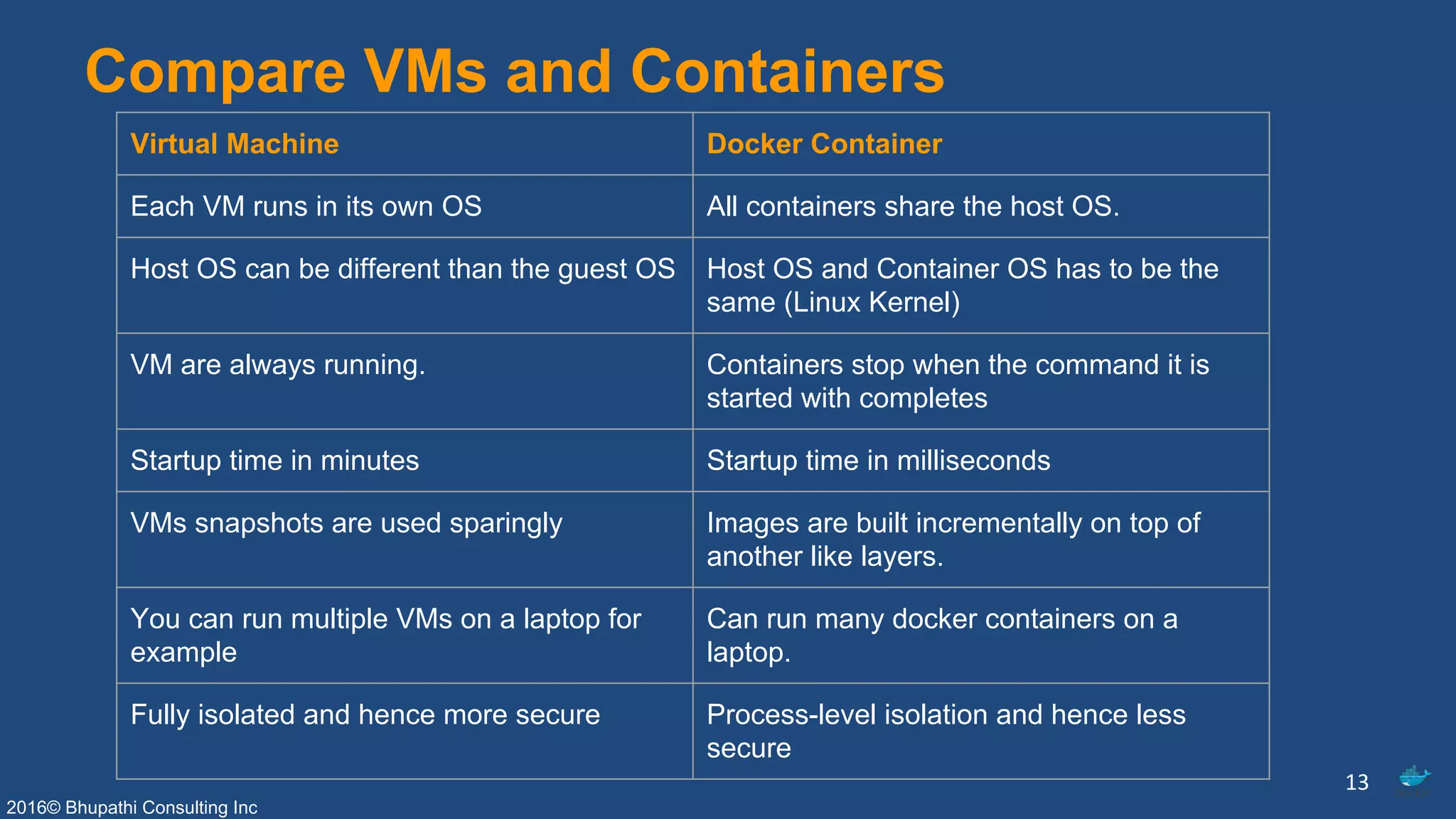
Virtual Machine Docker Container
Each VM runs in its own OS All containers share the host OS.
Host OS can be different than the guest OS Host OS and Container OS has to be the
same (Linux Kernel)
VM are always running. Containers stop when the command it is
started with completes
Startup time in minutes Startup time in milliseconds
VMs snapshots are used sparingly Images are built incrementally on top of
another like layers.
You can run multiple VMs on a laptop for
example
Can run many docker containers on a
laptop.
Fully isolated and hence more secure Process-level isolation and hence less
secure
13
2016© Bhupathi Consulting Inc
Similarities between VMs and Containers
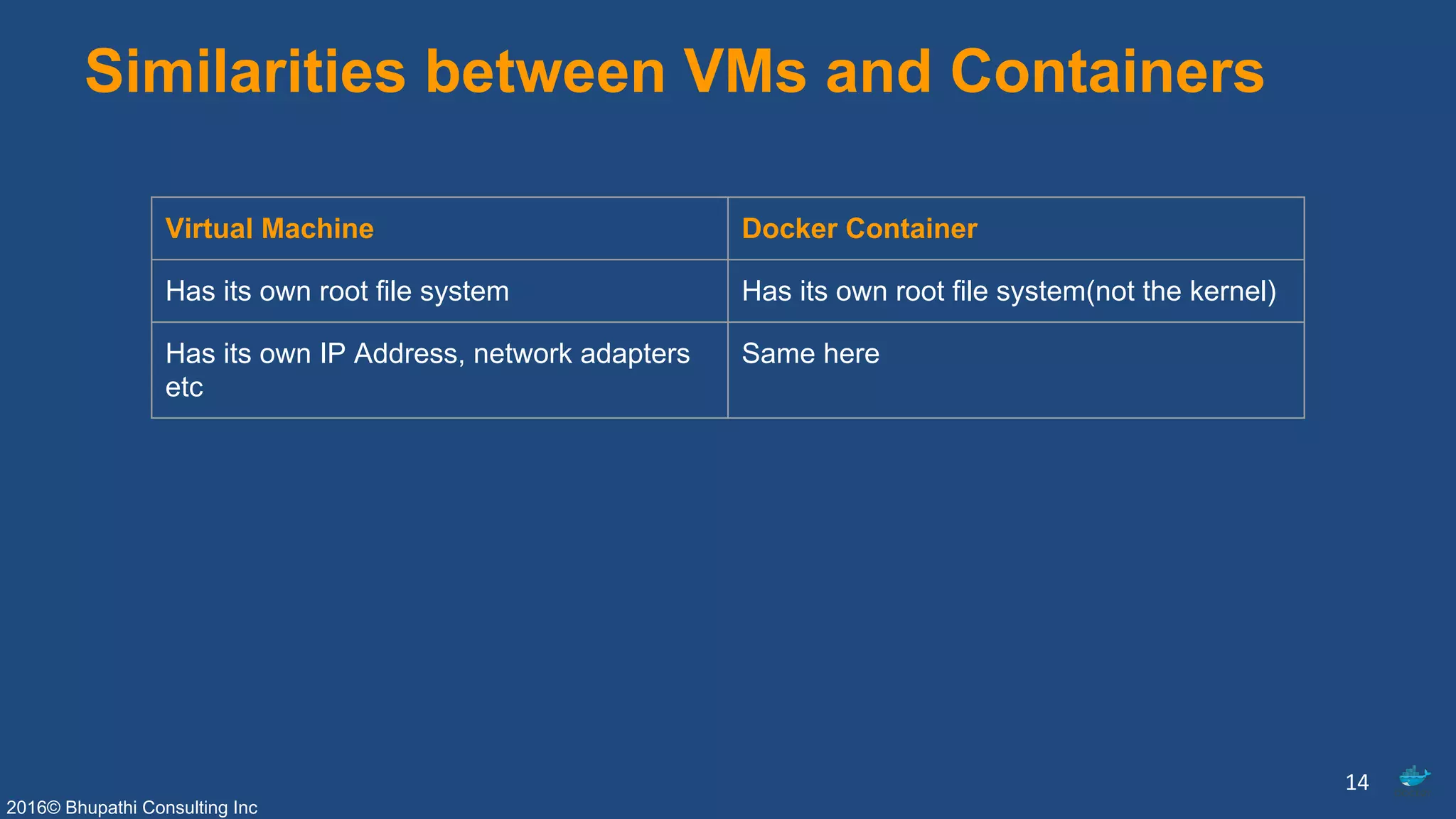
Virtual Machine Docker Container
Has its own root file system Has its own root file system(not the kernel)
Has its own IP Address, network adapters
etc
Same here
14
2016© Bhupathi Consulting Inc
How did Containers evolve?
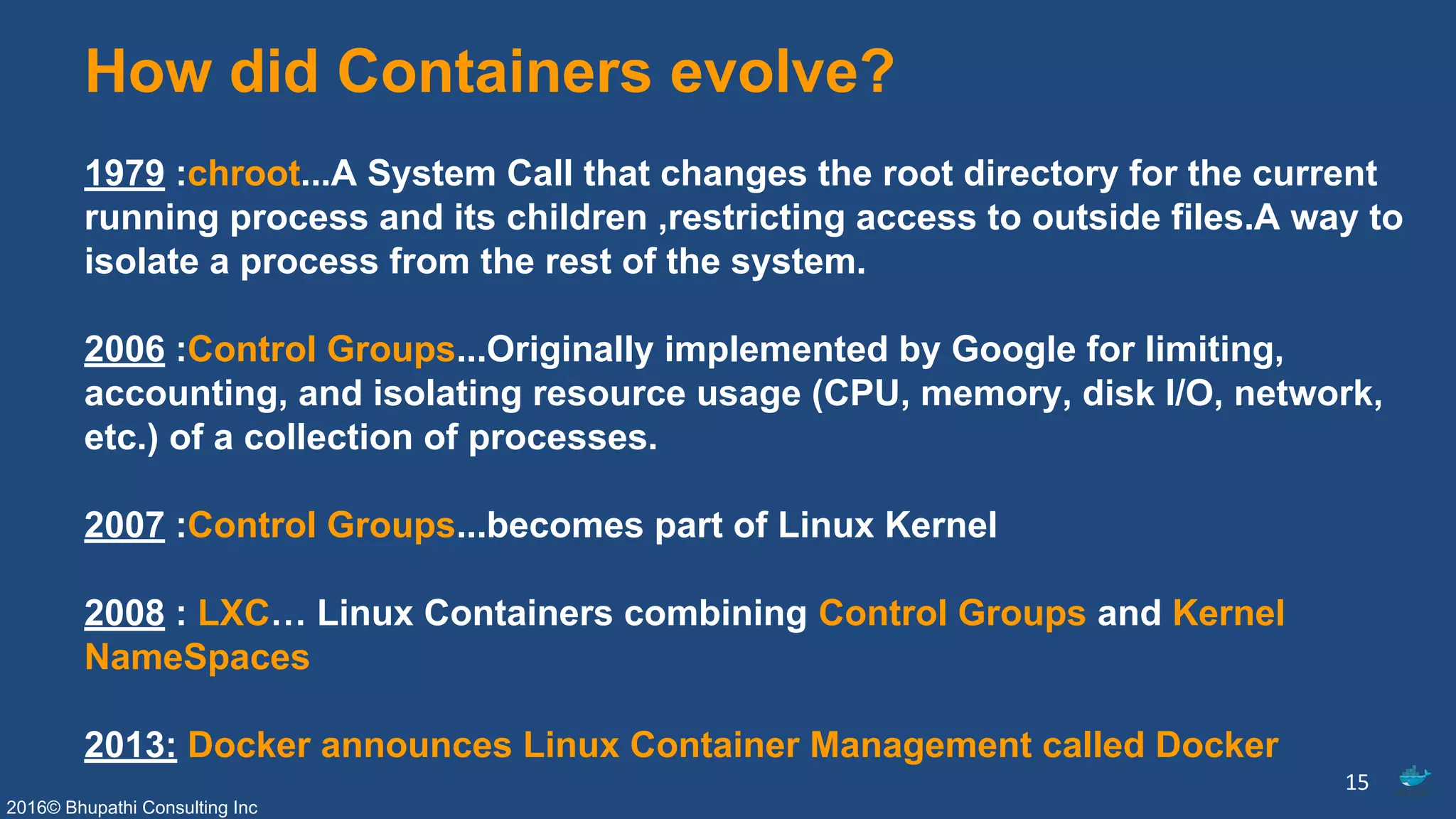
1979 :chroot...A System Call that changes the root directory for the current
running process and its children ,restricting access to outside files.A way to
isolate a process from the rest of the system.
2006 :Control Groups...Originally implemented by Google for limiting,
accounting, and isolating resource usage (CPU, memory, disk I/O, network,
etc.) of a collection of processes.
2007 :Control Groups...becomes part of Linux Kernel
2008 : LXC… Linux Containers combining Control Groups and Kernel
NameSpaces
2013: Docker announces Linux Container Management called Docker
15
2016© Bhupathi Consulting Inc
Some analogies before the Intro...
16
2016© Bhupathi Consulting Inc
Some analogies before the Intro...
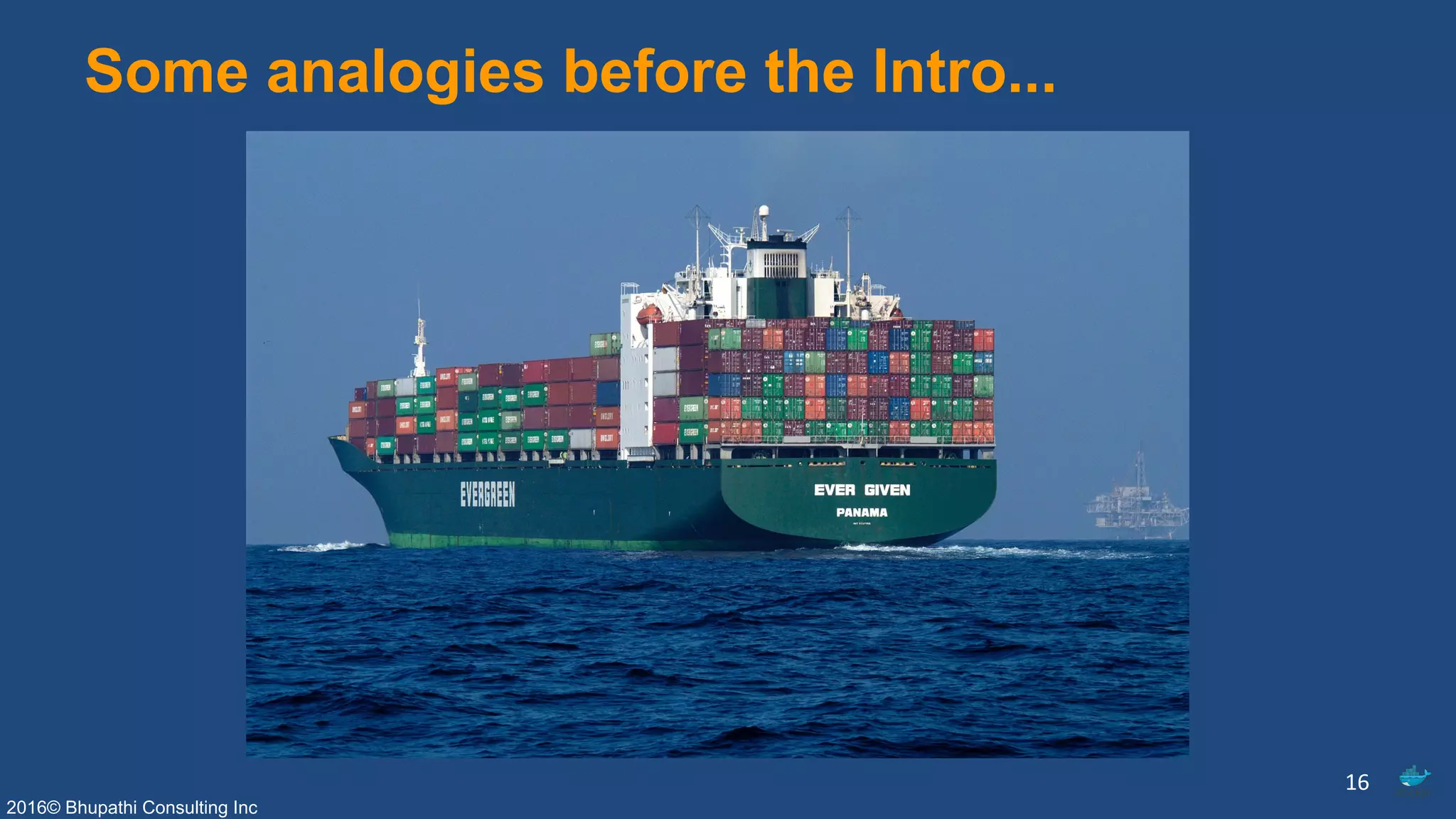
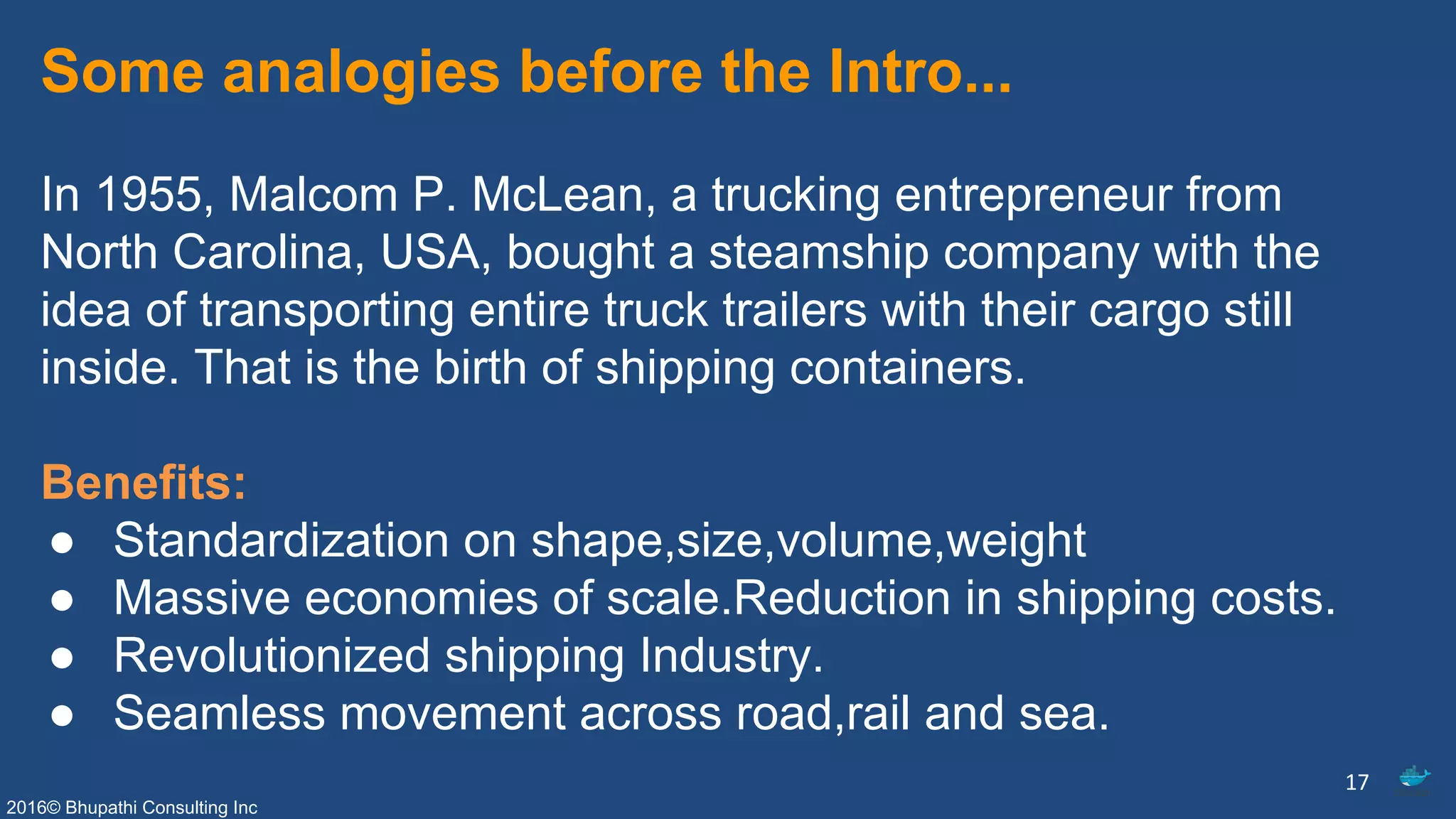
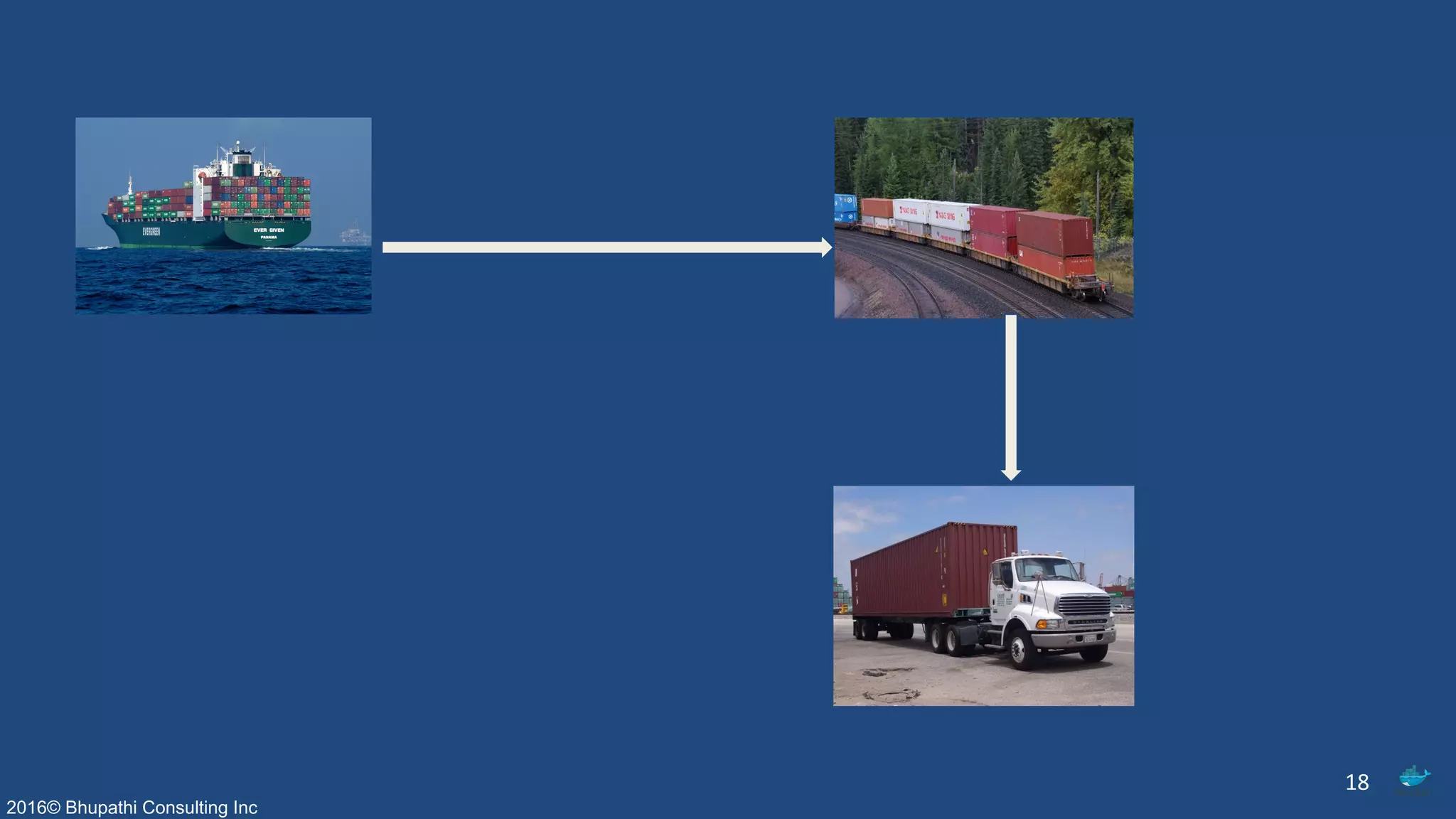
In 1955, Malcom P. McLean, a trucking entrepreneur from
North Carolina, USA, bought a steamship company with the
idea of transporting entire truck trailers with their cargo still
inside. That is the birth of shipping containers.
Benefits:
● Standardization on shape,size,volume,weight
● Massive economies of scale.Reduction in shipping costs.
● Revolutionized shipping Industry.
● Seamless movement across road,rail and sea.
17
2016© Bhupathi Consulting Inc
18
2016© Bhupathi Consulting Inc
Docker
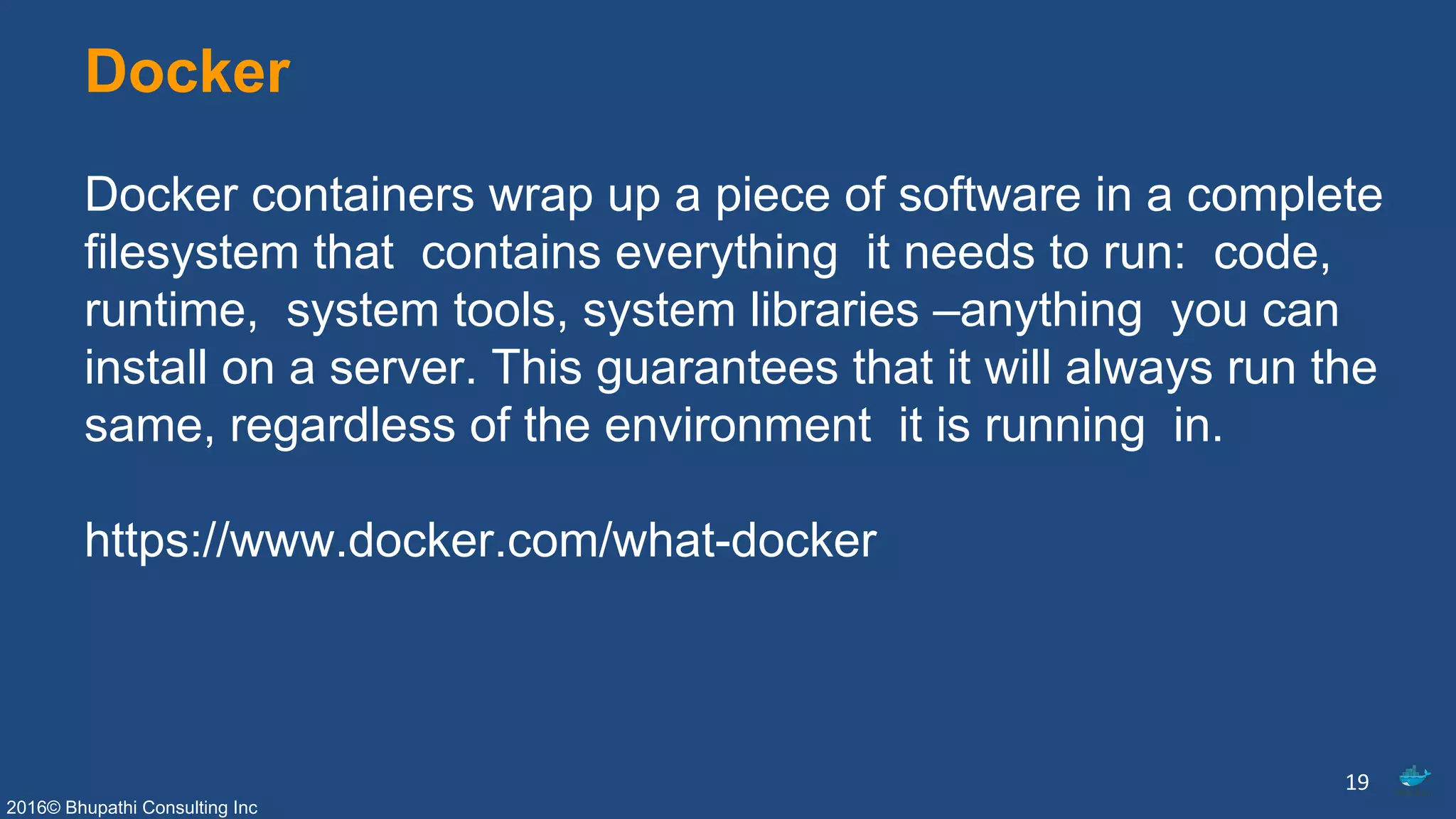
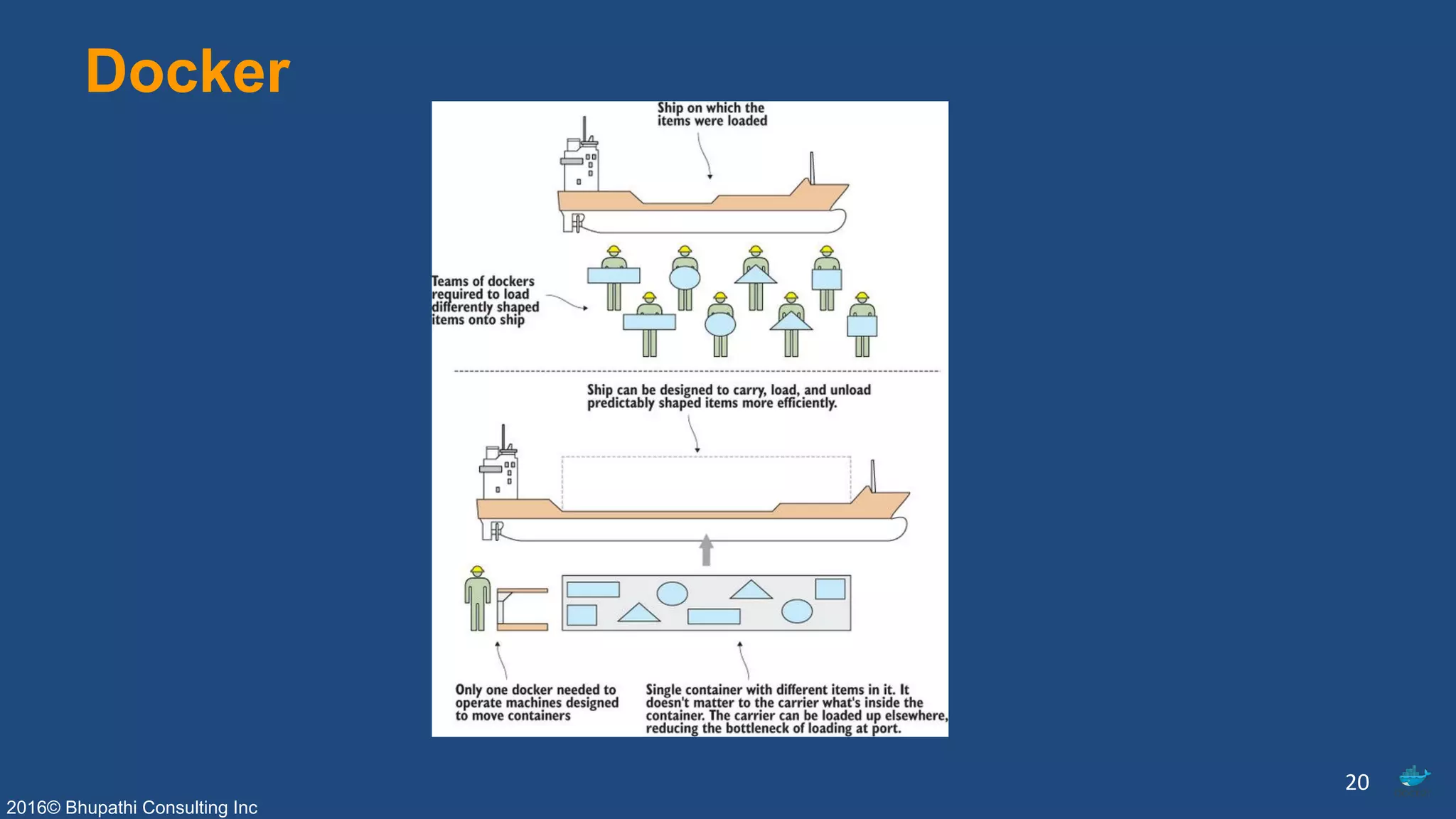
Docker containers wrap up a piece of software in a complete
filesystem that contains everything it needs to run: code,
runtime, system tools, system libraries –anything you can
install on a server. This guarantees that it will always run the
same, regardless of the environment it is running in.
https://www.docker.com/what-docker
19
2016© Bhupathi Consulting Inc
Docker
20
2016© Bhupathi Consulting Inc
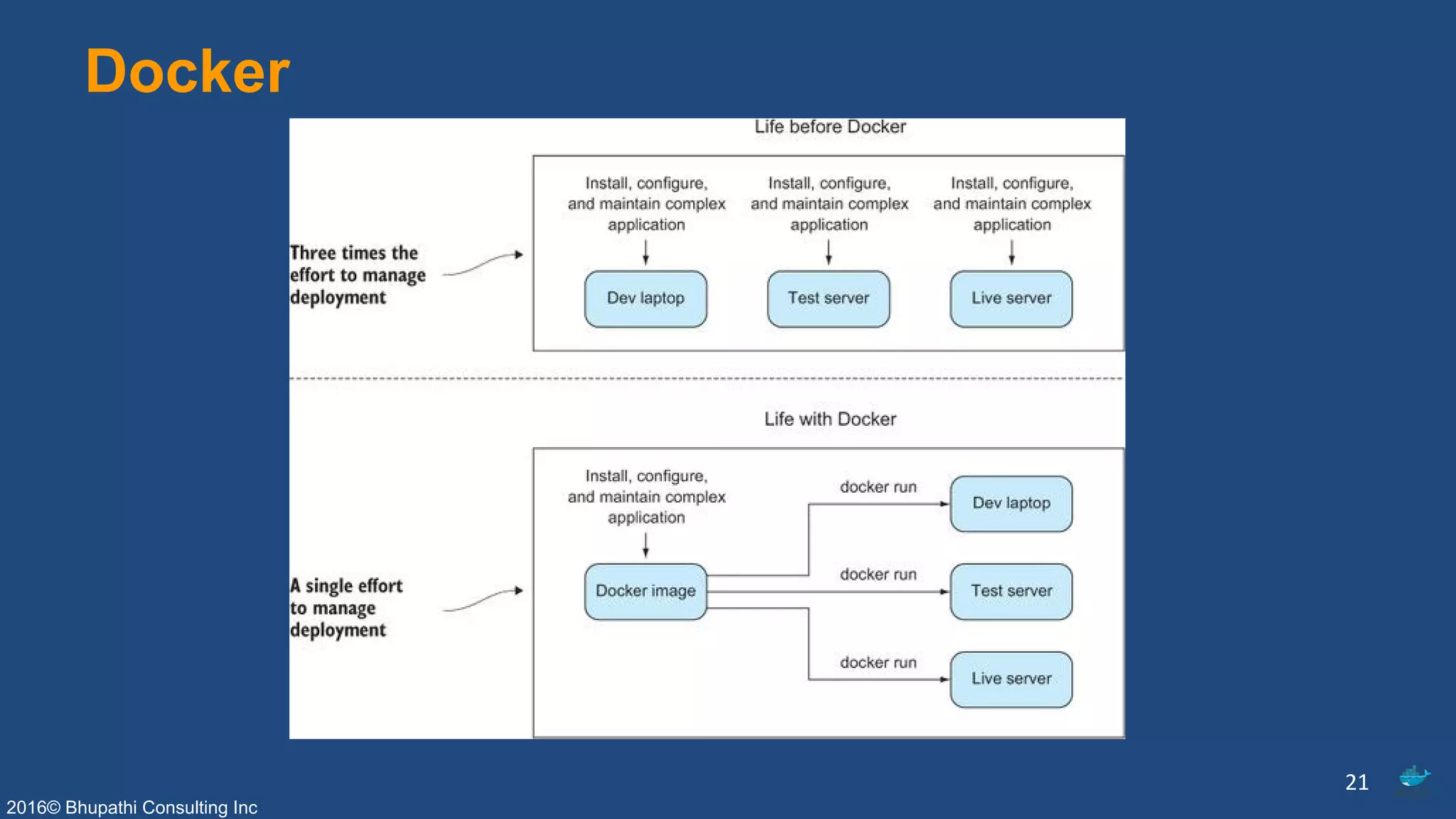
Docker
21
2016© Bhupathi Consulting Inc
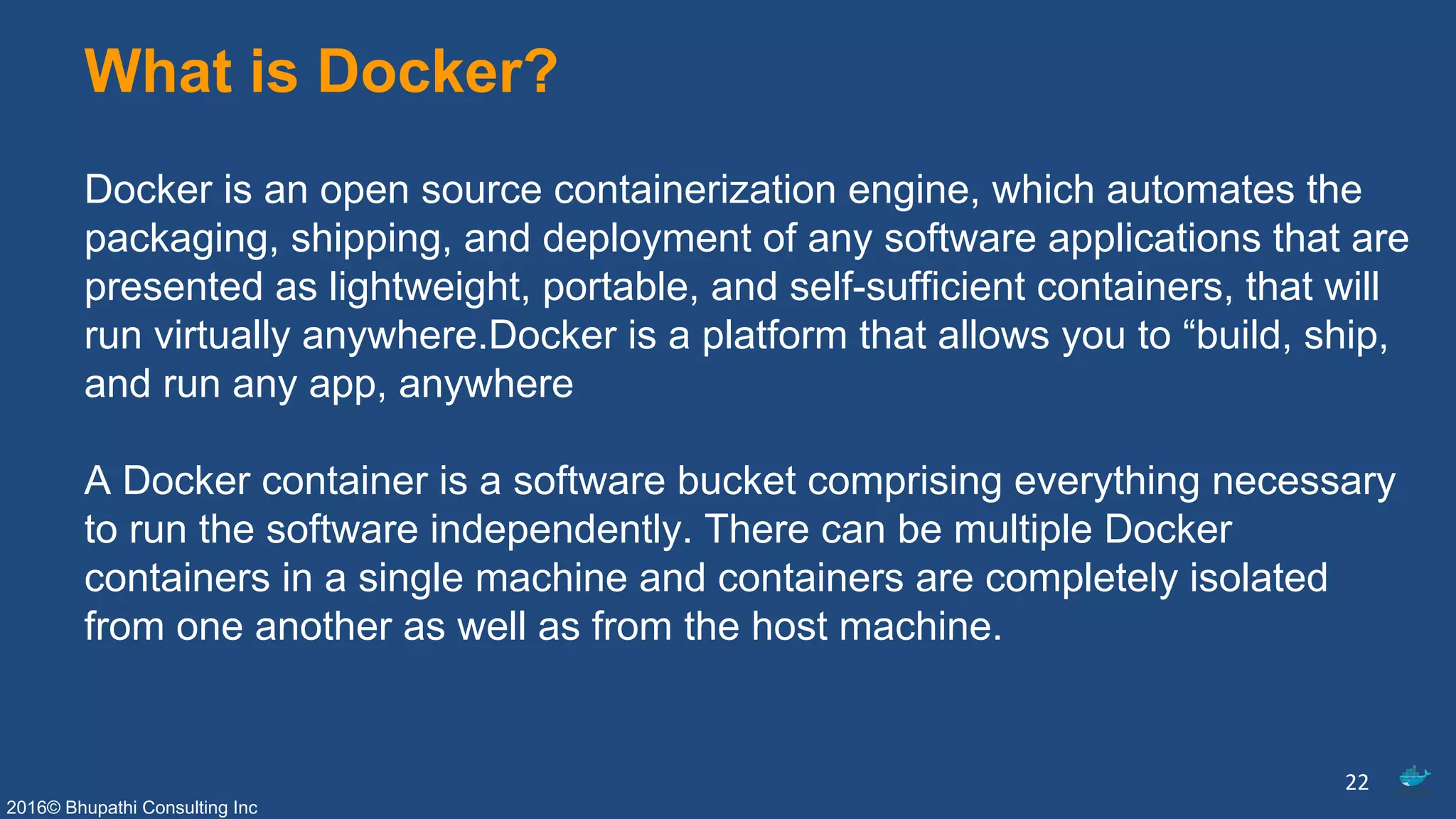
What is Docker?
Docker is an open source containerization engine, which automates the
packaging, shipping, and deployment of any software applications that are
presented as lightweight, portable, and self-sufficient containers, that will
run virtually anywhere.Docker is a platform that allows you to “build, ship,
and run any app, anywhere
A Docker container is a software bucket comprising everything necessary
to run the software independently. There can be multiple Docker
containers in a single machine and containers are completely isolated
from one another as well as from the host machine.
22
2016© Bhupathi Consulting Inc
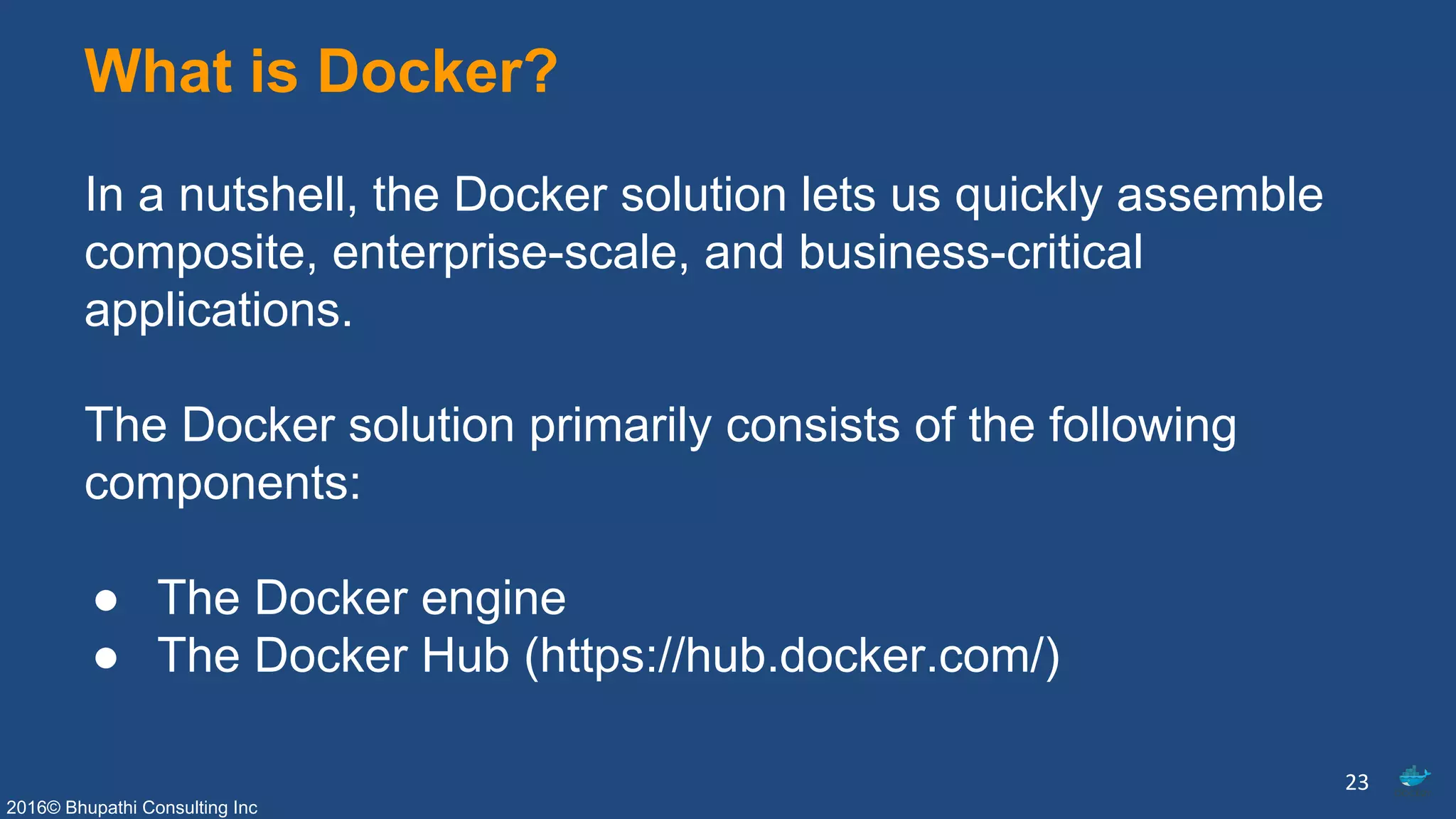
What is Docker?
In a nutshell, the Docker solution lets us quickly assemble
composite, enterprise-scale, and business-critical
applications.
The Docker solution primarily consists of the following
components:
● The Docker engine
● The Docker Hub (https://hub.docker.com/)
23
2016© Bhupathi Consulting Inc
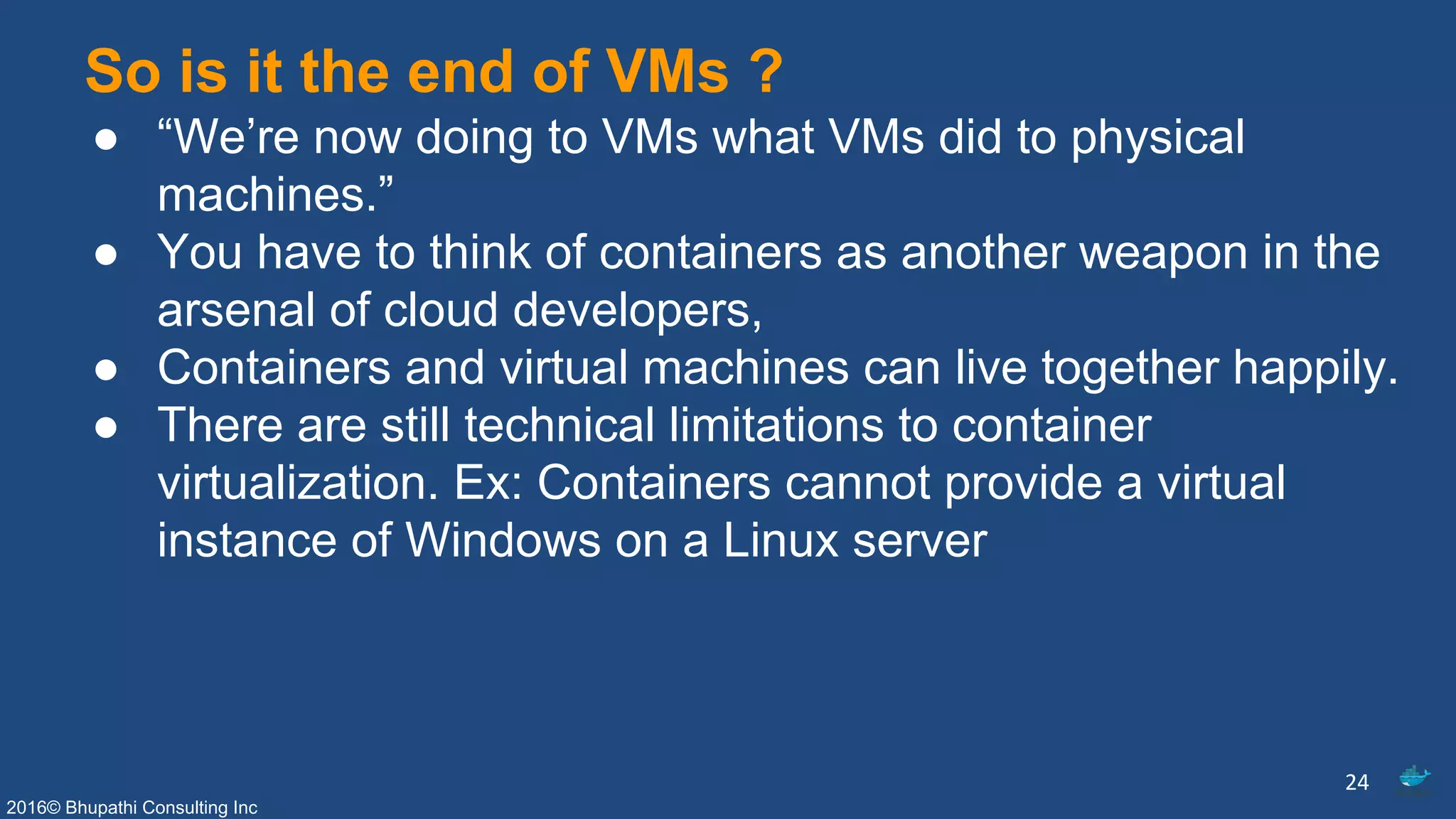
So is it the end of VMs ?
● “We’re now doing to VMs what VMs did to physical
machines.”
● You have to think of containers as another weapon in the
arsenal of cloud developers,
● Containers and virtual machines can live together happily.
● There are still technical limitations to container
virtualization. Ex: Containers cannot provide a virtual
instance of Windows on a Linux server
24
2016© Bhupathi Consulting Inc
Thank You
Q/A
25

Docker and containers : Disrupting the virtual machine(VM)

  • 1.
    2016© Bhupathi ConsultingInc Docker and Containers Disrupting the Virtual Machine Rama Krishna Bhupathi ramakris@gmail.com
  • 2.
    2016© Bhupathi ConsultingInc Some Terminologies ● Virtualization: In computing, virtualization refers to the act of creating a virtual version of a computer resource including CPU, operating systems, storage , and computer network resources. ● Virtual Machine:A virtual machine (VM) is an emulation of a particular computer system, its resources such as CPU, RAM, Disk space. Each VM has its own kernel,OS, and supporting libraries. Behaves like a machine(PC) but not real machine(everything is virtualized) 2
  • 3.
    2016© Bhupathi ConsultingInc Some Terminologies ● Hypervisor: A hypervisor or virtual machine monitor (VMM) is a piece of computer software, firmware or hardware that creates and runs virtual machines. Zen (Used by Amazon Web Services) KVM (Used by OpenStack) Microsoft Hyper V VMWare VSphere ESXi RedHat Enterprise Virtualization 3
  • 4.
    2016© Bhupathi ConsultingInc Why Virtualization is so popular? ● More Agile , more dynamic provisioning ● Reduce the data center footprint ● Reduce vendor lock-in ● Faster Server Provisioning ● Reduced costs ● More flexibility in demand / supply of resources. ● High Server Utilization ● Low Total Cost of Ownership(TCO) 4
  • 5.
    2016© Bhupathi ConsultingInc Virtualization Timeline 1960 and 1970s: First Virtual machines used by IBM 1990s: x86 becomes prominent server platform 1999: VMWare first commercial product to virtualize x86 2006: AMD(AMD-V) and Intel(Intel-VT) build Virtualization into their CPUs 5
  • 6.
    2016© Bhupathi ConsultingInc Virtualization 6
  • 7.
    2016© Bhupathi ConsultingInc Virtualization...any improvements? ● Virtual Machines are fat (requires its own OS) ● Overhead in terms of the hypervisor that emulates the hardware. ● Even if you want to run an application you need a full scale OS stack. ● Maintenance: Need to patch the individual OSes on the VM as needed ● Increased complexity when there are huge number of OSes in VMs that needs patching ● Explicitly turn ON virtualization at BIOS. 7
  • 8.
    2016© Bhupathi ConsultingInc Linux Containers Containers are lightweight isolated operating system environments(processes) running on a host. Unlike virtual machines, containers ... ● don’t need additional hardware capabilities such as Intel-VT and so on. ● don’t need emulated BIOS or completely virtualized hardware 8
  • 9.
    2016© Bhupathi ConsultingInc Linux Containers Linux containers are an operating system level virtualization technology for providing multiple isolated Linux environments on a single Linux host. Unlike virtual machines (VMs), containers do not run dedicated guest operating systems. Rather, they share the host operating system kernel and make use of the guest operating system system libraries for providing the required OS capabilities. 9
  • 10.
    2016© Bhupathi ConsultingInc Linux Containers Containers run on a host operating system that provide allocation and assignment of resources such as CPU, memory, block IO, and network bandwidth and do not (or cannot) interfere with rest of the system’s resources or process. Provides isolation. But how is it possible to get the kind of isolation like a VM and still be lightweight? 10
  • 11.
    2016© Bhupathi ConsultingInc Compare VMs and Containers VM VM VM Container Container Container 11
  • 12.
    2016© Bhupathi ConsultingInc Compare VMs and Containers 12
  • 13.
    2016© Bhupathi ConsultingInc Compare VMs and Containers Virtual Machine Docker Container Each VM runs in its own OS All containers share the host OS. Host OS can be different than the guest OS Host OS and Container OS has to be the same (Linux Kernel) VM are always running. Containers stop when the command it is started with completes Startup time in minutes Startup time in milliseconds VMs snapshots are used sparingly Images are built incrementally on top of another like layers. You can run multiple VMs on a laptop for example Can run many docker containers on a laptop. Fully isolated and hence more secure Process-level isolation and hence less secure 13
  • 14.
    2016© Bhupathi ConsultingInc Similarities between VMs and Containers Virtual Machine Docker Container Has its own root file system Has its own root file system(not the kernel) Has its own IP Address, network adapters etc Same here 14
  • 15.
    2016© Bhupathi ConsultingInc How did Containers evolve? 1979 :chroot...A System Call that changes the root directory for the current running process and its children ,restricting access to outside files.A way to isolate a process from the rest of the system. 2006 :Control Groups...Originally implemented by Google for limiting, accounting, and isolating resource usage (CPU, memory, disk I/O, network, etc.) of a collection of processes. 2007 :Control Groups...becomes part of Linux Kernel 2008 : LXC… Linux Containers combining Control Groups and Kernel NameSpaces 2013: Docker announces Linux Container Management called Docker 15
  • 16.
    2016© Bhupathi ConsultingInc Some analogies before the Intro... 16
  • 17.
    2016© Bhupathi ConsultingInc Some analogies before the Intro... In 1955, Malcom P. McLean, a trucking entrepreneur from North Carolina, USA, bought a steamship company with the idea of transporting entire truck trailers with their cargo still inside. That is the birth of shipping containers. Benefits: ● Standardization on shape,size,volume,weight ● Massive economies of scale.Reduction in shipping costs. ● Revolutionized shipping Industry. ● Seamless movement across road,rail and sea. 17
  • 18.
  • 19.
    2016© Bhupathi ConsultingInc Docker Docker containers wrap up a piece of software in a complete filesystem that contains everything it needs to run: code, runtime, system tools, system libraries –anything you can install on a server. This guarantees that it will always run the same, regardless of the environment it is running in. https://www.docker.com/what-docker 19
  • 20.
  • 21.
  • 22.
    2016© Bhupathi ConsultingInc What is Docker? Docker is an open source containerization engine, which automates the packaging, shipping, and deployment of any software applications that are presented as lightweight, portable, and self-sufficient containers, that will run virtually anywhere.Docker is a platform that allows you to “build, ship, and run any app, anywhere A Docker container is a software bucket comprising everything necessary to run the software independently. There can be multiple Docker containers in a single machine and containers are completely isolated from one another as well as from the host machine. 22
  • 23.
    2016© Bhupathi ConsultingInc What is Docker? In a nutshell, the Docker solution lets us quickly assemble composite, enterprise-scale, and business-critical applications. The Docker solution primarily consists of the following components: ● The Docker engine ● The Docker Hub (https://hub.docker.com/) 23
  • 24.
    2016© Bhupathi ConsultingInc So is it the end of VMs ? ● “We’re now doing to VMs what VMs did to physical machines.” ● You have to think of containers as another weapon in the arsenal of cloud developers, ● Containers and virtual machines can live together happily. ● There are still technical limitations to container virtualization. Ex: Containers cannot provide a virtual instance of Windows on a Linux server 24
  • 25.
    2016© Bhupathi ConsultingInc Thank You Q/A 25