Bare-metal, Docker Containers, and 
Virtualization: The Growing Choices for Cloud 
Applications 
Nicholas Weaver – Principal Architect, Intel Corporation 
DATS004
2 
How did we get here?
3
4 
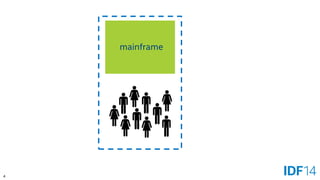
mainframe
5 
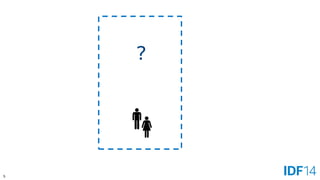
?
6 
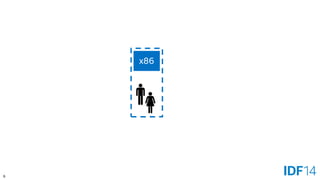
x86
7 
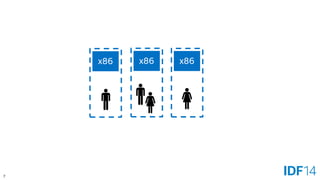
x86 
x86 
x86
8 
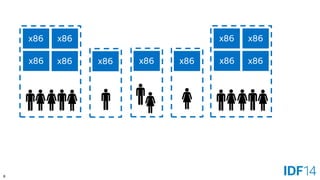
x86 
x86 
x86 
x86 
x86 
x86 
x86 
x86 
x86 
x86 
x86
9 
x86
10 
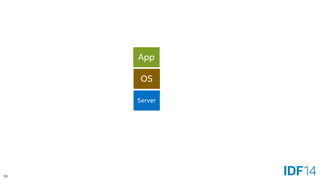
Server 
OS 
App
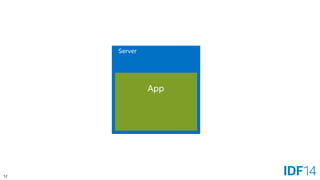
11 
Server
12 
Server 
App
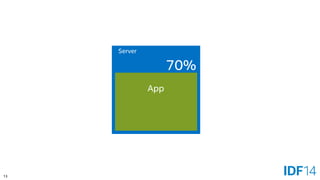
13 
Server 
App 
70%
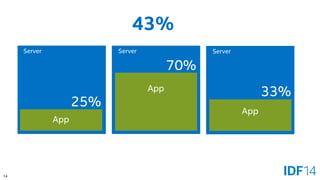
14 
Server 
App 
Server 
App 
Server 
App 
70% 
25% 
33% 
43%
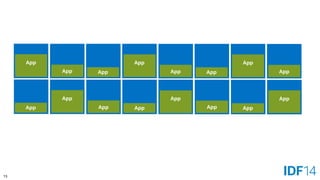
15 
App 
App 
App 
App 
App 
App 
App 
App 
App 
App 
App 
App 
App 
App 
App 
App
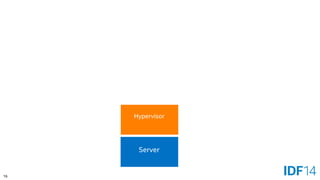
16 
Server 
Hypervisor 
VM
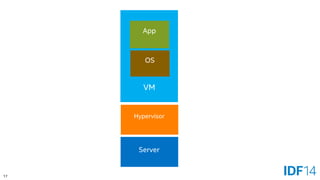
17 
Server 
Hypervisor 
VM 
OS 
App
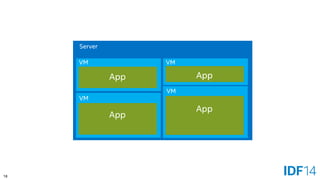
18 
Server 
VM 
App 
App 
App 
VM 
VM 
App 
VM
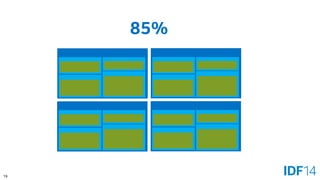
19 
85%
20 
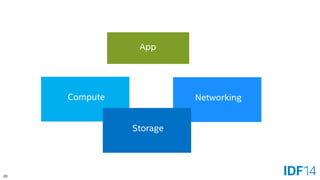
App 
Compute 
Networking 
Storage
21 
Virtualization -Pros 
•Carves hardware into virtual hardware 
•Virtual hardware presented as a virtual machine 
•Strong isolation between virtual machines 
•Allows for running heterogeneous operating systems 
•QoS, orchestration, templates, portability 
•Live migration, high-availability, resource pooling
22 
Virtualization -Cons 
•Each virtual machine is a complete stack (OS, patches, applications) 
•Hypervisor and supporting management have to be maintained 
•Measurable overhead compared to bare-metal
23 
Containers
24 
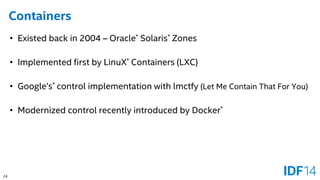
Containers 
•Existed back in 2004 –Oracle*Solaris*Zones 
•Implemented first by LinuX*Containers (LXC) 
•Google’s*control implementation with lmctfy (Let Me Contain That For You) 
•Modernized control recently introduced by Docker*
25 
How does it work?
26 
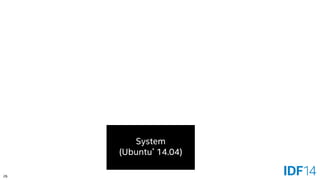
System 
(Ubuntu*14.04)
27 
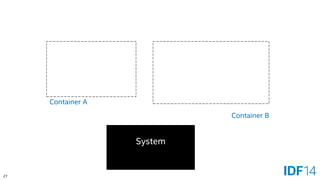
Container A 
Container B 
System
28 
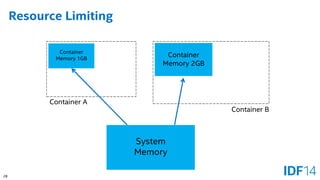
Resource Limiting 
System 
Memory 
Container 
Memory 1GB 
Container 
Memory 2GB 
Container A 
Container B
29 
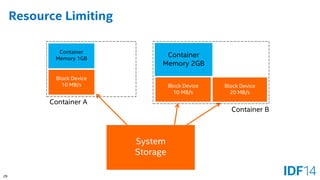
Resource Limiting 
System 
Storage 
Container 
Memory 1GB 
Container 
Memory 2GB 
Container A 
Block Device 
10 MB/s 
Block Device 
10 MB/s 
Block Device 
20 MB/s 
Container B
30 
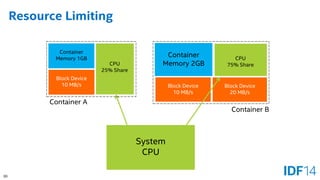
Resource Limiting 
System 
CPU 
Container 
Memory 1GB 
Container 
Memory 2GB 
Container A 
Container B 
Block Device 
10 MB/s 
Block Device 
10 MB/s 
Block Device 
20 MB/s 
CPU25% Share 
CPU75% Share
31 
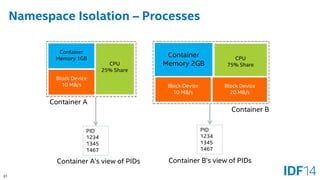
Namespace Isolation –Processes 
Container 
Memory 1GB 
Container 
Memory 2GB 
Container A 
Container B 
Block Device 
10 MB/s 
Block Device 
10 MB/s 
Block Device 
20 MB/s 
CPU25% Share 
CPU75% Share 
PID 
1234 
1345 
1467 
PID 
1234 
1345 
1467 
Container A’s view of PIDs 
Container B’s view of PIDs
32 
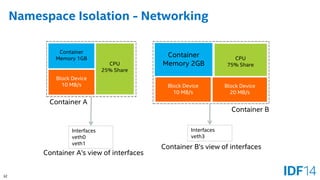
Namespace Isolation -Networking 
Container 
Memory 1GB 
Container 
Memory 2GB 
Container A 
Container B 
Block Device 
10 MB/s 
Block Device 
10 MB/s 
Block Device 
20 MB/s 
CPU25% Share 
CPU75% Share 
Interfaces 
veth0 
veth1 
Container A’s view of interfaces 
Container B’s view of interfaces 
Interfaces 
veth3
33 
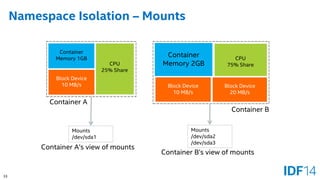
Namespace Isolation –Mounts 
Container 
Memory 1GB 
Container 
Memory 2GB 
Container A 
Container B 
Block Device 
10 MB/s 
Block Device 
10 MB/s 
Block Device 
20 MB/s 
CPU25% Share 
CPU75% Share 
Mounts 
/dev/sda1 
Container A’s view of mounts 
Container B’s view of mounts 
Mounts 
/dev/sda2 
/dev/sda3
34 
Namespace Isolation –Mounts 
Container 
Memory 1GB 
Container 
Memory 2GB 
Container A 
Container B 
Block Device 
10 MB/s 
Block Device 
10 MB/s 
Block Device 
20 MB/s 
CPU25% Share 
CPU75% Share 
Mounts 
/dev/sda1 
Container A’s view of mounts 
Container B’s view of mounts 
Mounts 
/dev/sda2 
/dev/sda3
35 
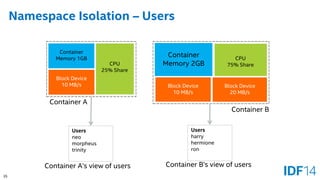
Namespace Isolation –Users 
Container 
Memory 1GB 
Container 
Memory 2GB 
Container A 
Container B 
Block Device 
10 MB/s 
Block Device 
10 MB/s 
Block Device 
20 MB/s 
CPU25% Share 
CPU75% Share 
Users 
neo 
morpheustrinity 
Container A’s view of users 
Container B’s view of users 
Usersharry 
hermioneron
36 
When things look the same
37 
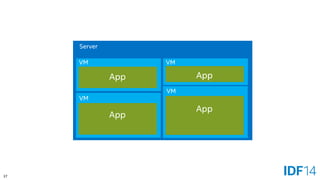
Server 
VM 
App 
App 
App 
VM 
VM 
App 
VM
38 
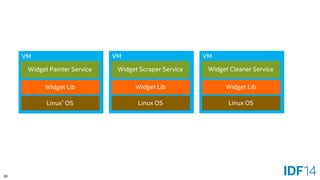
VM 
Widget Scraper Service 
Widget Lib 
Linux OS 
VM 
Widget Painter Service 
Widget Lib 
Linux*OS 
VM 
Widget Cleaner Service 
Widget Lib 
Linux OS
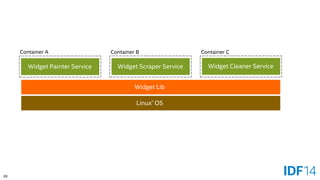
39 
Widget Scraper Service 
Widget Lib 
Linux*OS 
Widget Painter Service 
Widget Cleaner Service 
Container A 
Container B 
Container C
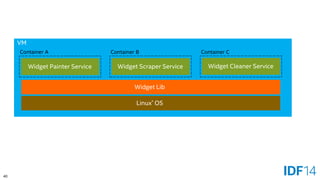
40 
VM 
Widget Scraper Service 
Widget Lib 
Linux*OS 
Widget Painter Service 
Widget Cleaner Service 
Container A 
Container B 
Container C
41 
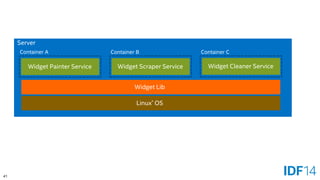
Server 
Widget Scraper Service 
Widget Lib 
Linux*OS 
Widget Painter Service 
Widget Cleaner Service 
Container A 
Container B 
Container C
42 
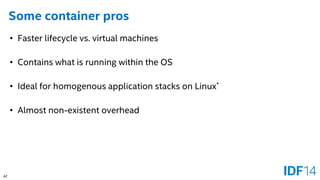
Some container pros 
•Faster lifecycle vs. virtual machines 
•Contains what is running within the OS 
•Ideal for homogenous application stacks on Linux* 
•Almost non-existent overhead
43 
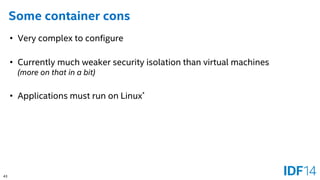
Some container cons 
•Very complex to configure 
•Currently much weaker security isolation than virtual machines(more on that in a bit) 
•Applications must run on Linux*
44
45 
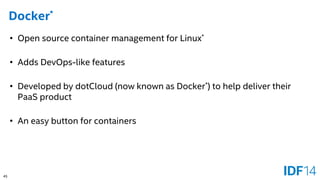
Docker* 
•Open source container management for Linux* 
•Adds DevOps-like features 
•Developed by dotCloud (now known as Docker*) to help deliver their PaaS product 
•An easy button for containers
46 
What does Docker*bring?
47 
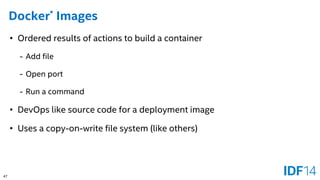
Docker*Images 
•Ordered results of actions to build a container 
-Add file 
-Open port 
-Run a command 
•DevOps like source code for a deployment image 
•Uses a copy-on-write file system (like others)
48 
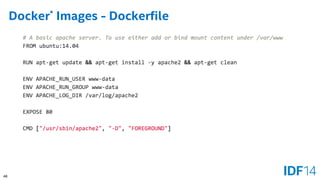
Docker*Images -Dockerfile
49 
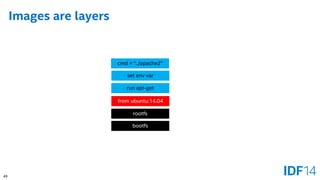
Images are layers 
rootfs 
bootfs 
run apt-get 
set env var 
from ubuntu:14.04 
cmd = “../apache2”
50 
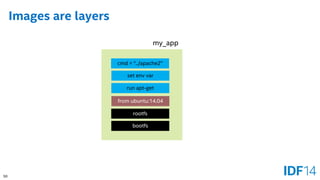
Images are layers 
rootfs 
bootfs 
run apt-get 
set env var 
from ubuntu:14.04 
cmd = “../apache2” 
my_app
51 
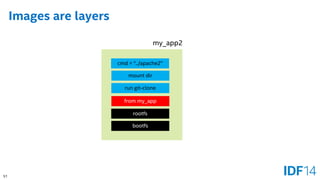
Images are layers 
rootfs 
bootfs 
run git-clone 
mount dir 
from my_app 
cmd = “../apache2” 
my_app2
52 
Image Registry 
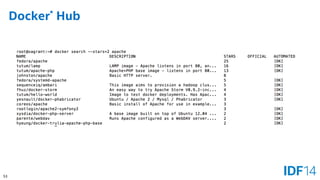
•Public Docker registry: Docker*Hub 
•Option to deploy your own private Docker Registry
53 
Docker*Hub
54 
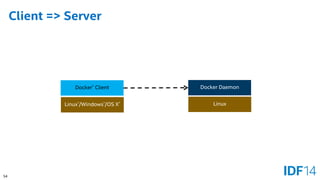
Client => Server 
Docker Daemon 
Linux 
Docker*Client 
Linux*/Windows*/OS X*
55 
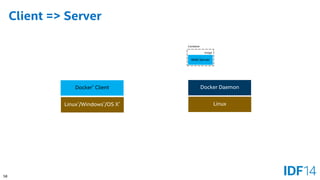
Client => Server 
Docker Daemon 
Linux 
Docker*Client 
Linux*/Windows*/OS X* 
[docker run web-server] 
Container 
Web Server 
Image
56 
Client => Server 
Docker Daemon 
Linux 
Docker*Client 
Linux*/Windows*/OS X* 
[docker run database] 
Container 
Web Server 
Image 
Container 
Database 
Image
57 
Client => Server 
Docker Daemon 
Linux 
Docker*Client 
Linux*/Windows*/OS X* 
[docker stop database] 
Container 
Web Server 
Image 
Container 
Database 
Image
58 
Client => Server 
Docker Daemon 
Linux 
Docker*Client 
Linux*/Windows*/OS X* 
Container 
Web Server 
Image
59 
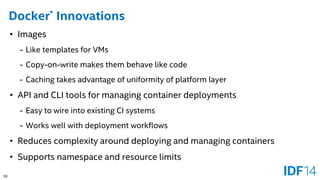
Docker*Innovations 
•Images 
-Like templates for VMs 
-Copy-on-write makes them behave like code 
-Caching takes advantage of uniformity of platform layer 
•API and CLI tools for managing container deployments 
-Easy to wire into existing CI systems 
-Works well with deployment workflows 
•Reduces complexity around deploying and managing containers 
•Supports namespace and resource limits
60 
Rubber meets road
61 
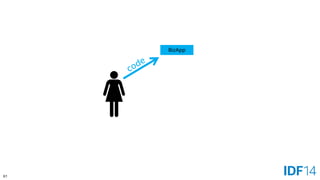
BizApp
62 
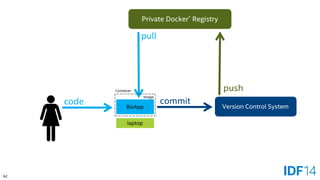
code 
Private Docker*Registry 
BizApp 
Image 
Container 
laptop 
pull 
Version Control System 
commit 
push
63 
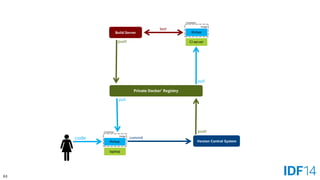
code 
Private Docker*Registry 
Container 
laptop 
pull 
Version Control System 
commit 
push 
pull 
Container 
CI server 
BizApp 
Image 
BizApp 
Image 
Build Server 
push 
test
64 
Private Docker*Registry 
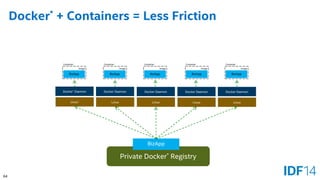
Docker*+ Containers = Less Friction 
BizApp 
Docker Daemon 
Linux 
Docker Daemon 
Linux 
Docker Daemon 
Linux 
Docker Daemon 
Linux 
Docker*Daemon 
Linux* 
Container 
BizApp 
Image 
Container 
BizApp 
Image 
Container 
BizApp 
Image 
Container 
BizApp 
Image 
Container 
BizApp 
Image
65 
The Gotchas
66 
Are containers secure?
67 
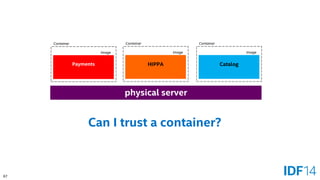
Payments 
Image 
Container 
physical server 
HIPPA 
Image 
Container 
Catalog 
Image 
Container 
Can I trust a container?
68 
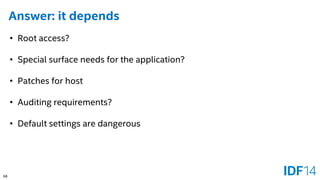
Answer: it depends 
•Root access? 
•Special surface needs for the application? 
•Patches for host 
•Auditing requirements? 
•Default settings are dangerous
69 
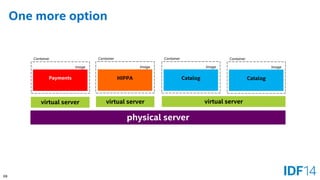
One more option 
Payments 
Image 
Container 
virtual server 
HIPPA 
Image 
Container 
Catalog 
Image 
Container 
physical server 
virtual server 
virtual server 
Catalog 
Image 
Container
70 
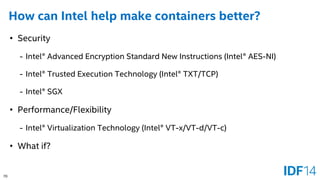
How can Intel help make containers better? 
•Security 
-Intel® Advanced Encryption Standard New Instructions (Intel® AES-NI) 
-Intel® Trusted Execution Technology (Intel® TXT/TCP) 
-Intel® SGX 
•Performance/Flexibility 
-Intel® Virtualization Technology (Intel® VT-x/VT-d/VT-c) 
•What if?
71 
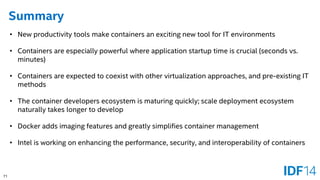
Summary 
•New productivity tools make containers an exciting new tool for IT environments 
•Containers are especially powerful where application startup time is crucial (seconds vs. minutes) 
•Containers are expected to coexist with other virtualization approaches, and pre-existing IT methods 
•The container developers ecosystem is maturing quickly; scale deployment ecosystem naturally takes longer to develop 
•Docker adds imaging features and greatly simplifies container management 
•Intel is working on enhancing the performance, security, and interoperability of containers
72 
Next Steps 
•Explore more on containers 
-The Docker Book, James Turnball –www.dockerbook.com 
-Run Docker on Windows*or OS X*w/ boot2dockerhttps://github.com/boot2docker/boot2docker
73 
Additional Sources of Information 
•A PDF of this presentation is available from our Technical Session Catalog: www.intel.com/idfsessionsSF. This URL is also printed on the top of Session Agenda Pages in the Pocket Guide.
74 
Legal Disclaimer 
INFORMATION IN THIS DOCUMENT IS PROVIDED IN CONNECTION WITH INTEL PRODUCTS.NO LICENSE, EXPRESS OR IMPLIED, BY ESTOPPEL OR OTHERWISE, TO ANY INTELLECTUAL PROPERTY RIGHTS IS GRANTED BY THIS DOCUMENT.EXCEPT AS PROVIDED IN INTEL'S TERMS AND CONDITIONS OF SALE FOR SUCH PRODUCTS, INTEL ASSUMES NO LIABILITY WHATSOEVER AND INTEL DISCLAIMS ANY EXPRESS OR IMPLIED WARRANTY, RELATING TO SALE AND/OR USEOF INTEL PRODUCTS INCLUDING LIABILITY OR WARRANTIES RELATING TO FITNESS FOR A PARTICULAR PURPOSE, MERCHANTABILITY, OR INFRINGEMENT OF ANYPATENT, COPYRIGHT OR OTHER INTELLECTUAL PROPERTY RIGHT. 
A "Mission Critical Application" is any application in which failure of the Intel Product could result, directly or indirectly, in personal injury or death.SHOULD YOU PURCHASE OR USE INTEL'S PRODUCTS FOR ANY SUCH MISSION CRITICAL APPLICATION, YOU SHALL INDEMNIFY AND HOLD INTEL AND ITS SUBSIDIARIES, SUBCONTRACTORS AND AFFILIATES, AND THE DIRECTORS, OFFICERS, AND EMPLOYEES OF EACH, HARMLESS AGAINST ALL CLAIMS COSTS, DAMAGES, AND EXPENSES AND REASONABLE ATTORNEYS' FEES ARISING OUT OF, DIRECTLY OR INDIRECTLY, ANY CLAIM OF PRODUCT LIABILITY, PERSONAL INJURY,OR DEATH ARISING IN ANY WAY OUT OF SUCH MISSION CRITICAL APPLICATION, WHETHER OR NOT INTEL OR ITS SUBCONTRACTOR WAS NEGLIGENT IN THE DESIGN, MANUFACTURE, OR WARNING OF THE INTEL PRODUCT OR ANY OF ITS PARTS. 
Intel may make changes to specifications and product descriptions at any time, without notice.Designers must not rely on the absence or characteristics of any features or instructions marked "reserved" or "undefined".Intel reserves these for future definition and shall have no responsibility whatsoever for conflicts or incompatibilities arising from future changes to them.The information here is subject to change without notice.Do not finalize a design with this information. 
The products described in this document may contain design defects or errors known as errata which may cause the product to deviate from published specifications.Current characterized errata are available on request. 
Contact your local Intel sales office or your distributor to obtain the latest specifications and before placing your productorder. 
Copies of documents which have an order number and are referenced in this document, or other Intel literature, may be obtained by calling 1-800-548-4725, or go to:http://www.intel.com/design/literature.htm 
Intel, Look Inside and the Intel logo are trademarks of Intel Corporation in the United States and other countries. 
*Other names and brands may be claimed as the property of others. 
Copyright ©2014 Intel Corporation.
75 
Risk Factors 
The above statements and any others in this document that refer to plans and expectations for the second quarter, the year and the future are forward- looking statements that involve a number of risks and uncertainties. Words such as “anticipates,” “expects,” “intends,” “plans,”“believes,” “seeks,” “estimates,” “may,” “will,” “should” and their variations identify forward-looking statements. Statements that refer to or are based on projections, uncertain events or assumptions also identify forward-looking statements. Many factors could affect Intel’s actual results, and variances from Intel’s current expectations regarding such factors could cause actual results to differ materially from those expressed in these forward-looking statements. Intel presently considers the following to be important factors that could cause actual results to differ materially from thecompany’s expectations. Demand for Intel's products is highly variable and, in recent years, Intel has experienced declining orders in the traditional PC market segment. Demand could be different from Intel's expectations due to factors including changes in business and economic conditions; consumer confidence or income levels; customer acceptance of Intel’s and competitors’ products; competitive and pricing pressures, including actionstaken by competitors; supply constraints and other disruptions affecting customers; changes in customer order patterns including order cancellations; and changes in the level of inventory at customers. Intel operates in highly competitive industries and its operations have high costs that are either fixed or difficult to reduce in the short term. Intel's gross margin percentage could vary significantly from expectations based on capacity utilization; variations in inventory valuation, including variations related to the timing of qualifying products for sale; changes in revenue levels; segment product mix; the timing and execution of the manufacturing ramp and associated costs; excess or obsolete inventory; changes in unit costs; defects or disruptions in the supply of materials or resources; and product manufacturing quality/yields. Variations in gross margin may also be caused by the timing of Intel product introductions and related expenses, including marketing expenses, and Intel's ability to respond quickly to technological developments and to introduce new products or incorporate new features into existing products, which may result in restructuring and asset impairment charges. Intel's results could be affected by adverse economic, social, political and physical/infrastructure conditions in countries where Intel, its customers or its suppliers operate, including military conflict and other security risks, natural disasters, infrastructure disruptions, health concerns and fluctuations in currency exchange rates. Intel’s results could be affected by the timing of closing of acquisitions, divestitures and other significant transactions. Intel's results could be affected by adverse effects associated with product defects and errata (deviations from published specifications), and by litigation or regulatory matters involving intellectual property, stockholder, consumer, antitrust, disclosure and other issues, such as the litigation and regulatory matters described in Intel's SEC filings. An unfavorable ruling could include monetary damages or an injunction prohibiting Intel from manufacturing or selling one or more products, precluding particular business practices, impacting Intel’s ability to design its products, or requiring other remedies such as compulsory licensing of intellectual property. A detailed discussion of these and other factors that could affect Intel’s results is included in Intel’s SEC filings, including the company’s most recent reports on Form 10-Q, Form 10-K and earnings release. 
Rev. 4/15/14

Bare-metal, Docker Containers, and Virtualization: The Growing Choices for Cloud Applications

  • 1.
    Bare-metal, Docker Containers,and Virtualization: The Growing Choices for Cloud Applications Nicholas Weaver – Principal Architect, Intel Corporation DATS004
  • 2.
    2 How didwe get here?
  • 3.
  • 4.
  • 5.
  • 6.
  • 7.
  • 8.
    8 x86 x86 x86 x86 x86 x86 x86 x86 x86 x86 x86
  • 9.
  • 10.
  • 11.
  • 12.
  • 13.
  • 14.
    14 Server App Server App Server App 70% 25% 33% 43%
  • 15.
    15 App App App App App App App App App App App App App App App App
  • 16.
  • 17.
  • 18.
    18 Server VM App App App VM VM App VM
  • 19.
  • 20.
    20 App Compute Networking Storage
  • 21.
    21 Virtualization -Pros •Carves hardware into virtual hardware •Virtual hardware presented as a virtual machine •Strong isolation between virtual machines •Allows for running heterogeneous operating systems •QoS, orchestration, templates, portability •Live migration, high-availability, resource pooling
  • 22.
    22 Virtualization -Cons •Each virtual machine is a complete stack (OS, patches, applications) •Hypervisor and supporting management have to be maintained •Measurable overhead compared to bare-metal
  • 23.
  • 24.
    24 Containers •Existedback in 2004 –Oracle*Solaris*Zones •Implemented first by LinuX*Containers (LXC) •Google’s*control implementation with lmctfy (Let Me Contain That For You) •Modernized control recently introduced by Docker*
  • 25.
    25 How doesit work?
  • 26.
  • 27.
    27 Container A Container B System
  • 28.
    28 Resource Limiting System Memory Container Memory 1GB Container Memory 2GB Container A Container B
  • 29.
    29 Resource Limiting System Storage Container Memory 1GB Container Memory 2GB Container A Block Device 10 MB/s Block Device 10 MB/s Block Device 20 MB/s Container B
  • 30.
    30 Resource Limiting System CPU Container Memory 1GB Container Memory 2GB Container A Container B Block Device 10 MB/s Block Device 10 MB/s Block Device 20 MB/s CPU25% Share CPU75% Share
  • 31.
    31 Namespace Isolation–Processes Container Memory 1GB Container Memory 2GB Container A Container B Block Device 10 MB/s Block Device 10 MB/s Block Device 20 MB/s CPU25% Share CPU75% Share PID 1234 1345 1467 PID 1234 1345 1467 Container A’s view of PIDs Container B’s view of PIDs
  • 32.
    32 Namespace Isolation-Networking Container Memory 1GB Container Memory 2GB Container A Container B Block Device 10 MB/s Block Device 10 MB/s Block Device 20 MB/s CPU25% Share CPU75% Share Interfaces veth0 veth1 Container A’s view of interfaces Container B’s view of interfaces Interfaces veth3
  • 33.
    33 Namespace Isolation–Mounts Container Memory 1GB Container Memory 2GB Container A Container B Block Device 10 MB/s Block Device 10 MB/s Block Device 20 MB/s CPU25% Share CPU75% Share Mounts /dev/sda1 Container A’s view of mounts Container B’s view of mounts Mounts /dev/sda2 /dev/sda3
  • 34.
    34 Namespace Isolation–Mounts Container Memory 1GB Container Memory 2GB Container A Container B Block Device 10 MB/s Block Device 10 MB/s Block Device 20 MB/s CPU25% Share CPU75% Share Mounts /dev/sda1 Container A’s view of mounts Container B’s view of mounts Mounts /dev/sda2 /dev/sda3
  • 35.
    35 Namespace Isolation–Users Container Memory 1GB Container Memory 2GB Container A Container B Block Device 10 MB/s Block Device 10 MB/s Block Device 20 MB/s CPU25% Share CPU75% Share Users neo morpheustrinity Container A’s view of users Container B’s view of users Usersharry hermioneron
  • 36.
    36 When thingslook the same
  • 37.
    37 Server VM App App App VM VM App VM
  • 38.
    38 VM WidgetScraper Service Widget Lib Linux OS VM Widget Painter Service Widget Lib Linux*OS VM Widget Cleaner Service Widget Lib Linux OS
  • 39.
    39 Widget ScraperService Widget Lib Linux*OS Widget Painter Service Widget Cleaner Service Container A Container B Container C
  • 40.
    40 VM WidgetScraper Service Widget Lib Linux*OS Widget Painter Service Widget Cleaner Service Container A Container B Container C
  • 41.
    41 Server WidgetScraper Service Widget Lib Linux*OS Widget Painter Service Widget Cleaner Service Container A Container B Container C
  • 42.
    42 Some containerpros •Faster lifecycle vs. virtual machines •Contains what is running within the OS •Ideal for homogenous application stacks on Linux* •Almost non-existent overhead
  • 43.
    43 Some containercons •Very complex to configure •Currently much weaker security isolation than virtual machines(more on that in a bit) •Applications must run on Linux*
  • 44.
  • 45.
    45 Docker* •Opensource container management for Linux* •Adds DevOps-like features •Developed by dotCloud (now known as Docker*) to help deliver their PaaS product •An easy button for containers
  • 46.
    46 What doesDocker*bring?
  • 47.
    47 Docker*Images •Orderedresults of actions to build a container -Add file -Open port -Run a command •DevOps like source code for a deployment image •Uses a copy-on-write file system (like others)
  • 48.
  • 49.
    49 Images arelayers rootfs bootfs run apt-get set env var from ubuntu:14.04 cmd = “../apache2”
  • 50.
    50 Images arelayers rootfs bootfs run apt-get set env var from ubuntu:14.04 cmd = “../apache2” my_app
  • 51.
    51 Images arelayers rootfs bootfs run git-clone mount dir from my_app cmd = “../apache2” my_app2
  • 52.
    52 Image Registry •Public Docker registry: Docker*Hub •Option to deploy your own private Docker Registry
  • 53.
  • 54.
    54 Client =>Server Docker Daemon Linux Docker*Client Linux*/Windows*/OS X*
  • 55.
    55 Client =>Server Docker Daemon Linux Docker*Client Linux*/Windows*/OS X* [docker run web-server] Container Web Server Image
  • 56.
    56 Client =>Server Docker Daemon Linux Docker*Client Linux*/Windows*/OS X* [docker run database] Container Web Server Image Container Database Image
  • 57.
    57 Client =>Server Docker Daemon Linux Docker*Client Linux*/Windows*/OS X* [docker stop database] Container Web Server Image Container Database Image
  • 58.
    58 Client =>Server Docker Daemon Linux Docker*Client Linux*/Windows*/OS X* Container Web Server Image
  • 59.
    59 Docker*Innovations •Images -Like templates for VMs -Copy-on-write makes them behave like code -Caching takes advantage of uniformity of platform layer •API and CLI tools for managing container deployments -Easy to wire into existing CI systems -Works well with deployment workflows •Reduces complexity around deploying and managing containers •Supports namespace and resource limits
  • 60.
  • 61.
  • 62.
    62 code PrivateDocker*Registry BizApp Image Container laptop pull Version Control System commit push
  • 63.
    63 code PrivateDocker*Registry Container laptop pull Version Control System commit push pull Container CI server BizApp Image BizApp Image Build Server push test
  • 64.
    64 Private Docker*Registry Docker*+ Containers = Less Friction BizApp Docker Daemon Linux Docker Daemon Linux Docker Daemon Linux Docker Daemon Linux Docker*Daemon Linux* Container BizApp Image Container BizApp Image Container BizApp Image Container BizApp Image Container BizApp Image
  • 65.
  • 66.
  • 67.
    67 Payments Image Container physical server HIPPA Image Container Catalog Image Container Can I trust a container?
  • 68.
    68 Answer: itdepends •Root access? •Special surface needs for the application? •Patches for host •Auditing requirements? •Default settings are dangerous
  • 69.
    69 One moreoption Payments Image Container virtual server HIPPA Image Container Catalog Image Container physical server virtual server virtual server Catalog Image Container
  • 70.
    70 How canIntel help make containers better? •Security -Intel® Advanced Encryption Standard New Instructions (Intel® AES-NI) -Intel® Trusted Execution Technology (Intel® TXT/TCP) -Intel® SGX •Performance/Flexibility -Intel® Virtualization Technology (Intel® VT-x/VT-d/VT-c) •What if?
  • 71.
    71 Summary •Newproductivity tools make containers an exciting new tool for IT environments •Containers are especially powerful where application startup time is crucial (seconds vs. minutes) •Containers are expected to coexist with other virtualization approaches, and pre-existing IT methods •The container developers ecosystem is maturing quickly; scale deployment ecosystem naturally takes longer to develop •Docker adds imaging features and greatly simplifies container management •Intel is working on enhancing the performance, security, and interoperability of containers
  • 72.
    72 Next Steps •Explore more on containers -The Docker Book, James Turnball –www.dockerbook.com -Run Docker on Windows*or OS X*w/ boot2dockerhttps://github.com/boot2docker/boot2docker
  • 73.
    73 Additional Sourcesof Information •A PDF of this presentation is available from our Technical Session Catalog: www.intel.com/idfsessionsSF. This URL is also printed on the top of Session Agenda Pages in the Pocket Guide.
  • 74.
    74 Legal Disclaimer INFORMATION IN THIS DOCUMENT IS PROVIDED IN CONNECTION WITH INTEL PRODUCTS.NO LICENSE, EXPRESS OR IMPLIED, BY ESTOPPEL OR OTHERWISE, TO ANY INTELLECTUAL PROPERTY RIGHTS IS GRANTED BY THIS DOCUMENT.EXCEPT AS PROVIDED IN INTEL'S TERMS AND CONDITIONS OF SALE FOR SUCH PRODUCTS, INTEL ASSUMES NO LIABILITY WHATSOEVER AND INTEL DISCLAIMS ANY EXPRESS OR IMPLIED WARRANTY, RELATING TO SALE AND/OR USEOF INTEL PRODUCTS INCLUDING LIABILITY OR WARRANTIES RELATING TO FITNESS FOR A PARTICULAR PURPOSE, MERCHANTABILITY, OR INFRINGEMENT OF ANYPATENT, COPYRIGHT OR OTHER INTELLECTUAL PROPERTY RIGHT. A "Mission Critical Application" is any application in which failure of the Intel Product could result, directly or indirectly, in personal injury or death.SHOULD YOU PURCHASE OR USE INTEL'S PRODUCTS FOR ANY SUCH MISSION CRITICAL APPLICATION, YOU SHALL INDEMNIFY AND HOLD INTEL AND ITS SUBSIDIARIES, SUBCONTRACTORS AND AFFILIATES, AND THE DIRECTORS, OFFICERS, AND EMPLOYEES OF EACH, HARMLESS AGAINST ALL CLAIMS COSTS, DAMAGES, AND EXPENSES AND REASONABLE ATTORNEYS' FEES ARISING OUT OF, DIRECTLY OR INDIRECTLY, ANY CLAIM OF PRODUCT LIABILITY, PERSONAL INJURY,OR DEATH ARISING IN ANY WAY OUT OF SUCH MISSION CRITICAL APPLICATION, WHETHER OR NOT INTEL OR ITS SUBCONTRACTOR WAS NEGLIGENT IN THE DESIGN, MANUFACTURE, OR WARNING OF THE INTEL PRODUCT OR ANY OF ITS PARTS. Intel may make changes to specifications and product descriptions at any time, without notice.Designers must not rely on the absence or characteristics of any features or instructions marked "reserved" or "undefined".Intel reserves these for future definition and shall have no responsibility whatsoever for conflicts or incompatibilities arising from future changes to them.The information here is subject to change without notice.Do not finalize a design with this information. The products described in this document may contain design defects or errors known as errata which may cause the product to deviate from published specifications.Current characterized errata are available on request. Contact your local Intel sales office or your distributor to obtain the latest specifications and before placing your productorder. Copies of documents which have an order number and are referenced in this document, or other Intel literature, may be obtained by calling 1-800-548-4725, or go to:http://www.intel.com/design/literature.htm Intel, Look Inside and the Intel logo are trademarks of Intel Corporation in the United States and other countries. *Other names and brands may be claimed as the property of others. Copyright ©2014 Intel Corporation.
  • 75.
    75 Risk Factors The above statements and any others in this document that refer to plans and expectations for the second quarter, the year and the future are forward- looking statements that involve a number of risks and uncertainties. Words such as “anticipates,” “expects,” “intends,” “plans,”“believes,” “seeks,” “estimates,” “may,” “will,” “should” and their variations identify forward-looking statements. Statements that refer to or are based on projections, uncertain events or assumptions also identify forward-looking statements. Many factors could affect Intel’s actual results, and variances from Intel’s current expectations regarding such factors could cause actual results to differ materially from those expressed in these forward-looking statements. Intel presently considers the following to be important factors that could cause actual results to differ materially from thecompany’s expectations. Demand for Intel's products is highly variable and, in recent years, Intel has experienced declining orders in the traditional PC market segment. Demand could be different from Intel's expectations due to factors including changes in business and economic conditions; consumer confidence or income levels; customer acceptance of Intel’s and competitors’ products; competitive and pricing pressures, including actionstaken by competitors; supply constraints and other disruptions affecting customers; changes in customer order patterns including order cancellations; and changes in the level of inventory at customers. Intel operates in highly competitive industries and its operations have high costs that are either fixed or difficult to reduce in the short term. Intel's gross margin percentage could vary significantly from expectations based on capacity utilization; variations in inventory valuation, including variations related to the timing of qualifying products for sale; changes in revenue levels; segment product mix; the timing and execution of the manufacturing ramp and associated costs; excess or obsolete inventory; changes in unit costs; defects or disruptions in the supply of materials or resources; and product manufacturing quality/yields. Variations in gross margin may also be caused by the timing of Intel product introductions and related expenses, including marketing expenses, and Intel's ability to respond quickly to technological developments and to introduce new products or incorporate new features into existing products, which may result in restructuring and asset impairment charges. Intel's results could be affected by adverse economic, social, political and physical/infrastructure conditions in countries where Intel, its customers or its suppliers operate, including military conflict and other security risks, natural disasters, infrastructure disruptions, health concerns and fluctuations in currency exchange rates. Intel’s results could be affected by the timing of closing of acquisitions, divestitures and other significant transactions. Intel's results could be affected by adverse effects associated with product defects and errata (deviations from published specifications), and by litigation or regulatory matters involving intellectual property, stockholder, consumer, antitrust, disclosure and other issues, such as the litigation and regulatory matters described in Intel's SEC filings. An unfavorable ruling could include monetary damages or an injunction prohibiting Intel from manufacturing or selling one or more products, precluding particular business practices, impacting Intel’s ability to design its products, or requiring other remedies such as compulsory licensing of intellectual property. A detailed discussion of these and other factors that could affect Intel’s results is included in Intel’s SEC filings, including the company’s most recent reports on Form 10-Q, Form 10-K and earnings release. Rev. 4/15/14