1
AmjadKhanAfridi
DNA and Mutations
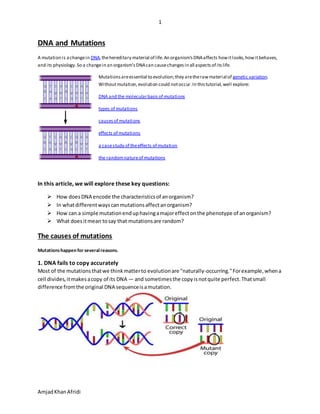
A mutation is achangein DNA,thehereditary material of life.An organism'sDNAaffects howitlooks,howitbehaves,
and its physiology.So a changein an organism'sDNAcan causechangesin all aspectsof itslife.
Mutationsareessential to evolution;they aretherawmaterial of genetic variation.
Withoutmutation,evolution could notoccur.In thistutorial,well explore:
DNA and the molecularbasis of mutations
types of mutations
causesof mutations
effects of mutations
a casestudy of theeffects of mutation
the randomnatureof mutations
In this article, we will explore these key questions:
 How doesDNA encode the characteristicsof anorganism?
 In whatdifferentwayscanmutationsaffectanorganism?
 How can a simple mutationenduphavingamajoreffectonthe phenotype of anorganism?
 What doesitmean tosay that mutationsare random?
The causes of mutations
Mutationshappen for severalreasons.
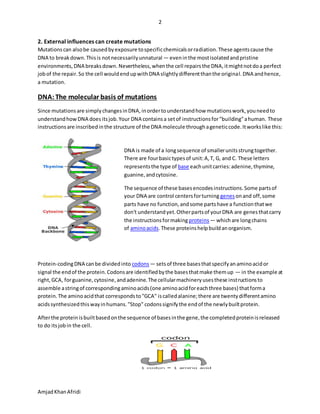
1. DNA fails to copy accurately
Most of the mutationsthatwe thinkmatterto evolutionare "naturally-occurring."Forexample,whena
cell divides,itmakesacopy of its DNA — and sometimesthe copyisnotquite perfect.Thatsmall
difference fromthe original DNA sequenceisamutation.
2
AmjadKhanAfridi
2. External influences can create mutations
Mutationscan alsobe causedbyexposure tospecificchemicalsorradiation.These agentscause the
DNA to breakdown.Thisis notnecessarilyunnatural — eveninthe mostisolatedandpristine
environments,DNA breaksdown. Nevertheless,whenthe cell repairsthe DNA,itmightnotdoa perfect
jobof the repair.So the cell wouldendupwithDNA slightlydifferentthanthe original. DNA andhence,
a mutation.
DNA:The molecular basis of mutations
Since mutationsare simplychangesinDNA,inordertounderstandhow mutationswork,youneedto
understandhowDNA doesitsjob.Your DNA containsa setof instructionsfor"building"ahuman. These
instructionsare inscribedinthe structure of the DNA molecule throughageneticcode.Itworkslike this:
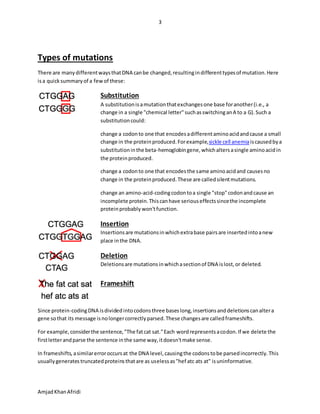
DNA is made of a longsequence of smallerunitsstrungtogether.
There are fourbasictypesof unit:A,T, G, and C. These letters
representsthe type of base eachunitcarries:adenine,thymine,
guanine,andcytosine.
The sequence of these basesencodesinstructions.Some partsof
your DNA are control centersforturning genesonand off,some
parts have no function,andsome partshave a functionthatwe
don't understandyet.Otherpartsof yourDNA are genesthatcarry
the instructionsformaking proteins — whichare longchains
of aminoacids.These proteinshelpbuildanorganism.
Protein-codingDNA canbe dividedinto codons — setsof three basesthatspecifyanaminoacidor
signal the endof the protein.Codonsare identifiedbythe basesthatmake themup — in the example at
right,GCA, forguanine,cytosine,andadenine.The cellularmachineryusesthese instructionsto
assemble astringof correspondingaminoacids(one aminoacidforeachthree bases) thatforma
protein.The aminoacidthat correspondsto"GCA" iscalledalanine;there are twentydifferentamino
acidssynthesizedthiswayinhumans."Stop" codonssignifythe endof the newlybuiltprotein.
Afterthe proteinisbuiltbasedonthe sequence of basesinthe gene,the completedproteinisreleased
to do itsjobin the cell.
3
AmjadKhanAfridi
Types of mutations
There are manydifferentwaysthatDNA canbe changed,resultingindifferenttypesof mutation.Here
isa quicksummaryof a fewof these:
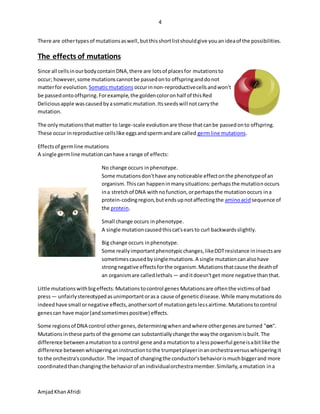
Substitution
A substitutionisamutationthatexchangesone base foranother(i.e., a
change in a single "chemical letter"suchasswitchinganA to a G).Such a
substitutioncould:
change a codonto one that encodesadifferentaminoacidandcause a small
change in the proteinproduced.Forexample,sickle cell anemiaiscausedbya
substitutioninthe beta-hemoglobingene,whichaltersasingle aminoacidin
the proteinproduced.
change a codonto one that encodesthe same aminoacidand causesno
change in the proteinproduced.These are calledsilentmutations.
change an amino-acid-codingcodontoa single "stop"codonandcause an
incomplete protein.Thiscanhave seriouseffectssincethe incomplete
proteinprobably won'tfunction.
Insertion
Insertionsare mutationsinwhichextrabase pairsare insertedintoanew
place inthe DNA.
Deletion
Deletionsare mutationsinwhichasectionof DNA islost,or deleted.
Frameshift
Since protein-codingDNA isdividedintocodonsthree baseslong,insertionsanddeletionscanaltera
gene sothat its message isnolongercorrectlyparsed.These changesare calledframeshifts.
For example,considerthe sentence,"The fatcat sat."Each wordrepresentsacodon.If we delete the
firstletterandparse the sentence inthe same way,itdoesn'tmake sense.
In frameshifts,asimilarerroroccursat the DNA level,causingthe codonstobe parsedincorrectly.This
usuallygeneratestruncatedproteinsthatare as uselessas"hef atc ats at" isuninformative.
4
AmjadKhanAfridi
There are othertypesof mutationsaswell,butthisshortlistshouldgive youanideaof the possibilities.
The effects of mutations
Since all cellsinourbodycontainDNA,there are lotsof placesfor mutationsto
occur; however,some mutationscannotbe passedonto offspringanddonot
matterfor evolution. Somaticmutations occurinnon-reproductivecellsandwon't
be passedontooffspring.Forexample,the goldencoloronhalf of thisRed
Deliciousapple wascausedbyasomaticmutation.Itsseedswill notcarrythe
mutation.
The onlymutationsthatmatter to large-scale evolutionare those thatcanbe passedonto offspring.
These occur inreproductive cellslike eggsandspermandare called germline mutations.
Effectsof germline mutations
A single germline mutationcanhave a range of effects:
No change occurs inphenotype.
Some mutationsdon'thave anynoticeable effectonthe phenotypeof an
organism.Thiscan happeninmanysituations:perhapsthe mutationoccurs
ina stretchof DNA withnofunction,orperhapsthe mutationoccurs ina
protein-codingregion,butendsupnotaffectingthe aminoacidsequence of
the protein.
Small change occurs inphenotype.
A single mutationcausedthiscat'searsto curl backwardsslightly.
Big change occurs inphenotype.
Some reallyimportantphenotypicchanges,likeDDTresistance ininsectsare
sometimescausedbysinglemutations.A single mutationcanalsohave
strongnegative effectsforthe organism.Mutationsthatcause the deathof
an organismare calledlethals — anditdoesn'tget more negative thanthat.
Little mutationswithbigeffects:Mutationstocontrol genes Mutationsare oftenthe victimsof bad
press— unfairlystereotypedasunimportantorasa cause of geneticdisease.While manymutationsdo
indeedhave small ornegative effects,anothersortof mutationgetslessairtime.Mutationstocontrol
genescan have major(andsometimespositive) effects.
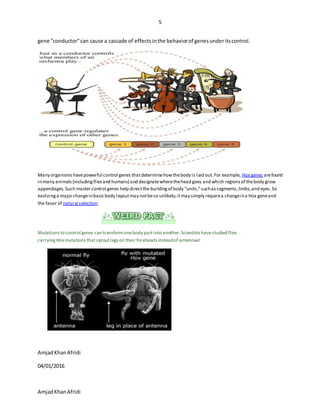
Some regionsof DNA control othergenes,determiningwhenandwhere othergenesare turned "on".
Mutationsinthese partsof the genome can substantiallychange the waythe organismisbuilt.The
difference betweenamutationtoa control gene anda mutationto a lesspowerful geneisabitlike the
difference betweenwhisperinganinstructiontothe trumpetplayerinanorchestraversuswhisperingit
to the orchestra'sconductor.The impactof changingthe conductor'sbehaviorismuchbiggerand more
coordinatedthanchangingthe behaviorof anindividualorchestramember.Similarly,amutation ina
5
AmjadKhanAfridi
gene "conductor"can cause a cascade of effectsinthe behaviorof genesunderitscontrol.
Many organismshavepowerful control genes thatdeterminehowthebody is laid out.For example, Hox genes arefound
in many animals(includingfliesand humans) and designatewherethehead goes and which regionsof thebody grow
appendages.Such master control genes help directthe buildingof body "units,"suchassegments,limbs,and eyes.So
evolvinga majorchangeinbasicbody layoutmay notbeso unlikely;itmay simply requirea changeina Hox geneand
the favor of natural selection.
Mutationsto control genes can transformonebody partinto another.Scientistshavestudied flies
carrying Hoxmutationsthatsproutlegson their foreheadsinsteadof antennae!
AmjadKhanAfridi
04/01/2016
6
AmjadKhanAfridi

Dna and mutation

  • 1.
    1 AmjadKhanAfridi DNA and Mutations Amutation is achangein DNA,thehereditary material of life.An organism'sDNAaffects howitlooks,howitbehaves, and its physiology.So a changein an organism'sDNAcan causechangesin all aspectsof itslife. Mutationsareessential to evolution;they aretherawmaterial of genetic variation. Withoutmutation,evolution could notoccur.In thistutorial,well explore: DNA and the molecularbasis of mutations types of mutations causesof mutations effects of mutations a casestudy of theeffects of mutation the randomnatureof mutations In this article, we will explore these key questions:  How doesDNA encode the characteristicsof anorganism?  In whatdifferentwayscanmutationsaffectanorganism?  How can a simple mutationenduphavingamajoreffectonthe phenotype of anorganism?  What doesitmean tosay that mutationsare random? The causes of mutations Mutationshappen for severalreasons. 1. DNA fails to copy accurately Most of the mutationsthatwe thinkmatterto evolutionare "naturally-occurring."Forexample,whena cell divides,itmakesacopy of its DNA — and sometimesthe copyisnotquite perfect.Thatsmall difference fromthe original DNA sequenceisamutation.
  • 2.
    2 AmjadKhanAfridi 2. External influencescan create mutations Mutationscan alsobe causedbyexposure tospecificchemicalsorradiation.These agentscause the DNA to breakdown.Thisis notnecessarilyunnatural — eveninthe mostisolatedandpristine environments,DNA breaksdown. Nevertheless,whenthe cell repairsthe DNA,itmightnotdoa perfect jobof the repair.So the cell wouldendupwithDNA slightlydifferentthanthe original. DNA andhence, a mutation. DNA:The molecular basis of mutations Since mutationsare simplychangesinDNA,inordertounderstandhow mutationswork,youneedto understandhowDNA doesitsjob.Your DNA containsa setof instructionsfor"building"ahuman. These instructionsare inscribedinthe structure of the DNA molecule throughageneticcode.Itworkslike this: DNA is made of a longsequence of smallerunitsstrungtogether. There are fourbasictypesof unit:A,T, G, and C. These letters representsthe type of base eachunitcarries:adenine,thymine, guanine,andcytosine. The sequence of these basesencodesinstructions.Some partsof your DNA are control centersforturning genesonand off,some parts have no function,andsome partshave a functionthatwe don't understandyet.Otherpartsof yourDNA are genesthatcarry the instructionsformaking proteins — whichare longchains of aminoacids.These proteinshelpbuildanorganism. Protein-codingDNA canbe dividedinto codons — setsof three basesthatspecifyanaminoacidor signal the endof the protein.Codonsare identifiedbythe basesthatmake themup — in the example at right,GCA, forguanine,cytosine,andadenine.The cellularmachineryusesthese instructionsto assemble astringof correspondingaminoacids(one aminoacidforeachthree bases) thatforma protein.The aminoacidthat correspondsto"GCA" iscalledalanine;there are twentydifferentamino acidssynthesizedthiswayinhumans."Stop" codonssignifythe endof the newlybuiltprotein. Afterthe proteinisbuiltbasedonthe sequence of basesinthe gene,the completedproteinisreleased to do itsjobin the cell.
  • 3.
    3 AmjadKhanAfridi Types of mutations Thereare manydifferentwaysthatDNA canbe changed,resultingindifferenttypesof mutation.Here isa quicksummaryof a fewof these: Substitution A substitutionisamutationthatexchangesone base foranother(i.e., a change in a single "chemical letter"suchasswitchinganA to a G).Such a substitutioncould: change a codonto one that encodesadifferentaminoacidandcause a small change in the proteinproduced.Forexample,sickle cell anemiaiscausedbya substitutioninthe beta-hemoglobingene,whichaltersasingle aminoacidin the proteinproduced. change a codonto one that encodesthe same aminoacidand causesno change in the proteinproduced.These are calledsilentmutations. change an amino-acid-codingcodontoa single "stop"codonandcause an incomplete protein.Thiscanhave seriouseffectssincethe incomplete proteinprobably won'tfunction. Insertion Insertionsare mutationsinwhichextrabase pairsare insertedintoanew place inthe DNA. Deletion Deletionsare mutationsinwhichasectionof DNA islost,or deleted. Frameshift Since protein-codingDNA isdividedintocodonsthree baseslong,insertionsanddeletionscanaltera gene sothat its message isnolongercorrectlyparsed.These changesare calledframeshifts. For example,considerthe sentence,"The fatcat sat."Each wordrepresentsacodon.If we delete the firstletterandparse the sentence inthe same way,itdoesn'tmake sense. In frameshifts,asimilarerroroccursat the DNA level,causingthe codonstobe parsedincorrectly.This usuallygeneratestruncatedproteinsthatare as uselessas"hef atc ats at" isuninformative.
  • 4.
    4 AmjadKhanAfridi There are othertypesofmutationsaswell,butthisshortlistshouldgive youanideaof the possibilities. The effects of mutations Since all cellsinourbodycontainDNA,there are lotsof placesfor mutationsto occur; however,some mutationscannotbe passedonto offspringanddonot matterfor evolution. Somaticmutations occurinnon-reproductivecellsandwon't be passedontooffspring.Forexample,the goldencoloronhalf of thisRed Deliciousapple wascausedbyasomaticmutation.Itsseedswill notcarrythe mutation. The onlymutationsthatmatter to large-scale evolutionare those thatcanbe passedonto offspring. These occur inreproductive cellslike eggsandspermandare called germline mutations. Effectsof germline mutations A single germline mutationcanhave a range of effects: No change occurs inphenotype. Some mutationsdon'thave anynoticeable effectonthe phenotypeof an organism.Thiscan happeninmanysituations:perhapsthe mutationoccurs ina stretchof DNA withnofunction,orperhapsthe mutationoccurs ina protein-codingregion,butendsupnotaffectingthe aminoacidsequence of the protein. Small change occurs inphenotype. A single mutationcausedthiscat'searsto curl backwardsslightly. Big change occurs inphenotype. Some reallyimportantphenotypicchanges,likeDDTresistance ininsectsare sometimescausedbysinglemutations.A single mutationcanalsohave strongnegative effectsforthe organism.Mutationsthatcause the deathof an organismare calledlethals — anditdoesn'tget more negative thanthat. Little mutationswithbigeffects:Mutationstocontrol genes Mutationsare oftenthe victimsof bad press— unfairlystereotypedasunimportantorasa cause of geneticdisease.While manymutationsdo indeedhave small ornegative effects,anothersortof mutationgetslessairtime.Mutationstocontrol genescan have major(andsometimespositive) effects. Some regionsof DNA control othergenes,determiningwhenandwhere othergenesare turned "on". Mutationsinthese partsof the genome can substantiallychange the waythe organismisbuilt.The difference betweenamutationtoa control gene anda mutationto a lesspowerful geneisabitlike the difference betweenwhisperinganinstructiontothe trumpetplayerinanorchestraversuswhisperingit to the orchestra'sconductor.The impactof changingthe conductor'sbehaviorismuchbiggerand more coordinatedthanchangingthe behaviorof anindividualorchestramember.Similarly,amutation ina
  • 5.
    5 AmjadKhanAfridi gene "conductor"can causea cascade of effectsinthe behaviorof genesunderitscontrol. Many organismshavepowerful control genes thatdeterminehowthebody is laid out.For example, Hox genes arefound in many animals(includingfliesand humans) and designatewherethehead goes and which regionsof thebody grow appendages.Such master control genes help directthe buildingof body "units,"suchassegments,limbs,and eyes.So evolvinga majorchangeinbasicbody layoutmay notbeso unlikely;itmay simply requirea changeina Hox geneand the favor of natural selection. Mutationsto control genes can transformonebody partinto another.Scientistshavestudied flies carrying Hoxmutationsthatsproutlegson their foreheadsinsteadof antennae! AmjadKhanAfridi 04/01/2016
  • 6.