Student Diversity
(Final coverage)
 It means understanding that each individual is unique,
and recognizing our individual differences. These can
be along the dimensions of race, ethnicity, gender,
sexual orientation, socio-economic status, age, physical
abilities, religious beliefs, political beliefs, or other
ideologies.
Diversity
 Having a diverse group of students simply means
recognizing that all the people are unique in their own
way. Their differences could consist of their reading
level, athletic ability, cultural background, personality,
religious beliefs, and the list goes on.
Student diversity
 The teacher as facilitator of learning is tasked to consider
diversity in learning brought about by individual differences,
multiple intelligences, exceptional learners, their learning and
thinking styles among others in planning for effective
instruction. This diversity also comes from other factors like the
following:
 (1).Socio-economic status – the millionaires’ lifestyle differs
from that of the middle income or lower income group;
 (2). Thinking/ Learning Style – some of you learn better by
seeing something; others by just listening; still others by
manipulating something; and
 (3). Exceptionalities – in class there may be one who has
difficulty in spoken language comprehension or in seeing,
hearing, etc.
 In all learning environments, individuals interact with
others who are in some ways different from them. A
teacher may be “challenged “ to handle a class with
students so diverse. There may be students having
different cultural background, different language abilities,
different attitudes, aptitude and behaviors. Teachers
might see this diversity as a difficult predicament, really a
hassle! Yet a more reflective teacher may see a diverse
classroom as an exciting place to learn not just for her
students, but for herself, as well. A wise teacher may
choose to respect and celebrate diversity! Read on,
discover the benefits and learning opportunities that
student diversity can bring to your classroom. One will
have to focus on some important aspects in diversity.
 Student diversity contributes to cognitive development. The
opportunity to gain access to the perspectives of peers and to learn from
other students, rather than the instructor only, may be especially
important for promoting the cognitive development of learners.
Supreme Court Justice William J. Brennan said “ the classroom is
peculiarly the market place of ideas.” The depth and breadth of student
learning are enhanced by exposure to others from diverse backgrounds.
Student diversity in the classroom brings about different points of view
and varied approach to the learning process. As the German
philosopher Nietzsche, said over one hundred years ago “the more
affects we allow to speak about one thing, the more eyes, different eyes
we can use to observe one thing, the more complete will our concept of
this thing, our objectivity, be.”
Exposing students to others with diverse backgrounds and
experiences also serve to help students focus on their awareness of
themselves. When they see how others are different, students are
given reference points or comparative perspectives which sharpen
assessment of their own attitudes, values and behaviors. This will
enhance students’ self-awareness of diversity.
 Student diversity prepares learners for their role as responsible
members of society. Suzanne Morse stresses one competency that has
strong implications for instructional strategies that capitalize on
diversity “the capacity to imagine situations are problems from all
perspectives and to appreciate all aspects of diversity” furthermore,
she argues “the classroom can provide more than just theory given by
the teacher in a lecture. With student diversity, the classroom becomes
a public place where community can be practiced.
 Student diversity can promote harmony. When student diversity is
integrated into the classroom teaching and learning process, it can
become a vehicle for promoting harmonious race relations. Through
student-centered teaching strategies, diverse students can be
encouraged to interact and collaborate with one another on learning
tasks that emphasize unity of effort while capitalizing on their diversity
of background. Teachers may consider student diversity by observing
some important tips such as to:
a. Encourage learners to share their personal history and experiences.
Students will be made to realize that they have something in common
with the rest. They also differ in several ways.
b. Integrate learning experience in activities which promote students’
multi-cultural and cross-cultural awareness.
c. Aside from highlighting diversity, identify patterns of unity that
transcend group differences. Clyde Kluckholn, an early American
anthropologist who spent a lifetime studying human diversity across
different cultures, concluded from his extensive research that, “every
human is, at the same time, like all other humans, like some human,
and like no other human” (Wong, 1991). His observation suggests a
product in the human experience, mainly we are all the same in
different ways.
d. Communicate high expectations to students from all sub-groups.
e. Use varied instructional methods to accommodate student diversity
in learning styles.
 Vary the examples you use to illustrate concepts in order to provide
multiple contexts that are relevant to students from diverse
backgrounds.
 Adapt to students diverse backgrounds or learning styles by allowing
them personal choice and decision-making opportunities concerning
what they will learn and how they will learn it.
Giving the learner more decision-making opportunity with respect to
learning tasks ( a) promotes positive students’ attitudes toward the
subject matter; (b) fosters more positive interactions among
students; and (c) results in students’ working more consistently with
lesser teacher intervention. Also, when individuals are allowed to
exert some control over a task, they tend to experience less anxiety
or stress while performing that tasks.
 Diversify your methods of assessing and evaluating student learning.
You can accommodate student diversity not only by varying what
you do with your teaching, but also by varying what you ask students
to do to demonstrate learning. In addition to the traditional paper-in-
pencil test in written assignments, students can demonstrate their
learning in variety of performance formats, such as
(a) individually-delivered oral reports;
(b) panel presentations;
(c) group projects;
(d) visual presentations (e.g., concept maps, slide presentations, power
point presentations, collages, exhibits),; and
(e) dramatic vignettes - presented live or on video tape. One potential
benefit of allowing students to choose how they demonstrate their
learning is that the variety of options exercised may be a powerful way to
promote students’ awareness of the diversity of human learning styles.
 Purposely, form small – discussion groups of students from diverse
backgrounds. You can form groups of students with different
learning styles, different cultural backgrounds, etc.
Small peer – learning groups may be effective for promoting students’
progress to a more advanced stage of cognitive development. Peer-
learning groups may promote this cognitive advancement because
(a) the instructor is removed from center stage, thereby reducing the
likelihood that the teacher is perceived as the ultimate or absolute
authority; and
(b) (b) students are exposed to the perspectives of other students, thus
increasing their appreciation of multiple view points and different
approaches to learning.
 Learning/Thinking styles refer to the preferred way an
individual processes information. They describe a person’s
typical mode of thinking, remembering, or problem-solving.
Furthermore, styles are usually considered to be bipolar
dimensions. For instance, your particular learning/thinking
style would lie at a point in a continuum. Having a particular
learning/thinking style simply denotes a tendency to behave
in a certain manner. Your style is usually described as a
personality dimension which influences your attitudes, values
and social interaction.
Learning/Thinking Styles and Multiple Intelligences
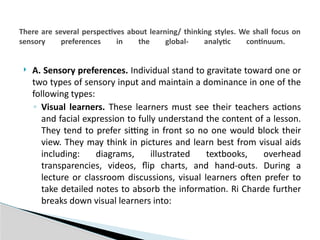
 A. Sensory preferences. Individual stand to gravitate toward one or
two types of sensory input and maintain a dominance in one of the
following types:
◦ Visual learners. These learners must see their teachers actions
and facial expression to fully understand the content of a lesson.
They tend to prefer sitting in front so no one would block their
view. They may think in pictures and learn best from visual aids
including: diagrams, illustrated textbooks, overhead
transparencies, videos, flip charts, and hand-outs. During a
lecture or classroom discussions, visual learners often prefer to
take detailed notes to absorb the information. Ri Charde further
breaks down visual learners into:
There are several perspectives about learning/ thinking styles. We shall focus on
sensory preferences in the global- analytic continuum.
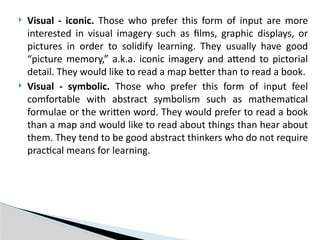
 Visual - iconic. Those who prefer this form of input are more
interested in visual imagery such as films, graphic displays, or
pictures in order to solidify learning. They usually have good
“picture memory,” a.k.a. iconic imagery and attend to pictorial
detail. They would like to read a map better than to read a book.
 Visual - symbolic. Those who prefer this form of input feel
comfortable with abstract symbolism such as mathematical
formulae or the written word. They would prefer to read a book
than a map and would like to read about things than hear about
them. They tend to be good abstract thinkers who do not require
practical means for learning.
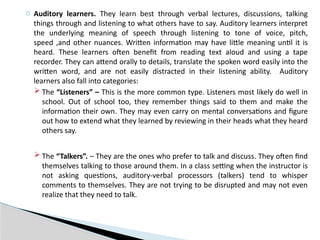
o Auditory learners. They learn best through verbal lectures, discussions, talking
things through and listening to what others have to say. Auditory learners interpret
the underlying meaning of speech through listening to tone of voice, pitch,
speed ,and other nuances. Written information may have little meaning until it is
heard. These learners often benefit from reading text aloud and using a tape
recorder. They can attend orally to details, translate the spoken word easily into the
written word, and are not easily distracted in their listening ability. Auditory
learners also fall into categories:
 The “Listeners” – This is the more common type. Listeners most likely do well in
school. Out of school too, they remember things said to them and make the
information their own. They may even carry on mental conversations and figure
out how to extend what they learned by reviewing in their heads what they heard
others say.
 The “Talkers”. – They are the ones who prefer to talk and discuss. They often find
themselves talking to those around them. In a class setting when the instructor is
not asking questions, auditory-verbal processors (talkers) tend to whisper
comments to themselves. They are not trying to be disrupted and may not even
realize that they need to talk.
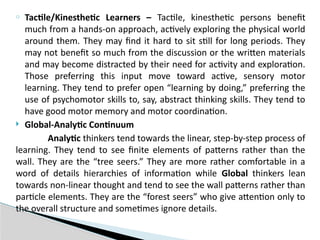
o Tactile/Kinesthetic Learners – Tactile, kinesthetic persons benefit
much from a hands-on approach, actively exploring the physical world
around them. They may find it hard to sit still for long periods. They
may not benefit so much from the discussion or the written materials
and may become distracted by their need for activity and exploration.
Those preferring this input move toward active, sensory motor
learning. They tend to prefer open “learning by doing,” preferring the
use of psychomotor skills to, say, abstract thinking skills. They tend to
have good motor memory and motor coordination.
 Global-Analytic Continuum
Analytic thinkers tend towards the linear, step-by-step process of
learning. They tend to see finite elements of patterns rather than the
wall. They are the “tree seers.” They are more rather comfortable in a
word of details hierarchies of information while Global thinkers lean
towards non-linear thought and tend to see the wall patterns rather than
particle elements. They are the “forest seers” who give attention only to
the overall structure and sometimes ignore details.
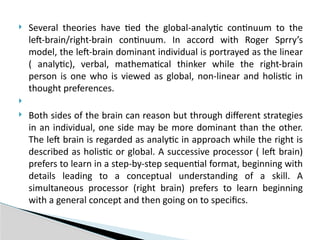
 Several theories have tied the global-analytic continuum to the
left-brain/right-brain continuum. In accord with Roger Sprry’s
model, the left-brain dominant individual is portrayed as the linear
( analytic), verbal, mathematical thinker while the right-brain
person is one who is viewed as global, non-linear and holistic in
thought preferences.

 Both sides of the brain can reason but through different strategies
in an individual, one side may be more dominant than the other.
The left brain is regarded as analytic in approach while the right is
described as holistic or global. A successive processor ( left brain)
prefers to learn in a step-by-step sequential format, beginning with
details leading to a conceptual understanding of a skill. A
simultaneous processor (right brain) prefers to learn beginning
with a general concept and then going on to specifics.
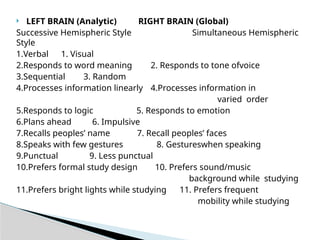
 LEFT BRAIN (Analytic) RIGHT BRAIN (Global)
Successive Hemispheric Style Simultaneous Hemispheric
Style
1.Verbal 1. Visual
2.Responds to word meaning 2. Responds to tone ofvoice
3.Sequential 3. Random
4.Processes information linearly 4.Processes information in
varied order
5.Responds to logic 5. Responds to emotion
6.Plans ahead 6. Impulsive
7.Recalls peoples’ name 7. Recall peoples’ faces
8.Speaks with few gestures 8. Gestureswhen speaking
9.Punctual 9. Less punctual
10.Prefers formal study design 10. Prefers sound/music
background while studying
11.Prefers bright lights while studying 11. Prefers frequent
mobility while studying
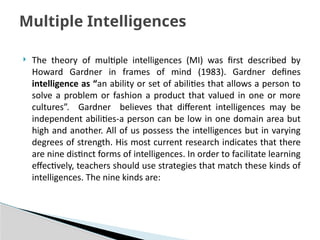
 The theory of multiple intelligences (MI) was first described by
Howard Gardner in frames of mind (1983). Gardner defines
intelligence as “an ability or set of abilities that allows a person to
solve a problem or fashion a product that valued in one or more
cultures”. Gardner believes that different intelligences may be
independent abilities-a person can be low in one domain area but
high and another. All of us possess the intelligences but in varying
degrees of strength. His most current research indicates that there
are nine distinct forms of intelligences. In order to facilitate learning
effectively, teachers should use strategies that match these kinds of
intelligences. The nine kinds are:
Multiple Intelligences
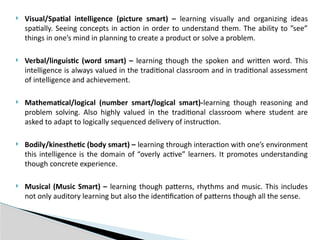
 Visual/Spatial intelligence (picture smart) – learning visually and organizing ideas
spatially. Seeing concepts in action in order to understand them. The ability to ”see”
things in one’s mind in planning to create a product or solve a problem.
 Verbal/linguistic (word smart) – learning though the spoken and written word. This
intelligence is always valued in the traditional classroom and in traditional assessment
of intelligence and achievement.
 Mathematical/logical (number smart/logical smart)-learning though reasoning and
problem solving. Also highly valued in the traditional classroom where student are
asked to adapt to logically sequenced delivery of instruction.
 Bodily/kinesthetic (body smart) – learning through interaction with one’s environment
this intelligence is the domain of “overly active” learners. It promotes understanding
though concrete experience.
 Musical (Music Smart) – learning though patterns, rhythms and music. This includes
not only auditory learning but also the identification of patterns though all the sense.
 Intrapersonal (Self Smart) – learning though feelings, values and
attitudes. This is a decidedly affective component of learning though
which students place value on what they learn and take ownership for
their learning.
 Interpersonal (People Smart) – learning though interaction with others.
Not the domain of children who are simply “talkative” or “overly social.”
This intelligence promotes collaborations and working cooperatively with
others.
 Naturalist (Nature Smart) – learning though classification, categories and
hierarchies. The naturalist intelligence picks up on subtle differences in
meaning. It is not simply the study of nature; it can be used in all areas of
study.
 Existential (Spirit Smart) – learning by seeing the “big picture”: “why are
we here?” “what is my role in the world?” this intelligence seeks
connections to real world understanding and application of new learning.

ffffffffffffffffffffffffffffffinal coverage 1.pptx

  • 1.
  • 2.
     It meansunderstanding that each individual is unique, and recognizing our individual differences. These can be along the dimensions of race, ethnicity, gender, sexual orientation, socio-economic status, age, physical abilities, religious beliefs, political beliefs, or other ideologies. Diversity
  • 3.
     Having adiverse group of students simply means recognizing that all the people are unique in their own way. Their differences could consist of their reading level, athletic ability, cultural background, personality, religious beliefs, and the list goes on. Student diversity
  • 4.
     The teacheras facilitator of learning is tasked to consider diversity in learning brought about by individual differences, multiple intelligences, exceptional learners, their learning and thinking styles among others in planning for effective instruction. This diversity also comes from other factors like the following:  (1).Socio-economic status – the millionaires’ lifestyle differs from that of the middle income or lower income group;  (2). Thinking/ Learning Style – some of you learn better by seeing something; others by just listening; still others by manipulating something; and  (3). Exceptionalities – in class there may be one who has difficulty in spoken language comprehension or in seeing, hearing, etc.
  • 5.
     In alllearning environments, individuals interact with others who are in some ways different from them. A teacher may be “challenged “ to handle a class with students so diverse. There may be students having different cultural background, different language abilities, different attitudes, aptitude and behaviors. Teachers might see this diversity as a difficult predicament, really a hassle! Yet a more reflective teacher may see a diverse classroom as an exciting place to learn not just for her students, but for herself, as well. A wise teacher may choose to respect and celebrate diversity! Read on, discover the benefits and learning opportunities that student diversity can bring to your classroom. One will have to focus on some important aspects in diversity.
  • 6.
     Student diversitycontributes to cognitive development. The opportunity to gain access to the perspectives of peers and to learn from other students, rather than the instructor only, may be especially important for promoting the cognitive development of learners. Supreme Court Justice William J. Brennan said “ the classroom is peculiarly the market place of ideas.” The depth and breadth of student learning are enhanced by exposure to others from diverse backgrounds. Student diversity in the classroom brings about different points of view and varied approach to the learning process. As the German philosopher Nietzsche, said over one hundred years ago “the more affects we allow to speak about one thing, the more eyes, different eyes we can use to observe one thing, the more complete will our concept of this thing, our objectivity, be.” Exposing students to others with diverse backgrounds and experiences also serve to help students focus on their awareness of themselves. When they see how others are different, students are given reference points or comparative perspectives which sharpen assessment of their own attitudes, values and behaviors. This will enhance students’ self-awareness of diversity.
  • 7.
     Student diversityprepares learners for their role as responsible members of society. Suzanne Morse stresses one competency that has strong implications for instructional strategies that capitalize on diversity “the capacity to imagine situations are problems from all perspectives and to appreciate all aspects of diversity” furthermore, she argues “the classroom can provide more than just theory given by the teacher in a lecture. With student diversity, the classroom becomes a public place where community can be practiced.  Student diversity can promote harmony. When student diversity is integrated into the classroom teaching and learning process, it can become a vehicle for promoting harmonious race relations. Through student-centered teaching strategies, diverse students can be encouraged to interact and collaborate with one another on learning tasks that emphasize unity of effort while capitalizing on their diversity of background. Teachers may consider student diversity by observing some important tips such as to:
  • 8.
    a. Encourage learnersto share their personal history and experiences. Students will be made to realize that they have something in common with the rest. They also differ in several ways. b. Integrate learning experience in activities which promote students’ multi-cultural and cross-cultural awareness. c. Aside from highlighting diversity, identify patterns of unity that transcend group differences. Clyde Kluckholn, an early American anthropologist who spent a lifetime studying human diversity across different cultures, concluded from his extensive research that, “every human is, at the same time, like all other humans, like some human, and like no other human” (Wong, 1991). His observation suggests a product in the human experience, mainly we are all the same in different ways. d. Communicate high expectations to students from all sub-groups. e. Use varied instructional methods to accommodate student diversity in learning styles.
  • 9.
     Vary theexamples you use to illustrate concepts in order to provide multiple contexts that are relevant to students from diverse backgrounds.  Adapt to students diverse backgrounds or learning styles by allowing them personal choice and decision-making opportunities concerning what they will learn and how they will learn it. Giving the learner more decision-making opportunity with respect to learning tasks ( a) promotes positive students’ attitudes toward the subject matter; (b) fosters more positive interactions among students; and (c) results in students’ working more consistently with lesser teacher intervention. Also, when individuals are allowed to exert some control over a task, they tend to experience less anxiety or stress while performing that tasks.
  • 10.
     Diversify yourmethods of assessing and evaluating student learning. You can accommodate student diversity not only by varying what you do with your teaching, but also by varying what you ask students to do to demonstrate learning. In addition to the traditional paper-in- pencil test in written assignments, students can demonstrate their learning in variety of performance formats, such as (a) individually-delivered oral reports; (b) panel presentations; (c) group projects; (d) visual presentations (e.g., concept maps, slide presentations, power point presentations, collages, exhibits),; and (e) dramatic vignettes - presented live or on video tape. One potential benefit of allowing students to choose how they demonstrate their learning is that the variety of options exercised may be a powerful way to promote students’ awareness of the diversity of human learning styles.
  • 11.
     Purposely, formsmall – discussion groups of students from diverse backgrounds. You can form groups of students with different learning styles, different cultural backgrounds, etc. Small peer – learning groups may be effective for promoting students’ progress to a more advanced stage of cognitive development. Peer- learning groups may promote this cognitive advancement because (a) the instructor is removed from center stage, thereby reducing the likelihood that the teacher is perceived as the ultimate or absolute authority; and (b) (b) students are exposed to the perspectives of other students, thus increasing their appreciation of multiple view points and different approaches to learning.
  • 12.
     Learning/Thinking stylesrefer to the preferred way an individual processes information. They describe a person’s typical mode of thinking, remembering, or problem-solving. Furthermore, styles are usually considered to be bipolar dimensions. For instance, your particular learning/thinking style would lie at a point in a continuum. Having a particular learning/thinking style simply denotes a tendency to behave in a certain manner. Your style is usually described as a personality dimension which influences your attitudes, values and social interaction. Learning/Thinking Styles and Multiple Intelligences
  • 13.
     A. Sensorypreferences. Individual stand to gravitate toward one or two types of sensory input and maintain a dominance in one of the following types: ◦ Visual learners. These learners must see their teachers actions and facial expression to fully understand the content of a lesson. They tend to prefer sitting in front so no one would block their view. They may think in pictures and learn best from visual aids including: diagrams, illustrated textbooks, overhead transparencies, videos, flip charts, and hand-outs. During a lecture or classroom discussions, visual learners often prefer to take detailed notes to absorb the information. Ri Charde further breaks down visual learners into: There are several perspectives about learning/ thinking styles. We shall focus on sensory preferences in the global- analytic continuum.
  • 14.
     Visual -iconic. Those who prefer this form of input are more interested in visual imagery such as films, graphic displays, or pictures in order to solidify learning. They usually have good “picture memory,” a.k.a. iconic imagery and attend to pictorial detail. They would like to read a map better than to read a book.  Visual - symbolic. Those who prefer this form of input feel comfortable with abstract symbolism such as mathematical formulae or the written word. They would prefer to read a book than a map and would like to read about things than hear about them. They tend to be good abstract thinkers who do not require practical means for learning.
  • 15.
    o Auditory learners.They learn best through verbal lectures, discussions, talking things through and listening to what others have to say. Auditory learners interpret the underlying meaning of speech through listening to tone of voice, pitch, speed ,and other nuances. Written information may have little meaning until it is heard. These learners often benefit from reading text aloud and using a tape recorder. They can attend orally to details, translate the spoken word easily into the written word, and are not easily distracted in their listening ability. Auditory learners also fall into categories:  The “Listeners” – This is the more common type. Listeners most likely do well in school. Out of school too, they remember things said to them and make the information their own. They may even carry on mental conversations and figure out how to extend what they learned by reviewing in their heads what they heard others say.  The “Talkers”. – They are the ones who prefer to talk and discuss. They often find themselves talking to those around them. In a class setting when the instructor is not asking questions, auditory-verbal processors (talkers) tend to whisper comments to themselves. They are not trying to be disrupted and may not even realize that they need to talk.
  • 16.
    o Tactile/Kinesthetic Learners– Tactile, kinesthetic persons benefit much from a hands-on approach, actively exploring the physical world around them. They may find it hard to sit still for long periods. They may not benefit so much from the discussion or the written materials and may become distracted by their need for activity and exploration. Those preferring this input move toward active, sensory motor learning. They tend to prefer open “learning by doing,” preferring the use of psychomotor skills to, say, abstract thinking skills. They tend to have good motor memory and motor coordination.  Global-Analytic Continuum Analytic thinkers tend towards the linear, step-by-step process of learning. They tend to see finite elements of patterns rather than the wall. They are the “tree seers.” They are more rather comfortable in a word of details hierarchies of information while Global thinkers lean towards non-linear thought and tend to see the wall patterns rather than particle elements. They are the “forest seers” who give attention only to the overall structure and sometimes ignore details.
  • 17.
     Several theorieshave tied the global-analytic continuum to the left-brain/right-brain continuum. In accord with Roger Sprry’s model, the left-brain dominant individual is portrayed as the linear ( analytic), verbal, mathematical thinker while the right-brain person is one who is viewed as global, non-linear and holistic in thought preferences.   Both sides of the brain can reason but through different strategies in an individual, one side may be more dominant than the other. The left brain is regarded as analytic in approach while the right is described as holistic or global. A successive processor ( left brain) prefers to learn in a step-by-step sequential format, beginning with details leading to a conceptual understanding of a skill. A simultaneous processor (right brain) prefers to learn beginning with a general concept and then going on to specifics.
  • 18.
     LEFT BRAIN(Analytic) RIGHT BRAIN (Global) Successive Hemispheric Style Simultaneous Hemispheric Style 1.Verbal 1. Visual 2.Responds to word meaning 2. Responds to tone ofvoice 3.Sequential 3. Random 4.Processes information linearly 4.Processes information in varied order 5.Responds to logic 5. Responds to emotion 6.Plans ahead 6. Impulsive 7.Recalls peoples’ name 7. Recall peoples’ faces 8.Speaks with few gestures 8. Gestureswhen speaking 9.Punctual 9. Less punctual 10.Prefers formal study design 10. Prefers sound/music background while studying 11.Prefers bright lights while studying 11. Prefers frequent mobility while studying
  • 19.
     The theoryof multiple intelligences (MI) was first described by Howard Gardner in frames of mind (1983). Gardner defines intelligence as “an ability or set of abilities that allows a person to solve a problem or fashion a product that valued in one or more cultures”. Gardner believes that different intelligences may be independent abilities-a person can be low in one domain area but high and another. All of us possess the intelligences but in varying degrees of strength. His most current research indicates that there are nine distinct forms of intelligences. In order to facilitate learning effectively, teachers should use strategies that match these kinds of intelligences. The nine kinds are: Multiple Intelligences
  • 20.
     Visual/Spatial intelligence(picture smart) – learning visually and organizing ideas spatially. Seeing concepts in action in order to understand them. The ability to ”see” things in one’s mind in planning to create a product or solve a problem.  Verbal/linguistic (word smart) – learning though the spoken and written word. This intelligence is always valued in the traditional classroom and in traditional assessment of intelligence and achievement.  Mathematical/logical (number smart/logical smart)-learning though reasoning and problem solving. Also highly valued in the traditional classroom where student are asked to adapt to logically sequenced delivery of instruction.  Bodily/kinesthetic (body smart) – learning through interaction with one’s environment this intelligence is the domain of “overly active” learners. It promotes understanding though concrete experience.  Musical (Music Smart) – learning though patterns, rhythms and music. This includes not only auditory learning but also the identification of patterns though all the sense.
  • 21.
     Intrapersonal (SelfSmart) – learning though feelings, values and attitudes. This is a decidedly affective component of learning though which students place value on what they learn and take ownership for their learning.  Interpersonal (People Smart) – learning though interaction with others. Not the domain of children who are simply “talkative” or “overly social.” This intelligence promotes collaborations and working cooperatively with others.  Naturalist (Nature Smart) – learning though classification, categories and hierarchies. The naturalist intelligence picks up on subtle differences in meaning. It is not simply the study of nature; it can be used in all areas of study.  Existential (Spirit Smart) – learning by seeing the “big picture”: “why are we here?” “what is my role in the world?” this intelligence seeks connections to real world understanding and application of new learning.