Diversity In The Workplace
Diversity Defined
•The fact or quality of being diverse; difference.
•A point or respect in which things differ.
•Variety or multiformity: “Charles Darwin saw in the
diversity of species the principles of evolution that
operated to generate the species: variation,
competition and selection” (Scientific American).
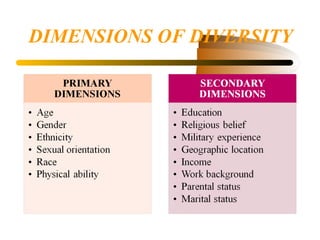
DIMENSIONS OF DIVERSITY
Types of Diversity
• Gender
• Age
• Race
• Ethnicity
• Culture
• Religion
• Language/Accent
• Disability
• Height/Weight
• Sexual Orientation
• Education
• Job Title
• Job Function
• Job Skills
• Union/Non-Union
• Part-Time/Full-Time
• Marital Status
• Political affiliation
The Village Earth
• "If we could shrink the earth's
population to a village of precisely
100 people, with all the existing
human ratios remaining the same,
it would look something like the
following. There would be:
The Village Earth
• 57 Asians
21 Europeans; 14 from the Western
Hemisphere, both north and south
8 Africans
• 52 would be female
48 would be male
• 70 would be non-white
30 would be white
• 70 would be non-Christian
30 would be Christian
• 89 would be heterosexual
11 would be homosexual
The Village Earth
• 6 people would possess 59% of the
entire world's wealth and all 6 would be
from the United States
• 80 would live in substandard housing
• 70 would be unable to read
• 50 would suffer from malnutrition
• 1 would be near death; 1 would be near
birth
• 1 (yes, only 1) would have a college
education
• 1 would own a computer
Diversity Consciousness Defined
Recognizing, appreciating, valuing,
and utilizing the unique talents
and contributions of all individuals
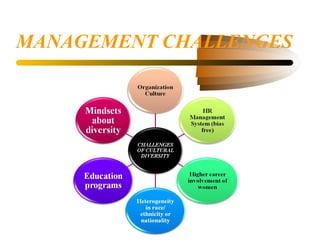
MANAGEMENT CHALLENGES
The Challenge of Workplace Diversity?
• Continuous improvement of the integration and
social acceptance of people from different
backgrounds.
• Our differing human characteristics influence
the way we think, act, interact, and make
choices.
• Often, these differences interfere with our ability
to support, trust, and respect each other, and thus
to effectively function together.
Areas of Workplace Diversity
• Equal Opportunity and Affirmative Action
– The active recruitment of women, minorities,
and other protected groups.
– The goal is to meet certain legal imperatives.
• EEOC
• Department of Justice
• Civil Rights
Areas of Workplace Diversity
• Managing Diversity
– The organization is diverse by default, and now
it must deal with it.
– The goal is to fix, cover-up, and/or defer the
problem with a minimum of hassle.
– The effort is top management-driven, thus
forced throughout the organization.
– The concern is more for a change in behavior
than attitudes.
Areas of Workplace Diversity
• Valuing Diversity
– The organization sees direct benefits from
incorporating diverse people and perspectives.
– INCLUSION: The goal is to change and/or
create a organizational culture that recognizes,
respects and encourages individual differences.
Diversity Bias
• Assumptions of Superiority
– I’m better than you.
• Assumptions of Correctness
– This is the way it should be
• Assumptions of Universality
– We’re all the same. Everybody is just like me.
Thoughts on Culture
• Everyone creates culture—every person, group, family,
organization.
• Culture is what everyone knows that everyone else knows. It is
a way of understanding and living in the world.
• Cultures are defined by their differences from other cultures.
The greater the difference, the more defined the culture.
• People from different cultures experience different realities.
• Most cultures accept differences in power and status, and
consider it normal.
• Most cultures value conformity, reward compliance, and punish
descent.
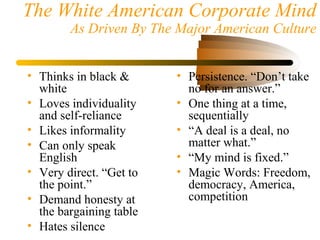
The White American Corporate Mind
As Driven By The Major American Culture
• Thinks in black &
white
• Loves individuality
and self-reliance
• Likes informality
• Can only speak
English
• Very direct. “Get to
the point.”
• Demand honesty at
the bargaining table
• Hates silence
• Persistence. “Don’t take
no for an answer.”
• One thing at a time,
sequentially
• “A deal is a deal, no
matter what.”
• “My mind is fixed.”
• Magic Words: Freedom,
democracy, America,
competition
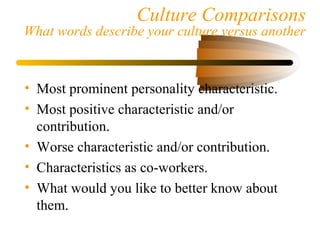
Culture Comparisons
What words describe your culture versus another
• Most prominent personality characteristic.
• Most positive characteristic and/or
contribution.
• Worse characteristic and/or contribution.
• Characteristics as co-workers.
• What would you like to better know about
them.

Diversity In Work Place

  • 1.
  • 2.
    Diversity Defined •The factor quality of being diverse; difference. •A point or respect in which things differ. •Variety or multiformity: “Charles Darwin saw in the diversity of species the principles of evolution that operated to generate the species: variation, competition and selection” (Scientific American).
  • 3.
  • 4.
    Types of Diversity •Gender • Age • Race • Ethnicity • Culture • Religion • Language/Accent • Disability • Height/Weight • Sexual Orientation • Education • Job Title • Job Function • Job Skills • Union/Non-Union • Part-Time/Full-Time • Marital Status • Political affiliation
  • 5.
    The Village Earth •"If we could shrink the earth's population to a village of precisely 100 people, with all the existing human ratios remaining the same, it would look something like the following. There would be:
  • 6.
    The Village Earth •57 Asians 21 Europeans; 14 from the Western Hemisphere, both north and south 8 Africans • 52 would be female 48 would be male • 70 would be non-white 30 would be white • 70 would be non-Christian 30 would be Christian • 89 would be heterosexual 11 would be homosexual
  • 7.
    The Village Earth •6 people would possess 59% of the entire world's wealth and all 6 would be from the United States • 80 would live in substandard housing • 70 would be unable to read • 50 would suffer from malnutrition • 1 would be near death; 1 would be near birth • 1 (yes, only 1) would have a college education • 1 would own a computer
  • 8.
    Diversity Consciousness Defined Recognizing,appreciating, valuing, and utilizing the unique talents and contributions of all individuals
  • 9.
  • 10.
    The Challenge ofWorkplace Diversity? • Continuous improvement of the integration and social acceptance of people from different backgrounds. • Our differing human characteristics influence the way we think, act, interact, and make choices. • Often, these differences interfere with our ability to support, trust, and respect each other, and thus to effectively function together.
  • 11.
    Areas of WorkplaceDiversity • Equal Opportunity and Affirmative Action – The active recruitment of women, minorities, and other protected groups. – The goal is to meet certain legal imperatives. • EEOC • Department of Justice • Civil Rights
  • 12.
    Areas of WorkplaceDiversity • Managing Diversity – The organization is diverse by default, and now it must deal with it. – The goal is to fix, cover-up, and/or defer the problem with a minimum of hassle. – The effort is top management-driven, thus forced throughout the organization. – The concern is more for a change in behavior than attitudes.
  • 13.
    Areas of WorkplaceDiversity • Valuing Diversity – The organization sees direct benefits from incorporating diverse people and perspectives. – INCLUSION: The goal is to change and/or create a organizational culture that recognizes, respects and encourages individual differences.
  • 14.
    Diversity Bias • Assumptionsof Superiority – I’m better than you. • Assumptions of Correctness – This is the way it should be • Assumptions of Universality – We’re all the same. Everybody is just like me.
  • 15.
    Thoughts on Culture •Everyone creates culture—every person, group, family, organization. • Culture is what everyone knows that everyone else knows. It is a way of understanding and living in the world. • Cultures are defined by their differences from other cultures. The greater the difference, the more defined the culture. • People from different cultures experience different realities. • Most cultures accept differences in power and status, and consider it normal. • Most cultures value conformity, reward compliance, and punish descent.
  • 16.
    The White AmericanCorporate Mind As Driven By The Major American Culture • Thinks in black & white • Loves individuality and self-reliance • Likes informality • Can only speak English • Very direct. “Get to the point.” • Demand honesty at the bargaining table • Hates silence • Persistence. “Don’t take no for an answer.” • One thing at a time, sequentially • “A deal is a deal, no matter what.” • “My mind is fixed.” • Magic Words: Freedom, democracy, America, competition
  • 17.
    Culture Comparisons What wordsdescribe your culture versus another • Most prominent personality characteristic. • Most positive characteristic and/or contribution. • Worse characteristic and/or contribution. • Characteristics as co-workers. • What would you like to better know about them.