THE ENVIRONMENT &
CORPORATE CULTURE
Prepared By : ZAREEN SHAIKH, SZABIST Larkana
Session-3
Class-BBA.2
Organizational Environment
 All elements existing outside the organization's
boundaries that have the potential to affect the
organization.
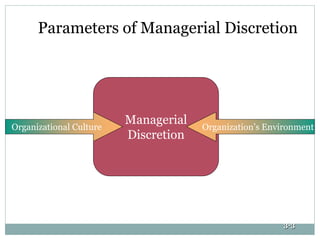
Parameters of Managerial Discretion
Managerial
Discretion
Organization’s EnvironmentOrganizational Culture
3-3
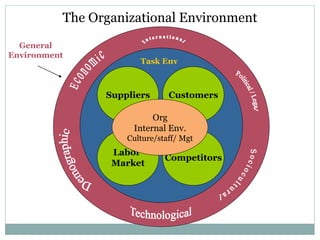
External Environment’s Two Layers
 Task environment.
 General environment.
The Organizational Environment
Customers
Competitors
Suppliers
Labor
Market
Org
Internal Env.
Culture/staff/ Mgt
General
Environment
Task Env
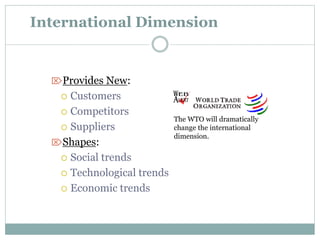
International Dimension
Provides New:
 Customers
 Competitors
 Suppliers
Shapes:
 Social trends
 Technological trends
 Economic trends
The WTO will dramatically
change the international
dimension.
Technological Dimension
 Includes scientific and technological
advancements in specific industry
and society at large.
Today computers are
practically taken for granted as
one of the minimum tools for
doing business.
Socio-Cultural Dimension
 Demographic characteristics as well as the norms, customs, and
values of the general population.
 Important characteristics are geographical and population density,
age, and education levels.
Organization’s Economic
Environment
 Consumer purchasing
power.
 Unemployment rate.
 Interest rates.
 Frequency of mergers.
Legal-Political
 Government regulations
 Local
 State
 Federal
 Considers political activities designed to
influence company behavior.
Task Environment
Customers
 A concern is the power the
internet has given customers.
 This new found power enables
customers to directly impact
organizations in new ways.
 Managers are using the internet
to learn about customers.
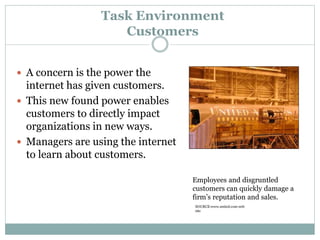
Employees and disgruntled
customers can quickly damage a
firm’s reputation and sales.
SOURCE:www.untied.com web
site
Task Environment
Competitors
 Each industry is characterized by specific
competitive issues.
 Part of the new workplace involves competitors
working together.
Task Environment
Suppliers
 Many companies are now using fewer suppliers
while trying to build better relationships.
 Traditionally the role has been adversarial many
companies are looking to cooperation.
Task Environment
Labor Market Factors
1. Growing need for computer-literate information
technology workers.
2. The necessity for continuous investment in human
resources in order to meet the borderless world.
3. The effects of international trading blocks,
automation, and shifting plant locations.
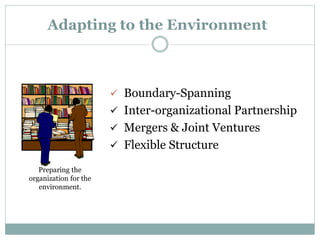
Adapting to the Environment
 Boundary-Spanning
 Inter-organizational Partnership
 Mergers & Joint Ventures
 Flexible Structure
Preparing the
organization for the
environment.
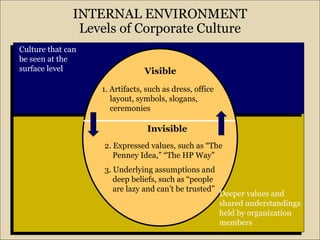
Visible
1. Artifacts, such as dress, office
layout, symbols, slogans,
ceremonies
2. Expressed values, such as “The
Penney Idea,” “The HP Way”
3. Underlying assumptions and
deep beliefs, such as “people
are lazy and can’t be trusted”
Invisible
Culture that can
be seen at the
surface level
Deeper values and
shared understandings
held by organization
members
INTERNAL ENVIRONMENT
Levels of Corporate Culture
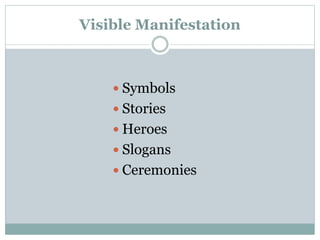
Visible Manifestation
 Symbols
 Stories
 Heroes
 Slogans
 Ceremonies
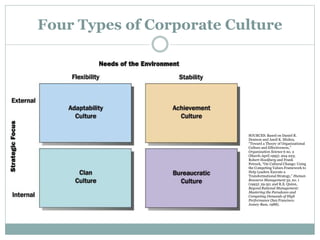
Four Types of Corporate Culture
SOURCES: Based on Daniel R.
Denison and Aneil K. Mishra,
“Toward a Theory of Organizational
Culture and Effectiveness,”
Organization Science 6 no. 2
(March-April 1995): 204-223;
Robert Hooijberg and Frank
Petrock, “On Cultural Change: Using
the Competing Values Framework to
Help Leaders Execute a
Transformational Strategy,” Human
Resource Management 32, no. 1
(1993): 29-50; and R.E. Quinn,
Beyond Rational Management:
Mastering the Paradoxes and
Competing Demands of High
Performance (San Francisco:
Jossey-Bass, 1988).
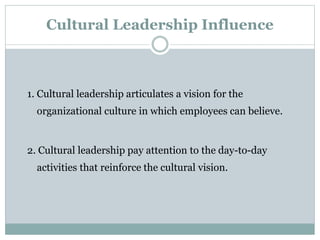
Cultural Leadership Influence
1. Cultural leadership articulates a vision for the
organizational culture in which employees can believe.
2. Cultural leadership pay attention to the day-to-day
activities that reinforce the cultural vision.

Environment And Corporate Culture

  • 1.
    THE ENVIRONMENT & CORPORATECULTURE Prepared By : ZAREEN SHAIKH, SZABIST Larkana Session-3 Class-BBA.2
  • 2.
    Organizational Environment  Allelements existing outside the organization's boundaries that have the potential to affect the organization.
  • 3.
    Parameters of ManagerialDiscretion Managerial Discretion Organization’s EnvironmentOrganizational Culture 3-3
  • 4.
    External Environment’s TwoLayers  Task environment.  General environment.
  • 5.
  • 6.
    International Dimension Provides New: Customers  Competitors  Suppliers Shapes:  Social trends  Technological trends  Economic trends The WTO will dramatically change the international dimension.
  • 7.
    Technological Dimension  Includesscientific and technological advancements in specific industry and society at large. Today computers are practically taken for granted as one of the minimum tools for doing business.
  • 8.
    Socio-Cultural Dimension  Demographiccharacteristics as well as the norms, customs, and values of the general population.  Important characteristics are geographical and population density, age, and education levels.
  • 9.
    Organization’s Economic Environment  Consumerpurchasing power.  Unemployment rate.  Interest rates.  Frequency of mergers.
  • 10.
    Legal-Political  Government regulations Local  State  Federal  Considers political activities designed to influence company behavior.
  • 11.
    Task Environment Customers  Aconcern is the power the internet has given customers.  This new found power enables customers to directly impact organizations in new ways.  Managers are using the internet to learn about customers. Employees and disgruntled customers can quickly damage a firm’s reputation and sales. SOURCE:www.untied.com web site
  • 12.
    Task Environment Competitors  Eachindustry is characterized by specific competitive issues.  Part of the new workplace involves competitors working together.
  • 13.
    Task Environment Suppliers  Manycompanies are now using fewer suppliers while trying to build better relationships.  Traditionally the role has been adversarial many companies are looking to cooperation.
  • 14.
    Task Environment Labor MarketFactors 1. Growing need for computer-literate information technology workers. 2. The necessity for continuous investment in human resources in order to meet the borderless world. 3. The effects of international trading blocks, automation, and shifting plant locations.
  • 15.
    Adapting to theEnvironment  Boundary-Spanning  Inter-organizational Partnership  Mergers & Joint Ventures  Flexible Structure Preparing the organization for the environment.
  • 16.
    Visible 1. Artifacts, suchas dress, office layout, symbols, slogans, ceremonies 2. Expressed values, such as “The Penney Idea,” “The HP Way” 3. Underlying assumptions and deep beliefs, such as “people are lazy and can’t be trusted” Invisible Culture that can be seen at the surface level Deeper values and shared understandings held by organization members INTERNAL ENVIRONMENT Levels of Corporate Culture
  • 17.
    Visible Manifestation  Symbols Stories  Heroes  Slogans  Ceremonies
  • 18.
    Four Types ofCorporate Culture SOURCES: Based on Daniel R. Denison and Aneil K. Mishra, “Toward a Theory of Organizational Culture and Effectiveness,” Organization Science 6 no. 2 (March-April 1995): 204-223; Robert Hooijberg and Frank Petrock, “On Cultural Change: Using the Competing Values Framework to Help Leaders Execute a Transformational Strategy,” Human Resource Management 32, no. 1 (1993): 29-50; and R.E. Quinn, Beyond Rational Management: Mastering the Paradoxes and Competing Demands of High Performance (San Francisco: Jossey-Bass, 1988).
  • 19.
    Cultural Leadership Influence 1.Cultural leadership articulates a vision for the organizational culture in which employees can believe. 2. Cultural leadership pay attention to the day-to-day activities that reinforce the cultural vision.