
Chapter 10: Racial and Ethnic Relations Section 1: Race, Ethnicity, and the Social Structure Section 2: Patterns of Intergroup Relations Section 3: Minority Groups in the United States
Section 1: Race, ethnicity, and the Social Structure Race: a category of people who share inherited physical characteristics and whom others see as being a distinct group.  Historically scholars have used 3 different racial groups: caucaosoids, mongoloids, negroids…is this good enough?
Ethnicity: set of cultural characteristics that distinguishes one group from another group Ethnic group—people who share a common cultural background and a common sense of identity Based on national origin, religion, language, customs, values  How do ethnic groups survive? Do ethnicities over step racial or national boundaries? Jewish people, African Americans
Minority Groups: a group of people who because of their physical characteristics or cultural practices are singled out and unequally treated. Does not have to do equate with group size –South Africa whites during apartheid Groups possess identifiable physical or cultural characteristics that differ from dominant group Victims of unequal treatment Ascribed status? Share strong bond and sense of group loyalty Tend to practice endogamy
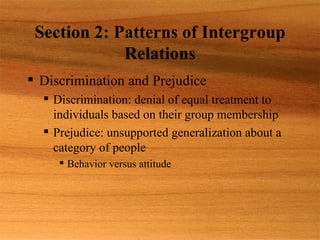
Section 2: Patterns of Intergroup Relations Discrimination and Prejudice Discrimination: denial of equal treatment to individuals based on their group membership Prejudice: unsupported generalization about a category of people Behavior versus attitude
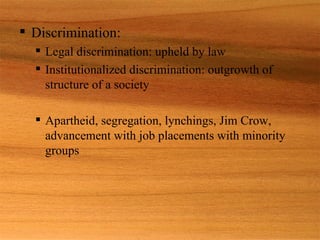
Discrimination: Legal discrimination: upheld by law Institutionalized discrimination: outgrowth of structure of a society Apartheid, segregation, lynchings, Jim Crow, advancement with job placements with minority groups
Prejudice Stereotype: oversimplified, exaggerated, unfavorable generalization about a group of people Irish people are hot-tempered Self-fulfilling prophecy: prediction that results in behavior that makes it come true –internalizing a stereotype…examples? Racism: belief that one’s own race or ethnic group is naturally superior See chart page 240: active bigot, timid bigot, fair-weather liberal, all-weather liberal
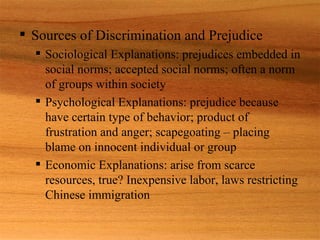
Sources of Discrimination and Prejudice Sociological Explanations: prejudices embedded in social norms; accepted social norms; often a norm of groups within society Psychological Explanations: prejudice because have certain type of behavior; product of frustration and anger; scapegoating – placing blame on innocent individual or group Economic Explanations: arise from scarce resources, true? Inexpensive labor, laws restricting Chinese immigration
 

Chapter 10 Soc

  • 1.
    Chapter 10: Racialand Ethnic Relations Section 1: Race, Ethnicity, and the Social Structure Section 2: Patterns of Intergroup Relations Section 3: Minority Groups in the United States
  • 2.
    Section 1: Race,ethnicity, and the Social Structure Race: a category of people who share inherited physical characteristics and whom others see as being a distinct group. Historically scholars have used 3 different racial groups: caucaosoids, mongoloids, negroids…is this good enough?
  • 3.
    Ethnicity: set ofcultural characteristics that distinguishes one group from another group Ethnic group—people who share a common cultural background and a common sense of identity Based on national origin, religion, language, customs, values How do ethnic groups survive? Do ethnicities over step racial or national boundaries? Jewish people, African Americans
  • 4.
    Minority Groups: agroup of people who because of their physical characteristics or cultural practices are singled out and unequally treated. Does not have to do equate with group size –South Africa whites during apartheid Groups possess identifiable physical or cultural characteristics that differ from dominant group Victims of unequal treatment Ascribed status? Share strong bond and sense of group loyalty Tend to practice endogamy
  • 5.
    Section 2: Patternsof Intergroup Relations Discrimination and Prejudice Discrimination: denial of equal treatment to individuals based on their group membership Prejudice: unsupported generalization about a category of people Behavior versus attitude
  • 6.
    Discrimination: Legal discrimination:upheld by law Institutionalized discrimination: outgrowth of structure of a society Apartheid, segregation, lynchings, Jim Crow, advancement with job placements with minority groups
  • 7.
    Prejudice Stereotype: oversimplified,exaggerated, unfavorable generalization about a group of people Irish people are hot-tempered Self-fulfilling prophecy: prediction that results in behavior that makes it come true –internalizing a stereotype…examples? Racism: belief that one’s own race or ethnic group is naturally superior See chart page 240: active bigot, timid bigot, fair-weather liberal, all-weather liberal
  • 8.
    Sources of Discriminationand Prejudice Sociological Explanations: prejudices embedded in social norms; accepted social norms; often a norm of groups within society Psychological Explanations: prejudice because have certain type of behavior; product of frustration and anger; scapegoating – placing blame on innocent individual or group Economic Explanations: arise from scarce resources, true? Inexpensive labor, laws restricting Chinese immigration
  • 9.