MANAGEMENT 6th
Ed.
By: Richard Daft
Prepared By : ZAREEN SHAIKH, SZABIST Larkana
Session-1
Class-BBA.2
 The attainment of organizational goals in an
effective and efficient manner through planning,
organizing, leading, and controlling organizational
resources.
 Planning
 Management function concerned with defining goals for
future organizational performance and deciding on the tasks
and use of resources needed to attain them.
 Organizing
 Management function concerned with assigning tasks,
grouping tasks into departments, and allocating resources to
departments.
 Leading
 The management function that involves the use of influence
to motivate employees to achieve the organization’s goals.
 Controlling
 The management function concerned with monitoring
employees’ activities, keeping the organization on track
toward its goals, and making corrections as needed.
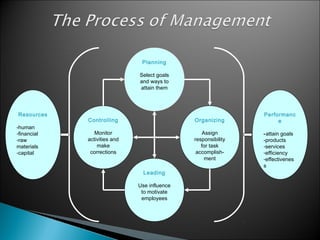
Planning
Select goals
and ways to
attain them
Controlling
Monitor
activities and
make
corrections
Leading
Use influence
to motivate
employees
Organizing
Assign
responsibility
for task
accomplish-
ment
Resources
-human
-financial
-raw
materials
-capital
Performanc
e
-attain goals
-products
-services
-efficiency
-effectivenes
s
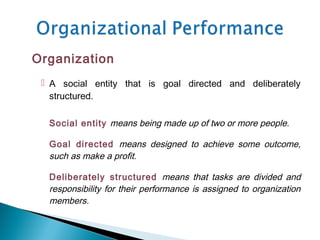
Organization
 A social entity that is goal directed and deliberately
structured.
Social entity means being made up of two or more people.
Goal directed means designed to achieve some outcome,
such as make a profit.
Deliberately structured means that tasks are divided and
responsibility for their performance is assigned to organization
members.
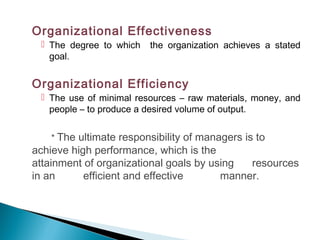
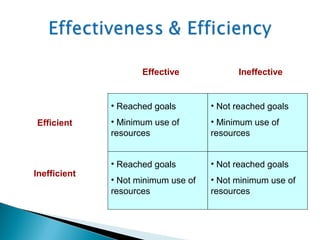
Organizational Effectiveness
 The degree to which the organization achieves a stated
goal.
Organizational Efficiency
 The use of minimal resources – raw materials, money, and
people – to produce a desired volume of output.
* The ultimate responsibility of managers is to
achieve high performance, which is the
attainment of organizational goals by using resources
in an efficient and effective manner.
• Not reached goals
• Minimum use of
resources
• Reached goals
• Not minimum use of
resources
• Not reached goals
• Not minimum use of
resources
• Reached goals
• Minimum use of
resources
Effective Ineffective
Efficient
Inefficient
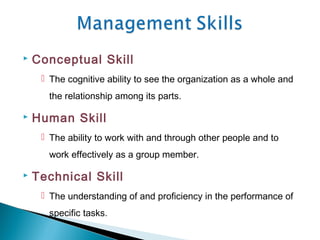
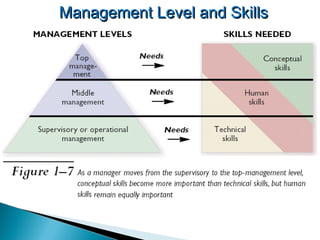
 Conceptual Skill
 The cognitive ability to see the organization as a whole and
the relationship among its parts.
 Human Skill
 The ability to work with and through other people and to
work effectively as a group member.
 Technical Skill
 The understanding of and proficiency in the performance of
specific tasks.
Management Level and SkillsManagement Level and Skills
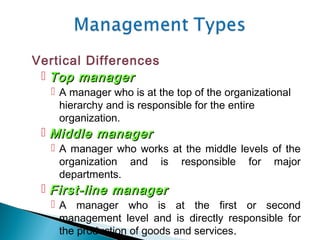
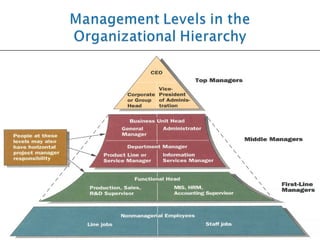
Vertical Differences
 Top managerTop manager
 A manager who is at the top of the organizational
hierarchy and is responsible for the entire
organization.
 Middle managerMiddle manager
 A manager who works at the middle levels of the
organization and is responsible for major
departments.
 First-line managerFirst-line manager
 A manager who is at the first or second
management level and is directly responsible for
the production of goods and services..
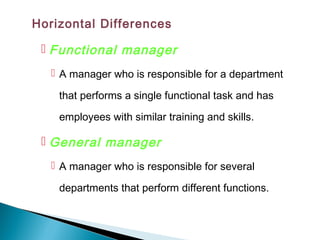
Horizontal Differences
 Functional manager
 A manager who is responsible for a department
that performs a single functional task and has
employees with similar training and skills.
 General manager
 A manager who is responsible for several
departments that perform different functions.
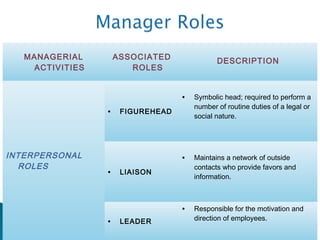
MANAGERIAL
ACTIVITIES
ASSOCIATED
ROLES
DESCRIPTION
INTERPERSONAL
ROLES
• FIGUREHEAD
• Symbolic head; required to perform a
number of routine duties of a legal or
social nature.
• LIAISON
• Maintains a network of outside
contacts who provide favors and
information.
• LEADER
• Responsible for the motivation and
direction of employees.
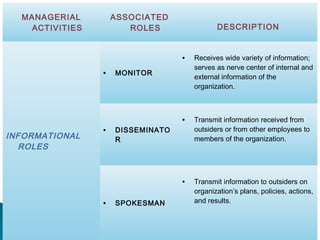
MANAGERIAL
ACTIVITIES
ASSOCIATED
ROLES DESCRIPTION
INFORMATIONAL
ROLES
• MONITOR
• Receives wide variety of information;
serves as nerve center of internal and
external information of the
organization.
• DISSEMINATO
R
• Transmit information received from
outsiders or from other employees to
members of the organization.
• SPOKESMAN
• Transmit information to outsiders on
organization’s plans, policies, actions,
and results.
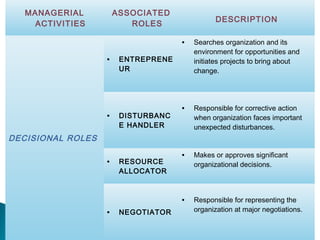
MANAGERIAL
ACTIVITIES
ASSOCIATED
ROLES
DESCRIPTION
DECISIONAL ROLES
• ENTREPRENE
UR
• Searches organization and its
environment for opportunities and
initiates projects to bring about
change.
• DISTURBANC
E HANDLER
• Responsible for corrective action
when organization faces important
unexpected disturbances.
• RESOURCE
ALLOCATOR
• Makes or approves significant
organizational decisions.
• NEGOTIATOR
• Responsible for representing the
organization at major negotiations.
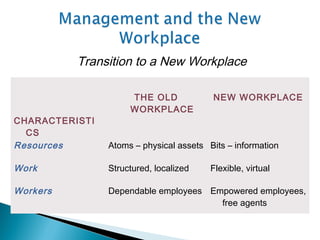
Transition to a New Workplace
THE OLD
WORKPLACE
NEW WORKPLACE
CHARACTERISTI
CS
Resources Atoms – physical assets Bits – information
Work Structured, localized Flexible, virtual
Workers Dependable employees Empowered employees,
free agents
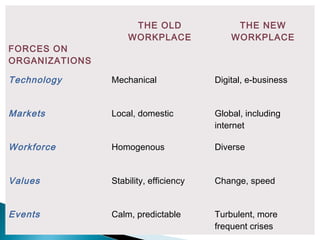
THE OLD
WORKPLACE
THE NEW
WORKPLACE
FORCES ON
ORGANIZATIONS
Technology Mechanical Digital, e-business
Markets Local, domestic Global, including
internet
Workforce Homogenous Diverse
Values Stability, efficiency Change, speed
Events Calm, predictable Turbulent, more
frequent crises
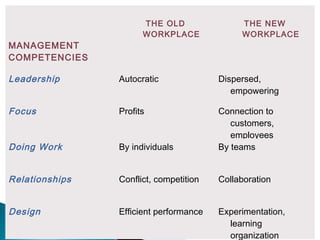
THE OLD
WORKPLACE
THE NEW
WORKPLACE
MANAGEMENT
COMPETENCIES
Leadership Autocratic Dispersed,
empowering
Focus Profits Connection to
customers,
employees
Doing Work By individuals By teams
Relationships Conflict, competition Collaboration
Design Efficient performance Experimentation,
learning
organization
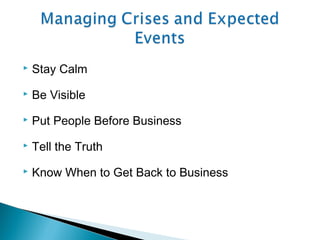
 Stay Calm
 Be Visible
 Put People Before Business
 Tell the Truth
 Know When to Get Back to Business
Any clarifications?
HAVE A NICE DAY!!! 

Managing The New Workplace By Richard

  • 1.
    MANAGEMENT 6th Ed. By: RichardDaft Prepared By : ZAREEN SHAIKH, SZABIST Larkana Session-1 Class-BBA.2
  • 2.
     The attainmentof organizational goals in an effective and efficient manner through planning, organizing, leading, and controlling organizational resources.
  • 3.
     Planning  Managementfunction concerned with defining goals for future organizational performance and deciding on the tasks and use of resources needed to attain them.  Organizing  Management function concerned with assigning tasks, grouping tasks into departments, and allocating resources to departments.
  • 4.
     Leading  Themanagement function that involves the use of influence to motivate employees to achieve the organization’s goals.  Controlling  The management function concerned with monitoring employees’ activities, keeping the organization on track toward its goals, and making corrections as needed.
  • 5.
    Planning Select goals and waysto attain them Controlling Monitor activities and make corrections Leading Use influence to motivate employees Organizing Assign responsibility for task accomplish- ment Resources -human -financial -raw materials -capital Performanc e -attain goals -products -services -efficiency -effectivenes s
  • 6.
    Organization  A socialentity that is goal directed and deliberately structured. Social entity means being made up of two or more people. Goal directed means designed to achieve some outcome, such as make a profit. Deliberately structured means that tasks are divided and responsibility for their performance is assigned to organization members.
  • 7.
    Organizational Effectiveness  Thedegree to which the organization achieves a stated goal. Organizational Efficiency  The use of minimal resources – raw materials, money, and people – to produce a desired volume of output. * The ultimate responsibility of managers is to achieve high performance, which is the attainment of organizational goals by using resources in an efficient and effective manner.
  • 8.
    • Not reachedgoals • Minimum use of resources • Reached goals • Not minimum use of resources • Not reached goals • Not minimum use of resources • Reached goals • Minimum use of resources Effective Ineffective Efficient Inefficient
  • 9.
     Conceptual Skill The cognitive ability to see the organization as a whole and the relationship among its parts.  Human Skill  The ability to work with and through other people and to work effectively as a group member.  Technical Skill  The understanding of and proficiency in the performance of specific tasks.
  • 10.
    Management Level andSkillsManagement Level and Skills
  • 11.
    Vertical Differences  TopmanagerTop manager  A manager who is at the top of the organizational hierarchy and is responsible for the entire organization.  Middle managerMiddle manager  A manager who works at the middle levels of the organization and is responsible for major departments.  First-line managerFirst-line manager  A manager who is at the first or second management level and is directly responsible for the production of goods and services..
  • 12.
    Horizontal Differences  Functionalmanager  A manager who is responsible for a department that performs a single functional task and has employees with similar training and skills.  General manager  A manager who is responsible for several departments that perform different functions.
  • 14.
    MANAGERIAL ACTIVITIES ASSOCIATED ROLES DESCRIPTION INTERPERSONAL ROLES • FIGUREHEAD • Symbolichead; required to perform a number of routine duties of a legal or social nature. • LIAISON • Maintains a network of outside contacts who provide favors and information. • LEADER • Responsible for the motivation and direction of employees.
  • 15.
    MANAGERIAL ACTIVITIES ASSOCIATED ROLES DESCRIPTION INFORMATIONAL ROLES • MONITOR •Receives wide variety of information; serves as nerve center of internal and external information of the organization. • DISSEMINATO R • Transmit information received from outsiders or from other employees to members of the organization. • SPOKESMAN • Transmit information to outsiders on organization’s plans, policies, actions, and results.
  • 16.
    MANAGERIAL ACTIVITIES ASSOCIATED ROLES DESCRIPTION DECISIONAL ROLES • ENTREPRENE UR •Searches organization and its environment for opportunities and initiates projects to bring about change. • DISTURBANC E HANDLER • Responsible for corrective action when organization faces important unexpected disturbances. • RESOURCE ALLOCATOR • Makes or approves significant organizational decisions. • NEGOTIATOR • Responsible for representing the organization at major negotiations.
  • 17.
    Transition to aNew Workplace THE OLD WORKPLACE NEW WORKPLACE CHARACTERISTI CS Resources Atoms – physical assets Bits – information Work Structured, localized Flexible, virtual Workers Dependable employees Empowered employees, free agents
  • 18.
    THE OLD WORKPLACE THE NEW WORKPLACE FORCESON ORGANIZATIONS Technology Mechanical Digital, e-business Markets Local, domestic Global, including internet Workforce Homogenous Diverse Values Stability, efficiency Change, speed Events Calm, predictable Turbulent, more frequent crises
  • 19.
    THE OLD WORKPLACE THE NEW WORKPLACE MANAGEMENT COMPETENCIES LeadershipAutocratic Dispersed, empowering Focus Profits Connection to customers, employees Doing Work By individuals By teams Relationships Conflict, competition Collaboration Design Efficient performance Experimentation, learning organization
  • 20.
     Stay Calm Be Visible  Put People Before Business  Tell the Truth  Know When to Get Back to Business
  • 21.