Circle of Courage
Christian Ethics
Mr. LeBlanc
https://www.reclaiming.com/content/aboutcircleofcourage
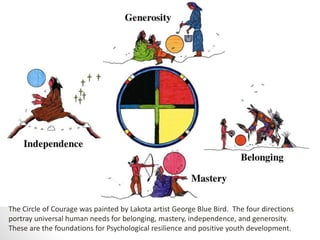
The Circle of Courage was painted by Lakota artist George Blue Bird. The four directions
portray universal human needs for belonging, mastery, independence, and generosity.
These are the foundations for Psychological resilience and positive youth development.
Belonging
• In Native American and First Nations cultures, significance was
nurtured in communities of belonging.
• Lakota anthropologist Ella Deloria described the core value of
belonging in these simple words: "Be related, somehow, to
everyone you know."
• Treating others as kin forges powerful social bonds that draw
all into relationships of respect.
• Throughout history, the tribe, not the nuclear family, always
ensured the survival of the culture.
• Even if parents died or were not responsible, the tribe was
always there to nourish the next generation.
Mastery
• Competence in traditional cultures is ensured by guaranteed
opportunity for mastery.
• Children were taught to carefully observe and listen to those
with more experience.
A person with greater ability was seen as a model for learning,
not as a rival.
• Each person strives for mastery for personal growth, but not
to be superior to someone else.
• Humans have an innate drive to become competent and solve
problems.
• With success in surmounting challenges, the desire to achieve
is strengthened. To lead by example and be responsible.
Independence
• Power in Western culture was based on dominance, but in
tribal traditions it meant respecting the right for
independence.
• In contrast to obedience models of discipline, Native teaching
was designed to build respect and teach inner discipline.
• From earliest childhood, children were encouraged to make
decisions, solve problems, and show personal responsibility.
• Adults modeled, nurtured, taught values, and gave feedback,
but children were given abundant opportunities to make
choices without coercion.
• It means that people can rely on you and trust you at all times.
Generosity
• Finally, virtue was reflected in the preeminent value of
generosity.
• The central goal in Native American child-rearing is to teach
the importance of being generous and unselfish.
• In the words of a Lakota Elder, "You should be able to give
away your most cherished possession without your heart
beating faster."
• In helping others, youth create their own proof of worthiness:
they make a positive contribution to another human life.
How will we build Belonging?
How will we build Mastery?
How will we build
Independence?
How will we build Generosity?

Circle of courage

  • 1.
    Circle of Courage ChristianEthics Mr. LeBlanc https://www.reclaiming.com/content/aboutcircleofcourage
  • 2.
    The Circle ofCourage was painted by Lakota artist George Blue Bird. The four directions portray universal human needs for belonging, mastery, independence, and generosity. These are the foundations for Psychological resilience and positive youth development.
  • 3.
    Belonging • In NativeAmerican and First Nations cultures, significance was nurtured in communities of belonging. • Lakota anthropologist Ella Deloria described the core value of belonging in these simple words: "Be related, somehow, to everyone you know." • Treating others as kin forges powerful social bonds that draw all into relationships of respect. • Throughout history, the tribe, not the nuclear family, always ensured the survival of the culture. • Even if parents died or were not responsible, the tribe was always there to nourish the next generation.
  • 4.
    Mastery • Competence intraditional cultures is ensured by guaranteed opportunity for mastery. • Children were taught to carefully observe and listen to those with more experience. A person with greater ability was seen as a model for learning, not as a rival. • Each person strives for mastery for personal growth, but not to be superior to someone else. • Humans have an innate drive to become competent and solve problems. • With success in surmounting challenges, the desire to achieve is strengthened. To lead by example and be responsible.
  • 5.
    Independence • Power inWestern culture was based on dominance, but in tribal traditions it meant respecting the right for independence. • In contrast to obedience models of discipline, Native teaching was designed to build respect and teach inner discipline. • From earliest childhood, children were encouraged to make decisions, solve problems, and show personal responsibility. • Adults modeled, nurtured, taught values, and gave feedback, but children were given abundant opportunities to make choices without coercion. • It means that people can rely on you and trust you at all times.
  • 6.
    Generosity • Finally, virtuewas reflected in the preeminent value of generosity. • The central goal in Native American child-rearing is to teach the importance of being generous and unselfish. • In the words of a Lakota Elder, "You should be able to give away your most cherished possession without your heart beating faster." • In helping others, youth create their own proof of worthiness: they make a positive contribution to another human life.
  • 7.
    How will webuild Belonging?
  • 8.
    How will webuild Mastery?
  • 9.
    How will webuild Independence?
  • 10.
    How will webuild Generosity?