THE CONCEPT OF DIVERSITY
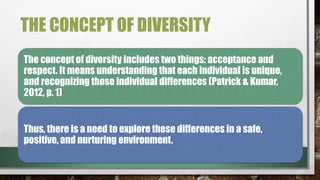
The concept of diversity includes two things: acceptance and
respect. It means understanding that each individual is unique,
and recognizing those individual differences (Patrick & Kumar,
2012, p. 1)
Thus, there is a need to explore these differences in a safe,
positive, and nurturing environment.
FEATURES OF DIVERSITY
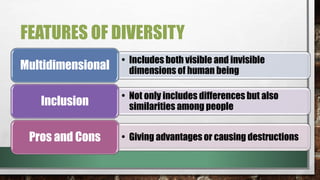
• Includes both visible and invisible
dimensions of human being
Multidimensional
• Not only includes differences but also
similarities among people
Inclusion
• Giving advantages or causing destructions
Pros and Cons
DIMENSIONS OF DIVERSITY (LODEN)
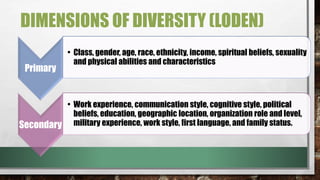
Primary
• Class, gender, age, race, ethnicity, income, spiritual beliefs, sexuality
and physical abilities and characteristics
Secondary
• Work experience, communication style, cognitive style, political
beliefs, education, geographic location, organization role and level,
military experience, work style, first language, and family status.
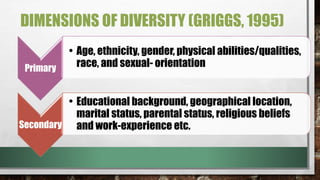
DIMENSIONS OF DIVERSITY (GRIGGS, 1995)
Primary
• Age, ethnicity, gender, physical abilities/qualities,
race, and sexual- orientation
Secondary
• Educational background, geographical location,
marital status, parental status, religious beliefs
and work-experience etc.
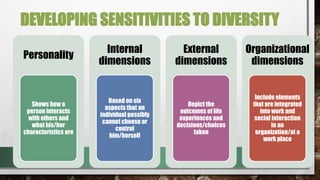
DEVELOPING SENSITIVITIES TO DIVERSITY
Personality
Shows how a
person interacts
with others and
what his/her
characteristics are
Internal
dimensions
Based on six
aspects that an
individual possibly
cannot choose or
control
him/herself
External
dimensions
Depict the
outcomes of life
experiences and
decisions/choices
taken
Organizational
dimensions
Include elements
that are integrated
into work and
social interaction
in an
organization/at a
work place
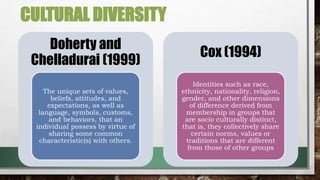
CULTURAL DIVERSITY
Doherty and
Chelladurai (1999)
The unique sets of values,
beliefs, attitudes, and
expectations, as well as
language, symbols, customs,
and behaviors, that an
individual possess by virtue of
sharing some common
characteristic(s) with others.
Cox (1994)
Identities such as race,
ethnicity, nationality, religion,
gender, and other dimensions
of difference derived from
membership in groups that
are socio culturally distinct,
that is, they collectively share
certain norms, values or
traditions that are different
from those of other groups
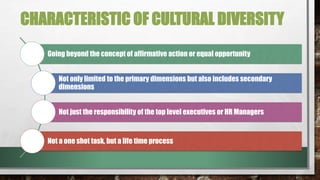
CHARACTERISTIC OF CULTURAL DIVERSITY
Going beyond the concept of affirmative action or equal opportunity
Not only limited to the primary dimensions but also includes secondary
dimensions
Not just the responsibility of the top level executives or HR Managers
Not a one shot task, but a life time process
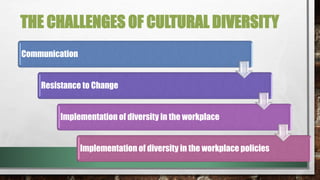
THE CHALLENGES OF CULTURAL DIVERSITY
Communication
Resistance to Change
Implementation of diversity in the workplace
Implementation of diversity in the workplace policies
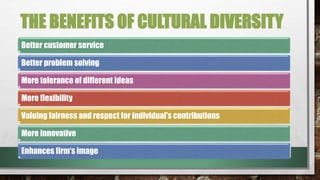
THE BENEFITS OF CULTURAL DIVERSITY
Better customer service
Better problem solving
More tolerance of different ideas
More flexibility
Valuing fairness and respect for individual’s contributions
More innovative
Enhances firm‘s image
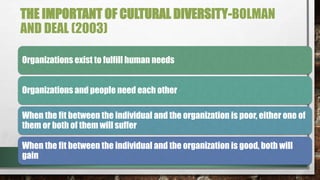
THE IMPORTANT OF CULTURAL DIVERSITY-BOLMAN
AND DEAL (2003)
Organizations exist to fulfill human needs
Organizations and people need each other
When the fit between the individual and the organization is poor, either one of
them or both of them will suffer
When the fit between the individual and the organization is good, both will
gain

CULTURAL DIVERSITIES.pptx

  • 2.
    THE CONCEPT OFDIVERSITY The concept of diversity includes two things: acceptance and respect. It means understanding that each individual is unique, and recognizing those individual differences (Patrick & Kumar, 2012, p. 1) Thus, there is a need to explore these differences in a safe, positive, and nurturing environment.
  • 3.
    FEATURES OF DIVERSITY •Includes both visible and invisible dimensions of human being Multidimensional • Not only includes differences but also similarities among people Inclusion • Giving advantages or causing destructions Pros and Cons
  • 4.
    DIMENSIONS OF DIVERSITY(LODEN) Primary • Class, gender, age, race, ethnicity, income, spiritual beliefs, sexuality and physical abilities and characteristics Secondary • Work experience, communication style, cognitive style, political beliefs, education, geographic location, organization role and level, military experience, work style, first language, and family status.
  • 5.
    DIMENSIONS OF DIVERSITY(GRIGGS, 1995) Primary • Age, ethnicity, gender, physical abilities/qualities, race, and sexual- orientation Secondary • Educational background, geographical location, marital status, parental status, religious beliefs and work-experience etc.
  • 6.
    DEVELOPING SENSITIVITIES TODIVERSITY Personality Shows how a person interacts with others and what his/her characteristics are Internal dimensions Based on six aspects that an individual possibly cannot choose or control him/herself External dimensions Depict the outcomes of life experiences and decisions/choices taken Organizational dimensions Include elements that are integrated into work and social interaction in an organization/at a work place
  • 7.
    CULTURAL DIVERSITY Doherty and Chelladurai(1999) The unique sets of values, beliefs, attitudes, and expectations, as well as language, symbols, customs, and behaviors, that an individual possess by virtue of sharing some common characteristic(s) with others. Cox (1994) Identities such as race, ethnicity, nationality, religion, gender, and other dimensions of difference derived from membership in groups that are socio culturally distinct, that is, they collectively share certain norms, values or traditions that are different from those of other groups
  • 8.
    CHARACTERISTIC OF CULTURALDIVERSITY Going beyond the concept of affirmative action or equal opportunity Not only limited to the primary dimensions but also includes secondary dimensions Not just the responsibility of the top level executives or HR Managers Not a one shot task, but a life time process
  • 9.
    THE CHALLENGES OFCULTURAL DIVERSITY Communication Resistance to Change Implementation of diversity in the workplace Implementation of diversity in the workplace policies
  • 10.
    THE BENEFITS OFCULTURAL DIVERSITY Better customer service Better problem solving More tolerance of different ideas More flexibility Valuing fairness and respect for individual’s contributions More innovative Enhances firm‘s image
  • 11.
    THE IMPORTANT OFCULTURAL DIVERSITY-BOLMAN AND DEAL (2003) Organizations exist to fulfill human needs Organizations and people need each other When the fit between the individual and the organization is poor, either one of them or both of them will suffer When the fit between the individual and the organization is good, both will gain