Cruz: Application-Transparent Distributed Checkpoint-Restart on Standard Operating Systems G. (John) Janakiraman, Jose Renato Santos,  Dinesh Subhraveti § ,  Yoshio Turner HP Labs §:  Currently at Meiosys, Inc.
Broad Opportunity for Checkpoint-Restart in Server Management Fault tolerance (minimize unplanned downtime) Recover by restarting from checkpoint Minimize planned downtime Migrate application before hardware/OS maintenance Resource management Manage resource allocation in shared computing environments by migrating applications
Need for General-Purpose Checkpoint-Restart Existing checkpoint-restart methods are too limited: No support for many OS resources that commercial applications use (e.g., sockets) Limited to applications using specific libraries Require application source and recompilation Require use of specialized operating systems Need a practical checkpoint-restart mechanism that is capable of supporting a broad class of applications
Cruz: Our Solution for General-Purpose Checkpoint-Restart on Linux Application-transparent: supports applications without modifications or recompilation Supports a broad class of applications (e.g., databases, parallel MPI apps, desktop apps) Comprehensive support for user-level state, kernel-level state, and distributed computation and communication state Supported on unmodified Linux base kernel – checkpoint-restart integrated via a kernel module
Cruz Overview Builds on Columbia Univ.’s Zap process migration Our Key Extensions Support for migrating networked applications, transparent to communicating peers Enables role in managing servers running commercial applications (e.g., databases) General method for checkpoint-restart of TCP/IP-based distributed applications Also enables efficiencies compared to library-specific approaches
Outline Zap (Background) Migrating Networked Applications Network Address Migration Communication State Checkpoint and Restore Checkpoint-Restart of Distributed Applications Evaluation Related Work Future Work Summary
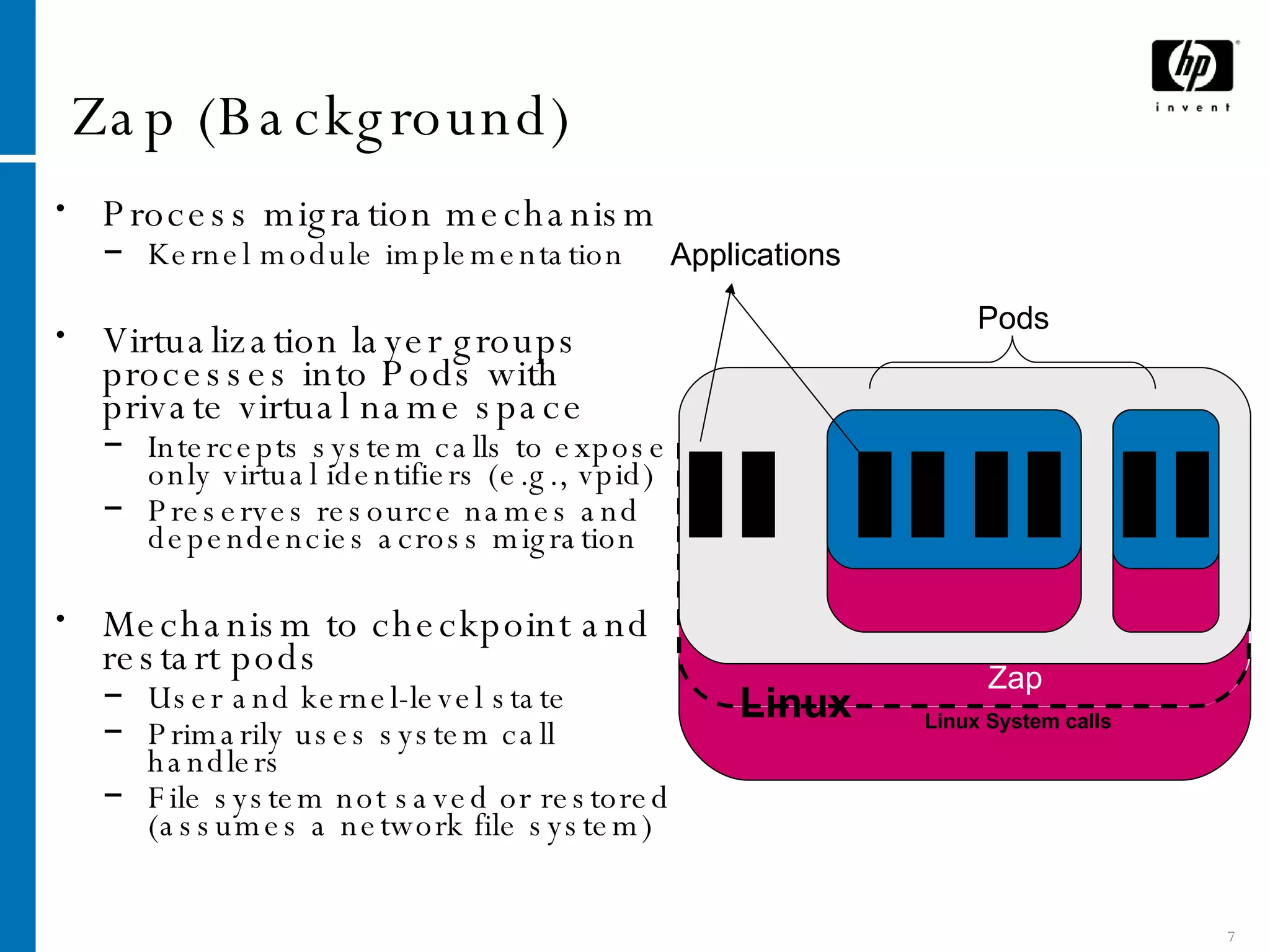
Zap (Background) Process migration mechanism Kernel module implementation Virtualization layer groups processes into Pods with private virtual name space Intercepts system calls to expose only virtual identifiers (e.g., vpid)  Preserves resource names and dependencies across migration Mechanism to checkpoint and restart pods User and kernel-level state Primarily uses system call handlers File system not saved or restored (assumes a network file system) Linux System calls Zap Linux Pods Applications
Outline Zap (Background) Migrating Networked Applications Network Address Migration Communication State Checkpoint and Restore Checkpoint-Restart of Distributed Applications Evaluation Related Work Future Work Summary
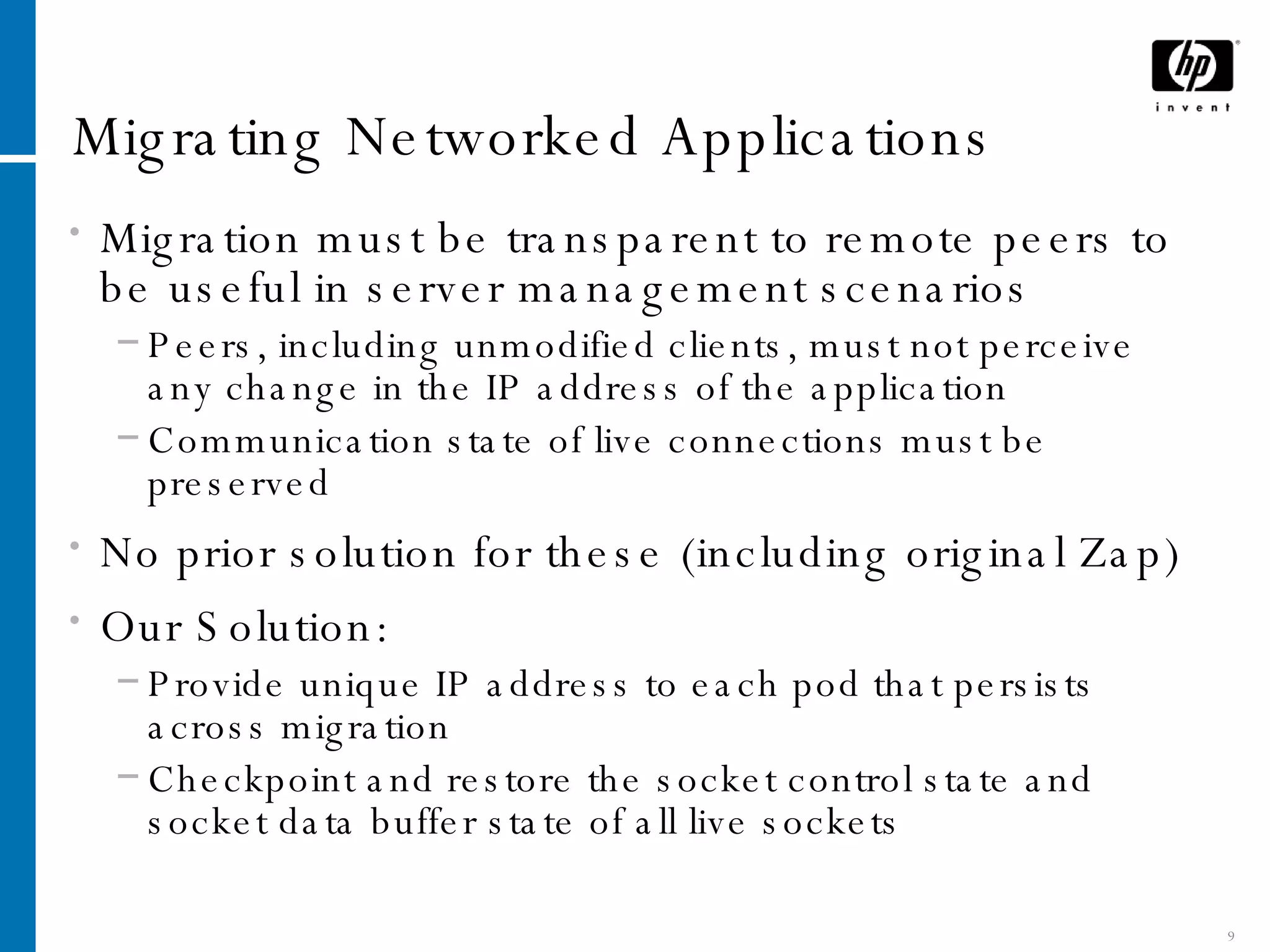
Migrating Networked Applications Migration must be transparent to remote peers to be useful in server management scenarios Peers, including unmodified clients, must not perceive any change in the IP address of the application Communication state of live connections must be preserved No prior solution for these (including original Zap) Our Solution: Provide unique IP address to each pod that persists across migration Checkpoint and restore the socket control state and socket data buffer state of all live sockets
Network Address Migration Pod attached to virtual interface with own IP & MAC addr. Implemented by using Linux’s virtual interfaces (VIFs) IP address assigned statically or through a DHCP client running inside the pod (using pod’s MAC address) Intercept bind() & connect() to ensure pod processes use pod’s IP address Migration: delete VIF on source host & create on new host Migration limited to subnet eth0 [IP-1, MAC-h1] eth0:1 Pod DHCP Server Network DHCP Client 1. ioctl() 2. MAC-p1 3. dhcprequest(MAC-p1) 4. dhcpack(IP-p1)
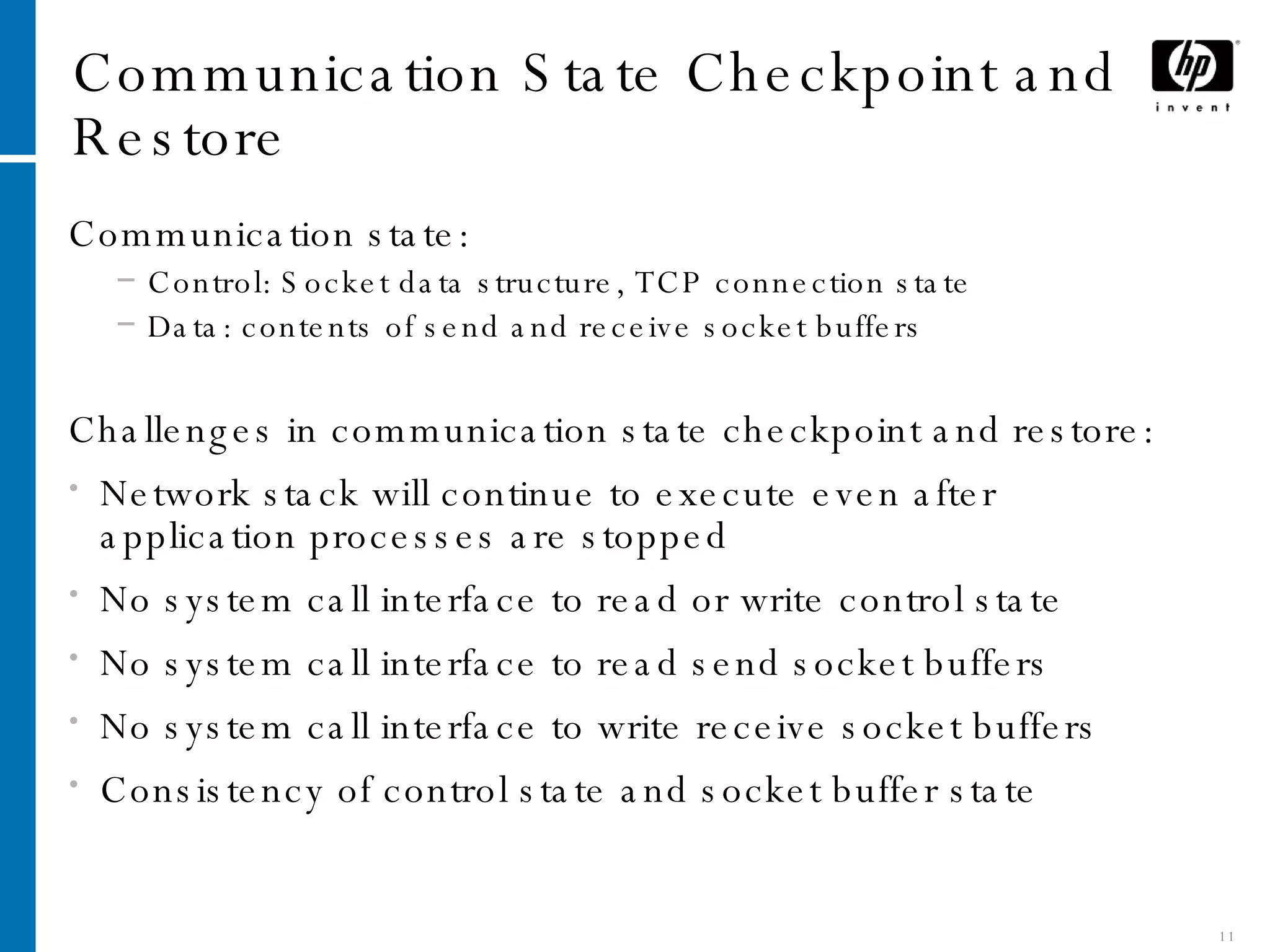
Communication State Checkpoint and Restore Communication state: Control: Socket data structure, TCP connection state Data: contents of send and receive socket buffers Challenges in communication state checkpoint and restore: Network stack will continue to execute even after application processes are stopped No system call interface to read or write control state No system call interface to read send socket buffers No system call interface to write receive socket buffers Consistency of control state and socket buffer state
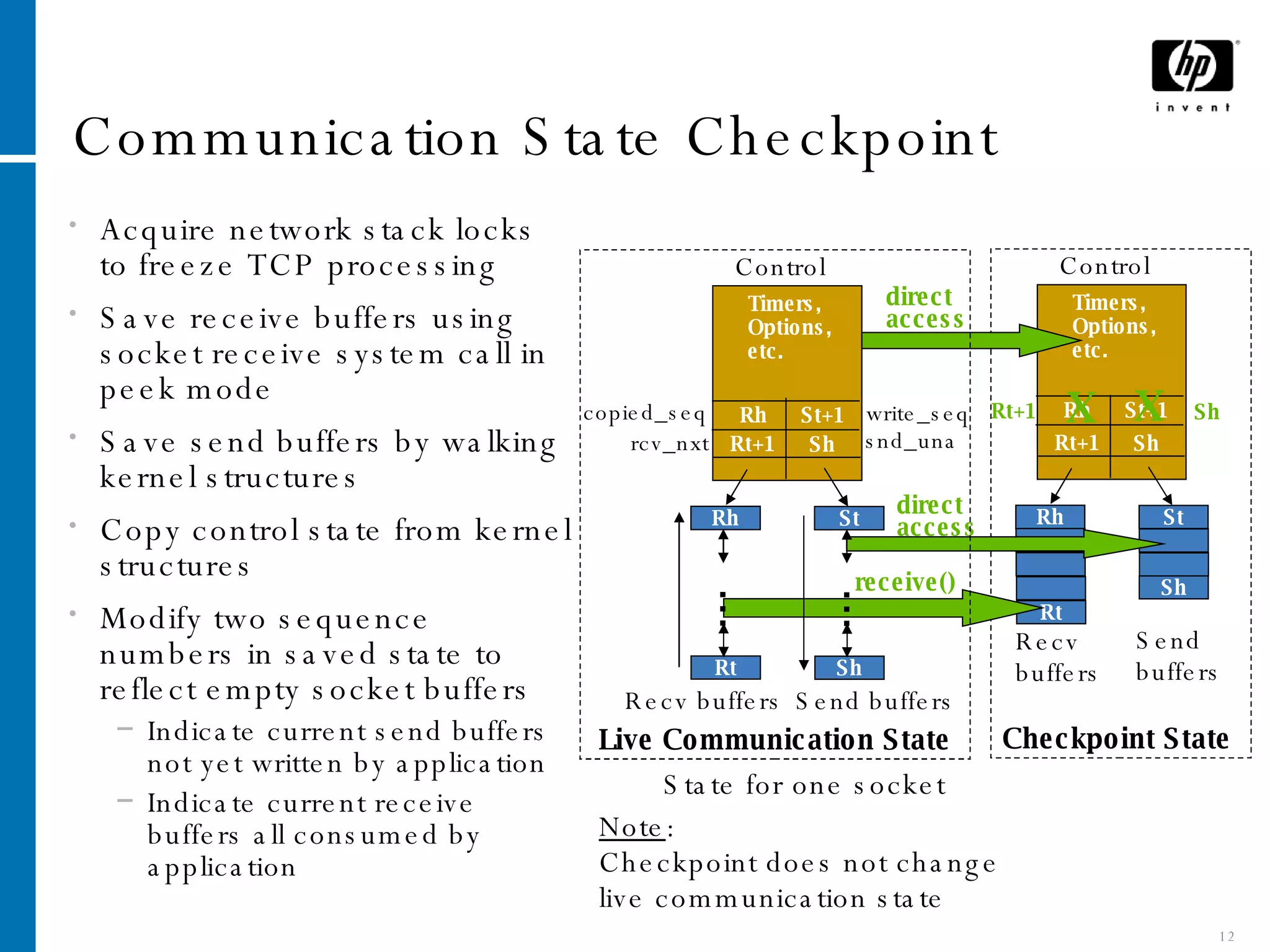
Communication State Checkpoint Acquire network stack locks to freeze TCP processing Save receive buffers using socket receive system call in peek mode Save send buffers by walking kernel structures Copy control state from kernel structures Modify two sequence numbers in saved state to reflect empty socket buffers Indicate current send buffers not yet written by application Indicate current receive buffers all consumed by application Checkpoint State State for one socket Note : Checkpoint does not change live communication state Control Rh Rt Recv buffers St Sh Send buffers Sh Rt+1 Timers, Options, etc. Rh St+1 Sh Rt+1 X X receive() direct access direct access Rh Rt . . . St Sh . . . Rt+1 Rh Sh St+1 Timers, Options, etc. Control Recv buffers Send buffers copied_seq rcv_nxt snd_una write_seq Live Communication State
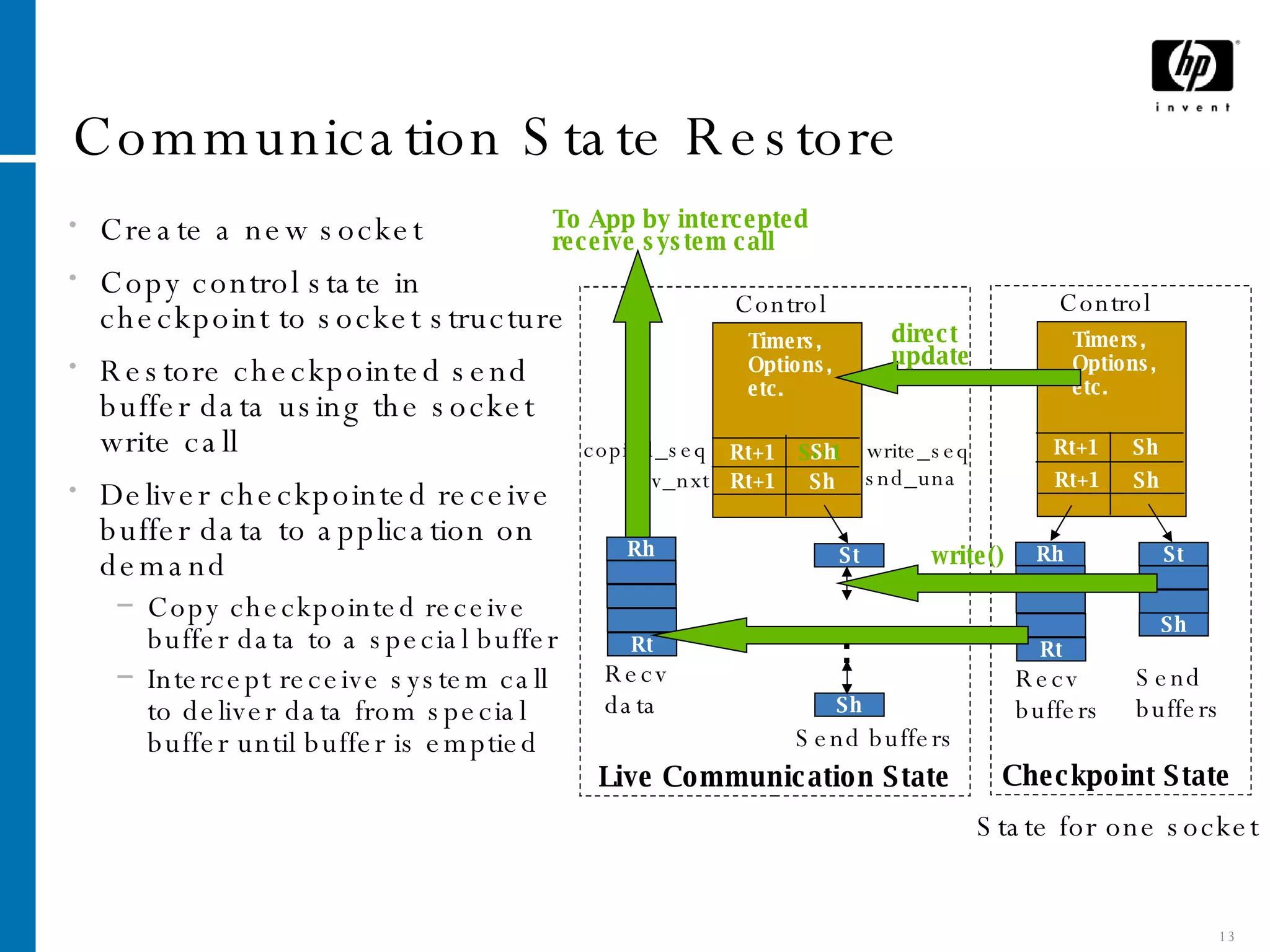
Communication State Restore Create a new socket Copy control state in checkpoint to socket structure  Restore checkpointed send buffer data using the socket write call  Deliver checkpointed receive buffer data to application on demand Copy checkpointed receive buffer data to a special buffer Intercept receive system call to deliver data from special buffer until buffer is emptied Sh State for one socket Control Live Communication State copied_seq rcv_nxt snd_una write_seq St Sh . . . Send buffers Checkpoint State Control Rh Rt Recv buffers St Sh Send buffers Sh Rt+1 Timers, Options, etc. Rt+1 Sh Rt+1 Rt+1 Sh Timers, Options, etc. Rh Rt Recv data direct update St+1 write() To App by intercepted receive system call
Outline Zap (Background) Migrating Networked Applications Network Address Migration Communication State Checkpoint and Restore Checkpoint-Restart of Distributed Applications Evaluation Related Work Future Work Summary
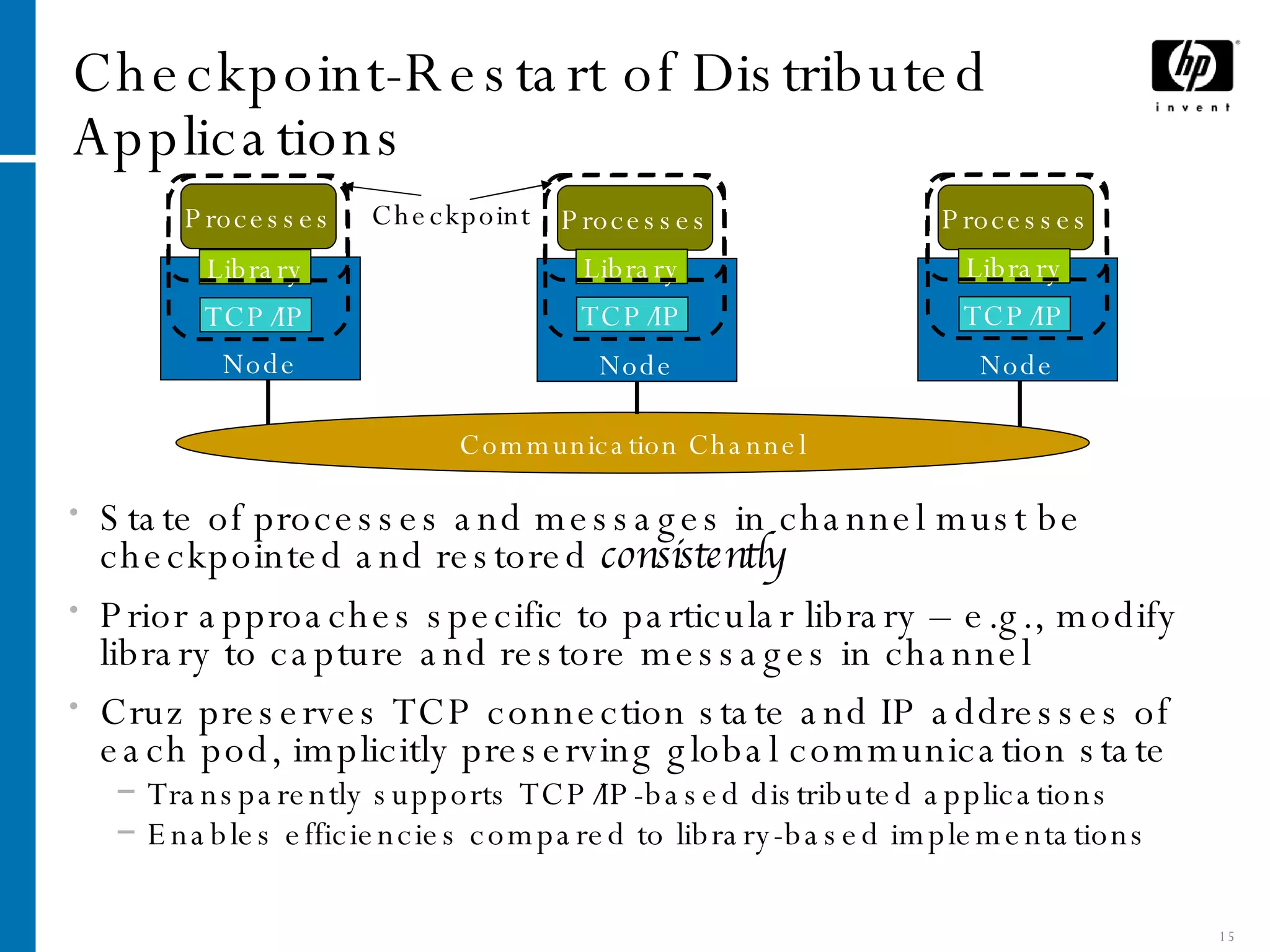
Checkpoint-Restart of Distributed Applications State of processes and messages in channel must be checkpointed and restored  consistently Prior approaches specific to particular library – e.g., modify library to capture and restore messages in channel Cruz preserves TCP connection state and IP addresses of each pod, implicitly preserving global communication state Transparently supports TCP/IP-based distributed applications  Enables efficiencies compared to library-based implementations Communication Channel Library Library Library Checkpoint Node Processes Node Processes Node Processes TCP/IP TCP/IP TCP/IP
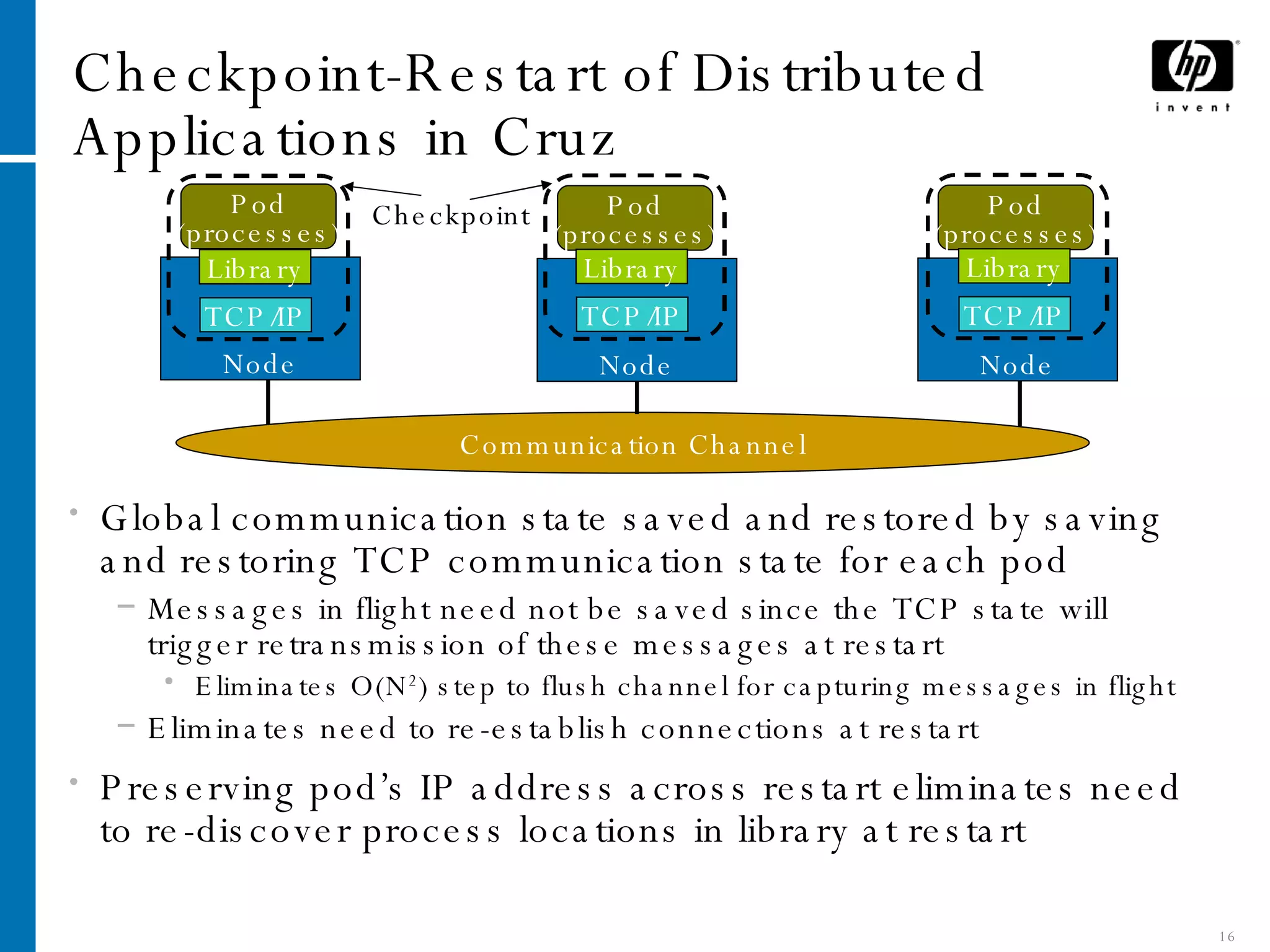
Checkpoint-Restart of Distributed Applications in Cruz Global communication state saved and restored by saving and restoring TCP communication state for each pod  Messages in flight need not be saved since the TCP state will trigger retransmission of these messages at restart Eliminates O(N 2 ) step to flush channel for capturing messages in flight Eliminates need to re-establish connections at restart Preserving pod’s IP address across restart eliminates need to re-discover process locations in library at restart Communication Channel Library Library Library Checkpoint Node Pod (processes) Node Pod (processes) Node Pod (processes) TCP/IP TCP/IP TCP/IP
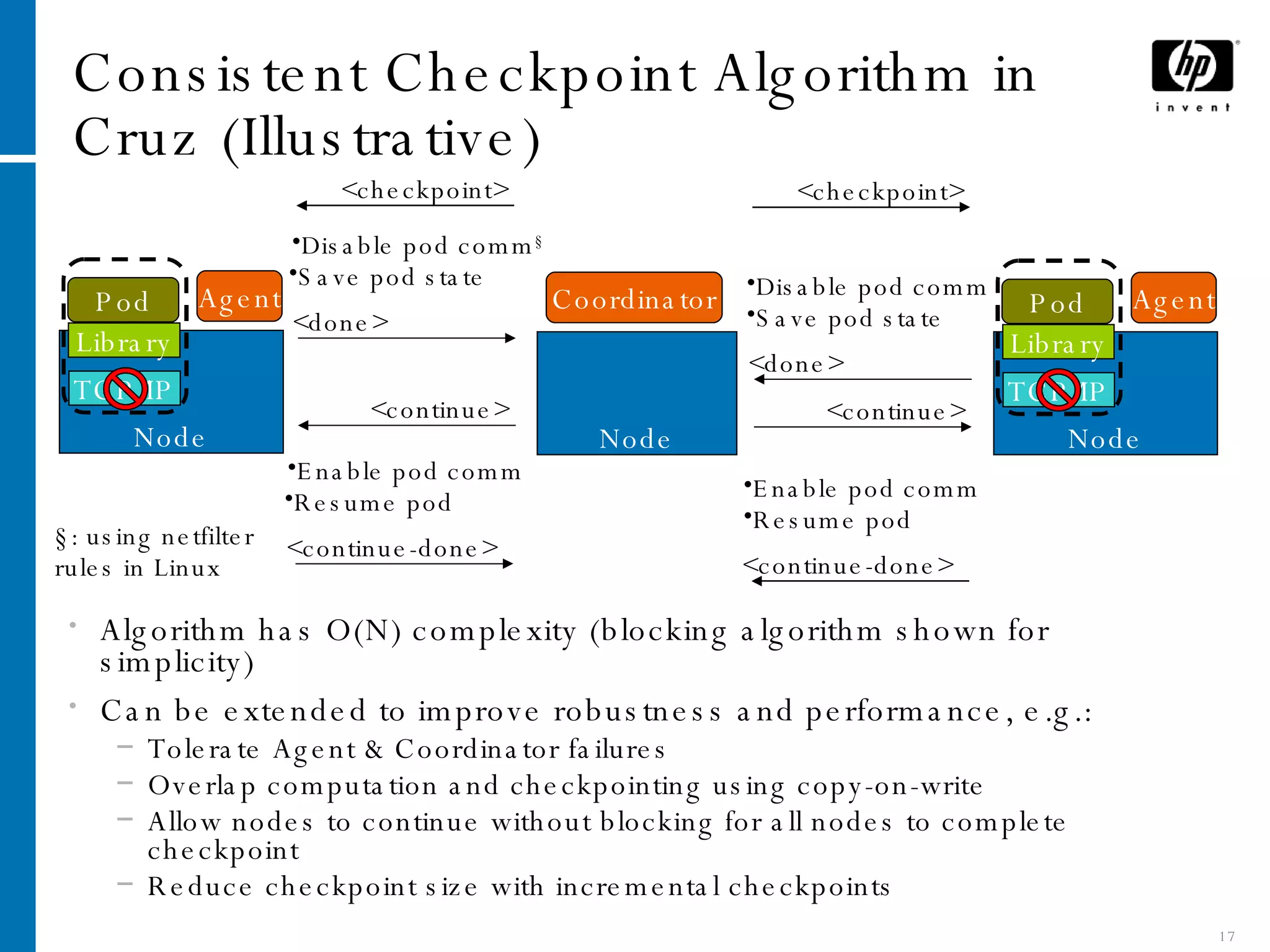
Consistent Checkpoint Algorithm in Cruz (Illustrative) Algorithm has O(N) complexity (blocking algorithm shown for simplicity) Can be extended to improve robustness and performance, e.g.: Tolerate Agent & Coordinator failures Overlap computation and checkpointing using copy-on-write Allow nodes to continue without blocking for all nodes to complete checkpoint Reduce checkpoint size with incremental checkpoints <checkpoint> Node Pod TCP/IP Library Agent Node Coordinator Node Pod TCP/IP Library Agent Disable pod comm § <done> <continue> Enable pod comm <continue-done> <checkpoint> Disable pod comm Save pod state <done> <continue> Enable pod comm Resume pod <continue-done> Save pod state Resume pod §: using netfilter rules in Linux
Outline Zap (Background) Migrating Networked Applications Network Address Migration Communication State Checkpoint and Restore Checkpoint-Restart of Distributed Applications Evaluation Related Work Future Work Summary
Evaluation Cruz implemented for Linux 2.4.x on x86 Functionality verified on several applications, e.g., MySQL, K Desktop Environment, and a multi-node MPI benchmark Cruz incurs negligible runtime overhead (less than 0.5%) Initial study shows performance overhead of coordinating checkpoints is negligible, suggesting the scheme is scalable
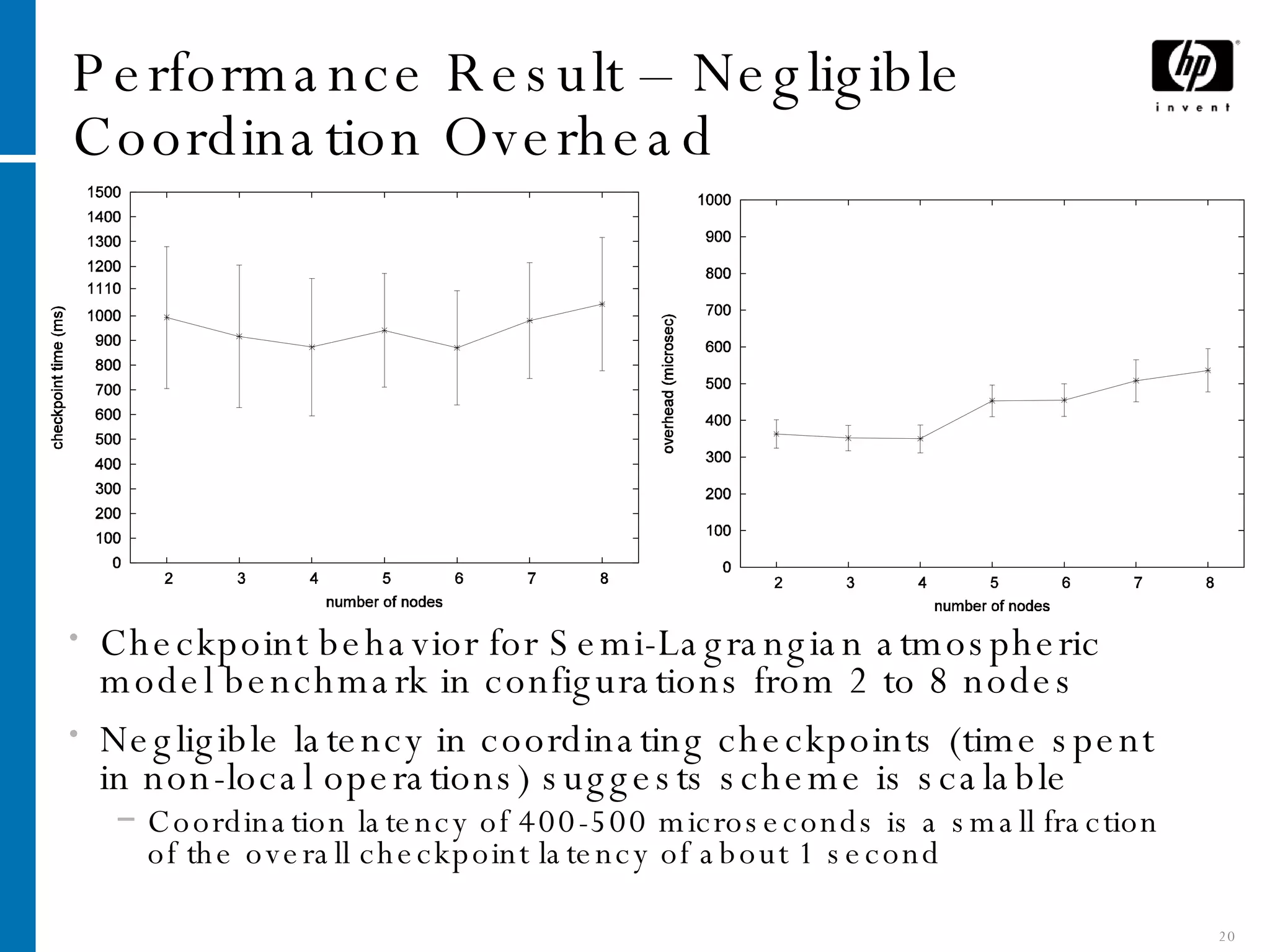
Performance Result – Negligible Coordination Overhead Checkpoint behavior for Semi-Lagrangian atmospheric model benchmark in configurations from 2 to 8 nodes Negligible latency in coordinating checkpoints (time spent in non-local operations) suggests scheme is scalable Coordination latency of 400-500 microseconds is a small fraction of the overall checkpoint latency of about 1 second
Related Work MetaCluster product from Meiosys Capabilities similar to Cruz (e.g., checkpoint and restart of unmodified distributed applications) Berkeley Labs Checkpoint Restart (BLCR) Kernel-module based checkpoint-restart for single node No identifier virtualization – restart will fail in the event of an identifier (e.g., pid) conflict No support for handling communication state – relies on application or library changes MPVM, CoCheck, LAM-MPI Library-specific implementations of parallel application checkpoint-restart with disadvantages described earlier
Future Work Many areas for future work, e.g., Improve portability across kernel versions by minimizing direct access to kernel structures Recommend additional kernel interfaces when advantageous (e.g., accessing socket attributes) Implement performance optimizations to the coordinated checkpoint-restart algorithm Evaluate performance on a wide range of applications and cluster configurations Support systems with newer interconnects and newer communication abstractions (e.g., InfiniBand, RDMA)
Summary Cruz, a practical checkpoint-restart system for Linux No change to applications or to base OS kernel needed Novel mechanisms to support checkpoint-restart of a broader class of applications Migrating networked applications transparent to communicating peers Consistent checkpoint-restart of general TCP/IP-based distributed applications Cruz’s broad capabilities will drive its use in solutions for fault tolerance, online OS maintenance, and resource management
http://www.hpl.hp.com/research/dca
Zap Virtualization Groups processes into a POD (Process Domain) that has a private virtual   namespace Uses system call interception to expose only virtual identifiers (e.g., virtual pids, virtual IPC identifiers) Virtual identifiers eliminate conflicts with identifiers already in use within the OS on the restarting node All dependent processes (e.g., forked child processes) are assigned to same pod Checkpoint and restart operate on an entire pod, which preserves resource dependencies across checkpoint and restart
Zap Checkpoint and Restart Checkpoint: Stops all processes in pod with SIGSTOP Parent-child relationships saved from /proc State of each process is captured by accessing system call handlers and kernel data structures Restart: Original forest of processes recreated in a new pod by forking recursively Each process restores most of its resources using system calls  (e.g., open files) Kernel module restores sharing relationships (e.g., shared file descriptors) and other key resources (e.g., socket state)
Outline Zap (Background) Migrating Networked Applications Network Address Migration Communication State Checkpoint and Restore Checkpoint-Restart of Distributed Applications Evaluation Related Work Future Work Summary
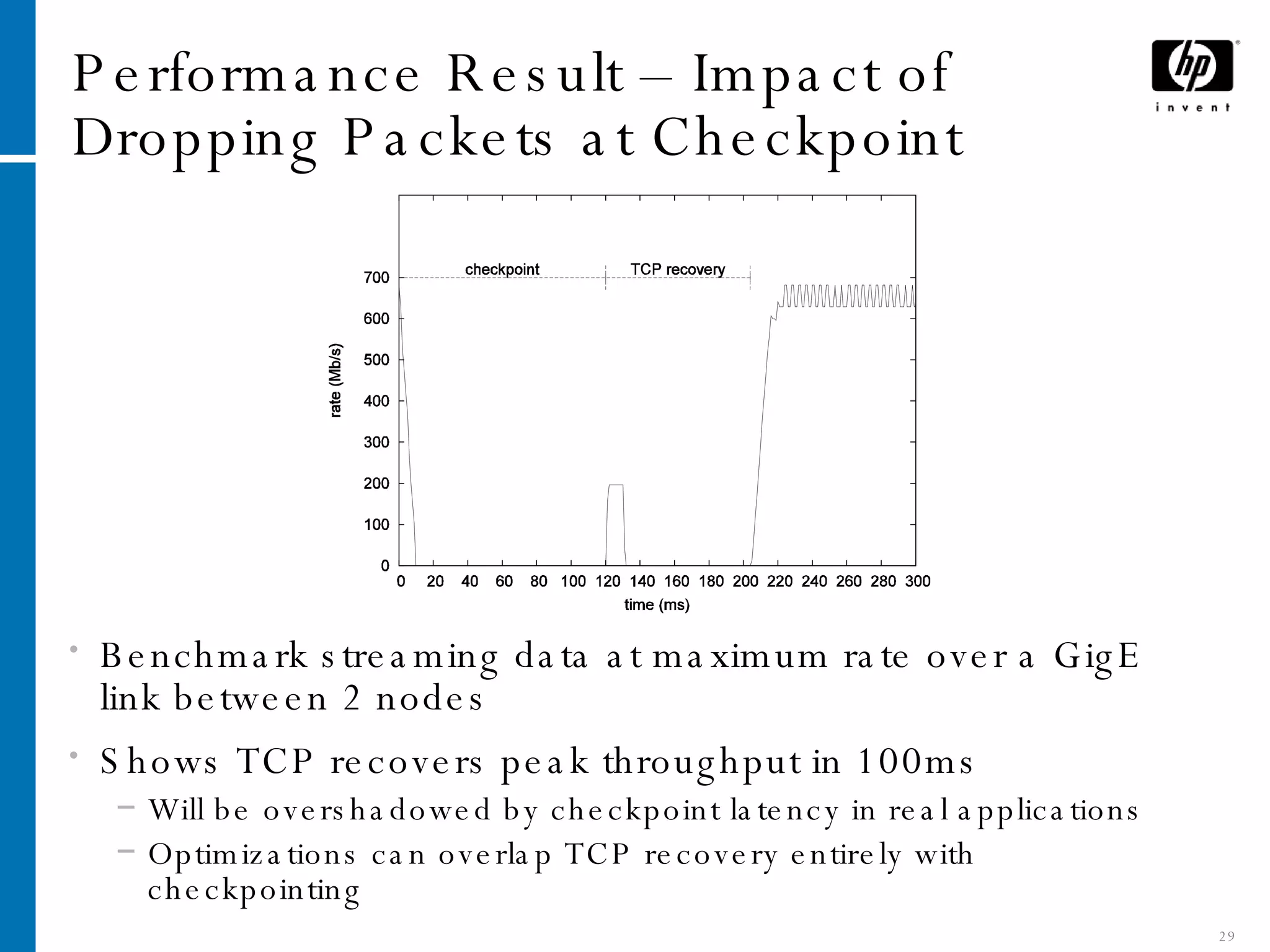
Performance Result – Impact of Dropping Packets at Checkpoint Benchmark streaming data at maximum rate over a GigE link between 2 nodes Shows TCP recovers peak throughput in 100ms Will be overshadowed by checkpoint latency in real applications Optimizations can overlap TCP recovery entirely with checkpointing

Cruz: Application-Transparent Distributed Checkpoint-Restart on Standard Operating Systems

  • 1.
    Cruz: Application-Transparent DistributedCheckpoint-Restart on Standard Operating Systems G. (John) Janakiraman, Jose Renato Santos, Dinesh Subhraveti § , Yoshio Turner HP Labs §: Currently at Meiosys, Inc.
  • 2.
    Broad Opportunity forCheckpoint-Restart in Server Management Fault tolerance (minimize unplanned downtime) Recover by restarting from checkpoint Minimize planned downtime Migrate application before hardware/OS maintenance Resource management Manage resource allocation in shared computing environments by migrating applications
  • 3.
    Need for General-PurposeCheckpoint-Restart Existing checkpoint-restart methods are too limited: No support for many OS resources that commercial applications use (e.g., sockets) Limited to applications using specific libraries Require application source and recompilation Require use of specialized operating systems Need a practical checkpoint-restart mechanism that is capable of supporting a broad class of applications
  • 4.
    Cruz: Our Solutionfor General-Purpose Checkpoint-Restart on Linux Application-transparent: supports applications without modifications or recompilation Supports a broad class of applications (e.g., databases, parallel MPI apps, desktop apps) Comprehensive support for user-level state, kernel-level state, and distributed computation and communication state Supported on unmodified Linux base kernel – checkpoint-restart integrated via a kernel module
  • 5.
    Cruz Overview Buildson Columbia Univ.’s Zap process migration Our Key Extensions Support for migrating networked applications, transparent to communicating peers Enables role in managing servers running commercial applications (e.g., databases) General method for checkpoint-restart of TCP/IP-based distributed applications Also enables efficiencies compared to library-specific approaches
  • 6.
    Outline Zap (Background)Migrating Networked Applications Network Address Migration Communication State Checkpoint and Restore Checkpoint-Restart of Distributed Applications Evaluation Related Work Future Work Summary
  • 7.
    Zap (Background) Processmigration mechanism Kernel module implementation Virtualization layer groups processes into Pods with private virtual name space Intercepts system calls to expose only virtual identifiers (e.g., vpid) Preserves resource names and dependencies across migration Mechanism to checkpoint and restart pods User and kernel-level state Primarily uses system call handlers File system not saved or restored (assumes a network file system) Linux System calls Zap Linux Pods Applications
  • 8.
    Outline Zap (Background)Migrating Networked Applications Network Address Migration Communication State Checkpoint and Restore Checkpoint-Restart of Distributed Applications Evaluation Related Work Future Work Summary
  • 9.
    Migrating Networked ApplicationsMigration must be transparent to remote peers to be useful in server management scenarios Peers, including unmodified clients, must not perceive any change in the IP address of the application Communication state of live connections must be preserved No prior solution for these (including original Zap) Our Solution: Provide unique IP address to each pod that persists across migration Checkpoint and restore the socket control state and socket data buffer state of all live sockets
  • 10.
    Network Address MigrationPod attached to virtual interface with own IP & MAC addr. Implemented by using Linux’s virtual interfaces (VIFs) IP address assigned statically or through a DHCP client running inside the pod (using pod’s MAC address) Intercept bind() & connect() to ensure pod processes use pod’s IP address Migration: delete VIF on source host & create on new host Migration limited to subnet eth0 [IP-1, MAC-h1] eth0:1 Pod DHCP Server Network DHCP Client 1. ioctl() 2. MAC-p1 3. dhcprequest(MAC-p1) 4. dhcpack(IP-p1)
  • 11.
    Communication State Checkpointand Restore Communication state: Control: Socket data structure, TCP connection state Data: contents of send and receive socket buffers Challenges in communication state checkpoint and restore: Network stack will continue to execute even after application processes are stopped No system call interface to read or write control state No system call interface to read send socket buffers No system call interface to write receive socket buffers Consistency of control state and socket buffer state
  • 12.
    Communication State CheckpointAcquire network stack locks to freeze TCP processing Save receive buffers using socket receive system call in peek mode Save send buffers by walking kernel structures Copy control state from kernel structures Modify two sequence numbers in saved state to reflect empty socket buffers Indicate current send buffers not yet written by application Indicate current receive buffers all consumed by application Checkpoint State State for one socket Note : Checkpoint does not change live communication state Control Rh Rt Recv buffers St Sh Send buffers Sh Rt+1 Timers, Options, etc. Rh St+1 Sh Rt+1 X X receive() direct access direct access Rh Rt . . . St Sh . . . Rt+1 Rh Sh St+1 Timers, Options, etc. Control Recv buffers Send buffers copied_seq rcv_nxt snd_una write_seq Live Communication State
  • 13.
    Communication State RestoreCreate a new socket Copy control state in checkpoint to socket structure Restore checkpointed send buffer data using the socket write call Deliver checkpointed receive buffer data to application on demand Copy checkpointed receive buffer data to a special buffer Intercept receive system call to deliver data from special buffer until buffer is emptied Sh State for one socket Control Live Communication State copied_seq rcv_nxt snd_una write_seq St Sh . . . Send buffers Checkpoint State Control Rh Rt Recv buffers St Sh Send buffers Sh Rt+1 Timers, Options, etc. Rt+1 Sh Rt+1 Rt+1 Sh Timers, Options, etc. Rh Rt Recv data direct update St+1 write() To App by intercepted receive system call
  • 14.
    Outline Zap (Background)Migrating Networked Applications Network Address Migration Communication State Checkpoint and Restore Checkpoint-Restart of Distributed Applications Evaluation Related Work Future Work Summary
  • 15.
    Checkpoint-Restart of DistributedApplications State of processes and messages in channel must be checkpointed and restored consistently Prior approaches specific to particular library – e.g., modify library to capture and restore messages in channel Cruz preserves TCP connection state and IP addresses of each pod, implicitly preserving global communication state Transparently supports TCP/IP-based distributed applications Enables efficiencies compared to library-based implementations Communication Channel Library Library Library Checkpoint Node Processes Node Processes Node Processes TCP/IP TCP/IP TCP/IP
  • 16.
    Checkpoint-Restart of DistributedApplications in Cruz Global communication state saved and restored by saving and restoring TCP communication state for each pod Messages in flight need not be saved since the TCP state will trigger retransmission of these messages at restart Eliminates O(N 2 ) step to flush channel for capturing messages in flight Eliminates need to re-establish connections at restart Preserving pod’s IP address across restart eliminates need to re-discover process locations in library at restart Communication Channel Library Library Library Checkpoint Node Pod (processes) Node Pod (processes) Node Pod (processes) TCP/IP TCP/IP TCP/IP
  • 17.
    Consistent Checkpoint Algorithmin Cruz (Illustrative) Algorithm has O(N) complexity (blocking algorithm shown for simplicity) Can be extended to improve robustness and performance, e.g.: Tolerate Agent & Coordinator failures Overlap computation and checkpointing using copy-on-write Allow nodes to continue without blocking for all nodes to complete checkpoint Reduce checkpoint size with incremental checkpoints <checkpoint> Node Pod TCP/IP Library Agent Node Coordinator Node Pod TCP/IP Library Agent Disable pod comm § <done> <continue> Enable pod comm <continue-done> <checkpoint> Disable pod comm Save pod state <done> <continue> Enable pod comm Resume pod <continue-done> Save pod state Resume pod §: using netfilter rules in Linux
  • 18.
    Outline Zap (Background)Migrating Networked Applications Network Address Migration Communication State Checkpoint and Restore Checkpoint-Restart of Distributed Applications Evaluation Related Work Future Work Summary
  • 19.
    Evaluation Cruz implementedfor Linux 2.4.x on x86 Functionality verified on several applications, e.g., MySQL, K Desktop Environment, and a multi-node MPI benchmark Cruz incurs negligible runtime overhead (less than 0.5%) Initial study shows performance overhead of coordinating checkpoints is negligible, suggesting the scheme is scalable
  • 20.
    Performance Result –Negligible Coordination Overhead Checkpoint behavior for Semi-Lagrangian atmospheric model benchmark in configurations from 2 to 8 nodes Negligible latency in coordinating checkpoints (time spent in non-local operations) suggests scheme is scalable Coordination latency of 400-500 microseconds is a small fraction of the overall checkpoint latency of about 1 second
  • 21.
    Related Work MetaClusterproduct from Meiosys Capabilities similar to Cruz (e.g., checkpoint and restart of unmodified distributed applications) Berkeley Labs Checkpoint Restart (BLCR) Kernel-module based checkpoint-restart for single node No identifier virtualization – restart will fail in the event of an identifier (e.g., pid) conflict No support for handling communication state – relies on application or library changes MPVM, CoCheck, LAM-MPI Library-specific implementations of parallel application checkpoint-restart with disadvantages described earlier
  • 22.
    Future Work Manyareas for future work, e.g., Improve portability across kernel versions by minimizing direct access to kernel structures Recommend additional kernel interfaces when advantageous (e.g., accessing socket attributes) Implement performance optimizations to the coordinated checkpoint-restart algorithm Evaluate performance on a wide range of applications and cluster configurations Support systems with newer interconnects and newer communication abstractions (e.g., InfiniBand, RDMA)
  • 23.
    Summary Cruz, apractical checkpoint-restart system for Linux No change to applications or to base OS kernel needed Novel mechanisms to support checkpoint-restart of a broader class of applications Migrating networked applications transparent to communicating peers Consistent checkpoint-restart of general TCP/IP-based distributed applications Cruz’s broad capabilities will drive its use in solutions for fault tolerance, online OS maintenance, and resource management
  • 24.
  • 25.
    Zap Virtualization Groupsprocesses into a POD (Process Domain) that has a private virtual namespace Uses system call interception to expose only virtual identifiers (e.g., virtual pids, virtual IPC identifiers) Virtual identifiers eliminate conflicts with identifiers already in use within the OS on the restarting node All dependent processes (e.g., forked child processes) are assigned to same pod Checkpoint and restart operate on an entire pod, which preserves resource dependencies across checkpoint and restart
  • 26.
    Zap Checkpoint andRestart Checkpoint: Stops all processes in pod with SIGSTOP Parent-child relationships saved from /proc State of each process is captured by accessing system call handlers and kernel data structures Restart: Original forest of processes recreated in a new pod by forking recursively Each process restores most of its resources using system calls (e.g., open files) Kernel module restores sharing relationships (e.g., shared file descriptors) and other key resources (e.g., socket state)
  • 27.
    Outline Zap (Background)Migrating Networked Applications Network Address Migration Communication State Checkpoint and Restore Checkpoint-Restart of Distributed Applications Evaluation Related Work Future Work Summary
  • 28.
    Outline Zap (Background)Migrating Networked Applications Network Address Migration Communication State Checkpoint and Restore Checkpoint-Restart of Distributed Applications Evaluation Related Work Future Work Summary
  • 29.
    Performance Result –Impact of Dropping Packets at Checkpoint Benchmark streaming data at maximum rate over a GigE link between 2 nodes Shows TCP recovers peak throughput in 100ms Will be overshadowed by checkpoint latency in real applications Optimizations can overlap TCP recovery entirely with checkpointing