DISTILLATION
NAME : SHUBHAM SAKHARELIYA
ENROLLMENT NO : 180470105047
BRANCH : CHEMICAL ENGINEERING
SUBJECT : MASS TRANSFER OPERATION
V.V.P. ENGINEERING COLLEGE
CONTENTS ► Introduction
► Roult’s law
► Dalton’s law
► Relative volatility
► Methods of distillation
► Types of distillation
► Simple or Differential distillation
► Flash or Equilibrium distillation
► Rectification or Fractionations
► Reflux ratio
► Application of distillation
2
“
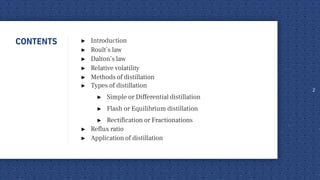
Distillation is a unit operation in which
the constituents of a liquid mixture
(solution) are separated using thermal
energy. Basically, the difference in
vapour pressures (volatilities) of different
constituents at the same temperature is
responsible for such a separation.
3
INTRODUCTION  In distillation, the phases involved are : liquid and vapour (the
vapour phase is created by supplying heat to the liquid) and
mass is transferred from both the phases to one another, by
vaporisation from the liquid phase and by condensation from
the vapour phase.
 The net effect is an increase in composition of the more volatile
component in the vapour (phase) and that of the less volatile
component in the liquid. The basic requirement for a separation
of components by distillation is that the composition of the
vapour be different from the composition of the liquid with
which it is in equilibrium - the vapour is always richer in the
more volatile component than the liquid from which it is formed.
If the vapour composition is the same as the liquid composition,
distillation technique will not effect a separation.
4
ROULT’S LAW  It is commonly used for predicting the vapour-liquid
equilibrium for an ideal solution in equilibrium with
an ideal gas mixture from the pure component
vapour pressure data. It states that the equilibrium
partial pressure of a constituent/component in a
solution at a given temperature is equal to the
product of its vapour pressure in the pure state and
its mole fraction in the liquid phase.
 Thus, for a binary (two component) system, if pA is
the equilibrium partial pressure of A, pA° is the
vapour pressure of 'A' in the pure state and xA is the
mole fraction of 'A' in the liquid phase, then…
5
DALTONS’S
LAW
 It states that the total pressure exerted by a gas/vapour mixture is equal to
the sum of the partial pressures of the components present in it. Thus, it
expresses the additive nature of the partial pressures.
 Mathematically, for a binary system :
where P is the total pressure.
 For an ideal gas or vapour, the partial pressure is related to mole fraction of
the component in gas or vapour phase by the relation :
Partial pressure = Mole fraction × Total pressure
 Thus, for component ‘A’
where yA is the mole fraction of 'A' in the vapour phase.
 Knowing the vapour pressures of components 'A' (more volatile
component) and 'B' at various values of temperatures, x - y data can be
generated for an ideal solution as follows :
6
RELATIVE VOLATILITY :
7
METHODS OF
DISTILLATION
Basically, distillation is carried out in two ways :
 The liquid mixture to be separated is heated to create a vapour. The
vapour formed is condensed in a condenser and withdrawn as
product. As there is no reflux, products of relatively low purities are
obtained.
 The liquid mixture to be separated is heated to create a vapour, the
vapour formed is condensed in a condenser. A part of the condensed
liquid is returned to the distillation still (as reflux) and the remaining
part is withdrawn as product. In this method, the liquid and vapour
are brought into intimate contact for a number of times and almost
pure product can be achieved. The part of the condensed liquid
returned to the distillation unit is called reflux and the operation is
called rectification or fractionation. The term rectification originated
in the alcohol industry, whereas the term fractionation is popular in
the petroleum industry.
8
TYPES OF DISTILLATON
SIMPLE
OR
DIFFERENTIAL
DISTILLATION
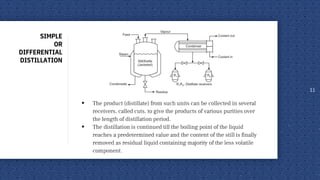
 In this distillation technique, a known quantity of a liquid mixture is
charged into a jacketed kettle or still.
 The jacket is provided for heating the liquid mass in the still with the
help of a heating medium such as steam.
 The charge is boiled slowly, the vapours formed is withdrawn and fed
to a condenser where it is liquefied and collected in a receiver as a
distillate.
 In the early stage of distillation, the vapour, so the distillate, leaving
the still is rich in the more volatile component and as the distillation
proceeds the liquid in the still becomes lean with respect to the more
volatile component.
 The composition of the less volatile component thereby increases
and hence the boiling point increases.
10
SIMPLE
OR
DIFFERENTIAL
DISTILLATION
 The product (distillate) from such units can be collected in several
receivers, called cuts, to give the products of various purities over
the length of distillation period.
 The distillation is continued till the boiling point of the liquid
reaches a predetermined value and the content of the still is finally
removed as residual liquid containing majority of the less volatile
component.
11
FLASH OR
EQUILIBRIUM
DISTILLATION
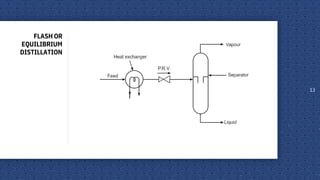
 Flash distillation is normally carried out in a continuous manner.
 In this method, a liquid mixture is partially vaporized, the vapour and
liquid are allowed to attain equilibrium by providing a sufficient
contact time and finally withdrawn separately.
 Feed is heated in a tubular heat exchanger.
 The hot liquid mixture is then fed to a separator via a pressure
reducing valve whereby pressure is reduced and the vapour is
formed at the expense of liquid adiabatically.
 The liquid is withdrawn from the bottom of the separator and the
equilibrium vapour leaves the separator from the top which is then
liquefied in a condenser.
 Flash distillation is commonly used in petroleum industry, handling
multicomponent systems in the pipe stills.
12
FLASH OR
EQUILIBRIUM
DISTILLATION
13
RECTIFICATION
OR
FRACTIONATIONS
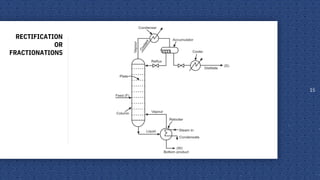
 A fractionating column or fractionator consists of (i) a cylindrical
shell divided into sections by a series of perforated trays, (ii) a
reboiler and (iii) a condenser.
 The liquid mixture to be separated is introduced in the cylindrical
column more or less centrally.
 The column itself is divided into two sections - rectifying and
stripping section.
 The section above the feed plate or tray is called the rectifying
section, wherein the vapour is washed to remove the less volatile
component with the liquid returned to the column from top (known
as reflux). The portion below the feed plate including the feed plate
is called the stripping section wherein the liquid is stripped off more
volatile component by rising vapour.
 Perforated trays are nothing but gas-liquid contacting devices on
which gas/vapour and liquid are brought into intimate contact for
mass transfer to occur.
14
RECTIFICATION
OR
FRACTIONATIONS
15
RECTIFICATION
OR
FRACTIONATIONS
 Vapours are generated in a reboiler (generally steam heated) and are
fed to the bottom of the column.
 The liquid removed from the fractionator rich in the less volatile
component is called the bottoms or bottom product.
 The vapour issuing from the top of the column is fed to a condenser
where the latent heat is removed with the help of a circulated coolant
through the condenser. A part of the condensed liquid is returned to
the column (reflux) and the remaining part is withdrawn as the top
product or distillate which is rich in the more volatile component.
 As we move up the column, the vapour becomes richer and richer in
the more volatile component and as we move down the column, the
liquid becomes richer and richer in the less volatile component.
 As the liquid is at its bubble point and the vapour is at its dew point,
temperature is maximum at the bottom and minimum at the top. The
part of the condensed liquid returning to the top of the column is
called as reflux.
16
REFLUX
RATIO
Infinite Reflux Ratio or Total Reflux Ratio, R∞ :
 It is one of the limiting values of the reflux ratio.
 The total reflux operation is necessary only to know
the minimum number of plates required and is not a
practical method of operation, as at total reflux, the
product withdrawal rate is zero.
 The total reflux operation corresponds to a maximum
reboiler heat supply and condenser cooling capacity
for the separation.
17
REFLUX
RATIO
Minimum Reflux Ratio, Rm :
 At total reflux, operating lines coincide with the
diagonal and to effect a desired separation, number of
stages required are minimum.
 The minimum reflux ratio is that reflux ratio at which
an infinite number of plates are required for a desired
separation.
 At the minimum reflux ratio, required heat supply for
reboiler and coolant supply for condenser are
minimum (thus, the minimum reboiler and condenser
sizes are required).
18
REFLUX
RATIO
Optimum Reflux Ratio :
 The optimum reflux ratio is defined as that reflux ratio
at which the total cost of operation (the sum of the
fixed charges and the cost of heating and cooling) is
minimum.
 Any reflux ratio between infinite reflux ratio requiring
a minimum number of plates and minimum reflux
ratio requiring an infinite number of plates is a
workable system which requires finite stages for a
desired degree of separation.
 The optimum reflux ratio usually lies in the range of
1.1 to 1.5 times the minimum reflux ratio.
19
APPLICATION
OF
DISTILLATION
 Separation of volatile oils – Cloves (Eugenol
comprises 71-90%, Vanillin, Acetyl eugenol)
 Separation of drugs obtained from plant and animal
sources – Vitamin A from fish liver oil
 Purification of organic solvents – Absolute alcohol
(100%)
 Purification of drugs obtained from chemical process.
 Manufacturing of official preparations – Sprit of
nitrous ether, sprit of ammonia.
 Quality control methods – Alcohol content in elixir.
 Refining of petroleum products – Petroleum ether
 Recovery of solvents – synthesis.
20
21

Distillation

  • 1.
    DISTILLATION NAME : SHUBHAMSAKHARELIYA ENROLLMENT NO : 180470105047 BRANCH : CHEMICAL ENGINEERING SUBJECT : MASS TRANSFER OPERATION V.V.P. ENGINEERING COLLEGE
  • 2.
    CONTENTS ► Introduction ►Roult’s law ► Dalton’s law ► Relative volatility ► Methods of distillation ► Types of distillation ► Simple or Differential distillation ► Flash or Equilibrium distillation ► Rectification or Fractionations ► Reflux ratio ► Application of distillation 2
  • 3.
    “ Distillation is aunit operation in which the constituents of a liquid mixture (solution) are separated using thermal energy. Basically, the difference in vapour pressures (volatilities) of different constituents at the same temperature is responsible for such a separation. 3
  • 4.
    INTRODUCTION  Indistillation, the phases involved are : liquid and vapour (the vapour phase is created by supplying heat to the liquid) and mass is transferred from both the phases to one another, by vaporisation from the liquid phase and by condensation from the vapour phase.  The net effect is an increase in composition of the more volatile component in the vapour (phase) and that of the less volatile component in the liquid. The basic requirement for a separation of components by distillation is that the composition of the vapour be different from the composition of the liquid with which it is in equilibrium - the vapour is always richer in the more volatile component than the liquid from which it is formed. If the vapour composition is the same as the liquid composition, distillation technique will not effect a separation. 4
  • 5.
    ROULT’S LAW It is commonly used for predicting the vapour-liquid equilibrium for an ideal solution in equilibrium with an ideal gas mixture from the pure component vapour pressure data. It states that the equilibrium partial pressure of a constituent/component in a solution at a given temperature is equal to the product of its vapour pressure in the pure state and its mole fraction in the liquid phase.  Thus, for a binary (two component) system, if pA is the equilibrium partial pressure of A, pA° is the vapour pressure of 'A' in the pure state and xA is the mole fraction of 'A' in the liquid phase, then… 5
  • 6.
    DALTONS’S LAW  It statesthat the total pressure exerted by a gas/vapour mixture is equal to the sum of the partial pressures of the components present in it. Thus, it expresses the additive nature of the partial pressures.  Mathematically, for a binary system : where P is the total pressure.  For an ideal gas or vapour, the partial pressure is related to mole fraction of the component in gas or vapour phase by the relation : Partial pressure = Mole fraction × Total pressure  Thus, for component ‘A’ where yA is the mole fraction of 'A' in the vapour phase.  Knowing the vapour pressures of components 'A' (more volatile component) and 'B' at various values of temperatures, x - y data can be generated for an ideal solution as follows : 6
  • 7.
  • 8.
    METHODS OF DISTILLATION Basically, distillationis carried out in two ways :  The liquid mixture to be separated is heated to create a vapour. The vapour formed is condensed in a condenser and withdrawn as product. As there is no reflux, products of relatively low purities are obtained.  The liquid mixture to be separated is heated to create a vapour, the vapour formed is condensed in a condenser. A part of the condensed liquid is returned to the distillation still (as reflux) and the remaining part is withdrawn as product. In this method, the liquid and vapour are brought into intimate contact for a number of times and almost pure product can be achieved. The part of the condensed liquid returned to the distillation unit is called reflux and the operation is called rectification or fractionation. The term rectification originated in the alcohol industry, whereas the term fractionation is popular in the petroleum industry. 8
  • 9.
  • 10.
    SIMPLE OR DIFFERENTIAL DISTILLATION  In thisdistillation technique, a known quantity of a liquid mixture is charged into a jacketed kettle or still.  The jacket is provided for heating the liquid mass in the still with the help of a heating medium such as steam.  The charge is boiled slowly, the vapours formed is withdrawn and fed to a condenser where it is liquefied and collected in a receiver as a distillate.  In the early stage of distillation, the vapour, so the distillate, leaving the still is rich in the more volatile component and as the distillation proceeds the liquid in the still becomes lean with respect to the more volatile component.  The composition of the less volatile component thereby increases and hence the boiling point increases. 10
  • 11.
    SIMPLE OR DIFFERENTIAL DISTILLATION  The product(distillate) from such units can be collected in several receivers, called cuts, to give the products of various purities over the length of distillation period.  The distillation is continued till the boiling point of the liquid reaches a predetermined value and the content of the still is finally removed as residual liquid containing majority of the less volatile component. 11
  • 12.
    FLASH OR EQUILIBRIUM DISTILLATION  Flashdistillation is normally carried out in a continuous manner.  In this method, a liquid mixture is partially vaporized, the vapour and liquid are allowed to attain equilibrium by providing a sufficient contact time and finally withdrawn separately.  Feed is heated in a tubular heat exchanger.  The hot liquid mixture is then fed to a separator via a pressure reducing valve whereby pressure is reduced and the vapour is formed at the expense of liquid adiabatically.  The liquid is withdrawn from the bottom of the separator and the equilibrium vapour leaves the separator from the top which is then liquefied in a condenser.  Flash distillation is commonly used in petroleum industry, handling multicomponent systems in the pipe stills. 12
  • 13.
  • 14.
    RECTIFICATION OR FRACTIONATIONS  A fractionatingcolumn or fractionator consists of (i) a cylindrical shell divided into sections by a series of perforated trays, (ii) a reboiler and (iii) a condenser.  The liquid mixture to be separated is introduced in the cylindrical column more or less centrally.  The column itself is divided into two sections - rectifying and stripping section.  The section above the feed plate or tray is called the rectifying section, wherein the vapour is washed to remove the less volatile component with the liquid returned to the column from top (known as reflux). The portion below the feed plate including the feed plate is called the stripping section wherein the liquid is stripped off more volatile component by rising vapour.  Perforated trays are nothing but gas-liquid contacting devices on which gas/vapour and liquid are brought into intimate contact for mass transfer to occur. 14
  • 15.
  • 16.
    RECTIFICATION OR FRACTIONATIONS  Vapours aregenerated in a reboiler (generally steam heated) and are fed to the bottom of the column.  The liquid removed from the fractionator rich in the less volatile component is called the bottoms or bottom product.  The vapour issuing from the top of the column is fed to a condenser where the latent heat is removed with the help of a circulated coolant through the condenser. A part of the condensed liquid is returned to the column (reflux) and the remaining part is withdrawn as the top product or distillate which is rich in the more volatile component.  As we move up the column, the vapour becomes richer and richer in the more volatile component and as we move down the column, the liquid becomes richer and richer in the less volatile component.  As the liquid is at its bubble point and the vapour is at its dew point, temperature is maximum at the bottom and minimum at the top. The part of the condensed liquid returning to the top of the column is called as reflux. 16
  • 17.
    REFLUX RATIO Infinite Reflux Ratioor Total Reflux Ratio, R∞ :  It is one of the limiting values of the reflux ratio.  The total reflux operation is necessary only to know the minimum number of plates required and is not a practical method of operation, as at total reflux, the product withdrawal rate is zero.  The total reflux operation corresponds to a maximum reboiler heat supply and condenser cooling capacity for the separation. 17
  • 18.
    REFLUX RATIO Minimum Reflux Ratio,Rm :  At total reflux, operating lines coincide with the diagonal and to effect a desired separation, number of stages required are minimum.  The minimum reflux ratio is that reflux ratio at which an infinite number of plates are required for a desired separation.  At the minimum reflux ratio, required heat supply for reboiler and coolant supply for condenser are minimum (thus, the minimum reboiler and condenser sizes are required). 18
  • 19.
    REFLUX RATIO Optimum Reflux Ratio:  The optimum reflux ratio is defined as that reflux ratio at which the total cost of operation (the sum of the fixed charges and the cost of heating and cooling) is minimum.  Any reflux ratio between infinite reflux ratio requiring a minimum number of plates and minimum reflux ratio requiring an infinite number of plates is a workable system which requires finite stages for a desired degree of separation.  The optimum reflux ratio usually lies in the range of 1.1 to 1.5 times the minimum reflux ratio. 19
  • 20.
    APPLICATION OF DISTILLATION  Separation ofvolatile oils – Cloves (Eugenol comprises 71-90%, Vanillin, Acetyl eugenol)  Separation of drugs obtained from plant and animal sources – Vitamin A from fish liver oil  Purification of organic solvents – Absolute alcohol (100%)  Purification of drugs obtained from chemical process.  Manufacturing of official preparations – Sprit of nitrous ether, sprit of ammonia.  Quality control methods – Alcohol content in elixir.  Refining of petroleum products – Petroleum ether  Recovery of solvents – synthesis. 20
  • 21.