RESERVOIRS IN DEVELOPMENT OF
UNCONVENTIONAL PAKISTAN
By
Nighat Seema
Karachi
July 15, 2013
Gulshan-e-Hadeed
PROVOKING THOUHHTS
 With the nuclear industry in crisis and oil
prices on the rise, could the solution to
our energy problems be in the ground at
home? Daniel yergin on the promise of
shale gas.
 He ," states that the turmoil in the middle
east is a "sea change" for the global oil
market and that the U.S.A and emerging
markets are most economically vulnerable
to rising oil prices.
Outline of Presentation
 Objectives
 Energy out Look
 Existing Indigenous Resource
 International Scenario
 Conventional & Unconventional Reservoirs
 Potential of Unconventional Resource
 Development Model
 Economic Consideration
 Summary
 HOW TO MEET ENERGY REQUIREMENT
OF THE COUNTRY
 UNCONVENTIONAL ENERGY RESOURCE
AVAILABILITY
 DEVELOPMENT PHIL0SPHY
OBJECTIVES
Pakistan
Energy Out Look
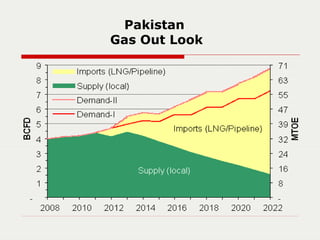
Pakistan
Gas Out Look
Energy Resources
Available To Us
 Indigenous Resources of Oil & Gas
 Hydroelectric
 Nuclear
 Solar & Wind Energy
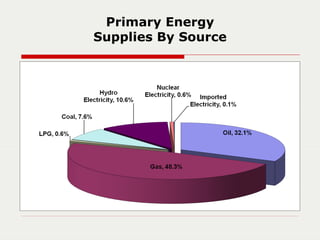
Primary Energy
Supplies By Source
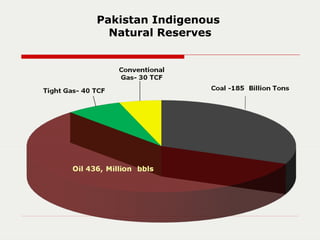
Pakistan Indigenous
Natural Reserves
Sectoral Energy
Consumption By Source
INTERNATIONAL SCENARIO
FOR UNCONVENTIONAL
RESERVOIR
World Un-Conventional Gas Resource
WORLD
UN-CONVENTIONAL GAS
40-50 TCF
Pakistan
European Unconventional Reservoir
India Shale Gas & CBM Projects
 Started work on CBM 1993
 Group of experts was formulated to collect and analyze
data.
 32 BLOCKS Have been given to different companies
 Now India started Production from CBM
 Next Few Years, Production will be 38 CM^3/day
 ONGC had Recent Discovery of Shale Gas in West Bengal
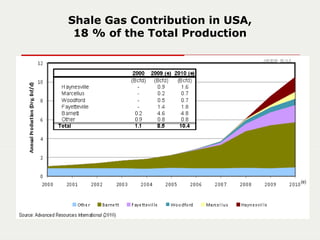
Shale Gas Contribution in USA,
18 % of the Total Production
Advance Resources International USA Gas Projected
values from different Sources, 2009
INDIGNEOUS HYDROCARBON
RESOURCES
Indigenous Oil & Gas Reservoirs
Conventional Reservoirs
 Sandstone and carbonate
Reservoirs.
 With good reservoir properties
have good capability of storage
and Productivity
 Reasonable Efforts for
Exploration
 Explored area is about
275,000 Sq km
 550,000 Sq km is unexplored
 Current Production
 Oil: 60000-66000 bbl
 Gas: 4.15 BCF
Unconventional Reservoirs
 Poor reservoir properties
have capability of storage
but poor Productivity
 Tight Gas Reservoir
 Shale Gas Reservoir
 Coal Bed Methane
 NOT DEVELOPED YET
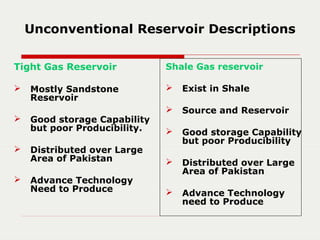
Unconventional Reservoir Descriptions
Tight Gas Reservoir
 Mostly Sandstone
Reservoir
 Good storage Capability
but poor Producibility.
 Distributed over Large
Area of Pakistan
 Advance Technology
Need to Produce
Shale Gas reservoir
 Exist in Shale
 Source and Reservoir
 Good storage Capability
but poor Producibility
 Distributed over Large
Area of Pakistan
 Advance Technology
need to Produce
Unconventional Reservoirs
 COAL BED METHAN
(CBM)
 Gas is generated
during Coalification
Process
 Gas Adsorbed on the
Coal
 Very poor conductivity
 Distributed over Sindh
& Punjab Province
 Word 10 % Coal
Deposits are in Sindh
 Total Deposits are 185
billion tone.
 Not developed Yet
 No Conclusive Work
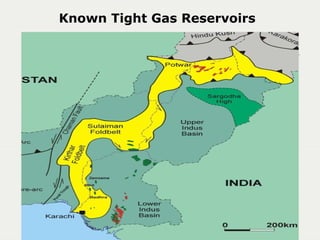
Known Tight Gas Reservoirs
Shale Sequence in Pakistan
 Ghazij Shale Thickness (meters)
 Vastly Distributed- 100 -1200
 Thalar Shale
 Vastly Distributed – 45 – 184
 Samber Shale
 Vastly Distributed – 500- 600
 Chichali Sahle
 Vastly Distributed – 35 – 130
Ghazij Shale Distribution
Talhar Shale
Ghazij Area
Chichali Area
Talhar Area
Coal Fields in Pakistan
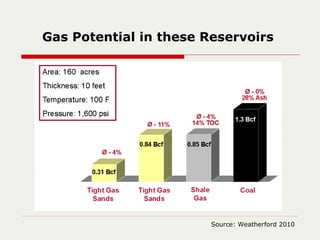
Gas Potential in these Reservoirs
Source: Weatherford 2010
Unconventional Gas
Resource
 Tight Gas 40-50 TCF
 Ghazig Shale Gas 20-30 TCF
 Talhar Shale Gas 100 TCF
 Coal Bed Methane 21 TCF
(Recoverable- Cathy Oil Canada)
 Samber Shale
(Moin PPL) 60-80 TCF
TOTAL 241-281
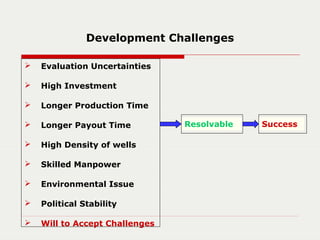
Development Challenges
 Evaluation Uncertainties
 High Investment
 Longer Production Time
 Longer Payout Time
 High Density of wells
 Skilled Manpower
 Environmental Issue
 Political Stability
 Will to Accept Challenges
Resolvable Success
Availability of Technology In World
 Vertical & Horizontal well
 Multilateral Wells
 Hydraulic Fracturing
 Stimulation Techniques
Multilateral Wells
DEVELOPMENT PHILOSPHY
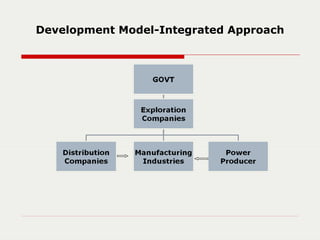
Development Model-Integrated Approach
Exploration & Production Companies
 Should Invest to Explore Tight and Shale gas
 Exploration area for Tight and Shale Gas should be
awarded to the companies
 Price Incentives have been given
 Freedom of Marketing of Gas to the Consumer
Manufacturing & Power Industries
 Should have direct access to Energy Producer
 Should have option of buying gas from Producer &
paying Tariff to the distribution company for using
the network if required
 Reference Price should be according to the
concession area
 Distribution Companies should effectively assist
for supply of gas to Industries
 Consortium of Industry units to share the cost of
energy.
Cost Effective Buisness Model
 Exploration Companies- Consortium
 Work Program for next 3-4 years
• Drilling of Vertical, horizontal & Multilateral
• Hydraulic Fracturing/Stimulation jobs
 Service Providers-Consortium
• Bring Relevant Technology
• Efficient Execution of jobs
• Cost effective Solution
 Human Resource Development---Serious Consideration
Continue----
 Need consortium of industry units for sharing of
their cost of energy
 No Misuse of Freedom
 No Monopolization of any company weather it is
service or distribution companies.
ECONOMIC EVALUATION
Production Challenge
Reference: Weatherford 2010
Probable Production Behavior
Brown Field with 8 year development
0
20
40
60
80
1 2 3 4 5 6 7 8 9 10 11 12 13 14 15 16 17 18 19 20 21 22 23 24 25
Years of production
GasMMSCFD
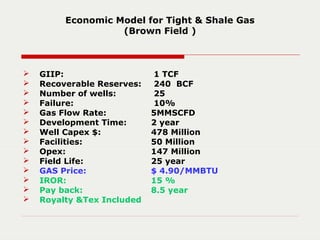
Economic Model for Tight & Shale Gas
(Brown Field )
 GIIP: 1 TCF
 Recoverable Reserves: 240 BCF
 Number of wells: 25
 Failure: 10%
 Gas Flow Rate: 5MMSCFD
 Development Time: 2 year
 Well Capex $: 478 Million
 Facilities: 50 Million
 Opex: 147 Million
 Field Life: 25 year
 GAS Price: $ 4.90/MMBTU
 IROR: 15 %
 Pay back: 8.5 year
 Royalty &Tex Included
Economic Model for Tight & Shale Gas
(Green Field )
 GIIP: 1 TCF
 Recoverable Reserves: 240 BCF
 Number of wells: 25
 Failure: 10 %
 Gas Flow Rate: 5MMSCFD
 Development Time: 5 year
 Well Capex $: 478 Million
 Facilities: 124 Million
 Opex: 147 Million
 Field Life: 25 year
 GAS Price: $ 6.21/MMBTU
 IROR: 15 %
 Pay back: 6.5 years
SUMMARY
 Enough unconventional Reservoir exist
in the country
 Unconventional Reservoirs are required to
be evaluated by collection of more data by
initiating Pilot Projects in Shale Gas as
earliest as possible.
 Exploration blocks may be awarded for
unconventional reservoirs.
 Economically, Projects in Shale & Tight
Gas looks viable.
 Human Resource Development to cater the
demand of oil companies operating in Pkistan
 Introduction of consortium concept of E & P
companies for the planning of their work
 Consortium of Service companies for cost
effective solution of development of these
Reservoirs.
 Integrated Approach of all the stack holder is
required to develop these unconventional
Reservoirs
Continue----
THANKS

RESERVOIRS IN DEVELOPMENT OF UNCONVENTIONAL PAKISTAN

  • 1.
    RESERVOIRS IN DEVELOPMENTOF UNCONVENTIONAL PAKISTAN By Nighat Seema Karachi July 15, 2013 Gulshan-e-Hadeed
  • 2.
    PROVOKING THOUHHTS  Withthe nuclear industry in crisis and oil prices on the rise, could the solution to our energy problems be in the ground at home? Daniel yergin on the promise of shale gas.  He ," states that the turmoil in the middle east is a "sea change" for the global oil market and that the U.S.A and emerging markets are most economically vulnerable to rising oil prices.
  • 3.
    Outline of Presentation Objectives  Energy out Look  Existing Indigenous Resource  International Scenario  Conventional & Unconventional Reservoirs  Potential of Unconventional Resource  Development Model  Economic Consideration  Summary
  • 4.
     HOW TOMEET ENERGY REQUIREMENT OF THE COUNTRY  UNCONVENTIONAL ENERGY RESOURCE AVAILABILITY  DEVELOPMENT PHIL0SPHY OBJECTIVES
  • 5.
  • 6.
  • 7.
    Energy Resources Available ToUs  Indigenous Resources of Oil & Gas  Hydroelectric  Nuclear  Solar & Wind Energy
  • 8.
  • 9.
  • 10.
  • 11.
  • 12.
  • 13.
  • 14.
  • 15.
    India Shale Gas& CBM Projects  Started work on CBM 1993  Group of experts was formulated to collect and analyze data.  32 BLOCKS Have been given to different companies  Now India started Production from CBM  Next Few Years, Production will be 38 CM^3/day  ONGC had Recent Discovery of Shale Gas in West Bengal
  • 16.
    Shale Gas Contributionin USA, 18 % of the Total Production
  • 17.
    Advance Resources InternationalUSA Gas Projected values from different Sources, 2009
  • 18.
  • 19.
    Indigenous Oil &Gas Reservoirs Conventional Reservoirs  Sandstone and carbonate Reservoirs.  With good reservoir properties have good capability of storage and Productivity  Reasonable Efforts for Exploration  Explored area is about 275,000 Sq km  550,000 Sq km is unexplored  Current Production  Oil: 60000-66000 bbl  Gas: 4.15 BCF Unconventional Reservoirs  Poor reservoir properties have capability of storage but poor Productivity  Tight Gas Reservoir  Shale Gas Reservoir  Coal Bed Methane  NOT DEVELOPED YET
  • 20.
    Unconventional Reservoir Descriptions TightGas Reservoir  Mostly Sandstone Reservoir  Good storage Capability but poor Producibility.  Distributed over Large Area of Pakistan  Advance Technology Need to Produce Shale Gas reservoir  Exist in Shale  Source and Reservoir  Good storage Capability but poor Producibility  Distributed over Large Area of Pakistan  Advance Technology need to Produce
  • 21.
    Unconventional Reservoirs  COALBED METHAN (CBM)  Gas is generated during Coalification Process  Gas Adsorbed on the Coal  Very poor conductivity  Distributed over Sindh & Punjab Province  Word 10 % Coal Deposits are in Sindh  Total Deposits are 185 billion tone.  Not developed Yet  No Conclusive Work
  • 22.
    Known Tight GasReservoirs
  • 23.
    Shale Sequence inPakistan  Ghazij Shale Thickness (meters)  Vastly Distributed- 100 -1200  Thalar Shale  Vastly Distributed – 45 – 184  Samber Shale  Vastly Distributed – 500- 600  Chichali Sahle  Vastly Distributed – 35 – 130
  • 24.
  • 25.
  • 26.
  • 27.
  • 28.
    Gas Potential inthese Reservoirs Source: Weatherford 2010
  • 29.
    Unconventional Gas Resource  TightGas 40-50 TCF  Ghazig Shale Gas 20-30 TCF  Talhar Shale Gas 100 TCF  Coal Bed Methane 21 TCF (Recoverable- Cathy Oil Canada)  Samber Shale (Moin PPL) 60-80 TCF TOTAL 241-281
  • 30.
    Development Challenges  EvaluationUncertainties  High Investment  Longer Production Time  Longer Payout Time  High Density of wells  Skilled Manpower  Environmental Issue  Political Stability  Will to Accept Challenges Resolvable Success
  • 31.
    Availability of TechnologyIn World  Vertical & Horizontal well  Multilateral Wells  Hydraulic Fracturing  Stimulation Techniques
  • 33.
  • 34.
  • 35.
  • 36.
    Exploration & ProductionCompanies  Should Invest to Explore Tight and Shale gas  Exploration area for Tight and Shale Gas should be awarded to the companies  Price Incentives have been given  Freedom of Marketing of Gas to the Consumer
  • 37.
    Manufacturing & PowerIndustries  Should have direct access to Energy Producer  Should have option of buying gas from Producer & paying Tariff to the distribution company for using the network if required  Reference Price should be according to the concession area  Distribution Companies should effectively assist for supply of gas to Industries  Consortium of Industry units to share the cost of energy.
  • 38.
    Cost Effective BuisnessModel  Exploration Companies- Consortium  Work Program for next 3-4 years • Drilling of Vertical, horizontal & Multilateral • Hydraulic Fracturing/Stimulation jobs  Service Providers-Consortium • Bring Relevant Technology • Efficient Execution of jobs • Cost effective Solution  Human Resource Development---Serious Consideration
  • 39.
    Continue----  Need consortiumof industry units for sharing of their cost of energy  No Misuse of Freedom  No Monopolization of any company weather it is service or distribution companies.
  • 40.
  • 41.
  • 42.
    Probable Production Behavior BrownField with 8 year development 0 20 40 60 80 1 2 3 4 5 6 7 8 9 10 11 12 13 14 15 16 17 18 19 20 21 22 23 24 25 Years of production GasMMSCFD
  • 43.
    Economic Model forTight & Shale Gas (Brown Field )  GIIP: 1 TCF  Recoverable Reserves: 240 BCF  Number of wells: 25  Failure: 10%  Gas Flow Rate: 5MMSCFD  Development Time: 2 year  Well Capex $: 478 Million  Facilities: 50 Million  Opex: 147 Million  Field Life: 25 year  GAS Price: $ 4.90/MMBTU  IROR: 15 %  Pay back: 8.5 year  Royalty &Tex Included
  • 44.
    Economic Model forTight & Shale Gas (Green Field )  GIIP: 1 TCF  Recoverable Reserves: 240 BCF  Number of wells: 25  Failure: 10 %  Gas Flow Rate: 5MMSCFD  Development Time: 5 year  Well Capex $: 478 Million  Facilities: 124 Million  Opex: 147 Million  Field Life: 25 year  GAS Price: $ 6.21/MMBTU  IROR: 15 %  Pay back: 6.5 years
  • 45.
    SUMMARY  Enough unconventionalReservoir exist in the country  Unconventional Reservoirs are required to be evaluated by collection of more data by initiating Pilot Projects in Shale Gas as earliest as possible.  Exploration blocks may be awarded for unconventional reservoirs.  Economically, Projects in Shale & Tight Gas looks viable.
  • 46.
     Human ResourceDevelopment to cater the demand of oil companies operating in Pkistan  Introduction of consortium concept of E & P companies for the planning of their work  Consortium of Service companies for cost effective solution of development of these Reservoirs.  Integrated Approach of all the stack holder is required to develop these unconventional Reservoirs Continue----
  • 47.