DISSEMINATED
INTRAVASCULAR
COAGULATION
QURATULAIN MUGHAL
BATCH IV
IIRS,IUKC
DOCTOR PF PHYSICAL THERAPY
1
CONTENTS
• DEFINITION
• TYPES
• PATHOPHYSIOLOGY
• SIGNS AND SYMPTOMS
• DIFFERENTIAL DIAGNOSIS
• DIAGNOSIS
• TREATMENT
• REFERENCES
2
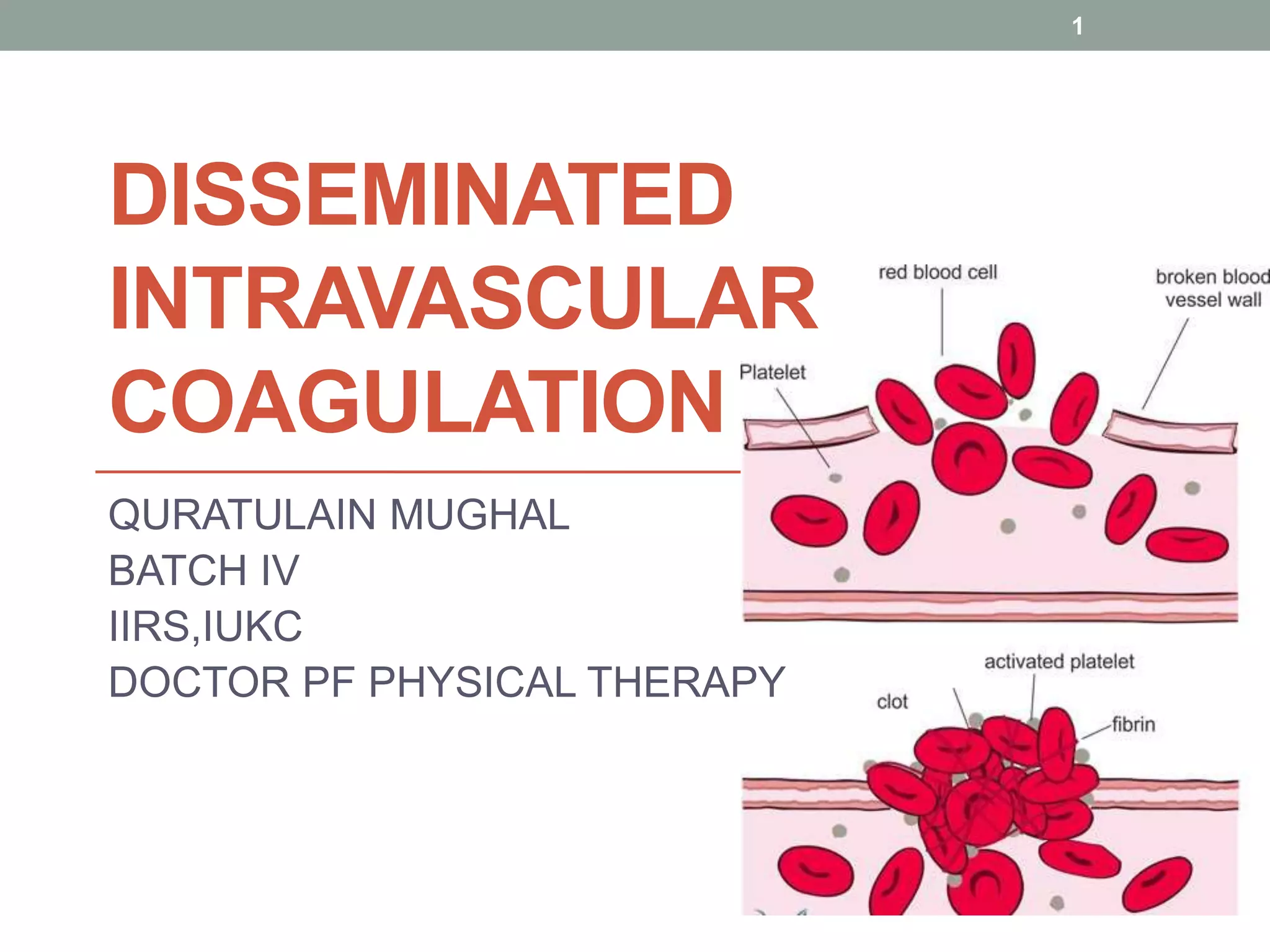
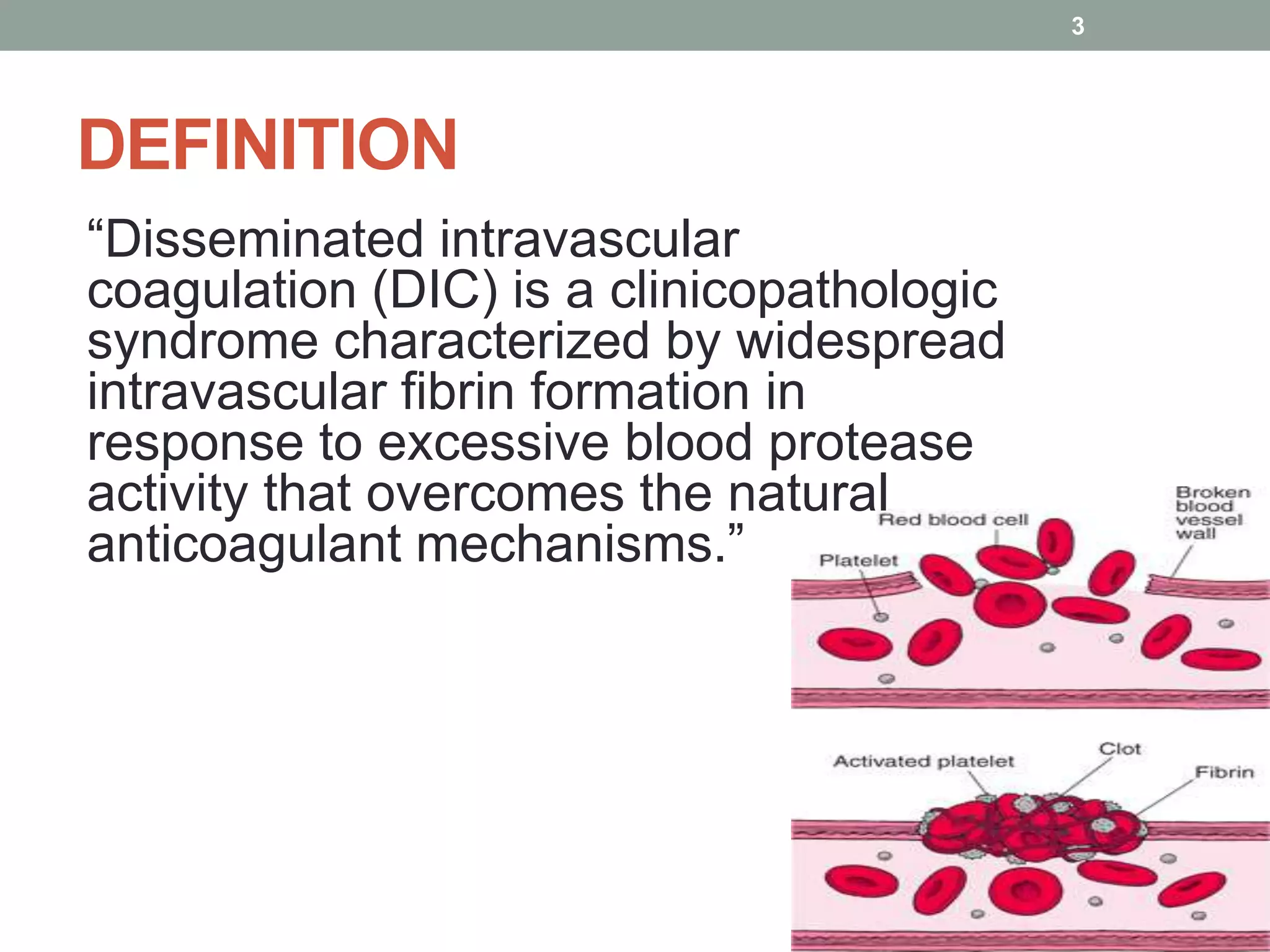
DEFINITION
“Disseminated intravascular
coagulation (DIC) is a clinicopathologic
syndrome characterized by widespread
intravascular fibrin formation in
response to excessive blood protease
activity that overcomes the natural
anticoagulant mechanisms.”
3
TYPES
• ACUTE DIC
• CHRONIC DIC
4
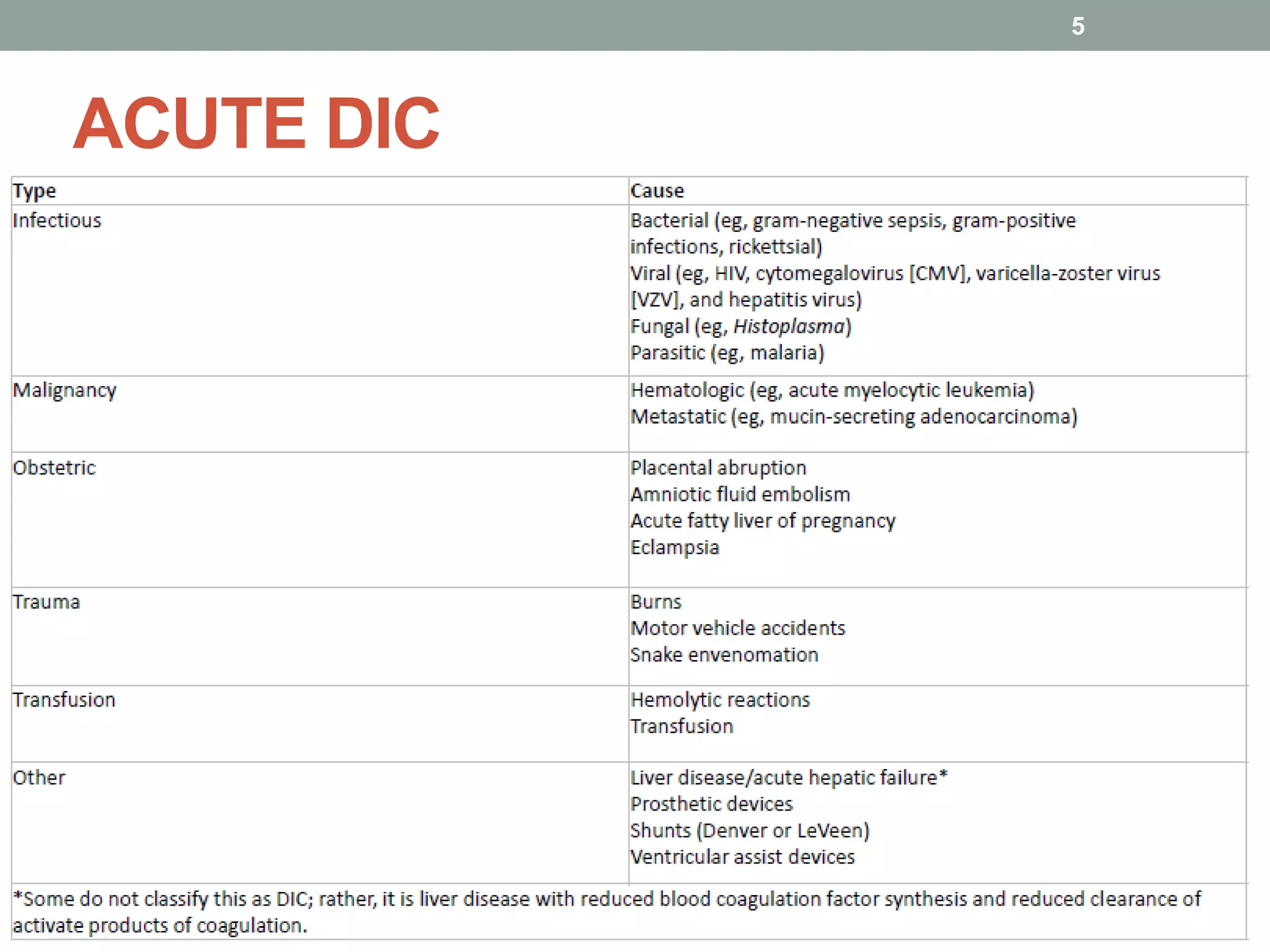
ACUTE DIC
5
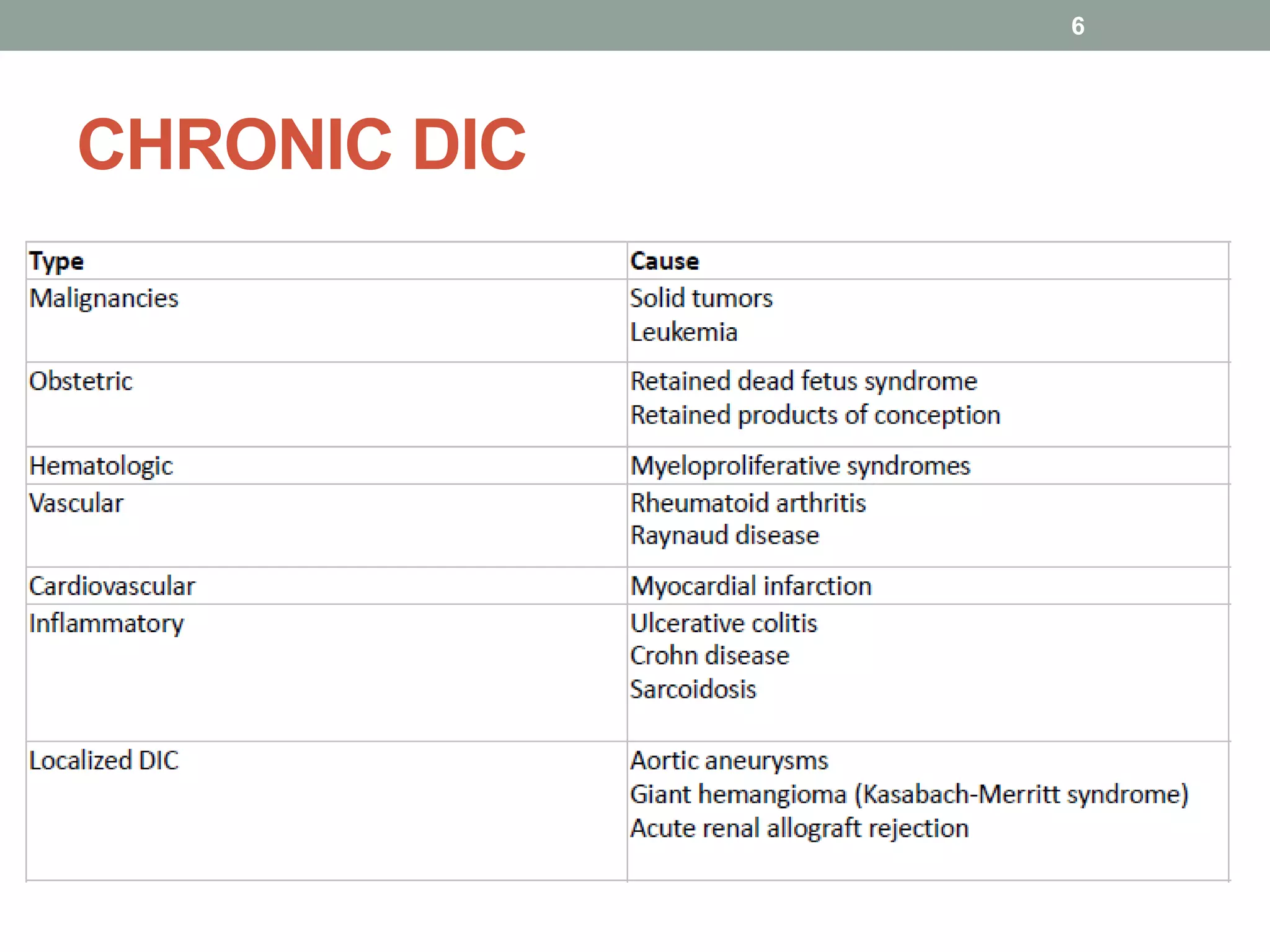
CHRONIC DIC
6
7
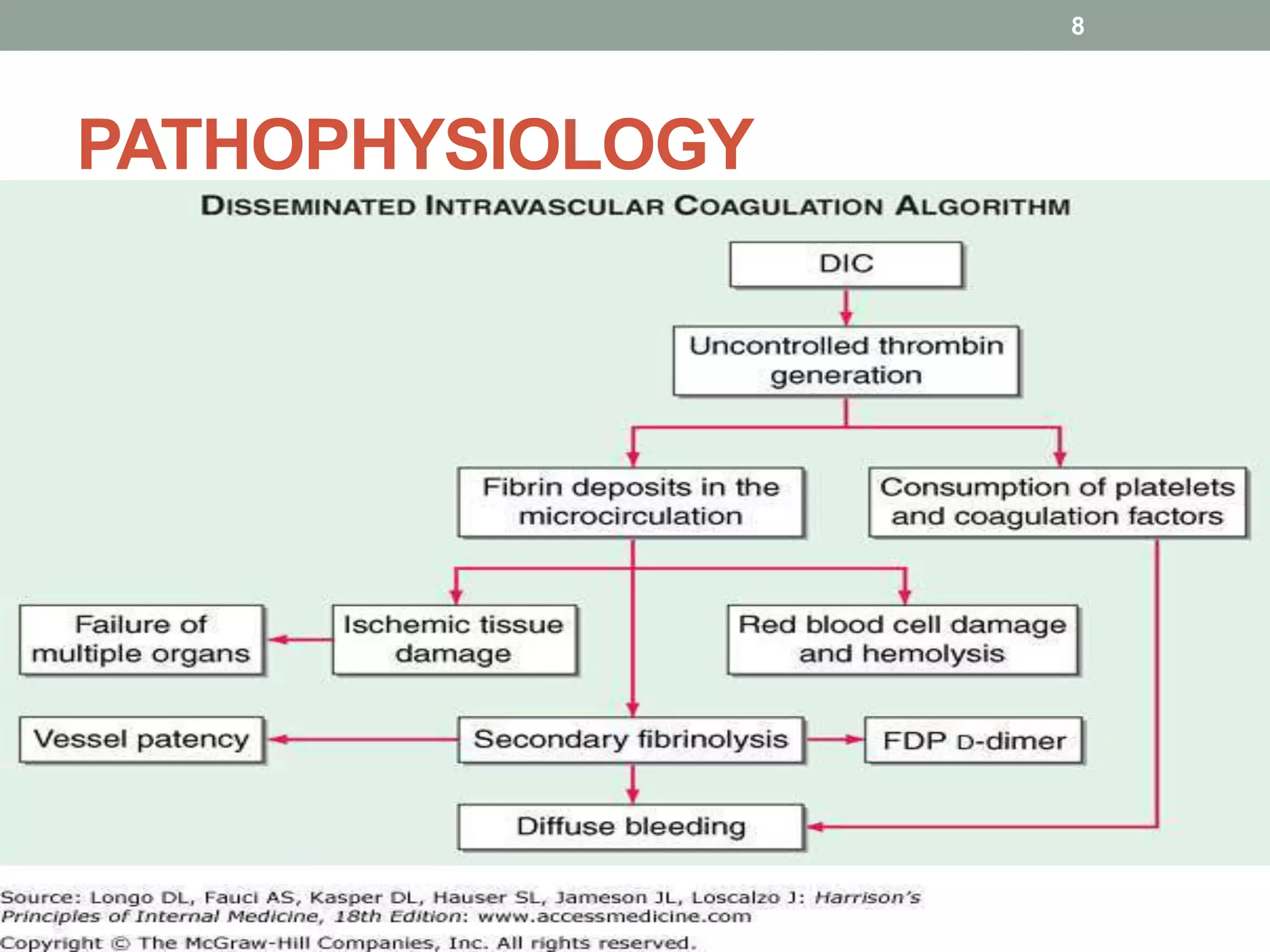
PATHOPHYSIOLOGY
8
1. Increased thrombin generation: Mediated
predominantly by tissue factor/factor VIIa pathway.
2. Impaired function of physiological anticoagulant
pathway
a) Reduction of antithrombin levels -- The result of a
combination of increased consumption, enzyme
degradation, impaired liver synthesis and vascular leakage.
b) Depression of protein C system -- The result of a
combination of increased consumption, impaired liver
synthesis, vascular leakage and down- regulation of
thrombomodulin.
c) Insufficient tissue factor pathway inhibitor (TFPI)
9
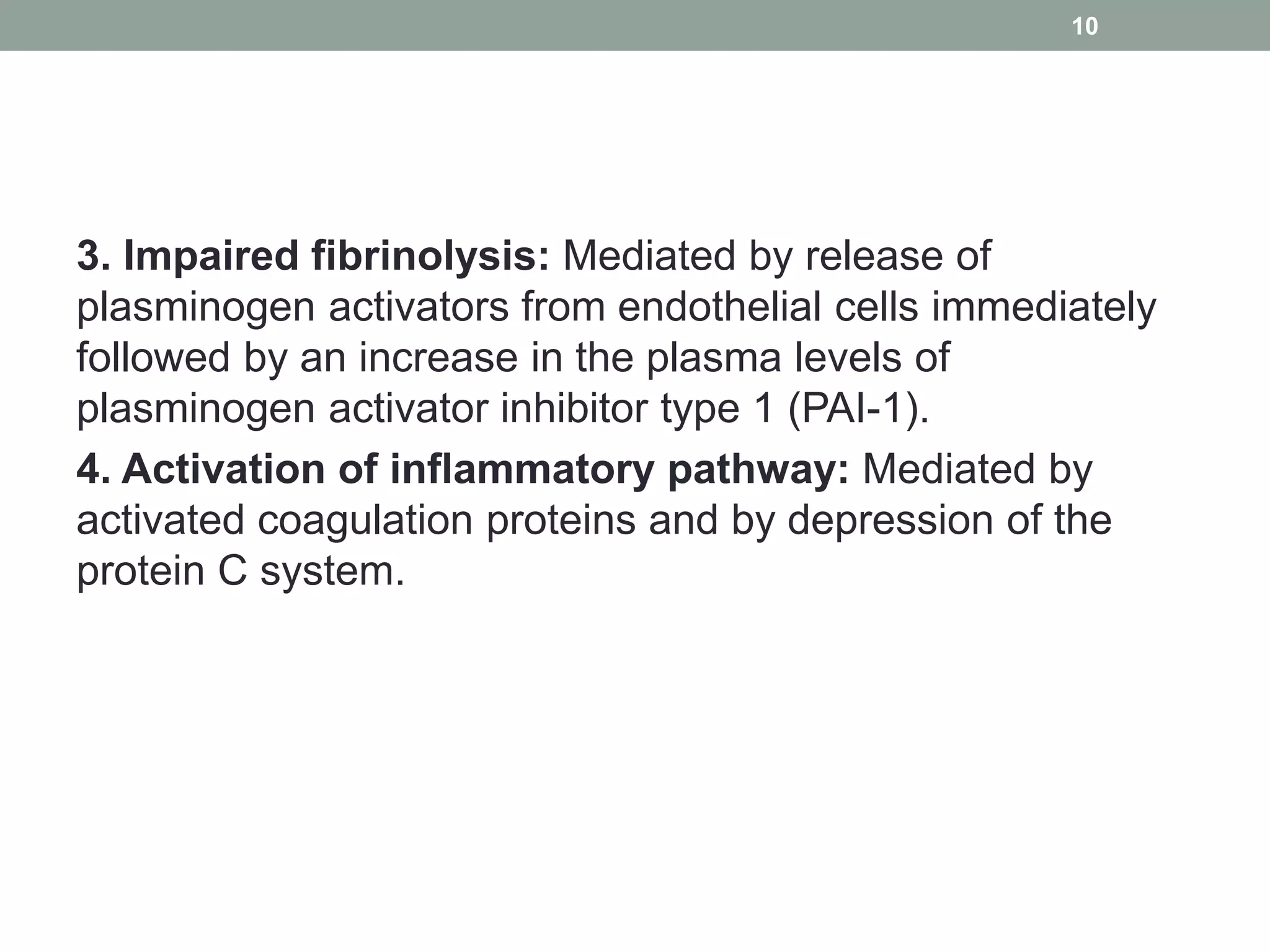
3. Impaired fibrinolysis: Mediated by release of
plasminogen activators from endothelial cells immediately
followed by an increase in the plasma levels of
plasminogen activator inhibitor type 1 (PAI-1).
4. Activation of inflammatory pathway: Mediated by
activated coagulation proteins and by depression of the
protein C system.
10
SIGNS AND SYMPTOMS
History
The symptoms of disseminated intravascular coagulation (DIC)
are often those of the underlying inciting condition.
1. Bleeding:
• GI bleed
• Petechiae and ecchymosis,
• Intravenous (IV) lines and catheters bleed
• Surgical sites, drains, and tracheostomies and within serous
cavities.
2. Renal failure
3. Pulmonary involvement
• Dyspnea, hemoptysis, and cough
4. Jaundice
11
SYMPTOMS
Circulatory signs include the following:
1. Signs of spontaneous and life-threatening hemorrhage
2. Signs of subacute bleeding
3. Signs of diffuse or localized thrombosis
4. Bleeding into serous cavities
Central nervous system signs include the following:
1. Nonspecific altered consciousness or stupor
2. Transient focal or neurologic deficits
Cardiovascular signs include the following:
1. Hypotension
2. Tachycardia
3. Circulatory collapse
Respiratory signs include the following:
1. Pleural friction rub
2. Signs of acute respiratory distress syndrome (ARDS)
12
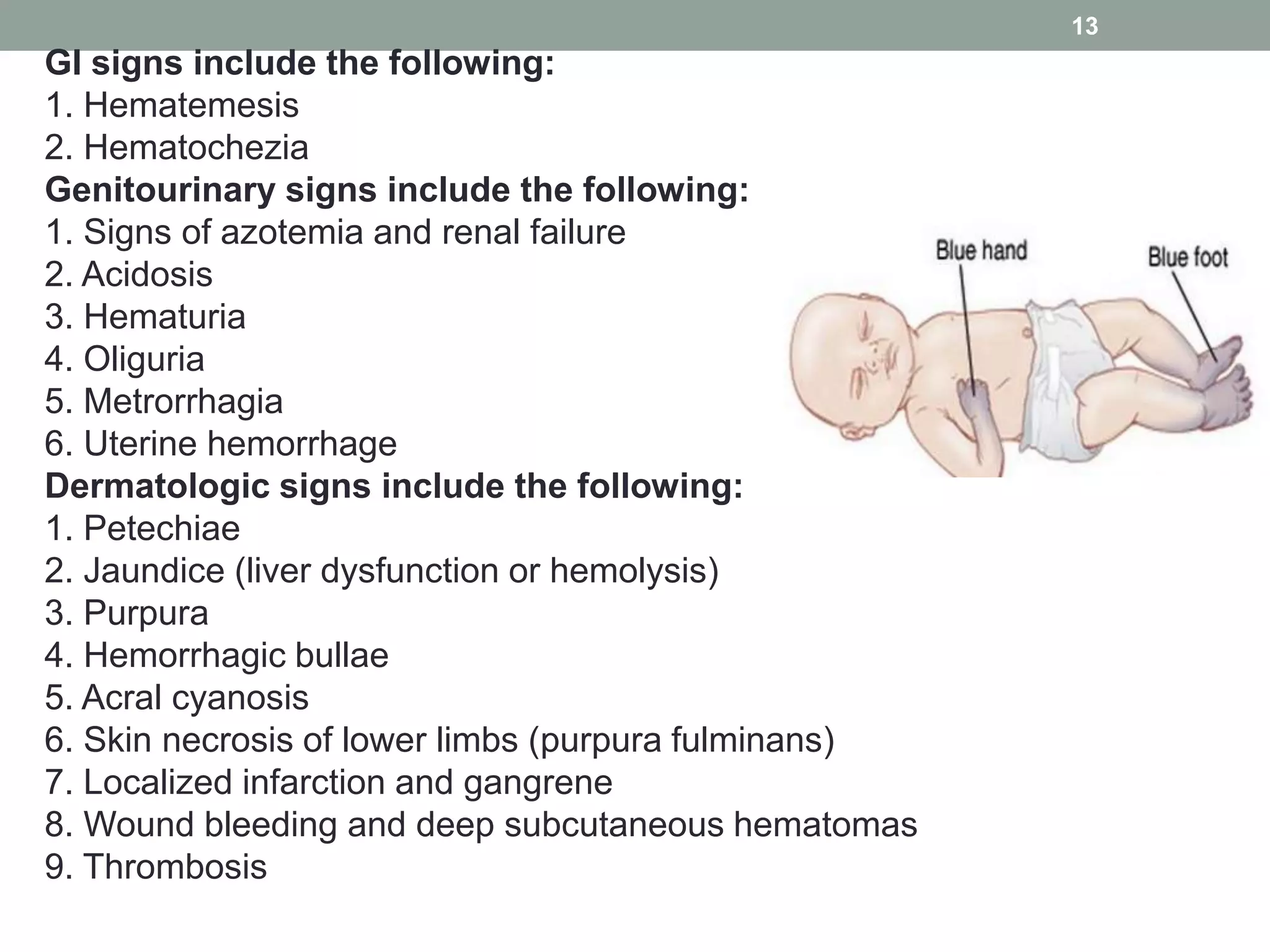
GI signs include the following:
1. Hematemesis
2. Hematochezia
Genitourinary signs include the following:
1. Signs of azotemia and renal failure
2. Acidosis
3. Hematuria
4. Oliguria
5. Metrorrhagia
6. Uterine hemorrhage
Dermatologic signs include the following:
1. Petechiae
2. Jaundice (liver dysfunction or hemolysis)
3. Purpura
4. Hemorrhagic bullae
5. Acral cyanosis
6. Skin necrosis of lower limbs (purpura fulminans)
7. Localized infarction and gangrene
8. Wound bleeding and deep subcutaneous hematomas
9. Thrombosis
13
14
DIFFERENTIAL DIAGNOSIS
1. Atypical hemolytic-uremic syndrome
2. Hemolytic-Uremic Syndrome
3. Heparin-induced thrombocytopenia and thrombosis
syndrome
4. Idiopathic Thrombocytopenic Purpura
5. Liver disease
6. Primary hemostatic disorders (eg, dysfibrinogenemias;
inhibitors
to factors II, V, X)
7. Thrombotic Thrombocytopenic Purpura
15
DIAGNOSIS
•Platelet -- moderate-to-severe thrombocytopenia is
present in DIC.
•Activated partial thromboplastin time [aPTT] and
prothrombin time [PT]) are typically prolonged.
•Protein C and antithrombin are 2 natural anticoagulants
that are frequently decreased in DIC.
•Elevated levels D-dimer and FDPs
•Thrombomodulin is elevated in DIC, a marker for early
identification and monitoring of DIC.
•Chronic DIC diagnosis when the schistocytes are seen in
concert with normal coagulation values and increased D-
dimer levels.
16
17
18
TREATMENT
1) Replacement therapy - Fresh-frozen plasma
2) Anticoagulants
- Unfractionated and low-molecular-weight heparin
- Danaparoid sodium
- Recombinant hirudin
- Recombinant tissue factor pathway inhibitor
- Recombinant nematode anticoagulant protein c2
3) Restoration of anticoagulant pathways - Antithrombin
- Recombinant human activated protein C
4) Other agents - Recombinant activated factor VII
- Antifibrinolytic agents
- Antiselectin antibodies
- Recombinant interleukin-10
- Monoclonal antibodies against TNF and CD14
19
Management of Underlying Disease
•The management of acute and chronic forms of disseminated
intravascular
coagulation (DIC) should primarily be directed at treatment of the
underlying disorder.
Administration of Blood Components and Coagulation Factors
•Platelet transfusion may be considered in patients with DIC and
severe thrombocytopenia, in particular, in patients with bleeding or in
patients at risk for bleeding.
•The PT (>1.5 times the normal) Replacement with FFP is indicated
•Low levels of fibrinogen (<100 mg/dL) or brisk hyperfibrinolysis will
require infusion of cryoprecipitate. The replacement of 10 U of
cryoprecipitate for every 2–3 U of FFP is sufficient to correct the
hemostasis.
•In case of a (relative) vitamin K deficiency in the face of
consumption, administration of vitamin K may be required.
20
Anticoagulation
•Experimental studies have suggested that heparin can at least
partly inhibit the activation of coagulation in cases of sepsis and
other causes of DIC. However, a beneficial effect of heparin on
clinically important outcome events in patients with DIC has not
yet been demonstrated in controlled clinical trials.
•Therapeutic doses of heparin are indicated in cases of obvious
thromboembolic disease or where fibrin deposition
predominates
(eg, purpura fulminans or acral ischemia).
• A dose of 4-5 U/kg constant infusion without a 80-U/kg bolus
is a safe means to deliver heparin to the DIC without increasing
the bleeding risk.
Restoration of Anticoagulant Pathways
•Antithrombin concentrate, recombinant human APC, tissue
factor (TF) pathway inhibitor (TFPI) and recombinant
thrombomodulin (rTM).
21
Antifibrinolytic treatment
In the coagulopathy associated with acute promyelocytic
leukemia (AML-M3) and in some cases of DIC secondary
to malignancies (e.g. prostate carcinoma) lysine analogues
such as tranexamic acid can be utilized.
Investigational Treatments
Tissue factor (TF)-VIIa complex include inactivated factor
VII and recombinant nematode anticoagulant peptide
(NAPc2).
22
REFERENCES
23
24

Disseminated Intravascular Coagulation

  • 1.
  • 2.
    CONTENTS • DEFINITION • TYPES •PATHOPHYSIOLOGY • SIGNS AND SYMPTOMS • DIFFERENTIAL DIAGNOSIS • DIAGNOSIS • TREATMENT • REFERENCES 2
  • 3.
    DEFINITION “Disseminated intravascular coagulation (DIC)is a clinicopathologic syndrome characterized by widespread intravascular fibrin formation in response to excessive blood protease activity that overcomes the natural anticoagulant mechanisms.” 3
  • 4.
  • 5.
  • 6.
  • 7.
  • 8.
  • 9.
    1. Increased thrombingeneration: Mediated predominantly by tissue factor/factor VIIa pathway. 2. Impaired function of physiological anticoagulant pathway a) Reduction of antithrombin levels -- The result of a combination of increased consumption, enzyme degradation, impaired liver synthesis and vascular leakage. b) Depression of protein C system -- The result of a combination of increased consumption, impaired liver synthesis, vascular leakage and down- regulation of thrombomodulin. c) Insufficient tissue factor pathway inhibitor (TFPI) 9
  • 10.
    3. Impaired fibrinolysis:Mediated by release of plasminogen activators from endothelial cells immediately followed by an increase in the plasma levels of plasminogen activator inhibitor type 1 (PAI-1). 4. Activation of inflammatory pathway: Mediated by activated coagulation proteins and by depression of the protein C system. 10
  • 11.
    SIGNS AND SYMPTOMS History Thesymptoms of disseminated intravascular coagulation (DIC) are often those of the underlying inciting condition. 1. Bleeding: • GI bleed • Petechiae and ecchymosis, • Intravenous (IV) lines and catheters bleed • Surgical sites, drains, and tracheostomies and within serous cavities. 2. Renal failure 3. Pulmonary involvement • Dyspnea, hemoptysis, and cough 4. Jaundice 11
  • 12.
    SYMPTOMS Circulatory signs includethe following: 1. Signs of spontaneous and life-threatening hemorrhage 2. Signs of subacute bleeding 3. Signs of diffuse or localized thrombosis 4. Bleeding into serous cavities Central nervous system signs include the following: 1. Nonspecific altered consciousness or stupor 2. Transient focal or neurologic deficits Cardiovascular signs include the following: 1. Hypotension 2. Tachycardia 3. Circulatory collapse Respiratory signs include the following: 1. Pleural friction rub 2. Signs of acute respiratory distress syndrome (ARDS) 12
  • 13.
    GI signs includethe following: 1. Hematemesis 2. Hematochezia Genitourinary signs include the following: 1. Signs of azotemia and renal failure 2. Acidosis 3. Hematuria 4. Oliguria 5. Metrorrhagia 6. Uterine hemorrhage Dermatologic signs include the following: 1. Petechiae 2. Jaundice (liver dysfunction or hemolysis) 3. Purpura 4. Hemorrhagic bullae 5. Acral cyanosis 6. Skin necrosis of lower limbs (purpura fulminans) 7. Localized infarction and gangrene 8. Wound bleeding and deep subcutaneous hematomas 9. Thrombosis 13
  • 14.
  • 15.
    DIFFERENTIAL DIAGNOSIS 1. Atypicalhemolytic-uremic syndrome 2. Hemolytic-Uremic Syndrome 3. Heparin-induced thrombocytopenia and thrombosis syndrome 4. Idiopathic Thrombocytopenic Purpura 5. Liver disease 6. Primary hemostatic disorders (eg, dysfibrinogenemias; inhibitors to factors II, V, X) 7. Thrombotic Thrombocytopenic Purpura 15
  • 16.
    DIAGNOSIS •Platelet -- moderate-to-severethrombocytopenia is present in DIC. •Activated partial thromboplastin time [aPTT] and prothrombin time [PT]) are typically prolonged. •Protein C and antithrombin are 2 natural anticoagulants that are frequently decreased in DIC. •Elevated levels D-dimer and FDPs •Thrombomodulin is elevated in DIC, a marker for early identification and monitoring of DIC. •Chronic DIC diagnosis when the schistocytes are seen in concert with normal coagulation values and increased D- dimer levels. 16
  • 17.
  • 18.
  • 19.
    TREATMENT 1) Replacement therapy- Fresh-frozen plasma 2) Anticoagulants - Unfractionated and low-molecular-weight heparin - Danaparoid sodium - Recombinant hirudin - Recombinant tissue factor pathway inhibitor - Recombinant nematode anticoagulant protein c2 3) Restoration of anticoagulant pathways - Antithrombin - Recombinant human activated protein C 4) Other agents - Recombinant activated factor VII - Antifibrinolytic agents - Antiselectin antibodies - Recombinant interleukin-10 - Monoclonal antibodies against TNF and CD14 19
  • 20.
    Management of UnderlyingDisease •The management of acute and chronic forms of disseminated intravascular coagulation (DIC) should primarily be directed at treatment of the underlying disorder. Administration of Blood Components and Coagulation Factors •Platelet transfusion may be considered in patients with DIC and severe thrombocytopenia, in particular, in patients with bleeding or in patients at risk for bleeding. •The PT (>1.5 times the normal) Replacement with FFP is indicated •Low levels of fibrinogen (<100 mg/dL) or brisk hyperfibrinolysis will require infusion of cryoprecipitate. The replacement of 10 U of cryoprecipitate for every 2–3 U of FFP is sufficient to correct the hemostasis. •In case of a (relative) vitamin K deficiency in the face of consumption, administration of vitamin K may be required. 20
  • 21.
    Anticoagulation •Experimental studies havesuggested that heparin can at least partly inhibit the activation of coagulation in cases of sepsis and other causes of DIC. However, a beneficial effect of heparin on clinically important outcome events in patients with DIC has not yet been demonstrated in controlled clinical trials. •Therapeutic doses of heparin are indicated in cases of obvious thromboembolic disease or where fibrin deposition predominates (eg, purpura fulminans or acral ischemia). • A dose of 4-5 U/kg constant infusion without a 80-U/kg bolus is a safe means to deliver heparin to the DIC without increasing the bleeding risk. Restoration of Anticoagulant Pathways •Antithrombin concentrate, recombinant human APC, tissue factor (TF) pathway inhibitor (TFPI) and recombinant thrombomodulin (rTM). 21
  • 22.
    Antifibrinolytic treatment In thecoagulopathy associated with acute promyelocytic leukemia (AML-M3) and in some cases of DIC secondary to malignancies (e.g. prostate carcinoma) lysine analogues such as tranexamic acid can be utilized. Investigational Treatments Tissue factor (TF)-VIIa complex include inactivated factor VII and recombinant nematode anticoagulant peptide (NAPc2). 22
  • 23.
  • 24.