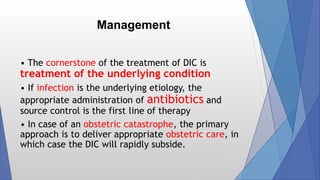
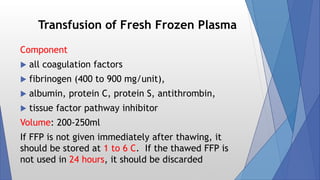
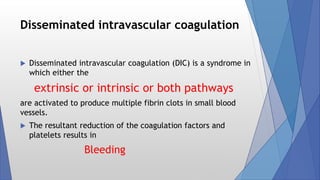
The document discusses disseminated intravascular coagulation (DIC), including its causes, clinical features, diagnostic testing, management, and complications. DIC results from excessive activation of coagulation pathways leading to microthrombi formation and bleeding. It is always secondary to an underlying condition like infection, malignancy, trauma, or obstetric complications. Management involves treating the underlying cause, monitoring for bleeding and organ dysfunction, and replacing clotting factors or administering anticoagulants depending on the clinical situation. Complications can be bleeding or thromboembolic in nature. The prognosis depends on the severity of DIC and underlying condition.


![Etiology
Infection
Bacterial (gram-negative sepsis, gram-positive
infections,
rickettsial )
Viral (HIV, cytomegalovirus [CMV], varicella-zoster
virus [VZV], and hepatitis virus)
Fungal (Histoplasma)
Parasitic (malaria)](https://image.slidesharecdn.com/dic-200217130157/85/DIC-11-320.jpg)