CHILDREN MUST BE TAUGHT HOW TO
THINK, NOT WHAT TO THINK.”
“
”
PRESENTED BY :
SAMRITI SHARMA
MSC NURSING 2ND YEAR (CHN)
BASICS TO UNDERSTAND THE DISEASE
CONDITION
• DISSEMINATED Means wide spread
• INTRAVASCULAR Means with in the vessels
• COAGULATION Means the process by which a
blood clot is formed.
INTRODUCTION
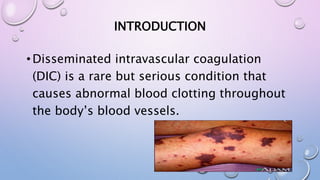
• Disseminated intravascular coagulation
(DIC) is a rare but serious condition that
causes abnormal blood clotting throughout
the body’s blood vessels.
CONT……….
• It is an Thrombohemorrhagic disorder.
• So there are two phases in this disorder i.e
1. Thrombotic phase
2. Hemorrhagic phase
CONT……
• Disseminated intravascular coagulation (DIC) is a
serious medical disorder in which multiple clots
are formed that can lead to permanent end-organ
damage.
• Systemic activation of the blood coagulation
occurs that results in the generation and the
deposition of excess fibrin. This causes the
blockage of blood vessels by the thrombi.
CONT………
• DIC is also known as Consumption coagulopathy
increase clot formation
increase consumption of C. factors and platelets
deficiency of C. factor and platelets
prevent clot formation
increase bleeding
ANOTHER REASON FOR ABNORMAL BLEEDING
• It is due to plasmin activation,,,,,, because it destroy
clotting factor and leads to bleeding
DEFINITION
• DISSEMINATED INTRAVASCULAR COAGULATION
(DIC) IS A SERIOUS DISORDER IN WHICH THE
PROTEINS THAT CONTROL BLOOD CLOTTING
BECOME OVERACTIVE.
TYPES OF DIC
• ACUTE DIC
• CHRONIC DIC
ACUTE DIC
• It happened rapidly, the coagulopathy is dominant and major
symptoms are bleeding and Shock, mainly seen in severe infection
• An explosive generation of thrombin diminish clotting factors and
platelets and activates the fibrinolytic system. Bleeding into the
subcutaneous tissues, skin, and mucous membranes occurs, along
with occlusion of blood vessels caused by fibrin in the
microcirculation.
CHRONIC DIC
It happened slowly and last several weeks, thrombosis and clotting
may predominate ,mainly seen in cancer.
 Process is the same, but it is less explosive. Usually there is time for
compensatory responses to take
CAUSES
• Injury
• Infectious disease 31%~43%
• cancer 24%~34%
• Obstetric complications 4%~12%
• severe tissue injury 1%~5%
• systemic disease
RISK FACTORS
• Cancer, especially certain types of leukemia
• Inflammation of the pancreas
• Infection in the blood, especially by bacteria or
fungus
• Liver disease
CONT……..
• Recent surgery
• Severe tissue injury (as in burns and head injury)
• Large hemangioma (a blood vessel that is not
formed properly)
PATHOPHYSIOLOGY
• Disseminated intravascular coagulation occurs
when the first stages of the coagulation process is
abnormally stimulated.
• Although no well-defined sequence of events
occurs, two distinct phase can be identified or
two mechanism are there.
FIRST
• When the clotting mechanism is triggered in the circulation,
• Thrombin is generated in greater amounts that can be neutralized
by the body
• As a result, there is rapid conversion of fibrinogen to fibrin, with
aggregation and destruction of platelets.
• If local and wide-spread fibrin deposition in blood vessels take
place, obstruction and eventual necrosis of tissues occur.
SECOND
• If Fibrinolytic mechanism is activated
• Causing extensive destruction of clotting factors,
• The child is prone to uncontrollable hemorrhage into
vital organs.
• An additional complication is damage and hemolysis of
RBCs
SYMPTOMS OF DIC
SYMPTOMS OF DIC MAY INCLUDE ANY OF THE FOLLOWING:
• BLEEDING, FROM MANY SITES IN THE BODY
• BLOOD CLOTS
• BRUISING
• DROP IN BLOOD PRESSURE
• SHORTNESS OF BREATH
• CONFUSION, MEMORY LOSS OR CHANGE OF BEHAVIOR
• FEVER
DIAGNOSTIC EVALUATION
• There are three components of the diagnostic
workup. The detailed history, physical
examination, and laboratory investigations are
done.
• Physical examination is the most important step.
The treatment is started on the basis of positive
physical signs, while the results of the laboratory
investigations are awaited.
CONT…….
• DIC is a life-threatening condition and immediate treatment
is started without any delay. The signs to look for during the
examination are:
• Signs of hemorrhage
• Signs of localized thrombosis
• Altered consciousness
• Focal neurological deficits
• Hypotension and tachycardia
CONT…….
• Signs of ARDS (acute respiratory distress)
• Haematuria
• Oliguria
• Purpura
• Cyanosis
• Skin necrosis
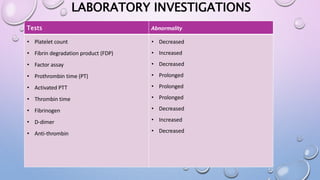
LABORATORY INVESTIGATIONS
Tests Abnormality
• Platelet count
• Fibrin degradation product (FDP)
• Factor assay
• Prothrombin time (PT)
• Activated PTT
• Thrombin time
• Fibrinogen
• D-dimer
• Anti-thrombin
• Decreased
• Increased
• Decreased
• Prolonged
• Prolonged
• Prolonged
• Decreased
• Increased
• Decreased
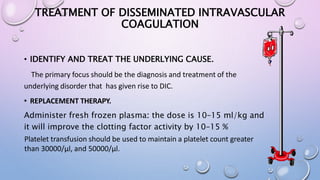
TREATMENT OF DISSEMINATED INTRAVASCULAR
COAGULATION
• IDENTIFY AND TREAT THE UNDERLYING CAUSE.
The primary focus should be the diagnosis and treatment of the
underlying disorder that has given rise to DIC.
• REPLACEMENT THERAPY.
Administer fresh frozen plasma: the dose is 10–15 ml/kg and
it will improve the clotting factor activity by 10–15 %
Platelet transfusion should be used to maintain a platelet count greater
than 30000/μl, and 50000/μl.
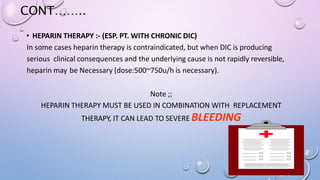
CONT……..
• HEPARIN THERAPY :- (ESP. PT. WITH CHRONIC DIC)
In some cases heparin therapy is contraindicated, but when DIC is producing
serious clinical consequences and the underlying cause is not rapidly reversible,
heparin may be Necessary (dose:500~750u/h is necessary).
Note ;;
HEPARIN THERAPY MUST BE USED IN COMBINATION WITH REPLACEMENT
THERAPY, IT CAN LEAD TO SEVERE BLEEDING
CONT………
1-Acute DIC:- (depend on the case) 2. Chronic DIC :- (depend on the case )
 Without bleeding or evidence of ischemia:-
-No treatment
 With bleeding:-
1-Blood components as needed
2-Fresh frozen plasma
3 Cryoprecipitate
4 Platelet transfusions
 With ischemia:-
-Anticoagulants after bleeding risk is corrected
with blood products
 Without thromboembolism:-
-No specific therapy needed, but prophylactic
drugs (eg, low-dose heparin, low-molecular-
weight heparin) may be used for patients at
high risk for formation of thrombosis.
 With thromboembolism:-
- Heparin or low-molecular-weight heparin, trial of
warfarin sodium (Coumadin). (If warfarin is
unsuccessful, long-term use of low- molecular-
weight heparin may be helpful.)
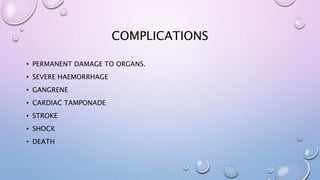
COMPLICATIONS
• PERMANENT DAMAGE TO ORGANS.
• SEVERE HAEMORRHAGE
• GANGRENE
• CARDIAC TAMPONADE
• STROKE
• SHOCK
• DEATH
PROGNOSIS OF DISSEMINATED
INTRAVASCULAR COAGULATION
• The prognosis of the disease is very variable depending
on the cause and extent of thrombosis.
• An overall ‘poor prognosis’ is associated with dic. 10–50
% of people die as a result of DIC. Sepsis-related deaths
are more common than trauma-related DIC.
Dic ppt
Dic ppt

Dic ppt

  • 1.
    CHILDREN MUST BETAUGHT HOW TO THINK, NOT WHAT TO THINK.”
  • 2.
    “ ” PRESENTED BY : SAMRITISHARMA MSC NURSING 2ND YEAR (CHN)
  • 3.
    BASICS TO UNDERSTANDTHE DISEASE CONDITION • DISSEMINATED Means wide spread • INTRAVASCULAR Means with in the vessels • COAGULATION Means the process by which a blood clot is formed.
  • 4.
    INTRODUCTION • Disseminated intravascularcoagulation (DIC) is a rare but serious condition that causes abnormal blood clotting throughout the body’s blood vessels.
  • 5.
    CONT………. • It isan Thrombohemorrhagic disorder. • So there are two phases in this disorder i.e 1. Thrombotic phase 2. Hemorrhagic phase
  • 6.
    CONT…… • Disseminated intravascularcoagulation (DIC) is a serious medical disorder in which multiple clots are formed that can lead to permanent end-organ damage. • Systemic activation of the blood coagulation occurs that results in the generation and the deposition of excess fibrin. This causes the blockage of blood vessels by the thrombi.
  • 7.
    CONT……… • DIC isalso known as Consumption coagulopathy increase clot formation increase consumption of C. factors and platelets deficiency of C. factor and platelets prevent clot formation increase bleeding
  • 8.
    ANOTHER REASON FORABNORMAL BLEEDING • It is due to plasmin activation,,,,,, because it destroy clotting factor and leads to bleeding
  • 9.
    DEFINITION • DISSEMINATED INTRAVASCULARCOAGULATION (DIC) IS A SERIOUS DISORDER IN WHICH THE PROTEINS THAT CONTROL BLOOD CLOTTING BECOME OVERACTIVE.
  • 10.
    TYPES OF DIC •ACUTE DIC • CHRONIC DIC
  • 11.
    ACUTE DIC • Ithappened rapidly, the coagulopathy is dominant and major symptoms are bleeding and Shock, mainly seen in severe infection • An explosive generation of thrombin diminish clotting factors and platelets and activates the fibrinolytic system. Bleeding into the subcutaneous tissues, skin, and mucous membranes occurs, along with occlusion of blood vessels caused by fibrin in the microcirculation.
  • 12.
    CHRONIC DIC It happenedslowly and last several weeks, thrombosis and clotting may predominate ,mainly seen in cancer.  Process is the same, but it is less explosive. Usually there is time for compensatory responses to take
  • 13.
    CAUSES • Injury • Infectiousdisease 31%~43% • cancer 24%~34% • Obstetric complications 4%~12% • severe tissue injury 1%~5% • systemic disease
  • 14.
    RISK FACTORS • Cancer,especially certain types of leukemia • Inflammation of the pancreas • Infection in the blood, especially by bacteria or fungus • Liver disease
  • 15.
    CONT…….. • Recent surgery •Severe tissue injury (as in burns and head injury) • Large hemangioma (a blood vessel that is not formed properly)
  • 16.
    PATHOPHYSIOLOGY • Disseminated intravascularcoagulation occurs when the first stages of the coagulation process is abnormally stimulated. • Although no well-defined sequence of events occurs, two distinct phase can be identified or two mechanism are there.
  • 17.
    FIRST • When theclotting mechanism is triggered in the circulation, • Thrombin is generated in greater amounts that can be neutralized by the body • As a result, there is rapid conversion of fibrinogen to fibrin, with aggregation and destruction of platelets. • If local and wide-spread fibrin deposition in blood vessels take place, obstruction and eventual necrosis of tissues occur.
  • 18.
    SECOND • If Fibrinolyticmechanism is activated • Causing extensive destruction of clotting factors, • The child is prone to uncontrollable hemorrhage into vital organs. • An additional complication is damage and hemolysis of RBCs
  • 19.
    SYMPTOMS OF DIC SYMPTOMSOF DIC MAY INCLUDE ANY OF THE FOLLOWING: • BLEEDING, FROM MANY SITES IN THE BODY • BLOOD CLOTS • BRUISING • DROP IN BLOOD PRESSURE • SHORTNESS OF BREATH • CONFUSION, MEMORY LOSS OR CHANGE OF BEHAVIOR • FEVER
  • 20.
    DIAGNOSTIC EVALUATION • Thereare three components of the diagnostic workup. The detailed history, physical examination, and laboratory investigations are done. • Physical examination is the most important step. The treatment is started on the basis of positive physical signs, while the results of the laboratory investigations are awaited.
  • 21.
    CONT……. • DIC isa life-threatening condition and immediate treatment is started without any delay. The signs to look for during the examination are: • Signs of hemorrhage • Signs of localized thrombosis • Altered consciousness • Focal neurological deficits • Hypotension and tachycardia
  • 22.
    CONT……. • Signs ofARDS (acute respiratory distress) • Haematuria • Oliguria • Purpura • Cyanosis • Skin necrosis
  • 23.
    LABORATORY INVESTIGATIONS Tests Abnormality •Platelet count • Fibrin degradation product (FDP) • Factor assay • Prothrombin time (PT) • Activated PTT • Thrombin time • Fibrinogen • D-dimer • Anti-thrombin • Decreased • Increased • Decreased • Prolonged • Prolonged • Prolonged • Decreased • Increased • Decreased
  • 24.
    TREATMENT OF DISSEMINATEDINTRAVASCULAR COAGULATION • IDENTIFY AND TREAT THE UNDERLYING CAUSE. The primary focus should be the diagnosis and treatment of the underlying disorder that has given rise to DIC. • REPLACEMENT THERAPY. Administer fresh frozen plasma: the dose is 10–15 ml/kg and it will improve the clotting factor activity by 10–15 % Platelet transfusion should be used to maintain a platelet count greater than 30000/μl, and 50000/μl.
  • 25.
    CONT…….. • HEPARIN THERAPY:- (ESP. PT. WITH CHRONIC DIC) In some cases heparin therapy is contraindicated, but when DIC is producing serious clinical consequences and the underlying cause is not rapidly reversible, heparin may be Necessary (dose:500~750u/h is necessary). Note ;; HEPARIN THERAPY MUST BE USED IN COMBINATION WITH REPLACEMENT THERAPY, IT CAN LEAD TO SEVERE BLEEDING
  • 26.
    CONT……… 1-Acute DIC:- (dependon the case) 2. Chronic DIC :- (depend on the case )  Without bleeding or evidence of ischemia:- -No treatment  With bleeding:- 1-Blood components as needed 2-Fresh frozen plasma 3 Cryoprecipitate 4 Platelet transfusions  With ischemia:- -Anticoagulants after bleeding risk is corrected with blood products  Without thromboembolism:- -No specific therapy needed, but prophylactic drugs (eg, low-dose heparin, low-molecular- weight heparin) may be used for patients at high risk for formation of thrombosis.  With thromboembolism:- - Heparin or low-molecular-weight heparin, trial of warfarin sodium (Coumadin). (If warfarin is unsuccessful, long-term use of low- molecular- weight heparin may be helpful.)
  • 27.
    COMPLICATIONS • PERMANENT DAMAGETO ORGANS. • SEVERE HAEMORRHAGE • GANGRENE • CARDIAC TAMPONADE • STROKE • SHOCK • DEATH
  • 28.
    PROGNOSIS OF DISSEMINATED INTRAVASCULARCOAGULATION • The prognosis of the disease is very variable depending on the cause and extent of thrombosis. • An overall ‘poor prognosis’ is associated with dic. 10–50 % of people die as a result of DIC. Sepsis-related deaths are more common than trauma-related DIC.

Editor's Notes

  • #7 Fibrin: when tissue is damage result in bleeding, fibrinogen is converted at the wound into fibrin by action of thrombin, a clotting enzyme.
  • #12 Coagulopathy : impaired clot formation………..which may be cause due to reduce In level or absence of bloot clotting factors.
  • #22 Focal neurological deficit is problem with spinal cord, nerve or brain function . Afftect specific location such as left side of face right arm or even small areas of tongue
  • #23 Purpura;;;rash of purple spot caused by internal bleeding