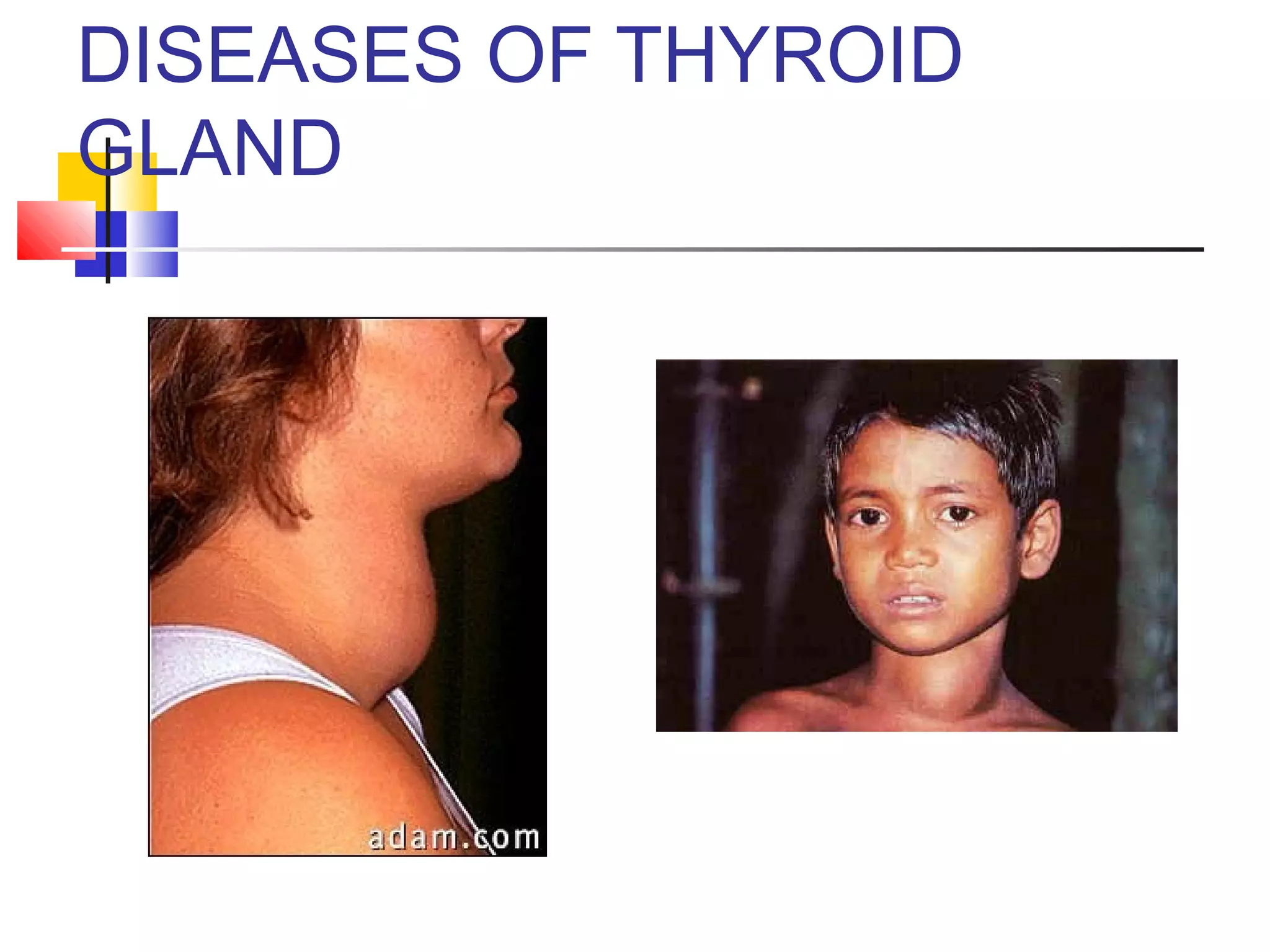

DISEASES OF THYROID 
GLAND
ANATOMY OF THYROID 
GLAND 
 The gland as seen from the front is more nearly the 
shape of a butterfly. 
 composed of 2 encapsulated lobes, one on either 
side of the trachea, connected by a thin isthmus. 
 The thyroid extending from the level of the fifth 
cervical vertebra down to the first thoracic. The gland 
varies from an H to a U shape, overlying the second 
to fourth tracheal rings.
TYPES OF THYROID 
DISORDERS 
 Hypofunction 
 Hyperfunction 
 Enlargements 
1. Diffuse __ termed goiter 
regardless of functional status. 
2. Nodule.
HISTORY 
signs & symptom of hypo or hyperthyroidism 
pressure symptom as dysphagia ,dysphonia 
,dyspnea &choking sensation 
Change in voice 
presence of mass and its duration 
,progression& pain. 
H/O exposure to radiation , diet , drugs 
Family hx.
PHYSICAL 
EXAMINATION 
 Inspection 
 palpation 
 percussion 
 Auscultation
CLASSIFICATION 
 Simple goiter (euthyroid) 
1. Diffuse hyperplastic: 
 physiological 
 Pubertal 
 pregnancy 
1. Multinodular goiter 
 Toxic 
1. Diffuse __ graves’ disease 
2. Multinodular 
3. Toxic adenoma
CLASSIFICATION- cont... 
 Neoplastic 
1- Bengin 
2- Malignant 
 Inflammatory 
1- Autoimmune : 
 Chronic lymphocytic thyroditis 
 Hashimoto’s disease 
2- Granulomatous 
 De quervain’s thyroditis 
3- Fibrosing 
 Riedel’s thyroiditis 
4- Infective 
 Acute (bacterial , viral thyroiditis ‘subacute thyroiditis’) 
 Chronic ( tuberculous , syphilitic ) 
 Other 
1- amyloid.
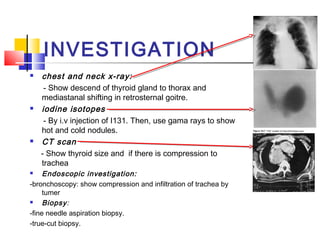
INVESTIGATION 
 chest and neck x-ray: 
- Show descend of thyroid gland to thorax and 
mediastanal shifting in retrosternal goitre. 
 iodine isotopes 
- By i.v injection of I131. Then, use gama rays to show 
hot and cold nodules. 
 CT scan 
- Show thyroid size and if there is compression to 
trachea 
 Endoscopic investigation: 
-bronchoscopy: show compression and infiltration of trachea by 
tumer 
 Biopsy: 
-fine needle aspiration biopsy. 
-true-cut biopsy.
TREATMENT OPTIONS 
 Medical Treatment 
 Surgical Treatment
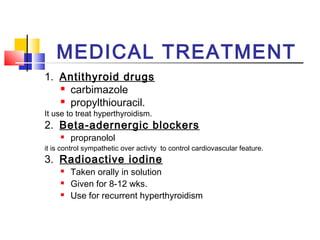
MEDICAL TREATMENT 
1. Antithyroid drugs 
 carbimazole 
 propylthiouracil. 
It use to treat hyperthyroidism. 
2. Beta-adernergic blockers 
 propranolol 
it is control sympathetic over activty to control cardiovascular feature. 
3. Radioactive iodine 
 Taken orally in solution 
 Given for 8-12 wks. 
 Use for recurrent hyperthyroidism
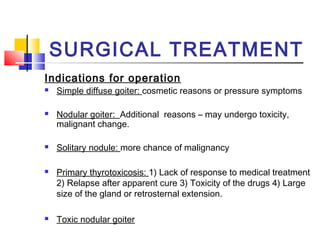
SURGICAL TREATMENT 
Indications for operation 
 Simple diffuse goiter: cosmetic reasons or pressure symptoms 
 Nodular goiter: Additional reasons – may undergo toxicity, 
malignant change. 
 Solitary nodule: more chance of malignancy 
 Primary thyrotoxicosis: 1) Lack of response to medical treatment 
2) Relapse after apparent cure 3) Toxicity of the drugs 4) Large 
size of the gland or retrosternal extension. 
 Toxic nodular goiter
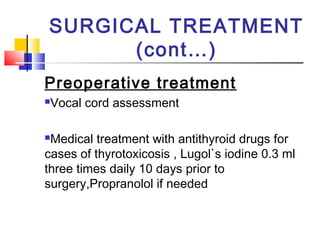
SURGICAL TREATMENT 
(cont…) 
Preoperative treatment 
Vocal cord assessment 
Medical treatment with antithyroid drugs for 
cases of thyrotoxicosis , Lugol`s iodine 0.3 ml 
three times daily 10 days prior to 
surgery,Propranolol if needed
SURGICAL TREATMENT 
(cont…) 
surgical procedures 
Subtotal thyroidectomy 
Hemithyroidectomy (lobectomy) 
Total thyroidectomy 
Excision of the isthmus
COMPLICATIONS OF 
THYROIDECTOMY 
 Haemorrhage 
 Respiratory obstruction 
 Recurrent laryngeal nerve 
paralysis 
 Hypoparathyroidism 
 Hypothyroidism 
 Recurrent thyrotoxicosis
Brief introduction on disorders of thyroid gland

Brief introduction on disorders of thyroid gland

  • 1.
  • 2.
    ANATOMY OF THYROID GLAND  The gland as seen from the front is more nearly the shape of a butterfly.  composed of 2 encapsulated lobes, one on either side of the trachea, connected by a thin isthmus.  The thyroid extending from the level of the fifth cervical vertebra down to the first thoracic. The gland varies from an H to a U shape, overlying the second to fourth tracheal rings.
  • 3.
    TYPES OF THYROID DISORDERS  Hypofunction  Hyperfunction  Enlargements 1. Diffuse __ termed goiter regardless of functional status. 2. Nodule.
  • 4.
    HISTORY signs &symptom of hypo or hyperthyroidism pressure symptom as dysphagia ,dysphonia ,dyspnea &choking sensation Change in voice presence of mass and its duration ,progression& pain. H/O exposure to radiation , diet , drugs Family hx.
  • 5.
    PHYSICAL EXAMINATION Inspection  palpation  percussion  Auscultation
  • 6.
    CLASSIFICATION  Simplegoiter (euthyroid) 1. Diffuse hyperplastic:  physiological  Pubertal  pregnancy 1. Multinodular goiter  Toxic 1. Diffuse __ graves’ disease 2. Multinodular 3. Toxic adenoma
  • 7.
    CLASSIFICATION- cont... Neoplastic 1- Bengin 2- Malignant  Inflammatory 1- Autoimmune :  Chronic lymphocytic thyroditis  Hashimoto’s disease 2- Granulomatous  De quervain’s thyroditis 3- Fibrosing  Riedel’s thyroiditis 4- Infective  Acute (bacterial , viral thyroiditis ‘subacute thyroiditis’)  Chronic ( tuberculous , syphilitic )  Other 1- amyloid.
  • 8.
    INVESTIGATION  chestand neck x-ray: - Show descend of thyroid gland to thorax and mediastanal shifting in retrosternal goitre.  iodine isotopes - By i.v injection of I131. Then, use gama rays to show hot and cold nodules.  CT scan - Show thyroid size and if there is compression to trachea  Endoscopic investigation: -bronchoscopy: show compression and infiltration of trachea by tumer  Biopsy: -fine needle aspiration biopsy. -true-cut biopsy.
  • 9.
    TREATMENT OPTIONS Medical Treatment  Surgical Treatment
  • 10.
    MEDICAL TREATMENT 1.Antithyroid drugs  carbimazole  propylthiouracil. It use to treat hyperthyroidism. 2. Beta-adernergic blockers  propranolol it is control sympathetic over activty to control cardiovascular feature. 3. Radioactive iodine  Taken orally in solution  Given for 8-12 wks.  Use for recurrent hyperthyroidism
  • 11.
    SURGICAL TREATMENT Indicationsfor operation  Simple diffuse goiter: cosmetic reasons or pressure symptoms  Nodular goiter: Additional reasons – may undergo toxicity, malignant change.  Solitary nodule: more chance of malignancy  Primary thyrotoxicosis: 1) Lack of response to medical treatment 2) Relapse after apparent cure 3) Toxicity of the drugs 4) Large size of the gland or retrosternal extension.  Toxic nodular goiter
  • 12.
    SURGICAL TREATMENT (cont…) Preoperative treatment Vocal cord assessment Medical treatment with antithyroid drugs for cases of thyrotoxicosis , Lugol`s iodine 0.3 ml three times daily 10 days prior to surgery,Propranolol if needed
  • 13.
    SURGICAL TREATMENT (cont…) surgical procedures Subtotal thyroidectomy Hemithyroidectomy (lobectomy) Total thyroidectomy Excision of the isthmus
  • 14.
    COMPLICATIONS OF THYROIDECTOMY  Haemorrhage  Respiratory obstruction  Recurrent laryngeal nerve paralysis  Hypoparathyroidism  Hypothyroidism  Recurrent thyrotoxicosis