By: Dr MD ASHFAQ AHMED
MODERATOR: Dr NITIN TENGLI
Sterilization the process by which an article, surface or
medium is freed of all living microorganisms either in
vegetative or spore state
Disinfection  it is the destruction or removal of all
pathogenic organisms, or organisms capable of giving rise
to infection
Antiseptics  chemical disinfectants used to prevent
infection by inhibiting the growth of bacteria on the skin
or mucous membrane
Asepsis  term used to indicate the prevention of
infection by inhibiting the growth of bacteria in wounds or
tissues
BASIC TERMINOLOGIES
Bactericidal agents  kill bacteria
Bacteriostatic agents  prevents multiplication of
bacteria
Decontamination  article or area free from
contaminants that include microbial, chemical, radioactive
and other hazards
Cleaning  removing soil or dirt  reduces the
microbial burden  making sterilization more effective
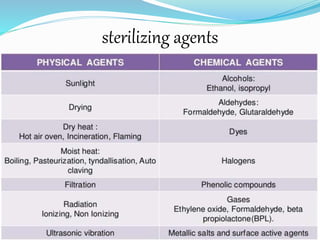
sterilizing agents
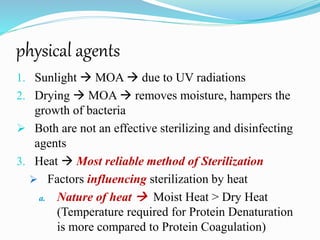
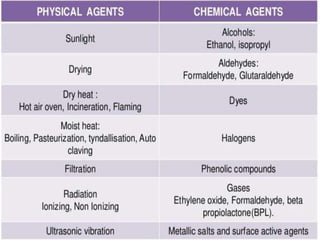
physical agents
1. Sunlight  MOA  due to UV radiations
2. Drying  MOA  removes moisture, hampers the
growth of bacteria
 Both are not an effective sterilizing and disinfecting
agents
3. Heat  Most reliable method of Sterilization
 Factors influencing sterilization by heat
a. Nature of heat  Moist Heat > Dry Heat
(Temperature required for Protein Denaturation
is more compared to Protein Coagulation)
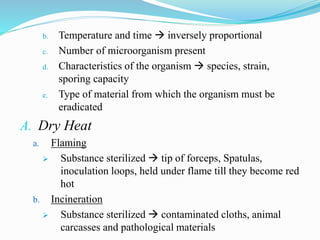
b. Temperature and time  inversely proportional
c. Number of microorganism present
d. Characteristics of the organism  species, strain,
sporing capacity
e. Type of material from which the organism must be
eradicated
A. Dry Heat
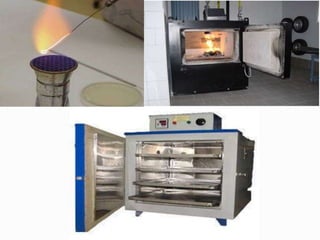
a. Flaming
 Substance sterilized  tip of forceps, Spatulas,
inoculation loops, held under flame till they become red
hot
b. Incineration
 Substance sterilized  contaminated cloths, animal
carcasses and pathological materials
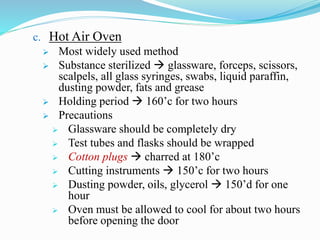
c. Hot Air Oven
 Most widely used method
 Substance sterilized  glassware, forceps, scissors,
scalpels, all glass syringes, swabs, liquid paraffin,
dusting powder, fats and grease
 Holding period  160’c for two hours
 Precautions
 Glassware should be completely dry
 Test tubes and flasks should be wrapped
 Cotton plugs  charred at 180’c
 Cutting instruments  150’c for two hours
 Dusting powder, oils, glycerol  150’d for one
hour
 Oven must be allowed to cool for about two hours
before opening the door
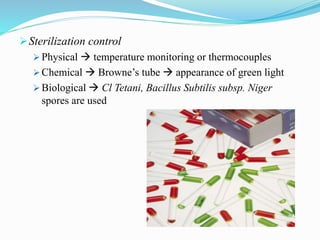
Sterilization control
 Physical  temperature monitoring or thermocouples
 Chemical  Browne’s tube  appearance of green light
 Biological  Cl Tetani, Bacillus Subtilis subsp. Niger
spores are used
B. Moist Heat
1. Temperature below 100’c
 Pasteurization of milk
 Holder’s method  63’c for 30 min
 Flash method  72’c for 15-20 sec followed by rapid
cooling below 13’c
 Vaccines  vaccine bath for 60’c for one hour
 Serum or body fluids  56’c for one hour
2. Temperature at 100’c
 Boiling  not a recommended method for
sterilization of instruments, can only be regarded as a
means of disinfection
Steam at atmospheric pressure  sterilization of
culture media, holding period 90 min but
 For media containing sugar/gelatin  100’c for
20 min on three successive days 
Tyndallisation or intermittent sterilisation
 Steam under pressure (AUTOCLAVE) 
 Principle  when steam comes in contact with a
cooler surface it condenses to water and gives up
its latent heat to that surface
 Temperature  108’c to 147’c
 Substances sterilized  dressings, gowns, gloves,
instruments, laboratory ware, media
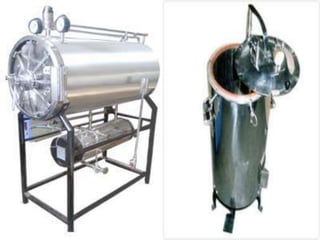
 Types of autoclave
 Gravity displacement autoclave
 Pre vacuum type
 Vertical or Horizontal type
 Mechanism
 Loading  Closing  Air removal  Steam exposure 
Holding  Exhaust  Drying  Unloading
 Temperature  121’c
 Chamber pressure  15 lb/sq inch
 Holding time  15 min
 Flash sterilization  132’c at 30 lbs for 3 min
Precautions
The tap should be opened only after pressure inside
the chamber becomes equal to atmospheric pressure
(risk of explosion)
Sterilization control
Physical  Temperature monitoring and
thermocouples
Chemical  Browne’s tube (green spot)
Biological  Bacillus stearothermophilus spores
are used
4. Filtration
 Substance sterilized  sera, sugars, antibiotic solutions, sterilization of hydatid
fluid
 Types 
1. Candle filters  purification of water for drinking purpose
2. Membrane filters  sterilisation and sterility testing, production of solutions
for parenteral use
3. Asbestos filter
4. Sintered glass filters
5. Radiation
 Non-Ionizing radiation
 Infrared radiation  rapid mass sterilization of syringes and catheters
 UV radiation  disinfection of entryways, OT and laboratories
 Ionizing radiation/cold sterilization
 Sterilization of disposable items like plastic syringes, swabs, cannulas,
catheters etc
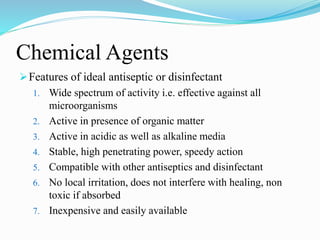
Chemical Agents
Features of ideal antiseptic or disinfectant
1. Wide spectrum of activity i.e. effective against all
microorganisms
2. Active in presence of organic matter
3. Active in acidic as well as alkaline media
4. Stable, high penetrating power, speedy action
5. Compatible with other antiseptics and disinfectant
6. No local irritation, does not interfere with healing, non
toxic if absorbed
7. Inexpensive and easily available
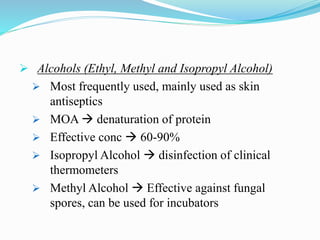
 Alcohols (Ethyl, Methyl and Isopropyl Alcohol)
 Most frequently used, mainly used as skin
antiseptics
 MOA  denaturation of protein
 Effective conc  60-90%
 Isopropyl Alcohol  disinfection of clinical
thermometers
 Methyl Alcohol  Effective against fungal
spores, can be used for incubators
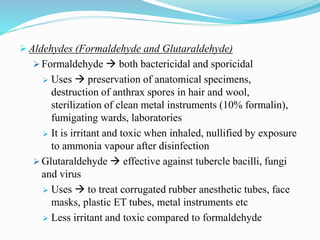
 Aldehydes (Formaldehyde and Glutaraldehyde)
 Formaldehyde  both bactericidal and sporicidal
 Uses  preservation of anatomical specimens,
destruction of anthrax spores in hair and wool,
sterilization of clean metal instruments (10% formalin),
fumigating wards, laboratories
 It is irritant and toxic when inhaled, nullified by exposure
to ammonia vapour after disinfection
 Glutaraldehyde  effective against tubercle bacilli, fungi
and virus
 Uses  to treat corrugated rubber anesthetic tubes, face
masks, plastic ET tubes, metal instruments etc
 Less irritant and toxic compared to formaldehyde
Dyes  used in skin antiseptics
Aniline dyes
 Includes brilliant green, malachite green and crystal
violet
 Active against Gram positive > Gram negative
 No activity against tubercle bacilli (used in LJ
medium)
 Non irritant, non toxic but inhibited by pus
 Use  selective agents in culture media
Acridine dyes
 Includes proflavine, Acriflavine, Euflavine
 Impregnated in gauze and released in moist
environment
Halogens
 Used as a skin disinfectant
 Active against tubercle bacilli and viruses
 Chlorine  used as disinfectant in water supplies,
swimming pools
Phenols
 Include Lysol, Cresol, Chlorhexidine
 Aqueous solution are used in treatment of wounds
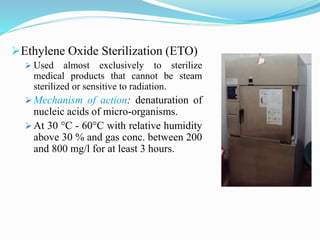
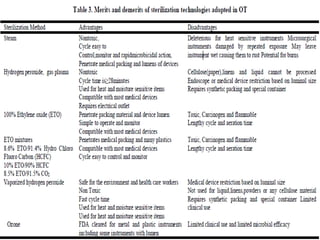
Ethylene Oxide Sterilization (ETO)
 Used almost exclusively to sterilize
medical products that cannot be steam
sterilized or sensitive to radiation.
 Mechanism of action: denaturation of
nucleic acids of micro-organisms.
 At 30 °C - 60°C with relative humidity
above 30 % and gas conc. between 200
and 800 mg/l for at least 3 hours.
 Ethylene oxide is a colorless liquid with a boiling point of 10.7
°C.
 Highly penetrating gas with sweet ethereal smell.
 Highly inflammable & in conc. greater than 3%, highly
explosive.
 By mixing with inert gases such as CFC or CO2, explosive
tendency is eliminated.
 Plastics, rubber & photographic equipments can be sterilized
by this method.
 Also used for mass sterilization of disposable items, plastic
syringes, needles, catheters, blades etc.
Disadvantages
 – Lengthy cycle time
 – High Cost
 – Potential hazards to patients & staff
Advantage:
 Can sterilize heat or moisture sensitive medical
equipments.
Various sterilization techniques for
instruments used in OT
 For forceps, scissors, scalpels, all glass syringes, swabs 
HOT AIR OVEN IS USED
 For dressings, gowns, gloves, instruments, laboratory ware 
AUTOCLAVE IS USED
 For production of solutions for parenteral use  membrane
filters are used
 For rapid mass sterilization of syringes and catheters
Infrared radiation
 For disinfection of entryways, OT and laboratories UV
radiation
 For Sterilization of disposable items like plastic syringes,
swabs, cannulas, catheters  Ionizing radiation/cold
sterilization
STERILIZATION OF OPERATION THEATRE
Basic principles
 All materials that are to be used in OT should be sterile
 Instrument sterilization should be done
 One night before or
 Immediately before operation
 Once the instruments are removed from the sterile wrap
 Either use it or discard it
 Only the top surface of the draped table is considered sterile
 Sterile packages should be laid in dry area, any wet area
should be covered with dry drape
 Precautions
 Skin shaving, head caps and masks
 Proper scrubbing of hand and arms
 Dry the hands with sterile towel
 A sponge is used only once
 After skin incision the blade/knife should be kept isolated
from other items
 Should not talk to patient except when essential (respiratory
tract is a source of infection)
 Doors should be kept close
 Temperature  24c to 27c
 Ventilation
 1 change/hr  contamination reduced by 60%
 2 change/hr  contamination reduced by 86%
 10 change/hr  contamination reduced by 99%
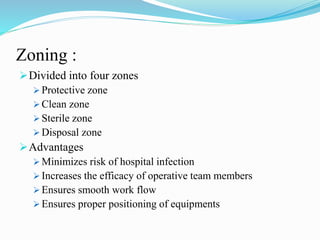
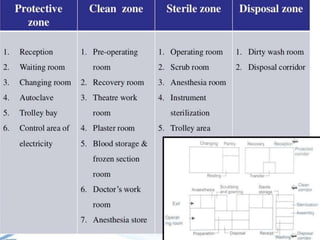
Zoning :
Divided into four zones
 Protective zone
 Clean zone
 Sterile zone
 Disposal zone
Advantages
 Minimizes risk of hospital infection
 Increases the efficacy of operative team members
 Ensures smooth work flow
 Ensures proper positioning of equipments
Sterilization and Disinfection of OT
Daily cleaning after the operation session is over
All surfaces should be cleaned with detergent and water
and wiped over phenol and are left to dry
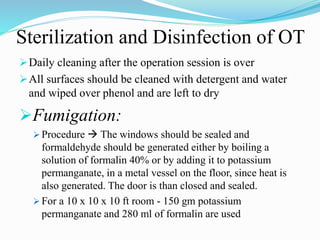
Fumigation:
 Procedure  The windows should be sealed and
formaldehyde should be generated either by boiling a
solution of formalin 40% or by adding it to potassium
permanganate, in a metal vessel on the floor, since heat is
also generated. The door is than closed and sealed.
 For a 10 x 10 x 10 ft room - 150 gm potassium
permanganate and 280 ml of formalin are used
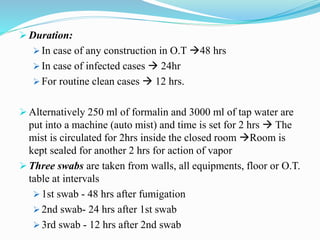
 Duration:
 In case of any construction in O.T 48 hrs
 In case of infected cases  24hr
 For routine clean cases  12 hrs.
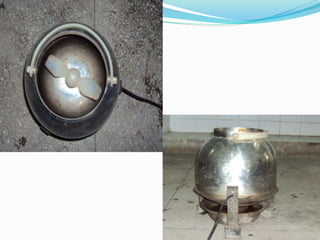
 Alternatively 250 ml of formalin and 3000 ml of tap water are
put into a machine (auto mist) and time is set for 2 hrs  The
mist is circulated for 2hrs inside the closed room Room is
kept sealed for another 2 hrs for action of vapor
 Three swabs are taken from walls, all equipments, floor or O.T.
table at intervals
 1st swab - 48 hrs after fumigation
 2nd swab- 24 hrs after 1st swab
 3rd swab - 12 hrs after 2nd swab
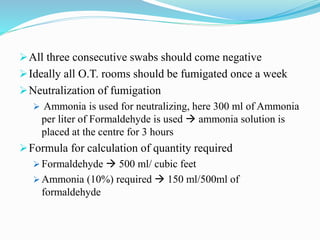
All three consecutive swabs should come negative
Ideally all O.T. rooms should be fumigated once a week
Neutralization of fumigation
 Ammonia is used for neutralizing, here 300 ml of Ammonia
per liter of Formaldehyde is used  ammonia solution is
placed at the centre for 3 hours
Formula for calculation of quantity required
 Formaldehyde  500 ml/ cubic feet
 Ammonia (10%) required  150 ml/500ml of
formaldehyde
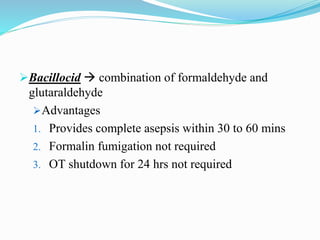
Bacillocid  combination of formaldehyde and
glutaraldehyde
Advantages
1. Provides complete asepsis within 30 to 60 mins
2. Formalin fumigation not required
3. OT shutdown for 24 hrs not required
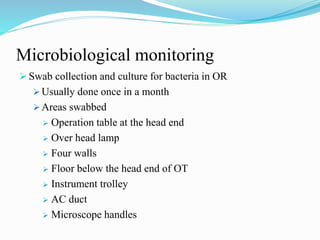
Microbiological monitoring
 Swab collection and culture for bacteria in OR
 Usually done once in a month
 Areas swabbed
 Operation table at the head end
 Over head lamp
 Four walls
 Floor below the head end of OT
 Instrument trolley
 AC duct
 Microscope handles
Media for culture
 Aerobic  chocolate agar
 Anaerobic  Robertson’s cooked meat medium
For quality of air in OT
 Settle plate method is used  once a month
 One plate of blood agar and sabouraud dextrose agar is
placed in the centre of the OR close to operation table for 30
min
Incubation
 Blood agar  at 37’c for 48 hours
 SDA  27’c for 7 days
Inference
 Bacterial colony count in blood agar > 10 per plate and/or
 Fungal colony count in SDA > 1 per plate is unacceptable
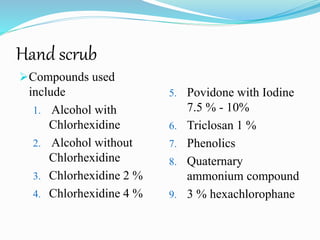
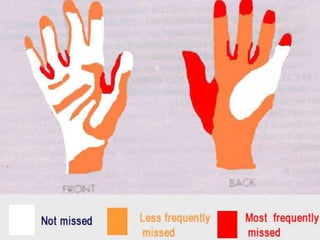
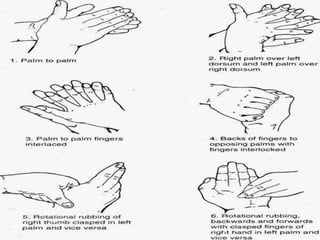
Hand scrub
Compounds used
include
1. Alcohol with
Chlorhexidine
2. Alcohol without
Chlorhexidine
3. Chlorhexidine 2 %
4. Chlorhexidine 4 %
5. Povidone with Iodine
7.5 % - 10%
6. Triclosan 1 %
7. Phenolics
8. Quaternary
ammonium compound
9. 3 % hexachlorophane
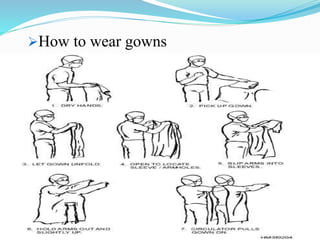
How to wear gowns
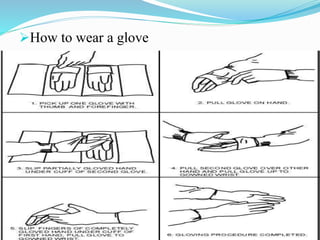
How to wear a glove
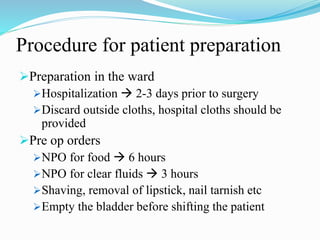
Procedure for patient preparation
Preparation in the ward
Hospitalization  2-3 days prior to surgery
Discard outside cloths, hospital cloths should be
provided
Pre op orders
NPO for food  6 hours
NPO for clear fluids  3 hours
Shaving, removal of lipstick, nail tarnish etc
Empty the bladder before shifting the patient
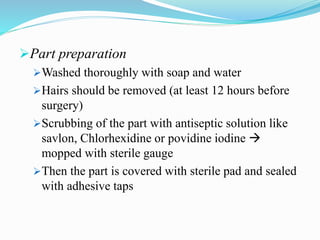
Part preparation
Washed thoroughly with soap and water
Hairs should be removed (at least 12 hours before
surgery)
Scrubbing of the part with antiseptic solution like
savlon, Chlorhexidine or povidine iodine 
mopped with sterile gauge
Then the part is covered with sterile pad and sealed
with adhesive taps
Preparation of surgical site
Done for 5 min
Procedure
 Scrub should begin in the center of the area to be
prepared & then move outwards (minimizes the
contamination from unscrubbed area)
 Once central part is prepared, then it should not
be touched again with same sponge
 Start in middle & extend towards periphery
Draping of the patient  isolation of the surgical
area from other parts of the body that have not been
prepared for surgery
At the end of operation
 Check for proper wound closure and cessation of
hemorrhage
 Confirm the completion of all surgical plan
 Report the anesthetist regarding the completion of procedure
 Write operative notes
 Shift the patient on a trolley equipped with oxygen cylinder
and mask assisted by 2 persons
 Keep the patient in recovery room and recovery position
(under the observation of anesthetist)
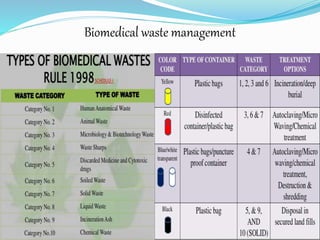
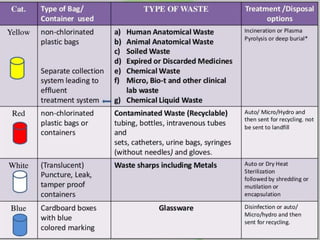
Biomedical waste management
Sterilizaton and disinfection

Sterilizaton and disinfection

  • 1.
    By: Dr MDASHFAQ AHMED MODERATOR: Dr NITIN TENGLI
  • 2.
    Sterilization the processby which an article, surface or medium is freed of all living microorganisms either in vegetative or spore state Disinfection  it is the destruction or removal of all pathogenic organisms, or organisms capable of giving rise to infection Antiseptics  chemical disinfectants used to prevent infection by inhibiting the growth of bacteria on the skin or mucous membrane Asepsis  term used to indicate the prevention of infection by inhibiting the growth of bacteria in wounds or tissues BASIC TERMINOLOGIES
  • 3.
    Bactericidal agents kill bacteria Bacteriostatic agents  prevents multiplication of bacteria Decontamination  article or area free from contaminants that include microbial, chemical, radioactive and other hazards Cleaning  removing soil or dirt  reduces the microbial burden  making sterilization more effective
  • 4.
  • 5.
    physical agents 1. Sunlight MOA  due to UV radiations 2. Drying  MOA  removes moisture, hampers the growth of bacteria  Both are not an effective sterilizing and disinfecting agents 3. Heat  Most reliable method of Sterilization  Factors influencing sterilization by heat a. Nature of heat  Moist Heat > Dry Heat (Temperature required for Protein Denaturation is more compared to Protein Coagulation)
  • 6.
    b. Temperature andtime  inversely proportional c. Number of microorganism present d. Characteristics of the organism  species, strain, sporing capacity e. Type of material from which the organism must be eradicated A. Dry Heat a. Flaming  Substance sterilized  tip of forceps, Spatulas, inoculation loops, held under flame till they become red hot b. Incineration  Substance sterilized  contaminated cloths, animal carcasses and pathological materials
  • 7.
    c. Hot AirOven  Most widely used method  Substance sterilized  glassware, forceps, scissors, scalpels, all glass syringes, swabs, liquid paraffin, dusting powder, fats and grease  Holding period  160’c for two hours  Precautions  Glassware should be completely dry  Test tubes and flasks should be wrapped  Cotton plugs  charred at 180’c  Cutting instruments  150’c for two hours  Dusting powder, oils, glycerol  150’d for one hour  Oven must be allowed to cool for about two hours before opening the door
  • 9.
    Sterilization control  Physical temperature monitoring or thermocouples  Chemical  Browne’s tube  appearance of green light  Biological  Cl Tetani, Bacillus Subtilis subsp. Niger spores are used
  • 10.
    B. Moist Heat 1.Temperature below 100’c  Pasteurization of milk  Holder’s method  63’c for 30 min  Flash method  72’c for 15-20 sec followed by rapid cooling below 13’c  Vaccines  vaccine bath for 60’c for one hour  Serum or body fluids  56’c for one hour 2. Temperature at 100’c  Boiling  not a recommended method for sterilization of instruments, can only be regarded as a means of disinfection
  • 11.
    Steam at atmosphericpressure  sterilization of culture media, holding period 90 min but  For media containing sugar/gelatin  100’c for 20 min on three successive days  Tyndallisation or intermittent sterilisation  Steam under pressure (AUTOCLAVE)   Principle  when steam comes in contact with a cooler surface it condenses to water and gives up its latent heat to that surface  Temperature  108’c to 147’c  Substances sterilized  dressings, gowns, gloves, instruments, laboratory ware, media
  • 12.
     Types ofautoclave  Gravity displacement autoclave  Pre vacuum type  Vertical or Horizontal type  Mechanism  Loading  Closing  Air removal  Steam exposure  Holding  Exhaust  Drying  Unloading  Temperature  121’c  Chamber pressure  15 lb/sq inch  Holding time  15 min  Flash sterilization  132’c at 30 lbs for 3 min
  • 14.
    Precautions The tap shouldbe opened only after pressure inside the chamber becomes equal to atmospheric pressure (risk of explosion) Sterilization control Physical  Temperature monitoring and thermocouples Chemical  Browne’s tube (green spot) Biological  Bacillus stearothermophilus spores are used
  • 15.
    4. Filtration  Substancesterilized  sera, sugars, antibiotic solutions, sterilization of hydatid fluid  Types  1. Candle filters  purification of water for drinking purpose 2. Membrane filters  sterilisation and sterility testing, production of solutions for parenteral use 3. Asbestos filter 4. Sintered glass filters 5. Radiation  Non-Ionizing radiation  Infrared radiation  rapid mass sterilization of syringes and catheters  UV radiation  disinfection of entryways, OT and laboratories  Ionizing radiation/cold sterilization  Sterilization of disposable items like plastic syringes, swabs, cannulas, catheters etc
  • 17.
    Chemical Agents Features ofideal antiseptic or disinfectant 1. Wide spectrum of activity i.e. effective against all microorganisms 2. Active in presence of organic matter 3. Active in acidic as well as alkaline media 4. Stable, high penetrating power, speedy action 5. Compatible with other antiseptics and disinfectant 6. No local irritation, does not interfere with healing, non toxic if absorbed 7. Inexpensive and easily available
  • 18.
     Alcohols (Ethyl,Methyl and Isopropyl Alcohol)  Most frequently used, mainly used as skin antiseptics  MOA  denaturation of protein  Effective conc  60-90%  Isopropyl Alcohol  disinfection of clinical thermometers  Methyl Alcohol  Effective against fungal spores, can be used for incubators
  • 19.
     Aldehydes (Formaldehydeand Glutaraldehyde)  Formaldehyde  both bactericidal and sporicidal  Uses  preservation of anatomical specimens, destruction of anthrax spores in hair and wool, sterilization of clean metal instruments (10% formalin), fumigating wards, laboratories  It is irritant and toxic when inhaled, nullified by exposure to ammonia vapour after disinfection  Glutaraldehyde  effective against tubercle bacilli, fungi and virus  Uses  to treat corrugated rubber anesthetic tubes, face masks, plastic ET tubes, metal instruments etc  Less irritant and toxic compared to formaldehyde
  • 20.
    Dyes  usedin skin antiseptics Aniline dyes  Includes brilliant green, malachite green and crystal violet  Active against Gram positive > Gram negative  No activity against tubercle bacilli (used in LJ medium)  Non irritant, non toxic but inhibited by pus  Use  selective agents in culture media Acridine dyes  Includes proflavine, Acriflavine, Euflavine  Impregnated in gauze and released in moist environment
  • 21.
    Halogens  Used asa skin disinfectant  Active against tubercle bacilli and viruses  Chlorine  used as disinfectant in water supplies, swimming pools Phenols  Include Lysol, Cresol, Chlorhexidine  Aqueous solution are used in treatment of wounds
  • 22.
    Ethylene Oxide Sterilization(ETO)  Used almost exclusively to sterilize medical products that cannot be steam sterilized or sensitive to radiation.  Mechanism of action: denaturation of nucleic acids of micro-organisms.  At 30 °C - 60°C with relative humidity above 30 % and gas conc. between 200 and 800 mg/l for at least 3 hours.
  • 23.
     Ethylene oxideis a colorless liquid with a boiling point of 10.7 °C.  Highly penetrating gas with sweet ethereal smell.  Highly inflammable & in conc. greater than 3%, highly explosive.  By mixing with inert gases such as CFC or CO2, explosive tendency is eliminated.  Plastics, rubber & photographic equipments can be sterilized by this method.  Also used for mass sterilization of disposable items, plastic syringes, needles, catheters, blades etc.
  • 24.
    Disadvantages  – Lengthycycle time  – High Cost  – Potential hazards to patients & staff Advantage:  Can sterilize heat or moisture sensitive medical equipments.
  • 25.
    Various sterilization techniquesfor instruments used in OT  For forceps, scissors, scalpels, all glass syringes, swabs  HOT AIR OVEN IS USED  For dressings, gowns, gloves, instruments, laboratory ware  AUTOCLAVE IS USED  For production of solutions for parenteral use  membrane filters are used  For rapid mass sterilization of syringes and catheters Infrared radiation  For disinfection of entryways, OT and laboratories UV radiation  For Sterilization of disposable items like plastic syringes, swabs, cannulas, catheters  Ionizing radiation/cold sterilization
  • 26.
    STERILIZATION OF OPERATIONTHEATRE Basic principles  All materials that are to be used in OT should be sterile  Instrument sterilization should be done  One night before or  Immediately before operation  Once the instruments are removed from the sterile wrap  Either use it or discard it  Only the top surface of the draped table is considered sterile  Sterile packages should be laid in dry area, any wet area should be covered with dry drape
  • 27.
     Precautions  Skinshaving, head caps and masks  Proper scrubbing of hand and arms  Dry the hands with sterile towel  A sponge is used only once  After skin incision the blade/knife should be kept isolated from other items  Should not talk to patient except when essential (respiratory tract is a source of infection)  Doors should be kept close  Temperature  24c to 27c  Ventilation  1 change/hr  contamination reduced by 60%  2 change/hr  contamination reduced by 86%  10 change/hr  contamination reduced by 99%
  • 28.
    Zoning : Divided intofour zones  Protective zone  Clean zone  Sterile zone  Disposal zone Advantages  Minimizes risk of hospital infection  Increases the efficacy of operative team members  Ensures smooth work flow  Ensures proper positioning of equipments
  • 30.
    Sterilization and Disinfectionof OT Daily cleaning after the operation session is over All surfaces should be cleaned with detergent and water and wiped over phenol and are left to dry Fumigation:  Procedure  The windows should be sealed and formaldehyde should be generated either by boiling a solution of formalin 40% or by adding it to potassium permanganate, in a metal vessel on the floor, since heat is also generated. The door is than closed and sealed.  For a 10 x 10 x 10 ft room - 150 gm potassium permanganate and 280 ml of formalin are used
  • 32.
     Duration:  Incase of any construction in O.T 48 hrs  In case of infected cases  24hr  For routine clean cases  12 hrs.  Alternatively 250 ml of formalin and 3000 ml of tap water are put into a machine (auto mist) and time is set for 2 hrs  The mist is circulated for 2hrs inside the closed room Room is kept sealed for another 2 hrs for action of vapor  Three swabs are taken from walls, all equipments, floor or O.T. table at intervals  1st swab - 48 hrs after fumigation  2nd swab- 24 hrs after 1st swab  3rd swab - 12 hrs after 2nd swab
  • 33.
    All three consecutiveswabs should come negative Ideally all O.T. rooms should be fumigated once a week Neutralization of fumigation  Ammonia is used for neutralizing, here 300 ml of Ammonia per liter of Formaldehyde is used  ammonia solution is placed at the centre for 3 hours Formula for calculation of quantity required  Formaldehyde  500 ml/ cubic feet  Ammonia (10%) required  150 ml/500ml of formaldehyde
  • 34.
    Bacillocid  combinationof formaldehyde and glutaraldehyde Advantages 1. Provides complete asepsis within 30 to 60 mins 2. Formalin fumigation not required 3. OT shutdown for 24 hrs not required
  • 36.
    Microbiological monitoring  Swabcollection and culture for bacteria in OR  Usually done once in a month  Areas swabbed  Operation table at the head end  Over head lamp  Four walls  Floor below the head end of OT  Instrument trolley  AC duct  Microscope handles
  • 37.
    Media for culture Aerobic  chocolate agar  Anaerobic  Robertson’s cooked meat medium For quality of air in OT  Settle plate method is used  once a month  One plate of blood agar and sabouraud dextrose agar is placed in the centre of the OR close to operation table for 30 min
  • 38.
    Incubation  Blood agar at 37’c for 48 hours  SDA  27’c for 7 days Inference  Bacterial colony count in blood agar > 10 per plate and/or  Fungal colony count in SDA > 1 per plate is unacceptable
  • 39.
    Hand scrub Compounds used include 1.Alcohol with Chlorhexidine 2. Alcohol without Chlorhexidine 3. Chlorhexidine 2 % 4. Chlorhexidine 4 % 5. Povidone with Iodine 7.5 % - 10% 6. Triclosan 1 % 7. Phenolics 8. Quaternary ammonium compound 9. 3 % hexachlorophane
  • 42.
  • 43.
  • 44.
    Procedure for patientpreparation Preparation in the ward Hospitalization  2-3 days prior to surgery Discard outside cloths, hospital cloths should be provided Pre op orders NPO for food  6 hours NPO for clear fluids  3 hours Shaving, removal of lipstick, nail tarnish etc Empty the bladder before shifting the patient
  • 45.
    Part preparation Washed thoroughlywith soap and water Hairs should be removed (at least 12 hours before surgery) Scrubbing of the part with antiseptic solution like savlon, Chlorhexidine or povidine iodine  mopped with sterile gauge Then the part is covered with sterile pad and sealed with adhesive taps
  • 46.
    Preparation of surgicalsite Done for 5 min Procedure  Scrub should begin in the center of the area to be prepared & then move outwards (minimizes the contamination from unscrubbed area)  Once central part is prepared, then it should not be touched again with same sponge  Start in middle & extend towards periphery Draping of the patient  isolation of the surgical area from other parts of the body that have not been prepared for surgery
  • 47.
    At the endof operation  Check for proper wound closure and cessation of hemorrhage  Confirm the completion of all surgical plan  Report the anesthetist regarding the completion of procedure  Write operative notes  Shift the patient on a trolley equipped with oxygen cylinder and mask assisted by 2 persons  Keep the patient in recovery room and recovery position (under the observation of anesthetist)
  • 48.