

Discussing Design :
The Art of Critique
Improving the conversation around design
IXDA NYC - Oct. 10th 2013
So, what is critique?
It’s laid out too much like [popular service]. We
should be different.
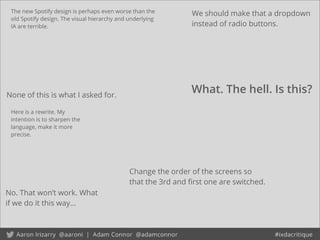
The new Spotify design is perhaps even worse than the
old Spotify design. The visual hierarchy and underlying
IA are terrible.
No. That won’t work. What
if we do it this way... It needs more flululululuh!!
The wireframes are still not answering our
problem and are not providing enough an
easier solution for the page.
Change the order of the screens so
that the 3rd and first one are switched.
It doesn't have enough spunk.
What kind of company shuts down a
much-loved service like Google Reader
but keeps the vegetative Google Plus?
We're disappointed in this solution. We're going to have our
own designers come up with one.
Looks ugly. Make it pretty.
What. The hell. Is this?
I would never use this. I don’t
like the layout.
We should make that a dropdown
instead of radio buttons.
None of this is what I asked for.
This is terrible. I have no idea
what the lines mean.
I like the paper form better.
I'm just not feeling it. I don't know what,
but it isn't right yet. Just needs to be
more innovative.
Make it look more
like SharePoint.
Here is a rewrite. My
intention is to sharpen the
language, make it more
precise.
The new Spotify design is perhaps even worse than the
old Spotify design. The visual hierarchy and underlying
IA are terrible.
No. That won’t work. What
if we do it this way...
Change the order of the screens so
that the 3rd and first one are switched.
What. The hell. Is this?
We should make that a dropdown
instead of radio buttons.
None of this is what I asked for.
Here is a rewrite. My
intention is to sharpen the
language, make it more
precise.
Critique is about critical thinking.
At their foundation is intent.
There are two facets to critique: giving and receiving.
Giving critique with the wrong intent is selfish.
Giving critique with the right intent is selfless.
Tips for giving critique
Use a filter.
Gather initial thoughts and reactions. Revisit them in the right context.
Tips for giving critique
Use a filter.
Gather initial thoughts and reactions. Revisit them in the right context.
Don’t assume.
Find out the reason behind thinking, constraints or other variables.
Tips for giving critique
Don’t invite yourself.
Get in touch and ask to chat about the design.
Use a filter.
Gather initial thoughts and reactions. Revisit them in the right context.
Don’t assume.
Find out the reason behind thinking, constraints or other variables.
Tips for giving critique
Don’t invite yourself.
Get in touch and ask to chat about the design.
Use a filter.
Gather initial thoughts and reactions. Revisit them in the right context.
Don’t assume.
Find out the reason behind thinking, constraints or other variables.
Lead with questions.
Show an interest in their process.
Tips for giving critique
Don’t invite yourself.
Get in touch and ask to chat about the design.
Use a filter.
Gather initial thoughts and reactions. Revisit them in the right context.
Don’t assume.
Find out the reason behind thinking, constraints or other variables.
Lead with questions.
Show an interest in their process.
Talk about strengths.
Critique isn’t just about the things that aren’t working.
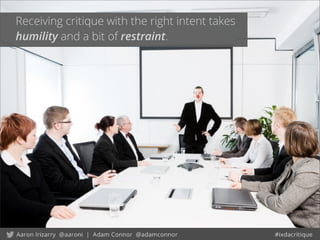
Receiving critique with the right intent takes
humility and a bit of restraint.
Tips for receiving critique
Remember the purpose.
Critique is about understanding and improvement, not judgement.
Tips for receiving critique
Remember the purpose.
Critique is about understanding and improvement, not judgement.
Listen and think before you talk back.
Do you understand what the critics are saying?
Tips for receiving critique
Remember the purpose.
Critique is about understanding and improvement, not judgement.
Listen and think before you talk back.
Do you understand what the critics are saying?
Participate.
Analyze your proposed solution with everyone else.
Tips for receiving critique
Remember the purpose.
Critique is about understanding and improvement, not judgement.
Listen and think before you talk back.
Do you understand what the critics are saying?
Participate.
Analyze your proposed solution with everyone else.
Set the right foundation.
Use knowledge and prior agreements to get everyone on the same page.
A framework for critique
What problem was the designer trying to solve or what
goal were they trying to achieve?
A framework for critique
What problem was the designer trying to solve or what
goal were they trying to achieve?
How did the designer try to solve that problem or achieve
that goal?
A framework for critique
How effective is what the designer did at solving the
problem or achieving the goal?
What problem was the designer trying to solve or what
goal were they trying to achieve?
How did the designer try to solve that problem or achieve
that goal?
A framework for critique
How effective is what the designer did at solving the
problem or achieving the goal?
What problem was the designer trying to solve or what
goal were they trying to achieve?
How did the designer try to solve that problem or achieve
that goal?
Why is or isn’t what the designer did effective?
More things to think about
Are there any problems the designer could or should
have solved, but didn’t?
More things to think about
Are there any problems the designer could or should
have solved, but didn’t?
Do any new problems arise as a result of the choices
the designer made?
More things to think about
Are there any problems the designer could or should
have solved, but didn’t?
Do any new problems arise as a result of the choices
the designer made?
These kinds of questions can be important to think about and
ask, but be prepared for them to be beyond the scope of the
designer’s work, and therefore not something to focus the
remainder your critique on.
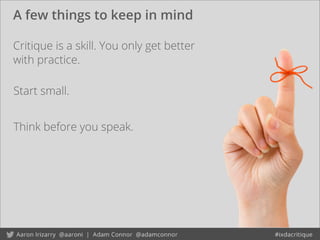
A few things to keep in mind
Critique is a skill. You only get better
with practice.
A few things to keep in mind
Critique is a skill. You only get better
with practice.
Start small.
A few things to keep in mind
Think before you speak.
Critique is a skill. You only get better
with practice.
Start small.
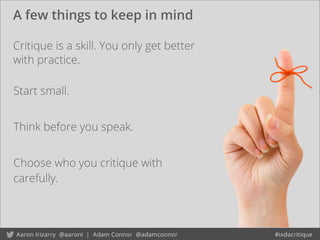
A few things to keep in mind
Choose who you critique with
carefully.
Think before you speak.
Critique is a skill. You only get better
with practice.
Start small.
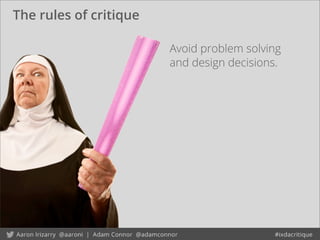
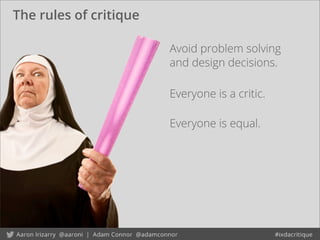
The rules of critique
Avoid problem solving
and design decisions.
The rules of critique
Avoid problem solving
and design decisions.
Everyone is a critic.
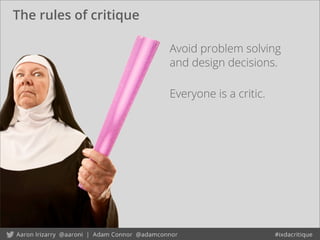
The rules of critique
Avoid problem solving
and design decisions.
Everyone is a critic.
Everyone is equal.
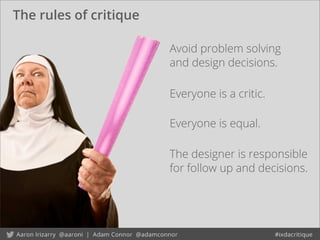
The rules of critique
Avoid problem solving
and design decisions.
The designer is responsible
for follow up and decisions.
Everyone is a critic.
Everyone is equal.
Who should
you invite?
Set the right foundation for good critique
Scenarios
Short narratives that the describe the desired behaviors, thoughts,
reactions, emotions, etc. of the user. Describes what happens, but not how.
Set the right foundation for good critique
Scenarios
Short narratives that the describe the desired behaviors, thoughts,
reactions, emotions, etc. of the user. Describes what happens, but not how.
Personas
User Archetypes that describe their average behaviors, goals, expectations,
knowledge, etc.
Set the right foundation for good critique
Goals
Desired, measurable outcomes of the user interacting with the
product or service. Can be user oriented, business oriented or both.
Scenarios
Short narratives that the describe the desired behaviors, thoughts,
reactions, emotions, etc. of the user. Describes what happens, but not how.
Personas
User Archetypes that describe their average behaviors, goals, expectations,
knowledge, etc.
Set the right foundation for good critique
Goals
Desired, measurable outcomes of the user interacting with the
product or service. Can be user oriented, business oriented or both.
Scenarios
Short narratives that the describe the desired behaviors, thoughts,
reactions, emotions, etc. of the user. Describes what happens, but not how.
Personas
User Archetypes that describe their average behaviors, goals, expectations,
knowledge, etc.
Principles
Desired qualities or characteristics of the solution. Describe what
happens, but not how.
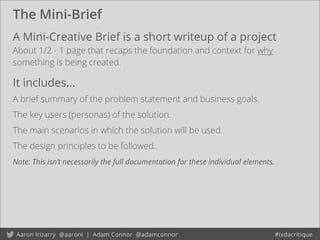
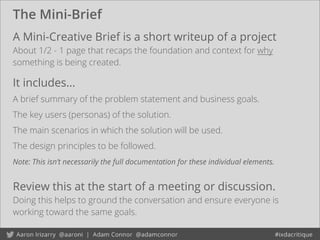
The Mini-Brief
The Mini-Brief
A Mini-Creative Brief is a short writeup of a project
About 1/2 - 1 page that recaps the foundation and context for why
something is being created.
The Mini-Brief
A Mini-Creative Brief is a short writeup of a project
About 1/2 - 1 page that recaps the foundation and context for why
something is being created.
It includes...
The Mini-Brief
A Mini-Creative Brief is a short writeup of a project
About 1/2 - 1 page that recaps the foundation and context for why
something is being created.
It includes...
A brief summary of the problem statement and business goals.
The Mini-Brief
A Mini-Creative Brief is a short writeup of a project
About 1/2 - 1 page that recaps the foundation and context for why
something is being created.
It includes...
A brief summary of the problem statement and business goals.
The key users (personas) of the solution.
The Mini-Brief
A Mini-Creative Brief is a short writeup of a project
About 1/2 - 1 page that recaps the foundation and context for why
something is being created.
It includes...
A brief summary of the problem statement and business goals.
The key users (personas) of the solution.
The main scenarios in which the solution will be used.
The Mini-Brief
A Mini-Creative Brief is a short writeup of a project
About 1/2 - 1 page that recaps the foundation and context for why
something is being created.
It includes...
A brief summary of the problem statement and business goals.
The key users (personas) of the solution.
The main scenarios in which the solution will be used.
The design principles to be followed.
The Mini-Brief
A Mini-Creative Brief is a short writeup of a project
About 1/2 - 1 page that recaps the foundation and context for why
something is being created.
It includes...
A brief summary of the problem statement and business goals.
The key users (personas) of the solution.
The main scenarios in which the solution will be used.
The design principles to be followed.
Note: This isn’t necessarily the full documentation for these individual elements.
The Mini-Brief
Review this at the start of a meeting or discussion.
Doing this helps to ground the conversation and ensure everyone is
working toward the same goals.
A Mini-Creative Brief is a short writeup of a project
About 1/2 - 1 page that recaps the foundation and context for why
something is being created.
It includes...
A brief summary of the problem statement and business goals.
The key users (personas) of the solution.
The main scenarios in which the solution will be used.
The design principles to be followed.
Note: This isn’t necessarily the full documentation for these individual elements.
Preparation & Kickoff
Facilitating critique
Critique Goals
Facilitating critique
Critique Goals
Active listening, question for clarity
Facilitating critique
Critique Goals
Round Robin
Active listening, question for clarity
Facilitating critique
Critique Goals
Round Robin
Direct Inquiry
Active listening, question for clarity
Facilitating critique
Critique Goals
Round Robin
Quotas
Direct Inquiry
Active listening, question for clarity
Facilitating critique
Critique Goals
Round Robin
Quotas
Direct Inquiry
Six Thinking Hats
Active listening, question for clarity
Facilitating critique
Critique Goals
Round Robin
Quotas
Direct Inquiry
Six Thinking Hats
Facilitators
Active listening, question for clarity
Dealing with difficult people
Set expectations at the beginning.
Dealing with difficult people
Set expectations at the beginning.
Make sure everyone understands critique.
Dealing with difficult people
Set expectations at the beginning.
Ask quiet people for feedback directly.
Make sure everyone understands critique.
Dealing with difficult people
Set expectations at the beginning.
Ask quiet people for feedback directly.
Refer back to personas, goals and principles.
Make sure everyone understands critique.
Dealing with difficult people
Set expectations at the beginning.
Ask quiet people for feedback directly.
Use laddering (The 5 Whys).
Refer back to personas, goals and principles.
Make sure everyone understands critique.
Dealing with difficult people
Set expectations at the beginning.
Ask quiet people for feedback directly.
Use laddering (The 5 Whys).
Refer back to personas, goals and principles.
Critique with people individually.
Make sure everyone understands critique.
What comes next?
Making critique part of your process
Standalone Critiques
Making critique part of your process
Design Reviews
Standalone Critiques
Making critique part of your process
Design Reviews
Standalone Critiques
Brainstorms and Collaborative Activities
Standalone critiques work well because they...
Provide an introduction to people unfamiliar with
critique.
Standalone critiques work well because they...
Provide an introduction to people unfamiliar with
critique.
Provide a safe(r) place to practice giving and receiving
feedback.
Standalone critiques work well because they...
Provide an introduction to people unfamiliar with
critique.
Provide a safe(r) place to practice giving and receiving
feedback.
Allow teams to focus feedback on specific goals, topics,
etc.
Standalone critiques work well because they...
Provide an introduction to people unfamiliar with
critique.
Provide a safe(r) place to practice giving and receiving
feedback.
Allow teams to focus feedback on specific goals, topics,
etc.
Increase the sense of collaboration in team members.
Two approaches: Impromptu and Scheduled
Standalone critiques work well because they...
Provide an introduction to people unfamiliar with
critique.
Provide a safe(r) place to practice giving and receiving
feedback.
Allow teams to focus feedback on specific goals, topics,
etc.
Increase the sense of collaboration in team members.
When can you have critiques ?
All of the time!
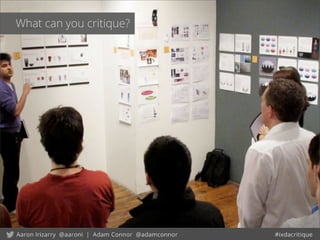
What can you critique?
All of the things!
Critique is about iteration and
improvement. So long as you’re
looking to improve on whatever it is
you’re doing, you’ve got an
opportunity for critique.
Making critique part of your process
Design Reviews
Standalone Critiques
Brainstorms and Collaborative Activities
Design Reviews are challenging because...
They’re used to get approval or some kind of blessing.
Design Reviews are challenging because...
They’re used to get approval or some kind of blessing.
Their timing is driven by project timeline.
Design Reviews are challenging because...
They’re used to get approval or some kind of blessing.
Their timing is driven by project timeline.
They often have too large of an audience and many
attendees have the wrong intent.
Design Reviews are challenging because...
They’re used to get approval or some kind of blessing.
Their timing is driven by project timeline.
They often have too large of an audience and many
attendees have the wrong intent.
Their output, if not approval, is typically a list of specified
changes.
Making the most of a Design Review
Take control as much as possible.
Making the most of a Design Review
Take control as much as possible.
Recap the goals and principles of the design.
Making the most of a Design Review
Take control as much as possible.
Use the same tools as you would for dealing with
difficult people.
Recap the goals and principles of the design.
Making the most of a Design Review
Take control as much as possible.
Use the same tools as you would for dealing with
difficult people.
Don’t rely on them for critique. Be prepared to
schedule a more focused session.
Recap the goals and principles of the design.
Standalone Critiques
Making critique part of your process
Design Reviews
Brainstorms and Collaborative Activities
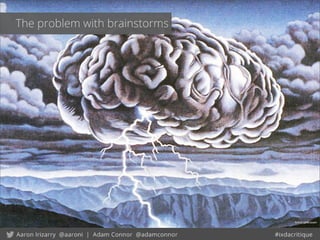
Artist Unknown
The problem with brainstorms
They lack focus.
The problem with brainstorms
They progress too quickly into group think mentality.
They lack focus.
The problem with brainstorms
They progress too quickly into group think mentality.
They fail to generate more ideas than would be
produced by a single contributor.
They lack focus.
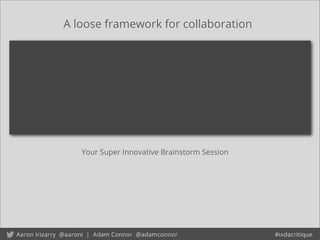
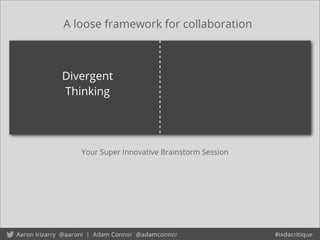
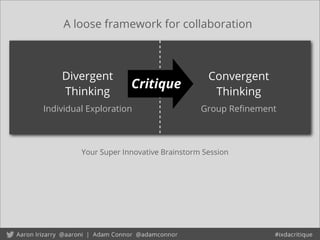
A loose framework for collaboration
Your Super Innovative Brainstorm Session
A loose framework for collaboration
Your Super Innovative Brainstorm Session
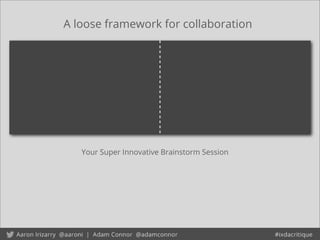
A loose framework for collaboration
Divergent
Thinking
Your Super Innovative Brainstorm Session
A loose framework for collaboration
Divergent
Thinking
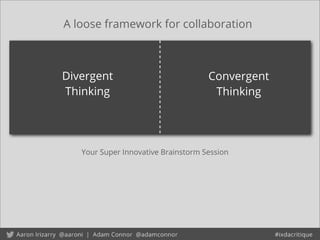
Convergent
Thinking
Your Super Innovative Brainstorm Session
A loose framework for collaboration
Divergent
Thinking
Convergent
Thinking
Your Super Innovative Brainstorm Session
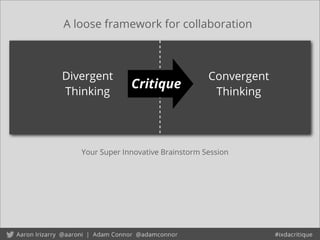
Critique
A loose framework for collaboration
Divergent
Thinking
Convergent
Thinking
Your Super Innovative Brainstorm Session
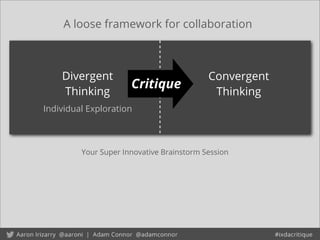
Critique
Individual Exploration
A loose framework for collaboration
Divergent
Thinking
Convergent
Thinking
Your Super Innovative Brainstorm Session
Critique
Individual Exploration Group Refinement
Critique allows participants to...
Analyze ideas against the personas, scenarios, goals and
principles that frame the project.
Critique allows participants to...
Analyze ideas against the personas, scenarios, goals and
principles that frame the project.
Collectively identify which ideas are most important in
creating an effective design.
Critique allows participants to...
Avoid group-think, design-by-committee and preferential
based decision making.
Analyze ideas against the personas, scenarios, goals and
principles that frame the project.
Collectively identify which ideas are most important in
creating an effective design.
To sum it all up
To sum it all up
There are 2 sides to critique: giving & receiving.
To sum it all up
There are 2 sides to critique: giving & receiving.
The right intent (on both sides) is to try to understand the
decisions made so far and their impact toward meeting
goals and objectives.
To sum it all up
There are 2 sides to critique: giving & receiving.
Critique is a skill. It takes practice to improve.
The right intent (on both sides) is to try to understand the
decisions made so far and their impact toward meeting
goals and objectives.
To sum it all up
There are 2 sides to critique: giving & receiving.
Critique is a skill. It takes practice to improve.
There are basic rules that should be followed to help
ensure good critique.
The right intent (on both sides) is to try to understand the
decisions made so far and their impact toward meeting
goals and objectives.
To sum it all up (cont.)
Mutually understood and agreed upon goals are critical
both when asking for and giving critique.
To sum it all up (cont.)
Mutually understood and agreed upon goals are critical
both when asking for and giving critique.
Critique can be done both internally and with clients. Use
up to 6 people for about 1 hour.
To sum it all up (cont.)
Mutually understood and agreed upon goals are critical
both when asking for and giving critique.
Be prepared to deal with difficult people. You will
encounter them.
Critique can be done both internally and with clients. Use
up to 6 people for about 1 hour.
To sum it all up (cont.)
Mutually understood and agreed upon goals are critical
both when asking for and giving critique.
Be prepared to deal with difficult people. You will
encounter them.
Critique can be incorporated into the design process
both as an activity and as part of other activities.
Critique can be done both internally and with clients. Use
up to 6 people for about 1 hour.
Thank you.
Aaron Irizarry
Product Designer Nasdaq OMX
@aaroni
Adam Connor
Design Director Mad*Pow
@adamconnor

Discussing Design: The Art of Critique - ixdaNYC

  • 1.
    Discussing Design : TheArt of Critique Improving the conversation around design IXDA NYC - Oct. 10th 2013
  • 2.
    So, what iscritique?
  • 4.
    It’s laid outtoo much like [popular service]. We should be different. The new Spotify design is perhaps even worse than the old Spotify design. The visual hierarchy and underlying IA are terrible. No. That won’t work. What if we do it this way... It needs more flululululuh!! The wireframes are still not answering our problem and are not providing enough an easier solution for the page. Change the order of the screens so that the 3rd and first one are switched. It doesn't have enough spunk. What kind of company shuts down a much-loved service like Google Reader but keeps the vegetative Google Plus? We're disappointed in this solution. We're going to have our own designers come up with one. Looks ugly. Make it pretty. What. The hell. Is this? I would never use this. I don’t like the layout. We should make that a dropdown instead of radio buttons. None of this is what I asked for. This is terrible. I have no idea what the lines mean. I like the paper form better. I'm just not feeling it. I don't know what, but it isn't right yet. Just needs to be more innovative. Make it look more like SharePoint. Here is a rewrite. My intention is to sharpen the language, make it more precise.
  • 5.
    The new Spotifydesign is perhaps even worse than the old Spotify design. The visual hierarchy and underlying IA are terrible. No. That won’t work. What if we do it this way... Change the order of the screens so that the 3rd and first one are switched. What. The hell. Is this? We should make that a dropdown instead of radio buttons. None of this is what I asked for. Here is a rewrite. My intention is to sharpen the language, make it more precise.
  • 6.
    Critique is aboutcritical thinking.
  • 7.
    At their foundationis intent. There are two facets to critique: giving and receiving.
  • 8.
    Giving critique withthe wrong intent is selfish.
  • 9.
    Giving critique withthe right intent is selfless.
  • 10.
  • 11.
    Tips for givingcritique Use a filter. Gather initial thoughts and reactions. Revisit them in the right context.
  • 12.
    Tips for givingcritique Use a filter. Gather initial thoughts and reactions. Revisit them in the right context. Don’t assume. Find out the reason behind thinking, constraints or other variables.
  • 13.
    Tips for givingcritique Don’t invite yourself. Get in touch and ask to chat about the design. Use a filter. Gather initial thoughts and reactions. Revisit them in the right context. Don’t assume. Find out the reason behind thinking, constraints or other variables.
  • 14.
    Tips for givingcritique Don’t invite yourself. Get in touch and ask to chat about the design. Use a filter. Gather initial thoughts and reactions. Revisit them in the right context. Don’t assume. Find out the reason behind thinking, constraints or other variables. Lead with questions. Show an interest in their process.
  • 15.
    Tips for givingcritique Don’t invite yourself. Get in touch and ask to chat about the design. Use a filter. Gather initial thoughts and reactions. Revisit them in the right context. Don’t assume. Find out the reason behind thinking, constraints or other variables. Lead with questions. Show an interest in their process. Talk about strengths. Critique isn’t just about the things that aren’t working.
  • 16.
    Receiving critique withthe right intent takes humility and a bit of restraint.
  • 17.
  • 18.
    Tips for receivingcritique Remember the purpose. Critique is about understanding and improvement, not judgement.
  • 19.
    Tips for receivingcritique Remember the purpose. Critique is about understanding and improvement, not judgement. Listen and think before you talk back. Do you understand what the critics are saying?
  • 20.
    Tips for receivingcritique Remember the purpose. Critique is about understanding and improvement, not judgement. Listen and think before you talk back. Do you understand what the critics are saying? Participate. Analyze your proposed solution with everyone else.
  • 21.
    Tips for receivingcritique Remember the purpose. Critique is about understanding and improvement, not judgement. Listen and think before you talk back. Do you understand what the critics are saying? Participate. Analyze your proposed solution with everyone else. Set the right foundation. Use knowledge and prior agreements to get everyone on the same page.
  • 22.
  • 23.
    A framework forcritique What problem was the designer trying to solve or what goal were they trying to achieve?
  • 24.
    A framework forcritique What problem was the designer trying to solve or what goal were they trying to achieve? How did the designer try to solve that problem or achieve that goal?
  • 25.
    A framework forcritique How effective is what the designer did at solving the problem or achieving the goal? What problem was the designer trying to solve or what goal were they trying to achieve? How did the designer try to solve that problem or achieve that goal?
  • 26.
    A framework forcritique How effective is what the designer did at solving the problem or achieving the goal? What problem was the designer trying to solve or what goal were they trying to achieve? How did the designer try to solve that problem or achieve that goal? Why is or isn’t what the designer did effective?
  • 27.
    More things tothink about
  • 28.
    More things tothink about Are there any problems the designer could or should have solved, but didn’t?
  • 29.
    More things tothink about Are there any problems the designer could or should have solved, but didn’t? Do any new problems arise as a result of the choices the designer made?
  • 30.
    More things tothink about Are there any problems the designer could or should have solved, but didn’t? Do any new problems arise as a result of the choices the designer made? These kinds of questions can be important to think about and ask, but be prepared for them to be beyond the scope of the designer’s work, and therefore not something to focus the remainder your critique on.
  • 31.
    A few thingsto keep in mind
  • 32.
    A few thingsto keep in mind Critique is a skill. You only get better with practice.
  • 33.
    A few thingsto keep in mind Critique is a skill. You only get better with practice. Start small.
  • 34.
    A few thingsto keep in mind Think before you speak. Critique is a skill. You only get better with practice. Start small.
  • 35.
    A few thingsto keep in mind Choose who you critique with carefully. Think before you speak. Critique is a skill. You only get better with practice. Start small.
  • 36.
    The rules ofcritique
  • 37.
    The rules ofcritique Avoid problem solving and design decisions.
  • 38.
    The rules ofcritique Avoid problem solving and design decisions. Everyone is a critic.
  • 39.
    The rules ofcritique Avoid problem solving and design decisions. Everyone is a critic. Everyone is equal.
  • 40.
    The rules ofcritique Avoid problem solving and design decisions. The designer is responsible for follow up and decisions. Everyone is a critic. Everyone is equal.
  • 41.
  • 42.
    Set the rightfoundation for good critique
  • 43.
    Set the rightfoundation for good critique Scenarios Short narratives that the describe the desired behaviors, thoughts, reactions, emotions, etc. of the user. Describes what happens, but not how.
  • 44.
    Set the rightfoundation for good critique Scenarios Short narratives that the describe the desired behaviors, thoughts, reactions, emotions, etc. of the user. Describes what happens, but not how. Personas User Archetypes that describe their average behaviors, goals, expectations, knowledge, etc.
  • 45.
    Set the rightfoundation for good critique Goals Desired, measurable outcomes of the user interacting with the product or service. Can be user oriented, business oriented or both. Scenarios Short narratives that the describe the desired behaviors, thoughts, reactions, emotions, etc. of the user. Describes what happens, but not how. Personas User Archetypes that describe their average behaviors, goals, expectations, knowledge, etc.
  • 46.
    Set the rightfoundation for good critique Goals Desired, measurable outcomes of the user interacting with the product or service. Can be user oriented, business oriented or both. Scenarios Short narratives that the describe the desired behaviors, thoughts, reactions, emotions, etc. of the user. Describes what happens, but not how. Personas User Archetypes that describe their average behaviors, goals, expectations, knowledge, etc. Principles Desired qualities or characteristics of the solution. Describe what happens, but not how.
  • 47.
  • 48.
    The Mini-Brief A Mini-CreativeBrief is a short writeup of a project About 1/2 - 1 page that recaps the foundation and context for why something is being created.
  • 49.
    The Mini-Brief A Mini-CreativeBrief is a short writeup of a project About 1/2 - 1 page that recaps the foundation and context for why something is being created. It includes...
  • 50.
    The Mini-Brief A Mini-CreativeBrief is a short writeup of a project About 1/2 - 1 page that recaps the foundation and context for why something is being created. It includes... A brief summary of the problem statement and business goals.
  • 51.
    The Mini-Brief A Mini-CreativeBrief is a short writeup of a project About 1/2 - 1 page that recaps the foundation and context for why something is being created. It includes... A brief summary of the problem statement and business goals. The key users (personas) of the solution.
  • 52.
    The Mini-Brief A Mini-CreativeBrief is a short writeup of a project About 1/2 - 1 page that recaps the foundation and context for why something is being created. It includes... A brief summary of the problem statement and business goals. The key users (personas) of the solution. The main scenarios in which the solution will be used.
  • 53.
    The Mini-Brief A Mini-CreativeBrief is a short writeup of a project About 1/2 - 1 page that recaps the foundation and context for why something is being created. It includes... A brief summary of the problem statement and business goals. The key users (personas) of the solution. The main scenarios in which the solution will be used. The design principles to be followed.
  • 54.
    The Mini-Brief A Mini-CreativeBrief is a short writeup of a project About 1/2 - 1 page that recaps the foundation and context for why something is being created. It includes... A brief summary of the problem statement and business goals. The key users (personas) of the solution. The main scenarios in which the solution will be used. The design principles to be followed. Note: This isn’t necessarily the full documentation for these individual elements.
  • 55.
    The Mini-Brief Review thisat the start of a meeting or discussion. Doing this helps to ground the conversation and ensure everyone is working toward the same goals. A Mini-Creative Brief is a short writeup of a project About 1/2 - 1 page that recaps the foundation and context for why something is being created. It includes... A brief summary of the problem statement and business goals. The key users (personas) of the solution. The main scenarios in which the solution will be used. The design principles to be followed. Note: This isn’t necessarily the full documentation for these individual elements.
  • 56.
  • 57.
  • 58.
  • 59.
    Facilitating critique Critique Goals Activelistening, question for clarity
  • 60.
    Facilitating critique Critique Goals RoundRobin Active listening, question for clarity
  • 61.
    Facilitating critique Critique Goals RoundRobin Direct Inquiry Active listening, question for clarity
  • 62.
    Facilitating critique Critique Goals RoundRobin Quotas Direct Inquiry Active listening, question for clarity
  • 63.
    Facilitating critique Critique Goals RoundRobin Quotas Direct Inquiry Six Thinking Hats Active listening, question for clarity
  • 64.
    Facilitating critique Critique Goals RoundRobin Quotas Direct Inquiry Six Thinking Hats Facilitators Active listening, question for clarity
  • 65.
  • 66.
  • 67.
    Dealing with difficultpeople Set expectations at the beginning.
  • 68.
    Dealing with difficultpeople Set expectations at the beginning. Make sure everyone understands critique.
  • 69.
    Dealing with difficultpeople Set expectations at the beginning. Ask quiet people for feedback directly. Make sure everyone understands critique.
  • 70.
    Dealing with difficultpeople Set expectations at the beginning. Ask quiet people for feedback directly. Refer back to personas, goals and principles. Make sure everyone understands critique.
  • 71.
    Dealing with difficultpeople Set expectations at the beginning. Ask quiet people for feedback directly. Use laddering (The 5 Whys). Refer back to personas, goals and principles. Make sure everyone understands critique.
  • 72.
    Dealing with difficultpeople Set expectations at the beginning. Ask quiet people for feedback directly. Use laddering (The 5 Whys). Refer back to personas, goals and principles. Critique with people individually. Make sure everyone understands critique.
  • 73.
  • 74.
    Making critique partof your process
  • 75.
    Making critique partof your process Standalone Critiques
  • 76.
    Making critique partof your process Design Reviews Standalone Critiques
  • 77.
    Making critique partof your process Design Reviews Standalone Critiques Brainstorms and Collaborative Activities
  • 78.
    Standalone critiques workwell because they...
  • 79.
    Standalone critiques workwell because they... Provide an introduction to people unfamiliar with critique.
  • 80.
    Standalone critiques workwell because they... Provide an introduction to people unfamiliar with critique. Provide a safe(r) place to practice giving and receiving feedback.
  • 81.
    Standalone critiques workwell because they... Provide an introduction to people unfamiliar with critique. Provide a safe(r) place to practice giving and receiving feedback. Allow teams to focus feedback on specific goals, topics, etc.
  • 82.
    Standalone critiques workwell because they... Provide an introduction to people unfamiliar with critique. Provide a safe(r) place to practice giving and receiving feedback. Allow teams to focus feedback on specific goals, topics, etc. Increase the sense of collaboration in team members.
  • 83.
    Two approaches: Impromptuand Scheduled Standalone critiques work well because they... Provide an introduction to people unfamiliar with critique. Provide a safe(r) place to practice giving and receiving feedback. Allow teams to focus feedback on specific goals, topics, etc. Increase the sense of collaboration in team members.
  • 84.
    When can youhave critiques ?
  • 85.
  • 86.
    What can youcritique?
  • 87.
    All of thethings!
  • 88.
    Critique is aboutiteration and improvement. So long as you’re looking to improve on whatever it is you’re doing, you’ve got an opportunity for critique.
  • 89.
    Making critique partof your process Design Reviews Standalone Critiques Brainstorms and Collaborative Activities
  • 90.
    Design Reviews arechallenging because...
  • 91.
    Design Reviews arechallenging because... They’re used to get approval or some kind of blessing.
  • 92.
    Design Reviews arechallenging because... They’re used to get approval or some kind of blessing. Their timing is driven by project timeline.
  • 93.
    Design Reviews arechallenging because... They’re used to get approval or some kind of blessing. Their timing is driven by project timeline. They often have too large of an audience and many attendees have the wrong intent.
  • 94.
    Design Reviews arechallenging because... They’re used to get approval or some kind of blessing. Their timing is driven by project timeline. They often have too large of an audience and many attendees have the wrong intent. Their output, if not approval, is typically a list of specified changes.
  • 95.
    Making the mostof a Design Review
  • 96.
    Making the mostof a Design Review Take control as much as possible.
  • 97.
    Making the mostof a Design Review Take control as much as possible. Recap the goals and principles of the design.
  • 98.
    Making the mostof a Design Review Take control as much as possible. Use the same tools as you would for dealing with difficult people. Recap the goals and principles of the design.
  • 99.
    Making the mostof a Design Review Take control as much as possible. Use the same tools as you would for dealing with difficult people. Don’t rely on them for critique. Be prepared to schedule a more focused session. Recap the goals and principles of the design.
  • 100.
    Standalone Critiques Making critiquepart of your process Design Reviews Brainstorms and Collaborative Activities
  • 101.
  • 102.
    The problem withbrainstorms
  • 103.
    The problem withbrainstorms They lack focus.
  • 104.
    The problem withbrainstorms They progress too quickly into group think mentality. They lack focus.
  • 105.
    The problem withbrainstorms They progress too quickly into group think mentality. They fail to generate more ideas than would be produced by a single contributor. They lack focus.
  • 106.
    A loose frameworkfor collaboration Your Super Innovative Brainstorm Session
  • 107.
    A loose frameworkfor collaboration Your Super Innovative Brainstorm Session
  • 108.
    A loose frameworkfor collaboration Divergent Thinking Your Super Innovative Brainstorm Session
  • 109.
    A loose frameworkfor collaboration Divergent Thinking Convergent Thinking Your Super Innovative Brainstorm Session
  • 110.
    A loose frameworkfor collaboration Divergent Thinking Convergent Thinking Your Super Innovative Brainstorm Session Critique
  • 111.
    A loose frameworkfor collaboration Divergent Thinking Convergent Thinking Your Super Innovative Brainstorm Session Critique Individual Exploration
  • 112.
    A loose frameworkfor collaboration Divergent Thinking Convergent Thinking Your Super Innovative Brainstorm Session Critique Individual Exploration Group Refinement
  • 113.
  • 114.
    Critique allows participantsto... Analyze ideas against the personas, scenarios, goals and principles that frame the project.
  • 115.
    Critique allows participantsto... Analyze ideas against the personas, scenarios, goals and principles that frame the project. Collectively identify which ideas are most important in creating an effective design.
  • 116.
    Critique allows participantsto... Avoid group-think, design-by-committee and preferential based decision making. Analyze ideas against the personas, scenarios, goals and principles that frame the project. Collectively identify which ideas are most important in creating an effective design.
  • 117.
    To sum itall up
  • 118.
    To sum itall up There are 2 sides to critique: giving & receiving.
  • 119.
    To sum itall up There are 2 sides to critique: giving & receiving. The right intent (on both sides) is to try to understand the decisions made so far and their impact toward meeting goals and objectives.
  • 120.
    To sum itall up There are 2 sides to critique: giving & receiving. Critique is a skill. It takes practice to improve. The right intent (on both sides) is to try to understand the decisions made so far and their impact toward meeting goals and objectives.
  • 121.
    To sum itall up There are 2 sides to critique: giving & receiving. Critique is a skill. It takes practice to improve. There are basic rules that should be followed to help ensure good critique. The right intent (on both sides) is to try to understand the decisions made so far and their impact toward meeting goals and objectives.
  • 122.
    To sum itall up (cont.)
  • 123.
    To sum itall up (cont.) Mutually understood and agreed upon goals are critical both when asking for and giving critique.
  • 124.
    To sum itall up (cont.) Mutually understood and agreed upon goals are critical both when asking for and giving critique. Critique can be done both internally and with clients. Use up to 6 people for about 1 hour.
  • 125.
    To sum itall up (cont.) Mutually understood and agreed upon goals are critical both when asking for and giving critique. Be prepared to deal with difficult people. You will encounter them. Critique can be done both internally and with clients. Use up to 6 people for about 1 hour.
  • 126.
    To sum itall up (cont.) Mutually understood and agreed upon goals are critical both when asking for and giving critique. Be prepared to deal with difficult people. You will encounter them. Critique can be incorporated into the design process both as an activity and as part of other activities. Critique can be done both internally and with clients. Use up to 6 people for about 1 hour.
  • 127.
    Thank you. Aaron Irizarry ProductDesigner Nasdaq OMX @aaroni Adam Connor Design Director Mad*Pow @adamconnor