
A Systematic
Approach to
Design Critique
Zac Halbert
@ZacHalbert
Product design
lead at Tradecraft
TryMyUI
@trymyui
#trymyuiEDU
1
Why critique?
Design
critique
A formal, regularly scheduled design critique
process helps designers improve, and provides
professional development.
It’s also an acknowledgement that designers
don’t have to be perfect at all times and WIP is
acceptable.
Critical to implement, especially when your
design team lacks senior mentorship.
Good / Bad
Better / Worse
Applies to designers, and
designs
2.
Fixed mindset is lazy, and will
result in high designer turnover
3.
1. Growth mindset
Good / Bad
Better / Worse
Applies to designers, and
designs
2.
Fixed mindset is lazy, and will
result in high designer turnover
3.
1. Growth mindset
Good / Bad
Better / Worse
Applies to designers, and
designs
2.
Fixed mindset is lazy, and will
result in high designer turnover
3.
1. Growth mindset
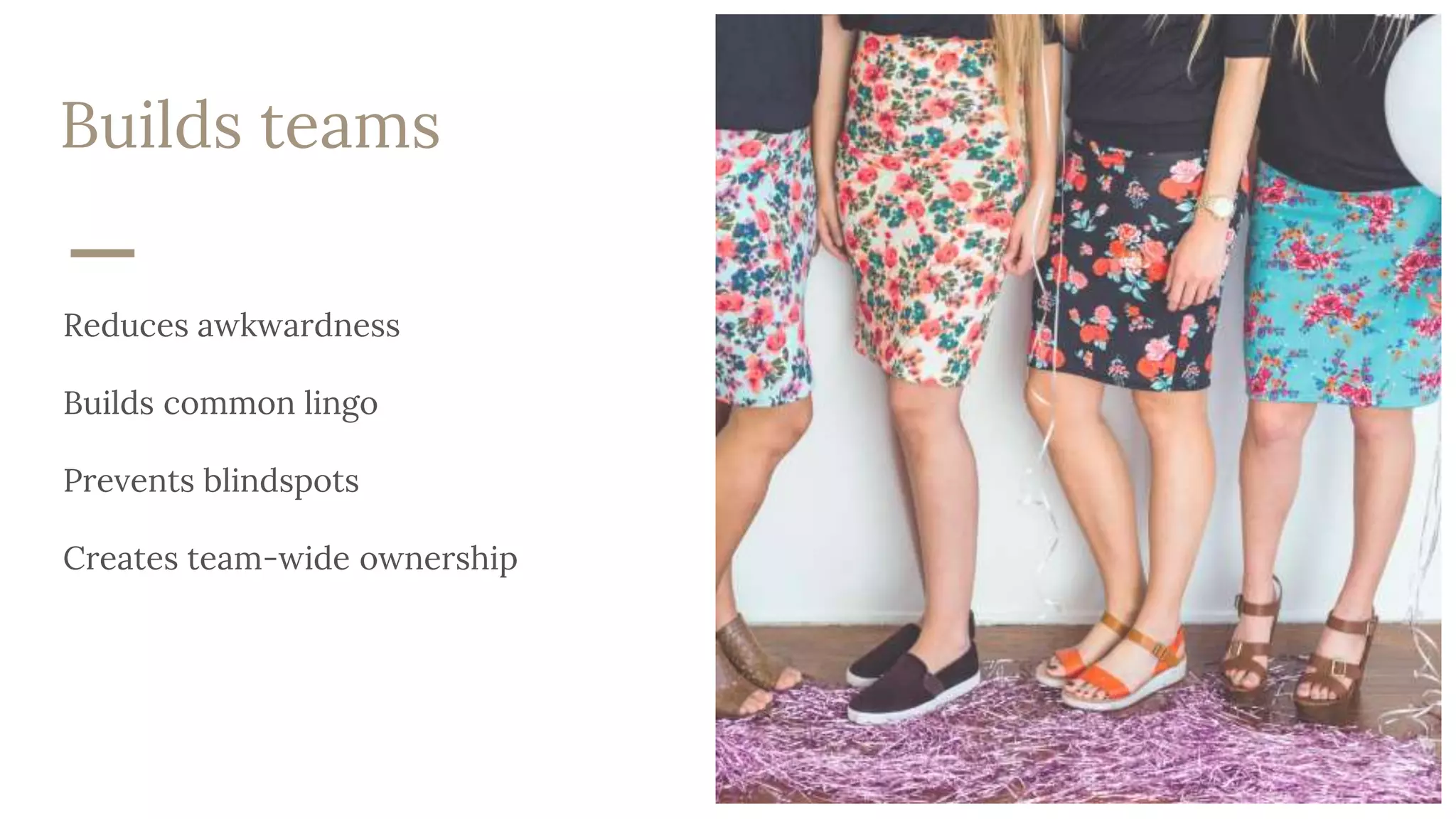
Builds teams
Reduces awkwardness
Builds common lingo
Prevents blindspots
Creates team-wide ownership
Regular critique makes
designers better
Analyzing other people’s work improves your
taste, and makes you better at spotting your own
weaknesses.
It also helps designers separate ego from work.
2
The setup.
Decide on a
format, then
post it publicly
Discuss the process with non-
design stakeholders beforehand.
2.
Do a retrospective, then tweak
the format next time.
3.
1. Write an agenda and schedule on
the whiteboard at the start of
every critique session.
Decide on a
format, then
post it publicly
Discuss the process with non-
design stakeholders beforehand.
2.
Do a retrospective, then tweak
the format next time.
3.
1. Write an agenda and schedule on
the whiteboard at the start of
every critique session.
Decide on a
format, then
post it publicly
Discuss the process with non-
design stakeholders beforehand.
2.
Do a retrospective, then tweak
the format next time.
3.
1. Write an agenda and schedule on
the whiteboard at the start of
every critique session.
Roles
13
I. Designer
II. Participant
III. Facilitator
IV. Timekeeper
V. Notetaker (optional)
Other
guidelines
Review rules of conduct before the meeting
until everyone knows them by heart.
Limit the number of people participating. 8-10
max is a good guideline, but depends heavily on
the rapport within your team and the project
requirements. Some teams can have free form
conversation, some need to take turns.
Experiment with what works.
Establish design principles before you start your
first critique session.
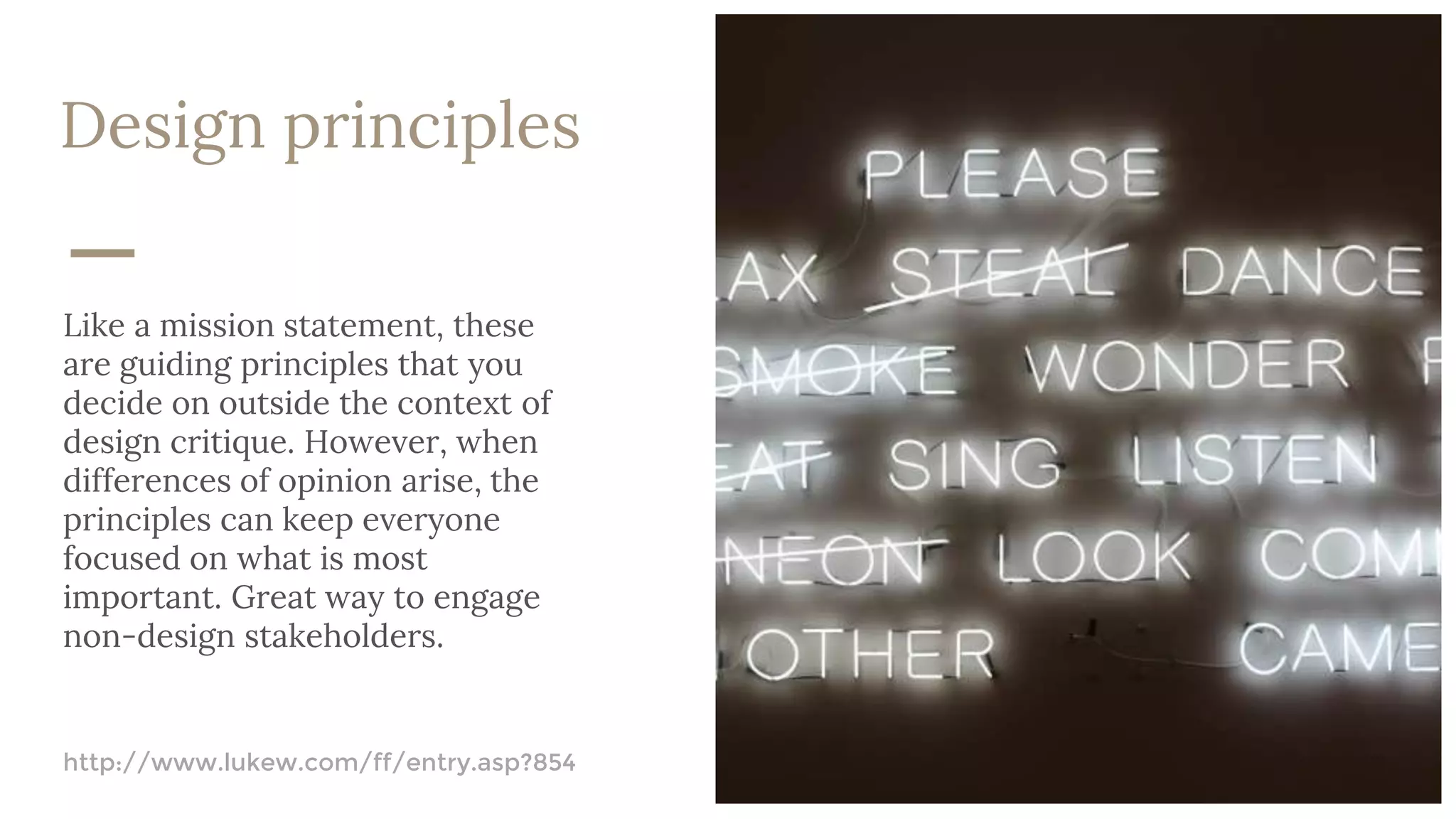
Design principles
Like a mission statement, these
are guiding principles that you
decide on outside the context of
design critique. However, when
differences of opinion arise, the
principles can keep everyone
focused on what is most
important. Great way to engage
non-design stakeholders.
http://www.lukew.com/ff/entry.asp?854
16
Deference
Clarity
Depth
Apple
Designing for iOS, Human Interface Guidelines*
*
https://developer.apple.com/library/ios/documentation/UserExperience/Conceptual/MobileHIG/
17
Universal
Human
Clean
Consistent
Useful
Fast
Transparent
Facebook
Design principles, posted 7 / 1 / 09
* https://www.facebook.com/note.php?note_id=118951047792&ref=mf
Design rubric
Content
Affordances
Typography
Layout
Imagery
Color
18
Rules of
conduct
No disclaimers, no selling work.
Keep the preamble very concise, and focused
on the type of feedback you need. 60 seconds is
likely sufficient.
Assume participants have good intentions.
Accept feedback graciously (say thanks). People
avoid giving feedback to a defensive designer,
which will limit your growth.
Presenter
Rules of
conduct
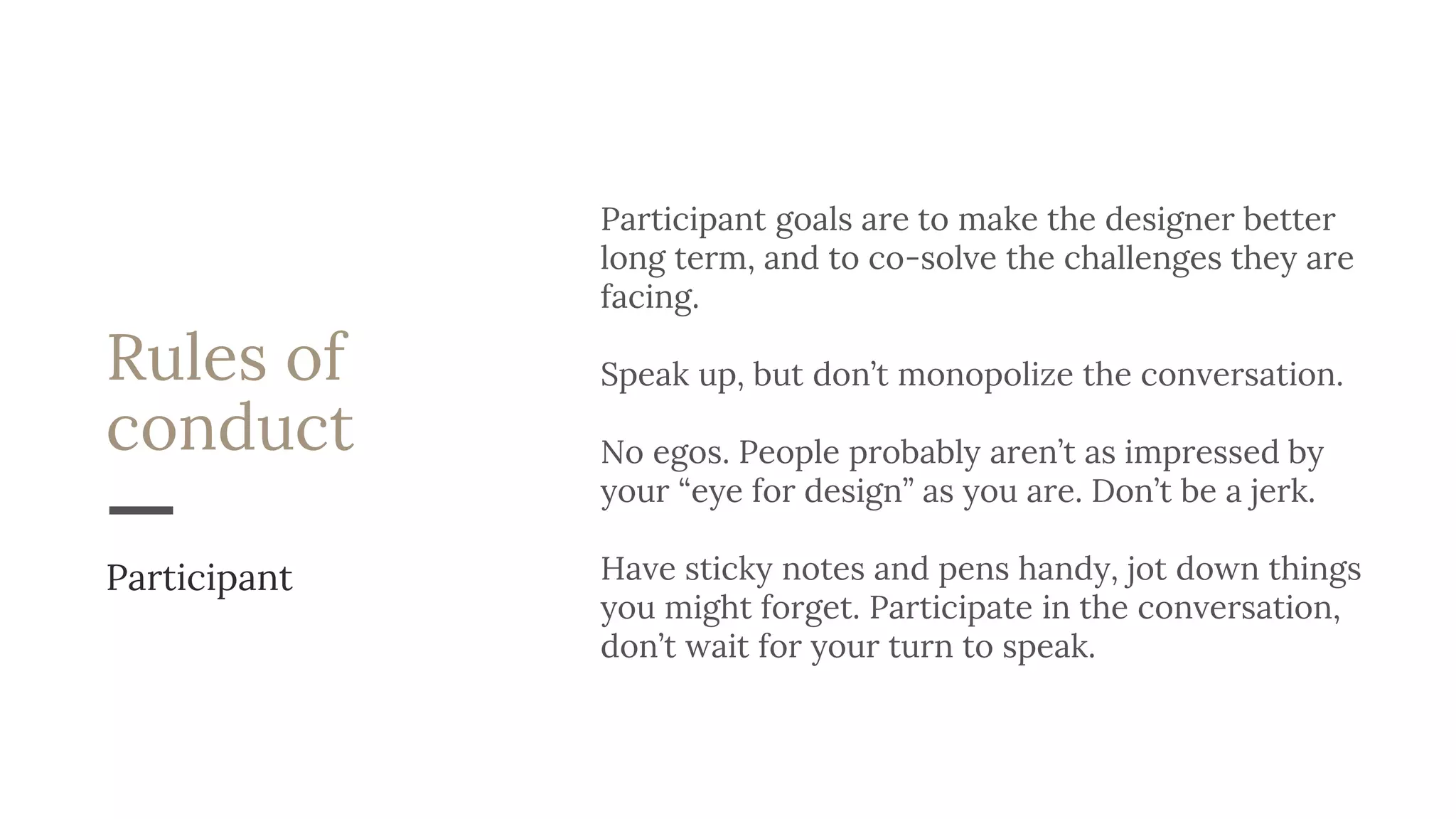
Participant goals are to make the designer better
long term, and to co-solve the challenges they are
facing.
Speak up, but don’t monopolize the conversation.
No egos. People probably aren’t as impressed by
your “eye for design” as you are. Don’t be a jerk.
Have sticky notes and pens handy, jot down things
you might forget. Participate in the conversation,
don’t wait for your turn to speak.
Participant
Design critique setup checklist
❏ Assign roles
❏ Post agenda and schedule
❏ Post design principles
❏ Post design rubric
❏ Post / discuss rules of conduct
3
The critique.
23
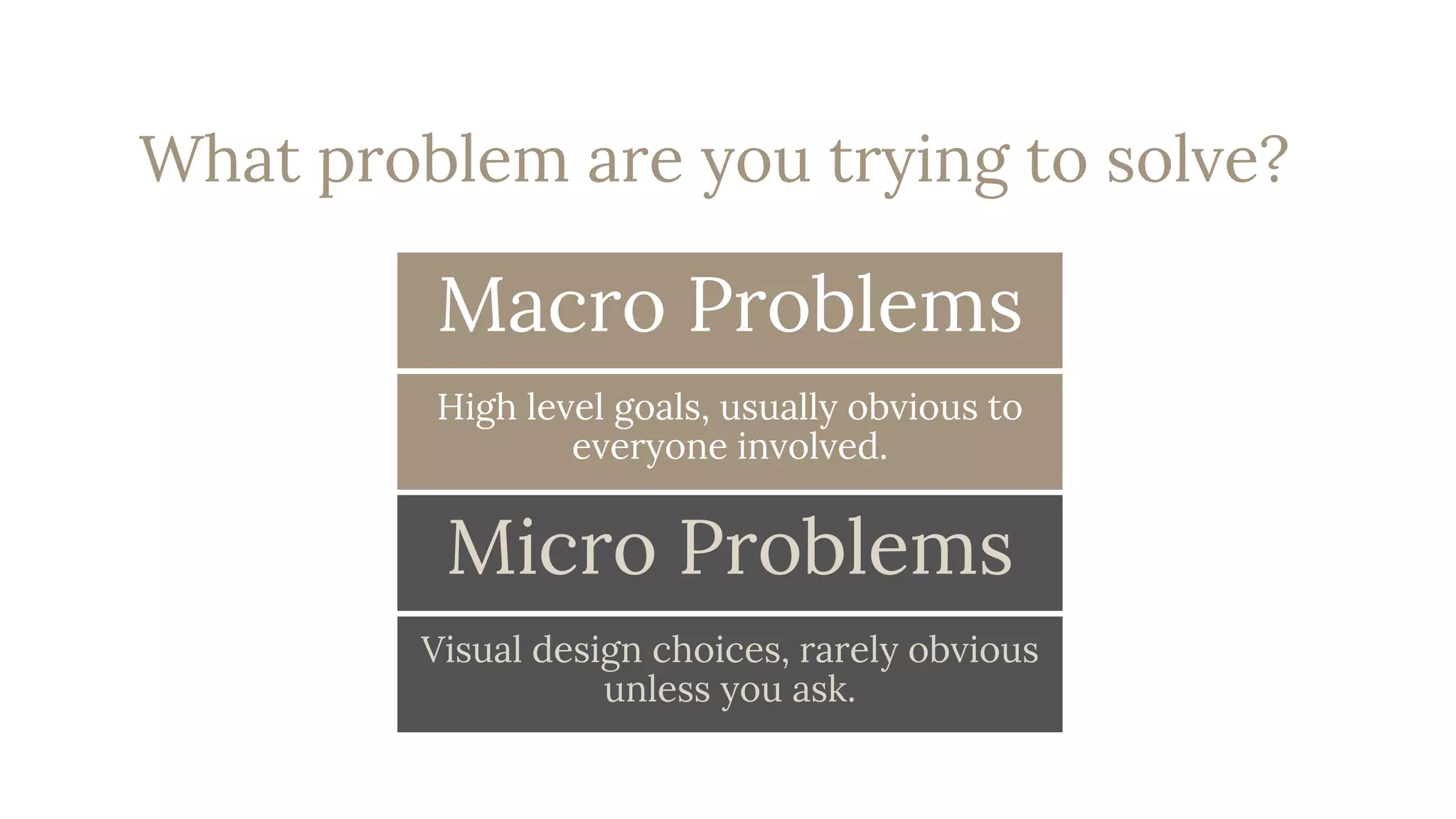
Macro Problems
High level goals, usually obvious to
everyone involved.
Micro Problems
Visual design choices, rarely obvious
unless you ask.
What problem are you trying to solve?
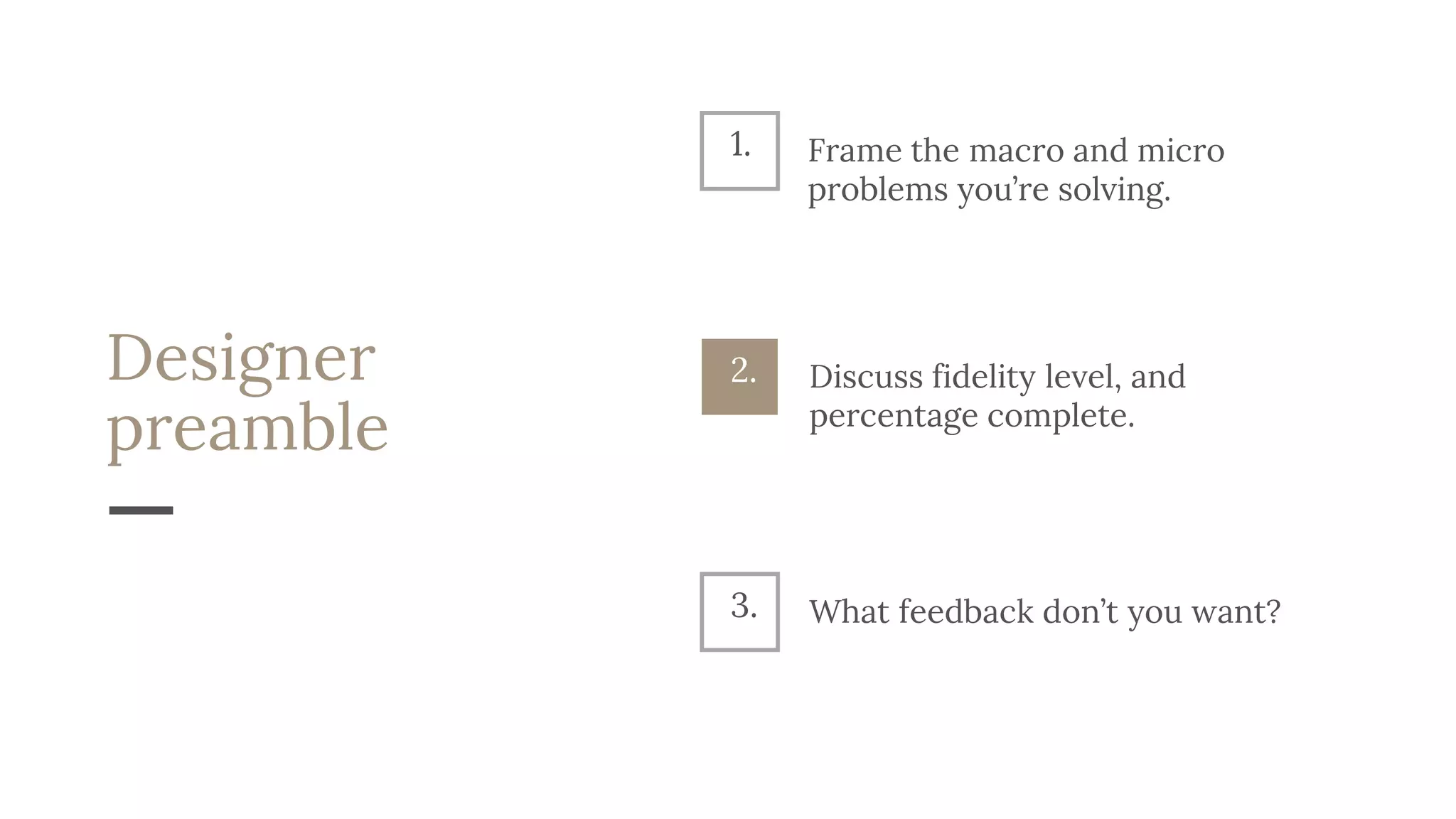
Designer
preamble
Discuss fidelity level, and
percentage complete.
2.
What feedback don’t you want?3.
1. Frame the macro and micro
problems you’re solving.
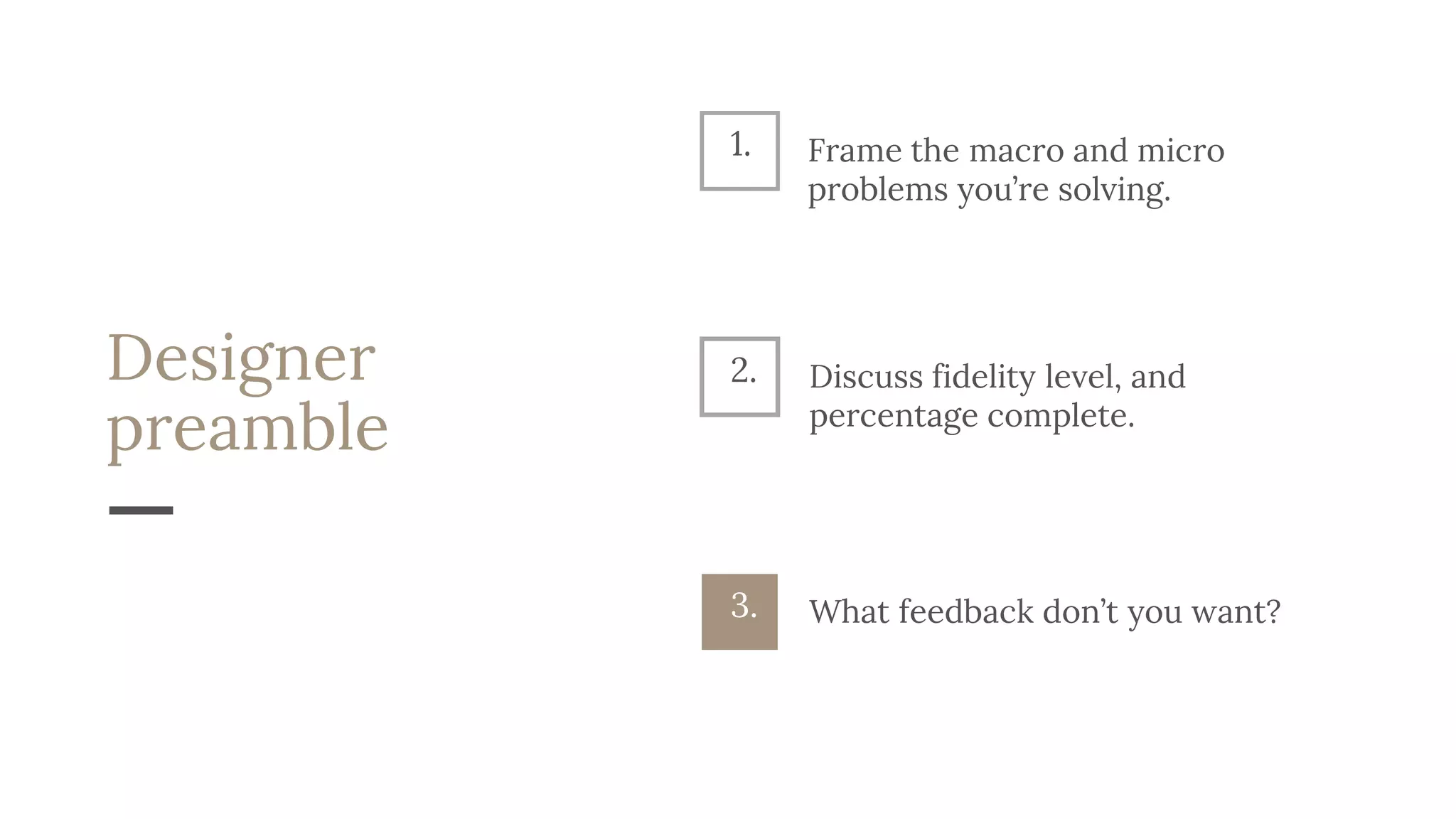
Designer
preamble
Discuss fidelity level, and
percentage complete.
2.
What feedback don’t you want?3.
1. Frame the macro and micro
problems you’re solving.
Designer
preamble
Discuss fidelity level, and
percentage complete.
2.
What feedback don’t you want?3.
1. Frame the macro and micro
problems you’re solving.
Giving
critique
Thing in terms of solution
strength, rather than good/bad.
2.
Pose questions rather than
statements.
3.
1. Watch out for fundamental
attribution error.
Giving
critique
Thing in terms of solution
strength, rather than good/bad.
2.
Pose questions rather than
statements.
3.
1. Watch out for fundamental
attribution error.
Giving
critique
Thing in terms of solution
strength, rather than good/bad.
2.
Pose questions rather than
statements.
3.
1. Watch out for fundamental
attribution error.
“Posing thoughts as questions allows the designer
to express their reasoning instead of being
defensive. If they hadn’t considered a particular
angle, they can make a note and address it in the
next iteration.”
Judy Reeves
Receiving
critique
Hopefully, people will be respectful. Grow a
thick skin for when they’re not.
If you feel terrible after critique, that’s a signal
you’re identifying too closely with your work.
It’s not your child, even if it feels that way
sometimes.
Invite participants to co-solve with you.
We’re not as good at visualizing as we think. Be
willing to try other people’s ideas. “That won’t
look good” vs “I’ll try it and see.”
Designers: stop being so
precious with your work.
You won’t get better if
you don’t ask for
feedback early and often.
Mindset, not
Fixed
Mindset
Growth
Successful critique requires a
Thanks!
Zac Halbert
@ZacHalbert

A Systematic Approach to Design Critique

  • 1.
    A Systematic Approach to DesignCritique Zac Halbert @ZacHalbert Product design lead at Tradecraft TryMyUI @trymyui #trymyuiEDU
  • 2.
  • 3.
    Design critique A formal, regularlyscheduled design critique process helps designers improve, and provides professional development. It’s also an acknowledgement that designers don’t have to be perfect at all times and WIP is acceptable. Critical to implement, especially when your design team lacks senior mentorship.
  • 4.
    Good / Bad Better/ Worse Applies to designers, and designs 2. Fixed mindset is lazy, and will result in high designer turnover 3. 1. Growth mindset
  • 5.
    Good / Bad Better/ Worse Applies to designers, and designs 2. Fixed mindset is lazy, and will result in high designer turnover 3. 1. Growth mindset
  • 6.
    Good / Bad Better/ Worse Applies to designers, and designs 2. Fixed mindset is lazy, and will result in high designer turnover 3. 1. Growth mindset
  • 7.
    Builds teams Reduces awkwardness Buildscommon lingo Prevents blindspots Creates team-wide ownership
  • 8.
    Regular critique makes designersbetter Analyzing other people’s work improves your taste, and makes you better at spotting your own weaknesses. It also helps designers separate ego from work.
  • 9.
  • 10.
    Decide on a format,then post it publicly Discuss the process with non- design stakeholders beforehand. 2. Do a retrospective, then tweak the format next time. 3. 1. Write an agenda and schedule on the whiteboard at the start of every critique session.
  • 11.
    Decide on a format,then post it publicly Discuss the process with non- design stakeholders beforehand. 2. Do a retrospective, then tweak the format next time. 3. 1. Write an agenda and schedule on the whiteboard at the start of every critique session.
  • 12.
    Decide on a format,then post it publicly Discuss the process with non- design stakeholders beforehand. 2. Do a retrospective, then tweak the format next time. 3. 1. Write an agenda and schedule on the whiteboard at the start of every critique session.
  • 13.
    Roles 13 I. Designer II. Participant III.Facilitator IV. Timekeeper V. Notetaker (optional)
  • 14.
    Other guidelines Review rules ofconduct before the meeting until everyone knows them by heart. Limit the number of people participating. 8-10 max is a good guideline, but depends heavily on the rapport within your team and the project requirements. Some teams can have free form conversation, some need to take turns. Experiment with what works. Establish design principles before you start your first critique session.
  • 15.
    Design principles Like amission statement, these are guiding principles that you decide on outside the context of design critique. However, when differences of opinion arise, the principles can keep everyone focused on what is most important. Great way to engage non-design stakeholders. http://www.lukew.com/ff/entry.asp?854
  • 16.
    16 Deference Clarity Depth Apple Designing for iOS,Human Interface Guidelines* * https://developer.apple.com/library/ios/documentation/UserExperience/Conceptual/MobileHIG/
  • 17.
    17 Universal Human Clean Consistent Useful Fast Transparent Facebook Design principles, posted7 / 1 / 09 * https://www.facebook.com/note.php?note_id=118951047792&ref=mf
  • 18.
  • 19.
    Rules of conduct No disclaimers,no selling work. Keep the preamble very concise, and focused on the type of feedback you need. 60 seconds is likely sufficient. Assume participants have good intentions. Accept feedback graciously (say thanks). People avoid giving feedback to a defensive designer, which will limit your growth. Presenter
  • 20.
    Rules of conduct Participant goalsare to make the designer better long term, and to co-solve the challenges they are facing. Speak up, but don’t monopolize the conversation. No egos. People probably aren’t as impressed by your “eye for design” as you are. Don’t be a jerk. Have sticky notes and pens handy, jot down things you might forget. Participate in the conversation, don’t wait for your turn to speak. Participant
  • 21.
    Design critique setupchecklist ❏ Assign roles ❏ Post agenda and schedule ❏ Post design principles ❏ Post design rubric ❏ Post / discuss rules of conduct
  • 22.
  • 23.
    23 Macro Problems High levelgoals, usually obvious to everyone involved. Micro Problems Visual design choices, rarely obvious unless you ask. What problem are you trying to solve?
  • 24.
    Designer preamble Discuss fidelity level,and percentage complete. 2. What feedback don’t you want?3. 1. Frame the macro and micro problems you’re solving.
  • 25.
    Designer preamble Discuss fidelity level,and percentage complete. 2. What feedback don’t you want?3. 1. Frame the macro and micro problems you’re solving.
  • 26.
    Designer preamble Discuss fidelity level,and percentage complete. 2. What feedback don’t you want?3. 1. Frame the macro and micro problems you’re solving.
  • 27.
    Giving critique Thing in termsof solution strength, rather than good/bad. 2. Pose questions rather than statements. 3. 1. Watch out for fundamental attribution error.
  • 28.
    Giving critique Thing in termsof solution strength, rather than good/bad. 2. Pose questions rather than statements. 3. 1. Watch out for fundamental attribution error.
  • 29.
    Giving critique Thing in termsof solution strength, rather than good/bad. 2. Pose questions rather than statements. 3. 1. Watch out for fundamental attribution error.
  • 30.
    “Posing thoughts asquestions allows the designer to express their reasoning instead of being defensive. If they hadn’t considered a particular angle, they can make a note and address it in the next iteration.” Judy Reeves
  • 31.
    Receiving critique Hopefully, people willbe respectful. Grow a thick skin for when they’re not. If you feel terrible after critique, that’s a signal you’re identifying too closely with your work. It’s not your child, even if it feels that way sometimes. Invite participants to co-solve with you. We’re not as good at visualizing as we think. Be willing to try other people’s ideas. “That won’t look good” vs “I’ll try it and see.”
  • 32.
    Designers: stop beingso precious with your work. You won’t get better if you don’t ask for feedback early and often.
  • 33.
  • 34.