Constructive
Criticism
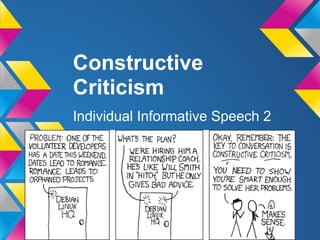
Individual Informative Speech 2
Criticism
1. a : the act of criticizing usually unfavorably <seeking
encouragement rather than criticism> b : a critical
observation or remark <an unfair criticism> c :
CRITIQUE
2. : the art of evaluating or analyzing works of art or
literature; also : writings expressing such evaluation or
analysis <an anthology of literary criticism>
3. : the scientific investigation of literary documents (as the
Bible) in regard to such matters as origin, text,
composition, or history
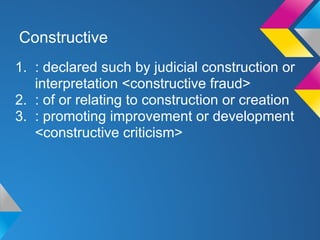
Constructive
1. : declared such by judicial construction or
interpretation <constructive fraud>
2. : of or relating to construction or creation
3. : promoting improvement or development
<constructive criticism>
Reasons to Give
● Content
● Delivery
● Structure
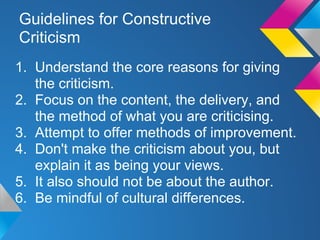
Guidelines for Constructive
Criticism
1. Understand the core reasons for giving
the criticism.
2. Focus on the content, the delivery, and
the method of what you are criticising.
3. Attempt to offer methods of improvement.
4. Don't make the criticism about you, but
explain it as being your views.
5. It also should not be about the author.
6. Be mindful of cultural differences.
Things to Avoid
1. Personal Attacks
"It's easier to be an
a** to words, than to
people"
Things to Avoid
2. Blanket Statements
Things to Avoid
3. Strong/Harsh
Language
Receiving Constructive Criticism
1. Be open to criticism.
2. Listen or read carefully what is given.
3. Pay attention to what is said, not how it is
said.
4. Be mindful of cultural differences.
Key things to avoid
Knee-Jerk Responses.
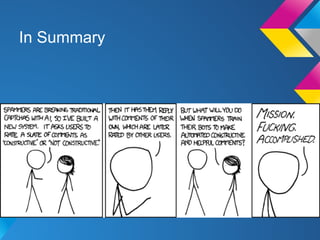
In Summary

Individual informative speech #2

  • 1.
  • 2.
    Criticism 1. a :the act of criticizing usually unfavorably <seeking encouragement rather than criticism> b : a critical observation or remark <an unfair criticism> c : CRITIQUE 2. : the art of evaluating or analyzing works of art or literature; also : writings expressing such evaluation or analysis <an anthology of literary criticism> 3. : the scientific investigation of literary documents (as the Bible) in regard to such matters as origin, text, composition, or history
  • 3.
    Constructive 1. : declaredsuch by judicial construction or interpretation <constructive fraud> 2. : of or relating to construction or creation 3. : promoting improvement or development <constructive criticism>
  • 4.
    Reasons to Give ●Content ● Delivery ● Structure
  • 5.
    Guidelines for Constructive Criticism 1.Understand the core reasons for giving the criticism. 2. Focus on the content, the delivery, and the method of what you are criticising. 3. Attempt to offer methods of improvement. 4. Don't make the criticism about you, but explain it as being your views. 5. It also should not be about the author. 6. Be mindful of cultural differences.
  • 6.
    Things to Avoid 1.Personal Attacks "It's easier to be an a** to words, than to people"
  • 7.
    Things to Avoid 2.Blanket Statements
  • 8.
    Things to Avoid 3.Strong/Harsh Language
  • 9.
    Receiving Constructive Criticism 1.Be open to criticism. 2. Listen or read carefully what is given. 3. Pay attention to what is said, not how it is said. 4. Be mindful of cultural differences.
  • 10.
    Key things toavoid Knee-Jerk Responses.
  • 11.