DISCUSSINGDESIGN
IMPROVING TEAM COMMUNICATION &
COLLABORATION THROUGH CRITIQUE
Conversations can hurt.
It’s laid out too much like [popular service]. We should be different.
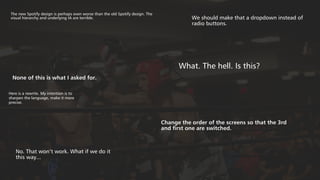
The new Spotify design is perhaps even worse than the old Spotify design. The
visual hierarchy and underlying IA are terrible.
No. That won’t work. What if we do it
this way...
It needs more flululululuh!!
The wireframes are still not answering our problem and are not
providing enough an easier solution for the page.
Change the order of the screens so that the 3rd
and first one are switched.
It doesn't have enough spunk.
What kind of company shuts down a much-loved service like
Google Reader but keeps the vegetative Google Plus?
We're disappointed in this solution. We're going to have our own designers come up with
one.
Looks ugly. Make it pretty.
What. The hell. Is this?
I would never use this. I don’t like the
layout.
We should make that a dropdown instead of
radio buttons.
None of this is what I asked for.
This is terrible. I have no idea what the lines
mean.
I like the paper form better.
I'm just not feeling it. I don't know what, but it isn't right
yet. Just needs to be more innovative.
Make it look more like
SharePoint.
Here is a rewrite. My intention is to
sharpen the language, make it more
precise.
The new Spotify design is perhaps even worse than the old Spotify design. The
visual hierarchy and underlying IA are terrible.
No. That won’t work. What if we do it
this way...
Change the order of the screens so that the 3rd
and first one are switched.
What. The hell. Is this?
We should make that a dropdown instead of
radio buttons.
None of this is what I asked for.
Here is a rewrite. My intention is to
sharpen the language, make it more
precise.
feedback
Reaction
“Good lord! That’s awful! An inebriated cocker
spaniel could have done better!
Reaction
“Good lord! That’s awful! An inebriated cocker
spaniel could have done better!
Reaction
Direction
“Good lord! That’s awful! An inebriated cocker
spaniel could have done better!
“You should have made all of those radio buttons a
drop down [,because…]
Reaction
Direction
criticalthinking
critique
“Good lord! That’s awful! An inebriated cocker
spaniel could have done better!
“You should have made all of those radio buttons a
drop down [,because…]
Reaction
Direction
Critique
“Good lord! That’s awful! An inebriated cocker
spaniel could have done better!
“You should have made all of those radio buttons a
drop down [,because…]
Reaction
Direction
“If the objective is for users to seriously consider the
impact to their bank balance before making a
purchase, placing the balance at the bottom of the
screen at the same size as all the other numbers
isn’t effective because it get’s lost in all of the other
the information.
Critique
“Good lord! That’s awful! An inebriated cocker
spaniel could have done better!
“You should have made all of those radio buttons a
drop down [,because…]
Reaction
Direction
At their foundation is intent.
There are two facets to critique,
giving and receiving…
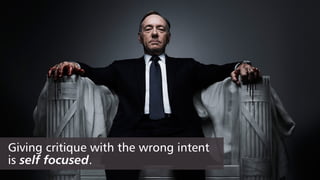
Giving critique with the wrong intent
is self focused.
Giving critique with the right intent
is objective focused.
When giving critique...
Use a filter.
Gather initial thoughts and reactions. Revisit them in the right context.
When giving critique...
Don’t assume.
Find out the reason behind thinking, constraints, or other variables.
When giving critique...
Don’t invite yourself.
Get in touch and ask to chat about the design.
When giving critique...
Lead with questions.
Show an interest in their process and learn more about their objectives.
When giving critique...
Talk about strengths.
Critique isn’t just about the things that aren’t working.
Receiving critique
with the right
intent takes
humility &
restraint.
Receiving critique
with the right
intent takes
humility &
restraint.
When receiving critique...
Remember the purpose.
Critique is about understanding and improvement, not judgement.
When receiving critique...
Think before responding.
Do you understand what the critics are saying?
When receiving critique...
Participate.
Analyze your proposed solution alongside everyone else.
When receiving critique...
Set the foundation.
Use prior agreements and objectives to get everyone on the same page.
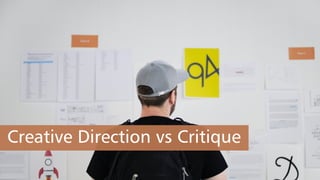
Creative Direction vs Critique
Critique is a form of feedback meant to provide
guidance by identifying concerns and insights about
the work being presented. It is up to the designer(s)
to take the insights and make decisions about
progressing the design.
Direction is a more “direct” form of feedback that
identifies specific things that need to be changed in a
design. This feedback is less open to designer
interpretation.
We need tools, and a plan.
What are the objectives for the design?
What are the related design elements?
What are the objectives for the design?
What are the related design elements?
What are the objectives for the design?
What are the related design elements?
Are they effective at achieving the objectives?
What are the objectives for the design?
What are the related design elements?
Are they effective at achieving the objectives?
Why are or aren’t they effective?
What are the objectives for the design?
What are the related design elements?
Are they effective at achieving the objectives?
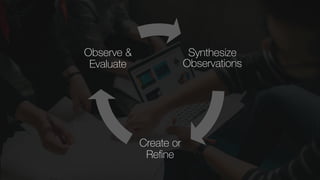
Synthesize
Observations
Create or
Refine
Observe &
Evaluate
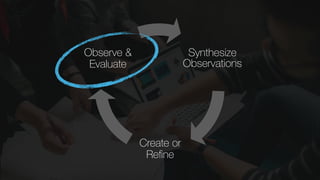
Synthesize
Observations
Create or
Refine
Observe &
Evaluate
Too Soon
Too Soon
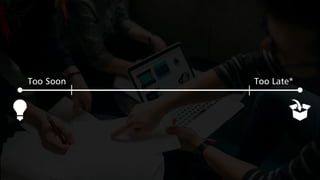
Too Soon Too Late*
Too Soon Too Late*Just Right
Critique is a skill. You need to practice.
Keep in mind…
Critique is a skill. You need to practice.
Start small.
Keep in mind…
Critique is a skill. You need to practice.
Think before you speak.
Start small.
Keep in mind…
Critique is a skill. You need to practice.
Choose who you critique with carefully.
Think before you speak.
Start small.
Keep in mind…
Rules of critique
Avoid problem solving.
Rules of critique
Avoid problem solving.
Everyone is equal.
Rules of critique
Avoid problem solving.
Everyone is equal.
Everyone is a critic.
Rules of critique
Avoid problem solving.
Everyone is equal.
Everyone is a critic.
The designer is responsible for next steps.
Set the right foundation.
Set your foundation with…
Personas
User archetypes that describe their average behaviors, goals, expectations,
knowledge, etc.
Set your foundation with…
Goals
Desired, measurable outcomes of the user interacting with the product or
service. Can be user oriented, business oriented or both.
Set your foundation with…
Principles
Statements, often worded as rules, that capture the desired qualities or
characteristics of the final solution.
Set your foundation with…
Scenarios
Short narratives that the describe the desired behaviors, thoughts, emotions,
etc. of the user as they move through a use case.
Critique is about iteration and improvement.
So long as you’re looking to improve on
whatever it is you’re doing, you’ve got an
opportunity for critique.
Who should we invite?
Start things off on the right foot.
Facilitating critique
Critique Goals
Facilitating critique
Critique Goals
Active Listening
Facilitating critique
Critique Goals
Round Robin & Quotas
Active Listening
Facilitating critique
Critique Goals
Round Robin & Quotas
Direct Inquiry
Active Listening
Facilitating critique
Critique Goals
Round Robin & Quotas
Direct Inquiry
Six Thinking HatsActive Listening
Facilitating critique
Critique Goals
Round Robin & Quotas
Direct Inquiry
Six Thinking Hats
Facilitators
Active Listening
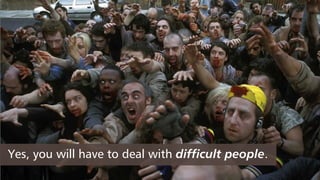
Yes, you will have to deal with difficult people.
Brainstorms?
Following up.
Critique and remote teams
Tips for critiquing with remote teams
Sight, sound, patience.
Tips for critiquing with remote teams
Sight, sound, patience.
Be open to use whatever tools work.
Tips for critiquing with remote teams
Sight, sound, patience.
Be open to use whatever tools work.
Be ready to ask a lot of questions, especially
after you get an answer.
Tips for critiquing with remote teams
Sight, sound, patience.
Be open to use whatever tools work.
Be ready to ask a lot of questions, especially
after you get an answer.
Be prepared, really prepared.
Tools for critiquing with remote teams
Zoom
GoTo Meeting
Slack
Google Hangouts
iPevo camera
Challenges to critique, & the path to better conversations
Aaron Irizarry
Head of Experience Infrastructure Capital One
@aaroni
oreilly.com
Use code “AUTH5” to get 50% off.
Amazon.com

Critique and The Design Process: Facilitating Better Feedback

  • 1.
    DISCUSSINGDESIGN IMPROVING TEAM COMMUNICATION& COLLABORATION THROUGH CRITIQUE
  • 2.
  • 4.
    It’s laid outtoo much like [popular service]. We should be different. The new Spotify design is perhaps even worse than the old Spotify design. The visual hierarchy and underlying IA are terrible. No. That won’t work. What if we do it this way... It needs more flululululuh!! The wireframes are still not answering our problem and are not providing enough an easier solution for the page. Change the order of the screens so that the 3rd and first one are switched. It doesn't have enough spunk. What kind of company shuts down a much-loved service like Google Reader but keeps the vegetative Google Plus? We're disappointed in this solution. We're going to have our own designers come up with one. Looks ugly. Make it pretty. What. The hell. Is this? I would never use this. I don’t like the layout. We should make that a dropdown instead of radio buttons. None of this is what I asked for. This is terrible. I have no idea what the lines mean. I like the paper form better. I'm just not feeling it. I don't know what, but it isn't right yet. Just needs to be more innovative. Make it look more like SharePoint. Here is a rewrite. My intention is to sharpen the language, make it more precise.
  • 5.
    The new Spotifydesign is perhaps even worse than the old Spotify design. The visual hierarchy and underlying IA are terrible. No. That won’t work. What if we do it this way... Change the order of the screens so that the 3rd and first one are switched. What. The hell. Is this? We should make that a dropdown instead of radio buttons. None of this is what I asked for. Here is a rewrite. My intention is to sharpen the language, make it more precise.
  • 6.
  • 8.
  • 9.
    “Good lord! That’sawful! An inebriated cocker spaniel could have done better! Reaction
  • 10.
    “Good lord! That’sawful! An inebriated cocker spaniel could have done better! Reaction Direction
  • 11.
    “Good lord! That’sawful! An inebriated cocker spaniel could have done better! “You should have made all of those radio buttons a drop down [,because…] Reaction Direction
  • 12.
  • 13.
  • 14.
    “Good lord! That’sawful! An inebriated cocker spaniel could have done better! “You should have made all of those radio buttons a drop down [,because…] Reaction Direction
  • 15.
    Critique “Good lord! That’sawful! An inebriated cocker spaniel could have done better! “You should have made all of those radio buttons a drop down [,because…] Reaction Direction
  • 16.
    “If the objectiveis for users to seriously consider the impact to their bank balance before making a purchase, placing the balance at the bottom of the screen at the same size as all the other numbers isn’t effective because it get’s lost in all of the other the information. Critique “Good lord! That’s awful! An inebriated cocker spaniel could have done better! “You should have made all of those radio buttons a drop down [,because…] Reaction Direction
  • 17.
    At their foundationis intent. There are two facets to critique, giving and receiving…
  • 18.
    Giving critique withthe wrong intent is self focused.
  • 19.
    Giving critique withthe right intent is objective focused.
  • 20.
    When giving critique... Usea filter. Gather initial thoughts and reactions. Revisit them in the right context.
  • 21.
    When giving critique... Don’tassume. Find out the reason behind thinking, constraints, or other variables.
  • 22.
    When giving critique... Don’tinvite yourself. Get in touch and ask to chat about the design.
  • 23.
    When giving critique... Leadwith questions. Show an interest in their process and learn more about their objectives.
  • 24.
    When giving critique... Talkabout strengths. Critique isn’t just about the things that aren’t working.
  • 25.
    Receiving critique with theright intent takes humility & restraint.
  • 26.
    Receiving critique with theright intent takes humility & restraint.
  • 27.
    When receiving critique... Rememberthe purpose. Critique is about understanding and improvement, not judgement.
  • 28.
    When receiving critique... Thinkbefore responding. Do you understand what the critics are saying?
  • 29.
    When receiving critique... Participate. Analyzeyour proposed solution alongside everyone else.
  • 30.
    When receiving critique... Setthe foundation. Use prior agreements and objectives to get everyone on the same page.
  • 31.
  • 32.
    Critique is aform of feedback meant to provide guidance by identifying concerns and insights about the work being presented. It is up to the designer(s) to take the insights and make decisions about progressing the design. Direction is a more “direct” form of feedback that identifies specific things that need to be changed in a design. This feedback is less open to designer interpretation.
  • 33.
    We need tools,and a plan.
  • 35.
    What are theobjectives for the design?
  • 36.
    What are theobjectives for the design?
  • 37.
    What are theobjectives for the design? What are the related design elements?
  • 38.
    What are theobjectives for the design? What are the related design elements?
  • 39.
    What are theobjectives for the design? What are the related design elements? Are they effective at achieving the objectives?
  • 40.
    What are theobjectives for the design? What are the related design elements? Are they effective at achieving the objectives?
  • 41.
    Why are oraren’t they effective? What are the objectives for the design? What are the related design elements? Are they effective at achieving the objectives?
  • 42.
  • 43.
  • 49.
  • 50.
  • 51.
  • 52.
    Too Soon TooLate*Just Right
  • 53.
    Critique is askill. You need to practice. Keep in mind…
  • 54.
    Critique is askill. You need to practice. Start small. Keep in mind…
  • 55.
    Critique is askill. You need to practice. Think before you speak. Start small. Keep in mind…
  • 56.
    Critique is askill. You need to practice. Choose who you critique with carefully. Think before you speak. Start small. Keep in mind…
  • 57.
    Rules of critique Avoidproblem solving.
  • 58.
    Rules of critique Avoidproblem solving. Everyone is equal.
  • 59.
    Rules of critique Avoidproblem solving. Everyone is equal. Everyone is a critic.
  • 60.
    Rules of critique Avoidproblem solving. Everyone is equal. Everyone is a critic. The designer is responsible for next steps.
  • 61.
    Set the rightfoundation.
  • 62.
    Set your foundationwith… Personas User archetypes that describe their average behaviors, goals, expectations, knowledge, etc.
  • 63.
    Set your foundationwith… Goals Desired, measurable outcomes of the user interacting with the product or service. Can be user oriented, business oriented or both.
  • 64.
    Set your foundationwith… Principles Statements, often worded as rules, that capture the desired qualities or characteristics of the final solution.
  • 65.
    Set your foundationwith… Scenarios Short narratives that the describe the desired behaviors, thoughts, emotions, etc. of the user as they move through a use case.
  • 66.
    Critique is aboutiteration and improvement. So long as you’re looking to improve on whatever it is you’re doing, you’ve got an opportunity for critique.
  • 67.
  • 68.
    Start things offon the right foot.
  • 69.
  • 70.
  • 71.
    Facilitating critique Critique Goals RoundRobin & Quotas Active Listening
  • 72.
    Facilitating critique Critique Goals RoundRobin & Quotas Direct Inquiry Active Listening
  • 73.
    Facilitating critique Critique Goals RoundRobin & Quotas Direct Inquiry Six Thinking HatsActive Listening
  • 74.
    Facilitating critique Critique Goals RoundRobin & Quotas Direct Inquiry Six Thinking Hats Facilitators Active Listening
  • 75.
    Yes, you willhave to deal with difficult people.
  • 76.
  • 77.
  • 78.
  • 79.
    Tips for critiquingwith remote teams
  • 80.
    Tips for critiquingwith remote teams Sight, sound, patience.
  • 81.
    Tips for critiquingwith remote teams Sight, sound, patience. Be open to use whatever tools work.
  • 82.
    Tips for critiquingwith remote teams Sight, sound, patience. Be open to use whatever tools work. Be ready to ask a lot of questions, especially after you get an answer.
  • 83.
    Tips for critiquingwith remote teams Sight, sound, patience. Be open to use whatever tools work. Be ready to ask a lot of questions, especially after you get an answer. Be prepared, really prepared.
  • 84.
    Tools for critiquingwith remote teams Zoom GoTo Meeting Slack Google Hangouts iPevo camera
  • 85.
    Challenges to critique,& the path to better conversations
  • 86.
    Aaron Irizarry Head ofExperience Infrastructure Capital One @aaroni oreilly.com Use code “AUTH5” to get 50% off. Amazon.com