Topic To Be Covered:
First Order Logic(FOL)
Jagdamba Education Society's
SND College of Engineering & Research Centre
Department of Computer Engineering
SUBJECT: Artificial Intelligence & Robotics
Lecture No-09(UNIT-03)
Logic & Reasoning
Prof.Dhakane Vikas N
First Order Logic
 In the topic of Propositional logic, we have seen that how to
represent statements using propositional logic.
 But unfortunately, in propositional logic, we can only represent the
facts, which are either true or false.
 PL is not sufficient to represent the complex sentences or natural
language statements.
 The propositional logic has very limited expressive power.
 Consider the following sentence, which we cannot represent using
PL logic.
"Some humans are intelligent"
"Sachin likes cricket."
To represent the above statements, PL logic is not sufficient, so we
required some more powerful logic, such as first-order logic.
First Order Logic
 PL is context independent
Ex:1.Radha started feeling feverish & Radha went to doctor
2.Radha went to doctor & Radha started feeling feverish
-If we represent above two statement by PL symbol and relation as
-According to PL A^B=B^A
-But,
A^B
B^A
-In above example A^B ,B^A should have same meaning but in natural
language words & sentences may have different meaning.
First Order Logic
 First-order logic is another way of knowledge representation in artificial
intelligence. It is an extension to propositional logic.
 FOL is sufficiently expressive to represent the natural language
statements in a concise way.
 First-order logic is also known as Predicate logic or First-order predicate
logic.
 First-order logic is a powerful language that develops information about
the objects in a more easy way and can also express the relationship
between those objects.
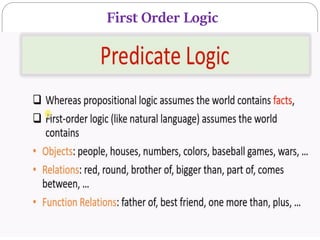
 First-order logic (like natural language) does not only assume that the
world contains facts like propositional logic but also assumes the
following things in the world:
First Order Logic
 Objects: A, B, people, numbers, colors, wars, theories, squares, pits,
wumpus, ......
 Relations: It can be unary relation such as: red, round, is adjacent, or n-
any relation such as: the sister of, brother of, has color, Father of, comes
between
 Function: best friend, third inning of, end of, ......
 As a natural language, first-order logic also has two main parts:
-Syntax
-Semantics
First Order Logic
First Order Logic
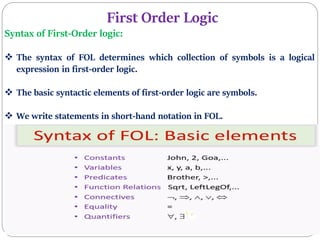
Syntax of First-Order logic:
 The syntax of FOL determines which collection of symbols is a logical
expression in first-order logic.
 The basic syntactic elements of first-order logic are symbols.
 We write statements in short-hand notation in FOL.
First Order Logic
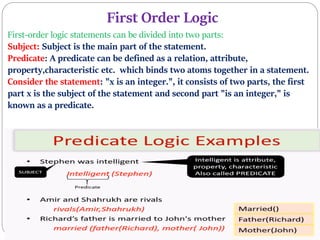
First-order logic statements can be divided into two parts:
Subject: Subject is the main part of the statement.
Predicate: A predicate can be defined as a relation, attribute,
property,characteristic etc. which binds two atoms together in a statement.
Consider the statement: "x is an integer.", it consists of two parts, the first
part x is the subject of the statement and second part "is an integer," is
known as a predicate.
First Order Logic
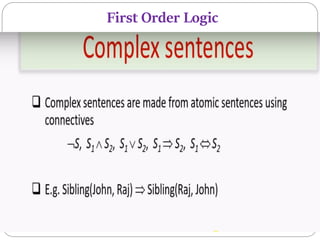
Types of Sentences In FOL
First Order Logic
First Order Logic
Quantifiers in First-order logic:
 Quantifiers are the symbols that permit to determine or identify the
range and scope of the variable in the logical expression. There are two
types of quantifier:
 Universal Quantifier, (for all, everyone, everything)
 Existential quantifier, (for some, at least one).
 Note: In universal quantifier we use implication "→".
 Note: In Existential quantifier we always use AND or Conjunction symbol
(∧).
First Order Logic
For all X ,if X is cat, then X drinks Milk
First Order Logic
For every X ,if X is integral, then X is smart
First Order Logic
For some X ,if X is cat, then X is duffer
First Order Logic
For some X ,if X is prime no., then X is even no.
For some X ,if X is student, then X like bunk
First Order Logic
First Order Logic
More Examples:
1)All students are smart
2)All graduates are employed
3)Someone is crying
4)We love India
5)Everyone Like Everyone
Ai lecture  09(unit03)

Ai lecture 09(unit03)

  • 1.
    Topic To BeCovered: First Order Logic(FOL) Jagdamba Education Society's SND College of Engineering & Research Centre Department of Computer Engineering SUBJECT: Artificial Intelligence & Robotics Lecture No-09(UNIT-03) Logic & Reasoning Prof.Dhakane Vikas N
  • 2.
    First Order Logic In the topic of Propositional logic, we have seen that how to represent statements using propositional logic.  But unfortunately, in propositional logic, we can only represent the facts, which are either true or false.  PL is not sufficient to represent the complex sentences or natural language statements.  The propositional logic has very limited expressive power.  Consider the following sentence, which we cannot represent using PL logic. "Some humans are intelligent" "Sachin likes cricket." To represent the above statements, PL logic is not sufficient, so we required some more powerful logic, such as first-order logic.
  • 3.
    First Order Logic PL is context independent Ex:1.Radha started feeling feverish & Radha went to doctor 2.Radha went to doctor & Radha started feeling feverish -If we represent above two statement by PL symbol and relation as -According to PL A^B=B^A -But, A^B B^A -In above example A^B ,B^A should have same meaning but in natural language words & sentences may have different meaning.
  • 4.
    First Order Logic First-order logic is another way of knowledge representation in artificial intelligence. It is an extension to propositional logic.  FOL is sufficiently expressive to represent the natural language statements in a concise way.  First-order logic is also known as Predicate logic or First-order predicate logic.  First-order logic is a powerful language that develops information about the objects in a more easy way and can also express the relationship between those objects.  First-order logic (like natural language) does not only assume that the world contains facts like propositional logic but also assumes the following things in the world:
  • 5.
    First Order Logic Objects: A, B, people, numbers, colors, wars, theories, squares, pits, wumpus, ......  Relations: It can be unary relation such as: red, round, is adjacent, or n- any relation such as: the sister of, brother of, has color, Father of, comes between  Function: best friend, third inning of, end of, ......  As a natural language, first-order logic also has two main parts: -Syntax -Semantics
  • 6.
  • 7.
    First Order Logic Syntaxof First-Order logic:  The syntax of FOL determines which collection of symbols is a logical expression in first-order logic.  The basic syntactic elements of first-order logic are symbols.  We write statements in short-hand notation in FOL.
  • 8.
    First Order Logic First-orderlogic statements can be divided into two parts: Subject: Subject is the main part of the statement. Predicate: A predicate can be defined as a relation, attribute, property,characteristic etc. which binds two atoms together in a statement. Consider the statement: "x is an integer.", it consists of two parts, the first part x is the subject of the statement and second part "is an integer," is known as a predicate.
  • 9.
    First Order Logic Typesof Sentences In FOL
  • 10.
  • 11.
    First Order Logic Quantifiersin First-order logic:  Quantifiers are the symbols that permit to determine or identify the range and scope of the variable in the logical expression. There are two types of quantifier:  Universal Quantifier, (for all, everyone, everything)  Existential quantifier, (for some, at least one).  Note: In universal quantifier we use implication "→".  Note: In Existential quantifier we always use AND or Conjunction symbol (∧).
  • 12.
    First Order Logic Forall X ,if X is cat, then X drinks Milk
  • 13.
    First Order Logic Forevery X ,if X is integral, then X is smart
  • 14.
    First Order Logic Forsome X ,if X is cat, then X is duffer
  • 15.
    First Order Logic Forsome X ,if X is prime no., then X is even no. For some X ,if X is student, then X like bunk
  • 16.
  • 17.
    First Order Logic MoreExamples: 1)All students are smart 2)All graduates are employed 3)Someone is crying 4)We love India 5)Everyone Like Everyone