Constructive Modalities
Valeria de Paiva
Ticamore 7th Meeting
June 2021
1 / 34
Thank You!
2 / 34
Modal Logic
...there is no one fundamental logical notion of necessity, nor con-
sequently of possibility. If this conclusion is valid, the subject of
modality ought to be banished from logic, since propositions are
simply true or false...
[Russell, 1905]
3 / 34
Modal Logics
One often hears that modal (or some other) logic is pointless
because it can be translated into some simpler language in a first-
order way. Take no notice of such arguments. There is no weight
to the claim that the original system must therefore be replaced by
the new one. What is essential is to single out important concepts
and to investigate their properties.
[Scott, 1971]
4 / 34
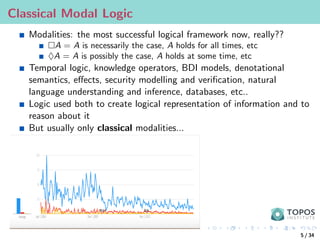
Classical Modal Logic
Modalities: the most successful logical framework now, really??
A = A is necessarily the case, A holds for all times, etc
♦A = A is possibly the case, A holds at some time, etc
Temporal logic, knowledge operators, BDI models, denotational
semantics, effects, security modelling and verification, natural
language understanding and inference, databases, etc..
Logic used both to create logical representation of information and to
reason about it
But usually only classical modalities...
5 / 34
Classical Modalities (in Computing)
Reasoning about [concurrent] programs
Pnueli, The Temporal Logic of Programs, 1977.
ACM Turing Award, 1996.
Reasoning about hardware; model-checking
Clarke, Emerson, Synthesis of Synchronization Skeletons for
Branching Time Temporal Logic, 1981.
Bryant, Clarke, Emerson, McMillan; ACM Kanellakis Award, 1999
Knowledge Representation
From frames to KL-ONE to Description Logics
MacGregor1987, Baader et al. 2003 Semantic Web!
They are also essential in AI, Cognitive Science, Philosophy, Decision
Theory, etc... Thanks Frank Pfenning!
6 / 34
Constructive reasoning
What: Reasoning principles that are safer
if I ask you whether “is there an x such that P(x)?”
I’m happier with the answer “yes, x0”, than with an answer “yes, for
all x it is not the case that not P(x)”
Why: want reasoning to be as precise and safe as possible
How: constructive reasoning as much as possible, classical if need be,
but tell me where and why...
Today: constructive modalities!
7 / 34
Intuitionistic Modal Logic
Basic idea: Modalities over an Intuitionistic propositional basis:
∧, ∨, →, ¬
Which modalities?
Which intuitionistic basis?
Why? How?
Why so many modal logics?
How to choose?
Can relate to others?
Which are the important theorems?
Which are the most useful applications?
8 / 34
Constructive Modal Logic
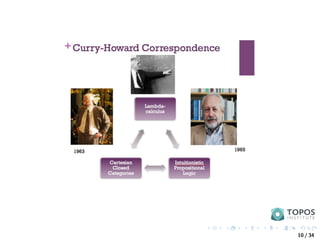
Constructive logic = a logical basis for programming via
Curry-Howard correspondences
Modalities useful in Computing
Constructive modalities ought to be twice as useful
But why they so niche? which constructive modalities should we
have?
Usual phenomenon: classical facts can be ‘constructivized’ in many
different ways. Hence constructive notions multiply...
Hence too many choices
9 / 34
10 / 34
Constructive Modal Logics
Operators Box , Diamond ♦ (like forall/exists) not interdefinable
How do these two modalities interact?
Depends on expected behavior and on tools you want to use
The proof theory of modal logic is difficult, Handbook of
Philosophical Logic – Segerberg first to write it
Solutions add to syntax: hypersequents, labelled deduction systems,
(linear) nested sequents, tree-sequents, all add some semantics to
syntax (many ways...)
11 / 34
What’s the state of play?
IMLA’s goal: functional programmers talking to philosophical
logicians and vice-versa
Not attained?
Communities still largely talking past each other
Incremental work on intuitionistic modal logics continues, as well as
some of the big research programmes that started it
Does it make sense to try to change this?
12 / 34
What did I expect twenty years ago?
Fully worked out Curry-Howard for a collection of intuitionistic modal
logics
Fully worked out design space for intuitionistic modal logic, for
classical logic and how to move from intuitionistic modal to classic
modal
Full range of applications of modal type systems
Fully worked out dualities for desirable systems
Collections of implementations for proof search/proof normalization
13 / 34
Why did I think it would be easy?
Some early successes. Systems: CS4, Lax, CK
CS4: On an Intuitionistic Modal Logic (with Bierman, Studia Logica
2000, conference 1992)
DIML: Explicit Substitutions for Constructive Necessity (with Neil
Ghani and Eike Ritter), ICALP 1998
Lax Logic: Computational Types from a Logical Perspective (with
Benton, Bierman, JFP 1998)
CK: Basic Constructive Modal Logic. (with Bellin and Ritter, M4M
2001), Kripke semantics for CK (with Mendler 2005),
14 / 34
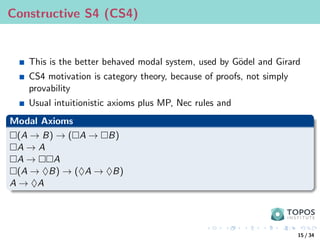
Constructive S4 (CS4)
This is the better behaved modal system, used by Gödel and Girard
CS4 motivation is category theory, because of proofs, not simply
provability
Usual intuitionistic axioms plus MP, Nec rules and
Modal Axioms
(A → B) → (A → B)
A → A
A → A
(A → ♦B) → (♦A → ♦B)
A → ♦A
15 / 34
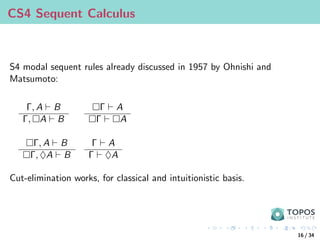
CS4 Sequent Calculus
S4 modal sequent rules already discussed in 1957 by Ohnishi and
Matsumoto:
Γ, A ` B
Γ, A ` B
Γ ` A
Γ ` A
Γ, A ` B
Γ, ♦A ` B
Γ ` A
Γ ` ♦A
Cut-elimination works, for classical and intuitionistic basis.
16 / 34
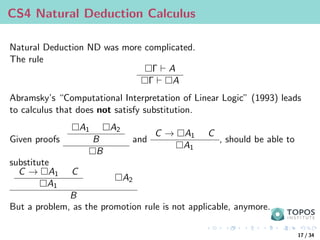
CS4 Natural Deduction Calculus
Natural Deduction ND was more complicated.
The rule
Γ ` A
Γ ` A
Abramsky’s “Computational Interpretation of Linear Logic” (1993) leads
to calculus that does not satisfy substitution.
Given proofs
A1 A2
B
B
and
C → A1 C
A1
, should be able to
substitute
C → A1 C
A1
A2
B
But a problem, as the promotion rule is not applicable, anymore.
17 / 34
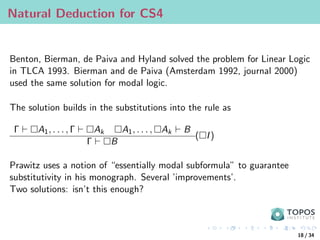
Natural Deduction for CS4
Benton, Bierman, de Paiva and Hyland solved the problem for Linear Logic
in TLCA 1993. Bierman and de Paiva (Amsterdam 1992, journal 2000)
used the same solution for modal logic.
The solution builds in the substitutions into the rule as
Γ ` A1, . . . , Γ ` Ak A1, . . . , Ak ` B
Γ ` B
(I)
Prawitz uses a notion of “essentially modal subformula” to guarantee
substitutivity in his monograph. Several ’improvements’.
Two solutions: isn’t this enough?
18 / 34
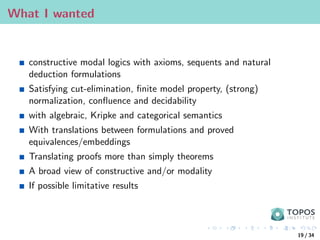
What I wanted
constructive modal logics with axioms, sequents and natural
deduction formulations
Satisfying cut-elimination, finite model property, (strong)
normalization, confluence and decidability
with algebraic, Kripke and categorical semantics
With translations between formulations and proved
equivalences/embeddings
Translating proofs more than simply theorems
A broad view of constructive and/or modality
If possible limitative results
19 / 34
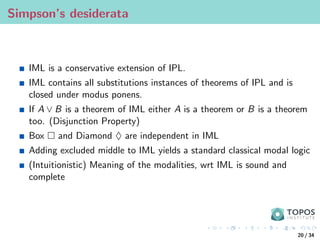
Simpson’s desiderata
IML is a conservative extension of IPL.
IML contains all substitutions instances of theorems of IPL and is
closed under modus ponens.
If A ∨ B is a theorem of IML either A is a theorem or B is a theorem
too. (Disjunction Property)
Box  and Diamond ♦ are independent in IML
Adding excluded middle to IML yields a standard classical modal logic
(Intuitionistic) Meaning of the modalities, wrt IML is sound and
complete
20 / 34
Avron’s desiderata
A generic proof-theoretical framework should:
Be able to handle a great diversity of logics. Expect to get the ones
logicians have used already
Be independent of any particular semantics
Structures should be built from formulae in the logic and not too
complicated, should yield a “real” subformula property
Rules of inference should have a small fixed number of premisses, and
a local nature of application
Rules for conjunction, disjunction, implication and negation should be
as standard as possible
Proof systems constructed should give us a better understanding of
the corresponding logics and the differences between them
21 / 34
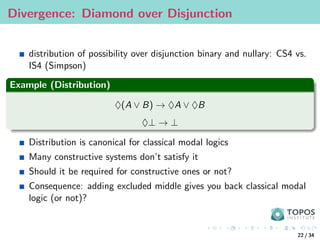
Divergence: Diamond over Disjunction
distribution of possibility over disjunction binary and nullary: CS4 vs.
IS4 (Simpson)
Example (Distribution)
♦(A ∨ B) → ♦A ∨ ♦B
♦⊥ → ⊥
Distribution is canonical for classical modal logics
Many constructive systems don’t satisfy it
Should it be required for constructive ones or not?
Consequence: adding excluded middle gives you back classical modal
logic (or not)?
22 / 34
Divergence: labelled vs. unlabelled systems
proof system should have (Kripke) semantics as part of the syntax?
Example (Introduction of Box)
Γ ` A
Γ ` A
vs.
Γ [xRy] ` y : A
Γ ` x : A
The introduction rule for  must express that if A holds at every
world y visible from x then A holds at x.
if, on the assumption that y is an arbitrary world visible from x, we
can show that A holds at y then we can conclude that A holds at x.
Simpson’s systems have two kinds of hypotheses, x : A which means
that the modal formula A is true in the world x and xRy, which says
that world y is accessible from world x
How reasonable is it to have your proposed semantics as part of your
syntax?
Proof-theoretic properties there, but no categorical semantics?
23 / 34
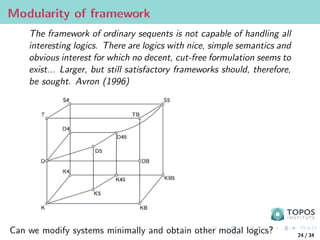
Modularity of framework
The framework of ordinary sequents is not capable of handling all
interesting logics. There are logics with nice, simple semantics and
obvious interest for which no decent, cut-free formulation seems to
exist... Larger, but still satisfactory frameworks should, therefore,
be sought. Avron (1996)
Can we modify systems minimally and obtain other modal logics? 24 / 34
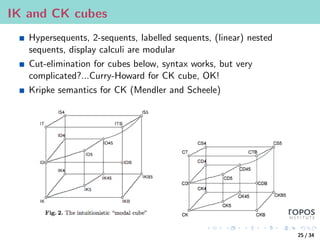
IK and CK cubes
Hypersequents, 2-sequents, labelled sequents, (linear) nested
sequents, display calculi are modular
Cut-elimination for cubes below, syntax works, but very
complicated?...Curry-Howard for CK cube, OK!
Kripke semantics for CK (Mendler and Scheele)
25 / 34
Conclusions
Panorama of Curry-Howard for constructive modal logics
Plenty of recent work on pure syntax from Bruennler, Strassburger,
Pimentel, Lellmann and and many others
Many applications of the ideas of constructive modal logic
Many interesting papers on specific applications, see Jagadhesan et
al, Jeffrey FRP, etc
Still lacking an over-arching framework? proposals by Shulman,
Licata and others coming from HoTT
26 / 34
Summary
Constructive modal logics are interesting for programmers, logicians
and philosophers. Shame they don’t talk to each other much.
At least two families CK and IK, different properties. Hard to produce
good proof theory for them: many augmentations of sequent systems.
So far IK better for model theory, CK better for lambda-calculus, but
want both, plus categorical semantics too
Further work
Further trade-offs: generalization vs simplicity?
Can extend fibrational semantics to CK?
Fibrational semantics for Linear Logic? which gains?
Thanks!
27 / 34
Some References I
G. Bierman, V de Paiva
On an Intuitionistic Modal Logic
Studia Logica (65):383-416, 2000.
N. Benton, G. Bierman, V de Paiva
Computational Types from a Logical Perspective I.
Journal of Functional Programming, 8(2):177-193. 1998 .
N. Ghani, V de Paiva, E. Ritter
Explicit Substitutions for Constructive Necessity
ICALP’98 Proceedings, LNCS 1443, 1998
G. Bellin, V de Paiva, E. Ritter
Basic Constructive Modal Logic
Methods for the Modalities, 2001
28 / 34
Some References II
A. Simpson
The Proof Theory and Semantics of Intuitionistic Modal Logic
PhD thesis, Edinburgh, 1994.
A. Avron
The method of hypersequents in the proof theory of propositional
non-classical logics
http://www.math.tau.ac.il, 1996
H. Wansing
Sequent Systems for Modal Logic
Handbook of Philosophical Logic Volume 8, 2002
S. Negri
Proof analysis in modal logic.
Journal of Philosophical Logic, 34:507544, 2005.
29 / 34
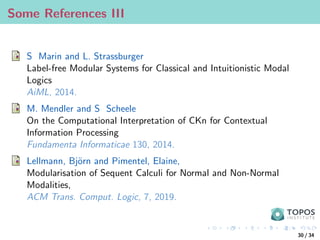
Some References III
S Marin and L. Strassburger
Label-free Modular Systems for Classical and Intuitionistic Modal
Logics
AiML, 2014.
M. Mendler and S Scheele
On the Computational Interpretation of CKn for Contextual
Information Processing
Fundamenta Informaticae 130, 2014.
Lellmann, Björn and Pimentel, Elaine,
Modularisation of Sequent Calculi for Normal and Non-Normal
Modalities,
ACM Trans. Comput. Logic, 7, 2019.
30 / 34
Anyways...
Intuitionistic Modal Logic and Applications (IMLA) a loose
association of researchers, meetings and a certain amount of
mathematical common ground.
Hope that philosophers, mathematical logicians and computer
scientists would share information and tools when investigating
intuitionistic modal logics and modal type theories
if they knew of each other’s work
31 / 34
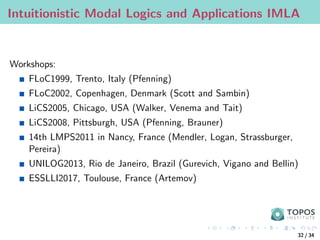
Intuitionistic Modal Logics and Applications IMLA
Workshops:
FLoC1999, Trento, Italy (Pfenning)
FLoC2002, Copenhagen, Denmark (Scott and Sambin)
LiCS2005, Chicago, USA (Walker, Venema and Tait)
LiCS2008, Pittsburgh, USA (Pfenning, Brauner)
14th LMPS2011 in Nancy, France (Mendler, Logan, Strassburger,
Pereira)
UNILOG2013, Rio de Janeiro, Brazil (Gurevich, Vigano and Bellin)
ESSLLI2017, Toulouse, France (Artemov)
32 / 34
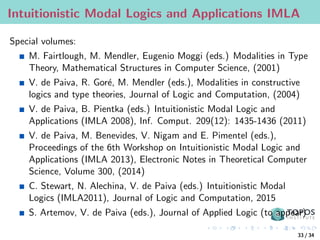
Intuitionistic Modal Logics and Applications IMLA
Special volumes:
M. Fairtlough, M. Mendler, Eugenio Moggi (eds.) Modalities in Type
Theory, Mathematical Structures in Computer Science, (2001)
V. de Paiva, R. Goré, M. Mendler (eds.), Modalities in constructive
logics and type theories, Journal of Logic and Computation, (2004)
V. de Paiva, B. Pientka (eds.) Intuitionistic Modal Logic and
Applications (IMLA 2008), Inf. Comput. 209(12): 1435-1436 (2011)
V. de Paiva, M. Benevides, V. Nigam and E. Pimentel (eds.),
Proceedings of the 6th Workshop on Intuitionistic Modal Logic and
Applications (IMLA 2013), Electronic Notes in Theoretical Computer
Science, Volume 300, (2014)
C. Stewart, N. Alechina, V. de Paiva (eds.) Intuitionistic Modal
Logics (IMLA2011), Journal of Logic and Computation, 2015
S. Artemov, V. de Paiva (eds.), Journal of Applied Logic (to appear)
33 / 34
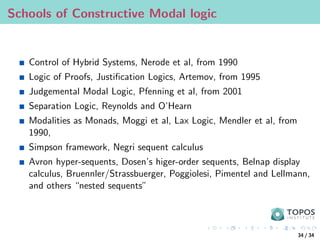
Schools of Constructive Modal logic
Control of Hybrid Systems, Nerode et al, from 1990
Logic of Proofs, Justification Logics, Artemov, from 1995
Judgemental Modal Logic, Pfenning et al, from 2001
Separation Logic, Reynolds and O’Hearn
Modalities as Monads, Moggi et al, Lax Logic, Mendler et al, from
1990,
Simpson framework, Negri sequent calculus
Avron hyper-sequents, Dosen’s higer-order sequents, Belnap display
calculus, Bruennler/Strassbuerger, Poggiolesi, Pimentel and Lellmann,
and others “nested sequents”
34 / 34

Constructive Modalities

  • 1.
    Constructive Modalities Valeria dePaiva Ticamore 7th Meeting June 2021 1 / 34
  • 2.
  • 3.
    Modal Logic ...there isno one fundamental logical notion of necessity, nor con- sequently of possibility. If this conclusion is valid, the subject of modality ought to be banished from logic, since propositions are simply true or false... [Russell, 1905] 3 / 34
  • 4.
    Modal Logics One oftenhears that modal (or some other) logic is pointless because it can be translated into some simpler language in a first- order way. Take no notice of such arguments. There is no weight to the claim that the original system must therefore be replaced by the new one. What is essential is to single out important concepts and to investigate their properties. [Scott, 1971] 4 / 34
  • 5.
    Classical Modal Logic Modalities:the most successful logical framework now, really?? A = A is necessarily the case, A holds for all times, etc ♦A = A is possibly the case, A holds at some time, etc Temporal logic, knowledge operators, BDI models, denotational semantics, effects, security modelling and verification, natural language understanding and inference, databases, etc.. Logic used both to create logical representation of information and to reason about it But usually only classical modalities... 5 / 34
  • 6.
    Classical Modalities (inComputing) Reasoning about [concurrent] programs Pnueli, The Temporal Logic of Programs, 1977. ACM Turing Award, 1996. Reasoning about hardware; model-checking Clarke, Emerson, Synthesis of Synchronization Skeletons for Branching Time Temporal Logic, 1981. Bryant, Clarke, Emerson, McMillan; ACM Kanellakis Award, 1999 Knowledge Representation From frames to KL-ONE to Description Logics MacGregor1987, Baader et al. 2003 Semantic Web! They are also essential in AI, Cognitive Science, Philosophy, Decision Theory, etc... Thanks Frank Pfenning! 6 / 34
  • 7.
    Constructive reasoning What: Reasoningprinciples that are safer if I ask you whether “is there an x such that P(x)?” I’m happier with the answer “yes, x0”, than with an answer “yes, for all x it is not the case that not P(x)” Why: want reasoning to be as precise and safe as possible How: constructive reasoning as much as possible, classical if need be, but tell me where and why... Today: constructive modalities! 7 / 34
  • 8.
    Intuitionistic Modal Logic Basicidea: Modalities over an Intuitionistic propositional basis: ∧, ∨, →, ¬ Which modalities? Which intuitionistic basis? Why? How? Why so many modal logics? How to choose? Can relate to others? Which are the important theorems? Which are the most useful applications? 8 / 34
  • 9.
    Constructive Modal Logic Constructivelogic = a logical basis for programming via Curry-Howard correspondences Modalities useful in Computing Constructive modalities ought to be twice as useful But why they so niche? which constructive modalities should we have? Usual phenomenon: classical facts can be ‘constructivized’ in many different ways. Hence constructive notions multiply... Hence too many choices 9 / 34
  • 10.
  • 11.
    Constructive Modal Logics OperatorsBox , Diamond ♦ (like forall/exists) not interdefinable How do these two modalities interact? Depends on expected behavior and on tools you want to use The proof theory of modal logic is difficult, Handbook of Philosophical Logic – Segerberg first to write it Solutions add to syntax: hypersequents, labelled deduction systems, (linear) nested sequents, tree-sequents, all add some semantics to syntax (many ways...) 11 / 34
  • 12.
    What’s the stateof play? IMLA’s goal: functional programmers talking to philosophical logicians and vice-versa Not attained? Communities still largely talking past each other Incremental work on intuitionistic modal logics continues, as well as some of the big research programmes that started it Does it make sense to try to change this? 12 / 34
  • 13.
    What did Iexpect twenty years ago? Fully worked out Curry-Howard for a collection of intuitionistic modal logics Fully worked out design space for intuitionistic modal logic, for classical logic and how to move from intuitionistic modal to classic modal Full range of applications of modal type systems Fully worked out dualities for desirable systems Collections of implementations for proof search/proof normalization 13 / 34
  • 14.
    Why did Ithink it would be easy? Some early successes. Systems: CS4, Lax, CK CS4: On an Intuitionistic Modal Logic (with Bierman, Studia Logica 2000, conference 1992) DIML: Explicit Substitutions for Constructive Necessity (with Neil Ghani and Eike Ritter), ICALP 1998 Lax Logic: Computational Types from a Logical Perspective (with Benton, Bierman, JFP 1998) CK: Basic Constructive Modal Logic. (with Bellin and Ritter, M4M 2001), Kripke semantics for CK (with Mendler 2005), 14 / 34
  • 15.
    Constructive S4 (CS4) Thisis the better behaved modal system, used by Gödel and Girard CS4 motivation is category theory, because of proofs, not simply provability Usual intuitionistic axioms plus MP, Nec rules and Modal Axioms (A → B) → (A → B) A → A A → A (A → ♦B) → (♦A → ♦B) A → ♦A 15 / 34
  • 16.
    CS4 Sequent Calculus S4modal sequent rules already discussed in 1957 by Ohnishi and Matsumoto: Γ, A ` B Γ, A ` B Γ ` A Γ ` A Γ, A ` B Γ, ♦A ` B Γ ` A Γ ` ♦A Cut-elimination works, for classical and intuitionistic basis. 16 / 34
  • 17.
    CS4 Natural DeductionCalculus Natural Deduction ND was more complicated. The rule Γ ` A Γ ` A Abramsky’s “Computational Interpretation of Linear Logic” (1993) leads to calculus that does not satisfy substitution. Given proofs A1 A2 B B and C → A1 C A1 , should be able to substitute C → A1 C A1 A2 B But a problem, as the promotion rule is not applicable, anymore. 17 / 34
  • 18.
    Natural Deduction forCS4 Benton, Bierman, de Paiva and Hyland solved the problem for Linear Logic in TLCA 1993. Bierman and de Paiva (Amsterdam 1992, journal 2000) used the same solution for modal logic. The solution builds in the substitutions into the rule as Γ ` A1, . . . , Γ ` Ak A1, . . . , Ak ` B Γ ` B (I) Prawitz uses a notion of “essentially modal subformula” to guarantee substitutivity in his monograph. Several ’improvements’. Two solutions: isn’t this enough? 18 / 34
  • 19.
    What I wanted constructivemodal logics with axioms, sequents and natural deduction formulations Satisfying cut-elimination, finite model property, (strong) normalization, confluence and decidability with algebraic, Kripke and categorical semantics With translations between formulations and proved equivalences/embeddings Translating proofs more than simply theorems A broad view of constructive and/or modality If possible limitative results 19 / 34
  • 20.
    Simpson’s desiderata IML isa conservative extension of IPL. IML contains all substitutions instances of theorems of IPL and is closed under modus ponens. If A ∨ B is a theorem of IML either A is a theorem or B is a theorem too. (Disjunction Property) Box and Diamond ♦ are independent in IML Adding excluded middle to IML yields a standard classical modal logic (Intuitionistic) Meaning of the modalities, wrt IML is sound and complete 20 / 34
  • 21.
    Avron’s desiderata A genericproof-theoretical framework should: Be able to handle a great diversity of logics. Expect to get the ones logicians have used already Be independent of any particular semantics Structures should be built from formulae in the logic and not too complicated, should yield a “real” subformula property Rules of inference should have a small fixed number of premisses, and a local nature of application Rules for conjunction, disjunction, implication and negation should be as standard as possible Proof systems constructed should give us a better understanding of the corresponding logics and the differences between them 21 / 34
  • 22.
    Divergence: Diamond overDisjunction distribution of possibility over disjunction binary and nullary: CS4 vs. IS4 (Simpson) Example (Distribution) ♦(A ∨ B) → ♦A ∨ ♦B ♦⊥ → ⊥ Distribution is canonical for classical modal logics Many constructive systems don’t satisfy it Should it be required for constructive ones or not? Consequence: adding excluded middle gives you back classical modal logic (or not)? 22 / 34
  • 23.
    Divergence: labelled vs.unlabelled systems proof system should have (Kripke) semantics as part of the syntax? Example (Introduction of Box) Γ ` A Γ ` A vs. Γ [xRy] ` y : A Γ ` x : A The introduction rule for must express that if A holds at every world y visible from x then A holds at x. if, on the assumption that y is an arbitrary world visible from x, we can show that A holds at y then we can conclude that A holds at x. Simpson’s systems have two kinds of hypotheses, x : A which means that the modal formula A is true in the world x and xRy, which says that world y is accessible from world x How reasonable is it to have your proposed semantics as part of your syntax? Proof-theoretic properties there, but no categorical semantics? 23 / 34
  • 24.
    Modularity of framework Theframework of ordinary sequents is not capable of handling all interesting logics. There are logics with nice, simple semantics and obvious interest for which no decent, cut-free formulation seems to exist... Larger, but still satisfactory frameworks should, therefore, be sought. Avron (1996) Can we modify systems minimally and obtain other modal logics? 24 / 34
  • 25.
    IK and CKcubes Hypersequents, 2-sequents, labelled sequents, (linear) nested sequents, display calculi are modular Cut-elimination for cubes below, syntax works, but very complicated?...Curry-Howard for CK cube, OK! Kripke semantics for CK (Mendler and Scheele) 25 / 34
  • 26.
    Conclusions Panorama of Curry-Howardfor constructive modal logics Plenty of recent work on pure syntax from Bruennler, Strassburger, Pimentel, Lellmann and and many others Many applications of the ideas of constructive modal logic Many interesting papers on specific applications, see Jagadhesan et al, Jeffrey FRP, etc Still lacking an over-arching framework? proposals by Shulman, Licata and others coming from HoTT 26 / 34
  • 27.
    Summary Constructive modal logicsare interesting for programmers, logicians and philosophers. Shame they don’t talk to each other much. At least two families CK and IK, different properties. Hard to produce good proof theory for them: many augmentations of sequent systems. So far IK better for model theory, CK better for lambda-calculus, but want both, plus categorical semantics too Further work Further trade-offs: generalization vs simplicity? Can extend fibrational semantics to CK? Fibrational semantics for Linear Logic? which gains? Thanks! 27 / 34
  • 28.
    Some References I G.Bierman, V de Paiva On an Intuitionistic Modal Logic Studia Logica (65):383-416, 2000. N. Benton, G. Bierman, V de Paiva Computational Types from a Logical Perspective I. Journal of Functional Programming, 8(2):177-193. 1998 . N. Ghani, V de Paiva, E. Ritter Explicit Substitutions for Constructive Necessity ICALP’98 Proceedings, LNCS 1443, 1998 G. Bellin, V de Paiva, E. Ritter Basic Constructive Modal Logic Methods for the Modalities, 2001 28 / 34
  • 29.
    Some References II A.Simpson The Proof Theory and Semantics of Intuitionistic Modal Logic PhD thesis, Edinburgh, 1994. A. Avron The method of hypersequents in the proof theory of propositional non-classical logics http://www.math.tau.ac.il, 1996 H. Wansing Sequent Systems for Modal Logic Handbook of Philosophical Logic Volume 8, 2002 S. Negri Proof analysis in modal logic. Journal of Philosophical Logic, 34:507544, 2005. 29 / 34
  • 30.
    Some References III SMarin and L. Strassburger Label-free Modular Systems for Classical and Intuitionistic Modal Logics AiML, 2014. M. Mendler and S Scheele On the Computational Interpretation of CKn for Contextual Information Processing Fundamenta Informaticae 130, 2014. Lellmann, Björn and Pimentel, Elaine, Modularisation of Sequent Calculi for Normal and Non-Normal Modalities, ACM Trans. Comput. Logic, 7, 2019. 30 / 34
  • 31.
    Anyways... Intuitionistic Modal Logicand Applications (IMLA) a loose association of researchers, meetings and a certain amount of mathematical common ground. Hope that philosophers, mathematical logicians and computer scientists would share information and tools when investigating intuitionistic modal logics and modal type theories if they knew of each other’s work 31 / 34
  • 32.
    Intuitionistic Modal Logicsand Applications IMLA Workshops: FLoC1999, Trento, Italy (Pfenning) FLoC2002, Copenhagen, Denmark (Scott and Sambin) LiCS2005, Chicago, USA (Walker, Venema and Tait) LiCS2008, Pittsburgh, USA (Pfenning, Brauner) 14th LMPS2011 in Nancy, France (Mendler, Logan, Strassburger, Pereira) UNILOG2013, Rio de Janeiro, Brazil (Gurevich, Vigano and Bellin) ESSLLI2017, Toulouse, France (Artemov) 32 / 34
  • 33.
    Intuitionistic Modal Logicsand Applications IMLA Special volumes: M. Fairtlough, M. Mendler, Eugenio Moggi (eds.) Modalities in Type Theory, Mathematical Structures in Computer Science, (2001) V. de Paiva, R. Goré, M. Mendler (eds.), Modalities in constructive logics and type theories, Journal of Logic and Computation, (2004) V. de Paiva, B. Pientka (eds.) Intuitionistic Modal Logic and Applications (IMLA 2008), Inf. Comput. 209(12): 1435-1436 (2011) V. de Paiva, M. Benevides, V. Nigam and E. Pimentel (eds.), Proceedings of the 6th Workshop on Intuitionistic Modal Logic and Applications (IMLA 2013), Electronic Notes in Theoretical Computer Science, Volume 300, (2014) C. Stewart, N. Alechina, V. de Paiva (eds.) Intuitionistic Modal Logics (IMLA2011), Journal of Logic and Computation, 2015 S. Artemov, V. de Paiva (eds.), Journal of Applied Logic (to appear) 33 / 34
  • 34.
    Schools of ConstructiveModal logic Control of Hybrid Systems, Nerode et al, from 1990 Logic of Proofs, Justification Logics, Artemov, from 1995 Judgemental Modal Logic, Pfenning et al, from 2001 Separation Logic, Reynolds and O’Hearn Modalities as Monads, Moggi et al, Lax Logic, Mendler et al, from 1990, Simpson framework, Negri sequent calculus Avron hyper-sequents, Dosen’s higer-order sequents, Belnap display calculus, Bruennler/Strassbuerger, Poggiolesi, Pimentel and Lellmann, and others “nested sequents” 34 / 34