Cover
Targeting Epigenetic Readers and
Chromatin Remodelers
Next Generation Histone Deacetylase
Inhibitors Symposium
Targeting the Ubiquitin
Proteasome System
Big Data Analytics and Solutions
GPCR-Based Drug Discovery
RNAi for Functional Genomics
Screening - Part 1
Protein-Protein Interactions
as Drug Targets
Antibodies Against Membrane
Protein Targets - Part 1
Sponsor & Exhibit Opportunities
Conference-at-a-Glance
Hotel & Travel Information
Short Courses
Registration Information
Click Here to
Register Online!
DiscoveryOnTarget.com
Targeting Histone Methyltransferases
and Demethylases
Screening Drug Transporter Proteins
Maximizing Efficiency in Discovery
GPCR-Targeted Therapeutics
Genome Editing for Functional
Genomics Screens - Part 2
Cancer Metabolism
Antibodies Against Membrane
Protein Targets - Part 2
Discovery on Target | 1
REGISTER BY JUNE 13 AND SAVE UP TO $
600!
October 8 – 9
Targeting Epigenetic Readers and Chromatin Remodelers
Targeting the Ubiquitin Proteasome System
Big Data Analytics and Solutions – NEW!
GPCR-Based Drug Discovery
RNAi for Functional Genomics Screening - Part 1
Protein-Protein Interactions as Drug Targets – NEW!
Antibodies Against Membrane Protein Targets - Part 1
October 9 – 10
Targeting Histone Methyltransferases and Demethylases
Screening Drug Transporter Proteins – NEW!
Maximizing Efficiency in Discovery – NEW!
GPCR-Targeted Therapeutics
Genome Editing for Functional Genomics Screens - Part 2
Cancer Metabolism
Antibodies Against Membrane Protein Targets - Part 2
12th
ANNUAL
OCTOBER 8 - 10, 2014 WESTIN BOSTON WATERFRONT | BOSTON MA
The Industry’s Preeminent Event on Novel Drug Targets
SYMPOSIUM
EIGHTH ANNUAL
Next Generation Histone
Deacetylase Inhibitors
EVENT FEATURES
14 Conferences
13 Short Courses
1 Symposium
40+ Exhibitors
50+ Posters
40+ Interactive Breakout Discussion Groups
Plenary Keynote Speakers
PREMIER
SPONSOR
Cover
Targeting Epigenetic Readers and
Chromatin Remodelers
Next Generation Histone Deacetylase
Inhibitors Symposium
Targeting the Ubiquitin
Proteasome System
Big Data Analytics and Solutions
GPCR-Based Drug Discovery
RNAi for Functional Genomics
Screening - Part 1
Protein-Protein Interactions
as Drug Targets
Antibodies Against Membrane
Protein Targets - Part 1
Sponsor & Exhibit Opportunities
Conference-at-a-Glance
Hotel & Travel Information
Short Courses
Registration Information
Click Here to
Register Online!
DiscoveryOnTarget.com
Targeting Histone Methyltransferases
and Demethylases
Screening Drug Transporter Proteins
Maximizing Efficiency in Discovery
GPCR-Targeted Therapeutics
Genome Editing for Functional
Genomics Screens - Part 2
Cancer Metabolism
Antibodies Against Membrane
Protein Targets - Part 2
Discovery on Target | 2
Tuesday
October 7
Pre-Conference Short Courses* and 1-day Symposium: Next Generation Histone Deacetylase Inhibitors*
Wednesday
October 8
1A: Targeting
Epigenetic Readers
and Chromatin
Remodelers
2A: Targeting the
Ubiquitin Proteasome
System
3A: Big Data Analytics
& Solutions
4A: GPCR-Based Drug
Discovery
5A: RNAi for Functional
Genomics Screening –
Part 1
6A: Protein-Protein
Interactions as Drug
Targets
7A: Antibodies Against
Membrane Protein
Targets – Part 1
Thursday
October 9
1A: Targeting
Epigenetic Readers
and Chromatin
Remodelers
2A: Targeting the
Ubiquitin Proteasome
System
3A: Big Data Analytics
& Solutions
4A: GPCR-Based Drug
Discovery
5A: RNAi for Functional
Genomics Screening –
Part 1
6A: Protein-Protein
Interactions as Drug
Targets
7A: Antibodies Against
Membrane Protein
Targets – Part 1
1B: Targeting Histone
Methyltransferases and
Demethylases
2B: Screening Drug
Transporter Proteins
3B: Maximizing
Efficiency in Discovery
4B: GPCR-Targeted
Therapies
5B: Genome Editing for
Functional Genomics
Screens – Part 2
6B: Cancer Metabolism 7B: Antibodies Against
Membrane Protein
Targets – Part 2
Thursday
October 9
7:00–10:00 pm
Dinner Short Courses*
Friday
October 10
1B: Targeting Histone
Methyltransferases and
Demethylases
2B: Screening Drug
Transporter Proteins
3B: Maximizing
Efficiency in Discovery
4B: GPCR-Targeted
Therapies
5B: Genome Editing for
Functional Genomics
Screens – Part 2
6B: Cancer Metabolism 7B: Antibodies Against
Membrane Protein
Targets – Part 2
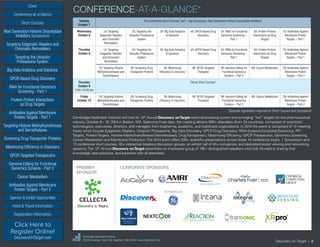
CONFERENCE-AT-A-GLANCE*
Cambridge Healthtech Institute will host its 12th
Annual Discovery onTarget event showcasing current and emerging “hot” targets for the pharmaceutical
industry October 8 – 10, 2014 in Boston, MA. Spanning three days, the meeting attracts 900+ attendees (from 24 countries), composed of scientists/
technologists, executives, directors, and managers from biopharma, academic, and healthcare organizations. In 2014 the event is comprised of 14 meeting
tracks which include Epigenetic Readers, Ubiquitin Proteasome, Big Data Discovery, GPCR Drug Discovery, RNAi-Screens-Functional-Genomics, PPI
Targets, Protein-Targets, Histone-Methyltransferases-Demethylases, DrugTransporters, Maximizing Efficiency, GPCRTherapeutics, Genomics Screening,
Cancer Metabolism and Membrane Production.The 2014 event offers 200+ scientific presentations across these 14 conference tracks, 1 Symposium and
13 conference short courses, 40+ interactive breakout discussion groups, an exhibit hall of 40+ companies, and dedicated poster viewing and networking
sessions.The 12th
Annual Discovery onTarget assembles an impressive group of 195+ distinguished speakers who look forward to sharing their
knowledge, best practices, and expertise with all attendees.
*Separate registration required for Short Courses and Symposium
PREMIER
SPONSOR
CORPORATE SPONSORS
Cambridge Healthtech Institute
250 First Avenue, Suite 300, Needham, MA 02494 | www.healthtech.com
Cover
Targeting Epigenetic Readers and
Chromatin Remodelers
Next Generation Histone Deacetylase
Inhibitors Symposium
Targeting the Ubiquitin
Proteasome System
Big Data Analytics and Solutions
GPCR-Based Drug Discovery
RNAi for Functional Genomics
Screening - Part 1
Protein-Protein Interactions
as Drug Targets
Antibodies Against Membrane
Protein Targets - Part 1
Sponsor & Exhibit Opportunities
Conference-at-a-Glance
Hotel & Travel Information
Short Courses
Registration Information
Click Here to
Register Online!
DiscoveryOnTarget.com
Targeting Histone Methyltransferases
and Demethylases
Screening Drug Transporter Proteins
Maximizing Efficiency in Discovery
GPCR-Targeted Therapeutics
Genome Editing for Functional
Genomics Screens - Part 2
Cancer Metabolism
Antibodies Against Membrane
Protein Targets - Part 2
Discovery on Target | 3
SHORT COURSES*
* Separate registration required; see website for complete course details
TUESDAY, OCTOBER 7
Morning Courses | 8:00 am – 11:00 am
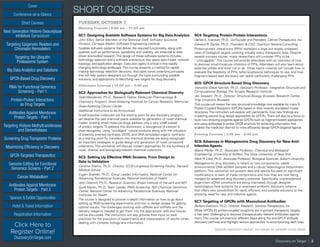
SC1: Designing Scalable Software Systems for Big Data Analytics
John Klein, Senior Member of the Technical Staff, Software Solutions
Division, Carnegie Mellon Software Engineering Institute
Scalable software systems that deliver the required functionality, along with
qualities such as performance, availability, and usability, are essential to data-
driven biomedical research.The design of these software systems includes
technology selection and a software architecture that spans data model, network
topology, and application design. Execution agility is critical in this rapidly
changing technology landscape.This course presents a method for rapidly
making technology selection decisions, discusses some underlying principles
that will help system designers cut through the hype surrounding scalable
solutions, and applications to identifying new targets for drug discovery.
Afternoon Courses | 12:00 pm – 3:00 pm
SC2: Approaches for Biologically-Relevant Chemical Diversity
Todd Wenderski, Ph.D., Research Fellow, Molecular Pharmacology &
Chemistry Program, Sloan-Kettering Institute for Cancer Research, Memorial
Sloan-Kettering Cancer Center
Additional Instructors to be Announced
Small bioactive molecules are the starting point for any discovery program,
yet despite the vast chemical space available for generation of novel chemical
matter, existing small-molecule drugs address only a very small subset
of protein targets.To address this disconnect, a resurgence of interest in
pharmacognosy, using “privileged” natural products along with the utilization
of diversity oriented synthesis (DOS), and DNA-templated organic synthesis
as a starting point for translation into chemical libraries are being recognized
as important strategies to guide design and generation of novel compound
collections.This workshop will discuss modern approaches for the synthesis of
novel, diverse, and biologically-relevant chemical collections.
SC3: Setting Up Effective RNAi Screens: From Design to
Data to Validation
Caroline Shamu, Ph.D., Director, ICCB-Longwood Screening Facility, Harvard
Medical School
Eugen Buehler, Ph.D., Group Leader, Informatics, National Center for
Advancing Translational Sciences, National Institutes of Health
John Doench, Ph.D., Research Scientist, Broad Institute of Harvard and MIT
Scott Martin, Ph.D., Team Leader, RNAi Screening, NIH Chemical Genomics
Center, National Center for Advancing Translational Sciences, National
Institutes for Health
The course is designed to provide in-depth information on how to go about
setting up RNAi screening experiments and how to design assays for getting
optimal results.The challenges working with siRNAs and shRNAs and the
delivery reagents needed to get them into the appropriate cells and tissues
will be discussed. The instructors will also provide their input on best
practices for the execution of experiments and interpretation of results when
dealing with complex biology and informatics.
SC4:Targeting Protein-Protein Interactions
Daniel A. Erlanson, Ph.D., Co-Founder and President, CarmotTherapeutics, Inc.
Edward R. Zartler, Ph.D., President & CSO, Quantum Tessera Consulting
Protein-protein interactions (PPIs) represent a large but largely untapped
class of biological targets covering virtually every therapeutic area. Despite
several success stories, many researchers still consider PPIs to be
“undruggable.” This course will provide attendees with an overview of how
to discover small-molecule inhibitors of PPIs. Attendees will also learn about
potential pitfalls and what not to do. Other topics covered will include how to
evaluate the feasibility of PPIs, what biophysical techniques to use, and how
fragment-based lead discovery can tackle particularly challenging PPIs.
SC5: GPCR Structure-Based Drug Discovery
Vsevolod (Seva) Katritch, Ph.D., Assistant Professor, Integrative Structural and
Computational Biology, The Scripps Research Institute
Jan Steyaert, Ph.D., Director, Structural Biology Brussels Research Center,
Vrije University Brussels
This course will review the new structural knowledge now available for many G
Protein-Coupled Receptors (GPCRs) based on their recently elucidated crystal
structures.The instructors will explore with participants, how new findings are
impacting rational drug design approaches for GPCRs.There will also be a focus on
tools now showing progress against GPCRs such as fragment-based approaches
and using antibodies to probe GPCR structure for extracting information that
enables the medicinal chemist to more efficiently design GPCR-targeted ligands.
Evening Courses | 3:45 pm – 6:45 pm
SC6: Advances in Metagenomic Drug Discovery for New Anti-
Infective Agents
Blaine Pfeifer, Ph.D., Associate Professor, Chemical and Biological
Engineering, University at Buffalo, The State University of New York
Mark R. Liles, Ph.D., Associate Professor, Biological Sciences, Auburn University
Metagenomic drug discovery is reliant on two components: viable
environmental DNA (eDNA) samples and a robust heterologous biosynthetic
platform. This workshop will present data and results focused on significant
modifications to each of these components and how they are now being
merged for advanced drug discovery potential. Specifically, unprecedented
large-insert eDNA constructs are being channeled through designer
heterologous host systems for a revamped antibiotic discovery scheme
that offers new possibilities for rapid, efficient, and scalable solutions to the
pressing need for new anti-infective agents.
SC7:Targeting of GPCRs with Monoclonal Antibodies
Barbara Swanson, Ph.D., Director, Research, SorrentoTherapeutics, Inc.
While GPCRs (G protein-coupled receptors) are important therapeutic targets,
it has been challenging to discover therapeutically relevant antibodies against
them.This course will examine different steps along the anti-GPCR antibody
discovery pathway and highlight various approaches to accomplishing each step.
Cover
Targeting Epigenetic Readers and
Chromatin Remodelers
Next Generation Histone Deacetylase
Inhibitors Symposium
Targeting the Ubiquitin
Proteasome System
Big Data Analytics and Solutions
GPCR-Based Drug Discovery
RNAi for Functional Genomics
Screening - Part 1
Protein-Protein Interactions
as Drug Targets
Antibodies Against Membrane
Protein Targets - Part 1
Sponsor & Exhibit Opportunities
Conference-at-a-Glance
Hotel & Travel Information
Short Courses
Registration Information
Click Here to
Register Online!
DiscoveryOnTarget.com
Targeting Histone Methyltransferases
and Demethylases
Screening Drug Transporter Proteins
Maximizing Efficiency in Discovery
GPCR-Targeted Therapeutics
Genome Editing for Functional
Genomics Screens - Part 2
Cancer Metabolism
Antibodies Against Membrane
Protein Targets - Part 2
Discovery on Target | 4
SHORT COURSES*
* Separate registration required; see website for complete course details
The topics to be covered include: 1) Antibody discovery, including methods to
generate antibodies and antigen preparation; 2) Assays to measure antibody
binding, such as an EC50 using cells expressing the GPCR; 3) In vitro assays
to measure functional activity of the antibody, including antagonism (IC50) or
agonism using chemotaxis, calcium, cAMP or other cell-based assays; and 4)
Review of promising GPCR targets and antibodies in the clinic.
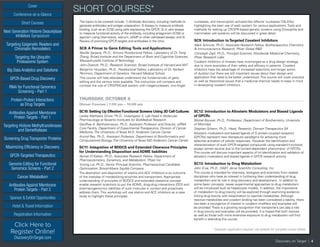
SC8: A Primer to Gene Editing:Tools and Applications
Neville Sanjana, Ph.D., Simons Postdoctoral Fellow, Laboratory of Dr. Feng
Zhang, Broad Institute and the Department of Brain and Cognitive Sciences,
Massachusetts Institute of Technology
John Doench, Ph.D., Research Scientist, Broad Institute of Harvard and MIT
Benjamin Housden, Ph.D., Postdoctoral Fellow, Laboratory of Dr. Norbert
Perrimon, Department of Genetics, Harvard Medical School
This course will help attendees understand the fundamentals of gene
editing and the various tools available. The instructors will compare and
contrast the use of CRISPR/Cas9 system with meganucleases, zinc-finger
nucleases, and transcription activator-like effector nucleases (TALENs)
highlighting the best use of each system for various applications. Tools and
methods for setting up CRISPR-based genetic screens using Drosophila and
mammalian cell systems will be discussed in great detail.
SC9: Introduction toTargeted Covalent Inhibitors
Mark Schnute, Ph.D., Associate Research Fellow, Biotherapeutics Chemistry
& Immunoscience Research, Pfizer Global R&D
Christoph Zapf, Ph.D., Principal Scientist, Worldwide Medicinal Chemistry,
Pfizer Research Labs
Covalent inhibitors of kinases have re-emerged as a drug design strategy
due to more examples of their safety and efficacy in patients. Covalent
inhibitors have the advantage of increased selectivity and longer action
of duration but there are still important issues about their design and
application that need to be better understood. This course will cover practical
as well as theoretical issues that a medicinal chemist needs to keep in mind
in developing covalent inhibitors.
THURSDAY, OCTOBER 9
Dinner Courses | 7:00 pm – 10:00 pm
SC10: Setting Up Effective Functional Screens Using 3D Cell Cultures
Lesley Mathews Griner, Ph.D., Investigator II, Lab Head in Molecular
Pharmacology at Novartis Institutes for BioMedical Research
Geoffrey A. Bartholomeusz, Ph.D., Assistant Professor and Director, siRNA
Core Facility, Department of Experimental Therapeutics, Division of Cancer
Medicine, The University of Texas M.D. Anderson Cancer Center
Arvind Rao, Ph.D., Assistant Professor, Department of Bioinformatics and
Computational Biology, The University of Texas MD Anderson Cancer Center
SC11: Integration of BDDCS and Extended Clearance Principles
for Understanding Disposition and ADME liabilities
Ayman El-Kattan, Ph.D., Associate Research Fellow, Department of
Pharmacokinetics, Dynamics, and Metabolism, Pfizer Inc.
Yurong Lai, Ph.D., Senior Principal Scientist, Pharmaceutical Candidate
Optimization, Bristol-Myers Squibb Company
The absorption and disposition of statins and ACE inhibitors is an outcome
of the interplay of metabolizing enzymes and transporters. Appropriate
understanding of principles of BDDCS and extended clearance concept
enable research scientists to put the ADME, drug-drug interactions (DDI) and
pharmacogenomics liabilities of such molcules in context and proactively
address them. This workshop will use statins and ACE inhibitors as a case
study to highlight these principles.
SC12: Introduction to Allosteric Modulators and Biased Ligands
of GPCRs
Michel Bouvier, Ph.D., Professeur, Department of Biochemistry, University
of Montréal
Stephan Schann, Ph.D., Head, Research, Domain Therapeutics SA
Allosteric modulators and biased ligands of G protein-coupled receptors
(GPCRs) represent new therapeutic paradigms for achieving more
selective activation of cellular responses. However the identification and
characterization of such GPCR-targeted compounds using standard functional
assays remain elusive due to the‘context-dependent phenomena’ of GPCRs.
This course will discuss important aspects of hit identification and validation of
allosteric modulators and biased ligands in GPCR research activity.
SC13: Introduction to Drug Metabolism
John Erve, Ph.D., DABT, Jerve Scientific Consulting, Inc.
This course is intended for chemists, biologists and scientists from related
disciplines who have an interest in furthering their understanding of drug
metabolism and its role in drug discovery and development. In addition to
some basic concepts, newer experimental approaches to drug metabolism
will be introduced such as hepatocyte models. In addition, the importance
of metabolism to drug toxicity will be explored through examining evidence
linking drug toxicity with bioactivation to reactive metabolites. Although
reactive metabolites and covalent binding has been considered a liability, there
has been a resurgence of interest in covalent modifiers and examples will
be provided.There is a growing recognition that transporters can play a role
in drug toxicity and examples will be provided. It is hoped that both novices
as well as those with more extensive exposure to drug metabolism will find
benefit in attending this course.
Cover
Targeting Epigenetic Readers and
Chromatin Remodelers
Next Generation Histone Deacetylase
Inhibitors Symposium
Targeting the Ubiquitin
Proteasome System
Big Data Analytics and Solutions
GPCR-Based Drug Discovery
RNAi for Functional Genomics
Screening - Part 1
Protein-Protein Interactions
as Drug Targets
Antibodies Against Membrane
Protein Targets - Part 1
Sponsor & Exhibit Opportunities
Conference-at-a-Glance
Hotel & Travel Information
Short Courses
Registration Information
Click Here to
Register Online!
DiscoveryOnTarget.com
Targeting Histone Methyltransferases
and Demethylases
Screening Drug Transporter Proteins
Maximizing Efficiency in Discovery
GPCR-Targeted Therapeutics
Genome Editing for Functional
Genomics Screens - Part 2
Cancer Metabolism
Antibodies Against Membrane
Protein Targets - Part 2
Discovery on Target | 5
Eighth Annual	 October 7, 2014
Next Generation Histone Deacetylase Inhibitors Symposium*
Promising New Chemistries and Biological Strategies for Targeting HDACs
Histone deacetylases (HDACs) have proven to be a promising target for drug intervention and there are a number of HDAC inhibitors (HDACi) currently being
tested in pre-clinical and clinical stages. HDACi were primarily developed as anti-tumor agents for cancer, but many are now being explored for treating
neurodegenerative, immunologic, metabolic, inflammatory and cardiovascular disorders. However, much remains to be elucidated about the functional
implications of modulating HDACs and understanding the signaling pathways that can cause adverse cellular effects and unwanted toxicity. Cambridge
Healthtech Institute’s eighth annual event on Next Generation Histone Deacetylase Inhibitors, tracks both the scientific and clinical progress being made to
better understand the cellular function of this complex drug target family.
Suggested Event Package
October 7 Symposium: Next Generation Histone Deacetylase Inhibitors
October 8-9 Conference: Targeting Epigenetic Readers and
Chromatin Remodelers
October 9-10 Conference: Targeting Histone Methyltransferases
and Demethylases
New HDAC Chemistries and Screening Approaches
8:00 Chairperson’s Opening Remarks
Alan P. Kozikowski, Ph.D., Professor, College of Pharmacy Department of
Medicinal Chemistry and Pharmacognosy, University of Illinois at Chicago
8:10 HDAC6 Inhibitor Platform:Therapeutic Applications in
Charcot-Marie-Tooth (CMT) and Rett Syndrome
Alan P. Kozikowski, Ph.D., Professor, College of Pharmacy Department of
Medicinal Chemistry and Pharmacognosy, University of Illinois at Chicago
HDAC6 is one of the key enzymes that regulates the acetylation state of the
microtubule protein a-tubulin, and microtubule-dependent transport rates are
more efficient along acetylated a-tubulin than deacetylated a-tubulin. In addition to
facilitating anterograde transport of new cargo to synaptic zones, acetyl-tubulin also
increases the ability of damaged organelles or misfolded proteins to leave synaptic
zones.This may be very important for Rett Syndrome as well as other conditions, as
damaged mitochondria and elevated levels of improperly spliced mRNA transcripts
have been noted in MeCP2-deficient neurons.The design, synthesis, assay, and
application of HDAC6 inhibitors to various therapeutic areas will be covered.
8:40 Defining the Structural Requirements for the Design of Inter-
Class Selective HDAC Inhibitors
Edward Holson, Ph.D., Director, Medicinal Chemistry, Stanley Center for Psychiatric
Research and Director of Chemistry, Chemical Biology Platform, Broad Institute
I will describe the minimal structural requirements necessary for the potent
and selective inhibition of HDAC6 achieved through the careful choice of linker
element only. We extend these design considerations to the design of the first
inhibitors capable of potently and selectively inhibiting both HDAC6 and HDAC8
despite the fact that these isoforms belong to distinct phylogenetic classes
within the HDAC family of enzymes. Our biochemical and computational data
provide evidence that evolutionary relationships between HDACs cannot always
predict molecular recognition or ligand binding similarities.
9:10 Engaging Nuclear Receptors forTargeted Histone
Deacetylase Inhibition
Adeboyega “Yomi” Oyelere, Ph.D., Associate Professor, School of Chemistry
and Biochemistry, Georgia Institute of Technology
Histone deacetylase (HDAC) inhibition is a clinically validated strategy for
cancer treatment. Despite promises in preclinical studies, HDAC inhibitors
(HDACi) have been less efficacious in treating solid tumors. To address
this problem, my lab has designed HDACi equipped with secondary
pharmacophores to facilitate selective accumulation in malignant cells. In this
presentation, I will discuss the discovery and SAR studies on new class of
HDACi compounds targeted to breast and prostate tumors by equipping them
with the additional ability to bind to the estrogen receptor (ER) and androgen
receptor (AR) respectively.
9:40 Coffee break
10:00 Discovery of the First N-Hydroxycinnamamide-Based
Histone Deacetylase 1/3 Dual Inhibitors with Potent Oral
Antitumor Activity
Yingjie Zhang, Ph.D., Lecturer, Department of Medicinal Chemistry, School of
Pharmaceutical Sciences, Shandong University
A novel class of N-hydroxycinnamamide-based HDACs inhibitors was designed
and synthesized. In vitro activity evaluation of these compounds showed
excellent HDACs inhibition and potent growth inhibition in multiple tumor
cell lines. Relative to the approved HDACs inhibitor SAHA, our compound 11r
exhibited comparable even more potent oral anticancer activity in a human
leukemic monocyte lymphoma (U937) xenograft model. Most importantly,
our compounds exhibited marked dual HDAC1/3 selectivity over other Class I
isoforms (HDAC2 and HDAC8), Class IIa representative isoform HDAC4, Class
IIb representative isoform HDAC6 and Class IV isoform HDAC11.
10:30 Imaging HDAC Density and Drug Inhibition in the Human Brain
Jacob Hooker, Ph.D., Assistant Professor, Radiology, Harvard Medical School
Histone deacetylases have shown broad potential in treatments against
cancer and emerging data supports HDAC-targeting in the context of
cardiovascular disease and CNS dysfunction. Development of a radiotracer
for non-invasive imaging will elucidate the distribution and functional roles
of HDACs in human and accelerate medical research and drug discovery in
this domain. We have developed an HDAC imaging agent, [11C]Martinostat
for imaging HDACs in the brain, heart, kidney, pancreas and spleen to realize
these goals.
*Separate Registration Required for Next Generation Histone Deacetylase Inhibitors Symposium
Cover
Targeting Epigenetic Readers and
Chromatin Remodelers
Next Generation Histone Deacetylase
Inhibitors Symposium
Targeting the Ubiquitin
Proteasome System
Big Data Analytics and Solutions
GPCR-Based Drug Discovery
RNAi for Functional Genomics
Screening - Part 1
Protein-Protein Interactions
as Drug Targets
Antibodies Against Membrane
Protein Targets - Part 1
Sponsor & Exhibit Opportunities
Conference-at-a-Glance
Hotel & Travel Information
Short Courses
Registration Information
Click Here to
Register Online!
DiscoveryOnTarget.com
Targeting Histone Methyltransferases
and Demethylases
Screening Drug Transporter Proteins
Maximizing Efficiency in Discovery
GPCR-Targeted Therapeutics
Genome Editing for Functional
Genomics Screens - Part 2
Cancer Metabolism
Antibodies Against Membrane
Protein Targets - Part 2
Discovery on Target | 6
Eighth Annual	 October 7, 2014
Next Generation Histone Deacetylase Inhibitors Symposium*
Promising New Chemistries and Biological Strategies for Targeting HDACs
11:00 Enjoy Lunch onYour Own
Exploring HDAC Biology
12:00 pm Chairperson’s Remarks
Wayne W. Hancock, M.D., Ph.D., Professor of Pathology and Chief of
Transplant Immunology, Children’s Hospital of Philadelphia and University of
Pennsylvania
12:10 Chemogenomic Approaches to Spatiotemporal Regulation
of HDAC Activity
Ralph Mazitschek, Ph.D., Assistant Professor, Center for Systems Biology,
Chemical Biology Platform, Massachusetts General Hospital
HDACs are master regulators of chromatin structure and function. Beyond
modulating histones acetylation they are recognized as regulators of non-histone
proteins. HDAC inhibitors have been used as tool compounds to study basic
biology and recognized as promising therapeutics. However, systemic exposure
is often not well tolerated, or does not provide the required resolution in biological
model systems.To address these shortcomings we have developed a new
approach to control HDAC activity with greater spatial and temporal resolution.
12:40 Characterization of HDAC Inhibitors: From Structural
Analysis to Cell Function
Pascal Steiner, Ph.D., Scientist, Department of Neuroscience, Genentech, Inc.
A detailed understanding of how HDAC inhibitors with different pharmacological
properties affect biological functions in vitro and in vivo is still missing. I will
present our recent findings showing the evaluation of HDAC inhibitors potency
in vitro using recombinant proteins and of their pharmacodynamic properties
as measured with histone acetylation are insufficient to predict their functional
consequences on biological activity such as gene expression and cell viability
and therefore might be misleading in identifying useful HDACi.
1:10 Immuno-Modulatory Function of HDAC6 andTubulinAcetylation
Tso-Pang Yao, Ph.D., Associate Professor, Department of Pharmacology and
Cancer Biology, Duke University
HDAC inhibitors show an anti-inflammatory activity. The underlying mechanism
is not well understood. The potential toxicity associated with pan-HDAC
inhibitors also presents a barrier for their chronic use in inflammatory disease.
We will discuss different anti-inflammatory phenotypes induced by HDAC
inhibitors and offer mechanistic basis for differential therapeutic effects and
opportunities for targeting selective HDAC members.
1:40 Coffee break
2:00The Roles of Class I HDACs in Alzheimer’s Disease
Li-Huei Tsai, Ph.D., Professor of Neuroscience, Department of Brain and
Cognitive Sciences and Director, Picower Institute for Learning and Memory,
Massachusetts Institute of Technology
Impaired genome integrity has been implicated in aging and in neurodegenerative
diseases such as Alzheimer’s disease (AD). Our work suggests that the
accumulation of DNA damage occurs early in AD pathophysiology, and that
this contributed to disease progression. In two separate studies, we found that
HDAC1 plays an important role in DNA damage repair and that its reduced activity
is correlated with neurodegeneration. Furthermore, HDAC1 may also directly
regulate the production and clearance of beta-amyloid.Thus targeting HDAC1 may
be beneficial for treatment of neurodegenerative disorders.
2:30 Discrete and Novel Immunologic Roles of Individual Class I
HDAC Enzymes
Wayne W. Hancock, M.D., Ph.D., Professor of Pathology and Chief ofTransplant
Immunology, Children’s Hospital of Philadelphia and University of Pennsylvania
In the same way that one size doesn’t fit all, it may not be desirable to try
and efficiently block all class I HDAC enzymes. I will present data comparing
the differing roles of class I enzymes in the immune system using genetic
and pharmacologic approaches. While there is some redundancy and ability
to compensate, HDAC1 and HDAC2 play distinct roles and their deletion has
differing effects, as does targeting of HDAC3 and HDAC8. Our data point to
the potential for major advances in therapeutics if, and as, the ability to target
individual class I isoforms is achieved.
3:00 Sponsored Presentation (Opportunity available)
3:30 Session Break
Evaluating Pan v/s Isoform-Specific Inhibitors
3:45 Chairperson’s Remarks
Simon Jones, Ph.D., Vice President, Biology and Preclinical Development,
Acetylon Pharmaceuticals
3:50 Clinical Potential of Isoform Selective HDAC Inhibitors
Simon Jones, Ph.D., Vice President, Biology and Preclinical Development,
Acetylon Pharmaceuticals, Inc.
There has been resurgence of activity in developing selective HDAC
inhibitors for the clinic. The use of selective inhibitors with genetic models
has substantially added to the basic biology of roles for HDACs regulating
acetylation states histone and non-histone protein substrates. The potential for
ricolinostat, a selective HDAC6 inhibitor, in multiple myeloma, highly selective
HDAC6 inhibitors for neurological indications, and targeting HDAC1,2 in
β-thalassemia and cellular differentiation in cancer will be discussed.
4:20 HDAC10 Controls Autophagy-Mediated Drug Resistance
Olaf Witt, M.D., Professor for Pediatric Oncology, Hematology and
Immunology Head, CCU Pediatric Oncology German Cancer Research Center
Head, Section Pediatric Brain Tumors, Department of Pediatric Oncology,
Hematology and Immunology, University Children’s Hospital
Pediatric neuronal cancers have been instructive in defining oncogenic functions
*Separate Registration Required for Next Generation Histone Deacetylase Inhibitors Symposium
Cover
Targeting Epigenetic Readers and
Chromatin Remodelers
Next Generation Histone Deacetylase
Inhibitors Symposium
Targeting the Ubiquitin
Proteasome System
Big Data Analytics and Solutions
GPCR-Based Drug Discovery
RNAi for Functional Genomics
Screening - Part 1
Protein-Protein Interactions
as Drug Targets
Antibodies Against Membrane
Protein Targets - Part 1
Sponsor & Exhibit Opportunities
Conference-at-a-Glance
Hotel & Travel Information
Short Courses
Registration Information
Click Here to
Register Online!
DiscoveryOnTarget.com
Targeting Histone Methyltransferases
and Demethylases
Screening Drug Transporter Proteins
Maximizing Efficiency in Discovery
GPCR-Targeted Therapeutics
Genome Editing for Functional
Genomics Screens - Part 2
Cancer Metabolism
Antibodies Against Membrane
Protein Targets - Part 2
Discovery on Target | 7
Eighth Annual	 October 7, 2014
Next Generation Histone Deacetylase Inhibitors Symposium*
Promising New Chemistries and Biological Strategies for Targeting HDACs
of HDAC isoforms including HDACs 8, 5 and 9. Recently, we have identified a
novel non-epigenetic function of HDAC10 in controlling autophagy-mediated drug
resistance.Targeting of HDAC10 inhibits autophagic flux and restores sensitivity
of neuroblastoma to chemotherapy. Moreover, high level of HDAC10 expression is
associated with poor clinical outcome. We will discuss molecular mechanisms of
the HDAC10-autophagy-axis and potential options for isoform selective inhibition.
4:50 Coffee Break
5:10Targeting HDACs in Cardiovascular Disease
Timothy A. McKinsey, Ph.D., Associate Professor and Associate Division Head
for Translational Research, Department of Medicine, Division of Cardiology,
University of Colorado Denver
Efficacy of small molecule HDAC inhibitors has been demonstrated in animal
models of heart failure, where the compounds block cardiac hypertrophy and
fibrosis and improve systolic and diastolic function. Since the pharmacological
inhibitors used in the pre-clinical heart failure studies target 11 distinct HDAC
enzymes, the identity of the HDAC isoform(s) that controls pathological responses
of the heart unknown. I will present our recent data from studies of isoform-
selective HDAC inhibitors and HDAC knockout mice in models of cardiac disease.
5:40 Sponsored Presentation (Opportunity available)
»»5:55 FEATURED PRESENTATION: CHEMICAL
MODULATION OF CHROMATIN STRUCTURE AND
FUNCTION
James E. Bradner, M.D., Assistant Professor, Department of Medicine,
Harvard University Medical School and Staff Physician, Division of
Hematologic Malignancies, Dana-Farber Cancer Institute
With an interest in understanding chromatin-dependent signal transduction to
RNA polymerase in developmental and disease biology, we and others have
undertaken to discover and optimize small molecule modulators of chromatin
regulatory factors. These incisive chemical probes have availed new insights
into chromatin structure and function, and suggest plausible translational
opportunities for the targeted development of drug-like derivatives in cancer
and non-malignant indications. New biotechnologies have been created which
allow the rapid identification of critical regulatory regions underlying cell state
and which provide the first genome-wide maps of spatial localization of drug
molecules within the epigenome. Discussed in this lecture will be mechanistic
and translational efforts to modulate gene regulatory pathways of lysine
acetylation in cancer transcriptional signaling.
6:30 Close of Symposium
*Separate Registration Required for Next Generation Histone Deacetylase
Inhibitors Symposium
GET CONNECTED!
Maximize your experience on-site at
Discovery OnTarget 2014!
The Intro-Net offers you the opportunity to
set up meetings with selected attendees
before, during and after this conference,
allowing you to connect to the key people
you want to meet. This online system
was designed with your privacy in mind
and is available only to registered session
attendees of this event. Registered
conference attendees will receive more
information on accessing the Intro-Net in the
weeks leading up to the event!
Join the Discovery
On Target Group
Follow us on Twitter
@DOTBoston
PRESENT A POSTER AND SAVE $50!
Cambridge Healthtech Institute encourages attendees
to gain further exposure by presenting their work in
the poster sessions. To secure a poster board and
inclusion in the conference materials, your abstract
must be submitted, approved and your registration
paid in full by August 8, 2014.
•	 Your poster will be available to 900+ delegates
•	 You’ll automatically be entered into our poster
competition where two winners each will receive
an American Express Gift Certificate
•	 $50 off your registration fee
•	 Your research will be seen by leaders from
pharmaceutical, biotech, academic and
government institutes
Discovery onTarget Student Fellowship
Full time graduate students and PhD Candidates
are encouraged to apply for the Discovery on Target
Student Fellowship. Interested students must
complete an online application for the 2014 Student
Fellowship. Applications are due by July 25, 2014.
How Students Benefit from Presenting a Poster:
1.	 ShowcaseYour Research to 900+ Attendees: Within
the expansive Exhibit Hall stand by your poster and
network with attendees. Distribute copies of journal
articles or papers you have authored or contributed to.
2.	Start a Future Collaboration and Meet a Potential
Employer: Collect business cards and meet prospective
collaborators who may be actively pursuing work in
your field. Put together a short outline of the field(s)
in which you seek collaborators or new professional
challenges, and distribute those to the people
you meet.
3.	Expand Your Network: When you return to school/
lab, add each person you meet to your LinkedIn
connections. Keep in touch to share new ideas that
may advance your own research or stature in the
scientific community.
Cover
Targeting Epigenetic Readers and
Chromatin Remodelers
Next Generation Histone Deacetylase
Inhibitors Symposium
Targeting the Ubiquitin
Proteasome System
Big Data Analytics and Solutions
GPCR-Based Drug Discovery
RNAi for Functional Genomics
Screening - Part 1
Protein-Protein Interactions
as Drug Targets
Antibodies Against Membrane
Protein Targets - Part 1
Sponsor & Exhibit Opportunities
Conference-at-a-Glance
Hotel & Travel Information
Short Courses
Registration Information
Click Here to
Register Online!
DiscoveryOnTarget.com
Targeting Histone Methyltransferases
and Demethylases
Screening Drug Transporter Proteins
Maximizing Efficiency in Discovery
GPCR-Targeted Therapeutics
Genome Editing for Functional
Genomics Screens - Part 2
Cancer Metabolism
Antibodies Against Membrane
Protein Targets - Part 2
Discovery on Target | 8
Second Annual	 October 8 - 9, 2014
Targeting Epigenetic Readers and Chromatin Remodelers
Drugging the “Undruggable”
Operating at the interface of translating histone marks, reader domains that recognize the histone code written in acetyl and methyl marks have now emerged
as viable targets for therapeutic development. In particular, the BET bromodomain family of readers has gained significant attention for the treatment of human
cancers, with several inhibitors developed and clinical-stage programs now underway. Cambridge Healthtech Institute’s Second Annual Targeting Epigenetic
Readers and Chromatin Remodelers meeting will unite leading academic and industry researchers for the development of chemical probes and inhibitors to
further our understanding of the therapeutic opportunities associated with targeting reader domains and chromatin remodeling.
Suggested Event Package
October 7 Short Course: Targeting Protein-Protein Interactions
October 7 Short Course: Introduction to Targeted Covalent Inhibitors
October 8-9 Conference: Targeting Epigenetic Readers and
Chromatin Remodelers
October 9-10 Conference: Targeting Histone Methyltransferases
and Demethylases
WEDNESDAY, OCTOBER 8
7:00 am Registration and Morning Coffee
DEVELOPING NOVEL BROMODOMAIN INHIBITORS
8:05 Chairperson’s Opening Remarks
Ming-Ming Zhou, Ph.D., Harold and Golden Lamport Professor and Chairman,
Department of Structural & Chemical Biology; Co-Director, Experimental
Therapeutics Institute, Icahn School of Medicine at Mount Sinai
»»8:15 FEATURED PRESENTATION:TARGETING GENE
EXPRESSION: SELECTIVE VS. PROMISCUOUS
BROMODOMAIN INHIBITION
Panagis Filippakopoulos, Ph.D., Principal Investigator, Bromodomains, Structural
Genomics Consortium & Ludwig Institute for Cancer Research, Nuffield
Department of Clinical Medicine, University of Oxford
I will present our efforts to identify novel inhibitors of BRDs that are site
selective (in the case of BET bromodomains) as well as our efforts to destroy
selectivity while retaining affinity outside the BET family (i.e., promiscuous
inhibitors). I will be covering the development and characterization of these
tool compounds as well as their properties targeting gene expression in
diverse cellular systems, seeking to validate BRD function.
9:00 Selective Modulation of Bromodomains in Gene Activation
Ming-Ming Zhou, Ph.D., Harold and Golden Lamport Professor and Chairman,
Department of Structural & Chemical Biology; Co-Director, Experimental
Therapeutics Institute, Icahn School of Medicine at Mount Sinai
In this talk I will present my group’s latest study of structural mechanism
and function of bromodomain proteins in gene transcriptional activation
using newly designed, highly selective bromodomain inhibitors. I will discuss
the functional implications of their new findings of basic principles that
govern the molecular interactions and regulation in gene expression, and
a new strategy for developing targeted epigenetic therapy for cancer and
chronic inflammation.
9:30 Development and Utilities of BET Bromodomain Inhibitors
with High CNS Exposure
Claes Wahlestedt, M.D., Ph.D., Leonard M. Miller Professor & Associate Dean,
Therapeutic Innovation, Miller School of Medicine, University of Miami
Published bromodomain inhibitors show insufficient in vivo CNS exposure
due to a variety off issues. In collaboration with Epigenetix, Inc. we therefore
developed novel small molecules, such as EP11313, with characteristics
of CNS active drugs. These compounds have to date primarily been tested
in various models of glioblastoma. However, they have also been useful in
demonstrating a role for BET bromodomain proteins as novel epigenetic
regulators of cocaine-induced behavioral plasticity.
10:00 Grand Opening Coffee Break in the Exhibit Hall with Poster
Viewing
10:45 Discovery of Selective BRD4 Bromodomain Inhibitors by
Fragment-Based High-Throughput Docking
Dimitrios Spiliotopoulos, Ph.D., Senior Research Scientist, Biochemistry,
University of Zurich
Using a fragment-based in silico screening approach, we identified two small
molecules that selectively bind to the first bromodomain of BRD4 with low-
micromolar affinity and favorable ligand efficiency (0.37 kcal/mol per non-
hydrogen atom). Notably, the hit rate of the fragment-based in silico approach
is about 10% as only 24 putative inhibitors, from an initial library of about 10
million molecules, were tested in vitro.
11:15 Development and Application of BET and CREBBP
Bromodomain Ligands
Stuart Conway, Ph.D., Associate Professor, Chemistry, University of Oxford
I will present our work on the development of small molecule ligands for
the BET bromodomain. I will describe our understanding of the SAR for BET
bromodomain binding and our work to optimise the structure of our ligands
both for potency and metabolic stability for use in vivo. I will also present our
work on the development of a novel class of CREBBP ligands and describe
what these compounds have taught us about the requirements for CREBBP
bromodomain binding.
Cover
Targeting Epigenetic Readers and
Chromatin Remodelers
Next Generation Histone Deacetylase
Inhibitors Symposium
Targeting the Ubiquitin
Proteasome System
Big Data Analytics and Solutions
GPCR-Based Drug Discovery
RNAi for Functional Genomics
Screening - Part 1
Protein-Protein Interactions
as Drug Targets
Antibodies Against Membrane
Protein Targets - Part 1
Sponsor & Exhibit Opportunities
Conference-at-a-Glance
Hotel & Travel Information
Short Courses
Registration Information
Click Here to
Register Online!
DiscoveryOnTarget.com
Targeting Histone Methyltransferases
and Demethylases
Screening Drug Transporter Proteins
Maximizing Efficiency in Discovery
GPCR-Targeted Therapeutics
Genome Editing for Functional
Genomics Screens - Part 2
Cancer Metabolism
Antibodies Against Membrane
Protein Targets - Part 2
Discovery on Target | 9
Second Annual	 October 8 - 9, 2014
Targeting Epigenetic Readers and Chromatin Remodelers
Drugging the “Undruggable”
11:45 A Novel Chemical Probe for Family VIII Bromodomains
Dafydd Owen, Ph.D., Associate Research Fellow, Medicinal Chemistry,
Biotherapeutics Worldwide R&D, Pfizer
BRG1 (SMARCA4) and BRM (SMARCA2) are the central ATPase components
of the multi-component complexes. BRG1 and BRM are multi-domain
proteins that contain a number of DNA and protein interaction modules.
These include C-terminal bromodomains. Through collaboration with the
SGC we have identified a chemical probe that interacts with just three of the
Family VIII bromodomains - BRG1, BRM and PB1(5). The discovery, binding
mode and phenotype derived from the use of PFI-3 will be discussed.
12:15 pm Sponsored Presentations (Opportunities Available)
12:45 Session Break
1:00 Luncheon Presentation (Sponsorship Opportunity Available) or
Lunch onYour Own
1:40 Session Break
MOLECULAR MECHANISMS IN CANCER
1:50 Chairperson’s Opening Remarks
Dafydd Owen, Ph.D., Associate Research Fellow, Medicinal Chemistry,
Biotherapeutics Worldwide R&D, Pfizer
2:00 Role of BRD4 and SWI/SNF in the Maintenance of Acute
Myeloid Leukemia
Chris Vakoc, M.D., Ph.D., Assistant Professor, Cold Spring Harbor Laboratory
Our lab has employed negative-selection shRNA screening to identify
chromatin regulator dependencies in a mouse model of acute
myeloidleukemia. These studies have identified Brd4 and SWI/SNF as
among the top dependencies in this disease, which exhibit several desirable
properties for therapeutic targeting. Recent work will be presented that
seeks to understand the molecular mechanism of these chromatin regulators
that underlies their role in cancer maintenance.
2:30Targeting Bromodomains in NUT Midline Carcinoma
Christopher A. French, M.D., Assistant Professor, Department of Pathology,
Harvard Medical School; Assistant Professor, Pathology, Brigham and
Women’s Hospital
I will first discuss the basic clinical aspects of NUT midline carcinoma. I will
then discuss three aspects of how BRD4-NUT blocks differentiation and
promotes growth of affected cancer cells. Next, I will present recent findings
that reveal the chromatin regions bound by BRD4-NUT, as well as NSD3,
which we recently found to be a variant fusion partner of NUT in a subset of
NUT midline carcinomas. Finally, I will discuss recent progress using BET
bromodomain inhibitors.
3:00 Sponsored Presentations (Opportunities Available)
3:30 Refreshment Break in the Exhibit Hall with PosterViewing
4:10Treating Genetically Diverse Glioblastoma with
Bromodomain Inhibitors
Jialiang Wang, Ph.D., Assistant Professor, Neurological Surgery, Vanderbilt
University
Glioblastoma is a genetically heterogeneous disease. Yet, a wide range of
glioblastoma tumors of diverse genotypes exhibited significant sensitivity
to BET bromodomain inhibitors. I will discuss in vitro and in vivo activities
of BET bromodomain inhibitors in glioblastoma primary samples. Molecular
mechanisms underlie the oncogenic activities of BET proteins in glioblastoma
will be discussed.
4:40 Betting on BETs for Advanced Prostate CancerTreatment
Irfan Asangani, Ph.D., Research Investigator, Pathology, Michigan Center for
Translational Pathology, University of Michigan
Maintenance of AR signaling is the most common resistance mechanism
that patients with advanced prostate cancer develop after conventional
hormonal treatments. Recently, selective small molecule inhibitors that
target the bromodomains of BET family proteins have been shown to exhibit
anti-proliferative effects in a range of malignancies. I will present our findings
offering a preclinical proof of principle for the use of BET-bromodomain
inhibitors that block AR signaling.
5:10 Interactive Breakout Discussion Groups (see website for
details)
6:10 Welcome Reception in the Exhibit Hall with Poster Viewing
7:15 Close of Day
THURSDAY, OCTOBER 9
7:30 am Registration and Morning Coffee
EVALUATINGTHERAPEUTIC POTENTIAL
8:00 Chairperson’s Opening Remarks
Claes Wahlestedt, M.D., Ph.D., Leonard M. Miller Professor & Associate
Dean, Therapeutic Innovation, Miller School of Medicine, University of Miami
Cover
Targeting Epigenetic Readers and
Chromatin Remodelers
Next Generation Histone Deacetylase
Inhibitors Symposium
Targeting the Ubiquitin
Proteasome System
Big Data Analytics and Solutions
GPCR-Based Drug Discovery
RNAi for Functional Genomics
Screening - Part 1
Protein-Protein Interactions
as Drug Targets
Antibodies Against Membrane
Protein Targets - Part 1
Sponsor & Exhibit Opportunities
Conference-at-a-Glance
Hotel & Travel Information
Short Courses
Registration Information
Click Here to
Register Online!
DiscoveryOnTarget.com
Targeting Histone Methyltransferases
and Demethylases
Screening Drug Transporter Proteins
Maximizing Efficiency in Discovery
GPCR-Targeted Therapeutics
Genome Editing for Functional
Genomics Screens - Part 2
Cancer Metabolism
Antibodies Against Membrane
Protein Targets - Part 2
Second Annual	 October 8 - 9, 2014
Targeting Epigenetic Readers and Chromatin Remodelers
Drugging the “Undruggable”
8:10Targeting BET Bromodomains for CancerTreatment
Bernard Haendler, Ph.D., Senior Scientist, Global Drug Discovery, Bayer
Pharma AG
BRD4 belongs to the BET bromodomain family and represents an
interesting target for the treatment of various pathologies, including cancer.
Pharmacological in vitro and in vivo data on the activity of potent, selective
BET inhibitors in tumor cell lines and in xenografts will be presented. In
addition, the impact of individual point mutations in the BRD4 bromodomain
on inhibitor and acetylated histone peptide binding will be discussed.
8:40 Epigenetic Control ofT-Cell Biology
Jose M. Lora, Ph.D., Executive Director, Preclinical Sciences, Constellation
Pharmaceuticals
In my talk I will discuss some of our research, elucidating how chromatin
regulators and epigenetic factors are intimately involved in T-cell lineage
commitment and function, and how their functional inhibition could lead to
novel therapeutic opportunities.
9:10 Inhibition of BET Bromodomain Proteins as aTherapeutic
Approach in Prostate Cancer
Anastasia Wyce, Ph.D., Investigator, R&D Oncology, GlaxoSmithKline
9:40 Coffee Break in the Exhibit Hall with Poster Viewing
ASSESSINGTOXICITIES
10:30 Multifocal Defects in the Hematopoietic and Lymphoid
Compartments in Mice Dosed with a Broad BET Inhibitor
Dong Lee, Ph.D., Scientist, Safety Assessment, Genentech
The safety profile of BET inhibition is largely unknown. Our study shows
that mice treated with JQ1, a broad BET small molecule, at efficacious
concentrations develop multifocal defects in the lymphoid and immune cell
compartments. In addition JQ1 at higher concentrations are not tolerated.
This toxicity study establishes a baseline safety signal for JQ1 and begs
the question of whether these findings are related to specific BET isoform
inhibition or caused by secondary pharmacology from JQ1.
11:00 Bromodomain and ExtraTerminal (BET) Domain Inhibitors
Induce a Loss of Intestinal Stem Cells andVillous Atrophy
Peter Newham, Ph.D., Global Head, Discovery Safety, R&D Innovative
Medicines, AstraZeneca
The molecular and cellular mechanisms behind BET inhibitor gastrointestinal toxicity
have yet to be elucidated.We have found that BET inhibitors induce a dose-limiting
duodenal villous atrophy in vivo, accompanied by inappetance and weight loss. Ex
vivo cultures of intestinal organoids confirm that villous atrophy occurs with multiple
chemical classes of BET inhibitors and that toxicity is driven by their primary
pharmacology.We find instead inhibitors induce a loss of intestinal stem cells.
11:30 Enjoy Lunch onYour Own
1:00 pm Plenary Keynote Session (see website for details)
2:45 Refreshment Break in the Exhibit Hall with Poster Viewing
3:45 Close of Conference
Discovery on Target | 10
Cover
Targeting Epigenetic Readers and
Chromatin Remodelers
Next Generation Histone Deacetylase
Inhibitors Symposium
Targeting the Ubiquitin
Proteasome System
Big Data Analytics and Solutions
GPCR-Based Drug Discovery
RNAi for Functional Genomics
Screening - Part 1
Protein-Protein Interactions
as Drug Targets
Antibodies Against Membrane
Protein Targets - Part 1
Sponsor & Exhibit Opportunities
Conference-at-a-Glance
Hotel & Travel Information
Short Courses
Registration Information
Click Here to
Register Online!
DiscoveryOnTarget.com
Targeting Histone Methyltransferases
and Demethylases
Screening Drug Transporter Proteins
Maximizing Efficiency in Discovery
GPCR-Targeted Therapeutics
Genome Editing for Functional
Genomics Screens - Part 2
Cancer Metabolism
Antibodies Against Membrane
Protein Targets - Part 2
Discovery on Target | 11
Second Annual	 October 8 - 9, 2014
Targeting the Ubiquitin Proteasome System
Exploring the Therapeutic Potential of Ubiquitin Ligases and Deubiquitinases (DUBs)
The ubiquitin proteasome system (UPS) is an essential and highly regulated mechanism operating to tightly control intracellular protein degradation and turnover.
It is therefore no surprise that emerging strategies in drug discovery moving away from single-target approaches are shifting toward targeting multicomponent
cellular machineries such as the UPS to elicit therapeutic response in complex disease. Following the approval of two proteasome inhibitors, significant progress
has been made in our understanding of ubiquitin biology along with the emergence of novel technologies and strategies enabling the development of small
molecules targeting specific UPS components. Thus, modulating ligases within the ubiquitination cascade and “rescue” deubiquitinases (DUBs) have gained
significant interest in drug discovery.
Suggested Event Package
October 7 Short Course: Targeting Protein-Protein Interactions
October 7 Short Course: Introduction to Targeted Covalent Inhibitors
October 8-9 Conference: Targeting the Ubiquitin Proteasome System
October 9-10 Conference: Maximizing Efficiency in Discovery
WEDNESDAY, OCTOBER 8
7:00am Registration and Morning Coffee
DIVERSE STRATEGIES MODULATINGTHE UPS &
PROTEIN DEGRADATION
8:05 Chairperson’s Opening Remarks
Ben Nicholson, Ph.D., Senior Director, R&D, Progenra, Inc.
»»8:15 FEATURED PRESENTATION: INDUCING PROTEIN
DEGRADATION AS ATHERAPEUTIC STRATEGY
Craig M. Crews, Ph.D., Lewis B. Cullman Professor of Molecular, Cellular, and
Developmental Biology; Professor Chemistry & Pharmacology, Yale University
Induced protein degradation offers a novel, catalytic mechanism to irreversibly
inhibit protein function, namely, the intracellular destruction of target proteins.
This is achieved via recruitment of target proteins to the cellular quality
control machinery, i.e., the Ubiquitin/Proteasome System (UPS). For the past
decade, we have focused on developing different strategies for inducing
selective protein degradation, including the Proteolytic Targeting Chimera and
Hydrophobic Tagging.
9:00 Pharmacological Activators ofTumor Suppressor PTEN
Alexander Statsyuk, Ph.D., Assistant Professor, Department of Chemistry,
Northwestern University
We developed a novel fragment-based drug discovery platform, and used it to
discover first in class mechanism based covalent inhibitor of Nedd4-1 ubiquitin
ligase, which degrades tumor suppressor PTEN. The developed drug discovery
platform is generally applicable to discover covalent drug leads for E1, E2, E3
enzymes and DUBs (~800 known enzymes). Our findings are conceptually
novel and will be of significant interest to the drug discovery community.
9:30 Substrate-Assisted Inhibition of Ubiquitin-Like Protein
Activation
Lawrence Dick, Ph.D., Director, Biochemistry, Oncology Drug Discovery Unit,
Takeda Pharmaceuticals International Co.
We have identified small molecule inhibitors of ubiquitin-like protein (Ubl)
activating enzymes (E1’s) that work by a novel form of mechanism-based
inhibition. These molecules serve as tools to probe the biological functions
of individual Ubl conjugation pathway. To date our efforts have yielded
two investigational drugs of this class that have entered into clinical trials;
MLN4924, an inhibitor of the Nedd8 conjugation pathway; and MLN7243, an
inhibitor of the ubiquitin conjugation pathway.
10:00 Grand Opening Coffee Break in the Exhibit Hall with Poster
Viewing
10:45Targeting Ring1B-Bmi1 E3 Ubiquitin Ligase Activity
Tomasz Cierpicki, Ph.D., Assistant Professor, Pathology, University of Michigan
Small molecule inhibitors of Ring1B-Bmi1 E3 ligase activity are highly desired
as potential agents targeting cancer stem cells. Targeting the Ring E3 ligases
with small molecules is a challenging task due to the lack of well-defined
substrate binding pocket and a complex biochemical assay required for
enzymatic activity studies. To identify small molecule inhibitors of Ring1B-
Bmi1 we performed fragment-based screening using NMR. I will present
development of potent Ring1B-Bmi1 inhibitors.
11:15 Discovery of a Selective p97 Inhibitor that Disrupts Protein
Homeostasis in vitro and Has Antitumor Activity in Vivo
Han-Jie Zhou, Ph.D., Director, Chemistry, Cleave BioSciences
Herein we reported the discovery of a selective and potent p97 inhibitor which
demonstrated effects on tumor cell markers of protein homeostasis related to
UPS inhibition and survival in vitro. After oral dosing this compound affected
pharmacodynamic markers of UPS activity in vivo as well as antitumor activity
in a xenograft model. Together these studies validate p97 as a druggable target
with potential antitumor activity.
Cover
Targeting Epigenetic Readers and
Chromatin Remodelers
Next Generation Histone Deacetylase
Inhibitors Symposium
Targeting the Ubiquitin
Proteasome System
Big Data Analytics and Solutions
GPCR-Based Drug Discovery
RNAi for Functional Genomics
Screening - Part 1
Protein-Protein Interactions
as Drug Targets
Antibodies Against Membrane
Protein Targets - Part 1
Sponsor & Exhibit Opportunities
Conference-at-a-Glance
Hotel & Travel Information
Short Courses
Registration Information
Click Here to
Register Online!
DiscoveryOnTarget.com
Targeting Histone Methyltransferases
and Demethylases
Screening Drug Transporter Proteins
Maximizing Efficiency in Discovery
GPCR-Targeted Therapeutics
Genome Editing for Functional
Genomics Screens - Part 2
Cancer Metabolism
Antibodies Against Membrane
Protein Targets - Part 2
Discovery on Target | 12
Second Annual	 October 8 - 9, 2014
Targeting the Ubiquitin Proteasome System
Exploring the Therapeutic Potential of Ubiquitin Ligases and Deubiquitinases (DUBs)
11:45 Small MoleculesTargeting Integrity of the 26S Proteasome
Assembly
Pawel Osmulski, Ph.D., Assistant Research Professor, Molecular Medicine,
The University of Texas Health Science Center at San Antonio
Clinically recognized inhibitors used to treat aggressive blood cancers are
directly targeting catalytic sites of the core. We developed a set of small
molecules disabling the proteasome with an entirely different mechanism: by
targeting interactions between the catalytic core and its regulatory modules
and by allosterically inhibiting the core. In a proof-of principle studies one of
our compounds disables degradation of polyubiquitinylated substrates and
induces apoptosis in cancer cells.
12:15 pm Sponsored Presentations (Opportunities Available)
12:45 Session Break
1:00 Luncheon Presentation (Sponsorship Opportunity Available) or
Lunch onYour Own
1:40 Session Break
TARGETING DUBs: NOVEL APPROACHES, CHEMICAL
MATTER AND LEAD OPTIMIZATION
1:50 Chairperson’s Opening Remarks
Lawrence Dick, Ph.D., Director, Biochemistry, Oncology Drug Discovery Unit,
Takeda Pharmaceuticals International Co.
2:00Targeting DUBs by Chemoproteomic Inhibitor Profiling in
Cancer Cells
Benedikt Kessler, Ph.D., University Research Lecturer, Ubiquitin Proteolysis
Group, Target Discovery Institute, Nuffield Department of Medicine, University
of Oxford
We have utilized chemical proteomics and ubiquitin-based active site probes
to determine the potency and selectivity of deubiquitylating enzyme (DUB)
inhibitors in cell culture models. This approach is now being combined with
the application of unbiased molecular probes that allowed detection of
endogenous active nucleophile-dependent enzymatic activities in cell extracts
by direct isotope-label based mass spectrometric quantitation to discover a
broad range of small molecule cellular targets.
2:30 A Selective USP1/UAF1 Deubiquitinase Inhibitor Modulates
the DNA Damage Response In Humans
Zhihao Zhuang, Ph.D., Associate Professor, Department of Chemistry &
Biochemistry, University of Delaware
DUBs, as a promising therapeutic target class, have attracted increasing
interest in inhibitor discovery. We conducted a quantitative high-throughput
screening (qHTS) against USP1/UAF1 and a subsequent lead optimization.
We obtained a reversible inhibitor that displays nanomolar inhibition and
excellent selectivity towards USP1/UAF1. The USP1/UAF1 inhibitor disrupts
cellular DNA damage tolerance and repair pathways, i.e. Fanconi Anemia (FA)
and DNA translesion synthesis (TLS). Our study suggested a new strategy of
inhibiting deubiquitinases.
3:00 Sponsored Presentations (Opportunities Available)
3:30 Refreshment Break in the Exhibit Hall with Poster Viewing
4:10 Identification of Selective DUB InhibitorsTargeting DDR
DeficientTumors
Niall Martin, Ph.D., COO, MISSION Therapeutics Ltd.
In cancer cells, loss of one DDR pathway leads to dependency on the
remaining DDR pathways for survival. Inhibition of these remaining pathways
causes synthetic lethality (SL), a powerful mechanism for selectively targeting
cancer. By systematically knocking down all deubiquitylating enzymes (DUBs)
in isogenic models of DDR deficiencies, we identified SL interactions in
genetic backgrounds including ATM-, ATR- and BRCA2. These results have
been “phenocopied” using novel inhibitors identified.
4:40 Small Molecule Inhibitors of the Deubiquitinase USP7
Interfere with Ubiquitin Binding
Ingrid E. Wertz, Ph.D., Scientist & Project Team Leader, Department of Early
Discovery Biochemistry, Genentech
5:10 Interactive Breakout Discussion Groups (see website for
details)
6:10 Welcome Reception in the Exhibit Hall with Poster Viewing
7:15 Close of Day
THURSDAY, OCTOBER 9
7:30 am Registration and Morning Coffee
BEYOND ONCOLOGY: DISCOVERY OF BIOACTIVE
COMPOUNDS
8:00 Chairperson’s Opening Remarks
Niall Martin, Ph.D., COO, MISSION Therapeutics Ltd.
8:10 Selective Inhibition of the Proteasome-Associated
Deubiquitinating Enzyme USP14
Daniel Finley, Ph.D., Professor, Cell Biology, Harvard Medical School
Small-molecule inhibitors of the deubiquitinating enzyme Usp14 were obtained
via HTS. The compounds enhance degradation of various proteins and may
Cover
Targeting Epigenetic Readers and
Chromatin Remodelers
Next Generation Histone Deacetylase
Inhibitors Symposium
Targeting the Ubiquitin
Proteasome System
Big Data Analytics and Solutions
GPCR-Based Drug Discovery
RNAi for Functional Genomics
Screening - Part 1
Protein-Protein Interactions
as Drug Targets
Antibodies Against Membrane
Protein Targets - Part 1
Sponsor & Exhibit Opportunities
Conference-at-a-Glance
Hotel & Travel Information
Short Courses
Registration Information
Click Here to
Register Online!
DiscoveryOnTarget.com
Targeting Histone Methyltransferases
and Demethylases
Screening Drug Transporter Proteins
Maximizing Efficiency in Discovery
GPCR-Targeted Therapeutics
Genome Editing for Functional
Genomics Screens - Part 2
Cancer Metabolism
Antibodies Against Membrane
Protein Targets - Part 2
Second Annual	 October 8 - 9, 2014
Targeting the Ubiquitin Proteasome System
Exploring the Therapeutic Potential of Ubiquitin Ligases and Deubiquitinases (DUBs)
have therapeutic applications for proteopathies. Proteasome substrates vary
dramatically in their susceptibility to Usp14 inhibition, and surprisingly Usp14
will not act on tested substrates when only a single ubiquitin chain is present
on the substrate. This principle of selectivity is to our knowledge novel for a
deubiquitinating enzyme.
8:40 Small-Molecule Inhibition of JAK-STAT Signaling through
the Deubiquitinase USP9X
Bridget Wagner, Ph.D., Director, Pancreatic Cell Biology, Center for the
Science of Therapeutics, Broad Institute
Using phenotypic screening, we identified a small-molecule suppressor of
beta-cell apoptosis. MOA studies revealed that our top compound binds
USP9X and interferes with JAK-STAT signaling induced by IFN-gamma
stimulation. Phenotypic screening, followed by comprehensive MOA efforts,
can provide novel mechanistic insights into ostensibly well-understood cell
signaling pathways. Furthermore, this study suggests USP9X as a novel
target for regulating JAK2 activity in cellular inflammation.
9:10 Idolizing Ubiquitin: NovelTherapies toTreat Cardiovascular
Disease
Ben Nicholson, Ph.D., Senior Director, R&D, Progenra, Inc.
Here we report that using our UbiProTM drug discovery platform we have
discovered novel inhibitors of the E3 ligase IDOL that modulate cellular
cholesterol homeostasis. The most promising compounds were used
as starting points to develop novel drug like molecules and the efficacy
of the lead compounds is being evaluated in translational models of
hypercholesterolemia. Data will be presented summarizing our progress to
date targeting IDOL for the treatment of hypercholesterolemia.
9:40 Coffee Break in the Exhibit Hall with Poster Viewing
DISRUPTING PPIs OF E3 LIGASES
10:30The Discovery of Small MoleculesTargeting the VHL E3
Ubiquitin Ligase and Disrupting its Protein-Protein Interaction
with HIF-alpha Subunit
Alessio Ciulli, Ph.D., Reader, Chemical & Structural Biology, College of Life
Sciences, University of Dundee
We have discovered drug-like small molecules that target the ubiquitin
proteosome system by disrupting, with nanomolar potencies, the key
interaction between the von Hippel-Lindau protein cullin ring E3 ligase and
with the Hypoxia Inducible Factor alpha subunit. Structure-based design
informed by co-crystal structures and biophysical binding assays guided the
medicinal chemistry optimization. Our efforts combined peptidomimetic
strategies with fragment-based deconstructive analyses.
11:00Targeting the MDM2-p53 Protein-Protein Interaction for
New CancerTherapeutics
Shaomeng Wang, Ph.D., Director, Center for Discovery of New Medicines;
Warner-Lambert/Parke-Davis Professor, Medicine, Pharmacology and
Medicinal Chemistry, University of Michigan Comprehensive Cancer Center
Blocking the MDM2-p53 protein-protein interaction is being pursued as a new
cancer therapeutic strategy. Our laboratory has designed and developed a class of
highly potent and specific small-molecule inhibitors to block the MDM2-p53 PPI
(MDM2 inhibitors). I will present our structure-based design and optimization of our
MDM2 inhibitors and extensive preclinical studies of SAR405838 (MI-77301), which
is now in phase I clinical development for the treatment of human cancers.
11:30 Enjoy Lunch onYour Own
1:00 pm Plenary Keynote Session (see website for details)
2:45 Refreshment Break in the Exhibit Hall with Poster Viewing
3:45 Close of Conference
Discovery on Target | 13
Interactive Breakout Discussion Groups
This interactive session provides conference delegates and speakers an opportunity to choose a specific roundtable discussion group to join. Each group has a
moderator to ensure focused discussions around key issues within the topic. This format allows participants to meet potential collaborators, share examples from
their work, vet ideas with peers, and be part of a group problem-solving endeavor. The discussions provide an informal exchange of ideas and are not meant to be a
corporate or specific product discussion. The Interactive Breakout Discussion Groups take place across all programs and will be held either on Wednesday, October
8 from 5:10-6:10 pm or Friday, October 10 from 8:00-9:00 am.
Cover
Targeting Epigenetic Readers and
Chromatin Remodelers
Next Generation Histone Deacetylase
Inhibitors Symposium
Targeting the Ubiquitin
Proteasome System
Big Data Analytics and Solutions
GPCR-Based Drug Discovery
RNAi for Functional Genomics
Screening - Part 1
Protein-Protein Interactions
as Drug Targets
Antibodies Against Membrane
Protein Targets - Part 1
Sponsor & Exhibit Opportunities
Conference-at-a-Glance
Hotel & Travel Information
Short Courses
Registration Information
Click Here to
Register Online!
DiscoveryOnTarget.com
Targeting Histone Methyltransferases
and Demethylases
Screening Drug Transporter Proteins
Maximizing Efficiency in Discovery
GPCR-Targeted Therapeutics
Genome Editing for Functional
Genomics Screens - Part 2
Cancer Metabolism
Antibodies Against Membrane
Protein Targets - Part 2
Discovery on Target | 14
Inaugural	 October 8 - 9, 2014
Big Data Analytics and Solutions
Using Big Data to Identify New Targets for Drug Discovery
According to the McKinsey Global Institute, applying big-data strategies to better inform decision making could generate up to $100 billion in value annually
across the US health-care system, by optimizing innovation, improving the efficiency of research and clinical trials, and building new tools for physicians,
consumers, insurers, and regulators to meet the promise of more individualized approaches. Effectively utilizing big-data opportunities can help biopharma
companies better identify new potential drug candidates and develop them into effective, approved and reimbursed medicines more quickly. This potential
cannot be unlocked without addressing key issues including collection of low throughput, poor quality data; the ever-growing complex and disparate datasets;
scalability; bioinformatics tools not integrated; disparate analysis and visualization tools; revisiting analysis workflow; streamlining computational infrastructure;
and identifying multiple drug targets (not just single drug targets) to work together as a network.
Through lectures and panel discussions, Cambridge Healthtech Institute’s Big Data Analytics and Solutions Conference will bring together leading researchers
and thought leaders to discuss the significant role that big data has on drug design to identify biomarkers and discover targets for potential therapies.
Suggested Event Package
October 7 Short Course: Designing Scalable Software Systems for Big
Data Analytics
October 7 Short Course: Setting Up Effective RNAi Screens: From
Design to Data to Validation
October 7 Short Course: A Primer to Gene Editing: Tools
and Applications
October 8-9 Conference: Big Data Analytics and Solutions
October 9-10 Conference: Maximizing Efficiency in Discovery
WEDNESDAY, OCTOBER 8
7:00 am Registration and Morning Coffee
RIGHT DRUG, RIGHTTARGET: ROLE OF BIG DATA ON
DRUG DESIGNTO IDENTIFY POTENTIALTHERAPIES
8:05 Chairperson’s Opening Remarks
Michael Liebman, Ph.D., Managing Director, IPQ Analytics, LLC
8:15 Disease and Big (NGS) Data: Searching for Needles in
Needlestacks
Joseph D. Szustakowski, Ph.D., Senior Group Head, Novartis Institutes for
BioMedical Research
9:00 Big Data:We May Have the Right Drugs, but Do We Have the
RightTargets?
Michael Liebman, Ph.D., Managing Director, IPQ Analytics, LLC
Drug development targets the proposed molecular mechanism associated
with a disease but in much of medicine, accurate definition/diagnosis of the
disease or phenotype is lacking. We focus on applying big data to understand
the complexity of the disease to both improve clinical decision making/patient
care and drug development, particularly in complex diseases and syndromes.
Our approach uniquely starts with clinical need rather than data generation.
9:30 Rapid Drug Repositioning by Combining High-Throughput
Experiments and Publicly Available Datasets
Blake Borgeson, Co-Founder and CTO, Recursion Pharmaceuticals
This talk will describe integrating various sources of data from both data-
intensive high-throughput experiments and large public datasets such as
the Connectivity Map project. A practical evaluation of the ways in which
these sources can be integrated to support drug repositioning efforts will be
discussed. Additionally, the talk will describe relevant challenges and pitfalls of
combining public datasets with in-house experimental results.
10:00 Grand Opening Coffee Break in the Exhibit Hall with Poster
Viewing
BIG DATA APPROACHES ACROSS
MULTIPLE RESEARCH INITIATIVES
10:45 Cell-Based Assays for DrugTarget Discovery: Lessons from
Transcriptomic Studies With Human Lymphoblastoid Cell Lines
David Gurwitz, Ph.D., Director, National Laboratory for the Genetics of Israeli
Populations, Human Molecular Genetics and Biochemistry, Sackler Faculty of
Medicine, Tel-Aviv University
Genome-wide pharmacogenomic studies for developing targeted therapies
offer the advantage of hypothesis-free search for tentative drug response
biomarkers (efficacy and safety). However, they require large patient cohorts and
are therefore very costly.This talk presents our experience with an alternative
approach, based on genome-wide transcriptomic profiling of a panel of human
lymphoblastoid cell lines (LCLs) representing unrelated healthy donors.
11:15 Supporting Data and Development Strategy for ALZ-801:
Derisked, Close-to-Market Product for SymptomaticTreatment of
Alzheimer’s Disease
Martin Tolar, M.D., Ph.D., Founder, President & CEO, Alzheon, Inc.
This presentation describes data and development strategies that Alzheon is
using to build market leadership in Alzheimer’s disease with ALZ-801. ALZ-801
has the potential to be one of the first new treatments for Alzheimer’s in
over a decade. ALZ-801 is a prodrug of tramiprosate, an inhibitor of amyloid
aggregation and neurotoxicity, with demonstrated efficacy and safety in Phase
3 in the ApoE4 positive patient subgroup.
Cover
Targeting Epigenetic Readers and
Chromatin Remodelers
Next Generation Histone Deacetylase
Inhibitors Symposium
Targeting the Ubiquitin
Proteasome System
Big Data Analytics and Solutions
GPCR-Based Drug Discovery
RNAi for Functional Genomics
Screening - Part 1
Protein-Protein Interactions
as Drug Targets
Antibodies Against Membrane
Protein Targets - Part 1
Sponsor & Exhibit Opportunities
Conference-at-a-Glance
Hotel & Travel Information
Short Courses
Registration Information
Click Here to
Register Online!
DiscoveryOnTarget.com
Targeting Histone Methyltransferases
and Demethylases
Screening Drug Transporter Proteins
Maximizing Efficiency in Discovery
GPCR-Targeted Therapeutics
Genome Editing for Functional
Genomics Screens - Part 2
Cancer Metabolism
Antibodies Against Membrane
Protein Targets - Part 2
Discovery on Target | 15
Inaugural	 October 8 - 9, 2014
Big Data Analytics and Solutions
Using Big Data to Identify New Targets for Drug Discovery
11:45 From Big Data to Smart Data: Using Quantitative Systems
Pharmacology for De-risking R&D Projects in CNS R&D
Hugo Geerts, Ph.D., CSO, Computational Neuropharmacology, In Silico
Biosciences
Mechanistic Disease Modeling is a completely new data analytic approach
for de-risking Drug Discovery and Development programs. The approach
has been recognized by the Institute of Medicine as an innovative platform
to reduce the limitations of preclinical animal models in CNS R&D, support
actively rationally designed multi-target drug discovery programs, and
significantly de-risk therapeutic projects for complex CNS disorders.
12:15 pm Sponsored Presentations (Opportunities Available)
12:45 Session Break
1:00 Luncheon Presentation (Sponsorship Opportunity Available) or
Lunch onYour Own
1:40 Session Break
1:50 Chairperson’s Opening Remarks
Deepak Rajpal, Ph.D., Senior Scientific Investigator, Computational Biology,
Medicines Discovery & Development, GlaxoSmithKline
2:00 Metabolic Diseases: Modulation of Microbiome
Deepak Rajpal, Ph.D., Senior Scientific Investigator, Computational Biology,
Medicines Discovery & Development, GlaxoSmithKline
We present a proof-of-concept study where modulation of gut microbiome
revealed novel associations with metabolic improvements in rodents.
This is an important step in evaluating the gut microbiome changes with
metabolic improvements.
2:30TalkTitle to be Announced
Chris Dwan, Assistant Director, Research Computing and Data Services,
Broad Institute of MIT and Harvard
DATA MODELING, SIMULATING
AND VISUALIZING IN NOVEL WAYS
3:00 Caleydo Entourage:Visualizing Relationships between
Biological Pathways
Alexander Lex, Ph.D., Researcher, Harvard School of Engineering & Applied
Sciences
This talk will introduce Entourage, a visualization technique for analyzing
interrelationships between multiple related biological pathways. This talk
demonstrates three case studies showing how Entourage can be used to
judge potential side-effects of compounds, to find potential targets for drug-
repositioning and how it can be combined with visualization of experimental
data to reason about varying effects of compounds on samples. Entourage is
part of Caleydo, an open-source visualization framework.
3:30 Refreshment Break in the Exhibit Hall with Poster Viewing
4:10The Secrets inTheir Landscapes: Using ‘Google Exacyle’ to
Elucidate Activation Mechanism of GPCRs for Selective Drug
Design
Diwakar Shukla, Ph.D., Simbios Distinguished Fellow, Laboratory of Vijay
Pande, Chemistry Department, Stanford University and soon to be Professor,
Chemical Engineering, University of Illinois at Urbana-Champaign
Mechanistic understanding of GPCR activation could be obtained via insilico
approaches, although this is very challenging due to the long activation
timescales. Here, we employ a novel computational paradigm that couples
cloud computing and Markov state model based sampling algorithms for
mapping the conformational landscape of β2-adrenergic receptor. These
computations provide the atomistic picture of activation and help identify key
structural intermediates for drug design.
4:40 Free Energies from a Molecular Printing Press
Kenneth M. Merz, Jr., Director, Institute for Cyber Enabled Research (iCER)
and Joseph Zichis Chair in Chemistry, Department of Chemistry, Department
of Biochemistry and Molecular Biology, Michigan State University
Docking calculations coupled with binding free energy estimates are a
mainstay of structure-based drug design. Docking and scoring methods have
steadily improved over the years, but remain challenging because of the
extensive sampling that is required, the need for accurate scoring functions
and challenges encountered in accurately estimating entropy effects. We
developed the Moveable Type (MT) method that combines knowledge-based
approaches with physics-based models to create molecular ensembles.
5:10 Interactive Breakout Discussion Groups (see website for
details)
6:10 Welcome Reception in the Exhibit Hall with Poster Viewing
7:15 Close of Day
Cover
Targeting Epigenetic Readers and
Chromatin Remodelers
Next Generation Histone Deacetylase
Inhibitors Symposium
Targeting the Ubiquitin
Proteasome System
Big Data Analytics and Solutions
GPCR-Based Drug Discovery
RNAi for Functional Genomics
Screening - Part 1
Protein-Protein Interactions
as Drug Targets
Antibodies Against Membrane
Protein Targets - Part 1
Sponsor & Exhibit Opportunities
Conference-at-a-Glance
Hotel & Travel Information
Short Courses
Registration Information
Click Here to
Register Online!
DiscoveryOnTarget.com
Targeting Histone Methyltransferases
and Demethylases
Screening Drug Transporter Proteins
Maximizing Efficiency in Discovery
GPCR-Targeted Therapeutics
Genome Editing for Functional
Genomics Screens - Part 2
Cancer Metabolism
Antibodies Against Membrane
Protein Targets - Part 2
Inaugural	 October 8 - 9, 2014
Big Data Analytics and Solutions
Using Big Data to Identify New Targets for Drug Discovery
THURSDAY, OCTOBER 9
7:30 am Registration and Morning Coffee
DATA MODELING, SIMULATING AND VISUALIZING
IN NOVEL WAYS
8:00 Chairperson’s Opening Remarks
Peter Henstock, Ph.D., Senior Principal Scientist, Research Business
Technology Group, Pfizer, Inc.
8:10 CARD: A Web-Based Application for Statistical Analysis and
Interactive Visualization of RNAi Screen Data
Bhaskar Dutta, Ph.D., Staff Scientist, Laboratory of Systems Biology, National
Institute of Allergy and Infectious Diseases, National Institutes of Health
CARD is a web-based application for comprehensive analysis and interpretation
of RNAi-screen data. It uses client-server architecture and integrates multiple
types of genome-scale biological data. Different existing and novel data analysis
algorithms are implemented as back-end R modules.The results generated are
visualized using JavaScript libraries as interactive tables and figures. All the data
and results can be saved and securely shared between researchers.
8:40 Genome Wide Association Visual Analysis (GWAVA) Enabled
by a Scalable Data Pipeline
Peter Henstock, Ph.D., Senior Principal Scientist, Research Business
Technology Group, Pfizer, Inc.
Ami Khandeshi, Manager, Research Business Technology Group, Pfizer Inc.
GWAVA is our corporate standard software for interactively querying and
visualizing genome-wide association studies (GWAS) data loaded into the
tranSMART platform. Managing multiple genes and studies, it facilitates an
understanding of the relationship between SNP p-values and study endpoints
by providing and managing access to different views of the data. GWAVA
has recently been released as open source software available through the
tranSMART Foundation.
TRANSLATING DATA INTO KNOWLEDGE FOR
IMPROVED CLINICAL DECISION MAKING, PATIENT
CARE AND DRUG DEVELOPMENT
9:10 A Proven Platform for Diagnosis and 	 Sponsored by
Discovery Using Massive WGS and Phenotypic
Data in RealTime
Jeffrey Gulcher, MD, PhD, Co-founder, President and CSO, NextCODE Health
NextCODE offers the world’s only road-tested solutions for rapidly analyzing
population-scale whole-genome and health data to detect disease-causing
mutations, enabling clinical diagnosis and the optimization of existing and
new treatments. Built to mine 350,000 whole genomes, our genome-
ordered relational (GOR) database architecture is uniquely powered to take
full advantage of the new WGS technology. Its SDL can query phenotypic
datasets to define cases and controls as well as drug response.
9:40 Coffee Break in the Exhibit Hall with Poster Viewing
10:30The Path to Establishing a Global Data Analysis
Infrastructure at AstraZeneca
Justin Johnson, Principal Translational Genomic Scientist, Oncology,
AstraZeneca
It is imperative that we build tools and methods to translate NGS data into
knowledge for target discovery, patient selection, and translational medicine
through a flexible, scalable and secure infrastructure. The hybrid cloud / local
solution and novel data warehousing strategies being built at AstraZeneca will
allow for a global streamlined ability to analyze, store and interpret NGS data.
11:00 Data and Computational Requirements for Implementing
the Department of Veterans Affairs Precision Oncology Program -
A Partnership Between Clinical Care and Clinical Research
Louis Fiore, M.D., MPH, Executive Director, Massachusetts Veterans
Epidemiology Research and Information Center (MAVERIC), Department of
Veterans Affairs; Associate Professor, Boston University School of Medicine,
Boston University School of Public Health
Precision Oncology is our current best chance to reduce the burden of disease
attributed to cancer. Information systems that capture longitudinal medical record
and genomic variant data and allow for real-time data analysis to recommend
individualized patient treatments is a necessary step in the process that must be
addressed by the medical informatics community.This presentation will discuss
the pilot project within VA to create such an integrated system.
11:30 Enjoy Lunch onYour Own
1:00 pm Plenary Keynote Session (see website for details)
2:45 Refreshment Break in the Exhibit Hall with Poster Viewing
3:45 Close of Conference
Discovery on Target | 16
Cover
Targeting Epigenetic Readers and
Chromatin Remodelers
Next Generation Histone Deacetylase
Inhibitors Symposium
Targeting the Ubiquitin
Proteasome System
Big Data Analytics and Solutions
GPCR-Based Drug Discovery
RNAi for Functional Genomics
Screening - Part 1
Protein-Protein Interactions
as Drug Targets
Antibodies Against Membrane
Protein Targets - Part 1
Sponsor & Exhibit Opportunities
Conference-at-a-Glance
Hotel & Travel Information
Short Courses
Registration Information
Click Here to
Register Online!
DiscoveryOnTarget.com
Targeting Histone Methyltransferases
and Demethylases
Screening Drug Transporter Proteins
Maximizing Efficiency in Discovery
GPCR-Targeted Therapeutics
Genome Editing for Functional
Genomics Screens - Part 2
Cancer Metabolism
Antibodies Against Membrane
Protein Targets - Part 2
Discovery on Target | 17
Ninth Annual	 October 8 - 9, 2014
GPCR-Based Drug Discovery
New Approaches, Technologies and Assays
The renewed excitement in the field of GPCR drug discovery is due to technological progress which has enabled the collection of more structural data on GPCRs
and is allowing study of receptors in different conformational states. This meeting will focus on structural aspects of GPCRs and new assays and technologies
whose applications may enable the discovery of more selective and therefore therapeutically attractive modulators of GPCR signaling.
Suggested Event Package
October 7 Short Course: GPCR Structured-Based Drug Discovery
October 7 Short Course: Targeting of GPCRs with
Monoclonal Antibodies
October 8-9 Conference: GPCR-Based Drug Discovery
October 9-10 Conference: GPCR-Targeted Therapeutics
October 9 Dinner Course: Introduction to Allosteric Modulators and
Biased Ligands of GPCRs
WEDNESDAY, OCTOBER 8
7:00 am Registration and Morning Coffee
STRUCTURAL FEATURES OF GPCRS AND
IMPLICATIONS FOR DRUG DESIGN
8:05 Chairperson’s Opening Remarks
Xinjun Hou, Ph.D., Head, Computational Chemistry, Neuroscience
Department, Pfizer
»»8:15 FEATURED PRESENTATION: FUNCTION
AND PHARMACOLOGY OF CLASS A GPCR: NEW
STRUCTURAL AND COMPUTATIONAL INSIGHTS
Vsevolod (Seva) Katritch, Ph.D., Assistant Professor, Integrative Structural and
Computational Biology, The Scripps Research Institute
Class A G protein-coupled receptors represent the largest and the most
evolutionary dynamic branch of the GPCR tree.This talk will describe the
amazing diversity and the common features of Class A GPCR functional
mechanisms emerging from recent crystallographic, spectroscopic and
molecular modeling studies of the receptors. Direct applications of this atomic-
level knowledge to GPCR pharmacology and drug discovery will be discussed.
9:00 Structure and Ligand Binding Analysis of a Lipid Receptor
Michael Hanson, Ph.D., Director, Structural Biology, Receptos, Inc.
The Edg family of lipid binding receptors has been widely studied since the
discovery of its first member the S1P1 receptor. The structure of the S1P1
receptor has been used to understand the binding mode of pharmaceutical
agents for the treatment of relapsing multiple sclerosis. This structure can
also be used to understand pharmacological differences within the lipid
binding class of G protein coupled receptors.
9:30The Human Glucagon Receptor Structure
Fai Siu, Ph.D., Investigator II, Center for Proteomic Chemistry, Novartis
Institute for BioMedical Research
Binding of glucagon to the glucagon receptor (GCGR) triggers the release
of glucose from the liver during fasting; thus GCGR is important in glucose
homeostasis. I will present the crystal structure of the transmembrane domain
of human GCGR at 3.4 Å resolution, complemented by extensive site-specific
mutagenesis, and a hybrid model of glucagon bound.
10:00 Grand Opening Coffee Break in the Exhibit Hall with Poster
Viewing
10:45 Structure of a Class C GPCR 7TM Domain and Its Allosteric
Modulation
Huixian Wu, Ph.D., Raymond C. Stevens Lab, Department of Integrative
Structural and Computational Biology, The Scripps Research Institute
The metabotropic glutamate receptors (mGlus), which are class C GPCRs,
mediate the modulatory effects of the excitatory neurotransmitter, glutamate.
Allosteric modulators of mGlus are important drug candidates for many
diseases such as brain disorders. In this talk, the structure of mGlu1 seven-
transmembrane domain bound by a negative allosteric modulator will be
presented and the structural basis of the allosteric modulation will be discussed.
11:15 Computational Design of Water Soluble Variants of GPCRs
and other Membrane Proteins
Jeffrey G. Saven, Ph.D., Professor, Department of Chemistry, University of
Pennsylvania
Obtaining G-protein coupled receptors (GPCRs) in forms that retain native
structural and functional properties remains a core problem of membrane
protein science. Membrane proteins can be computationally redesigned,
however, to facilitate heterologous expression in E. coli and characterization.
We have developed and applied such methods to ion channels and to the
human mu opioid receptor, the GPCR target of many pain medications.
11:45 Impact and Gaps in Structural-Based GPCR Drug Discovery:
Q&A Panel Discussion
Moderator: Xinjun Hou, Ph.D., Head, Computational Chemistry, Neuroscience
Department, Pfizer
•	 Impact on computational chemistry
•	 Influence in collaborative culture: interactions between biologists, structural
biologists, computational chemists and medicinal chemists?
•	 Changing landscapes in assay techniques
•	 Evolving skill sets of computational chemists and modelers
Cover
Targeting Epigenetic Readers and
Chromatin Remodelers
Next Generation Histone Deacetylase
Inhibitors Symposium
Targeting the Ubiquitin
Proteasome System
Big Data Analytics and Solutions
GPCR-Based Drug Discovery
RNAi for Functional Genomics
Screening - Part 1
Protein-Protein Interactions
as Drug Targets
Antibodies Against Membrane
Protein Targets - Part 1
Sponsor & Exhibit Opportunities
Conference-at-a-Glance
Hotel & Travel Information
Short Courses
Registration Information
Click Here to
Register Online!
DiscoveryOnTarget.com
Targeting Histone Methyltransferases
and Demethylases
Screening Drug Transporter Proteins
Maximizing Efficiency in Discovery
GPCR-Targeted Therapeutics
Genome Editing for Functional
Genomics Screens - Part 2
Cancer Metabolism
Antibodies Against Membrane
Protein Targets - Part 2
Discovery on Target | 18
Ninth Annual	 October 8 - 9, 2014
GPCR-Based Drug Discovery
New Approaches, Technologies and Assays
12:15 pm Sponsored Presentations (Opportunities Available)
12:45 Session Break
1:00 Luncheon Presentation	 Sponsored by
Speaker to be Announced
1:40 Session Break
SIMULATIONS AND BIG DATA
1:50 Chairperson’s Opening Remarks
Ron Dror, Ph.D., Associate Professor, Computer Science, Stanford University
2:00 Exploration of Drug Disease-Related Selectivity Using
Molecular Simulations of the Bioamine Receptor Family
Irina Tikhonova, Ph.D., Lecturer in Molecular Modeling, School of Pharmacy,
Queen’s University Belfast
Selective polypharmacology is when drugs act on multiple rather than single
molecular targets involved in a disease. We focus on bioamine receptors that
are targets for schizophrenia and depression. Among them, 5-HT2A, 5-HT6,
D2 and D3 receptors induce cognition-enhancing effects, while H1, 5-HT2C
and 5-HT2B receptors causes side effects. A computational dynamic structure-
based approach will be presented to identify drugs targeting preferably the
disease-active receptors.
2:30 Continuous Water Pathway Features GPCRs Ligand
Specificities and Activation States
Shuguang Yuan, Ph.D., Computational Chemist, Drug Discovery, Actelion
Internal water molecules are essential for the function of many membrane
proteins such as channel and GPCRs. We introduced the 32 microseconds
all-atom long time scale molecular dynamics on three different receptors
indicated that continuous water pathway can be features of family A GPCRs
ligand specificities and activation states.
3:00 Sponsored Presentations (Opportunities Available)
3:30 Refreshment Break in the Exhibit Hall with Poster Viewing
4:10The Secrets inTheir Landscapes: Using ‘Google Exacyle’ to
Elucidate Activation Mechanism of GPCRs for Selective Drug Design
Diwakar Shukla, Ph.D., Simbios Distinguished Fellow, Laboratory of Vijay
Pande, Chemistry Department, Stanford University and soon to be Professor,
Chemical Engineering, University of Illinois at Urbana-Champaign
Mechanistic understanding of GPCR activation could be obtained via in silico
approaches, although this is very challenging due to the long activation timescales.
Here, we employ a novel computational paradigm that couples cloud computing
and Markov state model based sampling algorithms for mapping the conformational
landscape of β2-adrenergic receptor.These computations provide the atomistic
picture of activation and help identify key structural intermediates for drug design.
4:40 Free Energies from a Molecular Printing Press
Kenneth M. Merz, Jr., Director, Institute for Cyber Enabled Research (iCER)
and Joseph Zichis Chair in Chemistry, Department of Chemistry, Department
of Biochemistry and Molecular Biology, Michigan State University
Docking calculations coupled with binding free energy estimates are a
mainstay of structure-based drug design. Docking and scoring methods have
steadily improved over the years, but remain challenging because of the
extensive sampling that is required, the need for accurate scoring functions
and challenges encountered in accurately estimating entropy effects. We
developed the Moveable Type (MT) method that combines knowledge-based
approaches with physics-based models to create molecular ensembles.
5:10 Interactive Breakout Discussion Groups (see website for
details)
6:10 Welcome Reception in the Exhibit Hall with Poster Viewing
7:15 Close of Day
THURSDAY, OCTOBER 9
7:30 am Registration and Morning Coffee
NEW APPROACHES FOR STUDYING GPCRS
8:00 Chairperson’s Opening Remarks
Michel Bouvier, Ph.D., Professeur, Department of Biochemistry, University of Montréal
8:10 Nanobody-Enabled Fragment Screening on Active-State
Constrained GPCRs
Jan Steyaert, Ph.D., Director, Structural Biology Brussels Research Center,
Vrije University Brussels
Nanobodies are effective tools for stabilizing agonist-bound active states
of GPCRs. Building on this technology, we have developed a nanobody-
enabled fragment screening approach to explore new chemical space for the
development of drugs targeting GPCRs. Our approach has the advantage
over other methods in that we can screen fragments that exclusively bind to
particular functional conformations of the receptor, allowing us to triage our
fragments according to efficacy profile and potency from a
Cover
Targeting Epigenetic Readers and
Chromatin Remodelers
Next Generation Histone Deacetylase
Inhibitors Symposium
Targeting the Ubiquitin
Proteasome System
Big Data Analytics and Solutions
GPCR-Based Drug Discovery
RNAi for Functional Genomics
Screening - Part 1
Protein-Protein Interactions
as Drug Targets
Antibodies Against Membrane
Protein Targets - Part 1
Sponsor & Exhibit Opportunities
Conference-at-a-Glance
Hotel & Travel Information
Short Courses
Registration Information
Click Here to
Register Online!
DiscoveryOnTarget.com
Targeting Histone Methyltransferases
and Demethylases
Screening Drug Transporter Proteins
Maximizing Efficiency in Discovery
GPCR-Targeted Therapeutics
Genome Editing for Functional
Genomics Screens - Part 2
Cancer Metabolism
Antibodies Against Membrane
Protein Targets - Part 2
Discovery on Target | 19
Ninth Annual	 October 8 - 9, 2014
GPCR-Based Drug Discovery
New Approaches, Technologies and Assays
8:40 BRET to Study Receptor Pharmacology
Kevin Pfleger, Ph.D., Harry Perkins Institute of Medical Research, Australia
Exciting advances have been made recently with respect to the development
of bioluminescence resonance energy transfer (BRET) for studying GPCRs.
This includes the validation of the latest BRET reagents and new BRET-based
approaches to study all facets of GPCR pharmacology, from ligand binding
and G protein-coupling to arrestin recruitment and intracellular trafficking,
particularly in terms of heteromeric complexes.
9:10 Sponsored Presentation	
Sponsored by
Speaker to be Announced
9:40 Coffee Break in the Exhibit Hall with Poster Viewing
10:30 Designing Ligands that SpecificallyTarget Nuclear GPCRs
Terry Hébert, Ph.D., Professor, Department of Pharmacology and
Therapeutics,McGill University
An increasing number of GPCRs have been demonstrated to be targeted to
the endomembrane locations as have their associated signalling cascades.
What if half the drugs we deliver reach the wrong intracellular target? What
if the target is an intracellular GPCR rather than the better-characterized
cell surface version? Caging ligands may be an excellent means of further
stratifying the phenotypic effects of known pharmacophores.
11:00 High-Content Analysis to Study GPCR Internalization and
Trafficking
Marla Watt, Ph.D., Senior Research Investigator, Purdue Pharma, LP
11:30 Enjoy Lunch onYour Own
1:00 pm Plenary Keynote Session (see website for details)
2:45 Refreshment Break in the Exhibit Hall with Poster Viewing
3:45 Close of Conference
LEAD SPONSORING PUBLICATIONS MEDIA PARTNERS
SPONSORING PUBLICATION
Cover
Targeting Epigenetic Readers and
Chromatin Remodelers
Next Generation Histone Deacetylase
Inhibitors Symposium
Targeting the Ubiquitin
Proteasome System
Big Data Analytics and Solutions
GPCR-Based Drug Discovery
RNAi for Functional Genomics
Screening - Part 1
Protein-Protein Interactions
as Drug Targets
Antibodies Against Membrane
Protein Targets - Part 1
Sponsor & Exhibit Opportunities
Conference-at-a-Glance
Hotel & Travel Information
Short Courses
Registration Information
Click Here to
Register Online!
DiscoveryOnTarget.com
Targeting Histone Methyltransferases
and Demethylases
Screening Drug Transporter Proteins
Maximizing Efficiency in Discovery
GPCR-Targeted Therapeutics
Genome Editing for Functional
Genomics Screens - Part 2
Cancer Metabolism
Antibodies Against Membrane
Protein Targets - Part 2
Discovery on Target | 20
11th
Annual	 October 8 - 9, 2014
RNAi for Functional Genomics Screening - Part 1
Utilizing RNA Interference Screens to Explore Drug Targets and Pathways
Cambridge Healthtech Institute’s eleventh annual conference on RNAi for Functional Genomics Screening will cover the latest in the use of RNA interference
(RNAi) screens for identifying and validating new drug targets and exploring unknown cellular pathways. It will cover everything from assay design to data
analysis for the use of in vitro and in vivo siRNA (small interfering RNA) and shRNA (short hairpin RNA) screens, in a way that will evoke thought-provoking
discussions and inspire collaborations.
Suggested Event Package
October 7 Short Course: Setting Up Effective RNAi Screens
October 7 Short Course: A Primer to Gene Editing
October 8-9 Conference: RNAi for Functional Genomics Screening
October 9-10 Conference: Genome Editing for Functional
Genomics Screens
October 9 Dinner Course: Setting Up Effective Functional Screens Using
3D Cell Cultures
WEDNESDAY, OCTOBER 8
7:00 am Registration and Morning Coffee
EMERGING APPLICATIONS FOR IN VIVO RNAi
SCREENING
8:05 Chairperson’s Opening Remarks
»»8:15 FEATURED PRESENTATION: FUNCTIONAL RNAi
SCREENS FOR CANCER IN MICE
Elaine Fuchs, Ph.D., Rebecca C. Lancefield Professor and Investigator,
Howard Hughes Medical Institute, Laboratory of Mammalian Cell Biology and
Development, The Rockefeller University
Using mouse as a model, Fuchs’ team has made major contributions towards
understanding how tissues repair injuries and how abnormalities in stem
cell behavior can lead to cancers. Recently, her team developed technology
to conduct genome-wide RNAi screens in mice for oncogenic regulators of
growth. She’ll discuss the methodology, findings and implications for sifting
through the functional significance of hundreds of gene mutations found in
human epithelial cancers.
9:00 In vivo Synthetic Lethality Screens to Identify Genetic
Dependencies in Patient-DerivedTumor Models
Timothy Heffernan, Ph.D., Senior Associate Director, Target Discovery and
Deputy Head, Center for Co-Clinical Trials, Institute for Applied Cancer Science,
University of Texas, MD Anderson Cancer Center
Large scale sequencing has uncovered a staggering level of complexity of
cancer genomes and made clear that translation of genomic knowledge into
effective therapeutics will require systematic approaches to inform on context-
specific genetic dependencies. We describe an in vivo synthetic lethality
platform that leverages deep coverage shRNA libraries to interrogate genetic
dependencies in patient-derived tumor models. We report how this platform
has informed novel targets and strategies to overcome drug resistance.
9:30 Applying Pooled RNAi Screens in CD8T Cells During Viral
Infections in Mice
Matthew Pipkin, Ph.D., Assistant Professor, Department of Cancer Biology,
Florida Campus, The Scripps Research Institute
Naïve CD8 T cells differentiate into cytotoxic T lymphocytes (CTL) that lyse
infected or malignant host cells. Most CD8 T cell-intrinsic factors that regulate
this process are unknown. I will present an approach to conduct pooled RNAi
screens in antigen-specific CD8 T cells using shRNAmirs in the context of
viral infections in mice, as well as identification and validation of some novel
players that underlie generation of protective CTL, and mechanistic insight into
their function(s).
10:00 Grand Opening Coffee Break in the Exhibit Hall with Poster
Viewing
EXPLORING RNAi AND cDNA SCREENS FOR
NOVEL USES
10:45 In vivoTarget Validation with Viral Vectors:Translating in
vitro Hits to in vivo Functions
Ki Jeong Lee, Ph.D., Principal Scientist, Genome Analysis Unit, Amgen, Inc.
We investigated the in vivo biological roles of cDNAs that were identified
through in vitro functional genomic screens or based on expression patterns
related to disease states. Recombinant adeno-associated virus (rAAV) was
utilized for in vivo gene expression, partly because of its ability to confer long-
term gene expression with a single injection. This strategy was also used to
further validate hits from in vitro screens and to identify novel drug targets
based on in vivo phenotypes.
11:15 Cell-based Screening to Empower Human Genetics:
Moving From Gene to Genetic Variant
Heiko Runz, M.D., Director, Human Genetics, Merck Research Laboratories
Sequencing technologies identify a number of potentially disease-relevant
variants in the human genome, but our abilities to accurately evaluate which
of these variants are of the highest relevance to human health and disease
are lagging behind. I will demonstrate how systematic strategies to profile the
biological effects of genetic variants by RNAi and cDNA-overexpression in cells
can help us to prioritize genetic factors that control blood cholesterol levels
and the risk for early-onset risk for early-onset myocardial infarction.
Cover
Targeting Epigenetic Readers and
Chromatin Remodelers
Next Generation Histone Deacetylase
Inhibitors Symposium
Targeting the Ubiquitin
Proteasome System
Big Data Analytics and Solutions
GPCR-Based Drug Discovery
RNAi for Functional Genomics
Screening - Part 1
Protein-Protein Interactions
as Drug Targets
Antibodies Against Membrane
Protein Targets - Part 1
Sponsor & Exhibit Opportunities
Conference-at-a-Glance
Hotel & Travel Information
Short Courses
Registration Information
Click Here to
Register Online!
DiscoveryOnTarget.com
Targeting Histone Methyltransferases
and Demethylases
Screening Drug Transporter Proteins
Maximizing Efficiency in Discovery
GPCR-Targeted Therapeutics
Genome Editing for Functional
Genomics Screens - Part 2
Cancer Metabolism
Antibodies Against Membrane
Protein Targets - Part 2
Discovery on Target | 21
11th
Annual	 October 8 - 9, 2014
RNAi for Functional Genomics Screening - Part 1
Utilizing RNA Interference Screens to Explore Drug Targets and Pathways
11:45 RNAi Screens for Identification of Rare Genetic Disease
Treatments
Chris Gibson, Ph.D., CEO, Recursion Pharmaceuticals
Orphan diseases are increasingly targets of interest for both large and small
pharmaceutical companies. A large proportion of orphan diseases are due to
loss-of function genetic mutations. As such, RNAi presents an opportunity and
a challenge in terms of efficiently modeling a large number of these diseases.
A variety of strategies for modeling genetic diseases using RNAi in human
cells will be discussed, including highlights of the many challenges associated
with working in this space.
12:15 pm Sponsored Presentations (Opportunities Available)
12:45 Session Break
1:00 Luncheon Presentation (Sponsorship Opportunity Available) or
Lunch onYour Own
1:40 Session Break
EVALUATING NEW MODELS AND DATA
ANALYSISTOOLS
1:50 Chairperson’s Opening Remarks
Geoffrey A. Bartholomeusz, Ph.D., Assistant Professor and Director, siRNA
Core Facility, Department of Experimental Therapeutics, Division of Cancer
Medicine, The University of Texas MD Anderson Cancer Center
2:00 Relevance of 3D Cell Culture Models and siRNA Screens for
Target Identification and Drug Development
Geoffrey A. Bartholomeusz, Ph.D., Assistant Professor and Director, siRNA
Core Facility, Department of Experimental Therapeutics, Division of Cancer
Medicine, The University of Texas, MD Anderson Cancer Center
3D cell culture models are varied and complex and unlike 2D monolayer
cell cultures, replicate certain biological outcomes observed in a tumor
microenvironment. The reliability of data generated from 3D cell culture-
based studies is dependent on the development of appropriate model. The
development of 3D models used in high-throughput screening to address
relevant questions in cancer biology will be discussed.
2:30 RNAi Off-Target Effects - CanThey Be Used to Our
Advantage?
Christian von Mering, Ph.D., Chair, Computational Biology, Institute
of Molecular Life Sciences, University of Zurich and Swiss Institute of
Bioinformatics
A comparative analysis of several genome-wide RNAi screens has been
performed. This enabled the relative quantification of on-target and off-
target effects, considering real-life phenotypes in a high-throughput setting.
In all cases, the average phenotypic consequence of a given RNAi oligo
is dominated by the off-target mechanism, with on-target signals low or
completely absent. However, custom-designed oligos focusing exclusively
on the off-target mechanism may become promising perturbation reagents,
targeting entire pathways instead of single genes.
3:00 Loss-of-Function Genetic Screens to Find 	Sponsored by
Genes Regulating Cell Responses and Identify
Potential DrugTargets
Paul Diehl, Ph.D., Director, Commercial Development,
Cellecta, Inc.
RNAi-based loss-of-function genetic screens using pooled shRNA libraries
have proven to be an efficient way to identify genes responsible for a range
of cell responses. However, generating robust results with this technique
requires viral-based shRNA libraries with constrained hairpin representation
and sequence-optimized barcodes. This presentation will discuss
enhancements in genetic screens that enable tracking of distinct clonal cell
populations in pooled screens, dropout viability screening in xenograft tumor
models, and complementary CRISPR-based approaches to genetic screens.
3:30 Refreshment Break in the Exhibit Hall with Poster Viewing
4:10 Integrating High-Throughput Imaging and Genomics to
Identify Drug Combinations in Cancer
Arvind Rao, Ph.D., Assistant Professor, Department of Bioinformatics and
Computational Biology, The University of Texas, MD Anderson Cancer Center
High-throughput screening is routinely used to identify the role of RNAi in
modulating cellular phenotype as well as to study the effects of therapeutics
on diseased cell morphology. A high-throughput kinome siRNA screen was
carried out to study their effects on tumor architecture in 3D tumor spheroids.
We present a workflow to identify and interpret gene function in such large
scale 3D RNAi experiments by analyzing such image-derived data in the
context of associated molecular data.
4:40 CARD: A Platform for Comprehensive and Integrative
Analysis of RNAi Screen Data
Bhaskar Dutta, Ph.D., Staff Scientist, Laboratory of Systems Biology, National
Institute of Allergy and Infectious Diseases, National Institutes of Health
Although RNAi screen is widely used, there is no user-friendly application for
comprehensive analysis and interpretation of the data. We have developed a
Cover
Targeting Epigenetic Readers and
Chromatin Remodelers
Next Generation Histone Deacetylase
Inhibitors Symposium
Targeting the Ubiquitin
Proteasome System
Big Data Analytics and Solutions
GPCR-Based Drug Discovery
RNAi for Functional Genomics
Screening - Part 1
Protein-Protein Interactions
as Drug Targets
Antibodies Against Membrane
Protein Targets - Part 1
Sponsor & Exhibit Opportunities
Conference-at-a-Glance
Hotel & Travel Information
Short Courses
Registration Information
Click Here to
Register Online!
DiscoveryOnTarget.com
Targeting Histone Methyltransferases
and Demethylases
Screening Drug Transporter Proteins
Maximizing Efficiency in Discovery
GPCR-Targeted Therapeutics
Genome Editing for Functional
Genomics Screens - Part 2
Cancer Metabolism
Antibodies Against Membrane
Protein Targets - Part 2
Discovery on Target | 22
11th
Annual	 October 8 - 9, 2014
RNAi for Functional Genomics Screening - Part 1
Utilizing RNA Interference Screens to Explore Drug Targets and Pathways
web-based application that integrates different existing and novel algorithms
associated with screen data analysis, e.g., different normalizations,
transformations, common seed analysis, expression filter, RNAiCut, pathway
enrichment, network analysis, etc.
5:10 Interactive Breakout Discussion Groups (see website for
details)
6:10 Welcome Reception in the Exhibit Hall with Poster Viewing
7:15 Close of Day
THURSDAY, OCTOBER 9
7:30 am Registration and Morning Coffee
DISSECTING FUNCTIONAL SCREENS: MAKINGTHE
RIGHT CHOICES
8:00 Chairperson’s Opening Remarks
Scott Martin, Ph.D.,Team Leader, RNAi Screening, NIH Chemical Genomics Center,
National Center for AdvancingTranslational Sciences, National Institutes for Health
8:10 From Superstar to Washed-Up Delinquent: Is itTime to
Abandon RNAi Screening?
Scott Martin, Ph.D., Team Leader, RNAi Screening, NIH Chemical Genomics
Center, National Center for Advancing Translational Sciences, National
Institutes for Health
“Hits” from RNAi screens have evolved from being treated as mostly true
positives to a laundry list of false positives. However, much is understood
about the pitfalls of RNAi screening, and when applied with these in mind, the
technology delivers. This talk will highlight some fruitful assays, illustrate how
understanding the pitfalls improves outcome, and discuss leveraging other
technologies to further refine results.
8:40 Multiple Genome-Wide JAK/STAT Cell-Based Screens Reveal
a Core, Conserved Functional Pathway
Stephen Brown, Ph.D., Manager, RNAi Facility Screening, Department of
Biomedical Science, University of Sheffield
The Sheffield RNAi Screening Facility is the UK’s National Drosophila cell-
based functional genomics centre and has recently screened human siRNA
libraries. This presentation will talk about the technical challenges of assay
development and improvements we have implemented to our approaches.
Specifically, I will focus on the JAK/STAT pathway and what impact our
screening practices have had on three genome-wide JAK/STAT screens.
9:10 RNAi is Dead, Long Live RNAi: Reinventing the RNAi
Screening Workflow
Samuel Hasson, Ph.D., Principal Investigator, Neuroscience, Pfizer, Inc.
As some contemplate the impending demise of RNAi with the rapid
maturation of genome editing technologies, now is the time to rethink RNAi-
based functional genomics. New systematic methodologies that embrace the
rampant off-target effects can strengthen the utility and effectiveness of RNAi
screening. By enhancing the screening workflow with seed-profiling, reagent
multiplicity, c911 controls, and a genome editing-powered RNAi “breakout”, the
platform can evolve in a changing landscape.
9:40 Coffee Break in the Exhibit Hall with Poster Viewing
10:30 siRNA Screening for DrugTarget Identification: Synthetic
Lethal Genes and Optimal Drug Combinations
Carla Grandori, M.D., Ph.D., Research Associate Member, Human Biology
Division, Fred Hutchinson Cancer Research Center
To overcome the challenge of identifying cancer drug targets, in particular
for undruggable oncogenes, we have employed a unique platform of high-
throughput siRNA screening that combines use of isogenic cell systems,
cancer cell lines and primary cancer cultures with an integrated genomic
approach for hit selection. Results to validate novel targets across different
cancer types will be presented suggesting that despite tissue specific
programs and concurrent genetic changes, certain MYC-synthetic lethal
interactions are shared among tissues.
11:00 A High-Content Screen of an Arrayed cDNA Library for
Modulators of Adipogenic Differentiation
Patrick Collins, Ph.D., Senior Scientist, Genome Analysis Unit, Amgen, Inc.
We screened an arrayed cDNA library in a mouse mesenchymal stem cell line
to identify proteins with an effect on adipogenesis. Images of stained cells
were analyzed and dozens of features extracted. A variety of multiparametric
analyses identified clones for further study by imaging and highly multiplexed
gene expression analysis. The screen revealed modulators of adipogenesis, as
well as a variety of phenotypes providing broader insight into mesenchymal
stem cell biology.
11:30 Enjoy Lunch onYour Own
1:00 pm Plenary Keynote Session (see website for details)
2:45 Refreshment Break in the Exhibit Hall with Poster Viewing
3:45 Close of Conference
Cover
Targeting Epigenetic Readers and
Chromatin Remodelers
Next Generation Histone Deacetylase
Inhibitors Symposium
Targeting the Ubiquitin
Proteasome System
Big Data Analytics and Solutions
GPCR-Based Drug Discovery
RNAi for Functional Genomics
Screening - Part 1
Protein-Protein Interactions
as Drug Targets
Antibodies Against Membrane
Protein Targets - Part 1
Sponsor & Exhibit Opportunities
Conference-at-a-Glance
Hotel & Travel Information
Short Courses
Registration Information
Click Here to
Register Online!
DiscoveryOnTarget.com
Targeting Histone Methyltransferases
and Demethylases
Screening Drug Transporter Proteins
Maximizing Efficiency in Discovery
GPCR-Targeted Therapeutics
Genome Editing for Functional
Genomics Screens - Part 2
Cancer Metabolism
Antibodies Against Membrane
Protein Targets - Part 2
Discovery on Target | 23
Inaugural	 October 8 - 9, 2014
Protein-Protein Interactions as Drug Targets
Beyond Enzyme Catalytic Sites for Therapeutic Intervention
Inhibiting protein-protein interactions (PPIs) is gaining ground in the drug discovery industry as a way to find new drug candidates either against previously
intractable targets such as protein regulatory complexes or ‘tried and true’ targets such as kinases but where new options are needed. PPI approaches are in
contrast to traditional drug discovery that focuses on indentifying direct inhibitors of an enzyme’s catalytic site.This meeting will provide examples of PPIs that are
being targeted in the drug discovery industry, applications of new approaches for finding PPI inhibitors and some of the resulting drug development challenges.
Suggested Event Package
October 7 Short Course: Targeting Protein-Protein Interactions
October 7 Short Course: Introduction to Targeted Covalent Inhibitors
October 8-9 Conference: Protein-Protein Interactions as Drug Targets
October 9-10 Conference: Cancer Metabolism
October 9 Dinner Course: Setting Up Effective Functional Screens Using
3D Cell Cultures
WEDNESDAY, OCTOBER 8
7:00 am Registration and Morning Coffee
CASE STUDIES ON PPITARGETS
8:05 Chairperson’s Opening Remarks
Robert H. Scannevin, Ph.D., Director, Neurology Research, Biogen Idec
»»8:15 FEATURED PRESENTATION: SELECTIVE BCL-2
FAMILY INHIBITORS: POTENTIALTHERAPEUTICS AND
POWERFUL RESEARCHTOOLS
Andrew J. Souers, Ph.D., Project Director, Oncology Discovery, Abbvie
9:00 Dimethyl Fumarate and Activation of the Nrf2 Pathway via
Keap1 Modification
Robert H. Scannevin, Ph.D., Director, Neurology Research, Biogen Idec
Delayed release dimethyl fumarate (DMF) is an approved oral therapy for
multiple sclerosis. One of the primary DMF mechanisms of action is activation
of the Nrf2 pathway by covalent modification of Keap1 and subsequent
liberation of Nrf2 from constitutive degradation. Our current works focuses on
understanding how differential modification of Keap1 influences interaction
with Nrf2 and downstream gene transcription.
9:30 ERK- DNMT3A Interaction Epigenetically Regulates Gene
Expression
Deepak Kumar, Ph.D., Senior. Scientist, TIP Immunology, EMD Serono
DNA methylation is one of the critical events that epigenetically regulate gene
expression during various physiological and pathological conditions. We have
found that FGF signaling via ERK1/2 not only phosphorylates de novo DNA
methyltransferase, DNMT3A, but also blocks its recruitment and function in
mesenchymal stem cells. Further understanding of ERK-DNMT3A interaction
may provide us with a novel target to regulate gene expression.
10:00 Grand Opening Coffee Break in the Exhibit Hall with Poster
Viewing
PEPTIDES FOR PPIs
10:45 PeptideTherapeutics for Inflammatory Bowel Disease
Larry Mattheakis, Ph.D., Director, Biology, Protagonist Therapeutics
Protagonist is utilizing its platform & know-how on orally stable peptides to
discover highly innovative and safe drugs against IBD (inflammatory bowel
diseases) & IBS (irritable bowel syndrome) disease related targets. This
opportunity is very well differentiated both against small molecules (SMs)
and biologics since SMs do not offer a large enough binding foot print and
therefore lack potency against these PPI targets, and antibodies/biologics
cannot be delivered orally. An additional advantag
11:15 Get Exposed: Cell-Permeable Peptide ModulatorsTargeting
Wnt Signaling in Cancer Stemness with Anti-Tumoral Activities
upon Systemic Delivery
Jörg Vollmer, Ph.D., Managing Director, Nexigen GmbH
The identification of inhibitors of protein-protein interactions is not trivial but
allows the extension of the druggable target space. Novel and improved
PPI screening systems such as Nexigen’s peptide screening combine a
wide applicability among target protein classes, increased sensitivity, better
reliability and high hit rates. Cell-permeable peptides identifiedby Nexigen’s
screening engine allow intracellular targeting of the Wnt pathway resulting in
anti-tumoral activities.
11:45 An Allosteric Switch for Pro-HGF/Met Signaling Using
Zymogen Activator Peptides
Robert A. Lazarus, Ph.D., Principal Scientist, Early Discovery Biochemistry,
Genentech, Inc.
Hepatocyte growth factor (HGF) binds Met, leading to cell proliferation,
migration, and survival. By incorporating structural and mechanistic insights
from trypsin-like serine proteases into a novel phage display selection, we
establish a path for reversible allosteric activators of zymogen-like pro-HGF
that selectively bind the trypsin-like activation pocket to stimulate Met
signaling for tissue repair. This strategy is extendable to zymogen serine
protease and protease-like targets.
12:15 pm Sponsored Presentations (Opportunities Available)
12:45 Session Break
Cover
Targeting Epigenetic Readers and
Chromatin Remodelers
Next Generation Histone Deacetylase
Inhibitors Symposium
Targeting the Ubiquitin
Proteasome System
Big Data Analytics and Solutions
GPCR-Based Drug Discovery
RNAi for Functional Genomics
Screening - Part 1
Protein-Protein Interactions
as Drug Targets
Antibodies Against Membrane
Protein Targets - Part 1
Sponsor & Exhibit Opportunities
Conference-at-a-Glance
Hotel & Travel Information
Short Courses
Registration Information
Click Here to
Register Online!
DiscoveryOnTarget.com
Targeting Histone Methyltransferases
and Demethylases
Screening Drug Transporter Proteins
Maximizing Efficiency in Discovery
GPCR-Targeted Therapeutics
Genome Editing for Functional
Genomics Screens - Part 2
Cancer Metabolism
Antibodies Against Membrane
Protein Targets - Part 2
Discovery on Target | 24
Inaugural	 October 8 - 9, 2014
Protein-Protein Interactions as Drug Targets
Beyond Enzyme Catalytic Sites for Therapeutic Intervention
1:00 Luncheon Presentation (Sponsorship Opportunity Available) or
Lunch onYour Own
1:40 Session Break
TARGETING PPIS: STRUCTURAL, FRAGMENT AND
OTHER APPROACHES
1:50 Chairperson’s Opening Remarks
Pamela Williams, Ph.D., Director, Structural Biology, Astex
2:00 Protein-Protein Interactions: An Easy DrugTarget
Daria Mochly-Rosen, Ph.D., Professor, Chemical and Systems Biology, Stanford
Since 1991, we used a rational approach to identify peptide inhibitors of
protein-protein interactions (PPI) as drugs in a variety of animal models of
human diseases and in clinical trials. Over 40 peptides with select biological
activities were designed and characterized for different signaling proteins. Two
examples of the rational approach, the preclinical work and one clinical study
with these PPI inhibitors will be discussed.
2:30 Fragment and Structural-Based Approaches for PPIs of
Apoptotic Pathways
Pamela Williams, Ph.D., Director, Structural Biology, Astex
Fragment based drug discovery (FBDD) has been successfully used to identify
hits for PPI targets, providing alternatives to more traditional methods like
high-throughput screening or peptidomimetics. I will describe the use of
FBDD to identify dual antagonists of XIAP and cIAP1, members of the inhibitor
of apoptosis protein (IAP) family, key regulators of anti-apoptotic and pro-
survival signalling pathways.
3:00 Sponsored Presentations (Opportunities Available)
3:30 Refreshment Break in the Exhibit Hall with Poster Viewing
4:10 Allosteric JAK Inhibition for Autoimmune Diseases
Atli Thorarensen, Ph.D., Associate Research Fellow, Immunoscience Research
Chemistry, Pfizer
Selective target inhibition is a fundamental goal of drug discovery in order to
deliver efficacy while sparing potential adverse side effects from off-targets.
This talk will outline the strategy and results from phenotypic screening
strategies using primary cells and in cell binding experiments that identified
active, non-ATP competitive modulators for JAK.
4:40 Small Solutions for Big Problems: NMR as a Hit Generation
Tool for PPIs
Edward R. Zartler, Ph.D., President & CSO, Quantum Tessera Consulting
Protein-Protein Interactions (PPIs) have great therapeutic promise, but are
difficult targets to ligand. PPIs don’t have defined binding sites, instead having
plastic binding interfaces. Fragment-based Hit Generation using NMR offers a
robust avenue into this very difficult target class.
5:10 Interactive Breakout Discussion Groups (see website for
details)
6:10 Welcome Reception in the Exhibit Hall with Poster Viewing
7:15 Close of Day
THURSDAY, OCTOBER 9
7:30 am Registration and Morning Coffee
EMERGING PPITARGETS
8:00 Chairperson’s Opening Remarks
Daria Mochly-Rosen, Ph.D., Professor, Chemical and Systems Biology, Stanford
8:10Targeting Protein-Protein Interactions: NovelTreatment for
NeglectedTropical Diseases
Nir Qvit, Ph.D., Post-Doctoral Fellow, Chemical and System Biology, Stanford
University
Based on rational approach we have developed novel peptide inhibitors of
protein-protein interactions between LACK, scaffold Leishmania protein,and its
binding proteins. The peptides inhibited promastigotes growth (IC50~10µM)
and reduced in vivo parasitemia by 60%. Without any knowledge on partner
proteins, we were able to design inhibitors of LACK’s function and affect
the parasite’s viability. Our method is likely applicable to design other
anti-parasitic drugs.
8:40The Papillomavirus E1-E2 Interaction: a Surprisingly
DruggableTarget
Peter W. White, former Director, Infectious Disease at Boehringer Ingelheim
Inhibitors of protein-protein interactions could be one of the few options for
treating conditions with no more obviously druggable targets. We identified
inhibitors of the papillomavirus E1-E2 PPI by high-throughput screening, and a
range of in vitro experiments were used to characterize them. Our experience
may provide guidance for evaluating specific PPIs as drug targets and then for
successfully identifying leads with potential for optimization.
Cover
Targeting Epigenetic Readers and
Chromatin Remodelers
Next Generation Histone Deacetylase
Inhibitors Symposium
Targeting the Ubiquitin
Proteasome System
Big Data Analytics and Solutions
GPCR-Based Drug Discovery
RNAi for Functional Genomics
Screening - Part 1
Protein-Protein Interactions
as Drug Targets
Antibodies Against Membrane
Protein Targets - Part 1
Sponsor & Exhibit Opportunities
Conference-at-a-Glance
Hotel & Travel Information
Short Courses
Registration Information
Click Here to
Register Online!
DiscoveryOnTarget.com
Targeting Histone Methyltransferases
and Demethylases
Screening Drug Transporter Proteins
Maximizing Efficiency in Discovery
GPCR-Targeted Therapeutics
Genome Editing for Functional
Genomics Screens - Part 2
Cancer Metabolism
Antibodies Against Membrane
Protein Targets - Part 2
Inaugural	 October 8 - 9, 2014
Protein-Protein Interactions as Drug Targets
Beyond Enzyme Catalytic Sites for Therapeutic Intervention
9:10 Presentation to be Announced
9:40 Coffee Break in the Exhibit Hall with Poster Viewing
TARGETING UBIQUITIN LIGASES
WITH PPI APPROACHES
10:30The Discovery of Small MoleculesTargeting the VHL E3
Ubiquitin Ligase and Disrupting Its Protein-Protein Interaction
with HIF-alpha Subunit
Alessio Ciulli, Ph.D., Reader in Chemical & Structural Biology, Division of
Biological Chemistry and Drug Discovery, College of Life Sciences, University
of Dundee
We have discovered drug-like small molecules that target the ubiquitin
proteosome system by disrupting, with nanomolar potencies, the key
interaction between the von Hippel-Lindau protein (VHL) cullin ring
E3 ligase and with the Hypoxia Inducible Factor alpha subunit (HIF-α).
Structure-based design informed by co-crystal structures and biophysical
binding characterisation guided the medicinal chemistry optimization of our
compounds. Our efforts combined peptidomimetic strategies with fragment-
based deconstructive analyses.
11:00Targeting the MDM2-p53 Protein-Protein Interaction for
New CancerTherapeutics
Shaomeng Wang, Ph.D., Director, Center for Discovery of New Medicines;
Warner-Lambert/Parke-Davis Professor, Medicine, Pharmacology and
Medicinal Chemistry, University of Michigan Comprehensive Cancer Center
Blocking the MDM2-p53 protein-protein interaction is being pursued as a
new cancer therapeutic strategy. Our laboratory has designed and developed
a class of highly potent and specific small-molecule inhibitors to block the
MDM2-p53 PPI (MDM2 inhibitors). I will present our structure-based design
and optimization of our MDM2 inhibitors and extensive preclinical studies of
SAR405838 (MI-77301), which is now in phase I clinical development for the
treatment of human cancers.
11:30 Enjoy Lunch onYour Own
1:00 pm Plenary Keynote Session (see website for details)
2:45 Refreshment Break in the Exhibit Hall with Poster Viewing
3:45 Close of Conference
Discovery on Target | 25
Cover
Targeting Epigenetic Readers and
Chromatin Remodelers
Next Generation Histone Deacetylase
Inhibitors Symposium
Targeting the Ubiquitin
Proteasome System
Big Data Analytics and Solutions
GPCR-Based Drug Discovery
RNAi for Functional Genomics
Screening - Part 1
Protein-Protein Interactions
as Drug Targets
Antibodies Against Membrane
Protein Targets - Part 1
Sponsor & Exhibit Opportunities
Conference-at-a-Glance
Hotel & Travel Information
Short Courses
Registration Information
Click Here to
Register Online!
DiscoveryOnTarget.com
Targeting Histone Methyltransferases
and Demethylases
Screening Drug Transporter Proteins
Maximizing Efficiency in Discovery
GPCR-Targeted Therapeutics
Genome Editing for Functional
Genomics Screens - Part 2
Cancer Metabolism
Antibodies Against Membrane
Protein Targets - Part 2
Discovery on Target | 26
Second Annual	 October 8 - 9, 2014
Antibodies Against Membrane Protein Targets - Part 1
Membrane Protein Targets and Targeting
The two-part Antibodies Against Membrane Protein Targets provides a forum in which discovery biologists and protein engineers can come together to discuss
next generation strategies and technologies that will allow antibody-and alternate scaffold-based therapeutics directed against these target families to advance
into the clinic and beyond. The first meeting in the set, Membrane Protein Targets and Targeting, will discuss the fundamental challenges associated with
targeting specific membrane protein families, and provide updates of the application of nanobodies and other small protein scaffolds to optimize binding.
Suggested Event Package
October 7 Short Course: Targeting of GPCRs with
Monoclonal Antibodies
October 8-9 Conference: Antibodies Against Membrane Protein
Targets – Part 1
October 9-10 Conference: Antibodies Against Membrane Protein
Targets – Part 2
WEDNESDAY, OCTOBER 8
7:00 am Registration and Morning Coffee
8:05 Chairperson’s Opening Remarks
Benjamin Doranz, Ph.D., President & CSO, Integral Molecular Inc.
»»8:15 FEATURED PRESENTATION: EVOLVING STABLE
GPCRS FOR DRUG SCREENING AND STRUCTURAL
ANALYSIS
Andreas Plückthun, Ph.D., Professor of Biochemistry, University of Zürich, Switzerland
GPCRs are validated drug targets for small molecules and antibodies alike,
yet their low expression levels and poor biophysical properties have limited
progress. We have developed several technologies to evolve functional
receptors with greatly improved stability in detergents, based on a polymer
encapsulation of a whole E. coli library (termed CHESS). This has allowed us
to crystallize functional GPCRs from protein produced in E. coli and use such
receptors for advanced drug screening.
GPCR ANTIBODYTARGETS
9:00 Discovery and Optimization of Novel Anti-G-Protein Coupled
Receptor Monoclonal Antibodies
Trevor Wilkinson, Ph.D., Associate Director, Protein Sciences, Antibody
Discovery and Protein Engineering, MedImmune, United Kingdom
G-protein coupled receptors represent a challenging target class for
the isolation and optimization of therapeutic biologics. We have used a
combination of immunization and phage display to isolate antibodies that
potently block the activity of the formyl peptide receptor (FPR). Using
combinatorial mutagenesis approaches, significant improvements to both
affinity and species cross-reactivity of the lead molecules are demonstrated
resulting in antibodies that show significant potency in cellular disease assays.
9:30 Using Patient DerivedTumor Models to Predict Response
and Impact on Cancer Stem Cells byTargeting NOTCH and WNT
Signaling Pathways
Christopher Murriel, Ph.D., Senior Scientist, Cancer Biology, OncoMed
Pharmaceuticals
We previously demonstrated that targeting NOTCH, using an anti-DLL4
antibody, and WNT, using FZD receptor (OMP-18R5) or WNT ligand binding
antagonists (OMP-FZD8-Fc) in patient-derived xenograft models (PDX),
inhibited tumor growth and decreased CSC frequency. Additionally, anti-DLL4
and anti-WNT therapy decreased the expression of many genes associated
with NOTCH, WNT, EMT, multidrug resistance, and DNA repair, with increased
expression of differentiation markers. Therefore, our findings provide a
rationale to target cancer stem cells through interference with NOTCH and
WNT signaling pathways.
10:00 Grand Opening Coffee Break in the Exhibit Hall with Poster
Viewing
10:45Targeting of Clinically-Important GPCRs with Fully Human
Antibodies
Barbara Swanson, Ph.D., Director, Research, Sorrento Therapeutics, Inc.
We are developing antagonistic fully human antibodies derived from our
proprietary G- MAB®
library targeting GPCR chemokine receptors, including
CCR2, CXCR3 and CXCR5. These antibodies possess excellent in vitro
characteristics regarding cell binding and inhibition of calcium flux and
chemotaxis. The antibodies have been evaluated in pilot in vivo models and
IND-enabling activities have been initiated for development as future anti-
cancer and/or anti-inflammatory therapeutics.
11:15 Generation and Characterization of Antibodies against the
Small Extra Cellular Loops of Glucagon Receptor
Bas van der Woning, Ph.D., Senior Scientist, arGEN-X, Belgium
Glucagon receptor (GCGR) is a type B GPCR, characterized by a large
N-terminal domain that covers the small extracellular loops (ECLs). Glucagon
activates GCGR by binding to the N-terminal domain and a pocket formed by
the ECLs. By DNA immunization of outbred llamas we generated monoclonal
antibodies (mAbs) binding to the N-terminal domain or to the ECLs of GCGR.
Using these antibodies we will able to study the involvement of the ECLs in
glucagon mediated GCGR activation.
Cover
Targeting Epigenetic Readers and
Chromatin Remodelers
Next Generation Histone Deacetylase
Inhibitors Symposium
Targeting the Ubiquitin
Proteasome System
Big Data Analytics and Solutions
GPCR-Based Drug Discovery
RNAi for Functional Genomics
Screening - Part 1
Protein-Protein Interactions
as Drug Targets
Antibodies Against Membrane
Protein Targets - Part 1
Sponsor & Exhibit Opportunities
Conference-at-a-Glance
Hotel & Travel Information
Short Courses
Registration Information
Click Here to
Register Online!
DiscoveryOnTarget.com
Targeting Histone Methyltransferases
and Demethylases
Screening Drug Transporter Proteins
Maximizing Efficiency in Discovery
GPCR-Targeted Therapeutics
Genome Editing for Functional
Genomics Screens - Part 2
Cancer Metabolism
Antibodies Against Membrane
Protein Targets - Part 2
Discovery on Target | 27
Second Annual	 October 8 - 9, 2014
Antibodies Against Membrane Protein Targets - Part 1
Membrane Protein Targets and Targeting
11:45 Discovery of GPCR AntibodyTherapeutics: Modulation of
Cannabinoid Receptor 1 (CB1) Signaling
Erik Karrer, Ph.D., CSO, RuiYi, Inc.
Clinical and experimental evidence supports involvement of Cannabinoid Receptor
1 (CB1) signaling in metabolic and fibrotic diseases. RuiYi’s iCAPS technology
(intramembranous conformation antigen presenting system) was used to
generate antibodies to CB1 that recognize native structural epitopes. Antibodies
with a range of functional activities were identified, including antagonist (inverse
agonist), agonist and neutral effects on CB1 receptor signaling. Detailed in vitro
characterization of an inverse agonist antibody will be presented.
12:15 pm Developing Functional Monoclonal	 Sponsored by
Antibodies for Beta-3 Adrenergic Receptor
Lisa Minor, Ph.D., Business Development Consultant,
Multispan, Inc.
Although GPCRs represent 40% of medicinal small molecule therapeutics,
there are no successful monoclonal antibody therapeutics. Using cell based
functional assays to characterize antibody properties may help develop
successful therapeutics. In this presentation, we detail the development of
Beta-3 adrenergic receptor mAbs characterized using Multispan’s GPCR cell
based assay platforms. Our preliminary data show that several mAb clones
specifically bound to the receptor while increasing the receptor function by
acting as agonists.
12:45 Session Break
1:00 Luncheon Presentation (Sponsorship Opportunity Available) or
Lunch onYour Own
1:40 Session Break
1:50 Chairperson’s Opening Remarks
Chris Mathes, Ph.D., Chief Commercial Officer, ChanTest Corporation
»»2:00 FEATURED PRESENTATION: FAB ASSISTED
SINGLE PARTICLE CRYO-EM STUDIES OF INTEGRAL
MEMBRANE PROTEINS
Yifan Cheng, Ph.D., Associate Professor, Department of Biochemistry and
Biophysics, University of California San Francisco
We developed a novel approach of using Fab to assist single particle cryo-
EM studies of small integral membrane proteins. Using this approach, we
determined a 3D reconstruction of a bacterial ABC exporter at ~8A resolution.
ION CHANNELTARGETS
2:30 Generating Antibodies Against Ion ChannelTargets
Matthew Gardener, Ph.D., Senior Scientist, Research, MedImmune
3:00 Development of an Electrophysiological	 Sponsored by
ScreeningTool to Identify Sub-Type Selective
Nicotinic Receptor Compounds
Glenn Kirsch, Ph.D., Senior Director, Pharmacology and Program
Management
Our objective was to develop a screening tool for rapid identification of
compounds with sub type-selective nicotinic receptor modulation properties.
We developed cell lines and automated patch clamp assays for screening and
profiling in IonWorks Barracuda. We will present progress in development,
optimization and assay validation of cell lines that stably express human
neuronal nicotinic receptors, including α3β4, α7, α4β2, and α3β4α5 subtypes.
3:15 Novel Strategies for Developing Functional 	 Sponsored by
Transporter and Ion Channel Assays
Nathan Zahler, Ph.D., Senior Scientist, XRPro Corporation
A high-throughput method for ion transporter and ion channel
investigations based on X-ray fluorescence (XRF). This broadly applicable
technique measures ion uptake and efflux using populations of cells without
requirement for fluorophores or radiolabels. Results are insensitive to
chemical form, permitting use of complex cell media including serum and
high DMSO concentrations. This complimentary capability is efficient and is
compatible with current HTS workflows.
3:30 Refreshment Break in the Exhibit Hall with Poster Viewing
4:10 Discovery of MAbs against Difficult GPCRs,	 Sponsored by
Ion Channels, andTransporters
Joseph Rucker, Ph.D., Vice President, Research &
Development, Integral Molecular
To enable the isolation, characterization, and engineering of MAbs against
challenging membrane protein targets, Integral Molecular has developed
the MPS Discovery Engine™ platform, encompassing Lipoparticles for
concentrating native membrane proteins and Shotgun Mutagenesis for
membrane protein engineering and epitope mapping. Using the MPS platform,
we have generated inhibitory MAbs against the ion channel P2X3 for treating
neuropathic and inflammatory pain, and have ongoing discovery programs
against additional GPCR, ion channel, and transporter targets.
Cover
Targeting Epigenetic Readers and
Chromatin Remodelers
Next Generation Histone Deacetylase
Inhibitors Symposium
Targeting the Ubiquitin
Proteasome System
Big Data Analytics and Solutions
GPCR-Based Drug Discovery
RNAi for Functional Genomics
Screening - Part 1
Protein-Protein Interactions
as Drug Targets
Antibodies Against Membrane
Protein Targets - Part 1
Sponsor & Exhibit Opportunities
Conference-at-a-Glance
Hotel & Travel Information
Short Courses
Registration Information
Click Here to
Register Online!
DiscoveryOnTarget.com
Targeting Histone Methyltransferases
and Demethylases
Screening Drug Transporter Proteins
Maximizing Efficiency in Discovery
GPCR-Targeted Therapeutics
Genome Editing for Functional
Genomics Screens - Part 2
Cancer Metabolism
Antibodies Against Membrane
Protein Targets - Part 2
Discovery on Target | 28
Second Annual	 October 8 - 9, 2014
Antibodies Against Membrane Protein Targets - Part 1
Membrane Protein Targets and Targeting
4:40 Development of Pore-Blocking AntibodiesTargeting Ion
Channels
Sam Xu, Ph.D., Senior Lecturer, Center for Cardiovascular and Metabolic
Research, Hull York Medical School, United Kingdom
Antibody targeting ion channel pore is a very useful tool for studying individual
ion channel functionality. We have developed TRP cationic channel and sodium
channel pore-blocking antibodies with a strategy named E3-targeting. This
concept has been successfully extended to other ion channel families. The
talk will give an overview of recent development in the field including pore-
blocking antibody design, generation, functional characterization, application
and therapeutic potential.
5:10 Interactive Breakout Discussion Groups (see website for details)
6:10 Welcome Reception in the Exhibit Hall with Poster Viewing
7:15 Close of Day
THURSDAY, OCTOBER 9
7:30 am Registration and Morning Coffee
OTHER MEMBRANE PROTEINTARGETS
8:00 Chairperson’s Opening Remarks
Mark Tornetta, Ph.D., Scientist, Molecular Discovery Technologies, Janssen
Pharmaceuticals
8:10 NewTools for Modification of Antibodies and Antibody
Fragments
Hidde Ploegh, Ph.D., Member, Whitehead Institute, Professor of Biology,
Massachusetts Institute of Technology
The application of sortase-catalyzed transacylation reactions to full sized
antibodies and antibody fragments is a convenient and versatile tool to
prepare derivatives over a wide spectrum of modifications. Applications of this
methodology will be discussed.
8:40 Aquaporins as Potential DrugTargets for AntibodyTherapeutics
Alan S. Verkman, M.D., Ph.D., Professor of Medicine and Physiology,
University of California, San Francisco
The aquaporins are membrane water channels expressed widely in epithelia,
endothelia and other cell types. Animal data suggest that modulation of
aquaporin function or expression could have therapeutic potential in edema,
cancer, obesity, brain injury, glaucoma and other conditions. Autoantibodies
against AQP4 cause the autoimmune demyelinating disease neuromyelitis
optica, for which a monoclonal non-pathogenic anti-AQP4 antibody
(aquaporumab) is in development.
9:10Targeting Siglec-15 forTherapeutic Inhibition of Osteoclastic
Bone Resorption Results in the Maintenance of Bone Formation
Mario Filion, Ph.D., CSO, Alethia Biotherapeutics
Siglec-15 has recently emerged as an osteoclast-specific receptor that could
potentially be targeted therapeutically for treatment of bone loss. Antibodies
targeting this receptor impair osteoclast differentiation and activity while
maintaining bone formation by osteoblasts. The combination of antiresorptive
activity with the maintenance of bone formation offers a new treatment
paradigm in areas of unmet medical needs such as severe bone loss that
occurs in multiple myeloma and invasive carcinomas.
9:40 Coffee Break in the Exhibit Hall with Poster Viewing
10:30 Solute Carriers asTargets for Biotherapeutics
Mathias Rask-Andersen, Ph.D., Post Doctoral Researcher, Department of
Neuroscience, Functional Pharmacology, Uppsala University, Sweden
Solute carriers (SLCs) comprise a large family of membrane transporters.
Despite being the largest family of membrane transport proteins, SLCs
have been relatively under-utilized as therapeutic drug targets by approved
drugs. To gain a better overview of the drug-targeted portion of the human
proteome and the directions of current drug development, we developed a
comprehensive dataset of established and clinical trial drug-target interactions.
11:00 Nanobodies®
to Create Better Medicines: Clinical Validation
with IL-6R and New Platform Opportunities
Antonin de Fougerolles, Ph.D., CSO, Ablynx, Belgium
Nanobodies are clinically validated small antibody fragments derived
from heavy-chain only camelid antibodies. Data will be presented from
the IL-6R Nanobody (ALX-0061) program that has demonstrated clinical
efficacy in rheumatoid arthritis patients. In addition, unique aspects of the
Nanobody platform will be exemplified using various pre-clinical and clinical
stage programs.
11:30 Enjoy Lunch onYour Own
1:00 pm Plenary Keynote Session (see website for details)
2:45 Refreshment Break in the Exhibit Hall with Poster Viewing
3:45 Close of Conference
SHORT COURSES
	 Commercial	 Academic, Government, Hospital-affiliated
One short course	 $XXX	 $XXX
Two short courses	 $XXX	 $XXX
Monday, August 38th
Monday, August 38th
NGS Data Management: Sequencing Systems, Storage, and Analysis NGS Data Management: Sequencing Systems, Storage, and Analysis
CONFERENCE PRICING
STANDARD PACKAGE (Includes access to 1 conference, excludes short courses)
Early Registration Discount until June 4, 2010	 $1245	 $475
Advance Registration Discount until July 23, 2010	 $1395	 $545
Registrations after July 23, 2010, and on-site	 $1595	 $625
BASIC PACKAGE (Includes access to 2 conferences, excludes short courses)
Early Registration Discount until June 4, 2010	 $1245	 $475
Advance Registration Discount until July 23, 2010	 $1395	 $545
Registrations after July 23, 2010, and on-site	 $1595	 $625
Monday, August 38th
Monday, August 38th
NGS Data Management: Sequencing Systems, Storage, and Analysis NGS Data Management: Sequencing Systems, Storage, and Analysis
CONFERENCE DISCOUNTS
Poster Submission - Discount ($50 Off): Poster abstracts are due by XXXXXXXX. Once your registration has been fully processed, we will send an
email containing a unique link allowing you to submit your poster abstract. If you do not receive your link within 5 business days, please contact
jring@healthtech.com. *CHI reserves the right to publish your poster title and abstract in various marketing materials and products.
Protein Society Members: CHI is pleased to offer all Protein Society Members a 20% discount to attend. Records must indicate you are a Protein
Society member at time of registration. Please Note - Discounts may not be combined.
REGISTER 3 ­- 4th IS FREE: Individuals must register for the same conference or conference combination and submit completed registration form together for
discount to apply.
Alumni Discount: Cambridge Healthtech Institute (CHI) appreciates your past participation at PepTalk. As a result of the great loyalty you have shown us, we are
pleased to extend to you the exclusive opportunity to save an additional 20% off the registration rate.
Group Discounts: Discounts are available for multiple attendees from the same organization. For more information on group rates contact
David Cunningham at +1-781-972-5472
If you are unable to attend but would like to purchase the Next Generation XXXXXXX CD for $750 (plus shipping), please visit XXXXXXXXXX.com. Massachusetts
delivery will include sales tax.
How to Register: Healthtech.com/URL
reg@healthtech.com • P: 781.972.5400 orToll-free in the U.S. 888.999.6288
Please use keycode XXXX when registering
Cover
Targeting Epigenetic Readers and
Chromatin Remodelers
Next Generation Histone Deacetylase
Inhibitors Symposium
Targeting the Ubiquitin
Proteasome System
Big Data Analytics and Solutions
GPCR-Based Drug Discovery
RNAi for Functional Genomics
Screening - Part 1
Protein-Protein Interactions
as Drug Targets
Antibodies Against Membrane
Protein Targets - Part 1
Sponsor & Exhibit Opportunities
Conference-at-a-Glance
Hotel & Travel Information
Short Courses
Registration Information
Click Here to
Register Online!
DiscoveryOnTarget.com
Targeting Histone Methyltransferases
and Demethylases
Screening Drug Transporter Proteins
Maximizing Efficiency in Discovery
GPCR-Targeted Therapeutics
Genome Editing for Functional
Genomics Screens - Part 2
Cancer Metabolism
Antibodies Against Membrane
Protein Targets - Part 2
Discovery on Target | 29
Third Annual	 October 9 - 10, 2014
Targeting Histone Methyltransferases and Demethylases
Regulating the Histone Methylome through Small Molecule Inhibition
Epigenetic drug development has quickly gained widespread interest due to the apparent therapeutic efficacy now being demonstrated in preclinical and
clinical studies.. Drugging the histone methylome remains at the center of discovery with new findings of mutations and deregulation of genes coding for
Histone Methyltransferase and Demethylase enzymes. Cambridge Healthtech Institute will once again convene leaders in epigenetic drug development to
provide updates on preclinical and clinical programs, introduce novel targets and chemical matter, and discuss strategies for targeting and validating histone
methyltransferases and demethylases.
Suggested Event Package
October 7 Short Course: Biologically-Relevant Chemical Diversity
October 7 Short Course: Introduction to Targeted Covalent Inhibitors
October 8-9 Conference: Targeting Epigenetic Readers and
Chromatin Remodelers
October 9-10 Conference: Targeting Histone Methyltransferases
and Demethylases
THURSDAY, OCTOBER 9
11:30 am Registration
1:00 pm Plenary Keynote Session (see website for details)
2:45 Refreshment Break in the Exhibit Hall with Poster Viewing
3:45 Chairperson’s Opening Remarks
Jonathan D. Licht, M.D., Johanna Dobe Professor & Chief, Division of
Hematology/Oncology, Feinberg School of Medicine, Northwestern University
3:55 Disorders of Histone Methylation in Hematological Malignancy
Jonathan D. Licht, M.D., Johanna Dobe Professor & Chief, Division of
Hematology/Oncology, Feinberg School of Medicine, Northwestern University
I will discuss the recurrent mutations in epigenetic enemies affecting
methylation between histone 3 lysine 4 (H3K4me- activation) and H3K27me
(repression). Among the proteins that will be discussed are EZH2, which
is mutated in a substantial fraction of germinal center derived lymphomas;
UTX, a histone demethylase for H3K27 that is deleted in multiple myeloma
and other tumors; and WHSC1/MMSET, a gene over expressed in multiple
myeloma as well as many solid tumors and mutated in a subset of ALL.
4:25 Epigenetic Reprogramming byTumor Derived EZH2 Gain-of-
Function Mutations Promotes Aggressive 3D Cell Morphologies
and Enhances MelanomaTumor Growth
Robert Rollins, Ph.D., Principal Scientist, Oncology, Pfizer
To elucidate the role of EZH2 gain-of-function (GOF) mutations in the solid
tumor, we ectopically expressed EZH2 GOF mutations in multiple cell
models. These mutations dramatically altered 3D cell morphology/motility
and regulated related intracellular pathways. In addition, melanoma cells
expressing ectopic mutations form larger tumors than control mice in mouse
xenograft studies. These results suggest EZH2 GOF mutations may alter the
interaction of cancer cells with their microenvironment.
4:55 Kinetics and Assay Condition-Dependence Sponsored by
of Activity Enhancement by the NSD2 E1099K and
T1150A Mutations
Konrad T. Howitz, Ph.D., Director, Epigenetics, Reaction Biology Corporation
Over expression of the histone H3K36 methyltransferase NSD2 (MMSET/
WHSC1), for example due to the t(4;14) translocation in multiple myelomas,
can help drive oncogenesis. This effect may be phenocopied, particularly
in certain leukemias and lymphomas, by what are presumed to be
hyperactivating NSD2 mutations. We have investigated the effects of two
such mutations, E1099K and T1150A, using full-length, insect cell-expressed,
wild-type and mutant enzymes to perform in vitro kinetic studies with
nucleosomal substrates.
5:25 Coffee Break in the Foyer
5:40 Critical Roles of Histone Methyltransferases and
Demethylases in Human Carcinogenesis
Ryuji Hamamoto, Ph.D., Associate Professor, Hematology & Oncology, The
University of Chicago
Recent development of basic cancer research indicated that deregulation
of histone methylation plays a critical role in human carcinogenesis. We
have comprehensively conducted expression profile and functional analyses
of histone methyltransferases and demethylases, and identified several
ideal candidates for anti-cancer therapy. Furthermore, we have also been
developing anti-cancer drugs targeting these enzymes. I will introduce the
current progress of our research.
6:10 JARID1/KDM5 Demethylases as CancerTargets
QinYan, Ph.D., Assistant Professor, Pathology, School of Medicine,Yale University
My laboratory focuses on the roles and regulatory mechanisms of the JARID1/
KDM5 histone demethylases. The JARID1A/B demethylases play critical roles
in tumor formation, metastasis and drug resistance, and therefore are novel
targets for cancer treatment. We have identified novel mechanisms by which
the JARID1 enzymes regulate gene expression and promote tumorigenesis.
The implications of these results in cancer treatment will be discussed.
6:40 Close of Day
Cover
Targeting Epigenetic Readers and
Chromatin Remodelers
Next Generation Histone Deacetylase
Inhibitors Symposium
Targeting the Ubiquitin
Proteasome System
Big Data Analytics and Solutions
GPCR-Based Drug Discovery
RNAi for Functional Genomics
Screening - Part 1
Protein-Protein Interactions
as Drug Targets
Antibodies Against Membrane
Protein Targets - Part 1
Sponsor & Exhibit Opportunities
Conference-at-a-Glance
Hotel & Travel Information
Short Courses
Registration Information
Click Here to
Register Online!
DiscoveryOnTarget.com
Targeting Histone Methyltransferases
and Demethylases
Screening Drug Transporter Proteins
Maximizing Efficiency in Discovery
GPCR-Targeted Therapeutics
Genome Editing for Functional
Genomics Screens - Part 2
Cancer Metabolism
Antibodies Against Membrane
Protein Targets - Part 2
Discovery on Target | 30
Third Annual	 October 9 - 10, 2014
Targeting Histone Methyltransferases and Demethylases
Regulating the Histone Methylome through Small Molecule Inhibition
FRIDAY, OCTOBER 10
7:30 am Registration
THERAPEUTIC OPPORTUNITIESTARGETINGTHE
HISTONE METHYLOME
8:00 Interactive Breakfast Breakout Discussion Groups (see
website for details)
9:00 Chairperson’s Remarks
Peter Staller, Ph.D., Director, Oncology Research, EpiTherapeutics ApS
9:10Targeting Histone Methyltransferases in CancerTherapy
Jesse Smith, Ph.D., Executive Director, Biological Sciences, Epizyme
9:40 EZH2 Inhibitors andTheir Application in Cancer
Patrick Trojer, Ph.D., Senior Director & Head, Biology, Constellation
Pharmaceuticals
Constellation has identified potent, selective small molecule inhibitors of
the histone H3 lysine 27 (H3K27)-specific EZH2. These compounds cause
selective cell killing of Non-Hodgkin Lymphoma cell lines and regression in
subcutaneous NHL models in vivo. The impact on tumor growth is correlated
with global reduction of H3K27me3 levels and the induction of EZH2 target
gene expression. We have identified Multiple Myeloma and drug combinations
that expand the application of EZH2 inhibitiors.
10:10 Coffee Break in the Exhibit Hall with Poster Viewing
10:55 Development of Histone Demethylase Inhibitors for
Oncological and Neurodegenerative Disease
Tamara Maes, Ph.D., Co-Founder, Vice President & CSO, Oryzon Genomics
Oryzon’s LSD1 inhibitors were shown to selectively abrogate the clonogenic
potential of AML cells with MLL translocations, sparing the repopulating
potential of normal hematopoietic stem cells. ORY-1001 is a potent, selective
LSD1 inhibitor, with excellent pharmacological characteristics. ORY-2001
is a dual LSD1/MAO-B inhibitor and protects mice from MPTP insult,
demonstrating its brainMAOBi capacity, and restores the memory loss of
SAMP-8 mice, a non-transgenic model for Alzheimer’s.
11:25 Inhibition of LSD1 as aTherapeutic Strategy for the
Treatment of AML and SCLC
Ryan Kruger, Ph.D., Director, Discovery Biology, GlaxoSmithKline
Pre-clinical data demonstrate that pharmacological inhibition of LSD1
causes differentiation of AML cells in vitro and in vivo. In SCLC cell line and
primary sample xenograft studies LSD1 inhibition resulted in potent tumor
growth inhibition. The current study describes the anti-tumor effects of
GSK2879552, a novel, potent, selective, irreversible LSD1 inhibitor currently in
clinical development.
11:55Therapeutic Inhibitors of the KDM5 Histone Demethylases
Peter Staller, Ph.D., Director, Oncology Research, EpiTherapeutics ApS
The histone demethylases KDM5A and KDM5B target methylation of histone
H3 at lysine 4 and contribute to cancer cell proliferation and to the induction of
drug tolerance. EpiTherapeutics has developed specific and potent inhibitors
of KDM5. The pharmacological properties of selected compounds and their in
vivo activity as well as potential therapeutic applications will be discussed.
12:25 pm Sponsored Presentation (Opportunity Available)
12:55 Session Break
1:05 Luncheon Presentation (Sponsorship Opportunity Available) or
Lunch onYour Own
1:45 Session Break
DISCOVERY AND DEVELOPMENT OF NOVEL
BIOACTIVE CHEMICAL MATTER
1:55 Chairperson’s Remarks
Qin Yan, Ph.D., Assistant Professor, Pathology, School of Medicine, Yale
University
2:00Targeting the MLL1-WDR5 Protein-Protein Interaction as a
NovelTherapeutic Strategy for Acute Leukemia Harboring MLL1
Fusion Protein
Shaomeng Wang, Ph.D., Director, Center for Discovery of New Medicines;
Warner-Lambert/Parke-Davis Professor, Medicine, Pharmacology and
Medicinal Chemistry, University of Michigan Comprehensive Cancer Center
I will present our structure-based design of highly potent and specific small-
molecule inhibitors of the MLL1-WDR5 protein-protein interaction as a new
therapeutic strategy for the treatment of acute leukemia harboring MLL1 fusion
protein.Their mode of action and therapeutic potential will be discussed.
Cover
Targeting Epigenetic Readers and
Chromatin Remodelers
Next Generation Histone Deacetylase
Inhibitors Symposium
Targeting the Ubiquitin
Proteasome System
Big Data Analytics and Solutions
GPCR-Based Drug Discovery
RNAi for Functional Genomics
Screening - Part 1
Protein-Protein Interactions
as Drug Targets
Antibodies Against Membrane
Protein Targets - Part 1
Sponsor & Exhibit Opportunities
Conference-at-a-Glance
Hotel & Travel Information
Short Courses
Registration Information
Click Here to
Register Online!
DiscoveryOnTarget.com
Targeting Histone Methyltransferases
and Demethylases
Screening Drug Transporter Proteins
Maximizing Efficiency in Discovery
GPCR-Targeted Therapeutics
Genome Editing for Functional
Genomics Screens - Part 2
Cancer Metabolism
Antibodies Against Membrane
Protein Targets - Part 2
Third Annual	 October 9 - 10, 2014
Targeting Histone Methyltransferases and Demethylases
Regulating the Histone Methylome through Small Molecule Inhibition
2:30Targeting Arginine Methyltransferases
Masoud Vedadi, Ph.D., Principal Investigator, Molecular Biophysics, Structural
Genomics Consortium; Assistant Professor, Department of Pharmacology and
Toxicology, University of Toronto
Protein arginine methyltransferases (PRMTs) is an emerging class of
therapeutic targets. We previously reported the first allosteric inhibitor of
PRMT3 with an IC50 value of 2.5 µM, and a significantly more potent next
generation inhibitor with an IC50 value of 230 nM. Here we will report on
further optimization of this series of inhibitors (<100 nM), discuss their target
engagement in cells, and possible allosteric inhibition of other PRMTs.
3:00 Refreshment Break in the Exhibit Hall with Poster Viewing
3:30 A Dual Approach to Develop Inhibitors of Protein
Methyltransferases
Minkui Luo, Ph.D., Assistant Member & Assistant Professor, Molecular
Pharmacology and Chemistry, Memorial Sloan-Kettering Cancer Center
It is of great challenge to develop PMT inhibitors aiming at potency and
specificity. We combined rational design and HTS to develop PMT inhibitors
within the scope of our interest in chemical probes and cancer therapy. We
designed sinefungin analogues against a collection of human PMTs and
identified structurally-distinct sinefungin scaffolds that can selectively bind a
subset of PMTs such as SETD2, CARM1 and SET7/9. We have also identified
novel scaffolds to inhibit SET8.
4:00 Small Molecule Epigenetic Modulators for theTreatment of
Cardiovascular Disorders
Patrick M Woster, Ph.D., Endowed Chair, Drug Discovery; Professor,
Pharmaceutical and Biomedical Sciences, College of Pharmacy, Medical
University of South Carolina
We have identified a new series of small molecules that act as potent and
selective LSD1 inhibitors. Because of their relatively low toxicity, we have
explored the use of these molecules in diseases other than cancer, where
cytotoxicity is not a desirable endpoint. In this presentation, we will describe
the optimization of this new series of LSD1 inhibitors, and present evidence
that LSD1 inhibitor-mediated correction of aberrant gene silencing can have
therapeutic potential.
4:30 Strategies for Developing Histone Demethylase Inhibitors
Akane Kawamura, Ph.D., Senior Investigator, Department of Chemistry,
University of Oxford
Histone demethylases are involved in the epigenetic regulation of gene
transcription via controlling the methylation status on histone tails. Chemical
probes against these enzymes are needed to understand their complex
biology in development and disease. Approximately 20 JmjC-domain
containing KDMs have been identified, which forms a cluster within the
Fe(II) and 2OG-dependent oxygenase superfamily of proteins. This talk will
focus on our recent efforts and different strategies employed for JmjC-KDM
inhibitor development.
5:00 Close of Conference
Discovery on Target | 31
SHORT COURSES
	 Commercial	 Academic, Government, Hospital-affiliated
One short course	 $XXX	 $XXX
Two short courses	 $XXX	 $XXX
Monday, August 38th
Monday, August 38th
NGS Data Management: Sequencing Systems, Storage, and Analysis NGS Data Management: Sequencing Systems, Storage, and Analysis
CONFERENCE PRICING
STANDARD PACKAGE (Includes access to 1 conference, excludes short courses)
Early Registration Discount until June 4, 2010	 $1245	 $475
Advance Registration Discount until July 23, 2010	 $1395	 $545
Registrations after July 23, 2010, and on-site	 $1595	 $625
BASIC PACKAGE (Includes access to 2 conferences, excludes short courses)
Early Registration Discount until June 4, 2010	 $1245	 $475
Advance Registration Discount until July 23, 2010	 $1395	 $545
Registrations after July 23, 2010, and on-site	 $1595	 $625
Monday, August 38th
Monday, August 38th
NGS Data Management: Sequencing Systems, Storage, and Analysis NGS Data Management: Sequencing Systems, Storage, and Analysis
CONFERENCE DISCOUNTS
Poster Submission - Discount ($50 Off): Poster abstracts are due by XXXXXXXX. Once your registration has been fully processed, we will send an
email containing a unique link allowing you to submit your poster abstract. If you do not receive your link within 5 business days, please contact
jring@healthtech.com. *CHI reserves the right to publish your poster title and abstract in various marketing materials and products.
Protein Society Members: CHI is pleased to offer all Protein Society Members a 20% discount to attend. Records must indicate you are a Protein
Society member at time of registration. Please Note - Discounts may not be combined.
REGISTER 3 ­- 4th IS FREE: Individuals must register for the same conference or conference combination and submit completed registration form together for
discount to apply.
Alumni Discount: Cambridge Healthtech Institute (CHI) appreciates your past participation at PepTalk. As a result of the great loyalty you have shown us, we are
pleased to extend to you the exclusive opportunity to save an additional 20% off the registration rate.
Group Discounts: Discounts are available for multiple attendees from the same organization. For more information on group rates contact
David Cunningham at +1-781-972-5472
If you are unable to attend but would like to purchase the Next Generation XXXXXXX CD for $750 (plus shipping), please visit XXXXXXXXXX.com. Massachusetts
delivery will include sales tax.
How to Register: Healthtech.com/URL
reg@healthtech.com • P: 781.972.5400 orToll-free in the U.S. 888.999.6288
Please use keycode XXXX when registering
Cover
Targeting Epigenetic Readers and
Chromatin Remodelers
Next Generation Histone Deacetylase
Inhibitors Symposium
Targeting the Ubiquitin
Proteasome System
Big Data Analytics and Solutions
GPCR-Based Drug Discovery
RNAi for Functional Genomics
Screening - Part 1
Protein-Protein Interactions
as Drug Targets
Antibodies Against Membrane
Protein Targets - Part 1
Sponsor & Exhibit Opportunities
Conference-at-a-Glance
Hotel & Travel Information
Short Courses
Registration Information
Click Here to
Register Online!
DiscoveryOnTarget.com
Targeting Histone Methyltransferases
and Demethylases
Screening Drug Transporter Proteins
Maximizing Efficiency in Discovery
GPCR-Targeted Therapeutics
Genome Editing for Functional
Genomics Screens - Part 2
Cancer Metabolism
Antibodies Against Membrane
Protein Targets - Part 2
Discovery on Target | 32
Inaugural	 October 9 - 10, 2014
Screening Drug Transporter Proteins
Using New Assays and Cellular Models for Functional Predictions
Cambridge Healthtech Institute’s Inaugural conference on Screening Drug Transporter Proteins will cover the latest in the use of 2D and 3D in vitro systems
and in vivo models for studying the function, expression and localization of important classes of drug transporters. What transporters to study and when? How
physiologically relevant are these systems and how reliable are the predictions made from the data? How can you design assays that are clinically significant and
how will the regulatory agencies receive this data? Experts in the field share their experiences leveraging the utility of diverse assays and endpoints, and help
address some of the key bottlenecks.
Suggested Event Package
October 7 Short Course: GPCR Structure-Based Drug Discovery
October 8-9 Conference: GPCR-Based Drug Discovery
October 9-10 Conference: Screening Drug Transporter Proteins
October 9 Dinner Course: Integration of BDDCS and Extended
Clearance Principles for Understanding Disposition and ADME Liabilities
THURSDAY, OCTOBER 9
11:30 am Registration
1:00 pm Plenary Keynote Session (see website for details)
2:45 Refreshment Break in the Exhibit Hall with Poster Viewing
UTILIZING RELEVANT IN VITRO ASSAYS
AND MODELS
3:45 Chairperson’s Opening Remarks
Yvonne Will, Ph.D., Associate Research Fellow, Compound Safety Prediction,
Pfizer Global Research & Development
3:55 Novel Applications of the Sandwich-Cultured Hepatocyte
Model forTransporter Investigations
Kim Brouwer, Pharm.D., Ph.D., W.R. Kenan, Jr., Distinguished Professor and
Chair, Division of Pharmacotherapy and Experimental Therapeutics, Eshelman
School of Pharmacy, The University of North Carolina at Chapel Hill
Sandwich-cultured hepatocytes (SCH) are a versatile in vitro model to assess
hepatic drug transport (uptake, basolateral efflux, biliary clearance). Recently,
the utility of SCH to quantify intracellular drug/metabolite concentrations, drug
interactions in hepatic transport, and the drug metabolism-transport interplay
has been demonstrated. Novel applications of SCH as a screening tool to
assess phospholipidosis potential and bile-acid mediated drug-induced liver
will be discussed.
4:25 Informing the Potential of Drug-induced Liver Injury (DILI):
Predictive Models for Bile Acid Synthesis and Disposition
Yurong Lai, Ph.D., Senior Principal Scientist, Pharmaceutical Candidate
Optimization, Bristol-Myers Squibb Company
DILI is a major concern for the pharmaceutical industry. Drug-induced
disruption of BSEP function leads to accumulation of bile acids (BAs) in
hepatocytes, and subsequently regulates bile acid transport and biosynthesis
through feed-forward and feedback regulatory mechanism. Disruption of
these complex processes could lead to BA accumulation and liver injury. The
presentation will describe the in vitro efforts on bile acid profiling to inform the
potential for liver injury.
4:55 Sponsored Presentations (Opportunities Available)
5:25 Coffee Break in the Foyer
5:40 Developing Cell-Based Assays to Accurately Predict Liver
Injury Due to MitochondrialToxicity and BSEP Inhibition
Yvonne Will, Ph.D., Associate Research Fellow, Compound Safety Prediction,
Pfizer Global Research & Development
For many years we have studied drug induced mitochondrial toxicity in a
variety of drug classes. Of those drugs that cause clinical drug-induced liver
injury (DILI), we noticed that some of the drugs also inhibited the bile salt
efflux pump. We conducted a study and found that indeed dual inhibition
correlated with severe human DILI, whereas inhibition of only one or the other
had less of a correlate.
6:10 Developing Cell-Based Assays to Accurately Predict Liver
Injury Due to MitochondrialToxicity and BSEP Inhibition
Michael Aleo, Ph.D., Research Fellow, Drug Safety, Pfizer Global Research &
Development
The association between inhibition of bile salt export pump (BSEP) along with
mitochondrial function to clinical DILI are known. Various in vitro approaches
(e.g. isolated mitochondria, human BSEP expressing vesicles, and high
content imaging of cellular biliary flux in hepatocytes) can be utilized that
highlight this potential hazard that does not correlate with results in animals.
The challenges of interpreting information from these approaches with animal
and human DILI will be discussed.
6:40 Close of Day
Cover
Targeting Epigenetic Readers and
Chromatin Remodelers
Next Generation Histone Deacetylase
Inhibitors Symposium
Targeting the Ubiquitin
Proteasome System
Big Data Analytics and Solutions
GPCR-Based Drug Discovery
RNAi for Functional Genomics
Screening - Part 1
Protein-Protein Interactions
as Drug Targets
Antibodies Against Membrane
Protein Targets - Part 1
Sponsor & Exhibit Opportunities
Conference-at-a-Glance
Hotel & Travel Information
Short Courses
Registration Information
Click Here to
Register Online!
DiscoveryOnTarget.com
Targeting Histone Methyltransferases
and Demethylases
Screening Drug Transporter Proteins
Maximizing Efficiency in Discovery
GPCR-Targeted Therapeutics
Genome Editing for Functional
Genomics Screens - Part 2
Cancer Metabolism
Antibodies Against Membrane
Protein Targets - Part 2
Discovery on Target | 33
Inaugural	 October 9 - 10, 2014
Screening Drug Transporter Proteins
Using New Assays and Cellular Models for Functional Predictions
FRIDAY, OCTOBER 10
7:30 am Registration
TRANSLATINGTRANSPORTER DATA INTO
IMPROVED UNDERSTANDING
8:00 Interactive Breakfast Breakout Discussion Groups (see
website for details)
9:00 Chairperson’s Remarks
Toshihisa Ishikawa, Ph.D., President, NGO Personalized Medicine &
Healthcare, Yokohama, Japan
9:10The Use of Genomic and Systems Biology Approaches to
Identify Genetic Determinants of Susceptibility to Chemical-
Induced Hepatotoxicity
Jose Manautou, Ph.D., Professor of Toxicology, Department of Pharmaceutical
Sciences, School of Pharmacy, University of Connecticut
Treatment of rodents with low hepatotoxic doses of acetaminophen (APAP)
results in resistance to subsequent, more toxic doses of APAP, termed APAP
autoprotection. We are interested in studying the genetic determinants of
this heightened tolerance to APAP hepatotoxicity. I will highlight the results
of studies analyzing differentially expressed hepatic transporters in the APAP
autoprotection model, with emphasis on Mrp4 (ABCC4). The regulatory
mechanisms governing such changes and our characterization of the structure
and regulation of the Mrp4 gene core promoter will be presented.
9:40 In vitro and in silico Investigations of BCRP Polymorphism
on StatinTransport
Mingxiang Liao, Ph.D., Senior Scientist I, DMPK, Takeda Pharmaceutical Intl.
Company
10:10 Coffee Break in the Exhibit Hall with Poster Viewing
10:55 Lost inTranslation? – A Focus on RenalTransporter
Mediated Drug-Drug Interactions
Kari Morrissey, Ph.D., Associate Scientist, Department of Clinical
Pharmacology, Genentech, Inc.
Typically, one compares the in vivo Cmax,u
of a potential inhibitor to its in vitro
IC50
to predict the likelihood for a transporter DDI to occur. However, other
factors such as the inhibitor’s half-life and activity against other transporters
should also be considered. This presentation will highlight in vitro and clinical
studies with promiscuous and selective inhibitors of renal transporters, with a
focus on the clinical impact of renal transporter-mediated DDIs.
11:25Towards an Increased Understanding of the Complex
Drug–Drug Interactions Involving OATPTransporters: Recent
Experiences and Key Learnings
Xiaoyan Chu, Ph.D., Department of Pharmacokinetics, Pharmacodynamics &
Drug Metabolism (PPDM), Merck & Co.
Inhibition of OATP1B1-mediated hepatic uptake may cause clinically significant
drug-drug interactions (DDIs). To assess risk for such DDIs, in vitro approaches,
decision trees, and clinical studies have been recommended by the US FDA
and EMA (European Medicines Agency). Case studies will be presented which
highlight potential complications associated with statin related DDIs. In vitro
and in vivo approaches to better understand such DDIs will also be discussed.
11:55 In vivo Models to Bridge theTranslational Gaps for
Pharmacokinetics Influenced by Hepatic OATPs
Maciej Zamek-Gliszczynski, Ph.D., Director, Drug Metabolism and
Pharmacokinetics, GlaxoSmithKline
The fraction of total hepatic uptake mediated by OATP1B1 is key to
understanding clinical DDIs and pharmacogenetic variability. Studies with
OATP-substrate drugs support the utility of oatp1a/1b-knockout mice in
determining whether hepatic OATPs affect drug pharmacokinetics and
hepatic distribution. If so, OATP1B1-humanized knockout-mice can be used
to accurately predict the fractional contribution of OATP1B1 to hepatic uptake
in humans after correcting for protein expression differences be expression
differences between humanized mouse and human liver.
12:25 pm Sponsored Presentation (Opportunity Available)
12:55 Session Break
1:05 Luncheon Presentation (Sponsorship Opportunity Available) or
Lunch onYour Own
1:45 Session Break
Cover
Targeting Epigenetic Readers and
Chromatin Remodelers
Next Generation Histone Deacetylase
Inhibitors Symposium
Targeting the Ubiquitin
Proteasome System
Big Data Analytics and Solutions
GPCR-Based Drug Discovery
RNAi for Functional Genomics
Screening - Part 1
Protein-Protein Interactions
as Drug Targets
Antibodies Against Membrane
Protein Targets - Part 1
Sponsor & Exhibit Opportunities
Conference-at-a-Glance
Hotel & Travel Information
Short Courses
Registration Information
Click Here to
Register Online!
DiscoveryOnTarget.com
Targeting Histone Methyltransferases
and Demethylases
Screening Drug Transporter Proteins
Maximizing Efficiency in Discovery
GPCR-Targeted Therapeutics
Genome Editing for Functional
Genomics Screens - Part 2
Cancer Metabolism
Antibodies Against Membrane
Protein Targets - Part 2
Discovery on Target | 34
Inaugural	 October 9 - 10, 2014
Screening Drug Transporter Proteins
Using New Assays and Cellular Models for Functional Predictions
IN VITRO TO IN VIVO EXTRAPOLATION
1:55 Chairperson’s Remarks
Joseph Polli, Ph.D., Worldwide Director, DMPK, GlaxoSmithKline
»»2:00 FEATURED PRESENTATION: DRUG
TRANSPORTERS, DRUG INTERACTIONS AND AGENCY
REVIEW EXPERIENCES
Joseph Polli, Ph.D., Worldwide Director, DMPK, GlaxoSmithKline
With the publication of the International Transporter Consortium Whitepapers
and the Drug Interaction Guidances from EMA and FDA in 2013, there
has been a surge of research and regulatory activity in the area of drug
transporters over the past 12 months. The objective of this presentation
is to share a perspective on when transporter related work should be
undertaken during drug discovery/development and how this fits with current
regulatory guidances.
2:30Translation of Renal ActiveTubular Secretion from in vitro to
the Clinic
Kathleen M. Hillgren, Ph.D., Senior Research Advisor, Investigational Drug
Disposition, Lilly Research Laboratories
Transporters in the renal proximal tubule cells mediate the active tubule
secretion of some unbound drugs. The scaling of in vitro uptake data can aid in
understanding the severity of possible drug interactions in the clinic. Examples
of scaling of active renal elimination from in vitro cell lines to the clinic will
be shared with a critical evaluation of the gaps in the field of prediction of
renal elimination.
3:00 Refreshment Break in the Exhibit Hall with Poster Viewing
3:30 Modulation of OATP1B1/1B3 Uptake Alter Systemic and
Hepatic Exposure of Drug Substrates, Right!Think Again
Ayman El-Kattan, Ph.D., Associate Research Fellow, Department of
Pharmacokinetics, Dynamics, and Metabolism, Pfizer, Inc.
Systemic and hepatic exposure of OATP1B1 and 1B3 substrates is governed
by different mechanisms. The systemic exposure of these substrates is
governed by active uptake as highlighted by the extended clearance concept.
However, liver exposure is driven by metabolism/bilairy elimination. This
presentation will highlight these principles and substantiate it with in silico/in
vitro/clinical drug-drug interactions and pharmacogenomics findings.
4:00 Evaluation of the Interaction of Poorly Permeable
Metabolites with Hepatic Uptake and EffluxTransporters
Mitchell E. Taub, Ph.D., Senior Research Fellow, Drug Metabolism &
Pharmacokinetics, Boehringer Ingelheim Pharmaceuticals, Inc.
To comply with current regulatory guidelines, the potential interaction of
major metabolites of investigational drugs with uptake and efflux transporters
should be evaluated. However, metabolites are typically more hydrophilic
than the parent drug, and due to their lower membrane permeability, may
be challenging to study using commonly employed bidirectional transport
assays. Two case studies involving late-stage development compounds will
be presented.
4:30 Mechanistic Modeling of Drug-Induced Liver Injury that
Involves Bile AcidTransport Inhibition: A Case Study with
Troglitazone
Kyunghee Yang, Ph.D., Postdoctoral Fellow, The Hamner Institutes for Health
Sciences
Drug-mediated functional disturbances in hepatic bile acid transporters leads
to intracellular bile acid accumulation and subsequent hepatic injury. DILIsym®
is a mechanistic model of DILI that integrates data from different experimental
systems and species, and biological knowledge, to predict human DILI. In this
presentation, troglitazone will be employed as a model hepatotoxic compound
to demonstrate how DILIsym® can be used to predict hepatotoxic potential of
compounds that involve bile acid transport inhibition.
5:00 Close of Conference
SHORT COURSES
	 Commercial	 Academic, Government, Hospital-affiliated
One short course	 $XXX	 $XXX
Two short courses	 $XXX	 $XXX
Monday, August 38th
Monday, August 38th
NGS Data Management: Sequencing Systems, Storage, and Analysis NGS Data Management: Sequencing Systems, Storage, and Analysis
CONFERENCE PRICING
STANDARD PACKAGE (Includes access to 1 conference, excludes short courses)
Early Registration Discount until June 4, 2010	 $1245	 $475
Advance Registration Discount until July 23, 2010	 $1395	 $545
Registrations after July 23, 2010, and on-site	 $1595	 $625
BASIC PACKAGE (Includes access to 2 conferences, excludes short courses)
Early Registration Discount until June 4, 2010	 $1245	 $475
Advance Registration Discount until July 23, 2010	 $1395	 $545
Registrations after July 23, 2010, and on-site	 $1595	 $625
Monday, August 38th
Monday, August 38th
NGS Data Management: Sequencing Systems, Storage, and Analysis NGS Data Management: Sequencing Systems, Storage, and Analysis
CONFERENCE DISCOUNTS
Poster Submission - Discount ($50 Off): Poster abstracts are due by XXXXXXXX. Once your registration has been fully processed, we will send an
email containing a unique link allowing you to submit your poster abstract. If you do not receive your link within 5 business days, please contact
jring@healthtech.com. *CHI reserves the right to publish your poster title and abstract in various marketing materials and products.
Protein Society Members: CHI is pleased to offer all Protein Society Members a 20% discount to attend. Records must indicate you are a Protein
Society member at time of registration. Please Note - Discounts may not be combined.
REGISTER 3 ­- 4th IS FREE: Individuals must register for the same conference or conference combination and submit completed registration form together for
discount to apply.
Alumni Discount: Cambridge Healthtech Institute (CHI) appreciates your past participation at PepTalk. As a result of the great loyalty you have shown us, we are
pleased to extend to you the exclusive opportunity to save an additional 20% off the registration rate.
Group Discounts: Discounts are available for multiple attendees from the same organization. For more information on group rates contact
David Cunningham at +1-781-972-5472
If you are unable to attend but would like to purchase the Next Generation XXXXXXX CD for $750 (plus shipping), please visit XXXXXXXXXX.com. Massachusetts
delivery will include sales tax.
How to Register: Healthtech.com/URL
reg@healthtech.com • P: 781.972.5400 orToll-free in the U.S. 888.999.6288
Please use keycode XXXX when registering
Cover
Targeting Epigenetic Readers and
Chromatin Remodelers
Next Generation Histone Deacetylase
Inhibitors Symposium
Targeting the Ubiquitin
Proteasome System
Big Data Analytics and Solutions
GPCR-Based Drug Discovery
RNAi for Functional Genomics
Screening - Part 1
Protein-Protein Interactions
as Drug Targets
Antibodies Against Membrane
Protein Targets - Part 1
Sponsor & Exhibit Opportunities
Conference-at-a-Glance
Hotel & Travel Information
Short Courses
Registration Information
Click Here to
Register Online!
DiscoveryOnTarget.com
Targeting Histone Methyltransferases
and Demethylases
Screening Drug Transporter Proteins
Maximizing Efficiency in Discovery
GPCR-Targeted Therapeutics
Genome Editing for Functional
Genomics Screens - Part 2
Cancer Metabolism
Antibodies Against Membrane
Protein Targets - Part 2
Discovery on Target | 35
Inaugural	 October 9 - 10, 2014
Maximizing Efficiency in Discovery
Right Drug - Right Target: Strategies for Preclinical Efficiency to Improve
Outcomes Reduce Attrition
Despite the continued success in unlocking the druggable genome, the ability to efficiently translate novel science to meet patients in need has declined,
due to mounting reports of compounds displaying lack of efficacy or toxicity in early phases of clinical trials. With attrition rates climbing, developers are
being challenged to respond by becoming more efficient during preclinical activities by identifying “right” targets and mechanisms of action; selecting “right”
compounds without mechanism-based, compound-based or off-target toxicities, and utilizing disease-relevant models to validate and identify translatable
biomarkers to enable POC earlier in development.
Suggested Event Package
October 7 Short Course: Biologically-Relevant Chemical Diversity
October 7 Short Course: Advances in Metagenomic Drug Discovery for
New Anti-Infective Agents
October 8-9 Conference: Big Data Analytics and Solutions
October 9-10 Conference: Maximizing Efficiency in Discovery
THURSDAY, OCTOBER 9
11:30 am Registration
1:00 pm Plenary Keynote Session (see website for details)
2:45 Refreshment Break in the Exhibit Hall with Poster Viewing
3:45 Chairperson’s Opening Remarks
Meir Glick, Ph.D., Head, In Silico Lead Discovery, Novartis Institutes for
BioMedical Research, Inc.
HIGH-THROUGHPUT CHEMICAL DIVERSITY
»»3:55 FEATURED PRESENTATION: Industrializing Drug
Discovery – Make More Compounds and Better Compounds
and MakeThem Faster
Russell C. Petter, Ph.D., Vice President, Chemistry, Celgene
I will discuss placing high-throughput medicinal chemistry (HTMC) on the
critical path, such that chemistry is actually driving programs into clinical POC.
ADVANCES IN PHENOTYPIC DISCOVERY
4:25Toward Enabling Physiologically Relevant Assays:Taking
Advantage of 3D/Complex Cell Systems for Drug Discovery
Christophe Antczak, Ph.D., Laboratory Head, CPC Integrated Lead Discovery,
Novartis Institutes for BioMedical Research
In vitro organoid models are emerging that maintain aspects of in vivo tissue
organization and function. Those complex cell systems may better mimic
physiological conditions; in turn, more predictive assays may emerge by
screening those complex cell systems. However, challenges exist in the
path toward enabling high-throughput screening with such models, such as
simplifying long and complex workflows, facilitating the handling of cells in
suspension, and designing minimally invasive readouts.
4:55 Sponsored Presentations (Opportunities Available)
5:25 Coffee Break in the Foyer
5:40 Regenerative Medicine Drug Discovery: Increasing
Effectiveness in Drug Discovery Using Physiologically Relevant
Human Cells and Biologically Annotated Compound Libraries
Alleyn Plowright, Ph.D., Senior Principal Scientist, Medicinal Chemistry,
AstraZeneca
Physiologically relevant human cells, including primary cells from patients and
human induced pluripotent stem cells, in compound phenotypic screening
and toxicology testing, has the potential to transform drug. Challenges lay
ahead including target deconvolution and the potential need to optimize
chemistry against multiple targets. This presentation will describe advances in
this area, including application in the field of identifying novel therapeutics for
regeneration of cardiac tissue.
6:10Tackling Metastasis through a Phenotypic Assay: Discovery
of Compounds that Reduce the Perinucleolar Compartment
Samarjit Patnaik, Ph.D., Reseach Scientist, Probe Development Center,
NCATS, NIH
Using a high content imaging assay we have discovered a chemical series
that is able to reduce PNC prevalence in multiple cells lines without significant
impact on cell viability. The lead compound shows in vitro anti-oncogenic
properties including inhibition of migration and invasion. When tested in a
pancreatic mestastasis model, derived from pancreatic cancer stem-like cells,
daily treatment significantly reduced metastasis to the lung and liver with no
signs of toxicity.
6:40 Close of Day
Cover
Targeting Epigenetic Readers and
Chromatin Remodelers
Next Generation Histone Deacetylase
Inhibitors Symposium
Targeting the Ubiquitin
Proteasome System
Big Data Analytics and Solutions
GPCR-Based Drug Discovery
RNAi for Functional Genomics
Screening - Part 1
Protein-Protein Interactions
as Drug Targets
Antibodies Against Membrane
Protein Targets - Part 1
Sponsor  Exhibit Opportunities
Conference-at-a-Glance
Hotel  Travel Information
Short Courses
Registration Information
Click Here to
Register Online!
DiscoveryOnTarget.com
Targeting Histone Methyltransferases
and Demethylases
Screening Drug Transporter Proteins
Maximizing Efficiency in Discovery
GPCR-Targeted Therapeutics
Genome Editing for Functional
Genomics Screens - Part 2
Cancer Metabolism
Antibodies Against Membrane
Protein Targets - Part 2
Discovery on Target | 36
Inaugural	 October 9 - 10, 2014
Maximizing Efficiency in Discovery
Right Drug - Right Target: Strategies for Preclinical Efficiency to Improve
Outcomes Reduce Attrition
FRIDAY, OCTOBER 10
7:30 am Registration
ENSURINGTARGET ENGAGEMENT
8:00 Interactive Breakfast Breakout Discussion Groups (see
website for details)
9:00 Chairperson’s Remarks
Alleyn Plowright, Ph.D., Senior Principal Scientist, Medicinal Chemistry,
AstraZeneca
9:10 ImprovingTranslation in Drug Discovery by Monitoring
Target Engagement Using CETSA
Michael Dabrowski, Ph.D., Associate, Pär Nordlund Group,Research Division
of Biophysics, Karolinska Institute; CEO, Pelago Biosciences AB
We have developed a novel generic method for evaluating drug binding to
target proteins in cells, tissues and organs. (CETSA™) is based on ligand-
induced thermal stabilization of target proteins. It is possible to quantify drug-
target interactions completely label free. We have validated the translational
utility of the method to monitor drug binding and mode of action of the native
target in physiological relevant conditions in in vitro cell cultures and in vivo
samples from mice and man.
9:40 Positron EmissionTomography (PET): Enabling Earlier, More
Confident Decisions in Drug Discovery and Development
Eric Hostetler, Ph.D., Lead, PET Tracer Group, Merck Research Laboratories
Pharmaceutical industry productivity has been decreasing at a steady rate,
spending more to discover fewer drugs. Given the probability of success,
Phase II as the default clinical decision-making stage is not sustainable.
Attrition can be shifted to earlier stages of drug development by better use
of biomarkers. We will discuss PET tracer discovery and how PET can be
integrated into Phase I to ensure target engagement, focus dose range, and
maximize benefit to risk for clinical drug candidates.
10:10 Coffee Break in the Exhibit Hall with Poster Viewing
DEVELOPMENT OF HIGH-QUALITY
CANDIDATES: IMPROVED DMPK CRITERIA,
NOVEL DATA ANALYTICS AND EXPLOITING
POLYPHARMACOLOGY
10:55 A Proposed DMPK Screening Paradigm for Efficient
Discovery of Reversible and Irreversible Drugs
Mehran F. Moghaddam, Ph.D., Head, Drug Metabolism and Pharmacokinetics,
Celgene
Discovery of high-quality drug development candidates in an efficient, timely,
and cost effective manner remains a challenge for the biopharmaceutical
industry. Discovery groups are now forced to seek compound advancement
criteria that allow faster discovery, with the most probability of clinical
success, while speedily removing low quality compounds. In this
presentation, our proposed screening paradigms for discovery of non-covalent
and covalent drugs and their nuances will be discussed.
11:25 In silico Lead Finding through Holistic Understanding of
Screening Data from Multiple Approaches
Meir Glick, Ph.D., Head, In Silico Lead Discovery, Novartis Institutes for
BioMedical Research, Inc.
The changing drug discovery environment presents a richer, more
complicated and novel data landscape. How can state of the art data analytics
increase the probability of a lead compound to be disease relevant? We will
discuss how in silico approaches actively shape the lead discovery process:
informing on relevant assays, compounds subset design to probe the biology,
visualization of complex biological data, models elucidating target / MOA
hypothesis and design of chemical matter.
11:55 Novel Inter-Omics Approaches for Big Data Analysis and
Drug Discovery
Shuxing Zhang, Ph.D., Head, Integrated Molecular Discovery Laboratory;
Director, Molecular Modeling/Structural Biology Core; Assistant Professor,
Department of Experimental Therapeutics, University of Texas MD Anderson
Cancer Center
The large scale data available to date can help us understand cancer biology
and accelerate development of novel agents for targeted therapies. We
recently embarked on the implementation of novel inter-omics approaches
by integrating concepts and technologies in cheminformatics, bioinformatics,
and systems biology. These tools have significantly sped up our analysis of
the big chemogenomics data and guided our translational cancer research. In
particular, we have built an integrated platform to
12:25 pm Sponsored Presentation (Opportunity Available)
12:55 Session Break
1:05 Luncheon Presentation (Sponsorship Opportunity Available) or
Lunch onYour Own
Cover
Targeting Epigenetic Readers and
Chromatin Remodelers
Next Generation Histone Deacetylase
Inhibitors Symposium
Targeting the Ubiquitin
Proteasome System
Big Data Analytics and Solutions
GPCR-Based Drug Discovery
RNAi for Functional Genomics
Screening - Part 1
Protein-Protein Interactions
as Drug Targets
Antibodies Against Membrane
Protein Targets - Part 1
Sponsor  Exhibit Opportunities
Conference-at-a-Glance
Hotel  Travel Information
Short Courses
Registration Information
Click Here to
Register Online!
DiscoveryOnTarget.com
Targeting Histone Methyltransferases
and Demethylases
Screening Drug Transporter Proteins
Maximizing Efficiency in Discovery
GPCR-Targeted Therapeutics
Genome Editing for Functional
Genomics Screens - Part 2
Cancer Metabolism
Antibodies Against Membrane
Protein Targets - Part 2
Inaugural	 October 9 - 10, 2014
Maximizing Efficiency in Discovery
Right Drug - Right Target: Strategies for Preclinical Efficiency to Improve
Outcomes Reduce Attrition
1:45 Session Break
CASE STUDIES IN EPIGENETICS: EXPANDING
CHEMICAL SPACE INTO PPI AND ALLOSTERY
1:55 Chairperson’s Remarks
Eugene Chekler, Ph.D., Senior Principal Scientist, Medicinal Chemistry, Pfizer
2:00Targeting the MLL1-WDR5 Protein-Protein Interaction as a
NovelTherapeutic Strategy for Acute Leukemia Harboring MLL1
Fusion Protein
Shaomeng Wang, Ph.D., Director, Center for Discovery of New Medicines;
Warner-Lambert/Parke-Davis Professor, Medicine, Pharmacology and
Medicinal Chemistry, University of Michigan Comprehensive Cancer Center
I will present our structure-based design of highly potent and specific
small-molecule inhibitors of the MLL1-WDR5 protein-protein interaction as
a new therapeutic strategy for the treatment of acute leukemia harboring
MLL1 fusion protein. Their mode of action and therapeutic potential will
be discussed.
2:30Targeting Arginine Methyltransferases
Masoud Vedadi, Ph.D., Principal Investigator, Molecular Biophysics, Structural
Genomics Consortium; Assistant Professor, Department of Pharmacology and
Toxicology, University of Toronto
Protein arginine methyltransferases (PRMTs) is an emerging class of
therapeutic targets. We previously reported the first allosteric inhibitor of
PRMT3 with an IC50 value of 2.5 µM, and a significantly more potent next
generation inhibitor with an IC50 value of 230 nM. Here we will report on
further optimization of this series of inhibitors (100 nM), discuss their target
engagement in cells, and possible allosteric inhibition of other PRMTs.
3:00 Refreshment Break in the Exhibit Hall with Poster Viewing
MODERN DRUG DISCOVERY: A RIGOROUS
APPROACHTOTARGET VALIDATION
3:30Target Validation Using Chemical Probes in Medicinal
Chemistry
Eugene Chekler, Ph.D., Senior Principal Scientist, Medicinal Chemistry, Pfizer
Development of CREB Binding Protein (CREBBP) selective chemical probe
to elucidate biology associated with this bromodomain epigenetic target is
presented. The selectivity of the chemical probe against other bromodomain
family members was investigated using biochemical and biophysical assays. To
address the selectivity issue with BRD4, X-ray crystal structures of the probe
candidates bound to CREBBP and BRD4 were used to guide the design.
4:00 Development of Highly Potent and Selective Reversible
Covalent BTK Inhibitors
Erik Verner, Ph.D., Director, Chemistry, Principia Biopharma
4:30 Evaluation of Cancer Dependence and Druggability of PRP4
Kinase Using Cellular, Biochemical and Proteomic Approaches
Qiang Gao, Ph.D., Senior Investigator, Oncology, Sanofi
In this presentation, the requirement of enzymatic activity of PRP4 in
regulating cancer cell growth is reported. An array of novel proteomics
approaches for its substrates identification is proposed and transferable to
exploring the kinase substrates for other kinases. These results provide new
and important information for further exploration of PRP4 kinase function
in cancer.
5:00 Close of Conference
Discovery on Target | 37
SHORT COURSES
	 Commercial	 Academic, Government, Hospital-affiliated
One short course	 $XXX	 $XXX
Two short courses	 $XXX	 $XXX
Monday, August 38th
Monday, August 38th
NGS Data Management: Sequencing Systems, Storage, and Analysis NGS Data Management: Sequencing Systems, Storage, and Analysis
CONFERENCE PRICING
STANDARD PACKAGE (Includes access to 1 conference, excludes short courses)
Early Registration Discount until June 4, 2010	 $1245	 $475
Advance Registration Discount until July 23, 2010	 $1395	 $545
Registrations after July 23, 2010, and on-site	 $1595	 $625
BASIC PACKAGE (Includes access to 2 conferences, excludes short courses)
Early Registration Discount until June 4, 2010	 $1245	 $475
Advance Registration Discount until July 23, 2010	 $1395	 $545
Registrations after July 23, 2010, and on-site	 $1595	 $625
Monday, August 38th
Monday, August 38th
NGS Data Management: Sequencing Systems, Storage, and Analysis NGS Data Management: Sequencing Systems, Storage, and Analysis
CONFERENCE DISCOUNTS
Poster Submission - Discount ($50 Off): Poster abstracts are due by XXXXXXXX. Once your registration has been fully processed, we will send an
email containing a unique link allowing you to submit your poster abstract. If you do not receive your link within 5 business days, please contact
jring@healthtech.com. *CHI reserves the right to publish your poster title and abstract in various marketing materials and products.
Protein Society Members: CHI is pleased to offer all Protein Society Members a 20% discount to attend. Records must indicate you are a Protein
Society member at time of registration. Please Note - Discounts may not be combined.
REGISTER 3 ­- 4th IS FREE: Individuals must register for the same conference or conference combination and submit completed registration form together for
discount to apply.
Alumni Discount: Cambridge Healthtech Institute (CHI) appreciates your past participation at PepTalk. As a result of the great loyalty you have shown us, we are
pleased to extend to you the exclusive opportunity to save an additional 20% off the registration rate.
Group Discounts: Discounts are available for multiple attendees from the same organization. For more information on group rates contact
David Cunningham at +1-781-972-5472
If you are unable to attend but would like to purchase the Next Generation XXXXXXX CD for $750 (plus shipping), please visit XXXXXXXXXX.com. Massachusetts
delivery will include sales tax.
How to Register: Healthtech.com/URL
reg@healthtech.com • P: 781.972.5400 orToll-free in the U.S. 888.999.6288
Please use keycode XXXX when registering
Cover
Targeting Epigenetic Readers and
Chromatin Remodelers
Next Generation Histone Deacetylase
Inhibitors Symposium
Targeting the Ubiquitin
Proteasome System
Big Data Analytics and Solutions
GPCR-Based Drug Discovery
RNAi for Functional Genomics
Screening - Part 1
Protein-Protein Interactions
as Drug Targets
Antibodies Against Membrane
Protein Targets - Part 1
Sponsor  Exhibit Opportunities
Conference-at-a-Glance
Hotel  Travel Information
Short Courses
Registration Information
Click Here to
Register Online!
DiscoveryOnTarget.com
Targeting Histone Methyltransferases
and Demethylases
Screening Drug Transporter Proteins
Maximizing Efficiency in Discovery
GPCR-Targeted Therapeutics
Genome Editing for Functional
Genomics Screens - Part 2
Cancer Metabolism
Antibodies Against Membrane
Protein Targets - Part 2
Discovery on Target | 38
Second Annual	 October 9 - 10, 2014
GPCR-Targeted Therapeutics
Preclinical and Pharmacological Challenges
G protein-coupled receptors (GPCRs) are attractive targets for pharmacological modulation due to their role in many medically-relevant biological processes. This
meeting will present tools and new knowledge that is aiding the discovery of compounds with more precise control of receptor signaling. Case studies of lead
compounds progressing (or not) in the drug discovery pipeline will also be included.
Suggested Event Package
October 7 Short Course: GPCR Structured-Based Drug Discovery
October 7 Short Course:Targeting of GPCRs with Monoclonal Antibodies
October 8-9 Conference: GPCR-Based Drug Discovery
October 9-10 Conference: GPCR-Targeted Therapeutics
October 9 Dinner Course: Introduction to Allosteric Modulators and
Biased Ligands of GPCR
THURSDAY, OCTOBER 9
11:30 am Registration
1:00 pm Plenary Keynote Session (see website for details)
2:45 Refreshment Break in the Exhibit Hall with Poster Viewing
3:45 Chairperson’s Opening Remarks
Jeffrey Brown, Ph.D., Senior Research Investigator II, Department of
Experimental Biology and Genomics, Bristol-Myers Squibb
3:55 Discovery of Potent and Selective Inhibitors of CRTH2
Kevin W. Hunt, Ph.D., Senior Research Investigator, Medicinal Chemistry, Array
Biopharma
ARRY-502 is a potent, selective inhibitor of CRTh2, a key GPCR emerging as
an effective drug target for allergic asthma. As current asthma therapies do
not fully target this pathway, CRTh2 antagonists represent an exciting new
approach to enhanced disease control. The preclinical and clinical data to be
presented suggest broad applicability of ARRY-502 in the asthma population,
as well as in other Th-2 driven diseases.
4:25Targeting Chemokine Receptors for Inflammation
Dan Dairaghi, Ph.D., Senior Director, Molecular Pharmacology and Biomarkers,
ChemoCentyrx
The chemokine system, including chemokines and chemo-attractants, directs
inflammatory responses, serving to precisely coordinate immune system cell
movement. As drivers of the inflammatory response, chemokines and their
receptors present opportunities for the development of new therapies. Each
of ChemoCentryx’s novel small molecule drug candidates is designed to target
a specific chemokine receptor, thereby blocking the inflammatory response
driven by that particular chemokine while leavin
4:55 An Innovative Biochemical Assay Measures Sponsored by
Affinities and Rate Constants of CXCR4-Ligand
Binding: New Perspectives for GPCRs as Drug
Targets
Manal Chatila, Ph.D., Manager, Strategic Alliance  Business Development,
Intana Bioscience
GPCR assay development relies on cellular assays due to solubilization and
purification difficulties. Using our fluorescence correlation spectroscopy
approach we can bypass these pitfalls and measure Kds and rate constants
of GPCR-Ligand interactions and thus allows a comprehensive interaction
analysis. Here, we show the establishment of a mix-and-read assay for GFP-
labeled CXCR4 as a proof of concept, amenable to extension to other GPCRs
5:10 Sponsored Presentation (Opportunity Available)
5:25 Coffee Break in the Foyer
5:40 Oral FSH? Discovery of Oral FSHR (Follicle Stimulating
Hormone Receptor) Allosteric Modulators
Henry Yu, Ph.D., Head, Medicinal Chemistry, TocopheRx, Inc.
Follicle-stimulating hormone (FSH), acting on its receptor (FSHR), plays
a pivotal role in the stimulation of follicular development and maturation.
Multiple injections of FSH are used in clinics for ovulation induction and for
in-vitro fertilization. An orally bioavailable FSH mimetics would increase patient
convenience and compliance. Our effort leading to orally active positive
allosteric modulators (PAM) targeting FSHR will be described. We will present
SAR, selectivity, DMPK, and efficacy
6:10Targeting GPCRs for Cardiometabolic Diseases
Brian J. Murphy, Ph.D., Senior Principal Scientist, Metabolic Disease Biology,
Bristol-Myers Squibb
6:40 Close of Day
Cover
Targeting Epigenetic Readers and
Chromatin Remodelers
Next Generation Histone Deacetylase
Inhibitors Symposium
Targeting the Ubiquitin
Proteasome System
Big Data Analytics and Solutions
GPCR-Based Drug Discovery
RNAi for Functional Genomics
Screening - Part 1
Protein-Protein Interactions
as Drug Targets
Antibodies Against Membrane
Protein Targets - Part 1
Sponsor  Exhibit Opportunities
Conference-at-a-Glance
Hotel  Travel Information
Short Courses
Registration Information
Click Here to
Register Online!
DiscoveryOnTarget.com
Targeting Histone Methyltransferases
and Demethylases
Screening Drug Transporter Proteins
Maximizing Efficiency in Discovery
GPCR-Targeted Therapeutics
Genome Editing for Functional
Genomics Screens - Part 2
Cancer Metabolism
Antibodies Against Membrane
Protein Targets - Part 2
Discovery on Target | 39
Second Annual	 October 9 - 10, 2014
GPCR-Targeted Therapeutics
Preclinical and Pharmacological Challenges
FRIDAY, OCTOBER 10
7:30 am Registration
ALLOSTERIC MODULATORS
8:00 Interactive Breakfast Breakout Discussion Groups (see
website for details)
9:00 Chairperson’s Remarks
Dario Doller, Ph.D., Director, Discovery Chemistry  DMPK, Lundbeck
Research USA
9:10 Complexities in Allosteric Modulation of the mu-Opioid
Receptor
John Traynor, Ph.D., Professor of Pharmacology, University of Michigan
Medical School
The orthosteric binding site of the opioid mu-receptor (MOPr) is the major
target for all clinically used opioid analgesics. We have recently discovered the
first positive allosteric modulator (PAM) of MOPr. Identification of MOPr-PAMs
provides a new approach to the development of novel analgesic agents. I will
discuss the complex probe-dependent nature of the MOPr-PAM activity and
the potential mechanism of allosteric modulation.
9:40 Identification of a Novel D1 Dopamine Receptor PAM
Binding Site
Jeffrey Brown, Ph.D., Senior Research Investigator II, Department of
Experimental Biology and Genomics, Bristol-Myers Squibb
10:10 Coffee Break in the Exhibit Hall with Poster Viewing
FEATURED SESSION:
ALLOSTERIC AND BIASED LIGANDS
»»10:55 STRUCTURAL BASIS FOR ALLOSTERIC
MODULATION OF GPCRS
Ron Dror, Ph.D., Associate Professor, Computer Science, Stanford University
Using atomic-level simulations, we determined the binding sites and binding
modes of multiple allosteric modulators of a muscarinic GPCR. Simulations
also revealed mechanisms that contribute to positive and negative allosteric
modulation of classical ligand binding. These findings, which we validated
experimentally, provide an initial structural basis for the rational design of
allosteric GPCR modulators.
»»11:25 IMPACT OF DIVERSE MODES OF EFFICACY ON
IN VIVO ACTIONS OF ALLOSTERIC MODULATORS OF
GPCRS
P. Jeffrey Conn, Ph.D., Professor of Pharmacology, Director, Vanderbilt Center
for Neuroscience Drug Discovery
Allosteric modulators of the metabotropic glutamate (mGlu) receptors
provide excellent examples of the multiple modes of efficacy that can
be achieved with allosteric modulators of GPCRs. The diversity of mGlu
allosteric modulators now available are providing fundamental new insights
into the impact of stimulus bias, actions on homodimer versus heterodimer
forms of the receptors, and unique modes of efficacy of structurally related
allosteric modulators.
»»11:55 UNBIASED APPROACHESTO STUDY LIGAND-
BIASED SIGNALING AND GPCR FUNCTIONAL
SELECTIVITY
Michel Bouvier, Ph.D., Professeur, Department of Biochemistry, University of
Montréal
It is now well established that a given GPCR can engage multiple G protein-
dependent and independent signaling pathways. This pluri-dimensionality of
efficacy gave rise to the concepts of functional selectivity and ligand-biased
signaling that open great opportunities for drug discovery but also present
important technical challenges. We will discuss the development of BRET-
based biosensors as well as label-free approaches that can be used as
unbiased means to map the signaling repertoire of G
12:25 pm Novel Melanin-Concentrating Hormone Sponsored by
Receptor-1 (MCH1) Antagonists: From Concept to
Clinic
Michele M. Luche Director, Biology and Pharmacology, Discovery and
Development, AMRI
Clinical development of drugs for CNS disorders can be a challenging and
risky endeavor. In this presentation we look at the steps required to move a
preclinical candidate compound into clinical development. We use the case
study of ALB-127158(a), an MCH1 receptor antagonist for the treatment of
obesity via a central mechanism.
12:40 Sponsored Presentation (Opportunity Available)
12:55 Session Break
1:05 Luncheon Presentation (Sponsorship Opportunity Available) or
Lunch onYour Own
1:45 Session Break
Cover
Targeting Epigenetic Readers and
Chromatin Remodelers
Next Generation Histone Deacetylase
Inhibitors Symposium
Targeting the Ubiquitin
Proteasome System
Big Data Analytics and Solutions
GPCR-Based Drug Discovery
RNAi for Functional Genomics
Screening - Part 1
Protein-Protein Interactions
as Drug Targets
Antibodies Against Membrane
Protein Targets - Part 1
Sponsor  Exhibit Opportunities
Conference-at-a-Glance
Hotel  Travel Information
Short Courses
Registration Information
Click Here to
Register Online!
DiscoveryOnTarget.com
Targeting Histone Methyltransferases
and Demethylases
Screening Drug Transporter Proteins
Maximizing Efficiency in Discovery
GPCR-Targeted Therapeutics
Genome Editing for Functional
Genomics Screens - Part 2
Cancer Metabolism
Antibodies Against Membrane
Protein Targets - Part 2
Second Annual	 October 9 - 10, 2014
GPCR-Targeted Therapeutics
Preclinical and Pharmacological Challenges
GPCR-TARGETED COMPOUNDS FOR COMBATING
CNS-RELATED CONDITIONS
1:55 Chairperson’s Remarks
John Traynor, Ph.D., Professor of Pharmacology, University of Michigan
Medical School
2:00 Structures of the Nociceptin/Orphanin FQ Receptor (NOP/
ORL1): Black Sheep of the Opioid Receptor Family
Aaron Thompson, Ph.D., Staff Scientist, Molecular and Cell Biology
Department, Scripps Research Institute
2:30Targeting a Family B GPCR: CGRP Receptor Antagonists for
Migraine
Ian Bell, Ph.D., Principal Scientist, Discovery Chemistry, Merck Research
Laboratories
Calcitonin gene-related peptide receptor antagonists (CGRP-RAs) have
demonstrated clinical efficacy for acute treatment of migraine. In general,
these agents have shown similar clinical responses to triptans with a
reduced incidence of adverse events. Interestingly, the precise mechanism
of action of CGRP-RAs, in particular whether they act centrally or peripherally,
continues to be a matter of debate. Our program to develop novel, orally
bioavailable CGRP-RAs and our efforts to elucidate their
3:00 Refreshment Break in the Exhibit Hall with Poster Viewing
3:30Targeting mGluR4 for Parkinson’s Disease
Delphine Charvin, Ph.D., Head, Biology, Prexton Therapeutics
One of the major objectives of research into new treatments for Parkinson’s
disease (PD) is to find alternatives to the stimulation of the dopaminergic
system through L-DOPA and dopamine agonists, as long-term use of these
established treatments are responsible for severe side effects. Prexton is
developing positive allosteric modulators of the metabotropic glutamate
receptor mGluR4 for the treatment of motor symptoms of PD.
4:00 Chemical Biology of mGlu4 Receptor Activation: Dogmas,
Challenges, Strategies and Opportunities
Dario Doller, Ph.D., Director, Discovery Chemistry  DMPK, Lundbeck
Research USA
L-glutamate exerts its physiological functions acting through transmembrane
ion channels and G protein-coupled receptors (GPCRs). Progress using
allosteric modulators to evaluate the therapeutic potential of mGlu4 receptor
activation continues. Our aim is to present a number of reflections on recent
developments and unique challenges that point out the singularities in the
Chemical Biology of mGlu4 positive allosteric modulators.
4:30 Presentation to be Announced
5:00 Close of Conference
Discovery on Target | 40
SHORT COURSES
	 Commercial	 Academic, Government, Hospital-affiliated
One short course	 $XXX	 $XXX
Two short courses	 $XXX	 $XXX
Monday, August 38th
Monday, August 38th
NGS Data Management: Sequencing Systems, Storage, and Analysis NGS Data Management: Sequencing Systems, Storage, and Analysis
CONFERENCE PRICING
STANDARD PACKAGE (Includes access to 1 conference, excludes short courses)
Early Registration Discount until June 4, 2010	 $1245	 $475
Advance Registration Discount until July 23, 2010	 $1395	 $545
Registrations after July 23, 2010, and on-site	 $1595	 $625
BASIC PACKAGE (Includes access to 2 conferences, excludes short courses)
Early Registration Discount until June 4, 2010	 $1245	 $475
Advance Registration Discount until July 23, 2010	 $1395	 $545
Registrations after July 23, 2010, and on-site	 $1595	 $625
Monday, August 38th
Monday, August 38th
NGS Data Management: Sequencing Systems, Storage, and Analysis NGS Data Management: Sequencing Systems, Storage, and Analysis
CONFERENCE DISCOUNTS
Poster Submission - Discount ($50 Off): Poster abstracts are due by XXXXXXXX. Once your registration has been fully processed, we will send an
email containing a unique link allowing you to submit your poster abstract. If you do not receive your link within 5 business days, please contact
jring@healthtech.com. *CHI reserves the right to publish your poster title and abstract in various marketing materials and products.
Protein Society Members: CHI is pleased to offer all Protein Society Members a 20% discount to attend. Records must indicate you are a Protein
Society member at time of registration. Please Note - Discounts may not be combined.
REGISTER 3 ­- 4th IS FREE: Individuals must register for the same conference or conference combination and submit completed registration form together for
discount to apply.
Alumni Discount: Cambridge Healthtech Institute (CHI) appreciates your past participation at PepTalk. As a result of the great loyalty you have shown us, we are
pleased to extend to you the exclusive opportunity to save an additional 20% off the registration rate.
Group Discounts: Discounts are available for multiple attendees from the same organization. For more information on group rates contact
David Cunningham at +1-781-972-5472
If you are unable to attend but would like to purchase the Next Generation XXXXXXX CD for $750 (plus shipping), please visit XXXXXXXXXX.com. Massachusetts
delivery will include sales tax.
How to Register: Healthtech.com/URL
reg@healthtech.com • P: 781.972.5400 orToll-free in the U.S. 888.999.6288
Please use keycode XXXX when registering
Cover
Targeting Epigenetic Readers and
Chromatin Remodelers
Next Generation Histone Deacetylase
Inhibitors Symposium
Targeting the Ubiquitin
Proteasome System
Big Data Analytics and Solutions
GPCR-Based Drug Discovery
RNAi for Functional Genomics
Screening - Part 1
Protein-Protein Interactions
as Drug Targets
Antibodies Against Membrane
Protein Targets - Part 1
Sponsor  Exhibit Opportunities
Conference-at-a-Glance
Hotel  Travel Information
Short Courses
Registration Information
Click Here to
Register Online!
DiscoveryOnTarget.com
Targeting Histone Methyltransferases
and Demethylases
Screening Drug Transporter Proteins
Maximizing Efficiency in Discovery
GPCR-Targeted Therapeutics
Genome Editing for Functional
Genomics Screens - Part 2
Cancer Metabolism
Antibodies Against Membrane
Protein Targets - Part 2
Discovery on Target | 41
11th
Annual	 October 9 - 10, 2014
Genome Editing for Functional Genomics Screens - Part 2
Exploring CRISPRs and New Cellular Models For Next-Generation Screens
Cambridge Healthtech Institute’s conference on Genome Editing for Functional Genomics Screens will bring together experts to try and figure out how and
where genome editing can be best applied in functional screening. What are the different tools and reagents that can be used, and based on those choices
what are the downstream challenges encountered with assay design and data analysis? What are the strengths and limitations of CRISPR (Clustered Regularly
Interspaced Short Palindromic Repeats) -based screens, when compared to siRNA and shRNA screens? Can some of the lessons learned from the early days of
RNAi screening, help with setting up these newer screens?
Suggested Event Package
October 7 Short Course: Setting Up Effective RNAi Screens
October 7 Short Course: A Primer to Gene Editing
October 8-9 Conference: RNAi for Functional Genomics Screening
October 9-10 Conference: Genome Editing for Functional
Genomics Screens
October 9 Dinner Course: Setting Up Effective Functional Screens Using
3D Cell Cultures
THURSDAY, OCTOBER 9
11:30 am Registration
1:00 pm Plenary Keynote Session (see website for details)
2:45 Refreshment Break in the Exhibit Hall with Poster Viewing
NON-CODING RNA SCREENS: AN
UNKNOWN FRONTIER
3:45 Chairperson’s Opening Remarks
Christophe Echeverri, Ph.D., CEO  CSO, Cenix BioScience USA, Inc.
3:55 Functional Dissection of Coding and Long Non-coding
Transcripts in Pluripotent Cells
Frank Buchholz, Ph.D., Professor, Medical Systems Biology, UCC, University
Hospital and Medical Faculty Carl Gustav Carus,Technische Uuniversitat Dresden
Pluripotent cells can be isolated and cultured from pre- and post implantation
embryos. We present data from genome-wide RNAi screens for protein coding
and long non-coding transcripts coupled with genetic interaction, protein
localization and protein level dependency studies to delineate connectivity
between the factors that control the pluripotent program in ES and EpiSCs.The
data reveals a systematic view on these two closely related stem cells.
4:25 First Screens Using a LncRNA siRNA Library: Shedding
Some Light on the Dark Matter of theTranscriptome
Eugen Buehler, Ph.D., Group Leader, Informatics, National Center for
Advancing Translational Sciences National Institutes of Health
Recently, commercial RNAi libraries have become available to target long
non-coding RNAs. Using screening results of one of these libraries in several
assays that we have previously interrogated using a conventional library, we
can begin to compare frequencies of detection for coding versus non-coding
siRNA libraries. We will discuss the implications of these results for the
functional activity of lncRNAs and the cost/benefit of screening for functional
members of this class of genes.
4:55 Sensor-Based shRNA-mir Reagents for More	 Sponsored by
Effective RNAi Screens
Gwen D. Fewell, Ph.D., Co-Founder  Chief Commercial
Officer, transOMIC
5:10 Sponsored Presentation (Opportunity Available)
5:25 Coffee Break in the Foyer
5:40 Using ncRNAs to Identify Cancer Cell Vulnerabilities
Alexander Pertsemlidis, Ph.D., Associate Professor, Greehey Children’s Cancer
Research Institute, University of Texas Health Science Center at San Antonio
In an unbiased and comprehensive approach, we have combined a high-
throughput screening platform with a library of inhibitors of short and long
non-coding RNAs. We use this platform to identify ncRNAs that reduce
cell viability and specifically sensitize cells to microtubule-targeting agents.
Regulatory targets of candidate ncRNAs are identified and the response
of cancer cells to perturbations in ncRNA levels are assessed through a
combination of in vitro, in silico and in vivo approaches.
6:10TECHNOLOGY PANEL:Tools for Next-Generation Functional
Genomics Screens
Moderator: Christophe Echeverri, Ph.D., CEO  CSO, Cenix BioScience USA, Inc.
Panelists:
Paul Diehl, Ph.D., Director, Business Development, Cellecta, Inc.
Gwen D. Fewell, Ph.D., Chief Commercial Officer,TransOMICTechnologies, Inc.
Panelist to be Announced, ThermoFisher Scientific
This panel will bring together 4-5 technical experts from leading technology
and service companies to discuss screening trends and improvements in
assay platforms and reagents that users can expect to see in the near future.
(Opportunities Available for Sponsoring Panelists)
Topics to be covered:
-For what types of applications will emerging CRISPR-Cas9 capabilities replace
RNAi, as opposed to complementing it?
-What efforts are being made to update RNAi reagents to help users tackle
off-target effects?
Cover
Targeting Epigenetic Readers and
Chromatin Remodelers
Next Generation Histone Deacetylase
Inhibitors Symposium
Targeting the Ubiquitin
Proteasome System
Big Data Analytics and Solutions
GPCR-Based Drug Discovery
RNAi for Functional Genomics
Screening - Part 1
Protein-Protein Interactions
as Drug Targets
Antibodies Against Membrane
Protein Targets - Part 1
Sponsor  Exhibit Opportunities
Conference-at-a-Glance
Hotel  Travel Information
Short Courses
Registration Information
Click Here to
Register Online!
DiscoveryOnTarget.com
Targeting Histone Methyltransferases
and Demethylases
Screening Drug Transporter Proteins
Maximizing Efficiency in Discovery
GPCR-Targeted Therapeutics
Genome Editing for Functional
Genomics Screens - Part 2
Cancer Metabolism
Antibodies Against Membrane
Protein Targets - Part 2
Discovery on Target | 42
11th
Annual	 October 9 - 10, 2014
Genome Editing for Functional Genomics Screens - Part 2
Exploring CRISPRs and New Cellular Models For Next-Generation Screens
-To what degree are vendors making efforts to address the risk of off-target
effects with CRISPR-Cas9 reagents?
-Are there plans to build and offer genome-scale CRISPR-Cas9 libraries only
for pooled, selection-based screening or also for arrayed screening?
6:40 Close of Day
FRIDAY, OCTOBER 10
7:30 am Registration
shRNA AND CRISPR SCREENS: COMPETING OR
COMPLEMENTING?
8:00 Interactive Breakfast Breakout Discussion Groups (see
website for details)
9:00 Chairperson’s Remarks
Ralph J. Garippa, Ph.D., Director, RNAi Core Facility, Sloan-Kettering Institute,
Memorial Sloan-Kettering Cancer Center
9:10 Creating a State-of-the-Art Pipeline for RNAi and Gene
Editing in an Academic Setting
Ralph J. Garippa, Ph.D., Director, RNAi Core Facility, Sloan-Kettering Institute,
Memorial Sloan-Kettering Cancer Center
As a multi-faceted core lab, we have instituted a broad genomics platform to
address biological questions using the tools of RNAi interference and gene
editing via the CRISPR-Cas9 system. Screening is offered in both pooled
and arrayed formats, with subsequent readouts via HCS, HTS, FACS or NGS
deconvolution. Here we present a series of case studies highlighting the
flexible utility of this platform, and innovative methodologies to improve and
enhance interpretation of RNAi screening results.
9:40 Exploring the Secretory Pathway Using ER-TraffickingToxins,
High-Complexity shRNA Libraries, and Genetic Interaction Maps
Michael Bassik, Ph.D., Assistant Professor, Department of Genetics, Stanford
University
We have developed high-complexity shRNA libraries (25 shRNAs/gene) that
greatly reduce false negatives/false positives for RNAi screens, and have
adapted these libraries to knock down gene pairs to perform systematic
genetic interaction maps in mammalian cells. We are using this strategy for
functional genomics efforts and identification of novel drug targets, and are
continuing to develop our screening platform using the CRISPR/Cas9 system.
10:10 Coffee Break in the Exhibit Hall with Poster Viewing
UTILIZING CRISPR/Cas9 FOR FUNCTIONAL
SCREENING
»»10:55 FEATURED PRESENTATION: ANALYSES OF
SIGNALING NETWORKS IN DROSOPHILA
Norbert Perrimon, Ph.D., Professor, Department of Genetics, Harvard Medical
School and Investigator, Howard Hughes Medical Institute
I will describe how our laboratory is applying the tools of CRISPR genome
engineering to analyze the structure and spatio-temporal regulation of
signaling pathways both in tissue culture cells and in vivo.
»»11:25 FEATURED PRESENTATION: DEVELOPMENTS IN
MAMMALIAN FUNCTIONAL GENOMICSTOOLS AND
APPLICATIONS
David Root, Ph.D., Director, RNAi Platform and Project Leader, The RNAi
Consortium, The Broad Institute of MIT and Harvard
11:55 EXPERT PANEL: How to Best Utilize Gene Editing for
Functional Genomics Screens
Moderator: Christophe Echeverri, Ph.D., CEO  CSO, Cenix BioScience USA, Inc.
Panelist: Session Speakers
12:25 pm Sponsored Presentation (Opportunity Available)
12:55 Session Break
1:05 Luncheon Presentation (Sponsorship Opportunity Available) or
Lunch onYour Own
1:45 Session Break
EXPLORINGTHE DIVERSITY OF GENE EDITING
1:55 Chairperson’s Remarks
2:00 Genome-Scale CRISPR Knock-Out Screen in Human Cancer
and Stem Cells
Neville Sanjana, Ph.D., Simons Postdoctoral Fellow, Laboratory of Dr. Feng
Zhang, Broad Institute and the Department of Brain and Cognitive Sciences,
Massachusetts Institute of Technology
The simplicity of programming the CRISPR/ Cas9 to modify specific genomic
loci suggests a new way to interrogate gene function on a genome-wide
scale. We show that lentiviral delivery of a genome-scale CRISPR-Cas9
knockout (GeCKO) library targeting 18,080 human genes enables both
negative and positive selection. When compared to shRNA knock-down,
CRISPR reagents are more consistent in their ability to knock-out (not knock-
down) genes, resulting in a greater number of validated hits.
Cover
Targeting Epigenetic Readers and
Chromatin Remodelers
Next Generation Histone Deacetylase
Inhibitors Symposium
Targeting the Ubiquitin
Proteasome System
Big Data Analytics and Solutions
GPCR-Based Drug Discovery
RNAi for Functional Genomics
Screening - Part 1
Protein-Protein Interactions
as Drug Targets
Antibodies Against Membrane
Protein Targets - Part 1
Sponsor  Exhibit Opportunities
Conference-at-a-Glance
Hotel  Travel Information
Short Courses
Registration Information
Click Here to
Register Online!
DiscoveryOnTarget.com
Targeting Histone Methyltransferases
and Demethylases
Screening Drug Transporter Proteins
Maximizing Efficiency in Discovery
GPCR-Targeted Therapeutics
Genome Editing for Functional
Genomics Screens - Part 2
Cancer Metabolism
Antibodies Against Membrane
Protein Targets - Part 2
11th
Annual	 October 9 - 10, 2014
Genome Editing for Functional Genomics Screens - Part 2
Exploring CRISPRs and New Cellular Models For Next-Generation Screens
2:30 Functional Genomics, Genomics and Clinical Need:The
Successful Output of Large Genetic Screens for NovelTreatment
Combinations
Roderick Beijersbergen, Ph.D., Group Leader, Division of Molecular
Carcinogenesis, The Netherlands Cancer Institute
Several screening technologies exist that allow for large scale perturbation
of gene expression in mammalian cells including siRNA, shRNA, gene traps
and CRISPR based gene editing. In particular, pooled screening approaches
have been applied widely to identify genes that are lethal under specific
circumstances, e.g. in combination with a drug treatment or only in the
context of disease specific genetic alterations. We will discuss the challenges
associated with these efforts, their performance and their power in the
identification of novel treatment combinations.
3:00 Refreshment Break in the Exhibit Hall with Poster Viewing
3:30 Functional Human Genetics through Genome Editing in
Human Embryonic Stem Cells
Danwei Huangfu, Ph.D., Assistant Professor, Developmental Biology,
Memorial Sloan-Kettering Cancer Center
Through applyingTALENs and CRISPRs to human embryonic stem cells (hESCs),
we have generated knockout hESCs for 8 of the 10 neonatal diabetes-associate
transcription factors identified to date. Mutations in these genes may also
contribute to juvenile and adult onset diabetes.Through directed differentiation of
these mutant hESCs, our studies are beginning to shed light on both conserved and
human-specific mechanisms of pancreatic development and neonatal diabetes.
4:00 A Computational Algorithm to Predict shRNA Potency
Simon Knott, Ph.D., Postdoctoral Fellow, Howard Hughes Medical Institute,
Cold Spring Harbor Laboratory
To date, no established method has emerged to identify effective shRNAs.
Using a multiplexed assay we have generated over ~250,000 shRNA efficacy
data points. Using these data, we developed shERWOOD, an algorithm
capable of predicting, for any shRNA, the likelihood that it will elicit potent
target knockdown. Combined with additional shRNA design strategies,
shERWOOD allows the ab initio identification of potent shRNAs that target,
the majority of each gene’s multiple transcripts.
4:30 Phenotypic Screening: Opportunities and Challenges
Jing Li, Ph.D., Director, Genomics and Phenotypic Screening, Merck Research
Laboratories
In the first-in-class drug category, phenotypic screens have yielded more
approved drugs than target-centric approach during 1999-2008. The lack of
chemistry support and the immaturity of technologiess for protein target
identification have contributed to the low success rate for phenotypic screens.
Recent advances in affinity capture, quantitative mass spectrometry, and
chemoinformatics greatly improve the identification of underlying protein
targets. With the lessons learnt, the possibility of successfully applying
phenotypic screens in drug discovery can improve significantly.
5:00 Close of Conference
Discovery on Target | 43
SHORT COURSES
	 Commercial	 Academic, Government, Hospital-affiliated
One short course	 $XXX	 $XXX
Two short courses	 $XXX	 $XXX
Monday, August 38th
Monday, August 38th
NGS Data Management: Sequencing Systems, Storage, and Analysis NGS Data Management: Sequencing Systems, Storage, and Analysis
CONFERENCE PRICING
STANDARD PACKAGE (Includes access to 1 conference, excludes short courses)
Early Registration Discount until June 4, 2010	 $1245	 $475
Advance Registration Discount until July 23, 2010	 $1395	 $545
Registrations after July 23, 2010, and on-site	 $1595	 $625
BASIC PACKAGE (Includes access to 2 conferences, excludes short courses)
Early Registration Discount until June 4, 2010	 $1245	 $475
Advance Registration Discount until July 23, 2010	 $1395	 $545
Registrations after July 23, 2010, and on-site	 $1595	 $625
Monday, August 38th
Monday, August 38th
NGS Data Management: Sequencing Systems, Storage, and Analysis NGS Data Management: Sequencing Systems, Storage, and Analysis
CONFERENCE DISCOUNTS
Poster Submission - Discount ($50 Off): Poster abstracts are due by XXXXXXXX. Once your registration has been fully processed, we will send an
email containing a unique link allowing you to submit your poster abstract. If you do not receive your link within 5 business days, please contact
jring@healthtech.com. *CHI reserves the right to publish your poster title and abstract in various marketing materials and products.
Protein Society Members: CHI is pleased to offer all Protein Society Members a 20% discount to attend. Records must indicate you are a Protein
Society member at time of registration. Please Note - Discounts may not be combined.
REGISTER 3 ­- 4th IS FREE: Individuals must register for the same conference or conference combination and submit completed registration form together for
discount to apply.
Alumni Discount: Cambridge Healthtech Institute (CHI) appreciates your past participation at PepTalk. As a result of the great loyalty you have shown us, we are
pleased to extend to you the exclusive opportunity to save an additional 20% off the registration rate.
Group Discounts: Discounts are available for multiple attendees from the same organization. For more information on group rates contact
David Cunningham at +1-781-972-5472
If you are unable to attend but would like to purchase the Next Generation XXXXXXX CD for $750 (plus shipping), please visit XXXXXXXXXX.com. Massachusetts
delivery will include sales tax.
How to Register: Healthtech.com/URL
reg@healthtech.com • P: 781.972.5400 orToll-free in the U.S. 888.999.6288
Please use keycode XXXX when registering
Cover
Targeting Epigenetic Readers and
Chromatin Remodelers
Next Generation Histone Deacetylase
Inhibitors Symposium
Targeting the Ubiquitin
Proteasome System
Big Data Analytics and Solutions
GPCR-Based Drug Discovery
RNAi for Functional Genomics
Screening - Part 1
Protein-Protein Interactions
as Drug Targets
Antibodies Against Membrane
Protein Targets - Part 1
Sponsor  Exhibit Opportunities
Conference-at-a-Glance
Hotel  Travel Information
Short Courses
Registration Information
Click Here to
Register Online!
DiscoveryOnTarget.com
Targeting Histone Methyltransferases
and Demethylases
Screening Drug Transporter Proteins
Maximizing Efficiency in Discovery
GPCR-Targeted Therapeutics
Genome Editing for Functional
Genomics Screens - Part 2
Cancer Metabolism
Antibodies Against Membrane
Protein Targets - Part 2
Discovery on Target | 44
Second Annual	 October 9 - 10, 2014
Cancer Metabolism
Emerging Targets for Combating Cancer
Inhibition of glycolytic energy production is providing the framework for the discovery of new anti-cancer compounds. This meeting will cover the progress
of therapeutic agents against these newer cancer targets, discuss the latest findings that are influencing their development and highlight newer metabolism-
related cancer targets.
Suggested Event Package
October 7 Short Course: Targeting Protein-Protein Interactions
October 7 Short Course: Introduction to Targeted Covalent Inhibitors
October 8-9 Conference: Protein-Protein Interactions as Drug Targets
October 9-10 Conference: Cancer Metabolism
October 9 Dinner Course: Integration of BDDCS and Extended
Clearance Principles for Understanding Disposition and ADME Liabilities
THURSDAY, OCTOBER 9
11:30 am Registration
1:00 pm Plenary Keynote Session (see website for details)
2:45 Refreshment Break in the Exhibit Hall with Poster Viewing
ONCO-METABOLIC CANDIDATES IN DEVELOPMENT
3:45 Chairperson’s Opening Remarks
Marcia Haigis, Ph.D., Associate Professor, Department of Cell Biology, Harvard
Medical School
»»3:55 FEATURED PRESENTATION: DRUGGING MUTANT IDH
ATTHE CROSSROADS OF CANCER AND 2HG ACIDURIA
Lenny Dang, Ph.D., Senior Director, Biochemistry, Agios Pharmaceuticals, Inc.
We previously demonstrated recurrent IDH mutations found in low-grade glioma,
AML and cholangiocarcinoma produce the oncometabolite 2-hydroxyglutarate (2HG)
leading to impaired histone methylation and a block in differentiation. Interestingly,
D-2HG is also pathogenic for the rare and devastating D-2HG aciduria.We have
developed selective potent inhibitors against mutant IDH1  IDH2 for the treatment
of 2HG-driven diseases.These drug candidates have just entered clinical trials.
4:25 Inhibition of Glucose Uptake by PFK-158, a Novel Anti-
Cancer Agent
Gilles Tapolsky, Ph.D., CSO, Advanced Cancer Therapeutics
4:55 Sponsored Presentations (Opportunities Available)
5:25 Coffee Break in the Foyer
5:40 CPI-613’sTwo-Pronged Attack on Glucose Metabolism and
Tumor Growth
Paul Bingham, Ph.D., Associate Professor, Department of Biochemistry and
Cell Biology, Stony Brook University and Vice President Research, Cornerstone
Pharmaceuticals
Attacking altered mitochondrial metabolism is a potent approach to cancer
chemotherapy. Lipoate plays a central role in regulating tumor-specific
mitochondrial energy flows. We have pioneered the use of lipoate analogs
to target tumor metabolism with power and selectivity. I will discuss new
progress in understanding both the fundamental mechanism of action and the
clinical performance of these first-in-class agents.
6:10 Discovery and Development of CB-839, a Glutaminase
Inhibitor thatTargetsTumor-Specific Metabolism
Susan Demo, Ph.D., Director of Translational Research, Calithera Biosciences
6:40 Close of Day
FRIDAY, OCTOBER 10
7:30 am Registration
CELLULAR METABOLISM AND CANCERTARGETS
8:00 Interactive Breakfast Breakout Discussion Groups (see
website for details)
9:00 Chairperson’s Remarks
Susan Demo, Ph.D., Director, Translational Research, Calithera Biosciences
9:10 New Insights inTumor Metabolism: Lessons Learned from
Sirtuins
Marcia Haigis, Ph.D., Associate Professor, Department of Cell Biology, Harvard
Medical School
Tumor cells redirect metabolism of fuels in order to meet their demands for
energy, stress responses and generation of anabolic metabolites needed for
rapid proliferation. Understanding how mitochondria contribute to tumorigenesis
and emerging therapeutic resistance is a major focus in cancer biology.
Mitochondrial sirtuins are NAD-dependent enzymes that post-translationally
modify enzymes involved in metabolism and stress responses. Here we will
discuss how mitochondrial acetylation impacts cell survival and growth. A
better understanding of sirtuin-mediated regulation may identify novel ways to
therapeutically target diseases associated with aging, such as cancer.
9:40 Metabolic Regulation of Stem-like Cancer Cells through AKT
Activation andTherapeutic Implications
Peng Huang, M.D., Ph.D., Department of Translational Molecular Pathology,
The University of Texas MD Anderson Cancer Center
This presentation will focus on the regulation of stem-like cancer cells (side
population, or SP cells) by glucose, a key metabolic substrate in generation
of cellular energy and metabolic intermediates for cell proliferation. The
Cover
Targeting Epigenetic Readers and
Chromatin Remodelers
Next Generation Histone Deacetylase
Inhibitors Symposium
Targeting the Ubiquitin
Proteasome System
Big Data Analytics and Solutions
GPCR-Based Drug Discovery
RNAi for Functional Genomics
Screening - Part 1
Protein-Protein Interactions
as Drug Targets
Antibodies Against Membrane
Protein Targets - Part 1
Sponsor  Exhibit Opportunities
Conference-at-a-Glance
Hotel  Travel Information
Short Courses
Registration Information
Click Here to
Register Online!
DiscoveryOnTarget.com
Targeting Histone Methyltransferases
and Demethylases
Screening Drug Transporter Proteins
Maximizing Efficiency in Discovery
GPCR-Targeted Therapeutics
Genome Editing for Functional
Genomics Screens - Part 2
Cancer Metabolism
Antibodies Against Membrane
Protein Targets - Part 2
Discovery on Target | 45
Second Annual	 October 9 - 10, 2014
Cancer Metabolism
Emerging Targets for Combating Cancer
potential mechanisms involved in this metabolic regulation of SP cells will
be discussed. A potential therapeutic strategy to target this process and kill
cancer stem cells will also be presented.
10:10 Coffee Break in the Exhibit Hall with Poster Viewing
10:55 Identifying Metabolic Dependencies in Pancreatic Cancer
Alec Kimmelman, M.D., Ph.D., Assistant Professor, Dana Farber Cancer
Institute, Harvard Medical School
Our work has shown that pancreatic cancers have an altered cellular
metabolism. We have demonstrated that in many cases, oncogenic Kras
plays a key role in regulating the metabolism of this tumor type. Importantly,
several of these metabolic pathways are critical for tumor growth and
therefore represent potential therapeutic targets. These and other aspects of
pancreatic cancer metabolism will be discussed.
11:25 Cell Cycle Regulators Link Metabolism and Proliferation in
Cancer Cells
Luis Fajas, Ph.D., Professor and Director, Physiology, University of Lausanne
Analysis of genetically engineered mice deficient for cell cycle regulators,
including E2F1, cdk4, or, pRB showed that the major phenotypes are
metabolic perturbations. We proved that these key cell cycle regulators
contribute to lipid synthesis, glucose production, insulin secretion, and
oxidative metabolism and how deregulation of those pathways can lead to
metabolic perturbations. These examples illustrate the growing notion that
cell cycle regulatory proteins can also modulate metabolic processes.
11:55 mTOR/S6K Pathway-Dependent Metabolic Reprogramming
in Cancer Cells Mediates Resistance to Glycolytic Inhibitors
Raju Pusapati, Ph.D., Postdoctoral Research Fellow, Discovery Oncology (Jeff
Settleman Lab), Genentech, Inc.
Although the targeting of “glycolytic addiction” offers tremendous potential
in cancer therapy, it has not been successful in the clinic thus far. Our work
attempts at understanding the underlying mechanisms by which cancer cells
escape glycolytic dependency. Employing a combination of metabolomic and
biochemical approaches we tease out the metabolic and signaling pathways
that underlie cancer cell resistance to glycolytic drugs.
12:25 pm Sponsored Presentation (Opportunity Available)
12:55 Session Break
1:05 Luncheon Presentation (Sponsorship Opportunity Available) or
Lunch onYour Own
1:45 Session Break
METABOLISM, METASTASIS, MITOCHONDRIA,
MORETARGETS
1:55 Chairperson’s Remarks
Raju Pusapati, Ph.D., Post-Doctoral Research Fellow, Discovery Oncology (Jeff
Settleman Lab), Genentech, Inc.
2:00 Mitochondrial Complex 1 Dysfunction and Cancer
Ivana Kurelac, Ph.D., Postdoctoral Fellow, Genetics Unit, University of Bologna
Respiratory complex I (CI) has shown to be essential for the induction of Warburg
effect and adaptation to hypoxia of cancer cells, allowing them to sustain tumor
growth.The mechanistic link between CI and Warburg effect will be discussed,
together with how different CI defects may lead to opposite effects on tumor
growth, introducing thus a novel cancer gene definition of oncojanus.
2:30Targeting Energy Metabolism for Brain Cancer
Purna Mukherjee, Ph.D., Research Assistant Professor, Department of
Biology, Boston College
Emerging evidence indicates that cancer is primarily a metabolic disease
arising from defects in cell mitochondria. In contrast to normal neurons and
glia, which transition to ketone bodies for respiratory energy when glucose
levels are reduced, malignant brain tumors are mostly dependent on non-
oxidative substrate level phosphorylation. We propose a different approach to
brain cancer management that exploits the metabolic flexibility of normal cells
at the expense of the genetically defective a
3:00 Refreshment Break in the Exhibit Hall with Poster Viewing
3:30 Physiological and Oncogenic Regulation of Nucleotide
Biosynthesis
Issam Ben-Sahra, Ph.D., Senior Fellow, Laboratory of Brendan Manning,
Oncology, Harvard Medical School
The mechanistic target of rapamycin (mTOR), as part of mTORC1, is a
protein kinase that senses growth signals to regulate anabolic growth
and proliferation. We found that activation of mTORC1 leads to the acute
stimulation of metabolic flux through the de novopyrimidine synthesis
pathway. I will discuss a new mechanism of regulation of nucleotide
synthesis by mTORC1 signaling in response to growth and oncogenic signals.
4:00 Serine Catabolism and Mitochondrial Redox Control
Jiangbin Ye, Ph.D., Research Scholar, Thompson Lab, Memorial Sloan-
Kettering Cancer Center
The de novo synthesis of the non-essential amino acid serine is often
upregulated in cancer. We demonstrate that mitochondrial serine
hydroxymethyltransferase (SHMT2) is induced when Myc-transformed
cells are subjected to hypoxia. In mitochondria, SHMT2 can initiate the
catabolism of serine, resulting in net production of NADPH, which is critical
for maintaining redox balance and cell survival under hypoxia.
4:30 Presentation to be Announced
5:00 Close of Conference
SHORT COURSES
	 Commercial	 Academic, Government, Hospital-affiliated
One short course	 $XXX	 $XXX
Two short courses	 $XXX	 $XXX
Monday, August 38th
Monday, August 38th
NGS Data Management: Sequencing Systems, Storage, and Analysis NGS Data Management: Sequencing Systems, Storage, and Analysis
CONFERENCE PRICING
STANDARD PACKAGE (Includes access to 1 conference, excludes short courses)
Early Registration Discount until June 4, 2010	 $1245	 $475
Advance Registration Discount until July 23, 2010	 $1395	 $545
Registrations after July 23, 2010, and on-site	 $1595	 $625
BASIC PACKAGE (Includes access to 2 conferences, excludes short courses)
Early Registration Discount until June 4, 2010	 $1245	 $475
Advance Registration Discount until July 23, 2010	 $1395	 $545
Registrations after July 23, 2010, and on-site	 $1595	 $625
Monday, August 38th
Monday, August 38th
NGS Data Management: Sequencing Systems, Storage, and Analysis NGS Data Management: Sequencing Systems, Storage, and Analysis
CONFERENCE DISCOUNTS
Poster Submission - Discount ($50 Off): Poster abstracts are due by XXXXXXXX. Once your registration has been fully processed, we will send an
email containing a unique link allowing you to submit your poster abstract. If you do not receive your link within 5 business days, please contact
jring@healthtech.com. *CHI reserves the right to publish your poster title and abstract in various marketing materials and products.
Protein Society Members: CHI is pleased to offer all Protein Society Members a 20% discount to attend. Records must indicate you are a Protein
Society member at time of registration. Please Note - Discounts may not be combined.
REGISTER 3 ­- 4th IS FREE: Individuals must register for the same conference or conference combination and submit completed registration form together for
discount to apply.
Alumni Discount: Cambridge Healthtech Institute (CHI) appreciates your past participation at PepTalk. As a result of the great loyalty you have shown us, we are
pleased to extend to you the exclusive opportunity to save an additional 20% off the registration rate.
Group Discounts: Discounts are available for multiple attendees from the same organization. For more information on group rates contact
David Cunningham at +1-781-972-5472
If you are unable to attend but would like to purchase the Next Generation XXXXXXX CD for $750 (plus shipping), please visit XXXXXXXXXX.com. Massachusetts
delivery will include sales tax.
How to Register: Healthtech.com/URL
reg@healthtech.com • P: 781.972.5400 orToll-free in the U.S. 888.999.6288
Please use keycode XXXX when registering
Cover
Targeting Epigenetic Readers and
Chromatin Remodelers
Next Generation Histone Deacetylase
Inhibitors Symposium
Targeting the Ubiquitin
Proteasome System
Big Data Analytics and Solutions
GPCR-Based Drug Discovery
RNAi for Functional Genomics
Screening - Part 1
Protein-Protein Interactions
as Drug Targets
Antibodies Against Membrane
Protein Targets - Part 1
Sponsor  Exhibit Opportunities
Conference-at-a-Glance
Hotel  Travel Information
Short Courses
Registration Information
Click Here to
Register Online!
DiscoveryOnTarget.com
Targeting Histone Methyltransferases
and Demethylases
Screening Drug Transporter Proteins
Maximizing Efficiency in Discovery
GPCR-Targeted Therapeutics
Genome Editing for Functional
Genomics Screens - Part 2
Cancer Metabolism
Antibodies Against Membrane
Protein Targets - Part 2
Discovery on Target | 46
Second Annual	 October 9 - 10, 2014
Antibodies Against Membrane Protein Targets - Part 2
Generation, Preparation and Selection of Membrane Protein Targets
The two-part Antibodies Against Membrane Protein Targets provides a forum in which discovery biologists and protein engineers can come together to
discuss next generation strategies and technologies that will allow antibody-and alternate scaffold-based therapeutics directed against these target families
to advance into the clinic and beyond. The second conference, Generation, Preparation and Selection of Membrane Protein Targets, explores approaches
to generating antigens of sufficient quality and purity to enable structural and modeling studies of target engagement and the associated screening and
selection strategies used to isolate high-quality binders.
Suggested Event Package
October 7 Short Course: Targeting of GPCRs with
Monoclonal Antibodies
October 8-9 Conference: Antibodies Against Membrane Protein
Targets – Part 1
October 9-10 Conference: Antibodies Against Membrane Protein
Targets – Part 2
THURSDAY, OCTOBER 9
11:30 am Registration
1:00 pm Plenary Keynote Session (see website for details)
2:45 Refreshment Break in the Exhibit Hall with Poster Viewing
GENERATION OF FUNCTIONAL
MEMBRANE PROTEINS
3:45 Chairperson’s Opening Remarks
Christopher Koth, Ph.D., Senior Scientist, Structural Biology, Genentech
3:55WhyVLPs for Generating Biologics to Cell Surface Proteins?
Mark Tornetta, Ph.D., Scientist, Molecular Discovery Technologies, Janssen
Pharmaceuticals
Viral lipoparticles (VLP) present a great means to display cell surface targets.
VLPs are either viruses or non-replicating viral particles. They contain the
host cell’s membrane by way of budding, there in which the ability to
capture the target protein in its natural conformation. This presentation will
discuss VLPs as a format of ‘target display’ within the process of generating
biological molecules to cell surface proteins.
4:25 High-Throughput Platforms for Expression of Bacterial and
Eukaryotic Membrane Proteins
Renato Bruni, Ph.D., Head, Eukaryotic Membrane Protein Expression, New
York Structural Biology Center
We describe here recent developments of two HTP platforms for the cloning
and expression of integral membrane proteins. In the first one, prokaryotic
membrane proteins are expressed in E.coli using a variety of expression
vectors, growth conditions and purification methods. The second platform
was developed for eukaryotic membrane proteins using mammalian cells
for screening by fluorescence-detection size-exclusion chromatography and
insect cells for expression and purification.
4:55 Co-Presentation: Creating Focused Mutant	 Sponsored by
Libraries for Protein Engineering
Chris Williams, Ph.D., Principal Scientist, Chemical
Computing Group
Michael Drummond, Ph.D., Applications Scientist, Chemical Computing Group
In protein engineering, efficient search and evaluation of excessively large
sequence design space is challenging and requires multiple experimental
rounds. Here we have developed a computational approach which predicts
mutation probabilities for given residue sites in specified sequences. In
assessing the probabilities at given residue sites, the sequence search space
can be efficiently sampled to design and produce focused mutant libraries.
5:25 Coffee Break in the Foyer
5:40 Development of Engineered Crystallization Chaperones to
Promote Membrane Protein Crystallization
Raquel Lieberman, Ph.D., Associate Professor, School of Chemistry 
Biochemistry, Georgia Institute of Technology
We are developing for cost-effective non-covalent crystallization chaperones
for membrane protein (MP) crystallization.The method is generalizable through
insertion of a short epitope into a surface-exposed loop of a MP by site directed
mutagenesis. Complexation and crystallization trials of representative chaperone-
MP complexes are currently underway. In the long term, we hope these
approaches will aid the community in solving structures of MPs of interest.
6:10 Optimization of Channels and Receptors for High-
Throughput Screening and Antibody Development
Susmith Mukund, Senior Research Associate, Genentech
Membrane proteins are therapeutic targets for many diseases but are
generally very difficult to express and purify. Considerable optimization is
often required for downstream applications such as assay development,
functional antibody screening and structural studies. This talk will provide
a practical perspective on how to generate suitable purified membrane
protein reagents in a drug development environment. Consensus ‘first-pass’
techniques for ion channel and receptor targets will be discussed, where
functional antibodies or small molecule drugs are the desired outcome.
6:40 Close of Day
Cover
Targeting Epigenetic Readers and
Chromatin Remodelers
Next Generation Histone Deacetylase
Inhibitors Symposium
Targeting the Ubiquitin
Proteasome System
Big Data Analytics and Solutions
GPCR-Based Drug Discovery
RNAi for Functional Genomics
Screening - Part 1
Protein-Protein Interactions
as Drug Targets
Antibodies Against Membrane
Protein Targets - Part 1
Sponsor  Exhibit Opportunities
Conference-at-a-Glance
Hotel  Travel Information
Short Courses
Registration Information
Click Here to
Register Online!
DiscoveryOnTarget.com
Targeting Histone Methyltransferases
and Demethylases
Screening Drug Transporter Proteins
Maximizing Efficiency in Discovery
GPCR-Targeted Therapeutics
Genome Editing for Functional
Genomics Screens - Part 2
Cancer Metabolism
Antibodies Against Membrane
Protein Targets - Part 2
Discovery on Target | 47
Second Annual	 October 9 - 10, 2014
Antibodies Against Membrane Protein Targets - Part 2
Generation, Preparation and Selection of Membrane Protein Targets
FRIDAY, OCTOBER 10
7:30 am Registration
8:00 Interactive Breakfast Breakout Discussion Groups (see
website for details)
PREPARATION OF MEMBRANE PROTEINS FOR
ANTIBODY PRODUCTION
9:00 Chairperson’s Remarks
9:10 Using Purified Membrane Proteins for Antibody
Development:When and How
Christopher Koth, Ph.D., Senior Scientist, Structural Biology, Genentech
9:40 Stabilizing Membrane Protein and Membrane Protein
Complex on Analytical Surface
Rick Chu, Ph.D., Lead Research Investigator, Genzyme
Traditionally, membrane protein binding assays rely on utilizing radioactive
labeled ligands. In order to simplify membrane protein kinetics binding assay,
purified membrane proteins, such as G-protein-coupled receptors (GPCRs),
are captured on analytical surfaces and further stabilized by limited chemical
crosslinking. This limited chemical crosslinking enables high quality label-
free kinetics assays of membrane proteins via the same methods that are
conventionally used for soluble proteins.
10:10 Coffee Break in the Exhibit Hall with Poster Viewing
10:55 Challenges of Membrane Proteins Antigen Production for
Antibody Generation
Ramkrishna (Ramu) Sadhukhan, Ph.D,. Senior Group Leader, Global Biologics,
AbbVie
ASSAYS FOR DEVELOPING MABS AGAINST
MEMBRANE PROTEINTARGETS
11:25Therapeutic Monoclonal AntibodiesTargeting APJ Receptor
Krzysztof Palczewski, Ph.D., John H. Hord Professor and Chair, Department of
Pharmacology, School of Medicine, Case Western Reserve University
The apelin receptor (APJ) is a G protein-coupled receptor (GPCR) widely
expressed in various tissues, and it is associated with cardiovascular diseases
and metabolic syndrome. A short peptide apelin is the only known APJ ligand,
is rapidly degraded, and stable APJ agonists and antagonists with therapeutic
potential are urgently needed. Monoclonal antibodies provide an attractive
alternative strategy for targeting APJ therapeutically because they have
significantly stability and high specificity. A strategy and molecular assays will
be discussed toward developing therapeutically active mAb.
11:55 Characterization of a Nanobody Library Against
Cannabinoid Receptor CB2
Alexei Yeliseev, Ph.D., Staff Scientist, Protein Biochemistry, LMBB, NIH
Cannabinoid receptor CB2 has become a prominent target for pharmaceutical
drug development. We expressed and purified a full-length functional CB2,
and optimized its stabilization in detergent micelles and lipid bilayers in a form
of proteoliposomes and nanodiscs. A library of functional fold-specific camelid
antibody fragments (nanobodies) was created, and their interaction with the
receptor characterized by ELISA, G protein-activation assay, as well as by
surface plasmon resonance and biolayer interferometry.
12:25 pm High-Throughput Microfluidic Platform	 Sponsored by
for Functional Antibody Screening from Single
Carl L. Hansen, Ph.D., President  CEO, AbCellera
Biologics Inc.
AbCellera has developed a microfluidic-based platform for the high-throughput
selection of monoclonal antibodies from single cells. This technology enables
direct screening and characterization of antibody-secreting cells from any
species using binding and functional cellular assays at a throughput of
400,000 cells per run.
12:40 Sponsored Presentation (Opportunity Available)
12:55 Session Break
1:05 Luncheon Presentation (Sponsorship Opportunity Available) or
Lunch onYour Own
1:45 Session Break
ANTIBODY GENERATION, SELECTION AND
SCREENING
1:55 Chairperson’s Remarks
Ralph Minter, Ph.D., Fellow, Technology, Antibody Discovery and Protein
Engineering MedImmune, United Kingdom
2:00 Innovative Methods for the Generation of Nanobodies
against Membrane Proteins
Jan Steyaert, Ph.D., Department Head, Structural Biology, Vrije University
Brussels, Belgium
By rigidifying flexible regions and obscuring aggregative surfaces, nanobody
complexes warrant conformationally uniform samples that are key to
protein structure determination by X-ray crystallography. The elucidation
of the first GPCR structure in its active state using a conformationally
selective Nanobody demonstrates the power of the Nanobody platform to
generate diffracting quality crystals of the most challenging targets including
membrane proteins, and their complexes.
Cover
Targeting Epigenetic Readers and
Chromatin Remodelers
Next Generation Histone Deacetylase
Inhibitors Symposium
Targeting the Ubiquitin
Proteasome System
Big Data Analytics and Solutions
GPCR-Based Drug Discovery
RNAi for Functional Genomics
Screening - Part 1
Protein-Protein Interactions
as Drug Targets
Antibodies Against Membrane
Protein Targets - Part 1
Sponsor  Exhibit Opportunities
Conference-at-a-Glance
Hotel  Travel Information
Short Courses
Registration Information
Click Here to
Register Online!
DiscoveryOnTarget.com
Targeting Histone Methyltransferases
and Demethylases
Screening Drug Transporter Proteins
Maximizing Efficiency in Discovery
GPCR-Targeted Therapeutics
Genome Editing for Functional
Genomics Screens - Part 2
Cancer Metabolism
Antibodies Against Membrane
Protein Targets - Part 2
Second Annual	 October 9 - 10, 2014
Antibodies Against Membrane Protein Targets - Part 2
Generation, Preparation and Selection of Membrane Protein Targets
2:30 Phage Libraries andTheir Application in Antibody Discovery
Against Membrane Proteins
Johan Fransson, Ph.D., Principal Scientist, Janssen RD
Antibody libraries displayed on phage offer a unique way to discover
antibodies against virtually any protein. Specifically, cell panning strategies
can be designed that enrich libraries with binders to a target cell line, while
subtracting the vast majority of binders to non-target cells. This presentation
will provide a perspective of the current state-of-the art selection schemes as
well as insights into next generation phage libraries and their application.
3:00 Refreshment Break in the Exhibit Hall with Poster Viewing
3:30 Fluorescent Approaches for Screening and Characterizing
Ligand and Antibody Binding to Membrane Proteins and
Surface-Displayed Proteins inYeast
Mark E. Dumont, Ph.D., Principal Investigator, University of Rochester
Medical Center
The genetic manipulability of yeast, coupled with genetic screening via flow
cytometry, provides a powerful way of isolating rare variants with desired
phenotypes from randomized libraries. We have used this approach to identify
mutations of the endogenous yeast G protein coupled receptor Ste2p that
specifically affect ligand binding, oligomeric state, and protein stability. We are
also screening HIV envelope glycoprotein expressed at the yeast cell surface
for variants exhibiting optimized antibody binding for vaccine development.
4:00 Activity-Based Screening of Antibodies to Cell Surface
Targets
Ralph Minter, Ph.D., Fellow, Technology, Antibody Discovery and Protein
Engineering MedImmune, United Kingdom
Target-led drug discovery is associated with a high attrition rate and also
a high level of competition on each target. Our approach is to perform
target-agnostic enrichment of antibodies on cells of interest and then to
screen these antibodies for activity, prior to determining the target antigen.
By following this phenotypic screening approach we have isolated many
antibodies to novel disease-relevant targets, some of which will be described
in more detail.
4:30 Single Domain Antibodies Against GPCRs and Ion Channels
Mick Foley, Ph.D., CSO, Biochemistry, AdAlta, Australia
The i-body is a human scaffold derived from information gained from the
structure of the shark single domain antibody. The presence of a long
CDR3 enables better access to GPCRs and ion channels than monoclonal
antibodies. We have obtained high affinity single domain antibodies specific
for the chemokine receptor CXCR4 that modulate β-arrestin signaling and
block HIV infection. Binders to another GPCR LPA-1 and the ion channel TrpV4
have also been identified.
5:00 Close of Conference
Discovery on Target | 48
Cover
Targeting Epigenetic Readers and
Chromatin Remodelers
Next Generation Histone Deacetylase
Inhibitors Symposium
Targeting the Ubiquitin
Proteasome System
Big Data Analytics and Solutions
GPCR-Based Drug Discovery
RNAi for Functional Genomics
Screening - Part 1
Protein-Protein Interactions
as Drug Targets
Antibodies Against Membrane
Protein Targets - Part 1
Sponsor  Exhibit Opportunities
Conference-at-a-Glance
Hotel  Travel Information
Short Courses
Registration Information
Click Here to
Register Online!
DiscoveryOnTarget.com
Targeting Histone Methyltransferases
and Demethylases
Screening Drug Transporter Proteins
Maximizing Efficiency in Discovery
GPCR-Targeted Therapeutics
Genome Editing for Functional
Genomics Screens - Part 2
Cancer Metabolism
Antibodies Against Membrane
Protein Targets - Part 2
Discovery on Target | 49
CHI offers comprehensive packages that can be customized to your budget and
objectives. Sponsorship allows you to achieve your goals before, during, and long
after the event. Packages may include presentations, exhibit space and branding,
as well as the use of delegate lists. Signing on early will maximize your exposure to
qualified decision-makers and drive traffic to your website in the coming months.
Podium Presentations — Available within Main Agenda!
Showcase your solutions to a guaranteed, targeted audience through a 15- or
30-minute presentation during a specific conference program, breakfast, lunch, or
separate from the main agenda within a pre-conference workshop. Package includes
exhibit space, on-site branding, and access to cooperative marketing efforts by CHI.
Presentations will sell out quickly, so sign on early to secure your talk!
Breakfast  Luncheon Podium Presentations
Opportunity includes a 30-minute podium presentation. Boxed lunches are
delivered into the main session room, which guarantees audience attendance and
participation. A limited number of these presentations are available for sponsorship.
Invitation-Only VIP Dinner/Hospitality Suite
Select specific delegates from the pre-registration list to attend a private
function at an upscale restaurant or a reception at the hotel. From extending the
invitations, to venue suggestions, CHI will deliver your prospects and help you
make the most of this invaluable opportunity.
Focus Group
CHI will gladly provide you the opportunity of running a focus group on-site. This
exclusive gathering can be useful to conduct market research, collect feedback
on a new product idea, and collect marketing intelligence from industry experts
on a specific topic.
User Group Meeting/Custom Event
Co-locate your user group meeting or custom event. CHI will help market the
event, manage logistical operations, develop the agenda, and more. CHI can
handle the entirety of the meeting or select aspects.
Exhibit
Exhibitors will enjoy facilitated networking opportunities with qualified delegates,
making it the perfect platform to launch a new product, collect feedback, and
generate new leads. Exhibit space sells out quickly, so reserve yours today!
Additional branding and promotional opportunities are available, including:
• Conference Tote Bags
• Literature Distribution (Tote Bag Insert or Chair Drop)
• Badge Lanyards
• Program Guide Advertisement
• Padfolios and More...
For additional sponsorship  exhibit
information, please contact:
Jon Stroup
Business Development Manager
781-972-5483 | jstroup@healthtech.com
SPONSORSHIP 
EXHIBIT OPPORTUNITIES
Cover
Targeting Epigenetic Readers and
Chromatin Remodelers
Next Generation Histone Deacetylase
Inhibitors Symposium
Targeting the Ubiquitin
Proteasome System
Big Data Analytics and Solutions
GPCR-Based Drug Discovery
RNAi for Functional Genomics
Screening - Part 1
Protein-Protein Interactions
as Drug Targets
Antibodies Against Membrane
Protein Targets - Part 1
Sponsor  Exhibit Opportunities
Conference-at-a-Glance
Hotel  Travel Information
Short Courses
Registration Information
Click Here to
Register Online!
DiscoveryOnTarget.com
Targeting Histone Methyltransferases
and Demethylases
Screening Drug Transporter Proteins
Maximizing Efficiency in Discovery
GPCR-Targeted Therapeutics
Genome Editing for Functional
Genomics Screens - Part 2
Cancer Metabolism
Antibodies Against Membrane
Protein Targets - Part 2
Conference Venue and Host Hotel
Westin Boston Waterfront
425 Summer St.
Boston, MA 02210
T:617-532-4600
westinbostonwaterfront.com
Room Rate: $269 s/d
Reservation Cutoff: September 8, 2014
Click here or call the hotel directly to reserve your sleeping
accommodations. You will need to identify yourself as a
Cambridge Healthtech Institute conference attendee to
receive the discounted room rate with the host hotel.
Reservations made after the cut-off date or after the group
room block has been filled (whichever comes first) will be
accepted at the descretion of the hotel. Rooms are limited,
so please book early.
We understand that you have many choices when making
your travel arrangements, and may ultimately decide to
stay at another hotel. Please understand that reserving
your room in the CHI room block allows you to take
full advantage of the conference sessions, events and
networking opportunities, and ensures that our staff
will be available to help should you have any issues with
your accommodations.
Flight Discounts:
Special discounts have been established with American
Airlines for this conference.
• Call American Airlines 800-433-1790 and use Conference
code 23H4BR.
• Go to aa.com/group and enter Conference code 23H4BR
in promotion discount box.
• Contact our designated travel agent, Rona Meizler, at
617-559-3735 or rona.meizler@protravelinc.com
Car Rental Discounts:
Special discount rentals have been established with Hertz
for this conference.
- Please call HERTZ, 800-654-3131 use our Hertz
Convention Number (CV): 04KL0005- Click here and use
our Hertz Convention Number (CV): 04KL0005
Public Transportation information is available here.
Driving Directions are available here.
HOTEL 
TRAVEL INFORMATION
• 	Take advantage of the deeply discounted $269 group rate!
• 	No Commute, since meeting takes place at hotel
• 	Lots of new restaurants within walking distances.
Waterfront is the up and coming area of Boston!
• 	Complimentary wireless internet access in guest rooms
Discovery on Target | 50
Top Reasons to Stay at the Westin Boston Waterfront Hotel
Cover
Targeting Epigenetic Readers and
Chromatin Remodelers
Next Generation Histone Deacetylase
Inhibitors Symposium
Targeting the Ubiquitin
Proteasome System
Big Data Analytics and Solutions
GPCR-Based Drug Discovery
RNAi for Functional Genomics
Screening - Part 1
Protein-Protein Interactions
as Drug Targets
Antibodies Against Membrane
Protein Targets - Part 1
Sponsor  Exhibit Opportunities
Conference-at-a-Glance
Hotel  Travel Information
Short Courses
Registration Information
Click Here to
Register Online!
DiscoveryOnTarget.com
Targeting Histone Methyltransferases
and Demethylases
Screening Drug Transporter Proteins
Maximizing Efficiency in Discovery
GPCR-Targeted Therapeutics
Genome Editing for Functional
Genomics Screens - Part 2
Cancer Metabolism
Antibodies Against Membrane
Protein Targets - Part 2
Discovery on Target | 51
CONFERENCE PRICING
ALL ACCESS (Includes access to 2 Short Courses or	 Commercial	 Academic, Government, Hospital-affiliated
1 Symposium and 2 conferences)
Early Bird Registration Discount until June 13, 2014	 $2899	 $1599
Early Registration Discount until July 11, 2014	 $2999	 $1699
Advance Registration Discount until August 22, 2014	 $3099	 $1799
Registrations after August 22, 2014, and on-site	 $3199	 $1899
STANDARD PACKAGE (Includes access to 2 conferences, excludes short courses)
Early Bird Registration Discount until June 13, 2014	 $2199	 $1029
Early Registration Discount until July 11, 2014	 $2309	 $1099
Advance Registration Discount until August 22, 2014	 $2409	 $1199
Registrations after August 22, 2014, and on-site	 $2709	 $1299
SINGLE CONFERENCE PRICING (Includes access to 1 conferences, excludes short courses)
Early Bird Registration Discount until June 13, 2014	 $1299	 $695
Early Registration Discount until July 11, 2014	 $1399	 $795
Advance Registration Discount until August 22, 2014	 $1599	 $875
Registrations after August 22, 2014, and on-site	 $1799	 $975
October 8-9 October 9-10
1A: Targeting Epigenetic Readers and Chromatin Remodelers 1B: Targeting Histone Methyltransferases and Demethylases
2A: Targeting the Ubiquitin Proteasome System 2B: Screening Drug Transporter Proteins
3A: Big Data Analytics and Solutions 3B: Maximizing Efficiency in Discovery
4A: GPCR-Based Drug Discovery 4B: GPCR-Targeted Therapeutics
5A: RNAi for Functional Genomics Screening – Part 1 5B: Genome Editing for Functional Genomics Screens – Part 2
6A: Protein-Protein Interactions as Drug Targets 6B: Cancer Metabolism
7A: Antibodies Against Membrane Protein Targets – Part 1 7B: Antibodies Against Membrane Protein Targets – Part 2
SYMPOSIUM PRICING
Next-Generation Histone Deacetylase Inhibitors	 $999	 $699
SHORT COURSES
Add a Short Course to your Conference Registration, SAVE $100	 Commercial	 Academic, Government, Hospital-affiliated
One short course	 $699	 $399
Two short courses	 $999	 $699
Three short courses	 $1199	 $899
Tuesday, October 7
8:00 am - 11:00 am SC1: Designing Scalable Software Systems for Big Data Analytics
12:00 pm - 3:00 pm SC2: Approaches for Biologically-Relevant Chemical Diversity
SC3: Setting Up Effective RNAi Screens: From Design to Data to Validation
SC4: Targeting Protein-Protein Interactions
SC5: GPCR Structure-Based Drug Discovery
3:45 pm - 6:45 pm SC6: Advances in Metagenomic Drug Discovery for New Anti-Infective
Agents
SC7: Targeting of GPCRs with Monoclonal Antibodies
SC8: A Primer to Gene Editing: Tools and Applications
SC9: Introduction to Targeted Covalent Inhibitors
How to Register:
DiscoveryOnTarget.com
reg@healthtech.com
P: 781.972.5400 or
Toll-free in the U.S.
888.999.6288
If you are unable to attend but
would like to purchase the
Discovery On Target CD for $750
(plus shipping), please visit
DiscoveryOnTarget.com.
Massachusetts delivery will include
sales tax.
CONFERENCE DISCOUNTS
Poster Submission - Discount
($50 Off): Poster abstracts are
due by August 8, 2014. Once
your registration has been fully
processed, we will send an email
containing a unique link allowing
you to submit your poster abstract.
If you do not receive your link
within 5 business days, please
contact jring@healthtech.com.
*CHI reserves the right to publish
your poster title and abstract in
various marketing materials and
products.
REGISTER 3 ­- 4th IS FREE:
Individuals must register for the same
conference or conference combination
and submit completed registration form
together for discount to apply.
Alumni Discount: Cambridge
Healthtech Institute (CHI) appreciates
your past participation at Discovery On
Target. As a result of the great loyalty
you have shown us, we are pleased to
extend to you the exclusive opportunity
to save an additional 20% off the
registration rate.
Group Discounts: Discounts are
available for multiple attendees from
the same organization. For more
information on group rates contact
David Cunningham at +1-781-972-5472
Please use keycode
DOT F when
registering
Thursday, October 9 | 7:00 pm - 10:00 pm
(Dinner provided)
SC10: Setting Up Effective Functional Screens Using 3D
Cell Cultures
SC11: Integration of BDDCS and Extended Clearance
Principles for Understanding Disposition and
ADME Liabilities
SC12: Introduction to Allosteric Modulators and Biased
Ligands of GPCRs
SC13: Introduction to Drug Metabolism

Discovery on Target 2014 - The Industry's Preeminent Event on Novel Drug Targets

  • 1.
    Cover Targeting Epigenetic Readersand Chromatin Remodelers Next Generation Histone Deacetylase Inhibitors Symposium Targeting the Ubiquitin Proteasome System Big Data Analytics and Solutions GPCR-Based Drug Discovery RNAi for Functional Genomics Screening - Part 1 Protein-Protein Interactions as Drug Targets Antibodies Against Membrane Protein Targets - Part 1 Sponsor & Exhibit Opportunities Conference-at-a-Glance Hotel & Travel Information Short Courses Registration Information Click Here to Register Online! DiscoveryOnTarget.com Targeting Histone Methyltransferases and Demethylases Screening Drug Transporter Proteins Maximizing Efficiency in Discovery GPCR-Targeted Therapeutics Genome Editing for Functional Genomics Screens - Part 2 Cancer Metabolism Antibodies Against Membrane Protein Targets - Part 2 Discovery on Target | 1 REGISTER BY JUNE 13 AND SAVE UP TO $ 600! October 8 – 9 Targeting Epigenetic Readers and Chromatin Remodelers Targeting the Ubiquitin Proteasome System Big Data Analytics and Solutions – NEW! GPCR-Based Drug Discovery RNAi for Functional Genomics Screening - Part 1 Protein-Protein Interactions as Drug Targets – NEW! Antibodies Against Membrane Protein Targets - Part 1 October 9 – 10 Targeting Histone Methyltransferases and Demethylases Screening Drug Transporter Proteins – NEW! Maximizing Efficiency in Discovery – NEW! GPCR-Targeted Therapeutics Genome Editing for Functional Genomics Screens - Part 2 Cancer Metabolism Antibodies Against Membrane Protein Targets - Part 2 12th ANNUAL OCTOBER 8 - 10, 2014 WESTIN BOSTON WATERFRONT | BOSTON MA The Industry’s Preeminent Event on Novel Drug Targets SYMPOSIUM EIGHTH ANNUAL Next Generation Histone Deacetylase Inhibitors EVENT FEATURES 14 Conferences 13 Short Courses 1 Symposium 40+ Exhibitors 50+ Posters 40+ Interactive Breakout Discussion Groups Plenary Keynote Speakers PREMIER SPONSOR
  • 2.
    Cover Targeting Epigenetic Readersand Chromatin Remodelers Next Generation Histone Deacetylase Inhibitors Symposium Targeting the Ubiquitin Proteasome System Big Data Analytics and Solutions GPCR-Based Drug Discovery RNAi for Functional Genomics Screening - Part 1 Protein-Protein Interactions as Drug Targets Antibodies Against Membrane Protein Targets - Part 1 Sponsor & Exhibit Opportunities Conference-at-a-Glance Hotel & Travel Information Short Courses Registration Information Click Here to Register Online! DiscoveryOnTarget.com Targeting Histone Methyltransferases and Demethylases Screening Drug Transporter Proteins Maximizing Efficiency in Discovery GPCR-Targeted Therapeutics Genome Editing for Functional Genomics Screens - Part 2 Cancer Metabolism Antibodies Against Membrane Protein Targets - Part 2 Discovery on Target | 2 Tuesday October 7 Pre-Conference Short Courses* and 1-day Symposium: Next Generation Histone Deacetylase Inhibitors* Wednesday October 8 1A: Targeting Epigenetic Readers and Chromatin Remodelers 2A: Targeting the Ubiquitin Proteasome System 3A: Big Data Analytics & Solutions 4A: GPCR-Based Drug Discovery 5A: RNAi for Functional Genomics Screening – Part 1 6A: Protein-Protein Interactions as Drug Targets 7A: Antibodies Against Membrane Protein Targets – Part 1 Thursday October 9 1A: Targeting Epigenetic Readers and Chromatin Remodelers 2A: Targeting the Ubiquitin Proteasome System 3A: Big Data Analytics & Solutions 4A: GPCR-Based Drug Discovery 5A: RNAi for Functional Genomics Screening – Part 1 6A: Protein-Protein Interactions as Drug Targets 7A: Antibodies Against Membrane Protein Targets – Part 1 1B: Targeting Histone Methyltransferases and Demethylases 2B: Screening Drug Transporter Proteins 3B: Maximizing Efficiency in Discovery 4B: GPCR-Targeted Therapies 5B: Genome Editing for Functional Genomics Screens – Part 2 6B: Cancer Metabolism 7B: Antibodies Against Membrane Protein Targets – Part 2 Thursday October 9 7:00–10:00 pm Dinner Short Courses* Friday October 10 1B: Targeting Histone Methyltransferases and Demethylases 2B: Screening Drug Transporter Proteins 3B: Maximizing Efficiency in Discovery 4B: GPCR-Targeted Therapies 5B: Genome Editing for Functional Genomics Screens – Part 2 6B: Cancer Metabolism 7B: Antibodies Against Membrane Protein Targets – Part 2 CONFERENCE-AT-A-GLANCE* Cambridge Healthtech Institute will host its 12th Annual Discovery onTarget event showcasing current and emerging “hot” targets for the pharmaceutical industry October 8 – 10, 2014 in Boston, MA. Spanning three days, the meeting attracts 900+ attendees (from 24 countries), composed of scientists/ technologists, executives, directors, and managers from biopharma, academic, and healthcare organizations. In 2014 the event is comprised of 14 meeting tracks which include Epigenetic Readers, Ubiquitin Proteasome, Big Data Discovery, GPCR Drug Discovery, RNAi-Screens-Functional-Genomics, PPI Targets, Protein-Targets, Histone-Methyltransferases-Demethylases, DrugTransporters, Maximizing Efficiency, GPCRTherapeutics, Genomics Screening, Cancer Metabolism and Membrane Production.The 2014 event offers 200+ scientific presentations across these 14 conference tracks, 1 Symposium and 13 conference short courses, 40+ interactive breakout discussion groups, an exhibit hall of 40+ companies, and dedicated poster viewing and networking sessions.The 12th Annual Discovery onTarget assembles an impressive group of 195+ distinguished speakers who look forward to sharing their knowledge, best practices, and expertise with all attendees. *Separate registration required for Short Courses and Symposium PREMIER SPONSOR CORPORATE SPONSORS Cambridge Healthtech Institute 250 First Avenue, Suite 300, Needham, MA 02494 | www.healthtech.com
  • 3.
    Cover Targeting Epigenetic Readersand Chromatin Remodelers Next Generation Histone Deacetylase Inhibitors Symposium Targeting the Ubiquitin Proteasome System Big Data Analytics and Solutions GPCR-Based Drug Discovery RNAi for Functional Genomics Screening - Part 1 Protein-Protein Interactions as Drug Targets Antibodies Against Membrane Protein Targets - Part 1 Sponsor & Exhibit Opportunities Conference-at-a-Glance Hotel & Travel Information Short Courses Registration Information Click Here to Register Online! DiscoveryOnTarget.com Targeting Histone Methyltransferases and Demethylases Screening Drug Transporter Proteins Maximizing Efficiency in Discovery GPCR-Targeted Therapeutics Genome Editing for Functional Genomics Screens - Part 2 Cancer Metabolism Antibodies Against Membrane Protein Targets - Part 2 Discovery on Target | 3 SHORT COURSES* * Separate registration required; see website for complete course details TUESDAY, OCTOBER 7 Morning Courses | 8:00 am – 11:00 am SC1: Designing Scalable Software Systems for Big Data Analytics John Klein, Senior Member of the Technical Staff, Software Solutions Division, Carnegie Mellon Software Engineering Institute Scalable software systems that deliver the required functionality, along with qualities such as performance, availability, and usability, are essential to data- driven biomedical research.The design of these software systems includes technology selection and a software architecture that spans data model, network topology, and application design. Execution agility is critical in this rapidly changing technology landscape.This course presents a method for rapidly making technology selection decisions, discusses some underlying principles that will help system designers cut through the hype surrounding scalable solutions, and applications to identifying new targets for drug discovery. Afternoon Courses | 12:00 pm – 3:00 pm SC2: Approaches for Biologically-Relevant Chemical Diversity Todd Wenderski, Ph.D., Research Fellow, Molecular Pharmacology & Chemistry Program, Sloan-Kettering Institute for Cancer Research, Memorial Sloan-Kettering Cancer Center Additional Instructors to be Announced Small bioactive molecules are the starting point for any discovery program, yet despite the vast chemical space available for generation of novel chemical matter, existing small-molecule drugs address only a very small subset of protein targets.To address this disconnect, a resurgence of interest in pharmacognosy, using “privileged” natural products along with the utilization of diversity oriented synthesis (DOS), and DNA-templated organic synthesis as a starting point for translation into chemical libraries are being recognized as important strategies to guide design and generation of novel compound collections.This workshop will discuss modern approaches for the synthesis of novel, diverse, and biologically-relevant chemical collections. SC3: Setting Up Effective RNAi Screens: From Design to Data to Validation Caroline Shamu, Ph.D., Director, ICCB-Longwood Screening Facility, Harvard Medical School Eugen Buehler, Ph.D., Group Leader, Informatics, National Center for Advancing Translational Sciences, National Institutes of Health John Doench, Ph.D., Research Scientist, Broad Institute of Harvard and MIT Scott Martin, Ph.D., Team Leader, RNAi Screening, NIH Chemical Genomics Center, National Center for Advancing Translational Sciences, National Institutes for Health The course is designed to provide in-depth information on how to go about setting up RNAi screening experiments and how to design assays for getting optimal results.The challenges working with siRNAs and shRNAs and the delivery reagents needed to get them into the appropriate cells and tissues will be discussed. The instructors will also provide their input on best practices for the execution of experiments and interpretation of results when dealing with complex biology and informatics. SC4:Targeting Protein-Protein Interactions Daniel A. Erlanson, Ph.D., Co-Founder and President, CarmotTherapeutics, Inc. Edward R. Zartler, Ph.D., President & CSO, Quantum Tessera Consulting Protein-protein interactions (PPIs) represent a large but largely untapped class of biological targets covering virtually every therapeutic area. Despite several success stories, many researchers still consider PPIs to be “undruggable.” This course will provide attendees with an overview of how to discover small-molecule inhibitors of PPIs. Attendees will also learn about potential pitfalls and what not to do. Other topics covered will include how to evaluate the feasibility of PPIs, what biophysical techniques to use, and how fragment-based lead discovery can tackle particularly challenging PPIs. SC5: GPCR Structure-Based Drug Discovery Vsevolod (Seva) Katritch, Ph.D., Assistant Professor, Integrative Structural and Computational Biology, The Scripps Research Institute Jan Steyaert, Ph.D., Director, Structural Biology Brussels Research Center, Vrije University Brussels This course will review the new structural knowledge now available for many G Protein-Coupled Receptors (GPCRs) based on their recently elucidated crystal structures.The instructors will explore with participants, how new findings are impacting rational drug design approaches for GPCRs.There will also be a focus on tools now showing progress against GPCRs such as fragment-based approaches and using antibodies to probe GPCR structure for extracting information that enables the medicinal chemist to more efficiently design GPCR-targeted ligands. Evening Courses | 3:45 pm – 6:45 pm SC6: Advances in Metagenomic Drug Discovery for New Anti- Infective Agents Blaine Pfeifer, Ph.D., Associate Professor, Chemical and Biological Engineering, University at Buffalo, The State University of New York Mark R. Liles, Ph.D., Associate Professor, Biological Sciences, Auburn University Metagenomic drug discovery is reliant on two components: viable environmental DNA (eDNA) samples and a robust heterologous biosynthetic platform. This workshop will present data and results focused on significant modifications to each of these components and how they are now being merged for advanced drug discovery potential. Specifically, unprecedented large-insert eDNA constructs are being channeled through designer heterologous host systems for a revamped antibiotic discovery scheme that offers new possibilities for rapid, efficient, and scalable solutions to the pressing need for new anti-infective agents. SC7:Targeting of GPCRs with Monoclonal Antibodies Barbara Swanson, Ph.D., Director, Research, SorrentoTherapeutics, Inc. While GPCRs (G protein-coupled receptors) are important therapeutic targets, it has been challenging to discover therapeutically relevant antibodies against them.This course will examine different steps along the anti-GPCR antibody discovery pathway and highlight various approaches to accomplishing each step.
  • 4.
    Cover Targeting Epigenetic Readersand Chromatin Remodelers Next Generation Histone Deacetylase Inhibitors Symposium Targeting the Ubiquitin Proteasome System Big Data Analytics and Solutions GPCR-Based Drug Discovery RNAi for Functional Genomics Screening - Part 1 Protein-Protein Interactions as Drug Targets Antibodies Against Membrane Protein Targets - Part 1 Sponsor & Exhibit Opportunities Conference-at-a-Glance Hotel & Travel Information Short Courses Registration Information Click Here to Register Online! DiscoveryOnTarget.com Targeting Histone Methyltransferases and Demethylases Screening Drug Transporter Proteins Maximizing Efficiency in Discovery GPCR-Targeted Therapeutics Genome Editing for Functional Genomics Screens - Part 2 Cancer Metabolism Antibodies Against Membrane Protein Targets - Part 2 Discovery on Target | 4 SHORT COURSES* * Separate registration required; see website for complete course details The topics to be covered include: 1) Antibody discovery, including methods to generate antibodies and antigen preparation; 2) Assays to measure antibody binding, such as an EC50 using cells expressing the GPCR; 3) In vitro assays to measure functional activity of the antibody, including antagonism (IC50) or agonism using chemotaxis, calcium, cAMP or other cell-based assays; and 4) Review of promising GPCR targets and antibodies in the clinic. SC8: A Primer to Gene Editing:Tools and Applications Neville Sanjana, Ph.D., Simons Postdoctoral Fellow, Laboratory of Dr. Feng Zhang, Broad Institute and the Department of Brain and Cognitive Sciences, Massachusetts Institute of Technology John Doench, Ph.D., Research Scientist, Broad Institute of Harvard and MIT Benjamin Housden, Ph.D., Postdoctoral Fellow, Laboratory of Dr. Norbert Perrimon, Department of Genetics, Harvard Medical School This course will help attendees understand the fundamentals of gene editing and the various tools available. The instructors will compare and contrast the use of CRISPR/Cas9 system with meganucleases, zinc-finger nucleases, and transcription activator-like effector nucleases (TALENs) highlighting the best use of each system for various applications. Tools and methods for setting up CRISPR-based genetic screens using Drosophila and mammalian cell systems will be discussed in great detail. SC9: Introduction toTargeted Covalent Inhibitors Mark Schnute, Ph.D., Associate Research Fellow, Biotherapeutics Chemistry & Immunoscience Research, Pfizer Global R&D Christoph Zapf, Ph.D., Principal Scientist, Worldwide Medicinal Chemistry, Pfizer Research Labs Covalent inhibitors of kinases have re-emerged as a drug design strategy due to more examples of their safety and efficacy in patients. Covalent inhibitors have the advantage of increased selectivity and longer action of duration but there are still important issues about their design and application that need to be better understood. This course will cover practical as well as theoretical issues that a medicinal chemist needs to keep in mind in developing covalent inhibitors. THURSDAY, OCTOBER 9 Dinner Courses | 7:00 pm – 10:00 pm SC10: Setting Up Effective Functional Screens Using 3D Cell Cultures Lesley Mathews Griner, Ph.D., Investigator II, Lab Head in Molecular Pharmacology at Novartis Institutes for BioMedical Research Geoffrey A. Bartholomeusz, Ph.D., Assistant Professor and Director, siRNA Core Facility, Department of Experimental Therapeutics, Division of Cancer Medicine, The University of Texas M.D. Anderson Cancer Center Arvind Rao, Ph.D., Assistant Professor, Department of Bioinformatics and Computational Biology, The University of Texas MD Anderson Cancer Center SC11: Integration of BDDCS and Extended Clearance Principles for Understanding Disposition and ADME liabilities Ayman El-Kattan, Ph.D., Associate Research Fellow, Department of Pharmacokinetics, Dynamics, and Metabolism, Pfizer Inc. Yurong Lai, Ph.D., Senior Principal Scientist, Pharmaceutical Candidate Optimization, Bristol-Myers Squibb Company The absorption and disposition of statins and ACE inhibitors is an outcome of the interplay of metabolizing enzymes and transporters. Appropriate understanding of principles of BDDCS and extended clearance concept enable research scientists to put the ADME, drug-drug interactions (DDI) and pharmacogenomics liabilities of such molcules in context and proactively address them. This workshop will use statins and ACE inhibitors as a case study to highlight these principles. SC12: Introduction to Allosteric Modulators and Biased Ligands of GPCRs Michel Bouvier, Ph.D., Professeur, Department of Biochemistry, University of Montréal Stephan Schann, Ph.D., Head, Research, Domain Therapeutics SA Allosteric modulators and biased ligands of G protein-coupled receptors (GPCRs) represent new therapeutic paradigms for achieving more selective activation of cellular responses. However the identification and characterization of such GPCR-targeted compounds using standard functional assays remain elusive due to the‘context-dependent phenomena’ of GPCRs. This course will discuss important aspects of hit identification and validation of allosteric modulators and biased ligands in GPCR research activity. SC13: Introduction to Drug Metabolism John Erve, Ph.D., DABT, Jerve Scientific Consulting, Inc. This course is intended for chemists, biologists and scientists from related disciplines who have an interest in furthering their understanding of drug metabolism and its role in drug discovery and development. In addition to some basic concepts, newer experimental approaches to drug metabolism will be introduced such as hepatocyte models. In addition, the importance of metabolism to drug toxicity will be explored through examining evidence linking drug toxicity with bioactivation to reactive metabolites. Although reactive metabolites and covalent binding has been considered a liability, there has been a resurgence of interest in covalent modifiers and examples will be provided.There is a growing recognition that transporters can play a role in drug toxicity and examples will be provided. It is hoped that both novices as well as those with more extensive exposure to drug metabolism will find benefit in attending this course.
  • 5.
    Cover Targeting Epigenetic Readersand Chromatin Remodelers Next Generation Histone Deacetylase Inhibitors Symposium Targeting the Ubiquitin Proteasome System Big Data Analytics and Solutions GPCR-Based Drug Discovery RNAi for Functional Genomics Screening - Part 1 Protein-Protein Interactions as Drug Targets Antibodies Against Membrane Protein Targets - Part 1 Sponsor & Exhibit Opportunities Conference-at-a-Glance Hotel & Travel Information Short Courses Registration Information Click Here to Register Online! DiscoveryOnTarget.com Targeting Histone Methyltransferases and Demethylases Screening Drug Transporter Proteins Maximizing Efficiency in Discovery GPCR-Targeted Therapeutics Genome Editing for Functional Genomics Screens - Part 2 Cancer Metabolism Antibodies Against Membrane Protein Targets - Part 2 Discovery on Target | 5 Eighth Annual October 7, 2014 Next Generation Histone Deacetylase Inhibitors Symposium* Promising New Chemistries and Biological Strategies for Targeting HDACs Histone deacetylases (HDACs) have proven to be a promising target for drug intervention and there are a number of HDAC inhibitors (HDACi) currently being tested in pre-clinical and clinical stages. HDACi were primarily developed as anti-tumor agents for cancer, but many are now being explored for treating neurodegenerative, immunologic, metabolic, inflammatory and cardiovascular disorders. However, much remains to be elucidated about the functional implications of modulating HDACs and understanding the signaling pathways that can cause adverse cellular effects and unwanted toxicity. Cambridge Healthtech Institute’s eighth annual event on Next Generation Histone Deacetylase Inhibitors, tracks both the scientific and clinical progress being made to better understand the cellular function of this complex drug target family. Suggested Event Package October 7 Symposium: Next Generation Histone Deacetylase Inhibitors October 8-9 Conference: Targeting Epigenetic Readers and Chromatin Remodelers October 9-10 Conference: Targeting Histone Methyltransferases and Demethylases New HDAC Chemistries and Screening Approaches 8:00 Chairperson’s Opening Remarks Alan P. Kozikowski, Ph.D., Professor, College of Pharmacy Department of Medicinal Chemistry and Pharmacognosy, University of Illinois at Chicago 8:10 HDAC6 Inhibitor Platform:Therapeutic Applications in Charcot-Marie-Tooth (CMT) and Rett Syndrome Alan P. Kozikowski, Ph.D., Professor, College of Pharmacy Department of Medicinal Chemistry and Pharmacognosy, University of Illinois at Chicago HDAC6 is one of the key enzymes that regulates the acetylation state of the microtubule protein a-tubulin, and microtubule-dependent transport rates are more efficient along acetylated a-tubulin than deacetylated a-tubulin. In addition to facilitating anterograde transport of new cargo to synaptic zones, acetyl-tubulin also increases the ability of damaged organelles or misfolded proteins to leave synaptic zones.This may be very important for Rett Syndrome as well as other conditions, as damaged mitochondria and elevated levels of improperly spliced mRNA transcripts have been noted in MeCP2-deficient neurons.The design, synthesis, assay, and application of HDAC6 inhibitors to various therapeutic areas will be covered. 8:40 Defining the Structural Requirements for the Design of Inter- Class Selective HDAC Inhibitors Edward Holson, Ph.D., Director, Medicinal Chemistry, Stanley Center for Psychiatric Research and Director of Chemistry, Chemical Biology Platform, Broad Institute I will describe the minimal structural requirements necessary for the potent and selective inhibition of HDAC6 achieved through the careful choice of linker element only. We extend these design considerations to the design of the first inhibitors capable of potently and selectively inhibiting both HDAC6 and HDAC8 despite the fact that these isoforms belong to distinct phylogenetic classes within the HDAC family of enzymes. Our biochemical and computational data provide evidence that evolutionary relationships between HDACs cannot always predict molecular recognition or ligand binding similarities. 9:10 Engaging Nuclear Receptors forTargeted Histone Deacetylase Inhibition Adeboyega “Yomi” Oyelere, Ph.D., Associate Professor, School of Chemistry and Biochemistry, Georgia Institute of Technology Histone deacetylase (HDAC) inhibition is a clinically validated strategy for cancer treatment. Despite promises in preclinical studies, HDAC inhibitors (HDACi) have been less efficacious in treating solid tumors. To address this problem, my lab has designed HDACi equipped with secondary pharmacophores to facilitate selective accumulation in malignant cells. In this presentation, I will discuss the discovery and SAR studies on new class of HDACi compounds targeted to breast and prostate tumors by equipping them with the additional ability to bind to the estrogen receptor (ER) and androgen receptor (AR) respectively. 9:40 Coffee break 10:00 Discovery of the First N-Hydroxycinnamamide-Based Histone Deacetylase 1/3 Dual Inhibitors with Potent Oral Antitumor Activity Yingjie Zhang, Ph.D., Lecturer, Department of Medicinal Chemistry, School of Pharmaceutical Sciences, Shandong University A novel class of N-hydroxycinnamamide-based HDACs inhibitors was designed and synthesized. In vitro activity evaluation of these compounds showed excellent HDACs inhibition and potent growth inhibition in multiple tumor cell lines. Relative to the approved HDACs inhibitor SAHA, our compound 11r exhibited comparable even more potent oral anticancer activity in a human leukemic monocyte lymphoma (U937) xenograft model. Most importantly, our compounds exhibited marked dual HDAC1/3 selectivity over other Class I isoforms (HDAC2 and HDAC8), Class IIa representative isoform HDAC4, Class IIb representative isoform HDAC6 and Class IV isoform HDAC11. 10:30 Imaging HDAC Density and Drug Inhibition in the Human Brain Jacob Hooker, Ph.D., Assistant Professor, Radiology, Harvard Medical School Histone deacetylases have shown broad potential in treatments against cancer and emerging data supports HDAC-targeting in the context of cardiovascular disease and CNS dysfunction. Development of a radiotracer for non-invasive imaging will elucidate the distribution and functional roles of HDACs in human and accelerate medical research and drug discovery in this domain. We have developed an HDAC imaging agent, [11C]Martinostat for imaging HDACs in the brain, heart, kidney, pancreas and spleen to realize these goals. *Separate Registration Required for Next Generation Histone Deacetylase Inhibitors Symposium
  • 6.
    Cover Targeting Epigenetic Readersand Chromatin Remodelers Next Generation Histone Deacetylase Inhibitors Symposium Targeting the Ubiquitin Proteasome System Big Data Analytics and Solutions GPCR-Based Drug Discovery RNAi for Functional Genomics Screening - Part 1 Protein-Protein Interactions as Drug Targets Antibodies Against Membrane Protein Targets - Part 1 Sponsor & Exhibit Opportunities Conference-at-a-Glance Hotel & Travel Information Short Courses Registration Information Click Here to Register Online! DiscoveryOnTarget.com Targeting Histone Methyltransferases and Demethylases Screening Drug Transporter Proteins Maximizing Efficiency in Discovery GPCR-Targeted Therapeutics Genome Editing for Functional Genomics Screens - Part 2 Cancer Metabolism Antibodies Against Membrane Protein Targets - Part 2 Discovery on Target | 6 Eighth Annual October 7, 2014 Next Generation Histone Deacetylase Inhibitors Symposium* Promising New Chemistries and Biological Strategies for Targeting HDACs 11:00 Enjoy Lunch onYour Own Exploring HDAC Biology 12:00 pm Chairperson’s Remarks Wayne W. Hancock, M.D., Ph.D., Professor of Pathology and Chief of Transplant Immunology, Children’s Hospital of Philadelphia and University of Pennsylvania 12:10 Chemogenomic Approaches to Spatiotemporal Regulation of HDAC Activity Ralph Mazitschek, Ph.D., Assistant Professor, Center for Systems Biology, Chemical Biology Platform, Massachusetts General Hospital HDACs are master regulators of chromatin structure and function. Beyond modulating histones acetylation they are recognized as regulators of non-histone proteins. HDAC inhibitors have been used as tool compounds to study basic biology and recognized as promising therapeutics. However, systemic exposure is often not well tolerated, or does not provide the required resolution in biological model systems.To address these shortcomings we have developed a new approach to control HDAC activity with greater spatial and temporal resolution. 12:40 Characterization of HDAC Inhibitors: From Structural Analysis to Cell Function Pascal Steiner, Ph.D., Scientist, Department of Neuroscience, Genentech, Inc. A detailed understanding of how HDAC inhibitors with different pharmacological properties affect biological functions in vitro and in vivo is still missing. I will present our recent findings showing the evaluation of HDAC inhibitors potency in vitro using recombinant proteins and of their pharmacodynamic properties as measured with histone acetylation are insufficient to predict their functional consequences on biological activity such as gene expression and cell viability and therefore might be misleading in identifying useful HDACi. 1:10 Immuno-Modulatory Function of HDAC6 andTubulinAcetylation Tso-Pang Yao, Ph.D., Associate Professor, Department of Pharmacology and Cancer Biology, Duke University HDAC inhibitors show an anti-inflammatory activity. The underlying mechanism is not well understood. The potential toxicity associated with pan-HDAC inhibitors also presents a barrier for their chronic use in inflammatory disease. We will discuss different anti-inflammatory phenotypes induced by HDAC inhibitors and offer mechanistic basis for differential therapeutic effects and opportunities for targeting selective HDAC members. 1:40 Coffee break 2:00The Roles of Class I HDACs in Alzheimer’s Disease Li-Huei Tsai, Ph.D., Professor of Neuroscience, Department of Brain and Cognitive Sciences and Director, Picower Institute for Learning and Memory, Massachusetts Institute of Technology Impaired genome integrity has been implicated in aging and in neurodegenerative diseases such as Alzheimer’s disease (AD). Our work suggests that the accumulation of DNA damage occurs early in AD pathophysiology, and that this contributed to disease progression. In two separate studies, we found that HDAC1 plays an important role in DNA damage repair and that its reduced activity is correlated with neurodegeneration. Furthermore, HDAC1 may also directly regulate the production and clearance of beta-amyloid.Thus targeting HDAC1 may be beneficial for treatment of neurodegenerative disorders. 2:30 Discrete and Novel Immunologic Roles of Individual Class I HDAC Enzymes Wayne W. Hancock, M.D., Ph.D., Professor of Pathology and Chief ofTransplant Immunology, Children’s Hospital of Philadelphia and University of Pennsylvania In the same way that one size doesn’t fit all, it may not be desirable to try and efficiently block all class I HDAC enzymes. I will present data comparing the differing roles of class I enzymes in the immune system using genetic and pharmacologic approaches. While there is some redundancy and ability to compensate, HDAC1 and HDAC2 play distinct roles and their deletion has differing effects, as does targeting of HDAC3 and HDAC8. Our data point to the potential for major advances in therapeutics if, and as, the ability to target individual class I isoforms is achieved. 3:00 Sponsored Presentation (Opportunity available) 3:30 Session Break Evaluating Pan v/s Isoform-Specific Inhibitors 3:45 Chairperson’s Remarks Simon Jones, Ph.D., Vice President, Biology and Preclinical Development, Acetylon Pharmaceuticals 3:50 Clinical Potential of Isoform Selective HDAC Inhibitors Simon Jones, Ph.D., Vice President, Biology and Preclinical Development, Acetylon Pharmaceuticals, Inc. There has been resurgence of activity in developing selective HDAC inhibitors for the clinic. The use of selective inhibitors with genetic models has substantially added to the basic biology of roles for HDACs regulating acetylation states histone and non-histone protein substrates. The potential for ricolinostat, a selective HDAC6 inhibitor, in multiple myeloma, highly selective HDAC6 inhibitors for neurological indications, and targeting HDAC1,2 in β-thalassemia and cellular differentiation in cancer will be discussed. 4:20 HDAC10 Controls Autophagy-Mediated Drug Resistance Olaf Witt, M.D., Professor for Pediatric Oncology, Hematology and Immunology Head, CCU Pediatric Oncology German Cancer Research Center Head, Section Pediatric Brain Tumors, Department of Pediatric Oncology, Hematology and Immunology, University Children’s Hospital Pediatric neuronal cancers have been instructive in defining oncogenic functions *Separate Registration Required for Next Generation Histone Deacetylase Inhibitors Symposium
  • 7.
    Cover Targeting Epigenetic Readersand Chromatin Remodelers Next Generation Histone Deacetylase Inhibitors Symposium Targeting the Ubiquitin Proteasome System Big Data Analytics and Solutions GPCR-Based Drug Discovery RNAi for Functional Genomics Screening - Part 1 Protein-Protein Interactions as Drug Targets Antibodies Against Membrane Protein Targets - Part 1 Sponsor & Exhibit Opportunities Conference-at-a-Glance Hotel & Travel Information Short Courses Registration Information Click Here to Register Online! DiscoveryOnTarget.com Targeting Histone Methyltransferases and Demethylases Screening Drug Transporter Proteins Maximizing Efficiency in Discovery GPCR-Targeted Therapeutics Genome Editing for Functional Genomics Screens - Part 2 Cancer Metabolism Antibodies Against Membrane Protein Targets - Part 2 Discovery on Target | 7 Eighth Annual October 7, 2014 Next Generation Histone Deacetylase Inhibitors Symposium* Promising New Chemistries and Biological Strategies for Targeting HDACs of HDAC isoforms including HDACs 8, 5 and 9. Recently, we have identified a novel non-epigenetic function of HDAC10 in controlling autophagy-mediated drug resistance.Targeting of HDAC10 inhibits autophagic flux and restores sensitivity of neuroblastoma to chemotherapy. Moreover, high level of HDAC10 expression is associated with poor clinical outcome. We will discuss molecular mechanisms of the HDAC10-autophagy-axis and potential options for isoform selective inhibition. 4:50 Coffee Break 5:10Targeting HDACs in Cardiovascular Disease Timothy A. McKinsey, Ph.D., Associate Professor and Associate Division Head for Translational Research, Department of Medicine, Division of Cardiology, University of Colorado Denver Efficacy of small molecule HDAC inhibitors has been demonstrated in animal models of heart failure, where the compounds block cardiac hypertrophy and fibrosis and improve systolic and diastolic function. Since the pharmacological inhibitors used in the pre-clinical heart failure studies target 11 distinct HDAC enzymes, the identity of the HDAC isoform(s) that controls pathological responses of the heart unknown. I will present our recent data from studies of isoform- selective HDAC inhibitors and HDAC knockout mice in models of cardiac disease. 5:40 Sponsored Presentation (Opportunity available) »»5:55 FEATURED PRESENTATION: CHEMICAL MODULATION OF CHROMATIN STRUCTURE AND FUNCTION James E. Bradner, M.D., Assistant Professor, Department of Medicine, Harvard University Medical School and Staff Physician, Division of Hematologic Malignancies, Dana-Farber Cancer Institute With an interest in understanding chromatin-dependent signal transduction to RNA polymerase in developmental and disease biology, we and others have undertaken to discover and optimize small molecule modulators of chromatin regulatory factors. These incisive chemical probes have availed new insights into chromatin structure and function, and suggest plausible translational opportunities for the targeted development of drug-like derivatives in cancer and non-malignant indications. New biotechnologies have been created which allow the rapid identification of critical regulatory regions underlying cell state and which provide the first genome-wide maps of spatial localization of drug molecules within the epigenome. Discussed in this lecture will be mechanistic and translational efforts to modulate gene regulatory pathways of lysine acetylation in cancer transcriptional signaling. 6:30 Close of Symposium *Separate Registration Required for Next Generation Histone Deacetylase Inhibitors Symposium GET CONNECTED! Maximize your experience on-site at Discovery OnTarget 2014! The Intro-Net offers you the opportunity to set up meetings with selected attendees before, during and after this conference, allowing you to connect to the key people you want to meet. This online system was designed with your privacy in mind and is available only to registered session attendees of this event. Registered conference attendees will receive more information on accessing the Intro-Net in the weeks leading up to the event! Join the Discovery On Target Group Follow us on Twitter @DOTBoston PRESENT A POSTER AND SAVE $50! Cambridge Healthtech Institute encourages attendees to gain further exposure by presenting their work in the poster sessions. To secure a poster board and inclusion in the conference materials, your abstract must be submitted, approved and your registration paid in full by August 8, 2014. • Your poster will be available to 900+ delegates • You’ll automatically be entered into our poster competition where two winners each will receive an American Express Gift Certificate • $50 off your registration fee • Your research will be seen by leaders from pharmaceutical, biotech, academic and government institutes Discovery onTarget Student Fellowship Full time graduate students and PhD Candidates are encouraged to apply for the Discovery on Target Student Fellowship. Interested students must complete an online application for the 2014 Student Fellowship. Applications are due by July 25, 2014. How Students Benefit from Presenting a Poster: 1. ShowcaseYour Research to 900+ Attendees: Within the expansive Exhibit Hall stand by your poster and network with attendees. Distribute copies of journal articles or papers you have authored or contributed to. 2. Start a Future Collaboration and Meet a Potential Employer: Collect business cards and meet prospective collaborators who may be actively pursuing work in your field. Put together a short outline of the field(s) in which you seek collaborators or new professional challenges, and distribute those to the people you meet. 3. Expand Your Network: When you return to school/ lab, add each person you meet to your LinkedIn connections. Keep in touch to share new ideas that may advance your own research or stature in the scientific community.
  • 8.
    Cover Targeting Epigenetic Readersand Chromatin Remodelers Next Generation Histone Deacetylase Inhibitors Symposium Targeting the Ubiquitin Proteasome System Big Data Analytics and Solutions GPCR-Based Drug Discovery RNAi for Functional Genomics Screening - Part 1 Protein-Protein Interactions as Drug Targets Antibodies Against Membrane Protein Targets - Part 1 Sponsor & Exhibit Opportunities Conference-at-a-Glance Hotel & Travel Information Short Courses Registration Information Click Here to Register Online! DiscoveryOnTarget.com Targeting Histone Methyltransferases and Demethylases Screening Drug Transporter Proteins Maximizing Efficiency in Discovery GPCR-Targeted Therapeutics Genome Editing for Functional Genomics Screens - Part 2 Cancer Metabolism Antibodies Against Membrane Protein Targets - Part 2 Discovery on Target | 8 Second Annual October 8 - 9, 2014 Targeting Epigenetic Readers and Chromatin Remodelers Drugging the “Undruggable” Operating at the interface of translating histone marks, reader domains that recognize the histone code written in acetyl and methyl marks have now emerged as viable targets for therapeutic development. In particular, the BET bromodomain family of readers has gained significant attention for the treatment of human cancers, with several inhibitors developed and clinical-stage programs now underway. Cambridge Healthtech Institute’s Second Annual Targeting Epigenetic Readers and Chromatin Remodelers meeting will unite leading academic and industry researchers for the development of chemical probes and inhibitors to further our understanding of the therapeutic opportunities associated with targeting reader domains and chromatin remodeling. Suggested Event Package October 7 Short Course: Targeting Protein-Protein Interactions October 7 Short Course: Introduction to Targeted Covalent Inhibitors October 8-9 Conference: Targeting Epigenetic Readers and Chromatin Remodelers October 9-10 Conference: Targeting Histone Methyltransferases and Demethylases WEDNESDAY, OCTOBER 8 7:00 am Registration and Morning Coffee DEVELOPING NOVEL BROMODOMAIN INHIBITORS 8:05 Chairperson’s Opening Remarks Ming-Ming Zhou, Ph.D., Harold and Golden Lamport Professor and Chairman, Department of Structural & Chemical Biology; Co-Director, Experimental Therapeutics Institute, Icahn School of Medicine at Mount Sinai »»8:15 FEATURED PRESENTATION:TARGETING GENE EXPRESSION: SELECTIVE VS. PROMISCUOUS BROMODOMAIN INHIBITION Panagis Filippakopoulos, Ph.D., Principal Investigator, Bromodomains, Structural Genomics Consortium & Ludwig Institute for Cancer Research, Nuffield Department of Clinical Medicine, University of Oxford I will present our efforts to identify novel inhibitors of BRDs that are site selective (in the case of BET bromodomains) as well as our efforts to destroy selectivity while retaining affinity outside the BET family (i.e., promiscuous inhibitors). I will be covering the development and characterization of these tool compounds as well as their properties targeting gene expression in diverse cellular systems, seeking to validate BRD function. 9:00 Selective Modulation of Bromodomains in Gene Activation Ming-Ming Zhou, Ph.D., Harold and Golden Lamport Professor and Chairman, Department of Structural & Chemical Biology; Co-Director, Experimental Therapeutics Institute, Icahn School of Medicine at Mount Sinai In this talk I will present my group’s latest study of structural mechanism and function of bromodomain proteins in gene transcriptional activation using newly designed, highly selective bromodomain inhibitors. I will discuss the functional implications of their new findings of basic principles that govern the molecular interactions and regulation in gene expression, and a new strategy for developing targeted epigenetic therapy for cancer and chronic inflammation. 9:30 Development and Utilities of BET Bromodomain Inhibitors with High CNS Exposure Claes Wahlestedt, M.D., Ph.D., Leonard M. Miller Professor & Associate Dean, Therapeutic Innovation, Miller School of Medicine, University of Miami Published bromodomain inhibitors show insufficient in vivo CNS exposure due to a variety off issues. In collaboration with Epigenetix, Inc. we therefore developed novel small molecules, such as EP11313, with characteristics of CNS active drugs. These compounds have to date primarily been tested in various models of glioblastoma. However, they have also been useful in demonstrating a role for BET bromodomain proteins as novel epigenetic regulators of cocaine-induced behavioral plasticity. 10:00 Grand Opening Coffee Break in the Exhibit Hall with Poster Viewing 10:45 Discovery of Selective BRD4 Bromodomain Inhibitors by Fragment-Based High-Throughput Docking Dimitrios Spiliotopoulos, Ph.D., Senior Research Scientist, Biochemistry, University of Zurich Using a fragment-based in silico screening approach, we identified two small molecules that selectively bind to the first bromodomain of BRD4 with low- micromolar affinity and favorable ligand efficiency (0.37 kcal/mol per non- hydrogen atom). Notably, the hit rate of the fragment-based in silico approach is about 10% as only 24 putative inhibitors, from an initial library of about 10 million molecules, were tested in vitro. 11:15 Development and Application of BET and CREBBP Bromodomain Ligands Stuart Conway, Ph.D., Associate Professor, Chemistry, University of Oxford I will present our work on the development of small molecule ligands for the BET bromodomain. I will describe our understanding of the SAR for BET bromodomain binding and our work to optimise the structure of our ligands both for potency and metabolic stability for use in vivo. I will also present our work on the development of a novel class of CREBBP ligands and describe what these compounds have taught us about the requirements for CREBBP bromodomain binding.
  • 9.
    Cover Targeting Epigenetic Readersand Chromatin Remodelers Next Generation Histone Deacetylase Inhibitors Symposium Targeting the Ubiquitin Proteasome System Big Data Analytics and Solutions GPCR-Based Drug Discovery RNAi for Functional Genomics Screening - Part 1 Protein-Protein Interactions as Drug Targets Antibodies Against Membrane Protein Targets - Part 1 Sponsor & Exhibit Opportunities Conference-at-a-Glance Hotel & Travel Information Short Courses Registration Information Click Here to Register Online! DiscoveryOnTarget.com Targeting Histone Methyltransferases and Demethylases Screening Drug Transporter Proteins Maximizing Efficiency in Discovery GPCR-Targeted Therapeutics Genome Editing for Functional Genomics Screens - Part 2 Cancer Metabolism Antibodies Against Membrane Protein Targets - Part 2 Discovery on Target | 9 Second Annual October 8 - 9, 2014 Targeting Epigenetic Readers and Chromatin Remodelers Drugging the “Undruggable” 11:45 A Novel Chemical Probe for Family VIII Bromodomains Dafydd Owen, Ph.D., Associate Research Fellow, Medicinal Chemistry, Biotherapeutics Worldwide R&D, Pfizer BRG1 (SMARCA4) and BRM (SMARCA2) are the central ATPase components of the multi-component complexes. BRG1 and BRM are multi-domain proteins that contain a number of DNA and protein interaction modules. These include C-terminal bromodomains. Through collaboration with the SGC we have identified a chemical probe that interacts with just three of the Family VIII bromodomains - BRG1, BRM and PB1(5). The discovery, binding mode and phenotype derived from the use of PFI-3 will be discussed. 12:15 pm Sponsored Presentations (Opportunities Available) 12:45 Session Break 1:00 Luncheon Presentation (Sponsorship Opportunity Available) or Lunch onYour Own 1:40 Session Break MOLECULAR MECHANISMS IN CANCER 1:50 Chairperson’s Opening Remarks Dafydd Owen, Ph.D., Associate Research Fellow, Medicinal Chemistry, Biotherapeutics Worldwide R&D, Pfizer 2:00 Role of BRD4 and SWI/SNF in the Maintenance of Acute Myeloid Leukemia Chris Vakoc, M.D., Ph.D., Assistant Professor, Cold Spring Harbor Laboratory Our lab has employed negative-selection shRNA screening to identify chromatin regulator dependencies in a mouse model of acute myeloidleukemia. These studies have identified Brd4 and SWI/SNF as among the top dependencies in this disease, which exhibit several desirable properties for therapeutic targeting. Recent work will be presented that seeks to understand the molecular mechanism of these chromatin regulators that underlies their role in cancer maintenance. 2:30Targeting Bromodomains in NUT Midline Carcinoma Christopher A. French, M.D., Assistant Professor, Department of Pathology, Harvard Medical School; Assistant Professor, Pathology, Brigham and Women’s Hospital I will first discuss the basic clinical aspects of NUT midline carcinoma. I will then discuss three aspects of how BRD4-NUT blocks differentiation and promotes growth of affected cancer cells. Next, I will present recent findings that reveal the chromatin regions bound by BRD4-NUT, as well as NSD3, which we recently found to be a variant fusion partner of NUT in a subset of NUT midline carcinomas. Finally, I will discuss recent progress using BET bromodomain inhibitors. 3:00 Sponsored Presentations (Opportunities Available) 3:30 Refreshment Break in the Exhibit Hall with PosterViewing 4:10Treating Genetically Diverse Glioblastoma with Bromodomain Inhibitors Jialiang Wang, Ph.D., Assistant Professor, Neurological Surgery, Vanderbilt University Glioblastoma is a genetically heterogeneous disease. Yet, a wide range of glioblastoma tumors of diverse genotypes exhibited significant sensitivity to BET bromodomain inhibitors. I will discuss in vitro and in vivo activities of BET bromodomain inhibitors in glioblastoma primary samples. Molecular mechanisms underlie the oncogenic activities of BET proteins in glioblastoma will be discussed. 4:40 Betting on BETs for Advanced Prostate CancerTreatment Irfan Asangani, Ph.D., Research Investigator, Pathology, Michigan Center for Translational Pathology, University of Michigan Maintenance of AR signaling is the most common resistance mechanism that patients with advanced prostate cancer develop after conventional hormonal treatments. Recently, selective small molecule inhibitors that target the bromodomains of BET family proteins have been shown to exhibit anti-proliferative effects in a range of malignancies. I will present our findings offering a preclinical proof of principle for the use of BET-bromodomain inhibitors that block AR signaling. 5:10 Interactive Breakout Discussion Groups (see website for details) 6:10 Welcome Reception in the Exhibit Hall with Poster Viewing 7:15 Close of Day THURSDAY, OCTOBER 9 7:30 am Registration and Morning Coffee EVALUATINGTHERAPEUTIC POTENTIAL 8:00 Chairperson’s Opening Remarks Claes Wahlestedt, M.D., Ph.D., Leonard M. Miller Professor & Associate Dean, Therapeutic Innovation, Miller School of Medicine, University of Miami
  • 10.
    Cover Targeting Epigenetic Readersand Chromatin Remodelers Next Generation Histone Deacetylase Inhibitors Symposium Targeting the Ubiquitin Proteasome System Big Data Analytics and Solutions GPCR-Based Drug Discovery RNAi for Functional Genomics Screening - Part 1 Protein-Protein Interactions as Drug Targets Antibodies Against Membrane Protein Targets - Part 1 Sponsor & Exhibit Opportunities Conference-at-a-Glance Hotel & Travel Information Short Courses Registration Information Click Here to Register Online! DiscoveryOnTarget.com Targeting Histone Methyltransferases and Demethylases Screening Drug Transporter Proteins Maximizing Efficiency in Discovery GPCR-Targeted Therapeutics Genome Editing for Functional Genomics Screens - Part 2 Cancer Metabolism Antibodies Against Membrane Protein Targets - Part 2 Second Annual October 8 - 9, 2014 Targeting Epigenetic Readers and Chromatin Remodelers Drugging the “Undruggable” 8:10Targeting BET Bromodomains for CancerTreatment Bernard Haendler, Ph.D., Senior Scientist, Global Drug Discovery, Bayer Pharma AG BRD4 belongs to the BET bromodomain family and represents an interesting target for the treatment of various pathologies, including cancer. Pharmacological in vitro and in vivo data on the activity of potent, selective BET inhibitors in tumor cell lines and in xenografts will be presented. In addition, the impact of individual point mutations in the BRD4 bromodomain on inhibitor and acetylated histone peptide binding will be discussed. 8:40 Epigenetic Control ofT-Cell Biology Jose M. Lora, Ph.D., Executive Director, Preclinical Sciences, Constellation Pharmaceuticals In my talk I will discuss some of our research, elucidating how chromatin regulators and epigenetic factors are intimately involved in T-cell lineage commitment and function, and how their functional inhibition could lead to novel therapeutic opportunities. 9:10 Inhibition of BET Bromodomain Proteins as aTherapeutic Approach in Prostate Cancer Anastasia Wyce, Ph.D., Investigator, R&D Oncology, GlaxoSmithKline 9:40 Coffee Break in the Exhibit Hall with Poster Viewing ASSESSINGTOXICITIES 10:30 Multifocal Defects in the Hematopoietic and Lymphoid Compartments in Mice Dosed with a Broad BET Inhibitor Dong Lee, Ph.D., Scientist, Safety Assessment, Genentech The safety profile of BET inhibition is largely unknown. Our study shows that mice treated with JQ1, a broad BET small molecule, at efficacious concentrations develop multifocal defects in the lymphoid and immune cell compartments. In addition JQ1 at higher concentrations are not tolerated. This toxicity study establishes a baseline safety signal for JQ1 and begs the question of whether these findings are related to specific BET isoform inhibition or caused by secondary pharmacology from JQ1. 11:00 Bromodomain and ExtraTerminal (BET) Domain Inhibitors Induce a Loss of Intestinal Stem Cells andVillous Atrophy Peter Newham, Ph.D., Global Head, Discovery Safety, R&D Innovative Medicines, AstraZeneca The molecular and cellular mechanisms behind BET inhibitor gastrointestinal toxicity have yet to be elucidated.We have found that BET inhibitors induce a dose-limiting duodenal villous atrophy in vivo, accompanied by inappetance and weight loss. Ex vivo cultures of intestinal organoids confirm that villous atrophy occurs with multiple chemical classes of BET inhibitors and that toxicity is driven by their primary pharmacology.We find instead inhibitors induce a loss of intestinal stem cells. 11:30 Enjoy Lunch onYour Own 1:00 pm Plenary Keynote Session (see website for details) 2:45 Refreshment Break in the Exhibit Hall with Poster Viewing 3:45 Close of Conference Discovery on Target | 10
  • 11.
    Cover Targeting Epigenetic Readersand Chromatin Remodelers Next Generation Histone Deacetylase Inhibitors Symposium Targeting the Ubiquitin Proteasome System Big Data Analytics and Solutions GPCR-Based Drug Discovery RNAi for Functional Genomics Screening - Part 1 Protein-Protein Interactions as Drug Targets Antibodies Against Membrane Protein Targets - Part 1 Sponsor & Exhibit Opportunities Conference-at-a-Glance Hotel & Travel Information Short Courses Registration Information Click Here to Register Online! DiscoveryOnTarget.com Targeting Histone Methyltransferases and Demethylases Screening Drug Transporter Proteins Maximizing Efficiency in Discovery GPCR-Targeted Therapeutics Genome Editing for Functional Genomics Screens - Part 2 Cancer Metabolism Antibodies Against Membrane Protein Targets - Part 2 Discovery on Target | 11 Second Annual October 8 - 9, 2014 Targeting the Ubiquitin Proteasome System Exploring the Therapeutic Potential of Ubiquitin Ligases and Deubiquitinases (DUBs) The ubiquitin proteasome system (UPS) is an essential and highly regulated mechanism operating to tightly control intracellular protein degradation and turnover. It is therefore no surprise that emerging strategies in drug discovery moving away from single-target approaches are shifting toward targeting multicomponent cellular machineries such as the UPS to elicit therapeutic response in complex disease. Following the approval of two proteasome inhibitors, significant progress has been made in our understanding of ubiquitin biology along with the emergence of novel technologies and strategies enabling the development of small molecules targeting specific UPS components. Thus, modulating ligases within the ubiquitination cascade and “rescue” deubiquitinases (DUBs) have gained significant interest in drug discovery. Suggested Event Package October 7 Short Course: Targeting Protein-Protein Interactions October 7 Short Course: Introduction to Targeted Covalent Inhibitors October 8-9 Conference: Targeting the Ubiquitin Proteasome System October 9-10 Conference: Maximizing Efficiency in Discovery WEDNESDAY, OCTOBER 8 7:00am Registration and Morning Coffee DIVERSE STRATEGIES MODULATINGTHE UPS & PROTEIN DEGRADATION 8:05 Chairperson’s Opening Remarks Ben Nicholson, Ph.D., Senior Director, R&D, Progenra, Inc. »»8:15 FEATURED PRESENTATION: INDUCING PROTEIN DEGRADATION AS ATHERAPEUTIC STRATEGY Craig M. Crews, Ph.D., Lewis B. Cullman Professor of Molecular, Cellular, and Developmental Biology; Professor Chemistry & Pharmacology, Yale University Induced protein degradation offers a novel, catalytic mechanism to irreversibly inhibit protein function, namely, the intracellular destruction of target proteins. This is achieved via recruitment of target proteins to the cellular quality control machinery, i.e., the Ubiquitin/Proteasome System (UPS). For the past decade, we have focused on developing different strategies for inducing selective protein degradation, including the Proteolytic Targeting Chimera and Hydrophobic Tagging. 9:00 Pharmacological Activators ofTumor Suppressor PTEN Alexander Statsyuk, Ph.D., Assistant Professor, Department of Chemistry, Northwestern University We developed a novel fragment-based drug discovery platform, and used it to discover first in class mechanism based covalent inhibitor of Nedd4-1 ubiquitin ligase, which degrades tumor suppressor PTEN. The developed drug discovery platform is generally applicable to discover covalent drug leads for E1, E2, E3 enzymes and DUBs (~800 known enzymes). Our findings are conceptually novel and will be of significant interest to the drug discovery community. 9:30 Substrate-Assisted Inhibition of Ubiquitin-Like Protein Activation Lawrence Dick, Ph.D., Director, Biochemistry, Oncology Drug Discovery Unit, Takeda Pharmaceuticals International Co. We have identified small molecule inhibitors of ubiquitin-like protein (Ubl) activating enzymes (E1’s) that work by a novel form of mechanism-based inhibition. These molecules serve as tools to probe the biological functions of individual Ubl conjugation pathway. To date our efforts have yielded two investigational drugs of this class that have entered into clinical trials; MLN4924, an inhibitor of the Nedd8 conjugation pathway; and MLN7243, an inhibitor of the ubiquitin conjugation pathway. 10:00 Grand Opening Coffee Break in the Exhibit Hall with Poster Viewing 10:45Targeting Ring1B-Bmi1 E3 Ubiquitin Ligase Activity Tomasz Cierpicki, Ph.D., Assistant Professor, Pathology, University of Michigan Small molecule inhibitors of Ring1B-Bmi1 E3 ligase activity are highly desired as potential agents targeting cancer stem cells. Targeting the Ring E3 ligases with small molecules is a challenging task due to the lack of well-defined substrate binding pocket and a complex biochemical assay required for enzymatic activity studies. To identify small molecule inhibitors of Ring1B- Bmi1 we performed fragment-based screening using NMR. I will present development of potent Ring1B-Bmi1 inhibitors. 11:15 Discovery of a Selective p97 Inhibitor that Disrupts Protein Homeostasis in vitro and Has Antitumor Activity in Vivo Han-Jie Zhou, Ph.D., Director, Chemistry, Cleave BioSciences Herein we reported the discovery of a selective and potent p97 inhibitor which demonstrated effects on tumor cell markers of protein homeostasis related to UPS inhibition and survival in vitro. After oral dosing this compound affected pharmacodynamic markers of UPS activity in vivo as well as antitumor activity in a xenograft model. Together these studies validate p97 as a druggable target with potential antitumor activity.
  • 12.
    Cover Targeting Epigenetic Readersand Chromatin Remodelers Next Generation Histone Deacetylase Inhibitors Symposium Targeting the Ubiquitin Proteasome System Big Data Analytics and Solutions GPCR-Based Drug Discovery RNAi for Functional Genomics Screening - Part 1 Protein-Protein Interactions as Drug Targets Antibodies Against Membrane Protein Targets - Part 1 Sponsor & Exhibit Opportunities Conference-at-a-Glance Hotel & Travel Information Short Courses Registration Information Click Here to Register Online! DiscoveryOnTarget.com Targeting Histone Methyltransferases and Demethylases Screening Drug Transporter Proteins Maximizing Efficiency in Discovery GPCR-Targeted Therapeutics Genome Editing for Functional Genomics Screens - Part 2 Cancer Metabolism Antibodies Against Membrane Protein Targets - Part 2 Discovery on Target | 12 Second Annual October 8 - 9, 2014 Targeting the Ubiquitin Proteasome System Exploring the Therapeutic Potential of Ubiquitin Ligases and Deubiquitinases (DUBs) 11:45 Small MoleculesTargeting Integrity of the 26S Proteasome Assembly Pawel Osmulski, Ph.D., Assistant Research Professor, Molecular Medicine, The University of Texas Health Science Center at San Antonio Clinically recognized inhibitors used to treat aggressive blood cancers are directly targeting catalytic sites of the core. We developed a set of small molecules disabling the proteasome with an entirely different mechanism: by targeting interactions between the catalytic core and its regulatory modules and by allosterically inhibiting the core. In a proof-of principle studies one of our compounds disables degradation of polyubiquitinylated substrates and induces apoptosis in cancer cells. 12:15 pm Sponsored Presentations (Opportunities Available) 12:45 Session Break 1:00 Luncheon Presentation (Sponsorship Opportunity Available) or Lunch onYour Own 1:40 Session Break TARGETING DUBs: NOVEL APPROACHES, CHEMICAL MATTER AND LEAD OPTIMIZATION 1:50 Chairperson’s Opening Remarks Lawrence Dick, Ph.D., Director, Biochemistry, Oncology Drug Discovery Unit, Takeda Pharmaceuticals International Co. 2:00Targeting DUBs by Chemoproteomic Inhibitor Profiling in Cancer Cells Benedikt Kessler, Ph.D., University Research Lecturer, Ubiquitin Proteolysis Group, Target Discovery Institute, Nuffield Department of Medicine, University of Oxford We have utilized chemical proteomics and ubiquitin-based active site probes to determine the potency and selectivity of deubiquitylating enzyme (DUB) inhibitors in cell culture models. This approach is now being combined with the application of unbiased molecular probes that allowed detection of endogenous active nucleophile-dependent enzymatic activities in cell extracts by direct isotope-label based mass spectrometric quantitation to discover a broad range of small molecule cellular targets. 2:30 A Selective USP1/UAF1 Deubiquitinase Inhibitor Modulates the DNA Damage Response In Humans Zhihao Zhuang, Ph.D., Associate Professor, Department of Chemistry & Biochemistry, University of Delaware DUBs, as a promising therapeutic target class, have attracted increasing interest in inhibitor discovery. We conducted a quantitative high-throughput screening (qHTS) against USP1/UAF1 and a subsequent lead optimization. We obtained a reversible inhibitor that displays nanomolar inhibition and excellent selectivity towards USP1/UAF1. The USP1/UAF1 inhibitor disrupts cellular DNA damage tolerance and repair pathways, i.e. Fanconi Anemia (FA) and DNA translesion synthesis (TLS). Our study suggested a new strategy of inhibiting deubiquitinases. 3:00 Sponsored Presentations (Opportunities Available) 3:30 Refreshment Break in the Exhibit Hall with Poster Viewing 4:10 Identification of Selective DUB InhibitorsTargeting DDR DeficientTumors Niall Martin, Ph.D., COO, MISSION Therapeutics Ltd. In cancer cells, loss of one DDR pathway leads to dependency on the remaining DDR pathways for survival. Inhibition of these remaining pathways causes synthetic lethality (SL), a powerful mechanism for selectively targeting cancer. By systematically knocking down all deubiquitylating enzymes (DUBs) in isogenic models of DDR deficiencies, we identified SL interactions in genetic backgrounds including ATM-, ATR- and BRCA2. These results have been “phenocopied” using novel inhibitors identified. 4:40 Small Molecule Inhibitors of the Deubiquitinase USP7 Interfere with Ubiquitin Binding Ingrid E. Wertz, Ph.D., Scientist & Project Team Leader, Department of Early Discovery Biochemistry, Genentech 5:10 Interactive Breakout Discussion Groups (see website for details) 6:10 Welcome Reception in the Exhibit Hall with Poster Viewing 7:15 Close of Day THURSDAY, OCTOBER 9 7:30 am Registration and Morning Coffee BEYOND ONCOLOGY: DISCOVERY OF BIOACTIVE COMPOUNDS 8:00 Chairperson’s Opening Remarks Niall Martin, Ph.D., COO, MISSION Therapeutics Ltd. 8:10 Selective Inhibition of the Proteasome-Associated Deubiquitinating Enzyme USP14 Daniel Finley, Ph.D., Professor, Cell Biology, Harvard Medical School Small-molecule inhibitors of the deubiquitinating enzyme Usp14 were obtained via HTS. The compounds enhance degradation of various proteins and may
  • 13.
    Cover Targeting Epigenetic Readersand Chromatin Remodelers Next Generation Histone Deacetylase Inhibitors Symposium Targeting the Ubiquitin Proteasome System Big Data Analytics and Solutions GPCR-Based Drug Discovery RNAi for Functional Genomics Screening - Part 1 Protein-Protein Interactions as Drug Targets Antibodies Against Membrane Protein Targets - Part 1 Sponsor & Exhibit Opportunities Conference-at-a-Glance Hotel & Travel Information Short Courses Registration Information Click Here to Register Online! DiscoveryOnTarget.com Targeting Histone Methyltransferases and Demethylases Screening Drug Transporter Proteins Maximizing Efficiency in Discovery GPCR-Targeted Therapeutics Genome Editing for Functional Genomics Screens - Part 2 Cancer Metabolism Antibodies Against Membrane Protein Targets - Part 2 Second Annual October 8 - 9, 2014 Targeting the Ubiquitin Proteasome System Exploring the Therapeutic Potential of Ubiquitin Ligases and Deubiquitinases (DUBs) have therapeutic applications for proteopathies. Proteasome substrates vary dramatically in their susceptibility to Usp14 inhibition, and surprisingly Usp14 will not act on tested substrates when only a single ubiquitin chain is present on the substrate. This principle of selectivity is to our knowledge novel for a deubiquitinating enzyme. 8:40 Small-Molecule Inhibition of JAK-STAT Signaling through the Deubiquitinase USP9X Bridget Wagner, Ph.D., Director, Pancreatic Cell Biology, Center for the Science of Therapeutics, Broad Institute Using phenotypic screening, we identified a small-molecule suppressor of beta-cell apoptosis. MOA studies revealed that our top compound binds USP9X and interferes with JAK-STAT signaling induced by IFN-gamma stimulation. Phenotypic screening, followed by comprehensive MOA efforts, can provide novel mechanistic insights into ostensibly well-understood cell signaling pathways. Furthermore, this study suggests USP9X as a novel target for regulating JAK2 activity in cellular inflammation. 9:10 Idolizing Ubiquitin: NovelTherapies toTreat Cardiovascular Disease Ben Nicholson, Ph.D., Senior Director, R&D, Progenra, Inc. Here we report that using our UbiProTM drug discovery platform we have discovered novel inhibitors of the E3 ligase IDOL that modulate cellular cholesterol homeostasis. The most promising compounds were used as starting points to develop novel drug like molecules and the efficacy of the lead compounds is being evaluated in translational models of hypercholesterolemia. Data will be presented summarizing our progress to date targeting IDOL for the treatment of hypercholesterolemia. 9:40 Coffee Break in the Exhibit Hall with Poster Viewing DISRUPTING PPIs OF E3 LIGASES 10:30The Discovery of Small MoleculesTargeting the VHL E3 Ubiquitin Ligase and Disrupting its Protein-Protein Interaction with HIF-alpha Subunit Alessio Ciulli, Ph.D., Reader, Chemical & Structural Biology, College of Life Sciences, University of Dundee We have discovered drug-like small molecules that target the ubiquitin proteosome system by disrupting, with nanomolar potencies, the key interaction between the von Hippel-Lindau protein cullin ring E3 ligase and with the Hypoxia Inducible Factor alpha subunit. Structure-based design informed by co-crystal structures and biophysical binding assays guided the medicinal chemistry optimization. Our efforts combined peptidomimetic strategies with fragment-based deconstructive analyses. 11:00Targeting the MDM2-p53 Protein-Protein Interaction for New CancerTherapeutics Shaomeng Wang, Ph.D., Director, Center for Discovery of New Medicines; Warner-Lambert/Parke-Davis Professor, Medicine, Pharmacology and Medicinal Chemistry, University of Michigan Comprehensive Cancer Center Blocking the MDM2-p53 protein-protein interaction is being pursued as a new cancer therapeutic strategy. Our laboratory has designed and developed a class of highly potent and specific small-molecule inhibitors to block the MDM2-p53 PPI (MDM2 inhibitors). I will present our structure-based design and optimization of our MDM2 inhibitors and extensive preclinical studies of SAR405838 (MI-77301), which is now in phase I clinical development for the treatment of human cancers. 11:30 Enjoy Lunch onYour Own 1:00 pm Plenary Keynote Session (see website for details) 2:45 Refreshment Break in the Exhibit Hall with Poster Viewing 3:45 Close of Conference Discovery on Target | 13 Interactive Breakout Discussion Groups This interactive session provides conference delegates and speakers an opportunity to choose a specific roundtable discussion group to join. Each group has a moderator to ensure focused discussions around key issues within the topic. This format allows participants to meet potential collaborators, share examples from their work, vet ideas with peers, and be part of a group problem-solving endeavor. The discussions provide an informal exchange of ideas and are not meant to be a corporate or specific product discussion. The Interactive Breakout Discussion Groups take place across all programs and will be held either on Wednesday, October 8 from 5:10-6:10 pm or Friday, October 10 from 8:00-9:00 am.
  • 14.
    Cover Targeting Epigenetic Readersand Chromatin Remodelers Next Generation Histone Deacetylase Inhibitors Symposium Targeting the Ubiquitin Proteasome System Big Data Analytics and Solutions GPCR-Based Drug Discovery RNAi for Functional Genomics Screening - Part 1 Protein-Protein Interactions as Drug Targets Antibodies Against Membrane Protein Targets - Part 1 Sponsor & Exhibit Opportunities Conference-at-a-Glance Hotel & Travel Information Short Courses Registration Information Click Here to Register Online! DiscoveryOnTarget.com Targeting Histone Methyltransferases and Demethylases Screening Drug Transporter Proteins Maximizing Efficiency in Discovery GPCR-Targeted Therapeutics Genome Editing for Functional Genomics Screens - Part 2 Cancer Metabolism Antibodies Against Membrane Protein Targets - Part 2 Discovery on Target | 14 Inaugural October 8 - 9, 2014 Big Data Analytics and Solutions Using Big Data to Identify New Targets for Drug Discovery According to the McKinsey Global Institute, applying big-data strategies to better inform decision making could generate up to $100 billion in value annually across the US health-care system, by optimizing innovation, improving the efficiency of research and clinical trials, and building new tools for physicians, consumers, insurers, and regulators to meet the promise of more individualized approaches. Effectively utilizing big-data opportunities can help biopharma companies better identify new potential drug candidates and develop them into effective, approved and reimbursed medicines more quickly. This potential cannot be unlocked without addressing key issues including collection of low throughput, poor quality data; the ever-growing complex and disparate datasets; scalability; bioinformatics tools not integrated; disparate analysis and visualization tools; revisiting analysis workflow; streamlining computational infrastructure; and identifying multiple drug targets (not just single drug targets) to work together as a network. Through lectures and panel discussions, Cambridge Healthtech Institute’s Big Data Analytics and Solutions Conference will bring together leading researchers and thought leaders to discuss the significant role that big data has on drug design to identify biomarkers and discover targets for potential therapies. Suggested Event Package October 7 Short Course: Designing Scalable Software Systems for Big Data Analytics October 7 Short Course: Setting Up Effective RNAi Screens: From Design to Data to Validation October 7 Short Course: A Primer to Gene Editing: Tools and Applications October 8-9 Conference: Big Data Analytics and Solutions October 9-10 Conference: Maximizing Efficiency in Discovery WEDNESDAY, OCTOBER 8 7:00 am Registration and Morning Coffee RIGHT DRUG, RIGHTTARGET: ROLE OF BIG DATA ON DRUG DESIGNTO IDENTIFY POTENTIALTHERAPIES 8:05 Chairperson’s Opening Remarks Michael Liebman, Ph.D., Managing Director, IPQ Analytics, LLC 8:15 Disease and Big (NGS) Data: Searching for Needles in Needlestacks Joseph D. Szustakowski, Ph.D., Senior Group Head, Novartis Institutes for BioMedical Research 9:00 Big Data:We May Have the Right Drugs, but Do We Have the RightTargets? Michael Liebman, Ph.D., Managing Director, IPQ Analytics, LLC Drug development targets the proposed molecular mechanism associated with a disease but in much of medicine, accurate definition/diagnosis of the disease or phenotype is lacking. We focus on applying big data to understand the complexity of the disease to both improve clinical decision making/patient care and drug development, particularly in complex diseases and syndromes. Our approach uniquely starts with clinical need rather than data generation. 9:30 Rapid Drug Repositioning by Combining High-Throughput Experiments and Publicly Available Datasets Blake Borgeson, Co-Founder and CTO, Recursion Pharmaceuticals This talk will describe integrating various sources of data from both data- intensive high-throughput experiments and large public datasets such as the Connectivity Map project. A practical evaluation of the ways in which these sources can be integrated to support drug repositioning efforts will be discussed. Additionally, the talk will describe relevant challenges and pitfalls of combining public datasets with in-house experimental results. 10:00 Grand Opening Coffee Break in the Exhibit Hall with Poster Viewing BIG DATA APPROACHES ACROSS MULTIPLE RESEARCH INITIATIVES 10:45 Cell-Based Assays for DrugTarget Discovery: Lessons from Transcriptomic Studies With Human Lymphoblastoid Cell Lines David Gurwitz, Ph.D., Director, National Laboratory for the Genetics of Israeli Populations, Human Molecular Genetics and Biochemistry, Sackler Faculty of Medicine, Tel-Aviv University Genome-wide pharmacogenomic studies for developing targeted therapies offer the advantage of hypothesis-free search for tentative drug response biomarkers (efficacy and safety). However, they require large patient cohorts and are therefore very costly.This talk presents our experience with an alternative approach, based on genome-wide transcriptomic profiling of a panel of human lymphoblastoid cell lines (LCLs) representing unrelated healthy donors. 11:15 Supporting Data and Development Strategy for ALZ-801: Derisked, Close-to-Market Product for SymptomaticTreatment of Alzheimer’s Disease Martin Tolar, M.D., Ph.D., Founder, President & CEO, Alzheon, Inc. This presentation describes data and development strategies that Alzheon is using to build market leadership in Alzheimer’s disease with ALZ-801. ALZ-801 has the potential to be one of the first new treatments for Alzheimer’s in over a decade. ALZ-801 is a prodrug of tramiprosate, an inhibitor of amyloid aggregation and neurotoxicity, with demonstrated efficacy and safety in Phase 3 in the ApoE4 positive patient subgroup.
  • 15.
    Cover Targeting Epigenetic Readersand Chromatin Remodelers Next Generation Histone Deacetylase Inhibitors Symposium Targeting the Ubiquitin Proteasome System Big Data Analytics and Solutions GPCR-Based Drug Discovery RNAi for Functional Genomics Screening - Part 1 Protein-Protein Interactions as Drug Targets Antibodies Against Membrane Protein Targets - Part 1 Sponsor & Exhibit Opportunities Conference-at-a-Glance Hotel & Travel Information Short Courses Registration Information Click Here to Register Online! DiscoveryOnTarget.com Targeting Histone Methyltransferases and Demethylases Screening Drug Transporter Proteins Maximizing Efficiency in Discovery GPCR-Targeted Therapeutics Genome Editing for Functional Genomics Screens - Part 2 Cancer Metabolism Antibodies Against Membrane Protein Targets - Part 2 Discovery on Target | 15 Inaugural October 8 - 9, 2014 Big Data Analytics and Solutions Using Big Data to Identify New Targets for Drug Discovery 11:45 From Big Data to Smart Data: Using Quantitative Systems Pharmacology for De-risking R&D Projects in CNS R&D Hugo Geerts, Ph.D., CSO, Computational Neuropharmacology, In Silico Biosciences Mechanistic Disease Modeling is a completely new data analytic approach for de-risking Drug Discovery and Development programs. The approach has been recognized by the Institute of Medicine as an innovative platform to reduce the limitations of preclinical animal models in CNS R&D, support actively rationally designed multi-target drug discovery programs, and significantly de-risk therapeutic projects for complex CNS disorders. 12:15 pm Sponsored Presentations (Opportunities Available) 12:45 Session Break 1:00 Luncheon Presentation (Sponsorship Opportunity Available) or Lunch onYour Own 1:40 Session Break 1:50 Chairperson’s Opening Remarks Deepak Rajpal, Ph.D., Senior Scientific Investigator, Computational Biology, Medicines Discovery & Development, GlaxoSmithKline 2:00 Metabolic Diseases: Modulation of Microbiome Deepak Rajpal, Ph.D., Senior Scientific Investigator, Computational Biology, Medicines Discovery & Development, GlaxoSmithKline We present a proof-of-concept study where modulation of gut microbiome revealed novel associations with metabolic improvements in rodents. This is an important step in evaluating the gut microbiome changes with metabolic improvements. 2:30TalkTitle to be Announced Chris Dwan, Assistant Director, Research Computing and Data Services, Broad Institute of MIT and Harvard DATA MODELING, SIMULATING AND VISUALIZING IN NOVEL WAYS 3:00 Caleydo Entourage:Visualizing Relationships between Biological Pathways Alexander Lex, Ph.D., Researcher, Harvard School of Engineering & Applied Sciences This talk will introduce Entourage, a visualization technique for analyzing interrelationships between multiple related biological pathways. This talk demonstrates three case studies showing how Entourage can be used to judge potential side-effects of compounds, to find potential targets for drug- repositioning and how it can be combined with visualization of experimental data to reason about varying effects of compounds on samples. Entourage is part of Caleydo, an open-source visualization framework. 3:30 Refreshment Break in the Exhibit Hall with Poster Viewing 4:10The Secrets inTheir Landscapes: Using ‘Google Exacyle’ to Elucidate Activation Mechanism of GPCRs for Selective Drug Design Diwakar Shukla, Ph.D., Simbios Distinguished Fellow, Laboratory of Vijay Pande, Chemistry Department, Stanford University and soon to be Professor, Chemical Engineering, University of Illinois at Urbana-Champaign Mechanistic understanding of GPCR activation could be obtained via insilico approaches, although this is very challenging due to the long activation timescales. Here, we employ a novel computational paradigm that couples cloud computing and Markov state model based sampling algorithms for mapping the conformational landscape of β2-adrenergic receptor. These computations provide the atomistic picture of activation and help identify key structural intermediates for drug design. 4:40 Free Energies from a Molecular Printing Press Kenneth M. Merz, Jr., Director, Institute for Cyber Enabled Research (iCER) and Joseph Zichis Chair in Chemistry, Department of Chemistry, Department of Biochemistry and Molecular Biology, Michigan State University Docking calculations coupled with binding free energy estimates are a mainstay of structure-based drug design. Docking and scoring methods have steadily improved over the years, but remain challenging because of the extensive sampling that is required, the need for accurate scoring functions and challenges encountered in accurately estimating entropy effects. We developed the Moveable Type (MT) method that combines knowledge-based approaches with physics-based models to create molecular ensembles. 5:10 Interactive Breakout Discussion Groups (see website for details) 6:10 Welcome Reception in the Exhibit Hall with Poster Viewing 7:15 Close of Day
  • 16.
    Cover Targeting Epigenetic Readersand Chromatin Remodelers Next Generation Histone Deacetylase Inhibitors Symposium Targeting the Ubiquitin Proteasome System Big Data Analytics and Solutions GPCR-Based Drug Discovery RNAi for Functional Genomics Screening - Part 1 Protein-Protein Interactions as Drug Targets Antibodies Against Membrane Protein Targets - Part 1 Sponsor & Exhibit Opportunities Conference-at-a-Glance Hotel & Travel Information Short Courses Registration Information Click Here to Register Online! DiscoveryOnTarget.com Targeting Histone Methyltransferases and Demethylases Screening Drug Transporter Proteins Maximizing Efficiency in Discovery GPCR-Targeted Therapeutics Genome Editing for Functional Genomics Screens - Part 2 Cancer Metabolism Antibodies Against Membrane Protein Targets - Part 2 Inaugural October 8 - 9, 2014 Big Data Analytics and Solutions Using Big Data to Identify New Targets for Drug Discovery THURSDAY, OCTOBER 9 7:30 am Registration and Morning Coffee DATA MODELING, SIMULATING AND VISUALIZING IN NOVEL WAYS 8:00 Chairperson’s Opening Remarks Peter Henstock, Ph.D., Senior Principal Scientist, Research Business Technology Group, Pfizer, Inc. 8:10 CARD: A Web-Based Application for Statistical Analysis and Interactive Visualization of RNAi Screen Data Bhaskar Dutta, Ph.D., Staff Scientist, Laboratory of Systems Biology, National Institute of Allergy and Infectious Diseases, National Institutes of Health CARD is a web-based application for comprehensive analysis and interpretation of RNAi-screen data. It uses client-server architecture and integrates multiple types of genome-scale biological data. Different existing and novel data analysis algorithms are implemented as back-end R modules.The results generated are visualized using JavaScript libraries as interactive tables and figures. All the data and results can be saved and securely shared between researchers. 8:40 Genome Wide Association Visual Analysis (GWAVA) Enabled by a Scalable Data Pipeline Peter Henstock, Ph.D., Senior Principal Scientist, Research Business Technology Group, Pfizer, Inc. Ami Khandeshi, Manager, Research Business Technology Group, Pfizer Inc. GWAVA is our corporate standard software for interactively querying and visualizing genome-wide association studies (GWAS) data loaded into the tranSMART platform. Managing multiple genes and studies, it facilitates an understanding of the relationship between SNP p-values and study endpoints by providing and managing access to different views of the data. GWAVA has recently been released as open source software available through the tranSMART Foundation. TRANSLATING DATA INTO KNOWLEDGE FOR IMPROVED CLINICAL DECISION MAKING, PATIENT CARE AND DRUG DEVELOPMENT 9:10 A Proven Platform for Diagnosis and Sponsored by Discovery Using Massive WGS and Phenotypic Data in RealTime Jeffrey Gulcher, MD, PhD, Co-founder, President and CSO, NextCODE Health NextCODE offers the world’s only road-tested solutions for rapidly analyzing population-scale whole-genome and health data to detect disease-causing mutations, enabling clinical diagnosis and the optimization of existing and new treatments. Built to mine 350,000 whole genomes, our genome- ordered relational (GOR) database architecture is uniquely powered to take full advantage of the new WGS technology. Its SDL can query phenotypic datasets to define cases and controls as well as drug response. 9:40 Coffee Break in the Exhibit Hall with Poster Viewing 10:30The Path to Establishing a Global Data Analysis Infrastructure at AstraZeneca Justin Johnson, Principal Translational Genomic Scientist, Oncology, AstraZeneca It is imperative that we build tools and methods to translate NGS data into knowledge for target discovery, patient selection, and translational medicine through a flexible, scalable and secure infrastructure. The hybrid cloud / local solution and novel data warehousing strategies being built at AstraZeneca will allow for a global streamlined ability to analyze, store and interpret NGS data. 11:00 Data and Computational Requirements for Implementing the Department of Veterans Affairs Precision Oncology Program - A Partnership Between Clinical Care and Clinical Research Louis Fiore, M.D., MPH, Executive Director, Massachusetts Veterans Epidemiology Research and Information Center (MAVERIC), Department of Veterans Affairs; Associate Professor, Boston University School of Medicine, Boston University School of Public Health Precision Oncology is our current best chance to reduce the burden of disease attributed to cancer. Information systems that capture longitudinal medical record and genomic variant data and allow for real-time data analysis to recommend individualized patient treatments is a necessary step in the process that must be addressed by the medical informatics community.This presentation will discuss the pilot project within VA to create such an integrated system. 11:30 Enjoy Lunch onYour Own 1:00 pm Plenary Keynote Session (see website for details) 2:45 Refreshment Break in the Exhibit Hall with Poster Viewing 3:45 Close of Conference Discovery on Target | 16
  • 17.
    Cover Targeting Epigenetic Readersand Chromatin Remodelers Next Generation Histone Deacetylase Inhibitors Symposium Targeting the Ubiquitin Proteasome System Big Data Analytics and Solutions GPCR-Based Drug Discovery RNAi for Functional Genomics Screening - Part 1 Protein-Protein Interactions as Drug Targets Antibodies Against Membrane Protein Targets - Part 1 Sponsor & Exhibit Opportunities Conference-at-a-Glance Hotel & Travel Information Short Courses Registration Information Click Here to Register Online! DiscoveryOnTarget.com Targeting Histone Methyltransferases and Demethylases Screening Drug Transporter Proteins Maximizing Efficiency in Discovery GPCR-Targeted Therapeutics Genome Editing for Functional Genomics Screens - Part 2 Cancer Metabolism Antibodies Against Membrane Protein Targets - Part 2 Discovery on Target | 17 Ninth Annual October 8 - 9, 2014 GPCR-Based Drug Discovery New Approaches, Technologies and Assays The renewed excitement in the field of GPCR drug discovery is due to technological progress which has enabled the collection of more structural data on GPCRs and is allowing study of receptors in different conformational states. This meeting will focus on structural aspects of GPCRs and new assays and technologies whose applications may enable the discovery of more selective and therefore therapeutically attractive modulators of GPCR signaling. Suggested Event Package October 7 Short Course: GPCR Structured-Based Drug Discovery October 7 Short Course: Targeting of GPCRs with Monoclonal Antibodies October 8-9 Conference: GPCR-Based Drug Discovery October 9-10 Conference: GPCR-Targeted Therapeutics October 9 Dinner Course: Introduction to Allosteric Modulators and Biased Ligands of GPCRs WEDNESDAY, OCTOBER 8 7:00 am Registration and Morning Coffee STRUCTURAL FEATURES OF GPCRS AND IMPLICATIONS FOR DRUG DESIGN 8:05 Chairperson’s Opening Remarks Xinjun Hou, Ph.D., Head, Computational Chemistry, Neuroscience Department, Pfizer »»8:15 FEATURED PRESENTATION: FUNCTION AND PHARMACOLOGY OF CLASS A GPCR: NEW STRUCTURAL AND COMPUTATIONAL INSIGHTS Vsevolod (Seva) Katritch, Ph.D., Assistant Professor, Integrative Structural and Computational Biology, The Scripps Research Institute Class A G protein-coupled receptors represent the largest and the most evolutionary dynamic branch of the GPCR tree.This talk will describe the amazing diversity and the common features of Class A GPCR functional mechanisms emerging from recent crystallographic, spectroscopic and molecular modeling studies of the receptors. Direct applications of this atomic- level knowledge to GPCR pharmacology and drug discovery will be discussed. 9:00 Structure and Ligand Binding Analysis of a Lipid Receptor Michael Hanson, Ph.D., Director, Structural Biology, Receptos, Inc. The Edg family of lipid binding receptors has been widely studied since the discovery of its first member the S1P1 receptor. The structure of the S1P1 receptor has been used to understand the binding mode of pharmaceutical agents for the treatment of relapsing multiple sclerosis. This structure can also be used to understand pharmacological differences within the lipid binding class of G protein coupled receptors. 9:30The Human Glucagon Receptor Structure Fai Siu, Ph.D., Investigator II, Center for Proteomic Chemistry, Novartis Institute for BioMedical Research Binding of glucagon to the glucagon receptor (GCGR) triggers the release of glucose from the liver during fasting; thus GCGR is important in glucose homeostasis. I will present the crystal structure of the transmembrane domain of human GCGR at 3.4 Å resolution, complemented by extensive site-specific mutagenesis, and a hybrid model of glucagon bound. 10:00 Grand Opening Coffee Break in the Exhibit Hall with Poster Viewing 10:45 Structure of a Class C GPCR 7TM Domain and Its Allosteric Modulation Huixian Wu, Ph.D., Raymond C. Stevens Lab, Department of Integrative Structural and Computational Biology, The Scripps Research Institute The metabotropic glutamate receptors (mGlus), which are class C GPCRs, mediate the modulatory effects of the excitatory neurotransmitter, glutamate. Allosteric modulators of mGlus are important drug candidates for many diseases such as brain disorders. In this talk, the structure of mGlu1 seven- transmembrane domain bound by a negative allosteric modulator will be presented and the structural basis of the allosteric modulation will be discussed. 11:15 Computational Design of Water Soluble Variants of GPCRs and other Membrane Proteins Jeffrey G. Saven, Ph.D., Professor, Department of Chemistry, University of Pennsylvania Obtaining G-protein coupled receptors (GPCRs) in forms that retain native structural and functional properties remains a core problem of membrane protein science. Membrane proteins can be computationally redesigned, however, to facilitate heterologous expression in E. coli and characterization. We have developed and applied such methods to ion channels and to the human mu opioid receptor, the GPCR target of many pain medications. 11:45 Impact and Gaps in Structural-Based GPCR Drug Discovery: Q&A Panel Discussion Moderator: Xinjun Hou, Ph.D., Head, Computational Chemistry, Neuroscience Department, Pfizer • Impact on computational chemistry • Influence in collaborative culture: interactions between biologists, structural biologists, computational chemists and medicinal chemists? • Changing landscapes in assay techniques • Evolving skill sets of computational chemists and modelers
  • 18.
    Cover Targeting Epigenetic Readersand Chromatin Remodelers Next Generation Histone Deacetylase Inhibitors Symposium Targeting the Ubiquitin Proteasome System Big Data Analytics and Solutions GPCR-Based Drug Discovery RNAi for Functional Genomics Screening - Part 1 Protein-Protein Interactions as Drug Targets Antibodies Against Membrane Protein Targets - Part 1 Sponsor & Exhibit Opportunities Conference-at-a-Glance Hotel & Travel Information Short Courses Registration Information Click Here to Register Online! DiscoveryOnTarget.com Targeting Histone Methyltransferases and Demethylases Screening Drug Transporter Proteins Maximizing Efficiency in Discovery GPCR-Targeted Therapeutics Genome Editing for Functional Genomics Screens - Part 2 Cancer Metabolism Antibodies Against Membrane Protein Targets - Part 2 Discovery on Target | 18 Ninth Annual October 8 - 9, 2014 GPCR-Based Drug Discovery New Approaches, Technologies and Assays 12:15 pm Sponsored Presentations (Opportunities Available) 12:45 Session Break 1:00 Luncheon Presentation Sponsored by Speaker to be Announced 1:40 Session Break SIMULATIONS AND BIG DATA 1:50 Chairperson’s Opening Remarks Ron Dror, Ph.D., Associate Professor, Computer Science, Stanford University 2:00 Exploration of Drug Disease-Related Selectivity Using Molecular Simulations of the Bioamine Receptor Family Irina Tikhonova, Ph.D., Lecturer in Molecular Modeling, School of Pharmacy, Queen’s University Belfast Selective polypharmacology is when drugs act on multiple rather than single molecular targets involved in a disease. We focus on bioamine receptors that are targets for schizophrenia and depression. Among them, 5-HT2A, 5-HT6, D2 and D3 receptors induce cognition-enhancing effects, while H1, 5-HT2C and 5-HT2B receptors causes side effects. A computational dynamic structure- based approach will be presented to identify drugs targeting preferably the disease-active receptors. 2:30 Continuous Water Pathway Features GPCRs Ligand Specificities and Activation States Shuguang Yuan, Ph.D., Computational Chemist, Drug Discovery, Actelion Internal water molecules are essential for the function of many membrane proteins such as channel and GPCRs. We introduced the 32 microseconds all-atom long time scale molecular dynamics on three different receptors indicated that continuous water pathway can be features of family A GPCRs ligand specificities and activation states. 3:00 Sponsored Presentations (Opportunities Available) 3:30 Refreshment Break in the Exhibit Hall with Poster Viewing 4:10The Secrets inTheir Landscapes: Using ‘Google Exacyle’ to Elucidate Activation Mechanism of GPCRs for Selective Drug Design Diwakar Shukla, Ph.D., Simbios Distinguished Fellow, Laboratory of Vijay Pande, Chemistry Department, Stanford University and soon to be Professor, Chemical Engineering, University of Illinois at Urbana-Champaign Mechanistic understanding of GPCR activation could be obtained via in silico approaches, although this is very challenging due to the long activation timescales. Here, we employ a novel computational paradigm that couples cloud computing and Markov state model based sampling algorithms for mapping the conformational landscape of β2-adrenergic receptor.These computations provide the atomistic picture of activation and help identify key structural intermediates for drug design. 4:40 Free Energies from a Molecular Printing Press Kenneth M. Merz, Jr., Director, Institute for Cyber Enabled Research (iCER) and Joseph Zichis Chair in Chemistry, Department of Chemistry, Department of Biochemistry and Molecular Biology, Michigan State University Docking calculations coupled with binding free energy estimates are a mainstay of structure-based drug design. Docking and scoring methods have steadily improved over the years, but remain challenging because of the extensive sampling that is required, the need for accurate scoring functions and challenges encountered in accurately estimating entropy effects. We developed the Moveable Type (MT) method that combines knowledge-based approaches with physics-based models to create molecular ensembles. 5:10 Interactive Breakout Discussion Groups (see website for details) 6:10 Welcome Reception in the Exhibit Hall with Poster Viewing 7:15 Close of Day THURSDAY, OCTOBER 9 7:30 am Registration and Morning Coffee NEW APPROACHES FOR STUDYING GPCRS 8:00 Chairperson’s Opening Remarks Michel Bouvier, Ph.D., Professeur, Department of Biochemistry, University of Montréal 8:10 Nanobody-Enabled Fragment Screening on Active-State Constrained GPCRs Jan Steyaert, Ph.D., Director, Structural Biology Brussels Research Center, Vrije University Brussels Nanobodies are effective tools for stabilizing agonist-bound active states of GPCRs. Building on this technology, we have developed a nanobody- enabled fragment screening approach to explore new chemical space for the development of drugs targeting GPCRs. Our approach has the advantage over other methods in that we can screen fragments that exclusively bind to particular functional conformations of the receptor, allowing us to triage our fragments according to efficacy profile and potency from a
  • 19.
    Cover Targeting Epigenetic Readersand Chromatin Remodelers Next Generation Histone Deacetylase Inhibitors Symposium Targeting the Ubiquitin Proteasome System Big Data Analytics and Solutions GPCR-Based Drug Discovery RNAi for Functional Genomics Screening - Part 1 Protein-Protein Interactions as Drug Targets Antibodies Against Membrane Protein Targets - Part 1 Sponsor & Exhibit Opportunities Conference-at-a-Glance Hotel & Travel Information Short Courses Registration Information Click Here to Register Online! DiscoveryOnTarget.com Targeting Histone Methyltransferases and Demethylases Screening Drug Transporter Proteins Maximizing Efficiency in Discovery GPCR-Targeted Therapeutics Genome Editing for Functional Genomics Screens - Part 2 Cancer Metabolism Antibodies Against Membrane Protein Targets - Part 2 Discovery on Target | 19 Ninth Annual October 8 - 9, 2014 GPCR-Based Drug Discovery New Approaches, Technologies and Assays 8:40 BRET to Study Receptor Pharmacology Kevin Pfleger, Ph.D., Harry Perkins Institute of Medical Research, Australia Exciting advances have been made recently with respect to the development of bioluminescence resonance energy transfer (BRET) for studying GPCRs. This includes the validation of the latest BRET reagents and new BRET-based approaches to study all facets of GPCR pharmacology, from ligand binding and G protein-coupling to arrestin recruitment and intracellular trafficking, particularly in terms of heteromeric complexes. 9:10 Sponsored Presentation Sponsored by Speaker to be Announced 9:40 Coffee Break in the Exhibit Hall with Poster Viewing 10:30 Designing Ligands that SpecificallyTarget Nuclear GPCRs Terry Hébert, Ph.D., Professor, Department of Pharmacology and Therapeutics,McGill University An increasing number of GPCRs have been demonstrated to be targeted to the endomembrane locations as have their associated signalling cascades. What if half the drugs we deliver reach the wrong intracellular target? What if the target is an intracellular GPCR rather than the better-characterized cell surface version? Caging ligands may be an excellent means of further stratifying the phenotypic effects of known pharmacophores. 11:00 High-Content Analysis to Study GPCR Internalization and Trafficking Marla Watt, Ph.D., Senior Research Investigator, Purdue Pharma, LP 11:30 Enjoy Lunch onYour Own 1:00 pm Plenary Keynote Session (see website for details) 2:45 Refreshment Break in the Exhibit Hall with Poster Viewing 3:45 Close of Conference LEAD SPONSORING PUBLICATIONS MEDIA PARTNERS SPONSORING PUBLICATION
  • 20.
    Cover Targeting Epigenetic Readersand Chromatin Remodelers Next Generation Histone Deacetylase Inhibitors Symposium Targeting the Ubiquitin Proteasome System Big Data Analytics and Solutions GPCR-Based Drug Discovery RNAi for Functional Genomics Screening - Part 1 Protein-Protein Interactions as Drug Targets Antibodies Against Membrane Protein Targets - Part 1 Sponsor & Exhibit Opportunities Conference-at-a-Glance Hotel & Travel Information Short Courses Registration Information Click Here to Register Online! DiscoveryOnTarget.com Targeting Histone Methyltransferases and Demethylases Screening Drug Transporter Proteins Maximizing Efficiency in Discovery GPCR-Targeted Therapeutics Genome Editing for Functional Genomics Screens - Part 2 Cancer Metabolism Antibodies Against Membrane Protein Targets - Part 2 Discovery on Target | 20 11th Annual October 8 - 9, 2014 RNAi for Functional Genomics Screening - Part 1 Utilizing RNA Interference Screens to Explore Drug Targets and Pathways Cambridge Healthtech Institute’s eleventh annual conference on RNAi for Functional Genomics Screening will cover the latest in the use of RNA interference (RNAi) screens for identifying and validating new drug targets and exploring unknown cellular pathways. It will cover everything from assay design to data analysis for the use of in vitro and in vivo siRNA (small interfering RNA) and shRNA (short hairpin RNA) screens, in a way that will evoke thought-provoking discussions and inspire collaborations. Suggested Event Package October 7 Short Course: Setting Up Effective RNAi Screens October 7 Short Course: A Primer to Gene Editing October 8-9 Conference: RNAi for Functional Genomics Screening October 9-10 Conference: Genome Editing for Functional Genomics Screens October 9 Dinner Course: Setting Up Effective Functional Screens Using 3D Cell Cultures WEDNESDAY, OCTOBER 8 7:00 am Registration and Morning Coffee EMERGING APPLICATIONS FOR IN VIVO RNAi SCREENING 8:05 Chairperson’s Opening Remarks »»8:15 FEATURED PRESENTATION: FUNCTIONAL RNAi SCREENS FOR CANCER IN MICE Elaine Fuchs, Ph.D., Rebecca C. Lancefield Professor and Investigator, Howard Hughes Medical Institute, Laboratory of Mammalian Cell Biology and Development, The Rockefeller University Using mouse as a model, Fuchs’ team has made major contributions towards understanding how tissues repair injuries and how abnormalities in stem cell behavior can lead to cancers. Recently, her team developed technology to conduct genome-wide RNAi screens in mice for oncogenic regulators of growth. She’ll discuss the methodology, findings and implications for sifting through the functional significance of hundreds of gene mutations found in human epithelial cancers. 9:00 In vivo Synthetic Lethality Screens to Identify Genetic Dependencies in Patient-DerivedTumor Models Timothy Heffernan, Ph.D., Senior Associate Director, Target Discovery and Deputy Head, Center for Co-Clinical Trials, Institute for Applied Cancer Science, University of Texas, MD Anderson Cancer Center Large scale sequencing has uncovered a staggering level of complexity of cancer genomes and made clear that translation of genomic knowledge into effective therapeutics will require systematic approaches to inform on context- specific genetic dependencies. We describe an in vivo synthetic lethality platform that leverages deep coverage shRNA libraries to interrogate genetic dependencies in patient-derived tumor models. We report how this platform has informed novel targets and strategies to overcome drug resistance. 9:30 Applying Pooled RNAi Screens in CD8T Cells During Viral Infections in Mice Matthew Pipkin, Ph.D., Assistant Professor, Department of Cancer Biology, Florida Campus, The Scripps Research Institute Naïve CD8 T cells differentiate into cytotoxic T lymphocytes (CTL) that lyse infected or malignant host cells. Most CD8 T cell-intrinsic factors that regulate this process are unknown. I will present an approach to conduct pooled RNAi screens in antigen-specific CD8 T cells using shRNAmirs in the context of viral infections in mice, as well as identification and validation of some novel players that underlie generation of protective CTL, and mechanistic insight into their function(s). 10:00 Grand Opening Coffee Break in the Exhibit Hall with Poster Viewing EXPLORING RNAi AND cDNA SCREENS FOR NOVEL USES 10:45 In vivoTarget Validation with Viral Vectors:Translating in vitro Hits to in vivo Functions Ki Jeong Lee, Ph.D., Principal Scientist, Genome Analysis Unit, Amgen, Inc. We investigated the in vivo biological roles of cDNAs that were identified through in vitro functional genomic screens or based on expression patterns related to disease states. Recombinant adeno-associated virus (rAAV) was utilized for in vivo gene expression, partly because of its ability to confer long- term gene expression with a single injection. This strategy was also used to further validate hits from in vitro screens and to identify novel drug targets based on in vivo phenotypes. 11:15 Cell-based Screening to Empower Human Genetics: Moving From Gene to Genetic Variant Heiko Runz, M.D., Director, Human Genetics, Merck Research Laboratories Sequencing technologies identify a number of potentially disease-relevant variants in the human genome, but our abilities to accurately evaluate which of these variants are of the highest relevance to human health and disease are lagging behind. I will demonstrate how systematic strategies to profile the biological effects of genetic variants by RNAi and cDNA-overexpression in cells can help us to prioritize genetic factors that control blood cholesterol levels and the risk for early-onset risk for early-onset myocardial infarction.
  • 21.
    Cover Targeting Epigenetic Readersand Chromatin Remodelers Next Generation Histone Deacetylase Inhibitors Symposium Targeting the Ubiquitin Proteasome System Big Data Analytics and Solutions GPCR-Based Drug Discovery RNAi for Functional Genomics Screening - Part 1 Protein-Protein Interactions as Drug Targets Antibodies Against Membrane Protein Targets - Part 1 Sponsor & Exhibit Opportunities Conference-at-a-Glance Hotel & Travel Information Short Courses Registration Information Click Here to Register Online! DiscoveryOnTarget.com Targeting Histone Methyltransferases and Demethylases Screening Drug Transporter Proteins Maximizing Efficiency in Discovery GPCR-Targeted Therapeutics Genome Editing for Functional Genomics Screens - Part 2 Cancer Metabolism Antibodies Against Membrane Protein Targets - Part 2 Discovery on Target | 21 11th Annual October 8 - 9, 2014 RNAi for Functional Genomics Screening - Part 1 Utilizing RNA Interference Screens to Explore Drug Targets and Pathways 11:45 RNAi Screens for Identification of Rare Genetic Disease Treatments Chris Gibson, Ph.D., CEO, Recursion Pharmaceuticals Orphan diseases are increasingly targets of interest for both large and small pharmaceutical companies. A large proportion of orphan diseases are due to loss-of function genetic mutations. As such, RNAi presents an opportunity and a challenge in terms of efficiently modeling a large number of these diseases. A variety of strategies for modeling genetic diseases using RNAi in human cells will be discussed, including highlights of the many challenges associated with working in this space. 12:15 pm Sponsored Presentations (Opportunities Available) 12:45 Session Break 1:00 Luncheon Presentation (Sponsorship Opportunity Available) or Lunch onYour Own 1:40 Session Break EVALUATING NEW MODELS AND DATA ANALYSISTOOLS 1:50 Chairperson’s Opening Remarks Geoffrey A. Bartholomeusz, Ph.D., Assistant Professor and Director, siRNA Core Facility, Department of Experimental Therapeutics, Division of Cancer Medicine, The University of Texas MD Anderson Cancer Center 2:00 Relevance of 3D Cell Culture Models and siRNA Screens for Target Identification and Drug Development Geoffrey A. Bartholomeusz, Ph.D., Assistant Professor and Director, siRNA Core Facility, Department of Experimental Therapeutics, Division of Cancer Medicine, The University of Texas, MD Anderson Cancer Center 3D cell culture models are varied and complex and unlike 2D monolayer cell cultures, replicate certain biological outcomes observed in a tumor microenvironment. The reliability of data generated from 3D cell culture- based studies is dependent on the development of appropriate model. The development of 3D models used in high-throughput screening to address relevant questions in cancer biology will be discussed. 2:30 RNAi Off-Target Effects - CanThey Be Used to Our Advantage? Christian von Mering, Ph.D., Chair, Computational Biology, Institute of Molecular Life Sciences, University of Zurich and Swiss Institute of Bioinformatics A comparative analysis of several genome-wide RNAi screens has been performed. This enabled the relative quantification of on-target and off- target effects, considering real-life phenotypes in a high-throughput setting. In all cases, the average phenotypic consequence of a given RNAi oligo is dominated by the off-target mechanism, with on-target signals low or completely absent. However, custom-designed oligos focusing exclusively on the off-target mechanism may become promising perturbation reagents, targeting entire pathways instead of single genes. 3:00 Loss-of-Function Genetic Screens to Find Sponsored by Genes Regulating Cell Responses and Identify Potential DrugTargets Paul Diehl, Ph.D., Director, Commercial Development, Cellecta, Inc. RNAi-based loss-of-function genetic screens using pooled shRNA libraries have proven to be an efficient way to identify genes responsible for a range of cell responses. However, generating robust results with this technique requires viral-based shRNA libraries with constrained hairpin representation and sequence-optimized barcodes. This presentation will discuss enhancements in genetic screens that enable tracking of distinct clonal cell populations in pooled screens, dropout viability screening in xenograft tumor models, and complementary CRISPR-based approaches to genetic screens. 3:30 Refreshment Break in the Exhibit Hall with Poster Viewing 4:10 Integrating High-Throughput Imaging and Genomics to Identify Drug Combinations in Cancer Arvind Rao, Ph.D., Assistant Professor, Department of Bioinformatics and Computational Biology, The University of Texas, MD Anderson Cancer Center High-throughput screening is routinely used to identify the role of RNAi in modulating cellular phenotype as well as to study the effects of therapeutics on diseased cell morphology. A high-throughput kinome siRNA screen was carried out to study their effects on tumor architecture in 3D tumor spheroids. We present a workflow to identify and interpret gene function in such large scale 3D RNAi experiments by analyzing such image-derived data in the context of associated molecular data. 4:40 CARD: A Platform for Comprehensive and Integrative Analysis of RNAi Screen Data Bhaskar Dutta, Ph.D., Staff Scientist, Laboratory of Systems Biology, National Institute of Allergy and Infectious Diseases, National Institutes of Health Although RNAi screen is widely used, there is no user-friendly application for comprehensive analysis and interpretation of the data. We have developed a
  • 22.
    Cover Targeting Epigenetic Readersand Chromatin Remodelers Next Generation Histone Deacetylase Inhibitors Symposium Targeting the Ubiquitin Proteasome System Big Data Analytics and Solutions GPCR-Based Drug Discovery RNAi for Functional Genomics Screening - Part 1 Protein-Protein Interactions as Drug Targets Antibodies Against Membrane Protein Targets - Part 1 Sponsor & Exhibit Opportunities Conference-at-a-Glance Hotel & Travel Information Short Courses Registration Information Click Here to Register Online! DiscoveryOnTarget.com Targeting Histone Methyltransferases and Demethylases Screening Drug Transporter Proteins Maximizing Efficiency in Discovery GPCR-Targeted Therapeutics Genome Editing for Functional Genomics Screens - Part 2 Cancer Metabolism Antibodies Against Membrane Protein Targets - Part 2 Discovery on Target | 22 11th Annual October 8 - 9, 2014 RNAi for Functional Genomics Screening - Part 1 Utilizing RNA Interference Screens to Explore Drug Targets and Pathways web-based application that integrates different existing and novel algorithms associated with screen data analysis, e.g., different normalizations, transformations, common seed analysis, expression filter, RNAiCut, pathway enrichment, network analysis, etc. 5:10 Interactive Breakout Discussion Groups (see website for details) 6:10 Welcome Reception in the Exhibit Hall with Poster Viewing 7:15 Close of Day THURSDAY, OCTOBER 9 7:30 am Registration and Morning Coffee DISSECTING FUNCTIONAL SCREENS: MAKINGTHE RIGHT CHOICES 8:00 Chairperson’s Opening Remarks Scott Martin, Ph.D.,Team Leader, RNAi Screening, NIH Chemical Genomics Center, National Center for AdvancingTranslational Sciences, National Institutes for Health 8:10 From Superstar to Washed-Up Delinquent: Is itTime to Abandon RNAi Screening? Scott Martin, Ph.D., Team Leader, RNAi Screening, NIH Chemical Genomics Center, National Center for Advancing Translational Sciences, National Institutes for Health “Hits” from RNAi screens have evolved from being treated as mostly true positives to a laundry list of false positives. However, much is understood about the pitfalls of RNAi screening, and when applied with these in mind, the technology delivers. This talk will highlight some fruitful assays, illustrate how understanding the pitfalls improves outcome, and discuss leveraging other technologies to further refine results. 8:40 Multiple Genome-Wide JAK/STAT Cell-Based Screens Reveal a Core, Conserved Functional Pathway Stephen Brown, Ph.D., Manager, RNAi Facility Screening, Department of Biomedical Science, University of Sheffield The Sheffield RNAi Screening Facility is the UK’s National Drosophila cell- based functional genomics centre and has recently screened human siRNA libraries. This presentation will talk about the technical challenges of assay development and improvements we have implemented to our approaches. Specifically, I will focus on the JAK/STAT pathway and what impact our screening practices have had on three genome-wide JAK/STAT screens. 9:10 RNAi is Dead, Long Live RNAi: Reinventing the RNAi Screening Workflow Samuel Hasson, Ph.D., Principal Investigator, Neuroscience, Pfizer, Inc. As some contemplate the impending demise of RNAi with the rapid maturation of genome editing technologies, now is the time to rethink RNAi- based functional genomics. New systematic methodologies that embrace the rampant off-target effects can strengthen the utility and effectiveness of RNAi screening. By enhancing the screening workflow with seed-profiling, reagent multiplicity, c911 controls, and a genome editing-powered RNAi “breakout”, the platform can evolve in a changing landscape. 9:40 Coffee Break in the Exhibit Hall with Poster Viewing 10:30 siRNA Screening for DrugTarget Identification: Synthetic Lethal Genes and Optimal Drug Combinations Carla Grandori, M.D., Ph.D., Research Associate Member, Human Biology Division, Fred Hutchinson Cancer Research Center To overcome the challenge of identifying cancer drug targets, in particular for undruggable oncogenes, we have employed a unique platform of high- throughput siRNA screening that combines use of isogenic cell systems, cancer cell lines and primary cancer cultures with an integrated genomic approach for hit selection. Results to validate novel targets across different cancer types will be presented suggesting that despite tissue specific programs and concurrent genetic changes, certain MYC-synthetic lethal interactions are shared among tissues. 11:00 A High-Content Screen of an Arrayed cDNA Library for Modulators of Adipogenic Differentiation Patrick Collins, Ph.D., Senior Scientist, Genome Analysis Unit, Amgen, Inc. We screened an arrayed cDNA library in a mouse mesenchymal stem cell line to identify proteins with an effect on adipogenesis. Images of stained cells were analyzed and dozens of features extracted. A variety of multiparametric analyses identified clones for further study by imaging and highly multiplexed gene expression analysis. The screen revealed modulators of adipogenesis, as well as a variety of phenotypes providing broader insight into mesenchymal stem cell biology. 11:30 Enjoy Lunch onYour Own 1:00 pm Plenary Keynote Session (see website for details) 2:45 Refreshment Break in the Exhibit Hall with Poster Viewing 3:45 Close of Conference
  • 23.
    Cover Targeting Epigenetic Readersand Chromatin Remodelers Next Generation Histone Deacetylase Inhibitors Symposium Targeting the Ubiquitin Proteasome System Big Data Analytics and Solutions GPCR-Based Drug Discovery RNAi for Functional Genomics Screening - Part 1 Protein-Protein Interactions as Drug Targets Antibodies Against Membrane Protein Targets - Part 1 Sponsor & Exhibit Opportunities Conference-at-a-Glance Hotel & Travel Information Short Courses Registration Information Click Here to Register Online! DiscoveryOnTarget.com Targeting Histone Methyltransferases and Demethylases Screening Drug Transporter Proteins Maximizing Efficiency in Discovery GPCR-Targeted Therapeutics Genome Editing for Functional Genomics Screens - Part 2 Cancer Metabolism Antibodies Against Membrane Protein Targets - Part 2 Discovery on Target | 23 Inaugural October 8 - 9, 2014 Protein-Protein Interactions as Drug Targets Beyond Enzyme Catalytic Sites for Therapeutic Intervention Inhibiting protein-protein interactions (PPIs) is gaining ground in the drug discovery industry as a way to find new drug candidates either against previously intractable targets such as protein regulatory complexes or ‘tried and true’ targets such as kinases but where new options are needed. PPI approaches are in contrast to traditional drug discovery that focuses on indentifying direct inhibitors of an enzyme’s catalytic site.This meeting will provide examples of PPIs that are being targeted in the drug discovery industry, applications of new approaches for finding PPI inhibitors and some of the resulting drug development challenges. Suggested Event Package October 7 Short Course: Targeting Protein-Protein Interactions October 7 Short Course: Introduction to Targeted Covalent Inhibitors October 8-9 Conference: Protein-Protein Interactions as Drug Targets October 9-10 Conference: Cancer Metabolism October 9 Dinner Course: Setting Up Effective Functional Screens Using 3D Cell Cultures WEDNESDAY, OCTOBER 8 7:00 am Registration and Morning Coffee CASE STUDIES ON PPITARGETS 8:05 Chairperson’s Opening Remarks Robert H. Scannevin, Ph.D., Director, Neurology Research, Biogen Idec »»8:15 FEATURED PRESENTATION: SELECTIVE BCL-2 FAMILY INHIBITORS: POTENTIALTHERAPEUTICS AND POWERFUL RESEARCHTOOLS Andrew J. Souers, Ph.D., Project Director, Oncology Discovery, Abbvie 9:00 Dimethyl Fumarate and Activation of the Nrf2 Pathway via Keap1 Modification Robert H. Scannevin, Ph.D., Director, Neurology Research, Biogen Idec Delayed release dimethyl fumarate (DMF) is an approved oral therapy for multiple sclerosis. One of the primary DMF mechanisms of action is activation of the Nrf2 pathway by covalent modification of Keap1 and subsequent liberation of Nrf2 from constitutive degradation. Our current works focuses on understanding how differential modification of Keap1 influences interaction with Nrf2 and downstream gene transcription. 9:30 ERK- DNMT3A Interaction Epigenetically Regulates Gene Expression Deepak Kumar, Ph.D., Senior. Scientist, TIP Immunology, EMD Serono DNA methylation is one of the critical events that epigenetically regulate gene expression during various physiological and pathological conditions. We have found that FGF signaling via ERK1/2 not only phosphorylates de novo DNA methyltransferase, DNMT3A, but also blocks its recruitment and function in mesenchymal stem cells. Further understanding of ERK-DNMT3A interaction may provide us with a novel target to regulate gene expression. 10:00 Grand Opening Coffee Break in the Exhibit Hall with Poster Viewing PEPTIDES FOR PPIs 10:45 PeptideTherapeutics for Inflammatory Bowel Disease Larry Mattheakis, Ph.D., Director, Biology, Protagonist Therapeutics Protagonist is utilizing its platform & know-how on orally stable peptides to discover highly innovative and safe drugs against IBD (inflammatory bowel diseases) & IBS (irritable bowel syndrome) disease related targets. This opportunity is very well differentiated both against small molecules (SMs) and biologics since SMs do not offer a large enough binding foot print and therefore lack potency against these PPI targets, and antibodies/biologics cannot be delivered orally. An additional advantag 11:15 Get Exposed: Cell-Permeable Peptide ModulatorsTargeting Wnt Signaling in Cancer Stemness with Anti-Tumoral Activities upon Systemic Delivery Jörg Vollmer, Ph.D., Managing Director, Nexigen GmbH The identification of inhibitors of protein-protein interactions is not trivial but allows the extension of the druggable target space. Novel and improved PPI screening systems such as Nexigen’s peptide screening combine a wide applicability among target protein classes, increased sensitivity, better reliability and high hit rates. Cell-permeable peptides identifiedby Nexigen’s screening engine allow intracellular targeting of the Wnt pathway resulting in anti-tumoral activities. 11:45 An Allosteric Switch for Pro-HGF/Met Signaling Using Zymogen Activator Peptides Robert A. Lazarus, Ph.D., Principal Scientist, Early Discovery Biochemistry, Genentech, Inc. Hepatocyte growth factor (HGF) binds Met, leading to cell proliferation, migration, and survival. By incorporating structural and mechanistic insights from trypsin-like serine proteases into a novel phage display selection, we establish a path for reversible allosteric activators of zymogen-like pro-HGF that selectively bind the trypsin-like activation pocket to stimulate Met signaling for tissue repair. This strategy is extendable to zymogen serine protease and protease-like targets. 12:15 pm Sponsored Presentations (Opportunities Available) 12:45 Session Break
  • 24.
    Cover Targeting Epigenetic Readersand Chromatin Remodelers Next Generation Histone Deacetylase Inhibitors Symposium Targeting the Ubiquitin Proteasome System Big Data Analytics and Solutions GPCR-Based Drug Discovery RNAi for Functional Genomics Screening - Part 1 Protein-Protein Interactions as Drug Targets Antibodies Against Membrane Protein Targets - Part 1 Sponsor & Exhibit Opportunities Conference-at-a-Glance Hotel & Travel Information Short Courses Registration Information Click Here to Register Online! DiscoveryOnTarget.com Targeting Histone Methyltransferases and Demethylases Screening Drug Transporter Proteins Maximizing Efficiency in Discovery GPCR-Targeted Therapeutics Genome Editing for Functional Genomics Screens - Part 2 Cancer Metabolism Antibodies Against Membrane Protein Targets - Part 2 Discovery on Target | 24 Inaugural October 8 - 9, 2014 Protein-Protein Interactions as Drug Targets Beyond Enzyme Catalytic Sites for Therapeutic Intervention 1:00 Luncheon Presentation (Sponsorship Opportunity Available) or Lunch onYour Own 1:40 Session Break TARGETING PPIS: STRUCTURAL, FRAGMENT AND OTHER APPROACHES 1:50 Chairperson’s Opening Remarks Pamela Williams, Ph.D., Director, Structural Biology, Astex 2:00 Protein-Protein Interactions: An Easy DrugTarget Daria Mochly-Rosen, Ph.D., Professor, Chemical and Systems Biology, Stanford Since 1991, we used a rational approach to identify peptide inhibitors of protein-protein interactions (PPI) as drugs in a variety of animal models of human diseases and in clinical trials. Over 40 peptides with select biological activities were designed and characterized for different signaling proteins. Two examples of the rational approach, the preclinical work and one clinical study with these PPI inhibitors will be discussed. 2:30 Fragment and Structural-Based Approaches for PPIs of Apoptotic Pathways Pamela Williams, Ph.D., Director, Structural Biology, Astex Fragment based drug discovery (FBDD) has been successfully used to identify hits for PPI targets, providing alternatives to more traditional methods like high-throughput screening or peptidomimetics. I will describe the use of FBDD to identify dual antagonists of XIAP and cIAP1, members of the inhibitor of apoptosis protein (IAP) family, key regulators of anti-apoptotic and pro- survival signalling pathways. 3:00 Sponsored Presentations (Opportunities Available) 3:30 Refreshment Break in the Exhibit Hall with Poster Viewing 4:10 Allosteric JAK Inhibition for Autoimmune Diseases Atli Thorarensen, Ph.D., Associate Research Fellow, Immunoscience Research Chemistry, Pfizer Selective target inhibition is a fundamental goal of drug discovery in order to deliver efficacy while sparing potential adverse side effects from off-targets. This talk will outline the strategy and results from phenotypic screening strategies using primary cells and in cell binding experiments that identified active, non-ATP competitive modulators for JAK. 4:40 Small Solutions for Big Problems: NMR as a Hit Generation Tool for PPIs Edward R. Zartler, Ph.D., President & CSO, Quantum Tessera Consulting Protein-Protein Interactions (PPIs) have great therapeutic promise, but are difficult targets to ligand. PPIs don’t have defined binding sites, instead having plastic binding interfaces. Fragment-based Hit Generation using NMR offers a robust avenue into this very difficult target class. 5:10 Interactive Breakout Discussion Groups (see website for details) 6:10 Welcome Reception in the Exhibit Hall with Poster Viewing 7:15 Close of Day THURSDAY, OCTOBER 9 7:30 am Registration and Morning Coffee EMERGING PPITARGETS 8:00 Chairperson’s Opening Remarks Daria Mochly-Rosen, Ph.D., Professor, Chemical and Systems Biology, Stanford 8:10Targeting Protein-Protein Interactions: NovelTreatment for NeglectedTropical Diseases Nir Qvit, Ph.D., Post-Doctoral Fellow, Chemical and System Biology, Stanford University Based on rational approach we have developed novel peptide inhibitors of protein-protein interactions between LACK, scaffold Leishmania protein,and its binding proteins. The peptides inhibited promastigotes growth (IC50~10µM) and reduced in vivo parasitemia by 60%. Without any knowledge on partner proteins, we were able to design inhibitors of LACK’s function and affect the parasite’s viability. Our method is likely applicable to design other anti-parasitic drugs. 8:40The Papillomavirus E1-E2 Interaction: a Surprisingly DruggableTarget Peter W. White, former Director, Infectious Disease at Boehringer Ingelheim Inhibitors of protein-protein interactions could be one of the few options for treating conditions with no more obviously druggable targets. We identified inhibitors of the papillomavirus E1-E2 PPI by high-throughput screening, and a range of in vitro experiments were used to characterize them. Our experience may provide guidance for evaluating specific PPIs as drug targets and then for successfully identifying leads with potential for optimization.
  • 25.
    Cover Targeting Epigenetic Readersand Chromatin Remodelers Next Generation Histone Deacetylase Inhibitors Symposium Targeting the Ubiquitin Proteasome System Big Data Analytics and Solutions GPCR-Based Drug Discovery RNAi for Functional Genomics Screening - Part 1 Protein-Protein Interactions as Drug Targets Antibodies Against Membrane Protein Targets - Part 1 Sponsor & Exhibit Opportunities Conference-at-a-Glance Hotel & Travel Information Short Courses Registration Information Click Here to Register Online! DiscoveryOnTarget.com Targeting Histone Methyltransferases and Demethylases Screening Drug Transporter Proteins Maximizing Efficiency in Discovery GPCR-Targeted Therapeutics Genome Editing for Functional Genomics Screens - Part 2 Cancer Metabolism Antibodies Against Membrane Protein Targets - Part 2 Inaugural October 8 - 9, 2014 Protein-Protein Interactions as Drug Targets Beyond Enzyme Catalytic Sites for Therapeutic Intervention 9:10 Presentation to be Announced 9:40 Coffee Break in the Exhibit Hall with Poster Viewing TARGETING UBIQUITIN LIGASES WITH PPI APPROACHES 10:30The Discovery of Small MoleculesTargeting the VHL E3 Ubiquitin Ligase and Disrupting Its Protein-Protein Interaction with HIF-alpha Subunit Alessio Ciulli, Ph.D., Reader in Chemical & Structural Biology, Division of Biological Chemistry and Drug Discovery, College of Life Sciences, University of Dundee We have discovered drug-like small molecules that target the ubiquitin proteosome system by disrupting, with nanomolar potencies, the key interaction between the von Hippel-Lindau protein (VHL) cullin ring E3 ligase and with the Hypoxia Inducible Factor alpha subunit (HIF-α). Structure-based design informed by co-crystal structures and biophysical binding characterisation guided the medicinal chemistry optimization of our compounds. Our efforts combined peptidomimetic strategies with fragment- based deconstructive analyses. 11:00Targeting the MDM2-p53 Protein-Protein Interaction for New CancerTherapeutics Shaomeng Wang, Ph.D., Director, Center for Discovery of New Medicines; Warner-Lambert/Parke-Davis Professor, Medicine, Pharmacology and Medicinal Chemistry, University of Michigan Comprehensive Cancer Center Blocking the MDM2-p53 protein-protein interaction is being pursued as a new cancer therapeutic strategy. Our laboratory has designed and developed a class of highly potent and specific small-molecule inhibitors to block the MDM2-p53 PPI (MDM2 inhibitors). I will present our structure-based design and optimization of our MDM2 inhibitors and extensive preclinical studies of SAR405838 (MI-77301), which is now in phase I clinical development for the treatment of human cancers. 11:30 Enjoy Lunch onYour Own 1:00 pm Plenary Keynote Session (see website for details) 2:45 Refreshment Break in the Exhibit Hall with Poster Viewing 3:45 Close of Conference Discovery on Target | 25
  • 26.
    Cover Targeting Epigenetic Readersand Chromatin Remodelers Next Generation Histone Deacetylase Inhibitors Symposium Targeting the Ubiquitin Proteasome System Big Data Analytics and Solutions GPCR-Based Drug Discovery RNAi for Functional Genomics Screening - Part 1 Protein-Protein Interactions as Drug Targets Antibodies Against Membrane Protein Targets - Part 1 Sponsor & Exhibit Opportunities Conference-at-a-Glance Hotel & Travel Information Short Courses Registration Information Click Here to Register Online! DiscoveryOnTarget.com Targeting Histone Methyltransferases and Demethylases Screening Drug Transporter Proteins Maximizing Efficiency in Discovery GPCR-Targeted Therapeutics Genome Editing for Functional Genomics Screens - Part 2 Cancer Metabolism Antibodies Against Membrane Protein Targets - Part 2 Discovery on Target | 26 Second Annual October 8 - 9, 2014 Antibodies Against Membrane Protein Targets - Part 1 Membrane Protein Targets and Targeting The two-part Antibodies Against Membrane Protein Targets provides a forum in which discovery biologists and protein engineers can come together to discuss next generation strategies and technologies that will allow antibody-and alternate scaffold-based therapeutics directed against these target families to advance into the clinic and beyond. The first meeting in the set, Membrane Protein Targets and Targeting, will discuss the fundamental challenges associated with targeting specific membrane protein families, and provide updates of the application of nanobodies and other small protein scaffolds to optimize binding. Suggested Event Package October 7 Short Course: Targeting of GPCRs with Monoclonal Antibodies October 8-9 Conference: Antibodies Against Membrane Protein Targets – Part 1 October 9-10 Conference: Antibodies Against Membrane Protein Targets – Part 2 WEDNESDAY, OCTOBER 8 7:00 am Registration and Morning Coffee 8:05 Chairperson’s Opening Remarks Benjamin Doranz, Ph.D., President & CSO, Integral Molecular Inc. »»8:15 FEATURED PRESENTATION: EVOLVING STABLE GPCRS FOR DRUG SCREENING AND STRUCTURAL ANALYSIS Andreas Plückthun, Ph.D., Professor of Biochemistry, University of Zürich, Switzerland GPCRs are validated drug targets for small molecules and antibodies alike, yet their low expression levels and poor biophysical properties have limited progress. We have developed several technologies to evolve functional receptors with greatly improved stability in detergents, based on a polymer encapsulation of a whole E. coli library (termed CHESS). This has allowed us to crystallize functional GPCRs from protein produced in E. coli and use such receptors for advanced drug screening. GPCR ANTIBODYTARGETS 9:00 Discovery and Optimization of Novel Anti-G-Protein Coupled Receptor Monoclonal Antibodies Trevor Wilkinson, Ph.D., Associate Director, Protein Sciences, Antibody Discovery and Protein Engineering, MedImmune, United Kingdom G-protein coupled receptors represent a challenging target class for the isolation and optimization of therapeutic biologics. We have used a combination of immunization and phage display to isolate antibodies that potently block the activity of the formyl peptide receptor (FPR). Using combinatorial mutagenesis approaches, significant improvements to both affinity and species cross-reactivity of the lead molecules are demonstrated resulting in antibodies that show significant potency in cellular disease assays. 9:30 Using Patient DerivedTumor Models to Predict Response and Impact on Cancer Stem Cells byTargeting NOTCH and WNT Signaling Pathways Christopher Murriel, Ph.D., Senior Scientist, Cancer Biology, OncoMed Pharmaceuticals We previously demonstrated that targeting NOTCH, using an anti-DLL4 antibody, and WNT, using FZD receptor (OMP-18R5) or WNT ligand binding antagonists (OMP-FZD8-Fc) in patient-derived xenograft models (PDX), inhibited tumor growth and decreased CSC frequency. Additionally, anti-DLL4 and anti-WNT therapy decreased the expression of many genes associated with NOTCH, WNT, EMT, multidrug resistance, and DNA repair, with increased expression of differentiation markers. Therefore, our findings provide a rationale to target cancer stem cells through interference with NOTCH and WNT signaling pathways. 10:00 Grand Opening Coffee Break in the Exhibit Hall with Poster Viewing 10:45Targeting of Clinically-Important GPCRs with Fully Human Antibodies Barbara Swanson, Ph.D., Director, Research, Sorrento Therapeutics, Inc. We are developing antagonistic fully human antibodies derived from our proprietary G- MAB® library targeting GPCR chemokine receptors, including CCR2, CXCR3 and CXCR5. These antibodies possess excellent in vitro characteristics regarding cell binding and inhibition of calcium flux and chemotaxis. The antibodies have been evaluated in pilot in vivo models and IND-enabling activities have been initiated for development as future anti- cancer and/or anti-inflammatory therapeutics. 11:15 Generation and Characterization of Antibodies against the Small Extra Cellular Loops of Glucagon Receptor Bas van der Woning, Ph.D., Senior Scientist, arGEN-X, Belgium Glucagon receptor (GCGR) is a type B GPCR, characterized by a large N-terminal domain that covers the small extracellular loops (ECLs). Glucagon activates GCGR by binding to the N-terminal domain and a pocket formed by the ECLs. By DNA immunization of outbred llamas we generated monoclonal antibodies (mAbs) binding to the N-terminal domain or to the ECLs of GCGR. Using these antibodies we will able to study the involvement of the ECLs in glucagon mediated GCGR activation.
  • 27.
    Cover Targeting Epigenetic Readersand Chromatin Remodelers Next Generation Histone Deacetylase Inhibitors Symposium Targeting the Ubiquitin Proteasome System Big Data Analytics and Solutions GPCR-Based Drug Discovery RNAi for Functional Genomics Screening - Part 1 Protein-Protein Interactions as Drug Targets Antibodies Against Membrane Protein Targets - Part 1 Sponsor & Exhibit Opportunities Conference-at-a-Glance Hotel & Travel Information Short Courses Registration Information Click Here to Register Online! DiscoveryOnTarget.com Targeting Histone Methyltransferases and Demethylases Screening Drug Transporter Proteins Maximizing Efficiency in Discovery GPCR-Targeted Therapeutics Genome Editing for Functional Genomics Screens - Part 2 Cancer Metabolism Antibodies Against Membrane Protein Targets - Part 2 Discovery on Target | 27 Second Annual October 8 - 9, 2014 Antibodies Against Membrane Protein Targets - Part 1 Membrane Protein Targets and Targeting 11:45 Discovery of GPCR AntibodyTherapeutics: Modulation of Cannabinoid Receptor 1 (CB1) Signaling Erik Karrer, Ph.D., CSO, RuiYi, Inc. Clinical and experimental evidence supports involvement of Cannabinoid Receptor 1 (CB1) signaling in metabolic and fibrotic diseases. RuiYi’s iCAPS technology (intramembranous conformation antigen presenting system) was used to generate antibodies to CB1 that recognize native structural epitopes. Antibodies with a range of functional activities were identified, including antagonist (inverse agonist), agonist and neutral effects on CB1 receptor signaling. Detailed in vitro characterization of an inverse agonist antibody will be presented. 12:15 pm Developing Functional Monoclonal Sponsored by Antibodies for Beta-3 Adrenergic Receptor Lisa Minor, Ph.D., Business Development Consultant, Multispan, Inc. Although GPCRs represent 40% of medicinal small molecule therapeutics, there are no successful monoclonal antibody therapeutics. Using cell based functional assays to characterize antibody properties may help develop successful therapeutics. In this presentation, we detail the development of Beta-3 adrenergic receptor mAbs characterized using Multispan’s GPCR cell based assay platforms. Our preliminary data show that several mAb clones specifically bound to the receptor while increasing the receptor function by acting as agonists. 12:45 Session Break 1:00 Luncheon Presentation (Sponsorship Opportunity Available) or Lunch onYour Own 1:40 Session Break 1:50 Chairperson’s Opening Remarks Chris Mathes, Ph.D., Chief Commercial Officer, ChanTest Corporation »»2:00 FEATURED PRESENTATION: FAB ASSISTED SINGLE PARTICLE CRYO-EM STUDIES OF INTEGRAL MEMBRANE PROTEINS Yifan Cheng, Ph.D., Associate Professor, Department of Biochemistry and Biophysics, University of California San Francisco We developed a novel approach of using Fab to assist single particle cryo- EM studies of small integral membrane proteins. Using this approach, we determined a 3D reconstruction of a bacterial ABC exporter at ~8A resolution. ION CHANNELTARGETS 2:30 Generating Antibodies Against Ion ChannelTargets Matthew Gardener, Ph.D., Senior Scientist, Research, MedImmune 3:00 Development of an Electrophysiological Sponsored by ScreeningTool to Identify Sub-Type Selective Nicotinic Receptor Compounds Glenn Kirsch, Ph.D., Senior Director, Pharmacology and Program Management Our objective was to develop a screening tool for rapid identification of compounds with sub type-selective nicotinic receptor modulation properties. We developed cell lines and automated patch clamp assays for screening and profiling in IonWorks Barracuda. We will present progress in development, optimization and assay validation of cell lines that stably express human neuronal nicotinic receptors, including α3β4, α7, α4β2, and α3β4α5 subtypes. 3:15 Novel Strategies for Developing Functional Sponsored by Transporter and Ion Channel Assays Nathan Zahler, Ph.D., Senior Scientist, XRPro Corporation A high-throughput method for ion transporter and ion channel investigations based on X-ray fluorescence (XRF). This broadly applicable technique measures ion uptake and efflux using populations of cells without requirement for fluorophores or radiolabels. Results are insensitive to chemical form, permitting use of complex cell media including serum and high DMSO concentrations. This complimentary capability is efficient and is compatible with current HTS workflows. 3:30 Refreshment Break in the Exhibit Hall with Poster Viewing 4:10 Discovery of MAbs against Difficult GPCRs, Sponsored by Ion Channels, andTransporters Joseph Rucker, Ph.D., Vice President, Research & Development, Integral Molecular To enable the isolation, characterization, and engineering of MAbs against challenging membrane protein targets, Integral Molecular has developed the MPS Discovery Engine™ platform, encompassing Lipoparticles for concentrating native membrane proteins and Shotgun Mutagenesis for membrane protein engineering and epitope mapping. Using the MPS platform, we have generated inhibitory MAbs against the ion channel P2X3 for treating neuropathic and inflammatory pain, and have ongoing discovery programs against additional GPCR, ion channel, and transporter targets.
  • 28.
    Cover Targeting Epigenetic Readersand Chromatin Remodelers Next Generation Histone Deacetylase Inhibitors Symposium Targeting the Ubiquitin Proteasome System Big Data Analytics and Solutions GPCR-Based Drug Discovery RNAi for Functional Genomics Screening - Part 1 Protein-Protein Interactions as Drug Targets Antibodies Against Membrane Protein Targets - Part 1 Sponsor & Exhibit Opportunities Conference-at-a-Glance Hotel & Travel Information Short Courses Registration Information Click Here to Register Online! DiscoveryOnTarget.com Targeting Histone Methyltransferases and Demethylases Screening Drug Transporter Proteins Maximizing Efficiency in Discovery GPCR-Targeted Therapeutics Genome Editing for Functional Genomics Screens - Part 2 Cancer Metabolism Antibodies Against Membrane Protein Targets - Part 2 Discovery on Target | 28 Second Annual October 8 - 9, 2014 Antibodies Against Membrane Protein Targets - Part 1 Membrane Protein Targets and Targeting 4:40 Development of Pore-Blocking AntibodiesTargeting Ion Channels Sam Xu, Ph.D., Senior Lecturer, Center for Cardiovascular and Metabolic Research, Hull York Medical School, United Kingdom Antibody targeting ion channel pore is a very useful tool for studying individual ion channel functionality. We have developed TRP cationic channel and sodium channel pore-blocking antibodies with a strategy named E3-targeting. This concept has been successfully extended to other ion channel families. The talk will give an overview of recent development in the field including pore- blocking antibody design, generation, functional characterization, application and therapeutic potential. 5:10 Interactive Breakout Discussion Groups (see website for details) 6:10 Welcome Reception in the Exhibit Hall with Poster Viewing 7:15 Close of Day THURSDAY, OCTOBER 9 7:30 am Registration and Morning Coffee OTHER MEMBRANE PROTEINTARGETS 8:00 Chairperson’s Opening Remarks Mark Tornetta, Ph.D., Scientist, Molecular Discovery Technologies, Janssen Pharmaceuticals 8:10 NewTools for Modification of Antibodies and Antibody Fragments Hidde Ploegh, Ph.D., Member, Whitehead Institute, Professor of Biology, Massachusetts Institute of Technology The application of sortase-catalyzed transacylation reactions to full sized antibodies and antibody fragments is a convenient and versatile tool to prepare derivatives over a wide spectrum of modifications. Applications of this methodology will be discussed. 8:40 Aquaporins as Potential DrugTargets for AntibodyTherapeutics Alan S. Verkman, M.D., Ph.D., Professor of Medicine and Physiology, University of California, San Francisco The aquaporins are membrane water channels expressed widely in epithelia, endothelia and other cell types. Animal data suggest that modulation of aquaporin function or expression could have therapeutic potential in edema, cancer, obesity, brain injury, glaucoma and other conditions. Autoantibodies against AQP4 cause the autoimmune demyelinating disease neuromyelitis optica, for which a monoclonal non-pathogenic anti-AQP4 antibody (aquaporumab) is in development. 9:10Targeting Siglec-15 forTherapeutic Inhibition of Osteoclastic Bone Resorption Results in the Maintenance of Bone Formation Mario Filion, Ph.D., CSO, Alethia Biotherapeutics Siglec-15 has recently emerged as an osteoclast-specific receptor that could potentially be targeted therapeutically for treatment of bone loss. Antibodies targeting this receptor impair osteoclast differentiation and activity while maintaining bone formation by osteoblasts. The combination of antiresorptive activity with the maintenance of bone formation offers a new treatment paradigm in areas of unmet medical needs such as severe bone loss that occurs in multiple myeloma and invasive carcinomas. 9:40 Coffee Break in the Exhibit Hall with Poster Viewing 10:30 Solute Carriers asTargets for Biotherapeutics Mathias Rask-Andersen, Ph.D., Post Doctoral Researcher, Department of Neuroscience, Functional Pharmacology, Uppsala University, Sweden Solute carriers (SLCs) comprise a large family of membrane transporters. Despite being the largest family of membrane transport proteins, SLCs have been relatively under-utilized as therapeutic drug targets by approved drugs. To gain a better overview of the drug-targeted portion of the human proteome and the directions of current drug development, we developed a comprehensive dataset of established and clinical trial drug-target interactions. 11:00 Nanobodies® to Create Better Medicines: Clinical Validation with IL-6R and New Platform Opportunities Antonin de Fougerolles, Ph.D., CSO, Ablynx, Belgium Nanobodies are clinically validated small antibody fragments derived from heavy-chain only camelid antibodies. Data will be presented from the IL-6R Nanobody (ALX-0061) program that has demonstrated clinical efficacy in rheumatoid arthritis patients. In addition, unique aspects of the Nanobody platform will be exemplified using various pre-clinical and clinical stage programs. 11:30 Enjoy Lunch onYour Own 1:00 pm Plenary Keynote Session (see website for details) 2:45 Refreshment Break in the Exhibit Hall with Poster Viewing 3:45 Close of Conference
  • 29.
    SHORT COURSES Commercial Academic, Government, Hospital-affiliated One short course $XXX $XXX Two short courses $XXX $XXX Monday, August 38th Monday, August 38th NGS Data Management: Sequencing Systems, Storage, and Analysis NGS Data Management: Sequencing Systems, Storage, and Analysis NGS Data Management: Sequencing Systems, Storage, and Analysis NGS Data Management: Sequencing Systems, Storage, and Analysis CONFERENCE PRICING STANDARD PACKAGE (Includes access to 1 conference, excludes short courses) Early Registration Discount until June 4, 2010 $1245 $475 Advance Registration Discount until July 23, 2010 $1395 $545 Registrations after July 23, 2010, and on-site $1595 $625 BASIC PACKAGE (Includes access to 2 conferences, excludes short courses) Early Registration Discount until June 4, 2010 $1245 $475 Advance Registration Discount until July 23, 2010 $1395 $545 Registrations after July 23, 2010, and on-site $1595 $625 Monday, August 38th Monday, August 38th NGS Data Management: Sequencing Systems, Storage, and Analysis NGS Data Management: Sequencing Systems, Storage, and Analysis NGS Data Management: Sequencing Systems, Storage, and Analysis NGS Data Management: Sequencing Systems, Storage, and Analysis CONFERENCE DISCOUNTS Poster Submission - Discount ($50 Off): Poster abstracts are due by XXXXXXXX. Once your registration has been fully processed, we will send an email containing a unique link allowing you to submit your poster abstract. If you do not receive your link within 5 business days, please contact jring@healthtech.com. *CHI reserves the right to publish your poster title and abstract in various marketing materials and products. Protein Society Members: CHI is pleased to offer all Protein Society Members a 20% discount to attend. Records must indicate you are a Protein Society member at time of registration. Please Note - Discounts may not be combined. REGISTER 3 ­- 4th IS FREE: Individuals must register for the same conference or conference combination and submit completed registration form together for discount to apply. Alumni Discount: Cambridge Healthtech Institute (CHI) appreciates your past participation at PepTalk. As a result of the great loyalty you have shown us, we are pleased to extend to you the exclusive opportunity to save an additional 20% off the registration rate. Group Discounts: Discounts are available for multiple attendees from the same organization. For more information on group rates contact David Cunningham at +1-781-972-5472 If you are unable to attend but would like to purchase the Next Generation XXXXXXX CD for $750 (plus shipping), please visit XXXXXXXXXX.com. Massachusetts delivery will include sales tax. How to Register: Healthtech.com/URL reg@healthtech.com • P: 781.972.5400 orToll-free in the U.S. 888.999.6288 Please use keycode XXXX when registering Cover Targeting Epigenetic Readers and Chromatin Remodelers Next Generation Histone Deacetylase Inhibitors Symposium Targeting the Ubiquitin Proteasome System Big Data Analytics and Solutions GPCR-Based Drug Discovery RNAi for Functional Genomics Screening - Part 1 Protein-Protein Interactions as Drug Targets Antibodies Against Membrane Protein Targets - Part 1 Sponsor & Exhibit Opportunities Conference-at-a-Glance Hotel & Travel Information Short Courses Registration Information Click Here to Register Online! DiscoveryOnTarget.com Targeting Histone Methyltransferases and Demethylases Screening Drug Transporter Proteins Maximizing Efficiency in Discovery GPCR-Targeted Therapeutics Genome Editing for Functional Genomics Screens - Part 2 Cancer Metabolism Antibodies Against Membrane Protein Targets - Part 2 Discovery on Target | 29 Third Annual October 9 - 10, 2014 Targeting Histone Methyltransferases and Demethylases Regulating the Histone Methylome through Small Molecule Inhibition Epigenetic drug development has quickly gained widespread interest due to the apparent therapeutic efficacy now being demonstrated in preclinical and clinical studies.. Drugging the histone methylome remains at the center of discovery with new findings of mutations and deregulation of genes coding for Histone Methyltransferase and Demethylase enzymes. Cambridge Healthtech Institute will once again convene leaders in epigenetic drug development to provide updates on preclinical and clinical programs, introduce novel targets and chemical matter, and discuss strategies for targeting and validating histone methyltransferases and demethylases. Suggested Event Package October 7 Short Course: Biologically-Relevant Chemical Diversity October 7 Short Course: Introduction to Targeted Covalent Inhibitors October 8-9 Conference: Targeting Epigenetic Readers and Chromatin Remodelers October 9-10 Conference: Targeting Histone Methyltransferases and Demethylases THURSDAY, OCTOBER 9 11:30 am Registration 1:00 pm Plenary Keynote Session (see website for details) 2:45 Refreshment Break in the Exhibit Hall with Poster Viewing 3:45 Chairperson’s Opening Remarks Jonathan D. Licht, M.D., Johanna Dobe Professor & Chief, Division of Hematology/Oncology, Feinberg School of Medicine, Northwestern University 3:55 Disorders of Histone Methylation in Hematological Malignancy Jonathan D. Licht, M.D., Johanna Dobe Professor & Chief, Division of Hematology/Oncology, Feinberg School of Medicine, Northwestern University I will discuss the recurrent mutations in epigenetic enemies affecting methylation between histone 3 lysine 4 (H3K4me- activation) and H3K27me (repression). Among the proteins that will be discussed are EZH2, which is mutated in a substantial fraction of germinal center derived lymphomas; UTX, a histone demethylase for H3K27 that is deleted in multiple myeloma and other tumors; and WHSC1/MMSET, a gene over expressed in multiple myeloma as well as many solid tumors and mutated in a subset of ALL. 4:25 Epigenetic Reprogramming byTumor Derived EZH2 Gain-of- Function Mutations Promotes Aggressive 3D Cell Morphologies and Enhances MelanomaTumor Growth Robert Rollins, Ph.D., Principal Scientist, Oncology, Pfizer To elucidate the role of EZH2 gain-of-function (GOF) mutations in the solid tumor, we ectopically expressed EZH2 GOF mutations in multiple cell models. These mutations dramatically altered 3D cell morphology/motility and regulated related intracellular pathways. In addition, melanoma cells expressing ectopic mutations form larger tumors than control mice in mouse xenograft studies. These results suggest EZH2 GOF mutations may alter the interaction of cancer cells with their microenvironment. 4:55 Kinetics and Assay Condition-Dependence Sponsored by of Activity Enhancement by the NSD2 E1099K and T1150A Mutations Konrad T. Howitz, Ph.D., Director, Epigenetics, Reaction Biology Corporation Over expression of the histone H3K36 methyltransferase NSD2 (MMSET/ WHSC1), for example due to the t(4;14) translocation in multiple myelomas, can help drive oncogenesis. This effect may be phenocopied, particularly in certain leukemias and lymphomas, by what are presumed to be hyperactivating NSD2 mutations. We have investigated the effects of two such mutations, E1099K and T1150A, using full-length, insect cell-expressed, wild-type and mutant enzymes to perform in vitro kinetic studies with nucleosomal substrates. 5:25 Coffee Break in the Foyer 5:40 Critical Roles of Histone Methyltransferases and Demethylases in Human Carcinogenesis Ryuji Hamamoto, Ph.D., Associate Professor, Hematology & Oncology, The University of Chicago Recent development of basic cancer research indicated that deregulation of histone methylation plays a critical role in human carcinogenesis. We have comprehensively conducted expression profile and functional analyses of histone methyltransferases and demethylases, and identified several ideal candidates for anti-cancer therapy. Furthermore, we have also been developing anti-cancer drugs targeting these enzymes. I will introduce the current progress of our research. 6:10 JARID1/KDM5 Demethylases as CancerTargets QinYan, Ph.D., Assistant Professor, Pathology, School of Medicine,Yale University My laboratory focuses on the roles and regulatory mechanisms of the JARID1/ KDM5 histone demethylases. The JARID1A/B demethylases play critical roles in tumor formation, metastasis and drug resistance, and therefore are novel targets for cancer treatment. We have identified novel mechanisms by which the JARID1 enzymes regulate gene expression and promote tumorigenesis. The implications of these results in cancer treatment will be discussed. 6:40 Close of Day
  • 30.
    Cover Targeting Epigenetic Readersand Chromatin Remodelers Next Generation Histone Deacetylase Inhibitors Symposium Targeting the Ubiquitin Proteasome System Big Data Analytics and Solutions GPCR-Based Drug Discovery RNAi for Functional Genomics Screening - Part 1 Protein-Protein Interactions as Drug Targets Antibodies Against Membrane Protein Targets - Part 1 Sponsor & Exhibit Opportunities Conference-at-a-Glance Hotel & Travel Information Short Courses Registration Information Click Here to Register Online! DiscoveryOnTarget.com Targeting Histone Methyltransferases and Demethylases Screening Drug Transporter Proteins Maximizing Efficiency in Discovery GPCR-Targeted Therapeutics Genome Editing for Functional Genomics Screens - Part 2 Cancer Metabolism Antibodies Against Membrane Protein Targets - Part 2 Discovery on Target | 30 Third Annual October 9 - 10, 2014 Targeting Histone Methyltransferases and Demethylases Regulating the Histone Methylome through Small Molecule Inhibition FRIDAY, OCTOBER 10 7:30 am Registration THERAPEUTIC OPPORTUNITIESTARGETINGTHE HISTONE METHYLOME 8:00 Interactive Breakfast Breakout Discussion Groups (see website for details) 9:00 Chairperson’s Remarks Peter Staller, Ph.D., Director, Oncology Research, EpiTherapeutics ApS 9:10Targeting Histone Methyltransferases in CancerTherapy Jesse Smith, Ph.D., Executive Director, Biological Sciences, Epizyme 9:40 EZH2 Inhibitors andTheir Application in Cancer Patrick Trojer, Ph.D., Senior Director & Head, Biology, Constellation Pharmaceuticals Constellation has identified potent, selective small molecule inhibitors of the histone H3 lysine 27 (H3K27)-specific EZH2. These compounds cause selective cell killing of Non-Hodgkin Lymphoma cell lines and regression in subcutaneous NHL models in vivo. The impact on tumor growth is correlated with global reduction of H3K27me3 levels and the induction of EZH2 target gene expression. We have identified Multiple Myeloma and drug combinations that expand the application of EZH2 inhibitiors. 10:10 Coffee Break in the Exhibit Hall with Poster Viewing 10:55 Development of Histone Demethylase Inhibitors for Oncological and Neurodegenerative Disease Tamara Maes, Ph.D., Co-Founder, Vice President & CSO, Oryzon Genomics Oryzon’s LSD1 inhibitors were shown to selectively abrogate the clonogenic potential of AML cells with MLL translocations, sparing the repopulating potential of normal hematopoietic stem cells. ORY-1001 is a potent, selective LSD1 inhibitor, with excellent pharmacological characteristics. ORY-2001 is a dual LSD1/MAO-B inhibitor and protects mice from MPTP insult, demonstrating its brainMAOBi capacity, and restores the memory loss of SAMP-8 mice, a non-transgenic model for Alzheimer’s. 11:25 Inhibition of LSD1 as aTherapeutic Strategy for the Treatment of AML and SCLC Ryan Kruger, Ph.D., Director, Discovery Biology, GlaxoSmithKline Pre-clinical data demonstrate that pharmacological inhibition of LSD1 causes differentiation of AML cells in vitro and in vivo. In SCLC cell line and primary sample xenograft studies LSD1 inhibition resulted in potent tumor growth inhibition. The current study describes the anti-tumor effects of GSK2879552, a novel, potent, selective, irreversible LSD1 inhibitor currently in clinical development. 11:55Therapeutic Inhibitors of the KDM5 Histone Demethylases Peter Staller, Ph.D., Director, Oncology Research, EpiTherapeutics ApS The histone demethylases KDM5A and KDM5B target methylation of histone H3 at lysine 4 and contribute to cancer cell proliferation and to the induction of drug tolerance. EpiTherapeutics has developed specific and potent inhibitors of KDM5. The pharmacological properties of selected compounds and their in vivo activity as well as potential therapeutic applications will be discussed. 12:25 pm Sponsored Presentation (Opportunity Available) 12:55 Session Break 1:05 Luncheon Presentation (Sponsorship Opportunity Available) or Lunch onYour Own 1:45 Session Break DISCOVERY AND DEVELOPMENT OF NOVEL BIOACTIVE CHEMICAL MATTER 1:55 Chairperson’s Remarks Qin Yan, Ph.D., Assistant Professor, Pathology, School of Medicine, Yale University 2:00Targeting the MLL1-WDR5 Protein-Protein Interaction as a NovelTherapeutic Strategy for Acute Leukemia Harboring MLL1 Fusion Protein Shaomeng Wang, Ph.D., Director, Center for Discovery of New Medicines; Warner-Lambert/Parke-Davis Professor, Medicine, Pharmacology and Medicinal Chemistry, University of Michigan Comprehensive Cancer Center I will present our structure-based design of highly potent and specific small- molecule inhibitors of the MLL1-WDR5 protein-protein interaction as a new therapeutic strategy for the treatment of acute leukemia harboring MLL1 fusion protein.Their mode of action and therapeutic potential will be discussed.
  • 31.
    Cover Targeting Epigenetic Readersand Chromatin Remodelers Next Generation Histone Deacetylase Inhibitors Symposium Targeting the Ubiquitin Proteasome System Big Data Analytics and Solutions GPCR-Based Drug Discovery RNAi for Functional Genomics Screening - Part 1 Protein-Protein Interactions as Drug Targets Antibodies Against Membrane Protein Targets - Part 1 Sponsor & Exhibit Opportunities Conference-at-a-Glance Hotel & Travel Information Short Courses Registration Information Click Here to Register Online! DiscoveryOnTarget.com Targeting Histone Methyltransferases and Demethylases Screening Drug Transporter Proteins Maximizing Efficiency in Discovery GPCR-Targeted Therapeutics Genome Editing for Functional Genomics Screens - Part 2 Cancer Metabolism Antibodies Against Membrane Protein Targets - Part 2 Third Annual October 9 - 10, 2014 Targeting Histone Methyltransferases and Demethylases Regulating the Histone Methylome through Small Molecule Inhibition 2:30Targeting Arginine Methyltransferases Masoud Vedadi, Ph.D., Principal Investigator, Molecular Biophysics, Structural Genomics Consortium; Assistant Professor, Department of Pharmacology and Toxicology, University of Toronto Protein arginine methyltransferases (PRMTs) is an emerging class of therapeutic targets. We previously reported the first allosteric inhibitor of PRMT3 with an IC50 value of 2.5 µM, and a significantly more potent next generation inhibitor with an IC50 value of 230 nM. Here we will report on further optimization of this series of inhibitors (<100 nM), discuss their target engagement in cells, and possible allosteric inhibition of other PRMTs. 3:00 Refreshment Break in the Exhibit Hall with Poster Viewing 3:30 A Dual Approach to Develop Inhibitors of Protein Methyltransferases Minkui Luo, Ph.D., Assistant Member & Assistant Professor, Molecular Pharmacology and Chemistry, Memorial Sloan-Kettering Cancer Center It is of great challenge to develop PMT inhibitors aiming at potency and specificity. We combined rational design and HTS to develop PMT inhibitors within the scope of our interest in chemical probes and cancer therapy. We designed sinefungin analogues against a collection of human PMTs and identified structurally-distinct sinefungin scaffolds that can selectively bind a subset of PMTs such as SETD2, CARM1 and SET7/9. We have also identified novel scaffolds to inhibit SET8. 4:00 Small Molecule Epigenetic Modulators for theTreatment of Cardiovascular Disorders Patrick M Woster, Ph.D., Endowed Chair, Drug Discovery; Professor, Pharmaceutical and Biomedical Sciences, College of Pharmacy, Medical University of South Carolina We have identified a new series of small molecules that act as potent and selective LSD1 inhibitors. Because of their relatively low toxicity, we have explored the use of these molecules in diseases other than cancer, where cytotoxicity is not a desirable endpoint. In this presentation, we will describe the optimization of this new series of LSD1 inhibitors, and present evidence that LSD1 inhibitor-mediated correction of aberrant gene silencing can have therapeutic potential. 4:30 Strategies for Developing Histone Demethylase Inhibitors Akane Kawamura, Ph.D., Senior Investigator, Department of Chemistry, University of Oxford Histone demethylases are involved in the epigenetic regulation of gene transcription via controlling the methylation status on histone tails. Chemical probes against these enzymes are needed to understand their complex biology in development and disease. Approximately 20 JmjC-domain containing KDMs have been identified, which forms a cluster within the Fe(II) and 2OG-dependent oxygenase superfamily of proteins. This talk will focus on our recent efforts and different strategies employed for JmjC-KDM inhibitor development. 5:00 Close of Conference Discovery on Target | 31
  • 32.
    SHORT COURSES Commercial Academic, Government, Hospital-affiliated One short course $XXX $XXX Two short courses $XXX $XXX Monday, August 38th Monday, August 38th NGS Data Management: Sequencing Systems, Storage, and Analysis NGS Data Management: Sequencing Systems, Storage, and Analysis NGS Data Management: Sequencing Systems, Storage, and Analysis NGS Data Management: Sequencing Systems, Storage, and Analysis CONFERENCE PRICING STANDARD PACKAGE (Includes access to 1 conference, excludes short courses) Early Registration Discount until June 4, 2010 $1245 $475 Advance Registration Discount until July 23, 2010 $1395 $545 Registrations after July 23, 2010, and on-site $1595 $625 BASIC PACKAGE (Includes access to 2 conferences, excludes short courses) Early Registration Discount until June 4, 2010 $1245 $475 Advance Registration Discount until July 23, 2010 $1395 $545 Registrations after July 23, 2010, and on-site $1595 $625 Monday, August 38th Monday, August 38th NGS Data Management: Sequencing Systems, Storage, and Analysis NGS Data Management: Sequencing Systems, Storage, and Analysis NGS Data Management: Sequencing Systems, Storage, and Analysis NGS Data Management: Sequencing Systems, Storage, and Analysis CONFERENCE DISCOUNTS Poster Submission - Discount ($50 Off): Poster abstracts are due by XXXXXXXX. Once your registration has been fully processed, we will send an email containing a unique link allowing you to submit your poster abstract. If you do not receive your link within 5 business days, please contact jring@healthtech.com. *CHI reserves the right to publish your poster title and abstract in various marketing materials and products. Protein Society Members: CHI is pleased to offer all Protein Society Members a 20% discount to attend. Records must indicate you are a Protein Society member at time of registration. Please Note - Discounts may not be combined. REGISTER 3 ­- 4th IS FREE: Individuals must register for the same conference or conference combination and submit completed registration form together for discount to apply. Alumni Discount: Cambridge Healthtech Institute (CHI) appreciates your past participation at PepTalk. As a result of the great loyalty you have shown us, we are pleased to extend to you the exclusive opportunity to save an additional 20% off the registration rate. Group Discounts: Discounts are available for multiple attendees from the same organization. For more information on group rates contact David Cunningham at +1-781-972-5472 If you are unable to attend but would like to purchase the Next Generation XXXXXXX CD for $750 (plus shipping), please visit XXXXXXXXXX.com. Massachusetts delivery will include sales tax. How to Register: Healthtech.com/URL reg@healthtech.com • P: 781.972.5400 orToll-free in the U.S. 888.999.6288 Please use keycode XXXX when registering Cover Targeting Epigenetic Readers and Chromatin Remodelers Next Generation Histone Deacetylase Inhibitors Symposium Targeting the Ubiquitin Proteasome System Big Data Analytics and Solutions GPCR-Based Drug Discovery RNAi for Functional Genomics Screening - Part 1 Protein-Protein Interactions as Drug Targets Antibodies Against Membrane Protein Targets - Part 1 Sponsor & Exhibit Opportunities Conference-at-a-Glance Hotel & Travel Information Short Courses Registration Information Click Here to Register Online! DiscoveryOnTarget.com Targeting Histone Methyltransferases and Demethylases Screening Drug Transporter Proteins Maximizing Efficiency in Discovery GPCR-Targeted Therapeutics Genome Editing for Functional Genomics Screens - Part 2 Cancer Metabolism Antibodies Against Membrane Protein Targets - Part 2 Discovery on Target | 32 Inaugural October 9 - 10, 2014 Screening Drug Transporter Proteins Using New Assays and Cellular Models for Functional Predictions Cambridge Healthtech Institute’s Inaugural conference on Screening Drug Transporter Proteins will cover the latest in the use of 2D and 3D in vitro systems and in vivo models for studying the function, expression and localization of important classes of drug transporters. What transporters to study and when? How physiologically relevant are these systems and how reliable are the predictions made from the data? How can you design assays that are clinically significant and how will the regulatory agencies receive this data? Experts in the field share their experiences leveraging the utility of diverse assays and endpoints, and help address some of the key bottlenecks. Suggested Event Package October 7 Short Course: GPCR Structure-Based Drug Discovery October 8-9 Conference: GPCR-Based Drug Discovery October 9-10 Conference: Screening Drug Transporter Proteins October 9 Dinner Course: Integration of BDDCS and Extended Clearance Principles for Understanding Disposition and ADME Liabilities THURSDAY, OCTOBER 9 11:30 am Registration 1:00 pm Plenary Keynote Session (see website for details) 2:45 Refreshment Break in the Exhibit Hall with Poster Viewing UTILIZING RELEVANT IN VITRO ASSAYS AND MODELS 3:45 Chairperson’s Opening Remarks Yvonne Will, Ph.D., Associate Research Fellow, Compound Safety Prediction, Pfizer Global Research & Development 3:55 Novel Applications of the Sandwich-Cultured Hepatocyte Model forTransporter Investigations Kim Brouwer, Pharm.D., Ph.D., W.R. Kenan, Jr., Distinguished Professor and Chair, Division of Pharmacotherapy and Experimental Therapeutics, Eshelman School of Pharmacy, The University of North Carolina at Chapel Hill Sandwich-cultured hepatocytes (SCH) are a versatile in vitro model to assess hepatic drug transport (uptake, basolateral efflux, biliary clearance). Recently, the utility of SCH to quantify intracellular drug/metabolite concentrations, drug interactions in hepatic transport, and the drug metabolism-transport interplay has been demonstrated. Novel applications of SCH as a screening tool to assess phospholipidosis potential and bile-acid mediated drug-induced liver will be discussed. 4:25 Informing the Potential of Drug-induced Liver Injury (DILI): Predictive Models for Bile Acid Synthesis and Disposition Yurong Lai, Ph.D., Senior Principal Scientist, Pharmaceutical Candidate Optimization, Bristol-Myers Squibb Company DILI is a major concern for the pharmaceutical industry. Drug-induced disruption of BSEP function leads to accumulation of bile acids (BAs) in hepatocytes, and subsequently regulates bile acid transport and biosynthesis through feed-forward and feedback regulatory mechanism. Disruption of these complex processes could lead to BA accumulation and liver injury. The presentation will describe the in vitro efforts on bile acid profiling to inform the potential for liver injury. 4:55 Sponsored Presentations (Opportunities Available) 5:25 Coffee Break in the Foyer 5:40 Developing Cell-Based Assays to Accurately Predict Liver Injury Due to MitochondrialToxicity and BSEP Inhibition Yvonne Will, Ph.D., Associate Research Fellow, Compound Safety Prediction, Pfizer Global Research & Development For many years we have studied drug induced mitochondrial toxicity in a variety of drug classes. Of those drugs that cause clinical drug-induced liver injury (DILI), we noticed that some of the drugs also inhibited the bile salt efflux pump. We conducted a study and found that indeed dual inhibition correlated with severe human DILI, whereas inhibition of only one or the other had less of a correlate. 6:10 Developing Cell-Based Assays to Accurately Predict Liver Injury Due to MitochondrialToxicity and BSEP Inhibition Michael Aleo, Ph.D., Research Fellow, Drug Safety, Pfizer Global Research & Development The association between inhibition of bile salt export pump (BSEP) along with mitochondrial function to clinical DILI are known. Various in vitro approaches (e.g. isolated mitochondria, human BSEP expressing vesicles, and high content imaging of cellular biliary flux in hepatocytes) can be utilized that highlight this potential hazard that does not correlate with results in animals. The challenges of interpreting information from these approaches with animal and human DILI will be discussed. 6:40 Close of Day
  • 33.
    Cover Targeting Epigenetic Readersand Chromatin Remodelers Next Generation Histone Deacetylase Inhibitors Symposium Targeting the Ubiquitin Proteasome System Big Data Analytics and Solutions GPCR-Based Drug Discovery RNAi for Functional Genomics Screening - Part 1 Protein-Protein Interactions as Drug Targets Antibodies Against Membrane Protein Targets - Part 1 Sponsor & Exhibit Opportunities Conference-at-a-Glance Hotel & Travel Information Short Courses Registration Information Click Here to Register Online! DiscoveryOnTarget.com Targeting Histone Methyltransferases and Demethylases Screening Drug Transporter Proteins Maximizing Efficiency in Discovery GPCR-Targeted Therapeutics Genome Editing for Functional Genomics Screens - Part 2 Cancer Metabolism Antibodies Against Membrane Protein Targets - Part 2 Discovery on Target | 33 Inaugural October 9 - 10, 2014 Screening Drug Transporter Proteins Using New Assays and Cellular Models for Functional Predictions FRIDAY, OCTOBER 10 7:30 am Registration TRANSLATINGTRANSPORTER DATA INTO IMPROVED UNDERSTANDING 8:00 Interactive Breakfast Breakout Discussion Groups (see website for details) 9:00 Chairperson’s Remarks Toshihisa Ishikawa, Ph.D., President, NGO Personalized Medicine & Healthcare, Yokohama, Japan 9:10The Use of Genomic and Systems Biology Approaches to Identify Genetic Determinants of Susceptibility to Chemical- Induced Hepatotoxicity Jose Manautou, Ph.D., Professor of Toxicology, Department of Pharmaceutical Sciences, School of Pharmacy, University of Connecticut Treatment of rodents with low hepatotoxic doses of acetaminophen (APAP) results in resistance to subsequent, more toxic doses of APAP, termed APAP autoprotection. We are interested in studying the genetic determinants of this heightened tolerance to APAP hepatotoxicity. I will highlight the results of studies analyzing differentially expressed hepatic transporters in the APAP autoprotection model, with emphasis on Mrp4 (ABCC4). The regulatory mechanisms governing such changes and our characterization of the structure and regulation of the Mrp4 gene core promoter will be presented. 9:40 In vitro and in silico Investigations of BCRP Polymorphism on StatinTransport Mingxiang Liao, Ph.D., Senior Scientist I, DMPK, Takeda Pharmaceutical Intl. Company 10:10 Coffee Break in the Exhibit Hall with Poster Viewing 10:55 Lost inTranslation? – A Focus on RenalTransporter Mediated Drug-Drug Interactions Kari Morrissey, Ph.D., Associate Scientist, Department of Clinical Pharmacology, Genentech, Inc. Typically, one compares the in vivo Cmax,u of a potential inhibitor to its in vitro IC50 to predict the likelihood for a transporter DDI to occur. However, other factors such as the inhibitor’s half-life and activity against other transporters should also be considered. This presentation will highlight in vitro and clinical studies with promiscuous and selective inhibitors of renal transporters, with a focus on the clinical impact of renal transporter-mediated DDIs. 11:25Towards an Increased Understanding of the Complex Drug–Drug Interactions Involving OATPTransporters: Recent Experiences and Key Learnings Xiaoyan Chu, Ph.D., Department of Pharmacokinetics, Pharmacodynamics & Drug Metabolism (PPDM), Merck & Co. Inhibition of OATP1B1-mediated hepatic uptake may cause clinically significant drug-drug interactions (DDIs). To assess risk for such DDIs, in vitro approaches, decision trees, and clinical studies have been recommended by the US FDA and EMA (European Medicines Agency). Case studies will be presented which highlight potential complications associated with statin related DDIs. In vitro and in vivo approaches to better understand such DDIs will also be discussed. 11:55 In vivo Models to Bridge theTranslational Gaps for Pharmacokinetics Influenced by Hepatic OATPs Maciej Zamek-Gliszczynski, Ph.D., Director, Drug Metabolism and Pharmacokinetics, GlaxoSmithKline The fraction of total hepatic uptake mediated by OATP1B1 is key to understanding clinical DDIs and pharmacogenetic variability. Studies with OATP-substrate drugs support the utility of oatp1a/1b-knockout mice in determining whether hepatic OATPs affect drug pharmacokinetics and hepatic distribution. If so, OATP1B1-humanized knockout-mice can be used to accurately predict the fractional contribution of OATP1B1 to hepatic uptake in humans after correcting for protein expression differences be expression differences between humanized mouse and human liver. 12:25 pm Sponsored Presentation (Opportunity Available) 12:55 Session Break 1:05 Luncheon Presentation (Sponsorship Opportunity Available) or Lunch onYour Own 1:45 Session Break
  • 34.
    Cover Targeting Epigenetic Readersand Chromatin Remodelers Next Generation Histone Deacetylase Inhibitors Symposium Targeting the Ubiquitin Proteasome System Big Data Analytics and Solutions GPCR-Based Drug Discovery RNAi for Functional Genomics Screening - Part 1 Protein-Protein Interactions as Drug Targets Antibodies Against Membrane Protein Targets - Part 1 Sponsor & Exhibit Opportunities Conference-at-a-Glance Hotel & Travel Information Short Courses Registration Information Click Here to Register Online! DiscoveryOnTarget.com Targeting Histone Methyltransferases and Demethylases Screening Drug Transporter Proteins Maximizing Efficiency in Discovery GPCR-Targeted Therapeutics Genome Editing for Functional Genomics Screens - Part 2 Cancer Metabolism Antibodies Against Membrane Protein Targets - Part 2 Discovery on Target | 34 Inaugural October 9 - 10, 2014 Screening Drug Transporter Proteins Using New Assays and Cellular Models for Functional Predictions IN VITRO TO IN VIVO EXTRAPOLATION 1:55 Chairperson’s Remarks Joseph Polli, Ph.D., Worldwide Director, DMPK, GlaxoSmithKline »»2:00 FEATURED PRESENTATION: DRUG TRANSPORTERS, DRUG INTERACTIONS AND AGENCY REVIEW EXPERIENCES Joseph Polli, Ph.D., Worldwide Director, DMPK, GlaxoSmithKline With the publication of the International Transporter Consortium Whitepapers and the Drug Interaction Guidances from EMA and FDA in 2013, there has been a surge of research and regulatory activity in the area of drug transporters over the past 12 months. The objective of this presentation is to share a perspective on when transporter related work should be undertaken during drug discovery/development and how this fits with current regulatory guidances. 2:30Translation of Renal ActiveTubular Secretion from in vitro to the Clinic Kathleen M. Hillgren, Ph.D., Senior Research Advisor, Investigational Drug Disposition, Lilly Research Laboratories Transporters in the renal proximal tubule cells mediate the active tubule secretion of some unbound drugs. The scaling of in vitro uptake data can aid in understanding the severity of possible drug interactions in the clinic. Examples of scaling of active renal elimination from in vitro cell lines to the clinic will be shared with a critical evaluation of the gaps in the field of prediction of renal elimination. 3:00 Refreshment Break in the Exhibit Hall with Poster Viewing 3:30 Modulation of OATP1B1/1B3 Uptake Alter Systemic and Hepatic Exposure of Drug Substrates, Right!Think Again Ayman El-Kattan, Ph.D., Associate Research Fellow, Department of Pharmacokinetics, Dynamics, and Metabolism, Pfizer, Inc. Systemic and hepatic exposure of OATP1B1 and 1B3 substrates is governed by different mechanisms. The systemic exposure of these substrates is governed by active uptake as highlighted by the extended clearance concept. However, liver exposure is driven by metabolism/bilairy elimination. This presentation will highlight these principles and substantiate it with in silico/in vitro/clinical drug-drug interactions and pharmacogenomics findings. 4:00 Evaluation of the Interaction of Poorly Permeable Metabolites with Hepatic Uptake and EffluxTransporters Mitchell E. Taub, Ph.D., Senior Research Fellow, Drug Metabolism & Pharmacokinetics, Boehringer Ingelheim Pharmaceuticals, Inc. To comply with current regulatory guidelines, the potential interaction of major metabolites of investigational drugs with uptake and efflux transporters should be evaluated. However, metabolites are typically more hydrophilic than the parent drug, and due to their lower membrane permeability, may be challenging to study using commonly employed bidirectional transport assays. Two case studies involving late-stage development compounds will be presented. 4:30 Mechanistic Modeling of Drug-Induced Liver Injury that Involves Bile AcidTransport Inhibition: A Case Study with Troglitazone Kyunghee Yang, Ph.D., Postdoctoral Fellow, The Hamner Institutes for Health Sciences Drug-mediated functional disturbances in hepatic bile acid transporters leads to intracellular bile acid accumulation and subsequent hepatic injury. DILIsym® is a mechanistic model of DILI that integrates data from different experimental systems and species, and biological knowledge, to predict human DILI. In this presentation, troglitazone will be employed as a model hepatotoxic compound to demonstrate how DILIsym® can be used to predict hepatotoxic potential of compounds that involve bile acid transport inhibition. 5:00 Close of Conference
  • 35.
    SHORT COURSES Commercial Academic, Government, Hospital-affiliated One short course $XXX $XXX Two short courses $XXX $XXX Monday, August 38th Monday, August 38th NGS Data Management: Sequencing Systems, Storage, and Analysis NGS Data Management: Sequencing Systems, Storage, and Analysis NGS Data Management: Sequencing Systems, Storage, and Analysis NGS Data Management: Sequencing Systems, Storage, and Analysis CONFERENCE PRICING STANDARD PACKAGE (Includes access to 1 conference, excludes short courses) Early Registration Discount until June 4, 2010 $1245 $475 Advance Registration Discount until July 23, 2010 $1395 $545 Registrations after July 23, 2010, and on-site $1595 $625 BASIC PACKAGE (Includes access to 2 conferences, excludes short courses) Early Registration Discount until June 4, 2010 $1245 $475 Advance Registration Discount until July 23, 2010 $1395 $545 Registrations after July 23, 2010, and on-site $1595 $625 Monday, August 38th Monday, August 38th NGS Data Management: Sequencing Systems, Storage, and Analysis NGS Data Management: Sequencing Systems, Storage, and Analysis NGS Data Management: Sequencing Systems, Storage, and Analysis NGS Data Management: Sequencing Systems, Storage, and Analysis CONFERENCE DISCOUNTS Poster Submission - Discount ($50 Off): Poster abstracts are due by XXXXXXXX. Once your registration has been fully processed, we will send an email containing a unique link allowing you to submit your poster abstract. If you do not receive your link within 5 business days, please contact jring@healthtech.com. *CHI reserves the right to publish your poster title and abstract in various marketing materials and products. Protein Society Members: CHI is pleased to offer all Protein Society Members a 20% discount to attend. Records must indicate you are a Protein Society member at time of registration. Please Note - Discounts may not be combined. REGISTER 3 ­- 4th IS FREE: Individuals must register for the same conference or conference combination and submit completed registration form together for discount to apply. Alumni Discount: Cambridge Healthtech Institute (CHI) appreciates your past participation at PepTalk. As a result of the great loyalty you have shown us, we are pleased to extend to you the exclusive opportunity to save an additional 20% off the registration rate. Group Discounts: Discounts are available for multiple attendees from the same organization. For more information on group rates contact David Cunningham at +1-781-972-5472 If you are unable to attend but would like to purchase the Next Generation XXXXXXX CD for $750 (plus shipping), please visit XXXXXXXXXX.com. Massachusetts delivery will include sales tax. How to Register: Healthtech.com/URL reg@healthtech.com • P: 781.972.5400 orToll-free in the U.S. 888.999.6288 Please use keycode XXXX when registering Cover Targeting Epigenetic Readers and Chromatin Remodelers Next Generation Histone Deacetylase Inhibitors Symposium Targeting the Ubiquitin Proteasome System Big Data Analytics and Solutions GPCR-Based Drug Discovery RNAi for Functional Genomics Screening - Part 1 Protein-Protein Interactions as Drug Targets Antibodies Against Membrane Protein Targets - Part 1 Sponsor & Exhibit Opportunities Conference-at-a-Glance Hotel & Travel Information Short Courses Registration Information Click Here to Register Online! DiscoveryOnTarget.com Targeting Histone Methyltransferases and Demethylases Screening Drug Transporter Proteins Maximizing Efficiency in Discovery GPCR-Targeted Therapeutics Genome Editing for Functional Genomics Screens - Part 2 Cancer Metabolism Antibodies Against Membrane Protein Targets - Part 2 Discovery on Target | 35 Inaugural October 9 - 10, 2014 Maximizing Efficiency in Discovery Right Drug - Right Target: Strategies for Preclinical Efficiency to Improve Outcomes Reduce Attrition Despite the continued success in unlocking the druggable genome, the ability to efficiently translate novel science to meet patients in need has declined, due to mounting reports of compounds displaying lack of efficacy or toxicity in early phases of clinical trials. With attrition rates climbing, developers are being challenged to respond by becoming more efficient during preclinical activities by identifying “right” targets and mechanisms of action; selecting “right” compounds without mechanism-based, compound-based or off-target toxicities, and utilizing disease-relevant models to validate and identify translatable biomarkers to enable POC earlier in development. Suggested Event Package October 7 Short Course: Biologically-Relevant Chemical Diversity October 7 Short Course: Advances in Metagenomic Drug Discovery for New Anti-Infective Agents October 8-9 Conference: Big Data Analytics and Solutions October 9-10 Conference: Maximizing Efficiency in Discovery THURSDAY, OCTOBER 9 11:30 am Registration 1:00 pm Plenary Keynote Session (see website for details) 2:45 Refreshment Break in the Exhibit Hall with Poster Viewing 3:45 Chairperson’s Opening Remarks Meir Glick, Ph.D., Head, In Silico Lead Discovery, Novartis Institutes for BioMedical Research, Inc. HIGH-THROUGHPUT CHEMICAL DIVERSITY »»3:55 FEATURED PRESENTATION: Industrializing Drug Discovery – Make More Compounds and Better Compounds and MakeThem Faster Russell C. Petter, Ph.D., Vice President, Chemistry, Celgene I will discuss placing high-throughput medicinal chemistry (HTMC) on the critical path, such that chemistry is actually driving programs into clinical POC. ADVANCES IN PHENOTYPIC DISCOVERY 4:25Toward Enabling Physiologically Relevant Assays:Taking Advantage of 3D/Complex Cell Systems for Drug Discovery Christophe Antczak, Ph.D., Laboratory Head, CPC Integrated Lead Discovery, Novartis Institutes for BioMedical Research In vitro organoid models are emerging that maintain aspects of in vivo tissue organization and function. Those complex cell systems may better mimic physiological conditions; in turn, more predictive assays may emerge by screening those complex cell systems. However, challenges exist in the path toward enabling high-throughput screening with such models, such as simplifying long and complex workflows, facilitating the handling of cells in suspension, and designing minimally invasive readouts. 4:55 Sponsored Presentations (Opportunities Available) 5:25 Coffee Break in the Foyer 5:40 Regenerative Medicine Drug Discovery: Increasing Effectiveness in Drug Discovery Using Physiologically Relevant Human Cells and Biologically Annotated Compound Libraries Alleyn Plowright, Ph.D., Senior Principal Scientist, Medicinal Chemistry, AstraZeneca Physiologically relevant human cells, including primary cells from patients and human induced pluripotent stem cells, in compound phenotypic screening and toxicology testing, has the potential to transform drug. Challenges lay ahead including target deconvolution and the potential need to optimize chemistry against multiple targets. This presentation will describe advances in this area, including application in the field of identifying novel therapeutics for regeneration of cardiac tissue. 6:10Tackling Metastasis through a Phenotypic Assay: Discovery of Compounds that Reduce the Perinucleolar Compartment Samarjit Patnaik, Ph.D., Reseach Scientist, Probe Development Center, NCATS, NIH Using a high content imaging assay we have discovered a chemical series that is able to reduce PNC prevalence in multiple cells lines without significant impact on cell viability. The lead compound shows in vitro anti-oncogenic properties including inhibition of migration and invasion. When tested in a pancreatic mestastasis model, derived from pancreatic cancer stem-like cells, daily treatment significantly reduced metastasis to the lung and liver with no signs of toxicity. 6:40 Close of Day
  • 36.
    Cover Targeting Epigenetic Readersand Chromatin Remodelers Next Generation Histone Deacetylase Inhibitors Symposium Targeting the Ubiquitin Proteasome System Big Data Analytics and Solutions GPCR-Based Drug Discovery RNAi for Functional Genomics Screening - Part 1 Protein-Protein Interactions as Drug Targets Antibodies Against Membrane Protein Targets - Part 1 Sponsor Exhibit Opportunities Conference-at-a-Glance Hotel Travel Information Short Courses Registration Information Click Here to Register Online! DiscoveryOnTarget.com Targeting Histone Methyltransferases and Demethylases Screening Drug Transporter Proteins Maximizing Efficiency in Discovery GPCR-Targeted Therapeutics Genome Editing for Functional Genomics Screens - Part 2 Cancer Metabolism Antibodies Against Membrane Protein Targets - Part 2 Discovery on Target | 36 Inaugural October 9 - 10, 2014 Maximizing Efficiency in Discovery Right Drug - Right Target: Strategies for Preclinical Efficiency to Improve Outcomes Reduce Attrition FRIDAY, OCTOBER 10 7:30 am Registration ENSURINGTARGET ENGAGEMENT 8:00 Interactive Breakfast Breakout Discussion Groups (see website for details) 9:00 Chairperson’s Remarks Alleyn Plowright, Ph.D., Senior Principal Scientist, Medicinal Chemistry, AstraZeneca 9:10 ImprovingTranslation in Drug Discovery by Monitoring Target Engagement Using CETSA Michael Dabrowski, Ph.D., Associate, Pär Nordlund Group,Research Division of Biophysics, Karolinska Institute; CEO, Pelago Biosciences AB We have developed a novel generic method for evaluating drug binding to target proteins in cells, tissues and organs. (CETSA™) is based on ligand- induced thermal stabilization of target proteins. It is possible to quantify drug- target interactions completely label free. We have validated the translational utility of the method to monitor drug binding and mode of action of the native target in physiological relevant conditions in in vitro cell cultures and in vivo samples from mice and man. 9:40 Positron EmissionTomography (PET): Enabling Earlier, More Confident Decisions in Drug Discovery and Development Eric Hostetler, Ph.D., Lead, PET Tracer Group, Merck Research Laboratories Pharmaceutical industry productivity has been decreasing at a steady rate, spending more to discover fewer drugs. Given the probability of success, Phase II as the default clinical decision-making stage is not sustainable. Attrition can be shifted to earlier stages of drug development by better use of biomarkers. We will discuss PET tracer discovery and how PET can be integrated into Phase I to ensure target engagement, focus dose range, and maximize benefit to risk for clinical drug candidates. 10:10 Coffee Break in the Exhibit Hall with Poster Viewing DEVELOPMENT OF HIGH-QUALITY CANDIDATES: IMPROVED DMPK CRITERIA, NOVEL DATA ANALYTICS AND EXPLOITING POLYPHARMACOLOGY 10:55 A Proposed DMPK Screening Paradigm for Efficient Discovery of Reversible and Irreversible Drugs Mehran F. Moghaddam, Ph.D., Head, Drug Metabolism and Pharmacokinetics, Celgene Discovery of high-quality drug development candidates in an efficient, timely, and cost effective manner remains a challenge for the biopharmaceutical industry. Discovery groups are now forced to seek compound advancement criteria that allow faster discovery, with the most probability of clinical success, while speedily removing low quality compounds. In this presentation, our proposed screening paradigms for discovery of non-covalent and covalent drugs and their nuances will be discussed. 11:25 In silico Lead Finding through Holistic Understanding of Screening Data from Multiple Approaches Meir Glick, Ph.D., Head, In Silico Lead Discovery, Novartis Institutes for BioMedical Research, Inc. The changing drug discovery environment presents a richer, more complicated and novel data landscape. How can state of the art data analytics increase the probability of a lead compound to be disease relevant? We will discuss how in silico approaches actively shape the lead discovery process: informing on relevant assays, compounds subset design to probe the biology, visualization of complex biological data, models elucidating target / MOA hypothesis and design of chemical matter. 11:55 Novel Inter-Omics Approaches for Big Data Analysis and Drug Discovery Shuxing Zhang, Ph.D., Head, Integrated Molecular Discovery Laboratory; Director, Molecular Modeling/Structural Biology Core; Assistant Professor, Department of Experimental Therapeutics, University of Texas MD Anderson Cancer Center The large scale data available to date can help us understand cancer biology and accelerate development of novel agents for targeted therapies. We recently embarked on the implementation of novel inter-omics approaches by integrating concepts and technologies in cheminformatics, bioinformatics, and systems biology. These tools have significantly sped up our analysis of the big chemogenomics data and guided our translational cancer research. In particular, we have built an integrated platform to 12:25 pm Sponsored Presentation (Opportunity Available) 12:55 Session Break 1:05 Luncheon Presentation (Sponsorship Opportunity Available) or Lunch onYour Own
  • 37.
    Cover Targeting Epigenetic Readersand Chromatin Remodelers Next Generation Histone Deacetylase Inhibitors Symposium Targeting the Ubiquitin Proteasome System Big Data Analytics and Solutions GPCR-Based Drug Discovery RNAi for Functional Genomics Screening - Part 1 Protein-Protein Interactions as Drug Targets Antibodies Against Membrane Protein Targets - Part 1 Sponsor Exhibit Opportunities Conference-at-a-Glance Hotel Travel Information Short Courses Registration Information Click Here to Register Online! DiscoveryOnTarget.com Targeting Histone Methyltransferases and Demethylases Screening Drug Transporter Proteins Maximizing Efficiency in Discovery GPCR-Targeted Therapeutics Genome Editing for Functional Genomics Screens - Part 2 Cancer Metabolism Antibodies Against Membrane Protein Targets - Part 2 Inaugural October 9 - 10, 2014 Maximizing Efficiency in Discovery Right Drug - Right Target: Strategies for Preclinical Efficiency to Improve Outcomes Reduce Attrition 1:45 Session Break CASE STUDIES IN EPIGENETICS: EXPANDING CHEMICAL SPACE INTO PPI AND ALLOSTERY 1:55 Chairperson’s Remarks Eugene Chekler, Ph.D., Senior Principal Scientist, Medicinal Chemistry, Pfizer 2:00Targeting the MLL1-WDR5 Protein-Protein Interaction as a NovelTherapeutic Strategy for Acute Leukemia Harboring MLL1 Fusion Protein Shaomeng Wang, Ph.D., Director, Center for Discovery of New Medicines; Warner-Lambert/Parke-Davis Professor, Medicine, Pharmacology and Medicinal Chemistry, University of Michigan Comprehensive Cancer Center I will present our structure-based design of highly potent and specific small-molecule inhibitors of the MLL1-WDR5 protein-protein interaction as a new therapeutic strategy for the treatment of acute leukemia harboring MLL1 fusion protein. Their mode of action and therapeutic potential will be discussed. 2:30Targeting Arginine Methyltransferases Masoud Vedadi, Ph.D., Principal Investigator, Molecular Biophysics, Structural Genomics Consortium; Assistant Professor, Department of Pharmacology and Toxicology, University of Toronto Protein arginine methyltransferases (PRMTs) is an emerging class of therapeutic targets. We previously reported the first allosteric inhibitor of PRMT3 with an IC50 value of 2.5 µM, and a significantly more potent next generation inhibitor with an IC50 value of 230 nM. Here we will report on further optimization of this series of inhibitors (100 nM), discuss their target engagement in cells, and possible allosteric inhibition of other PRMTs. 3:00 Refreshment Break in the Exhibit Hall with Poster Viewing MODERN DRUG DISCOVERY: A RIGOROUS APPROACHTOTARGET VALIDATION 3:30Target Validation Using Chemical Probes in Medicinal Chemistry Eugene Chekler, Ph.D., Senior Principal Scientist, Medicinal Chemistry, Pfizer Development of CREB Binding Protein (CREBBP) selective chemical probe to elucidate biology associated with this bromodomain epigenetic target is presented. The selectivity of the chemical probe against other bromodomain family members was investigated using biochemical and biophysical assays. To address the selectivity issue with BRD4, X-ray crystal structures of the probe candidates bound to CREBBP and BRD4 were used to guide the design. 4:00 Development of Highly Potent and Selective Reversible Covalent BTK Inhibitors Erik Verner, Ph.D., Director, Chemistry, Principia Biopharma 4:30 Evaluation of Cancer Dependence and Druggability of PRP4 Kinase Using Cellular, Biochemical and Proteomic Approaches Qiang Gao, Ph.D., Senior Investigator, Oncology, Sanofi In this presentation, the requirement of enzymatic activity of PRP4 in regulating cancer cell growth is reported. An array of novel proteomics approaches for its substrates identification is proposed and transferable to exploring the kinase substrates for other kinases. These results provide new and important information for further exploration of PRP4 kinase function in cancer. 5:00 Close of Conference Discovery on Target | 37
  • 38.
    SHORT COURSES Commercial Academic, Government, Hospital-affiliated One short course $XXX $XXX Two short courses $XXX $XXX Monday, August 38th Monday, August 38th NGS Data Management: Sequencing Systems, Storage, and Analysis NGS Data Management: Sequencing Systems, Storage, and Analysis NGS Data Management: Sequencing Systems, Storage, and Analysis NGS Data Management: Sequencing Systems, Storage, and Analysis CONFERENCE PRICING STANDARD PACKAGE (Includes access to 1 conference, excludes short courses) Early Registration Discount until June 4, 2010 $1245 $475 Advance Registration Discount until July 23, 2010 $1395 $545 Registrations after July 23, 2010, and on-site $1595 $625 BASIC PACKAGE (Includes access to 2 conferences, excludes short courses) Early Registration Discount until June 4, 2010 $1245 $475 Advance Registration Discount until July 23, 2010 $1395 $545 Registrations after July 23, 2010, and on-site $1595 $625 Monday, August 38th Monday, August 38th NGS Data Management: Sequencing Systems, Storage, and Analysis NGS Data Management: Sequencing Systems, Storage, and Analysis NGS Data Management: Sequencing Systems, Storage, and Analysis NGS Data Management: Sequencing Systems, Storage, and Analysis CONFERENCE DISCOUNTS Poster Submission - Discount ($50 Off): Poster abstracts are due by XXXXXXXX. Once your registration has been fully processed, we will send an email containing a unique link allowing you to submit your poster abstract. If you do not receive your link within 5 business days, please contact jring@healthtech.com. *CHI reserves the right to publish your poster title and abstract in various marketing materials and products. Protein Society Members: CHI is pleased to offer all Protein Society Members a 20% discount to attend. Records must indicate you are a Protein Society member at time of registration. Please Note - Discounts may not be combined. REGISTER 3 ­- 4th IS FREE: Individuals must register for the same conference or conference combination and submit completed registration form together for discount to apply. Alumni Discount: Cambridge Healthtech Institute (CHI) appreciates your past participation at PepTalk. As a result of the great loyalty you have shown us, we are pleased to extend to you the exclusive opportunity to save an additional 20% off the registration rate. Group Discounts: Discounts are available for multiple attendees from the same organization. For more information on group rates contact David Cunningham at +1-781-972-5472 If you are unable to attend but would like to purchase the Next Generation XXXXXXX CD for $750 (plus shipping), please visit XXXXXXXXXX.com. Massachusetts delivery will include sales tax. How to Register: Healthtech.com/URL reg@healthtech.com • P: 781.972.5400 orToll-free in the U.S. 888.999.6288 Please use keycode XXXX when registering Cover Targeting Epigenetic Readers and Chromatin Remodelers Next Generation Histone Deacetylase Inhibitors Symposium Targeting the Ubiquitin Proteasome System Big Data Analytics and Solutions GPCR-Based Drug Discovery RNAi for Functional Genomics Screening - Part 1 Protein-Protein Interactions as Drug Targets Antibodies Against Membrane Protein Targets - Part 1 Sponsor Exhibit Opportunities Conference-at-a-Glance Hotel Travel Information Short Courses Registration Information Click Here to Register Online! DiscoveryOnTarget.com Targeting Histone Methyltransferases and Demethylases Screening Drug Transporter Proteins Maximizing Efficiency in Discovery GPCR-Targeted Therapeutics Genome Editing for Functional Genomics Screens - Part 2 Cancer Metabolism Antibodies Against Membrane Protein Targets - Part 2 Discovery on Target | 38 Second Annual October 9 - 10, 2014 GPCR-Targeted Therapeutics Preclinical and Pharmacological Challenges G protein-coupled receptors (GPCRs) are attractive targets for pharmacological modulation due to their role in many medically-relevant biological processes. This meeting will present tools and new knowledge that is aiding the discovery of compounds with more precise control of receptor signaling. Case studies of lead compounds progressing (or not) in the drug discovery pipeline will also be included. Suggested Event Package October 7 Short Course: GPCR Structured-Based Drug Discovery October 7 Short Course:Targeting of GPCRs with Monoclonal Antibodies October 8-9 Conference: GPCR-Based Drug Discovery October 9-10 Conference: GPCR-Targeted Therapeutics October 9 Dinner Course: Introduction to Allosteric Modulators and Biased Ligands of GPCR THURSDAY, OCTOBER 9 11:30 am Registration 1:00 pm Plenary Keynote Session (see website for details) 2:45 Refreshment Break in the Exhibit Hall with Poster Viewing 3:45 Chairperson’s Opening Remarks Jeffrey Brown, Ph.D., Senior Research Investigator II, Department of Experimental Biology and Genomics, Bristol-Myers Squibb 3:55 Discovery of Potent and Selective Inhibitors of CRTH2 Kevin W. Hunt, Ph.D., Senior Research Investigator, Medicinal Chemistry, Array Biopharma ARRY-502 is a potent, selective inhibitor of CRTh2, a key GPCR emerging as an effective drug target for allergic asthma. As current asthma therapies do not fully target this pathway, CRTh2 antagonists represent an exciting new approach to enhanced disease control. The preclinical and clinical data to be presented suggest broad applicability of ARRY-502 in the asthma population, as well as in other Th-2 driven diseases. 4:25Targeting Chemokine Receptors for Inflammation Dan Dairaghi, Ph.D., Senior Director, Molecular Pharmacology and Biomarkers, ChemoCentyrx The chemokine system, including chemokines and chemo-attractants, directs inflammatory responses, serving to precisely coordinate immune system cell movement. As drivers of the inflammatory response, chemokines and their receptors present opportunities for the development of new therapies. Each of ChemoCentryx’s novel small molecule drug candidates is designed to target a specific chemokine receptor, thereby blocking the inflammatory response driven by that particular chemokine while leavin 4:55 An Innovative Biochemical Assay Measures Sponsored by Affinities and Rate Constants of CXCR4-Ligand Binding: New Perspectives for GPCRs as Drug Targets Manal Chatila, Ph.D., Manager, Strategic Alliance Business Development, Intana Bioscience GPCR assay development relies on cellular assays due to solubilization and purification difficulties. Using our fluorescence correlation spectroscopy approach we can bypass these pitfalls and measure Kds and rate constants of GPCR-Ligand interactions and thus allows a comprehensive interaction analysis. Here, we show the establishment of a mix-and-read assay for GFP- labeled CXCR4 as a proof of concept, amenable to extension to other GPCRs 5:10 Sponsored Presentation (Opportunity Available) 5:25 Coffee Break in the Foyer 5:40 Oral FSH? Discovery of Oral FSHR (Follicle Stimulating Hormone Receptor) Allosteric Modulators Henry Yu, Ph.D., Head, Medicinal Chemistry, TocopheRx, Inc. Follicle-stimulating hormone (FSH), acting on its receptor (FSHR), plays a pivotal role in the stimulation of follicular development and maturation. Multiple injections of FSH are used in clinics for ovulation induction and for in-vitro fertilization. An orally bioavailable FSH mimetics would increase patient convenience and compliance. Our effort leading to orally active positive allosteric modulators (PAM) targeting FSHR will be described. We will present SAR, selectivity, DMPK, and efficacy 6:10Targeting GPCRs for Cardiometabolic Diseases Brian J. Murphy, Ph.D., Senior Principal Scientist, Metabolic Disease Biology, Bristol-Myers Squibb 6:40 Close of Day
  • 39.
    Cover Targeting Epigenetic Readersand Chromatin Remodelers Next Generation Histone Deacetylase Inhibitors Symposium Targeting the Ubiquitin Proteasome System Big Data Analytics and Solutions GPCR-Based Drug Discovery RNAi for Functional Genomics Screening - Part 1 Protein-Protein Interactions as Drug Targets Antibodies Against Membrane Protein Targets - Part 1 Sponsor Exhibit Opportunities Conference-at-a-Glance Hotel Travel Information Short Courses Registration Information Click Here to Register Online! DiscoveryOnTarget.com Targeting Histone Methyltransferases and Demethylases Screening Drug Transporter Proteins Maximizing Efficiency in Discovery GPCR-Targeted Therapeutics Genome Editing for Functional Genomics Screens - Part 2 Cancer Metabolism Antibodies Against Membrane Protein Targets - Part 2 Discovery on Target | 39 Second Annual October 9 - 10, 2014 GPCR-Targeted Therapeutics Preclinical and Pharmacological Challenges FRIDAY, OCTOBER 10 7:30 am Registration ALLOSTERIC MODULATORS 8:00 Interactive Breakfast Breakout Discussion Groups (see website for details) 9:00 Chairperson’s Remarks Dario Doller, Ph.D., Director, Discovery Chemistry DMPK, Lundbeck Research USA 9:10 Complexities in Allosteric Modulation of the mu-Opioid Receptor John Traynor, Ph.D., Professor of Pharmacology, University of Michigan Medical School The orthosteric binding site of the opioid mu-receptor (MOPr) is the major target for all clinically used opioid analgesics. We have recently discovered the first positive allosteric modulator (PAM) of MOPr. Identification of MOPr-PAMs provides a new approach to the development of novel analgesic agents. I will discuss the complex probe-dependent nature of the MOPr-PAM activity and the potential mechanism of allosteric modulation. 9:40 Identification of a Novel D1 Dopamine Receptor PAM Binding Site Jeffrey Brown, Ph.D., Senior Research Investigator II, Department of Experimental Biology and Genomics, Bristol-Myers Squibb 10:10 Coffee Break in the Exhibit Hall with Poster Viewing FEATURED SESSION: ALLOSTERIC AND BIASED LIGANDS »»10:55 STRUCTURAL BASIS FOR ALLOSTERIC MODULATION OF GPCRS Ron Dror, Ph.D., Associate Professor, Computer Science, Stanford University Using atomic-level simulations, we determined the binding sites and binding modes of multiple allosteric modulators of a muscarinic GPCR. Simulations also revealed mechanisms that contribute to positive and negative allosteric modulation of classical ligand binding. These findings, which we validated experimentally, provide an initial structural basis for the rational design of allosteric GPCR modulators. »»11:25 IMPACT OF DIVERSE MODES OF EFFICACY ON IN VIVO ACTIONS OF ALLOSTERIC MODULATORS OF GPCRS P. Jeffrey Conn, Ph.D., Professor of Pharmacology, Director, Vanderbilt Center for Neuroscience Drug Discovery Allosteric modulators of the metabotropic glutamate (mGlu) receptors provide excellent examples of the multiple modes of efficacy that can be achieved with allosteric modulators of GPCRs. The diversity of mGlu allosteric modulators now available are providing fundamental new insights into the impact of stimulus bias, actions on homodimer versus heterodimer forms of the receptors, and unique modes of efficacy of structurally related allosteric modulators. »»11:55 UNBIASED APPROACHESTO STUDY LIGAND- BIASED SIGNALING AND GPCR FUNCTIONAL SELECTIVITY Michel Bouvier, Ph.D., Professeur, Department of Biochemistry, University of Montréal It is now well established that a given GPCR can engage multiple G protein- dependent and independent signaling pathways. This pluri-dimensionality of efficacy gave rise to the concepts of functional selectivity and ligand-biased signaling that open great opportunities for drug discovery but also present important technical challenges. We will discuss the development of BRET- based biosensors as well as label-free approaches that can be used as unbiased means to map the signaling repertoire of G 12:25 pm Novel Melanin-Concentrating Hormone Sponsored by Receptor-1 (MCH1) Antagonists: From Concept to Clinic Michele M. Luche Director, Biology and Pharmacology, Discovery and Development, AMRI Clinical development of drugs for CNS disorders can be a challenging and risky endeavor. In this presentation we look at the steps required to move a preclinical candidate compound into clinical development. We use the case study of ALB-127158(a), an MCH1 receptor antagonist for the treatment of obesity via a central mechanism. 12:40 Sponsored Presentation (Opportunity Available) 12:55 Session Break 1:05 Luncheon Presentation (Sponsorship Opportunity Available) or Lunch onYour Own 1:45 Session Break
  • 40.
    Cover Targeting Epigenetic Readersand Chromatin Remodelers Next Generation Histone Deacetylase Inhibitors Symposium Targeting the Ubiquitin Proteasome System Big Data Analytics and Solutions GPCR-Based Drug Discovery RNAi for Functional Genomics Screening - Part 1 Protein-Protein Interactions as Drug Targets Antibodies Against Membrane Protein Targets - Part 1 Sponsor Exhibit Opportunities Conference-at-a-Glance Hotel Travel Information Short Courses Registration Information Click Here to Register Online! DiscoveryOnTarget.com Targeting Histone Methyltransferases and Demethylases Screening Drug Transporter Proteins Maximizing Efficiency in Discovery GPCR-Targeted Therapeutics Genome Editing for Functional Genomics Screens - Part 2 Cancer Metabolism Antibodies Against Membrane Protein Targets - Part 2 Second Annual October 9 - 10, 2014 GPCR-Targeted Therapeutics Preclinical and Pharmacological Challenges GPCR-TARGETED COMPOUNDS FOR COMBATING CNS-RELATED CONDITIONS 1:55 Chairperson’s Remarks John Traynor, Ph.D., Professor of Pharmacology, University of Michigan Medical School 2:00 Structures of the Nociceptin/Orphanin FQ Receptor (NOP/ ORL1): Black Sheep of the Opioid Receptor Family Aaron Thompson, Ph.D., Staff Scientist, Molecular and Cell Biology Department, Scripps Research Institute 2:30Targeting a Family B GPCR: CGRP Receptor Antagonists for Migraine Ian Bell, Ph.D., Principal Scientist, Discovery Chemistry, Merck Research Laboratories Calcitonin gene-related peptide receptor antagonists (CGRP-RAs) have demonstrated clinical efficacy for acute treatment of migraine. In general, these agents have shown similar clinical responses to triptans with a reduced incidence of adverse events. Interestingly, the precise mechanism of action of CGRP-RAs, in particular whether they act centrally or peripherally, continues to be a matter of debate. Our program to develop novel, orally bioavailable CGRP-RAs and our efforts to elucidate their 3:00 Refreshment Break in the Exhibit Hall with Poster Viewing 3:30Targeting mGluR4 for Parkinson’s Disease Delphine Charvin, Ph.D., Head, Biology, Prexton Therapeutics One of the major objectives of research into new treatments for Parkinson’s disease (PD) is to find alternatives to the stimulation of the dopaminergic system through L-DOPA and dopamine agonists, as long-term use of these established treatments are responsible for severe side effects. Prexton is developing positive allosteric modulators of the metabotropic glutamate receptor mGluR4 for the treatment of motor symptoms of PD. 4:00 Chemical Biology of mGlu4 Receptor Activation: Dogmas, Challenges, Strategies and Opportunities Dario Doller, Ph.D., Director, Discovery Chemistry DMPK, Lundbeck Research USA L-glutamate exerts its physiological functions acting through transmembrane ion channels and G protein-coupled receptors (GPCRs). Progress using allosteric modulators to evaluate the therapeutic potential of mGlu4 receptor activation continues. Our aim is to present a number of reflections on recent developments and unique challenges that point out the singularities in the Chemical Biology of mGlu4 positive allosteric modulators. 4:30 Presentation to be Announced 5:00 Close of Conference Discovery on Target | 40
  • 41.
    SHORT COURSES Commercial Academic, Government, Hospital-affiliated One short course $XXX $XXX Two short courses $XXX $XXX Monday, August 38th Monday, August 38th NGS Data Management: Sequencing Systems, Storage, and Analysis NGS Data Management: Sequencing Systems, Storage, and Analysis NGS Data Management: Sequencing Systems, Storage, and Analysis NGS Data Management: Sequencing Systems, Storage, and Analysis CONFERENCE PRICING STANDARD PACKAGE (Includes access to 1 conference, excludes short courses) Early Registration Discount until June 4, 2010 $1245 $475 Advance Registration Discount until July 23, 2010 $1395 $545 Registrations after July 23, 2010, and on-site $1595 $625 BASIC PACKAGE (Includes access to 2 conferences, excludes short courses) Early Registration Discount until June 4, 2010 $1245 $475 Advance Registration Discount until July 23, 2010 $1395 $545 Registrations after July 23, 2010, and on-site $1595 $625 Monday, August 38th Monday, August 38th NGS Data Management: Sequencing Systems, Storage, and Analysis NGS Data Management: Sequencing Systems, Storage, and Analysis NGS Data Management: Sequencing Systems, Storage, and Analysis NGS Data Management: Sequencing Systems, Storage, and Analysis CONFERENCE DISCOUNTS Poster Submission - Discount ($50 Off): Poster abstracts are due by XXXXXXXX. Once your registration has been fully processed, we will send an email containing a unique link allowing you to submit your poster abstract. If you do not receive your link within 5 business days, please contact jring@healthtech.com. *CHI reserves the right to publish your poster title and abstract in various marketing materials and products. Protein Society Members: CHI is pleased to offer all Protein Society Members a 20% discount to attend. Records must indicate you are a Protein Society member at time of registration. Please Note - Discounts may not be combined. REGISTER 3 ­- 4th IS FREE: Individuals must register for the same conference or conference combination and submit completed registration form together for discount to apply. Alumni Discount: Cambridge Healthtech Institute (CHI) appreciates your past participation at PepTalk. As a result of the great loyalty you have shown us, we are pleased to extend to you the exclusive opportunity to save an additional 20% off the registration rate. Group Discounts: Discounts are available for multiple attendees from the same organization. For more information on group rates contact David Cunningham at +1-781-972-5472 If you are unable to attend but would like to purchase the Next Generation XXXXXXX CD for $750 (plus shipping), please visit XXXXXXXXXX.com. Massachusetts delivery will include sales tax. How to Register: Healthtech.com/URL reg@healthtech.com • P: 781.972.5400 orToll-free in the U.S. 888.999.6288 Please use keycode XXXX when registering Cover Targeting Epigenetic Readers and Chromatin Remodelers Next Generation Histone Deacetylase Inhibitors Symposium Targeting the Ubiquitin Proteasome System Big Data Analytics and Solutions GPCR-Based Drug Discovery RNAi for Functional Genomics Screening - Part 1 Protein-Protein Interactions as Drug Targets Antibodies Against Membrane Protein Targets - Part 1 Sponsor Exhibit Opportunities Conference-at-a-Glance Hotel Travel Information Short Courses Registration Information Click Here to Register Online! DiscoveryOnTarget.com Targeting Histone Methyltransferases and Demethylases Screening Drug Transporter Proteins Maximizing Efficiency in Discovery GPCR-Targeted Therapeutics Genome Editing for Functional Genomics Screens - Part 2 Cancer Metabolism Antibodies Against Membrane Protein Targets - Part 2 Discovery on Target | 41 11th Annual October 9 - 10, 2014 Genome Editing for Functional Genomics Screens - Part 2 Exploring CRISPRs and New Cellular Models For Next-Generation Screens Cambridge Healthtech Institute’s conference on Genome Editing for Functional Genomics Screens will bring together experts to try and figure out how and where genome editing can be best applied in functional screening. What are the different tools and reagents that can be used, and based on those choices what are the downstream challenges encountered with assay design and data analysis? What are the strengths and limitations of CRISPR (Clustered Regularly Interspaced Short Palindromic Repeats) -based screens, when compared to siRNA and shRNA screens? Can some of the lessons learned from the early days of RNAi screening, help with setting up these newer screens? Suggested Event Package October 7 Short Course: Setting Up Effective RNAi Screens October 7 Short Course: A Primer to Gene Editing October 8-9 Conference: RNAi for Functional Genomics Screening October 9-10 Conference: Genome Editing for Functional Genomics Screens October 9 Dinner Course: Setting Up Effective Functional Screens Using 3D Cell Cultures THURSDAY, OCTOBER 9 11:30 am Registration 1:00 pm Plenary Keynote Session (see website for details) 2:45 Refreshment Break in the Exhibit Hall with Poster Viewing NON-CODING RNA SCREENS: AN UNKNOWN FRONTIER 3:45 Chairperson’s Opening Remarks Christophe Echeverri, Ph.D., CEO CSO, Cenix BioScience USA, Inc. 3:55 Functional Dissection of Coding and Long Non-coding Transcripts in Pluripotent Cells Frank Buchholz, Ph.D., Professor, Medical Systems Biology, UCC, University Hospital and Medical Faculty Carl Gustav Carus,Technische Uuniversitat Dresden Pluripotent cells can be isolated and cultured from pre- and post implantation embryos. We present data from genome-wide RNAi screens for protein coding and long non-coding transcripts coupled with genetic interaction, protein localization and protein level dependency studies to delineate connectivity between the factors that control the pluripotent program in ES and EpiSCs.The data reveals a systematic view on these two closely related stem cells. 4:25 First Screens Using a LncRNA siRNA Library: Shedding Some Light on the Dark Matter of theTranscriptome Eugen Buehler, Ph.D., Group Leader, Informatics, National Center for Advancing Translational Sciences National Institutes of Health Recently, commercial RNAi libraries have become available to target long non-coding RNAs. Using screening results of one of these libraries in several assays that we have previously interrogated using a conventional library, we can begin to compare frequencies of detection for coding versus non-coding siRNA libraries. We will discuss the implications of these results for the functional activity of lncRNAs and the cost/benefit of screening for functional members of this class of genes. 4:55 Sensor-Based shRNA-mir Reagents for More Sponsored by Effective RNAi Screens Gwen D. Fewell, Ph.D., Co-Founder Chief Commercial Officer, transOMIC 5:10 Sponsored Presentation (Opportunity Available) 5:25 Coffee Break in the Foyer 5:40 Using ncRNAs to Identify Cancer Cell Vulnerabilities Alexander Pertsemlidis, Ph.D., Associate Professor, Greehey Children’s Cancer Research Institute, University of Texas Health Science Center at San Antonio In an unbiased and comprehensive approach, we have combined a high- throughput screening platform with a library of inhibitors of short and long non-coding RNAs. We use this platform to identify ncRNAs that reduce cell viability and specifically sensitize cells to microtubule-targeting agents. Regulatory targets of candidate ncRNAs are identified and the response of cancer cells to perturbations in ncRNA levels are assessed through a combination of in vitro, in silico and in vivo approaches. 6:10TECHNOLOGY PANEL:Tools for Next-Generation Functional Genomics Screens Moderator: Christophe Echeverri, Ph.D., CEO CSO, Cenix BioScience USA, Inc. Panelists: Paul Diehl, Ph.D., Director, Business Development, Cellecta, Inc. Gwen D. Fewell, Ph.D., Chief Commercial Officer,TransOMICTechnologies, Inc. Panelist to be Announced, ThermoFisher Scientific This panel will bring together 4-5 technical experts from leading technology and service companies to discuss screening trends and improvements in assay platforms and reagents that users can expect to see in the near future. (Opportunities Available for Sponsoring Panelists) Topics to be covered: -For what types of applications will emerging CRISPR-Cas9 capabilities replace RNAi, as opposed to complementing it? -What efforts are being made to update RNAi reagents to help users tackle off-target effects?
  • 42.
    Cover Targeting Epigenetic Readersand Chromatin Remodelers Next Generation Histone Deacetylase Inhibitors Symposium Targeting the Ubiquitin Proteasome System Big Data Analytics and Solutions GPCR-Based Drug Discovery RNAi for Functional Genomics Screening - Part 1 Protein-Protein Interactions as Drug Targets Antibodies Against Membrane Protein Targets - Part 1 Sponsor Exhibit Opportunities Conference-at-a-Glance Hotel Travel Information Short Courses Registration Information Click Here to Register Online! DiscoveryOnTarget.com Targeting Histone Methyltransferases and Demethylases Screening Drug Transporter Proteins Maximizing Efficiency in Discovery GPCR-Targeted Therapeutics Genome Editing for Functional Genomics Screens - Part 2 Cancer Metabolism Antibodies Against Membrane Protein Targets - Part 2 Discovery on Target | 42 11th Annual October 9 - 10, 2014 Genome Editing for Functional Genomics Screens - Part 2 Exploring CRISPRs and New Cellular Models For Next-Generation Screens -To what degree are vendors making efforts to address the risk of off-target effects with CRISPR-Cas9 reagents? -Are there plans to build and offer genome-scale CRISPR-Cas9 libraries only for pooled, selection-based screening or also for arrayed screening? 6:40 Close of Day FRIDAY, OCTOBER 10 7:30 am Registration shRNA AND CRISPR SCREENS: COMPETING OR COMPLEMENTING? 8:00 Interactive Breakfast Breakout Discussion Groups (see website for details) 9:00 Chairperson’s Remarks Ralph J. Garippa, Ph.D., Director, RNAi Core Facility, Sloan-Kettering Institute, Memorial Sloan-Kettering Cancer Center 9:10 Creating a State-of-the-Art Pipeline for RNAi and Gene Editing in an Academic Setting Ralph J. Garippa, Ph.D., Director, RNAi Core Facility, Sloan-Kettering Institute, Memorial Sloan-Kettering Cancer Center As a multi-faceted core lab, we have instituted a broad genomics platform to address biological questions using the tools of RNAi interference and gene editing via the CRISPR-Cas9 system. Screening is offered in both pooled and arrayed formats, with subsequent readouts via HCS, HTS, FACS or NGS deconvolution. Here we present a series of case studies highlighting the flexible utility of this platform, and innovative methodologies to improve and enhance interpretation of RNAi screening results. 9:40 Exploring the Secretory Pathway Using ER-TraffickingToxins, High-Complexity shRNA Libraries, and Genetic Interaction Maps Michael Bassik, Ph.D., Assistant Professor, Department of Genetics, Stanford University We have developed high-complexity shRNA libraries (25 shRNAs/gene) that greatly reduce false negatives/false positives for RNAi screens, and have adapted these libraries to knock down gene pairs to perform systematic genetic interaction maps in mammalian cells. We are using this strategy for functional genomics efforts and identification of novel drug targets, and are continuing to develop our screening platform using the CRISPR/Cas9 system. 10:10 Coffee Break in the Exhibit Hall with Poster Viewing UTILIZING CRISPR/Cas9 FOR FUNCTIONAL SCREENING »»10:55 FEATURED PRESENTATION: ANALYSES OF SIGNALING NETWORKS IN DROSOPHILA Norbert Perrimon, Ph.D., Professor, Department of Genetics, Harvard Medical School and Investigator, Howard Hughes Medical Institute I will describe how our laboratory is applying the tools of CRISPR genome engineering to analyze the structure and spatio-temporal regulation of signaling pathways both in tissue culture cells and in vivo. »»11:25 FEATURED PRESENTATION: DEVELOPMENTS IN MAMMALIAN FUNCTIONAL GENOMICSTOOLS AND APPLICATIONS David Root, Ph.D., Director, RNAi Platform and Project Leader, The RNAi Consortium, The Broad Institute of MIT and Harvard 11:55 EXPERT PANEL: How to Best Utilize Gene Editing for Functional Genomics Screens Moderator: Christophe Echeverri, Ph.D., CEO CSO, Cenix BioScience USA, Inc. Panelist: Session Speakers 12:25 pm Sponsored Presentation (Opportunity Available) 12:55 Session Break 1:05 Luncheon Presentation (Sponsorship Opportunity Available) or Lunch onYour Own 1:45 Session Break EXPLORINGTHE DIVERSITY OF GENE EDITING 1:55 Chairperson’s Remarks 2:00 Genome-Scale CRISPR Knock-Out Screen in Human Cancer and Stem Cells Neville Sanjana, Ph.D., Simons Postdoctoral Fellow, Laboratory of Dr. Feng Zhang, Broad Institute and the Department of Brain and Cognitive Sciences, Massachusetts Institute of Technology The simplicity of programming the CRISPR/ Cas9 to modify specific genomic loci suggests a new way to interrogate gene function on a genome-wide scale. We show that lentiviral delivery of a genome-scale CRISPR-Cas9 knockout (GeCKO) library targeting 18,080 human genes enables both negative and positive selection. When compared to shRNA knock-down, CRISPR reagents are more consistent in their ability to knock-out (not knock- down) genes, resulting in a greater number of validated hits.
  • 43.
    Cover Targeting Epigenetic Readersand Chromatin Remodelers Next Generation Histone Deacetylase Inhibitors Symposium Targeting the Ubiquitin Proteasome System Big Data Analytics and Solutions GPCR-Based Drug Discovery RNAi for Functional Genomics Screening - Part 1 Protein-Protein Interactions as Drug Targets Antibodies Against Membrane Protein Targets - Part 1 Sponsor Exhibit Opportunities Conference-at-a-Glance Hotel Travel Information Short Courses Registration Information Click Here to Register Online! DiscoveryOnTarget.com Targeting Histone Methyltransferases and Demethylases Screening Drug Transporter Proteins Maximizing Efficiency in Discovery GPCR-Targeted Therapeutics Genome Editing for Functional Genomics Screens - Part 2 Cancer Metabolism Antibodies Against Membrane Protein Targets - Part 2 11th Annual October 9 - 10, 2014 Genome Editing for Functional Genomics Screens - Part 2 Exploring CRISPRs and New Cellular Models For Next-Generation Screens 2:30 Functional Genomics, Genomics and Clinical Need:The Successful Output of Large Genetic Screens for NovelTreatment Combinations Roderick Beijersbergen, Ph.D., Group Leader, Division of Molecular Carcinogenesis, The Netherlands Cancer Institute Several screening technologies exist that allow for large scale perturbation of gene expression in mammalian cells including siRNA, shRNA, gene traps and CRISPR based gene editing. In particular, pooled screening approaches have been applied widely to identify genes that are lethal under specific circumstances, e.g. in combination with a drug treatment or only in the context of disease specific genetic alterations. We will discuss the challenges associated with these efforts, their performance and their power in the identification of novel treatment combinations. 3:00 Refreshment Break in the Exhibit Hall with Poster Viewing 3:30 Functional Human Genetics through Genome Editing in Human Embryonic Stem Cells Danwei Huangfu, Ph.D., Assistant Professor, Developmental Biology, Memorial Sloan-Kettering Cancer Center Through applyingTALENs and CRISPRs to human embryonic stem cells (hESCs), we have generated knockout hESCs for 8 of the 10 neonatal diabetes-associate transcription factors identified to date. Mutations in these genes may also contribute to juvenile and adult onset diabetes.Through directed differentiation of these mutant hESCs, our studies are beginning to shed light on both conserved and human-specific mechanisms of pancreatic development and neonatal diabetes. 4:00 A Computational Algorithm to Predict shRNA Potency Simon Knott, Ph.D., Postdoctoral Fellow, Howard Hughes Medical Institute, Cold Spring Harbor Laboratory To date, no established method has emerged to identify effective shRNAs. Using a multiplexed assay we have generated over ~250,000 shRNA efficacy data points. Using these data, we developed shERWOOD, an algorithm capable of predicting, for any shRNA, the likelihood that it will elicit potent target knockdown. Combined with additional shRNA design strategies, shERWOOD allows the ab initio identification of potent shRNAs that target, the majority of each gene’s multiple transcripts. 4:30 Phenotypic Screening: Opportunities and Challenges Jing Li, Ph.D., Director, Genomics and Phenotypic Screening, Merck Research Laboratories In the first-in-class drug category, phenotypic screens have yielded more approved drugs than target-centric approach during 1999-2008. The lack of chemistry support and the immaturity of technologiess for protein target identification have contributed to the low success rate for phenotypic screens. Recent advances in affinity capture, quantitative mass spectrometry, and chemoinformatics greatly improve the identification of underlying protein targets. With the lessons learnt, the possibility of successfully applying phenotypic screens in drug discovery can improve significantly. 5:00 Close of Conference Discovery on Target | 43
  • 44.
    SHORT COURSES Commercial Academic, Government, Hospital-affiliated One short course $XXX $XXX Two short courses $XXX $XXX Monday, August 38th Monday, August 38th NGS Data Management: Sequencing Systems, Storage, and Analysis NGS Data Management: Sequencing Systems, Storage, and Analysis NGS Data Management: Sequencing Systems, Storage, and Analysis NGS Data Management: Sequencing Systems, Storage, and Analysis CONFERENCE PRICING STANDARD PACKAGE (Includes access to 1 conference, excludes short courses) Early Registration Discount until June 4, 2010 $1245 $475 Advance Registration Discount until July 23, 2010 $1395 $545 Registrations after July 23, 2010, and on-site $1595 $625 BASIC PACKAGE (Includes access to 2 conferences, excludes short courses) Early Registration Discount until June 4, 2010 $1245 $475 Advance Registration Discount until July 23, 2010 $1395 $545 Registrations after July 23, 2010, and on-site $1595 $625 Monday, August 38th Monday, August 38th NGS Data Management: Sequencing Systems, Storage, and Analysis NGS Data Management: Sequencing Systems, Storage, and Analysis NGS Data Management: Sequencing Systems, Storage, and Analysis NGS Data Management: Sequencing Systems, Storage, and Analysis CONFERENCE DISCOUNTS Poster Submission - Discount ($50 Off): Poster abstracts are due by XXXXXXXX. Once your registration has been fully processed, we will send an email containing a unique link allowing you to submit your poster abstract. If you do not receive your link within 5 business days, please contact jring@healthtech.com. *CHI reserves the right to publish your poster title and abstract in various marketing materials and products. Protein Society Members: CHI is pleased to offer all Protein Society Members a 20% discount to attend. Records must indicate you are a Protein Society member at time of registration. Please Note - Discounts may not be combined. REGISTER 3 ­- 4th IS FREE: Individuals must register for the same conference or conference combination and submit completed registration form together for discount to apply. Alumni Discount: Cambridge Healthtech Institute (CHI) appreciates your past participation at PepTalk. As a result of the great loyalty you have shown us, we are pleased to extend to you the exclusive opportunity to save an additional 20% off the registration rate. Group Discounts: Discounts are available for multiple attendees from the same organization. For more information on group rates contact David Cunningham at +1-781-972-5472 If you are unable to attend but would like to purchase the Next Generation XXXXXXX CD for $750 (plus shipping), please visit XXXXXXXXXX.com. Massachusetts delivery will include sales tax. How to Register: Healthtech.com/URL reg@healthtech.com • P: 781.972.5400 orToll-free in the U.S. 888.999.6288 Please use keycode XXXX when registering Cover Targeting Epigenetic Readers and Chromatin Remodelers Next Generation Histone Deacetylase Inhibitors Symposium Targeting the Ubiquitin Proteasome System Big Data Analytics and Solutions GPCR-Based Drug Discovery RNAi for Functional Genomics Screening - Part 1 Protein-Protein Interactions as Drug Targets Antibodies Against Membrane Protein Targets - Part 1 Sponsor Exhibit Opportunities Conference-at-a-Glance Hotel Travel Information Short Courses Registration Information Click Here to Register Online! DiscoveryOnTarget.com Targeting Histone Methyltransferases and Demethylases Screening Drug Transporter Proteins Maximizing Efficiency in Discovery GPCR-Targeted Therapeutics Genome Editing for Functional Genomics Screens - Part 2 Cancer Metabolism Antibodies Against Membrane Protein Targets - Part 2 Discovery on Target | 44 Second Annual October 9 - 10, 2014 Cancer Metabolism Emerging Targets for Combating Cancer Inhibition of glycolytic energy production is providing the framework for the discovery of new anti-cancer compounds. This meeting will cover the progress of therapeutic agents against these newer cancer targets, discuss the latest findings that are influencing their development and highlight newer metabolism- related cancer targets. Suggested Event Package October 7 Short Course: Targeting Protein-Protein Interactions October 7 Short Course: Introduction to Targeted Covalent Inhibitors October 8-9 Conference: Protein-Protein Interactions as Drug Targets October 9-10 Conference: Cancer Metabolism October 9 Dinner Course: Integration of BDDCS and Extended Clearance Principles for Understanding Disposition and ADME Liabilities THURSDAY, OCTOBER 9 11:30 am Registration 1:00 pm Plenary Keynote Session (see website for details) 2:45 Refreshment Break in the Exhibit Hall with Poster Viewing ONCO-METABOLIC CANDIDATES IN DEVELOPMENT 3:45 Chairperson’s Opening Remarks Marcia Haigis, Ph.D., Associate Professor, Department of Cell Biology, Harvard Medical School »»3:55 FEATURED PRESENTATION: DRUGGING MUTANT IDH ATTHE CROSSROADS OF CANCER AND 2HG ACIDURIA Lenny Dang, Ph.D., Senior Director, Biochemistry, Agios Pharmaceuticals, Inc. We previously demonstrated recurrent IDH mutations found in low-grade glioma, AML and cholangiocarcinoma produce the oncometabolite 2-hydroxyglutarate (2HG) leading to impaired histone methylation and a block in differentiation. Interestingly, D-2HG is also pathogenic for the rare and devastating D-2HG aciduria.We have developed selective potent inhibitors against mutant IDH1 IDH2 for the treatment of 2HG-driven diseases.These drug candidates have just entered clinical trials. 4:25 Inhibition of Glucose Uptake by PFK-158, a Novel Anti- Cancer Agent Gilles Tapolsky, Ph.D., CSO, Advanced Cancer Therapeutics 4:55 Sponsored Presentations (Opportunities Available) 5:25 Coffee Break in the Foyer 5:40 CPI-613’sTwo-Pronged Attack on Glucose Metabolism and Tumor Growth Paul Bingham, Ph.D., Associate Professor, Department of Biochemistry and Cell Biology, Stony Brook University and Vice President Research, Cornerstone Pharmaceuticals Attacking altered mitochondrial metabolism is a potent approach to cancer chemotherapy. Lipoate plays a central role in regulating tumor-specific mitochondrial energy flows. We have pioneered the use of lipoate analogs to target tumor metabolism with power and selectivity. I will discuss new progress in understanding both the fundamental mechanism of action and the clinical performance of these first-in-class agents. 6:10 Discovery and Development of CB-839, a Glutaminase Inhibitor thatTargetsTumor-Specific Metabolism Susan Demo, Ph.D., Director of Translational Research, Calithera Biosciences 6:40 Close of Day FRIDAY, OCTOBER 10 7:30 am Registration CELLULAR METABOLISM AND CANCERTARGETS 8:00 Interactive Breakfast Breakout Discussion Groups (see website for details) 9:00 Chairperson’s Remarks Susan Demo, Ph.D., Director, Translational Research, Calithera Biosciences 9:10 New Insights inTumor Metabolism: Lessons Learned from Sirtuins Marcia Haigis, Ph.D., Associate Professor, Department of Cell Biology, Harvard Medical School Tumor cells redirect metabolism of fuels in order to meet their demands for energy, stress responses and generation of anabolic metabolites needed for rapid proliferation. Understanding how mitochondria contribute to tumorigenesis and emerging therapeutic resistance is a major focus in cancer biology. Mitochondrial sirtuins are NAD-dependent enzymes that post-translationally modify enzymes involved in metabolism and stress responses. Here we will discuss how mitochondrial acetylation impacts cell survival and growth. A better understanding of sirtuin-mediated regulation may identify novel ways to therapeutically target diseases associated with aging, such as cancer. 9:40 Metabolic Regulation of Stem-like Cancer Cells through AKT Activation andTherapeutic Implications Peng Huang, M.D., Ph.D., Department of Translational Molecular Pathology, The University of Texas MD Anderson Cancer Center This presentation will focus on the regulation of stem-like cancer cells (side population, or SP cells) by glucose, a key metabolic substrate in generation of cellular energy and metabolic intermediates for cell proliferation. The
  • 45.
    Cover Targeting Epigenetic Readersand Chromatin Remodelers Next Generation Histone Deacetylase Inhibitors Symposium Targeting the Ubiquitin Proteasome System Big Data Analytics and Solutions GPCR-Based Drug Discovery RNAi for Functional Genomics Screening - Part 1 Protein-Protein Interactions as Drug Targets Antibodies Against Membrane Protein Targets - Part 1 Sponsor Exhibit Opportunities Conference-at-a-Glance Hotel Travel Information Short Courses Registration Information Click Here to Register Online! DiscoveryOnTarget.com Targeting Histone Methyltransferases and Demethylases Screening Drug Transporter Proteins Maximizing Efficiency in Discovery GPCR-Targeted Therapeutics Genome Editing for Functional Genomics Screens - Part 2 Cancer Metabolism Antibodies Against Membrane Protein Targets - Part 2 Discovery on Target | 45 Second Annual October 9 - 10, 2014 Cancer Metabolism Emerging Targets for Combating Cancer potential mechanisms involved in this metabolic regulation of SP cells will be discussed. A potential therapeutic strategy to target this process and kill cancer stem cells will also be presented. 10:10 Coffee Break in the Exhibit Hall with Poster Viewing 10:55 Identifying Metabolic Dependencies in Pancreatic Cancer Alec Kimmelman, M.D., Ph.D., Assistant Professor, Dana Farber Cancer Institute, Harvard Medical School Our work has shown that pancreatic cancers have an altered cellular metabolism. We have demonstrated that in many cases, oncogenic Kras plays a key role in regulating the metabolism of this tumor type. Importantly, several of these metabolic pathways are critical for tumor growth and therefore represent potential therapeutic targets. These and other aspects of pancreatic cancer metabolism will be discussed. 11:25 Cell Cycle Regulators Link Metabolism and Proliferation in Cancer Cells Luis Fajas, Ph.D., Professor and Director, Physiology, University of Lausanne Analysis of genetically engineered mice deficient for cell cycle regulators, including E2F1, cdk4, or, pRB showed that the major phenotypes are metabolic perturbations. We proved that these key cell cycle regulators contribute to lipid synthesis, glucose production, insulin secretion, and oxidative metabolism and how deregulation of those pathways can lead to metabolic perturbations. These examples illustrate the growing notion that cell cycle regulatory proteins can also modulate metabolic processes. 11:55 mTOR/S6K Pathway-Dependent Metabolic Reprogramming in Cancer Cells Mediates Resistance to Glycolytic Inhibitors Raju Pusapati, Ph.D., Postdoctoral Research Fellow, Discovery Oncology (Jeff Settleman Lab), Genentech, Inc. Although the targeting of “glycolytic addiction” offers tremendous potential in cancer therapy, it has not been successful in the clinic thus far. Our work attempts at understanding the underlying mechanisms by which cancer cells escape glycolytic dependency. Employing a combination of metabolomic and biochemical approaches we tease out the metabolic and signaling pathways that underlie cancer cell resistance to glycolytic drugs. 12:25 pm Sponsored Presentation (Opportunity Available) 12:55 Session Break 1:05 Luncheon Presentation (Sponsorship Opportunity Available) or Lunch onYour Own 1:45 Session Break METABOLISM, METASTASIS, MITOCHONDRIA, MORETARGETS 1:55 Chairperson’s Remarks Raju Pusapati, Ph.D., Post-Doctoral Research Fellow, Discovery Oncology (Jeff Settleman Lab), Genentech, Inc. 2:00 Mitochondrial Complex 1 Dysfunction and Cancer Ivana Kurelac, Ph.D., Postdoctoral Fellow, Genetics Unit, University of Bologna Respiratory complex I (CI) has shown to be essential for the induction of Warburg effect and adaptation to hypoxia of cancer cells, allowing them to sustain tumor growth.The mechanistic link between CI and Warburg effect will be discussed, together with how different CI defects may lead to opposite effects on tumor growth, introducing thus a novel cancer gene definition of oncojanus. 2:30Targeting Energy Metabolism for Brain Cancer Purna Mukherjee, Ph.D., Research Assistant Professor, Department of Biology, Boston College Emerging evidence indicates that cancer is primarily a metabolic disease arising from defects in cell mitochondria. In contrast to normal neurons and glia, which transition to ketone bodies for respiratory energy when glucose levels are reduced, malignant brain tumors are mostly dependent on non- oxidative substrate level phosphorylation. We propose a different approach to brain cancer management that exploits the metabolic flexibility of normal cells at the expense of the genetically defective a 3:00 Refreshment Break in the Exhibit Hall with Poster Viewing 3:30 Physiological and Oncogenic Regulation of Nucleotide Biosynthesis Issam Ben-Sahra, Ph.D., Senior Fellow, Laboratory of Brendan Manning, Oncology, Harvard Medical School The mechanistic target of rapamycin (mTOR), as part of mTORC1, is a protein kinase that senses growth signals to regulate anabolic growth and proliferation. We found that activation of mTORC1 leads to the acute stimulation of metabolic flux through the de novopyrimidine synthesis pathway. I will discuss a new mechanism of regulation of nucleotide synthesis by mTORC1 signaling in response to growth and oncogenic signals. 4:00 Serine Catabolism and Mitochondrial Redox Control Jiangbin Ye, Ph.D., Research Scholar, Thompson Lab, Memorial Sloan- Kettering Cancer Center The de novo synthesis of the non-essential amino acid serine is often upregulated in cancer. We demonstrate that mitochondrial serine hydroxymethyltransferase (SHMT2) is induced when Myc-transformed cells are subjected to hypoxia. In mitochondria, SHMT2 can initiate the catabolism of serine, resulting in net production of NADPH, which is critical for maintaining redox balance and cell survival under hypoxia. 4:30 Presentation to be Announced 5:00 Close of Conference
  • 46.
    SHORT COURSES Commercial Academic, Government, Hospital-affiliated One short course $XXX $XXX Two short courses $XXX $XXX Monday, August 38th Monday, August 38th NGS Data Management: Sequencing Systems, Storage, and Analysis NGS Data Management: Sequencing Systems, Storage, and Analysis NGS Data Management: Sequencing Systems, Storage, and Analysis NGS Data Management: Sequencing Systems, Storage, and Analysis CONFERENCE PRICING STANDARD PACKAGE (Includes access to 1 conference, excludes short courses) Early Registration Discount until June 4, 2010 $1245 $475 Advance Registration Discount until July 23, 2010 $1395 $545 Registrations after July 23, 2010, and on-site $1595 $625 BASIC PACKAGE (Includes access to 2 conferences, excludes short courses) Early Registration Discount until June 4, 2010 $1245 $475 Advance Registration Discount until July 23, 2010 $1395 $545 Registrations after July 23, 2010, and on-site $1595 $625 Monday, August 38th Monday, August 38th NGS Data Management: Sequencing Systems, Storage, and Analysis NGS Data Management: Sequencing Systems, Storage, and Analysis NGS Data Management: Sequencing Systems, Storage, and Analysis NGS Data Management: Sequencing Systems, Storage, and Analysis CONFERENCE DISCOUNTS Poster Submission - Discount ($50 Off): Poster abstracts are due by XXXXXXXX. Once your registration has been fully processed, we will send an email containing a unique link allowing you to submit your poster abstract. If you do not receive your link within 5 business days, please contact jring@healthtech.com. *CHI reserves the right to publish your poster title and abstract in various marketing materials and products. Protein Society Members: CHI is pleased to offer all Protein Society Members a 20% discount to attend. Records must indicate you are a Protein Society member at time of registration. Please Note - Discounts may not be combined. REGISTER 3 ­- 4th IS FREE: Individuals must register for the same conference or conference combination and submit completed registration form together for discount to apply. Alumni Discount: Cambridge Healthtech Institute (CHI) appreciates your past participation at PepTalk. As a result of the great loyalty you have shown us, we are pleased to extend to you the exclusive opportunity to save an additional 20% off the registration rate. Group Discounts: Discounts are available for multiple attendees from the same organization. For more information on group rates contact David Cunningham at +1-781-972-5472 If you are unable to attend but would like to purchase the Next Generation XXXXXXX CD for $750 (plus shipping), please visit XXXXXXXXXX.com. Massachusetts delivery will include sales tax. How to Register: Healthtech.com/URL reg@healthtech.com • P: 781.972.5400 orToll-free in the U.S. 888.999.6288 Please use keycode XXXX when registering Cover Targeting Epigenetic Readers and Chromatin Remodelers Next Generation Histone Deacetylase Inhibitors Symposium Targeting the Ubiquitin Proteasome System Big Data Analytics and Solutions GPCR-Based Drug Discovery RNAi for Functional Genomics Screening - Part 1 Protein-Protein Interactions as Drug Targets Antibodies Against Membrane Protein Targets - Part 1 Sponsor Exhibit Opportunities Conference-at-a-Glance Hotel Travel Information Short Courses Registration Information Click Here to Register Online! DiscoveryOnTarget.com Targeting Histone Methyltransferases and Demethylases Screening Drug Transporter Proteins Maximizing Efficiency in Discovery GPCR-Targeted Therapeutics Genome Editing for Functional Genomics Screens - Part 2 Cancer Metabolism Antibodies Against Membrane Protein Targets - Part 2 Discovery on Target | 46 Second Annual October 9 - 10, 2014 Antibodies Against Membrane Protein Targets - Part 2 Generation, Preparation and Selection of Membrane Protein Targets The two-part Antibodies Against Membrane Protein Targets provides a forum in which discovery biologists and protein engineers can come together to discuss next generation strategies and technologies that will allow antibody-and alternate scaffold-based therapeutics directed against these target families to advance into the clinic and beyond. The second conference, Generation, Preparation and Selection of Membrane Protein Targets, explores approaches to generating antigens of sufficient quality and purity to enable structural and modeling studies of target engagement and the associated screening and selection strategies used to isolate high-quality binders. Suggested Event Package October 7 Short Course: Targeting of GPCRs with Monoclonal Antibodies October 8-9 Conference: Antibodies Against Membrane Protein Targets – Part 1 October 9-10 Conference: Antibodies Against Membrane Protein Targets – Part 2 THURSDAY, OCTOBER 9 11:30 am Registration 1:00 pm Plenary Keynote Session (see website for details) 2:45 Refreshment Break in the Exhibit Hall with Poster Viewing GENERATION OF FUNCTIONAL MEMBRANE PROTEINS 3:45 Chairperson’s Opening Remarks Christopher Koth, Ph.D., Senior Scientist, Structural Biology, Genentech 3:55WhyVLPs for Generating Biologics to Cell Surface Proteins? Mark Tornetta, Ph.D., Scientist, Molecular Discovery Technologies, Janssen Pharmaceuticals Viral lipoparticles (VLP) present a great means to display cell surface targets. VLPs are either viruses or non-replicating viral particles. They contain the host cell’s membrane by way of budding, there in which the ability to capture the target protein in its natural conformation. This presentation will discuss VLPs as a format of ‘target display’ within the process of generating biological molecules to cell surface proteins. 4:25 High-Throughput Platforms for Expression of Bacterial and Eukaryotic Membrane Proteins Renato Bruni, Ph.D., Head, Eukaryotic Membrane Protein Expression, New York Structural Biology Center We describe here recent developments of two HTP platforms for the cloning and expression of integral membrane proteins. In the first one, prokaryotic membrane proteins are expressed in E.coli using a variety of expression vectors, growth conditions and purification methods. The second platform was developed for eukaryotic membrane proteins using mammalian cells for screening by fluorescence-detection size-exclusion chromatography and insect cells for expression and purification. 4:55 Co-Presentation: Creating Focused Mutant Sponsored by Libraries for Protein Engineering Chris Williams, Ph.D., Principal Scientist, Chemical Computing Group Michael Drummond, Ph.D., Applications Scientist, Chemical Computing Group In protein engineering, efficient search and evaluation of excessively large sequence design space is challenging and requires multiple experimental rounds. Here we have developed a computational approach which predicts mutation probabilities for given residue sites in specified sequences. In assessing the probabilities at given residue sites, the sequence search space can be efficiently sampled to design and produce focused mutant libraries. 5:25 Coffee Break in the Foyer 5:40 Development of Engineered Crystallization Chaperones to Promote Membrane Protein Crystallization Raquel Lieberman, Ph.D., Associate Professor, School of Chemistry Biochemistry, Georgia Institute of Technology We are developing for cost-effective non-covalent crystallization chaperones for membrane protein (MP) crystallization.The method is generalizable through insertion of a short epitope into a surface-exposed loop of a MP by site directed mutagenesis. Complexation and crystallization trials of representative chaperone- MP complexes are currently underway. In the long term, we hope these approaches will aid the community in solving structures of MPs of interest. 6:10 Optimization of Channels and Receptors for High- Throughput Screening and Antibody Development Susmith Mukund, Senior Research Associate, Genentech Membrane proteins are therapeutic targets for many diseases but are generally very difficult to express and purify. Considerable optimization is often required for downstream applications such as assay development, functional antibody screening and structural studies. This talk will provide a practical perspective on how to generate suitable purified membrane protein reagents in a drug development environment. Consensus ‘first-pass’ techniques for ion channel and receptor targets will be discussed, where functional antibodies or small molecule drugs are the desired outcome. 6:40 Close of Day
  • 47.
    Cover Targeting Epigenetic Readersand Chromatin Remodelers Next Generation Histone Deacetylase Inhibitors Symposium Targeting the Ubiquitin Proteasome System Big Data Analytics and Solutions GPCR-Based Drug Discovery RNAi for Functional Genomics Screening - Part 1 Protein-Protein Interactions as Drug Targets Antibodies Against Membrane Protein Targets - Part 1 Sponsor Exhibit Opportunities Conference-at-a-Glance Hotel Travel Information Short Courses Registration Information Click Here to Register Online! DiscoveryOnTarget.com Targeting Histone Methyltransferases and Demethylases Screening Drug Transporter Proteins Maximizing Efficiency in Discovery GPCR-Targeted Therapeutics Genome Editing for Functional Genomics Screens - Part 2 Cancer Metabolism Antibodies Against Membrane Protein Targets - Part 2 Discovery on Target | 47 Second Annual October 9 - 10, 2014 Antibodies Against Membrane Protein Targets - Part 2 Generation, Preparation and Selection of Membrane Protein Targets FRIDAY, OCTOBER 10 7:30 am Registration 8:00 Interactive Breakfast Breakout Discussion Groups (see website for details) PREPARATION OF MEMBRANE PROTEINS FOR ANTIBODY PRODUCTION 9:00 Chairperson’s Remarks 9:10 Using Purified Membrane Proteins for Antibody Development:When and How Christopher Koth, Ph.D., Senior Scientist, Structural Biology, Genentech 9:40 Stabilizing Membrane Protein and Membrane Protein Complex on Analytical Surface Rick Chu, Ph.D., Lead Research Investigator, Genzyme Traditionally, membrane protein binding assays rely on utilizing radioactive labeled ligands. In order to simplify membrane protein kinetics binding assay, purified membrane proteins, such as G-protein-coupled receptors (GPCRs), are captured on analytical surfaces and further stabilized by limited chemical crosslinking. This limited chemical crosslinking enables high quality label- free kinetics assays of membrane proteins via the same methods that are conventionally used for soluble proteins. 10:10 Coffee Break in the Exhibit Hall with Poster Viewing 10:55 Challenges of Membrane Proteins Antigen Production for Antibody Generation Ramkrishna (Ramu) Sadhukhan, Ph.D,. Senior Group Leader, Global Biologics, AbbVie ASSAYS FOR DEVELOPING MABS AGAINST MEMBRANE PROTEINTARGETS 11:25Therapeutic Monoclonal AntibodiesTargeting APJ Receptor Krzysztof Palczewski, Ph.D., John H. Hord Professor and Chair, Department of Pharmacology, School of Medicine, Case Western Reserve University The apelin receptor (APJ) is a G protein-coupled receptor (GPCR) widely expressed in various tissues, and it is associated with cardiovascular diseases and metabolic syndrome. A short peptide apelin is the only known APJ ligand, is rapidly degraded, and stable APJ agonists and antagonists with therapeutic potential are urgently needed. Monoclonal antibodies provide an attractive alternative strategy for targeting APJ therapeutically because they have significantly stability and high specificity. A strategy and molecular assays will be discussed toward developing therapeutically active mAb. 11:55 Characterization of a Nanobody Library Against Cannabinoid Receptor CB2 Alexei Yeliseev, Ph.D., Staff Scientist, Protein Biochemistry, LMBB, NIH Cannabinoid receptor CB2 has become a prominent target for pharmaceutical drug development. We expressed and purified a full-length functional CB2, and optimized its stabilization in detergent micelles and lipid bilayers in a form of proteoliposomes and nanodiscs. A library of functional fold-specific camelid antibody fragments (nanobodies) was created, and their interaction with the receptor characterized by ELISA, G protein-activation assay, as well as by surface plasmon resonance and biolayer interferometry. 12:25 pm High-Throughput Microfluidic Platform Sponsored by for Functional Antibody Screening from Single Carl L. Hansen, Ph.D., President CEO, AbCellera Biologics Inc. AbCellera has developed a microfluidic-based platform for the high-throughput selection of monoclonal antibodies from single cells. This technology enables direct screening and characterization of antibody-secreting cells from any species using binding and functional cellular assays at a throughput of 400,000 cells per run. 12:40 Sponsored Presentation (Opportunity Available) 12:55 Session Break 1:05 Luncheon Presentation (Sponsorship Opportunity Available) or Lunch onYour Own 1:45 Session Break ANTIBODY GENERATION, SELECTION AND SCREENING 1:55 Chairperson’s Remarks Ralph Minter, Ph.D., Fellow, Technology, Antibody Discovery and Protein Engineering MedImmune, United Kingdom 2:00 Innovative Methods for the Generation of Nanobodies against Membrane Proteins Jan Steyaert, Ph.D., Department Head, Structural Biology, Vrije University Brussels, Belgium By rigidifying flexible regions and obscuring aggregative surfaces, nanobody complexes warrant conformationally uniform samples that are key to protein structure determination by X-ray crystallography. The elucidation of the first GPCR structure in its active state using a conformationally selective Nanobody demonstrates the power of the Nanobody platform to generate diffracting quality crystals of the most challenging targets including membrane proteins, and their complexes.
  • 48.
    Cover Targeting Epigenetic Readersand Chromatin Remodelers Next Generation Histone Deacetylase Inhibitors Symposium Targeting the Ubiquitin Proteasome System Big Data Analytics and Solutions GPCR-Based Drug Discovery RNAi for Functional Genomics Screening - Part 1 Protein-Protein Interactions as Drug Targets Antibodies Against Membrane Protein Targets - Part 1 Sponsor Exhibit Opportunities Conference-at-a-Glance Hotel Travel Information Short Courses Registration Information Click Here to Register Online! DiscoveryOnTarget.com Targeting Histone Methyltransferases and Demethylases Screening Drug Transporter Proteins Maximizing Efficiency in Discovery GPCR-Targeted Therapeutics Genome Editing for Functional Genomics Screens - Part 2 Cancer Metabolism Antibodies Against Membrane Protein Targets - Part 2 Second Annual October 9 - 10, 2014 Antibodies Against Membrane Protein Targets - Part 2 Generation, Preparation and Selection of Membrane Protein Targets 2:30 Phage Libraries andTheir Application in Antibody Discovery Against Membrane Proteins Johan Fransson, Ph.D., Principal Scientist, Janssen RD Antibody libraries displayed on phage offer a unique way to discover antibodies against virtually any protein. Specifically, cell panning strategies can be designed that enrich libraries with binders to a target cell line, while subtracting the vast majority of binders to non-target cells. This presentation will provide a perspective of the current state-of-the art selection schemes as well as insights into next generation phage libraries and their application. 3:00 Refreshment Break in the Exhibit Hall with Poster Viewing 3:30 Fluorescent Approaches for Screening and Characterizing Ligand and Antibody Binding to Membrane Proteins and Surface-Displayed Proteins inYeast Mark E. Dumont, Ph.D., Principal Investigator, University of Rochester Medical Center The genetic manipulability of yeast, coupled with genetic screening via flow cytometry, provides a powerful way of isolating rare variants with desired phenotypes from randomized libraries. We have used this approach to identify mutations of the endogenous yeast G protein coupled receptor Ste2p that specifically affect ligand binding, oligomeric state, and protein stability. We are also screening HIV envelope glycoprotein expressed at the yeast cell surface for variants exhibiting optimized antibody binding for vaccine development. 4:00 Activity-Based Screening of Antibodies to Cell Surface Targets Ralph Minter, Ph.D., Fellow, Technology, Antibody Discovery and Protein Engineering MedImmune, United Kingdom Target-led drug discovery is associated with a high attrition rate and also a high level of competition on each target. Our approach is to perform target-agnostic enrichment of antibodies on cells of interest and then to screen these antibodies for activity, prior to determining the target antigen. By following this phenotypic screening approach we have isolated many antibodies to novel disease-relevant targets, some of which will be described in more detail. 4:30 Single Domain Antibodies Against GPCRs and Ion Channels Mick Foley, Ph.D., CSO, Biochemistry, AdAlta, Australia The i-body is a human scaffold derived from information gained from the structure of the shark single domain antibody. The presence of a long CDR3 enables better access to GPCRs and ion channels than monoclonal antibodies. We have obtained high affinity single domain antibodies specific for the chemokine receptor CXCR4 that modulate β-arrestin signaling and block HIV infection. Binders to another GPCR LPA-1 and the ion channel TrpV4 have also been identified. 5:00 Close of Conference Discovery on Target | 48
  • 49.
    Cover Targeting Epigenetic Readersand Chromatin Remodelers Next Generation Histone Deacetylase Inhibitors Symposium Targeting the Ubiquitin Proteasome System Big Data Analytics and Solutions GPCR-Based Drug Discovery RNAi for Functional Genomics Screening - Part 1 Protein-Protein Interactions as Drug Targets Antibodies Against Membrane Protein Targets - Part 1 Sponsor Exhibit Opportunities Conference-at-a-Glance Hotel Travel Information Short Courses Registration Information Click Here to Register Online! DiscoveryOnTarget.com Targeting Histone Methyltransferases and Demethylases Screening Drug Transporter Proteins Maximizing Efficiency in Discovery GPCR-Targeted Therapeutics Genome Editing for Functional Genomics Screens - Part 2 Cancer Metabolism Antibodies Against Membrane Protein Targets - Part 2 Discovery on Target | 49 CHI offers comprehensive packages that can be customized to your budget and objectives. Sponsorship allows you to achieve your goals before, during, and long after the event. Packages may include presentations, exhibit space and branding, as well as the use of delegate lists. Signing on early will maximize your exposure to qualified decision-makers and drive traffic to your website in the coming months. Podium Presentations — Available within Main Agenda! Showcase your solutions to a guaranteed, targeted audience through a 15- or 30-minute presentation during a specific conference program, breakfast, lunch, or separate from the main agenda within a pre-conference workshop. Package includes exhibit space, on-site branding, and access to cooperative marketing efforts by CHI. Presentations will sell out quickly, so sign on early to secure your talk! Breakfast Luncheon Podium Presentations Opportunity includes a 30-minute podium presentation. Boxed lunches are delivered into the main session room, which guarantees audience attendance and participation. A limited number of these presentations are available for sponsorship. Invitation-Only VIP Dinner/Hospitality Suite Select specific delegates from the pre-registration list to attend a private function at an upscale restaurant or a reception at the hotel. From extending the invitations, to venue suggestions, CHI will deliver your prospects and help you make the most of this invaluable opportunity. Focus Group CHI will gladly provide you the opportunity of running a focus group on-site. This exclusive gathering can be useful to conduct market research, collect feedback on a new product idea, and collect marketing intelligence from industry experts on a specific topic. User Group Meeting/Custom Event Co-locate your user group meeting or custom event. CHI will help market the event, manage logistical operations, develop the agenda, and more. CHI can handle the entirety of the meeting or select aspects. Exhibit Exhibitors will enjoy facilitated networking opportunities with qualified delegates, making it the perfect platform to launch a new product, collect feedback, and generate new leads. Exhibit space sells out quickly, so reserve yours today! Additional branding and promotional opportunities are available, including: • Conference Tote Bags • Literature Distribution (Tote Bag Insert or Chair Drop) • Badge Lanyards • Program Guide Advertisement • Padfolios and More... For additional sponsorship exhibit information, please contact: Jon Stroup Business Development Manager 781-972-5483 | jstroup@healthtech.com SPONSORSHIP EXHIBIT OPPORTUNITIES
  • 50.
    Cover Targeting Epigenetic Readersand Chromatin Remodelers Next Generation Histone Deacetylase Inhibitors Symposium Targeting the Ubiquitin Proteasome System Big Data Analytics and Solutions GPCR-Based Drug Discovery RNAi for Functional Genomics Screening - Part 1 Protein-Protein Interactions as Drug Targets Antibodies Against Membrane Protein Targets - Part 1 Sponsor Exhibit Opportunities Conference-at-a-Glance Hotel Travel Information Short Courses Registration Information Click Here to Register Online! DiscoveryOnTarget.com Targeting Histone Methyltransferases and Demethylases Screening Drug Transporter Proteins Maximizing Efficiency in Discovery GPCR-Targeted Therapeutics Genome Editing for Functional Genomics Screens - Part 2 Cancer Metabolism Antibodies Against Membrane Protein Targets - Part 2 Conference Venue and Host Hotel Westin Boston Waterfront 425 Summer St. Boston, MA 02210 T:617-532-4600 westinbostonwaterfront.com Room Rate: $269 s/d Reservation Cutoff: September 8, 2014 Click here or call the hotel directly to reserve your sleeping accommodations. You will need to identify yourself as a Cambridge Healthtech Institute conference attendee to receive the discounted room rate with the host hotel. Reservations made after the cut-off date or after the group room block has been filled (whichever comes first) will be accepted at the descretion of the hotel. Rooms are limited, so please book early. We understand that you have many choices when making your travel arrangements, and may ultimately decide to stay at another hotel. Please understand that reserving your room in the CHI room block allows you to take full advantage of the conference sessions, events and networking opportunities, and ensures that our staff will be available to help should you have any issues with your accommodations. Flight Discounts: Special discounts have been established with American Airlines for this conference. • Call American Airlines 800-433-1790 and use Conference code 23H4BR. • Go to aa.com/group and enter Conference code 23H4BR in promotion discount box. • Contact our designated travel agent, Rona Meizler, at 617-559-3735 or rona.meizler@protravelinc.com Car Rental Discounts: Special discount rentals have been established with Hertz for this conference. - Please call HERTZ, 800-654-3131 use our Hertz Convention Number (CV): 04KL0005- Click here and use our Hertz Convention Number (CV): 04KL0005 Public Transportation information is available here. Driving Directions are available here. HOTEL TRAVEL INFORMATION • Take advantage of the deeply discounted $269 group rate! • No Commute, since meeting takes place at hotel • Lots of new restaurants within walking distances. Waterfront is the up and coming area of Boston! • Complimentary wireless internet access in guest rooms Discovery on Target | 50 Top Reasons to Stay at the Westin Boston Waterfront Hotel
  • 51.
    Cover Targeting Epigenetic Readersand Chromatin Remodelers Next Generation Histone Deacetylase Inhibitors Symposium Targeting the Ubiquitin Proteasome System Big Data Analytics and Solutions GPCR-Based Drug Discovery RNAi for Functional Genomics Screening - Part 1 Protein-Protein Interactions as Drug Targets Antibodies Against Membrane Protein Targets - Part 1 Sponsor Exhibit Opportunities Conference-at-a-Glance Hotel Travel Information Short Courses Registration Information Click Here to Register Online! DiscoveryOnTarget.com Targeting Histone Methyltransferases and Demethylases Screening Drug Transporter Proteins Maximizing Efficiency in Discovery GPCR-Targeted Therapeutics Genome Editing for Functional Genomics Screens - Part 2 Cancer Metabolism Antibodies Against Membrane Protein Targets - Part 2 Discovery on Target | 51 CONFERENCE PRICING ALL ACCESS (Includes access to 2 Short Courses or Commercial Academic, Government, Hospital-affiliated 1 Symposium and 2 conferences) Early Bird Registration Discount until June 13, 2014 $2899 $1599 Early Registration Discount until July 11, 2014 $2999 $1699 Advance Registration Discount until August 22, 2014 $3099 $1799 Registrations after August 22, 2014, and on-site $3199 $1899 STANDARD PACKAGE (Includes access to 2 conferences, excludes short courses) Early Bird Registration Discount until June 13, 2014 $2199 $1029 Early Registration Discount until July 11, 2014 $2309 $1099 Advance Registration Discount until August 22, 2014 $2409 $1199 Registrations after August 22, 2014, and on-site $2709 $1299 SINGLE CONFERENCE PRICING (Includes access to 1 conferences, excludes short courses) Early Bird Registration Discount until June 13, 2014 $1299 $695 Early Registration Discount until July 11, 2014 $1399 $795 Advance Registration Discount until August 22, 2014 $1599 $875 Registrations after August 22, 2014, and on-site $1799 $975 October 8-9 October 9-10 1A: Targeting Epigenetic Readers and Chromatin Remodelers 1B: Targeting Histone Methyltransferases and Demethylases 2A: Targeting the Ubiquitin Proteasome System 2B: Screening Drug Transporter Proteins 3A: Big Data Analytics and Solutions 3B: Maximizing Efficiency in Discovery 4A: GPCR-Based Drug Discovery 4B: GPCR-Targeted Therapeutics 5A: RNAi for Functional Genomics Screening – Part 1 5B: Genome Editing for Functional Genomics Screens – Part 2 6A: Protein-Protein Interactions as Drug Targets 6B: Cancer Metabolism 7A: Antibodies Against Membrane Protein Targets – Part 1 7B: Antibodies Against Membrane Protein Targets – Part 2 SYMPOSIUM PRICING Next-Generation Histone Deacetylase Inhibitors $999 $699 SHORT COURSES Add a Short Course to your Conference Registration, SAVE $100 Commercial Academic, Government, Hospital-affiliated One short course $699 $399 Two short courses $999 $699 Three short courses $1199 $899 Tuesday, October 7 8:00 am - 11:00 am SC1: Designing Scalable Software Systems for Big Data Analytics 12:00 pm - 3:00 pm SC2: Approaches for Biologically-Relevant Chemical Diversity SC3: Setting Up Effective RNAi Screens: From Design to Data to Validation SC4: Targeting Protein-Protein Interactions SC5: GPCR Structure-Based Drug Discovery 3:45 pm - 6:45 pm SC6: Advances in Metagenomic Drug Discovery for New Anti-Infective Agents SC7: Targeting of GPCRs with Monoclonal Antibodies SC8: A Primer to Gene Editing: Tools and Applications SC9: Introduction to Targeted Covalent Inhibitors How to Register: DiscoveryOnTarget.com reg@healthtech.com P: 781.972.5400 or Toll-free in the U.S. 888.999.6288 If you are unable to attend but would like to purchase the Discovery On Target CD for $750 (plus shipping), please visit DiscoveryOnTarget.com. Massachusetts delivery will include sales tax. CONFERENCE DISCOUNTS Poster Submission - Discount ($50 Off): Poster abstracts are due by August 8, 2014. Once your registration has been fully processed, we will send an email containing a unique link allowing you to submit your poster abstract. If you do not receive your link within 5 business days, please contact jring@healthtech.com. *CHI reserves the right to publish your poster title and abstract in various marketing materials and products. REGISTER 3 ­- 4th IS FREE: Individuals must register for the same conference or conference combination and submit completed registration form together for discount to apply. Alumni Discount: Cambridge Healthtech Institute (CHI) appreciates your past participation at Discovery On Target. As a result of the great loyalty you have shown us, we are pleased to extend to you the exclusive opportunity to save an additional 20% off the registration rate. Group Discounts: Discounts are available for multiple attendees from the same organization. For more information on group rates contact David Cunningham at +1-781-972-5472 Please use keycode DOT F when registering Thursday, October 9 | 7:00 pm - 10:00 pm (Dinner provided) SC10: Setting Up Effective Functional Screens Using 3D Cell Cultures SC11: Integration of BDDCS and Extended Clearance Principles for Understanding Disposition and ADME Liabilities SC12: Introduction to Allosteric Modulators and Biased Ligands of GPCRs SC13: Introduction to Drug Metabolism