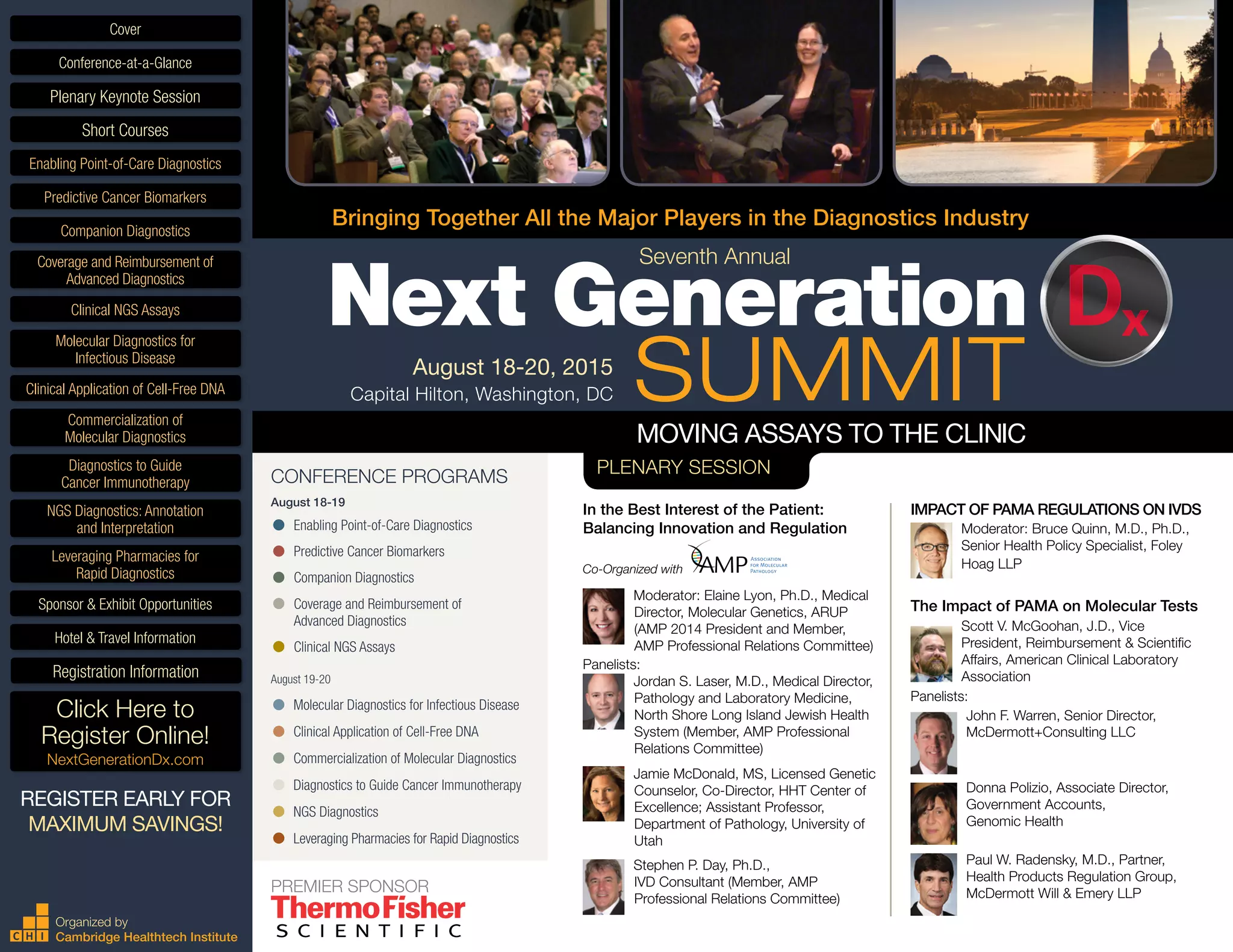
PLENARY SESSION
In the Best Interest of the Patient:
Balancing Innovation and Regulation
Co-Organized with
Moderator: Elaine Lyon, Ph.D., Medical
Director, Molecular Genetics, ARUP
(AMP 2014 President and Member,
AMP Professional Relations Committee)
Panelists:
Jordan S. Laser, M.D., Medical Director,
Pathology and Laboratory Medicine,
North Shore Long Island Jewish Health
System (Member, AMP Professional
Relations Committee)
Jamie McDonald, MS, Licensed Genetic
Counselor, Co-Director, HHT Center of
Excellence; Assistant Professor,
Department of Pathology, University of
Utah
Stephen P. Day, Ph.D.,
IVD Consultant (Member, AMP
Professional Relations Committee)
IMPACT OF PAMA REGULATIONS ON IVDS
Moderator: Bruce Quinn, M.D., Ph.D.,
Senior Health Policy Specialist, Foley
Hoag LLP
The Impact of PAMA on Molecular Tests
Scott V. McGoohan, J.D., Vice
President, Reimbursement & Scientific
Affairs, American Clinical Laboratory
Association
Panelists:
John F. Warren, Senior Director,
McDermott+Consulting LLC
Donna Polizio, Associate Director,
Government Accounts,
Genomic Health
Paul W. Radensky, M.D., Partner,
Health Products Regulation Group,
McDermott Will & Emery LLP
Seventh Annual
Next Generation
SUMMITAugust 18-20, 2015
Capital Hilton, Washington, DC
MOVING ASSAYS TO THE CLINIC
Bringing Together All the Major Players in the Diagnostics Industry
PREMIER SPONSOR
CONFERENCE PROGRAMS
August 18-19
•	Enabling Point-of-Care Diagnostics
•	Predictive Cancer Biomarkers	
•	Companion Diagnostics	
•	Coverage and Reimbursement of
Advanced Diagnostics
•	Clinical NGS Assays
August 19-20
• Molecular Diagnostics for Infectious Disease
• Clinical Application of Cell-Free DNA
• Commercialization of Molecular Diagnostics
• Diagnostics to Guide Cancer Immunotherapy
• NGS Diagnostics
• Leveraging Pharmacies for Rapid Diagnostics	
Cover
Enabling Point-of-Care Diagnostics
Predictive Cancer Biomarkers
Companion Diagnostics
Coverage and Reimbursement of
Advanced Diagnostics
Clinical NGS Assays
Molecular Diagnostics for
Infectious Disease
Clinical Application of Cell-Free DNA
Commercialization of
Molecular Diagnostics
Diagnostics to Guide
Cancer Immunotherapy
NGS Diagnostics: Annotation
and Interpretation
Leveraging Pharmacies for
Rapid Diagnostics
Sponsor & Exhibit Opportunities
Conference-at-a-Glance
Hotel & Travel Information
Plenary Keynote Session
Short Courses
Registration Information
Click Here to
Register Online!
NextGenerationDx.com
Organized by
Cambridge Healthtech Institute
REGISTER EARLY FOR
MAXIMUM SAVINGS!
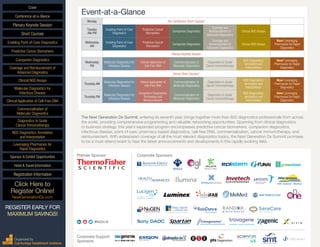
Event-at-a-Glance
Monday Pre-Conference Short Courses*
Tuesday
AM-PM
Enabling Point-of-Care
Diagnostics
Predictive Cancer
Biomarkers
Companion Diagnostics
Coverage and
Reimbursement of
Advanced Diagnostics
Clinical NGS Assays
Wednesday
AM
Enabling Point-of-Care
Diagnostics
Predictive Cancer
Biomarkers
Companion Diagnostics
Coverage and
Reimbursement of
Advanced Diagnostics
Clinical NGS Assays
New! Leveraging
Pharmacies for Rapid
Diagnostics
Plenary Keynote Session
Wednesday
PM
Molecular Diagnostics for
Infectious Disease
Clinical Application of
Cell-Free DNA
Commercialization of
Molecular Diagnostics
Diagnostics to Guide
Cancer Immunotherapy
NGS Diagnostics:
Annotation and
Interpretation
New! Leveraging
Pharmacies for Rapid
Diagnostics
Dinner Short Courses*
Thursday AM
Molecular Diagnostics for
Infectious Disease
Clinical Application of
Cell-Free DNA
Commercialization of
Molecular Diagnostics
Diagnostics to Guide
Cancer Immunotherapy
NGS Diagnostics:
Annotation and
Interpretation
New! Leveraging
Pharmacies for Rapid
Diagnostics
Thursday PM
Molecular Diagnostics for
Infectious Disease
Companion Diagnostics:
Technology and
Reimbursement
Commercialization of
Molecular Diagnostics
Diagnostics to Guide
Cancer Immunotherapy
NGS Diagnostics:
Annotation and
Interpretation
New! Leveraging
Pharmacies for Rapid
Diagnostics
The Next Generation Dx Summit, entering its seventh year, brings together more than 800 diagnostics professionals from across
the world, providing comprehensive programming and valuable networking opportunities. Spanning from clinical diagnostics
to business strategy, this year’s expanded program encompasses predictive cancer biomarkers, companion diagnostics,
infectious disease, point-of-care, pharmacy-based diagnostics, cell-free DNA, commercialization, cancer immunotherapy, and
reimbursement. With widespread coverage of all the most relevant diagnostics topics, the Next Generation Dx Summit promises
to be a must-attend event to hear the latest announcements and developments in this rapidly evolving field.
Premier Sponsor
Corporate Support
Sponsors
Corporate Sponsors
MICRO-ENGINEERING / MEDICAL / MANUFACTURING
#NGDx15
AdvancingPersonalizedMedicine
Transgenomic®
Cover
Enabling Point-of-Care Diagnostics
Predictive Cancer Biomarkers
Companion Diagnostics
Coverage and Reimbursement of
Advanced Diagnostics
Clinical NGS Assays
Molecular Diagnostics for
Infectious Disease
Clinical Application of Cell-Free DNA
Commercialization of
Molecular Diagnostics
Diagnostics to Guide
Cancer Immunotherapy
NGS Diagnostics: Annotation
and Interpretation
Leveraging Pharmacies for
Rapid Diagnostics
Sponsor & Exhibit Opportunities
Conference-at-a-Glance
Hotel & Travel Information
Plenary Keynote Session
Short Courses
Registration Information
Click Here to
Register Online!
NextGenerationDx.com
Organized by
Cambridge Healthtech Institute
REGISTER EARLY FOR
MAXIMUM SAVINGS!
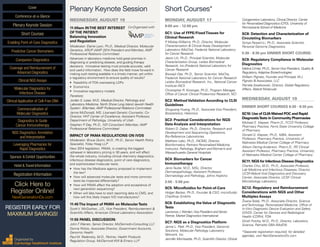
Plenary Keynote Session
WEDNESDAY, AUGUST 19
11:00am INTHE BEST INTEREST Co-Organized with
OFTHE PATIENT:
Balancing Innovation
and Regulation
Moderator: Elaine Lyon, Ph.D., Medical Director, Molecular
Genetics, ARUP (AMP 2014 President and Member, AMP
Professional Relations Committee)
Advances in laboratory medicine hold great promise in
diagnosing or predicting disease, and guiding therapy
decisions. Innovative testing must provide accurate, valid
and useful information. How does the field move forward in
making such testing available in a timely manner, yet within
a regulatory environment to ensure quality of results?
•	 Feasibility of FDA overseeing LDPs
•	 Economics
•	 Innovative regulatory models
Panelists:
Jordan S. Laser, M.D., Medical Director, Pathology and
Laboratory Medicine, North Shore Long Island Jewish Health
System (Member, AMP Professional Relations Committee)
Jamie McDonald, MS, Licensed Genetic Counselor, Co-
Director, HHT Center of Excellence; Assistant Professor,
Department of Pathology, University of Utah
Stephen P. Day, Ph.D., IVD Consultant (Member, AMP
Professional Relations Committee)
IMPACT OF PAMA REGULATIONS ON IVDS
Moderator: Bruce Quinn, M.D., Ph.D., Senior Health Policy
Specialist, Foley Hoag LLP
New 2014 legislation, PAMA, is creating the biggest
upheaval in laboratory pricing in 30 years, and will affect
the whole industry, including clinical chemistry diagnostics,
infectious disease diagnostics, point of care diagnostics,
and sophisticated molecular tests.
•	 How has the Medicare agency proposed to implement
the law?
•	 How will advanced molecular tests and more common
tests be impacted differentially?
•	 How will PAMA affect the adoption and acceptance of
next generation sequencing?
•	 When will labs have to start reporting data to CMS, and
how will this likely impact IVD manufacturers?
11:45The Impact of PAMA on MolecularTests
Scott V. McGoohan, J.D., Vice President, Reimbursement &
Scientific Affairs, American Clinical Laboratory Association
11:55 PANEL DISCUSSION:
John F. Warren, Senior Director, McDermott+Consulting LLC
Donna Polizio, Associate Director, Government Accounts,
Genomic Health
Paul W. Radensky, M.D., Partner, Health Products
Regulation Group, McDermott Will & Emery LLP
Short Courses*
MONDAY, AUGUST 17
9:00 am - 12:00 pm
SC1: Use of FFPE/FixedTissues for
Clinical Research
P. Mickey Williams, Ph.D., Director, Molecular
Characterization & Clinical Assay Development
Laboratory (MoCha), Frederick National Laboratory
for Cancer Research
Jason Lih, Ph.D., Principal Scientist, Molecular
Characterization Group, Leidos Biomedical
Research, Inc./Frederick National Laboratory for
Cancer Research
Biswajit Das, Ph.D., Senior Scientist, MoCha,
Frederick National Laboratory for Cancer Research
Leidos Biomedical Research, Inc., National Cancer
Institute (NCI)
Christopher R. Kinsinger, Ph.D., Program Manager,
Office of Cancer Clinical Proteomics Research, NCI
SC2: Method Validation According to CLSI
Guidelines
Shuguang Huang, Ph.D., Associate Vice President,
Biostatistics, Helomics
SC3: Practical Considerations for NGS
Data Analysis and Interpretation
Robert D. Daber, Ph.D., Director, Research and
Development and Sequencing Operations,
Bio-Reference Laboratories
Matthew Lebo, Ph.D., FACMG, Director,
Bioinformatics, Partners Personalized Medicine;
Instructor, Pathology, Brigham and Women’s and
Massachusetts General Hospitals
SC4: Biomarkers for Cancer
Immunotherapy
Janis Taube, M.D., MSc, Director,
Dermatopathology; Assistant Professor,
Dermatology and Pathology, Johns Hopkins
2:00 - 5:00 pm
SC5: Microfluidics for Point-of-Care
Holger Becker, Ph.D., Founder & CSO, microfluidic
ChipShop GmbHx
SC6: Establishing the Value of Diagnostic
Tests
Lawrence J.Worden,Vice President and Senior
Partner, Market Diagnostics International
SC7: NGS as a Diagnostics Platform
Jamie L. Platt, Ph.D., Vice President, Genomic
Solutions, Molecular Pathology Laboratory
Network, Inc.
Jennifer Morrissette, Ph.D., Scientific Director, Clinical
Cytogenetics Laboratory, Clinical Director, Center
for Personalized Diagnostics (CPD), University of
Pennsylvania School of Medicine
SC8: Detection and Characterization of
Circulating Biomarkers
Sonya Parpart-Li, Ph.D., Associate Scientist,
Personal Genome Diagnostics
5:30 - 8:30 pm DINNER SHORT COURSE:
SC9: Regulatory Compliance in Molecular
Diagnostics
Melina Cimler, Ph.D., SeniorVice President, Quality &
Regulatory, Adaptive Biotechnologies
William Pignato, Founder and Principal, W.J.
Pignato & Associates, LLC
Pamela Swatkowski, Director, Global Regulatory
Affairs, Abbott Molecular
WEDNESDAY, AUGUST 19
DINNER SHORT COURSES 6:30 - 8:30 pm
SC10: Use of CLIA-Waived POC and Rapid
DiagnosticTests in Community Pharmacies
Michael E. Klepser, Pharm.D., FCCP, Professor,
Pharmacy Practice, Ferris State University College
of Pharmacy
Donald G. Klepser, Ph.D., MBA, Assistant
Professor, Pharmacy Practice, University of
Nebraska Medical Center College of Pharmacy
Allison Dering-Anderson, Pharm.D., RP, Clinical
Assistant Professor, Pharmacy Practice, University
of Nebraska Medical Center College of Pharmacy
SC11: NGS for Infectious Disease Diagnostics
Charles Chiu, M.D., Ph.D., Associate Professor,
Lab Medicine and Infectious Diseases; Director,
UCSF-Abbott Viral Diagnostics and Discovery
Center; Associate Director, UCSF Clinical
Microbiology Laboratory
SC12: Regulatory and Reimbursement
Considerations with NGS and Other
Multiplex Assays
Živana Težak, Ph.D., Associate Director, Science
and Technology, Personalized Medicine, Office of
In Vitro Diagnostic Device Evaluation and Safety
(OIVD), Center for Devices and Radiological
Health (CDRH), FDA
Girish Putcha, M.D., Ph.D., Director, Laboratory
Science, Palmetto GBA (MolDX)
*Separate registration required; for detailed
agendas, visit NextGenerationDx.com
Cover
Enabling Point-of-Care Diagnostics
Predictive Cancer Biomarkers
Companion Diagnostics
Coverage and Reimbursement of
Advanced Diagnostics
Clinical NGS Assays
Molecular Diagnostics for
Infectious Disease
Clinical Application of Cell-Free DNA
Commercialization of
Molecular Diagnostics
Diagnostics to Guide
Cancer Immunotherapy
NGS Diagnostics: Annotation
and Interpretation
Leveraging Pharmacies for
Rapid Diagnostics
Sponsor & Exhibit Opportunities
Conference-at-a-Glance
Hotel & Travel Information
Plenary Keynote Session
Short Courses
Registration Information
Click Here to
Register Online!
NextGenerationDx.com
Organized by
Cambridge Healthtech Institute
REGISTER EARLY FOR
MAXIMUM SAVINGS!
RECOMMENDED SHORT COURSES*
SC5: Microfluidics for Point-of-Care:Technologies, Applications
and Products
SC12: Use of CLIA-Waived POC and Rapid DiagnosticTests in
Community Pharmacies
*Separate registration required, please see page 3 for details
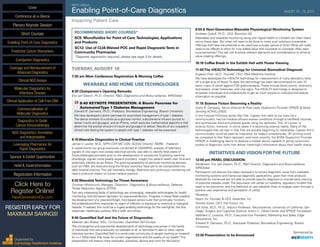
TUESDAY, AUGUST 18
7:30 am Main Conference Registration & Morning Coffee
WEARABLE AND HOME USETECHNOLOGIES
8:30 Chairperson’s Opening Remarks
Eric van Gieson, Ph.D., Director, R&D, Diagnostics and Biosurveillance, MRIGlobal
»»8:40 KEYNOTE PRESENTATION: A Bionic Pancreas for
AutomatedType 1 Diabetes Management
Edward R. Damiano, Ph.D., Professor, Biomedical Engineering, Boston University
We have developed a bionic pancreas for automated management of type 1 diabetes.
The device consists of a continuous glucose monitor, subcutaneous infusion pumps to
deliver insulin and glucagon, and an iPhone, which executes mathematical algorithms that
determine the precise amount of insulin and glucagon to deliver. Results of our outpatient
clinical trials testing the system in people with type 1 diabetes will be presented.
9:10 Wearable Diagnostics in Clinical Practice
James V. Lawler, M.D., MPH CDR MC USN, ACESO Director, NMRC - Frederick
In experiments our group previously conducted at USAMRIID, analysis of telemetry
signals of vital signs and cardiac electrical activity was able to identify fatal cases of
Ebola-challenged primates prior to the development of symptoms. Exploiting real-time
physiologic signals could greatly expand providers’ insight into patient health over time and
potentially identify acute illness.The growing availability of personal monitoring devices,
such as FitBit, are revolutionizing the fitness world but have yet to be incorporated into
daily medical practice.This will inevitably change. Real-time and continuous monitoring will
have a profound impact on future medical practice.
9:25 WearableTechnology forThreat Awareness
Christian Whitchurch, Manager, Detection, Diagnostics & Biosurveillance, Defense
Threat Reduction Agency (DTRA)
Two very interesting fields of technology are converging: wearable technologies for health
monitoring, and biomarker discovery for exposure/infection. Progress in these fields predicts
the development of a wear-and-forget, host-based sensor suite that continually monitors
the soldier/doctor/first responder for signs of infection or exposure to chemical or biological
hazards. If realized, this could be a hugely enabling technology for the warfighter, the first
responder, healthcare workers, BSL4 staff, and others.
9:40 Quantified Self and the Future of Diagnostics
Maarten den Braber, MSc, Co-Founder, Quantified Self Europe
The convergence and exponential developments of technology puts power in the hands
of individuals that was previously not available at all, or restricted to labs or other capital-
intensive owners. Quantified Self is a world-wide community of people working on research
for n=1. What does that mean for current organizations and the quality of our health?This
presentation will feature many examples, scenarios, demos and room for discussion.
9:55 A Next-Generation Wearable Physiological Monitoring System
Andreas Caduff, Ph.D., CEO, Biovotion AG
Wearables and wearable monitoring along with digital health or mHealth are often heard
terms these days. But what will need to be done to make such solutions sustainable
offerings that have the potential to be used over a longer period of time? What will really
need to be offered to allow for truly added value that succeeds to outweigh often seen
inconveniences?This talk will illustrate relevant elements and considerations to arrive at
value creating offerings.
10:10 Coffee Break in the Exhibit Hall with Poster Viewing
11:00The rHEALTHTechnology for Universal Biomedical Diagnosis
Eugene Chan, M.D., Founder, CEO, DNA Medicine Institute
We have developed the rHEALTH technology for measurement of many laboratory tests
off a single drop of blood.To date, the technology has been demonstrated on over 22
tests, many of which against FDA gold-standards.These include blood counts, chemistry,
biomarkers, small molecules, and vital signs.The rHEALTH technology is designed to
empower individuals and professionals to get as much access to individual biomedical
information as possible.
11:15 Science Fiction Becoming a Reality
Grant R. Campany, Senior Director & Prize Lead, Qualcomm Tricorder XPRIZE & Nokia
Sensing XCHALLENGE
In the fictional TV/movie series Star Trek, Captain Kirk talks to his crew via a
communicator, has his medical officers assess conditions through a handheld tricorder,
and synthesizes food and physical goods using his replicator. This, of course, is
science fiction, however, in some cases it is becoming science reality. Many of the
technologies that we saw in Star Trek are actually beginning to materialize. Captain Kirk’s
communicator could be seen as inspiration for today’s smartphones, 3D printing could
be compared to Star Trek’s replicator, and most recently, the $10M Qualcomm Tricorder
XPRIZE is challenging teams to develop a mobile device capable of giving consumers
access to diagnostic tools that deliver meaningful information about their health status.
INITIATIVES AND VISION FORTHE FUTURE
12:00 pm PANEL DISCUSSION:
Moderator: Eric van Gieson, Ph.D., R&D Director, Diagnostics and Biosurveillance,
MRIGlobal
Participants will discuss the steps necessary to extract diagnostic value from wearable
monitoring systems and home-use diagnostic applications, given that most products
destined for home-use are not able to provide specific diagnosis or provide early warning
of potential disease onset.The discussion will center on reliability, regulatory hurdles that
need to be overcome, and the likelihood of user adoption (how to engage users through a
positive user experience and perception of utility).
Panelists:
Noam Ziv, Founder & CEO, Kesembe, Inc.
Donald Jones, CEO, Trial Fusion, Inc.
Erik Viirre, M.D., Ph.D., Adjunct Professor, Neuroscience, University of California, San
Diego; Surgery and Cognitive Science, Arthur C. Clarke Center and XPRIZE Foundation
Matthew C. Lorence, Ph.D., Executive Vice President, Marketing and Sales, Edge
Biosystems, Inc.
Edward R. Damiano, Ph.D., Associate Professor, Biomedical Engineering, Boston
University
12:30 Presentation to be Announced	
Sponsored by
NINTH ANNUAL
Enabling Point-of-Care Diagnostics	 AUGUST 18 - 19, 2015
Impacting Patient Care
Cover
Enabling Point-of-Care Diagnostics
Predictive Cancer Biomarkers
Companion Diagnostics
Coverage and Reimbursement of
Advanced Diagnostics
Clinical NGS Assays
Molecular Diagnostics for
Infectious Disease
Clinical Application of Cell-Free DNA
Commercialization of
Molecular Diagnostics
Diagnostics to Guide
Cancer Immunotherapy
NGS Diagnostics: Annotation
and Interpretation
Leveraging Pharmacies for
Rapid Diagnostics
Sponsor & Exhibit Opportunities
Conference-at-a-Glance
Hotel & Travel Information
Plenary Keynote Session
Short Courses
Registration Information
Click Here to
Register Online!
NextGenerationDx.com
Organized by
Cambridge Healthtech Institute
REGISTER EARLY FOR
MAXIMUM SAVINGS!
1:00 Luncheon Presentation: Designing Point-of-Care	 Sponsored by
Instruments: Challenges and ProvenTools for Success
David James, Senior Vice President, Diagnostics, Invetech
Developing market-leading instruments and consumables to meet the demanding
requirements for point-of-care requires specialist skills and experience. Stakeholders with
competing priorities are often challenged to find a method to agree on the “critical few”
requirements that will provide the best product solutions. In this session we discuss
proven tools and processes critical to defining a winning design and then delivering a
robust and competitive final product in the shortest time to market.
1:30 Refreshment Break in the Exhibit Hall with Poster Viewing
CELL-BASEDASSAYSAND METHODS FOR DIAGNOSTICS
2:00 Chairperson’s Remarks
Holger Becker, Ph.D., Founder & CSO, microfluidic ChipShop GmbH
2:05 Point-of-Care Diagnostics for Clinical Hematology:Towards Novel
Cell-Based Hemostasis Assays and Patient-Operated Self-Tests
Wilbur A. Lam, M.D., Ph.D., Assistant Professor, Pediatrics and Biomedical Engineering,
Emory University and Georgia Institute of Technology
Hematologic disorders, almost by definition, can be diagnosed via sampling and analysis
of blood and as such, are especially amenable for point-of-care and cell-based diagnosis.
In this presentation, newly developed microfluidic cell-based assays for assessing
hemostatic function that offer improvements over standard clinical tests will be described.
In addition, a clinical assessment of a recently developed patient-operated, disposable,
self-test for anemia will also be discussed.
2:35 POC Diagnostics – A New Era for Portable Devices
James F. Leary, Ph.D., Professor, Basic Medical Sciences & Biomedical Engineering,
Purdue University
Portable devices required evolution of new technologies (e.g. low-power LEDs,
nanophotonic sensors, “smart-nanoparticles”) that permit small, light-weight, low-power
instruments to be brought to the patient.This represents a fundamental paradigm shift in
medicine changing the way healthcare decisions can be made. If rapid tests can be made
within 15-20 minutes, important medical decisions can be made during an initial patient
visit to improve patient outcomes.
3:05 Cell-Based Microfluidic Assays for Cardiovascular and
Ocular Diagnostics
Shashi K. Murthy, Ph.D., Associate Professor, Chemical Engineering, Northeastern
University
Cell-based microfluidic assays have advanced significantly, particularly in targeting
circulating tumor cells.The mode of operation of such assays is typically target cell
identification followed by enumeration. However, it is now possible to leverage cellular
function to obtain diagnostic readouts.This presentation will describe examples of both
current generation and next generation cell-based microfluidic diagnostic assays in the
context of cardiovascular and ocular diagnostics, respectively.
3:35 Reimagining the Future of Point-of-Care		
Sponsored by
Molecular Diagnostics for Infectious Disease
Hemanth Shenoi, Ph.D., Director, Business Development, Lucigen
Lucigen is developing ClariLight™, a CLIA-waivable molecular
diagnostic platform that provides results in about 30 minutes. The simple format will
be usable by laboratory and non-laboratory health care staff to accurately diagnose
infectious diseases at the point-of-care. Our initial focus is hospital-acquired infections,
specifically Clostridium difficile infection. This presentation will describe the patented
isothermal amplification technology, pre-clinical data and plans for a dual 510(k) and
CLIA-waiver clinical trial.
4:05 Refreshment Break in the Exhibit Hall with Poster Viewing
INTEGRATED MICROFLUIDICS
4:45 Smart Microfluidic and Its Impact on	 Sponsored by
POC Diagnostics
Yimin Guan, Ph.D, Microfluidic Business Development, FunaiTSG Group
Funai, a leader in inkjet technology innovation, has developed novel microfluidic modules
based on MEMS process of thermal inkjet technology, which include on-chip pico pump,
mixer, filter and output jetting array. Fabricated by using standard semiconductor process
and with built-in CMOS control, the modules are low-cost, small, intelligent and ready for
mass production.The integration of these intelligent, low-cost modules will enable various
new POC diagnostic platforms.
5:00 Ultrasensitive Rare Cell Disease Diagnostics on Hybrid Microfluidic/
Microelectronic Chips
David Issadore, Ph.D., Assistant Professor, Bioengineering and Electrical Engineering,
University of Pennsylvania
The impact of the growth in microelectronics has been profound - computing is pervasive
and portable, communication is instant and global, and information is ubiquitously
gathered and shared. My research aims to harness these same electrical engineering
approaches, which have enabled the microelectronic revolution, to solve high impact
problems in medical diagnostics.To accomplish this goal my lab develops hybrid
microchips, where microfluidics (i.e. micrometer sized plumbing) are built directly on top
of semiconductor chips.
5:25 Low Cost, Non-Invasive, Onsite Paper-Based Multiplex Device for
Early Prediction of Kidney Damage
Kadamb Patel, Ph.D., Program Manager, Biosensor, Research Scientist, Centre of
Molecular Diagnostics, School of Applied Science, Temasek Polytechnic
We have developed simple, user-friendly, inexpensive, noninvasive, and accurate, low
cost, point-of-care paper-based multiplex device for early prediction of kidney damage.
Paper-based device was developed using selected urine biomarkers with high sensitivity
and specificity, namely the Kidney injury molecule-1 (KIM-1) and Neutrophil gelatinase-
associated lipocalin (NGAL) which can be used for early prediction of acute kidney injury.
5:50 Wine & Cheese Pairing Welcome Reception in the Exhibit Hall with
Poster Viewing
6:50 Close of Day
NINTH ANNUAL
Enabling Point-of-Care Diagnostics	 AUGUST 18 - 19, 2015
Impacting Patient Care
Cover
Enabling Point-of-Care Diagnostics
Predictive Cancer Biomarkers
Companion Diagnostics
Coverage and Reimbursement of
Advanced Diagnostics
Clinical NGS Assays
Molecular Diagnostics for
Infectious Disease
Clinical Application of Cell-Free DNA
Commercialization of
Molecular Diagnostics
Diagnostics to Guide
Cancer Immunotherapy
NGS Diagnostics: Annotation
and Interpretation
Leveraging Pharmacies for
Rapid Diagnostics
Sponsor & Exhibit Opportunities
Conference-at-a-Glance
Hotel & Travel Information
Plenary Keynote Session
Short Courses
Registration Information
Click Here to
Register Online!
NextGenerationDx.com
Organized by
Cambridge Healthtech Institute
REGISTER EARLY FOR
MAXIMUM SAVINGS!
WEDNESDAY, AUGUST 19
7:15 am Registration
7:30 – 8:25 Problem-Solving Breakout Discussions with
Continental Breakfast
TRENDS IN POCT- VISION OFTHE FUTURE
8:25 Chairperson’s Opening Remarks
Gyorgy Abel, M.D., Ph.D., Director, Molecular Diagnostics, Immunology & Clinical
Chemistry, Laboratory Medicine, Lahey Hospital & Medical Center
»»8:30 KEYNOTE PRESENTATION: Coming to a Lab NearYou:
Global Review of POCT
Gyorgy Abel, M.D., Ph.D., Director, Molecular Diagnostics, Immunology & Clinical
Chemistry, Laboratory Medicine, Lahey Hospital & Medical Center
Clinical demand, convenience, and technological advancements have contributed to
the increasing popularity of point-of-care testing (POCT) world-wide.Yet there are
considerable differences in the utilization of POCT depending on the different medical
needs, health care delivery and reimbursement systems in various countries.The
presentation reviews these differences, the key drivers, challenges, trends, and the
attitudes toward POCT by geographic/economic region.
9:00 Use of a POC Laboratory to Successfully Manage
Ebola Patients
James C. Ritchie, Ph.D., Medical Director & Professor, Pathology & Laboratory
Medicine, Emory University
Our hospital has successfully treated 4 Ebola patients.These patients were entirely
managed using laboratory values generated by a point-of-care testing laboratory located
within the treatment unit. We will discuss the instrumentation used, the staff preparation,
and the teamwork needed to make this approach viable. We will also briefly discuss the
results for the common chemistry analytes on these patients throughout their treatment
course. Finally we will discuss the shipping of specimens and decontamination of
equipment and the laboratory after the patients depart.
9:30 Ambulatory POCT for Ebola, Lassa, Fever andTrace Infections
Mustapha S. Fofana, Ph.D., Associate Professor, Mechanical, Biomedical and
Manufacturing Engineering, Worcester Polytechnic Institute
The Ambulatory Point-of-CareTesting (POCT) vehicles are designed for rapid verification of
people suspected of Ebola, Lassa, Fever andTrace (ELFT) infections. We will discuss the
basic mechanics for POCT, explain engineering innovations of the POCT vehicles, outline
new approach of POCT for ELFT infections, discuss safety topics related to renewable
standards for evaluating and treating ELFT patients.
10:00 Improving Patient Care through	Decentralizing	 Sponsored by
Molecular DiagnosticTests for Infectious Diseases
John Clarkson, Ph.D., CEO, Atlas Genetics Ltd.
Diagnostic test accuracy and turn-around time are vital characteristics in
the fight against infectious diseases. Decentralizing diagnostic tests to the doctors’ office,
specialist clinics or hospital ER can improve response time and increase test coverage
of the population. In this presentation, attendees will gain an understanding of recent
developments in decentralized diagnostics and what aspects of the system specification
will drive clinical uptake.
10:15 Manufacturing Innovation for POC Devices	
Sponsored by
MICRO-ENGINEERING / MEDICAL / MANUFACTURING
Erol Harvey, CEO, miniFAB
Microfluidics has been around since the mid 1970’s yet only recently
have we begun to see a number of mainstream commercial products achieve
market success. Now, with several products reaching production volumes in
the several millions per annum, we have a better idea of what works and what
doesn’t work in terms of design and its match to manufacturing capability.
Important considerations include the right selection of materials, the division of
function between the consumable and the re-usable components, where in the
manufacturing cycle thermal, vacuum or wet processing occurs and how and
where to apply batch production rather than piece-part handling. Getting these
elements right early on will optimize the chances of commercial success.
10:30 Coffee Break in Exhibit Hall with Poster Viewing
»»PLENARY KEYNOTE SESSION: See page 3 for details.
12:40 pm Luncheon Presentation: Empowering Sponsored by
In-OfficeTreatment Decisions with Point-of-Care
Molecular DiagnosticTesting
Shana Kelley, Ph.D., CTO, Xagenic Inc.
Ihor Boszko, Vice President, Business Development, Xagenic Inc.
Point-of-care MDx testing is finally available in 2015, and it unlocks a huge
opportunity for improvement of clinical outcomes and reduction of healthcare
costs by delivering better diagnostic tools for physicians. Xagenic has developed
the enzyme-free, highly multiplexed Xagenic X1™ platform that boasts a time to
result of 20 minutes with a low cost of adoption. Our strategy will bring to market
a menu of infectious disease tests with greatest utility for clinical decision-making
during the initial patient visit.
1:10 Close of Enabling Point-of-Care Diagnostics
NINTH ANNUAL
Enabling Point-of-Care Diagnostics	 AUGUST 18 - 19, 2015
Impacting Patient Care
Cover
Enabling Point-of-Care Diagnostics
Predictive Cancer Biomarkers
Companion Diagnostics
Coverage and Reimbursement of
Advanced Diagnostics
Clinical NGS Assays
Molecular Diagnostics for
Infectious Disease
Clinical Application of Cell-Free DNA
Commercialization of
Molecular Diagnostics
Diagnostics to Guide
Cancer Immunotherapy
NGS Diagnostics: Annotation
and Interpretation
Leveraging Pharmacies for
Rapid Diagnostics
Sponsor & Exhibit Opportunities
Conference-at-a-Glance
Hotel & Travel Information
Plenary Keynote Session
Short Courses
Registration Information
Click Here to
Register Online!
NextGenerationDx.com
Organized by
Cambridge Healthtech Institute
REGISTER EARLY FOR
MAXIMUM SAVINGS!
EIGHTH ANNUAL
Predictive Cancer Biomarkers	 AUGUST 18 - 19, 2015
Strategies for Discovery, Analysis, and Clinical Translation
RECOMMENDED PRE-CONFERENCE SHORT COURSES*
SC4: Biomarkers for Cancer Immunotherapy
SC8: Detection and Characterization of Circulating Biomarkers
*Separate registration required, please see page 3 for details
TUESDAY, AUGUST 18
7:30 am Main Conference Registration & Morning Coffee
IDENTIFYING AND PRIORITIZING MARKERS
8:30 Chairperson’s Opening Remarks
Jennifer Morrissette, Ph.D., Scientific Director, Clinical Cytogenetics Laboratory;
Clinical Director, Center for Personalized Diagnostics (CPD), University of
Pennsylvania Perelman School of Medicine
8:40The Vision and the Reality: One Cancer Center’s Journey toward
Genomic Medicine
Jeff Boyd, Ph.D., Senior Vice President, Molecular Medicine; The Robert C. Young,
MD Chair in Cancer Research; Executive Director, Cancer Genome Institute; Chief,
Division of Molecular Pathology; Professor, Cancer Biology Program, Fox Chase
Cancer Center
9:10 Ranking Omics Data to Discover Biomarkers
Corrado Priami, Ph.D., President & CEO, The Microsoft Research and University of
Trento Centre for Computational and Systems Biology
An approach based on ranking of measurements is presented to identify patient
signatures. The signature can be used to define biomarkers with respect to
diseases, stratification of patients with respect to interventions or even toxicology
of drugs with respect to doses and number of deliveries. I will present the
approach and I’ll show examples of its application.
9:40 Databases and Case Review: An In-House Developed Program
for a Mid-Sized Academic Laboratory
Jennifer Morrissette, Ph.D., Scientific Director, Clinical Cytogenetics Laboratory;
Clinical Director, Center for Personalized Diagnostics (CPD), University of
Pennsylvania Perelman School of Medicine
Laboratories are increasingly moving into next generation sequencing (NGS) as
the costs have decreased and the technologies have become more robust. There
are many choices of how to process and analyze data coming off the machine,
some sequencer-specific analysis tools, commercial entities and in-house
solutions. This talk will describe a laboratory developed LIMS system, covering
sample management, analysis and reporting developed for identification of
abnormalities in DNA and RNA used in a clinical laboratory setting.
10:10 Coffee Break in the Exhibit Hall with Poster Viewing
CIRCULATING BIOMARKERS
10:55 Chairperson’s Remarks
Michael J. Heller, Ph.D., Professor, Nanoengineering & Bioengineering, University
of California San Diego
11:00 Circulating MicroRNAs and Other Nucleic Acids inTreatment
Monitoring
Anton Wellstein, M.D., Ph.D., Professor, Oncology, Georgetown University
This talk will describe the methodology of microRNA analysis from the circulation
and application to treatment monitoring. Potential pathway specific findings will
also be discussed.
11:30 Detection and Analysis of DNA/RNA Biomarkers from
Hematological Cancer, SolidTumors andTBI Patient Samples
Michael J. Heller, Ph.D., Professor, Nanoengineering & Bioengineering, University
of California, San Diego
Fluorescent detection of ccf-DNA/RNA biomarkers from CLL, solid tumor and TBI
patient blood and plasma samples (20-100ul) is achieved in 10-15 minutes using an
AC dielectrophoretic (DEP) microarray. For CLL, PCR and sequencing results are
comparable to “gold standard” procedures. Fragment size analysis is being carried
to determine apoptotic and necrotic origins of CLL and solid tumor ccf-DNA,
which may ultimately have important diagnostic value.
12:00 pm NGS of Circulating	 Sponsored by
Tumor Cells from the CELLSEARCH®
System
Charles Saginario, Ph.D., Scientist, CRS Labs, Janssen Diagnostics
CLINICAL ANALYSIS OF NGS SAMPLES
12:30 Epigenetic Profiling of DNA Methylation to Categorize Breast
Tumor Aggressiveness
Adam Marsh, Ph.D., Associate Professor, Bioinformatics and Computational
Biology, University of Delaware
Women with triple-negative genotypes for the 3 common marker mutations for
breast cancer are still at significant risk for this disease. We identify a suite of
differentially methylated CpG sites between Normal and Tumor breast tissues that
indicate a high degree of epigenetic conservation among different triple-negative
patients who have developed aggressive breast tumors. Subtle epigenetic shifts in
methylation status may provide a key line of evidence for assessing tumor risk and
deciding between surgery or therapy.
1:00 Luncheon Presentation:Targeted NGS	 Sponsored by
Analyses of Clinical Samples for SNPs, CNVs, Gene
Fusions and More
Joe Don Heath, Ph.D., Vice President, Market Development Diagnostics, NuGEN
A novel approach for custom targeted sequencing of both DNA and RNA will
be described. Sensitive variant detection in genomic DNA derived from fresh
and FFPE tissues will be demonstrated as well as utilization of the enrichment
technology as a rapid, cost-effective tool for the discovery of novel gene fusions
and the detection of known, clinically-relevant gene fusions using a 500+ cancer
gene screening panel.
Cover
Enabling Point-of-Care Diagnostics
Predictive Cancer Biomarkers
Companion Diagnostics
Coverage and Reimbursement of
Advanced Diagnostics
Clinical NGS Assays
Molecular Diagnostics for
Infectious Disease
Clinical Application of Cell-Free DNA
Commercialization of
Molecular Diagnostics
Diagnostics to Guide
Cancer Immunotherapy
NGS Diagnostics: Annotation
and Interpretation
Leveraging Pharmacies for
Rapid Diagnostics
Sponsor & Exhibit Opportunities
Conference-at-a-Glance
Hotel & Travel Information
Plenary Keynote Session
Short Courses
Registration Information
Click Here to
Register Online!
NextGenerationDx.com
Organized by
Cambridge Healthtech Institute
REGISTER EARLY FOR
MAXIMUM SAVINGS!
EIGHTH ANNUAL
Predictive Cancer Biomarkers	 AUGUST 18 - 19, 2015
Strategies for Discovery, Analysis, and Clinical Translation
1:30 Refreshment Break in the Exhibit Hall with Poster Viewing
PATIENT STRATIFICATION USING NGS DATA
2:00 Chairperson’s Remarks
Louis Fiore, M.D., Executive Director, MAVERIC, Boston VA Healthcare System
2:05The Department ofVeterans Affairs Precision Oncology Program
Louis Fiore, M.D., Executive Director, MAVERIC, Boston VA Healthcare System
The VA Precision Oncology Program systematically genotypes cancer patients
and enrolls them into a cohort so that they can be matched to biomarker-driven
clinical trials. This talk presents a collaborative model for integration of research
and clinical care. The program addresses important issues such as bringing clinical
trials to patients, identification of cases across a network of hospitals, sharing
of clinical data with research partners and collection of patient-centered and
patient-reported outcomes.
2:35 NGS for Patient Screening andTreatment Selection for NCI’s
MPACT and MatchTrials
P. Mickey Williams, Ph.D., Director, Molecular Characterization Laboratory
(MoCha), Frederick National Laboratory for Cancer Research
3:05 Predictive Biomarkers forTargeted CancerTherapy
Baolin Zhang, Ph.D., Senior Investigator, Office of Biotechnology Products, Center
for Drug Evaluation and Research, Food and Drug Administration
The ability to identify the subsets of patients with molecularly defined cancers
could significantly improve patient outcome. This presentation will discuss the
major challenges in the discovery, qualification and regulatory review of predictive
cancer biomarkers. Emphasis will be placed on the recent efforts of the US
Food and Drug Administration in facilitating the joint development of therapeutic
products and in vitro companion diagnostic devices (IVDs) that are essential for
the safe and effective use of the corresponding therapeutic products.
3:35 Automated Multimodal, High-Multiplex,	 Sponsored by
Quantitative Molecular Platform Solution for
Complicated Companion Diagnostics
Lilly Kong, Senior Director, Assay Development, Assay
Development, Qiagen
Clinicians across multiple disciplines are asking complex questions for tailored
therapies. Automated multimodal, high-multiplex, quantitative PCR is the ideal
next generation of MDx. Modaplex provides precise, robust and simple solutions
to meet the needs of next generation cancer diagnostics and therapeutic
modalities. We will discuss how our “All in One Tube” technology makes it
possible to develop unique, highly multiplexed, multimodal, quantitative and
qualitative IVDs to interrogate dozens of biomarkers in one tube. Using this, drug
developers can capture the full value of their therapies.
3:50 Driver-Map™ Panels: Quantitative, Multiplex	 Sponsored by
PCR,Target Enrichment Based NGS for DrugTarget
Discovery
Gus Frangou, Ph.D., Director, Clinical Diagnostics, Cellecta Inc.
Driver-Map™ Biomarker Discovery Panels offer a novel high-
throughput PCR based sequence enrichment platform to comprehensively assess
the genomic landscape for both solid tumors and hematologic malignancies from
archived FFPE, blood and bone marrow aspirate samples. Specifically, Driver-
Map analyzes common genomic “hot spot” regions that are frequently mutated
in 250 genes related to cancer treatment, prognosis and diagnosis. In addition,
simultaneous quantitative target gene expression analysis using competitive
multiplex-PCR amplicons for ~3000 genes and computational network modeling,
facilitates the rapid identification of cancer driver genes or gene models,
pathway analysis to identify commonalities across tumor type(s), and supporting
pharmacogenetic information.The talk will provide insight into how this functional
genomics pipeline can be used to expediently identify novel biomarkers and
therapeutic targets for cancer en masse.
4:05 Refreshment Break in the Exhibit Hall with Poster Viewing
CHALLENGES AND SOLUTIONS FOR NGS LABS
4:50 PANEL DISCUSSION:
Moderator: Robert D. Daber, Ph.D., Director, Research and Development and
Sequencing Operations, Bio-Reference Laboratories
Panelists: Avni B. Santani, Ph.D., Assistant Professor, Clinical Pathology, University
of Pennsylvania School of Medicine; Scientific Director, Molecular Genetics
Laboratory, The Children’s Hospital of Philadelphia
Helen Fernandes, Ph.D., Director, Molecular Pathology, Pathology & Laboratory
Medicine, Weill Cornell Medical College
• Selecting genes for new panels
• Informatics and analysis
• Building clinical infrastructure ensure action on mutations
5:50 Wine & Cheese Pairing Welcome Reception in the Exhibit Hall
with Poster Viewing
6:50 Close of Day
Cover
Enabling Point-of-Care Diagnostics
Predictive Cancer Biomarkers
Companion Diagnostics
Coverage and Reimbursement of
Advanced Diagnostics
Clinical NGS Assays
Molecular Diagnostics for
Infectious Disease
Clinical Application of Cell-Free DNA
Commercialization of
Molecular Diagnostics
Diagnostics to Guide
Cancer Immunotherapy
NGS Diagnostics: Annotation
and Interpretation
Leveraging Pharmacies for
Rapid Diagnostics
Sponsor & Exhibit Opportunities
Conference-at-a-Glance
Hotel & Travel Information
Plenary Keynote Session
Short Courses
Registration Information
Click Here to
Register Online!
NextGenerationDx.com
Organized by
Cambridge Healthtech Institute
REGISTER EARLY FOR
MAXIMUM SAVINGS!
EIGHTH ANNUAL
Predictive Cancer Biomarkers	 AUGUST 18 - 19, 2015
Strategies for Discovery, Analysis, and Clinical Translation
WEDNESDAY, AUGUST 19
7:15 am Registration
7:30 – 8:25 Problem-Solving Breakout Discussions
with Continental Breakfast
TRANSLATIONAL STRATEGIES AND CASE STUDIES
8:25 Chairperson’s Opening Remarks
Robert D. Daber, Ph.D., Director, Research and Development and Sequencing
Operations, Bio-Reference Laboratories
8:30 Utility of Implementing Clinical NGS Assays as Standard of
Care in Oncology
Helen Fernandes, Ph.D., Director, Molecular Pathology, Pathology & Laboratory
Medicine, Weill Cornell Medical College
The presentation will address the practical processes that need to be adopted for
a NGS-based assay to be run in a routine clinical laboratory. The topics will address
specific challenges encountered from the preanalytical to the analytical and
postanalytical phases of the process. Details on achieving libraries with optimal
quality from various types of specimens will be discussed. Factors that affect the
implementation of the analytical process and the variability encountered in the
interpretation of variants will be highlighted. Strategies for recognizing and dealing
with the barriers will be included.
9:00 Development and Implementation of Clinical NGSTesting:
Assay Development and Informatic Challenges
Robert D. Daber, Ph.D., Director, Research and Development and Sequencing
Operations, Bio-Reference Laboratories
As genomic technologies continue to advance and new bio-markers emerge, rapid
NGS assay development becomes critical in the age of Precision Diagnostics.
Here we will discuss emerging methods to capture important biological markers
and their associated informatic challenges during both the development and
implementation phases.
9:30 Implementation of Clinical Exome Sequencing
Avni B. Santani, Ph.D., Assistant Professor, Clinical Pathology, University of
Pennsylvania School of Medicine; Scientific Director, Molecular Genetics
Laboratory, The Children’s Hospital of Philadelphia
With the advent of next generation sequencing (NGS), diagnostic laboratories
are faced with unprecedented challenges in incorporating this technology in the
clinical setting. This presentation will provide a comprehensive overview on the
key considerations for implementation of clinical exome sequencing including
resource allocation, assay development, compliance, bioinformatics, data
management, analysis and interpretation of data.
10:00 Presentation to be Announced 	 Sponsored by
10:15 Sponsored Presentation (Opportunity Available)
10:30 Coffee Break in Exhibit Hall with Poster Viewing
»»PLENARY KEYNOTE SESSION: See page 3 for details.
12:40 pm Luncheon Presentation (Sponsorship Opportunity Available) or
Enjoy Lunch onYour Own
1:25 Refreshment Break in the Exhibit Hall with Poster Viewing
1:50 Chairperson’s Opening Remarks
»»2:00 KEYNOTE PRESENTATION: Monitoring the Cancer
Genome in Plasma Using CirculatingTumor DNA
Nitzan Rosenfeld, Ph.D., Senior Group Leader, CRUK-CI, University of
Cambridge; CSO, Inivata, Ltd.
Circulating cell-free tumor DNA (ctDNA) can be used to probe cancer genome
dynamics via plasma samples. When a biopsy is unavailable, ctDNA can be
used as a ‘liquid biopsy’ to assess sensitivity and resistance to targeted
therapies. Quantification of ctDNA is informative for cancer prognosis,
response or relapse. If cancer progresses, cancer evolution can be studied
noninvasively by genome-wide analysis of ctDNA in plasma.
3:00 Close of Predictive Cancer Biomarkers
Cover
Enabling Point-of-Care Diagnostics
Predictive Cancer Biomarkers
Companion Diagnostics
Coverage and Reimbursement of
Advanced Diagnostics
Clinical NGS Assays
Molecular Diagnostics for
Infectious Disease
Clinical Application of Cell-Free DNA
Commercialization of
Molecular Diagnostics
Diagnostics to Guide
Cancer Immunotherapy
NGS Diagnostics: Annotation
and Interpretation
Leveraging Pharmacies for
Rapid Diagnostics
Sponsor & Exhibit Opportunities
Conference-at-a-Glance
Hotel & Travel Information
Plenary Keynote Session
Short Courses
Registration Information
Click Here to
Register Online!
NextGenerationDx.com
Organized by
Cambridge Healthtech Institute
REGISTER EARLY FOR
MAXIMUM SAVINGS!
SIXTH ANNUAL
Companion Diagnostics	 AUGUST 18 - 19, 2015
Identifying Partners and Convening Stakeholders
RECOMMENDED SHORT COURSES*
SC9: Regulatory Compliance in Molecular Diagnostics
SC12: Regulatory and Reimbursement Considerations with NGS
and Other Multiplex Assays
*Separate registration required, please see page 3 for details
TUESDAY, AUGUST 18
7:30 am Main Conference Registration & Morning Coffee
FROM BIOMARKERSTO DIAGNOSTICS
8:20 Chairperson’s Opening Remarks
Kenneth Emancipator, M.D., Executive Medical Director, Molecular Biomarkers and
Diagnostics, Merck Research Laboratories
»»8:30 Extracting Added Value from ClinicalTrials
through Systematic Pharmacogenomic Research
Kenneth Emancipator, M.D., Executive Medical Director, Molecular Biomarkers
and Diagnostics, Merck Research Laboratories
Rebecca Blanchard, Ph.D., Executive Director, Genetics and Pharmacogenomics,
Head, of Clinical Pharmacogenomics, Merck & Co., Inc.
Clinical development activities provide drug companies with opportunities to
identify genomic variants associated with disease, pharmacological mechanisms
and biomarkers predictive of drug response. This genomic information can
be leveraged to identify new drug targets, optimize drug leads, determine
patients most likely to benefit from drug treatment, and to develop companion
diagnostics.This presentation will focus on a systematic approach to identifying
predictive biomarkers of drug response, possible impact of such findings on drug
development strategy, and ultimate development of companion diagnostics.
9:10 Creating and Managing the Multiple Interfaces of Drug/
Diagnostic Co-Development
George A. Green IV, Ph.D., Group Director, Pharmacodiagnostic Center of
Excellence, Bristol-Myers Squibb
Andrea H. Lauber, Ph.D., Executive Director, Business Development, Clinical
Biomarkers and Pharmacodiagnostics, Bristol-Myers Squibb
BMS works closely with external partners to co-develop diagnostic products for
our pipeline therapies. The pharmacodiagnostic strategy for each therapeutic asset
is developed based on medical need, biomarker science, assay performance and
value creation. Partnering facilitates access to the diverse capabilities needed to
execute on this strategy. Key partner capabilities considered include biomarkers,
technologies, manufacturing and commercialization expertise, and up-to-date
regulatory and reimbursement policies; aimed at providing benefits of companion
products to clinical practice. We will explore some of challenges and benefits that
Rx/Dx collaborations bring to the industry.
9:40 Achieving Personalized Medicine through successful Rx-Dx
Partnerships: From Biomarkers to Commercialization
Carolina Rizo, Ph.D., MBA, Director, Business Development, Roche Molecular Systems
Companion Diagnostics enable the safe and effective use of targeted therapies,
facilitating Personalized Medicine.This talk will describe strategies to overcome
intrinsic challenges and achieve successful partnerships between pharma and
diagnostics, from Biomarkers to Commercialization, based in real world experience.
10:10 Coffee Break in the Exhibit Hall with Poster Viewing
EARLY VS. LATE STAGE DRUG/DIAGNOSTICS
CO-DEVELOPMENT
10:55 Chairperson’s Remarks
William Pignato, Founder and Principal, W.J. Pignato & Associates, LLC
11:00 From One Biomarker, OneTest, to Multiple Biomarkers, One
Test: NGS and CDx Development to Support the Pipeline
Anne-Marie Martin, Ph.D., Head, Molecular Medicine and Precision Medicine &
Diagnostics, GlaxoSmithKline
I will discuss the limitations of developing assays for one biomarker and how
leveraging newer technologies, such as next generation sequencing, we
can maximize assay development to support multiple biomarkers supporting
multiple drugs.
11:20 Challenges with Early Co-Development of Rx/CDx: A
Companion Diagnostics Perspective – From a Large Pharma
Point of View
Peggy Carter, Ph.D., Global Head, Drug Regulatory Affairs, Novartis Companion
Diagnostics
In the ideal situation, the therapy and the companion diagnostic would be co-
developed starting as early in the development process as possible; but there are
challenges. I will discuss some of these challenges and some strategies that have
been employed to overcome them.
11:40 Strategic Considerations of Which Clinical Development Stage
To Start Selecting Patients
Jocelyn A. Holash, Ph.D., Vice President, Translational Sciences, BioClin
Therapeutics, Inc.
I will discuss the pros and cons of implementing patient selection strategies
early or late in the drug development process, how this decision will affect the
development of a CDx and why small companies might make different decisions
than larger companies.
12:00 pm PANEL DISCUSSION: Challenges and Opportunities in
Drug/CDX Co-Development: Early vs. Late Stage Development
Moderator: William Pignato, W.J. Pignato & Associates, LLC
•	 Designing Co-Development Strategy in Early Stages
•	 Coordinating Drug and Diagnostics Development throughout the Process
•	 Working with Regulators
•	 Planning Out Market Access Strategies
Panelists:
Anne-Marie Martin, Ph.D.,GlaxoSmithKline
Peggy Carter, Ph.D., Novartis Companion Diagnostics
Jocelyn A. Holash, Ph.D., BioClin Therapeutics, Inc.
Cover
Enabling Point-of-Care Diagnostics
Predictive Cancer Biomarkers
Companion Diagnostics
Coverage and Reimbursement of
Advanced Diagnostics
Clinical NGS Assays
Molecular Diagnostics for
Infectious Disease
Clinical Application of Cell-Free DNA
Commercialization of
Molecular Diagnostics
Diagnostics to Guide
Cancer Immunotherapy
NGS Diagnostics: Annotation
and Interpretation
Leveraging Pharmacies for
Rapid Diagnostics
Sponsor & Exhibit Opportunities
Conference-at-a-Glance
Hotel & Travel Information
Plenary Keynote Session
Short Courses
Registration Information
Click Here to
Register Online!
NextGenerationDx.com
Organized by
Cambridge Healthtech Institute
REGISTER EARLY FOR
MAXIMUM SAVINGS!
SIXTH ANNUAL
Companion Diagnostics	 AUGUST 18 - 19, 2015
Identifying Partners and Convening Stakeholders
12:30 Partnering for Precision Oncology:	 Sponsored by
From Companion Diagnostics to Companion
Therapeutics	
Karen Gutekunst, Ph.D., Vice President, IVD Development, Oncology, Illumina
1:00 Luncheon Presentation	
Sponsored by
1:30 Refreshment Break in the Exhibit Hall
with Poster Viewing
KEYNOTE SESSION: COMPANION DIAGNOSTICS
INTHE CLINIC
1:55 Chairperson’s Remarks
Mitch Raponi, Ph.D., Senior Director, Molecular Diagnostics, Clovis Oncology
2:00Testing for Cancer Heterogeneity
Marc Ladanyi, M.D., Chair, Molecular Oncology, Memorial Sloan-Kettering Cancer
Center
NGS offers a powerful tool for assessment of molecular defects found in cancer.The
utilization of NGS is becoming common practice in clinical laboratories.This complex
technology requires a new level of analytical performance testing and validation.This
discussion will focus on approaches used for analytical validation of the NGS clinical
assay used for treatment selection in the NCI-MPACT Study.
2:30 Liquid Biopsies for Cancer Detection and Characterization
Victor E. Velculescu, M.D., Ph.D., Professor, Oncology; Co-Director, Cancer Biology,
Johns Hopkins Kimmel Cancer Center
Analyses of cancer genomes have revealed mechanisms underlying tumorigenesis
and new avenues for therapeutic intervention. In this presentation, I will discuss
lessons learned through the characterization of cancer genome landscapes,
challenges in translating these analyses to the clinic, and new technologies that
have emerged to analyze molecular alterations in the circulation of cancer patients
as cell-free tumor DNA.These approaches have important implications for non-
invasive detection and monitoring of human cancer, therapeutic stratification, and
identification of mechanisms of resistance to targeted therapies.
CO-DEVELOPMENT OF DRUGS AND MULTIPLEX
COMPANION DIAGNOSTICS
3:00 Evolution of aTherapeutic and Its Companion Diagnostic: The
Search For Improved Patient OutcomesThrough Better Predictive
Tests, A Case Study
Catherine Lofton-Day, Ph.D., Principal Scientist, Amgen
Predictive biomarkers are difficult to identify during the course of drug
development but can provide great improvements in patient outcomes.
Maintaining an active biomarker program after drug approval can further define
patient response and provide data to support new therapeutic indications and
more effective diagnostics. Monoclonal antibody therapies targeting EGFR and
associated RAS biomarkers will be discussed as a case study for biomarker
evolution and global management of drug/diagnostic pairs.
3:30 Companion Diagnostic Assay Development:	 Sponsored by
A Perspective from a Global IVD Company
Chris Moriarty, Global Manager, Randox Pharma Sciences, Business
Development, Randox Biosciences
The majority of IVD cleared diagnostics currently in routine clinical use utilize
automated clinical chemistry or immunoassay platforms as they offer ease of
use, low cost per test and widespread adoption in clinical labs…key features
for any CDx. With this in mind the speaker will present an overview on
technical considerations, regulatory pathway and platform solutions for CDx
assay development.
3:45 PositioningYour Companion Program for	 Sponsored by
Global Success
Gary Gustavsen, Vice President, Health Advances LLC
Based on experiences from recent companion programs, it is clear that a “one
size fits all” approach is insufficient when commercializing a companion diagnostic
worldwide. This dynamic field fundamentally requires complete drug-companion
diagnostic commercialization strategies and this session will analyze several key
methods to optimize your strategy.
4:15 Refreshment Break in the Exhibit Hall with Poster Viewing
4:50 Development and Application of a NGS-Based Companion
Diagnostic for Prospective Identification of Ovarian Cancer Patients
Likely to Respond to Rucaparib
Mitch Raponi, Ph.D., Senior Director, Molecular Diagnostics, Clovis Oncology
A uniquely integrated translational-clinical program (Assessment of rucaparib
in ovarian cancer trials; ARIEL) is ongoing to identify endometrioid and HGSOC
patients who may benefit from rucaparib treatment. A test for HRD that
identifies both BRCA defects and genome-wide loss of heterozygosity (LOH), or
“BRCAness”, has been developed in collaboration with Foundation Medicine and is
being prospectively tested in the ARIEL2 study. The ARIEL program was developed
to enable prospective validation of a novel NGS-based companion diagnostic for
rucaparib in both the treatment (ARIEL2) and maintenance (ARIEL3) settings. This
presentation will discuss the development of the HRD test and results from the
ARIEL2 study.
5:20 NGS-Based Companion Diagnostics Assays – FDA Perspective
Abraham Tzou, M.D., Medical Officer, Center for Devices and Radiological Health,
Food and Drug Adminstration
The advent of next generation sequencing (NGS) has introduced new challenges to
the existing regulatory paradigm for companion diagnostic devices in oncology. To
date, all of the approved DNA-based companion diagnostics are single gene tests
for specific indications. In contrast, NGS-based tests can identify variants, which
may or may not be pre-specified, in numerous genomic regions for the therapeutic
management of patients. To enable appropriate oversight of NGS tests in oncology,
FDA is exploring new regulatory approaches.
5:50 Wine & Cheese Pairing Welcome Reception in the Exhibit Hall
with Poster Viewing
6:50 Close of Day
Cover
Enabling Point-of-Care Diagnostics
Predictive Cancer Biomarkers
Companion Diagnostics
Coverage and Reimbursement of
Advanced Diagnostics
Clinical NGS Assays
Molecular Diagnostics for
Infectious Disease
Clinical Application of Cell-Free DNA
Commercialization of
Molecular Diagnostics
Diagnostics to Guide
Cancer Immunotherapy
NGS Diagnostics: Annotation
and Interpretation
Leveraging Pharmacies for
Rapid Diagnostics
Sponsor & Exhibit Opportunities
Conference-at-a-Glance
Hotel & Travel Information
Plenary Keynote Session
Short Courses
Registration Information
Click Here to
Register Online!
NextGenerationDx.com
Organized by
Cambridge Healthtech Institute
REGISTER EARLY FOR
MAXIMUM SAVINGS!
SIXTH ANNUAL
Companion Diagnostics	 AUGUST 18 - 19, 2015
Identifying Partners and Convening Stakeholders
WEDNESDAY, AUGUST 19
7:15 am Registration
7:30 – 8:25 Problem-Solving Breakout Discussions with
Continental Breakfast
FROM CO-DEVELOPMENTTO CO-COMMERCIALIZATION
8:25 Chairperson’s Opening Remarks
Peter Collins, Chief Commercial Officer, Premaitha Health
8:30 Foundation Medicine & Roche: Joining Forces toTransform the
Field of Molecular Information in Oncology
Matthew J. Hawryluk, Ph.D., Senior Director, Corporate & Business Development,
Foundation Medicine, Inc.
9:00 UnderstandingThe Challenges in Companion
Diagnostic Development
Ron Mazumder, Ph.D., MBA, Global Head, R&D and Operations, Janssen
Diagnostics, Janssen Pharmaceutical Companies of Johnson & Johnson
Choosing the right sample type, platform, and partner and synchronizing
companion diagnostic development are critical for enabling precision medicine. I
will present various learnings gained from executing on our companion diagnostics
programs. The incorporation of diagnostics into proof of concept studies and
immuno-oncology studies will also be discussed.
9:30 Presentation to be Announced	
Sponsored by
10:00 PANEL DISCUSSION: Co-Commercialization of Drugs
and Diagnostics
Moderator: Peter Collins, Chief Commercial Officer, Premaitha Health
• What is pharma looking for in a commercialisation partner for Dx
• What are the critical issues in making a Dx product globally available
• How to overcome the challenges of operating in a Parallel universes
Panelists:
Jonathan Pan, Ph.D., Head, Oncology Companion Diagnostic and Disease Strategy,
Novartis Pharmaceuticals Corporation
Matthew J. Hawryluk, Ph.D., Foundation Medicine, Inc.
Ron Mazumder, Ph.D., MBA, Janssen
Panelist to be Announced, Thermo Fisher Scientific
10:30 Coffee Break in Exhibit Hall with Poster Viewing
»»PLENARY KEYNOTE SESSION	
See page 3 for details.
12:40 pm Luncheon Presentation: Rapid DNATesting Sponsored by
for Companion Diagnostics: Accelerating ClinicalTrials
and Expanding Markets
Paul Lem, CEO and Founder, Spartan Bioscience Inc.
To fulfill its promise, personalized medicine will require rapid, inexpensive genetic
tests for companion diagnostics. For clinical trials, these tests could improve study
outcomes and speed up patient enrolment. Following drug approval, rapid genetic
testing would make it faster and easier for patients to be prescribed the right drug
for their genotypes. Currently, it takes days to weeks to get genetic results from
central labs. Rapid genetic testing is a new advance, and one of the leaders is
Spartan Bioscience. Spartan’s on-demand DNA testing platform goes from sample
to result in less than 1 hour. This presentation will discuss the benefits for patients,
clinicians, and companies involved in drug commercialization.
1:10 Close of Companion Diagnostics
Cover
Enabling Point-of-Care Diagnostics
Predictive Cancer Biomarkers
Companion Diagnostics
Coverage and Reimbursement of
Advanced Diagnostics
Clinical NGS Assays
Molecular Diagnostics for
Infectious Disease
Clinical Application of Cell-Free DNA
Commercialization of
Molecular Diagnostics
Diagnostics to Guide
Cancer Immunotherapy
NGS Diagnostics: Annotation
and Interpretation
Leveraging Pharmacies for
Rapid Diagnostics
Sponsor & Exhibit Opportunities
Conference-at-a-Glance
Hotel & Travel Information
Plenary Keynote Session
Short Courses
Registration Information
Click Here to
Register Online!
NextGenerationDx.com
Organized by
Cambridge Healthtech Institute
REGISTER EARLY FOR
MAXIMUM SAVINGS!
FOURTH ANNUAL
Coverage and Reimbursement of Advanced Diagnostics	 AUGUST 18 - 19, 2015
Establishing Clinical Utility and Working with Payers
RECOMMENDED SHORT COURSES*
SC6: Establishing the Value of DiagnosticTests
SC12: Regulatory and Reimbursement Considerations with NGS
and Other Multiplex Assays
*Separate registration required, please see page 3 for details
TUESDAY, AUGUST 18
7:30 am Main Conference Registration & Morning Coffee
FROMTECHNOLOGY CENTEREDTO PATIENT
CENTERED ASSESSMENT
8:30 Chairperson’s Opening Remarks
Lon Castle, M.D., CMO, Molecular Genetics and Personalized Medicine,
CareCore National
»»8:40 KEYNOTE PRESENTATION: Advanced Diagnostics:
FromTechnology Centered to Patient Centered
Assessment
Naomi Aronson, Ph.D., Executive Director, Technology Evaluation Center (TEC),
Blue Cross Blue Shield Association
The classic model for assessing a genetic test begins with analytic validity,
to clinical validity to clinical utility. How would a patient centered approach
differ? First, begin assessment with clinical utility. What is the clinical decision
at hand? What performance characteristics are needed to support decision-
making? Second, make assessment comparative. What are the results of
various testing strategies? Third, recognize that cost is a patient-centered
outcome. What is the impact on value, affordability and access?
9:10 Long Day’s Journey into Night -The Quest for Clinical Utility
Steven Gutman, M.D., Myraqa Strategic Advisor, Illumina, Inc.
Over the past ten years there has been an explosive increase in the number
of biomarker assays available for the study and evaluation of human disease.
To ensure stakeholders are able to use this growing menu of tests responsibly,
there is a compelling need to understand the clinical utility of these assays.
Unfortunately a surprising number of tests are plagued by inadequate information
on clinical utility. This talk will focus on obstacles, challenges and opportunities for
addressing this problem
9:40Technology Assessment Best Practices:The Palmetto
GBA Perspective
Girish Putcha, M.D., Ph.D., Director, Laboratory Science, Palmetto GBA (MolDX)
Palmetto’s MolDX is a pilot program launched in 2011 that attempts to make more
transparent, consistent and robust the mechanisms by which molecular tests are
coded, covered and reimbursed. During this presentation, we will briefly review
the technical assessment process at MolDX.
10:05The Final Frontier: Securing Reimbursement from Payers
John Fox, M.D., Associate Vice President, Medical Affairs, Priority Health
Commercial payers are often the final hurdle in the reimbursement journey for
new molecular tests. The type of information payers require in order to provide
coverage—including what they are looking for in clinical utility studies—will
be discussed. Attendees will also hear about how the opinions of technology
assessment organizations, guidelines and specialty societies might influence
payer decisions.
10:10 Coffee Break in the Exhibit Hall with Poster Viewing
10:55 Chairperson’s Remarks
11:00 Integrating Evidence into Practice: NCCN’s Approach to
Guidelines Development
Joan S. McClure, SeniorVice President for Clinical Information and Publications, NCCN
Inclusion in guidelines frequently expedites payers’ acceptance of new molecular
technologies. Integrating effectiveness, risk, characteristics of supporting
evidence, and cost permits selection of interventions based on the values of
the patient and the clinician. Attendees will also find out about the nuances of
balancing expert opinion with the information available in the published literature
and how each can contribute to the final decision.
11:15 AHRQ Approaches for DiagnosticsTechnology Assessment and
Case Studies
Elise Berliner, Ph.D., Director, The Technology Assessment Program, AHRQ
The Agency for Healthcare Research and Quality (AHRQ) provides technology
assessments to CMS to inform coverage decisions and other policy questions.
This session will describe the methods used by AHRQ for technology assessment,
particularly methods relevant to the critical appraisal of diagnostic tests.
11:30 pm 2015 and Beyond! Reimbursement	 Sponsored by
Lessons for AnotherYear	
Kyle Fetter, Vice President, Advanced Diagnostics, XIFIN, Inc.
Rina Wolf, Vice President, Strategic Commercialization, Consulting & Industry
Affairs, XIFIN, Inc.
This session will highlight any updates on PAMA, Medicare and commercial payor
trends in coverage and pricing, and what labs should be looking out for this year,
and beyond.
12:00 PANEL DISCUSSION:TO PAY OR NOTTO PAY,THAT ISTHE
QUESTION: Different Perspectives on the Reimbursement Hurdles
for NewTechnologies
Moderator: Lon Castle, M.D., CMO, Molecular Genetics and Personalized
Medicine, CareCore National
•	 Hear what organizations believe are the key elements of clinical utility
•	 Discover how assessments from CMS and guideline organizations influence
payers’ decisions
•	 Understand how payers ultimately decide whether or not to include new tests
•	 Determine whether their approach will meet these goals—or if they need to
refine their tactics
Cover
Enabling Point-of-Care Diagnostics
Predictive Cancer Biomarkers
Companion Diagnostics
Coverage and Reimbursement of
Advanced Diagnostics
Clinical NGS Assays
Molecular Diagnostics for
Infectious Disease
Clinical Application of Cell-Free DNA
Commercialization of
Molecular Diagnostics
Diagnostics to Guide
Cancer Immunotherapy
NGS Diagnostics: Annotation
and Interpretation
Leveraging Pharmacies for
Rapid Diagnostics
Sponsor & Exhibit Opportunities
Conference-at-a-Glance
Hotel & Travel Information
Plenary Keynote Session
Short Courses
Registration Information
Click Here to
Register Online!
NextGenerationDx.com
Organized by
Cambridge Healthtech Institute
REGISTER EARLY FOR
MAXIMUM SAVINGS!
FOURTH ANNUAL
Coverage and Reimbursement of Advanced Diagnostics	 AUGUST 18 - 19, 2015
Establishing Clinical Utility and Working with Payers
Panelists:
Naomi Aronson, Ph.D., Executive Director, Technology Evaluation Center (TEC),
Blue Cross Blue Shield Association
Steven Gutman, M.D., Myraqa Strategic Advisor, Illumina, Inc.
Girish Putcha, M.D., Ph.D., Director, Laboratory Science, Palmetto GBA (MolDX)
John Fox, M.D., Associate Vice President, Medical Affairs, Priority Health
Joan S. McClure, Senior Vice President for Clinical Information and Publications, NCCN
Elise Berliner, Ph.D., Director, The Technology Assessment Program, AHRQ
1:00 Luncheon Presentation (Sponsorship Opportunity Available) or
Enjoy Lunch onYour Own
1:30 Refreshment Break in the Exhibit Hall with Poster Viewing
CHALLENGES AND SOLUTIONS
2:00 Chairperson’s Remarks
Speaker to be Announced, XIFIN
2:05 POCTest and PAMA: Challenges to the Industry
Ester Stein, Director, Corporate Reimbursement, Abbott Molecular
Point-of-care testing (POCT) is a small, innovative but growing area of the
U.S. healthcare system. The driving concept behind POCT is that is provides
convenient and immediate testing to the patient and accelerates the availability
of diagnostic test results to enable healthcare professionals to make treatment
decisions sooner. Protecting Access to Medicare Act of 2014 is the first major
reform to the Clinical Laboratory Fee Schedule since 1984, which will create
environmental changes to the laboratory community. This presentation will
examine how this new market based system may impact the point of care
testing segment.
2:35 Reimbursement for Multi-Analyte Assays: Different Ways to
Clinical Utility Data and Improved Health Outcome Data, a Case
Study on Prospective Study Design in Molecular Diagnostics
Bastiaan Van Der Baan, Vice President, Clinical Affairs, Agendia
Clinical utility as it is defined by payers continues to be an ongoing challenge for
diagnostic reimbursement professionals as there are often variations in the way
that payers view this data. With most diagnostic companies following the ACCE
model system for collecting, analyzing and disseminating information, payers still
interpret data from clinical utility studies differently, making the review process feel
wearisome and somewhat subjective for reimbursement professionals.
3:05 Whole Exome Sequencing in the Clinic:TheTest Reimbursed,
What HaveYou Done For Me Lately?
Mark E. Nunes, M.D., Associate Professor, Pediatrics, Division Chief, Medical
Genetics, Kaiser Permanente
The majority of clinical whole exome sequencing (WES) return “not positive”,
creating challenges for the genetic counselor. However, positive WES results
create just as many vexing challenges for the ordering specialist. The Diagnostic
and Treatment Odyssey continues in most cases, and the mechanisms for
accomplishing and paying for this, outside the academic setting, are not
established. This gap in Personalized Medicine is discussed, in contrast to targeted
next generation sequencing (NGS) panels.
3:35 Commercializing Advanced Diagnostics:	 Sponsored by
Challenges, Strategies, and Finding Paths to Success	
Brian Gorin, Managing Principal, Analysis Group
Evidence requirements for coverage, reimbursement and uptake of advanced
diagnostics are on an ever increasing trajectory. Developers need to articulate
clear value propositions as early in development as possible. These propositions
must be supported by well-designed and thoughtful evidence strategies. Even
when these activities are well executed, successful commercialization faces
significant risk. Upcoming changes to the regulatory and reimbursement
processes in the U.S. will better align diagnostic approval and reimbursement with
market forces. Hear about how companies are managing these challenges.
4:05 Refreshment Break in the Exhibit Hall with Poster Viewing
POLICIES REVIEW AND WHAT IS AHEAD
4:50 PAYER PANEL DISCUSSION:
Moderator: Andrew C. Fish, Executive Director, AdvaMedDx
•	 Payer evidence expectations
•	 Making the case for clinical utility
•	 Contrasting diagnostics with therapies
•	 When does cost matter?
•	 Interplay of Medicare and private payer policies
Panelists:
Tamara Syrek Jensen, Director, Coverage and Analysis Group, CMS (Invited)
John Fox, M.D., Associate Vice President, Medical Affairs, Priority Health
Ira Klein, M.D., Medical Director, Aetna
Mark E. Nunes, M.D., Division Chief, Medical Genetics, Kaiser Permanente
5:50 Wine & Cheese Pairing Welcome Reception in the Exhibit Hall
with Poster Viewing
6:50 Close of Day
WEDNESDAY, AUGUST 19
7:15 am Registration
7:30 – 8:25 Problem-Solving Breakout Discussions with
Continental Breakfast
CASE STUDIES AND FDA-CMS PARALLEL REVIEW
8:25 Chairperson’s Opening Remarks
Yarmela Pavlovic, Partner, Hogan Lovells US LLP
8:30 GenomicTesting: A Case Study in Maximizing Value in
Hereditary Condition Screening
Ira Klein, MD, Chief of Staff, Office of the Chief Medical Officer, AETNA
The growing technical scope of genomic testing can allow for additional low
penetrance markers to be explored at the same cost as previous testing for a more
confined set of markers. How should insurance companies manage this capability?
We created a two-tier system to allow for members to receive either the focused or
expanded genomic panel at no additional cost to the members.
Cover
Enabling Point-of-Care Diagnostics
Predictive Cancer Biomarkers
Companion Diagnostics
Coverage and Reimbursement of
Advanced Diagnostics
Clinical NGS Assays
Molecular Diagnostics for
Infectious Disease
Clinical Application of Cell-Free DNA
Commercialization of
Molecular Diagnostics
Diagnostics to Guide
Cancer Immunotherapy
NGS Diagnostics: Annotation
and Interpretation
Leveraging Pharmacies for
Rapid Diagnostics
Sponsor & Exhibit Opportunities
Conference-at-a-Glance
Hotel & Travel Information
Plenary Keynote Session
Short Courses
Registration Information
Click Here to
Register Online!
NextGenerationDx.com
Organized by
Cambridge Healthtech Institute
REGISTER EARLY FOR
MAXIMUM SAVINGS!
FOURTH ANNUAL
Coverage and Reimbursement of Advanced Diagnostics	 AUGUST 18 - 19, 2015
Establishing Clinical Utility and Working with Payers
9:00 Bringing Cologuard to Market:What ItTakes to Work
Simultaneously with FDA and CMS
John Ridge, Senior Director, Managed Care and Reimbursement, Exact Sciences
Sandra Statz, Vice President, Clinical, Quality & Regulatory, Exact Sciences
9:15 FDA-CMS Parallel Review – FDA Perspective
Nina Hunter, Ph.D., Regulatory Scientist, Division of Molecular Genetics and
Pathology, Food and Drug Administration (FDA)
On August 11, 2014, FDA approved Cologuard, the first stool-based colorectal
screening test. Concurrently, CMS issued a proposed national coverage
determination for Cologuard. Cologuard is the first product reviewed through
a joint FDA-CMS pilot program known as parallel review where the agencies
concurrently review medical devices to help reduce the time between the FDA’s
approval of a device and Medicare coverage. . A description of the program can
be found at: http://www.fda.gov/NewsEvents/Newsroom/PressAnnouncements/
ucm409021.htm
9:30 PANEL DISCUSSION: Lessons Learned from the Pilot Program
Moderator: Yarmela Pavlovic, Attorney at Law, Hogan Lovells US LLP
The existing FDA-CMS pilot parallel review program is currently slated to continue
accepting applicants until December 2015. Hear from participants (FDA, CMS and
Exact Sciences) from the one successful case study of parallel review regarding
their experiences with the program as they engage in discussion around the
benefits and challenges. The panel discussion will cover the following topics:
•	 Recommendations for companies considering the process, including factors to
evaluate in determining whether to apply
•	 Planning for participation – how to make the most out of the process
•	 Evolution of the program – any changes to be expected in the future?
Panelists:
John Ridge, Senior Director, Managed Care and Reimbursement, Exact Sciences
Sandra Statz, Vice President, Clinical, Quality & Regulatory, Exact Sciences
Nina Hunter, Ph.D., Regulatory Scientist, Division of Molecular Genetics and
Pathology, Food and Drug Administration (FDA)
10:00 Sponsored Presentation (Opportunity Available)
10:30 Coffee Break in Exhibit Hall with Poster Viewing
»»PLENARY KEYNOTE SESSION	
See page 3 for details.
1:10 Close of Coverage and Reimbursement of Advanced Diagnostics
Cover
Enabling Point-of-Care Diagnostics
Predictive Cancer Biomarkers
Companion Diagnostics
Coverage and Reimbursement of
Advanced Diagnostics
Clinical NGS Assays
Molecular Diagnostics for
Infectious Disease
Clinical Application of Cell-Free DNA
Commercialization of
Molecular Diagnostics
Diagnostics to Guide
Cancer Immunotherapy
NGS Diagnostics: Annotation
and Interpretation
Leveraging Pharmacies for
Rapid Diagnostics
Sponsor & Exhibit Opportunities
Conference-at-a-Glance
Hotel & Travel Information
Plenary Keynote Session
Short Courses
Registration Information
Click Here to
Register Online!
NextGenerationDx.com
Organized by
Cambridge Healthtech Institute
REGISTER EARLY FOR
MAXIMUM SAVINGS!
SECOND ANNUAL
Clinical NGS Assays	 AUGUST 18 - 19, 2015
Exploring Technical Mechanisms and Medical Utility
RECOMMENDED SHORT COURSES*
SC3: Practical Considerations for NGS Data Analysis and Interpretation
SC7: NGS as a Diagnostics Platform
SC12: Regulatory and Reimbursement Considerations with NGS and
Other Multiplex Assays
*Separate registration required, please see page 3 for details
TUESDAY, AUGUST 18
7:30 am Main Conference Registration & Morning Coffee
TECHNICAL CONSIDERATIONS FOR
NGS ASSAY DESIGN
8:30 Chairperson’s Opening Remarks
8:40 NCI Clinomics Program: Clinical Cancer Panel and Exome
Sequencing and Beyond
Jimmy Lin, M.D., Ph.D., MHS, Director, Clinical Genomics, Genetics Branch,
Center for Cancer Research, National Cancer Institute (NCI), National Institutes of
Health (NIH)
At the NCI Center for Cancer Research, the ClinOmics Program has been
established to perform systematic molecular, genomic, transcriptomic, proteomic,
metabolomics and other high throughput (³Omics²) profiling on tumor and normal
tissues on enrolled patients treated at the CCR and other NCI divisions for the
identification of biomarkers and targets for therapy. I will highlight the technical
considerations for our validation and design rationale for our assays.
9:10 Considerations for Optimizing Results with Ion Proton
Sequencing
Todd E. Arnold, Ph.D., Managing Director, Mount Sinai GeneticTesting Laboratory;
Genetics and Genomic Sciences, Icahn Institute for Genomics and Multiscale Biology
The presentation will discuss important elements for sequencing assays run on
the Ion Proton Platform. Topics will include assay design parameters, sample
preparation, quality metrics, and multiplexing.
9:40 RapidTurnaround Inherited Disease Panel in the NICU
Rong Mao, M.D., FACMG, Associate Professor, Pathology, University of Utah
School of Medicine; Medical Director, Molecular Genetics and Genomics,
ARUP Laboratories
Within the 4000 known single gene disorders, a significant fraction manifests
symptoms during the newborn period. A rapid diagnosis of newborn diseases
could make the difference between life and death and reduce length of stay in the
neonatal intensive care unit (NICU). A targeted 4200 known disease causing gene
panel has been developed with a short turnaround and a focused interpretation
combining genetics etiology with phenotype will provide a comprehensive clinical
understanding of disease in NICU.
10:10 Coffee Break in the Exhibit Hall with Poster Viewing
NGS ASSAY VALIDATION AND ANALYSIS
10:55 Chairperson’s Remarks
Justin Zook, Ph.D., Researcher, National Institute of Standards andTechnology (NIST)
11:00 Genome in a Bottle:You May Have Sequenced, but How Well
DidYou Do?
Justin Zook, Ph.D., Researcher, National Institute of Standards andTechnology (NIST)
Clinical laboratories, research laboratories and technology developers all need DNA
samples with reliably known genotypes in order to help validate and improve their
methods.The Genome in a Bottle Consortium (www.genomeinabottle.org) has been
developing reference DNA standards with high-accuracy whole genome sequences
to help support these efforts internationally.
11:30 From Gene Panels to Exome Sequencing - Validation and
Implementation of NGS Assays in the Clinic
Matthew Lebo, Ph.D., FACMG, Director, Bioinformatics; Assistant Laboratory Director,
Personalized Medicine Laboratory for Molecular Medicine, Partners Healthcare;
Instructor, Pathology, Brigham and Women’s Hospital, Harvard Medical School
This presentation will give an overview of state of the art clinical NGS and discuss
validation, clinical implementation and the migration from gene panels to exome
sequencing for inherited disorders with clinical and genetic heterogeneity.
12:00 pm Strategies for the Validation of Next-Generation
Sequencing-Based Multi-Gene Panels in Cancer Diagnostics
including Copy Number Analysis
Martin P. Powers, M.D., Molecular Genetic Pathologist, Co-Lab Director; NYS Lab
Director, InVitae
When validating a multi-gene panel including copy number analysis, certain
challenges may present themselves especially with regard to accuracy, precision,
sample choice and verification of results. Strategies and proposed solutions
to said problems will be presented in the framework of validating a multi-gene
hereditary cancer panel.
12:30 Molecular Phenotyping Provides a Unique Sponsored by
Insight into Health Assessment for Precision Medicine
Shaun Lonergan, Ph.D., Vice President, Precision Medicine,
Metabolon
Metabolon has developed a platform technology capitalizing on advances in mass
spectrometry, proprietary software and database analysis to provide unprecedented
insight into biochemical pathways.This capability can help assess an individual’s health
status. Along with information provided by whole genome or exome sequencing
technologies, metabolite data provides ontology for determining genome wide
associations. In precision medicine, this insight is critical to determining penetrance of
a gene determinant of interest and relating it to health status.
1:00 Luncheon Presentation (Sponsorship Opportunity Available) or
Enjoy Lunch onYour Own
1:30 Refreshment Break in the Exhibit Hall with Poster Viewing
NGS PLATFORMS FORTRANSLATIONAL MEDICINE
Cover
Enabling Point-of-Care Diagnostics
Predictive Cancer Biomarkers
Companion Diagnostics
Coverage and Reimbursement of
Advanced Diagnostics
Clinical NGS Assays
Molecular Diagnostics for
Infectious Disease
Clinical Application of Cell-Free DNA
Commercialization of
Molecular Diagnostics
Diagnostics to Guide
Cancer Immunotherapy
NGS Diagnostics: Annotation
and Interpretation
Leveraging Pharmacies for
Rapid Diagnostics
Sponsor & Exhibit Opportunities
Conference-at-a-Glance
Hotel & Travel Information
Plenary Keynote Session
Short Courses
Registration Information
Click Here to
Register Online!
NextGenerationDx.com
Organized by
Cambridge Healthtech Institute
REGISTER EARLY FOR
MAXIMUM SAVINGS!
SECOND ANNUAL
Clinical NGS Assays	 AUGUST 18 - 19, 2015
Exploring Technical Mechanisms and Medical Utility
2:00 Chairperson’s Remarks
David I. Smith, Ph.D., Professor, Laboratory Medicine & Pathology, Mayo Clinic
2:05 Exploring Next-Generation Sequencing Data:Targeted vs.
Genomic Approaches
Pinar Bayrak-Toydemir, M.D., Ph.D., Medical Director, Molecular Genetics and
Genomics Laboratory, ARUP; Associate Professor, Pathology, University of Utah
School of Medicine
2:35 NovelTargeted NGSTest for Retinal Dystrophy Empowers
Precision Medicine
John Chiang, Ph.D., FACMG, Director, Casey Molecular Diagnostics Laboratory,
Oregon Health and Science University
As molecular diagnosis becomes an integral component of clinical diagnosis of
retinal dystrophy, the methods through which clinicians are granted insight into the
molecular mechanisms underlying clinical presentation are rapidly evolving.The recent
emergence of NGS offers an exciting new avenue for more comprehensive molecular
diagnosis of complex inherited conditions like Retinal Dystrophy (RD).To this end
we have developed a high quality and cost effective test for patients who present
with RD.This clinical offering has been used to interrogate the underlying molecular
mechanisms involved in the presentation of RD in over 700 patients up to date.
Implementation of this Next Gen Dx has improved our understanding of the genes
contributing to RD, is leading to improved patient care and offers certain patients the
opportunities to be enrolled in clinical trials.
3:05 Next-Generation Sequencing Platforms:Where We Are and
Where We’re Going
David I. Smith, Ph.D., Professor, Laboratory Medicine & Pathology, Mayo Clinic
I will briefly discuss the history of next generation sequencing and the various
platforms that were developed using massively parallel sequencing. I will
then discuss the current state of next generation sequencing and how these
technologies are going to quickly transform clinical practice.
3:35 MyAML™ Next-Generation Sequencing	 Sponsored by
(NGS) Assay Associates with Clinical Outcomes
Brad Patay, M.D., CMO, Genection
Demonstrate how Genection’s MyAML CLIA- and CAP-accredited next generation
sequencing assay identifies clinically actionable pathogenic mutations in 194
acute myeloid leukemia (AML) genes. Give examples comparing conventional
karyotyping and how a NGS assay outperforms standard cytogenetics by
detecting novel fusion partners and cryptic translocations. Demonstrate
actionability of MyAML assay showing links to clinical trials and druggable targets.
Finally, the session will highlight compliance with secondary findings concepts
from recent ACMG and AMP recommendations.
4:05 Refreshment Break in the Exhibit Hall with Poster Viewing
CLINICIAN PERSPECTIVE ONTHE POTENTIAL FOR NGS
4:50 Using Genome Sequencing in the Clinical Setting
Jason Merker, M.D., Ph.D., Co-Director, Stanford Clinical Genomics Service;
Assistant Professor, Pathology, Stanford University School of Medicine
Health care providers are more frequently using genome and exome sequencing
to evaluate patients with unexplained heritable disease. I will describe our
experience establishing a clinical genomics service at an academic medical
center. I will then discuss our initial efforts to use genome sequencing to
identify the molecular etiology in patients with unexplained pediatric syndromes,
heritable cardiovascular disease, heritable cancer predisposition, and heritable
drug reactions
5:20The NGS Cost Equation in Cancer Care: Are We at the
Tipping Point?
German Pihan, M.D., Staff Pathologist & Director, Hematopathology Lab,
Pathology, Beth Israel Deaconess Medical Center
The cost-effectiveness of exome sequencing (WES) in the diagnosis, risk assessment
and, particularly, therapy of cancer remains undetermined.This talk will address this
very important issue and propose guidelines for the development of data-driven
algorithms predicting cost-effective implementation of WES.
5:50 Wine & Cheese Pairing Welcome Reception in the Exhibit Hall
with Poster Viewing
6:50 Close of Day
WEDNESDAY, AUGUST 19
7:15 am Registration
7:30 – 8:25 Problem-Solving Breakout Discussions with Continental
Breakfast
TRANSLATIONAL STRATEGIES AND CASE STUDIES
8:25 Chairperson’s Opening Remarks
Robert D. Daber, Ph.D., Director, Research and Development and Sequencing
Operations, Bio-Reference Laboratories
8:30 Utility of Implementing Clinical NGS Assays as Standard of
Care in Oncology
Helen Fernandes, Ph.D., Director, Molecular Pathology, Pathology & Laboratory
Medicine, Weill Cornell Medical College
The presentation will address the practical processes that need to be adopted for
a NGS-based assay to be run in a routine clinical laboratory. The topics will address
specific challenges encountered from the preanalytical to the analytical and
postanalytical phases of the process. Details on achieving libraries with optimal
quality from various types of specimens will be discussed. Factors that affect the
implementation of the analytical process and the variability encountered in the
interpretation of variants will be highlighted. Strategies for recognizing and dealing
with the barriers will be included.
Cover
Enabling Point-of-Care Diagnostics
Predictive Cancer Biomarkers
Companion Diagnostics
Coverage and Reimbursement of
Advanced Diagnostics
Clinical NGS Assays
Molecular Diagnostics for
Infectious Disease
Clinical Application of Cell-Free DNA
Commercialization of
Molecular Diagnostics
Diagnostics to Guide
Cancer Immunotherapy
NGS Diagnostics: Annotation
and Interpretation
Leveraging Pharmacies for
Rapid Diagnostics
Sponsor & Exhibit Opportunities
Conference-at-a-Glance
Hotel & Travel Information
Plenary Keynote Session
Short Courses
Registration Information
Click Here to
Register Online!
NextGenerationDx.com
Organized by
Cambridge Healthtech Institute
REGISTER EARLY FOR
MAXIMUM SAVINGS!
SECOND ANNUAL
Clinical NGS Assays	 AUGUST 18 - 19, 2015
Exploring Technical Mechanisms and Medical Utility
9:00 Development and Implementation of Clinical NGSTesting:
Assay Development and Informatic Challenges
Robert D. Daber, Ph.D., Director, R&D and Sequencing Operations, Bio-Reference
Laboratories
As genomic technologies continue to advance and new bio-markers emerge, rapid
NGS assay development becomes critical in the age of Precision Diagnostics.
Here we will discuss emerging methods to capture important biological markers
and their associated informatic challenges during both the development and
implementation phases.
9:30 Implementation of Clinical Exome Sequencing
Avni B. Santani, Ph.D., Assistant Professor, Clinical Pathology, University of
Pennsylvania School of Medicine; Scientific Director, Molecular Genetics
Laboratory, The Children’s Hospital of Philadelphia
With the advent of next generation sequencing (NGS), diagnostic laboratories
are faced with unprecedented challenges in incorporating this technology in the
clinical setting. This presentation will provide a comprehensive overview on the
key considerations for implementation of clinical exome sequencing including
resource allocation, assay development, compliance, bioinformatics, data
management, analysis and interpretation of data.
10:00 Presentation to be Announced	 Sponsored by
10:15 Sponsored Presentation (Opportunity Available)
10:30 Coffee Break in Exhibit Hall
with Poster Viewing
»»PLENARY KEYNOTE SESSION	
See page 3 for details.
1:10 Close of Clinical NGS Assays
Cover
Enabling Point-of-Care Diagnostics
Predictive Cancer Biomarkers
Companion Diagnostics
Coverage and Reimbursement of
Advanced Diagnostics
Clinical NGS Assays
Molecular Diagnostics for
Infectious Disease
Clinical Application of Cell-Free DNA
Commercialization of
Molecular Diagnostics
Diagnostics to Guide
Cancer Immunotherapy
NGS Diagnostics: Annotation
and Interpretation
Leveraging Pharmacies for
Rapid Diagnostics
Sponsor & Exhibit Opportunities
Conference-at-a-Glance
Hotel & Travel Information
Plenary Keynote Session
Short Courses
Registration Information
Click Here to
Register Online!
NextGenerationDx.com
Organized by
Cambridge Healthtech Institute
REGISTER EARLY FOR
MAXIMUM SAVINGS!
SEVENTH ANNUAL
Molecular Diagnostics for Infectious Disease	 AUGUST 19 - 20, 2015
The Challenge of Bringing New Technologies into Routine Clinical Practice
WEDNESDAY, AUGUST 19
10:30 am Registration
»»PLENARY KEYNOTE SESSION	
See page 3 for details.
12:40 pm Luncheon Presentation: Empowering Sponsored by
In-OfficeTreatment Decisions with Point-of-Care
Molecular DiagnosticTesting
Shana Kelley, Ph.D., CTO, Xagenic Inc.
Ihor Boszko, Vice President, Business Development, Xagenic Inc.
Point-of-care MDx testing is finally available in 2015, and it unlocks a huge opportunity
for improvement of clinical outcomes and reduction of healthcare costs by delivering
better diagnostic tools for physicians. Xagenic has developed the enzyme-free, highly
multiplexed Xagenic X1™ platform that boasts a time to result of 20 minutes with a
low cost of adoption. Our strategy will bring to market a menu of infectious disease
tests with greatest utility for clinical decision-making during the initial patient visit.
1:25 Refreshment Break in the Exhibit Hall with Poster Viewing
MOLECULAR POINT-OF-CARETESTING FOR ID
1:50 Chairperson’s Opening Remarks
Kate Simon, Ph.D., Senior Consultant, Biologics Consulting Group, Inc.
2:00 Point-of-Care Is Invading Microbiology
Nathan A. Ledeboer, Ph.D., D(ABMM), Assistant Professor, Medical Director,
Clinical Microbiology, Medical College of Wisconsin
The point-of-care molecular assays being released exhibit variable sensitivity and
specificity. This session will explore the utility of various assays for the point-of-
care market from the standpoint of outcomes, contribution to value added care,
and assay performance.
NEW & IMPROVED MOLECULARTESTING – CLINICAL
APPLICATION & EVALUATION
2:30The Impact of MolecularTests on the Management of Pneumonia
Thomas M. File, Jr., M.D., MSc, MACP, FIDSA, FCCP, Chair, Division of Infectious
Disease, Summa Health System; Professor, Internal Medicine, MasterTeacher,
Chair, Infectious Disease Section, Northeast Ohio Medical University
The utility of standard diagnostic studies to determine the etiologic agents of
pneumonia has been controversial in part because of the lack of rapid, accurate,
easily performed, and cost-effective methods. Advancements in molecular
testing methods have brought forth new potentials for diagnosis which might
allow results for most patients at the initial point of service, including in an office
setting, and result in better patient outcomes.
3:00 Host Gene Expression Classifiers Diagnose Acute Respiratory
Illness Etiology
Ephraim L. Tsalik, M.D., MHS, Ph.D., Assistant Professor, Medicine, Division
of Infectious Diseases, Center for Applied Genomics & Precision Medicine,
Medicine, Duke University School of Medicine
Host gene expression changes are specific to the offending pathogen class.Their
ability to discriminate common etiologies of respiratory illness is quantifiable and
robust.This creates an opportunity to develop and utilize gene expression classifiers
as novel diagnostic platforms with broad downstream implications.
3:30 A Molecular Host Response Assay to	 Sponsored by
Discriminate Between Infection-Positive and Infection-
Negative Systemic Inflammation in Critically Ill Patients
Therese Seldon, Vice President, Operations, Immunexpress
Traditional diagnosis of sepsis is based on detecting pathogens from microbial culture.
Newer molecular methods of pathogen detection continue to emerge, yet miss an
important part of the sepsis diagnostic picture; the ability to trust a negative result.
Analysis of the host immune response provides an alternative approach to diagnosing
sepsis. SeptiCyte® Lab, a new host response test showed an area under curve >0.9
with better performance than Procalcitonin in a large, prospective, multisite study.
4:00 Refreshment Break in the Exhibit Hall with Poster Viewing
NGS SEQUENCING FOR ID
4:45 NGS Assays for Diagnosis of Infectious Diseases
Charles Chiu, M.D., Ph.D., Associate Professor, Lab Medicine and Infectious
Diseases; Director, UCSF-Abbott Viral Diagnostics and Discovery Center;
Associate Director, UCSF Clinical Microbiology Laboratory
There is great interest and potential in the use of metagenomic next-generation
sequencing (NGS) for diagnosis of infectious diseases in clinical settings.We will
discuss assay development, clinical validation, bioinformatics analysis, and regulatory
considerations involved when developing such NGS-based assays in CLIA-certified
laboratories.We will also discuss emerging rapid, point-of-care sequencing technologies
and host-based approaches for infectious disease diagnosis.
5:15 Genomic Insights into the Epidemiology of Healthcare-
Associated Infections
Evan Snitkin, Ph.D., Assistant Professor, Microbiology and Immunology, Medicine,
Division of Infectious Diseases, University of Michigan Medical School
Whole-genome sequencing provides the ultimate resolution in molecular typing.
This resolution is yielding critical insights into the spread of healthcare-associated
infections and will have a major impact on the future of infection prevention.
5:45 Regulatory Perspective on Infectious Disease NGS Dx Devices
Heike Sichtig, Ph.D., Medical Countermeasures / Multiplex, Microbiology Devices,
Center for Devices (CDRH), FDA
The presentation will outline studies to evaluate the use of NGS-based devices
as an aid in Infectious Disease diagnostics, and to gain a better understanding of
potential NGS clinical implementation strategies.
6:15 Close of Day
6:00 Dinner Short Course Registration
6:30- 8:30 pm RECOMMENDED DINNER SHORT COURSE*
SC11: NGS for Infectious Disease Diagnostics
*Separate registration required, please see page 3 for details
Cover
Enabling Point-of-Care Diagnostics
Predictive Cancer Biomarkers
Companion Diagnostics
Coverage and Reimbursement of
Advanced Diagnostics
Clinical NGS Assays
Molecular Diagnostics for
Infectious Disease
Clinical Application of Cell-Free DNA
Commercialization of
Molecular Diagnostics
Diagnostics to Guide
Cancer Immunotherapy
NGS Diagnostics: Annotation
and Interpretation
Leveraging Pharmacies for
Rapid Diagnostics
Sponsor & Exhibit Opportunities
Conference-at-a-Glance
Hotel & Travel Information
Plenary Keynote Session
Short Courses
Registration Information
Click Here to
Register Online!
NextGenerationDx.com
Organized by
Cambridge Healthtech Institute
REGISTER EARLY FOR
MAXIMUM SAVINGS!
SEVENTH ANNUAL
Molecular Diagnostics for Infectious Disease	 AUGUST 19 - 20, 2015
The Challenge of Bringing New Technologies into Routine Clinical Practice
THURSDAY, AUGUST 20
7:30 – 8:25 am Problem-Solving Breakout Discussions with
Continental Breakfast
NGS SEQUENCING FOR ID
8:25 Chairperson’s Opening Remarks
Reiner Babiel, Ph.D., Executive Director, Consulting, RBDC
8:30Whole Genome Sequencing of Microbes in the Clinical Laboratory
Randall J. Olsen, M.D., Ph.D., Associate Member, Center for Molecular and
Translational Human Infectious Diseases Research, Houston Methodist
Research Institute
I will discuss how we routinely use whole genome sequencing in our clinical
laboratory to assign a taxonomic classification to unknown organisms, assess
genetic relationships among epidemiologically linked strains, and identify the
molecular basis of severe, unusual or interesting infections.
8:50 Acute Life-Threatening Infections: Sequencing in Emergency
Ivan Brukner, Ph.D., Molecular Diagnostics Lab Director, Medical Diagnostics,
Jewish General Hospital
The most common deadly viral, bacterial and fungal infections present in urine,
plasma and SCF (cell-free DNA). Antithetical coverage of what can be done now,
and which methods to use will be presented as well as a special overview of
detecting unknown DNA pathogen and what is needed to cover RNA pathogens.
ANTIMICROBIAL RESISTANCE
– ANTIMICROBIAL STEWARDSHIP
9:10 Antibacterial Resistance Leadership Group Master Protocol for
Diagnostic Studies: A Better Path Forward
Ephraim L. Tsalik, M.D., MHS, Ph.D., Assistant Professor, Medicine, Division
of Infectious Diseases, Center for Applied Genomics & Precision Medicine,
Medicine, Duke University School of Medicine
The Antibacterial Resistance Leadership Group (ARLG) prioritizes, designs, and
executes clinical research that will reduce the public health threat of antibacterial
resistance. Among the ARLG’s pillars is the advancement of diagnostic testing, which
in turn can decrease unnecessary antibacterial use, inform antibiotic stewardship,
and positively impact on antibacterial resistance.The ARLG has developed a Master
Protocol concept driven by the principle that one patient can contribute multiple
samples for the simultaneous evaluation of multiple diagnostic platforms.
9:30 Relying on the Most Accurate System to	 Sponsored by
Diagnose Infections…Your Immune System	
Eran Eden, CEO, MeMed
Bacterial and viral infections are often clinically indistinguishable, leading to antibiotic
misuse.To adress this challenge a pioneering test called ImmunoXpert™ was
developed, which accurately distinguishes between bacterial and viral infections
based on a patient’s immune response. ImmunoXpert™ empowers physicians to
make better antibiotic treatment decisions.
9:45 Sponsored Presentation (Opportunity Available)
10:00 Coffee Break in the Exhibit Hall with Poster Viewing
10:50 Utilizing Molecular Diagnostics to Enhance
Antimicrobial Stewardship
Jerod Nagel, Pharm.D., BCPS (AQID), Clinical Specialist, Infectious Diseases, Clinical
Assistant Professor, Director Infectious Diseases Residency, University of Michigan
Hospital and Health Systems, University of Michigan, College of Pharmacy
Antimicrobial stewardship programs have a dramatic impact on antimicrobial
prescribing. Programs that incorporate molecular diagnostics as part of
the decision paradigm, can improve timeliness of appropriate antimicrobial
prescribing, reduce cost and improve patient outcomes. This presentation will
examine the integration of molecular diagnostics within antimicrobial stewardship
programs and the impact on antibiotic utilization.
11:10 Antibiotic Stewardship: A National Priority
Jean B. Patel, Ph.D., D(ABMM), Deputy Director, Office of Antimicrobial
Resistance, Division of Healthcare Quality Promotion, CDC
As responsible stewards of antibiotics, we need to use antibiotics only when
necessary and to use the right antibiotic when one is needed.These strategies
not only improve patient outcomes but also prevent transmission of resistant
pathogens Novel diagnostics to identify an infectious agent, to detect resistance
mechanisms and to guide definitive therapeutic decisions have the potential to
significantly improve antibiotic use. In this presentation, we will discuss efforts to
measure antibiotic use and where diagnostics can make the biggest impact.
DIRECT DETECTION FOR SEPSIS – NEXT STEPS
11:30 Novel Approaches to the Laboratory Diagnosis of Sepsis
Jennifer Dien Bard, Ph.D., D(ABMM), FCCM, Assistant Professor, Clinical Pathology,
Keck School of Medicine, University of Southern California; Director, Clinical
Microbiology Laboratory; Acting Director, ClinicalVirology Laboratory, Pathology and
Laboratory Medicine, Children’s Hospital Los Angeles
Sepsis is associated with high morbidity and mortality. Prompt microbiological
workup that guide appropriate antimicrobial therapy is essential for the
optimization of patient outcome. Novel, innovative technologies have
revolutionized the detection and identification of bloodstream pathogens in the
laboratory. This session discusses approaches to rapid diagnosis of sepsis.
11:50 Integrative ‘Omics Analysis of Sepsis: Biomarkers for
Improved Patient Management
Raymond J. Langley, Ph.D., Associate Research Scientist, Lovelace Respiratory
Research Institute
Infection-induced severe sepsis patients who do not receive early therapy have a high
mortality rate (55%). However, current diagnostics are fairly non-specific. We used
an integrative ‘omics approach to develop a clinico-metabolomic classifier to predict
sepsis and the probability of death at the time of presentation.
Cover
Enabling Point-of-Care Diagnostics
Predictive Cancer Biomarkers
Companion Diagnostics
Coverage and Reimbursement of
Advanced Diagnostics
Clinical NGS Assays
Molecular Diagnostics for
Infectious Disease
Clinical Application of Cell-Free DNA
Commercialization of
Molecular Diagnostics
Diagnostics to Guide
Cancer Immunotherapy
NGS Diagnostics: Annotation
and Interpretation
Leveraging Pharmacies for
Rapid Diagnostics
Sponsor & Exhibit Opportunities
Conference-at-a-Glance
Hotel & Travel Information
Plenary Keynote Session
Short Courses
Registration Information
Click Here to
Register Online!
NextGenerationDx.com
Organized by
Cambridge Healthtech Institute
REGISTER EARLY FOR
MAXIMUM SAVINGS!
SEVENTH ANNUAL
Molecular Diagnostics for Infectious Disease	 AUGUST 19 - 20, 2015
The Challenge of Bringing New Technologies into Routine Clinical Practice
12:20 pm Luminex: Setting a New Standard of	 Sponsored by
Care with ARIES™ and NxTAG™
Sherry Dunbar, Ph.D., Director, Scientific Affairs, Luminex Corporation
Learn the latest in Luminex Technology. ARIES™, the sample-to-answer real-time
PCR platform of the future, integrates seamlessly into the molecular diagnostics
lab, increasing efficiency and productivity. NxTAG™, our next generation
multiplexing technology for MAGPIX®, provides a closed-tube solution for bead-
based multiplexing, with streamlined workflow and robust performance. We
will share the latest updates on these exciting new platforms, including some
preliminary data from clinical sample testing.
12:35 Sponsored Presentation (Opportunity Available)
12:50 Luncheon Presentation (Sponsorship Opportunity Available) or
Enjoy Lunch onYour Own
1:20 Session Break
DIRECT DETECTION FOR SEPSIS (CONT’D)
2:00 Chairperson’s Remarks
Raymond J. Langley, Ph.D., Associate Research Scientist, Lovelace Respiratory
Research Institute
2:05 Utility of the Abbott PCR/ESI-MS (Iridica) in Diagnostic
Microbiology: Results of a MulticenterTrial for the Rapid Diagnosis
of Sepsis
Mark Wilks, Ph.D., Lead Clinical Scientist, Microbiology, Barts Health NHS Trust
Abbott PLEXiD (now Iridica) is the first commercially available CE marked system
for the direct diagnosis of ID directly from the clinical specimen. A Europe wide
multicentre trial has recently been concluded and should hopefully be published
before the conference.
NOVELTECHNOLOGIES & APPROACHES
2:35 Biologically-Inspired Engineering of the Human Innate Immune
System for the Diagnosis andTherapy of Infectious Diseases
Michael Super, Ph.D., Senior Staff Scientist, Advanced Technology Team, Wyss
Institute, Harvard University
We have engineered PAMPs-binding proteins (e.g. FcMBL) on solid supports to
capture fungi, bacteria, viruses, parasites and toxins from complex media. We use
the engineered FcMBL for pathogen identification using molecular and protein
analysis and we have successfully treated septic rats and pigs using FcMBL in an
extracorporeal dialysis-like-therapy (DLT).
3:05 Rapid Pathogen ID on Existing MALDI-TOF-MS Systems
David R. Goodlett, Ph.D., Issac E. Emerson Professor, Pharmaceutical Sciences,
School of Pharmacy; Mass Spectrometry Facility Director, University of Maryland
UMB inventors have developed a lipid-based rapid, accurate and automatable
method of pathogen detection that may be deployed on existing MALDI-TOF-MS
instruments already becoming popular in diagnostic laboratories for pathogen
identification based on high abundance protein profiles.
3:35 Next-Generation Molecular Diagnostics for Emerging and Re-
Emerging Human Viral Diseases
François Jean, Ph.D., Scientific Director, UBC Facility for Infectious Disease and
Epidemic Research (FINDER), Associate Professor, Microbiology and Immunology,
University of British Columbia
Dr. Jean is leading a multidisciplinary team to develop and implement a robust
and sensitive non-invasive multiplexing diagnostic test for emerging and re-
emerging human viral diseases based on multiple reaction monitoring mass
spectrometry (MRM-MS).
4:05 Close of Conference
Cover
Enabling Point-of-Care Diagnostics
Predictive Cancer Biomarkers
Companion Diagnostics
Coverage and Reimbursement of
Advanced Diagnostics
Clinical NGS Assays
Molecular Diagnostics for
Infectious Disease
Clinical Application of Cell-Free DNA
Commercialization of
Molecular Diagnostics
Diagnostics to Guide
Cancer Immunotherapy
NGS Diagnostics: Annotation
and Interpretation
Leveraging Pharmacies for
Rapid Diagnostics
Sponsor & Exhibit Opportunities
Conference-at-a-Glance
Hotel & Travel Information
Plenary Keynote Session
Short Courses
Registration Information
Click Here to
Register Online!
NextGenerationDx.com
Organized by
Cambridge Healthtech Institute
REGISTER EARLY FOR
MAXIMUM SAVINGS!
SECOND ANNUAL
Clinical Application of Cell-Free DNA	 AUGUST 19 - 20, 2015
Enabling Non-Invasive Diagnostics
RECOMMENDED PRE-CONFERENCE SHORT COURSE*
SC1: Use of FFPE/FixedTissues for Clinical Research
*Separate registration required, please see page 3 for details
WEDNESDAY, AUGUST 19
10:30 Registration
»»PLENARY KEYNOTE SESSION	
See page 3 for details.
12:40 pm Luncheon Presentation: Precision-Based	 Sponsored by
CirculatingTumor DNA Detection in Gynecologic
Cancer Patients
John Martignetti, M.D., Ph.D., Genetics and Genomic Sciences, Pediatrics,
Obstetrics/Gynecology & Reproductive Sciences and Oncological Sciences, Icahn
School of Medicine at Mount Sinai
We developed a rapid and efficient approach for variant discovery in gynecologic
cancers which couples tumor-specific mutation identification to digital PCR-
based ctDNA detection. We generated tumor mutation profiles for each of our
ovarian and endometrial cancer patients and tested this pipeline to detect and
monitor tumor status. All results were compared against current FDA-approved
biomarkers and the known clinical status of the patients, demonstrating the highly
sensitive, specific and robust nature of our approach.
1:25 Refreshment Break in the Exhibit Hall with Poster Viewing
OPENING SESSION
1:50 Chairperson’s Opening Remarks
»»2:00 KEYNOTE PRESENTATION: Monitoring the Cancer
Genome in Plasma Using CirculatingTumor DNA
Nitzan Rosenfeld, Ph.D., Senior Group Leader, CRUK-CI, University of
Cambridge; CSO, Inivata, Ltd.
Circulating cell-free tumor DNA (ctDNA) can be used to probe cancer genome
dynamics via plasma samples. When a biopsy is unavailable, ctDNA can be
used as a ‘liquid biopsy’ to assess sensitivity and resistance to targeted
therapies. Quantification of ctDNA is informative for cancer prognosis,
response or relapse. If cancer progresses, cancer evolution can be studied
noninvasively by genome-wide analysis of ctDNA in plasma.
3:00 Blood-Based Genotyping of Colorectal Cancer Patients
Giulia Siravegna, MSc, Ph.D. Student, Molecular Medicine, Oncology, School of
Medicine, University of Torino; IRCCS-Candiolo Cancer Institute
Liquid biopsy and cfDNA analysis allow genotyping of colorectal cancer (CRC)
patients using a blood sample. CRC patients represent a model to assess
whether blood analyses could in principle be used to perform diagnosis, to guide
clinical decisions and to monitor the efficacy of therapies, establishing proof of
principle that genotyping of cancer alleles in the patients’ blood allows clinically
valuable longitudinal assessment for patients.
3:30The Use of Multiplexed ICE COLD-PCR	 Sponsored by
Advancing Personalized Medicine
Transgenomic®
Coupled to Multiple Downstream Analysis Platforms
for Detection of Low Level Sequence Alterations
Katherine Richardson, Ph.D., Vice President, Research & Development,
Transgenomic, Inc.
The use of “liquid biopsies”, where limited or no tumor tissue is available,
is increasingly important for molecular demographics, diagnostics and
pharmacodynamic monitoring of patients during therapy. The combination of
MX-ICP with many different downstream analysis platforms means that efficient
detection of alterations at ≤0.01% in samples is feasible for most laboratories.
Increased sensitivity using less DNA enables monitoring and detection of
alterations in the low volumes of liquid biopsies for patient treatment, monitoring
and surveillance.
4:00 Refreshment Break in the Exhibit Hall with Poster Viewing
NOVEL CLINICAL APPLICATIONS OF RARE MUTATION
DETECTIONTECHNOLOGY
4:35 Chairperson’s Introduction: PAP Smear Diagnostics for
Endometrial and Ovarian Cancers
Luis A. Diaz, M.D., Associate Professor, Oncology, Johns Hopkins Sidney Kimmel
Comprehensive Cancer Center
Dr. Diaz will introduce the topic and speakers of this session on novel clinical
applications of rare mutation detection technology. He will also review findings
from a study that demonstrates that DNA from most endometrial and a fraction of
ovarian cancers can be detected in a standard liquid-based Pap smear specimen
obtained during a routine pelvic examination.
4:45 Circulating Cell-Free DNA and CirculatingTumor Cells as
Complementary Sources of Liquid Biopsy in Cancer Patients
Klaus Pantel, M.D., Professor and Founding Director, Institute of Tumor Biology,
University Medical Center Hamburg-Eppendorf
Circulating cell-free DNA and genomic DNA amplified from single circulating
tumor cells harbor complementary information on mutations relevant for the
treatment of individual cancer patients. Here the technical challenges and clinical
implications of both approaches are discussed in the context of cancer therapy in
patients with solid tumors.
5:15 Cell-Free DNA inTransplant Medicine
Kiran K. Khush, M.D., MAS, Assistant Professor, Medicine, Cardiovascular
Medicine, Stanford University
This presentation will review clinical applications of cell-free DNA testing in
transplant medicine, specifically focusing on the non-invasive diagnosis of acute
rejection, unbiased screening for pathogens, and measurement of overall level
of immunosuppression. The focus will be on heart and lung transplantation, with
illustrative cases.
Cover
Enabling Point-of-Care Diagnostics
Predictive Cancer Biomarkers
Companion Diagnostics
Coverage and Reimbursement of
Advanced Diagnostics
Clinical NGS Assays
Molecular Diagnostics for
Infectious Disease
Clinical Application of Cell-Free DNA
Commercialization of
Molecular Diagnostics
Diagnostics to Guide
Cancer Immunotherapy
NGS Diagnostics: Annotation
and Interpretation
Leveraging Pharmacies for
Rapid Diagnostics
Sponsor & Exhibit Opportunities
Conference-at-a-Glance
Hotel & Travel Information
Plenary Keynote Session
Short Courses
Registration Information
Click Here to
Register Online!
NextGenerationDx.com
Organized by
Cambridge Healthtech Institute
REGISTER EARLY FOR
MAXIMUM SAVINGS!
SECOND ANNUAL
Clinical Application of Cell-Free DNA	 AUGUST 19 - 20, 2015
Enabling Non-Invasive Diagnostics
5:45 Clonal Hematopoiesis and Blood-Cancer Risk Inferred from
Exome Sequencing of Blood-Derived DNA
Giulio Genovese, Ph.D., Computational Biologist, Stanley Center for Psychiatric
Research, Broad Institute
Clonal expansion in blood is readily detected from whole-exome sequencing of
DNA in peripheral-blood cells, it most frequently involves somatic mutations in
genes DNMT3A, ASXL1, andTET2, and is often a precursor in blood malignancies.
While uncommon before 50 years of age, we observe it in a cohort of 12,380
subjects in more than 10% of individuals above 65 years of age.
6:15 Close of Day
6:00 Dinner Short Course Registration*
*Please see page 3 for details.
THURSDAY, AUGUST 20
7:30 – 8:25 am Problem-Solving Breakout Discussions with
Continental Breakfast
TECHNOLOGY FOR PROFILING cfDNA
8:25 Chairperson’s Opening Remarks
David S. B. Hoon, MSc, Ph.D., Chief of Scientific Intelligence, Director, Molecular
Oncology, Director, JWCI Sequencing Center, John Wayne Cancer Institute
8:30Whole Genome Sequencing of Plasma DNA in Patients with Cancer
Michael R. Speicher, M.D., Department Chair, Institute of Human Genetics,
Medical University of Graz
To scan the tumor genomes of patients with cancer noninvasively we establish a
genome-wide copy number profile of the tumor by whole-genome sequencing from
plasma at a shallow sequencing depth. In parallel, we sequence a panel of high-
interest genes and introns with frequent fusion breakpoints with high coverage.
Data of patients with breast, colon, and prostate carcinoma will be presented.
9:00 Diagnostic Applications of Cell-Free DNA in Solid Organ and
Bone MarrowTransplantation
Iwijn De Vlaminck, Ph.D., Assistant Professor, Biomedical Engineering,
Cornell University
This talk will cover applications of cell-free DNA in the diagnosis of rejection
in solid-organ transplantation, and Graft Versus Host Disease in bone marrow
transplantation, as well as applications of cell-free DNA monitoring in the broad,
hypothesis-free monitoring of infection.
9:30 Urinary Circulating Free DNA Platform for	 Sponsored by
Diagnosis and CancerTreatment Monitoring
Mark Erlander, Ph.D., CSO, Trovagene
The concept of liquid biopsies is now expanding to include urine as a specimen
type. Using DNA extraction process that isolates systemic cfDNA and PCR-
NGS enrichment method for mutation detection, we demonstrate high clinical
sensitivity for detection of genomic alterations across different cancer types.
Accurate quantitation using validated protocols reveals that longitudinal dynamics
of mutational load in urine correlates with disease burden and drug response,
thus enabling development of novel algorithms to inform treatment decisions.
10:00 Coffee Break in the Exhibit Hall with Poster Viewing
»»10:50 KEYNOTE PRESENTATION: Detection of Somatic
Mutations in Biological Fluids in the Management of
Cancer
Nickolas E. Papadopoulos, Ph.D., Professor, Oncology Cancer Biology, Sidney
Kimmel Comprehensive Cancer Center, Johns Hopkins University
Somatic mutations are cancer specific biomarkers. Their detection in
circulating free DNA or other biological fluids reveal the presence of cancer.
However, their accurate detection can be technically challenging because they
are present in a very small number of molecules. Here we discuss our efforts
for developing sensitive methods for their detection and clinical applications in
the management of cancer.
LIQUID BIOPSY- Comparing and Contrasting
Circulating Biomarkers
11:20 PANEL DISCUSSION:
Nitzan Rosenfeld, Ph.D., Senior Group Leader, CRUK-CI, University of Cambridge;
CSO, Inivata, Ltd.
Klaus Pantel, M.D., Professor and Founding Director, Institute of Tumor Biology,
University Medical Center Hamburg-Eppendorf
Luis A. Diaz, M.D., Associate Professor, Oncology, Johns Hopkins Sidney Kimmel
Comprehensive Cancer Center
We will discuss the current challenges and future perspectives of CTCs
and circulating nucleic acids (ctDNA, microRNA) as novel biomarkers in
clinical oncology.
•	 Potential and pitfalls of current methods used for liquid biopsy (CTCs,
ctDNA, miRNAs)
•	 Current areas of clinical applications of liquid biopsy (e.g., cancer screening,
predicting outcome, monitoring therapies, discovering resistance mechanisms)
•	 Future developments required to move liquid biopsies into clinical management
of cancer patients
12:20 pm Sponsored Presentation (Opportunity Available)
12:50 Luncheon Presentation (Sponsorship Opportunity Available) or
Enjoy Lunch onYour Own
1:20 Session Break
CLINICAL APPLICATIONS IN ONCOLOGY
2:00 Chairperson’s Remarks
Maximilian Diehn, M.D., Ph.D., Stanford University
Cover
Enabling Point-of-Care Diagnostics
Predictive Cancer Biomarkers
Companion Diagnostics
Coverage and Reimbursement of
Advanced Diagnostics
Clinical NGS Assays
Molecular Diagnostics for
Infectious Disease
Clinical Application of Cell-Free DNA
Commercialization of
Molecular Diagnostics
Diagnostics to Guide
Cancer Immunotherapy
NGS Diagnostics: Annotation
and Interpretation
Leveraging Pharmacies for
Rapid Diagnostics
Sponsor & Exhibit Opportunities
Conference-at-a-Glance
Hotel & Travel Information
Plenary Keynote Session
Short Courses
Registration Information
Click Here to
Register Online!
NextGenerationDx.com
Organized by
Cambridge Healthtech Institute
REGISTER EARLY FOR
MAXIMUM SAVINGS!
SECOND ANNUAL
Clinical Application of Cell-Free DNA	 AUGUST 19 - 20, 2015
Enabling Non-Invasive Diagnostics
2:05 An Ultrasensitive Method for Quantitating CirculatingTumor
DNA with Broad Patient Coverage
Maximilian Diehn, M.D., Ph.D., Assistant Professor, Radiation Oncology, Stanford
Cancer Institute, Institute for Stem Cell Biology & Regenerative Medicine,
Stanford University
This presentation will review the potential clinical utility of ctDNA analysis using
CAncer Personalized Profiling by deep Sequencing (CAPP-Seq), a novel next-
generation sequencing-based approach for ultrasensitive ctDNA detection.
Applications of CAPP-Seq for the personalization of cancer detection and therapy
are discussed.
2:35 Personalized Cancer Patient Monitoring with Plasma DNA
Multimarker Analysis
Alain R. Thierry, Ph.D., Senior Investigator, Research Institute in Oncology of
Montpellier, INSERM
Based upon crucial observations on the structure and origins of circulating cell
free DNA (cfDNA), we designed a specific method to analyze five different
biomarkers on plasma DNA. Point mutation detection was the subject of the
first clinical validation of the cfDNA analysis in oncology in a study on KRAS and
BRAF mutation testing in metastatic colorectal cancer patient. We demonstrated
that quantitative markers such the total cfDNA concentration, the mutant
cfDNA concentration, the cfDNA mutation load and a fragmentation index are
all strong prognostic factors. Lastly, we showed that point mutations initially
at very low allele frequency (<0.1% in cfDNA) may confer resistance under
subsequent targeted therapy suggesting the need for highly sensitive methods
for theragnostics purpose as well as for patient follow up.
3:05 CirculatingTumor DNA (ctDNA) as a Non-Invasive Substitute to
Metastasis Biopsy forTumor Genotyping and Personalized Medicine
in a ProspectiveTrial across AllTumorTypes
Jean-Yves Pierga, M.D., Ph.D., Circulating Cancer Biomarkers Lab, SiRIC,
Translational Research and Medical Oncology, Institut Curie and
University Paris Descartes
ctDNA analysis was an alternative to invasive biopsy of metastasis, irrespective
of cancer type and metastatic site, for multiplexed mutation detection in a
prospective Phase II trial in patients with different tumor types. This could allow
selecting appropriate and optimal therapies based on the context of a patient’s
tumor genetic content.
3:35 Circulating PlasmaTumor DNA as a Biomarker for
Individualized Medicine in Early Stage Breast Cancer
Ben H. Park, M.D., Ph.D., Associate Professor, Oncology, Johns Hopkins University
Circulating plasma tumor DNA (ptDNA) could be used as a marker of minimal
residual disease after surgery for early stage breast cancer. Using droplet digital
PCR, we demonstrate that ptDNA can be detected preoperatively with 93.3%
sensitivity and 100% specificity, and ptDNA can be detected postoperatively in
patients without evidence of disease. The ability to use this information for clinical
decision-making will be discussed.
4:05 Close of Conference
Cover
Enabling Point-of-Care Diagnostics
Predictive Cancer Biomarkers
Companion Diagnostics
Coverage and Reimbursement of
Advanced Diagnostics
Clinical NGS Assays
Molecular Diagnostics for
Infectious Disease
Clinical Application of Cell-Free DNA
Commercialization of
Molecular Diagnostics
Diagnostics to Guide
Cancer Immunotherapy
NGS Diagnostics: Annotation
and Interpretation
Leveraging Pharmacies for
Rapid Diagnostics
Sponsor & Exhibit Opportunities
Conference-at-a-Glance
Hotel & Travel Information
Plenary Keynote Session
Short Courses
Registration Information
Click Here to
Register Online!
NextGenerationDx.com
Organized by
Cambridge Healthtech Institute
REGISTER EARLY FOR
MAXIMUM SAVINGS!
FIFTH ANNUAL
Commercialization of Molecular Diagnostics	 AUGUST 19 - 20, 2015
Ensuring Success of Innovative Tests
RECOMMENDED PRE-CONFERENCE SHORT COURSES*
SC2: Method Validation According to CLSI Guidelines
SC6: Establishing the Value of DiagnosticTests
*Separate registration required, please see page 3 for details.
WEDNESDAY, AUGUST 19
10:30 Registration
»»PLENARY KEYNOTE SESSION	
See page 3 for details.
1:25 Refreshment Break in the Exhibit Hall with Poster Viewing
KEYNOTE SESSION
1:50 Chairperson’s Opening Remarks
Scott M. Kahn, Ph.D., CSO, Oncostem Biotherapeutics, LLC.; Adjunct Associate
Research Scientist, Urology, Columbia University; Chairman, Biomarkers Council,
International Cancer Advocacy Network
»»2:00 KEYNOTE PRESENTATION: Precision Medicine for
Adult Volunteers
C. Thomas Caskey, M.D., FACP, FACMG, FRSC, Professor, Molecular &
Human Genetics, Baylor College of Medicine
Forty-five physicians and eighty-five Young Presidents’ Organization members
volunteered to participate in an educational program studying utility of
whole genome sequencing. The study matched a molecular diagnosis to
their medical history in 29% of volunteers. The utility and acceptance will
be illustrated.
REVIEW OFTHE STUDY OF MOLECULAR
TESTING ASSESSMENT
2:30 Private Payer Evaluation of DiagnosticTests – A Survey of
50 Medical Directors and an Insider’s Perspective on the Health
Technology Assessment Process
John W. Hanna, MBA, Vice President, Endocrinology, Veracyte, Inc.
Melissa K. Bennett, MS, CGC, Clinical Director, Laboratory Management Program,
CareCore National
This session presents results of a published study surveying 50 payer medical
directors and evaluating their perceptions of the value of molecular diagnostics,
understanding of diagnostic test evidence including clinical utility, and use of
standardized health technology assessment (HTA) processes. CareCore will also
discuss their standard processes for molecular test evaluation and the growing
interest among private payers to outsource HTAs.
•	 Perception of the value molecular diagnostic
•	 Understanding of diagnostic study design
•	 Understanding of diagnostic test evidence evaluation, and in particular
clinical utility
•	 The use of standard tech assessment groups like Hayes, etc. in
evaluating products
3:00 Private Payer Evaluation of DiagnosticTests – A Survey of
50 Medical Directors and an Insider’s Perspective on the Health
Technology Assessment Process
Melissa K. Bennett, MS, CGC, Clinical Director, Laboratory Management Program,
CareCore National
This session presents results of a published study surveying 50 payer medical
directors and evaluating their perceptions of the value of molecular diagnostics,
understanding of diagnostic test evidence including clinical utility, and use of
standardized health technology assessment (HTA) processes. CareCore will also
discuss their standard processes for molecular test evaluation and the growing
interest among private payers to outsource HTAs.
3:30 Presentation to be Announced	
Sponsored by
4:00 Refreshment Break in the Exhibit Hall
with Poster Viewing
CHALLENGES AND PROSPECTS AHEAD FOR LDTS
4:45 Regulatory Panel:
Moderator: Andrew C. Fish, Executive Director, AdvaMedDx
This session will review current issues related to FDA oversight of laboratory
developed tests (LDTs) and offer perspectives from key stakeholders, including
regulators, laboratories, manufacturers, and clinicians. The panel will discuss
topics including the status and content of FDA proposed guidance on LDT
oversight, any legislative and policy updates, evidence expectations regarding
analytical and clinical validity, and compliance challenges.
Panelists:
Elizabeth A. Mansfield, Ph.D., Director, Personalized Medicine, FDA CDRH
Elissa Passiment, Executive Vice President, American Society for Clinical
Laboratory Science (ASCLS)
Roger D. Klein, M.D., J.D., Pathologist, Molecular Pathology, Cleveland Clinic Foundation
Richard L. Schilsky, M.D., FACP, FASCO, CMO, American Society of Clinical Oncology
6:15 Close of Day
6:00 Dinner Short Course Registration
RECOMMENDED DINNER SHORT COURSE*
SC9: Regulatory and Reimbursement Considerations with NGS
and Other Multiplex Assays
*Separate registration required, please see page 3 for details
Cover
Enabling Point-of-Care Diagnostics
Predictive Cancer Biomarkers
Companion Diagnostics
Coverage and Reimbursement of
Advanced Diagnostics
Clinical NGS Assays
Molecular Diagnostics for
Infectious Disease
Clinical Application of Cell-Free DNA
Commercialization of
Molecular Diagnostics
Diagnostics to Guide
Cancer Immunotherapy
NGS Diagnostics: Annotation
and Interpretation
Leveraging Pharmacies for
Rapid Diagnostics
Sponsor & Exhibit Opportunities
Conference-at-a-Glance
Hotel & Travel Information
Plenary Keynote Session
Short Courses
Registration Information
Click Here to
Register Online!
NextGenerationDx.com
Organized by
Cambridge Healthtech Institute
REGISTER EARLY FOR
MAXIMUM SAVINGS!
FIFTH ANNUAL
Commercialization of Molecular Diagnostics	 AUGUST 19 - 20, 2015
Ensuring Success of Innovative Tests
THURSDAY, AUGUST 20
7:30 – 8:25 am Problem-Solving Breakout Discussions with
Continental Breakfast
ACCESS ANDVALUE OF NGS DATA: DRIVING CLINICAL
DECISION MAKING ACROSS DISEASE AREAS
8:25 Chairperson’s Opening Remarks
Harry Glorikian, Healthcare Consultant
8:30 A New Business Model in LaboratoryTesting – Sharing Data
Carl Morrison, M.D., DVM, Executive Director, Center for Personalized Medicine;
Director, Roswell Park Cancer Institute
Prior models of revenue streams for laboratories have been almost exclusively
from 3rd party payers for laboratory services provided. As laboratories move
from traditional single analyte testing to comprehensive multi-analyte platforms
the ability to generate 2nd and 3rd uses of this data has the ability to generate
additional revenue streams. Dr. Morrison will present how his group is using this
new business model to achieve new avenues of commercialization for laboratory
testing through the OmniSeq program.
8:45 NGS: Filling in the Gaps
Erynn Gordon, MS, LCGC, Medical Marketing Director, 23andme
The use of Sanger sequencing and array based testing over the past few decades
has made genetic testing available to patients with clear Mendelian disorders.
However, the cost and time involved has been a burden to patients and many have
been left without answers. NGS has shifted the genetic testing paradigm allowing
many, if not all, genes to be queried at once.
9:00 New Knowledge from NGS and Big Data
Felix W. Frueh, Ph.D., CSO, Human Longevity, Inc.
The ability to integrate NGS in larger contexts of diverse health care data provides
the opportunity to interpret the human genome at increased precision. Such
interpretation creates the foundation for new knowledge (e.g. associations
between genome-level data and clinical manifestations) that will drive clinical
decision making in molecular medicine.
9:15 Improve CancerTreatments by Incorporating the NGS Data of
Tumor Samples
Han Liang, Ph.D., Associate Professor and Deputy Chair, Bioinformatics and
Computational Biology, R. Lee Clark Fellow, The University of Texas MD Anderson
Cancer Center
An important task in cancer research is how to accurately identify biomarkers and
use them to predict the prognosis or drug responses of cancer patients. Using
the genomic data from large-patient cohorts, we evaluated the power of diverse
types of molecular data in predicting patient survivals and annotated the functional
effects of mutational hotspots in clinically actionable genes across tumor types.
9:30 Cross-Industry Partnerships to Foster	 Sponsored by
Innovation and Decrease ManufacturingTime
to Market in the Biomedical Business
Ali Tinazli, Ph. D., Vice President, Head, Business Development & Sales, Sony
DADC Biosciences
Smart Consumables based on polymer materials with microscale or supreme
optical features are prerequisites for emerging applications in the biomedical
markets as in in vitro diagnostics. The increasing complexity of such new product,
including CMOS hybrid consumables, requires new manufacturing technologies.
9:45 Sponsored Presentation (Opportunity Available)
10:00 Coffee Break in the Exhibit Hall with Poster Viewing
ACCESS ANDVALUE OF NGS DATA
10:50 PANEL DISCUSSION:
Moderator: Harry Glorikian, Healthcare Consultant
•	 What are the value creation points for the data? How does the data make a
difference in how someone is treated?
•	 Ensuring access to and organizing and managing data
•	 How are partnering deals structured? What are some key issues?
•	 How do you monetize the value of the data?
•	 Is the data more valuable than the technology that creates it?
Panelists:
Carl Morrison, M.D., DVM,Center for Personalized Medicine; Roswell Park Cancer
Institute
Erynn Gordon, MS, LCGC, 23andme
Felix W. Frueh, Ph.D., Human Longevity, Inc.
Han Liang, Ph.D., The University of Texas MD Anderson Cancer Center
12:20 pm Sponsored Presentation (Opportunity Available)
12:50 Luncheon Presentation (Sponsorship Opportunity Available) or
Enjoy Lunch onYour Own
1:20 Session Break
Cover
Enabling Point-of-Care Diagnostics
Predictive Cancer Biomarkers
Companion Diagnostics
Coverage and Reimbursement of
Advanced Diagnostics
Clinical NGS Assays
Molecular Diagnostics for
Infectious Disease
Clinical Application of Cell-Free DNA
Commercialization of
Molecular Diagnostics
Diagnostics to Guide
Cancer Immunotherapy
NGS Diagnostics: Annotation
and Interpretation
Leveraging Pharmacies for
Rapid Diagnostics
Sponsor & Exhibit Opportunities
Conference-at-a-Glance
Hotel & Travel Information
Plenary Keynote Session
Short Courses
Registration Information
Click Here to
Register Online!
NextGenerationDx.com
Organized by
Cambridge Healthtech Institute
REGISTER EARLY FOR
MAXIMUM SAVINGS!
FIFTH ANNUAL
Commercialization of Molecular Diagnostics	 AUGUST 19 - 20, 2015
Ensuring Success of Innovative Tests
SOYOU HAVEYOUR DIAGNOSTIC- NOWWHAT?
2:00 PANEL DISCUSSION: Clinical Informatics Needed to Ensure
Implementation ofYourTest
Moderator: Julie Lynch, Ph.D., MBA, RN, Principal Investigator, Veterans Health
Administration
• How do you meet informatics requirements for your test
• Linking test results to pharmacy and EHR
• Guidelines for HIPAA compliance of your test with requirements
• How do you ensure utilization of test?
Panelists:
Terah B. Collins, Genomics Strategist, Cerner Corporation
Valentina I. Petkov, M.D., MPH, Health Scientist/Program Officer, Surveillance
Research Pro-gram, Division of Cancer Control and Population Sciences National
Cancer Institute
Danielle Chun, MPH, Genomics Informaticist, VINCI Services, VA
Scott Kulich, M.D., Ph.D., Associate Professor, Pathology, Division of Pathology and
Division of Neuropathology, VA Pittsburgh Healthcare System (VAPHS)
3:30 Chairperson’s Remarks
Speaker to be Announced, SonyDADC
»»3:35 CLOSING KEYNOTE: Commercializing Personalized
Medicine: It’s All About the Value Proposition
Daryl Pritchard, Ph.D., Vice President, Science Policy, Personalized
Medicine Coalition
A key barrier to the commercialization of personalized medicine products
involves an unclear value proposition. Many factors are involved in value
assessments, but determining what are the most important value drivers
depends on who you are asking.
4:05 Close of Conference
Present a Poster & Save!
Cambridge Healthtech Institute encourages attendees to gain further exposure by presenting
their work in the poster sessions. To secure a poster board and inclusion in the conference
materials, your abstract must be submitted, approved and your registration paid in full by
July 17, 2015
• 	Your research will be seen by leaders from top diagnostic technology developers and
academic and government institutes
• 	Your poster abstract will be published in the conference materials
• 	Receive $50 off your registration fee
Cover
Enabling Point-of-Care Diagnostics
Predictive Cancer Biomarkers
Companion Diagnostics
Coverage and Reimbursement of
Advanced Diagnostics
Clinical NGS Assays
Molecular Diagnostics for
Infectious Disease
Clinical Application of Cell-Free DNA
Commercialization of
Molecular Diagnostics
Diagnostics to Guide
Cancer Immunotherapy
NGS Diagnostics: Annotation
and Interpretation
Leveraging Pharmacies for
Rapid Diagnostics
Sponsor & Exhibit Opportunities
Conference-at-a-Glance
Hotel & Travel Information
Plenary Keynote Session
Short Courses
Registration Information
Click Here to
Register Online!
NextGenerationDx.com
Organized by
Cambridge Healthtech Institute
REGISTER EARLY FOR
MAXIMUM SAVINGS!
INAUGURAL
Diagnostics to Guide Cancer Immunotherapy	 AUGUST 19 - 20, 2015
Characterizing Tumor, Host and Tumor-Host Interaction
RECOMMENDED SHORT COURSES*
SC4: Biomarkers for Cancer Immunotherapy
SC12: Regulatory and Reimbursement Considerations with NGS
and Other Multiplex Assays
*Separate registration required, please see page 3 for details
WEDNESDAY, AUGUST 19
10:30 am Registration
»»PLENARY KEYNOTE SESSION	
See page 3 for details.
12:40 Luncheon Presentation (Sponsorship Opportunity Available) or
Enjoy Lunch onYour Own
1:25 Refreshment Break in the Exhibit Hall with Poster Viewing
DIAGNOSTICSTO GUIDE IMMUNOTHERAPY
BEYOND GENOMICS
1:50 Chairperson’s Opening Remarks
Stephen Johnston, Ph.D., Co-Director, The Biodesign Institute, Innovations in
Medicine, Professor, College of Liberal Arts and Sciences, School of Life Sciences,
Arizona State University
»»2:00 KEYNOTE PRESENTATION: Diagnostics to Guide
Immunotherapy Beyond Genomics
Sam M. Hanash, M.D., Ph.D., Professor, Molecular Pathology, Division of
Pathology/Lab Medicine, The University of Texas MD Anderson Cancer Center
Understanding the mechanisms of immune evasion exhibited by tumor
cells is essential for effective immunotherapy. Defining these mechanisms
extends beyond genomic characterization of tumors and requires elucidation
of dynamic processes of altered metabolism and altered protein expression,
localization, processing and presentation of antigens, leading to diagnostics to
guide immunotherapy.
2:30 DecipheringThe Diagnostic Landscape for PD-1/PD-L1 Checkpoint
Inhibitors
Priti Hegde, Ph.D., Anti-Angiogenesis and Cancer Immunotherapy Franchises
Biomarker Lead, Oncology Biomarkers, Genentech
Cancer immunotherapies provide long lasting and durable responses in patients.
To identify patients who best respond to these therapies, development of
diagnostic strategies become important particularly as more drugs enter clinical
trials over the next decade. Emerging clinical data on PD-L1 as a predictive marker
of monotherapy checkpoint inhibitors in NSCLC and UBC will be presented.
Lastly, biomarkers that aid the rational development of combination strategies will
be reviewed.
3:00 Biomarkers as Guide Posts in Patient Selection and Process
Development of Chimeric Antigen Receptor-DirectedT CellTherapy
J. Joseph Melenhorst, Ph.D., Director, Product Development & Correlative
Sciences Labs, Translational Research Program, Pathology and Laboratory
Medicine; Adjunct Associate Professor, Abramson Family Cancer Research
Institute, Perelman School of Medicine, University of Pennsylvania
T cells equipped with chimeric receptors (CAR) targeting tumors have evolved rapidly
from a basic scientific tool to a new way in which we induce remission in patients
with very poor risk cancer.The synergy between basic and translational science
continues to further boost the utility of immunotherapy and enhance its potency in
various forms of cancer. In my talk I will highlight recent developments in the field and
conclude with how correlative studies may contribute to the success of this therapy.
3:30 Sponsored Presentation (Opportunity Available)
4:00 Refreshment Break in the Exhibit Hall with Poster Viewing
4:45 Development of an ImmunohistochemistryTest for
“Programmed Cell Death 1 Ligand” (PD-L1) as a Companion
Diagnostic for Pembrolizumab
Marisa Dolled-Filhart, Ph.D., Director, Pathology and Companion Diagnostics,
Molecular Biomarkers and Diagnostics, Clinical Flow Cytometry and Molecular
Pathology, Merck & Co., Inc.
Tumors express PD-L1 to contribute to escape from immunosurveillance.
Pembrolizumab blocks this escape mechanism and thus effectively treats a
number of cancers. The rapid clinical development of pembrolizumab required
rapid development of an immunohistochemistry assay for PD-L1. Merck
developed the assay initially to determine whether or not PD-L1 is a predictive
biomarker, then to enrich clinical trials, and ultimately partnered with a diagnostics
company to develop the assay as a companion diagnostic
5:15 Companion Diagnostics for Immune-BasedTreatments of
Cancer:The Role of Immunohistochemical Methods
Clive R. Taylor, M.D., Ph.D., Professor, Chairman of the Department of Pathology,
USC Keck School of Medicine, Los Angeles
Personalized medicine demands personalized pathology. Molecular, genomic
and immunohistochemical (IHC) techniques have demonstrated the value
of Companion Diagnostics’ in classifying patients as ‘responders’ or ‘non-
responders’ for targeted therapies, including immune based therapies. Many of
the targets for immunotherapy are proteins and IHC is, in theory, the ideal method
for their detection and measurement. This presentation addresses challenges that
growing demand for quantitative Companion Diagnostics present for IHC.
5:45 Immunosignatures to Detect andTreat Cancer Early
Stephen Johnston, Ph.D., Co-Director, The Biodesign Institute, Innovations in
Medicine, Professor College of Liberal Arts and Sciences, School of Life Sciences,
Arizona State University
Immunosignatures is a simple method to profile the antibodies in an individual.
This platform diagnostic may be useful for diagnosing any disease, including
cancer. It could be applied to stratify potential recipients of ICIs or to follow the
course of response to treatment. We have also examined the ability of IMS
to detect cancer at early stages. We will present data from mouse model on
combining early detection with early ICI treatment.
Cover
Enabling Point-of-Care Diagnostics
Predictive Cancer Biomarkers
Companion Diagnostics
Coverage and Reimbursement of
Advanced Diagnostics
Clinical NGS Assays
Molecular Diagnostics for
Infectious Disease
Clinical Application of Cell-Free DNA
Commercialization of
Molecular Diagnostics
Diagnostics to Guide
Cancer Immunotherapy
NGS Diagnostics: Annotation
and Interpretation
Leveraging Pharmacies for
Rapid Diagnostics
Sponsor & Exhibit Opportunities
Conference-at-a-Glance
Hotel & Travel Information
Plenary Keynote Session
Short Courses
Registration Information
Click Here to
Register Online!
NextGenerationDx.com
Organized by
Cambridge Healthtech Institute
REGISTER EARLY FOR
MAXIMUM SAVINGS!
INAUGURAL
Diagnostics to Guide Cancer Immunotherapy	 AUGUST 19 - 20, 2015
Characterizing Tumor, Host and Tumor-Host Interaction
6:15 Close of Day
6:00 Dinner Short Course Registration
6:30 - 8:30 pm RECOMMENDED DINNER SHORT COURSE*
SC12: Regulatory and Reimbursement Considerations with NGS
and Other Multiplex Assays
*Separate registration required, please see page 3 for details
THURSDAY, AUGUST 20
7:30 – 8:25 am Problem-Solving Breakout Discussions with
Continental Breakfast
PROGRAMMED CELL DEATH 1 LIGAND AND BEYOND
8:25 Chairperson’s Opening Remarks
David L. Rimm, M.D., Ph.D., Yale University
8:30 Measuring Immune CheckpointTargets
David L. Rimm, M.D., Ph.D., Professor, Pathology, Executive Director, Translational
Pathology, Director, Yale Pathology Tissue Services, Yale University
Immune checkpoint therapies, specifically PD-L1 axis drugs, are extremely promising
showing durable response in high stage patients. However, they are effective on only
a small percentage of the population; about 10-30% depending on tumor type.The
assays to identify these patients has been challenging. Here we describe antibodies
and assays that have been used to measure PD-L1 expression and also examine
other variables that may help to predict response to therapy.
9:00 Adaptive Immune Resistance byTumor: Biomarker Implications
Janis Taube, M.D., Assistant Professor, Departments of Dermatology and
Pathology, Johns Hopkins School of Medicine
Immune resistance by tumor may have both adaptive and constitutive
components, and both have mechanistic and biomarker implications. This
talk will discuss our ongoing efforts to characterize further the local tumor
microenvironment with the aim of improving patient selection and developing
rational treatment combinations to overcome adaptive immune resistance.
9:30 Sponsored Presentation (Opportunity Available)
10:00 Coffee Break in the Exhibit Hall with Poster Viewing
10:50 PD-L1 Assays in Lung Cancer
Fred R. Hirsch, M.D., Ph.D., Professor, Medicine and Pathology, University of
Colorado Cancer Center; CEO, International Association for the Study of Lung
Cancer (IASLC)
Immunotherapy for patients with advanced NSCLC has emerged as a very
promising therapeutic avenue. Clinical studies indicate that patients with PDL-1
expressing tumors have a better response than those with PDL-1 negative tumors.
Several companies are pursuing PDL-1 assays, but they all seem to be different
in terms of defining a PDL-1 positive tumor. The International Association for the
Study of Lung Cancer (IASLC) is planning an international characterization study
of the PDL-1 assays in order to get a better understanding of the comparability
between the assays and their performance on different types of specimens (large
specimens, small biopsies, cytology) and different platforms.
11:20 Principles of Checkpoint Blockade in Gastrointestinal
Malignancies
Robert Albert Anders, M.D., Ph.D., Associate Professor, Pathology, Johns Hopkins
School of Medicine
Patient tissue has been tied to patient prognosis since Cuthbert Duke’s famous
1932 classification of colorectal cancer.The American Joint Committee on Cancer
Tumor/Nodes/Metastases system refined and replaced the Dukes classification of
colorectal cancers. Current efforts based upon the quality, quantity and location of
the immune response to malignancy may provide more prognostic information.The
development of immune check point inhibitors will be discussed in the setting of
gastrointestinal cancers.
11:50 MDSC ClinicalAssay as a New Diagnostic for Cancer
Alan L. Epstein, M.D., Ph.D., Professor, Pathology, University of Southern
California, Keck School of Medicine
Myeloid derived suppressor cells have been found to correlate with tumor burden
in thyroid and prostate cancer and may offer clinicians a new assay to assess
tumor growth in patients undergoing treatment. The assay consists of a panel of
three monoclonal antibodies used with flow cytometry on blood samples taken at
the time of diagnosis or during therapy. Additional clinical trials in renal, bladder,
and breast cancer are in progress.
12:20 pm Sponsored Presentation (Opportunity Available)
12:50 Luncheon Presentation (Sponsorship Opportunity Available) or
Enjoy Lunch onYour Own
1:20 Session Break
2:00 Chairperson’s Remarks
Sriram Sathy, Ph.D., Director,Target and Biomarker Discovery, JounceTherapeutics
Cover
Enabling Point-of-Care Diagnostics
Predictive Cancer Biomarkers
Companion Diagnostics
Coverage and Reimbursement of
Advanced Diagnostics
Clinical NGS Assays
Molecular Diagnostics for
Infectious Disease
Clinical Application of Cell-Free DNA
Commercialization of
Molecular Diagnostics
Diagnostics to Guide
Cancer Immunotherapy
NGS Diagnostics: Annotation
and Interpretation
Leveraging Pharmacies for
Rapid Diagnostics
Sponsor & Exhibit Opportunities
Conference-at-a-Glance
Hotel & Travel Information
Plenary Keynote Session
Short Courses
Registration Information
Click Here to
Register Online!
NextGenerationDx.com
Organized by
Cambridge Healthtech Institute
REGISTER EARLY FOR
MAXIMUM SAVINGS!
INAUGURAL
Diagnostics to Guide Cancer Immunotherapy	 AUGUST 19 - 20, 2015
Characterizing Tumor, Host and Tumor-Host Interaction
2:05 Developing a Multi-Parametric Approach For Biomarkers And
Patient Enrichment Strategies In Immune-Oncology
Sriram Sathy, Ph.D., Director,Target and Biomarker Discovery, JounceTherapeutics
Clinical proof of concept has been demonstrated with agents such as anti-
CTLA-4 and anti-PD-1. This success was facilitated by greater understanding of
the mechanisms of the immune mediated tumor escape, including the role that
T cell checkpoint inhibitors play in this process. Jounce is focused on developing
cancer immunotherapies that are geared to provide durable clinical responses
through identification of optimal targets for specific indications and for certain
subsets, patients within those indications. Towards this goal we have developed
a robust translational platform that allows for both target identification as well as
patient/indication selection in an unbiased fashion. This approach relies on the
fundamental principle of defining the immune system content and characteristics
via a comprehensive multiple parameters approach. The talk will focus on multiple
biomarkers that needs to be examined in the clinic to associate with response and
explore available methodologies to address these biomarkers in the clinic.
2:35 Prediction of PD-1 Blockade Response by Adaptive
Immune Resistance
Paul Tumeh, Ph.D., CSO, Dermatology, Acteris, Inc.
Measurement of pre-existing CD8+T cells distinctly located at the invasive tumor
margin have been shown to reliably predict response to therapies targeting the
PD-1/PD-L1 immune inhibitory axis. Moreover, tumor regression after therapeutic
PD-1 blockade requires pre-existing CD8+T-cells that are negatively regulated by
PD-1/PD-L1-mediated adaptive immune resistance.This presentation will review the
clinical analysis of patients with metastatic melanoma obtained before and during
anti-PD-1 therapy (pembrolizumab) using quantitative immunohistochemistry and
quantitative multiplex immunofluorescence.
3:05 Uncovering Rational Candidates for Novel Immuno-Oncological
Therapies
Scott Rodig M.D., Ph.D., Pathology, Brigham & Women’s Hospital and Dana-Farber
Cancer Institute, Associate Professor, Pathology, Harvard Medical School
PD1 blockade using human antibodies elicits potent anti-tumor immunity in a subset
of patients with cancer. Novel agents targeting a broad array of additional immuno-
modulatory proteins are now in early stage clinical trials for patients with advanced
disease. We will describe the development and application of novel quantitative
methods to identify and quantify critical immunological markers in tissue biopsy
samples that serve to facilitate the selection of tumor types and patient populations
that are most likely to benefit from specific, targeted immuno-therapies.
3:35 PANEL DISCUSSION: Enabling Immune Checkpoint Inhibitors
Therapy
Moderator: David L. Rimm, M.D., Ph.D., Professor, Pathology; Executive Director,
Translational Pathology, Director,Yale PathologyTissue Services,Yale University
•	 Discover novel immune checkpoints as antibody targets for
cancer immunotherapy
•	 Validate predictive biomarkers
•	 Design and validate clinical assay
4:05 Close of Conference
Cover
Enabling Point-of-Care Diagnostics
Predictive Cancer Biomarkers
Companion Diagnostics
Coverage and Reimbursement of
Advanced Diagnostics
Clinical NGS Assays
Molecular Diagnostics for
Infectious Disease
Clinical Application of Cell-Free DNA
Commercialization of
Molecular Diagnostics
Diagnostics to Guide
Cancer Immunotherapy
NGS Diagnostics: Annotation
and Interpretation
Leveraging Pharmacies for
Rapid Diagnostics
Sponsor & Exhibit Opportunities
Conference-at-a-Glance
Hotel & Travel Information
Plenary Keynote Session
Short Courses
Registration Information
Click Here to
Register Online!
NextGenerationDx.com
Organized by
Cambridge Healthtech Institute
REGISTER EARLY FOR
MAXIMUM SAVINGS!
INAUGURAL
NGS Diagnostics: Annotation and Interpretation	 AUGUST 19 - 20, 2015
Harnessing the Power of Genomic Information
WEDNESDAY, AUGUST 19
10:30 am Registration
»»PLENARY KEYNOTE SESSION	
See page 3 for details.
1:25 Refreshment Break in the Exhibit Hall with Poster Viewing
TACKLING INTERPRETATION AND
ANNOTATION CHALLENGES
1:50 Chairperson’s Opening Remarks
Wayne W. Grody, M.D., Ph.D., UCLA School of Medicine
2:00 Annotation and Interpretation of Clinical Exome Sequencing
Wayne W. Grody, M.D., Ph.D., Professor, Medical Genetics and Molecular Pathology,
Pathology & Lab Medicine, Pediatrics, and Human Genetics; Director, Molecular
Diagnostic Laboratories and Clinical Genomics Center, UCLA School of Medicine
Our center has been performing clinical-grade whole-exome sequencing (WES) for
the diagnosis of rare Mendelian disorders since January 2012. In addition to our
in-house bioinformatics pipeline and externally available databases and algorithms,
all mutations and variants are interpreted by a unique “Clinical Genomics Board”
comprised of lab directors, technologists, bioinformaticists, genetic counselors,
medical geneticists, and the ordering clinicians. We find that this approach
provides the most “value-added” clinical insight for proper annotation and
reporting of variants. As a result, definitive pathogenic variants were identified
and reported in 27% of all cases, and likely pathogenic variants were detected in
an additional 28%, producing an aggregate diagnostic yield of up to 55%.
2:30 Precision Medicine – Challenges Associated with Annotation
and Interpretation of Somatic Mutation Data
Gregory J. Tsongalis, Ph.D., Director, Molecular Pathology; Professor, Pathology,
Geisel School of Medicine, Dartmouth University
The past several years have seen a significant increase in the demand for somatic
mutation testing in human cancers in order to specifically tailor therapeutic
management strategies to specific patients. Many laboratories have begun testing
for various numbers of mutations in large numbers of genes using massively
parallel sequencing to provide genomic profiles that would direct therapeutic
selection. This lecture will discuss the challenges associated with data analysis
from the perspective of annotation and interpretation for routine clinical practice.
3:00 Interpretation of Exome Sequencing: Opening the Floodgates
Karen Weck, M.D., Professor of Pathology & Laboratory Medicine and Genetics,
University of North Carolina, Chapel Hill
Massively parallel sequencing is an attractive modality for the diagnosis of genetic
disorders. However, a major challenge with implementation in the clinical setting is
interpretation of the huge numbers of genomic variants identified in an individual
patient.The NCGENES (North Carolina Clinical Genomic Evaluation by Next-generation
Exome Sequencing) project is evaluating the use of whole exome sequencing (WES)
as a diagnostic tool in patients with a variety of suspected genetic conditions. We
have established a priori diagnostic gene lists tailored to clinical phenotypes in order
to streamline interpretation of genomic variants and increase the positive predictive
value of WES. In this talk, I will define several categories of “uncertain” results that
may be generated by WES and discuss strategies employed to adjudicate WES
results. Defining the pathogenicity of individual variants is important, but it is also
necessary to consider the phenotype to assess the overall diagnostic yield of such
testing. Results of sequencing >400 patients indicate that diagnostic yield of WES is
strongly influenced by the clinical indication for testing.
3:30 Sponsored Presentation (Opportunity Available)
4:00 Refreshment Break in the Exhibit Hall with Poster Viewing
CHALLENGES AND PROSPECTS AHEAD FOR LDTS
4:45 REGULATORY PANEL:
Moderator: Andrew C. Fish, Executive Director, AdvaMedDx
This session will review current issues related to FDA oversight of laboratory
developed tests (LDTs) and offer perspectives from key stakeholders, including
regulators, laboratories, manufacturers, and clinicians. The panel will discuss
topics including the status and content of FDA proposed guidance on LDT
oversight, any legislative and policy updates, evidence expectations regarding
analytical and clinical validity, and compliance challenges.
Panelists:
Elizabeth A. Mansfield, Ph.D., Director, Personalized Medicine, FDA CDRH
Elissa Passiment, Executive Vice President, American Society for Clinical
Laboratory Science (ASCLS)
Roger D. Klein, M.D., J.D., Pathologist, Molecular Pathology, Cleveland Clinic Foundation
Richard L. Schilsky, M.D., FACP, FASCO, CMO, American Society of Clinical Oncology
6:15 Close of Day
6:00 Dinner Short Course Registration*
*Please see Page 3 for details
Cover
Enabling Point-of-Care Diagnostics
Predictive Cancer Biomarkers
Companion Diagnostics
Coverage and Reimbursement of
Advanced Diagnostics
Clinical NGS Assays
Molecular Diagnostics for
Infectious Disease
Clinical Application of Cell-Free DNA
Commercialization of
Molecular Diagnostics
Diagnostics to Guide
Cancer Immunotherapy
NGS Diagnostics: Annotation
and Interpretation
Leveraging Pharmacies for
Rapid Diagnostics
Sponsor & Exhibit Opportunities
Conference-at-a-Glance
Hotel & Travel Information
Plenary Keynote Session
Short Courses
Registration Information
Click Here to
Register Online!
NextGenerationDx.com
Organized by
Cambridge Healthtech Institute
REGISTER EARLY FOR
MAXIMUM SAVINGS!
INAUGURAL
NGS Diagnostics: Annotation and Interpretation	 AUGUST 19 - 20, 2015
Harnessing the Power of Genomic Information
THURSDAY, AUGUST 20
7:30 – 8:25 am Problem-Solving Breakout Discussions with
Continental Breakfast
ACCESS ANDVALUE OF NGS DATA: DRIVING CLINICAL
DECISION MAKING ACROSS DISEASE AREAS
8:25 Chairperson’s Opening Remarks
Harry Glorikian, Healthcare Consultant
8:30 A New Business Model in LaboratoryTesting – Sharing Data
Carl Morrison, M.D., DVM, Executive Director, Center for Personalized Medicine;
Director, Roswell Park Cancer Institute
Prior models of revenue streams for laboratories have been almost exclusively
from 3rd party payers for laboratory services provided. As laboratories move
from traditional single analyte testing to comprehensive multi-analyte platforms
the ability to generate 2nd and 3rd uses of this data has the ability to generate
additional revenue streams. Dr. Morrison will present how his group is using this
new business model to achieve new avenues of commercialization for laboratory
testing through the OmniSeq program.
8:45 NGS: Filling in the Gaps
Erynn Gordon, MS, LCGC, Medical Marketing Director, 23andme
The use of Sanger sequencing and array based testing over the past few decades
has made genetic testing available to patients with clear Mendelian disorders.
However, the cost and time involved has been a burden to patients and many
have been left without answers. NGS has shifted the genetic testing paradigm
allowing many, if not all, genes to be queried at once.
9:00 New Knowledge from NGS and Big Data
Felix W. Frueh, Ph.D., CSO, Human Longevity, Inc.
The ability to integrate NGS in larger contexts of diverse health care data provides
the opportunity to interpret the human genome at increased precision. Such
interpretation creates the foundation for new knowledge (e.g. associations
between genome-level data and clinical manifestations) that will drive clinical
decision making in molecular medicine.
9:15 Improve CancerTreatments by Incorporating the NGS Data of
Tumor Samples
Han Liang, Ph.D., Associate Professor and Deputy Chair, Bioinformatics and
Computational Biology, R. Lee Clark Fellow, The University of Texas MD Anderson
Cancer Center
An important task in cancer research is how to accurately identify biomarkers and
use them to predict the prognosis or drug responses of cancer patients. Using the
genomic data from large-patient cohorts, we evaluated the power of diverse types
of molecular data in predicting patient survivals and annotated the functional
effects of mutational hotspots in clinically actionable genes across tumor types.
9:30 Cross-Industry Partnerships to Foster	 Sponsored by
Innovation and Decrease ManufacturingTime to
Market in the Biomedical Business
Ali Tinazli, Ph.D., Vice President, Head, Business Development & Sales, Sony
DADC Biosciences
Smart Consumables based on polymer materials with microscale or supreme
optical features are prerequisites for emerging applications in the biomedical
markets as in in vitro diagnostics. The increasing complexity of such new product,
including CMOS hybrid consumables, requires new manufacturing technologies.
9:45 Sponsored Presentation (Opportunity Available)
10:00 Coffee Break in the Exhibit Hall with Poster Viewing
ACCESS ANDVALUE OF NGS DATA
10:50 PANEL DISCUSSION:
Moderator: Harry Glorikian, Healthcare Consultant
• What are the value creation points for the data? How does the data make a
difference in how someone is treated?
• Ensuring access to and organizing and managing data
• How are partnering deals structured? What are some key issues?
• How do you monetize the value of the data?
• Is the data more valuable than the technology that creates it?
Panelists:
Carl Morrison, M.D., DVM, Executive Director, Center for Personalized Medicine;
Director, Roswell Park Cancer Institute
Erynn Gordon, MS, LCGC, Medical Marketing Director, 23andme
Felix W. Frueh, Ph.D., CSO, Human Longevity, Inc.
Han Liang, Ph.D., Associate Professor and Deputy Chair, Bioinformatics and
Computational Biology, R. Lee Clark Fellow, The University of Texas MD Anderson
Cancer Center
12:20 pm Sponsored Presentation (Opportunity Available)
12:50 Luncheon Presentation (Sponsorship Opportunity Available) or
Enjoy Lunch onYour Own
1:20 Session Break
NGS ANNOTATION IN GENOMICS, GENETICS,
AND RNA-SEQ
2:00 Chairperson’s Remarks
Jamie L. Platt, Ph.D., Vice President, Genomic Solutions, Geneuity
Cover
Enabling Point-of-Care Diagnostics
Predictive Cancer Biomarkers
Companion Diagnostics
Coverage and Reimbursement of
Advanced Diagnostics
Clinical NGS Assays
Molecular Diagnostics for
Infectious Disease
Clinical Application of Cell-Free DNA
Commercialization of
Molecular Diagnostics
Diagnostics to Guide
Cancer Immunotherapy
NGS Diagnostics: Annotation
and Interpretation
Leveraging Pharmacies for
Rapid Diagnostics
Sponsor & Exhibit Opportunities
Conference-at-a-Glance
Hotel & Travel Information
Plenary Keynote Session
Short Courses
Registration Information
Click Here to
Register Online!
NextGenerationDx.com
Organized by
Cambridge Healthtech Institute
REGISTER EARLY FOR
MAXIMUM SAVINGS!
INAUGURAL
NGS Diagnostics: Annotation and Interpretation	 AUGUST 19 - 20, 2015
Harnessing the Power of Genomic Information
2:05The NGS Annotation Landscape for Genomics, Genetics, and
RNA-Seq: Current Challenges for Commercial Clinical Labs
Jamie L. Platt, Ph.D., Vice President, Genomic Solutions, Geneuity
Advanced sequencing technologies are highly dependent on bioinformatics tools
and appropriate interpretation. In addition to applying the optimized bioinformatic
algorithms with specific, validated thresholds, transforming the data into clinically
useful information requires appropriate annotation. The application typically
dictates the knowledge base of choice as well as the clinical interpretation.
Selecting or building the appropriate bioinformatics, annotation solutions and
clinical interpretation are challenges for commercial clinical labs that will be
discussed within the context of Genomics, Genetics, and RNA-Seq.
2:35 Joint Presentation:The VA Precision	 Sponsored by
Oncology Program with N-of-One: OptimizingThe
Use of NGS Results to Enable a Partnership Between
Clinical Care and Research
Louis Fiore, M.D., Executive Director, MAVERIC, Boston VA Healthcare System
Jennifer Levin Carter, M.D., CMO & Founder, N-of-One
The Department of Veterans Affairs New England Healthcare system has recently
launched the Precision Oncology Program.The Program offers targeted sequencing
to all patients with non-small cell lung cancer and returns annotated results to
clinicians for clinical care decision making. A research agenda adds clinical trial
matching and data repository creation as value-added components of the Program.
This presentation will focus on the process of clinical interpretation of the NGS
results by N-of-One and the clinical use of those interpretations in the VA.
3:05 Databases and Case Review: An In-House Developed Program
for a Mid-Sized Academic Laboratory
Jennifer Morrissette, Ph.D., Scientific Director, Clinical Cytogenetics Laboratory,
Clinical Director, Center for Personalized Diagnostics (CPD), University of
Pennsylvania Perelman School of Medicine
Genomic technologies have revolutionized clinical landscape of oncology, with
the ability to detect mutations in many genes at relatively low cost. As more
targeted therapies are available, both as FDA cleared treatments and in the
clinical trial setting, more clinicians are demanding genomic data on their patient’s
tumors, looking for a therapy to exploit individualized for the mutations present
in the tumor tissue. Laboratories are increasingly moving into next-generation
sequencing (NGS) as the costs have decreased and the technologies have
become more robust. There are many choices of how to process and analyze
data coming off the machine, some sequencer-specific analysis tools, commercial
entities and in-house solutions. This talk will describe a laboratory developed
LIMS system, covering sample management, analysis and reporting developed for
identification of abnormalities in DNA and RNA used in a clinical laboratory setting.
3:35 PANEL DISCUSSION: Annotation Whole Exome Sequencing
and Panels: Practical Approaches
Moderator: Jamie L. Platt, Ph.D., Vice President, Genomic Solutions, Geneuity
•	 Data analysis approaches and challenges in next-generation sequencing
•	 User-friendly and accurate databases: do they exist?
•	 Handling the incidentalome
•	 New requirements for informed consent
4:05 Close of Conference
Cover
Enabling Point-of-Care Diagnostics
Predictive Cancer Biomarkers
Companion Diagnostics
Coverage and Reimbursement of
Advanced Diagnostics
Clinical NGS Assays
Molecular Diagnostics for
Infectious Disease
Clinical Application of Cell-Free DNA
Commercialization of
Molecular Diagnostics
Diagnostics to Guide
Cancer Immunotherapy
NGS Diagnostics: Annotation
and Interpretation
Leveraging Pharmacies for
Rapid Diagnostics
Sponsor & Exhibit Opportunities
Conference-at-a-Glance
Hotel & Travel Information
Plenary Keynote Session
Short Courses
Registration Information
Click Here to
Register Online!
NextGenerationDx.com
Organized by
Cambridge Healthtech Institute
REGISTER EARLY FOR
MAXIMUM SAVINGS!
INAUGURAL
Leveraging Pharmacies for Rapid Diagnostics	 AUGUST 19 - 20, 2015
Strategies for Implementation of Pharmacy-Based Point-of-Care Diagnostic Testing
WEDNESDAY, AUGUST 19
7:15 am Registration
TRENDS IN POCT - VISION OFTHE FUTURE
8:25 Chairperson’s Opening Remarks
Gyorgy Abel, M.D., Ph.D., Lahey Hospital & Medical Center
»»8:30 KEYNOTE PRESENTATION: Coming to a Lab Near
You: Global Review of POCT
Gyorgy Abel, M.D., Ph.D., Director, Molecular Diagnostics, Immunology &
Clinical Chemistry, Laboratory Medicine, Lahey Hospital & Medical Center
Clinical demand, convenience, and technological advancements have
contributed to the increasing popularity of point-of-care testing (POCT)
world-wide. Yet there are considerable differences in the utilization of
POCT depending on the different medical needs, health care delivery and
reimbursement systems in various countries. The presentation reviews these
differences, the key drivers, challenges, trends, and the attitudes toward POCT
by geographic/economic region.
9:00 Use of a Point-of-Care Laboratory to Successfully Manage
Ebola Patients
James C. Ritchie, Ph.D., Medical Director & Professor, Pathology & Laboratory
Medicine, Emory University
Our hospital has successfully treated 4 Ebola patients. These patients were
entirely managed using laboratory values generated by a point-of-care testing
laboratory located within the treatment unit. We will discuss the instrumentation
used, the staff preparation, and the teamwork needed to make this approach
viable. We will also briefly discuss the results for the common chemistry analytes
on these patients throughout their treatment course. Finally we will discuss the
shipping of specimens and decontamination of equipment and the laboratory
after the patients depart.
9:30 Ambulatory Point-of-CareTesting for Ebola, Lassa, Fever and
Trace Infections
Mustapha S. Fofana, Ph.D., Associate Professor, Mechanical, Biomedical and
Manufacturing Engineering, Worcester Polytechnic Institute
The Ambulatory Point-of-Care Testing (POCT) vehicles are designed for rapid
verification of people suspected of Ebola, Lassa, Fever and Trace (ELFT)
infections. We will discuss the basic mechanics for POCT, explain engineering
innovations of the POCT vehicles, outline new approach of POCT for ELFT
infections, discuss safety topics related to renewable standards for evaluating and
treating ELFT patients.
10:00 Improving Patient Care through	 Sponsored by
Decentralizing Molecular DiagnosticTests for Infectious
Diseases
John Clarkson, Ph.D., Chief Executive, Atlas Genetics Ltd
Diagnostic test accuracy and turn-around time are vital characteristics in the
fight against infectious diseases. Decentralizing diagnostic tests to the doctors’
office, specialist clinics or hospital ER can improve response time and increase
test coverage of the population. In this presentation, attendees will gain an
understanding of recent developments in decentralized diagnostics and what
aspects of the system specification will drive clinical uptake.
10:15 Manufacturing Innovation for POC Devices	 Sponsored by
MICRO-ENGINEERING / MEDICAL / MANUFACTURING
Erol Harvey, CEO, miniFAB
Microfluidics has been around since the mid 1970’s yet only
recently have we begun to see a number of mainstream commercial products
achieve market success. Now, with several products reaching production volumes
in the several millions per annum, we have a better idea of what works and
what doesn’t work in terms of design and its match to manufacturing capability.
Important considerations include the right selection of materials, the division of
function between the consumable and the re-usable components, where in the
manufacturing cycle thermal, vacuum or wet processing occurs and how and
where to apply batch production rather than piece-part handling. Getting these
elements right early on will optimize the chances of commercial success
10:30 Coffee Break in the Exhibit Hall with Poster Viewing
THE BUSINESS OF HEALTHCARE: SOCIAL, ECONOMIC,
AND LEGAL IMPLICATIONS
10:55 Chairperson’s Opening Remarks
Donald G. Klepser, Ph.D., MBA, Associate Professor, Pharmacy Practice,
University of Nebraska Medical Center
11:00 Point-of-Care Diagnostics: Business Case and
Patient Perceptions
Donald G. Klepser, Ph.D., MBA, Associate Professor, Pharmacy Practice,
University of Nebraska Medical Center
This program will discuss research studies examining patient acceptance of and
willingness to pay for pharmacy based point-of-care tests.
11:30 Point-of-Care Diagnostics: Regulatory Perspective
Allison M. Dering-Anderson, BA, Pharm.D., RP, FAAIM, Clinical Assistant
Professor, Pharmacy, University of Nebraska College of Pharmacy
This program will focus on the regulatory and statutory issues that may be
encountered by pharmacies conducting Point-of-Care Tests or planning to conduct
Point-of-Care Tests. It will also be useful to test manufacturers and developers
who are looking to enter the community pharmacy market.
Cover
Enabling Point-of-Care Diagnostics
Predictive Cancer Biomarkers
Companion Diagnostics
Coverage and Reimbursement of
Advanced Diagnostics
Clinical NGS Assays
Molecular Diagnostics for
Infectious Disease
Clinical Application of Cell-Free DNA
Commercialization of
Molecular Diagnostics
Diagnostics to Guide
Cancer Immunotherapy
NGS Diagnostics: Annotation
and Interpretation
Leveraging Pharmacies for
Rapid Diagnostics
Sponsor & Exhibit Opportunities
Conference-at-a-Glance
Hotel & Travel Information
Plenary Keynote Session
Short Courses
Registration Information
Click Here to
Register Online!
NextGenerationDx.com
Organized by
Cambridge Healthtech Institute
REGISTER EARLY FOR
MAXIMUM SAVINGS!
INAUGURAL
Leveraging Pharmacies for Rapid Diagnostics	 AUGUST 19 - 20, 2015
Strategies for Implementation of Pharmacy-Based Point-of-Care Diagnostic Testing
12:00 pm Reimbursement of Point-of-CareTesting in a Retail Health
Clinic Setting
Daniel R. Kerls, MBA, OTR/L, Director, Ambulatory Operations, CVS MinuteClinic
This presentation will focus on how point of care labs influence overall
reimbursement in a retail health setting and provide an overview of current
challenges and opportunities, as well as considerations of supplies and
control testing.
12:30 Enjoy Lunch onYour Own
1:25 Refreshment Break in the Exhibit Hall with Poster Viewing
CAPABILITIES OF PHARMACIES
1:50 Chairperson’s Opening Remarks
Allison M. Dering-Anderson, BA, Pharm.D., RP, FAAIM, Clinical Assistant Professor,
Pharmacy, University of Nebraska College of Pharmacy
2:00 Community Pharmacies:The Face of Neighborhood Healthcare
Alex J. Adams, Pharm.D., IOM, Vice President, Pharmacy Programs, National
Association of Chain Drug Stores (NACDS)
Community pharmacists are among the most accessible and trusted healthcare
professionals; 95% of all Americans live within 5 miles of a pharmacies.
Increasingly the public is turning to pharmacies for expanded services such as
immunizations and point-of-care tests. This session will describe the community
pharmacy landscape and opportunities to bring tests truly to the point-of-care.
2:30 Utilizing Pharmacists in Point-of-CareTesting: Scope of Practice
Opportunities and Barriers
Krystalyn K. Weaver, Pharm.D., RPh, Director, Policy and State Relations, National
Alliance of State Pharmacy Associations
This session will provide information on pharmacists’ education and training as it
relates to point-of-care testing. An overview will be provided on how state laws
and regulations that define pharmacist scope of practice create opportunities
and barriers for the implementation of point-of-care testing programs in
community pharmacies.
EXPLORING PHARMACY NEEDS AND
DIAGNOSTIC CAPABILITIES
3:00 Key Informant Interviews: Preliminary Results and Next Steps
Kenneth C. Hohmeier, Pharm.D., Assistant Professor, Clinical Pharmacy; Director,
Community Affairs, College of Pharmacy, University of Tennessee
This session will present preliminary results from key informant interviews of
diagnostic test manufacturers and pharmacy leaders. Manufacturers will have
an opportunity to ask questions about the pharmacy market and pharmacy
representatives will provide insight into the needs of the pharmacy market.
The session will also include an opportunity for the audience to inform
future interviews.
4:00 Refreshment Break in the Exhibit Hall with Poster Viewing
AVAILABLITY OF DIAGNOSTICTESTS
4:45 Sponsored Presentation (Opportunity Available)
5:15The Shifting Landscape of DiagnosticTesting
Harry Glorikian, Senior Executive/Board Director/Healthcare Consultant
Diagnostic technology is continually evolving to meet changing models of
care. This talk will discuss the trends driving the shift of where testing is
performed. We will also discuss existing and emerging technologies in relation to
diagnostics. We will discuss CLIA-waived tests and rapid tests that don’t require
extensive processing but also other emerging trends that affect patient care and
management. Finally, potential clinical and business opportunities for this market
will be addressed.
5:45 WhatTests Are Currently Available and DoThey Fit into a
Community Pharmacy Practice
Michael E. Klepser, Pharm.D., FCCP, Professor, Pharmacy Practice, Ferris State
University College of Pharmacy
The emerging market to use of CLIA-waived POC tests in community pharmacies
will be discussed. Existing and developing care models will be explored. A review
of test characteristics that would be attractive for pharmacy use will be provided.
Opportunities and barriers for implementation of CLIA-waived POC test integrated
care models will be explored.
6:15 Close of Day
6:00 Dinner Short Course Registration
6:30 - 8:30 RECOMMENDED DINNER SHORT COURSE*
SC10: Use of CLIA-Waived POC and Rapid DiagnosticTests in
Community Pharmacies
*Separate registration required, please see page 3 for details
THURSDAY, AUGUST 20
7:30– 8:25 am Problem-Solving Breakout Discussions with
Continental Breakfast
WORKING WITH PARTNERS: OPPORTUNITIES FOR
PHARMACIES AND DIAGNOSTIC COMPANIES
8:25 Chairperson’s Opening Remarks
Michael E. Klepser, Pharma.D., FCCP, Professor, Pharmacy Practice, Ferris State
University College of Pharmacy
Cover
Enabling Point-of-Care Diagnostics
Predictive Cancer Biomarkers
Companion Diagnostics
Coverage and Reimbursement of
Advanced Diagnostics
Clinical NGS Assays
Molecular Diagnostics for
Infectious Disease
Clinical Application of Cell-Free DNA
Commercialization of
Molecular Diagnostics
Diagnostics to Guide
Cancer Immunotherapy
NGS Diagnostics: Annotation
and Interpretation
Leveraging Pharmacies for
Rapid Diagnostics
Sponsor & Exhibit Opportunities
Conference-at-a-Glance
Hotel & Travel Information
Plenary Keynote Session
Short Courses
Registration Information
Click Here to
Register Online!
NextGenerationDx.com
Organized by
Cambridge Healthtech Institute
REGISTER EARLY FOR
MAXIMUM SAVINGS!
INAUGURAL
Leveraging Pharmacies for Rapid Diagnostics	 AUGUST 19 - 20, 2015
Strategies for Implementation of Pharmacy-Based Point-of-Care Diagnostic Testing
8:30 PANEL DISCUSSION:
Moderator: Michael E. Klepser, Pharm.D., FCCP, Professor, Pharmacy Practice,
Ferris State University College of Pharmacy
Panelists: Alex J. Adams, Pharm.D., IOM, Vice President, Pharmacy Programs,
National Association of Chain Drug Stores (NACDS)
Casey Kozlowski, Director, Diagnostic Testing, Walgreens
•	 Using technology to advance clinical services
•	 Developing an untapped market
•	 Generating data to support new programs
•	 Challenges faced by pharmacy
•	 Challenges faced by diagnostic manufacturers
9:30 Sponsored Presentation (Opportunity Available)
10:00 Coffee Break in the Exhibit Hall with Poster Viewing
DEVELOPMENT AND IMPLEMENTATION OF A
SUSTAINABLE PROGRAM
10:50 Point-of-CareTesting in a Retail Health Clinic Setting
Alexander Sbordone, J.D., Operations Manager, MinuteClinic, CVS Caremark Corporation
As retail health clinics continue to grow, more patients are using this model for the
convenience that it offers. Practitioners in this setting are relying on point-of-care lab
testing to assist in the diagnosis and treatment of both acute and chronic disease.
This presentation will review the testing utilized at CVS Minute Clinic as well as the
laboratory challenges and opportunities found in this setting.
11:20 Point-of-Care Diagnostics: Reimbursement Challenges
Scott A. Jackson, BSPh, RPh, Sr. Group Manager, Managed Care, Operations,
Target Corporation
This presentation will focus on the challenges associated with reimbursement
for point of care testing and services performed in a retail pharmacy setting. We
will have an open dialogue around what approaches have been used traditionally,
current barriers, and recommendations for short-term solutions.
11:50 Shifting the Paradigm: Bringing Lab Services to the Corner
Drugstore
Casey L. Kozlowski, R.Ph., MBA, Director, Diagnostic Testing Product
Development, Pharmacy Transformation, Walgreens Boots Alliance
Using Theranos’ innovative technology and Walgreens’ nationwide footprint, the
two companies have partnered to bring diagnostic testing closer to the patient,
and possibly change the way patients think about their pharmacy, pharmacists,
and lab testing.
12:20 pm Sponsored Presentation (Opportunity Available)
12:50 Luncheon Presentation (Sponsorship Opportunity Available) or
Enjoy Lunch onYour Own
1:20 Session Break
SOYOU HAVEYOUR DIAGNOSTIC- NOW WHAT?
2:00 PANEL DISCUSSION: Clinical Informatics Needed to Ensure
Implementation ofYourTest
Moderator: Julie Lynch, Ph.D., MBA, RN, Principal Investigator, Veterans Health
Administration
Panelists: Terah B. Collins, Genomics Strategist, Cerner Corporation
Valentina I. Petkov, M.D., MPH, Health Scientist/Program Officer, Surveillance
Research Pro-gram, Division of Cancer Control and Population Sciences National
Cancer Institute
Danielle Chun, MPH, Genomics Informaticist, VINCI Services, VA
Scott Kulich, M.D., Ph.D., Associate Professor, Pathology, Division of Pathology
and Division of Neuropathology, VA Pittsburgh Healthcare System (VAPHS)
•	 How do you meet informatics requirements for your test
•	 Linking test results to pharmacy and EHR
•	 Guidelines for HIPAA compliance of your test with requirements
•	 How do you ensure utilization of test?
3:30 Chairperson’s Remarks
Speaker to be Announced, SonyDADC
»»3:35 CLOSING KEYNOTE: Commercializing Personalized
Medicine: It’s All About the Value Proposition
Daryl Pritchard, Ph.D., Vice President, Science Policy, Personalized
Medicine Coalition
A key barrier to the commercialization of personalized medicine products
involves an unclear value proposition. Many factors are involved in value
assessments, but determining what are the most important value drivers
depends on who you are asking.
4:05 Close of Conference
Cover
Enabling Point-of-Care Diagnostics
Predictive Cancer Biomarkers
Companion Diagnostics
Coverage and Reimbursement of
Advanced Diagnostics
Clinical NGS Assays
Molecular Diagnostics for
Infectious Disease
Clinical Application of Cell-Free DNA
Commercialization of
Molecular Diagnostics
Diagnostics to Guide
Cancer Immunotherapy
NGS Diagnostics: Annotation
and Interpretation
Leveraging Pharmacies for
Rapid Diagnostics
Sponsor & Exhibit Opportunities
Conference-at-a-Glance
Hotel & Travel Information
Plenary Keynote Session
Short Courses
Registration Information
Click Here to
Register Online!
NextGenerationDx.com
Organized by
Cambridge Healthtech Institute
REGISTER EARLY FOR
MAXIMUM SAVINGS!
SPONSORSHIP, EXHIBIT & LEAD GENERATION OPPORTUNITIES
CHI offers comprehensive sponsorship packages which include presentation
opportunities, exhibit space, branding and networking with specific prospects.
Sponsorship allows you to achieve your objectives before, during, and long
after the event. Any sponsorship can be customized to meet your company’s
needs and budget. Signing on early will allow you to maximize exposure to
qualified decision-makers.
Podium Presentations – Available Within the Main Agenda!
Showcase your solutions to a guaranteed, targeted audience. Package includes a
15- or 30-minute podium presentation within the scientific agenda, exhibit space,
on-site branding, access to cooperative marketing efforts by CHI, and more.
Breakfast & Luncheon Podium Presentations
Opportunity includes a 30-minute podium presentation. Boxed lunches are
delivered into the main session room, which guarantees audience attendance
and participation. A limited number of presentations are available for sponsorship
and they will sell out quickly. Sign on early to secure your talk!
Invitation-Only VIP Dinner/Hospitality Suite
Sponsors will select their top prospects from the conference pre-registration list for an
evening of networking at the hotel or at a choice local venue. CHI will extend invitations
and deliver prospects, helping you to make the most out of this invaluable opportunity.
Evening will be customized according to sponsor’s objectives i.e.:
• Purely social	 • Focus group
• Reception style	 • Plated dinner with specific conversation focus
Exhibit
Exhibitors will enjoy facilitated networking opportunities with qualified delegates.
Speak face-to-face with prospective clients and showcase your latest product,
service, or solution.
Additional branding and promotional opportunities are available, including:
• Mobile App		 • Hotel Room Keys
• Footprint Trails		 • Staircase Ads
• Conference Tote Bags	 • Badge Lanyards
• Padfolios		 • Program Guide Advertisement
• Literature Distribution (Tote Bag Insert or Chair Drop)
Looking for additional ways to drive leads to your sales team?
CHI’s Lead Generation Programs will help you obtain more targeted, quality
leads throughout the year. We will mine our database of 800,000+ life science
professionals to your specific needs. We guarantee a minimum of 100 leads per
program! Opportunities include:
• Whitepapers • Webinars
• Podcasts		 • Custom Market Research Surveys
For sponsorship and exhibit information, please contact:
Joseph Vacca
Associate Director, Business Development
781-972-5431
jvacca@healthtech.com
Sponsors & Exhibitors as of March 17th
, 2015
AdvanDx
Analytik Jena/ UVP LLC
Analysis Group
Atlas Genetics
Axxin
Biosearch Technologies, Inc.
Covaris
Cureline, Inc.
Epistem Ltd
Funai Corp
Genection
GenArraytion
Health Advances
Illumina
Immunexpress
Integrated DNA Technologies
Invetech
Janssen Diagnostics
KMC Systems, Inc.
Lucigen
Luminex
Macrogen Clinical Laboratory
MeMed Diagnostics
microfluidic ChipShop GmbH
miniFAB
N-of-One
Norgen Biotek
NuGEN
OriGene Technologies, Inc.
Personal Genome Diagnostics
Precision for Medicine
PTS Diagnostics
RainDance Technologies
Randox Biosciences
Scienion
SeraCare Life Sciences
SonyDADC
Symbient Product Development
Thermo Fisher Scientific
thinXXS Microtechnology AG
Transgenomic, Inc.
Trovagene
UniConnect
Vela Diagnostics
XIFIN
2014 ATTENDEE DEMOGRAPHICS
COMPANY TITLE
n Executive/Director/Manager 48%
n Scientist/Technologist 26%
n Professor 14%
n Other 12%
GEOGRAPHIC LOCATION
n USA 79%
n Europe 10%
nAsia 6%
n Other 5%
USA BREAKDOWN
n East Coast 49%
nWest Coast 32%
n Midwest 19%
COMPANY TYPE
n 	Commercial
(Biotech/Pharma) 51%
nAcademic 20%
n Healthcare/Hospital 13%
n Government 9%
n Services/Societies 6%
n Other 1%
Cover
Enabling Point-of-Care Diagnostics
Predictive Cancer Biomarkers
Companion Diagnostics
Coverage and Reimbursement of
Advanced Diagnostics
Clinical NGS Assays
Molecular Diagnostics for
Infectious Disease
Clinical Application of Cell-Free DNA
Commercialization of
Molecular Diagnostics
Diagnostics to Guide
Cancer Immunotherapy
NGS Diagnostics: Annotation
and Interpretation
Leveraging Pharmacies for
Rapid Diagnostics
Sponsor & Exhibit Opportunities
Conference-at-a-Glance
Hotel & Travel Information
Plenary Keynote Session
Short Courses
Registration Information
Click Here to
Register Online!
NextGenerationDx.com
Organized by
Cambridge Healthtech Institute
REGISTER EARLY FOR
MAXIMUM SAVINGS!
HOTEL & TRAVEL INFORMATION
Conference Venue and Hotel: 	 Discounted Room Rate: $199 s/d
Capital Hilton Hotel		 Discounted Room Cut-off Date: July 20, 2015
1001 16th Street NW
Washington, DC 20036		 Reservations & Additional Info:
Phone: 202-393-1000 		 Go to the travel page of NextGenerationdx.com
MEDIA PARTNERS
Sponsoring Organizations
Vital Insights Transforming Care
Lead Sponsoring Publications
Sponsoring Publications
FierceBiotechTHE BIOTECH INDUSTRY’S DAILY MONITOR
Web Partners
Cover
Enabling Point-of-Care Diagnostics
Predictive Cancer Biomarkers
Companion Diagnostics
Coverage and Reimbursement of
Advanced Diagnostics
Clinical NGS Assays
Molecular Diagnostics for
Infectious Disease
Clinical Application of Cell-Free DNA
Commercialization of
Molecular Diagnostics
Diagnostics to Guide
Cancer Immunotherapy
NGS Diagnostics: Annotation
and Interpretation
Leveraging Pharmacies for
Rapid Diagnostics
Sponsor & Exhibit Opportunities
Conference-at-a-Glance
Hotel & Travel Information
Plenary Keynote Session
Short Courses
Registration Information
Click Here to
Register Online!
NextGenerationDx.com
Organized by
Cambridge Healthtech Institute
REGISTER EARLY FOR
MAXIMUM SAVINGS!
ADDITIONAL REGISTRATION DETAILS
Each registration includes all
conference sessions, posters and
exhibits, food functions, and access to
the conference proceedings link.
Handicapped Equal Access: In
accordance with the ADA, Cambridge
Healthtech Institute is pleased to
arrange special accommodations for
attendees with special needs. All
requests for such assistance must be
submitted in writing to CHI at least 30
days prior to the start of the meeting.
To view our Substitutions/
Cancellations Policy, go to
http://www.healthtech.com/
regdetails
Video and or audio recording of any
kind is prohibited onsite at all CHI
events.
If you are unable to attend but would
like to purchase the Next Generation Dx
CD for $750 (plus shipping), please visit
NextGenerationDx.com. Massachusetts
delivery will include sales tax.
PricingandRegistrationInformation
SHORT COURSES
	 Commercial	 Academic, Government, Hospital-affiliated
One short course	 $695	 $395
Two short courses	 $995	 $695
Three short courses	 $1195	 $795
Four short courses	 $1295	 $845
Monday, August 17th
SC1: Use of FFPE/Fixed Tissues for Clinical Research
SC2: Method Validation According to CLSI Guidelines
SC3: Practical Considerations for NGS Data Analysis and Interpretation
SC4: Biomarkers for Cancer Immunotherapy
SC5: Microfluidics for Point-of-Care
SC6: Establishing the Value of Diagnostic Tests
SC7: NGS as a Diagnostics Platform
SC8: Detection and Characterization of Circulating Biomarkers
SC9: Dinner Short Course: Regulatory Compliance in Molecular Diagnostics
CONFERENCE PRICING
SUMMIT PRICING - BEST VALUE! (Includes access to all conferences, excludes short courses)
Special Early Registration Deadline until April 24, 2015	 $2195	 $1030
Early Registration Deadline until June 5, 2015	 $2295	 $1100
Advance Registration Deadline until July 17, 2015	 $2445	 $1170
Registrations after July 17, 2015, and on-site	 $2645	 $1220
SINGLE CONFERENCE PRICING (Includes access to one conference, excludes short courses)
Special Early Registration Deadline until April 24, 2015	 $1545	 $650
Early Registration Deadline until June 5, 2015	 $1625	 $700
Advance Registration Deadline until July 17, 2015	 $1765	 $770
Registrations after July 17, 2015, and on-site	 $1975	 $850
August 18-19 August 19-20
C1: Enabling Point-of-Care Diagnostics C6: Molecular Diagnostics for Infectious Disease
C2: Predictive Cancer Biomarkers C7: Clinical Application of Cell-Free DNA
C3: Companion Diagnostics C8: Commercialization of Molecular Diagnostics
C4: Coverage & Reimbursement of Advanced Diagnostics C9: Diagnostics to Guide Cancer Immunotherapy
C5: Clinical NGS Assays C10: NGS Diagnostics
C11: Leveraging Pharmacies for Rapid Diagnostics
Cambridge Healthtech Institute, 250 First Avenue, Suite 300, Needham, MA 02494  •  www.healthtech.com  •  Fax: 781-972-5425
How to Register: NextGenerationDx.com
reg@healthtech.com • P: 781.972.5400 or Toll-free in the U.S. 888.999.6288
Please use
keycode 1580 F
when registering!
Wednesday, August 19th
SC10: Dinner Short Course: Use of CLIA-Waived Point-of-Care and Rapid Diagnostic Tests in
Community Pharmacies
SC11: NGS for Infectious Disease Diagnostics
SC12: Regulatory and Reimbursement Considerations with NGS and Other Multiplex Assays
CONFERENCE DISCOUNTS
Poster Submission - Discount ($50 Off):
Poster abstracts are due by July 17,
2015. Once your registration has been
fully processed, we will send an email
containing a unique link allowing you to
submit your poster abstract. If you do
not receive your link within 5 business
days, please contact jring@healthtech.
com. *CHI reserves the right to publish
your poster title and abstract in various
marketing materials and products.
REGISTER 3 ­- 4th IS FREE: Individuals
must register for the same conference or
conference combination and submit com-
pleted registration form together for discount
to apply.
Group Discounts: Discounts are available
for multiple attendees from the same organi-
zation. For more information on group rates
contact Bill Mote at +1-781-972-5479
Cover
Enabling Point-of-Care Diagnostics
Predictive Cancer Biomarkers
Companion Diagnostics
Coverage and Reimbursement of
Advanced Diagnostics
Clinical NGS Assays
Molecular Diagnostics for
Infectious Disease
Clinical Application of Cell-Free DNA
Commercialization of
Molecular Diagnostics
Diagnostics to Guide
Cancer Immunotherapy
NGS Diagnostics: Annotation
and Interpretation
Leveraging Pharmacies for
Rapid Diagnostics
Sponsor & Exhibit Opportunities
Conference-at-a-Glance
Hotel & Travel Information
Plenary Keynote Session
Short Courses
Registration Information
Click Here to
Register Online!
NextGenerationDx.com
Organized by
Cambridge Healthtech Institute
REGISTER EARLY FOR
MAXIMUM SAVINGS!

Seventh Annual Next Generation Dx Summit

  • 1.
    PLENARY SESSION In theBest Interest of the Patient: Balancing Innovation and Regulation Co-Organized with Moderator: Elaine Lyon, Ph.D., Medical Director, Molecular Genetics, ARUP (AMP 2014 President and Member, AMP Professional Relations Committee) Panelists: Jordan S. Laser, M.D., Medical Director, Pathology and Laboratory Medicine, North Shore Long Island Jewish Health System (Member, AMP Professional Relations Committee) Jamie McDonald, MS, Licensed Genetic Counselor, Co-Director, HHT Center of Excellence; Assistant Professor, Department of Pathology, University of Utah Stephen P. Day, Ph.D., IVD Consultant (Member, AMP Professional Relations Committee) IMPACT OF PAMA REGULATIONS ON IVDS Moderator: Bruce Quinn, M.D., Ph.D., Senior Health Policy Specialist, Foley Hoag LLP The Impact of PAMA on Molecular Tests Scott V. McGoohan, J.D., Vice President, Reimbursement & Scientific Affairs, American Clinical Laboratory Association Panelists: John F. Warren, Senior Director, McDermott+Consulting LLC Donna Polizio, Associate Director, Government Accounts, Genomic Health Paul W. Radensky, M.D., Partner, Health Products Regulation Group, McDermott Will & Emery LLP Seventh Annual Next Generation SUMMITAugust 18-20, 2015 Capital Hilton, Washington, DC MOVING ASSAYS TO THE CLINIC Bringing Together All the Major Players in the Diagnostics Industry PREMIER SPONSOR CONFERENCE PROGRAMS August 18-19 • Enabling Point-of-Care Diagnostics • Predictive Cancer Biomarkers • Companion Diagnostics • Coverage and Reimbursement of Advanced Diagnostics • Clinical NGS Assays August 19-20 • Molecular Diagnostics for Infectious Disease • Clinical Application of Cell-Free DNA • Commercialization of Molecular Diagnostics • Diagnostics to Guide Cancer Immunotherapy • NGS Diagnostics • Leveraging Pharmacies for Rapid Diagnostics Cover Enabling Point-of-Care Diagnostics Predictive Cancer Biomarkers Companion Diagnostics Coverage and Reimbursement of Advanced Diagnostics Clinical NGS Assays Molecular Diagnostics for Infectious Disease Clinical Application of Cell-Free DNA Commercialization of Molecular Diagnostics Diagnostics to Guide Cancer Immunotherapy NGS Diagnostics: Annotation and Interpretation Leveraging Pharmacies for Rapid Diagnostics Sponsor & Exhibit Opportunities Conference-at-a-Glance Hotel & Travel Information Plenary Keynote Session Short Courses Registration Information Click Here to Register Online! NextGenerationDx.com Organized by Cambridge Healthtech Institute REGISTER EARLY FOR MAXIMUM SAVINGS!
  • 2.
    Event-at-a-Glance Monday Pre-Conference ShortCourses* Tuesday AM-PM Enabling Point-of-Care Diagnostics Predictive Cancer Biomarkers Companion Diagnostics Coverage and Reimbursement of Advanced Diagnostics Clinical NGS Assays Wednesday AM Enabling Point-of-Care Diagnostics Predictive Cancer Biomarkers Companion Diagnostics Coverage and Reimbursement of Advanced Diagnostics Clinical NGS Assays New! Leveraging Pharmacies for Rapid Diagnostics Plenary Keynote Session Wednesday PM Molecular Diagnostics for Infectious Disease Clinical Application of Cell-Free DNA Commercialization of Molecular Diagnostics Diagnostics to Guide Cancer Immunotherapy NGS Diagnostics: Annotation and Interpretation New! Leveraging Pharmacies for Rapid Diagnostics Dinner Short Courses* Thursday AM Molecular Diagnostics for Infectious Disease Clinical Application of Cell-Free DNA Commercialization of Molecular Diagnostics Diagnostics to Guide Cancer Immunotherapy NGS Diagnostics: Annotation and Interpretation New! Leveraging Pharmacies for Rapid Diagnostics Thursday PM Molecular Diagnostics for Infectious Disease Companion Diagnostics: Technology and Reimbursement Commercialization of Molecular Diagnostics Diagnostics to Guide Cancer Immunotherapy NGS Diagnostics: Annotation and Interpretation New! Leveraging Pharmacies for Rapid Diagnostics The Next Generation Dx Summit, entering its seventh year, brings together more than 800 diagnostics professionals from across the world, providing comprehensive programming and valuable networking opportunities. Spanning from clinical diagnostics to business strategy, this year’s expanded program encompasses predictive cancer biomarkers, companion diagnostics, infectious disease, point-of-care, pharmacy-based diagnostics, cell-free DNA, commercialization, cancer immunotherapy, and reimbursement. With widespread coverage of all the most relevant diagnostics topics, the Next Generation Dx Summit promises to be a must-attend event to hear the latest announcements and developments in this rapidly evolving field. Premier Sponsor Corporate Support Sponsors Corporate Sponsors MICRO-ENGINEERING / MEDICAL / MANUFACTURING #NGDx15 AdvancingPersonalizedMedicine Transgenomic® Cover Enabling Point-of-Care Diagnostics Predictive Cancer Biomarkers Companion Diagnostics Coverage and Reimbursement of Advanced Diagnostics Clinical NGS Assays Molecular Diagnostics for Infectious Disease Clinical Application of Cell-Free DNA Commercialization of Molecular Diagnostics Diagnostics to Guide Cancer Immunotherapy NGS Diagnostics: Annotation and Interpretation Leveraging Pharmacies for Rapid Diagnostics Sponsor & Exhibit Opportunities Conference-at-a-Glance Hotel & Travel Information Plenary Keynote Session Short Courses Registration Information Click Here to Register Online! NextGenerationDx.com Organized by Cambridge Healthtech Institute REGISTER EARLY FOR MAXIMUM SAVINGS!
  • 3.
    Plenary Keynote Session WEDNESDAY,AUGUST 19 11:00am INTHE BEST INTEREST Co-Organized with OFTHE PATIENT: Balancing Innovation and Regulation Moderator: Elaine Lyon, Ph.D., Medical Director, Molecular Genetics, ARUP (AMP 2014 President and Member, AMP Professional Relations Committee) Advances in laboratory medicine hold great promise in diagnosing or predicting disease, and guiding therapy decisions. Innovative testing must provide accurate, valid and useful information. How does the field move forward in making such testing available in a timely manner, yet within a regulatory environment to ensure quality of results? • Feasibility of FDA overseeing LDPs • Economics • Innovative regulatory models Panelists: Jordan S. Laser, M.D., Medical Director, Pathology and Laboratory Medicine, North Shore Long Island Jewish Health System (Member, AMP Professional Relations Committee) Jamie McDonald, MS, Licensed Genetic Counselor, Co- Director, HHT Center of Excellence; Assistant Professor, Department of Pathology, University of Utah Stephen P. Day, Ph.D., IVD Consultant (Member, AMP Professional Relations Committee) IMPACT OF PAMA REGULATIONS ON IVDS Moderator: Bruce Quinn, M.D., Ph.D., Senior Health Policy Specialist, Foley Hoag LLP New 2014 legislation, PAMA, is creating the biggest upheaval in laboratory pricing in 30 years, and will affect the whole industry, including clinical chemistry diagnostics, infectious disease diagnostics, point of care diagnostics, and sophisticated molecular tests. • How has the Medicare agency proposed to implement the law? • How will advanced molecular tests and more common tests be impacted differentially? • How will PAMA affect the adoption and acceptance of next generation sequencing? • When will labs have to start reporting data to CMS, and how will this likely impact IVD manufacturers? 11:45The Impact of PAMA on MolecularTests Scott V. McGoohan, J.D., Vice President, Reimbursement & Scientific Affairs, American Clinical Laboratory Association 11:55 PANEL DISCUSSION: John F. Warren, Senior Director, McDermott+Consulting LLC Donna Polizio, Associate Director, Government Accounts, Genomic Health Paul W. Radensky, M.D., Partner, Health Products Regulation Group, McDermott Will & Emery LLP Short Courses* MONDAY, AUGUST 17 9:00 am - 12:00 pm SC1: Use of FFPE/FixedTissues for Clinical Research P. Mickey Williams, Ph.D., Director, Molecular Characterization & Clinical Assay Development Laboratory (MoCha), Frederick National Laboratory for Cancer Research Jason Lih, Ph.D., Principal Scientist, Molecular Characterization Group, Leidos Biomedical Research, Inc./Frederick National Laboratory for Cancer Research Biswajit Das, Ph.D., Senior Scientist, MoCha, Frederick National Laboratory for Cancer Research Leidos Biomedical Research, Inc., National Cancer Institute (NCI) Christopher R. Kinsinger, Ph.D., Program Manager, Office of Cancer Clinical Proteomics Research, NCI SC2: Method Validation According to CLSI Guidelines Shuguang Huang, Ph.D., Associate Vice President, Biostatistics, Helomics SC3: Practical Considerations for NGS Data Analysis and Interpretation Robert D. Daber, Ph.D., Director, Research and Development and Sequencing Operations, Bio-Reference Laboratories Matthew Lebo, Ph.D., FACMG, Director, Bioinformatics, Partners Personalized Medicine; Instructor, Pathology, Brigham and Women’s and Massachusetts General Hospitals SC4: Biomarkers for Cancer Immunotherapy Janis Taube, M.D., MSc, Director, Dermatopathology; Assistant Professor, Dermatology and Pathology, Johns Hopkins 2:00 - 5:00 pm SC5: Microfluidics for Point-of-Care Holger Becker, Ph.D., Founder & CSO, microfluidic ChipShop GmbHx SC6: Establishing the Value of Diagnostic Tests Lawrence J.Worden,Vice President and Senior Partner, Market Diagnostics International SC7: NGS as a Diagnostics Platform Jamie L. Platt, Ph.D., Vice President, Genomic Solutions, Molecular Pathology Laboratory Network, Inc. Jennifer Morrissette, Ph.D., Scientific Director, Clinical Cytogenetics Laboratory, Clinical Director, Center for Personalized Diagnostics (CPD), University of Pennsylvania School of Medicine SC8: Detection and Characterization of Circulating Biomarkers Sonya Parpart-Li, Ph.D., Associate Scientist, Personal Genome Diagnostics 5:30 - 8:30 pm DINNER SHORT COURSE: SC9: Regulatory Compliance in Molecular Diagnostics Melina Cimler, Ph.D., SeniorVice President, Quality & Regulatory, Adaptive Biotechnologies William Pignato, Founder and Principal, W.J. Pignato & Associates, LLC Pamela Swatkowski, Director, Global Regulatory Affairs, Abbott Molecular WEDNESDAY, AUGUST 19 DINNER SHORT COURSES 6:30 - 8:30 pm SC10: Use of CLIA-Waived POC and Rapid DiagnosticTests in Community Pharmacies Michael E. Klepser, Pharm.D., FCCP, Professor, Pharmacy Practice, Ferris State University College of Pharmacy Donald G. Klepser, Ph.D., MBA, Assistant Professor, Pharmacy Practice, University of Nebraska Medical Center College of Pharmacy Allison Dering-Anderson, Pharm.D., RP, Clinical Assistant Professor, Pharmacy Practice, University of Nebraska Medical Center College of Pharmacy SC11: NGS for Infectious Disease Diagnostics Charles Chiu, M.D., Ph.D., Associate Professor, Lab Medicine and Infectious Diseases; Director, UCSF-Abbott Viral Diagnostics and Discovery Center; Associate Director, UCSF Clinical Microbiology Laboratory SC12: Regulatory and Reimbursement Considerations with NGS and Other Multiplex Assays Živana Težak, Ph.D., Associate Director, Science and Technology, Personalized Medicine, Office of In Vitro Diagnostic Device Evaluation and Safety (OIVD), Center for Devices and Radiological Health (CDRH), FDA Girish Putcha, M.D., Ph.D., Director, Laboratory Science, Palmetto GBA (MolDX) *Separate registration required; for detailed agendas, visit NextGenerationDx.com Cover Enabling Point-of-Care Diagnostics Predictive Cancer Biomarkers Companion Diagnostics Coverage and Reimbursement of Advanced Diagnostics Clinical NGS Assays Molecular Diagnostics for Infectious Disease Clinical Application of Cell-Free DNA Commercialization of Molecular Diagnostics Diagnostics to Guide Cancer Immunotherapy NGS Diagnostics: Annotation and Interpretation Leveraging Pharmacies for Rapid Diagnostics Sponsor & Exhibit Opportunities Conference-at-a-Glance Hotel & Travel Information Plenary Keynote Session Short Courses Registration Information Click Here to Register Online! NextGenerationDx.com Organized by Cambridge Healthtech Institute REGISTER EARLY FOR MAXIMUM SAVINGS!
  • 4.
    RECOMMENDED SHORT COURSES* SC5:Microfluidics for Point-of-Care:Technologies, Applications and Products SC12: Use of CLIA-Waived POC and Rapid DiagnosticTests in Community Pharmacies *Separate registration required, please see page 3 for details TUESDAY, AUGUST 18 7:30 am Main Conference Registration & Morning Coffee WEARABLE AND HOME USETECHNOLOGIES 8:30 Chairperson’s Opening Remarks Eric van Gieson, Ph.D., Director, R&D, Diagnostics and Biosurveillance, MRIGlobal »»8:40 KEYNOTE PRESENTATION: A Bionic Pancreas for AutomatedType 1 Diabetes Management Edward R. Damiano, Ph.D., Professor, Biomedical Engineering, Boston University We have developed a bionic pancreas for automated management of type 1 diabetes. The device consists of a continuous glucose monitor, subcutaneous infusion pumps to deliver insulin and glucagon, and an iPhone, which executes mathematical algorithms that determine the precise amount of insulin and glucagon to deliver. Results of our outpatient clinical trials testing the system in people with type 1 diabetes will be presented. 9:10 Wearable Diagnostics in Clinical Practice James V. Lawler, M.D., MPH CDR MC USN, ACESO Director, NMRC - Frederick In experiments our group previously conducted at USAMRIID, analysis of telemetry signals of vital signs and cardiac electrical activity was able to identify fatal cases of Ebola-challenged primates prior to the development of symptoms. Exploiting real-time physiologic signals could greatly expand providers’ insight into patient health over time and potentially identify acute illness.The growing availability of personal monitoring devices, such as FitBit, are revolutionizing the fitness world but have yet to be incorporated into daily medical practice.This will inevitably change. Real-time and continuous monitoring will have a profound impact on future medical practice. 9:25 WearableTechnology forThreat Awareness Christian Whitchurch, Manager, Detection, Diagnostics & Biosurveillance, Defense Threat Reduction Agency (DTRA) Two very interesting fields of technology are converging: wearable technologies for health monitoring, and biomarker discovery for exposure/infection. Progress in these fields predicts the development of a wear-and-forget, host-based sensor suite that continually monitors the soldier/doctor/first responder for signs of infection or exposure to chemical or biological hazards. If realized, this could be a hugely enabling technology for the warfighter, the first responder, healthcare workers, BSL4 staff, and others. 9:40 Quantified Self and the Future of Diagnostics Maarten den Braber, MSc, Co-Founder, Quantified Self Europe The convergence and exponential developments of technology puts power in the hands of individuals that was previously not available at all, or restricted to labs or other capital- intensive owners. Quantified Self is a world-wide community of people working on research for n=1. What does that mean for current organizations and the quality of our health?This presentation will feature many examples, scenarios, demos and room for discussion. 9:55 A Next-Generation Wearable Physiological Monitoring System Andreas Caduff, Ph.D., CEO, Biovotion AG Wearables and wearable monitoring along with digital health or mHealth are often heard terms these days. But what will need to be done to make such solutions sustainable offerings that have the potential to be used over a longer period of time? What will really need to be offered to allow for truly added value that succeeds to outweigh often seen inconveniences?This talk will illustrate relevant elements and considerations to arrive at value creating offerings. 10:10 Coffee Break in the Exhibit Hall with Poster Viewing 11:00The rHEALTHTechnology for Universal Biomedical Diagnosis Eugene Chan, M.D., Founder, CEO, DNA Medicine Institute We have developed the rHEALTH technology for measurement of many laboratory tests off a single drop of blood.To date, the technology has been demonstrated on over 22 tests, many of which against FDA gold-standards.These include blood counts, chemistry, biomarkers, small molecules, and vital signs.The rHEALTH technology is designed to empower individuals and professionals to get as much access to individual biomedical information as possible. 11:15 Science Fiction Becoming a Reality Grant R. Campany, Senior Director & Prize Lead, Qualcomm Tricorder XPRIZE & Nokia Sensing XCHALLENGE In the fictional TV/movie series Star Trek, Captain Kirk talks to his crew via a communicator, has his medical officers assess conditions through a handheld tricorder, and synthesizes food and physical goods using his replicator. This, of course, is science fiction, however, in some cases it is becoming science reality. Many of the technologies that we saw in Star Trek are actually beginning to materialize. Captain Kirk’s communicator could be seen as inspiration for today’s smartphones, 3D printing could be compared to Star Trek’s replicator, and most recently, the $10M Qualcomm Tricorder XPRIZE is challenging teams to develop a mobile device capable of giving consumers access to diagnostic tools that deliver meaningful information about their health status. INITIATIVES AND VISION FORTHE FUTURE 12:00 pm PANEL DISCUSSION: Moderator: Eric van Gieson, Ph.D., R&D Director, Diagnostics and Biosurveillance, MRIGlobal Participants will discuss the steps necessary to extract diagnostic value from wearable monitoring systems and home-use diagnostic applications, given that most products destined for home-use are not able to provide specific diagnosis or provide early warning of potential disease onset.The discussion will center on reliability, regulatory hurdles that need to be overcome, and the likelihood of user adoption (how to engage users through a positive user experience and perception of utility). Panelists: Noam Ziv, Founder & CEO, Kesembe, Inc. Donald Jones, CEO, Trial Fusion, Inc. Erik Viirre, M.D., Ph.D., Adjunct Professor, Neuroscience, University of California, San Diego; Surgery and Cognitive Science, Arthur C. Clarke Center and XPRIZE Foundation Matthew C. Lorence, Ph.D., Executive Vice President, Marketing and Sales, Edge Biosystems, Inc. Edward R. Damiano, Ph.D., Associate Professor, Biomedical Engineering, Boston University 12:30 Presentation to be Announced Sponsored by NINTH ANNUAL Enabling Point-of-Care Diagnostics AUGUST 18 - 19, 2015 Impacting Patient Care Cover Enabling Point-of-Care Diagnostics Predictive Cancer Biomarkers Companion Diagnostics Coverage and Reimbursement of Advanced Diagnostics Clinical NGS Assays Molecular Diagnostics for Infectious Disease Clinical Application of Cell-Free DNA Commercialization of Molecular Diagnostics Diagnostics to Guide Cancer Immunotherapy NGS Diagnostics: Annotation and Interpretation Leveraging Pharmacies for Rapid Diagnostics Sponsor & Exhibit Opportunities Conference-at-a-Glance Hotel & Travel Information Plenary Keynote Session Short Courses Registration Information Click Here to Register Online! NextGenerationDx.com Organized by Cambridge Healthtech Institute REGISTER EARLY FOR MAXIMUM SAVINGS!
  • 5.
    1:00 Luncheon Presentation:Designing Point-of-Care Sponsored by Instruments: Challenges and ProvenTools for Success David James, Senior Vice President, Diagnostics, Invetech Developing market-leading instruments and consumables to meet the demanding requirements for point-of-care requires specialist skills and experience. Stakeholders with competing priorities are often challenged to find a method to agree on the “critical few” requirements that will provide the best product solutions. In this session we discuss proven tools and processes critical to defining a winning design and then delivering a robust and competitive final product in the shortest time to market. 1:30 Refreshment Break in the Exhibit Hall with Poster Viewing CELL-BASEDASSAYSAND METHODS FOR DIAGNOSTICS 2:00 Chairperson’s Remarks Holger Becker, Ph.D., Founder & CSO, microfluidic ChipShop GmbH 2:05 Point-of-Care Diagnostics for Clinical Hematology:Towards Novel Cell-Based Hemostasis Assays and Patient-Operated Self-Tests Wilbur A. Lam, M.D., Ph.D., Assistant Professor, Pediatrics and Biomedical Engineering, Emory University and Georgia Institute of Technology Hematologic disorders, almost by definition, can be diagnosed via sampling and analysis of blood and as such, are especially amenable for point-of-care and cell-based diagnosis. In this presentation, newly developed microfluidic cell-based assays for assessing hemostatic function that offer improvements over standard clinical tests will be described. In addition, a clinical assessment of a recently developed patient-operated, disposable, self-test for anemia will also be discussed. 2:35 POC Diagnostics – A New Era for Portable Devices James F. Leary, Ph.D., Professor, Basic Medical Sciences & Biomedical Engineering, Purdue University Portable devices required evolution of new technologies (e.g. low-power LEDs, nanophotonic sensors, “smart-nanoparticles”) that permit small, light-weight, low-power instruments to be brought to the patient.This represents a fundamental paradigm shift in medicine changing the way healthcare decisions can be made. If rapid tests can be made within 15-20 minutes, important medical decisions can be made during an initial patient visit to improve patient outcomes. 3:05 Cell-Based Microfluidic Assays for Cardiovascular and Ocular Diagnostics Shashi K. Murthy, Ph.D., Associate Professor, Chemical Engineering, Northeastern University Cell-based microfluidic assays have advanced significantly, particularly in targeting circulating tumor cells.The mode of operation of such assays is typically target cell identification followed by enumeration. However, it is now possible to leverage cellular function to obtain diagnostic readouts.This presentation will describe examples of both current generation and next generation cell-based microfluidic diagnostic assays in the context of cardiovascular and ocular diagnostics, respectively. 3:35 Reimagining the Future of Point-of-Care Sponsored by Molecular Diagnostics for Infectious Disease Hemanth Shenoi, Ph.D., Director, Business Development, Lucigen Lucigen is developing ClariLight™, a CLIA-waivable molecular diagnostic platform that provides results in about 30 minutes. The simple format will be usable by laboratory and non-laboratory health care staff to accurately diagnose infectious diseases at the point-of-care. Our initial focus is hospital-acquired infections, specifically Clostridium difficile infection. This presentation will describe the patented isothermal amplification technology, pre-clinical data and plans for a dual 510(k) and CLIA-waiver clinical trial. 4:05 Refreshment Break in the Exhibit Hall with Poster Viewing INTEGRATED MICROFLUIDICS 4:45 Smart Microfluidic and Its Impact on Sponsored by POC Diagnostics Yimin Guan, Ph.D, Microfluidic Business Development, FunaiTSG Group Funai, a leader in inkjet technology innovation, has developed novel microfluidic modules based on MEMS process of thermal inkjet technology, which include on-chip pico pump, mixer, filter and output jetting array. Fabricated by using standard semiconductor process and with built-in CMOS control, the modules are low-cost, small, intelligent and ready for mass production.The integration of these intelligent, low-cost modules will enable various new POC diagnostic platforms. 5:00 Ultrasensitive Rare Cell Disease Diagnostics on Hybrid Microfluidic/ Microelectronic Chips David Issadore, Ph.D., Assistant Professor, Bioengineering and Electrical Engineering, University of Pennsylvania The impact of the growth in microelectronics has been profound - computing is pervasive and portable, communication is instant and global, and information is ubiquitously gathered and shared. My research aims to harness these same electrical engineering approaches, which have enabled the microelectronic revolution, to solve high impact problems in medical diagnostics.To accomplish this goal my lab develops hybrid microchips, where microfluidics (i.e. micrometer sized plumbing) are built directly on top of semiconductor chips. 5:25 Low Cost, Non-Invasive, Onsite Paper-Based Multiplex Device for Early Prediction of Kidney Damage Kadamb Patel, Ph.D., Program Manager, Biosensor, Research Scientist, Centre of Molecular Diagnostics, School of Applied Science, Temasek Polytechnic We have developed simple, user-friendly, inexpensive, noninvasive, and accurate, low cost, point-of-care paper-based multiplex device for early prediction of kidney damage. Paper-based device was developed using selected urine biomarkers with high sensitivity and specificity, namely the Kidney injury molecule-1 (KIM-1) and Neutrophil gelatinase- associated lipocalin (NGAL) which can be used for early prediction of acute kidney injury. 5:50 Wine & Cheese Pairing Welcome Reception in the Exhibit Hall with Poster Viewing 6:50 Close of Day NINTH ANNUAL Enabling Point-of-Care Diagnostics AUGUST 18 - 19, 2015 Impacting Patient Care Cover Enabling Point-of-Care Diagnostics Predictive Cancer Biomarkers Companion Diagnostics Coverage and Reimbursement of Advanced Diagnostics Clinical NGS Assays Molecular Diagnostics for Infectious Disease Clinical Application of Cell-Free DNA Commercialization of Molecular Diagnostics Diagnostics to Guide Cancer Immunotherapy NGS Diagnostics: Annotation and Interpretation Leveraging Pharmacies for Rapid Diagnostics Sponsor & Exhibit Opportunities Conference-at-a-Glance Hotel & Travel Information Plenary Keynote Session Short Courses Registration Information Click Here to Register Online! NextGenerationDx.com Organized by Cambridge Healthtech Institute REGISTER EARLY FOR MAXIMUM SAVINGS!
  • 6.
    WEDNESDAY, AUGUST 19 7:15am Registration 7:30 – 8:25 Problem-Solving Breakout Discussions with Continental Breakfast TRENDS IN POCT- VISION OFTHE FUTURE 8:25 Chairperson’s Opening Remarks Gyorgy Abel, M.D., Ph.D., Director, Molecular Diagnostics, Immunology & Clinical Chemistry, Laboratory Medicine, Lahey Hospital & Medical Center »»8:30 KEYNOTE PRESENTATION: Coming to a Lab NearYou: Global Review of POCT Gyorgy Abel, M.D., Ph.D., Director, Molecular Diagnostics, Immunology & Clinical Chemistry, Laboratory Medicine, Lahey Hospital & Medical Center Clinical demand, convenience, and technological advancements have contributed to the increasing popularity of point-of-care testing (POCT) world-wide.Yet there are considerable differences in the utilization of POCT depending on the different medical needs, health care delivery and reimbursement systems in various countries.The presentation reviews these differences, the key drivers, challenges, trends, and the attitudes toward POCT by geographic/economic region. 9:00 Use of a POC Laboratory to Successfully Manage Ebola Patients James C. Ritchie, Ph.D., Medical Director & Professor, Pathology & Laboratory Medicine, Emory University Our hospital has successfully treated 4 Ebola patients.These patients were entirely managed using laboratory values generated by a point-of-care testing laboratory located within the treatment unit. We will discuss the instrumentation used, the staff preparation, and the teamwork needed to make this approach viable. We will also briefly discuss the results for the common chemistry analytes on these patients throughout their treatment course. Finally we will discuss the shipping of specimens and decontamination of equipment and the laboratory after the patients depart. 9:30 Ambulatory POCT for Ebola, Lassa, Fever andTrace Infections Mustapha S. Fofana, Ph.D., Associate Professor, Mechanical, Biomedical and Manufacturing Engineering, Worcester Polytechnic Institute The Ambulatory Point-of-CareTesting (POCT) vehicles are designed for rapid verification of people suspected of Ebola, Lassa, Fever andTrace (ELFT) infections. We will discuss the basic mechanics for POCT, explain engineering innovations of the POCT vehicles, outline new approach of POCT for ELFT infections, discuss safety topics related to renewable standards for evaluating and treating ELFT patients. 10:00 Improving Patient Care through Decentralizing Sponsored by Molecular DiagnosticTests for Infectious Diseases John Clarkson, Ph.D., CEO, Atlas Genetics Ltd. Diagnostic test accuracy and turn-around time are vital characteristics in the fight against infectious diseases. Decentralizing diagnostic tests to the doctors’ office, specialist clinics or hospital ER can improve response time and increase test coverage of the population. In this presentation, attendees will gain an understanding of recent developments in decentralized diagnostics and what aspects of the system specification will drive clinical uptake. 10:15 Manufacturing Innovation for POC Devices Sponsored by MICRO-ENGINEERING / MEDICAL / MANUFACTURING Erol Harvey, CEO, miniFAB Microfluidics has been around since the mid 1970’s yet only recently have we begun to see a number of mainstream commercial products achieve market success. Now, with several products reaching production volumes in the several millions per annum, we have a better idea of what works and what doesn’t work in terms of design and its match to manufacturing capability. Important considerations include the right selection of materials, the division of function between the consumable and the re-usable components, where in the manufacturing cycle thermal, vacuum or wet processing occurs and how and where to apply batch production rather than piece-part handling. Getting these elements right early on will optimize the chances of commercial success. 10:30 Coffee Break in Exhibit Hall with Poster Viewing »»PLENARY KEYNOTE SESSION: See page 3 for details. 12:40 pm Luncheon Presentation: Empowering Sponsored by In-OfficeTreatment Decisions with Point-of-Care Molecular DiagnosticTesting Shana Kelley, Ph.D., CTO, Xagenic Inc. Ihor Boszko, Vice President, Business Development, Xagenic Inc. Point-of-care MDx testing is finally available in 2015, and it unlocks a huge opportunity for improvement of clinical outcomes and reduction of healthcare costs by delivering better diagnostic tools for physicians. Xagenic has developed the enzyme-free, highly multiplexed Xagenic X1™ platform that boasts a time to result of 20 minutes with a low cost of adoption. Our strategy will bring to market a menu of infectious disease tests with greatest utility for clinical decision-making during the initial patient visit. 1:10 Close of Enabling Point-of-Care Diagnostics NINTH ANNUAL Enabling Point-of-Care Diagnostics AUGUST 18 - 19, 2015 Impacting Patient Care Cover Enabling Point-of-Care Diagnostics Predictive Cancer Biomarkers Companion Diagnostics Coverage and Reimbursement of Advanced Diagnostics Clinical NGS Assays Molecular Diagnostics for Infectious Disease Clinical Application of Cell-Free DNA Commercialization of Molecular Diagnostics Diagnostics to Guide Cancer Immunotherapy NGS Diagnostics: Annotation and Interpretation Leveraging Pharmacies for Rapid Diagnostics Sponsor & Exhibit Opportunities Conference-at-a-Glance Hotel & Travel Information Plenary Keynote Session Short Courses Registration Information Click Here to Register Online! NextGenerationDx.com Organized by Cambridge Healthtech Institute REGISTER EARLY FOR MAXIMUM SAVINGS!
  • 7.
    EIGHTH ANNUAL Predictive CancerBiomarkers AUGUST 18 - 19, 2015 Strategies for Discovery, Analysis, and Clinical Translation RECOMMENDED PRE-CONFERENCE SHORT COURSES* SC4: Biomarkers for Cancer Immunotherapy SC8: Detection and Characterization of Circulating Biomarkers *Separate registration required, please see page 3 for details TUESDAY, AUGUST 18 7:30 am Main Conference Registration & Morning Coffee IDENTIFYING AND PRIORITIZING MARKERS 8:30 Chairperson’s Opening Remarks Jennifer Morrissette, Ph.D., Scientific Director, Clinical Cytogenetics Laboratory; Clinical Director, Center for Personalized Diagnostics (CPD), University of Pennsylvania Perelman School of Medicine 8:40The Vision and the Reality: One Cancer Center’s Journey toward Genomic Medicine Jeff Boyd, Ph.D., Senior Vice President, Molecular Medicine; The Robert C. Young, MD Chair in Cancer Research; Executive Director, Cancer Genome Institute; Chief, Division of Molecular Pathology; Professor, Cancer Biology Program, Fox Chase Cancer Center 9:10 Ranking Omics Data to Discover Biomarkers Corrado Priami, Ph.D., President & CEO, The Microsoft Research and University of Trento Centre for Computational and Systems Biology An approach based on ranking of measurements is presented to identify patient signatures. The signature can be used to define biomarkers with respect to diseases, stratification of patients with respect to interventions or even toxicology of drugs with respect to doses and number of deliveries. I will present the approach and I’ll show examples of its application. 9:40 Databases and Case Review: An In-House Developed Program for a Mid-Sized Academic Laboratory Jennifer Morrissette, Ph.D., Scientific Director, Clinical Cytogenetics Laboratory; Clinical Director, Center for Personalized Diagnostics (CPD), University of Pennsylvania Perelman School of Medicine Laboratories are increasingly moving into next generation sequencing (NGS) as the costs have decreased and the technologies have become more robust. There are many choices of how to process and analyze data coming off the machine, some sequencer-specific analysis tools, commercial entities and in-house solutions. This talk will describe a laboratory developed LIMS system, covering sample management, analysis and reporting developed for identification of abnormalities in DNA and RNA used in a clinical laboratory setting. 10:10 Coffee Break in the Exhibit Hall with Poster Viewing CIRCULATING BIOMARKERS 10:55 Chairperson’s Remarks Michael J. Heller, Ph.D., Professor, Nanoengineering & Bioengineering, University of California San Diego 11:00 Circulating MicroRNAs and Other Nucleic Acids inTreatment Monitoring Anton Wellstein, M.D., Ph.D., Professor, Oncology, Georgetown University This talk will describe the methodology of microRNA analysis from the circulation and application to treatment monitoring. Potential pathway specific findings will also be discussed. 11:30 Detection and Analysis of DNA/RNA Biomarkers from Hematological Cancer, SolidTumors andTBI Patient Samples Michael J. Heller, Ph.D., Professor, Nanoengineering & Bioengineering, University of California, San Diego Fluorescent detection of ccf-DNA/RNA biomarkers from CLL, solid tumor and TBI patient blood and plasma samples (20-100ul) is achieved in 10-15 minutes using an AC dielectrophoretic (DEP) microarray. For CLL, PCR and sequencing results are comparable to “gold standard” procedures. Fragment size analysis is being carried to determine apoptotic and necrotic origins of CLL and solid tumor ccf-DNA, which may ultimately have important diagnostic value. 12:00 pm NGS of Circulating Sponsored by Tumor Cells from the CELLSEARCH® System Charles Saginario, Ph.D., Scientist, CRS Labs, Janssen Diagnostics CLINICAL ANALYSIS OF NGS SAMPLES 12:30 Epigenetic Profiling of DNA Methylation to Categorize Breast Tumor Aggressiveness Adam Marsh, Ph.D., Associate Professor, Bioinformatics and Computational Biology, University of Delaware Women with triple-negative genotypes for the 3 common marker mutations for breast cancer are still at significant risk for this disease. We identify a suite of differentially methylated CpG sites between Normal and Tumor breast tissues that indicate a high degree of epigenetic conservation among different triple-negative patients who have developed aggressive breast tumors. Subtle epigenetic shifts in methylation status may provide a key line of evidence for assessing tumor risk and deciding between surgery or therapy. 1:00 Luncheon Presentation:Targeted NGS Sponsored by Analyses of Clinical Samples for SNPs, CNVs, Gene Fusions and More Joe Don Heath, Ph.D., Vice President, Market Development Diagnostics, NuGEN A novel approach for custom targeted sequencing of both DNA and RNA will be described. Sensitive variant detection in genomic DNA derived from fresh and FFPE tissues will be demonstrated as well as utilization of the enrichment technology as a rapid, cost-effective tool for the discovery of novel gene fusions and the detection of known, clinically-relevant gene fusions using a 500+ cancer gene screening panel. Cover Enabling Point-of-Care Diagnostics Predictive Cancer Biomarkers Companion Diagnostics Coverage and Reimbursement of Advanced Diagnostics Clinical NGS Assays Molecular Diagnostics for Infectious Disease Clinical Application of Cell-Free DNA Commercialization of Molecular Diagnostics Diagnostics to Guide Cancer Immunotherapy NGS Diagnostics: Annotation and Interpretation Leveraging Pharmacies for Rapid Diagnostics Sponsor & Exhibit Opportunities Conference-at-a-Glance Hotel & Travel Information Plenary Keynote Session Short Courses Registration Information Click Here to Register Online! NextGenerationDx.com Organized by Cambridge Healthtech Institute REGISTER EARLY FOR MAXIMUM SAVINGS!
  • 8.
    EIGHTH ANNUAL Predictive CancerBiomarkers AUGUST 18 - 19, 2015 Strategies for Discovery, Analysis, and Clinical Translation 1:30 Refreshment Break in the Exhibit Hall with Poster Viewing PATIENT STRATIFICATION USING NGS DATA 2:00 Chairperson’s Remarks Louis Fiore, M.D., Executive Director, MAVERIC, Boston VA Healthcare System 2:05The Department ofVeterans Affairs Precision Oncology Program Louis Fiore, M.D., Executive Director, MAVERIC, Boston VA Healthcare System The VA Precision Oncology Program systematically genotypes cancer patients and enrolls them into a cohort so that they can be matched to biomarker-driven clinical trials. This talk presents a collaborative model for integration of research and clinical care. The program addresses important issues such as bringing clinical trials to patients, identification of cases across a network of hospitals, sharing of clinical data with research partners and collection of patient-centered and patient-reported outcomes. 2:35 NGS for Patient Screening andTreatment Selection for NCI’s MPACT and MatchTrials P. Mickey Williams, Ph.D., Director, Molecular Characterization Laboratory (MoCha), Frederick National Laboratory for Cancer Research 3:05 Predictive Biomarkers forTargeted CancerTherapy Baolin Zhang, Ph.D., Senior Investigator, Office of Biotechnology Products, Center for Drug Evaluation and Research, Food and Drug Administration The ability to identify the subsets of patients with molecularly defined cancers could significantly improve patient outcome. This presentation will discuss the major challenges in the discovery, qualification and regulatory review of predictive cancer biomarkers. Emphasis will be placed on the recent efforts of the US Food and Drug Administration in facilitating the joint development of therapeutic products and in vitro companion diagnostic devices (IVDs) that are essential for the safe and effective use of the corresponding therapeutic products. 3:35 Automated Multimodal, High-Multiplex, Sponsored by Quantitative Molecular Platform Solution for Complicated Companion Diagnostics Lilly Kong, Senior Director, Assay Development, Assay Development, Qiagen Clinicians across multiple disciplines are asking complex questions for tailored therapies. Automated multimodal, high-multiplex, quantitative PCR is the ideal next generation of MDx. Modaplex provides precise, robust and simple solutions to meet the needs of next generation cancer diagnostics and therapeutic modalities. We will discuss how our “All in One Tube” technology makes it possible to develop unique, highly multiplexed, multimodal, quantitative and qualitative IVDs to interrogate dozens of biomarkers in one tube. Using this, drug developers can capture the full value of their therapies. 3:50 Driver-Map™ Panels: Quantitative, Multiplex Sponsored by PCR,Target Enrichment Based NGS for DrugTarget Discovery Gus Frangou, Ph.D., Director, Clinical Diagnostics, Cellecta Inc. Driver-Map™ Biomarker Discovery Panels offer a novel high- throughput PCR based sequence enrichment platform to comprehensively assess the genomic landscape for both solid tumors and hematologic malignancies from archived FFPE, blood and bone marrow aspirate samples. Specifically, Driver- Map analyzes common genomic “hot spot” regions that are frequently mutated in 250 genes related to cancer treatment, prognosis and diagnosis. In addition, simultaneous quantitative target gene expression analysis using competitive multiplex-PCR amplicons for ~3000 genes and computational network modeling, facilitates the rapid identification of cancer driver genes or gene models, pathway analysis to identify commonalities across tumor type(s), and supporting pharmacogenetic information.The talk will provide insight into how this functional genomics pipeline can be used to expediently identify novel biomarkers and therapeutic targets for cancer en masse. 4:05 Refreshment Break in the Exhibit Hall with Poster Viewing CHALLENGES AND SOLUTIONS FOR NGS LABS 4:50 PANEL DISCUSSION: Moderator: Robert D. Daber, Ph.D., Director, Research and Development and Sequencing Operations, Bio-Reference Laboratories Panelists: Avni B. Santani, Ph.D., Assistant Professor, Clinical Pathology, University of Pennsylvania School of Medicine; Scientific Director, Molecular Genetics Laboratory, The Children’s Hospital of Philadelphia Helen Fernandes, Ph.D., Director, Molecular Pathology, Pathology & Laboratory Medicine, Weill Cornell Medical College • Selecting genes for new panels • Informatics and analysis • Building clinical infrastructure ensure action on mutations 5:50 Wine & Cheese Pairing Welcome Reception in the Exhibit Hall with Poster Viewing 6:50 Close of Day Cover Enabling Point-of-Care Diagnostics Predictive Cancer Biomarkers Companion Diagnostics Coverage and Reimbursement of Advanced Diagnostics Clinical NGS Assays Molecular Diagnostics for Infectious Disease Clinical Application of Cell-Free DNA Commercialization of Molecular Diagnostics Diagnostics to Guide Cancer Immunotherapy NGS Diagnostics: Annotation and Interpretation Leveraging Pharmacies for Rapid Diagnostics Sponsor & Exhibit Opportunities Conference-at-a-Glance Hotel & Travel Information Plenary Keynote Session Short Courses Registration Information Click Here to Register Online! NextGenerationDx.com Organized by Cambridge Healthtech Institute REGISTER EARLY FOR MAXIMUM SAVINGS!
  • 9.
    EIGHTH ANNUAL Predictive CancerBiomarkers AUGUST 18 - 19, 2015 Strategies for Discovery, Analysis, and Clinical Translation WEDNESDAY, AUGUST 19 7:15 am Registration 7:30 – 8:25 Problem-Solving Breakout Discussions with Continental Breakfast TRANSLATIONAL STRATEGIES AND CASE STUDIES 8:25 Chairperson’s Opening Remarks Robert D. Daber, Ph.D., Director, Research and Development and Sequencing Operations, Bio-Reference Laboratories 8:30 Utility of Implementing Clinical NGS Assays as Standard of Care in Oncology Helen Fernandes, Ph.D., Director, Molecular Pathology, Pathology & Laboratory Medicine, Weill Cornell Medical College The presentation will address the practical processes that need to be adopted for a NGS-based assay to be run in a routine clinical laboratory. The topics will address specific challenges encountered from the preanalytical to the analytical and postanalytical phases of the process. Details on achieving libraries with optimal quality from various types of specimens will be discussed. Factors that affect the implementation of the analytical process and the variability encountered in the interpretation of variants will be highlighted. Strategies for recognizing and dealing with the barriers will be included. 9:00 Development and Implementation of Clinical NGSTesting: Assay Development and Informatic Challenges Robert D. Daber, Ph.D., Director, Research and Development and Sequencing Operations, Bio-Reference Laboratories As genomic technologies continue to advance and new bio-markers emerge, rapid NGS assay development becomes critical in the age of Precision Diagnostics. Here we will discuss emerging methods to capture important biological markers and their associated informatic challenges during both the development and implementation phases. 9:30 Implementation of Clinical Exome Sequencing Avni B. Santani, Ph.D., Assistant Professor, Clinical Pathology, University of Pennsylvania School of Medicine; Scientific Director, Molecular Genetics Laboratory, The Children’s Hospital of Philadelphia With the advent of next generation sequencing (NGS), diagnostic laboratories are faced with unprecedented challenges in incorporating this technology in the clinical setting. This presentation will provide a comprehensive overview on the key considerations for implementation of clinical exome sequencing including resource allocation, assay development, compliance, bioinformatics, data management, analysis and interpretation of data. 10:00 Presentation to be Announced Sponsored by 10:15 Sponsored Presentation (Opportunity Available) 10:30 Coffee Break in Exhibit Hall with Poster Viewing »»PLENARY KEYNOTE SESSION: See page 3 for details. 12:40 pm Luncheon Presentation (Sponsorship Opportunity Available) or Enjoy Lunch onYour Own 1:25 Refreshment Break in the Exhibit Hall with Poster Viewing 1:50 Chairperson’s Opening Remarks »»2:00 KEYNOTE PRESENTATION: Monitoring the Cancer Genome in Plasma Using CirculatingTumor DNA Nitzan Rosenfeld, Ph.D., Senior Group Leader, CRUK-CI, University of Cambridge; CSO, Inivata, Ltd. Circulating cell-free tumor DNA (ctDNA) can be used to probe cancer genome dynamics via plasma samples. When a biopsy is unavailable, ctDNA can be used as a ‘liquid biopsy’ to assess sensitivity and resistance to targeted therapies. Quantification of ctDNA is informative for cancer prognosis, response or relapse. If cancer progresses, cancer evolution can be studied noninvasively by genome-wide analysis of ctDNA in plasma. 3:00 Close of Predictive Cancer Biomarkers Cover Enabling Point-of-Care Diagnostics Predictive Cancer Biomarkers Companion Diagnostics Coverage and Reimbursement of Advanced Diagnostics Clinical NGS Assays Molecular Diagnostics for Infectious Disease Clinical Application of Cell-Free DNA Commercialization of Molecular Diagnostics Diagnostics to Guide Cancer Immunotherapy NGS Diagnostics: Annotation and Interpretation Leveraging Pharmacies for Rapid Diagnostics Sponsor & Exhibit Opportunities Conference-at-a-Glance Hotel & Travel Information Plenary Keynote Session Short Courses Registration Information Click Here to Register Online! NextGenerationDx.com Organized by Cambridge Healthtech Institute REGISTER EARLY FOR MAXIMUM SAVINGS!
  • 10.
    SIXTH ANNUAL Companion Diagnostics AUGUST 18 - 19, 2015 Identifying Partners and Convening Stakeholders RECOMMENDED SHORT COURSES* SC9: Regulatory Compliance in Molecular Diagnostics SC12: Regulatory and Reimbursement Considerations with NGS and Other Multiplex Assays *Separate registration required, please see page 3 for details TUESDAY, AUGUST 18 7:30 am Main Conference Registration & Morning Coffee FROM BIOMARKERSTO DIAGNOSTICS 8:20 Chairperson’s Opening Remarks Kenneth Emancipator, M.D., Executive Medical Director, Molecular Biomarkers and Diagnostics, Merck Research Laboratories »»8:30 Extracting Added Value from ClinicalTrials through Systematic Pharmacogenomic Research Kenneth Emancipator, M.D., Executive Medical Director, Molecular Biomarkers and Diagnostics, Merck Research Laboratories Rebecca Blanchard, Ph.D., Executive Director, Genetics and Pharmacogenomics, Head, of Clinical Pharmacogenomics, Merck & Co., Inc. Clinical development activities provide drug companies with opportunities to identify genomic variants associated with disease, pharmacological mechanisms and biomarkers predictive of drug response. This genomic information can be leveraged to identify new drug targets, optimize drug leads, determine patients most likely to benefit from drug treatment, and to develop companion diagnostics.This presentation will focus on a systematic approach to identifying predictive biomarkers of drug response, possible impact of such findings on drug development strategy, and ultimate development of companion diagnostics. 9:10 Creating and Managing the Multiple Interfaces of Drug/ Diagnostic Co-Development George A. Green IV, Ph.D., Group Director, Pharmacodiagnostic Center of Excellence, Bristol-Myers Squibb Andrea H. Lauber, Ph.D., Executive Director, Business Development, Clinical Biomarkers and Pharmacodiagnostics, Bristol-Myers Squibb BMS works closely with external partners to co-develop diagnostic products for our pipeline therapies. The pharmacodiagnostic strategy for each therapeutic asset is developed based on medical need, biomarker science, assay performance and value creation. Partnering facilitates access to the diverse capabilities needed to execute on this strategy. Key partner capabilities considered include biomarkers, technologies, manufacturing and commercialization expertise, and up-to-date regulatory and reimbursement policies; aimed at providing benefits of companion products to clinical practice. We will explore some of challenges and benefits that Rx/Dx collaborations bring to the industry. 9:40 Achieving Personalized Medicine through successful Rx-Dx Partnerships: From Biomarkers to Commercialization Carolina Rizo, Ph.D., MBA, Director, Business Development, Roche Molecular Systems Companion Diagnostics enable the safe and effective use of targeted therapies, facilitating Personalized Medicine.This talk will describe strategies to overcome intrinsic challenges and achieve successful partnerships between pharma and diagnostics, from Biomarkers to Commercialization, based in real world experience. 10:10 Coffee Break in the Exhibit Hall with Poster Viewing EARLY VS. LATE STAGE DRUG/DIAGNOSTICS CO-DEVELOPMENT 10:55 Chairperson’s Remarks William Pignato, Founder and Principal, W.J. Pignato & Associates, LLC 11:00 From One Biomarker, OneTest, to Multiple Biomarkers, One Test: NGS and CDx Development to Support the Pipeline Anne-Marie Martin, Ph.D., Head, Molecular Medicine and Precision Medicine & Diagnostics, GlaxoSmithKline I will discuss the limitations of developing assays for one biomarker and how leveraging newer technologies, such as next generation sequencing, we can maximize assay development to support multiple biomarkers supporting multiple drugs. 11:20 Challenges with Early Co-Development of Rx/CDx: A Companion Diagnostics Perspective – From a Large Pharma Point of View Peggy Carter, Ph.D., Global Head, Drug Regulatory Affairs, Novartis Companion Diagnostics In the ideal situation, the therapy and the companion diagnostic would be co- developed starting as early in the development process as possible; but there are challenges. I will discuss some of these challenges and some strategies that have been employed to overcome them. 11:40 Strategic Considerations of Which Clinical Development Stage To Start Selecting Patients Jocelyn A. Holash, Ph.D., Vice President, Translational Sciences, BioClin Therapeutics, Inc. I will discuss the pros and cons of implementing patient selection strategies early or late in the drug development process, how this decision will affect the development of a CDx and why small companies might make different decisions than larger companies. 12:00 pm PANEL DISCUSSION: Challenges and Opportunities in Drug/CDX Co-Development: Early vs. Late Stage Development Moderator: William Pignato, W.J. Pignato & Associates, LLC • Designing Co-Development Strategy in Early Stages • Coordinating Drug and Diagnostics Development throughout the Process • Working with Regulators • Planning Out Market Access Strategies Panelists: Anne-Marie Martin, Ph.D.,GlaxoSmithKline Peggy Carter, Ph.D., Novartis Companion Diagnostics Jocelyn A. Holash, Ph.D., BioClin Therapeutics, Inc. Cover Enabling Point-of-Care Diagnostics Predictive Cancer Biomarkers Companion Diagnostics Coverage and Reimbursement of Advanced Diagnostics Clinical NGS Assays Molecular Diagnostics for Infectious Disease Clinical Application of Cell-Free DNA Commercialization of Molecular Diagnostics Diagnostics to Guide Cancer Immunotherapy NGS Diagnostics: Annotation and Interpretation Leveraging Pharmacies for Rapid Diagnostics Sponsor & Exhibit Opportunities Conference-at-a-Glance Hotel & Travel Information Plenary Keynote Session Short Courses Registration Information Click Here to Register Online! NextGenerationDx.com Organized by Cambridge Healthtech Institute REGISTER EARLY FOR MAXIMUM SAVINGS!
  • 11.
    SIXTH ANNUAL Companion Diagnostics AUGUST 18 - 19, 2015 Identifying Partners and Convening Stakeholders 12:30 Partnering for Precision Oncology: Sponsored by From Companion Diagnostics to Companion Therapeutics Karen Gutekunst, Ph.D., Vice President, IVD Development, Oncology, Illumina 1:00 Luncheon Presentation Sponsored by 1:30 Refreshment Break in the Exhibit Hall with Poster Viewing KEYNOTE SESSION: COMPANION DIAGNOSTICS INTHE CLINIC 1:55 Chairperson’s Remarks Mitch Raponi, Ph.D., Senior Director, Molecular Diagnostics, Clovis Oncology 2:00Testing for Cancer Heterogeneity Marc Ladanyi, M.D., Chair, Molecular Oncology, Memorial Sloan-Kettering Cancer Center NGS offers a powerful tool for assessment of molecular defects found in cancer.The utilization of NGS is becoming common practice in clinical laboratories.This complex technology requires a new level of analytical performance testing and validation.This discussion will focus on approaches used for analytical validation of the NGS clinical assay used for treatment selection in the NCI-MPACT Study. 2:30 Liquid Biopsies for Cancer Detection and Characterization Victor E. Velculescu, M.D., Ph.D., Professor, Oncology; Co-Director, Cancer Biology, Johns Hopkins Kimmel Cancer Center Analyses of cancer genomes have revealed mechanisms underlying tumorigenesis and new avenues for therapeutic intervention. In this presentation, I will discuss lessons learned through the characterization of cancer genome landscapes, challenges in translating these analyses to the clinic, and new technologies that have emerged to analyze molecular alterations in the circulation of cancer patients as cell-free tumor DNA.These approaches have important implications for non- invasive detection and monitoring of human cancer, therapeutic stratification, and identification of mechanisms of resistance to targeted therapies. CO-DEVELOPMENT OF DRUGS AND MULTIPLEX COMPANION DIAGNOSTICS 3:00 Evolution of aTherapeutic and Its Companion Diagnostic: The Search For Improved Patient OutcomesThrough Better Predictive Tests, A Case Study Catherine Lofton-Day, Ph.D., Principal Scientist, Amgen Predictive biomarkers are difficult to identify during the course of drug development but can provide great improvements in patient outcomes. Maintaining an active biomarker program after drug approval can further define patient response and provide data to support new therapeutic indications and more effective diagnostics. Monoclonal antibody therapies targeting EGFR and associated RAS biomarkers will be discussed as a case study for biomarker evolution and global management of drug/diagnostic pairs. 3:30 Companion Diagnostic Assay Development: Sponsored by A Perspective from a Global IVD Company Chris Moriarty, Global Manager, Randox Pharma Sciences, Business Development, Randox Biosciences The majority of IVD cleared diagnostics currently in routine clinical use utilize automated clinical chemistry or immunoassay platforms as they offer ease of use, low cost per test and widespread adoption in clinical labs…key features for any CDx. With this in mind the speaker will present an overview on technical considerations, regulatory pathway and platform solutions for CDx assay development. 3:45 PositioningYour Companion Program for Sponsored by Global Success Gary Gustavsen, Vice President, Health Advances LLC Based on experiences from recent companion programs, it is clear that a “one size fits all” approach is insufficient when commercializing a companion diagnostic worldwide. This dynamic field fundamentally requires complete drug-companion diagnostic commercialization strategies and this session will analyze several key methods to optimize your strategy. 4:15 Refreshment Break in the Exhibit Hall with Poster Viewing 4:50 Development and Application of a NGS-Based Companion Diagnostic for Prospective Identification of Ovarian Cancer Patients Likely to Respond to Rucaparib Mitch Raponi, Ph.D., Senior Director, Molecular Diagnostics, Clovis Oncology A uniquely integrated translational-clinical program (Assessment of rucaparib in ovarian cancer trials; ARIEL) is ongoing to identify endometrioid and HGSOC patients who may benefit from rucaparib treatment. A test for HRD that identifies both BRCA defects and genome-wide loss of heterozygosity (LOH), or “BRCAness”, has been developed in collaboration with Foundation Medicine and is being prospectively tested in the ARIEL2 study. The ARIEL program was developed to enable prospective validation of a novel NGS-based companion diagnostic for rucaparib in both the treatment (ARIEL2) and maintenance (ARIEL3) settings. This presentation will discuss the development of the HRD test and results from the ARIEL2 study. 5:20 NGS-Based Companion Diagnostics Assays – FDA Perspective Abraham Tzou, M.D., Medical Officer, Center for Devices and Radiological Health, Food and Drug Adminstration The advent of next generation sequencing (NGS) has introduced new challenges to the existing regulatory paradigm for companion diagnostic devices in oncology. To date, all of the approved DNA-based companion diagnostics are single gene tests for specific indications. In contrast, NGS-based tests can identify variants, which may or may not be pre-specified, in numerous genomic regions for the therapeutic management of patients. To enable appropriate oversight of NGS tests in oncology, FDA is exploring new regulatory approaches. 5:50 Wine & Cheese Pairing Welcome Reception in the Exhibit Hall with Poster Viewing 6:50 Close of Day Cover Enabling Point-of-Care Diagnostics Predictive Cancer Biomarkers Companion Diagnostics Coverage and Reimbursement of Advanced Diagnostics Clinical NGS Assays Molecular Diagnostics for Infectious Disease Clinical Application of Cell-Free DNA Commercialization of Molecular Diagnostics Diagnostics to Guide Cancer Immunotherapy NGS Diagnostics: Annotation and Interpretation Leveraging Pharmacies for Rapid Diagnostics Sponsor & Exhibit Opportunities Conference-at-a-Glance Hotel & Travel Information Plenary Keynote Session Short Courses Registration Information Click Here to Register Online! NextGenerationDx.com Organized by Cambridge Healthtech Institute REGISTER EARLY FOR MAXIMUM SAVINGS!
  • 12.
    SIXTH ANNUAL Companion Diagnostics AUGUST 18 - 19, 2015 Identifying Partners and Convening Stakeholders WEDNESDAY, AUGUST 19 7:15 am Registration 7:30 – 8:25 Problem-Solving Breakout Discussions with Continental Breakfast FROM CO-DEVELOPMENTTO CO-COMMERCIALIZATION 8:25 Chairperson’s Opening Remarks Peter Collins, Chief Commercial Officer, Premaitha Health 8:30 Foundation Medicine & Roche: Joining Forces toTransform the Field of Molecular Information in Oncology Matthew J. Hawryluk, Ph.D., Senior Director, Corporate & Business Development, Foundation Medicine, Inc. 9:00 UnderstandingThe Challenges in Companion Diagnostic Development Ron Mazumder, Ph.D., MBA, Global Head, R&D and Operations, Janssen Diagnostics, Janssen Pharmaceutical Companies of Johnson & Johnson Choosing the right sample type, platform, and partner and synchronizing companion diagnostic development are critical for enabling precision medicine. I will present various learnings gained from executing on our companion diagnostics programs. The incorporation of diagnostics into proof of concept studies and immuno-oncology studies will also be discussed. 9:30 Presentation to be Announced Sponsored by 10:00 PANEL DISCUSSION: Co-Commercialization of Drugs and Diagnostics Moderator: Peter Collins, Chief Commercial Officer, Premaitha Health • What is pharma looking for in a commercialisation partner for Dx • What are the critical issues in making a Dx product globally available • How to overcome the challenges of operating in a Parallel universes Panelists: Jonathan Pan, Ph.D., Head, Oncology Companion Diagnostic and Disease Strategy, Novartis Pharmaceuticals Corporation Matthew J. Hawryluk, Ph.D., Foundation Medicine, Inc. Ron Mazumder, Ph.D., MBA, Janssen Panelist to be Announced, Thermo Fisher Scientific 10:30 Coffee Break in Exhibit Hall with Poster Viewing »»PLENARY KEYNOTE SESSION See page 3 for details. 12:40 pm Luncheon Presentation: Rapid DNATesting Sponsored by for Companion Diagnostics: Accelerating ClinicalTrials and Expanding Markets Paul Lem, CEO and Founder, Spartan Bioscience Inc. To fulfill its promise, personalized medicine will require rapid, inexpensive genetic tests for companion diagnostics. For clinical trials, these tests could improve study outcomes and speed up patient enrolment. Following drug approval, rapid genetic testing would make it faster and easier for patients to be prescribed the right drug for their genotypes. Currently, it takes days to weeks to get genetic results from central labs. Rapid genetic testing is a new advance, and one of the leaders is Spartan Bioscience. Spartan’s on-demand DNA testing platform goes from sample to result in less than 1 hour. This presentation will discuss the benefits for patients, clinicians, and companies involved in drug commercialization. 1:10 Close of Companion Diagnostics Cover Enabling Point-of-Care Diagnostics Predictive Cancer Biomarkers Companion Diagnostics Coverage and Reimbursement of Advanced Diagnostics Clinical NGS Assays Molecular Diagnostics for Infectious Disease Clinical Application of Cell-Free DNA Commercialization of Molecular Diagnostics Diagnostics to Guide Cancer Immunotherapy NGS Diagnostics: Annotation and Interpretation Leveraging Pharmacies for Rapid Diagnostics Sponsor & Exhibit Opportunities Conference-at-a-Glance Hotel & Travel Information Plenary Keynote Session Short Courses Registration Information Click Here to Register Online! NextGenerationDx.com Organized by Cambridge Healthtech Institute REGISTER EARLY FOR MAXIMUM SAVINGS!
  • 13.
    FOURTH ANNUAL Coverage andReimbursement of Advanced Diagnostics AUGUST 18 - 19, 2015 Establishing Clinical Utility and Working with Payers RECOMMENDED SHORT COURSES* SC6: Establishing the Value of DiagnosticTests SC12: Regulatory and Reimbursement Considerations with NGS and Other Multiplex Assays *Separate registration required, please see page 3 for details TUESDAY, AUGUST 18 7:30 am Main Conference Registration & Morning Coffee FROMTECHNOLOGY CENTEREDTO PATIENT CENTERED ASSESSMENT 8:30 Chairperson’s Opening Remarks Lon Castle, M.D., CMO, Molecular Genetics and Personalized Medicine, CareCore National »»8:40 KEYNOTE PRESENTATION: Advanced Diagnostics: FromTechnology Centered to Patient Centered Assessment Naomi Aronson, Ph.D., Executive Director, Technology Evaluation Center (TEC), Blue Cross Blue Shield Association The classic model for assessing a genetic test begins with analytic validity, to clinical validity to clinical utility. How would a patient centered approach differ? First, begin assessment with clinical utility. What is the clinical decision at hand? What performance characteristics are needed to support decision- making? Second, make assessment comparative. What are the results of various testing strategies? Third, recognize that cost is a patient-centered outcome. What is the impact on value, affordability and access? 9:10 Long Day’s Journey into Night -The Quest for Clinical Utility Steven Gutman, M.D., Myraqa Strategic Advisor, Illumina, Inc. Over the past ten years there has been an explosive increase in the number of biomarker assays available for the study and evaluation of human disease. To ensure stakeholders are able to use this growing menu of tests responsibly, there is a compelling need to understand the clinical utility of these assays. Unfortunately a surprising number of tests are plagued by inadequate information on clinical utility. This talk will focus on obstacles, challenges and opportunities for addressing this problem 9:40Technology Assessment Best Practices:The Palmetto GBA Perspective Girish Putcha, M.D., Ph.D., Director, Laboratory Science, Palmetto GBA (MolDX) Palmetto’s MolDX is a pilot program launched in 2011 that attempts to make more transparent, consistent and robust the mechanisms by which molecular tests are coded, covered and reimbursed. During this presentation, we will briefly review the technical assessment process at MolDX. 10:05The Final Frontier: Securing Reimbursement from Payers John Fox, M.D., Associate Vice President, Medical Affairs, Priority Health Commercial payers are often the final hurdle in the reimbursement journey for new molecular tests. The type of information payers require in order to provide coverage—including what they are looking for in clinical utility studies—will be discussed. Attendees will also hear about how the opinions of technology assessment organizations, guidelines and specialty societies might influence payer decisions. 10:10 Coffee Break in the Exhibit Hall with Poster Viewing 10:55 Chairperson’s Remarks 11:00 Integrating Evidence into Practice: NCCN’s Approach to Guidelines Development Joan S. McClure, SeniorVice President for Clinical Information and Publications, NCCN Inclusion in guidelines frequently expedites payers’ acceptance of new molecular technologies. Integrating effectiveness, risk, characteristics of supporting evidence, and cost permits selection of interventions based on the values of the patient and the clinician. Attendees will also find out about the nuances of balancing expert opinion with the information available in the published literature and how each can contribute to the final decision. 11:15 AHRQ Approaches for DiagnosticsTechnology Assessment and Case Studies Elise Berliner, Ph.D., Director, The Technology Assessment Program, AHRQ The Agency for Healthcare Research and Quality (AHRQ) provides technology assessments to CMS to inform coverage decisions and other policy questions. This session will describe the methods used by AHRQ for technology assessment, particularly methods relevant to the critical appraisal of diagnostic tests. 11:30 pm 2015 and Beyond! Reimbursement Sponsored by Lessons for AnotherYear Kyle Fetter, Vice President, Advanced Diagnostics, XIFIN, Inc. Rina Wolf, Vice President, Strategic Commercialization, Consulting & Industry Affairs, XIFIN, Inc. This session will highlight any updates on PAMA, Medicare and commercial payor trends in coverage and pricing, and what labs should be looking out for this year, and beyond. 12:00 PANEL DISCUSSION:TO PAY OR NOTTO PAY,THAT ISTHE QUESTION: Different Perspectives on the Reimbursement Hurdles for NewTechnologies Moderator: Lon Castle, M.D., CMO, Molecular Genetics and Personalized Medicine, CareCore National • Hear what organizations believe are the key elements of clinical utility • Discover how assessments from CMS and guideline organizations influence payers’ decisions • Understand how payers ultimately decide whether or not to include new tests • Determine whether their approach will meet these goals—or if they need to refine their tactics Cover Enabling Point-of-Care Diagnostics Predictive Cancer Biomarkers Companion Diagnostics Coverage and Reimbursement of Advanced Diagnostics Clinical NGS Assays Molecular Diagnostics for Infectious Disease Clinical Application of Cell-Free DNA Commercialization of Molecular Diagnostics Diagnostics to Guide Cancer Immunotherapy NGS Diagnostics: Annotation and Interpretation Leveraging Pharmacies for Rapid Diagnostics Sponsor & Exhibit Opportunities Conference-at-a-Glance Hotel & Travel Information Plenary Keynote Session Short Courses Registration Information Click Here to Register Online! NextGenerationDx.com Organized by Cambridge Healthtech Institute REGISTER EARLY FOR MAXIMUM SAVINGS!
  • 14.
    FOURTH ANNUAL Coverage andReimbursement of Advanced Diagnostics AUGUST 18 - 19, 2015 Establishing Clinical Utility and Working with Payers Panelists: Naomi Aronson, Ph.D., Executive Director, Technology Evaluation Center (TEC), Blue Cross Blue Shield Association Steven Gutman, M.D., Myraqa Strategic Advisor, Illumina, Inc. Girish Putcha, M.D., Ph.D., Director, Laboratory Science, Palmetto GBA (MolDX) John Fox, M.D., Associate Vice President, Medical Affairs, Priority Health Joan S. McClure, Senior Vice President for Clinical Information and Publications, NCCN Elise Berliner, Ph.D., Director, The Technology Assessment Program, AHRQ 1:00 Luncheon Presentation (Sponsorship Opportunity Available) or Enjoy Lunch onYour Own 1:30 Refreshment Break in the Exhibit Hall with Poster Viewing CHALLENGES AND SOLUTIONS 2:00 Chairperson’s Remarks Speaker to be Announced, XIFIN 2:05 POCTest and PAMA: Challenges to the Industry Ester Stein, Director, Corporate Reimbursement, Abbott Molecular Point-of-care testing (POCT) is a small, innovative but growing area of the U.S. healthcare system. The driving concept behind POCT is that is provides convenient and immediate testing to the patient and accelerates the availability of diagnostic test results to enable healthcare professionals to make treatment decisions sooner. Protecting Access to Medicare Act of 2014 is the first major reform to the Clinical Laboratory Fee Schedule since 1984, which will create environmental changes to the laboratory community. This presentation will examine how this new market based system may impact the point of care testing segment. 2:35 Reimbursement for Multi-Analyte Assays: Different Ways to Clinical Utility Data and Improved Health Outcome Data, a Case Study on Prospective Study Design in Molecular Diagnostics Bastiaan Van Der Baan, Vice President, Clinical Affairs, Agendia Clinical utility as it is defined by payers continues to be an ongoing challenge for diagnostic reimbursement professionals as there are often variations in the way that payers view this data. With most diagnostic companies following the ACCE model system for collecting, analyzing and disseminating information, payers still interpret data from clinical utility studies differently, making the review process feel wearisome and somewhat subjective for reimbursement professionals. 3:05 Whole Exome Sequencing in the Clinic:TheTest Reimbursed, What HaveYou Done For Me Lately? Mark E. Nunes, M.D., Associate Professor, Pediatrics, Division Chief, Medical Genetics, Kaiser Permanente The majority of clinical whole exome sequencing (WES) return “not positive”, creating challenges for the genetic counselor. However, positive WES results create just as many vexing challenges for the ordering specialist. The Diagnostic and Treatment Odyssey continues in most cases, and the mechanisms for accomplishing and paying for this, outside the academic setting, are not established. This gap in Personalized Medicine is discussed, in contrast to targeted next generation sequencing (NGS) panels. 3:35 Commercializing Advanced Diagnostics: Sponsored by Challenges, Strategies, and Finding Paths to Success Brian Gorin, Managing Principal, Analysis Group Evidence requirements for coverage, reimbursement and uptake of advanced diagnostics are on an ever increasing trajectory. Developers need to articulate clear value propositions as early in development as possible. These propositions must be supported by well-designed and thoughtful evidence strategies. Even when these activities are well executed, successful commercialization faces significant risk. Upcoming changes to the regulatory and reimbursement processes in the U.S. will better align diagnostic approval and reimbursement with market forces. Hear about how companies are managing these challenges. 4:05 Refreshment Break in the Exhibit Hall with Poster Viewing POLICIES REVIEW AND WHAT IS AHEAD 4:50 PAYER PANEL DISCUSSION: Moderator: Andrew C. Fish, Executive Director, AdvaMedDx • Payer evidence expectations • Making the case for clinical utility • Contrasting diagnostics with therapies • When does cost matter? • Interplay of Medicare and private payer policies Panelists: Tamara Syrek Jensen, Director, Coverage and Analysis Group, CMS (Invited) John Fox, M.D., Associate Vice President, Medical Affairs, Priority Health Ira Klein, M.D., Medical Director, Aetna Mark E. Nunes, M.D., Division Chief, Medical Genetics, Kaiser Permanente 5:50 Wine & Cheese Pairing Welcome Reception in the Exhibit Hall with Poster Viewing 6:50 Close of Day WEDNESDAY, AUGUST 19 7:15 am Registration 7:30 – 8:25 Problem-Solving Breakout Discussions with Continental Breakfast CASE STUDIES AND FDA-CMS PARALLEL REVIEW 8:25 Chairperson’s Opening Remarks Yarmela Pavlovic, Partner, Hogan Lovells US LLP 8:30 GenomicTesting: A Case Study in Maximizing Value in Hereditary Condition Screening Ira Klein, MD, Chief of Staff, Office of the Chief Medical Officer, AETNA The growing technical scope of genomic testing can allow for additional low penetrance markers to be explored at the same cost as previous testing for a more confined set of markers. How should insurance companies manage this capability? We created a two-tier system to allow for members to receive either the focused or expanded genomic panel at no additional cost to the members. Cover Enabling Point-of-Care Diagnostics Predictive Cancer Biomarkers Companion Diagnostics Coverage and Reimbursement of Advanced Diagnostics Clinical NGS Assays Molecular Diagnostics for Infectious Disease Clinical Application of Cell-Free DNA Commercialization of Molecular Diagnostics Diagnostics to Guide Cancer Immunotherapy NGS Diagnostics: Annotation and Interpretation Leveraging Pharmacies for Rapid Diagnostics Sponsor & Exhibit Opportunities Conference-at-a-Glance Hotel & Travel Information Plenary Keynote Session Short Courses Registration Information Click Here to Register Online! NextGenerationDx.com Organized by Cambridge Healthtech Institute REGISTER EARLY FOR MAXIMUM SAVINGS!
  • 15.
    FOURTH ANNUAL Coverage andReimbursement of Advanced Diagnostics AUGUST 18 - 19, 2015 Establishing Clinical Utility and Working with Payers 9:00 Bringing Cologuard to Market:What ItTakes to Work Simultaneously with FDA and CMS John Ridge, Senior Director, Managed Care and Reimbursement, Exact Sciences Sandra Statz, Vice President, Clinical, Quality & Regulatory, Exact Sciences 9:15 FDA-CMS Parallel Review – FDA Perspective Nina Hunter, Ph.D., Regulatory Scientist, Division of Molecular Genetics and Pathology, Food and Drug Administration (FDA) On August 11, 2014, FDA approved Cologuard, the first stool-based colorectal screening test. Concurrently, CMS issued a proposed national coverage determination for Cologuard. Cologuard is the first product reviewed through a joint FDA-CMS pilot program known as parallel review where the agencies concurrently review medical devices to help reduce the time between the FDA’s approval of a device and Medicare coverage. . A description of the program can be found at: http://www.fda.gov/NewsEvents/Newsroom/PressAnnouncements/ ucm409021.htm 9:30 PANEL DISCUSSION: Lessons Learned from the Pilot Program Moderator: Yarmela Pavlovic, Attorney at Law, Hogan Lovells US LLP The existing FDA-CMS pilot parallel review program is currently slated to continue accepting applicants until December 2015. Hear from participants (FDA, CMS and Exact Sciences) from the one successful case study of parallel review regarding their experiences with the program as they engage in discussion around the benefits and challenges. The panel discussion will cover the following topics: • Recommendations for companies considering the process, including factors to evaluate in determining whether to apply • Planning for participation – how to make the most out of the process • Evolution of the program – any changes to be expected in the future? Panelists: John Ridge, Senior Director, Managed Care and Reimbursement, Exact Sciences Sandra Statz, Vice President, Clinical, Quality & Regulatory, Exact Sciences Nina Hunter, Ph.D., Regulatory Scientist, Division of Molecular Genetics and Pathology, Food and Drug Administration (FDA) 10:00 Sponsored Presentation (Opportunity Available) 10:30 Coffee Break in Exhibit Hall with Poster Viewing »»PLENARY KEYNOTE SESSION See page 3 for details. 1:10 Close of Coverage and Reimbursement of Advanced Diagnostics Cover Enabling Point-of-Care Diagnostics Predictive Cancer Biomarkers Companion Diagnostics Coverage and Reimbursement of Advanced Diagnostics Clinical NGS Assays Molecular Diagnostics for Infectious Disease Clinical Application of Cell-Free DNA Commercialization of Molecular Diagnostics Diagnostics to Guide Cancer Immunotherapy NGS Diagnostics: Annotation and Interpretation Leveraging Pharmacies for Rapid Diagnostics Sponsor & Exhibit Opportunities Conference-at-a-Glance Hotel & Travel Information Plenary Keynote Session Short Courses Registration Information Click Here to Register Online! NextGenerationDx.com Organized by Cambridge Healthtech Institute REGISTER EARLY FOR MAXIMUM SAVINGS!
  • 16.
    SECOND ANNUAL Clinical NGSAssays AUGUST 18 - 19, 2015 Exploring Technical Mechanisms and Medical Utility RECOMMENDED SHORT COURSES* SC3: Practical Considerations for NGS Data Analysis and Interpretation SC7: NGS as a Diagnostics Platform SC12: Regulatory and Reimbursement Considerations with NGS and Other Multiplex Assays *Separate registration required, please see page 3 for details TUESDAY, AUGUST 18 7:30 am Main Conference Registration & Morning Coffee TECHNICAL CONSIDERATIONS FOR NGS ASSAY DESIGN 8:30 Chairperson’s Opening Remarks 8:40 NCI Clinomics Program: Clinical Cancer Panel and Exome Sequencing and Beyond Jimmy Lin, M.D., Ph.D., MHS, Director, Clinical Genomics, Genetics Branch, Center for Cancer Research, National Cancer Institute (NCI), National Institutes of Health (NIH) At the NCI Center for Cancer Research, the ClinOmics Program has been established to perform systematic molecular, genomic, transcriptomic, proteomic, metabolomics and other high throughput (³Omics²) profiling on tumor and normal tissues on enrolled patients treated at the CCR and other NCI divisions for the identification of biomarkers and targets for therapy. I will highlight the technical considerations for our validation and design rationale for our assays. 9:10 Considerations for Optimizing Results with Ion Proton Sequencing Todd E. Arnold, Ph.D., Managing Director, Mount Sinai GeneticTesting Laboratory; Genetics and Genomic Sciences, Icahn Institute for Genomics and Multiscale Biology The presentation will discuss important elements for sequencing assays run on the Ion Proton Platform. Topics will include assay design parameters, sample preparation, quality metrics, and multiplexing. 9:40 RapidTurnaround Inherited Disease Panel in the NICU Rong Mao, M.D., FACMG, Associate Professor, Pathology, University of Utah School of Medicine; Medical Director, Molecular Genetics and Genomics, ARUP Laboratories Within the 4000 known single gene disorders, a significant fraction manifests symptoms during the newborn period. A rapid diagnosis of newborn diseases could make the difference between life and death and reduce length of stay in the neonatal intensive care unit (NICU). A targeted 4200 known disease causing gene panel has been developed with a short turnaround and a focused interpretation combining genetics etiology with phenotype will provide a comprehensive clinical understanding of disease in NICU. 10:10 Coffee Break in the Exhibit Hall with Poster Viewing NGS ASSAY VALIDATION AND ANALYSIS 10:55 Chairperson’s Remarks Justin Zook, Ph.D., Researcher, National Institute of Standards andTechnology (NIST) 11:00 Genome in a Bottle:You May Have Sequenced, but How Well DidYou Do? Justin Zook, Ph.D., Researcher, National Institute of Standards andTechnology (NIST) Clinical laboratories, research laboratories and technology developers all need DNA samples with reliably known genotypes in order to help validate and improve their methods.The Genome in a Bottle Consortium (www.genomeinabottle.org) has been developing reference DNA standards with high-accuracy whole genome sequences to help support these efforts internationally. 11:30 From Gene Panels to Exome Sequencing - Validation and Implementation of NGS Assays in the Clinic Matthew Lebo, Ph.D., FACMG, Director, Bioinformatics; Assistant Laboratory Director, Personalized Medicine Laboratory for Molecular Medicine, Partners Healthcare; Instructor, Pathology, Brigham and Women’s Hospital, Harvard Medical School This presentation will give an overview of state of the art clinical NGS and discuss validation, clinical implementation and the migration from gene panels to exome sequencing for inherited disorders with clinical and genetic heterogeneity. 12:00 pm Strategies for the Validation of Next-Generation Sequencing-Based Multi-Gene Panels in Cancer Diagnostics including Copy Number Analysis Martin P. Powers, M.D., Molecular Genetic Pathologist, Co-Lab Director; NYS Lab Director, InVitae When validating a multi-gene panel including copy number analysis, certain challenges may present themselves especially with regard to accuracy, precision, sample choice and verification of results. Strategies and proposed solutions to said problems will be presented in the framework of validating a multi-gene hereditary cancer panel. 12:30 Molecular Phenotyping Provides a Unique Sponsored by Insight into Health Assessment for Precision Medicine Shaun Lonergan, Ph.D., Vice President, Precision Medicine, Metabolon Metabolon has developed a platform technology capitalizing on advances in mass spectrometry, proprietary software and database analysis to provide unprecedented insight into biochemical pathways.This capability can help assess an individual’s health status. Along with information provided by whole genome or exome sequencing technologies, metabolite data provides ontology for determining genome wide associations. In precision medicine, this insight is critical to determining penetrance of a gene determinant of interest and relating it to health status. 1:00 Luncheon Presentation (Sponsorship Opportunity Available) or Enjoy Lunch onYour Own 1:30 Refreshment Break in the Exhibit Hall with Poster Viewing NGS PLATFORMS FORTRANSLATIONAL MEDICINE Cover Enabling Point-of-Care Diagnostics Predictive Cancer Biomarkers Companion Diagnostics Coverage and Reimbursement of Advanced Diagnostics Clinical NGS Assays Molecular Diagnostics for Infectious Disease Clinical Application of Cell-Free DNA Commercialization of Molecular Diagnostics Diagnostics to Guide Cancer Immunotherapy NGS Diagnostics: Annotation and Interpretation Leveraging Pharmacies for Rapid Diagnostics Sponsor & Exhibit Opportunities Conference-at-a-Glance Hotel & Travel Information Plenary Keynote Session Short Courses Registration Information Click Here to Register Online! NextGenerationDx.com Organized by Cambridge Healthtech Institute REGISTER EARLY FOR MAXIMUM SAVINGS!
  • 17.
    SECOND ANNUAL Clinical NGSAssays AUGUST 18 - 19, 2015 Exploring Technical Mechanisms and Medical Utility 2:00 Chairperson’s Remarks David I. Smith, Ph.D., Professor, Laboratory Medicine & Pathology, Mayo Clinic 2:05 Exploring Next-Generation Sequencing Data:Targeted vs. Genomic Approaches Pinar Bayrak-Toydemir, M.D., Ph.D., Medical Director, Molecular Genetics and Genomics Laboratory, ARUP; Associate Professor, Pathology, University of Utah School of Medicine 2:35 NovelTargeted NGSTest for Retinal Dystrophy Empowers Precision Medicine John Chiang, Ph.D., FACMG, Director, Casey Molecular Diagnostics Laboratory, Oregon Health and Science University As molecular diagnosis becomes an integral component of clinical diagnosis of retinal dystrophy, the methods through which clinicians are granted insight into the molecular mechanisms underlying clinical presentation are rapidly evolving.The recent emergence of NGS offers an exciting new avenue for more comprehensive molecular diagnosis of complex inherited conditions like Retinal Dystrophy (RD).To this end we have developed a high quality and cost effective test for patients who present with RD.This clinical offering has been used to interrogate the underlying molecular mechanisms involved in the presentation of RD in over 700 patients up to date. Implementation of this Next Gen Dx has improved our understanding of the genes contributing to RD, is leading to improved patient care and offers certain patients the opportunities to be enrolled in clinical trials. 3:05 Next-Generation Sequencing Platforms:Where We Are and Where We’re Going David I. Smith, Ph.D., Professor, Laboratory Medicine & Pathology, Mayo Clinic I will briefly discuss the history of next generation sequencing and the various platforms that were developed using massively parallel sequencing. I will then discuss the current state of next generation sequencing and how these technologies are going to quickly transform clinical practice. 3:35 MyAML™ Next-Generation Sequencing Sponsored by (NGS) Assay Associates with Clinical Outcomes Brad Patay, M.D., CMO, Genection Demonstrate how Genection’s MyAML CLIA- and CAP-accredited next generation sequencing assay identifies clinically actionable pathogenic mutations in 194 acute myeloid leukemia (AML) genes. Give examples comparing conventional karyotyping and how a NGS assay outperforms standard cytogenetics by detecting novel fusion partners and cryptic translocations. Demonstrate actionability of MyAML assay showing links to clinical trials and druggable targets. Finally, the session will highlight compliance with secondary findings concepts from recent ACMG and AMP recommendations. 4:05 Refreshment Break in the Exhibit Hall with Poster Viewing CLINICIAN PERSPECTIVE ONTHE POTENTIAL FOR NGS 4:50 Using Genome Sequencing in the Clinical Setting Jason Merker, M.D., Ph.D., Co-Director, Stanford Clinical Genomics Service; Assistant Professor, Pathology, Stanford University School of Medicine Health care providers are more frequently using genome and exome sequencing to evaluate patients with unexplained heritable disease. I will describe our experience establishing a clinical genomics service at an academic medical center. I will then discuss our initial efforts to use genome sequencing to identify the molecular etiology in patients with unexplained pediatric syndromes, heritable cardiovascular disease, heritable cancer predisposition, and heritable drug reactions 5:20The NGS Cost Equation in Cancer Care: Are We at the Tipping Point? German Pihan, M.D., Staff Pathologist & Director, Hematopathology Lab, Pathology, Beth Israel Deaconess Medical Center The cost-effectiveness of exome sequencing (WES) in the diagnosis, risk assessment and, particularly, therapy of cancer remains undetermined.This talk will address this very important issue and propose guidelines for the development of data-driven algorithms predicting cost-effective implementation of WES. 5:50 Wine & Cheese Pairing Welcome Reception in the Exhibit Hall with Poster Viewing 6:50 Close of Day WEDNESDAY, AUGUST 19 7:15 am Registration 7:30 – 8:25 Problem-Solving Breakout Discussions with Continental Breakfast TRANSLATIONAL STRATEGIES AND CASE STUDIES 8:25 Chairperson’s Opening Remarks Robert D. Daber, Ph.D., Director, Research and Development and Sequencing Operations, Bio-Reference Laboratories 8:30 Utility of Implementing Clinical NGS Assays as Standard of Care in Oncology Helen Fernandes, Ph.D., Director, Molecular Pathology, Pathology & Laboratory Medicine, Weill Cornell Medical College The presentation will address the practical processes that need to be adopted for a NGS-based assay to be run in a routine clinical laboratory. The topics will address specific challenges encountered from the preanalytical to the analytical and postanalytical phases of the process. Details on achieving libraries with optimal quality from various types of specimens will be discussed. Factors that affect the implementation of the analytical process and the variability encountered in the interpretation of variants will be highlighted. Strategies for recognizing and dealing with the barriers will be included. Cover Enabling Point-of-Care Diagnostics Predictive Cancer Biomarkers Companion Diagnostics Coverage and Reimbursement of Advanced Diagnostics Clinical NGS Assays Molecular Diagnostics for Infectious Disease Clinical Application of Cell-Free DNA Commercialization of Molecular Diagnostics Diagnostics to Guide Cancer Immunotherapy NGS Diagnostics: Annotation and Interpretation Leveraging Pharmacies for Rapid Diagnostics Sponsor & Exhibit Opportunities Conference-at-a-Glance Hotel & Travel Information Plenary Keynote Session Short Courses Registration Information Click Here to Register Online! NextGenerationDx.com Organized by Cambridge Healthtech Institute REGISTER EARLY FOR MAXIMUM SAVINGS!
  • 18.
    SECOND ANNUAL Clinical NGSAssays AUGUST 18 - 19, 2015 Exploring Technical Mechanisms and Medical Utility 9:00 Development and Implementation of Clinical NGSTesting: Assay Development and Informatic Challenges Robert D. Daber, Ph.D., Director, R&D and Sequencing Operations, Bio-Reference Laboratories As genomic technologies continue to advance and new bio-markers emerge, rapid NGS assay development becomes critical in the age of Precision Diagnostics. Here we will discuss emerging methods to capture important biological markers and their associated informatic challenges during both the development and implementation phases. 9:30 Implementation of Clinical Exome Sequencing Avni B. Santani, Ph.D., Assistant Professor, Clinical Pathology, University of Pennsylvania School of Medicine; Scientific Director, Molecular Genetics Laboratory, The Children’s Hospital of Philadelphia With the advent of next generation sequencing (NGS), diagnostic laboratories are faced with unprecedented challenges in incorporating this technology in the clinical setting. This presentation will provide a comprehensive overview on the key considerations for implementation of clinical exome sequencing including resource allocation, assay development, compliance, bioinformatics, data management, analysis and interpretation of data. 10:00 Presentation to be Announced Sponsored by 10:15 Sponsored Presentation (Opportunity Available) 10:30 Coffee Break in Exhibit Hall with Poster Viewing »»PLENARY KEYNOTE SESSION See page 3 for details. 1:10 Close of Clinical NGS Assays Cover Enabling Point-of-Care Diagnostics Predictive Cancer Biomarkers Companion Diagnostics Coverage and Reimbursement of Advanced Diagnostics Clinical NGS Assays Molecular Diagnostics for Infectious Disease Clinical Application of Cell-Free DNA Commercialization of Molecular Diagnostics Diagnostics to Guide Cancer Immunotherapy NGS Diagnostics: Annotation and Interpretation Leveraging Pharmacies for Rapid Diagnostics Sponsor & Exhibit Opportunities Conference-at-a-Glance Hotel & Travel Information Plenary Keynote Session Short Courses Registration Information Click Here to Register Online! NextGenerationDx.com Organized by Cambridge Healthtech Institute REGISTER EARLY FOR MAXIMUM SAVINGS!
  • 19.
    SEVENTH ANNUAL Molecular Diagnosticsfor Infectious Disease AUGUST 19 - 20, 2015 The Challenge of Bringing New Technologies into Routine Clinical Practice WEDNESDAY, AUGUST 19 10:30 am Registration »»PLENARY KEYNOTE SESSION See page 3 for details. 12:40 pm Luncheon Presentation: Empowering Sponsored by In-OfficeTreatment Decisions with Point-of-Care Molecular DiagnosticTesting Shana Kelley, Ph.D., CTO, Xagenic Inc. Ihor Boszko, Vice President, Business Development, Xagenic Inc. Point-of-care MDx testing is finally available in 2015, and it unlocks a huge opportunity for improvement of clinical outcomes and reduction of healthcare costs by delivering better diagnostic tools for physicians. Xagenic has developed the enzyme-free, highly multiplexed Xagenic X1™ platform that boasts a time to result of 20 minutes with a low cost of adoption. Our strategy will bring to market a menu of infectious disease tests with greatest utility for clinical decision-making during the initial patient visit. 1:25 Refreshment Break in the Exhibit Hall with Poster Viewing MOLECULAR POINT-OF-CARETESTING FOR ID 1:50 Chairperson’s Opening Remarks Kate Simon, Ph.D., Senior Consultant, Biologics Consulting Group, Inc. 2:00 Point-of-Care Is Invading Microbiology Nathan A. Ledeboer, Ph.D., D(ABMM), Assistant Professor, Medical Director, Clinical Microbiology, Medical College of Wisconsin The point-of-care molecular assays being released exhibit variable sensitivity and specificity. This session will explore the utility of various assays for the point-of- care market from the standpoint of outcomes, contribution to value added care, and assay performance. NEW & IMPROVED MOLECULARTESTING – CLINICAL APPLICATION & EVALUATION 2:30The Impact of MolecularTests on the Management of Pneumonia Thomas M. File, Jr., M.D., MSc, MACP, FIDSA, FCCP, Chair, Division of Infectious Disease, Summa Health System; Professor, Internal Medicine, MasterTeacher, Chair, Infectious Disease Section, Northeast Ohio Medical University The utility of standard diagnostic studies to determine the etiologic agents of pneumonia has been controversial in part because of the lack of rapid, accurate, easily performed, and cost-effective methods. Advancements in molecular testing methods have brought forth new potentials for diagnosis which might allow results for most patients at the initial point of service, including in an office setting, and result in better patient outcomes. 3:00 Host Gene Expression Classifiers Diagnose Acute Respiratory Illness Etiology Ephraim L. Tsalik, M.D., MHS, Ph.D., Assistant Professor, Medicine, Division of Infectious Diseases, Center for Applied Genomics & Precision Medicine, Medicine, Duke University School of Medicine Host gene expression changes are specific to the offending pathogen class.Their ability to discriminate common etiologies of respiratory illness is quantifiable and robust.This creates an opportunity to develop and utilize gene expression classifiers as novel diagnostic platforms with broad downstream implications. 3:30 A Molecular Host Response Assay to Sponsored by Discriminate Between Infection-Positive and Infection- Negative Systemic Inflammation in Critically Ill Patients Therese Seldon, Vice President, Operations, Immunexpress Traditional diagnosis of sepsis is based on detecting pathogens from microbial culture. Newer molecular methods of pathogen detection continue to emerge, yet miss an important part of the sepsis diagnostic picture; the ability to trust a negative result. Analysis of the host immune response provides an alternative approach to diagnosing sepsis. SeptiCyte® Lab, a new host response test showed an area under curve >0.9 with better performance than Procalcitonin in a large, prospective, multisite study. 4:00 Refreshment Break in the Exhibit Hall with Poster Viewing NGS SEQUENCING FOR ID 4:45 NGS Assays for Diagnosis of Infectious Diseases Charles Chiu, M.D., Ph.D., Associate Professor, Lab Medicine and Infectious Diseases; Director, UCSF-Abbott Viral Diagnostics and Discovery Center; Associate Director, UCSF Clinical Microbiology Laboratory There is great interest and potential in the use of metagenomic next-generation sequencing (NGS) for diagnosis of infectious diseases in clinical settings.We will discuss assay development, clinical validation, bioinformatics analysis, and regulatory considerations involved when developing such NGS-based assays in CLIA-certified laboratories.We will also discuss emerging rapid, point-of-care sequencing technologies and host-based approaches for infectious disease diagnosis. 5:15 Genomic Insights into the Epidemiology of Healthcare- Associated Infections Evan Snitkin, Ph.D., Assistant Professor, Microbiology and Immunology, Medicine, Division of Infectious Diseases, University of Michigan Medical School Whole-genome sequencing provides the ultimate resolution in molecular typing. This resolution is yielding critical insights into the spread of healthcare-associated infections and will have a major impact on the future of infection prevention. 5:45 Regulatory Perspective on Infectious Disease NGS Dx Devices Heike Sichtig, Ph.D., Medical Countermeasures / Multiplex, Microbiology Devices, Center for Devices (CDRH), FDA The presentation will outline studies to evaluate the use of NGS-based devices as an aid in Infectious Disease diagnostics, and to gain a better understanding of potential NGS clinical implementation strategies. 6:15 Close of Day 6:00 Dinner Short Course Registration 6:30- 8:30 pm RECOMMENDED DINNER SHORT COURSE* SC11: NGS for Infectious Disease Diagnostics *Separate registration required, please see page 3 for details Cover Enabling Point-of-Care Diagnostics Predictive Cancer Biomarkers Companion Diagnostics Coverage and Reimbursement of Advanced Diagnostics Clinical NGS Assays Molecular Diagnostics for Infectious Disease Clinical Application of Cell-Free DNA Commercialization of Molecular Diagnostics Diagnostics to Guide Cancer Immunotherapy NGS Diagnostics: Annotation and Interpretation Leveraging Pharmacies for Rapid Diagnostics Sponsor & Exhibit Opportunities Conference-at-a-Glance Hotel & Travel Information Plenary Keynote Session Short Courses Registration Information Click Here to Register Online! NextGenerationDx.com Organized by Cambridge Healthtech Institute REGISTER EARLY FOR MAXIMUM SAVINGS!
  • 20.
    SEVENTH ANNUAL Molecular Diagnosticsfor Infectious Disease AUGUST 19 - 20, 2015 The Challenge of Bringing New Technologies into Routine Clinical Practice THURSDAY, AUGUST 20 7:30 – 8:25 am Problem-Solving Breakout Discussions with Continental Breakfast NGS SEQUENCING FOR ID 8:25 Chairperson’s Opening Remarks Reiner Babiel, Ph.D., Executive Director, Consulting, RBDC 8:30Whole Genome Sequencing of Microbes in the Clinical Laboratory Randall J. Olsen, M.D., Ph.D., Associate Member, Center for Molecular and Translational Human Infectious Diseases Research, Houston Methodist Research Institute I will discuss how we routinely use whole genome sequencing in our clinical laboratory to assign a taxonomic classification to unknown organisms, assess genetic relationships among epidemiologically linked strains, and identify the molecular basis of severe, unusual or interesting infections. 8:50 Acute Life-Threatening Infections: Sequencing in Emergency Ivan Brukner, Ph.D., Molecular Diagnostics Lab Director, Medical Diagnostics, Jewish General Hospital The most common deadly viral, bacterial and fungal infections present in urine, plasma and SCF (cell-free DNA). Antithetical coverage of what can be done now, and which methods to use will be presented as well as a special overview of detecting unknown DNA pathogen and what is needed to cover RNA pathogens. ANTIMICROBIAL RESISTANCE – ANTIMICROBIAL STEWARDSHIP 9:10 Antibacterial Resistance Leadership Group Master Protocol for Diagnostic Studies: A Better Path Forward Ephraim L. Tsalik, M.D., MHS, Ph.D., Assistant Professor, Medicine, Division of Infectious Diseases, Center for Applied Genomics & Precision Medicine, Medicine, Duke University School of Medicine The Antibacterial Resistance Leadership Group (ARLG) prioritizes, designs, and executes clinical research that will reduce the public health threat of antibacterial resistance. Among the ARLG’s pillars is the advancement of diagnostic testing, which in turn can decrease unnecessary antibacterial use, inform antibiotic stewardship, and positively impact on antibacterial resistance.The ARLG has developed a Master Protocol concept driven by the principle that one patient can contribute multiple samples for the simultaneous evaluation of multiple diagnostic platforms. 9:30 Relying on the Most Accurate System to Sponsored by Diagnose Infections…Your Immune System Eran Eden, CEO, MeMed Bacterial and viral infections are often clinically indistinguishable, leading to antibiotic misuse.To adress this challenge a pioneering test called ImmunoXpert™ was developed, which accurately distinguishes between bacterial and viral infections based on a patient’s immune response. ImmunoXpert™ empowers physicians to make better antibiotic treatment decisions. 9:45 Sponsored Presentation (Opportunity Available) 10:00 Coffee Break in the Exhibit Hall with Poster Viewing 10:50 Utilizing Molecular Diagnostics to Enhance Antimicrobial Stewardship Jerod Nagel, Pharm.D., BCPS (AQID), Clinical Specialist, Infectious Diseases, Clinical Assistant Professor, Director Infectious Diseases Residency, University of Michigan Hospital and Health Systems, University of Michigan, College of Pharmacy Antimicrobial stewardship programs have a dramatic impact on antimicrobial prescribing. Programs that incorporate molecular diagnostics as part of the decision paradigm, can improve timeliness of appropriate antimicrobial prescribing, reduce cost and improve patient outcomes. This presentation will examine the integration of molecular diagnostics within antimicrobial stewardship programs and the impact on antibiotic utilization. 11:10 Antibiotic Stewardship: A National Priority Jean B. Patel, Ph.D., D(ABMM), Deputy Director, Office of Antimicrobial Resistance, Division of Healthcare Quality Promotion, CDC As responsible stewards of antibiotics, we need to use antibiotics only when necessary and to use the right antibiotic when one is needed.These strategies not only improve patient outcomes but also prevent transmission of resistant pathogens Novel diagnostics to identify an infectious agent, to detect resistance mechanisms and to guide definitive therapeutic decisions have the potential to significantly improve antibiotic use. In this presentation, we will discuss efforts to measure antibiotic use and where diagnostics can make the biggest impact. DIRECT DETECTION FOR SEPSIS – NEXT STEPS 11:30 Novel Approaches to the Laboratory Diagnosis of Sepsis Jennifer Dien Bard, Ph.D., D(ABMM), FCCM, Assistant Professor, Clinical Pathology, Keck School of Medicine, University of Southern California; Director, Clinical Microbiology Laboratory; Acting Director, ClinicalVirology Laboratory, Pathology and Laboratory Medicine, Children’s Hospital Los Angeles Sepsis is associated with high morbidity and mortality. Prompt microbiological workup that guide appropriate antimicrobial therapy is essential for the optimization of patient outcome. Novel, innovative technologies have revolutionized the detection and identification of bloodstream pathogens in the laboratory. This session discusses approaches to rapid diagnosis of sepsis. 11:50 Integrative ‘Omics Analysis of Sepsis: Biomarkers for Improved Patient Management Raymond J. Langley, Ph.D., Associate Research Scientist, Lovelace Respiratory Research Institute Infection-induced severe sepsis patients who do not receive early therapy have a high mortality rate (55%). However, current diagnostics are fairly non-specific. We used an integrative ‘omics approach to develop a clinico-metabolomic classifier to predict sepsis and the probability of death at the time of presentation. Cover Enabling Point-of-Care Diagnostics Predictive Cancer Biomarkers Companion Diagnostics Coverage and Reimbursement of Advanced Diagnostics Clinical NGS Assays Molecular Diagnostics for Infectious Disease Clinical Application of Cell-Free DNA Commercialization of Molecular Diagnostics Diagnostics to Guide Cancer Immunotherapy NGS Diagnostics: Annotation and Interpretation Leveraging Pharmacies for Rapid Diagnostics Sponsor & Exhibit Opportunities Conference-at-a-Glance Hotel & Travel Information Plenary Keynote Session Short Courses Registration Information Click Here to Register Online! NextGenerationDx.com Organized by Cambridge Healthtech Institute REGISTER EARLY FOR MAXIMUM SAVINGS!
  • 21.
    SEVENTH ANNUAL Molecular Diagnosticsfor Infectious Disease AUGUST 19 - 20, 2015 The Challenge of Bringing New Technologies into Routine Clinical Practice 12:20 pm Luminex: Setting a New Standard of Sponsored by Care with ARIES™ and NxTAG™ Sherry Dunbar, Ph.D., Director, Scientific Affairs, Luminex Corporation Learn the latest in Luminex Technology. ARIES™, the sample-to-answer real-time PCR platform of the future, integrates seamlessly into the molecular diagnostics lab, increasing efficiency and productivity. NxTAG™, our next generation multiplexing technology for MAGPIX®, provides a closed-tube solution for bead- based multiplexing, with streamlined workflow and robust performance. We will share the latest updates on these exciting new platforms, including some preliminary data from clinical sample testing. 12:35 Sponsored Presentation (Opportunity Available) 12:50 Luncheon Presentation (Sponsorship Opportunity Available) or Enjoy Lunch onYour Own 1:20 Session Break DIRECT DETECTION FOR SEPSIS (CONT’D) 2:00 Chairperson’s Remarks Raymond J. Langley, Ph.D., Associate Research Scientist, Lovelace Respiratory Research Institute 2:05 Utility of the Abbott PCR/ESI-MS (Iridica) in Diagnostic Microbiology: Results of a MulticenterTrial for the Rapid Diagnosis of Sepsis Mark Wilks, Ph.D., Lead Clinical Scientist, Microbiology, Barts Health NHS Trust Abbott PLEXiD (now Iridica) is the first commercially available CE marked system for the direct diagnosis of ID directly from the clinical specimen. A Europe wide multicentre trial has recently been concluded and should hopefully be published before the conference. NOVELTECHNOLOGIES & APPROACHES 2:35 Biologically-Inspired Engineering of the Human Innate Immune System for the Diagnosis andTherapy of Infectious Diseases Michael Super, Ph.D., Senior Staff Scientist, Advanced Technology Team, Wyss Institute, Harvard University We have engineered PAMPs-binding proteins (e.g. FcMBL) on solid supports to capture fungi, bacteria, viruses, parasites and toxins from complex media. We use the engineered FcMBL for pathogen identification using molecular and protein analysis and we have successfully treated septic rats and pigs using FcMBL in an extracorporeal dialysis-like-therapy (DLT). 3:05 Rapid Pathogen ID on Existing MALDI-TOF-MS Systems David R. Goodlett, Ph.D., Issac E. Emerson Professor, Pharmaceutical Sciences, School of Pharmacy; Mass Spectrometry Facility Director, University of Maryland UMB inventors have developed a lipid-based rapid, accurate and automatable method of pathogen detection that may be deployed on existing MALDI-TOF-MS instruments already becoming popular in diagnostic laboratories for pathogen identification based on high abundance protein profiles. 3:35 Next-Generation Molecular Diagnostics for Emerging and Re- Emerging Human Viral Diseases François Jean, Ph.D., Scientific Director, UBC Facility for Infectious Disease and Epidemic Research (FINDER), Associate Professor, Microbiology and Immunology, University of British Columbia Dr. Jean is leading a multidisciplinary team to develop and implement a robust and sensitive non-invasive multiplexing diagnostic test for emerging and re- emerging human viral diseases based on multiple reaction monitoring mass spectrometry (MRM-MS). 4:05 Close of Conference Cover Enabling Point-of-Care Diagnostics Predictive Cancer Biomarkers Companion Diagnostics Coverage and Reimbursement of Advanced Diagnostics Clinical NGS Assays Molecular Diagnostics for Infectious Disease Clinical Application of Cell-Free DNA Commercialization of Molecular Diagnostics Diagnostics to Guide Cancer Immunotherapy NGS Diagnostics: Annotation and Interpretation Leveraging Pharmacies for Rapid Diagnostics Sponsor & Exhibit Opportunities Conference-at-a-Glance Hotel & Travel Information Plenary Keynote Session Short Courses Registration Information Click Here to Register Online! NextGenerationDx.com Organized by Cambridge Healthtech Institute REGISTER EARLY FOR MAXIMUM SAVINGS!
  • 22.
    SECOND ANNUAL Clinical Applicationof Cell-Free DNA AUGUST 19 - 20, 2015 Enabling Non-Invasive Diagnostics RECOMMENDED PRE-CONFERENCE SHORT COURSE* SC1: Use of FFPE/FixedTissues for Clinical Research *Separate registration required, please see page 3 for details WEDNESDAY, AUGUST 19 10:30 Registration »»PLENARY KEYNOTE SESSION See page 3 for details. 12:40 pm Luncheon Presentation: Precision-Based Sponsored by CirculatingTumor DNA Detection in Gynecologic Cancer Patients John Martignetti, M.D., Ph.D., Genetics and Genomic Sciences, Pediatrics, Obstetrics/Gynecology & Reproductive Sciences and Oncological Sciences, Icahn School of Medicine at Mount Sinai We developed a rapid and efficient approach for variant discovery in gynecologic cancers which couples tumor-specific mutation identification to digital PCR- based ctDNA detection. We generated tumor mutation profiles for each of our ovarian and endometrial cancer patients and tested this pipeline to detect and monitor tumor status. All results were compared against current FDA-approved biomarkers and the known clinical status of the patients, demonstrating the highly sensitive, specific and robust nature of our approach. 1:25 Refreshment Break in the Exhibit Hall with Poster Viewing OPENING SESSION 1:50 Chairperson’s Opening Remarks »»2:00 KEYNOTE PRESENTATION: Monitoring the Cancer Genome in Plasma Using CirculatingTumor DNA Nitzan Rosenfeld, Ph.D., Senior Group Leader, CRUK-CI, University of Cambridge; CSO, Inivata, Ltd. Circulating cell-free tumor DNA (ctDNA) can be used to probe cancer genome dynamics via plasma samples. When a biopsy is unavailable, ctDNA can be used as a ‘liquid biopsy’ to assess sensitivity and resistance to targeted therapies. Quantification of ctDNA is informative for cancer prognosis, response or relapse. If cancer progresses, cancer evolution can be studied noninvasively by genome-wide analysis of ctDNA in plasma. 3:00 Blood-Based Genotyping of Colorectal Cancer Patients Giulia Siravegna, MSc, Ph.D. Student, Molecular Medicine, Oncology, School of Medicine, University of Torino; IRCCS-Candiolo Cancer Institute Liquid biopsy and cfDNA analysis allow genotyping of colorectal cancer (CRC) patients using a blood sample. CRC patients represent a model to assess whether blood analyses could in principle be used to perform diagnosis, to guide clinical decisions and to monitor the efficacy of therapies, establishing proof of principle that genotyping of cancer alleles in the patients’ blood allows clinically valuable longitudinal assessment for patients. 3:30The Use of Multiplexed ICE COLD-PCR Sponsored by Advancing Personalized Medicine Transgenomic® Coupled to Multiple Downstream Analysis Platforms for Detection of Low Level Sequence Alterations Katherine Richardson, Ph.D., Vice President, Research & Development, Transgenomic, Inc. The use of “liquid biopsies”, where limited or no tumor tissue is available, is increasingly important for molecular demographics, diagnostics and pharmacodynamic monitoring of patients during therapy. The combination of MX-ICP with many different downstream analysis platforms means that efficient detection of alterations at ≤0.01% in samples is feasible for most laboratories. Increased sensitivity using less DNA enables monitoring and detection of alterations in the low volumes of liquid biopsies for patient treatment, monitoring and surveillance. 4:00 Refreshment Break in the Exhibit Hall with Poster Viewing NOVEL CLINICAL APPLICATIONS OF RARE MUTATION DETECTIONTECHNOLOGY 4:35 Chairperson’s Introduction: PAP Smear Diagnostics for Endometrial and Ovarian Cancers Luis A. Diaz, M.D., Associate Professor, Oncology, Johns Hopkins Sidney Kimmel Comprehensive Cancer Center Dr. Diaz will introduce the topic and speakers of this session on novel clinical applications of rare mutation detection technology. He will also review findings from a study that demonstrates that DNA from most endometrial and a fraction of ovarian cancers can be detected in a standard liquid-based Pap smear specimen obtained during a routine pelvic examination. 4:45 Circulating Cell-Free DNA and CirculatingTumor Cells as Complementary Sources of Liquid Biopsy in Cancer Patients Klaus Pantel, M.D., Professor and Founding Director, Institute of Tumor Biology, University Medical Center Hamburg-Eppendorf Circulating cell-free DNA and genomic DNA amplified from single circulating tumor cells harbor complementary information on mutations relevant for the treatment of individual cancer patients. Here the technical challenges and clinical implications of both approaches are discussed in the context of cancer therapy in patients with solid tumors. 5:15 Cell-Free DNA inTransplant Medicine Kiran K. Khush, M.D., MAS, Assistant Professor, Medicine, Cardiovascular Medicine, Stanford University This presentation will review clinical applications of cell-free DNA testing in transplant medicine, specifically focusing on the non-invasive diagnosis of acute rejection, unbiased screening for pathogens, and measurement of overall level of immunosuppression. The focus will be on heart and lung transplantation, with illustrative cases. Cover Enabling Point-of-Care Diagnostics Predictive Cancer Biomarkers Companion Diagnostics Coverage and Reimbursement of Advanced Diagnostics Clinical NGS Assays Molecular Diagnostics for Infectious Disease Clinical Application of Cell-Free DNA Commercialization of Molecular Diagnostics Diagnostics to Guide Cancer Immunotherapy NGS Diagnostics: Annotation and Interpretation Leveraging Pharmacies for Rapid Diagnostics Sponsor & Exhibit Opportunities Conference-at-a-Glance Hotel & Travel Information Plenary Keynote Session Short Courses Registration Information Click Here to Register Online! NextGenerationDx.com Organized by Cambridge Healthtech Institute REGISTER EARLY FOR MAXIMUM SAVINGS!
  • 23.
    SECOND ANNUAL Clinical Applicationof Cell-Free DNA AUGUST 19 - 20, 2015 Enabling Non-Invasive Diagnostics 5:45 Clonal Hematopoiesis and Blood-Cancer Risk Inferred from Exome Sequencing of Blood-Derived DNA Giulio Genovese, Ph.D., Computational Biologist, Stanley Center for Psychiatric Research, Broad Institute Clonal expansion in blood is readily detected from whole-exome sequencing of DNA in peripheral-blood cells, it most frequently involves somatic mutations in genes DNMT3A, ASXL1, andTET2, and is often a precursor in blood malignancies. While uncommon before 50 years of age, we observe it in a cohort of 12,380 subjects in more than 10% of individuals above 65 years of age. 6:15 Close of Day 6:00 Dinner Short Course Registration* *Please see page 3 for details. THURSDAY, AUGUST 20 7:30 – 8:25 am Problem-Solving Breakout Discussions with Continental Breakfast TECHNOLOGY FOR PROFILING cfDNA 8:25 Chairperson’s Opening Remarks David S. B. Hoon, MSc, Ph.D., Chief of Scientific Intelligence, Director, Molecular Oncology, Director, JWCI Sequencing Center, John Wayne Cancer Institute 8:30Whole Genome Sequencing of Plasma DNA in Patients with Cancer Michael R. Speicher, M.D., Department Chair, Institute of Human Genetics, Medical University of Graz To scan the tumor genomes of patients with cancer noninvasively we establish a genome-wide copy number profile of the tumor by whole-genome sequencing from plasma at a shallow sequencing depth. In parallel, we sequence a panel of high- interest genes and introns with frequent fusion breakpoints with high coverage. Data of patients with breast, colon, and prostate carcinoma will be presented. 9:00 Diagnostic Applications of Cell-Free DNA in Solid Organ and Bone MarrowTransplantation Iwijn De Vlaminck, Ph.D., Assistant Professor, Biomedical Engineering, Cornell University This talk will cover applications of cell-free DNA in the diagnosis of rejection in solid-organ transplantation, and Graft Versus Host Disease in bone marrow transplantation, as well as applications of cell-free DNA monitoring in the broad, hypothesis-free monitoring of infection. 9:30 Urinary Circulating Free DNA Platform for Sponsored by Diagnosis and CancerTreatment Monitoring Mark Erlander, Ph.D., CSO, Trovagene The concept of liquid biopsies is now expanding to include urine as a specimen type. Using DNA extraction process that isolates systemic cfDNA and PCR- NGS enrichment method for mutation detection, we demonstrate high clinical sensitivity for detection of genomic alterations across different cancer types. Accurate quantitation using validated protocols reveals that longitudinal dynamics of mutational load in urine correlates with disease burden and drug response, thus enabling development of novel algorithms to inform treatment decisions. 10:00 Coffee Break in the Exhibit Hall with Poster Viewing »»10:50 KEYNOTE PRESENTATION: Detection of Somatic Mutations in Biological Fluids in the Management of Cancer Nickolas E. Papadopoulos, Ph.D., Professor, Oncology Cancer Biology, Sidney Kimmel Comprehensive Cancer Center, Johns Hopkins University Somatic mutations are cancer specific biomarkers. Their detection in circulating free DNA or other biological fluids reveal the presence of cancer. However, their accurate detection can be technically challenging because they are present in a very small number of molecules. Here we discuss our efforts for developing sensitive methods for their detection and clinical applications in the management of cancer. LIQUID BIOPSY- Comparing and Contrasting Circulating Biomarkers 11:20 PANEL DISCUSSION: Nitzan Rosenfeld, Ph.D., Senior Group Leader, CRUK-CI, University of Cambridge; CSO, Inivata, Ltd. Klaus Pantel, M.D., Professor and Founding Director, Institute of Tumor Biology, University Medical Center Hamburg-Eppendorf Luis A. Diaz, M.D., Associate Professor, Oncology, Johns Hopkins Sidney Kimmel Comprehensive Cancer Center We will discuss the current challenges and future perspectives of CTCs and circulating nucleic acids (ctDNA, microRNA) as novel biomarkers in clinical oncology. • Potential and pitfalls of current methods used for liquid biopsy (CTCs, ctDNA, miRNAs) • Current areas of clinical applications of liquid biopsy (e.g., cancer screening, predicting outcome, monitoring therapies, discovering resistance mechanisms) • Future developments required to move liquid biopsies into clinical management of cancer patients 12:20 pm Sponsored Presentation (Opportunity Available) 12:50 Luncheon Presentation (Sponsorship Opportunity Available) or Enjoy Lunch onYour Own 1:20 Session Break CLINICAL APPLICATIONS IN ONCOLOGY 2:00 Chairperson’s Remarks Maximilian Diehn, M.D., Ph.D., Stanford University Cover Enabling Point-of-Care Diagnostics Predictive Cancer Biomarkers Companion Diagnostics Coverage and Reimbursement of Advanced Diagnostics Clinical NGS Assays Molecular Diagnostics for Infectious Disease Clinical Application of Cell-Free DNA Commercialization of Molecular Diagnostics Diagnostics to Guide Cancer Immunotherapy NGS Diagnostics: Annotation and Interpretation Leveraging Pharmacies for Rapid Diagnostics Sponsor & Exhibit Opportunities Conference-at-a-Glance Hotel & Travel Information Plenary Keynote Session Short Courses Registration Information Click Here to Register Online! NextGenerationDx.com Organized by Cambridge Healthtech Institute REGISTER EARLY FOR MAXIMUM SAVINGS!
  • 24.
    SECOND ANNUAL Clinical Applicationof Cell-Free DNA AUGUST 19 - 20, 2015 Enabling Non-Invasive Diagnostics 2:05 An Ultrasensitive Method for Quantitating CirculatingTumor DNA with Broad Patient Coverage Maximilian Diehn, M.D., Ph.D., Assistant Professor, Radiation Oncology, Stanford Cancer Institute, Institute for Stem Cell Biology & Regenerative Medicine, Stanford University This presentation will review the potential clinical utility of ctDNA analysis using CAncer Personalized Profiling by deep Sequencing (CAPP-Seq), a novel next- generation sequencing-based approach for ultrasensitive ctDNA detection. Applications of CAPP-Seq for the personalization of cancer detection and therapy are discussed. 2:35 Personalized Cancer Patient Monitoring with Plasma DNA Multimarker Analysis Alain R. Thierry, Ph.D., Senior Investigator, Research Institute in Oncology of Montpellier, INSERM Based upon crucial observations on the structure and origins of circulating cell free DNA (cfDNA), we designed a specific method to analyze five different biomarkers on plasma DNA. Point mutation detection was the subject of the first clinical validation of the cfDNA analysis in oncology in a study on KRAS and BRAF mutation testing in metastatic colorectal cancer patient. We demonstrated that quantitative markers such the total cfDNA concentration, the mutant cfDNA concentration, the cfDNA mutation load and a fragmentation index are all strong prognostic factors. Lastly, we showed that point mutations initially at very low allele frequency (<0.1% in cfDNA) may confer resistance under subsequent targeted therapy suggesting the need for highly sensitive methods for theragnostics purpose as well as for patient follow up. 3:05 CirculatingTumor DNA (ctDNA) as a Non-Invasive Substitute to Metastasis Biopsy forTumor Genotyping and Personalized Medicine in a ProspectiveTrial across AllTumorTypes Jean-Yves Pierga, M.D., Ph.D., Circulating Cancer Biomarkers Lab, SiRIC, Translational Research and Medical Oncology, Institut Curie and University Paris Descartes ctDNA analysis was an alternative to invasive biopsy of metastasis, irrespective of cancer type and metastatic site, for multiplexed mutation detection in a prospective Phase II trial in patients with different tumor types. This could allow selecting appropriate and optimal therapies based on the context of a patient’s tumor genetic content. 3:35 Circulating PlasmaTumor DNA as a Biomarker for Individualized Medicine in Early Stage Breast Cancer Ben H. Park, M.D., Ph.D., Associate Professor, Oncology, Johns Hopkins University Circulating plasma tumor DNA (ptDNA) could be used as a marker of minimal residual disease after surgery for early stage breast cancer. Using droplet digital PCR, we demonstrate that ptDNA can be detected preoperatively with 93.3% sensitivity and 100% specificity, and ptDNA can be detected postoperatively in patients without evidence of disease. The ability to use this information for clinical decision-making will be discussed. 4:05 Close of Conference Cover Enabling Point-of-Care Diagnostics Predictive Cancer Biomarkers Companion Diagnostics Coverage and Reimbursement of Advanced Diagnostics Clinical NGS Assays Molecular Diagnostics for Infectious Disease Clinical Application of Cell-Free DNA Commercialization of Molecular Diagnostics Diagnostics to Guide Cancer Immunotherapy NGS Diagnostics: Annotation and Interpretation Leveraging Pharmacies for Rapid Diagnostics Sponsor & Exhibit Opportunities Conference-at-a-Glance Hotel & Travel Information Plenary Keynote Session Short Courses Registration Information Click Here to Register Online! NextGenerationDx.com Organized by Cambridge Healthtech Institute REGISTER EARLY FOR MAXIMUM SAVINGS!
  • 25.
    FIFTH ANNUAL Commercialization ofMolecular Diagnostics AUGUST 19 - 20, 2015 Ensuring Success of Innovative Tests RECOMMENDED PRE-CONFERENCE SHORT COURSES* SC2: Method Validation According to CLSI Guidelines SC6: Establishing the Value of DiagnosticTests *Separate registration required, please see page 3 for details. WEDNESDAY, AUGUST 19 10:30 Registration »»PLENARY KEYNOTE SESSION See page 3 for details. 1:25 Refreshment Break in the Exhibit Hall with Poster Viewing KEYNOTE SESSION 1:50 Chairperson’s Opening Remarks Scott M. Kahn, Ph.D., CSO, Oncostem Biotherapeutics, LLC.; Adjunct Associate Research Scientist, Urology, Columbia University; Chairman, Biomarkers Council, International Cancer Advocacy Network »»2:00 KEYNOTE PRESENTATION: Precision Medicine for Adult Volunteers C. Thomas Caskey, M.D., FACP, FACMG, FRSC, Professor, Molecular & Human Genetics, Baylor College of Medicine Forty-five physicians and eighty-five Young Presidents’ Organization members volunteered to participate in an educational program studying utility of whole genome sequencing. The study matched a molecular diagnosis to their medical history in 29% of volunteers. The utility and acceptance will be illustrated. REVIEW OFTHE STUDY OF MOLECULAR TESTING ASSESSMENT 2:30 Private Payer Evaluation of DiagnosticTests – A Survey of 50 Medical Directors and an Insider’s Perspective on the Health Technology Assessment Process John W. Hanna, MBA, Vice President, Endocrinology, Veracyte, Inc. Melissa K. Bennett, MS, CGC, Clinical Director, Laboratory Management Program, CareCore National This session presents results of a published study surveying 50 payer medical directors and evaluating their perceptions of the value of molecular diagnostics, understanding of diagnostic test evidence including clinical utility, and use of standardized health technology assessment (HTA) processes. CareCore will also discuss their standard processes for molecular test evaluation and the growing interest among private payers to outsource HTAs. • Perception of the value molecular diagnostic • Understanding of diagnostic study design • Understanding of diagnostic test evidence evaluation, and in particular clinical utility • The use of standard tech assessment groups like Hayes, etc. in evaluating products 3:00 Private Payer Evaluation of DiagnosticTests – A Survey of 50 Medical Directors and an Insider’s Perspective on the Health Technology Assessment Process Melissa K. Bennett, MS, CGC, Clinical Director, Laboratory Management Program, CareCore National This session presents results of a published study surveying 50 payer medical directors and evaluating their perceptions of the value of molecular diagnostics, understanding of diagnostic test evidence including clinical utility, and use of standardized health technology assessment (HTA) processes. CareCore will also discuss their standard processes for molecular test evaluation and the growing interest among private payers to outsource HTAs. 3:30 Presentation to be Announced Sponsored by 4:00 Refreshment Break in the Exhibit Hall with Poster Viewing CHALLENGES AND PROSPECTS AHEAD FOR LDTS 4:45 Regulatory Panel: Moderator: Andrew C. Fish, Executive Director, AdvaMedDx This session will review current issues related to FDA oversight of laboratory developed tests (LDTs) and offer perspectives from key stakeholders, including regulators, laboratories, manufacturers, and clinicians. The panel will discuss topics including the status and content of FDA proposed guidance on LDT oversight, any legislative and policy updates, evidence expectations regarding analytical and clinical validity, and compliance challenges. Panelists: Elizabeth A. Mansfield, Ph.D., Director, Personalized Medicine, FDA CDRH Elissa Passiment, Executive Vice President, American Society for Clinical Laboratory Science (ASCLS) Roger D. Klein, M.D., J.D., Pathologist, Molecular Pathology, Cleveland Clinic Foundation Richard L. Schilsky, M.D., FACP, FASCO, CMO, American Society of Clinical Oncology 6:15 Close of Day 6:00 Dinner Short Course Registration RECOMMENDED DINNER SHORT COURSE* SC9: Regulatory and Reimbursement Considerations with NGS and Other Multiplex Assays *Separate registration required, please see page 3 for details Cover Enabling Point-of-Care Diagnostics Predictive Cancer Biomarkers Companion Diagnostics Coverage and Reimbursement of Advanced Diagnostics Clinical NGS Assays Molecular Diagnostics for Infectious Disease Clinical Application of Cell-Free DNA Commercialization of Molecular Diagnostics Diagnostics to Guide Cancer Immunotherapy NGS Diagnostics: Annotation and Interpretation Leveraging Pharmacies for Rapid Diagnostics Sponsor & Exhibit Opportunities Conference-at-a-Glance Hotel & Travel Information Plenary Keynote Session Short Courses Registration Information Click Here to Register Online! NextGenerationDx.com Organized by Cambridge Healthtech Institute REGISTER EARLY FOR MAXIMUM SAVINGS!
  • 26.
    FIFTH ANNUAL Commercialization ofMolecular Diagnostics AUGUST 19 - 20, 2015 Ensuring Success of Innovative Tests THURSDAY, AUGUST 20 7:30 – 8:25 am Problem-Solving Breakout Discussions with Continental Breakfast ACCESS ANDVALUE OF NGS DATA: DRIVING CLINICAL DECISION MAKING ACROSS DISEASE AREAS 8:25 Chairperson’s Opening Remarks Harry Glorikian, Healthcare Consultant 8:30 A New Business Model in LaboratoryTesting – Sharing Data Carl Morrison, M.D., DVM, Executive Director, Center for Personalized Medicine; Director, Roswell Park Cancer Institute Prior models of revenue streams for laboratories have been almost exclusively from 3rd party payers for laboratory services provided. As laboratories move from traditional single analyte testing to comprehensive multi-analyte platforms the ability to generate 2nd and 3rd uses of this data has the ability to generate additional revenue streams. Dr. Morrison will present how his group is using this new business model to achieve new avenues of commercialization for laboratory testing through the OmniSeq program. 8:45 NGS: Filling in the Gaps Erynn Gordon, MS, LCGC, Medical Marketing Director, 23andme The use of Sanger sequencing and array based testing over the past few decades has made genetic testing available to patients with clear Mendelian disorders. However, the cost and time involved has been a burden to patients and many have been left without answers. NGS has shifted the genetic testing paradigm allowing many, if not all, genes to be queried at once. 9:00 New Knowledge from NGS and Big Data Felix W. Frueh, Ph.D., CSO, Human Longevity, Inc. The ability to integrate NGS in larger contexts of diverse health care data provides the opportunity to interpret the human genome at increased precision. Such interpretation creates the foundation for new knowledge (e.g. associations between genome-level data and clinical manifestations) that will drive clinical decision making in molecular medicine. 9:15 Improve CancerTreatments by Incorporating the NGS Data of Tumor Samples Han Liang, Ph.D., Associate Professor and Deputy Chair, Bioinformatics and Computational Biology, R. Lee Clark Fellow, The University of Texas MD Anderson Cancer Center An important task in cancer research is how to accurately identify biomarkers and use them to predict the prognosis or drug responses of cancer patients. Using the genomic data from large-patient cohorts, we evaluated the power of diverse types of molecular data in predicting patient survivals and annotated the functional effects of mutational hotspots in clinically actionable genes across tumor types. 9:30 Cross-Industry Partnerships to Foster Sponsored by Innovation and Decrease ManufacturingTime to Market in the Biomedical Business Ali Tinazli, Ph. D., Vice President, Head, Business Development & Sales, Sony DADC Biosciences Smart Consumables based on polymer materials with microscale or supreme optical features are prerequisites for emerging applications in the biomedical markets as in in vitro diagnostics. The increasing complexity of such new product, including CMOS hybrid consumables, requires new manufacturing technologies. 9:45 Sponsored Presentation (Opportunity Available) 10:00 Coffee Break in the Exhibit Hall with Poster Viewing ACCESS ANDVALUE OF NGS DATA 10:50 PANEL DISCUSSION: Moderator: Harry Glorikian, Healthcare Consultant • What are the value creation points for the data? How does the data make a difference in how someone is treated? • Ensuring access to and organizing and managing data • How are partnering deals structured? What are some key issues? • How do you monetize the value of the data? • Is the data more valuable than the technology that creates it? Panelists: Carl Morrison, M.D., DVM,Center for Personalized Medicine; Roswell Park Cancer Institute Erynn Gordon, MS, LCGC, 23andme Felix W. Frueh, Ph.D., Human Longevity, Inc. Han Liang, Ph.D., The University of Texas MD Anderson Cancer Center 12:20 pm Sponsored Presentation (Opportunity Available) 12:50 Luncheon Presentation (Sponsorship Opportunity Available) or Enjoy Lunch onYour Own 1:20 Session Break Cover Enabling Point-of-Care Diagnostics Predictive Cancer Biomarkers Companion Diagnostics Coverage and Reimbursement of Advanced Diagnostics Clinical NGS Assays Molecular Diagnostics for Infectious Disease Clinical Application of Cell-Free DNA Commercialization of Molecular Diagnostics Diagnostics to Guide Cancer Immunotherapy NGS Diagnostics: Annotation and Interpretation Leveraging Pharmacies for Rapid Diagnostics Sponsor & Exhibit Opportunities Conference-at-a-Glance Hotel & Travel Information Plenary Keynote Session Short Courses Registration Information Click Here to Register Online! NextGenerationDx.com Organized by Cambridge Healthtech Institute REGISTER EARLY FOR MAXIMUM SAVINGS!
  • 27.
    FIFTH ANNUAL Commercialization ofMolecular Diagnostics AUGUST 19 - 20, 2015 Ensuring Success of Innovative Tests SOYOU HAVEYOUR DIAGNOSTIC- NOWWHAT? 2:00 PANEL DISCUSSION: Clinical Informatics Needed to Ensure Implementation ofYourTest Moderator: Julie Lynch, Ph.D., MBA, RN, Principal Investigator, Veterans Health Administration • How do you meet informatics requirements for your test • Linking test results to pharmacy and EHR • Guidelines for HIPAA compliance of your test with requirements • How do you ensure utilization of test? Panelists: Terah B. Collins, Genomics Strategist, Cerner Corporation Valentina I. Petkov, M.D., MPH, Health Scientist/Program Officer, Surveillance Research Pro-gram, Division of Cancer Control and Population Sciences National Cancer Institute Danielle Chun, MPH, Genomics Informaticist, VINCI Services, VA Scott Kulich, M.D., Ph.D., Associate Professor, Pathology, Division of Pathology and Division of Neuropathology, VA Pittsburgh Healthcare System (VAPHS) 3:30 Chairperson’s Remarks Speaker to be Announced, SonyDADC »»3:35 CLOSING KEYNOTE: Commercializing Personalized Medicine: It’s All About the Value Proposition Daryl Pritchard, Ph.D., Vice President, Science Policy, Personalized Medicine Coalition A key barrier to the commercialization of personalized medicine products involves an unclear value proposition. Many factors are involved in value assessments, but determining what are the most important value drivers depends on who you are asking. 4:05 Close of Conference Present a Poster & Save! Cambridge Healthtech Institute encourages attendees to gain further exposure by presenting their work in the poster sessions. To secure a poster board and inclusion in the conference materials, your abstract must be submitted, approved and your registration paid in full by July 17, 2015 • Your research will be seen by leaders from top diagnostic technology developers and academic and government institutes • Your poster abstract will be published in the conference materials • Receive $50 off your registration fee Cover Enabling Point-of-Care Diagnostics Predictive Cancer Biomarkers Companion Diagnostics Coverage and Reimbursement of Advanced Diagnostics Clinical NGS Assays Molecular Diagnostics for Infectious Disease Clinical Application of Cell-Free DNA Commercialization of Molecular Diagnostics Diagnostics to Guide Cancer Immunotherapy NGS Diagnostics: Annotation and Interpretation Leveraging Pharmacies for Rapid Diagnostics Sponsor & Exhibit Opportunities Conference-at-a-Glance Hotel & Travel Information Plenary Keynote Session Short Courses Registration Information Click Here to Register Online! NextGenerationDx.com Organized by Cambridge Healthtech Institute REGISTER EARLY FOR MAXIMUM SAVINGS!
  • 28.
    INAUGURAL Diagnostics to GuideCancer Immunotherapy AUGUST 19 - 20, 2015 Characterizing Tumor, Host and Tumor-Host Interaction RECOMMENDED SHORT COURSES* SC4: Biomarkers for Cancer Immunotherapy SC12: Regulatory and Reimbursement Considerations with NGS and Other Multiplex Assays *Separate registration required, please see page 3 for details WEDNESDAY, AUGUST 19 10:30 am Registration »»PLENARY KEYNOTE SESSION See page 3 for details. 12:40 Luncheon Presentation (Sponsorship Opportunity Available) or Enjoy Lunch onYour Own 1:25 Refreshment Break in the Exhibit Hall with Poster Viewing DIAGNOSTICSTO GUIDE IMMUNOTHERAPY BEYOND GENOMICS 1:50 Chairperson’s Opening Remarks Stephen Johnston, Ph.D., Co-Director, The Biodesign Institute, Innovations in Medicine, Professor, College of Liberal Arts and Sciences, School of Life Sciences, Arizona State University »»2:00 KEYNOTE PRESENTATION: Diagnostics to Guide Immunotherapy Beyond Genomics Sam M. Hanash, M.D., Ph.D., Professor, Molecular Pathology, Division of Pathology/Lab Medicine, The University of Texas MD Anderson Cancer Center Understanding the mechanisms of immune evasion exhibited by tumor cells is essential for effective immunotherapy. Defining these mechanisms extends beyond genomic characterization of tumors and requires elucidation of dynamic processes of altered metabolism and altered protein expression, localization, processing and presentation of antigens, leading to diagnostics to guide immunotherapy. 2:30 DecipheringThe Diagnostic Landscape for PD-1/PD-L1 Checkpoint Inhibitors Priti Hegde, Ph.D., Anti-Angiogenesis and Cancer Immunotherapy Franchises Biomarker Lead, Oncology Biomarkers, Genentech Cancer immunotherapies provide long lasting and durable responses in patients. To identify patients who best respond to these therapies, development of diagnostic strategies become important particularly as more drugs enter clinical trials over the next decade. Emerging clinical data on PD-L1 as a predictive marker of monotherapy checkpoint inhibitors in NSCLC and UBC will be presented. Lastly, biomarkers that aid the rational development of combination strategies will be reviewed. 3:00 Biomarkers as Guide Posts in Patient Selection and Process Development of Chimeric Antigen Receptor-DirectedT CellTherapy J. Joseph Melenhorst, Ph.D., Director, Product Development & Correlative Sciences Labs, Translational Research Program, Pathology and Laboratory Medicine; Adjunct Associate Professor, Abramson Family Cancer Research Institute, Perelman School of Medicine, University of Pennsylvania T cells equipped with chimeric receptors (CAR) targeting tumors have evolved rapidly from a basic scientific tool to a new way in which we induce remission in patients with very poor risk cancer.The synergy between basic and translational science continues to further boost the utility of immunotherapy and enhance its potency in various forms of cancer. In my talk I will highlight recent developments in the field and conclude with how correlative studies may contribute to the success of this therapy. 3:30 Sponsored Presentation (Opportunity Available) 4:00 Refreshment Break in the Exhibit Hall with Poster Viewing 4:45 Development of an ImmunohistochemistryTest for “Programmed Cell Death 1 Ligand” (PD-L1) as a Companion Diagnostic for Pembrolizumab Marisa Dolled-Filhart, Ph.D., Director, Pathology and Companion Diagnostics, Molecular Biomarkers and Diagnostics, Clinical Flow Cytometry and Molecular Pathology, Merck & Co., Inc. Tumors express PD-L1 to contribute to escape from immunosurveillance. Pembrolizumab blocks this escape mechanism and thus effectively treats a number of cancers. The rapid clinical development of pembrolizumab required rapid development of an immunohistochemistry assay for PD-L1. Merck developed the assay initially to determine whether or not PD-L1 is a predictive biomarker, then to enrich clinical trials, and ultimately partnered with a diagnostics company to develop the assay as a companion diagnostic 5:15 Companion Diagnostics for Immune-BasedTreatments of Cancer:The Role of Immunohistochemical Methods Clive R. Taylor, M.D., Ph.D., Professor, Chairman of the Department of Pathology, USC Keck School of Medicine, Los Angeles Personalized medicine demands personalized pathology. Molecular, genomic and immunohistochemical (IHC) techniques have demonstrated the value of Companion Diagnostics’ in classifying patients as ‘responders’ or ‘non- responders’ for targeted therapies, including immune based therapies. Many of the targets for immunotherapy are proteins and IHC is, in theory, the ideal method for their detection and measurement. This presentation addresses challenges that growing demand for quantitative Companion Diagnostics present for IHC. 5:45 Immunosignatures to Detect andTreat Cancer Early Stephen Johnston, Ph.D., Co-Director, The Biodesign Institute, Innovations in Medicine, Professor College of Liberal Arts and Sciences, School of Life Sciences, Arizona State University Immunosignatures is a simple method to profile the antibodies in an individual. This platform diagnostic may be useful for diagnosing any disease, including cancer. It could be applied to stratify potential recipients of ICIs or to follow the course of response to treatment. We have also examined the ability of IMS to detect cancer at early stages. We will present data from mouse model on combining early detection with early ICI treatment. Cover Enabling Point-of-Care Diagnostics Predictive Cancer Biomarkers Companion Diagnostics Coverage and Reimbursement of Advanced Diagnostics Clinical NGS Assays Molecular Diagnostics for Infectious Disease Clinical Application of Cell-Free DNA Commercialization of Molecular Diagnostics Diagnostics to Guide Cancer Immunotherapy NGS Diagnostics: Annotation and Interpretation Leveraging Pharmacies for Rapid Diagnostics Sponsor & Exhibit Opportunities Conference-at-a-Glance Hotel & Travel Information Plenary Keynote Session Short Courses Registration Information Click Here to Register Online! NextGenerationDx.com Organized by Cambridge Healthtech Institute REGISTER EARLY FOR MAXIMUM SAVINGS!
  • 29.
    INAUGURAL Diagnostics to GuideCancer Immunotherapy AUGUST 19 - 20, 2015 Characterizing Tumor, Host and Tumor-Host Interaction 6:15 Close of Day 6:00 Dinner Short Course Registration 6:30 - 8:30 pm RECOMMENDED DINNER SHORT COURSE* SC12: Regulatory and Reimbursement Considerations with NGS and Other Multiplex Assays *Separate registration required, please see page 3 for details THURSDAY, AUGUST 20 7:30 – 8:25 am Problem-Solving Breakout Discussions with Continental Breakfast PROGRAMMED CELL DEATH 1 LIGAND AND BEYOND 8:25 Chairperson’s Opening Remarks David L. Rimm, M.D., Ph.D., Yale University 8:30 Measuring Immune CheckpointTargets David L. Rimm, M.D., Ph.D., Professor, Pathology, Executive Director, Translational Pathology, Director, Yale Pathology Tissue Services, Yale University Immune checkpoint therapies, specifically PD-L1 axis drugs, are extremely promising showing durable response in high stage patients. However, they are effective on only a small percentage of the population; about 10-30% depending on tumor type.The assays to identify these patients has been challenging. Here we describe antibodies and assays that have been used to measure PD-L1 expression and also examine other variables that may help to predict response to therapy. 9:00 Adaptive Immune Resistance byTumor: Biomarker Implications Janis Taube, M.D., Assistant Professor, Departments of Dermatology and Pathology, Johns Hopkins School of Medicine Immune resistance by tumor may have both adaptive and constitutive components, and both have mechanistic and biomarker implications. This talk will discuss our ongoing efforts to characterize further the local tumor microenvironment with the aim of improving patient selection and developing rational treatment combinations to overcome adaptive immune resistance. 9:30 Sponsored Presentation (Opportunity Available) 10:00 Coffee Break in the Exhibit Hall with Poster Viewing 10:50 PD-L1 Assays in Lung Cancer Fred R. Hirsch, M.D., Ph.D., Professor, Medicine and Pathology, University of Colorado Cancer Center; CEO, International Association for the Study of Lung Cancer (IASLC) Immunotherapy for patients with advanced NSCLC has emerged as a very promising therapeutic avenue. Clinical studies indicate that patients with PDL-1 expressing tumors have a better response than those with PDL-1 negative tumors. Several companies are pursuing PDL-1 assays, but they all seem to be different in terms of defining a PDL-1 positive tumor. The International Association for the Study of Lung Cancer (IASLC) is planning an international characterization study of the PDL-1 assays in order to get a better understanding of the comparability between the assays and their performance on different types of specimens (large specimens, small biopsies, cytology) and different platforms. 11:20 Principles of Checkpoint Blockade in Gastrointestinal Malignancies Robert Albert Anders, M.D., Ph.D., Associate Professor, Pathology, Johns Hopkins School of Medicine Patient tissue has been tied to patient prognosis since Cuthbert Duke’s famous 1932 classification of colorectal cancer.The American Joint Committee on Cancer Tumor/Nodes/Metastases system refined and replaced the Dukes classification of colorectal cancers. Current efforts based upon the quality, quantity and location of the immune response to malignancy may provide more prognostic information.The development of immune check point inhibitors will be discussed in the setting of gastrointestinal cancers. 11:50 MDSC ClinicalAssay as a New Diagnostic for Cancer Alan L. Epstein, M.D., Ph.D., Professor, Pathology, University of Southern California, Keck School of Medicine Myeloid derived suppressor cells have been found to correlate with tumor burden in thyroid and prostate cancer and may offer clinicians a new assay to assess tumor growth in patients undergoing treatment. The assay consists of a panel of three monoclonal antibodies used with flow cytometry on blood samples taken at the time of diagnosis or during therapy. Additional clinical trials in renal, bladder, and breast cancer are in progress. 12:20 pm Sponsored Presentation (Opportunity Available) 12:50 Luncheon Presentation (Sponsorship Opportunity Available) or Enjoy Lunch onYour Own 1:20 Session Break 2:00 Chairperson’s Remarks Sriram Sathy, Ph.D., Director,Target and Biomarker Discovery, JounceTherapeutics Cover Enabling Point-of-Care Diagnostics Predictive Cancer Biomarkers Companion Diagnostics Coverage and Reimbursement of Advanced Diagnostics Clinical NGS Assays Molecular Diagnostics for Infectious Disease Clinical Application of Cell-Free DNA Commercialization of Molecular Diagnostics Diagnostics to Guide Cancer Immunotherapy NGS Diagnostics: Annotation and Interpretation Leveraging Pharmacies for Rapid Diagnostics Sponsor & Exhibit Opportunities Conference-at-a-Glance Hotel & Travel Information Plenary Keynote Session Short Courses Registration Information Click Here to Register Online! NextGenerationDx.com Organized by Cambridge Healthtech Institute REGISTER EARLY FOR MAXIMUM SAVINGS!
  • 30.
    INAUGURAL Diagnostics to GuideCancer Immunotherapy AUGUST 19 - 20, 2015 Characterizing Tumor, Host and Tumor-Host Interaction 2:05 Developing a Multi-Parametric Approach For Biomarkers And Patient Enrichment Strategies In Immune-Oncology Sriram Sathy, Ph.D., Director,Target and Biomarker Discovery, JounceTherapeutics Clinical proof of concept has been demonstrated with agents such as anti- CTLA-4 and anti-PD-1. This success was facilitated by greater understanding of the mechanisms of the immune mediated tumor escape, including the role that T cell checkpoint inhibitors play in this process. Jounce is focused on developing cancer immunotherapies that are geared to provide durable clinical responses through identification of optimal targets for specific indications and for certain subsets, patients within those indications. Towards this goal we have developed a robust translational platform that allows for both target identification as well as patient/indication selection in an unbiased fashion. This approach relies on the fundamental principle of defining the immune system content and characteristics via a comprehensive multiple parameters approach. The talk will focus on multiple biomarkers that needs to be examined in the clinic to associate with response and explore available methodologies to address these biomarkers in the clinic. 2:35 Prediction of PD-1 Blockade Response by Adaptive Immune Resistance Paul Tumeh, Ph.D., CSO, Dermatology, Acteris, Inc. Measurement of pre-existing CD8+T cells distinctly located at the invasive tumor margin have been shown to reliably predict response to therapies targeting the PD-1/PD-L1 immune inhibitory axis. Moreover, tumor regression after therapeutic PD-1 blockade requires pre-existing CD8+T-cells that are negatively regulated by PD-1/PD-L1-mediated adaptive immune resistance.This presentation will review the clinical analysis of patients with metastatic melanoma obtained before and during anti-PD-1 therapy (pembrolizumab) using quantitative immunohistochemistry and quantitative multiplex immunofluorescence. 3:05 Uncovering Rational Candidates for Novel Immuno-Oncological Therapies Scott Rodig M.D., Ph.D., Pathology, Brigham & Women’s Hospital and Dana-Farber Cancer Institute, Associate Professor, Pathology, Harvard Medical School PD1 blockade using human antibodies elicits potent anti-tumor immunity in a subset of patients with cancer. Novel agents targeting a broad array of additional immuno- modulatory proteins are now in early stage clinical trials for patients with advanced disease. We will describe the development and application of novel quantitative methods to identify and quantify critical immunological markers in tissue biopsy samples that serve to facilitate the selection of tumor types and patient populations that are most likely to benefit from specific, targeted immuno-therapies. 3:35 PANEL DISCUSSION: Enabling Immune Checkpoint Inhibitors Therapy Moderator: David L. Rimm, M.D., Ph.D., Professor, Pathology; Executive Director, Translational Pathology, Director,Yale PathologyTissue Services,Yale University • Discover novel immune checkpoints as antibody targets for cancer immunotherapy • Validate predictive biomarkers • Design and validate clinical assay 4:05 Close of Conference Cover Enabling Point-of-Care Diagnostics Predictive Cancer Biomarkers Companion Diagnostics Coverage and Reimbursement of Advanced Diagnostics Clinical NGS Assays Molecular Diagnostics for Infectious Disease Clinical Application of Cell-Free DNA Commercialization of Molecular Diagnostics Diagnostics to Guide Cancer Immunotherapy NGS Diagnostics: Annotation and Interpretation Leveraging Pharmacies for Rapid Diagnostics Sponsor & Exhibit Opportunities Conference-at-a-Glance Hotel & Travel Information Plenary Keynote Session Short Courses Registration Information Click Here to Register Online! NextGenerationDx.com Organized by Cambridge Healthtech Institute REGISTER EARLY FOR MAXIMUM SAVINGS!
  • 31.
    INAUGURAL NGS Diagnostics: Annotationand Interpretation AUGUST 19 - 20, 2015 Harnessing the Power of Genomic Information WEDNESDAY, AUGUST 19 10:30 am Registration »»PLENARY KEYNOTE SESSION See page 3 for details. 1:25 Refreshment Break in the Exhibit Hall with Poster Viewing TACKLING INTERPRETATION AND ANNOTATION CHALLENGES 1:50 Chairperson’s Opening Remarks Wayne W. Grody, M.D., Ph.D., UCLA School of Medicine 2:00 Annotation and Interpretation of Clinical Exome Sequencing Wayne W. Grody, M.D., Ph.D., Professor, Medical Genetics and Molecular Pathology, Pathology & Lab Medicine, Pediatrics, and Human Genetics; Director, Molecular Diagnostic Laboratories and Clinical Genomics Center, UCLA School of Medicine Our center has been performing clinical-grade whole-exome sequencing (WES) for the diagnosis of rare Mendelian disorders since January 2012. In addition to our in-house bioinformatics pipeline and externally available databases and algorithms, all mutations and variants are interpreted by a unique “Clinical Genomics Board” comprised of lab directors, technologists, bioinformaticists, genetic counselors, medical geneticists, and the ordering clinicians. We find that this approach provides the most “value-added” clinical insight for proper annotation and reporting of variants. As a result, definitive pathogenic variants were identified and reported in 27% of all cases, and likely pathogenic variants were detected in an additional 28%, producing an aggregate diagnostic yield of up to 55%. 2:30 Precision Medicine – Challenges Associated with Annotation and Interpretation of Somatic Mutation Data Gregory J. Tsongalis, Ph.D., Director, Molecular Pathology; Professor, Pathology, Geisel School of Medicine, Dartmouth University The past several years have seen a significant increase in the demand for somatic mutation testing in human cancers in order to specifically tailor therapeutic management strategies to specific patients. Many laboratories have begun testing for various numbers of mutations in large numbers of genes using massively parallel sequencing to provide genomic profiles that would direct therapeutic selection. This lecture will discuss the challenges associated with data analysis from the perspective of annotation and interpretation for routine clinical practice. 3:00 Interpretation of Exome Sequencing: Opening the Floodgates Karen Weck, M.D., Professor of Pathology & Laboratory Medicine and Genetics, University of North Carolina, Chapel Hill Massively parallel sequencing is an attractive modality for the diagnosis of genetic disorders. However, a major challenge with implementation in the clinical setting is interpretation of the huge numbers of genomic variants identified in an individual patient.The NCGENES (North Carolina Clinical Genomic Evaluation by Next-generation Exome Sequencing) project is evaluating the use of whole exome sequencing (WES) as a diagnostic tool in patients with a variety of suspected genetic conditions. We have established a priori diagnostic gene lists tailored to clinical phenotypes in order to streamline interpretation of genomic variants and increase the positive predictive value of WES. In this talk, I will define several categories of “uncertain” results that may be generated by WES and discuss strategies employed to adjudicate WES results. Defining the pathogenicity of individual variants is important, but it is also necessary to consider the phenotype to assess the overall diagnostic yield of such testing. Results of sequencing >400 patients indicate that diagnostic yield of WES is strongly influenced by the clinical indication for testing. 3:30 Sponsored Presentation (Opportunity Available) 4:00 Refreshment Break in the Exhibit Hall with Poster Viewing CHALLENGES AND PROSPECTS AHEAD FOR LDTS 4:45 REGULATORY PANEL: Moderator: Andrew C. Fish, Executive Director, AdvaMedDx This session will review current issues related to FDA oversight of laboratory developed tests (LDTs) and offer perspectives from key stakeholders, including regulators, laboratories, manufacturers, and clinicians. The panel will discuss topics including the status and content of FDA proposed guidance on LDT oversight, any legislative and policy updates, evidence expectations regarding analytical and clinical validity, and compliance challenges. Panelists: Elizabeth A. Mansfield, Ph.D., Director, Personalized Medicine, FDA CDRH Elissa Passiment, Executive Vice President, American Society for Clinical Laboratory Science (ASCLS) Roger D. Klein, M.D., J.D., Pathologist, Molecular Pathology, Cleveland Clinic Foundation Richard L. Schilsky, M.D., FACP, FASCO, CMO, American Society of Clinical Oncology 6:15 Close of Day 6:00 Dinner Short Course Registration* *Please see Page 3 for details Cover Enabling Point-of-Care Diagnostics Predictive Cancer Biomarkers Companion Diagnostics Coverage and Reimbursement of Advanced Diagnostics Clinical NGS Assays Molecular Diagnostics for Infectious Disease Clinical Application of Cell-Free DNA Commercialization of Molecular Diagnostics Diagnostics to Guide Cancer Immunotherapy NGS Diagnostics: Annotation and Interpretation Leveraging Pharmacies for Rapid Diagnostics Sponsor & Exhibit Opportunities Conference-at-a-Glance Hotel & Travel Information Plenary Keynote Session Short Courses Registration Information Click Here to Register Online! NextGenerationDx.com Organized by Cambridge Healthtech Institute REGISTER EARLY FOR MAXIMUM SAVINGS!
  • 32.
    INAUGURAL NGS Diagnostics: Annotationand Interpretation AUGUST 19 - 20, 2015 Harnessing the Power of Genomic Information THURSDAY, AUGUST 20 7:30 – 8:25 am Problem-Solving Breakout Discussions with Continental Breakfast ACCESS ANDVALUE OF NGS DATA: DRIVING CLINICAL DECISION MAKING ACROSS DISEASE AREAS 8:25 Chairperson’s Opening Remarks Harry Glorikian, Healthcare Consultant 8:30 A New Business Model in LaboratoryTesting – Sharing Data Carl Morrison, M.D., DVM, Executive Director, Center for Personalized Medicine; Director, Roswell Park Cancer Institute Prior models of revenue streams for laboratories have been almost exclusively from 3rd party payers for laboratory services provided. As laboratories move from traditional single analyte testing to comprehensive multi-analyte platforms the ability to generate 2nd and 3rd uses of this data has the ability to generate additional revenue streams. Dr. Morrison will present how his group is using this new business model to achieve new avenues of commercialization for laboratory testing through the OmniSeq program. 8:45 NGS: Filling in the Gaps Erynn Gordon, MS, LCGC, Medical Marketing Director, 23andme The use of Sanger sequencing and array based testing over the past few decades has made genetic testing available to patients with clear Mendelian disorders. However, the cost and time involved has been a burden to patients and many have been left without answers. NGS has shifted the genetic testing paradigm allowing many, if not all, genes to be queried at once. 9:00 New Knowledge from NGS and Big Data Felix W. Frueh, Ph.D., CSO, Human Longevity, Inc. The ability to integrate NGS in larger contexts of diverse health care data provides the opportunity to interpret the human genome at increased precision. Such interpretation creates the foundation for new knowledge (e.g. associations between genome-level data and clinical manifestations) that will drive clinical decision making in molecular medicine. 9:15 Improve CancerTreatments by Incorporating the NGS Data of Tumor Samples Han Liang, Ph.D., Associate Professor and Deputy Chair, Bioinformatics and Computational Biology, R. Lee Clark Fellow, The University of Texas MD Anderson Cancer Center An important task in cancer research is how to accurately identify biomarkers and use them to predict the prognosis or drug responses of cancer patients. Using the genomic data from large-patient cohorts, we evaluated the power of diverse types of molecular data in predicting patient survivals and annotated the functional effects of mutational hotspots in clinically actionable genes across tumor types. 9:30 Cross-Industry Partnerships to Foster Sponsored by Innovation and Decrease ManufacturingTime to Market in the Biomedical Business Ali Tinazli, Ph.D., Vice President, Head, Business Development & Sales, Sony DADC Biosciences Smart Consumables based on polymer materials with microscale or supreme optical features are prerequisites for emerging applications in the biomedical markets as in in vitro diagnostics. The increasing complexity of such new product, including CMOS hybrid consumables, requires new manufacturing technologies. 9:45 Sponsored Presentation (Opportunity Available) 10:00 Coffee Break in the Exhibit Hall with Poster Viewing ACCESS ANDVALUE OF NGS DATA 10:50 PANEL DISCUSSION: Moderator: Harry Glorikian, Healthcare Consultant • What are the value creation points for the data? How does the data make a difference in how someone is treated? • Ensuring access to and organizing and managing data • How are partnering deals structured? What are some key issues? • How do you monetize the value of the data? • Is the data more valuable than the technology that creates it? Panelists: Carl Morrison, M.D., DVM, Executive Director, Center for Personalized Medicine; Director, Roswell Park Cancer Institute Erynn Gordon, MS, LCGC, Medical Marketing Director, 23andme Felix W. Frueh, Ph.D., CSO, Human Longevity, Inc. Han Liang, Ph.D., Associate Professor and Deputy Chair, Bioinformatics and Computational Biology, R. Lee Clark Fellow, The University of Texas MD Anderson Cancer Center 12:20 pm Sponsored Presentation (Opportunity Available) 12:50 Luncheon Presentation (Sponsorship Opportunity Available) or Enjoy Lunch onYour Own 1:20 Session Break NGS ANNOTATION IN GENOMICS, GENETICS, AND RNA-SEQ 2:00 Chairperson’s Remarks Jamie L. Platt, Ph.D., Vice President, Genomic Solutions, Geneuity Cover Enabling Point-of-Care Diagnostics Predictive Cancer Biomarkers Companion Diagnostics Coverage and Reimbursement of Advanced Diagnostics Clinical NGS Assays Molecular Diagnostics for Infectious Disease Clinical Application of Cell-Free DNA Commercialization of Molecular Diagnostics Diagnostics to Guide Cancer Immunotherapy NGS Diagnostics: Annotation and Interpretation Leveraging Pharmacies for Rapid Diagnostics Sponsor & Exhibit Opportunities Conference-at-a-Glance Hotel & Travel Information Plenary Keynote Session Short Courses Registration Information Click Here to Register Online! NextGenerationDx.com Organized by Cambridge Healthtech Institute REGISTER EARLY FOR MAXIMUM SAVINGS!
  • 33.
    INAUGURAL NGS Diagnostics: Annotationand Interpretation AUGUST 19 - 20, 2015 Harnessing the Power of Genomic Information 2:05The NGS Annotation Landscape for Genomics, Genetics, and RNA-Seq: Current Challenges for Commercial Clinical Labs Jamie L. Platt, Ph.D., Vice President, Genomic Solutions, Geneuity Advanced sequencing technologies are highly dependent on bioinformatics tools and appropriate interpretation. In addition to applying the optimized bioinformatic algorithms with specific, validated thresholds, transforming the data into clinically useful information requires appropriate annotation. The application typically dictates the knowledge base of choice as well as the clinical interpretation. Selecting or building the appropriate bioinformatics, annotation solutions and clinical interpretation are challenges for commercial clinical labs that will be discussed within the context of Genomics, Genetics, and RNA-Seq. 2:35 Joint Presentation:The VA Precision Sponsored by Oncology Program with N-of-One: OptimizingThe Use of NGS Results to Enable a Partnership Between Clinical Care and Research Louis Fiore, M.D., Executive Director, MAVERIC, Boston VA Healthcare System Jennifer Levin Carter, M.D., CMO & Founder, N-of-One The Department of Veterans Affairs New England Healthcare system has recently launched the Precision Oncology Program.The Program offers targeted sequencing to all patients with non-small cell lung cancer and returns annotated results to clinicians for clinical care decision making. A research agenda adds clinical trial matching and data repository creation as value-added components of the Program. This presentation will focus on the process of clinical interpretation of the NGS results by N-of-One and the clinical use of those interpretations in the VA. 3:05 Databases and Case Review: An In-House Developed Program for a Mid-Sized Academic Laboratory Jennifer Morrissette, Ph.D., Scientific Director, Clinical Cytogenetics Laboratory, Clinical Director, Center for Personalized Diagnostics (CPD), University of Pennsylvania Perelman School of Medicine Genomic technologies have revolutionized clinical landscape of oncology, with the ability to detect mutations in many genes at relatively low cost. As more targeted therapies are available, both as FDA cleared treatments and in the clinical trial setting, more clinicians are demanding genomic data on their patient’s tumors, looking for a therapy to exploit individualized for the mutations present in the tumor tissue. Laboratories are increasingly moving into next-generation sequencing (NGS) as the costs have decreased and the technologies have become more robust. There are many choices of how to process and analyze data coming off the machine, some sequencer-specific analysis tools, commercial entities and in-house solutions. This talk will describe a laboratory developed LIMS system, covering sample management, analysis and reporting developed for identification of abnormalities in DNA and RNA used in a clinical laboratory setting. 3:35 PANEL DISCUSSION: Annotation Whole Exome Sequencing and Panels: Practical Approaches Moderator: Jamie L. Platt, Ph.D., Vice President, Genomic Solutions, Geneuity • Data analysis approaches and challenges in next-generation sequencing • User-friendly and accurate databases: do they exist? • Handling the incidentalome • New requirements for informed consent 4:05 Close of Conference Cover Enabling Point-of-Care Diagnostics Predictive Cancer Biomarkers Companion Diagnostics Coverage and Reimbursement of Advanced Diagnostics Clinical NGS Assays Molecular Diagnostics for Infectious Disease Clinical Application of Cell-Free DNA Commercialization of Molecular Diagnostics Diagnostics to Guide Cancer Immunotherapy NGS Diagnostics: Annotation and Interpretation Leveraging Pharmacies for Rapid Diagnostics Sponsor & Exhibit Opportunities Conference-at-a-Glance Hotel & Travel Information Plenary Keynote Session Short Courses Registration Information Click Here to Register Online! NextGenerationDx.com Organized by Cambridge Healthtech Institute REGISTER EARLY FOR MAXIMUM SAVINGS!
  • 34.
    INAUGURAL Leveraging Pharmacies forRapid Diagnostics AUGUST 19 - 20, 2015 Strategies for Implementation of Pharmacy-Based Point-of-Care Diagnostic Testing WEDNESDAY, AUGUST 19 7:15 am Registration TRENDS IN POCT - VISION OFTHE FUTURE 8:25 Chairperson’s Opening Remarks Gyorgy Abel, M.D., Ph.D., Lahey Hospital & Medical Center »»8:30 KEYNOTE PRESENTATION: Coming to a Lab Near You: Global Review of POCT Gyorgy Abel, M.D., Ph.D., Director, Molecular Diagnostics, Immunology & Clinical Chemistry, Laboratory Medicine, Lahey Hospital & Medical Center Clinical demand, convenience, and technological advancements have contributed to the increasing popularity of point-of-care testing (POCT) world-wide. Yet there are considerable differences in the utilization of POCT depending on the different medical needs, health care delivery and reimbursement systems in various countries. The presentation reviews these differences, the key drivers, challenges, trends, and the attitudes toward POCT by geographic/economic region. 9:00 Use of a Point-of-Care Laboratory to Successfully Manage Ebola Patients James C. Ritchie, Ph.D., Medical Director & Professor, Pathology & Laboratory Medicine, Emory University Our hospital has successfully treated 4 Ebola patients. These patients were entirely managed using laboratory values generated by a point-of-care testing laboratory located within the treatment unit. We will discuss the instrumentation used, the staff preparation, and the teamwork needed to make this approach viable. We will also briefly discuss the results for the common chemistry analytes on these patients throughout their treatment course. Finally we will discuss the shipping of specimens and decontamination of equipment and the laboratory after the patients depart. 9:30 Ambulatory Point-of-CareTesting for Ebola, Lassa, Fever and Trace Infections Mustapha S. Fofana, Ph.D., Associate Professor, Mechanical, Biomedical and Manufacturing Engineering, Worcester Polytechnic Institute The Ambulatory Point-of-Care Testing (POCT) vehicles are designed for rapid verification of people suspected of Ebola, Lassa, Fever and Trace (ELFT) infections. We will discuss the basic mechanics for POCT, explain engineering innovations of the POCT vehicles, outline new approach of POCT for ELFT infections, discuss safety topics related to renewable standards for evaluating and treating ELFT patients. 10:00 Improving Patient Care through Sponsored by Decentralizing Molecular DiagnosticTests for Infectious Diseases John Clarkson, Ph.D., Chief Executive, Atlas Genetics Ltd Diagnostic test accuracy and turn-around time are vital characteristics in the fight against infectious diseases. Decentralizing diagnostic tests to the doctors’ office, specialist clinics or hospital ER can improve response time and increase test coverage of the population. In this presentation, attendees will gain an understanding of recent developments in decentralized diagnostics and what aspects of the system specification will drive clinical uptake. 10:15 Manufacturing Innovation for POC Devices Sponsored by MICRO-ENGINEERING / MEDICAL / MANUFACTURING Erol Harvey, CEO, miniFAB Microfluidics has been around since the mid 1970’s yet only recently have we begun to see a number of mainstream commercial products achieve market success. Now, with several products reaching production volumes in the several millions per annum, we have a better idea of what works and what doesn’t work in terms of design and its match to manufacturing capability. Important considerations include the right selection of materials, the division of function between the consumable and the re-usable components, where in the manufacturing cycle thermal, vacuum or wet processing occurs and how and where to apply batch production rather than piece-part handling. Getting these elements right early on will optimize the chances of commercial success 10:30 Coffee Break in the Exhibit Hall with Poster Viewing THE BUSINESS OF HEALTHCARE: SOCIAL, ECONOMIC, AND LEGAL IMPLICATIONS 10:55 Chairperson’s Opening Remarks Donald G. Klepser, Ph.D., MBA, Associate Professor, Pharmacy Practice, University of Nebraska Medical Center 11:00 Point-of-Care Diagnostics: Business Case and Patient Perceptions Donald G. Klepser, Ph.D., MBA, Associate Professor, Pharmacy Practice, University of Nebraska Medical Center This program will discuss research studies examining patient acceptance of and willingness to pay for pharmacy based point-of-care tests. 11:30 Point-of-Care Diagnostics: Regulatory Perspective Allison M. Dering-Anderson, BA, Pharm.D., RP, FAAIM, Clinical Assistant Professor, Pharmacy, University of Nebraska College of Pharmacy This program will focus on the regulatory and statutory issues that may be encountered by pharmacies conducting Point-of-Care Tests or planning to conduct Point-of-Care Tests. It will also be useful to test manufacturers and developers who are looking to enter the community pharmacy market. Cover Enabling Point-of-Care Diagnostics Predictive Cancer Biomarkers Companion Diagnostics Coverage and Reimbursement of Advanced Diagnostics Clinical NGS Assays Molecular Diagnostics for Infectious Disease Clinical Application of Cell-Free DNA Commercialization of Molecular Diagnostics Diagnostics to Guide Cancer Immunotherapy NGS Diagnostics: Annotation and Interpretation Leveraging Pharmacies for Rapid Diagnostics Sponsor & Exhibit Opportunities Conference-at-a-Glance Hotel & Travel Information Plenary Keynote Session Short Courses Registration Information Click Here to Register Online! NextGenerationDx.com Organized by Cambridge Healthtech Institute REGISTER EARLY FOR MAXIMUM SAVINGS!
  • 35.
    INAUGURAL Leveraging Pharmacies forRapid Diagnostics AUGUST 19 - 20, 2015 Strategies for Implementation of Pharmacy-Based Point-of-Care Diagnostic Testing 12:00 pm Reimbursement of Point-of-CareTesting in a Retail Health Clinic Setting Daniel R. Kerls, MBA, OTR/L, Director, Ambulatory Operations, CVS MinuteClinic This presentation will focus on how point of care labs influence overall reimbursement in a retail health setting and provide an overview of current challenges and opportunities, as well as considerations of supplies and control testing. 12:30 Enjoy Lunch onYour Own 1:25 Refreshment Break in the Exhibit Hall with Poster Viewing CAPABILITIES OF PHARMACIES 1:50 Chairperson’s Opening Remarks Allison M. Dering-Anderson, BA, Pharm.D., RP, FAAIM, Clinical Assistant Professor, Pharmacy, University of Nebraska College of Pharmacy 2:00 Community Pharmacies:The Face of Neighborhood Healthcare Alex J. Adams, Pharm.D., IOM, Vice President, Pharmacy Programs, National Association of Chain Drug Stores (NACDS) Community pharmacists are among the most accessible and trusted healthcare professionals; 95% of all Americans live within 5 miles of a pharmacies. Increasingly the public is turning to pharmacies for expanded services such as immunizations and point-of-care tests. This session will describe the community pharmacy landscape and opportunities to bring tests truly to the point-of-care. 2:30 Utilizing Pharmacists in Point-of-CareTesting: Scope of Practice Opportunities and Barriers Krystalyn K. Weaver, Pharm.D., RPh, Director, Policy and State Relations, National Alliance of State Pharmacy Associations This session will provide information on pharmacists’ education and training as it relates to point-of-care testing. An overview will be provided on how state laws and regulations that define pharmacist scope of practice create opportunities and barriers for the implementation of point-of-care testing programs in community pharmacies. EXPLORING PHARMACY NEEDS AND DIAGNOSTIC CAPABILITIES 3:00 Key Informant Interviews: Preliminary Results and Next Steps Kenneth C. Hohmeier, Pharm.D., Assistant Professor, Clinical Pharmacy; Director, Community Affairs, College of Pharmacy, University of Tennessee This session will present preliminary results from key informant interviews of diagnostic test manufacturers and pharmacy leaders. Manufacturers will have an opportunity to ask questions about the pharmacy market and pharmacy representatives will provide insight into the needs of the pharmacy market. The session will also include an opportunity for the audience to inform future interviews. 4:00 Refreshment Break in the Exhibit Hall with Poster Viewing AVAILABLITY OF DIAGNOSTICTESTS 4:45 Sponsored Presentation (Opportunity Available) 5:15The Shifting Landscape of DiagnosticTesting Harry Glorikian, Senior Executive/Board Director/Healthcare Consultant Diagnostic technology is continually evolving to meet changing models of care. This talk will discuss the trends driving the shift of where testing is performed. We will also discuss existing and emerging technologies in relation to diagnostics. We will discuss CLIA-waived tests and rapid tests that don’t require extensive processing but also other emerging trends that affect patient care and management. Finally, potential clinical and business opportunities for this market will be addressed. 5:45 WhatTests Are Currently Available and DoThey Fit into a Community Pharmacy Practice Michael E. Klepser, Pharm.D., FCCP, Professor, Pharmacy Practice, Ferris State University College of Pharmacy The emerging market to use of CLIA-waived POC tests in community pharmacies will be discussed. Existing and developing care models will be explored. A review of test characteristics that would be attractive for pharmacy use will be provided. Opportunities and barriers for implementation of CLIA-waived POC test integrated care models will be explored. 6:15 Close of Day 6:00 Dinner Short Course Registration 6:30 - 8:30 RECOMMENDED DINNER SHORT COURSE* SC10: Use of CLIA-Waived POC and Rapid DiagnosticTests in Community Pharmacies *Separate registration required, please see page 3 for details THURSDAY, AUGUST 20 7:30– 8:25 am Problem-Solving Breakout Discussions with Continental Breakfast WORKING WITH PARTNERS: OPPORTUNITIES FOR PHARMACIES AND DIAGNOSTIC COMPANIES 8:25 Chairperson’s Opening Remarks Michael E. Klepser, Pharma.D., FCCP, Professor, Pharmacy Practice, Ferris State University College of Pharmacy Cover Enabling Point-of-Care Diagnostics Predictive Cancer Biomarkers Companion Diagnostics Coverage and Reimbursement of Advanced Diagnostics Clinical NGS Assays Molecular Diagnostics for Infectious Disease Clinical Application of Cell-Free DNA Commercialization of Molecular Diagnostics Diagnostics to Guide Cancer Immunotherapy NGS Diagnostics: Annotation and Interpretation Leveraging Pharmacies for Rapid Diagnostics Sponsor & Exhibit Opportunities Conference-at-a-Glance Hotel & Travel Information Plenary Keynote Session Short Courses Registration Information Click Here to Register Online! NextGenerationDx.com Organized by Cambridge Healthtech Institute REGISTER EARLY FOR MAXIMUM SAVINGS!
  • 36.
    INAUGURAL Leveraging Pharmacies forRapid Diagnostics AUGUST 19 - 20, 2015 Strategies for Implementation of Pharmacy-Based Point-of-Care Diagnostic Testing 8:30 PANEL DISCUSSION: Moderator: Michael E. Klepser, Pharm.D., FCCP, Professor, Pharmacy Practice, Ferris State University College of Pharmacy Panelists: Alex J. Adams, Pharm.D., IOM, Vice President, Pharmacy Programs, National Association of Chain Drug Stores (NACDS) Casey Kozlowski, Director, Diagnostic Testing, Walgreens • Using technology to advance clinical services • Developing an untapped market • Generating data to support new programs • Challenges faced by pharmacy • Challenges faced by diagnostic manufacturers 9:30 Sponsored Presentation (Opportunity Available) 10:00 Coffee Break in the Exhibit Hall with Poster Viewing DEVELOPMENT AND IMPLEMENTATION OF A SUSTAINABLE PROGRAM 10:50 Point-of-CareTesting in a Retail Health Clinic Setting Alexander Sbordone, J.D., Operations Manager, MinuteClinic, CVS Caremark Corporation As retail health clinics continue to grow, more patients are using this model for the convenience that it offers. Practitioners in this setting are relying on point-of-care lab testing to assist in the diagnosis and treatment of both acute and chronic disease. This presentation will review the testing utilized at CVS Minute Clinic as well as the laboratory challenges and opportunities found in this setting. 11:20 Point-of-Care Diagnostics: Reimbursement Challenges Scott A. Jackson, BSPh, RPh, Sr. Group Manager, Managed Care, Operations, Target Corporation This presentation will focus on the challenges associated with reimbursement for point of care testing and services performed in a retail pharmacy setting. We will have an open dialogue around what approaches have been used traditionally, current barriers, and recommendations for short-term solutions. 11:50 Shifting the Paradigm: Bringing Lab Services to the Corner Drugstore Casey L. Kozlowski, R.Ph., MBA, Director, Diagnostic Testing Product Development, Pharmacy Transformation, Walgreens Boots Alliance Using Theranos’ innovative technology and Walgreens’ nationwide footprint, the two companies have partnered to bring diagnostic testing closer to the patient, and possibly change the way patients think about their pharmacy, pharmacists, and lab testing. 12:20 pm Sponsored Presentation (Opportunity Available) 12:50 Luncheon Presentation (Sponsorship Opportunity Available) or Enjoy Lunch onYour Own 1:20 Session Break SOYOU HAVEYOUR DIAGNOSTIC- NOW WHAT? 2:00 PANEL DISCUSSION: Clinical Informatics Needed to Ensure Implementation ofYourTest Moderator: Julie Lynch, Ph.D., MBA, RN, Principal Investigator, Veterans Health Administration Panelists: Terah B. Collins, Genomics Strategist, Cerner Corporation Valentina I. Petkov, M.D., MPH, Health Scientist/Program Officer, Surveillance Research Pro-gram, Division of Cancer Control and Population Sciences National Cancer Institute Danielle Chun, MPH, Genomics Informaticist, VINCI Services, VA Scott Kulich, M.D., Ph.D., Associate Professor, Pathology, Division of Pathology and Division of Neuropathology, VA Pittsburgh Healthcare System (VAPHS) • How do you meet informatics requirements for your test • Linking test results to pharmacy and EHR • Guidelines for HIPAA compliance of your test with requirements • How do you ensure utilization of test? 3:30 Chairperson’s Remarks Speaker to be Announced, SonyDADC »»3:35 CLOSING KEYNOTE: Commercializing Personalized Medicine: It’s All About the Value Proposition Daryl Pritchard, Ph.D., Vice President, Science Policy, Personalized Medicine Coalition A key barrier to the commercialization of personalized medicine products involves an unclear value proposition. Many factors are involved in value assessments, but determining what are the most important value drivers depends on who you are asking. 4:05 Close of Conference Cover Enabling Point-of-Care Diagnostics Predictive Cancer Biomarkers Companion Diagnostics Coverage and Reimbursement of Advanced Diagnostics Clinical NGS Assays Molecular Diagnostics for Infectious Disease Clinical Application of Cell-Free DNA Commercialization of Molecular Diagnostics Diagnostics to Guide Cancer Immunotherapy NGS Diagnostics: Annotation and Interpretation Leveraging Pharmacies for Rapid Diagnostics Sponsor & Exhibit Opportunities Conference-at-a-Glance Hotel & Travel Information Plenary Keynote Session Short Courses Registration Information Click Here to Register Online! NextGenerationDx.com Organized by Cambridge Healthtech Institute REGISTER EARLY FOR MAXIMUM SAVINGS!
  • 37.
    SPONSORSHIP, EXHIBIT &LEAD GENERATION OPPORTUNITIES CHI offers comprehensive sponsorship packages which include presentation opportunities, exhibit space, branding and networking with specific prospects. Sponsorship allows you to achieve your objectives before, during, and long after the event. Any sponsorship can be customized to meet your company’s needs and budget. Signing on early will allow you to maximize exposure to qualified decision-makers. Podium Presentations – Available Within the Main Agenda! Showcase your solutions to a guaranteed, targeted audience. Package includes a 15- or 30-minute podium presentation within the scientific agenda, exhibit space, on-site branding, access to cooperative marketing efforts by CHI, and more. Breakfast & Luncheon Podium Presentations Opportunity includes a 30-minute podium presentation. Boxed lunches are delivered into the main session room, which guarantees audience attendance and participation. A limited number of presentations are available for sponsorship and they will sell out quickly. Sign on early to secure your talk! Invitation-Only VIP Dinner/Hospitality Suite Sponsors will select their top prospects from the conference pre-registration list for an evening of networking at the hotel or at a choice local venue. CHI will extend invitations and deliver prospects, helping you to make the most out of this invaluable opportunity. Evening will be customized according to sponsor’s objectives i.e.: • Purely social • Focus group • Reception style • Plated dinner with specific conversation focus Exhibit Exhibitors will enjoy facilitated networking opportunities with qualified delegates. Speak face-to-face with prospective clients and showcase your latest product, service, or solution. Additional branding and promotional opportunities are available, including: • Mobile App • Hotel Room Keys • Footprint Trails • Staircase Ads • Conference Tote Bags • Badge Lanyards • Padfolios • Program Guide Advertisement • Literature Distribution (Tote Bag Insert or Chair Drop) Looking for additional ways to drive leads to your sales team? CHI’s Lead Generation Programs will help you obtain more targeted, quality leads throughout the year. We will mine our database of 800,000+ life science professionals to your specific needs. We guarantee a minimum of 100 leads per program! Opportunities include: • Whitepapers • Webinars • Podcasts • Custom Market Research Surveys For sponsorship and exhibit information, please contact: Joseph Vacca Associate Director, Business Development 781-972-5431 jvacca@healthtech.com Sponsors & Exhibitors as of March 17th , 2015 AdvanDx Analytik Jena/ UVP LLC Analysis Group Atlas Genetics Axxin Biosearch Technologies, Inc. Covaris Cureline, Inc. Epistem Ltd Funai Corp Genection GenArraytion Health Advances Illumina Immunexpress Integrated DNA Technologies Invetech Janssen Diagnostics KMC Systems, Inc. Lucigen Luminex Macrogen Clinical Laboratory MeMed Diagnostics microfluidic ChipShop GmbH miniFAB N-of-One Norgen Biotek NuGEN OriGene Technologies, Inc. Personal Genome Diagnostics Precision for Medicine PTS Diagnostics RainDance Technologies Randox Biosciences Scienion SeraCare Life Sciences SonyDADC Symbient Product Development Thermo Fisher Scientific thinXXS Microtechnology AG Transgenomic, Inc. Trovagene UniConnect Vela Diagnostics XIFIN 2014 ATTENDEE DEMOGRAPHICS COMPANY TITLE n Executive/Director/Manager 48% n Scientist/Technologist 26% n Professor 14% n Other 12% GEOGRAPHIC LOCATION n USA 79% n Europe 10% nAsia 6% n Other 5% USA BREAKDOWN n East Coast 49% nWest Coast 32% n Midwest 19% COMPANY TYPE n Commercial (Biotech/Pharma) 51% nAcademic 20% n Healthcare/Hospital 13% n Government 9% n Services/Societies 6% n Other 1% Cover Enabling Point-of-Care Diagnostics Predictive Cancer Biomarkers Companion Diagnostics Coverage and Reimbursement of Advanced Diagnostics Clinical NGS Assays Molecular Diagnostics for Infectious Disease Clinical Application of Cell-Free DNA Commercialization of Molecular Diagnostics Diagnostics to Guide Cancer Immunotherapy NGS Diagnostics: Annotation and Interpretation Leveraging Pharmacies for Rapid Diagnostics Sponsor & Exhibit Opportunities Conference-at-a-Glance Hotel & Travel Information Plenary Keynote Session Short Courses Registration Information Click Here to Register Online! NextGenerationDx.com Organized by Cambridge Healthtech Institute REGISTER EARLY FOR MAXIMUM SAVINGS!
  • 38.
    HOTEL & TRAVELINFORMATION Conference Venue and Hotel: Discounted Room Rate: $199 s/d Capital Hilton Hotel Discounted Room Cut-off Date: July 20, 2015 1001 16th Street NW Washington, DC 20036 Reservations & Additional Info: Phone: 202-393-1000 Go to the travel page of NextGenerationdx.com MEDIA PARTNERS Sponsoring Organizations Vital Insights Transforming Care Lead Sponsoring Publications Sponsoring Publications FierceBiotechTHE BIOTECH INDUSTRY’S DAILY MONITOR Web Partners Cover Enabling Point-of-Care Diagnostics Predictive Cancer Biomarkers Companion Diagnostics Coverage and Reimbursement of Advanced Diagnostics Clinical NGS Assays Molecular Diagnostics for Infectious Disease Clinical Application of Cell-Free DNA Commercialization of Molecular Diagnostics Diagnostics to Guide Cancer Immunotherapy NGS Diagnostics: Annotation and Interpretation Leveraging Pharmacies for Rapid Diagnostics Sponsor & Exhibit Opportunities Conference-at-a-Glance Hotel & Travel Information Plenary Keynote Session Short Courses Registration Information Click Here to Register Online! NextGenerationDx.com Organized by Cambridge Healthtech Institute REGISTER EARLY FOR MAXIMUM SAVINGS!
  • 39.
    ADDITIONAL REGISTRATION DETAILS Eachregistration includes all conference sessions, posters and exhibits, food functions, and access to the conference proceedings link. Handicapped Equal Access: In accordance with the ADA, Cambridge Healthtech Institute is pleased to arrange special accommodations for attendees with special needs. All requests for such assistance must be submitted in writing to CHI at least 30 days prior to the start of the meeting. To view our Substitutions/ Cancellations Policy, go to http://www.healthtech.com/ regdetails Video and or audio recording of any kind is prohibited onsite at all CHI events. If you are unable to attend but would like to purchase the Next Generation Dx CD for $750 (plus shipping), please visit NextGenerationDx.com. Massachusetts delivery will include sales tax. PricingandRegistrationInformation SHORT COURSES Commercial Academic, Government, Hospital-affiliated One short course $695 $395 Two short courses $995 $695 Three short courses $1195 $795 Four short courses $1295 $845 Monday, August 17th SC1: Use of FFPE/Fixed Tissues for Clinical Research SC2: Method Validation According to CLSI Guidelines SC3: Practical Considerations for NGS Data Analysis and Interpretation SC4: Biomarkers for Cancer Immunotherapy SC5: Microfluidics for Point-of-Care SC6: Establishing the Value of Diagnostic Tests SC7: NGS as a Diagnostics Platform SC8: Detection and Characterization of Circulating Biomarkers SC9: Dinner Short Course: Regulatory Compliance in Molecular Diagnostics CONFERENCE PRICING SUMMIT PRICING - BEST VALUE! (Includes access to all conferences, excludes short courses) Special Early Registration Deadline until April 24, 2015 $2195 $1030 Early Registration Deadline until June 5, 2015 $2295 $1100 Advance Registration Deadline until July 17, 2015 $2445 $1170 Registrations after July 17, 2015, and on-site $2645 $1220 SINGLE CONFERENCE PRICING (Includes access to one conference, excludes short courses) Special Early Registration Deadline until April 24, 2015 $1545 $650 Early Registration Deadline until June 5, 2015 $1625 $700 Advance Registration Deadline until July 17, 2015 $1765 $770 Registrations after July 17, 2015, and on-site $1975 $850 August 18-19 August 19-20 C1: Enabling Point-of-Care Diagnostics C6: Molecular Diagnostics for Infectious Disease C2: Predictive Cancer Biomarkers C7: Clinical Application of Cell-Free DNA C3: Companion Diagnostics C8: Commercialization of Molecular Diagnostics C4: Coverage & Reimbursement of Advanced Diagnostics C9: Diagnostics to Guide Cancer Immunotherapy C5: Clinical NGS Assays C10: NGS Diagnostics C11: Leveraging Pharmacies for Rapid Diagnostics Cambridge Healthtech Institute, 250 First Avenue, Suite 300, Needham, MA 02494  •  www.healthtech.com  •  Fax: 781-972-5425 How to Register: NextGenerationDx.com reg@healthtech.com • P: 781.972.5400 or Toll-free in the U.S. 888.999.6288 Please use keycode 1580 F when registering! Wednesday, August 19th SC10: Dinner Short Course: Use of CLIA-Waived Point-of-Care and Rapid Diagnostic Tests in Community Pharmacies SC11: NGS for Infectious Disease Diagnostics SC12: Regulatory and Reimbursement Considerations with NGS and Other Multiplex Assays CONFERENCE DISCOUNTS Poster Submission - Discount ($50 Off): Poster abstracts are due by July 17, 2015. Once your registration has been fully processed, we will send an email containing a unique link allowing you to submit your poster abstract. If you do not receive your link within 5 business days, please contact jring@healthtech. com. *CHI reserves the right to publish your poster title and abstract in various marketing materials and products. REGISTER 3 ­- 4th IS FREE: Individuals must register for the same conference or conference combination and submit com- pleted registration form together for discount to apply. Group Discounts: Discounts are available for multiple attendees from the same organi- zation. For more information on group rates contact Bill Mote at +1-781-972-5479 Cover Enabling Point-of-Care Diagnostics Predictive Cancer Biomarkers Companion Diagnostics Coverage and Reimbursement of Advanced Diagnostics Clinical NGS Assays Molecular Diagnostics for Infectious Disease Clinical Application of Cell-Free DNA Commercialization of Molecular Diagnostics Diagnostics to Guide Cancer Immunotherapy NGS Diagnostics: Annotation and Interpretation Leveraging Pharmacies for Rapid Diagnostics Sponsor & Exhibit Opportunities Conference-at-a-Glance Hotel & Travel Information Plenary Keynote Session Short Courses Registration Information Click Here to Register Online! NextGenerationDx.com Organized by Cambridge Healthtech Institute REGISTER EARLY FOR MAXIMUM SAVINGS!