Joan Escarrabill MD Director of Master Plan for Respiratory Diseases Institut d’Estudis de la Salut Barcelona [email_address] How to organize teaching and discharge management Vienna. September 12th  2009
Agenda Introduction Health professionals and team-working Discharge planning Follow-up and risk management Networks
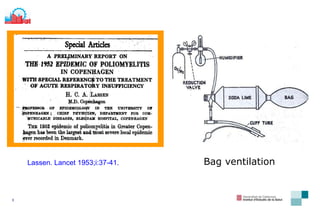
Lassen. Lancet 1953;i:37-41. Bag ventilation
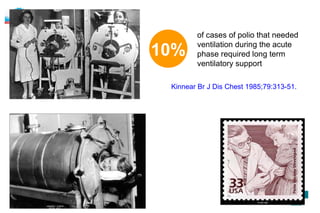
of cases of polio that needed ventilation during the acute phase required long term ventilatory support 10% Kinnear Br J Dis Chest 1985;79:313-51.
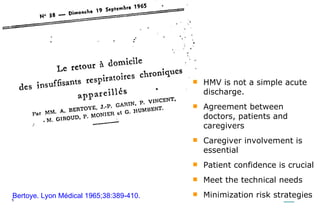
Bertoye. Lyon Médical 1965;38:389-410. HMV is not a simple acute discharge. A greement between doctors, patients and caregivers Caregiver involvement is essential Patient confidence is crucial M eet the technical needs Minimization risk strategies
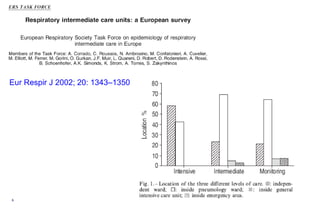
Eur Respir J 2002; 20: 1343–1350
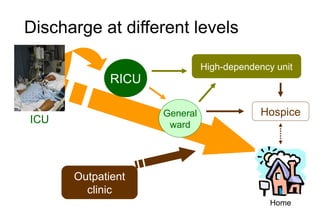
Discharge at different levels ICU Home Outpatient clinic General ward RICU High-dependency unit Hospice
Agenda Introduction Health professionals and team-working Discharge planning Follow-up and risk management Networks
Team Expertise +
Effective team It has a  range of individuals who contribute in different ways . Clear goals .  Everyone understands the tasks they have to do .  Co ordinator   There is a  supportive, informal atmosphere . C omfortable with disagreement . A  lot of discussion  ( Group members  listen  to each other ) F eel free to criticise   L earns from experience .  www.kent.ac.uk/careers/sk/teamwork.htm
The team produces more than the individual contributions of members.
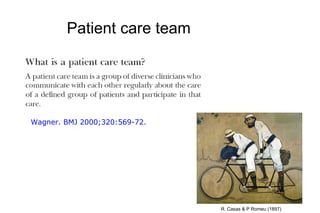
Patient care team Wagner. BMJ 2000;320:569-72. R. Casas & P Romeu (1897)
Aiken L. NEJM 2003;348:164-6 Holistic vision Better care related to coordination Increasing role of non-physcian health professionals .
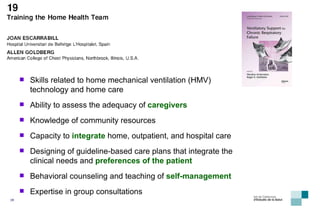
Skills related to home mechanical ventilation (HMV) technology and home care Ability to assess the adequacy of  caregivers Knowledge of community resources Capacity to  integrate  home, outpatient, and hospital care Designing of guideline-based care plans that integrate the clinical needs and   preferences of the patient Behavioral counseling and teaching of  self-management Expertise in group consultations
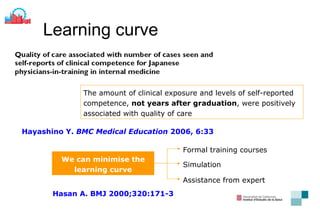
Learning curve The amount of clinical exposure and levels of self-reported competence,  not years after graduation , were positively associated with quality of care Hayashino Y.  BMC Medical Education  2006, 6:33 Hasan A. BMJ 2000;320:171-3 We can minimise the learning curve Formal training courses Simulation Assistance from expert
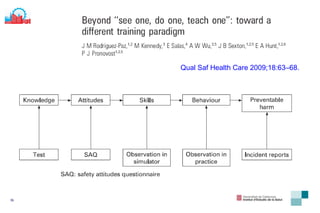
Qual Saf Health Care 2009;18:63–68.
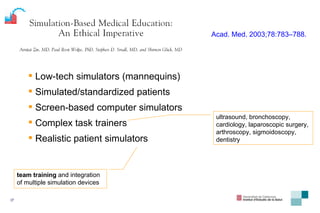
Acad. Med. 2003;78:783–788. Low-tech simulators (mannequins)  Simulated/standardized patients Screen-based computer simulators Complex task trainers Realistic patient   simulators team training  and   integration of multiple simulation   devices ultrasound,   bronchoscopy, cardiology,   laparoscopic surgery, arthroscopy,   sigmoidoscopy, dentistry
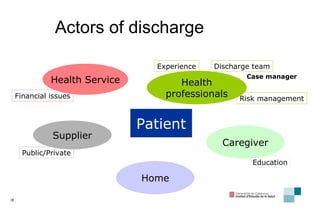
Actors of discharge Health Service Health professionals Supplier Caregiver Home Patient Financial issues Public/Private Discharge team Case manager Risk management Education Experience
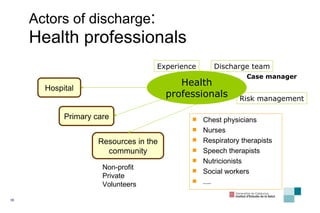
Actors of discharge :  Health professionals Health professionals Discharge team Case manager Risk management Experience Chest physicians Nurses Respiratory therapists Speech therapists Nutricionists Social workers .... Hospital Primary care Resources in the community Non-profit Private Volunteers
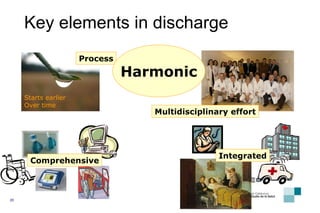
Key elements in discharge Harmonic Multidisciplinary effort Comprehensive Integrated Starts earlier Over time Process
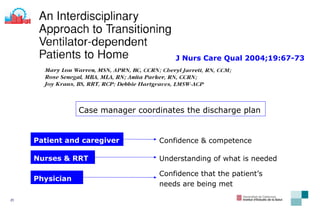
J Nurs Care Qual 2004;19:67-73 Case manager coordinates the discharge plan  Patient and caregiver  Confidence & competence  Nurses & RRT Understanding of what is needed Physician Confidence that the patient’s needs are being met
Agenda Introduction Health professionals and team-working Discharge planning Follow-up and risk management Networks
Discharge planning Discharge planning is defined as the development of an individualised discharge plan for the patient prior to them leaving hospital for home Definition The discharge planning includes the  multidis ci plinary effort  for the transition between the hospital and the home (or the facility where we transfer the patient).
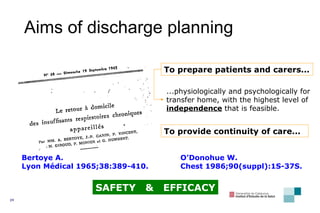
Aims of discharge planning   SAFETY  &  EFFICACY O’Donohue W.  Chest 1986;90(suppl):1S-37S. To prepare patients and carers... ...physiologically and psychologically for transfer home, with the highest level of  independence  that is feasible. To provide continuity of care... Bertoye A.  Lyon Médical 1965;38:389-410.
Monaldi Arch Chest Dis 2003; 59: 2, 119-122. Diurnal adaptation Efficacy of nocturnal ventilation Hospital training: caregiver & patient Follow-up plan
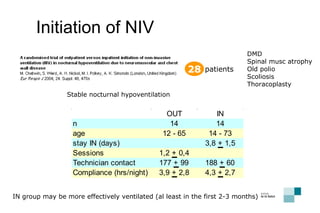
Initiation of NIV 28 patients DMD Spinal musc atrophy Old polio Scoliosis Thoracoplasty Stable nocturnal hypoventilation IN group may be more effectively ventilated (al least in the first 2-3 months)
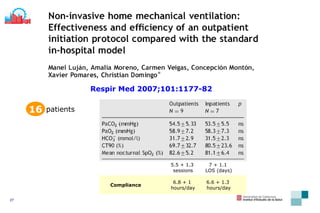
Respir Med 2007; 101:1177-82 5.5 + 1.3  ses s ions 7 + 1.1  LOS (days) 16 patients 6.8 + 1  hours/day 6.6 + 1.3  hours/day Compliance
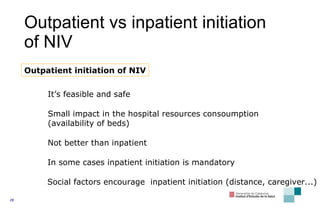
Outpatient vs inpatient initiation of NIV Small impact in the hospital resources consoumption (availability of beds) Outpatient initiation of NIV It’s feasible and safe Not better than inpatient In some cases inpatient initiation is mandatory Social factors encourage  inpatient initiation (distance, caregiver...)
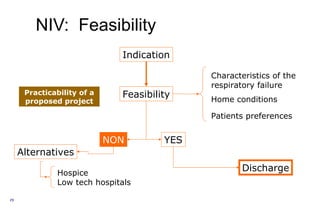
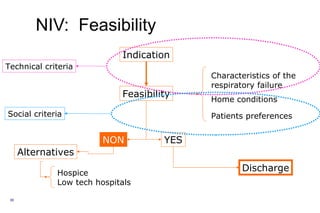
NIV:  Feasibility Indication Feasibility Characteristics of the respiratory failure Home conditions Patients preferences Discharge NON YES Alternatives Hospice Low tech hospitals Practicability of a proposed project
NIV:  Feasibility Indication Feasibility Characteristics of the respiratory failure Home conditions Patients preferences Discharge NON YES Alternatives Hospice Low tech hospitals Technical criteria Social criteria
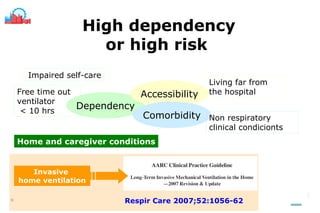
High dependency or high risk   Impaired self-care Free time out ventilator < 10 hrs Dependency Accessibility Living far from the hospital Comorbidity Non respiratory clinical condicionts Home and caregiver conditions Respir Care 2007; 52:1056-62 Invasive  home ventilation
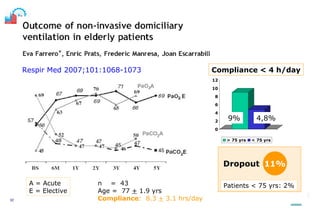
Respir Med  2007;101:1068-1073 A = Acute E = Elective n  =  43 Age =  77  +  1.9 yrs Compliance :  8.3  +  3.1 hrs/day Dropout 11% Patients < 75 yrs: 2% 9% 4,8% Compliance < 4 h/day
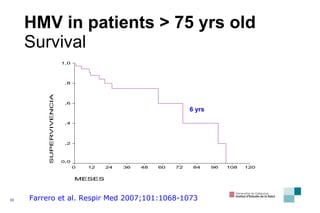
HMV in patients > 75 yrs old Survival 6 yrs Farrero et al. Respir Med  2007;101:1068-1073
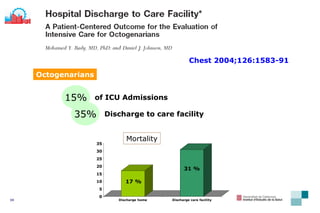
Chest 2004;126:1583-91 15% Octogenarians of ICU Admissions 35% Discharge to care facility Mortality
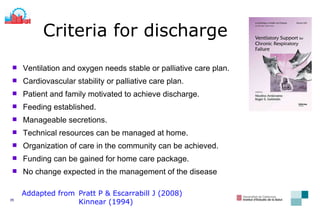
Ventilation and oxygen needs stable or palliative care plan. Cardiovascular stability or palliative care plan . Patient and family motivated to achieve discharge . Feeding established.   Manageable secretions. Technical resources can be managed at home . Organization of care in the community can be achieved . Funding can be gained for home care package . No change expected in the management of the disease Criteria for discharge Addapted from Pratt P & Escarrabill J (2008) Kinnear (1994)
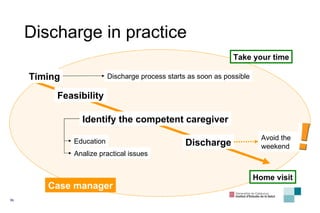
Discharge in practice Timing Discharge process starts as soon as possible Feasibility Identify the competent caregiver Education Analize practical issues Take your time Home visit Discharge Avoid the weekend Case manager                                               
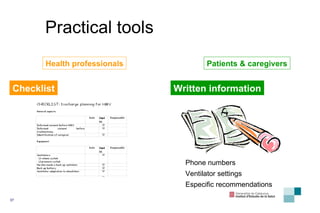
Practical tools Health professionals Checklist Patients & caregivers Written information Phone numbers Ventilator settings Especific recommendations
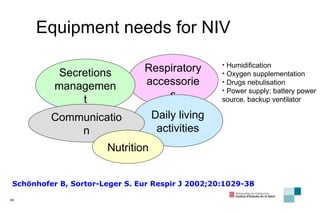
Equipment needs for NIV Schönhofer B, Sortor-Leger S. Eur Respir J 2002;20:1029-38 Respiratory accessories Humidification Oxygen supplementation Drugs nebulisation Power supply: battery power source, backup ventilator Secretions management Daily living activities Communication Nutrition
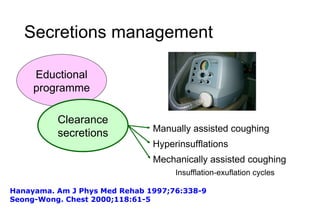
Secretions management Hanayama. Am J Phys Med Rehab 1997;76:338-9 Seong-Wong. Chest 2000;118:61-5 Eductional programme Clearance secretions Manually assisted coughing Hyperinsufflations Insufflation-exuflation cycles Mechanically assisted coughing
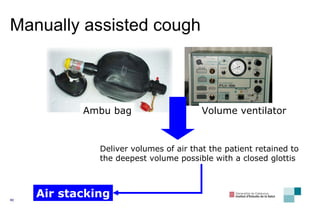
Manually assisted cough  Air stacking Deliver volumes of air that the patient retained to the deepest volume possible with a closed glottis Ambu bag Volume ventilator
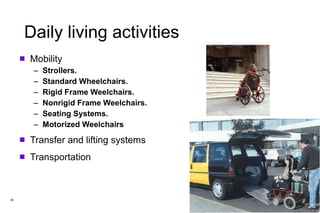
Daily living activities Mobility Strollers. Standard Wheelchairs. Rigid Frame Weelchairs. Nonrigid Frame Weelchairs. Seating Systems. Motorized Weelchairs Transfer and lifting systems Transportation
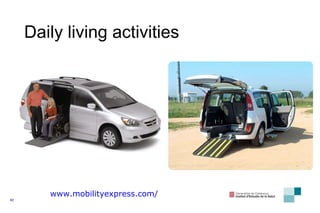
Daily living activities www.mobilityexpress.com/
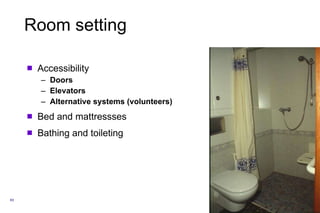
Room setting Accessibility Doors Elevators Alternative systems (volunteers) Bed and mattressses Bathing and toileting
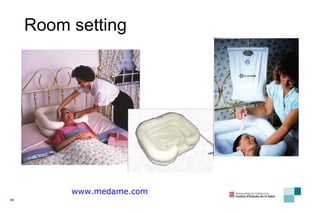
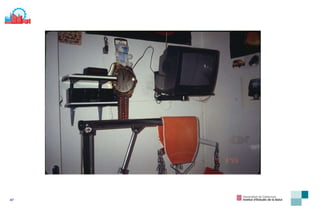
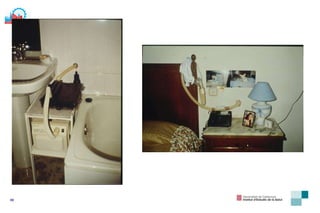
Room setting www.medame.com
Technological support Architectural Elements  Communication  Computers  Home Management  Personal Care: eating, personal higyene  Orthotics & Prosthetics  Recreation  Seating  Sensory Disabilities  Therapeutic Aids  Transportation  Vocational Management  Walking  Wheeled Mobility Patients will need a wide range of assistive devices, in some cases for a short period of time Support groups may help provide short term use devices
Nutritional status Difficulties in chewing and swallowing Factors triggering or aggravating eating problems: Food textures States / consistences Bolus size Associated difficulties wuth salivation Breathing d isorders while eating Proactive approach to anticipate dysphagia symptoms The  BMI  should be used with caution for the evaluation of the nutritional status of patients with  ALS  and Duchenne muscular dystrophy Pessolano FA  et al . Am J Phys Med Rehabil 2003;82:182-185.
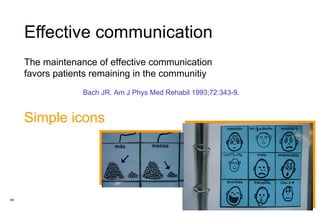
Effective communication The maintenance of effective communication favors patients remaining in the communitiy Bach JR. Am J Phys Med Rehabil 1993;72:343-9 . Simple icons
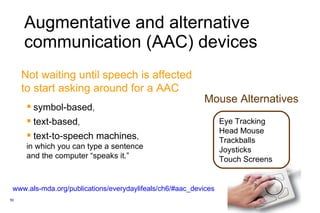
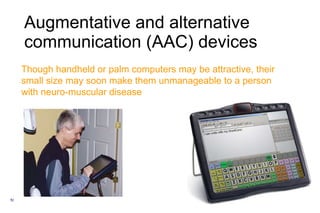
A ugmentative and alternative communication (AAC)  devices   N ot waiting until speech is affected to start  asking  around for a  AAC symbol-based ,  text-based ,  text-to-speech machines , in which you can type a sentence and the computer “speaks it.”  www.als-mda.org/publications/everydaylifeals/ch6/#aac_devices Eye Tracking Head Mouse Trackballs Joysticks Touch Screens Mouse Alternatives
A ugmentative and alternative communication (AAC)  devices   Though handheld or palm computers may be attractive, their small size may soon make them unmanageable to a person with  neuro-muscular disease
Agenda Introduction Health professionals and team-working Discharge planning Follow-up and risk management Networks
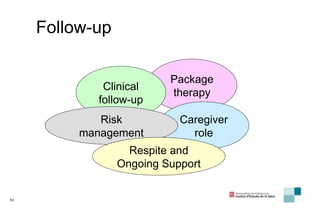
Follow-up Package therapy Clinical follow-up Caregiver role Risk management Respite and Ongoing Support
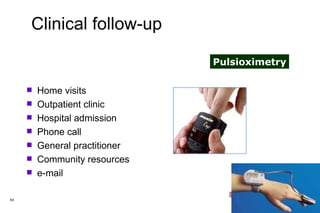
Clinical follow-up Pulsioximetry Home visits Outpatient clinic  Hospital admission Phone call General practitioner Community resources e-mail
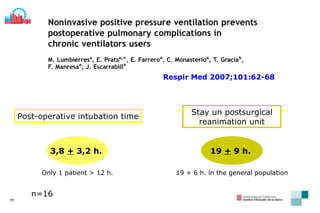
Respir Med 2007;101:62-68 Post-operative intubation time 3,8  +  3,2 h.  Only 1 patient > 12 h. Stay un postsurgical reanimation unit 19  +  9 h.  19 + 6 h. in the general population n=16
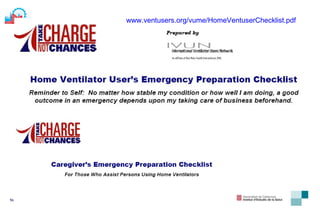
www.ventusers.org/vume/HomeVentuserChecklist.pdf
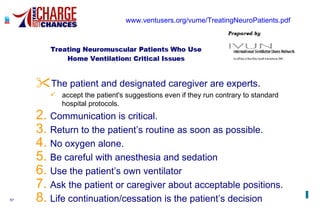
www.ventusers.org/vume/TreatingNeuroPatients.pdf The patient and designated caregiver are experts . accept the   patient's suggestions even if they run contrary to standard hospital protocols . Communication is critical . Return to the patient’s routine as soon as possible. No oxygen alone. Be careful with anesthesia and sedation Use the patient’s own ventilator Ask the patient or caregiver about acceptable positions. Life continuation/cessation is the patient’s decision
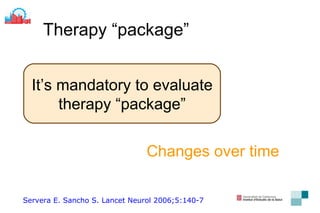
Therapy “package” Servera E. Sancho S. Lancet Neurol 2006;5:140-7 It’s mandatory to evaluate therapy “package” C hanges over time
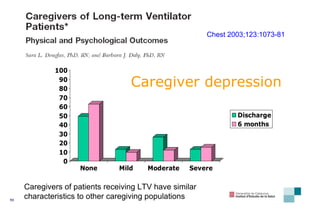
Caregiver depression Chest 2003;123:1073-81 Caregivers of patients receiving LTV have similar characteristics to   other caregiving populations
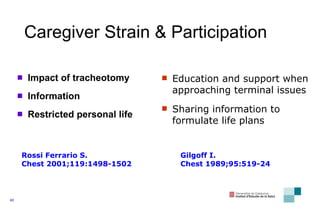
Caregiver Strain & Participation Impact of tracheotomy  Information Restricted personal life Rossi Ferrario S.  Chest 2001;119:1498-1502 Education and support when approaching terminal issues Sharing information to formulate life plans Gilgoff I.  Chest 1989;95:519-24
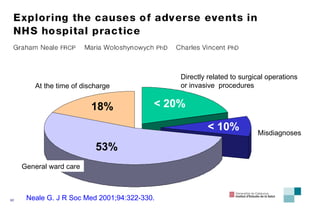
Neale G. J R Soc Med 2001;94:322-330. < 20% Directly related to surgical operations or invasive  procedures < 10% General ward care 53% 18% Misdiagnoses At the time of discharge
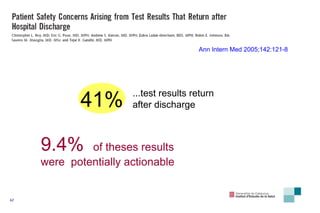
Ann Intern Med 2005;142:121-8 41% ...test results return after discharge 9.4%   of theses results were  potentially actionable
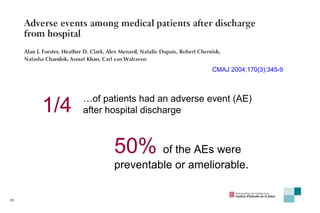
CMAJ 2004;170(3):345-9 … of patients had an adverse event (AE)  after hospital discharge  1/4 50%   of the AEs were preventable or ameliorable.
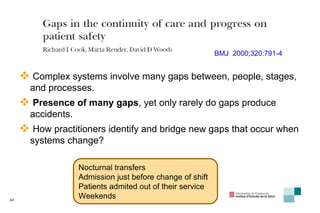
BMJ  2000;320:791-4 Complex systems involve many gaps between, people, stages, and processes. Presence of many gaps , yet only rarely do gaps produce accidents. How practitioners identify and bridge new gaps that occur when systems change? Nocturnal t ransfers  Admission just  before change of shift  Patients admited  out of their service  Weekends
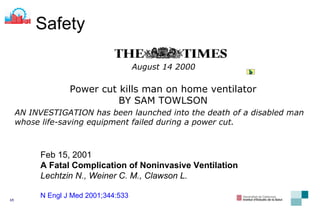
August 14 2000   Power cut kills man on home ventilator  BY SAM TOWLSON  AN INVESTIGATION has been launched into the death of a disabled man whose life-saving equipment failed during a power cut.  Safety Feb 15, 2001 A Fatal Complication of Noninvasive Ventilation Lechtzin N., Weiner C. M., Clawson L. N Engl J Med 2001;344:533
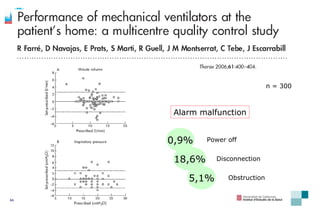
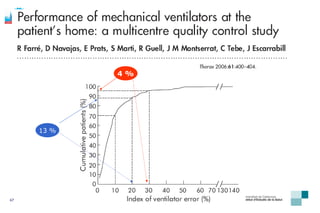
Alarm malfunction 0,9% Power off n = 300 18,6% Disconnection 5,1% Obstruction
13 % 4 %
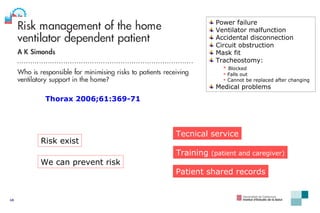
Power failure Ventilator malfunction Accidental disconnection Circuit obstruction Mask fit Tracheostomy: Blocked Falls out Cannot be replaced after changing Medical problems Thorax 2006;61:369-71 Risk exist We can prevent risk Tecnical service Training  (patient and caregiver) Patient shared records
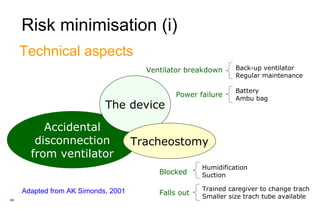
Risk   minimisation (i) Accidental disconnection from ventilator Adapted from AK Simonds, 2001 Power failure Back-up ventilator Regular maintenance Battery Ambu bag Blocked Humidification Suction Falls out Trained caregiver to change trach Smaller size trach tube available Technical aspects The device Ventilator breakdown Tracheostomy
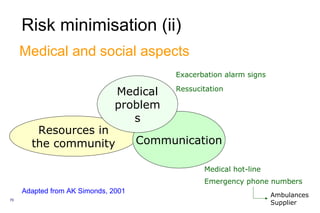
Risk   minimisation (ii) Adapted from AK Simonds, 2001 Medical and social aspects Resources in the community Communication Medical problems Exacerbation alarm signs  Ressucitation Medical hot-line Emergency phone numbers Ambulances Supplier
Respite and Ongoing Support....  when the burden of home care can be great Hospice Palliative care support
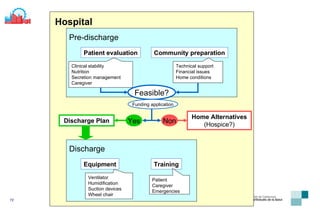
Hospital Pre-discharge Patient evaluation Community preparation Clinical stability Nutrition Secretion management Caregiver Technical support Financial issues Home conditions Feasible? Yes Non Home Alternatives (Hospice?) Discharge Plan Discharge Equipment Training Ventilator Humidification Suction devices Wheel chair Patient Caregiver Emergencies Funding application
Agenda Introduction Health professionals and team-working Discharge planning Follow-up and risk management Networks
Some questions Specific network for each disease? The needs of each patient are heterogeneous Patients' needs change through the natural history Balance between difficulties of accessibility and personal benefits Answer to problems non directlly related to respiratory failure.
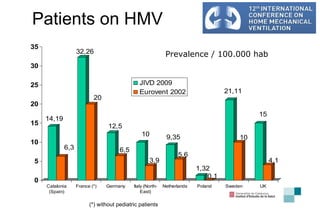
Patients on HMV Prevalence / 100.000 hab (*) without pediatric patients
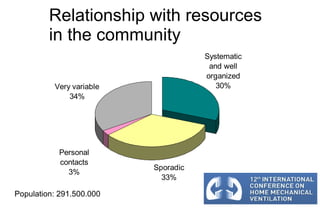
Relationship with resources in the community Population: 291.500.000
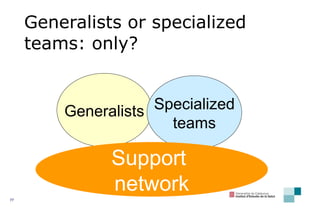
Generalists or specialized teams: only? Generalists Specialized teams Support  network
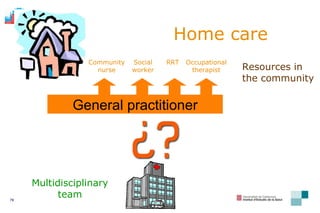
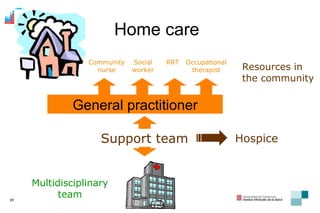
Community nurse Home care General practitioner Resources in the community RRT Social worker Occupational therapist Multidisciplinary team
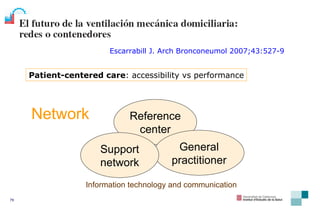
Network Reference center General practitioner Support network I nformation technology and communication Escarrabill J. Arch Bronconeumol 2007;43:527-9 Patient-centered care : accessibility vs performance
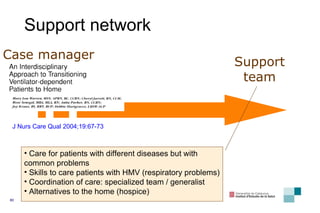
Support network Case manager J Nurs Care Qual 2004;19:67-73 Support team Care for patients with different diseases but with common problems Skills to  care  patients with  HMV  (respiratory problems) Coordination of care: specialized  team  / general ist Alternatives to the home (hospice)
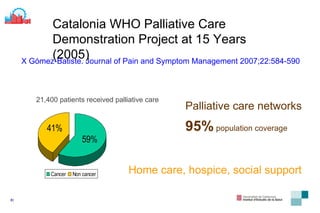
Catalonia WHO Palliative Care Demonstration Project at 15 Years (2005)  X Gómez-Batiste.  Journal of Pain and Symptom Managemen t 2007;22: 584-590  21,400 patients received palliative care P alliative care networks 95%  population coverage Home care, hospice, social support
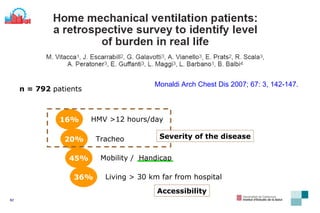
Monaldi Arch Chest Dis 2007; 67: 3, 142-147. n = 792  patients 16% HMV >12 hours/day 20% Tracheo 45% Mobility /  Handicap 36% Living > 30 km far from hospital Severity of the disease Accessibility
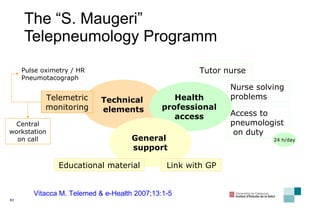
The “S. Maugeri”  Telepneumology Programm Pulse oximetry / HR Pneumotacograph Central workstation on call Tutor nurse Vitacca M. Telemed & e-Health 2007;13:1-5 Technical  elements Health  professional  access  General  support Nurse solving  problems Access to pneumologist on duty 24 h/day Educational material Link with GP Telemetric monitoring
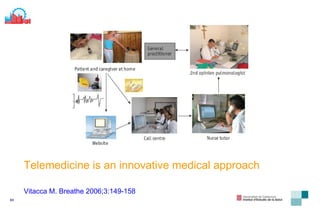
Vitacca M.  Breathe  2006;3:149-158 Telemedicine is an innovative medical approach
Community nurse Home care General practitioner Resources in the community RRT Social worker Occupational therapist Multidisciplinary team Support team Hospice
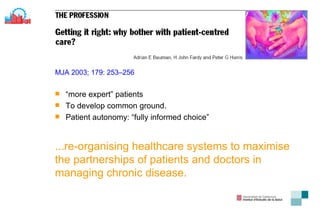
MJA 2003; 179: 253–256 “ more expert” patients T o develop common ground . Patient autonomy :  “fully informed choice” ... re-organising healthcare   systems to maximise the partnerships of patients and doctors   in managing chronic disease .
Health care system Direct access to the team Waiting time Fragmentation
Working for patients on home mechanical ventilation Organized by:   With the contribution of:   Welcome Benvinguts Bienvenidos
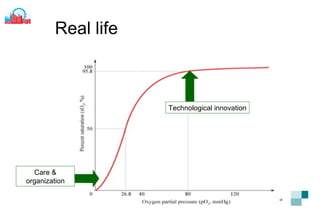
Technological innovation Care  & organization Real life
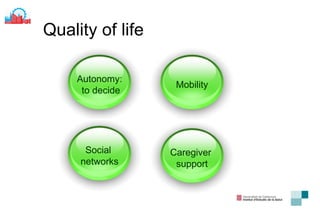
Quality of life Autonomy: to decide Mobility Social  networks Caregiver  support

Discharge Management (Vienna 09)

  • 1.
    Joan Escarrabill MDDirector of Master Plan for Respiratory Diseases Institut d’Estudis de la Salut Barcelona [email_address] How to organize teaching and discharge management Vienna. September 12th 2009
  • 2.
    Agenda Introduction Healthprofessionals and team-working Discharge planning Follow-up and risk management Networks
  • 3.
  • 4.
    of cases ofpolio that needed ventilation during the acute phase required long term ventilatory support 10% Kinnear Br J Dis Chest 1985;79:313-51.
  • 5.
    Bertoye. Lyon Médical1965;38:389-410. HMV is not a simple acute discharge. A greement between doctors, patients and caregivers Caregiver involvement is essential Patient confidence is crucial M eet the technical needs Minimization risk strategies
  • 6.
    Eur Respir J2002; 20: 1343–1350
  • 7.
    Discharge at differentlevels ICU Home Outpatient clinic General ward RICU High-dependency unit Hospice
  • 8.
    Agenda Introduction Healthprofessionals and team-working Discharge planning Follow-up and risk management Networks
  • 9.
  • 10.
    Effective team Ithas a range of individuals who contribute in different ways . Clear goals . Everyone understands the tasks they have to do . Co ordinator There is a supportive, informal atmosphere . C omfortable with disagreement . A lot of discussion ( Group members listen to each other ) F eel free to criticise L earns from experience . www.kent.ac.uk/careers/sk/teamwork.htm
  • 11.
    The team producesmore than the individual contributions of members.
  • 12.
    Patient care teamWagner. BMJ 2000;320:569-72. R. Casas & P Romeu (1897)
  • 13.
    Aiken L. NEJM2003;348:164-6 Holistic vision Better care related to coordination Increasing role of non-physcian health professionals .
  • 14.
    Skills related tohome mechanical ventilation (HMV) technology and home care Ability to assess the adequacy of caregivers Knowledge of community resources Capacity to integrate home, outpatient, and hospital care Designing of guideline-based care plans that integrate the clinical needs and preferences of the patient Behavioral counseling and teaching of self-management Expertise in group consultations
  • 15.
    Learning curve Theamount of clinical exposure and levels of self-reported competence, not years after graduation , were positively associated with quality of care Hayashino Y. BMC Medical Education 2006, 6:33 Hasan A. BMJ 2000;320:171-3 We can minimise the learning curve Formal training courses Simulation Assistance from expert
  • 16.
    Qual Saf HealthCare 2009;18:63–68.
  • 17.
    Acad. Med. 2003;78:783–788.Low-tech simulators (mannequins) Simulated/standardized patients Screen-based computer simulators Complex task trainers Realistic patient simulators team training and integration of multiple simulation devices ultrasound, bronchoscopy, cardiology, laparoscopic surgery, arthroscopy, sigmoidoscopy, dentistry
  • 18.
    Actors of dischargeHealth Service Health professionals Supplier Caregiver Home Patient Financial issues Public/Private Discharge team Case manager Risk management Education Experience
  • 19.
    Actors of discharge: Health professionals Health professionals Discharge team Case manager Risk management Experience Chest physicians Nurses Respiratory therapists Speech therapists Nutricionists Social workers .... Hospital Primary care Resources in the community Non-profit Private Volunteers
  • 20.
    Key elements indischarge Harmonic Multidisciplinary effort Comprehensive Integrated Starts earlier Over time Process
  • 21.
    J Nurs CareQual 2004;19:67-73 Case manager coordinates the discharge plan Patient and caregiver Confidence & competence Nurses & RRT Understanding of what is needed Physician Confidence that the patient’s needs are being met
  • 22.
    Agenda Introduction Healthprofessionals and team-working Discharge planning Follow-up and risk management Networks
  • 23.
    Discharge planning Dischargeplanning is defined as the development of an individualised discharge plan for the patient prior to them leaving hospital for home Definition The discharge planning includes the multidis ci plinary effort for the transition between the hospital and the home (or the facility where we transfer the patient).
  • 24.
    Aims of dischargeplanning SAFETY & EFFICACY O’Donohue W. Chest 1986;90(suppl):1S-37S. To prepare patients and carers... ...physiologically and psychologically for transfer home, with the highest level of independence that is feasible. To provide continuity of care... Bertoye A. Lyon Médical 1965;38:389-410.
  • 25.
    Monaldi Arch ChestDis 2003; 59: 2, 119-122. Diurnal adaptation Efficacy of nocturnal ventilation Hospital training: caregiver & patient Follow-up plan
  • 26.
    Initiation of NIV28 patients DMD Spinal musc atrophy Old polio Scoliosis Thoracoplasty Stable nocturnal hypoventilation IN group may be more effectively ventilated (al least in the first 2-3 months)
  • 27.
    Respir Med 2007;101:1177-82 5.5 + 1.3 ses s ions 7 + 1.1 LOS (days) 16 patients 6.8 + 1 hours/day 6.6 + 1.3 hours/day Compliance
  • 28.
    Outpatient vs inpatientinitiation of NIV Small impact in the hospital resources consoumption (availability of beds) Outpatient initiation of NIV It’s feasible and safe Not better than inpatient In some cases inpatient initiation is mandatory Social factors encourage inpatient initiation (distance, caregiver...)
  • 29.
    NIV: FeasibilityIndication Feasibility Characteristics of the respiratory failure Home conditions Patients preferences Discharge NON YES Alternatives Hospice Low tech hospitals Practicability of a proposed project
  • 30.
    NIV: FeasibilityIndication Feasibility Characteristics of the respiratory failure Home conditions Patients preferences Discharge NON YES Alternatives Hospice Low tech hospitals Technical criteria Social criteria
  • 31.
    High dependency orhigh risk Impaired self-care Free time out ventilator < 10 hrs Dependency Accessibility Living far from the hospital Comorbidity Non respiratory clinical condicionts Home and caregiver conditions Respir Care 2007; 52:1056-62 Invasive home ventilation
  • 32.
    Respir Med 2007;101:1068-1073 A = Acute E = Elective n = 43 Age = 77 + 1.9 yrs Compliance : 8.3 + 3.1 hrs/day Dropout 11% Patients < 75 yrs: 2% 9% 4,8% Compliance < 4 h/day
  • 33.
    HMV in patients> 75 yrs old Survival 6 yrs Farrero et al. Respir Med 2007;101:1068-1073
  • 34.
    Chest 2004;126:1583-91 15%Octogenarians of ICU Admissions 35% Discharge to care facility Mortality
  • 35.
    Ventilation and oxygenneeds stable or palliative care plan. Cardiovascular stability or palliative care plan . Patient and family motivated to achieve discharge . Feeding established. Manageable secretions. Technical resources can be managed at home . Organization of care in the community can be achieved . Funding can be gained for home care package . No change expected in the management of the disease Criteria for discharge Addapted from Pratt P & Escarrabill J (2008) Kinnear (1994)
  • 36.
    Discharge in practiceTiming Discharge process starts as soon as possible Feasibility Identify the competent caregiver Education Analize practical issues Take your time Home visit Discharge Avoid the weekend Case manager                                               
  • 37.
    Practical tools Healthprofessionals Checklist Patients & caregivers Written information Phone numbers Ventilator settings Especific recommendations
  • 38.
    Equipment needs forNIV Schönhofer B, Sortor-Leger S. Eur Respir J 2002;20:1029-38 Respiratory accessories Humidification Oxygen supplementation Drugs nebulisation Power supply: battery power source, backup ventilator Secretions management Daily living activities Communication Nutrition
  • 39.
    Secretions management Hanayama.Am J Phys Med Rehab 1997;76:338-9 Seong-Wong. Chest 2000;118:61-5 Eductional programme Clearance secretions Manually assisted coughing Hyperinsufflations Insufflation-exuflation cycles Mechanically assisted coughing
  • 40.
    Manually assisted cough Air stacking Deliver volumes of air that the patient retained to the deepest volume possible with a closed glottis Ambu bag Volume ventilator
  • 41.
    Daily living activitiesMobility Strollers. Standard Wheelchairs. Rigid Frame Weelchairs. Nonrigid Frame Weelchairs. Seating Systems. Motorized Weelchairs Transfer and lifting systems Transportation
  • 42.
    Daily living activitieswww.mobilityexpress.com/
  • 43.
    Room setting AccessibilityDoors Elevators Alternative systems (volunteers) Bed and mattressses Bathing and toileting
  • 44.
  • 45.
    Technological support ArchitecturalElements Communication Computers Home Management Personal Care: eating, personal higyene Orthotics & Prosthetics Recreation Seating Sensory Disabilities Therapeutic Aids Transportation Vocational Management Walking Wheeled Mobility Patients will need a wide range of assistive devices, in some cases for a short period of time Support groups may help provide short term use devices
  • 46.
    Nutritional status Difficultiesin chewing and swallowing Factors triggering or aggravating eating problems: Food textures States / consistences Bolus size Associated difficulties wuth salivation Breathing d isorders while eating Proactive approach to anticipate dysphagia symptoms The BMI should be used with caution for the evaluation of the nutritional status of patients with ALS and Duchenne muscular dystrophy Pessolano FA et al . Am J Phys Med Rehabil 2003;82:182-185.
  • 49.
    Effective communication Themaintenance of effective communication favors patients remaining in the communitiy Bach JR. Am J Phys Med Rehabil 1993;72:343-9 . Simple icons
  • 50.
    A ugmentative andalternative communication (AAC) devices N ot waiting until speech is affected to start asking around for a AAC symbol-based , text-based , text-to-speech machines , in which you can type a sentence and the computer “speaks it.” www.als-mda.org/publications/everydaylifeals/ch6/#aac_devices Eye Tracking Head Mouse Trackballs Joysticks Touch Screens Mouse Alternatives
  • 51.
    A ugmentative andalternative communication (AAC) devices Though handheld or palm computers may be attractive, their small size may soon make them unmanageable to a person with neuro-muscular disease
  • 52.
    Agenda Introduction Healthprofessionals and team-working Discharge planning Follow-up and risk management Networks
  • 53.
    Follow-up Package therapyClinical follow-up Caregiver role Risk management Respite and Ongoing Support
  • 54.
    Clinical follow-up PulsioximetryHome visits Outpatient clinic Hospital admission Phone call General practitioner Community resources e-mail
  • 55.
    Respir Med 2007;101:62-68Post-operative intubation time 3,8 + 3,2 h. Only 1 patient > 12 h. Stay un postsurgical reanimation unit 19 + 9 h. 19 + 6 h. in the general population n=16
  • 56.
  • 57.
    www.ventusers.org/vume/TreatingNeuroPatients.pdf The patientand designated caregiver are experts . accept the patient's suggestions even if they run contrary to standard hospital protocols . Communication is critical . Return to the patient’s routine as soon as possible. No oxygen alone. Be careful with anesthesia and sedation Use the patient’s own ventilator Ask the patient or caregiver about acceptable positions. Life continuation/cessation is the patient’s decision
  • 58.
    Therapy “package” ServeraE. Sancho S. Lancet Neurol 2006;5:140-7 It’s mandatory to evaluate therapy “package” C hanges over time
  • 59.
    Caregiver depression Chest2003;123:1073-81 Caregivers of patients receiving LTV have similar characteristics to other caregiving populations
  • 60.
    Caregiver Strain &Participation Impact of tracheotomy Information Restricted personal life Rossi Ferrario S. Chest 2001;119:1498-1502 Education and support when approaching terminal issues Sharing information to formulate life plans Gilgoff I. Chest 1989;95:519-24
  • 61.
    Neale G. JR Soc Med 2001;94:322-330. < 20% Directly related to surgical operations or invasive procedures < 10% General ward care 53% 18% Misdiagnoses At the time of discharge
  • 62.
    Ann Intern Med2005;142:121-8 41% ...test results return after discharge 9.4% of theses results were potentially actionable
  • 63.
    CMAJ 2004;170(3):345-9 …of patients had an adverse event (AE) after hospital discharge 1/4 50% of the AEs were preventable or ameliorable.
  • 64.
    BMJ  2000;320:791-4 Complex systemsinvolve many gaps between, people, stages, and processes. Presence of many gaps , yet only rarely do gaps produce accidents. How practitioners identify and bridge new gaps that occur when systems change? Nocturnal t ransfers Admission just before change of shift Patients admited out of their service Weekends
  • 65.
    August 14 2000 Power cut kills man on home ventilator BY SAM TOWLSON AN INVESTIGATION has been launched into the death of a disabled man whose life-saving equipment failed during a power cut. Safety Feb 15, 2001 A Fatal Complication of Noninvasive Ventilation Lechtzin N., Weiner C. M., Clawson L. N Engl J Med 2001;344:533
  • 66.
    Alarm malfunction 0,9%Power off n = 300 18,6% Disconnection 5,1% Obstruction
  • 67.
  • 68.
    Power failure Ventilatormalfunction Accidental disconnection Circuit obstruction Mask fit Tracheostomy: Blocked Falls out Cannot be replaced after changing Medical problems Thorax 2006;61:369-71 Risk exist We can prevent risk Tecnical service Training (patient and caregiver) Patient shared records
  • 69.
    Risk minimisation (i) Accidental disconnection from ventilator Adapted from AK Simonds, 2001 Power failure Back-up ventilator Regular maintenance Battery Ambu bag Blocked Humidification Suction Falls out Trained caregiver to change trach Smaller size trach tube available Technical aspects The device Ventilator breakdown Tracheostomy
  • 70.
    Risk minimisation (ii) Adapted from AK Simonds, 2001 Medical and social aspects Resources in the community Communication Medical problems Exacerbation alarm signs Ressucitation Medical hot-line Emergency phone numbers Ambulances Supplier
  • 71.
    Respite and OngoingSupport.... when the burden of home care can be great Hospice Palliative care support
  • 72.
    Hospital Pre-discharge Patientevaluation Community preparation Clinical stability Nutrition Secretion management Caregiver Technical support Financial issues Home conditions Feasible? Yes Non Home Alternatives (Hospice?) Discharge Plan Discharge Equipment Training Ventilator Humidification Suction devices Wheel chair Patient Caregiver Emergencies Funding application
  • 73.
    Agenda Introduction Healthprofessionals and team-working Discharge planning Follow-up and risk management Networks
  • 74.
    Some questions Specificnetwork for each disease? The needs of each patient are heterogeneous Patients' needs change through the natural history Balance between difficulties of accessibility and personal benefits Answer to problems non directlly related to respiratory failure.
  • 75.
    Patients on HMVPrevalence / 100.000 hab (*) without pediatric patients
  • 76.
    Relationship with resourcesin the community Population: 291.500.000
  • 77.
    Generalists or specializedteams: only? Generalists Specialized teams Support network
  • 78.
    Community nurse Homecare General practitioner Resources in the community RRT Social worker Occupational therapist Multidisciplinary team
  • 79.
    Network Reference centerGeneral practitioner Support network I nformation technology and communication Escarrabill J. Arch Bronconeumol 2007;43:527-9 Patient-centered care : accessibility vs performance
  • 80.
    Support network Casemanager J Nurs Care Qual 2004;19:67-73 Support team Care for patients with different diseases but with common problems Skills to care patients with HMV (respiratory problems) Coordination of care: specialized team / general ist Alternatives to the home (hospice)
  • 81.
    Catalonia WHO PalliativeCare Demonstration Project at 15 Years (2005) X Gómez-Batiste. Journal of Pain and Symptom Managemen t 2007;22: 584-590 21,400 patients received palliative care P alliative care networks 95% population coverage Home care, hospice, social support
  • 82.
    Monaldi Arch ChestDis 2007; 67: 3, 142-147. n = 792 patients 16% HMV >12 hours/day 20% Tracheo 45% Mobility / Handicap 36% Living > 30 km far from hospital Severity of the disease Accessibility
  • 83.
    The “S. Maugeri” Telepneumology Programm Pulse oximetry / HR Pneumotacograph Central workstation on call Tutor nurse Vitacca M. Telemed & e-Health 2007;13:1-5 Technical elements Health professional access General support Nurse solving problems Access to pneumologist on duty 24 h/day Educational material Link with GP Telemetric monitoring
  • 84.
    Vitacca M. Breathe 2006;3:149-158 Telemedicine is an innovative medical approach
  • 85.
    Community nurse Homecare General practitioner Resources in the community RRT Social worker Occupational therapist Multidisciplinary team Support team Hospice
  • 86.
    MJA 2003; 179:253–256 “ more expert” patients T o develop common ground . Patient autonomy : “fully informed choice” ... re-organising healthcare systems to maximise the partnerships of patients and doctors in managing chronic disease .
  • 87.
    Health care systemDirect access to the team Waiting time Fragmentation
  • 88.
    Working for patientson home mechanical ventilation Organized by: With the contribution of: Welcome Benvinguts Bienvenidos
  • 89.
    Technological innovation Care & organization Real life
  • 90.
    Quality of lifeAutonomy: to decide Mobility Social networks Caregiver support