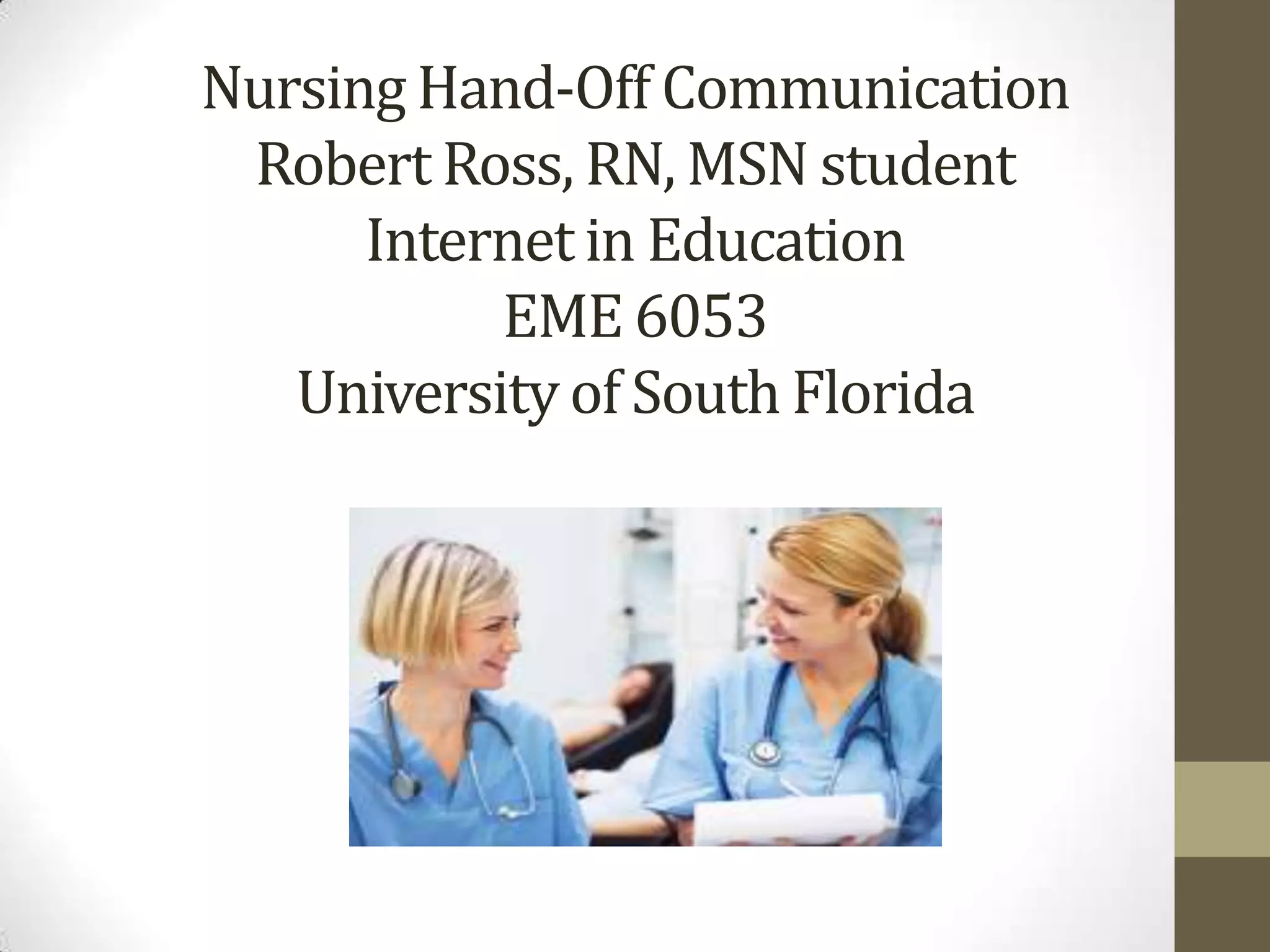
Nursing Hand-Off Communication
Robert Ross, RN, MSN student
Internet in Education
EME 6053
University of South Florida
Definition
• Nursing hand-off can be defined as a
communication between two shifts of
nurses occurring at the transfer of
responsibility for a patient to include an
opportunity to ask questions, clarify and
confirm (Friesen, 2009)
Definition (cont’d)
 Information

is exchanged about
the patient such as patient
name, IV
drips, meds, treatments, appoint
ments, etc.
Why is it needed?
• Hand-off communication is critical for
patient safety as missed information
could be harmful to the patient
• A study in Seattle concluded that up to 65% of
sentinel events could be linked to poor
communication between healthcare personnel
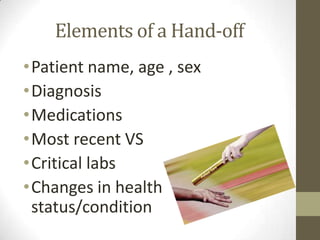
Elements of a Hand-off
•Patient name, age , sex
•Diagnosis
•Medications
•Most recent VS
•Critical labs
•Changes in health
status/condition
Standardization
• A lack of standardization among
the different types of hand-offs
can potentially cause problems
• The same form can also cut down
wasted time in attempting to
track down missing information
Summary
• Effective hand-off communication can
significantly reduce potential errors in patient
care
• Hand-offs are done to communicate patient
information across shifts and to help maintain
a high quality of care
• Facility wide standardization would help
reduce redundancy and improve
communication
A last note about effective
communication

Nursing Handoff, Internet in Education project

  • 1.
    Nursing Hand-Off Communication RobertRoss, RN, MSN student Internet in Education EME 6053 University of South Florida
  • 2.
    Definition • Nursing hand-offcan be defined as a communication between two shifts of nurses occurring at the transfer of responsibility for a patient to include an opportunity to ask questions, clarify and confirm (Friesen, 2009)
  • 3.
    Definition (cont’d)  Information isexchanged about the patient such as patient name, IV drips, meds, treatments, appoint ments, etc.
  • 4.
    Why is itneeded? • Hand-off communication is critical for patient safety as missed information could be harmful to the patient • A study in Seattle concluded that up to 65% of sentinel events could be linked to poor communication between healthcare personnel
  • 5.
    Elements of aHand-off •Patient name, age , sex •Diagnosis •Medications •Most recent VS •Critical labs •Changes in health status/condition
  • 6.
    Standardization • A lackof standardization among the different types of hand-offs can potentially cause problems • The same form can also cut down wasted time in attempting to track down missing information
  • 7.
    Summary • Effective hand-offcommunication can significantly reduce potential errors in patient care • Hand-offs are done to communicate patient information across shifts and to help maintain a high quality of care • Facility wide standardization would help reduce redundancy and improve communication
  • 8.
    A last noteabout effective communication

Editor's Notes

  • #3 Catalano (2009) also mentions that this transfers authority as well for patient treatment Also known as “report” or shift report
  • #5 The study was done at two children’s hospitals in the Seattle, WA areaTime constraints, stress, and miscommunication can all contribute to errors in handoffLarge of amounts of turbulence (discharges, admissions, pt movement) can also contribute to miscommunications or lost information
  • #7 - Each hospital unit/ward has it's own variation of a hand-off/communication sheet/report sheet