MANDATORY COURSE
MX3084
Disaster Risk Reduction
and Management
COURSE OUTCOMES
• CO1: To impart knowledge on the concepts of Disaster,
Vulnerability and Disaster Risk reduction (DRR)
• CO2: To enhance understanding on Hazards, Vulnerability and
Disaster Risk Assessment prevention and risk reduction
• CO3: To develop disaster response skills by adopting relevant tools
and technology
• CO4: Enhance awareness of institutional processes for Disaster
response in the country and
• CO5: Develop rudimentary ability to respond to their surroundings
with potential Disaster response in areas where they live, with due
sensitivity.
UNIT-I
HAZARADS,
VULNERABILITY
AND DISASTER
RISKS
DEFINITIONS
• A disaster is a serious disruption of the functioning of a community or
a society involving widespread human, material, economic or
environmental loss and impacts, which exceeds the ability of the
affected community or society to cope using its own resources.
• Disaster management is the creation of plans through which
communities reduce vulnerability to hazards and cope with disasters
• Disaster management does not avert or eliminate the threats; instead,
it focuses on creating plans to decrease the effect of disasters
• Disasters can be natural or human made
HAZARDS AND RISK
• Natural hazards are severe and extreme weather and climate events that
occur naturally in all parts of the world, although some regions are more
vulnerable to certain hazards than others
• Natural hazards become natural disasters when people's lives and
livelihoods are destroyed.
• Risk : The probability of harmful consequences, or expected losses resulting
from the interactions between hazards and vulnerable conditions e.g. deaths,
injuries, property, livelihoods, economic activity disrupted or environmental
damages.
• Risk Assessment :The process of determining the nature and extent of risk
by analysing potential hazards and evaluating existing condition of
vulnerability and capacity
• The estimation of risk posed by a hazard. Risk assessment consists of the
following steps: Hazard Assessment………Vulnerability
Assessment…………Capacity Assessment
Classification of Hazards
Earthquake
Tsunami
Mass Movement
triggered by
geophysical events
Landslide
Avalanche
Rock fall
Mud flow
Debris flow
Subsidence
Floods Wave
Action
Coastal
Erosion
Shoreline
Change
Mass Movement
triggered by
Hydrological
events Landslide
Avalanche
Rock fall
Mud flow
Debris
flow
Subsidenc
e
Storm, Rain, Wind,
Hail, Snow, Ice,
Blizzard, Lightning,
Sand, Dust, Tornado
Extreme
Temperature, Cold
Wave, Heat wave,
Frost, Freeze
Fog
Tropical Cyclone,
Cyclonic Wind, Rain,
Surge
Drought
Glacial lake
Outburst flood
(GLOF)
Wildfire
Erosion
Deforestation
Salinization
Sea Level Rise
Desertification
Asian Dust Cloud
Wetland
Loss/Degradation
Glacier
Retreat/Melting
Epidemics
Pandemics
Epizootics
Pest
Insect infestation,
Animal Incidents
Pollution
Industrial Disaster
Structural Collapse
Power Outage
Fire
Explosion
Mine Disaster
Chemical Spill
Oil Spill
Radiation
Contamination/
Nuclear Incident
Aviation Accident
Rail Accident
Road Accident
Navigation Accident
Space Accident
Classification of Hazards
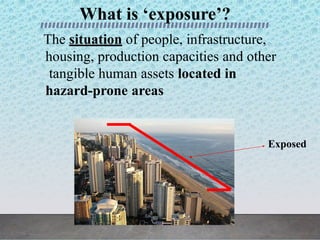
What is ‘exposure’?
The situation of people, infrastructure,
housing, production capacities and other
tangible human assets located in
hazard-prone areas
Exposed
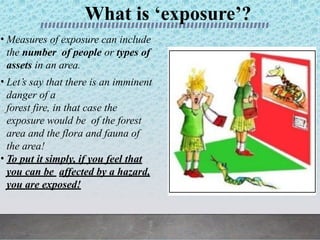
What is ‘exposure’?
• Measures of exposure can include
the number of people or types of
assets in an area.
• Let’s say that there is an imminent
danger of a
forest fire, in that case the
exposure would be of the forest
area and the flora and fauna of
the area!
• To put it simply, if you feel that
you can be affected by a hazard,
you are exposed!
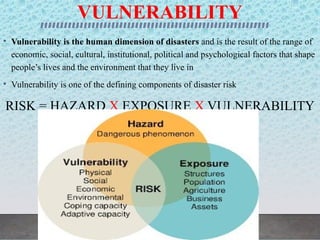
VULNERABILITY
• Vulnerability is the human dimension of disasters and is the result of the range of
economic, social, cultural, institutional, political and psychological factors that shape
people’s lives and the environment that they live in
• Vulnerability is one of the defining components of disaster risk
RISK = HAZARD X EXPOSURE X VULNERABILITY
So what is a ‘Disaster’ then?
When the ‘disaster risk’ exceeds the ‘coping
capacity’ of the ‘exposed’ assets, the
incident of a hazard turns into a
‘disaster’.
So, what is Coping Capacity?
What is ‘coping capacity’?
The ability of people, organizations and systems, using available skills
and resources, to manage adverse conditions, risk or disasters.
-The capacity to cope requires continuing awareness,
resources and good management, both in normal times as well
as during disasters or adverse conditions.
-Coping capacities contribute to the reduction of disaster risks.
If you have the capacity to deal with the disaster risk, you are good to
go, else it is
a disaster!
“When the going gets tough, the tough gets going”
Definition of a Disaster: Legal Connotation
 This has been taken from the Disaster Management Act of India, 2005
“Disaster means a catastrophe, mishap, calamity or grave occurrence
in any area, arising from natural or man made causes, or by accident
or negligence which results in substantial loss of life or human
suffering or damage to, or degradation of, environment, and is of such
a nature or magnitude as to be beyond the coping capacity of the
community of the affected area.”
An actual or imminent event, whether natural or otherwise occurring in any
part of the State which causes, or threatens to cause all or any of the
following:
1. Widespread loss or damage to property, both immovable and
movable; or
2. Widespread loss of human life or injury or illness to human beings; or
3. Damage or degradation of environment
Resilience……….Coping capacity
• Capacity of a community to resist, absorb, adjust to and recover from
the negative impacts of a disaster in a timely and efficient manner
• The capacity of a system, community or society potentially exposed to
hazards to adapt, by resisting or changing in order to reach and
maintain an acceptable level of functioning and structure – learnings
from earlier disasters
• The strengthening of coping capacities usually builds resilience to
withstand the effects of natural and human-induced hazards
Adaptation & Mitigation
• Adaptation : refers to changes in natural and human systems to reduce risks to the lives
and livelihoods of people
• Adaptation actions can reduce many unavoidable impacts in the near term, although they
cannot reduce them to zero
• Mitigation : Structural and non-structural measures taken to reduce the adverse effects of
a disaster, if it occurs e.g. construction of retaining walls, widening of water channels,
building codes, early warning systems, etc.
• Mitigation refers to the actions taken to reduce the severity of a disaster, while Adaptation
refers to the responsive adjustment to an environmental condition
• Failure to mitigate will eventually lead to failure of adaptation because the magnitude of
the impacts is predicted to become too large to manage even with considerable investment
• Adaptation and mitigation are not alternative strategies but complementary ones that need
to be pursued together
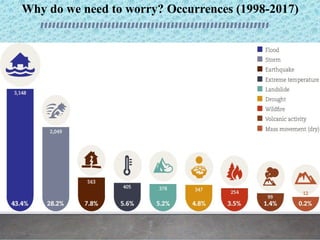
Why do we need to worry? Occurrences (1998-2017)
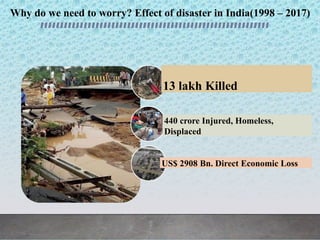
Why do we need to worry? Effect of disaster in India(1998 – 2017)
13 lakh Killed
440 crore Injured, Homeless,
Displaced
US$ 2908 Bn. Direct Economic Loss
We need to manage disasters, but how?
Now that we have a clear idea of how bad disasters can be, we obviously need to
manage it. This is how disaster management came into being.
The following definition of Disaster Management has been taken from the
Disaster Management Act (DM Act), 2003.
Disaster Management means a continuous and integrated process of planning
and
implementation of measures with a view to:
1. Mitigating or reducing the risk of reducing the risk of disasters;
2. Mitigating the severity or consequence of disasters;
3. Capacity - building;
4. Emergency preparedness;
5. Assessing the effects of disasters;
6. Providing emergency relief and rescue; and
7. Post-disaster rehabilitation and reconstruction
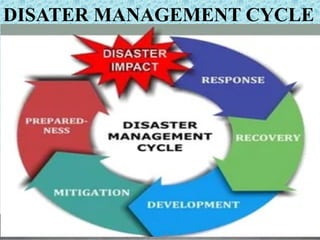
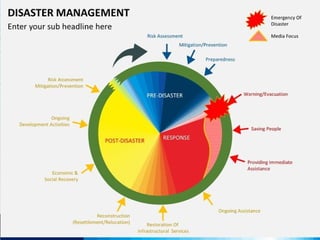
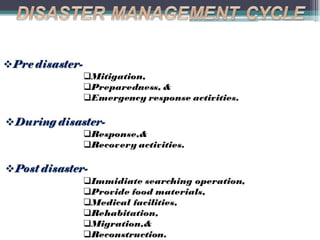
DISATER MANAGEMENT CYCLE
CRISIS MANAGEMENT
Crisis is an abnormal situation in which, decisions has to be taken at
short period of time
Crisis can be divided into two types :
(a) Community crisis which is generated by natural and technical
agents, disaster and conflicts (civil war, riots and civil disturbance) and
(b) Non-community crisis, such as transport accident which does not
impact the entire community.
Crisis management involves an accurate and timely diagnosis of the
criticality of the problem and dynamics of events. This requires
knowledge, skills, courageous leadership, high level of risk taking
ability, and vigilance. Successful crisis management requires
motivation, sense of urgency of the matter, commitment, and creative
thinking with long-term strategic vision.
TYPES OF DISASTERS
1. Water and Climate Related Disasters – Floods and drainage Management,
Cyclones, Tornadoes and Hurricanes, Hailstorm, Cloud Burst, Heat Wave and Cold
Wave, Snow Avalanches, Droughts, Sea Erosion and Thunder and Lightning
2. Geologically related disasters -- Landslides and Mudflows, Earthquakes, Dam
Failures/ Dam Bursts and Mine Fires
3. Chemical , Industrial & Nuclear related disasters -- Chemical and industrial
and nuclear disasters have been included.
4. Accident related disasters -- Forest Fires, Urban Fires, Mines Flooding Oil Spill,
Major Building Collapse, Serial Bomb Blasts, Festival related disasters, Electrical
disasters and Fires, Air, Road and Rail Accidents, Boat Capsizing and Village Fire
have been included in this sub-group by HPC
5. Biologically related disasters -- Epidemics, Pest Attacks, Cattle epidemics and
Food poisoning.
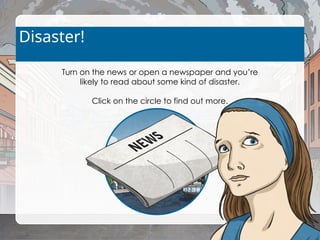
Disaster!
Turn on the news or open a newspaper and you’re
likely to read about some kind of disaster.
Click on the circle to find out more.
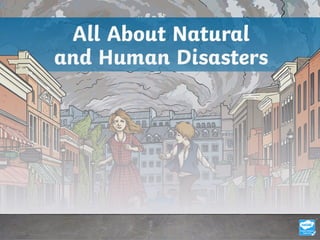
Natural and Human Disasters
A disaster is an event that causes great damage and loss. Disasters
can be divided into two types: natural and human. Click on the
circle to found out more.
Human
disaster
Natural
Disaster
A disaster caused
by nature or
natural events.
These include
floods, hurricanes
and tornadoes..
A disaster caused
by human action.
These include oil
spills, chemical
explosions and
gas leaks in
factories.
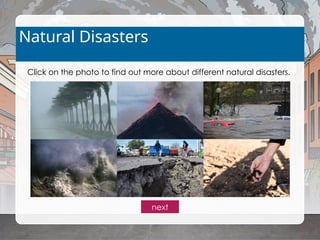
Natural Disasters
Click on the photo to find out more about different natural disasters.
next
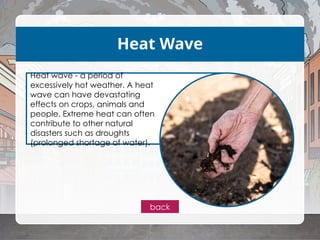
Heat Wave
Heat wave - a period of
excessively hot weather. A heat
wave can have devastating
effects on crops, animals and
people. Extreme heat can often
contribute to other natural
disasters such as droughts
(prolonged shortage of water).
back
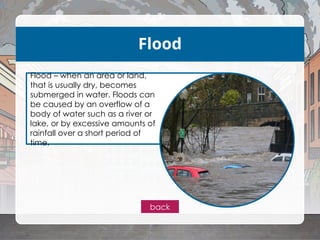
Flood
Flood – when an area or land,
that is usually dry, becomes
submerged in water. Floods can
be caused by an overflow of a
body of water such as a river or
lake, or by excessive amounts of
rainfall over a short period of
time.
back
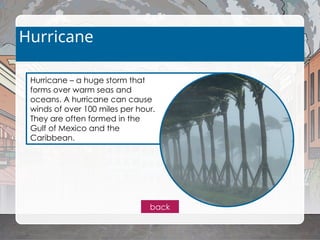
Hurricane – a huge storm that
forms over warm seas and
oceans. A hurricane can cause
winds of over 100 miles per hour.
They are often formed in the
Gulf of Mexico and the
Caribbean.
Hurricane
back
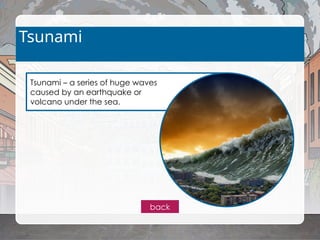
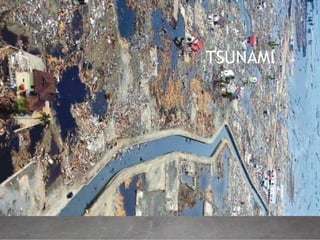
Tsunami – a series of huge waves
caused by an earthquake or
volcano under the sea.
Tsunami
back
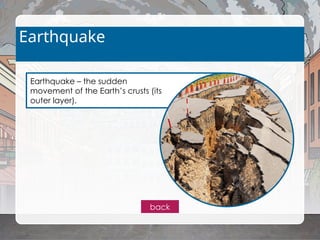
Earthquake – the sudden
movement of the Earth’s crusts (its
outer layer).
Earthquake
back
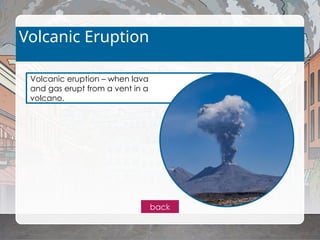
Volcanic eruption – when lava
and gas erupt from a vent in a
volcano.
Volcanic Eruption
back
• The Minamata Poisonings – in April 1956,
in Minamata, Japan, people began to
exhibit symptoms such as being unable
to walk or speak and were suffering
convulsions. It soon transpired that a
chemical factory had been dumping
waste into the local ecosystem for years.
The local water source, and therefore
the fish living within it, became poisoned
with mercury which subsequently
caused thousands of deaths.
• Deepwater Horizon oil spill – on 20th
April
2010, the Deepwater Horizon oil rig
exploded. It released 780,000,000 (780
million) litres of
oil into the sea. The damage to marine
wildlife and beaches is still being felt.
Human Disasters
Here are some examples of human disasters that have
happened to our planet:
• Chernobyl – Chernobyl was a power plant in
Ukraine which produced nuclear power. In
1986, an explosion caused one of the
nuclear reactors to leak. Over thirty years
later, the area is
still unsafe to live in or near to.
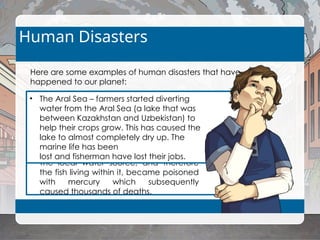
• The Aral Sea – farmers started diverting
water from the Aral Sea (a lake that was
between Kazakhstan and Uzbekistan) to
help their crops grow. This has caused the
lake to almost completely dry up. The
marine life has been
lost and fisherman have lost their jobs.
How can humans lessen the possibility
of
causing natural disasters?
How Humans Cause Disasters
Over recent years, human activity has increased the numbers of
apparent natural disasters. Scientists believe climate change has
caused extreme conditions such as hurricanes and flooding.
Talk About It
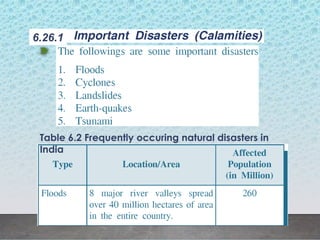
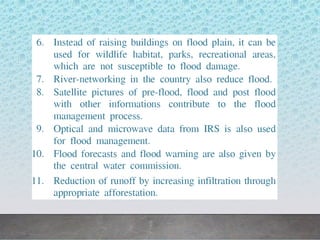
6.26.1
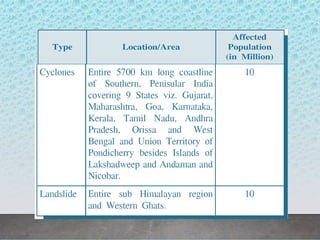
Table 6.2 Frequently occuring natural disasters in
India
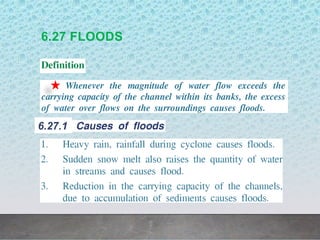
6.27 FLOODS
6.27.1
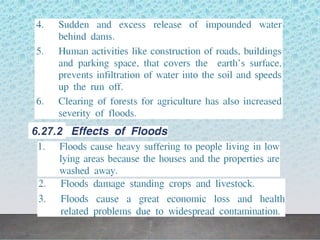
6.27.2
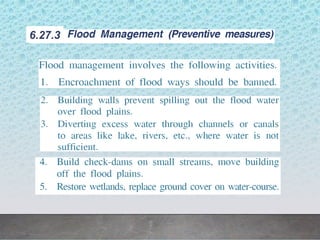
6.27.3
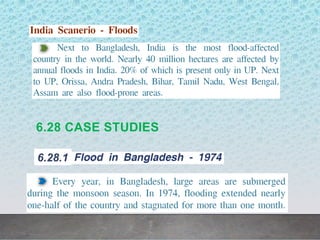
6.28 CASE STUDIES
6.28.1
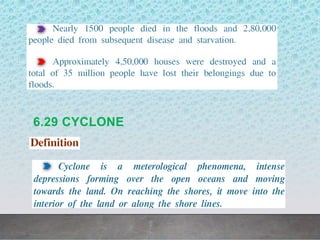
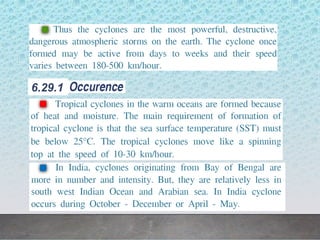
6.29 CYCLONE
6.29.1
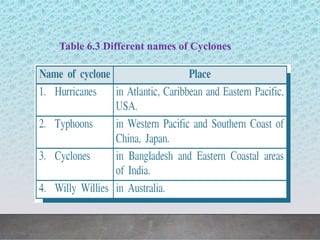
Table 6.3 Different names of Cyclones
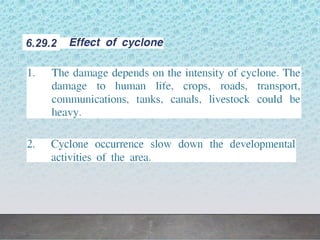
6.29.2
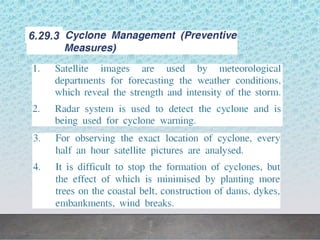
6.29.3
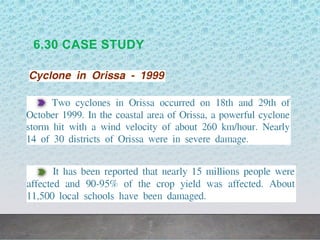
6.30 CASE STUDY
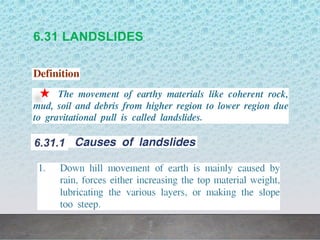
6.31 LANDSLIDES
6.31.1
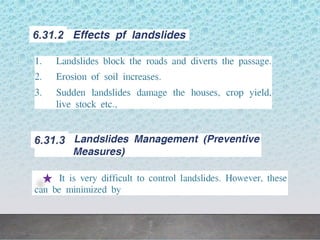
6.31.2
6.31.3
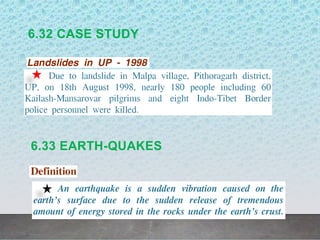
6.32 CASE STUDY
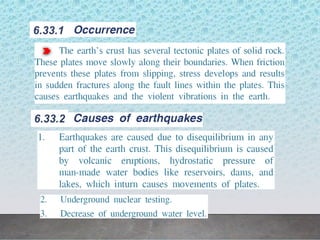
6.33 EARTH-QUAKES
6.33.1
6.33.2
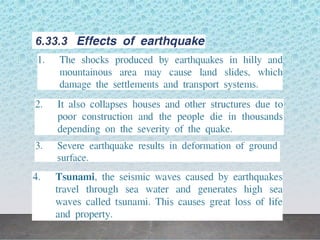
6.33.3
6.33.4
6.34 PUBLIC AWARNESS
6.34.1
6.34.2
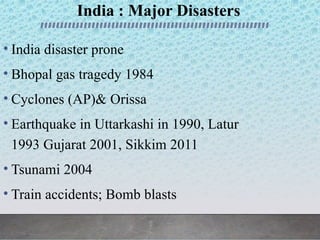
India : Major Disasters
• India disaster prone
• Bhopal gas tragedy 1984
• Cyclones (AP)& Orissa
• Earthquake in Uttarkashi in 1990, Latur
1993 Gujarat 2001, Sikkim 2011
• Tsunami 2004
• Train accidents; Bomb blasts
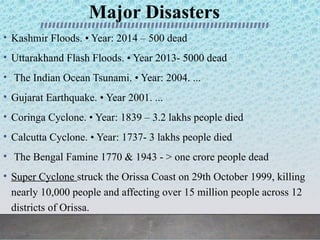
Major Disasters
• Kashmir Floods. • Year: 2014 – 500 dead
• Uttarakhand Flash Floods. • Year 2013- 5000 dead
• The Indian Ocean Tsunami. • Year: 2004. ...
• Gujarat Earthquake. • Year 2001. ...
• Coringa Cyclone. • Year: 1839 – 3.2 lakhs people died
• Calcutta Cyclone. • Year: 1737- 3 lakhs people died
• The Bengal Famine 1770 & 1943 - > one crore people dead
• Super Cyclone struck the Orissa Coast on 29th October 1999, killing
nearly 10,000 people and affecting over 15 million people across 12
districts of Orissa.
Frequency and Forewarning Levels of Different Hazards
•Through history disasters have destroyed lives and livelihoods, killing people and damaging homes and
businesses.
•Disasters in the past 35 years have taken an estimated 2.5 million lives and cost more than US$1.5
billion, mainly in developing countries.
•Disasters result from natural and biological hazards (floods or infectious diseases, for example) as well
as complex sociopolitical emergencies and industrial hazards (droughts or radioactive leaks).
Efforts to reduce disaster risk have therefore focused, in part, on developing early warning systems to
provide timely and effective information that enables people and communities to respond when a disaster
hits.
•Early warning systems are combinations of tools and processes embedded within institutional structures,
coordinated by international and sometimes national agencies.
•Whether they focus on one particular hazard or many, these systems are composed of four elements :
Knowledge of the risk, a technical monitoring and warning service, dissemination of meaningful
warnings to at-risk people, and public awareness and preparedness to act. Warning services lie at the core
of these systems, and how well they operate depends on having a sound scientific basis for predicting
and forecasting, and the capability to run reliably 24 hours a day.
•Scientific and technological advances have driven marked improvements in the quality, timeliness and
lead time of hazard warnings, and in the operation of integrated observation networks.
•But advances in technology alone are not enough - and in some cases they can even create obstacles to
the capacity of vulnerable populations to respond.
• Forecasting and modelling technology
• Several countries have early warning systems based on seasonal-to-interannual
climate forecasts.
• These systems are based on using monitoring data, including temperature and
rainfall values, and state-of-the art climate models.
• Climatologists analyse the observations and model-based predictions to predict
climate anomalies one or two seasons ahead.
• Remote sensing and Geographic Information Systems (GIS) applications
• Remote sensing and GIS applications have significantly advanced famine early
warning systems.
• The Regional Centre for Mapping of Resources for Development (RCMRD) has
been using remote sensing-based regional early warning systems for food security to
supplement national initiatives in eastern African countries.
• RCMRD predicts harvests half way through the growing season to give advance
warning on food security before the end of the season.
• In addition, flood monitoring is now regularly informed by remote sensing that
obtains information on soil types, water resources, settlements, cropped areas and
forests.
• Satellite communication technology
• Improvements in satellite communication have helped decrease the lag time
between data collection and warning.
• For example, the Pacific Tsunami Warning System works by a recorder on the
seabed relaying data on anomalies to a buoy on the surface.
• This data is then transmitted via satellite to ground stations every 15 seconds.
• Mobile phone technology
• With the global spread of mobile phones and networks, this technology is
now increasingly used to communicate warnings and coordinate preparation
activities particularly SMS alerts for disseminating mass messages.
• For example, upon detection of p-waves that precede earthquake shaking,
Japanese agencies send out SMS alerts to all registered mobile phones in the
country.
• However, some obstacles can arise with this technology, phone pylons can be
damaged or networks can be overburdened during hazards, for example.
• ICTs for crowdsourcing
• The use of 'crowdsourced' data is gaining traction with increasing Internet connectivity
and use of Information and Communication Technologies (ICTs) such as mobile phones.
• Crowdsourcing was used extensively in the response to the 2010 Haiti earthquake,
allowing local people, mapping experts and other stakeholders to communicate what they
saw and heard on the ground, and to produce information that could be used by
humanitarian workers.
• This was particularly useful in locating survivors who needed assistance, but it is
increasingly recognized that crowdsourcing could also help with pre-disaster activities,
specifically risk identification and early warning.
• Crisis mapping
• Through initiatives such as Ushahidi and Google Crisis Response, crisis mapping utilises
crowdsourcing as well as satellite imagery, participatory maps and statistical models to
power more informed and effective early warning.
• It can provide real-time information on an upcoming crisis in times of uncertainty and
confusion.
• The vast amount of data that can be produced from such systems can be analysed through
networks of stakeholders (such as Crisis Mappers).
Early warning systems
Early warning systems are increasingly considered to be an integral component of
disaster preparedness and involve a broad spectrum of actors.
Cuba's Tropical Cyclone Early Warning System is credited with reducing deaths
dramatically for weather related hazards such as tropical cyclones, storm surges and
related flooding: five successive flooding events left only seven dead.
Another example is Bangladesh, which now has a 48-hour early warning system in
place that allows people to evacuate to safe shelters hours before cyclones make
landfall, reducing deaths.
In 1970, 300,000 died as a result of Cyclone Bhola, compared to 3,000 in 2007
during Cyclone Sidr, which authorities were able to track as it grew in strength but
cannot prevent all damage.
While a certain amount can be done at the local level to protect lives and livelihoods
once a warning has been received, there is little that can be done to protect
infrastructure in a sudden disaster, financial losses from destruction of buildings and
interruption of services still occur.
However, in slower onset disasters that can be pre-empted days or months in
advance, early warning systems can provide enough time for risk reduction measures
to be put in place, such as retrofitting buildings and constructing barriers.
Risk Assessment and
Hazard Mitigation Plan
…an introduction to guide your projects!
Risk Assessment
• A hazard identification and risk assessment provides the factual
basis for activities proposed in the strategy portion of a hazard
mitigation plan.
• An effective risk assessment informs proposed actions by
focusing attention and resources on the greatest risks.
• In Units 1, 2, and 3, what did we learn/do that would help us
focus attention on the greatest risks?
Risk Assessment
• Four basic components:
1. Hazard Identification
2. Profiling of hazard events
3. Inventory of assets.
4. Estimation of potential and economic losses based on
the exposure and vulnerability of people, buildings,
and infrastructure.
Hazard Mitigation Planning
• Mitigation - sustained actions taken to reduce or eliminate long-term risk to
life and property from hazards.
• Prevention - actions necessary to avoid, prevent, or stop an imminent threat
or actual act of terrorism.
• Protection - actions necessary to secure the homeland against acts of
terrorism and manmade or natural disasters.
• Preparedness - actions taken to plan, organize, equip, train, and exercise to
build and sustain the capabilities necessary to prevent, protect against,
mitigate the effects of, respond to, and recover from those threats that
pose the greatest risk to the security of the Nation.
• Response - actions necessary to save lives, protect property and the
environment, and meet basic human needs after an incident has occurred.
• Recovery - actions necessary to assist communities affected by an incident
to recover effectively.
Mitigation Tasks
• Determine the Planning Area and Resources
• Build the Planning Team
• Create an Outreach Strategy
• Review Community Capabilities
• Conduct a Risk Assessment
• Develop a Mitigation Strategy
• Keep the Plan Current
• Review and Adopt the Plan
• Create a Safe and Resilient Community
TASK 1: Determine the Planning Area and
Resources
• Geographic area covered by the plan?
• Arizona or Puerto Rico?
• Usually determined by local government jurisdictional
boundaries, but can be defined by natural features.
• For your groups respective area, select a jurisdictional or
natural boundary. The boundary should cover almost the entire
area.
• You do not need to consider resources for this project
TASK 2: Build the Planning Team
• This is the core group of people responsible for developing and
reviewing drafts of the plan, creating the mitigation strategy,
and submitting the final plan for local adoption.
• The planning team (YOUR GROUP) has the expertise to
develop the plan.
• Who is in charge of different components? What are their
individual expertise?
Planning Team Usual Suspects
• Emergency Management
• Fire Department/Districts
• Parks and Recreation
• Public Information Office
• Public Works
• Storm water Management
• Transportation
TASK 3: Create an Outreach Strategy
• “A plan that accurately reflects the community’s values and
priorities is likely to have greater legitimacy and greater
success in implementing mitigation actions to reduce risk.”
• Why do you think this is?
• How could you incorporate this into your report?
TASK 4: Review Community Capabilities
• Describes the step of assessing your community’s existing
authorities, policies, programs, and resources.
• Not needed for your groups’ report.
TASK 5: Conduct a Risk Assessment
• Planning team determines the potential impacts of hazards to the
people, economy, and built and natural environments of the
community.
• Needed for your report:
• Regional assessment
• Local assessment
Steps to Conduct a Risk Assessment
1. Describe Hazards
2. Identify Community Assets
3. Analyze Risk
4. Summarize Vulnerability
TASK 6: Develop a Mitigation Strategy
• Serves as the blueprint for reducing the potential losses
identified in the risk assessment.
• Provides suggestions for developing a new or updating an
existing mitigation strategy.
TASK 7: Keep the Plan Current
• Mitigation plans are living documents.
• WHY?
• Recognize this fact, but updates are not necessary/possible for
your groups plan.
TASK 8: Review and Adopt the Plan
• Initiate local adoption through review and approval process.
• Incorporate feedback from the planning team, stakeholders,
and the public on the final document.
• For this project, since actual adoption is not feasible, you will
focus on reviewing (EDITING) your document.
TASK 9: Create a Safe and Resilient Community
• What might be some barriers to mitigation?
• How can mitigation barriers be overcome?
• Consider these questions, but this task is not required for the
final deliverable.
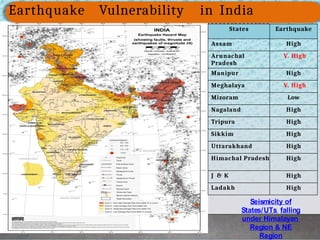
Earthquake Vulnerability in India
States Earthquake
Assam High
Arunachal
Pradesh
V. High
Manipur High
Meghalaya V. High
Mizoram Low
Nagaland High
Tripura High
Sikkim High
Uttarakhand High
Himachal Pradesh High
J & K High
Ladakh High
Seismicity of
States/UTs falling
under Himalayan
Region & NE
Region
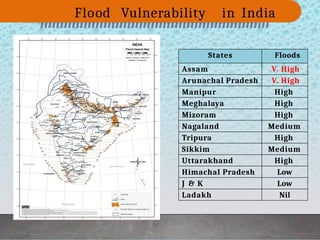
Flood Vulnerability in India
States Floods
Assam V. High
Arunachal Pradesh V. High
Manipur High
Meghalaya High
Mizoram High
Nagaland Medium
Tripura High
Sikkim Medium
Uttarakhand High
Himachal Pradesh Low
J & K Low
Ladakh Nil
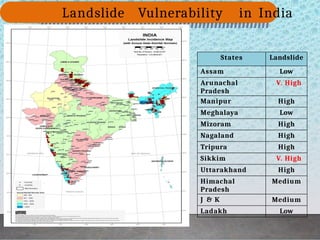
Landslide Vulnerability in India
States Landslide
Assam Low
Arunachal
Pradesh
V. High
Manipur High
Meghalaya Low
Mizoram High
Nagaland High
Tripura High
Sikkim V. High
Uttarakhand High
Himachal
Pradesh
Medium
J & K Medium
Ladakh Low
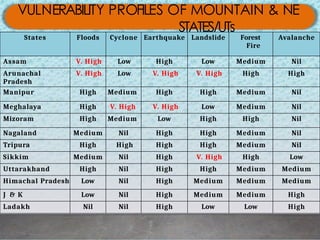
VULNERABILITY PROFILES OF MOUNTAIN & NE
STATES/UTs
States Floods Cyclone Earthquake Landslide Forest
Fire
Avalanche
Assam V. High Low High Low Medium Nil
Arunachal
Pradesh
V. High Low V. High V. High High High
Manipur High Medium High High Medium Nil
Meghalaya High V. High V. High Low Medium Nil
Mizoram High Medium Low High High Nil
Nagaland Medium Nil High High Medium Nil
Tripura High High High High Medium Nil
Sikkim Medium Nil High V. High High Low
Uttarakhand High Nil High High Medium Medium
Himachal Pradesh Low Nil High Medium Medium Medium
J & K Low Nil High Medium Medium High
Ladakh Nil Nil High Low Low High
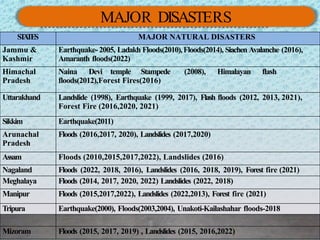
MAJOR DISASTERS
S
T
A
TES MAJOR NATURAL DISASTERS
Jammu &
Kashmir
Earthquake- 2005, Ladakh Floods(2010),Floods(2014), Siachen Avalanche (2016),
Amaranth floods(2022)
Himachal
Pradesh
Naina Devi temple Stampede (2008), Himalayan flash
floods(2012),Forest Fires(2016)
Uttarakhand Landslide (1998), Earthquake (1999, 2017), Flash floods (2012, 2013, 2021),
Forest Fire (2016,2020, 2021)
Sikkim Earthquake(2011)
Arunachal
Pradesh
Floods (2016,2017, 2020), Landslides (2017,2020)
Assam Floods (2010,2015,2017,2022), Landslides (2016)
Nagaland Floods (2022, 2018, 2016), Landslides (2016, 2018, 2019), Forest fire (2021)
Meghalaya Floods (2014, 2017, 2020, 2022) Landslides (2022, 2018)
Manipur Floods (2015,2017,2022), Landslides (2022,2013), Forest fire (2021)
Tripura Earthquake(2000), Floods(2003,2004), Unakoti-Kailashahar floods-2018
Mizoram Floods (2015, 2017, 2019) , Landslides (2015, 2016,2022)
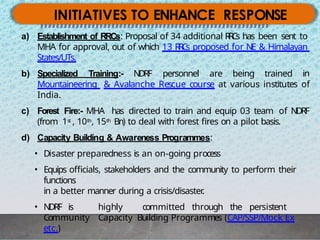
INITIATIVES TO ENHANCE RESPONSE
a) Establishment of RRCs: Proposal of 34 additional R
R
C
s has been sent to
MHA for approval, out of which 13 R
R
C
s proposed for NE & Himalayan
States/UTs.
b) Specialized Training:- NDRF personnel are being trained in
Mountaineering & Avalanche Rescue course at various institutes of
India.
c) Forest Fire:- MHA has directed to train and equip 03 team of NDRF
(from 1st , 10th, 15th Bn) to deal with forest fires on a pilot basis.
d) Capacity Building & Awareness Programmes:
• Disaster preparedness is an on-going process
• Equips officials, stakeholders and the community to perform their
functions
in a better manner during a crisis/disaster
.
• NDRF is highly committed through the persistent
Community Capacity Building Programmes (CAP/SSP/Mock Ex
etc.)
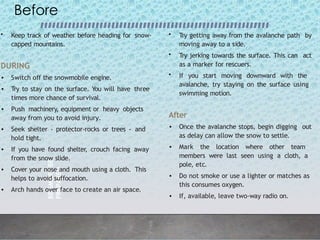
DISASTER SURVIVAL GUIDE 3
AVALANCHES
BE
SMART
BE
PREPARED
4
Before
• Keep track of weather before heading for snow-
capped mountains.
DURING
• Switch off the snowmobile engine.
• Try to stay on the surface. You will have three
times more chance of survival.
• Push machinery, equipment or heavy objects
away from you to avoid injury.
• Seek shelter - protector-rocks or trees - and
hold tight.
• If you have found shelter, crouch facing away
from the snow slide.
• Cover your nose and mouth using a cloth. This
helps to avoid suffocation.
• Arch hands over face to create an air space.
• Try getting away from the avalanche path by
moving away to a side.
• Try jerking towards the surface. This can act
as a marker for rescuers.
• If you start moving downward with the
avalanche, try staying on the surface using
swimming motion.
After
• Once the avalanche stops, begin digging out
as delay can allow the snow to settle.
• Mark the location where other team
members were last seen using a cloth, a
pole, etc.
• Do not smoke or use a lighter or matches as
this consumes oxygen.
• If, available, leave two-way radio on.
BE
SMART
BE
PREPARED
6
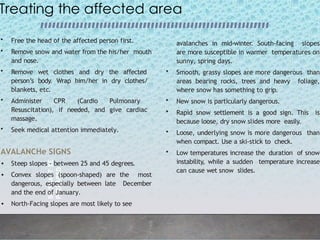
Treating the affected area
• Free the head of the affected person first.
• Remove snow and water from the his/her mouth
and nose.
• Remove wet clothes and dry the affected
person’s body. Wrap him/her in dry clothes/
blankets, etc.
• Administer CPR (Cardio Pulmonary
Resuscitation), if needed, and give cardiac
massage.
• Seek medical attention immediately.
AVALANCHe SIGNS
• Steep slopes - between 25 and 45 degrees.
• Convex slopes (spoon-shaped) are the most
dangerous, especially between late December
and the end of January.
• North-Facing slopes are most likely to see
avalanches in mid-winter. South-facing slopes
are more susceptible in warmer temperatures on
sunny, spring days.
• Smooth, grassy slopes are more dangerous than
areas bearing rocks, trees and heavy foliage,
where snow has something to grip.
• New snow is particularly dangerous.
• Rapid snow settlement is a good sign. This is
because loose, dry snow slides more easily.
• Loose, underlying snow is more dangerous than
when compact. Use a ski-stick to check.
• Low temperatures increase the duration of snow
instability, while a sudden temperature increase
can cause wet snow slides.
8
AR
ED
PR
EP
BE
SM
AR
T
BE
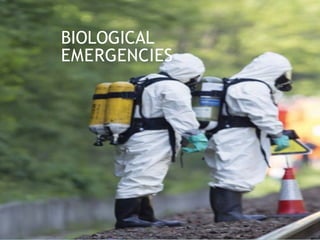
BIOLOGICAL
EMERGENCIES
BE
SMART
BE
PREPARED
1
0
Before
• Watch television, listen to radio, or surf the
Internet for official news of any outbreak.
• Practice good hygiene and keep your
premises clean.
• Use mosquito nets/repellents at night.
• Boil water before drinking. Chlorinate it, if
possible.
• Thoroughly wash all vegetables/fruits before
cooking/eating.
• Use insecticides to contain the vectors.
• Don’t consume stale or contaminated food
products.
• Immediately report any sickness with unusual
and/or suspicious symptoms in the family /
neighbourhood to health authorities.
• Seek medical attention if you are sick; keep a
stock of your regular prescribed medicines.
DURING
• Keep distance from and avoid direct
contact with the affected person.
• Avoid going to crowded areas.
• Use a respiration mask for protection.
AFTER
• Follow official instructions and help
authorities dispose of contaminated items
such as food, poultry, crops, vectors and
other materials, if advised.
• Ensure that all the required immunizations
are done and necessary precautions taken.
BE SMART BE PREPARED 18
COLD
WAVE
BE
SMART
BE
PREPARED
2
0
Before
• Have adequate winter clothing. Multiple layers of
clothing is also useful.
• Have emergency supplies ready.
DURING
• Stay indoors as much as possible, minimise travel to
prevent exposure to cold wind.
• Keep dry. If wet, change clothes quickly to prevent
loss of body heat.
• Prefer mittens over gloves; mittens provide more
warmth and insulation from cold.
• Listen to radio, watch TV, read newspapers for
weather updates.
• Drink hot drinks regularly.
• Don’t drink alcohol. It reduces your body temperature.
• Take care of elderly people and children.
• Store adequate water as pipes may freeze.
• Watch out for symptoms of frostbite like numbness,
white or pale appearance on fingers, toes, ear lobes
and the tip of the nose.
• Do not massage the frostbitten area. This can
cause more damage.
• Put the areas affected by frostbite in warm
— not hot — water (the temperature should
be comfortable to touch for unaffected parts
of the body).
• Do not ignore shivering. It is an important
first sign that the body is losing heat and a
signal to quickly return indoors.
IN THE CASE OF HYPOTHERMIA:
• Get the person into a warm place and change
his/her clothes.
• Warm the person’s body with skin-to-skin
contact, dry layers of blankets, clothes,
towels, or sheets.
• Give warm drinks to help increase body
temperature. Do not give alcohol.
• Seek medical attention if the condition
worsens.
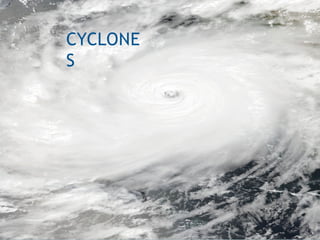
CYCLONE
S
BE
SMART
BE
PREPARED
2
4
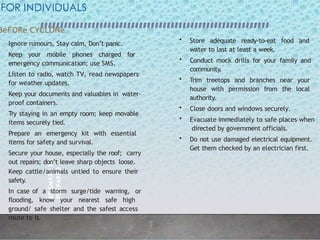
FOR INDIVIDUALS
BeFORe CYCLONe
• Ignore rumours, Stay calm, Don’t panic.
• Keep your mobile phones charged for
emergency communication; use SMS.
• Listen to radio, watch TV, read newspapers
for weather updates.
• Keep your documents and valuables in water-
proof containers.
• Try staying in an empty room; keep movable
items securely tied.
• Prepare an emergency kit with essential
items for safety and survival.
• Secure your house, especially the roof; carry
out repairs; don’t leave sharp objects loose.
• Keep cattle/animals untied to ensure their
safety.
• In case of a storm surge/tide warning, or
flooding, know your nearest safe high
ground/ safe shelter and the safest access
route to it.
• Store adequate ready-to-eat food and
water to last at least a week.
• Conduct mock drills for your family and
community.
• Trim treetops and branches near your
house with permission from the local
authority.
• Close doors and windows securely.
• Evacuate immediately to safe places when
directed by government officials.
• Do not use damaged electrical equipment.
Get them checked by an electrician first.
2
6
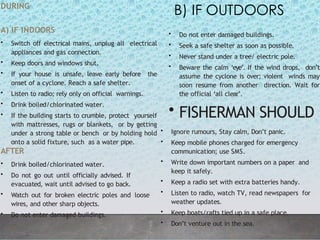
DURING
A) IF INDOORS
• Switch off electrical mains, unplug all electrical
appliances and gas connection.
• Keep doors and windows shut.
• If your house is unsafe, leave early before the
onset of a cyclone. Reach a safe shelter.
• Listen to radio; rely only on official warnings.
• Drink boiled/chlorinated water.
• If the building starts to crumble, protect yourself
with mattresses, rugs or blankets, or by getting
under a strong table or bench or by holding hold
onto a solid fixture, such as a water pipe.
AFTER
• Drink boiled/chlorinated water.
• Do not go out until officially advised. If
evacuated, wait until advised to go back.
• Watch out for broken electric poles and loose
wires, and other sharp objects.
• Do not enter damaged buildings.
• Seek a safe shelter as soon as possible.
• Never stand under a tree/ electric pole.
• Beware the calm ‘eye’. If the wind drops, don’t
assume the cyclone is over; violent winds may
soon resume from another direction. Wait for
the official ‘all clear’.
• FISHERMAN SHOULD
B) IF OUTDOORS
• Ignore rumours, Stay calm, Don’t panic.
• Keep mobile phones charged for emergency
communication; use SMS.
• Write down important numbers on a paper and
keep it safely.
• Keep a radio set with extra batteries handy.
• Listen to radio, watch TV, read newspapers for
weather updates.
• Keep boats/rafts tied up in a safe place.
• Don’t venture out in the sea.
DISASTER SURVIVAL GUIDE 29
DROUGHTS
BE
SMART
BE
PREPARED
3
0
DO’S
• Listen to radio, watch TV, read newspapers for
warnings, updates and instructions.
• Practice rainwater harvesting.
• Repair and rejuvenate local water bodies before
the rainy season.
• Use drought-resistant / low water intensity crop
seeds varieties / plants.
• Plant drought-tolerant grasses, shrubs, trees to
protect soil moisture.
• Excavate deep pits to help increase groundwater
table.
• Use sprinkler method/drip irrigation method for
crop irrigation; irrigate crops during evenings.
• Prepare and use crop contingency and
complementary plans.
• Participate in water
conservation programmes.
• Put used domestic water to use by
watering grasses and plants.
• Use a bucket instead of a shower for
bathing.
• Use wet clothes to clean and scrub floors
instead of using running water.
• Construct toilets that need less water for
flushing.
• Regularly check tanks, taps, etc. to
prevent leakage.
• Reuse water as much as possible.
• Adapt water conservation practices
in lifestyle. Follow all state and local
restrictions on water use, even if you
have a private well (groundwater levels
are affected by drought too).
BE
SMART
BE
PREPARED
3
2
DON’TS
• Do not waste water at all.
• Do not cut trees and forests.
• Do not waste rainwater collected on
rooftops, etc.
• Do not mess with traditional water sources
such as ponds, annicuts, well, tanks, etc.
• Do not use high water intensity seeds /
crops; don’t irrigate crops during mornings.
• Do not use the flowing water during
brushing, shaving, washing utensils,
clothes, etc.
• Avoid using handheld hose for any
domestic chores.
DISASTER SURVIVAL GUIDE 33
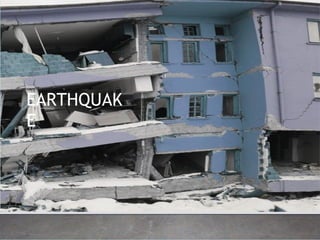
EARTHQUAK
E
BE
SMART
BE
PREPARED
3
4
FOR INDIVIDUALS
BEFORE
• Consult a structural engineer to make your
house earthquake resilient.
• Know your seismic zone and carry out
necessary structural changes in your house.
• Preserve the design and layout drawings of
your house for future reference.
• Repair deep plaster cracks on walls and
ceilings.
• Fasten shelves securely to walls; place
heavy / large objects on lower shelves.
Provide strong support to power and gas
appliances.
• Prepare an emergency kit with essential
items for safety and survival.
• Develop an emergency communication and
evacuation plan for your family.
• Learn the technique of ‘Drop-Cover-Hold’.
• Avoid flood plains and filled-up areas for construction
as far as possible.
• Educate yourself and family members about
earthquake risk.
DURING
• Stay calm. Do Not Panic. If you’re indoors, stay
inside. If you’re outside, stay outside.
• Don’t use matches, candles, or any flame. Broken gas
lines and fire don’t mix.
• If you’re in a car
, stop the car and stay inside until
the earthquake stops.
• Drop under a table; Cover your head with
one hand and Hold the table till the tremors
last.
• Stay away from mirrors and windows. Do
not exit the building while the earth is still
shaking.
• Move outside as soon as the tremors stop.
Do not use a lift.
• When outside, move away from buildings,
trees, walls and poles/electric lines.
• When inside a vehicle, pull over in an open
place and remain inside; avoid bridges.
• When in a structurally safe building, stay
inside until shaking stops.
• Protect yourself by staying in the corner/
under a strong table or bed/ an inside wall
away from mirrors and windows.
• If near an exit, leave the building as soon as
possible.
• If inside an old and weak structure, take the
fastest and safest way out.
AFTER
• Do not enter damaged buildings.
• If trapped in rubble:
— Do not light a matchstick.
— Cover your mouth with a cloth.
— Tap on a pipe or a wall.
— Sound a whistle.
— Shout only as a last resort. This will help
you conserve energy.
• Use stairs and not lifts or elevators.
• Move cautiously, and check for unstable objects
and other hazards above and around you.
Check yourself for injuries.
• Anticipate aftershocks, especially after a major
earthquake.
• Stay away from beaches. Tsunamis and seiches
sometimes hit after the ground has stopped
shaking.
• Do not spread and/ or believe in rumours.
• Leave a message stating where you are going if
you must evacuate your house.
• Do not drive around the damaged areas as
rescue and relief operations need roads for
mobility.
• Do not attempt to cross bridges/flyovers, which
may have been damaged.
COMMUNITY
• Practice Drop, Cover
, Hold drills regularly.
• Practice evacuation drills regularly.
• Ensure that exit routes are marked and fire
fighting equipment is working properly,
especially in high-rise buildings.
BE SMART BE PREPARED 40
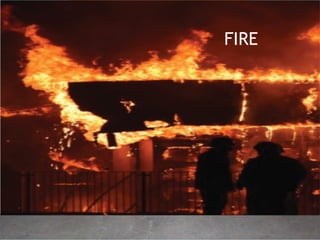
FIRE
PREPAREDNESS
• Prepare and practice a response plan for
residential and office complexes.
• Regularly carry out and practice fire rescue
drills such as stop, drop, and roll.
• Ensure that all residents/visitors are
periodically trained to face different emergency
situations and provide first aid.
• Ensure that smoke alarms are fitted in buildings
and are functional.
• Try to make your residential building, office
premises, etc. ‘No Smoking’ zones. If you
absolutely need to, create a separate smoking
area.
• Be familiar with the exit routes.
• Keep the exit routes /staircases free of any
obstructions. Periodically check
evacuation routes for obstruction, if any.
• Ensure that there is enough open area and
wide roads available in and around your home
and office premises to ensure easy access and
movement of emergency vehicles.
• Ensure that exit routes are marked and fire
fighting equipment is working properly in your
office premises and residential area.
• Ensure that your house and office premises
have a first aid kit placed at every segment.
• Do not leave any open fire unattended.
• Do not accumulate old newspapers or
combustible materials in your house.
• Do not burn waste, dry leaves or vegetation.
Always dispose of through appropriate
municipal channels.
• Do not store flammable liquids in the house.
• Always keep matches and lighters locked
away from children.
• Do not keep papers, clothes and flammable
liquids near heaters/stoves/open chulhas.
• Keep LPG gas stoves on a raised platform; do
not keep them on the floor.
• Turn off the gas cylinder valve and knob of
the gas stove after cooking.
• Don’t throw matches, cigarette butts, etc. in
waste baskets.
• Don’t place oil lamps, agarbattis or candles
on wooden floor or near combustible
material.
• Don’t wear loose, flowing and synthetic
clothes while cooking.
• Never reach for any article over a fire.
• Always evaluate the electric load requirement for
your premises and ensure that the power
company supplies electricity accordingly. This
will help avoid heating due to overload.
• Use standard electrical appliances, switches and
fuses, etc. to prevent fire from electrical short
circuit. Also, ensure that there are enough Earth-
leakage Circuit Breakers (ELCBs) to prevent short
circuit.
• Regularly check for loose electrical connections.
Do not run electric wires / cords under carpets or
in congested areas.
• Switch off electrical appliances after use and
remove plugs from the socket.
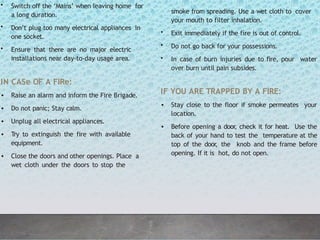
• Switch off the ‘Mains’ when leaving home for
a long duration.
• Don’t plug too many electrical appliances in
one socket.
• Ensure that there are no major electric
installations near day-to-day usage area.
IN CASe OF A FIRe:
• Raise an alarm and inform the Fire Brigade.
• Do not panic; Stay calm.
• Unplug all electrical appliances.
• Try to extinguish the fire with available
equipment.
• Close the doors and other openings. Place a
wet cloth under the doors to stop the
smoke from spreading. Use a wet cloth to cover
your mouth to filter inhalation.
• Exit immediately if the fire is out of control.
• Do not go back for your possessions.
• In case of burn injuries due to fire, pour water
over burn until pain subsides.
IF YOU ARE TRAPPED BY A FIRE:
• Stay close to the floor if smoke permeates your
location.
• Before opening a door, check it for heat. Use the
back of your hand to test the temperature at the
top of the door
, the knob and the frame before
opening. If it is hot, do not open.
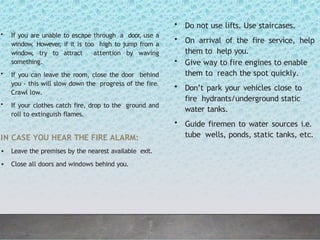
• If you are unable to escape through a door
, use a
window. However, if it is too high to jump from a
window, try to attract attention by waving
something.
• If you can leave the room, close the door behind
you - this will slow down the progress of the fire.
Crawl low.
• If your clothes catch fire, drop to the ground and
roll to extinguish flames.
IN CASE YOU HEAR THE FIRE ALARM:
• Leave the premises by the nearest available exit.
• Close all doors and windows behind you.
• Do not use lifts. Use staircases.
• On arrival of the fire service, help
them to help you.
• Give way to fire engines to enable
them to reach the spot quickly.
• Don’t park your vehicles close to
fire hydrants/underground static
water tanks.
• Guide firemen to water sources i.e.
tube wells, ponds, static tanks, etc.
DISASTER SURVIVAL GUIDE 51
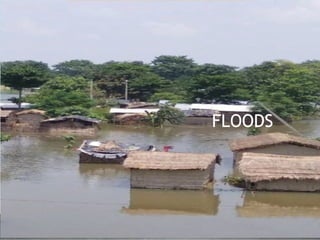
FLOODS
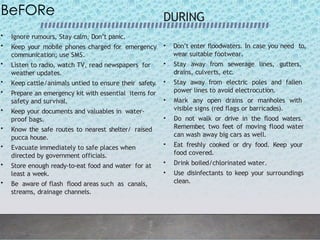
BeFORe
• Ignore rumours, Stay calm, Don’t panic.
• Keep your mobile phones charged for emergency
communication; use SMS.
• Listen to radio, watch TV, read newspapers for
weather updates.
• Keep cattle/animals untied to ensure their safety.
• Prepare an emergency kit with essential items for
safety and survival.
• Keep your documents and valuables in water-
proof bags.
• Know the safe routes to nearest shelter/ raised
pucca house.
• Evacuate immediately to safe places when
directed by government officials.
• Store enough ready-to-eat food and water for at
least a week.
• Be aware of flash flood areas such as canals,
streams, drainage channels.
DURING
• Don’t enter floodwaters. In case you need to,
wear suitable footwear.
• Stay away from sewerage lines, gutters,
drains, culverts, etc.
• Stay away from electric poles and fallen
power lines to avoid electrocution.
• Mark any open drains or manholes with
visible signs (red flags or barricades).
• Do not walk or drive in the flood waters.
Remember
, two feet of moving flood water
can wash away big cars as well.
• Eat freshly cooked or dry food. Keep your
food covered.
• Drink boiled/chlorinated water.
• Use disinfectants to keep your surroundings
clean.
AFTER
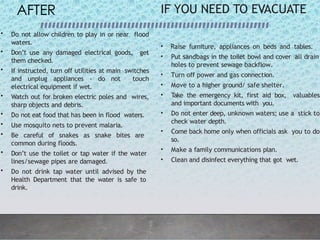
• Do not allow children to play in or near flood
waters.
• Don’t use any damaged electrical goods, get
them checked.
• If instructed, turn off utilities at main switches
and unplug appliances - do not touch
electrical equipment if wet.
• Watch out for broken electric poles and wires,
sharp objects and debris.
• Do not eat food that has been in flood waters.
• Use mosquito nets to prevent malaria.
• Be careful of snakes as snake bites are
common during floods.
• Don’t use the toilet or tap water if the water
lines/sewage pipes are damaged.
• Do not drink tap water until advised by the
Health Department that the water is safe to
drink.
IF YOU NEED TO EVACUATE
• Raise furniture, appliances on beds and tables.
• Put sandbags in the toilet bowl and cover all drain
holes to prevent sewage backflow.
• Turn off power and gas connection.
• Move to a higher ground/ safe shelter.
• Take the emergency kit, first aid box, valuables
and important documents with you.
• Do not enter deep, unknown waters; use a stick to
check water depth.
• Come back home only when officials ask you to do
so.
• Make a family communications plan.
• Clean and disinfect everything that got wet.
BE SMART BE PREPARED 64
HEAT
WAVE
S
HEAT WAVES
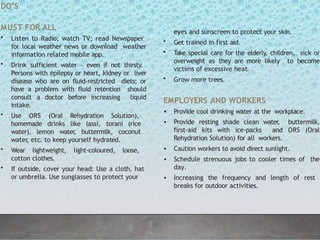
DO’S
MUST FOR ALL
• Listen to Radio; watch TV; read Newspaper
for local weather news or download weather
information related mobile app.
• Drink sufficient water - even if not thirsty.
Persons with epilepsy or heart, kidney or liver
disease who are on fluid-restricted diets; or
have a problem with fluid retention should
consult a doctor before increasing liquid
intake.
• Use ORS (Oral Rehydration Solution),
homemade drinks like lassi, torani (rice
water), lemon water
, buttermilk, coconut
water
, etc. to keep yourself hydrated.
• Wear lightweight, light-coloured, loose,
cotton clothes.
• If outside, cover your head: Use a cloth, hat
or umbrella. Use sunglasses to protect your
eyes and sunscreen to protect your skin.
• Get trained in first aid.
• Take special care for the elderly, children, sick or
overweight as they are more likely to become
victims of excessive heat.
• Grow more trees.
EMPLOYERS AND WORKERS
• Provide cool drinking water at the workplace.
• Provide resting shade clean water
, buttermilk,
first-aid kits with ice-packs and ORS (Oral
Rehydration Solution) for all workers.
• Caution workers to avoid direct sunlight.
• Schedule strenuous jobs to cooler times of the
day.
• Increasing the frequency and length of rest
breaks for outdoor activities.
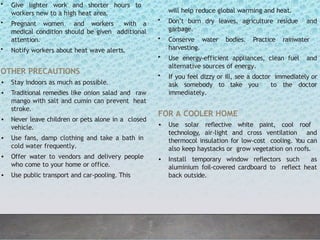
• Give lighter work and shorter hours to
workers new to a high heat area.
• Pregnant women and workers with a
medical condition should be given additional
attention.
• Notify workers about heat wave alerts.
OTHER PRECAUTIONS
• Stay indoors as much as possible.
• Traditional remedies like onion salad and raw
mango with salt and cumin can prevent heat
stroke.
• Never leave children or pets alone in a closed
vehicle.
• Use fans, damp clothing and take a bath in
cold water frequently.
• Offer water to vendors and delivery people
who come to your home or office.
• Use public transport and car-pooling. This
will help reduce global warming and heat.
• Don’t burn dry leaves, agriculture residue and
garbage.
• Conserve water bodies. Practice rainwater
harvesting.
• Use energy-efficient appliances, clean fuel and
alternative sources of energy.
• If you feel dizzy or ill, see a doctor immediately or
ask somebody to take you to the doctor
immediately.
FOR A COOLER HOME
• Use solar reflective white paint, cool roof
technology, air-light and cross ventilation and
thermocol insulation for low-cost cooling. You can
also keep haystacks or grow vegetation on roofs.
• Install temporary window reflectors such as
aluminium foil-covered cardboard to reflect heat
back outside.
• Keep your home cool, use dark colour
curtains, tinted glass/ shutters or sunshade
and open windows at night. Try to remain on
the lower floors.
• Green roofs, green walls and indoor plants
reduce heat by cooling the building naturally,
reducing air-conditioning requirements and
release of waste heat.
• Maintain AC temperature at 24 degrees or
higher. This will reduce your electricity bill
and make your health better.
WHILE CONSTRUCTING A NEW
HOME:
• Use cavity wall technology instead of regular
walls.
• Construct thick walls. They keep the interiors
cool.
• Construct lattice walls and louvered openings.
They allow maximum air flow while blocking
the heat.
• Use natural materials like lime or mud to coat
walls.
• Avoid glass, if possible.
• Consult a Building Technology expert before
construction.
FOR CATTLE
• Keep animals in shade and give them plenty of
clean and cold water to drink.
• Do not make them work between 11am to 4pm.
• Cover the shed roof with straw, paint it white or
plaster with dung-mud to reduce temperature.
• Use fans, water spray and foggers in the shed.
• During extreme heat, spray water and take
cattle to a water body to cool off.
• Give them green grass, protein-fat bypass
supplement, mineral mixture and salt. Make them
graze during cooler hours.
DON’TS
• Avoid going out in the sun, especially between
12.00 noon and 3.00 p.m.
• Avoid strenuous activities when outside in the
afternoon.
• Do not go out barefoot.
• Avoid cooking during peak hours. Open doors and
windows to ventilate cooking area adequately.
• Avoid alcohol, tea, coffee and carbonated soft
drinks, which dehydrates the body.
• Avoid high-protein, salty, spicy and oily food. Do not
eat stale food.
• Do not leave children or pets in parked vehicles.
• Avoid using incandescent light bulbs
• Use a wet cloth / pour water on the victim’s
head.
• Give the person ORS to drink or lemon sarbat
/ torani or whatever is useful to rehydrate
the body.
• Take the person immediately to the nearest
health centre.
• If consistently experiencing high body
temperature, throbbing headache, dizziness,
weakness, nausea or disorientation in the
summer, call an ambulance.
Tips for treatment of a
person affected by
sunstroke:
DISASTER SURVIVAL GUIDE 75
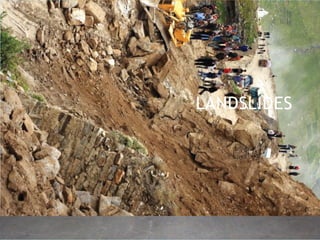
LANDSLIDES
BEFORE
• Grow more trees/vegetation as it can hold
the soil together.
• Listen to radio/Watch TV/Read newspaper
for any alerts.
• Keep drains clean, weep holes open. Do
not change the natural drainage system.
• Do not place debris, waste or fill material
on a steep slope.
• Watch out for any warning signs such as
subsidence of building, cracks on rocks,
muddy river water.
• Do not construct near steep slopes and
drainage path.
• Store emergency supplies of food and
water
, flashlights, batteries and medicine
ready.
• Keep a ‘disaster kit’ with essential
identity documents ready.
DURING
• Ignore rumours. Stay calm. Don’t panic.
• Stay together with your companions.
• Landslide debris moves from uphill to downhill. You
should, therefore, avoid low- lying areas or valleys.
• If you notice any warning signs such as unusual sounds
like trees cracking or boulders knocking together,
• Move away from landslip path or downstream valley
quickly;
• Inform nearest Tehsil/ District HQ/ Disaster Management
Helpline.
AFTeR
• Do not touch/walk over loose material and electrical
wires or poles.
DI
SA
ST
ER
SU
RV
IV
AL
G
UI
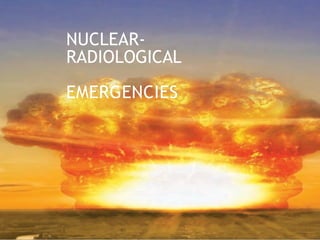
NUCLEAR-
RADIOLOGICAL
EMERGENCIES
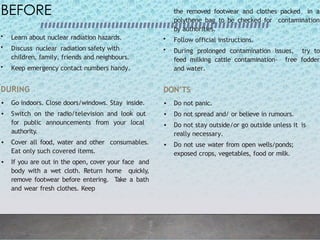
BEFORE
• Learn about nuclear radiation hazards.
• Discuss nuclear radiation safety with
children, family, friends and neighbours.
• Keep emergency contact numbers handy.
DURING
• Go indoors. Close doors/windows. Stay inside.
• Switch on the radio/television and look out
for public announcements from your local
authority.
• Cover all food, water and other consumables.
Eat only such covered items.
• If you are out in the open, cover your face and
body with a wet cloth. Return home quickly,
remove footwear before entering. Take a bath
and wear fresh clothes. Keep
the removed footwear and clothes packed in a
polythene bag to be checked for contamination
by authorities.
• Follow official instructions.
• During prolonged contamination issues, try to
feed milking cattle contamination- free fodder
and water.
DON’TS
• Do not panic.
• Do not spread and/ or believe in rumours.
• Do not stay outside/or go outside unless it is
really necessary.
• Do not use water from open wells/ponds;
exposed crops, vegetables, food or milk.
DI
SA
ST
ER
SU
RV
IV
AL
G
UI
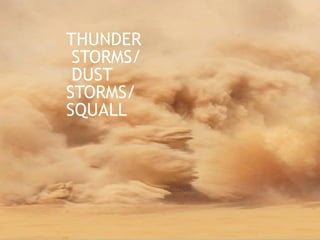
THUNDER
STORMS/
DUST
STORMS/
SQUALL
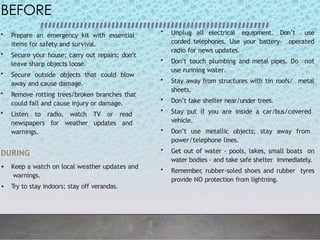
BEFORE
• Prepare an emergency kit with essential
items for safety and survival.
• Secure your house; carry out repairs; don’t
leave sharp objects loose.
• Secure outside objects that could blow
away and cause damage.
• Remove rotting trees/broken branches that
could fall and cause injury or damage.
• Listen to radio, watch TV or read
newspapers for weather updates and
warnings.
DURING
• Keep a watch on local weather updates and
warnings.
• Try to stay indoors; stay off verandas.
• Unplug all electrical equipment. Don’t use
corded telephones. Use your battery- operated
radio for news updates.
• Don’t touch plumbing and metal pipes. Do not
use running water.
• Stay away from structures with tin roofs/ metal
sheets.
• Don’t take shelter near/under trees.
• Stay put if you are inside a car/bus/covered
vehicle.
• Don’t use metallic objects; stay away from
power/telephone lines.
• Get out of water - pools, lakes, small boats on
water bodies - and take safe shelter immediately.
• Remember
, rubber-soled shoes and rubber tyres
provide NO protection from lightning.
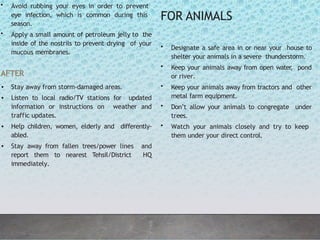
• Avoid rubbing your eyes in order to prevent
eye infection, which is common during this
season.
• Apply a small amount of petroleum jelly to the
inside of the nostrils to prevent drying of your
mucous membranes.
AFTER
• Stay away from storm-damaged areas.
• Listen to local radio/TV stations for updated
information or instructions on weather and
traffic updates.
• Help children, women, elderly and differently-
abled.
• Stay away from fallen trees/power lines and
report them to nearest Tehsil/District HQ
immediately.
FOR ANIMALS
• Designate a safe area in or near your house to
shelter your animals in a severe thunderstorm.
• Keep your animals away from open water
, pond
or river.
• Keep your animals away from tractors and other
metal farm equipment.
• Don’t allow your animals to congregate under
trees.
• Watch your animals closely and try to keep
them under your direct control.
BE SMART BE PREPARED 96
TSUNAMI
BEFORE
• Construct houses/buildings as per
Bureau of Indian Standards (BIS)
codes.
• Educate yourself and your family about
tsunami risk.
• Prepare an ‘emergency kit’ and make a
family communications plan.
• Know the height of your street above
sea level and the distance of your street
from the coast or other high-risk water
bodies.
• If you are a tourist, familiarise yourself
with local tsunami evacuation protocols.
• If an earthquake occurs and you are in a
coastal area, turn on your radio to learn
if there is a tsunami warning.
• Know your community’s warning systems
and disaster plans, including evacuation
routes. Practice evacuation through
identified routes.
• Identify the highest ground and the safest,
nearest, easiest way to reach the same.
• Know if the school evacuation plan requires you
to pick your children up from school or from any
other location. Be aware that telephone lines
during a tsunami watch or warning may be
overloaded and routes to and from schools may
be jammed.
DURING
• Stay calm. Do not panic.
• Evacuate immediately to safe places when
directed by government officials.
• Move inland to higher ground immediately.
• Stay away from the beach.
• Save yourself, not your possessions.
• Help those who may require special assistance -
infants, elderly people, and individuals with
access or functional
needs.
• If you are in the water
, then grab onto something
that floats, such as a raft/ tree trunk, etc.
• If you are in a boat, then face the direction of
the waves and head out to the sea. If you are in
a harbour, then go inland.
AFTER
• Return home only after officials tell you it is
safe.
• Avoid areas which are affected by a disaster.
• Stay away from debris in the water.
• Check yourself for injuries and get first aid as
needed before helping injured or trapped
persons.
• If someone needs to be rescued, call
professionals with the right equipment to
help.
• Help people who require special assistance
- infants, elderly people, people with access
and functional needs.
• Use radio or television for the latest updates.
• Stay out of any building that has water around
it as tsunami water can cause floors to crack
or walls to collapse.
• Use caution when re-entering buildings or
homes.
• T
o avoid injury, wear protective clothing and
be cautious when cleaning up.
• Do not eat or drink anything from open
containers.
• Leave a message stating where you are going
if you must evacuate your house.
• Do not spread and/ or believe in rumours.
UNIT-I.pptx-disaster and risk management

UNIT-I.pptx-disaster and risk management

  • 1.
    MANDATORY COURSE MX3084 Disaster RiskReduction and Management
  • 2.
    COURSE OUTCOMES • CO1:To impart knowledge on the concepts of Disaster, Vulnerability and Disaster Risk reduction (DRR) • CO2: To enhance understanding on Hazards, Vulnerability and Disaster Risk Assessment prevention and risk reduction • CO3: To develop disaster response skills by adopting relevant tools and technology • CO4: Enhance awareness of institutional processes for Disaster response in the country and • CO5: Develop rudimentary ability to respond to their surroundings with potential Disaster response in areas where they live, with due sensitivity.
  • 3.
  • 4.
    DEFINITIONS • A disasteris a serious disruption of the functioning of a community or a society involving widespread human, material, economic or environmental loss and impacts, which exceeds the ability of the affected community or society to cope using its own resources. • Disaster management is the creation of plans through which communities reduce vulnerability to hazards and cope with disasters • Disaster management does not avert or eliminate the threats; instead, it focuses on creating plans to decrease the effect of disasters • Disasters can be natural or human made
  • 5.
    HAZARDS AND RISK •Natural hazards are severe and extreme weather and climate events that occur naturally in all parts of the world, although some regions are more vulnerable to certain hazards than others • Natural hazards become natural disasters when people's lives and livelihoods are destroyed. • Risk : The probability of harmful consequences, or expected losses resulting from the interactions between hazards and vulnerable conditions e.g. deaths, injuries, property, livelihoods, economic activity disrupted or environmental damages. • Risk Assessment :The process of determining the nature and extent of risk by analysing potential hazards and evaluating existing condition of vulnerability and capacity • The estimation of risk posed by a hazard. Risk assessment consists of the following steps: Hazard Assessment………Vulnerability Assessment…………Capacity Assessment
  • 6.
    Classification of Hazards Earthquake Tsunami MassMovement triggered by geophysical events Landslide Avalanche Rock fall Mud flow Debris flow Subsidence Floods Wave Action Coastal Erosion Shoreline Change Mass Movement triggered by Hydrological events Landslide Avalanche Rock fall Mud flow Debris flow Subsidenc e Storm, Rain, Wind, Hail, Snow, Ice, Blizzard, Lightning, Sand, Dust, Tornado Extreme Temperature, Cold Wave, Heat wave, Frost, Freeze Fog Tropical Cyclone, Cyclonic Wind, Rain, Surge Drought Glacial lake Outburst flood (GLOF) Wildfire
  • 8.
    Erosion Deforestation Salinization Sea Level Rise Desertification AsianDust Cloud Wetland Loss/Degradation Glacier Retreat/Melting Epidemics Pandemics Epizootics Pest Insect infestation, Animal Incidents Pollution Industrial Disaster Structural Collapse Power Outage Fire Explosion Mine Disaster Chemical Spill Oil Spill Radiation Contamination/ Nuclear Incident Aviation Accident Rail Accident Road Accident Navigation Accident Space Accident Classification of Hazards
  • 10.
    What is ‘exposure’? Thesituation of people, infrastructure, housing, production capacities and other tangible human assets located in hazard-prone areas Exposed
  • 11.
    What is ‘exposure’? •Measures of exposure can include the number of people or types of assets in an area. • Let’s say that there is an imminent danger of a forest fire, in that case the exposure would be of the forest area and the flora and fauna of the area! • To put it simply, if you feel that you can be affected by a hazard, you are exposed!
  • 12.
    VULNERABILITY • Vulnerability isthe human dimension of disasters and is the result of the range of economic, social, cultural, institutional, political and psychological factors that shape people’s lives and the environment that they live in • Vulnerability is one of the defining components of disaster risk RISK = HAZARD X EXPOSURE X VULNERABILITY
  • 14.
    So what isa ‘Disaster’ then? When the ‘disaster risk’ exceeds the ‘coping capacity’ of the ‘exposed’ assets, the incident of a hazard turns into a ‘disaster’. So, what is Coping Capacity?
  • 15.
    What is ‘copingcapacity’? The ability of people, organizations and systems, using available skills and resources, to manage adverse conditions, risk or disasters. -The capacity to cope requires continuing awareness, resources and good management, both in normal times as well as during disasters or adverse conditions. -Coping capacities contribute to the reduction of disaster risks. If you have the capacity to deal with the disaster risk, you are good to go, else it is a disaster! “When the going gets tough, the tough gets going”
  • 16.
    Definition of aDisaster: Legal Connotation  This has been taken from the Disaster Management Act of India, 2005 “Disaster means a catastrophe, mishap, calamity or grave occurrence in any area, arising from natural or man made causes, or by accident or negligence which results in substantial loss of life or human suffering or damage to, or degradation of, environment, and is of such a nature or magnitude as to be beyond the coping capacity of the community of the affected area.” An actual or imminent event, whether natural or otherwise occurring in any part of the State which causes, or threatens to cause all or any of the following: 1. Widespread loss or damage to property, both immovable and movable; or 2. Widespread loss of human life or injury or illness to human beings; or 3. Damage or degradation of environment
  • 17.
    Resilience……….Coping capacity • Capacityof a community to resist, absorb, adjust to and recover from the negative impacts of a disaster in a timely and efficient manner • The capacity of a system, community or society potentially exposed to hazards to adapt, by resisting or changing in order to reach and maintain an acceptable level of functioning and structure – learnings from earlier disasters • The strengthening of coping capacities usually builds resilience to withstand the effects of natural and human-induced hazards
  • 18.
    Adaptation & Mitigation •Adaptation : refers to changes in natural and human systems to reduce risks to the lives and livelihoods of people • Adaptation actions can reduce many unavoidable impacts in the near term, although they cannot reduce them to zero • Mitigation : Structural and non-structural measures taken to reduce the adverse effects of a disaster, if it occurs e.g. construction of retaining walls, widening of water channels, building codes, early warning systems, etc. • Mitigation refers to the actions taken to reduce the severity of a disaster, while Adaptation refers to the responsive adjustment to an environmental condition • Failure to mitigate will eventually lead to failure of adaptation because the magnitude of the impacts is predicted to become too large to manage even with considerable investment • Adaptation and mitigation are not alternative strategies but complementary ones that need to be pursued together
  • 19.
    Why do weneed to worry? Occurrences (1998-2017)
  • 20.
    Why do weneed to worry? Effect of disaster in India(1998 – 2017) 13 lakh Killed 440 crore Injured, Homeless, Displaced US$ 2908 Bn. Direct Economic Loss
  • 21.
    We need tomanage disasters, but how? Now that we have a clear idea of how bad disasters can be, we obviously need to manage it. This is how disaster management came into being. The following definition of Disaster Management has been taken from the Disaster Management Act (DM Act), 2003. Disaster Management means a continuous and integrated process of planning and implementation of measures with a view to: 1. Mitigating or reducing the risk of reducing the risk of disasters; 2. Mitigating the severity or consequence of disasters; 3. Capacity - building; 4. Emergency preparedness; 5. Assessing the effects of disasters; 6. Providing emergency relief and rescue; and 7. Post-disaster rehabilitation and reconstruction
  • 22.
  • 26.
    CRISIS MANAGEMENT Crisis isan abnormal situation in which, decisions has to be taken at short period of time Crisis can be divided into two types : (a) Community crisis which is generated by natural and technical agents, disaster and conflicts (civil war, riots and civil disturbance) and (b) Non-community crisis, such as transport accident which does not impact the entire community. Crisis management involves an accurate and timely diagnosis of the criticality of the problem and dynamics of events. This requires knowledge, skills, courageous leadership, high level of risk taking ability, and vigilance. Successful crisis management requires motivation, sense of urgency of the matter, commitment, and creative thinking with long-term strategic vision.
  • 27.
    TYPES OF DISASTERS 1.Water and Climate Related Disasters – Floods and drainage Management, Cyclones, Tornadoes and Hurricanes, Hailstorm, Cloud Burst, Heat Wave and Cold Wave, Snow Avalanches, Droughts, Sea Erosion and Thunder and Lightning 2. Geologically related disasters -- Landslides and Mudflows, Earthquakes, Dam Failures/ Dam Bursts and Mine Fires 3. Chemical , Industrial & Nuclear related disasters -- Chemical and industrial and nuclear disasters have been included. 4. Accident related disasters -- Forest Fires, Urban Fires, Mines Flooding Oil Spill, Major Building Collapse, Serial Bomb Blasts, Festival related disasters, Electrical disasters and Fires, Air, Road and Rail Accidents, Boat Capsizing and Village Fire have been included in this sub-group by HPC 5. Biologically related disasters -- Epidemics, Pest Attacks, Cattle epidemics and Food poisoning.
  • 29.
    Disaster! Turn on thenews or open a newspaper and you’re likely to read about some kind of disaster. Click on the circle to find out more.
  • 30.
    Natural and HumanDisasters A disaster is an event that causes great damage and loss. Disasters can be divided into two types: natural and human. Click on the circle to found out more. Human disaster Natural Disaster A disaster caused by nature or natural events. These include floods, hurricanes and tornadoes.. A disaster caused by human action. These include oil spills, chemical explosions and gas leaks in factories.
  • 31.
    Natural Disasters Click onthe photo to find out more about different natural disasters. next
  • 32.
    Heat Wave Heat wave- a period of excessively hot weather. A heat wave can have devastating effects on crops, animals and people. Extreme heat can often contribute to other natural disasters such as droughts (prolonged shortage of water). back
  • 33.
    Flood Flood – whenan area or land, that is usually dry, becomes submerged in water. Floods can be caused by an overflow of a body of water such as a river or lake, or by excessive amounts of rainfall over a short period of time. back
  • 34.
    Hurricane – ahuge storm that forms over warm seas and oceans. A hurricane can cause winds of over 100 miles per hour. They are often formed in the Gulf of Mexico and the Caribbean. Hurricane back
  • 35.
    Tsunami – aseries of huge waves caused by an earthquake or volcano under the sea. Tsunami back
  • 36.
    Earthquake – thesudden movement of the Earth’s crusts (its outer layer). Earthquake back
  • 37.
    Volcanic eruption –when lava and gas erupt from a vent in a volcano. Volcanic Eruption back
  • 38.
    • The MinamataPoisonings – in April 1956, in Minamata, Japan, people began to exhibit symptoms such as being unable to walk or speak and were suffering convulsions. It soon transpired that a chemical factory had been dumping waste into the local ecosystem for years. The local water source, and therefore the fish living within it, became poisoned with mercury which subsequently caused thousands of deaths. • Deepwater Horizon oil spill – on 20th April 2010, the Deepwater Horizon oil rig exploded. It released 780,000,000 (780 million) litres of oil into the sea. The damage to marine wildlife and beaches is still being felt. Human Disasters Here are some examples of human disasters that have happened to our planet: • Chernobyl – Chernobyl was a power plant in Ukraine which produced nuclear power. In 1986, an explosion caused one of the nuclear reactors to leak. Over thirty years later, the area is still unsafe to live in or near to. • The Aral Sea – farmers started diverting water from the Aral Sea (a lake that was between Kazakhstan and Uzbekistan) to help their crops grow. This has caused the lake to almost completely dry up. The marine life has been lost and fisherman have lost their jobs.
  • 39.
    How can humanslessen the possibility of causing natural disasters? How Humans Cause Disasters Over recent years, human activity has increased the numbers of apparent natural disasters. Scientists believe climate change has caused extreme conditions such as hurricanes and flooding. Talk About It
  • 40.
    6.26.1 Table 6.2 Frequentlyoccuring natural disasters in India
  • 43.
  • 44.
  • 45.
  • 47.
  • 48.
  • 49.
  • 50.
    Table 6.3 Differentnames of Cyclones
  • 51.
  • 52.
  • 53.
  • 54.
  • 56.
  • 58.
  • 59.
  • 61.
  • 62.
  • 63.
  • 65.
  • 68.
    India : MajorDisasters • India disaster prone • Bhopal gas tragedy 1984 • Cyclones (AP)& Orissa • Earthquake in Uttarkashi in 1990, Latur 1993 Gujarat 2001, Sikkim 2011 • Tsunami 2004 • Train accidents; Bomb blasts
  • 69.
    Major Disasters • KashmirFloods. • Year: 2014 – 500 dead • Uttarakhand Flash Floods. • Year 2013- 5000 dead • The Indian Ocean Tsunami. • Year: 2004. ... • Gujarat Earthquake. • Year 2001. ... • Coringa Cyclone. • Year: 1839 – 3.2 lakhs people died • Calcutta Cyclone. • Year: 1737- 3 lakhs people died • The Bengal Famine 1770 & 1943 - > one crore people dead • Super Cyclone struck the Orissa Coast on 29th October 1999, killing nearly 10,000 people and affecting over 15 million people across 12 districts of Orissa.
  • 70.
    Frequency and ForewarningLevels of Different Hazards •Through history disasters have destroyed lives and livelihoods, killing people and damaging homes and businesses. •Disasters in the past 35 years have taken an estimated 2.5 million lives and cost more than US$1.5 billion, mainly in developing countries. •Disasters result from natural and biological hazards (floods or infectious diseases, for example) as well as complex sociopolitical emergencies and industrial hazards (droughts or radioactive leaks). Efforts to reduce disaster risk have therefore focused, in part, on developing early warning systems to provide timely and effective information that enables people and communities to respond when a disaster hits. •Early warning systems are combinations of tools and processes embedded within institutional structures, coordinated by international and sometimes national agencies. •Whether they focus on one particular hazard or many, these systems are composed of four elements : Knowledge of the risk, a technical monitoring and warning service, dissemination of meaningful warnings to at-risk people, and public awareness and preparedness to act. Warning services lie at the core of these systems, and how well they operate depends on having a sound scientific basis for predicting and forecasting, and the capability to run reliably 24 hours a day. •Scientific and technological advances have driven marked improvements in the quality, timeliness and lead time of hazard warnings, and in the operation of integrated observation networks. •But advances in technology alone are not enough - and in some cases they can even create obstacles to the capacity of vulnerable populations to respond.
  • 71.
    • Forecasting andmodelling technology • Several countries have early warning systems based on seasonal-to-interannual climate forecasts. • These systems are based on using monitoring data, including temperature and rainfall values, and state-of-the art climate models. • Climatologists analyse the observations and model-based predictions to predict climate anomalies one or two seasons ahead. • Remote sensing and Geographic Information Systems (GIS) applications • Remote sensing and GIS applications have significantly advanced famine early warning systems. • The Regional Centre for Mapping of Resources for Development (RCMRD) has been using remote sensing-based regional early warning systems for food security to supplement national initiatives in eastern African countries. • RCMRD predicts harvests half way through the growing season to give advance warning on food security before the end of the season. • In addition, flood monitoring is now regularly informed by remote sensing that obtains information on soil types, water resources, settlements, cropped areas and forests.
  • 72.
    • Satellite communicationtechnology • Improvements in satellite communication have helped decrease the lag time between data collection and warning. • For example, the Pacific Tsunami Warning System works by a recorder on the seabed relaying data on anomalies to a buoy on the surface. • This data is then transmitted via satellite to ground stations every 15 seconds. • Mobile phone technology • With the global spread of mobile phones and networks, this technology is now increasingly used to communicate warnings and coordinate preparation activities particularly SMS alerts for disseminating mass messages. • For example, upon detection of p-waves that precede earthquake shaking, Japanese agencies send out SMS alerts to all registered mobile phones in the country. • However, some obstacles can arise with this technology, phone pylons can be damaged or networks can be overburdened during hazards, for example.
  • 73.
    • ICTs forcrowdsourcing • The use of 'crowdsourced' data is gaining traction with increasing Internet connectivity and use of Information and Communication Technologies (ICTs) such as mobile phones. • Crowdsourcing was used extensively in the response to the 2010 Haiti earthquake, allowing local people, mapping experts and other stakeholders to communicate what they saw and heard on the ground, and to produce information that could be used by humanitarian workers. • This was particularly useful in locating survivors who needed assistance, but it is increasingly recognized that crowdsourcing could also help with pre-disaster activities, specifically risk identification and early warning. • Crisis mapping • Through initiatives such as Ushahidi and Google Crisis Response, crisis mapping utilises crowdsourcing as well as satellite imagery, participatory maps and statistical models to power more informed and effective early warning. • It can provide real-time information on an upcoming crisis in times of uncertainty and confusion. • The vast amount of data that can be produced from such systems can be analysed through networks of stakeholders (such as Crisis Mappers).
  • 74.
    Early warning systems Earlywarning systems are increasingly considered to be an integral component of disaster preparedness and involve a broad spectrum of actors. Cuba's Tropical Cyclone Early Warning System is credited with reducing deaths dramatically for weather related hazards such as tropical cyclones, storm surges and related flooding: five successive flooding events left only seven dead. Another example is Bangladesh, which now has a 48-hour early warning system in place that allows people to evacuate to safe shelters hours before cyclones make landfall, reducing deaths. In 1970, 300,000 died as a result of Cyclone Bhola, compared to 3,000 in 2007 during Cyclone Sidr, which authorities were able to track as it grew in strength but cannot prevent all damage. While a certain amount can be done at the local level to protect lives and livelihoods once a warning has been received, there is little that can be done to protect infrastructure in a sudden disaster, financial losses from destruction of buildings and interruption of services still occur. However, in slower onset disasters that can be pre-empted days or months in advance, early warning systems can provide enough time for risk reduction measures to be put in place, such as retrofitting buildings and constructing barriers.
  • 75.
    Risk Assessment and HazardMitigation Plan …an introduction to guide your projects!
  • 76.
    Risk Assessment • Ahazard identification and risk assessment provides the factual basis for activities proposed in the strategy portion of a hazard mitigation plan. • An effective risk assessment informs proposed actions by focusing attention and resources on the greatest risks. • In Units 1, 2, and 3, what did we learn/do that would help us focus attention on the greatest risks?
  • 77.
    Risk Assessment • Fourbasic components: 1. Hazard Identification 2. Profiling of hazard events 3. Inventory of assets. 4. Estimation of potential and economic losses based on the exposure and vulnerability of people, buildings, and infrastructure.
  • 78.
    Hazard Mitigation Planning •Mitigation - sustained actions taken to reduce or eliminate long-term risk to life and property from hazards. • Prevention - actions necessary to avoid, prevent, or stop an imminent threat or actual act of terrorism. • Protection - actions necessary to secure the homeland against acts of terrorism and manmade or natural disasters. • Preparedness - actions taken to plan, organize, equip, train, and exercise to build and sustain the capabilities necessary to prevent, protect against, mitigate the effects of, respond to, and recover from those threats that pose the greatest risk to the security of the Nation. • Response - actions necessary to save lives, protect property and the environment, and meet basic human needs after an incident has occurred. • Recovery - actions necessary to assist communities affected by an incident to recover effectively.
  • 79.
    Mitigation Tasks • Determinethe Planning Area and Resources • Build the Planning Team • Create an Outreach Strategy • Review Community Capabilities • Conduct a Risk Assessment • Develop a Mitigation Strategy • Keep the Plan Current • Review and Adopt the Plan • Create a Safe and Resilient Community
  • 80.
    TASK 1: Determinethe Planning Area and Resources • Geographic area covered by the plan? • Arizona or Puerto Rico? • Usually determined by local government jurisdictional boundaries, but can be defined by natural features. • For your groups respective area, select a jurisdictional or natural boundary. The boundary should cover almost the entire area. • You do not need to consider resources for this project
  • 81.
    TASK 2: Buildthe Planning Team • This is the core group of people responsible for developing and reviewing drafts of the plan, creating the mitigation strategy, and submitting the final plan for local adoption. • The planning team (YOUR GROUP) has the expertise to develop the plan. • Who is in charge of different components? What are their individual expertise?
  • 82.
    Planning Team UsualSuspects • Emergency Management • Fire Department/Districts • Parks and Recreation • Public Information Office • Public Works • Storm water Management • Transportation
  • 83.
    TASK 3: Createan Outreach Strategy • “A plan that accurately reflects the community’s values and priorities is likely to have greater legitimacy and greater success in implementing mitigation actions to reduce risk.” • Why do you think this is? • How could you incorporate this into your report?
  • 84.
    TASK 4: ReviewCommunity Capabilities • Describes the step of assessing your community’s existing authorities, policies, programs, and resources. • Not needed for your groups’ report.
  • 85.
    TASK 5: Conducta Risk Assessment • Planning team determines the potential impacts of hazards to the people, economy, and built and natural environments of the community. • Needed for your report: • Regional assessment • Local assessment Steps to Conduct a Risk Assessment 1. Describe Hazards 2. Identify Community Assets 3. Analyze Risk 4. Summarize Vulnerability
  • 86.
    TASK 6: Developa Mitigation Strategy • Serves as the blueprint for reducing the potential losses identified in the risk assessment. • Provides suggestions for developing a new or updating an existing mitigation strategy.
  • 87.
    TASK 7: Keepthe Plan Current • Mitigation plans are living documents. • WHY? • Recognize this fact, but updates are not necessary/possible for your groups plan.
  • 88.
    TASK 8: Reviewand Adopt the Plan • Initiate local adoption through review and approval process. • Incorporate feedback from the planning team, stakeholders, and the public on the final document. • For this project, since actual adoption is not feasible, you will focus on reviewing (EDITING) your document.
  • 89.
    TASK 9: Createa Safe and Resilient Community • What might be some barriers to mitigation? • How can mitigation barriers be overcome? • Consider these questions, but this task is not required for the final deliverable.
  • 90.
    Earthquake Vulnerability inIndia States Earthquake Assam High Arunachal Pradesh V. High Manipur High Meghalaya V. High Mizoram Low Nagaland High Tripura High Sikkim High Uttarakhand High Himachal Pradesh High J & K High Ladakh High Seismicity of States/UTs falling under Himalayan Region & NE Region
  • 91.
    Flood Vulnerability inIndia States Floods Assam V. High Arunachal Pradesh V. High Manipur High Meghalaya High Mizoram High Nagaland Medium Tripura High Sikkim Medium Uttarakhand High Himachal Pradesh Low J & K Low Ladakh Nil
  • 92.
    Landslide Vulnerability inIndia States Landslide Assam Low Arunachal Pradesh V. High Manipur High Meghalaya Low Mizoram High Nagaland High Tripura High Sikkim V. High Uttarakhand High Himachal Pradesh Medium J & K Medium Ladakh Low
  • 93.
    VULNERABILITY PROFILES OFMOUNTAIN & NE STATES/UTs States Floods Cyclone Earthquake Landslide Forest Fire Avalanche Assam V. High Low High Low Medium Nil Arunachal Pradesh V. High Low V. High V. High High High Manipur High Medium High High Medium Nil Meghalaya High V. High V. High Low Medium Nil Mizoram High Medium Low High High Nil Nagaland Medium Nil High High Medium Nil Tripura High High High High Medium Nil Sikkim Medium Nil High V. High High Low Uttarakhand High Nil High High Medium Medium Himachal Pradesh Low Nil High Medium Medium Medium J & K Low Nil High Medium Medium High Ladakh Nil Nil High Low Low High
  • 94.
    MAJOR DISASTERS S T A TES MAJORNATURAL DISASTERS Jammu & Kashmir Earthquake- 2005, Ladakh Floods(2010),Floods(2014), Siachen Avalanche (2016), Amaranth floods(2022) Himachal Pradesh Naina Devi temple Stampede (2008), Himalayan flash floods(2012),Forest Fires(2016) Uttarakhand Landslide (1998), Earthquake (1999, 2017), Flash floods (2012, 2013, 2021), Forest Fire (2016,2020, 2021) Sikkim Earthquake(2011) Arunachal Pradesh Floods (2016,2017, 2020), Landslides (2017,2020) Assam Floods (2010,2015,2017,2022), Landslides (2016) Nagaland Floods (2022, 2018, 2016), Landslides (2016, 2018, 2019), Forest fire (2021) Meghalaya Floods (2014, 2017, 2020, 2022) Landslides (2022, 2018) Manipur Floods (2015,2017,2022), Landslides (2022,2013), Forest fire (2021) Tripura Earthquake(2000), Floods(2003,2004), Unakoti-Kailashahar floods-2018 Mizoram Floods (2015, 2017, 2019) , Landslides (2015, 2016,2022)
  • 95.
    INITIATIVES TO ENHANCERESPONSE a) Establishment of RRCs: Proposal of 34 additional R R C s has been sent to MHA for approval, out of which 13 R R C s proposed for NE & Himalayan States/UTs. b) Specialized Training:- NDRF personnel are being trained in Mountaineering & Avalanche Rescue course at various institutes of India. c) Forest Fire:- MHA has directed to train and equip 03 team of NDRF (from 1st , 10th, 15th Bn) to deal with forest fires on a pilot basis. d) Capacity Building & Awareness Programmes: • Disaster preparedness is an on-going process • Equips officials, stakeholders and the community to perform their functions in a better manner during a crisis/disaster . • NDRF is highly committed through the persistent Community Capacity Building Programmes (CAP/SSP/Mock Ex etc.)
  • 96.
  • 97.
    BE SMART BE PREPARED 4 Before • Keep trackof weather before heading for snow- capped mountains. DURING • Switch off the snowmobile engine. • Try to stay on the surface. You will have three times more chance of survival. • Push machinery, equipment or heavy objects away from you to avoid injury. • Seek shelter - protector-rocks or trees - and hold tight. • If you have found shelter, crouch facing away from the snow slide. • Cover your nose and mouth using a cloth. This helps to avoid suffocation. • Arch hands over face to create an air space. • Try getting away from the avalanche path by moving away to a side. • Try jerking towards the surface. This can act as a marker for rescuers. • If you start moving downward with the avalanche, try staying on the surface using swimming motion. After • Once the avalanche stops, begin digging out as delay can allow the snow to settle. • Mark the location where other team members were last seen using a cloth, a pole, etc. • Do not smoke or use a lighter or matches as this consumes oxygen. • If, available, leave two-way radio on.
  • 98.
    BE SMART BE PREPARED 6 Treating the affectedarea • Free the head of the affected person first. • Remove snow and water from the his/her mouth and nose. • Remove wet clothes and dry the affected person’s body. Wrap him/her in dry clothes/ blankets, etc. • Administer CPR (Cardio Pulmonary Resuscitation), if needed, and give cardiac massage. • Seek medical attention immediately. AVALANCHe SIGNS • Steep slopes - between 25 and 45 degrees. • Convex slopes (spoon-shaped) are the most dangerous, especially between late December and the end of January. • North-Facing slopes are most likely to see avalanches in mid-winter. South-facing slopes are more susceptible in warmer temperatures on sunny, spring days. • Smooth, grassy slopes are more dangerous than areas bearing rocks, trees and heavy foliage, where snow has something to grip. • New snow is particularly dangerous. • Rapid snow settlement is a good sign. This is because loose, dry snow slides more easily. • Loose, underlying snow is more dangerous than when compact. Use a ski-stick to check. • Low temperatures increase the duration of snow instability, while a sudden temperature increase can cause wet snow slides.
  • 99.
  • 100.
    BE SMART BE PREPARED 1 0 Before • Watch television,listen to radio, or surf the Internet for official news of any outbreak. • Practice good hygiene and keep your premises clean. • Use mosquito nets/repellents at night. • Boil water before drinking. Chlorinate it, if possible. • Thoroughly wash all vegetables/fruits before cooking/eating. • Use insecticides to contain the vectors. • Don’t consume stale or contaminated food products. • Immediately report any sickness with unusual and/or suspicious symptoms in the family / neighbourhood to health authorities. • Seek medical attention if you are sick; keep a stock of your regular prescribed medicines. DURING • Keep distance from and avoid direct contact with the affected person. • Avoid going to crowded areas. • Use a respiration mask for protection. AFTER • Follow official instructions and help authorities dispose of contaminated items such as food, poultry, crops, vectors and other materials, if advised. • Ensure that all the required immunizations are done and necessary precautions taken.
  • 101.
    BE SMART BEPREPARED 18 COLD WAVE
  • 102.
    BE SMART BE PREPARED 2 0 Before • Have adequatewinter clothing. Multiple layers of clothing is also useful. • Have emergency supplies ready. DURING • Stay indoors as much as possible, minimise travel to prevent exposure to cold wind. • Keep dry. If wet, change clothes quickly to prevent loss of body heat. • Prefer mittens over gloves; mittens provide more warmth and insulation from cold. • Listen to radio, watch TV, read newspapers for weather updates. • Drink hot drinks regularly. • Don’t drink alcohol. It reduces your body temperature. • Take care of elderly people and children. • Store adequate water as pipes may freeze. • Watch out for symptoms of frostbite like numbness, white or pale appearance on fingers, toes, ear lobes and the tip of the nose. • Do not massage the frostbitten area. This can cause more damage. • Put the areas affected by frostbite in warm — not hot — water (the temperature should be comfortable to touch for unaffected parts of the body). • Do not ignore shivering. It is an important first sign that the body is losing heat and a signal to quickly return indoors. IN THE CASE OF HYPOTHERMIA: • Get the person into a warm place and change his/her clothes. • Warm the person’s body with skin-to-skin contact, dry layers of blankets, clothes, towels, or sheets. • Give warm drinks to help increase body temperature. Do not give alcohol. • Seek medical attention if the condition worsens.
  • 103.
  • 104.
    BE SMART BE PREPARED 2 4 FOR INDIVIDUALS BeFORe CYCLONe •Ignore rumours, Stay calm, Don’t panic. • Keep your mobile phones charged for emergency communication; use SMS. • Listen to radio, watch TV, read newspapers for weather updates. • Keep your documents and valuables in water- proof containers. • Try staying in an empty room; keep movable items securely tied. • Prepare an emergency kit with essential items for safety and survival. • Secure your house, especially the roof; carry out repairs; don’t leave sharp objects loose. • Keep cattle/animals untied to ensure their safety. • In case of a storm surge/tide warning, or flooding, know your nearest safe high ground/ safe shelter and the safest access route to it. • Store adequate ready-to-eat food and water to last at least a week. • Conduct mock drills for your family and community. • Trim treetops and branches near your house with permission from the local authority. • Close doors and windows securely. • Evacuate immediately to safe places when directed by government officials. • Do not use damaged electrical equipment. Get them checked by an electrician first.
  • 105.
    2 6 DURING A) IF INDOORS •Switch off electrical mains, unplug all electrical appliances and gas connection. • Keep doors and windows shut. • If your house is unsafe, leave early before the onset of a cyclone. Reach a safe shelter. • Listen to radio; rely only on official warnings. • Drink boiled/chlorinated water. • If the building starts to crumble, protect yourself with mattresses, rugs or blankets, or by getting under a strong table or bench or by holding hold onto a solid fixture, such as a water pipe. AFTER • Drink boiled/chlorinated water. • Do not go out until officially advised. If evacuated, wait until advised to go back. • Watch out for broken electric poles and loose wires, and other sharp objects. • Do not enter damaged buildings. • Do not enter damaged buildings. • Seek a safe shelter as soon as possible. • Never stand under a tree/ electric pole. • Beware the calm ‘eye’. If the wind drops, don’t assume the cyclone is over; violent winds may soon resume from another direction. Wait for the official ‘all clear’. • FISHERMAN SHOULD B) IF OUTDOORS • Ignore rumours, Stay calm, Don’t panic. • Keep mobile phones charged for emergency communication; use SMS. • Write down important numbers on a paper and keep it safely. • Keep a radio set with extra batteries handy. • Listen to radio, watch TV, read newspapers for weather updates. • Keep boats/rafts tied up in a safe place. • Don’t venture out in the sea.
  • 106.
  • 107.
    BE SMART BE PREPARED 3 0 DO’S • Listen toradio, watch TV, read newspapers for warnings, updates and instructions. • Practice rainwater harvesting. • Repair and rejuvenate local water bodies before the rainy season. • Use drought-resistant / low water intensity crop seeds varieties / plants. • Plant drought-tolerant grasses, shrubs, trees to protect soil moisture. • Excavate deep pits to help increase groundwater table. • Use sprinkler method/drip irrigation method for crop irrigation; irrigate crops during evenings. • Prepare and use crop contingency and complementary plans. • Participate in water conservation programmes. • Put used domestic water to use by watering grasses and plants. • Use a bucket instead of a shower for bathing. • Use wet clothes to clean and scrub floors instead of using running water. • Construct toilets that need less water for flushing. • Regularly check tanks, taps, etc. to prevent leakage. • Reuse water as much as possible. • Adapt water conservation practices in lifestyle. Follow all state and local restrictions on water use, even if you have a private well (groundwater levels are affected by drought too).
  • 108.
    BE SMART BE PREPARED 3 2 DON’TS • Do notwaste water at all. • Do not cut trees and forests. • Do not waste rainwater collected on rooftops, etc. • Do not mess with traditional water sources such as ponds, annicuts, well, tanks, etc. • Do not use high water intensity seeds / crops; don’t irrigate crops during mornings. • Do not use the flowing water during brushing, shaving, washing utensils, clothes, etc. • Avoid using handheld hose for any domestic chores.
  • 109.
  • 110.
    BE SMART BE PREPARED 3 4 FOR INDIVIDUALS BEFORE • Consulta structural engineer to make your house earthquake resilient. • Know your seismic zone and carry out necessary structural changes in your house. • Preserve the design and layout drawings of your house for future reference. • Repair deep plaster cracks on walls and ceilings. • Fasten shelves securely to walls; place heavy / large objects on lower shelves. Provide strong support to power and gas appliances. • Prepare an emergency kit with essential items for safety and survival. • Develop an emergency communication and evacuation plan for your family. • Learn the technique of ‘Drop-Cover-Hold’. • Avoid flood plains and filled-up areas for construction as far as possible. • Educate yourself and family members about earthquake risk. DURING • Stay calm. Do Not Panic. If you’re indoors, stay inside. If you’re outside, stay outside. • Don’t use matches, candles, or any flame. Broken gas lines and fire don’t mix. • If you’re in a car , stop the car and stay inside until the earthquake stops.
  • 111.
    • Drop undera table; Cover your head with one hand and Hold the table till the tremors last. • Stay away from mirrors and windows. Do not exit the building while the earth is still shaking. • Move outside as soon as the tremors stop. Do not use a lift. • When outside, move away from buildings, trees, walls and poles/electric lines. • When inside a vehicle, pull over in an open place and remain inside; avoid bridges. • When in a structurally safe building, stay inside until shaking stops. • Protect yourself by staying in the corner/ under a strong table or bed/ an inside wall away from mirrors and windows. • If near an exit, leave the building as soon as possible. • If inside an old and weak structure, take the fastest and safest way out. AFTER • Do not enter damaged buildings. • If trapped in rubble: — Do not light a matchstick. — Cover your mouth with a cloth. — Tap on a pipe or a wall. — Sound a whistle. — Shout only as a last resort. This will help you conserve energy. • Use stairs and not lifts or elevators.
  • 112.
    • Move cautiously,and check for unstable objects and other hazards above and around you. Check yourself for injuries. • Anticipate aftershocks, especially after a major earthquake. • Stay away from beaches. Tsunamis and seiches sometimes hit after the ground has stopped shaking. • Do not spread and/ or believe in rumours. • Leave a message stating where you are going if you must evacuate your house. • Do not drive around the damaged areas as rescue and relief operations need roads for mobility. • Do not attempt to cross bridges/flyovers, which may have been damaged. COMMUNITY • Practice Drop, Cover , Hold drills regularly. • Practice evacuation drills regularly. • Ensure that exit routes are marked and fire fighting equipment is working properly, especially in high-rise buildings.
  • 113.
    BE SMART BEPREPARED 40 FIRE
  • 114.
    PREPAREDNESS • Prepare andpractice a response plan for residential and office complexes. • Regularly carry out and practice fire rescue drills such as stop, drop, and roll. • Ensure that all residents/visitors are periodically trained to face different emergency situations and provide first aid. • Ensure that smoke alarms are fitted in buildings and are functional. • Try to make your residential building, office premises, etc. ‘No Smoking’ zones. If you absolutely need to, create a separate smoking area. • Be familiar with the exit routes. • Keep the exit routes /staircases free of any obstructions. Periodically check evacuation routes for obstruction, if any. • Ensure that there is enough open area and wide roads available in and around your home and office premises to ensure easy access and movement of emergency vehicles. • Ensure that exit routes are marked and fire fighting equipment is working properly in your office premises and residential area. • Ensure that your house and office premises have a first aid kit placed at every segment. • Do not leave any open fire unattended. • Do not accumulate old newspapers or combustible materials in your house. • Do not burn waste, dry leaves or vegetation. Always dispose of through appropriate municipal channels.
  • 115.
    • Do notstore flammable liquids in the house. • Always keep matches and lighters locked away from children. • Do not keep papers, clothes and flammable liquids near heaters/stoves/open chulhas. • Keep LPG gas stoves on a raised platform; do not keep them on the floor. • Turn off the gas cylinder valve and knob of the gas stove after cooking. • Don’t throw matches, cigarette butts, etc. in waste baskets. • Don’t place oil lamps, agarbattis or candles on wooden floor or near combustible material. • Don’t wear loose, flowing and synthetic clothes while cooking. • Never reach for any article over a fire. • Always evaluate the electric load requirement for your premises and ensure that the power company supplies electricity accordingly. This will help avoid heating due to overload. • Use standard electrical appliances, switches and fuses, etc. to prevent fire from electrical short circuit. Also, ensure that there are enough Earth- leakage Circuit Breakers (ELCBs) to prevent short circuit. • Regularly check for loose electrical connections. Do not run electric wires / cords under carpets or in congested areas. • Switch off electrical appliances after use and remove plugs from the socket.
  • 116.
    • Switch offthe ‘Mains’ when leaving home for a long duration. • Don’t plug too many electrical appliances in one socket. • Ensure that there are no major electric installations near day-to-day usage area. IN CASe OF A FIRe: • Raise an alarm and inform the Fire Brigade. • Do not panic; Stay calm. • Unplug all electrical appliances. • Try to extinguish the fire with available equipment. • Close the doors and other openings. Place a wet cloth under the doors to stop the smoke from spreading. Use a wet cloth to cover your mouth to filter inhalation. • Exit immediately if the fire is out of control. • Do not go back for your possessions. • In case of burn injuries due to fire, pour water over burn until pain subsides. IF YOU ARE TRAPPED BY A FIRE: • Stay close to the floor if smoke permeates your location. • Before opening a door, check it for heat. Use the back of your hand to test the temperature at the top of the door , the knob and the frame before opening. If it is hot, do not open.
  • 117.
    • If youare unable to escape through a door , use a window. However, if it is too high to jump from a window, try to attract attention by waving something. • If you can leave the room, close the door behind you - this will slow down the progress of the fire. Crawl low. • If your clothes catch fire, drop to the ground and roll to extinguish flames. IN CASE YOU HEAR THE FIRE ALARM: • Leave the premises by the nearest available exit. • Close all doors and windows behind you. • Do not use lifts. Use staircases. • On arrival of the fire service, help them to help you. • Give way to fire engines to enable them to reach the spot quickly. • Don’t park your vehicles close to fire hydrants/underground static water tanks. • Guide firemen to water sources i.e. tube wells, ponds, static tanks, etc.
  • 118.
  • 119.
    BeFORe • Ignore rumours,Stay calm, Don’t panic. • Keep your mobile phones charged for emergency communication; use SMS. • Listen to radio, watch TV, read newspapers for weather updates. • Keep cattle/animals untied to ensure their safety. • Prepare an emergency kit with essential items for safety and survival. • Keep your documents and valuables in water- proof bags. • Know the safe routes to nearest shelter/ raised pucca house. • Evacuate immediately to safe places when directed by government officials. • Store enough ready-to-eat food and water for at least a week. • Be aware of flash flood areas such as canals, streams, drainage channels. DURING • Don’t enter floodwaters. In case you need to, wear suitable footwear. • Stay away from sewerage lines, gutters, drains, culverts, etc. • Stay away from electric poles and fallen power lines to avoid electrocution. • Mark any open drains or manholes with visible signs (red flags or barricades). • Do not walk or drive in the flood waters. Remember , two feet of moving flood water can wash away big cars as well. • Eat freshly cooked or dry food. Keep your food covered. • Drink boiled/chlorinated water. • Use disinfectants to keep your surroundings clean.
  • 120.
    AFTER • Do notallow children to play in or near flood waters. • Don’t use any damaged electrical goods, get them checked. • If instructed, turn off utilities at main switches and unplug appliances - do not touch electrical equipment if wet. • Watch out for broken electric poles and wires, sharp objects and debris. • Do not eat food that has been in flood waters. • Use mosquito nets to prevent malaria. • Be careful of snakes as snake bites are common during floods. • Don’t use the toilet or tap water if the water lines/sewage pipes are damaged. • Do not drink tap water until advised by the Health Department that the water is safe to drink. IF YOU NEED TO EVACUATE • Raise furniture, appliances on beds and tables. • Put sandbags in the toilet bowl and cover all drain holes to prevent sewage backflow. • Turn off power and gas connection. • Move to a higher ground/ safe shelter. • Take the emergency kit, first aid box, valuables and important documents with you. • Do not enter deep, unknown waters; use a stick to check water depth. • Come back home only when officials ask you to do so. • Make a family communications plan. • Clean and disinfect everything that got wet.
  • 121.
    BE SMART BEPREPARED 64 HEAT WAVE S HEAT WAVES
  • 122.
    DO’S MUST FOR ALL •Listen to Radio; watch TV; read Newspaper for local weather news or download weather information related mobile app. • Drink sufficient water - even if not thirsty. Persons with epilepsy or heart, kidney or liver disease who are on fluid-restricted diets; or have a problem with fluid retention should consult a doctor before increasing liquid intake. • Use ORS (Oral Rehydration Solution), homemade drinks like lassi, torani (rice water), lemon water , buttermilk, coconut water , etc. to keep yourself hydrated. • Wear lightweight, light-coloured, loose, cotton clothes. • If outside, cover your head: Use a cloth, hat or umbrella. Use sunglasses to protect your eyes and sunscreen to protect your skin. • Get trained in first aid. • Take special care for the elderly, children, sick or overweight as they are more likely to become victims of excessive heat. • Grow more trees. EMPLOYERS AND WORKERS • Provide cool drinking water at the workplace. • Provide resting shade clean water , buttermilk, first-aid kits with ice-packs and ORS (Oral Rehydration Solution) for all workers. • Caution workers to avoid direct sunlight. • Schedule strenuous jobs to cooler times of the day. • Increasing the frequency and length of rest breaks for outdoor activities.
  • 123.
    • Give lighterwork and shorter hours to workers new to a high heat area. • Pregnant women and workers with a medical condition should be given additional attention. • Notify workers about heat wave alerts. OTHER PRECAUTIONS • Stay indoors as much as possible. • Traditional remedies like onion salad and raw mango with salt and cumin can prevent heat stroke. • Never leave children or pets alone in a closed vehicle. • Use fans, damp clothing and take a bath in cold water frequently. • Offer water to vendors and delivery people who come to your home or office. • Use public transport and car-pooling. This will help reduce global warming and heat. • Don’t burn dry leaves, agriculture residue and garbage. • Conserve water bodies. Practice rainwater harvesting. • Use energy-efficient appliances, clean fuel and alternative sources of energy. • If you feel dizzy or ill, see a doctor immediately or ask somebody to take you to the doctor immediately. FOR A COOLER HOME • Use solar reflective white paint, cool roof technology, air-light and cross ventilation and thermocol insulation for low-cost cooling. You can also keep haystacks or grow vegetation on roofs. • Install temporary window reflectors such as aluminium foil-covered cardboard to reflect heat back outside.
  • 124.
    • Keep yourhome cool, use dark colour curtains, tinted glass/ shutters or sunshade and open windows at night. Try to remain on the lower floors. • Green roofs, green walls and indoor plants reduce heat by cooling the building naturally, reducing air-conditioning requirements and release of waste heat. • Maintain AC temperature at 24 degrees or higher. This will reduce your electricity bill and make your health better. WHILE CONSTRUCTING A NEW HOME: • Use cavity wall technology instead of regular walls. • Construct thick walls. They keep the interiors cool. • Construct lattice walls and louvered openings. They allow maximum air flow while blocking the heat. • Use natural materials like lime or mud to coat walls. • Avoid glass, if possible. • Consult a Building Technology expert before construction. FOR CATTLE • Keep animals in shade and give them plenty of clean and cold water to drink. • Do not make them work between 11am to 4pm. • Cover the shed roof with straw, paint it white or plaster with dung-mud to reduce temperature. • Use fans, water spray and foggers in the shed. • During extreme heat, spray water and take cattle to a water body to cool off. • Give them green grass, protein-fat bypass
  • 125.
    supplement, mineral mixtureand salt. Make them graze during cooler hours. DON’TS • Avoid going out in the sun, especially between 12.00 noon and 3.00 p.m. • Avoid strenuous activities when outside in the afternoon. • Do not go out barefoot. • Avoid cooking during peak hours. Open doors and windows to ventilate cooking area adequately. • Avoid alcohol, tea, coffee and carbonated soft drinks, which dehydrates the body. • Avoid high-protein, salty, spicy and oily food. Do not eat stale food. • Do not leave children or pets in parked vehicles. • Avoid using incandescent light bulbs • Use a wet cloth / pour water on the victim’s head. • Give the person ORS to drink or lemon sarbat / torani or whatever is useful to rehydrate the body. • Take the person immediately to the nearest health centre. • If consistently experiencing high body temperature, throbbing headache, dizziness, weakness, nausea or disorientation in the summer, call an ambulance. Tips for treatment of a person affected by sunstroke:
  • 126.
  • 127.
    BEFORE • Grow moretrees/vegetation as it can hold the soil together. • Listen to radio/Watch TV/Read newspaper for any alerts. • Keep drains clean, weep holes open. Do not change the natural drainage system. • Do not place debris, waste or fill material on a steep slope. • Watch out for any warning signs such as subsidence of building, cracks on rocks, muddy river water. • Do not construct near steep slopes and drainage path. • Store emergency supplies of food and water , flashlights, batteries and medicine ready. • Keep a ‘disaster kit’ with essential identity documents ready. DURING • Ignore rumours. Stay calm. Don’t panic. • Stay together with your companions. • Landslide debris moves from uphill to downhill. You should, therefore, avoid low- lying areas or valleys. • If you notice any warning signs such as unusual sounds like trees cracking or boulders knocking together, • Move away from landslip path or downstream valley quickly; • Inform nearest Tehsil/ District HQ/ Disaster Management Helpline. AFTeR • Do not touch/walk over loose material and electrical wires or poles.
  • 128.
  • 129.
    BEFORE • Learn aboutnuclear radiation hazards. • Discuss nuclear radiation safety with children, family, friends and neighbours. • Keep emergency contact numbers handy. DURING • Go indoors. Close doors/windows. Stay inside. • Switch on the radio/television and look out for public announcements from your local authority. • Cover all food, water and other consumables. Eat only such covered items. • If you are out in the open, cover your face and body with a wet cloth. Return home quickly, remove footwear before entering. Take a bath and wear fresh clothes. Keep the removed footwear and clothes packed in a polythene bag to be checked for contamination by authorities. • Follow official instructions. • During prolonged contamination issues, try to feed milking cattle contamination- free fodder and water. DON’TS • Do not panic. • Do not spread and/ or believe in rumours. • Do not stay outside/or go outside unless it is really necessary. • Do not use water from open wells/ponds; exposed crops, vegetables, food or milk.
  • 130.
  • 131.
    BEFORE • Prepare anemergency kit with essential items for safety and survival. • Secure your house; carry out repairs; don’t leave sharp objects loose. • Secure outside objects that could blow away and cause damage. • Remove rotting trees/broken branches that could fall and cause injury or damage. • Listen to radio, watch TV or read newspapers for weather updates and warnings. DURING • Keep a watch on local weather updates and warnings. • Try to stay indoors; stay off verandas. • Unplug all electrical equipment. Don’t use corded telephones. Use your battery- operated radio for news updates. • Don’t touch plumbing and metal pipes. Do not use running water. • Stay away from structures with tin roofs/ metal sheets. • Don’t take shelter near/under trees. • Stay put if you are inside a car/bus/covered vehicle. • Don’t use metallic objects; stay away from power/telephone lines. • Get out of water - pools, lakes, small boats on water bodies - and take safe shelter immediately. • Remember , rubber-soled shoes and rubber tyres provide NO protection from lightning.
  • 132.
    • Avoid rubbingyour eyes in order to prevent eye infection, which is common during this season. • Apply a small amount of petroleum jelly to the inside of the nostrils to prevent drying of your mucous membranes. AFTER • Stay away from storm-damaged areas. • Listen to local radio/TV stations for updated information or instructions on weather and traffic updates. • Help children, women, elderly and differently- abled. • Stay away from fallen trees/power lines and report them to nearest Tehsil/District HQ immediately. FOR ANIMALS • Designate a safe area in or near your house to shelter your animals in a severe thunderstorm. • Keep your animals away from open water , pond or river. • Keep your animals away from tractors and other metal farm equipment. • Don’t allow your animals to congregate under trees. • Watch your animals closely and try to keep them under your direct control.
  • 133.
    BE SMART BEPREPARED 96 TSUNAMI
  • 134.
    BEFORE • Construct houses/buildingsas per Bureau of Indian Standards (BIS) codes. • Educate yourself and your family about tsunami risk. • Prepare an ‘emergency kit’ and make a family communications plan. • Know the height of your street above sea level and the distance of your street from the coast or other high-risk water bodies. • If you are a tourist, familiarise yourself with local tsunami evacuation protocols. • If an earthquake occurs and you are in a coastal area, turn on your radio to learn if there is a tsunami warning. • Know your community’s warning systems and disaster plans, including evacuation routes. Practice evacuation through identified routes. • Identify the highest ground and the safest, nearest, easiest way to reach the same. • Know if the school evacuation plan requires you to pick your children up from school or from any other location. Be aware that telephone lines during a tsunami watch or warning may be overloaded and routes to and from schools may be jammed. DURING • Stay calm. Do not panic. • Evacuate immediately to safe places when directed by government officials. • Move inland to higher ground immediately. • Stay away from the beach. • Save yourself, not your possessions. • Help those who may require special assistance - infants, elderly people, and individuals with access or functional
  • 135.
    needs. • If youare in the water , then grab onto something that floats, such as a raft/ tree trunk, etc. • If you are in a boat, then face the direction of the waves and head out to the sea. If you are in a harbour, then go inland. AFTER • Return home only after officials tell you it is safe. • Avoid areas which are affected by a disaster. • Stay away from debris in the water. • Check yourself for injuries and get first aid as needed before helping injured or trapped persons. • If someone needs to be rescued, call professionals with the right equipment to help. • Help people who require special assistance - infants, elderly people, people with access and functional needs. • Use radio or television for the latest updates. • Stay out of any building that has water around it as tsunami water can cause floors to crack or walls to collapse. • Use caution when re-entering buildings or homes. • T o avoid injury, wear protective clothing and be cautious when cleaning up. • Do not eat or drink anything from open containers. • Leave a message stating where you are going if you must evacuate your house. • Do not spread and/ or believe in rumours.

Editor's Notes

  • #75 s.
  • #76 From FEMA.gov
  • #77 The project will not consider components 3 and 4, as the research required for such components is quite large. However, teachers choosing to turn this project into a term project may choose to include components 3 and 4.
  • #78 Taken from the FEMA Local Hazard Mitigation Handbook.
  • #79 Taken from the FEMA Local Hazard Mitigation Handbook.
  • #80 Taken from the FEMA Local Hazard Mitigation Handbook. *Teachers may choose to have students turn the short project into a large term project and include resources/economic estimates into the assessment criteria.
  • #81 Taken from the FEMA Local Hazard Mitigation Handbook.
  • #83 Taken from the FEMA Local Hazard Mitigation Handbook.
  • #84 Taken from the FEMA Local Hazard Mitigation Handbook.
  • #85 Taken from the FEMA Local Hazard Mitigation Handbook.
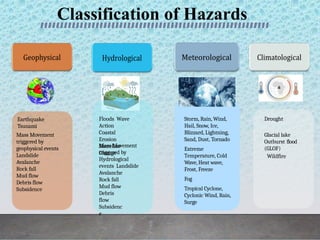
  • #86 Taken from the FEMA Local Hazard Mitigation Handbook.
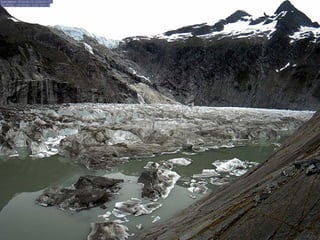
  • #87 Taken from the FEMA Local Hazard Mitigation Handbook.
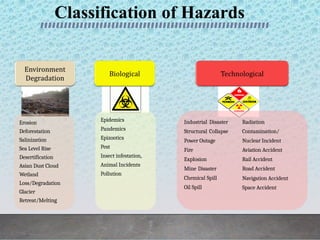
  • #88 Taken from the FEMA Local Hazard Mitigation Handbook.
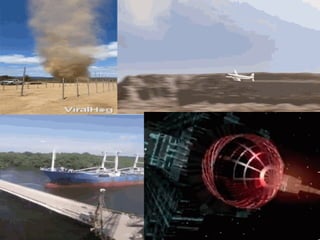
  • #89 Taken from the FEMA Local Hazard Mitigation Handbook.