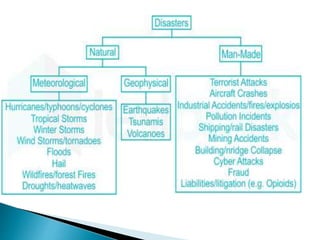
 A disaster is defined as a disruption on a massive scale,
either natural or man-made, occurring in short or long
periods. Disasters can lead to human, material,
economic or environmental hardships, which can be
beyond the bearable capacity of the affected society. As
per statistics, India as a whole is vulnerable to 30
different types of disasters that will affect the
economic, social, and human development potential to
such an extent that it will have long-term effects on
productivity and macro-economic performance
 Loss of life and property due to these disasters have
been steadily mounting throughout the world due to
inadequate technology to combat disasters, rise in
population, climate change, and continuing ecological
degradation. The global efforts to manage disasters
have proven to be insufficient to match the frequency
and magnitude of natural disasters.
 Water and Climate Disaster: Flood, hail storms,
cloudburst, cyclones, heat waves, cold waves, droughts,
hurricanes. (Read about Cyclone Disaster
Management separately at the linked article.)
 Geological Disaster: Landslides, earthquakes, volcanic
eruptions, tornadoes
 Biological Disaster: Viral epidemics, pest attacks,
cattle epidemic, and locust plague
• Industrial Disaster: Chemical and industrial
accidents, mine shaft fires, oil spills,
• Nuclear Disasters: Nuclear core meltdowns,
radiation poisoning
• Man-made disasters: Urban and forest fires, oil
spill, the collapse of huge building structures
 The Disaster Management Act of 2005
defines Disaster Management as an
integrated process of planning, organizing,
coordinating and implementing measures
which are necessary for
1. Prevention of threat of any disaster
2. Reduction of risk of any disaster or its consequences
3. Readiness to deal with any disaster
4. Promptness in dealing with a disaster
5. Assessing the severity of the effects of any disaster
6. Rescue and relief
7. Rehabilitation and Reconstruction
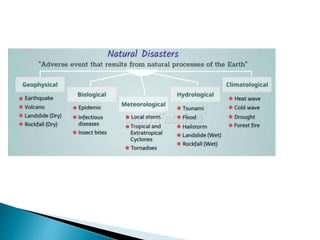
 Earthquakes. Volcanic eruptions.
 Landslides. Tsunamis.
 Avalanches. Floods.
 Heat waves. Cold waves.
 Wildfires. Droughts.
 Cyclones. Epidemics and pandemics.
 Technological and biological hazards. Hailstorms.

disaster management.pptx

disaster management.pptx

  • 1.
     A disasteris defined as a disruption on a massive scale, either natural or man-made, occurring in short or long periods. Disasters can lead to human, material, economic or environmental hardships, which can be beyond the bearable capacity of the affected society. As per statistics, India as a whole is vulnerable to 30 different types of disasters that will affect the economic, social, and human development potential to such an extent that it will have long-term effects on productivity and macro-economic performance
  • 2.
     Loss oflife and property due to these disasters have been steadily mounting throughout the world due to inadequate technology to combat disasters, rise in population, climate change, and continuing ecological degradation. The global efforts to manage disasters have proven to be insufficient to match the frequency and magnitude of natural disasters.
  • 3.
     Water andClimate Disaster: Flood, hail storms, cloudburst, cyclones, heat waves, cold waves, droughts, hurricanes. (Read about Cyclone Disaster Management separately at the linked article.)  Geological Disaster: Landslides, earthquakes, volcanic eruptions, tornadoes  Biological Disaster: Viral epidemics, pest attacks, cattle epidemic, and locust plague
  • 4.
    • Industrial Disaster:Chemical and industrial accidents, mine shaft fires, oil spills, • Nuclear Disasters: Nuclear core meltdowns, radiation poisoning • Man-made disasters: Urban and forest fires, oil spill, the collapse of huge building structures
  • 5.
     The DisasterManagement Act of 2005 defines Disaster Management as an integrated process of planning, organizing, coordinating and implementing measures which are necessary for
  • 6.
    1. Prevention ofthreat of any disaster 2. Reduction of risk of any disaster or its consequences 3. Readiness to deal with any disaster 4. Promptness in dealing with a disaster 5. Assessing the severity of the effects of any disaster 6. Rescue and relief 7. Rehabilitation and Reconstruction
  • 7.
     Earthquakes. Volcaniceruptions.  Landslides. Tsunamis.  Avalanches. Floods.  Heat waves. Cold waves.  Wildfires. Droughts.  Cyclones. Epidemics and pandemics.  Technological and biological hazards. Hailstorms. 