VERBAL REASONING
DIRECTION AND DISTANCE
TEST
Direction and distance
• In this chapter, the questions consist
of a sort of direction puzzle.
• A successive follow-up of directions is
formulatedformulated
• and we are required to ascertain the final
direction on the distance between two
points.
This test is meant to judge
the
our ability to trace and
followfollow
correctly and sense the
direction correctly
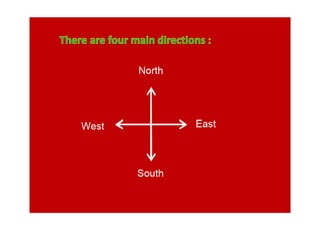
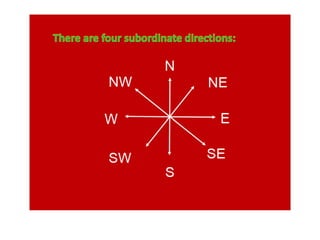
• each main direction change
undergoes a 90° change in
direction e.g. from North to
West/East it will be 90° change
• But the change between North
and North-east is only 45°.
• directions problems generally quiz
you about the minimum distance,
distance by air, crow fly distance etc.
• we assume all these distances to be
along straight lines and betweenalong straight lines and between
specified points.
• We use the concept of Pythagoras
theorem to solve the questions
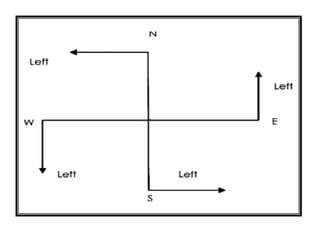
Left Right Movement
• A person facing north, on
taking left will face towards
west and on taking the rightwest and on taking the right
turn towards east.
• Whenever a person moves to
his left side, he will move
towards anti- clockwise
direction.
• Whenever a person moves to• Whenever a person moves to
his right side, he will move
towards clockwise direction.
•Note: When a question
says moved towards left
or right side, we assume
that the movement is atthat the movement is at
an angle of 90 degrees.
• Concept of Pythagoras Theorem
• We'll use the concept of
Pythagoras theorem to solve the
questions on directions.
• In a right-angled triangle, the• In a right-angled triangle, the
square of the hypotenuse is
equal to the sum of the squares
of the other two sides.
c2=a2 + b2
EXAMPLES
Type -1
MINIMUM DISTANCE
minimum distance between
2 points will lie along the
hypotenuse of the right-hypotenuse of the right-
angled triangle formed by 2
points.
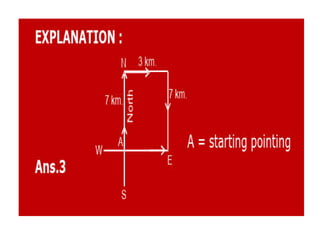
Q.1.Shyam travels 7 km. toward
North, then he turn to his right
and walks 3 km. He again turns to
his right and moves 7 km
forward. Now in which direction
is he from hisis he from his
starting point?
(1) North (2) South (3) East
(4)West (5) Can’t be determined
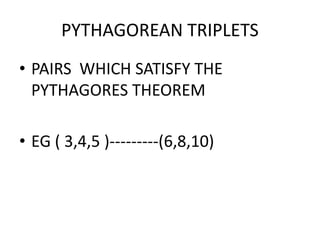
PYTHAGOREAN TRIPLETS
• PAIRS WHICH SATISFY THE
PYTHAGORES THEOREM
• EG ( 3,4,5 )---------(6,8,10)
IMP PYTHAGOREAN TRIPLETS
•(3, 4, 5), (6, 8,10), (5, 12,
13), (9, 12, 15),13), (9, 12, 15),
•(8, 15, 17), (12, 16, 20),
(15, 20, 25), (7, 24, 25),
(10, 24, 26),
USE OF PYTHA --TRIPLETS
• generally very helpful in
calculating the distances
involved as it saves time spentinvolved as it saves time spent
on calculations.
Q] A person moves North, then turns
to his right and then again right and
then finally go to left. In which
direction is he moving now?
1-East1-East
2-South-East
3-West
4-North
• ANS =====EAST
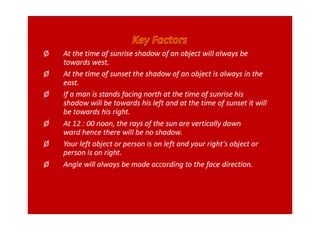
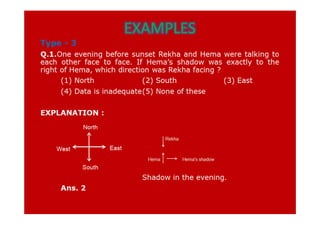
CONCEPT OF SHADOW
• SUNRISE -----------SUN IS IN
EAST SO SHADOW --------ON
WESTWEST
• SUNSET ------------SUN IS IN
WEST SO SHADOW ---ON EAST
•Direction of shadow is
opposite to the
direction of position
of sunof sun
Direction and distance topic for aptitude

Direction and distance topic for aptitude

  • 1.
  • 2.
    Direction and distance •In this chapter, the questions consist of a sort of direction puzzle. • A successive follow-up of directions is formulatedformulated • and we are required to ascertain the final direction on the distance between two points.
  • 3.
    This test ismeant to judge the our ability to trace and followfollow correctly and sense the direction correctly
  • 5.
    • each maindirection change undergoes a 90° change in direction e.g. from North to West/East it will be 90° change • But the change between North and North-east is only 45°.
  • 7.
    • directions problemsgenerally quiz you about the minimum distance, distance by air, crow fly distance etc. • we assume all these distances to be along straight lines and betweenalong straight lines and between specified points. • We use the concept of Pythagoras theorem to solve the questions
  • 8.
    Left Right Movement •A person facing north, on taking left will face towards west and on taking the rightwest and on taking the right turn towards east.
  • 10.
    • Whenever aperson moves to his left side, he will move towards anti- clockwise direction. • Whenever a person moves to• Whenever a person moves to his right side, he will move towards clockwise direction.
  • 11.
    •Note: When aquestion says moved towards left or right side, we assume that the movement is atthat the movement is at an angle of 90 degrees.
  • 12.
    • Concept ofPythagoras Theorem • We'll use the concept of Pythagoras theorem to solve the questions on directions. • In a right-angled triangle, the• In a right-angled triangle, the square of the hypotenuse is equal to the sum of the squares of the other two sides.
  • 13.
  • 14.
  • 15.
    MINIMUM DISTANCE minimum distancebetween 2 points will lie along the hypotenuse of the right-hypotenuse of the right- angled triangle formed by 2 points.
  • 16.
    Q.1.Shyam travels 7km. toward North, then he turn to his right and walks 3 km. He again turns to his right and moves 7 km forward. Now in which direction is he from hisis he from his starting point? (1) North (2) South (3) East (4)West (5) Can’t be determined
  • 18.
    PYTHAGOREAN TRIPLETS • PAIRSWHICH SATISFY THE PYTHAGORES THEOREM • EG ( 3,4,5 )---------(6,8,10)
  • 19.
    IMP PYTHAGOREAN TRIPLETS •(3,4, 5), (6, 8,10), (5, 12, 13), (9, 12, 15),13), (9, 12, 15), •(8, 15, 17), (12, 16, 20), (15, 20, 25), (7, 24, 25), (10, 24, 26),
  • 20.
    USE OF PYTHA--TRIPLETS • generally very helpful in calculating the distances involved as it saves time spentinvolved as it saves time spent on calculations.
  • 21.
    Q] A personmoves North, then turns to his right and then again right and then finally go to left. In which direction is he moving now? 1-East1-East 2-South-East 3-West 4-North • ANS =====EAST
  • 22.
    CONCEPT OF SHADOW •SUNRISE -----------SUN IS IN EAST SO SHADOW --------ON WESTWEST • SUNSET ------------SUN IS IN WEST SO SHADOW ---ON EAST
  • 23.
    •Direction of shadowis opposite to the direction of position of sunof sun