Valuations under Customs Duty
CA Divakar Vijayasarathy
Credits and Acknowledgement
 Harish Kumar
 CA Jugal Gala
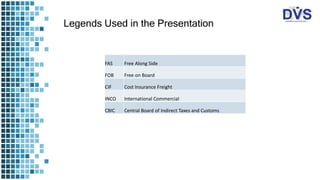
Legends Used in the Presentation
FAS Free Along Side
FOB Free on Board
CIF Cost Insurance Freight
INCO International Commercial
CBIC Central Board of Indirect Taxes and Customs
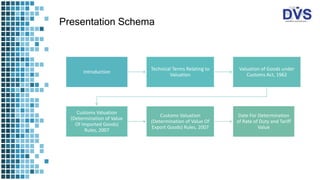
Presentation Schema
Introduction
Technical Terms Relating to
Valuation
Valuation of Goods under
Customs Act, 1962
Customs Valuation
(Determination of Value
Of Imported Goods)
Rules, 2007
Customs Valuation
(Determination of Value Of
Export Goods) Rules, 2007
Date For Determination
of Rate of Duty and Tariff
Value
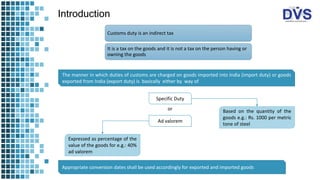
Introduction
Customs duty is an indirect tax
It is a tax on the goods and it is not a tax on the person having or
owning the goods
The manner in which duties of customs are charged on goods imported into India (import duty) or goods
exported from India (export duty) is basically either by way of
Specific Duty
Ad valorem
Based on the quantity of the
goods e.g.: Rs. 1000 per metric
tone of steel
or
Expressed as percentage of the
value of the goods for e.g.: 40%
ad valorem
Appropriate conversion dates shall be used accordingly for exported and imported goods
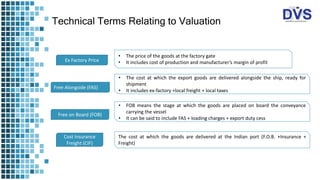
Technical Terms Relating to Valuation
Ex Factory Price
• The price of the goods at the factory gate
• It includes cost of production and manufacturer’s margin of profit
• The cost at which the export goods are delivered alongside the ship, ready for
shipment
• It includes ex-factory +local freight + local taxes
Free Alongside (FAS)
• FOB means the stage at which the goods are placed on board the conveyance
carrying the vessel
• It can be said to include FAS + loading charges + export duty cess
Free on Board (FOB)
The cost at which the goods are delivered at the Indian port (F.O.B. +Insurance +
Freight)
Cost Insurance
Freight (CIF)
Valuation under Customs Act, 1962
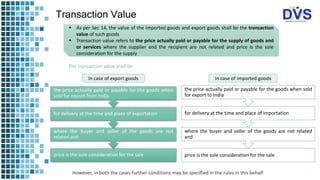
Transaction Value
 As per Sec 14, the value of the imported goods and export goods shall be the transaction
value of such goods
 Transaction value refers to the price actually paid or payable for the supply of goods and
or services where the supplier and the recipient are not related and price is the sole
consideration for the supply
In case of export goods
The transaction value shall be
price is the sole consideration for the sale
where the buyer and seller of the goods are not
related and
for delivery at the time and place of exportation
the price actually paid or payable for the goods when
sold for export from India
In case of imported goods
price is the sole consideration for the sale
where the buyer and seller of the goods are not related
and
for delivery at the time and place of importation
the price actually paid or payable for the goods when sold
for export to India
However, in both the cases further conditions may be specified in the rules in this behalf
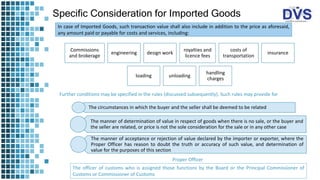
Specific Consideration for Imported Goods
In case of Imported Goods, such transaction value shall also include in addition to the price as aforesaid,
any amount paid or payable for costs and services, including:
Commissions
and brokerage
engineering design work
royalties and
licence fees
costs of
transportation
insurance
loading unloading
handling
charges
Further conditions may be specified in the rules (discussed subsequently). Such rules may provide for
The circumstances in which the buyer and the seller shall be deemed to be related
The manner of determination of value in respect of goods when there is no sale, or the buyer and
the seller are related, or price is not the sole consideration for the sale or in any other case
The manner of acceptance or rejection of value declared by the importer or exporter, where the
Proper Officer has reason to doubt the truth or accuracy of such value, and determination of
value for the purposes of this section
The officer of customs who is assigned those functions by the Board or the Principal Commissioner of
Customs or Commissioner of Customs
Proper Officer
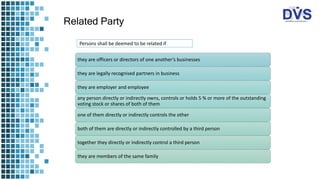
Related Party
Persons shall be deemed to be related if
they are officers or directors of one another’s businesses
they are legally recognised partners in business
they are employer and employee
any person directly or indirectly owns, controls or holds 5 % or more of the outstanding
voting stock or shares of both of them
one of them directly or indirectly controls the other
both of them are directly or indirectly controlled by a third person
together they directly or indirectly control a third person
they are members of the same family
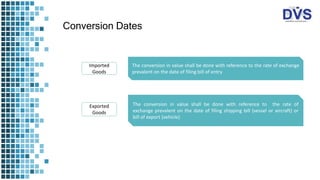
Conversion Dates
The conversion in value shall be done with reference to the rate of exchange
prevalent on the date of filing bill of entry
Imported
Goods
The conversion in value shall be done with reference to the rate of
exchange prevalent on the date of filing shipping bill (vessel or aircraft) or
bill of export (vehicle)
Exported
Goods
Currency of Conversion Rate
The rate of exchange is notified by three agencies
Central Board of Indirect taxes and
Customs (CBIC)[Board]
Reserve Bank of India
Foreign Exchange Dealers’
Association of India
However for the purpose of customs valuation, rate of exchange
means the rate of exchange
determined by the Board
ascertained in such manner as the
Board may direct
or

The CBIC notifies the rates periodically (generally every fortnight)
There are separate rates for imported goods (selling rate) and export goods (buying rate)
A declaration by an importer of the exact nature, precise quantity and value of goods that have
landed
The legal document filed with the customs department by an exporter for allowing shipment
Bill of Entry
Bill of Export/
Shipping bill
Customs Valuation (Determination of Value of
Imported Goods) Rules, 2007
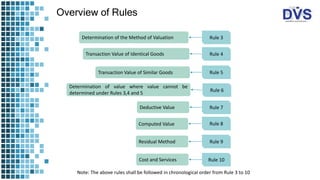
Overview of Rules
Rule 3
Rule 4
Rule 5
Rule 7
Rule 8
Rule 9
Rule 10
Transaction Value of Identical Goods
Determination of the Method of Valuation
Cost and Services
Transaction Value of Similar Goods
Deductive Value
Computed Value
Residual Method
Rule 6
Determination of value where value cannot be
determined under Rules 3,4 and 5
Note: The above rules shall be followed in chronological order from Rule 3 to 10
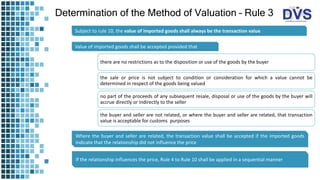
Determination of the Method of Valuation – Rule 3
Subject to rule 10, the value of imported goods shall always be the transaction value
Value of imported goods shall be accepted provided that
there are no restrictions as to the disposition or use of the goods by the buyer
the sale or price is not subject to condition or consideration for which a value cannot be
determined in respect of the goods being valued
no part of the proceeds of any subsequent resale, disposal or use of the goods by the buyer will
accrue directly or indirectly to the seller
the buyer and seller are not related, or where the buyer and seller are related, that transaction
value is acceptable for customs purposes
Where the buyer and seller are related, the transaction value shall be accepted if the imported goods
indicate that the relationship did not influence the price
If the relationship influences the price, Rule 4 to Rule 10 shall be applied in a sequential manner
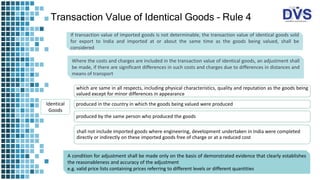
Transaction Value of Identical Goods – Rule 4
If transaction value of imported goods is not determinable, the transaction value of identical goods sold
for export to India and imported at or about the same time as the goods being valued, shall be
considered
Where the costs and charges are included in the transaction value of identical goods, an adjustment shall
be made, if there are significant differences in such costs and charges due to differences in distances and
means of transport
which are same in all respects, including physical characteristics, quality and reputation as the goods being
valued except for minor differences in appearance
produced in the country in which the goods being valued were produced
produced by the same person who produced the goods
shall not include imported goods where engineering, development undertaken in India were completed
directly or indirectly on these imported goods free of charge or at a reduced cost
Identical
Goods
A condition for adjustment shall be made only on the basis of demonstrated evidence that clearly establishes
the reasonableness and accuracy of the adjustment
e.g. valid price lists containing prices referring to different levels or different quantities
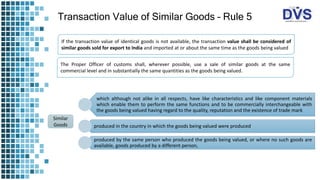
Transaction Value of Similar Goods – Rule 5
If the transaction value of identical goods is not available, the transaction value shall be considered of
similar goods sold for export to India and imported at or about the same time as the goods being valued
The Proper Officer of customs shall, wherever possible, use a sale of similar goods at the same
commercial level and in substantially the same quantities as the goods being valued.
which although not alike in all respects, have like characteristics and like component materials
which enable them to perform the same functions and to be commercially interchangeable with
the goods being valued having regard to the quality, reputation and the existence of trade mark
produced in the country in which the goods being valued were produced
produced by the same person who produced the goods being valued, or where no such goods are
available, goods produced by a different person,
Similar
Goods
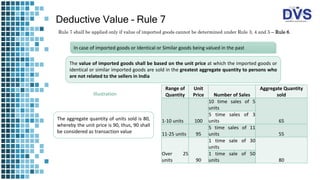
Deductive Value – Rule 7
In case of imported goods or Identical or Similar goods being valued in the past
The value of imported goods shall be based on the unit price at which the imported goods or
identical or similar imported goods are sold in the greatest aggregate quantity to persons who
are not related to the sellers in India
Range of
Quantity
Unit
Price Number of Sales
Aggregate Quantity
sold
1-10 units 100
10 time sales of 5
units
65
5 time sales of 3
units
11-25 units 95
5 time sales of 11
units 55
Over 25
units 90
1 time sale of 30
units
80
1 time sale of 50
units
Illustration
The aggregate quantity of units sold is 80,
whereby the unit price is 90, thus, 90 shall
be considered as transaction value
Rule 7 shall be applied only if value of imported goods cannot be determined under Rule 3, 4 and 5 – Rule 6.
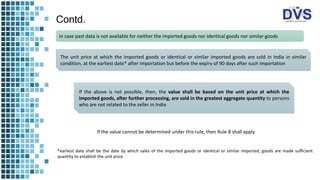
Contd.
In case past data is not available for neither the imported goods nor identical goods nor similar goods
The unit price at which the imported goods or identical or similar imported goods are sold in India in similar
condition, at the earliest date* after importation but before the expiry of 90 days after such importation
If the above is not possible, then, the value shall be based on the unit price at which the
imported goods, after further processing, are sold in the greatest aggregate quantity to persons
who are not related to the seller in India
If the value cannot be determined under this rule, then Rule 8 shall apply
*earliest date shall be the date by which sales of the imported goods or identical or similar imported, goods are made sufficient
quantity to establish the unit price
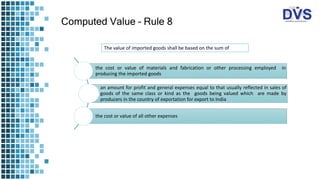
Computed Value – Rule 8
The value of imported goods shall be based on the sum of
the cost or value of materials and fabrication or other processing employed in
producing the imported goods
an amount for profit and general expenses equal to that usually reflected in sales of
goods of the same class or kind as the goods being valued which are made by
producers in the country of exportation for export to India
the cost or value of all other expenses
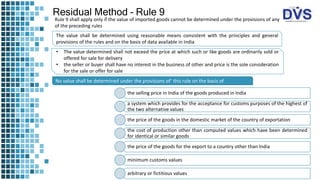
Residual Method – Rule 9
The value shall be determined using reasonable means consistent with the principles and general
provisions of the rules and on the basis of data available in India
No value shall be determined under the provisions of’ this rule on the basis of
the selling price in India of the goods produced in India
a system which provides for the acceptance for customs purposes of the highest of
the two alternative values
the price of the goods in the domestic market of the country of exportation
the cost of production other than computed values which have been determined
for identical or similar goods
the price of the goods for the export to a country other than India
minimum customs values
arbitrary or fictitious values
• The value determined shall not exceed the price at which such or like goods are ordinarily sold or
offered for sale for delivery
• the seller or buyer shall have no interest in the business of other and price is the sole consideration
for the sale or offer for sale
Rule 9 shall apply only if the value of imported goods cannot be determined under the provisions of any
of the preceding rules
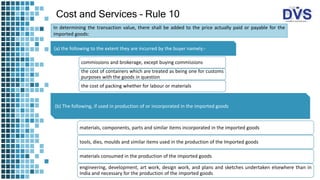
Cost and Services – Rule 10
In determining the transaction value, there shall be added to the price actually paid or payable for the
imported goods:
(a) the following to the extent they are incurred by the buyer namely:-
commissions and brokerage, except buying commissions
the cost of containers which are treated as being one for customs
purposes with the goods in question
the cost of packing whether for labour or materials
(b) The following, if used in production of or incorporated in the imported goods
materials, components, parts and similar items incorporated in the imported goods
tools, dies, moulds and similar items used in the production of the Imported goods
materials consumed in the production of the imported goods
engineering, development, art work, design work, and plans and sketches undertaken elsewhere than in
India and necessary for the production of the imported goods
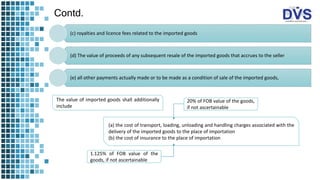
Contd.
(c) royalties and licence fees related to the imported goods
(d) The value of proceeds of any subsequent resale of the imported goods that accrues to the seller
(e) all other payments actually made or to be made as a condition of sale of the imported goods,
The value of imported goods shall additionally
include
(a) the cost of transport, loading, unloading and handling charges associated with the
delivery of the imported goods to the place of importation
(b) the cost of insurance to the place of importation
20% of FOB value of the goods,
if not ascertainable
1.125% of FOB value of the
goods, if not ascertainable
Customs Valuation (Determination of Value of Export
Goods) Rules, 2007
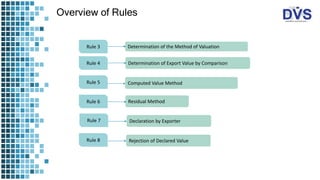
Overview of Rules
Rule 3
Rule 4
Rule 5
Rule 6
Rule 8
Determination of the Method of Valuation
Determination of Export Value by Comparison
Computed Value Method
Residual Method
Rejection of Declared Value
Rule 7 Declaration by Exporter
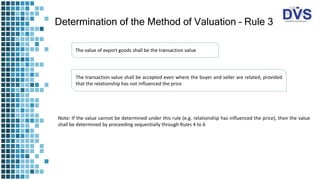
Determination of the Method of Valuation – Rule 3
The value of export goods shall be the transaction value
The transaction value shall be accepted even where the buyer and seller are related, provided
that the relationship has not influenced the price
Note: If the value cannot be determined under this rule (e.g. relationship has influenced the price), then the value
shall be determined by proceeding sequentially through Rules 4 to 6
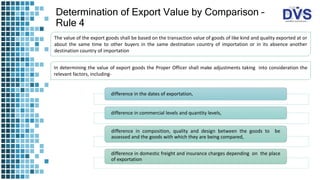
The value of the export goods shall be based on the transaction value of goods of like kind and quality exported at or
about the same time to other buyers in the same destination country of importation or in its absence another
destination country of importation
Determination of Export Value by Comparison –
Rule 4
In determining the value of export goods the Proper Officer shall make adjustments taking into consideration the
relevant factors, including-
difference in the dates of exportation,
difference in commercial levels and quantity levels,
difference in composition, quality and design between the goods to be
assessed and the goods with which they are being compared,
difference in domestic freight and insurance charges depending on the place
of exportation
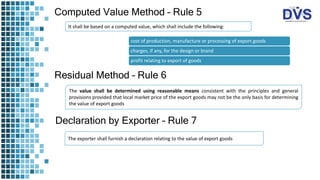
Computed Value Method – Rule 5
It shall be based on a computed value, which shall include the following:
cost of production, manufacture or processing of export goods
charges, if any, for the design or brand
profit relating to export of goods
Residual Method – Rule 6
The value shall be determined using reasonable means consistent with the principles and general
provisions provided that local market price of the export goods may not be the only basis for determining
the value of export goods
Declaration by Exporter – Rule 7
The exporter shall furnish a declaration relating to the value of export goods
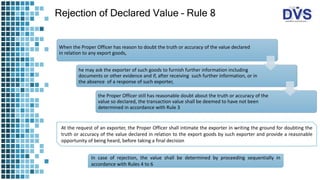
Rejection of Declared Value – Rule 8
When the Proper Officer has reason to doubt the truth or accuracy of the value declared
in relation to any export goods,
he may ask the exporter of such goods to furnish further information including
documents or other evidence and if, after receiving such further information, or in
the absence of a response of such exporter,
the Proper Officer still has reasonable doubt about the truth or accuracy of the
value so declared, the transaction value shall be deemed to have not been
determined in accordance with Rule 3
At the request of an exporter, the Proper Officer shall intimate the exporter in writing the ground for doubting the
truth or accuracy of the value declared in relation to the export goods by such exporter and provide a reasonable
opportunity of being heard, before taking a final decision
In case of rejection, the value shall be determined by proceeding sequentially in
accordance with Rules 4 to 6
Date For Determination of Rate of Duty And
Tariff Value
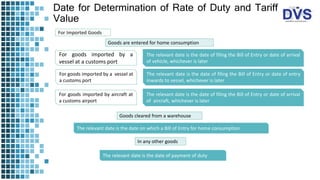
Date for Determination of Rate of Duty and Tariff
Value
For Imported Goods
Goods are entered for home consumption
For goods imported by a
vessel at a customs port
The relevant date is the date of filing the Bill of Entry or date of arrival
of vehicle, whichever is later
For goods imported by aircraft at
a customs airport
For goods imported by a vessel at
a customs port
The relevant date is the date of filing the Bill of Entry or date of arrival
of aircraft, whichever is later
The relevant date is the date of filing the Bill of Entry or date of entry
inwards to vessel, whichever is later
Goods cleared from a warehouse
The relevant date is the date on which a Bill of Entry for home consumption
In any other goods
The relevant date is the date of payment of duty
Contd.
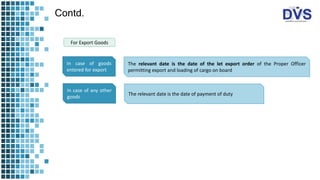
For Export Goods
In case of goods
entered for export
The relevant date is the date of the let export order of the Proper Officer
permitting export and loading of cargo on board
In case of any other
goods
The relevant date is the date of payment of duty
Thank You!
Scan the QR Code to Join our
Research Group on WhatsApp
Scan the QR Code to explore more
Research from our Website
DVS Advisors LLP
India-Singapore-London-Dubai-Malaysia-Africa
www.dvsca.com
Copyrights © 2020 DVS Advisors LLP

Valuations under customs

  • 1.
    Valuations under CustomsDuty CA Divakar Vijayasarathy
  • 2.
    Credits and Acknowledgement Harish Kumar  CA Jugal Gala
  • 3.
    Legends Used inthe Presentation FAS Free Along Side FOB Free on Board CIF Cost Insurance Freight INCO International Commercial CBIC Central Board of Indirect Taxes and Customs
  • 4.
    Presentation Schema Introduction Technical TermsRelating to Valuation Valuation of Goods under Customs Act, 1962 Customs Valuation (Determination of Value Of Imported Goods) Rules, 2007 Customs Valuation (Determination of Value Of Export Goods) Rules, 2007 Date For Determination of Rate of Duty and Tariff Value
  • 5.
    Introduction Customs duty isan indirect tax It is a tax on the goods and it is not a tax on the person having or owning the goods The manner in which duties of customs are charged on goods imported into India (import duty) or goods exported from India (export duty) is basically either by way of Specific Duty Ad valorem Based on the quantity of the goods e.g.: Rs. 1000 per metric tone of steel or Expressed as percentage of the value of the goods for e.g.: 40% ad valorem Appropriate conversion dates shall be used accordingly for exported and imported goods
  • 6.
    Technical Terms Relatingto Valuation Ex Factory Price • The price of the goods at the factory gate • It includes cost of production and manufacturer’s margin of profit • The cost at which the export goods are delivered alongside the ship, ready for shipment • It includes ex-factory +local freight + local taxes Free Alongside (FAS) • FOB means the stage at which the goods are placed on board the conveyance carrying the vessel • It can be said to include FAS + loading charges + export duty cess Free on Board (FOB) The cost at which the goods are delivered at the Indian port (F.O.B. +Insurance + Freight) Cost Insurance Freight (CIF)
  • 7.
  • 8.
    Transaction Value  Asper Sec 14, the value of the imported goods and export goods shall be the transaction value of such goods  Transaction value refers to the price actually paid or payable for the supply of goods and or services where the supplier and the recipient are not related and price is the sole consideration for the supply In case of export goods The transaction value shall be price is the sole consideration for the sale where the buyer and seller of the goods are not related and for delivery at the time and place of exportation the price actually paid or payable for the goods when sold for export from India In case of imported goods price is the sole consideration for the sale where the buyer and seller of the goods are not related and for delivery at the time and place of importation the price actually paid or payable for the goods when sold for export to India However, in both the cases further conditions may be specified in the rules in this behalf
  • 9.
    Specific Consideration forImported Goods In case of Imported Goods, such transaction value shall also include in addition to the price as aforesaid, any amount paid or payable for costs and services, including: Commissions and brokerage engineering design work royalties and licence fees costs of transportation insurance loading unloading handling charges Further conditions may be specified in the rules (discussed subsequently). Such rules may provide for The circumstances in which the buyer and the seller shall be deemed to be related The manner of determination of value in respect of goods when there is no sale, or the buyer and the seller are related, or price is not the sole consideration for the sale or in any other case The manner of acceptance or rejection of value declared by the importer or exporter, where the Proper Officer has reason to doubt the truth or accuracy of such value, and determination of value for the purposes of this section The officer of customs who is assigned those functions by the Board or the Principal Commissioner of Customs or Commissioner of Customs Proper Officer
  • 10.
    Related Party Persons shallbe deemed to be related if they are officers or directors of one another’s businesses they are legally recognised partners in business they are employer and employee any person directly or indirectly owns, controls or holds 5 % or more of the outstanding voting stock or shares of both of them one of them directly or indirectly controls the other both of them are directly or indirectly controlled by a third person together they directly or indirectly control a third person they are members of the same family
  • 11.
    Conversion Dates The conversionin value shall be done with reference to the rate of exchange prevalent on the date of filing bill of entry Imported Goods The conversion in value shall be done with reference to the rate of exchange prevalent on the date of filing shipping bill (vessel or aircraft) or bill of export (vehicle) Exported Goods
  • 12.
    Currency of ConversionRate The rate of exchange is notified by three agencies Central Board of Indirect taxes and Customs (CBIC)[Board] Reserve Bank of India Foreign Exchange Dealers’ Association of India However for the purpose of customs valuation, rate of exchange means the rate of exchange determined by the Board ascertained in such manner as the Board may direct or  The CBIC notifies the rates periodically (generally every fortnight) There are separate rates for imported goods (selling rate) and export goods (buying rate) A declaration by an importer of the exact nature, precise quantity and value of goods that have landed The legal document filed with the customs department by an exporter for allowing shipment Bill of Entry Bill of Export/ Shipping bill
  • 13.
    Customs Valuation (Determinationof Value of Imported Goods) Rules, 2007
  • 14.
    Overview of Rules Rule3 Rule 4 Rule 5 Rule 7 Rule 8 Rule 9 Rule 10 Transaction Value of Identical Goods Determination of the Method of Valuation Cost and Services Transaction Value of Similar Goods Deductive Value Computed Value Residual Method Rule 6 Determination of value where value cannot be determined under Rules 3,4 and 5 Note: The above rules shall be followed in chronological order from Rule 3 to 10
  • 15.
    Determination of theMethod of Valuation – Rule 3 Subject to rule 10, the value of imported goods shall always be the transaction value Value of imported goods shall be accepted provided that there are no restrictions as to the disposition or use of the goods by the buyer the sale or price is not subject to condition or consideration for which a value cannot be determined in respect of the goods being valued no part of the proceeds of any subsequent resale, disposal or use of the goods by the buyer will accrue directly or indirectly to the seller the buyer and seller are not related, or where the buyer and seller are related, that transaction value is acceptable for customs purposes Where the buyer and seller are related, the transaction value shall be accepted if the imported goods indicate that the relationship did not influence the price If the relationship influences the price, Rule 4 to Rule 10 shall be applied in a sequential manner
  • 16.
    Transaction Value ofIdentical Goods – Rule 4 If transaction value of imported goods is not determinable, the transaction value of identical goods sold for export to India and imported at or about the same time as the goods being valued, shall be considered Where the costs and charges are included in the transaction value of identical goods, an adjustment shall be made, if there are significant differences in such costs and charges due to differences in distances and means of transport which are same in all respects, including physical characteristics, quality and reputation as the goods being valued except for minor differences in appearance produced in the country in which the goods being valued were produced produced by the same person who produced the goods shall not include imported goods where engineering, development undertaken in India were completed directly or indirectly on these imported goods free of charge or at a reduced cost Identical Goods A condition for adjustment shall be made only on the basis of demonstrated evidence that clearly establishes the reasonableness and accuracy of the adjustment e.g. valid price lists containing prices referring to different levels or different quantities
  • 17.
    Transaction Value ofSimilar Goods – Rule 5 If the transaction value of identical goods is not available, the transaction value shall be considered of similar goods sold for export to India and imported at or about the same time as the goods being valued The Proper Officer of customs shall, wherever possible, use a sale of similar goods at the same commercial level and in substantially the same quantities as the goods being valued. which although not alike in all respects, have like characteristics and like component materials which enable them to perform the same functions and to be commercially interchangeable with the goods being valued having regard to the quality, reputation and the existence of trade mark produced in the country in which the goods being valued were produced produced by the same person who produced the goods being valued, or where no such goods are available, goods produced by a different person, Similar Goods
  • 18.
    Deductive Value –Rule 7 In case of imported goods or Identical or Similar goods being valued in the past The value of imported goods shall be based on the unit price at which the imported goods or identical or similar imported goods are sold in the greatest aggregate quantity to persons who are not related to the sellers in India Range of Quantity Unit Price Number of Sales Aggregate Quantity sold 1-10 units 100 10 time sales of 5 units 65 5 time sales of 3 units 11-25 units 95 5 time sales of 11 units 55 Over 25 units 90 1 time sale of 30 units 80 1 time sale of 50 units Illustration The aggregate quantity of units sold is 80, whereby the unit price is 90, thus, 90 shall be considered as transaction value Rule 7 shall be applied only if value of imported goods cannot be determined under Rule 3, 4 and 5 – Rule 6.
  • 19.
    Contd. In case pastdata is not available for neither the imported goods nor identical goods nor similar goods The unit price at which the imported goods or identical or similar imported goods are sold in India in similar condition, at the earliest date* after importation but before the expiry of 90 days after such importation If the above is not possible, then, the value shall be based on the unit price at which the imported goods, after further processing, are sold in the greatest aggregate quantity to persons who are not related to the seller in India If the value cannot be determined under this rule, then Rule 8 shall apply *earliest date shall be the date by which sales of the imported goods or identical or similar imported, goods are made sufficient quantity to establish the unit price
  • 20.
    Computed Value –Rule 8 The value of imported goods shall be based on the sum of the cost or value of materials and fabrication or other processing employed in producing the imported goods an amount for profit and general expenses equal to that usually reflected in sales of goods of the same class or kind as the goods being valued which are made by producers in the country of exportation for export to India the cost or value of all other expenses
  • 21.
    Residual Method –Rule 9 The value shall be determined using reasonable means consistent with the principles and general provisions of the rules and on the basis of data available in India No value shall be determined under the provisions of’ this rule on the basis of the selling price in India of the goods produced in India a system which provides for the acceptance for customs purposes of the highest of the two alternative values the price of the goods in the domestic market of the country of exportation the cost of production other than computed values which have been determined for identical or similar goods the price of the goods for the export to a country other than India minimum customs values arbitrary or fictitious values • The value determined shall not exceed the price at which such or like goods are ordinarily sold or offered for sale for delivery • the seller or buyer shall have no interest in the business of other and price is the sole consideration for the sale or offer for sale Rule 9 shall apply only if the value of imported goods cannot be determined under the provisions of any of the preceding rules
  • 22.
    Cost and Services– Rule 10 In determining the transaction value, there shall be added to the price actually paid or payable for the imported goods: (a) the following to the extent they are incurred by the buyer namely:- commissions and brokerage, except buying commissions the cost of containers which are treated as being one for customs purposes with the goods in question the cost of packing whether for labour or materials (b) The following, if used in production of or incorporated in the imported goods materials, components, parts and similar items incorporated in the imported goods tools, dies, moulds and similar items used in the production of the Imported goods materials consumed in the production of the imported goods engineering, development, art work, design work, and plans and sketches undertaken elsewhere than in India and necessary for the production of the imported goods
  • 23.
    Contd. (c) royalties andlicence fees related to the imported goods (d) The value of proceeds of any subsequent resale of the imported goods that accrues to the seller (e) all other payments actually made or to be made as a condition of sale of the imported goods, The value of imported goods shall additionally include (a) the cost of transport, loading, unloading and handling charges associated with the delivery of the imported goods to the place of importation (b) the cost of insurance to the place of importation 20% of FOB value of the goods, if not ascertainable 1.125% of FOB value of the goods, if not ascertainable
  • 24.
    Customs Valuation (Determinationof Value of Export Goods) Rules, 2007
  • 25.
    Overview of Rules Rule3 Rule 4 Rule 5 Rule 6 Rule 8 Determination of the Method of Valuation Determination of Export Value by Comparison Computed Value Method Residual Method Rejection of Declared Value Rule 7 Declaration by Exporter
  • 26.
    Determination of theMethod of Valuation – Rule 3 The value of export goods shall be the transaction value The transaction value shall be accepted even where the buyer and seller are related, provided that the relationship has not influenced the price Note: If the value cannot be determined under this rule (e.g. relationship has influenced the price), then the value shall be determined by proceeding sequentially through Rules 4 to 6
  • 27.
    The value ofthe export goods shall be based on the transaction value of goods of like kind and quality exported at or about the same time to other buyers in the same destination country of importation or in its absence another destination country of importation Determination of Export Value by Comparison – Rule 4 In determining the value of export goods the Proper Officer shall make adjustments taking into consideration the relevant factors, including- difference in the dates of exportation, difference in commercial levels and quantity levels, difference in composition, quality and design between the goods to be assessed and the goods with which they are being compared, difference in domestic freight and insurance charges depending on the place of exportation
  • 28.
    Computed Value Method– Rule 5 It shall be based on a computed value, which shall include the following: cost of production, manufacture or processing of export goods charges, if any, for the design or brand profit relating to export of goods Residual Method – Rule 6 The value shall be determined using reasonable means consistent with the principles and general provisions provided that local market price of the export goods may not be the only basis for determining the value of export goods Declaration by Exporter – Rule 7 The exporter shall furnish a declaration relating to the value of export goods
  • 29.
    Rejection of DeclaredValue – Rule 8 When the Proper Officer has reason to doubt the truth or accuracy of the value declared in relation to any export goods, he may ask the exporter of such goods to furnish further information including documents or other evidence and if, after receiving such further information, or in the absence of a response of such exporter, the Proper Officer still has reasonable doubt about the truth or accuracy of the value so declared, the transaction value shall be deemed to have not been determined in accordance with Rule 3 At the request of an exporter, the Proper Officer shall intimate the exporter in writing the ground for doubting the truth or accuracy of the value declared in relation to the export goods by such exporter and provide a reasonable opportunity of being heard, before taking a final decision In case of rejection, the value shall be determined by proceeding sequentially in accordance with Rules 4 to 6
  • 30.
    Date For Determinationof Rate of Duty And Tariff Value
  • 31.
    Date for Determinationof Rate of Duty and Tariff Value For Imported Goods Goods are entered for home consumption For goods imported by a vessel at a customs port The relevant date is the date of filing the Bill of Entry or date of arrival of vehicle, whichever is later For goods imported by aircraft at a customs airport For goods imported by a vessel at a customs port The relevant date is the date of filing the Bill of Entry or date of arrival of aircraft, whichever is later The relevant date is the date of filing the Bill of Entry or date of entry inwards to vessel, whichever is later Goods cleared from a warehouse The relevant date is the date on which a Bill of Entry for home consumption In any other goods The relevant date is the date of payment of duty
  • 32.
    Contd. For Export Goods Incase of goods entered for export The relevant date is the date of the let export order of the Proper Officer permitting export and loading of cargo on board In case of any other goods The relevant date is the date of payment of duty
  • 33.
    Thank You! Scan theQR Code to Join our Research Group on WhatsApp Scan the QR Code to explore more Research from our Website DVS Advisors LLP India-Singapore-London-Dubai-Malaysia-Africa www.dvsca.com Copyrights © 2020 DVS Advisors LLP